EXOGENIC PROCESSES:
WEATHERING AND EROSION ;
DEPOSITION
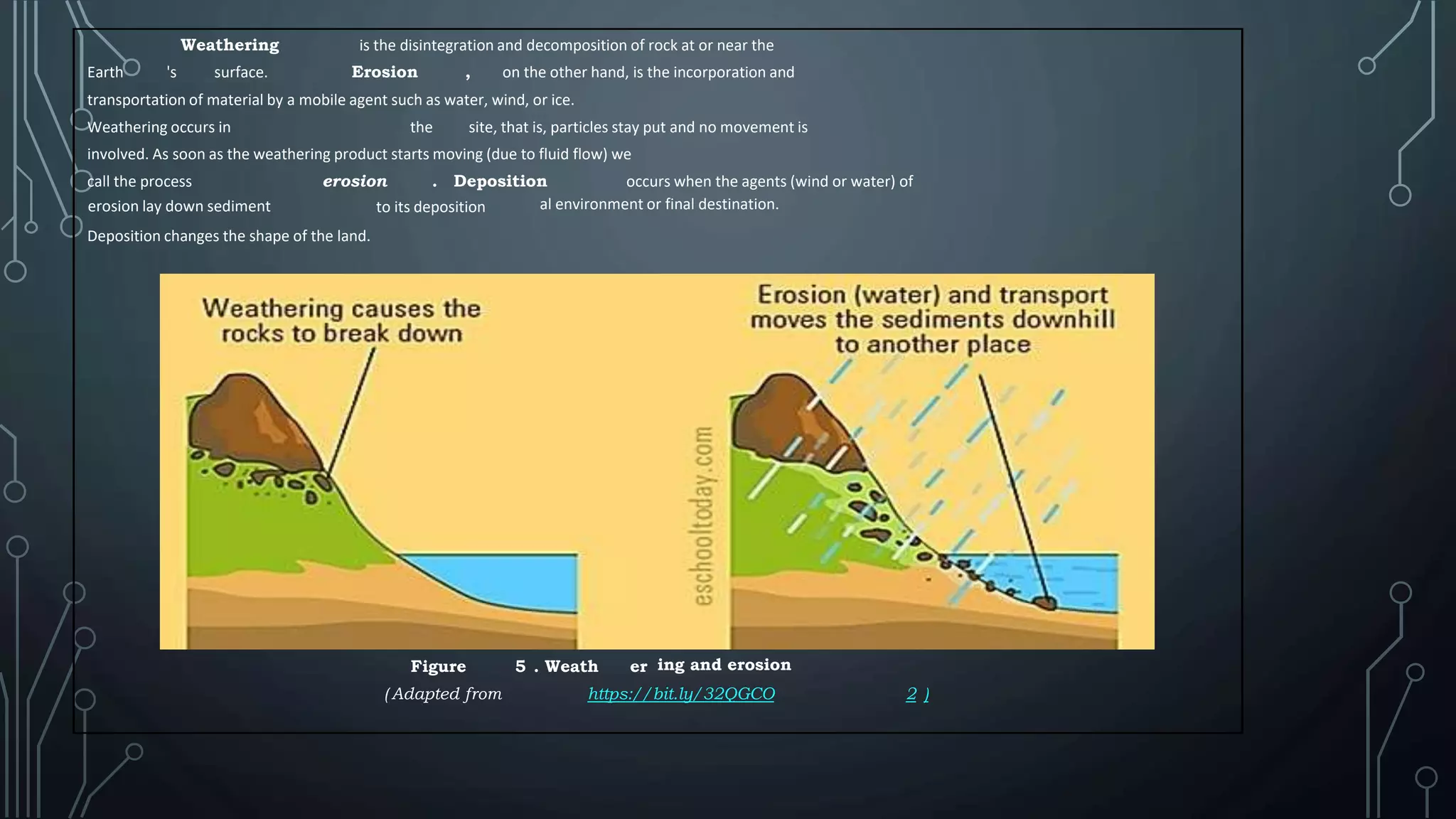
Weathering is the disintegration and decomposition of rock at or near the
Earth 's surface. Erosion , on the other hand, is the incorporation and
transportation of material by a mobile agent such as water, wind, or ice.
Weathering occurs in the site, that is, particles stay put and no movement is
involved. As soon as the weathering product starts moving (due to fluid flow) we
call the process erosion . Deposition occurs when the agents (wind or water) of
erosion lay down sediment to its deposition al environment or final destination.
Deposition changes the shape of the land.
Figure 5 . Weath er ing and erosion
Adapted from
( https://bit.ly/32QGCO 2 )
Agents of Erosion
A. Running water
• Water is the most powerful agent of
erosion. Both surface and groundwater
act as an agent of erosion.
Groundwater creates underground
surfaces like caves while water
running on land surfaces creates land
surfaces like deltas.
A. Moving Ice
Ice is also a powerful agent of erosion. A
large mass of moving ice is called a glacier.
When glaciers move, they carve their
valleys, (U-shaped, Vshaped). Like rivers,
glaciers break and carry away rock
fragments.
B.Action of Wind
• Like ice and water, wind erodes too,
transports, and deposits rock
materials. The action of the wind is
more prominent in arid and semi-arid
regions. The flow of wind can change
the shape and size of the rocks.
C. Action of Waves
• In coastal areas, the sea is constantly
eroding old landforms and creating
new ones. The marine erosion is also
a type of wave erosion that creates
landforms such as an arch, a sea
cave, etc.
D. Gravity
• Mass wasting or the downslope
movement of soil, rock, and regolith is
under the direct influence of gravity.
Mass wasting can be affected by the
slope angle and addition of water to
the eroded material.
E. Man-made Erosion
Man is responsible for erosions. Today man
is the strongest agent of erosion. We see
several examples in our daily life. Cutting
mountains and big rock bodies for road
making, building construction and
farmlands, mining for precious metals, and
construction materials are examples of
activities that trigger erosion
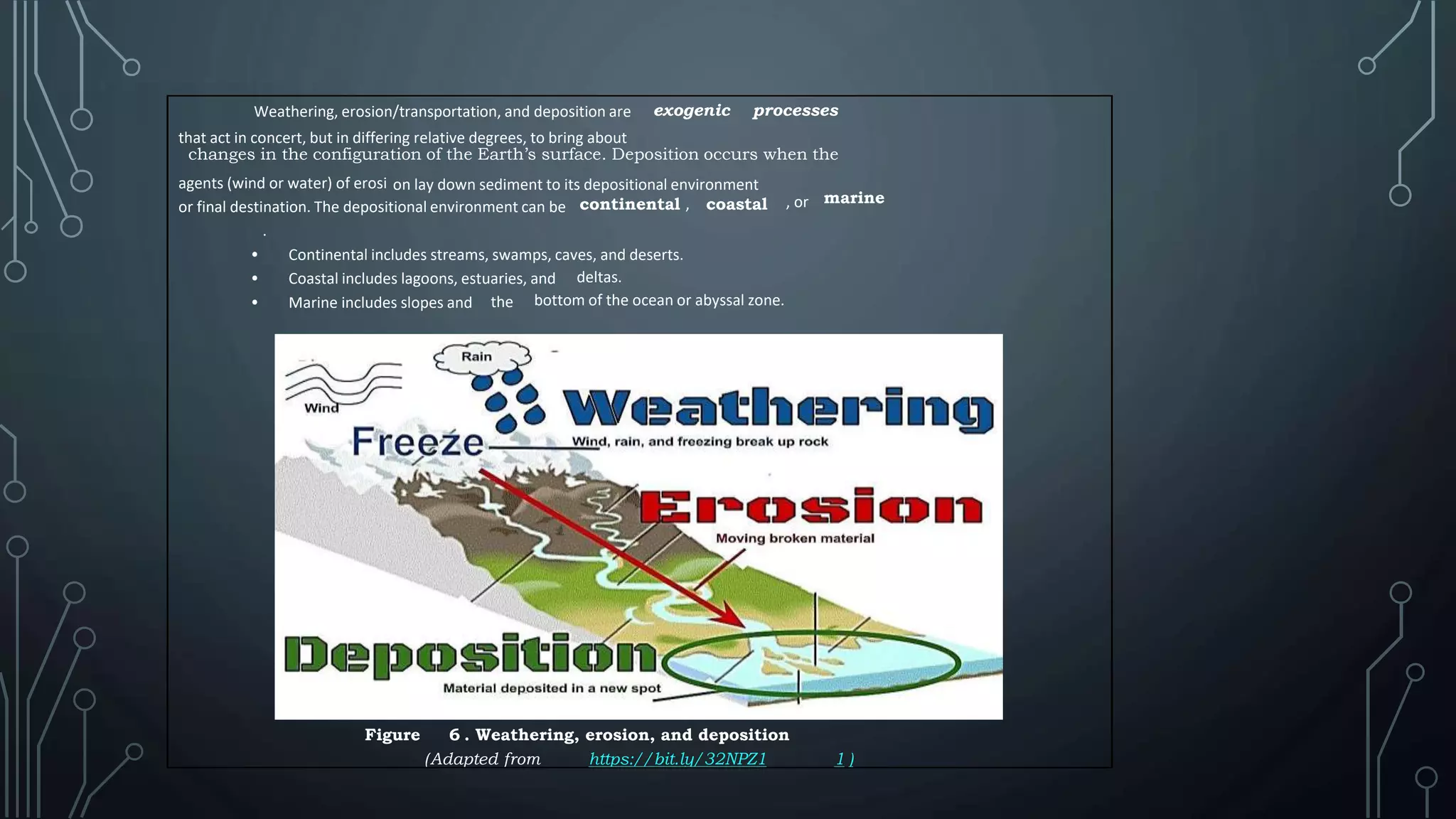
Weathering, erosion/transportation, and deposition are exogenic processes
that act in concert, but in differing relative degrees, to bring about
changes in the configuration of the Earth’s surface. Deposition occurs when the
agents (wind or water) of erosi on lay down sediment to its depositional environment
or final destination. The depositional environment can be continental , coastal , or marine
.
• Continental includes streams, swamps, caves, and deserts.
• Coastal includes lagoons, estuaries, and deltas.
• Marine includes slopes and the bottom of the ocean or abyssal zone.
Figure 6 . Weathering, erosion, and deposition
(Adapted from https://bit.ly/32NPZ1 1 )
Water and Landforms
a. Deltas - are formed when the river loses energy as it
flows into an area of slow-moving water, such as a lake
or the sea. When the river meets the sea, clay particles
coagulate and settle in the seabed.
b. Alluvial fans - are formed when a stream reaches a flat
area or gently sloping plain.
c. Flood plain - is a flat wide expanse of alluvium covering
flat areas prone to flooding; a sheet of silts is deposited
after a successive flood.
d. Levees - are formed by successive floods over many
years. When a river overflows, its velocity decreases,
leaving coarse sediments deposited; fine sediments also
are deposited over the valley, forming gentle slopes of
levees.
Wind and Landforms
Accumulations of windblown sediments are usually
found in drylands and along sandy coasts.
a. Loess - is the accumulated blanket of silt
carried by wind in suspension and deposited
over broad areas.
Sand dunes - are deposits of coarse materials in the
shape of hills or ridges; they are found in deserts or
above low-lying coasts where sand is constantly renewed
by onshore winds flowing across the sandy beaches.

Exogenic Processes.pptx

  • 1.
  • 2.
    Weathering is thedisintegration and decomposition of rock at or near the Earth 's surface. Erosion , on the other hand, is the incorporation and transportation of material by a mobile agent such as water, wind, or ice. Weathering occurs in the site, that is, particles stay put and no movement is involved. As soon as the weathering product starts moving (due to fluid flow) we call the process erosion . Deposition occurs when the agents (wind or water) of erosion lay down sediment to its deposition al environment or final destination. Deposition changes the shape of the land. Figure 5 . Weath er ing and erosion Adapted from ( https://bit.ly/32QGCO 2 )
  • 3.
  • 4.
    A. Running water •Water is the most powerful agent of erosion. Both surface and groundwater act as an agent of erosion. Groundwater creates underground surfaces like caves while water running on land surfaces creates land surfaces like deltas.
  • 5.
    A. Moving Ice Iceis also a powerful agent of erosion. A large mass of moving ice is called a glacier. When glaciers move, they carve their valleys, (U-shaped, Vshaped). Like rivers, glaciers break and carry away rock fragments.
  • 6.
    B.Action of Wind •Like ice and water, wind erodes too, transports, and deposits rock materials. The action of the wind is more prominent in arid and semi-arid regions. The flow of wind can change the shape and size of the rocks.
  • 7.
    C. Action ofWaves • In coastal areas, the sea is constantly eroding old landforms and creating new ones. The marine erosion is also a type of wave erosion that creates landforms such as an arch, a sea cave, etc.
  • 8.
    D. Gravity • Masswasting or the downslope movement of soil, rock, and regolith is under the direct influence of gravity. Mass wasting can be affected by the slope angle and addition of water to the eroded material.
  • 9.
    E. Man-made Erosion Manis responsible for erosions. Today man is the strongest agent of erosion. We see several examples in our daily life. Cutting mountains and big rock bodies for road making, building construction and farmlands, mining for precious metals, and construction materials are examples of activities that trigger erosion
  • 10.
    Weathering, erosion/transportation, anddeposition are exogenic processes that act in concert, but in differing relative degrees, to bring about changes in the configuration of the Earth’s surface. Deposition occurs when the agents (wind or water) of erosi on lay down sediment to its depositional environment or final destination. The depositional environment can be continental , coastal , or marine . • Continental includes streams, swamps, caves, and deserts. • Coastal includes lagoons, estuaries, and deltas. • Marine includes slopes and the bottom of the ocean or abyssal zone. Figure 6 . Weathering, erosion, and deposition (Adapted from https://bit.ly/32NPZ1 1 )
  • 11.
    Water and Landforms a.Deltas - are formed when the river loses energy as it flows into an area of slow-moving water, such as a lake or the sea. When the river meets the sea, clay particles coagulate and settle in the seabed. b. Alluvial fans - are formed when a stream reaches a flat area or gently sloping plain. c. Flood plain - is a flat wide expanse of alluvium covering flat areas prone to flooding; a sheet of silts is deposited after a successive flood. d. Levees - are formed by successive floods over many years. When a river overflows, its velocity decreases, leaving coarse sediments deposited; fine sediments also are deposited over the valley, forming gentle slopes of levees.
  • 12.
    Wind and Landforms Accumulationsof windblown sediments are usually found in drylands and along sandy coasts. a. Loess - is the accumulated blanket of silt carried by wind in suspension and deposited over broad areas. Sand dunes - are deposits of coarse materials in the shape of hills or ridges; they are found in deserts or above low-lying coasts where sand is constantly renewed by onshore winds flowing across the sandy beaches.