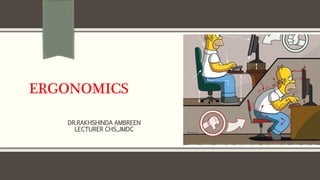
ERGONOMICS
DR.RAKHSHINDA AMBREEN
LECTURER CHS,JMDC
OBJECTIVES
By the end of the session students will be able to:
 Define ergonomics
 Differentiate between micro and macro ergonomics
 Describe different domains of ergonomics
 Identify different risk factor associated with ergonomics
 Classify ergonomics related injuries
 Explain different recommendations to avoid injuries related to ergonomics.
What is ergonomics?
“The term “ergonomics” originates from the Greek
words:
ergon - work and nomos - custom, law.
Ergonomics is an applied science concerned with the
design of workplaces, tools, and tasks that match the
physiological, anatomical, and psychological
characteristics and capabilities of the worker.” Vern
Putz-Anderson
“The Goal of ergonomics is to ‘fit the job to the
person,’ rather than making the person fit the job.”
Ergotech
“If it hurts when you are doing something, don’t do it.”
Bill Black
Organizations responsible for ergonomics
 International Commission on Occupational Health (ICOH)
 International Ergonomics Association (IEA)
 International labor organization (ILO)
Different types of ergonomics
Micro ergonomics
 working with tools,
 machines and other equipment.
 “human-machine” interface
Macro ergonomics
 organizational and work-system design -
--relevant personnel
 technological and environmental
variables
 It examines the interactions and
interdependence of all facets of the
working environment and considers the
way organizations are managed
Domains of ergonomics
 Physical ergonomics
human anatomical, anthropometric, physiological and biomechanical characteristics
as they relate to physical activity. relevant topics include working postures, materials
handling, repetitive movements, heavy work, work-related musculoskeletal disorders,
workplace layout, noise, thermal conditions and vibration, safety and health, as
these relate to work.
 Cognitive ergonomics
mental process .e.g. mental workload, decision-making, skilled performance,
human-computer interaction, human error, work stress and training
Continued…
 Organizational ergonomics
socio-technical systems, including their organizational structures, policies and
processes. relevant topics include human system considerations in communication,
human resource management, work design, design of work schedules, teamwork,
participatory design, community ergonomics, cooperative work, new work models,
virtual organizations, tele-work and quality management
Physical ergonomics
Types of Injuries
• Muscle pain
• Joint pain
• Swelling
• Numbness
• Restricted motion
• Repetitive stress injury
•Repetitive motion
injury
•Cumulative trauma
disorder
•Musculoskeletal
disorder
CUMULATIVE TRAUMA DISORDERS
 A type of illness which relates to the cumulative effect of micro-traumas that result
from repetitive or static work, forceful exertions or awkward postures. n Examples: è
Tendinitis, Tenosynovitis è Carpal Tunnel Syndrome è Shoulder, Neck, Back and Leg
Discomforts CUMULATIVE TRAUMA DISORDERS (CTD’s)
EFFECTS OF ERGONOMICS RELATED INJURIES
 Two classifications of ergonomic injuries
 Cumulative Trauma Disorders (CTD’s) –
exposure driven
 Strains/Sprains – instantaneous (event driven)
 Cumulative Trauma Disorders (CTD’s)
 Injury to soft tissue caused by prolonged
exposure to multiple ergonomic risk factors
 Typically develop in small body segments (i.e.
fingers, wrists, elbows, and neck)
Continue…
 Examples of CTD’s
 Tendon disorders:
 Inflammation of tendon and/or tendon sheathing caused
by repeated rubbing against ligaments, bone, etc.
 Lateral epicondylitis (tennis elbow)
 Nerve disorders: (Hands arm vibration
syndrome)
 Compression of nerves from repeated or sustained
exposure to sharp edges, bones, ligaments, and/or
tendons
 Carpal tunnel syndrome
 Neurovascular disorders: (Hands arm vibration
syndrome)
 Compression of blood vessels and/or nerves from
repeated exposure to vibration or cold temperatures
 Secondary Raynaud’s phenomenon (white finger
syndrome)
Continue…
 Strains & Sprains
 Injury to connective tissue caused by single forceful event: lifting heavy
objects in awkward position
 Common to large body segments (i.e. back, legs, and shoulders)
 Risk of injury increases with the presence of multiple risk factors
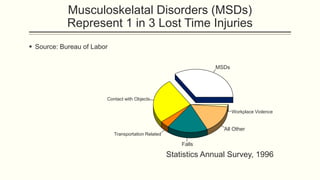
Musculoskelatal Disorders (MSDs)
Represent 1 in 3 Lost Time Injuries
 Source: Bureau of Labor
MSDs
Contact with Objects
Transportation Related
Falls
All Other
Workplace Violence
Statistics Annual Survey, 1996
Healthcare ergonomics
Reason for MSD among healthcare workers
 patient care such as lifting
 turning, bending
 reaching overhead, etc.)
 many of these injuries can be attributed to traditional office and factory injuries.
 resulting from poor posture and alignment with computer workstations (which are
being used increasingly) and being subjected to long periods of standing in a
stationary position such as during surgery and other longer procedures and
treatments.
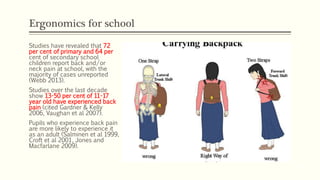
Ergonomics for school
Studies have revealed that 72
per cent of primary and 64 per
cent of secondary school
children report back and/or
neck pain at school, with the
majority of cases unreported
(Webb 2013).
Studies over the last decade
show 13-50 per cent of 11-17
year old have experienced back
pain (cited Gardner & Kelly
2006, Vaughan et al 2007).
Pupils who experience back pain
are more likely to experience it
as an adult (Salminen et al 1999,
Croft et al 2001, Jones and
Macfarlane 2009).
28
Musculoskeletal problems among teachers
Musculoskeletal problems were found to be the leading
cause of ill-health retirement in Irish school teachers
affecting 10 per cent of teachers (Maguire and O’Connell
2007).
Low back pain was reported by 40-45 per cent of nursery
and primary school teachers (Pillastrini et al 2009, Hashim
and Samad et al 2010).
Low back pain, neck and shoulder pain are in the top 10
most frequently reported health complaints amongst
teachers (Chong and Chan 2010).
There is evidence of knee osteoarthritis from prolonged
kneeling and squatting (Coggan et al 2000, Klussmann et al
2010).
School furniture ergonomics
 Should suit the age group
 Desks should be of Minus type
 Chairs should be provided with proper back rest. •
 avoid postural deformities like Kyphosis and Scoliosis
31
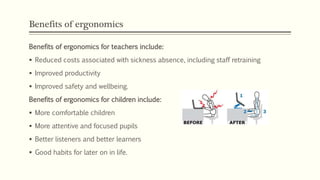
Benefits of ergonomics
Benefits of ergonomics for teachers include:
 Reduced costs associated with sickness absence, including staff retraining
 Improved productivity
 Improved safety and wellbeing.
Benefits of ergonomics for children include:
 More comfortable children
 More attentive and focused pupils
 Better listeners and better learners
 Good habits for later on in life.
Musculoskeletal Disorders (MSDs)
Impact of MSDs in the Workplace
Work related MSDs are among the most frequently reported
causes of lost or restricted work time.
According to the Bureau of Labor Statistics (BLS) in 2013,
MSD1 cases accounted for 33% of all worker injury and
illness cases
Example:
Carpal tunnel syndrome
Tendinitis
Rotator cuff injuries (affects the shoulder)
Epicondylitis (affects the elbow)
Trigger finger-musicians, industrial worker, smokers
Muscle strains and low back injuries
.
Types of Problems or Mismatches
Physical Size
Endurance
Strength
Manipulative
Environmental
Cognitive
From David Alexander, 1986
Physical Size
Clearance
Reach
Equipment Size
Personal Protective Equipment
(PPE)
Endurance (Capacity for Work)
Environmental
Noise
Lighting
Thermal
Chemical
Cognitive
Machine Pacing
Shift Work
Morale
Psychosocial
Strength
Force Requirements
Male/Female
Manual Materials Handling
Other Issues
Aging workforce
Universal design
Other Issues
Aging workforce
Universal design
Office ergonomics
ERGO REMINDERS
Correct & Incorrect Techniques
Occupational Health (objectives) as the:
• Promotion and maintenance of the highest degree of physical, mental
and social well-being of workers in all occupations
• Prevention among workers of departures from health caused by their
working conditions
• Protection of workers in their employment from risks resulting from
factors adverse to health
• Placing and the maintenance of workers in an occupational environment
adapted to their physical and mental needs
Therefore Occupational Health services deal with:
1. Health promotion and maintenance (Primary Prevention or well
people care)
2. Prevention of disease and injury, or workers’ return to full work duties
after injury or illness (Secondary Prevention or threatened people care)
3. Some treatment or workplace modification for residual disability (Tertiary
Prevention or sick people care)
Conclusion
THANK YOU………..
REFERENCES
• ERGONOMICS GUIDELINES FOR OCCUPATIONAL HEALTH PRACTICE IN
INDUSTRIALLY DEVELOPING COUNTRIES 2010
• SCHOOLBAG WEIGHT AND MUSCULOSKELETAL SYMPTOMS IN NEW ZEALAND
SECONDARY SCHOOLS
http://www.ergonomics4schools.com/research/schoolbags.htm

Ergonomics

  • 1.
  • 2.
    OBJECTIVES By the endof the session students will be able to:  Define ergonomics  Differentiate between micro and macro ergonomics  Describe different domains of ergonomics  Identify different risk factor associated with ergonomics  Classify ergonomics related injuries  Explain different recommendations to avoid injuries related to ergonomics.
  • 3.
    What is ergonomics? “Theterm “ergonomics” originates from the Greek words: ergon - work and nomos - custom, law. Ergonomics is an applied science concerned with the design of workplaces, tools, and tasks that match the physiological, anatomical, and psychological characteristics and capabilities of the worker.” Vern Putz-Anderson “The Goal of ergonomics is to ‘fit the job to the person,’ rather than making the person fit the job.” Ergotech “If it hurts when you are doing something, don’t do it.” Bill Black
  • 4.
    Organizations responsible forergonomics  International Commission on Occupational Health (ICOH)  International Ergonomics Association (IEA)  International labor organization (ILO)
  • 5.
    Different types ofergonomics Micro ergonomics  working with tools,  machines and other equipment.  “human-machine” interface Macro ergonomics  organizational and work-system design - --relevant personnel  technological and environmental variables  It examines the interactions and interdependence of all facets of the working environment and considers the way organizations are managed
  • 7.
    Domains of ergonomics Physical ergonomics human anatomical, anthropometric, physiological and biomechanical characteristics as they relate to physical activity. relevant topics include working postures, materials handling, repetitive movements, heavy work, work-related musculoskeletal disorders, workplace layout, noise, thermal conditions and vibration, safety and health, as these relate to work.  Cognitive ergonomics mental process .e.g. mental workload, decision-making, skilled performance, human-computer interaction, human error, work stress and training
  • 8.
    Continued…  Organizational ergonomics socio-technicalsystems, including their organizational structures, policies and processes. relevant topics include human system considerations in communication, human resource management, work design, design of work schedules, teamwork, participatory design, community ergonomics, cooperative work, new work models, virtual organizations, tele-work and quality management
  • 9.
  • 10.
    Types of Injuries •Muscle pain • Joint pain • Swelling • Numbness • Restricted motion • Repetitive stress injury •Repetitive motion injury •Cumulative trauma disorder •Musculoskeletal disorder
  • 11.
    CUMULATIVE TRAUMA DISORDERS A type of illness which relates to the cumulative effect of micro-traumas that result from repetitive or static work, forceful exertions or awkward postures. n Examples: è Tendinitis, Tenosynovitis è Carpal Tunnel Syndrome è Shoulder, Neck, Back and Leg Discomforts CUMULATIVE TRAUMA DISORDERS (CTD’s)
  • 14.
    EFFECTS OF ERGONOMICSRELATED INJURIES  Two classifications of ergonomic injuries  Cumulative Trauma Disorders (CTD’s) – exposure driven  Strains/Sprains – instantaneous (event driven)  Cumulative Trauma Disorders (CTD’s)  Injury to soft tissue caused by prolonged exposure to multiple ergonomic risk factors  Typically develop in small body segments (i.e. fingers, wrists, elbows, and neck)
  • 15.
    Continue…  Examples ofCTD’s  Tendon disorders:  Inflammation of tendon and/or tendon sheathing caused by repeated rubbing against ligaments, bone, etc.  Lateral epicondylitis (tennis elbow)  Nerve disorders: (Hands arm vibration syndrome)  Compression of nerves from repeated or sustained exposure to sharp edges, bones, ligaments, and/or tendons  Carpal tunnel syndrome  Neurovascular disorders: (Hands arm vibration syndrome)  Compression of blood vessels and/or nerves from repeated exposure to vibration or cold temperatures  Secondary Raynaud’s phenomenon (white finger syndrome)
  • 16.
    Continue…  Strains &Sprains  Injury to connective tissue caused by single forceful event: lifting heavy objects in awkward position  Common to large body segments (i.e. back, legs, and shoulders)  Risk of injury increases with the presence of multiple risk factors
  • 17.
    Musculoskelatal Disorders (MSDs) Represent1 in 3 Lost Time Injuries  Source: Bureau of Labor MSDs Contact with Objects Transportation Related Falls All Other Workplace Violence Statistics Annual Survey, 1996
  • 25.
  • 26.
    Reason for MSDamong healthcare workers  patient care such as lifting  turning, bending  reaching overhead, etc.)  many of these injuries can be attributed to traditional office and factory injuries.  resulting from poor posture and alignment with computer workstations (which are being used increasingly) and being subjected to long periods of standing in a stationary position such as during surgery and other longer procedures and treatments.
  • 27.
    Ergonomics for school Studieshave revealed that 72 per cent of primary and 64 per cent of secondary school children report back and/or neck pain at school, with the majority of cases unreported (Webb 2013). Studies over the last decade show 13-50 per cent of 11-17 year old have experienced back pain (cited Gardner & Kelly 2006, Vaughan et al 2007). Pupils who experience back pain are more likely to experience it as an adult (Salminen et al 1999, Croft et al 2001, Jones and Macfarlane 2009).
  • 28.
  • 29.
    Musculoskeletal problems amongteachers Musculoskeletal problems were found to be the leading cause of ill-health retirement in Irish school teachers affecting 10 per cent of teachers (Maguire and O’Connell 2007). Low back pain was reported by 40-45 per cent of nursery and primary school teachers (Pillastrini et al 2009, Hashim and Samad et al 2010). Low back pain, neck and shoulder pain are in the top 10 most frequently reported health complaints amongst teachers (Chong and Chan 2010). There is evidence of knee osteoarthritis from prolonged kneeling and squatting (Coggan et al 2000, Klussmann et al 2010).
  • 30.
    School furniture ergonomics Should suit the age group  Desks should be of Minus type  Chairs should be provided with proper back rest. •  avoid postural deformities like Kyphosis and Scoliosis
  • 31.
  • 32.
    Benefits of ergonomics Benefitsof ergonomics for teachers include:  Reduced costs associated with sickness absence, including staff retraining  Improved productivity  Improved safety and wellbeing. Benefits of ergonomics for children include:  More comfortable children  More attentive and focused pupils  Better listeners and better learners  Good habits for later on in life.
  • 33.
    Musculoskeletal Disorders (MSDs) Impactof MSDs in the Workplace Work related MSDs are among the most frequently reported causes of lost or restricted work time. According to the Bureau of Labor Statistics (BLS) in 2013, MSD1 cases accounted for 33% of all worker injury and illness cases Example: Carpal tunnel syndrome Tendinitis Rotator cuff injuries (affects the shoulder) Epicondylitis (affects the elbow) Trigger finger-musicians, industrial worker, smokers Muscle strains and low back injuries .
  • 34.
    Types of Problemsor Mismatches Physical Size Endurance Strength Manipulative Environmental Cognitive From David Alexander, 1986
  • 35.
  • 36.
  • 37.
  • 38.
  • 39.
  • 40.
  • 41.
  • 44.
  • 46.
  • 47.
  • 56.
    Occupational Health (objectives)as the: • Promotion and maintenance of the highest degree of physical, mental and social well-being of workers in all occupations • Prevention among workers of departures from health caused by their working conditions • Protection of workers in their employment from risks resulting from factors adverse to health • Placing and the maintenance of workers in an occupational environment adapted to their physical and mental needs
  • 57.
    Therefore Occupational Healthservices deal with: 1. Health promotion and maintenance (Primary Prevention or well people care) 2. Prevention of disease and injury, or workers’ return to full work duties after injury or illness (Secondary Prevention or threatened people care) 3. Some treatment or workplace modification for residual disability (Tertiary Prevention or sick people care)
  • 58.
  • 59.
  • 60.
    REFERENCES • ERGONOMICS GUIDELINESFOR OCCUPATIONAL HEALTH PRACTICE IN INDUSTRIALLY DEVELOPING COUNTRIES 2010 • SCHOOLBAG WEIGHT AND MUSCULOSKELETAL SYMPTOMS IN NEW ZEALAND SECONDARY SCHOOLS http://www.ergonomics4schools.com/research/schoolbags.htm

Editor's Notes

  • #2 NOTE: To change the image on this slide, select the picture and delete it. Then click the Pictures icon in the placeholder to insert your own image.
  • #19 BURSITIS: INFLAMATION OF BURSA (FLUID FILLED SAC THAT CUSHION NEAR JOINTS) EACH KNEE HAS 11 BURSAE MINOR INJURY,REPITATIVE OVERUSE. GOES AWAY ITSELF WITHIN SEVERAL WEEKS WITH REST. PAIN FUTHER AWAY FROM JOINTS, SPLINT(KNEE BRACES), STEROID
  • #23 BURSITIS:
  • #34 Trigger finger: painful condition that cause the finger and thumb to catch or lock when bent. In the thumb its called trigger thumb. Tendon in finger become inflamed. Prolong irritation of the tendon sheath can produce scarring and thickening that impedes the tendon’s motion. When this happens bending the finger or thumb can pull the inflamed tendon sheath making snap or pop. Rheumatoid arthritis, gout, diabetes Farmers Musicians Industrial workers Smokers-lighter Splints,NSAID,STEROID
  • #38 75-85 DBL NORMAL