Ergonomics Industrial
Session Objectives You will be able to: Understand the principles of ergonomics Recognize the risk factors, signs, and symptoms of musculoskeletal disorders (MSDs) Understand our program for identifying, reporting, and controlling MSDs Know how to protect yourself from MSD injuries and reduce your risk
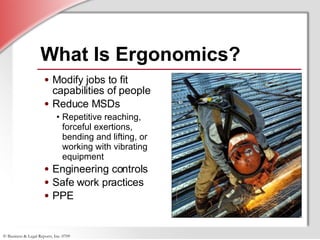
What Is Ergonomics? Modify jobs to fit capabilities of people Reduce MSDs Repetitive reaching, forceful exertions, bending and lifting, or working with vibrating equipment Engineering controls Safe work practices PPE
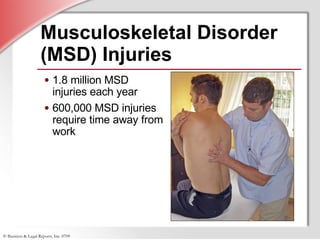
Musculoskeletal Disorder (MSD) Injuries 1.8 million MSD injuries each year 600,000 MSD injuries require time away from work
Regulation  Of Ergonomics General Duty Clause Applies to unregulated hazards Failure to keep a hazard-free workplace Hazard recognized by employer or employer’s industry Hazard could cause death or serious harm Method exists to correct the hazard
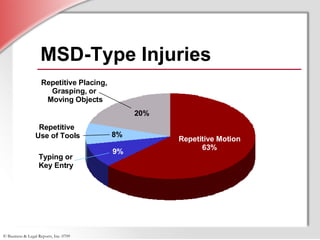
MSD-Type Injuries Repetitive Motion 63% Repetitive Placing,  Grasping, or  Moving Objects 20% Repetitive  Use of Tools 8% Typing or  Key Entry 9%
Characteristics of MSDs  Occur from a single event or many small injuries Take weeks, months, or years to develop Produce no symptoms in early stages, but show symptoms after injury has occurred Contributing causes may occur at home  and at work Same MSD may differ in severity from person to person doing a similar task
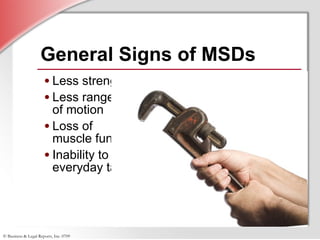
General Signs of MSDs Less strength for gripping Less range  of motion Loss of  muscle function Inability to do  everyday tasks
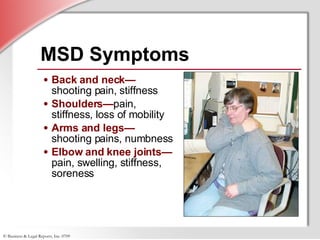
MSD Symptoms Back and neck—   shooting pain, stiffness Shoulders— pain, stiffness, loss of mobility Arms and legs—   shooting pains, numbness Elbow and knee joints—  pain, swelling, stiffness, soreness
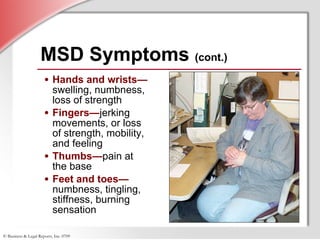
MSD Symptoms  (cont.) Hands and wrists—  swelling, numbness, loss of strength Fingers— jerking movements, or loss  of strength, mobility, and feeling  Thumbs— pain at  the base Feet and toes— numbness, tingling, stiffness, burning sensation
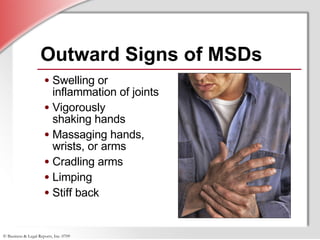
Outward Signs of MSDs Swelling or  inflammation of joints Vigorously  shaking hands  Massaging hands,  wrists, or arms Cradling arms Limping  Stiff back
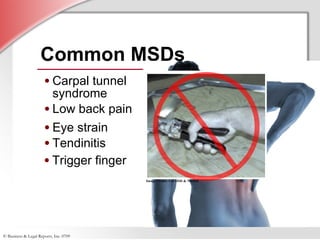
Common MSDs Carpal tunnel syndrome Low back pain Eye strain Tendinitis Trigger finger Image Credit: Cal OSH & NIOSH
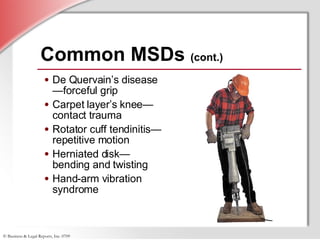
Common MSDs  (cont.) De Quervain’s disease—forceful grip Carpet layer’s knee—contact trauma Rotator cuff tendinitis— repetitive motion Herniated disk— bending and twisting Hand-arm vibration syndrome
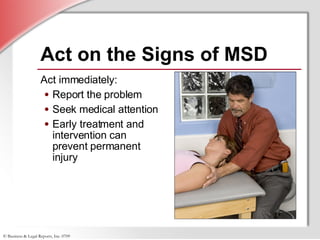
Act on the Signs of MSD Act immediately: Report the problem Seek medical attention Early treatment and intervention can prevent permanent injury
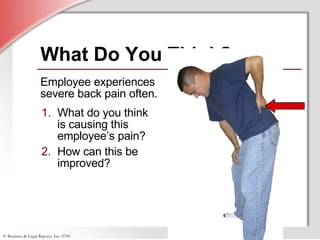
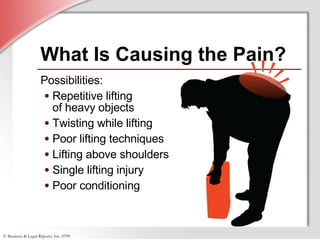
What Do You Think? What do you think  is causing this employee’s pain? How can this be improved? Employee experiences severe back pain often.
What Is Causing the Pain? Possibilities: Repetitive lifting  of heavy objects  Twisting while lifting Poor lifting techniques Lifting above shoulders Single lifting injury Poor conditioning
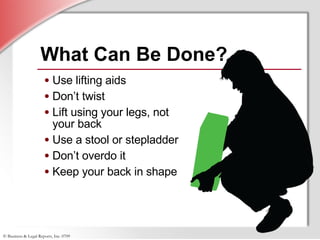
What Can Be Done? Use lifting aids Don’t twist Lift using your legs, not your back Use a stool or stepladder Don’t overdo it Keep your back in shape
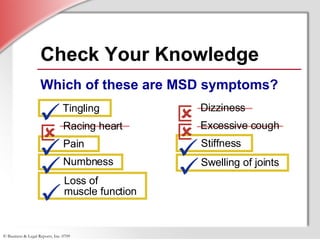
Check Your Knowledge Loss of  muscle function Which of these are MSD symptoms? Racing heart  Pain  Numbness  Tingling          Dizziness  Excessive cough  Stiffness  Swelling of joints
MSDs—Any Questions? Do you understand what MSDs are and the signs and symptoms of MSDs?
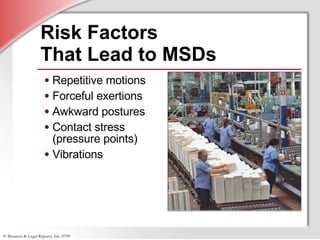
Risk Factors  That Lead to MSDs Repetitive motions Forceful exertions Awkward postures Contact stress (pressure points) Vibrations
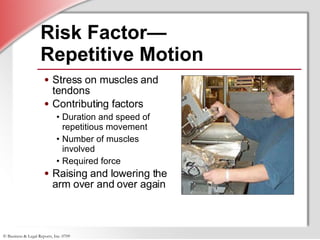
Risk Factor— Repetitive Motion Stress on muscles and tendons Contributing factors Duration and speed of repetitious movement Number of muscles involved Required force Raising and lowering the arm over and over again
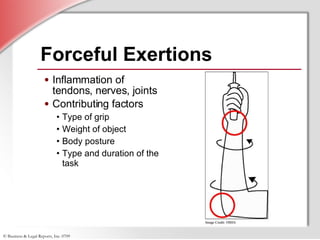
Forceful Exertions Inflammation of tendons, nerves, joints Contributing factors Type of grip Weight of object Body posture Type and duration of the task Image Credit: OSHA
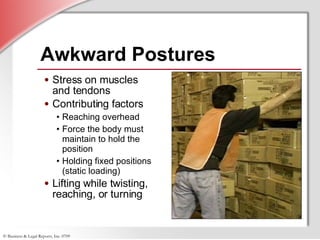
Awkward Postures Stress on muscles  and tendons Contributing factors Reaching overhead Force the body must maintain to hold the position Holding fixed positions (static loading) Lifting while twisting, reaching, or turning
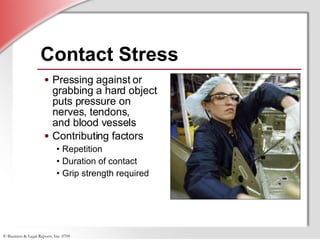
Contact Stress Pressing against or grabbing a hard object puts pressure on nerves, tendons,  and blood vessels Contributing factors Repetition Duration of contact Grip strength required
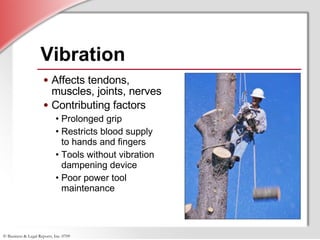
Vibration Affects tendons, muscles, joints, nerves Contributing factors Prolonged grip Restricts blood supply  to hands and fingers Tools without vibration dampening device Poor power tool maintenance
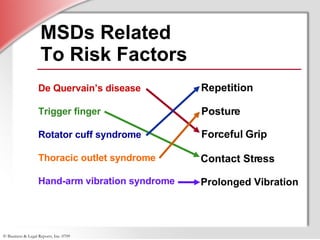
MSDs Related  To Risk Factors De Quervain’s disease Trigger finger Rotator cuff syndrome Thoracic outlet syndrome Hand-arm vibration syndrome Repetition Posture Forceful Grip Contact Stress Prolonged Vibration
Can You Identify  The Risk Factors?
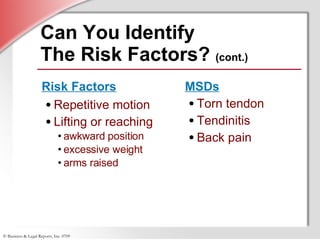
Can You Identify  The Risk Factors?  (cont.) Repetitive motion Lifting or reaching awkward position excessive weight arms raised MSDs Torn tendon Tendinitis Back pain Risk Factors
MSD Risk Factors— Any Questions? Do you understand MSD risk factors and hazards?
Ergonomics Management Job assessment MSD reporting and response system Designated coordinator Training Encourage employee participation and reporting of MSDs
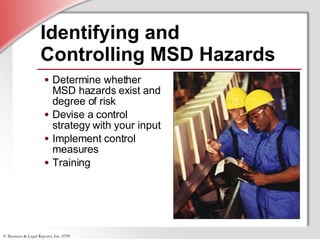
Identifying and  Controlling MSD Hazards Determine whether  MSD hazards exist and degree of risk Devise a control strategy with your input Implement control  measures Training
Control Methods Install engineering controls including workstation layout and proper tools Institute work practice controls including neutral postures for performing tasks Administrative controls including rescheduling to reduce frequency or duration of exposure to MSDs Personal protective equipment (PPE) to provide a protective barrier between worker and MSD
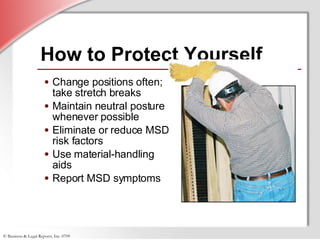
How to Protect Yourself Change positions often; take stretch breaks  Maintain neutral posture whenever possible Eliminate or reduce MSD risk factors Use material-handling aids Report MSD symptoms
MSD Prevention and Control—Any Questions? Do you think you understand what you need to know about the methods to manage, prevent, and control MSDs?
Recognize MSD signs and symptoms Understand MSD hazards Take steps to control MSD hazards Participate in the Ergonomics Program

Ergonomics Training

  • 1.
  • 2.
    Session Objectives Youwill be able to: Understand the principles of ergonomics Recognize the risk factors, signs, and symptoms of musculoskeletal disorders (MSDs) Understand our program for identifying, reporting, and controlling MSDs Know how to protect yourself from MSD injuries and reduce your risk
  • 3.
    What Is Ergonomics?Modify jobs to fit capabilities of people Reduce MSDs Repetitive reaching, forceful exertions, bending and lifting, or working with vibrating equipment Engineering controls Safe work practices PPE
  • 4.
    Musculoskeletal Disorder (MSD)Injuries 1.8 million MSD injuries each year 600,000 MSD injuries require time away from work
  • 5.
    Regulation OfErgonomics General Duty Clause Applies to unregulated hazards Failure to keep a hazard-free workplace Hazard recognized by employer or employer’s industry Hazard could cause death or serious harm Method exists to correct the hazard
  • 6.
    MSD-Type Injuries RepetitiveMotion 63% Repetitive Placing, Grasping, or Moving Objects 20% Repetitive Use of Tools 8% Typing or Key Entry 9%
  • 7.
    Characteristics of MSDs Occur from a single event or many small injuries Take weeks, months, or years to develop Produce no symptoms in early stages, but show symptoms after injury has occurred Contributing causes may occur at home and at work Same MSD may differ in severity from person to person doing a similar task
  • 8.
    General Signs ofMSDs Less strength for gripping Less range of motion Loss of muscle function Inability to do everyday tasks
  • 9.
    MSD Symptoms Backand neck— shooting pain, stiffness Shoulders— pain, stiffness, loss of mobility Arms and legs— shooting pains, numbness Elbow and knee joints— pain, swelling, stiffness, soreness
  • 10.
    MSD Symptoms (cont.) Hands and wrists— swelling, numbness, loss of strength Fingers— jerking movements, or loss of strength, mobility, and feeling Thumbs— pain at the base Feet and toes— numbness, tingling, stiffness, burning sensation
  • 11.
    Outward Signs ofMSDs Swelling or inflammation of joints Vigorously shaking hands Massaging hands, wrists, or arms Cradling arms Limping Stiff back
  • 12.
    Common MSDs Carpaltunnel syndrome Low back pain Eye strain Tendinitis Trigger finger Image Credit: Cal OSH & NIOSH
  • 13.
    Common MSDs (cont.) De Quervain’s disease—forceful grip Carpet layer’s knee—contact trauma Rotator cuff tendinitis— repetitive motion Herniated disk— bending and twisting Hand-arm vibration syndrome
  • 14.
    Act on theSigns of MSD Act immediately: Report the problem Seek medical attention Early treatment and intervention can prevent permanent injury
  • 15.
    What Do YouThink? What do you think is causing this employee’s pain? How can this be improved? Employee experiences severe back pain often.
  • 16.
    What Is Causingthe Pain? Possibilities: Repetitive lifting of heavy objects Twisting while lifting Poor lifting techniques Lifting above shoulders Single lifting injury Poor conditioning
  • 17.
    What Can BeDone? Use lifting aids Don’t twist Lift using your legs, not your back Use a stool or stepladder Don’t overdo it Keep your back in shape
  • 18.
    Check Your KnowledgeLoss of muscle function Which of these are MSD symptoms? Racing heart Pain Numbness Tingling          Dizziness Excessive cough Stiffness Swelling of joints
  • 19.
    MSDs—Any Questions? Doyou understand what MSDs are and the signs and symptoms of MSDs?
  • 20.
    Risk Factors That Lead to MSDs Repetitive motions Forceful exertions Awkward postures Contact stress (pressure points) Vibrations
  • 21.
    Risk Factor— RepetitiveMotion Stress on muscles and tendons Contributing factors Duration and speed of repetitious movement Number of muscles involved Required force Raising and lowering the arm over and over again
  • 22.
    Forceful Exertions Inflammationof tendons, nerves, joints Contributing factors Type of grip Weight of object Body posture Type and duration of the task Image Credit: OSHA
  • 23.
    Awkward Postures Stresson muscles and tendons Contributing factors Reaching overhead Force the body must maintain to hold the position Holding fixed positions (static loading) Lifting while twisting, reaching, or turning
  • 24.
    Contact Stress Pressingagainst or grabbing a hard object puts pressure on nerves, tendons, and blood vessels Contributing factors Repetition Duration of contact Grip strength required
  • 25.
    Vibration Affects tendons,muscles, joints, nerves Contributing factors Prolonged grip Restricts blood supply to hands and fingers Tools without vibration dampening device Poor power tool maintenance
  • 26.
    MSDs Related To Risk Factors De Quervain’s disease Trigger finger Rotator cuff syndrome Thoracic outlet syndrome Hand-arm vibration syndrome Repetition Posture Forceful Grip Contact Stress Prolonged Vibration
  • 27.
    Can You Identify The Risk Factors?
  • 28.
    Can You Identify The Risk Factors? (cont.) Repetitive motion Lifting or reaching awkward position excessive weight arms raised MSDs Torn tendon Tendinitis Back pain Risk Factors
  • 29.
    MSD Risk Factors—Any Questions? Do you understand MSD risk factors and hazards?
  • 30.
    Ergonomics Management Jobassessment MSD reporting and response system Designated coordinator Training Encourage employee participation and reporting of MSDs
  • 31.
    Identifying and Controlling MSD Hazards Determine whether MSD hazards exist and degree of risk Devise a control strategy with your input Implement control measures Training
  • 32.
    Control Methods Installengineering controls including workstation layout and proper tools Institute work practice controls including neutral postures for performing tasks Administrative controls including rescheduling to reduce frequency or duration of exposure to MSDs Personal protective equipment (PPE) to provide a protective barrier between worker and MSD
  • 33.
    How to ProtectYourself Change positions often; take stretch breaks Maintain neutral posture whenever possible Eliminate or reduce MSD risk factors Use material-handling aids Report MSD symptoms
  • 34.
    MSD Prevention andControl—Any Questions? Do you think you understand what you need to know about the methods to manage, prevent, and control MSDs?
  • 35.
    Recognize MSD signsand symptoms Understand MSD hazards Take steps to control MSD hazards Participate in the Ergonomics Program

Editor's Notes

  • #2 Slide Show Notes Welcome to the training session on ergonomics in industrial work areas. This session will look at some of the basic principles of ergonomics so that you can use a commonsense approach to working safely. In particular, the information presented here will focus on musculoskeletal disorders, or MSDs, and how ergonomics helps prevent them.