Good Morning!
Good Morning!
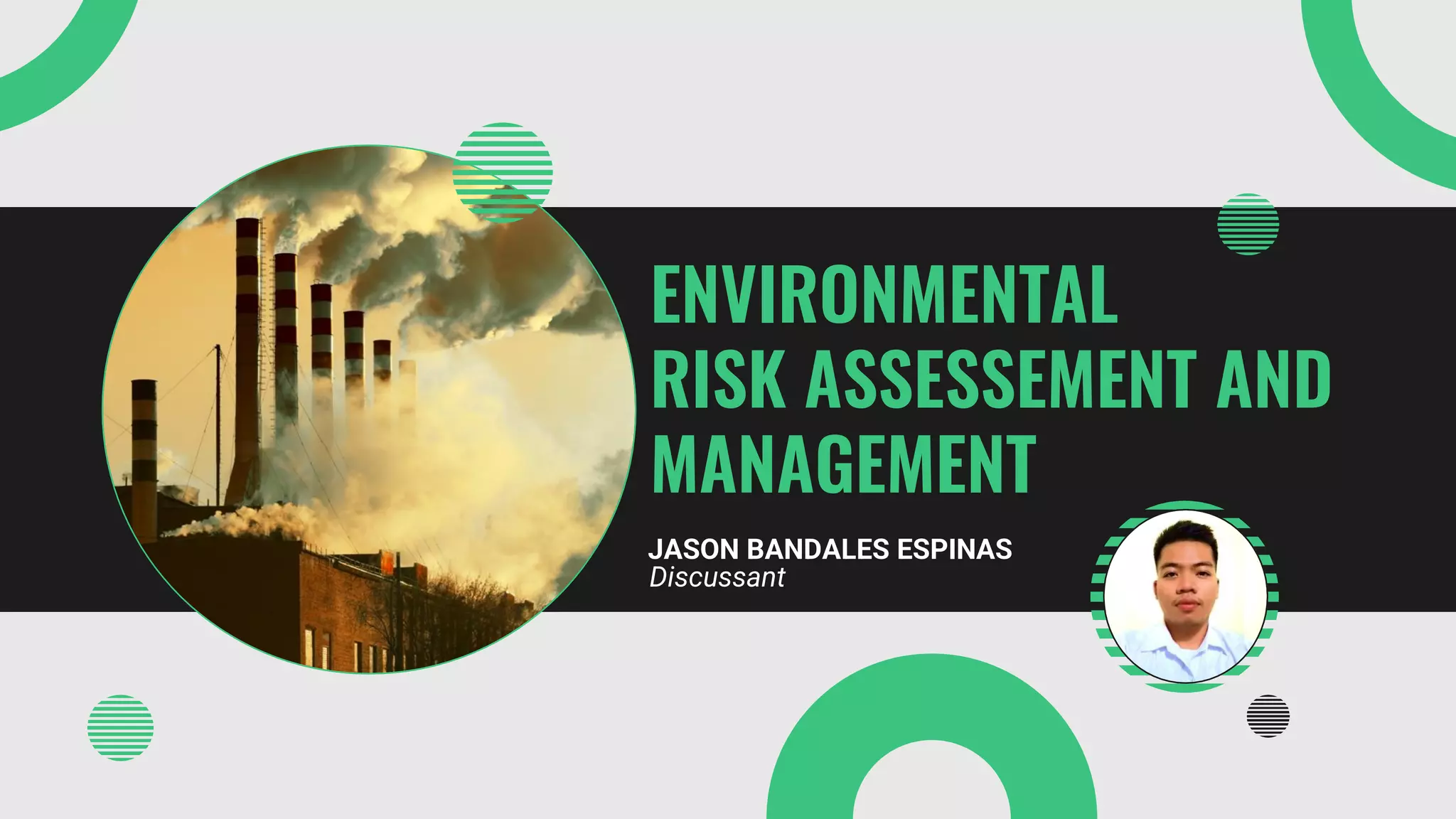
ENVIRONMENTAL
RISK ASSESSEMENT AND
MANAGEMENT
JASON BANDALES ESPINAS
Discussant
Objectives of the lesson:
1. Identify the elements of risk assessment and
explain the impact of it.
2. Explain the tools and methods of risk
assessment and cite some examples.
3. Identify the different risk management and
explain the importance and impact to human
and environment.
Definition of Environmental Risk Assessment
01
03
CONTENTS OF THE REPORT
Steps/Elements of Environmental Risk Assessment
02
Tools in conducting Environmental Risk Assessment
Definition of Environmental Risk Management
04
06
Strategies in Environmental Risk Management
05
Key players in Environmental Risk Assessment & Management
07 Importance of Environmental Risk Assessment and
Management
________
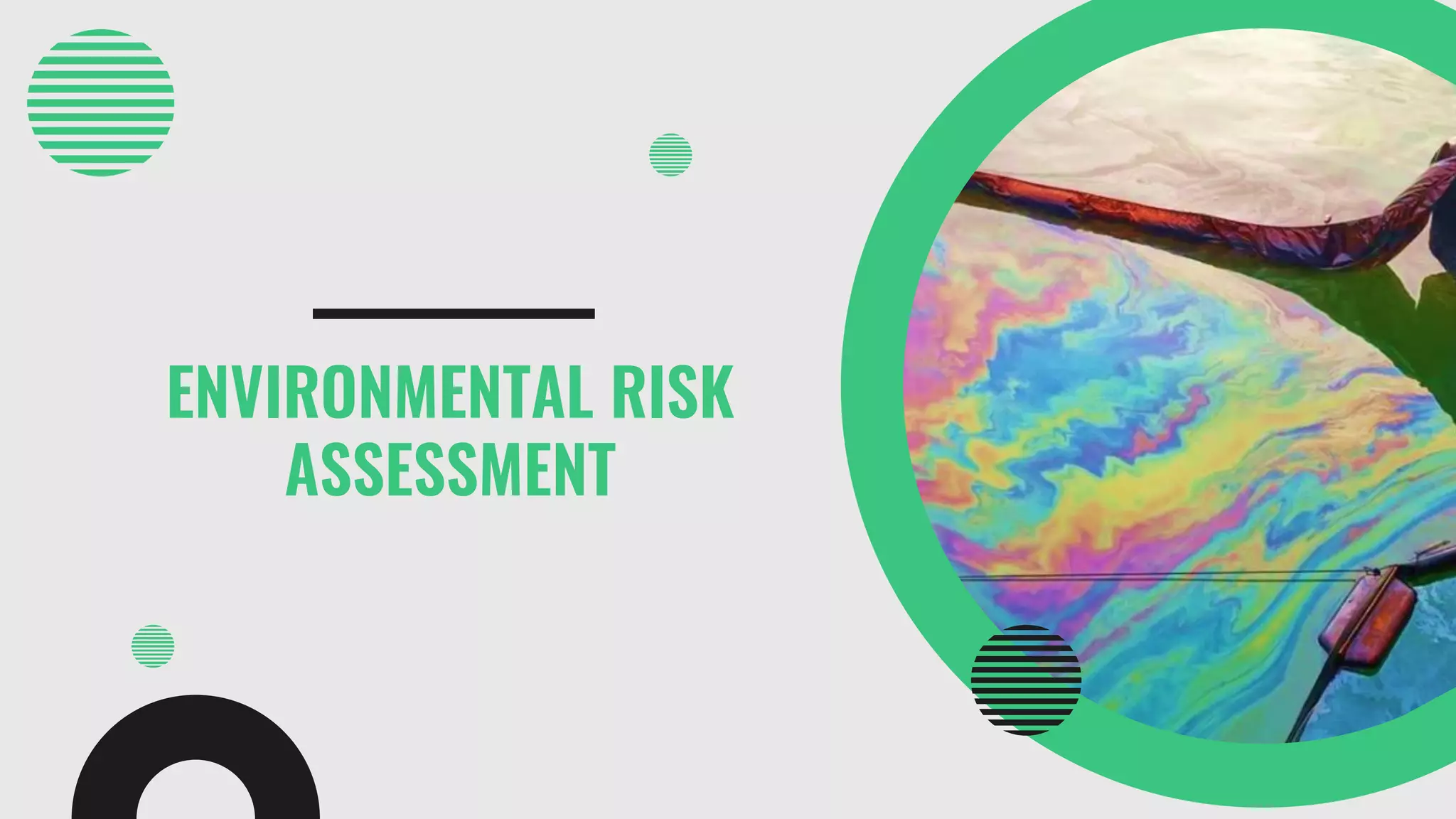
ENVIRONMENTAL RISK
ASSESSMENT
An environmental RISK assessment
(ERA) is a process for evaluating how
likely it is that the environment
(including human) may be impacted as
a result of EXPOSURE to one or more
environmental HAZARD, such as
chemicals, disease, invasive species,
and climate change.
(01) What is Environmental Risk
Assessment (ERA)?
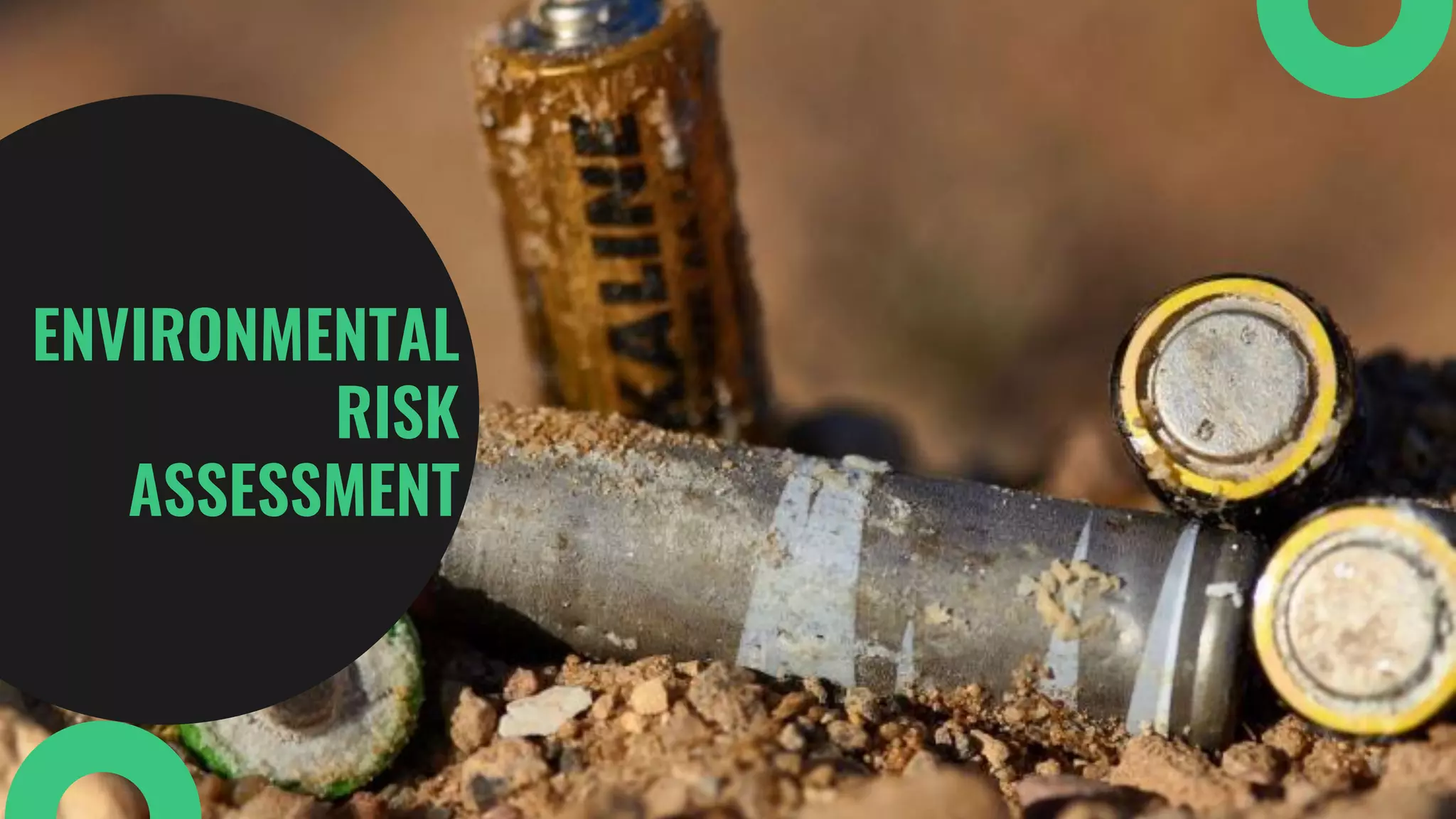
ENVIRONMENTAL
RISK
ASSESSMENT
ENVIRONMENTAL
RISK
ASSESSMENT
An environmental RISK assessment
(ERA) is a process for evaluating how
likely it is that the environment
(including human) may be impacted as
a result of EXPOSURE to one or more
environmental HAZARD, such as
chemicals, disease, invasive species,
and climate change.
(01) What is Environmental Risk
Assessment (ERA)?
RISK
HAZARD
EXPOSURE
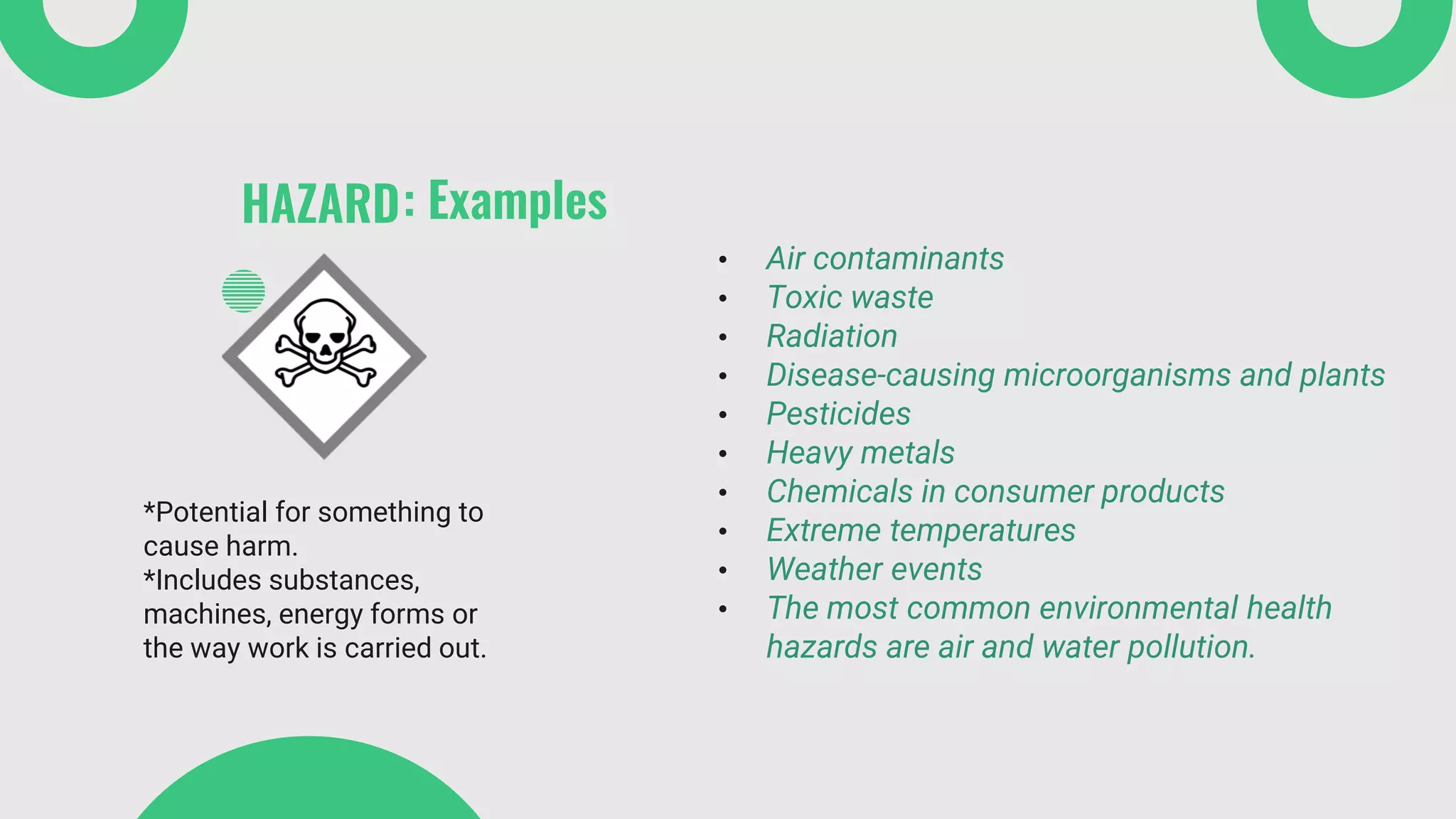
*Potential for something to
cause harm.
*Includes substances,
machines, energy forms or
the way work is carried out.
RISK
HAZARD EXPOSURE
*Potential for something to
cause harm.
*Includes substances,
machines, energy forms or
the way work is carried out.
• Air contaminants
• Toxic waste
• Radiation
• Disease-causing microorganisms and plants
• Pesticides
• Heavy metals
• Chemicals in consumer products
• Extreme temperatures
• Weather events
• The most common environmental health
hazards are air and water pollution.
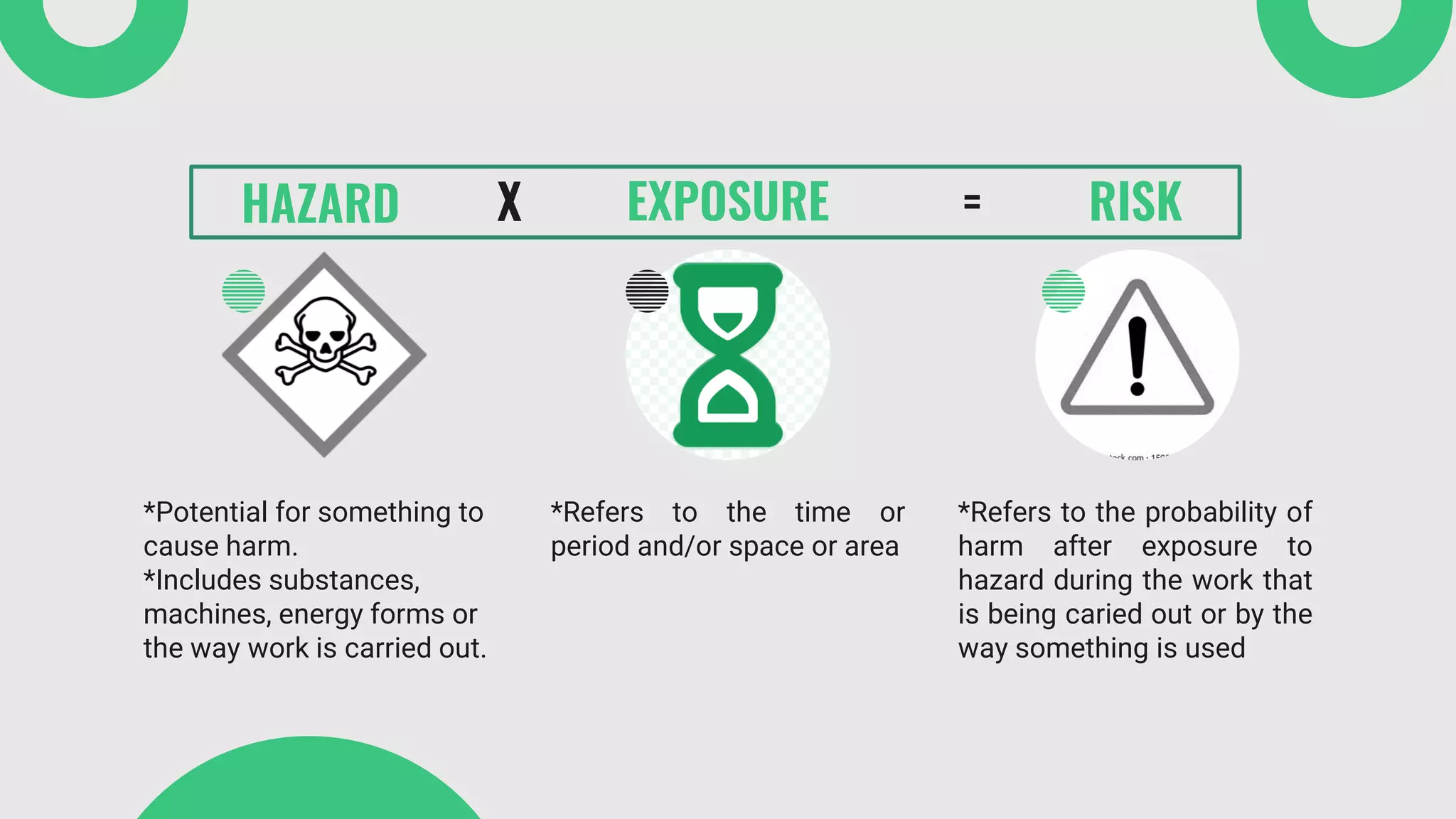
RISK
HAZARD EXPOSURE
X =
: Examples
•*Air contaminants
•*Toxic waste
•*Radiation
•*Disease-causing
microorganisms and plants
•*Pesticides
•*Heavy metals
•*Chemicals in consumer
products
•*Extreme temperatures
•*Weather events
•*Air and water pollution.
*Potential for something to
cause harm.
*Includes substances,
machines, energy forms or
the way work is carried out.
*Refers to the time or
period and/or space or area
*Refers to the probability of
harm after exposure to
hazard during the work that
is being caried out or by the
way something is used
RISK
HAZARD EXPOSURE
X =
RISK
HAZARD EXPOSURE
X =
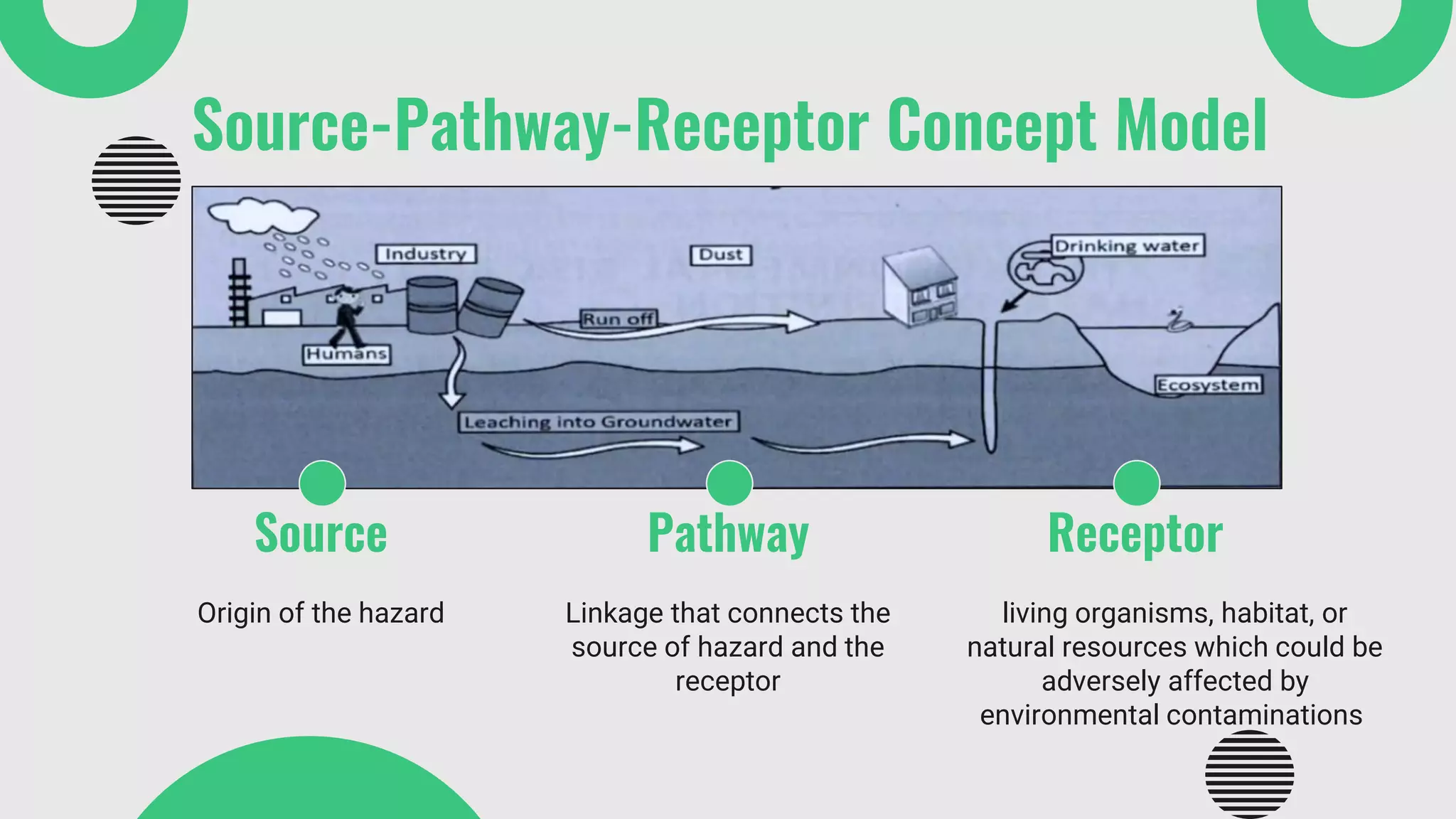
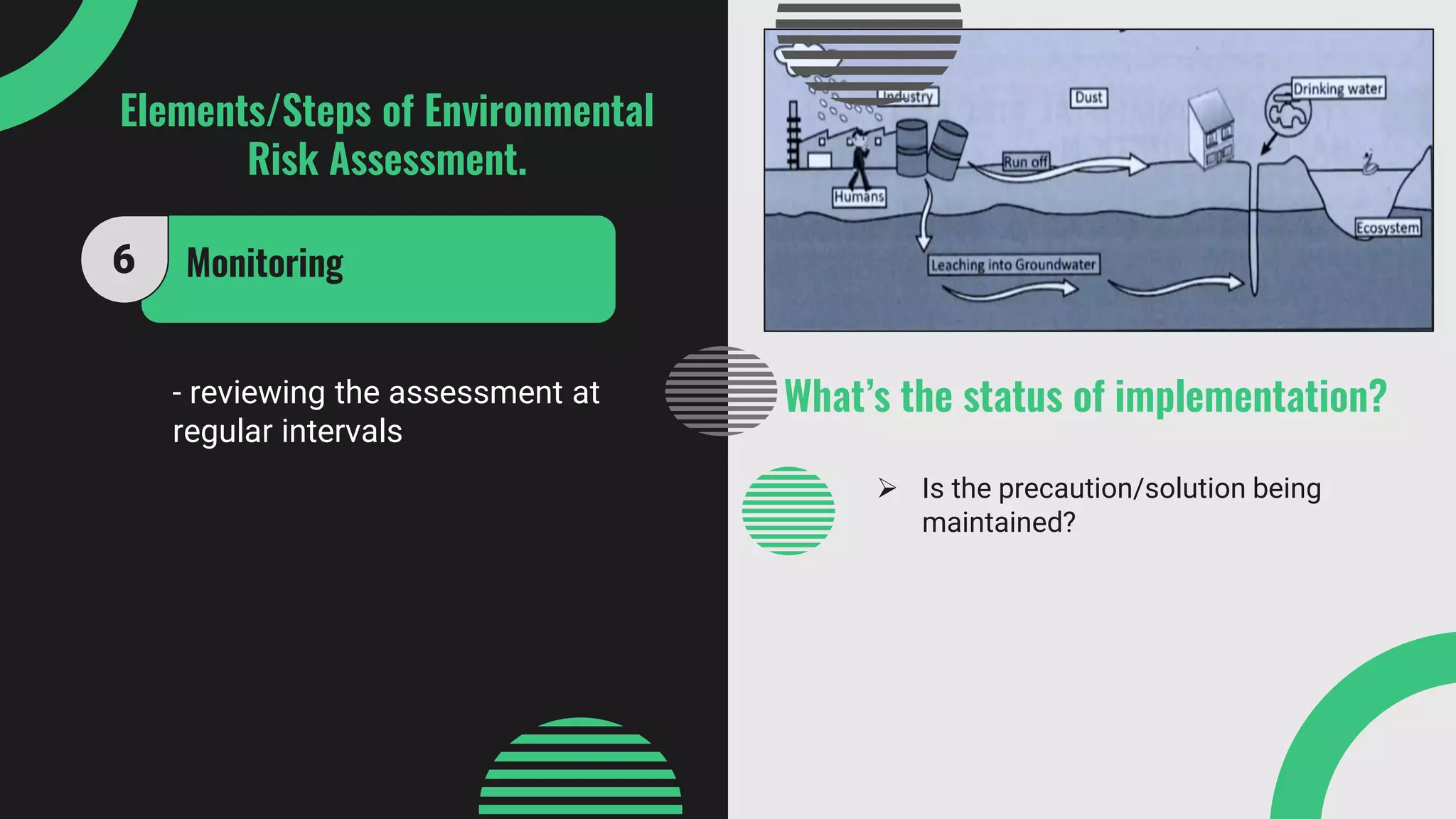
Source-Pathway-Receptor Concept Model
Source
Origin of the hazard
Pathway
Linkage that connects the
source of hazard and the
receptor
living organisms, habitat, or
natural resources which could be
adversely affected by
environmental contaminations
Receptor
If there is no pathway, there is
no risk.
If the pathway exists, the
consequences must be
determined
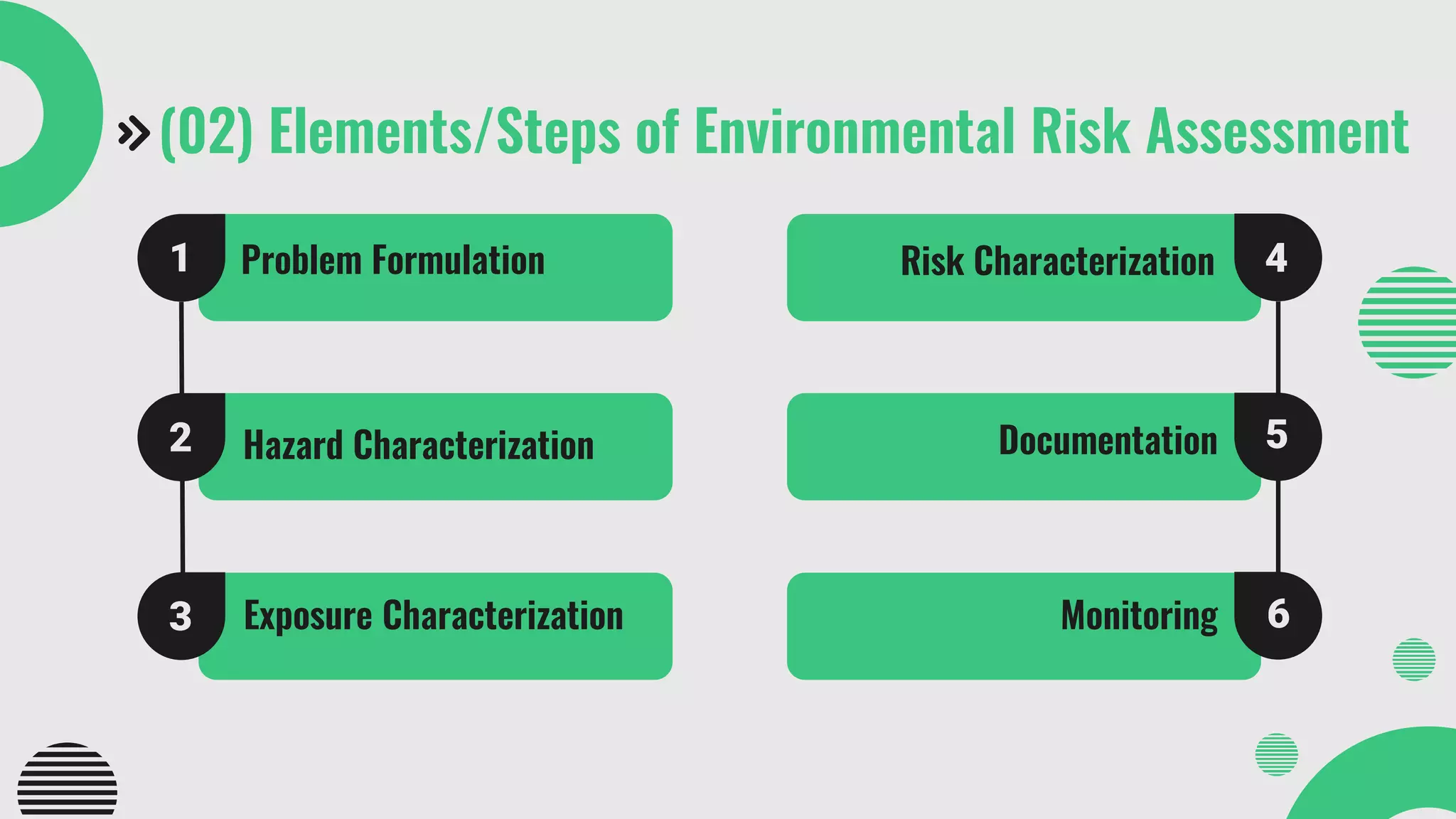
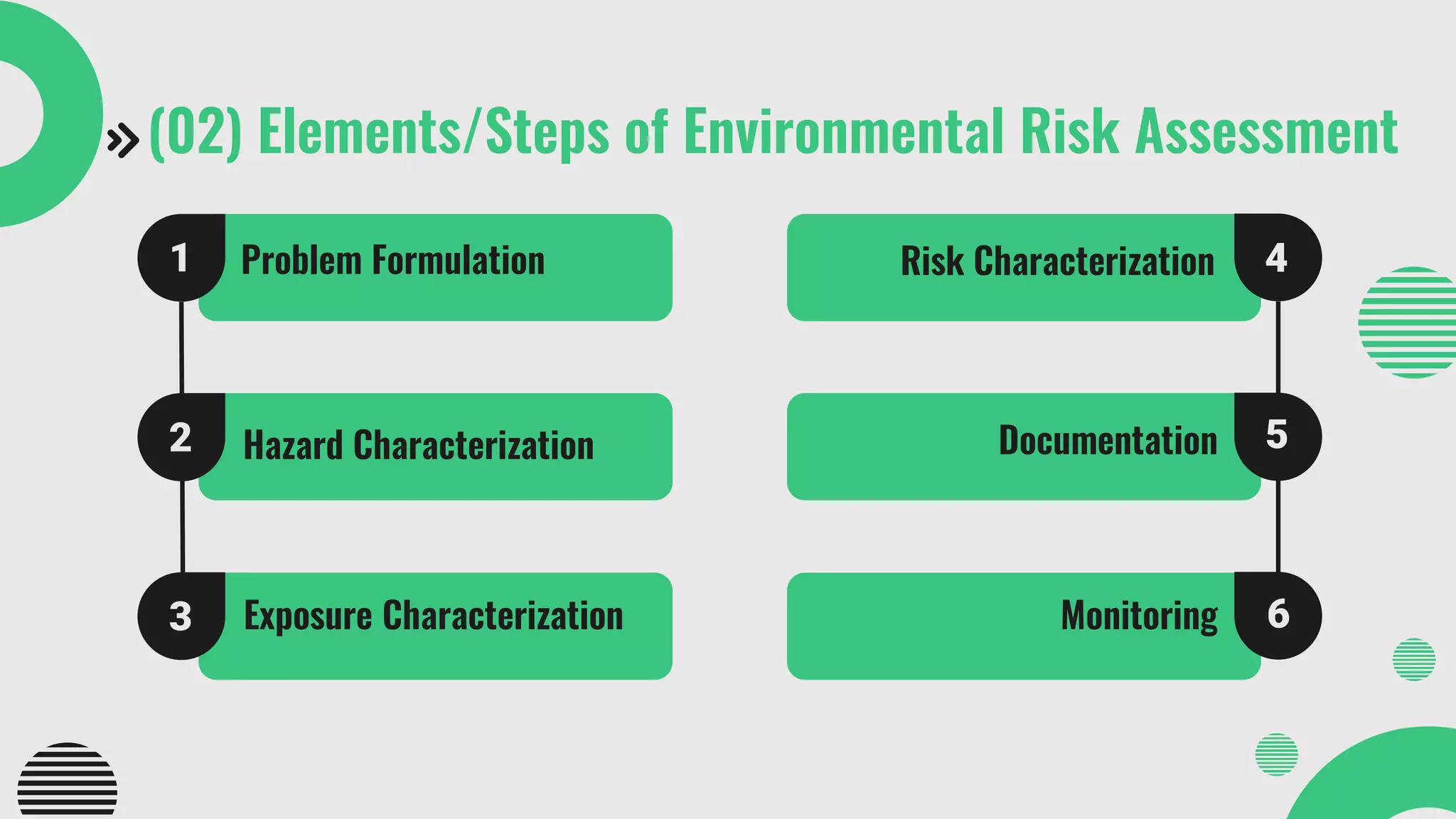
(02) What are the Elements/Steps of
Environmental Risk Assessment?
Hazard Characterization
Risk Characterization
Documentation
Monitoring
Problem Formulation
Exposure Characterization
1
2
3
4
5
6
Hazard Characterization
Risk Characterization
Documentation
Monitoring
Problem Formulation
Exposure Characterization
(02) Elements/Steps of Environmental Risk Assessment
- the most critical step
- defining the scope of an
ERA by identifying what
needs to be protected from
harm
What are the problems?
➢ Too much solid waste
➢ Improper waste disposal
➢ Too much carbon dioxide emission
1 Problem Formulation
Elements/Steps of Environmental
Risk Assessment.
- examining the potential
environmental hazards
present in the workplace or
site
2
Elements/Steps of Environmental
Risk Assessment.
Hazard Characterization
What are the hazards?
➢ Too much solid waste that causes
pollution in water and soil
➢ Improper waste disposal leads to
other problems like flood that can
spread different kinds of diseases
➢ Too much carbon dioxide poses
threat to respiratory system and
causes acid rain.
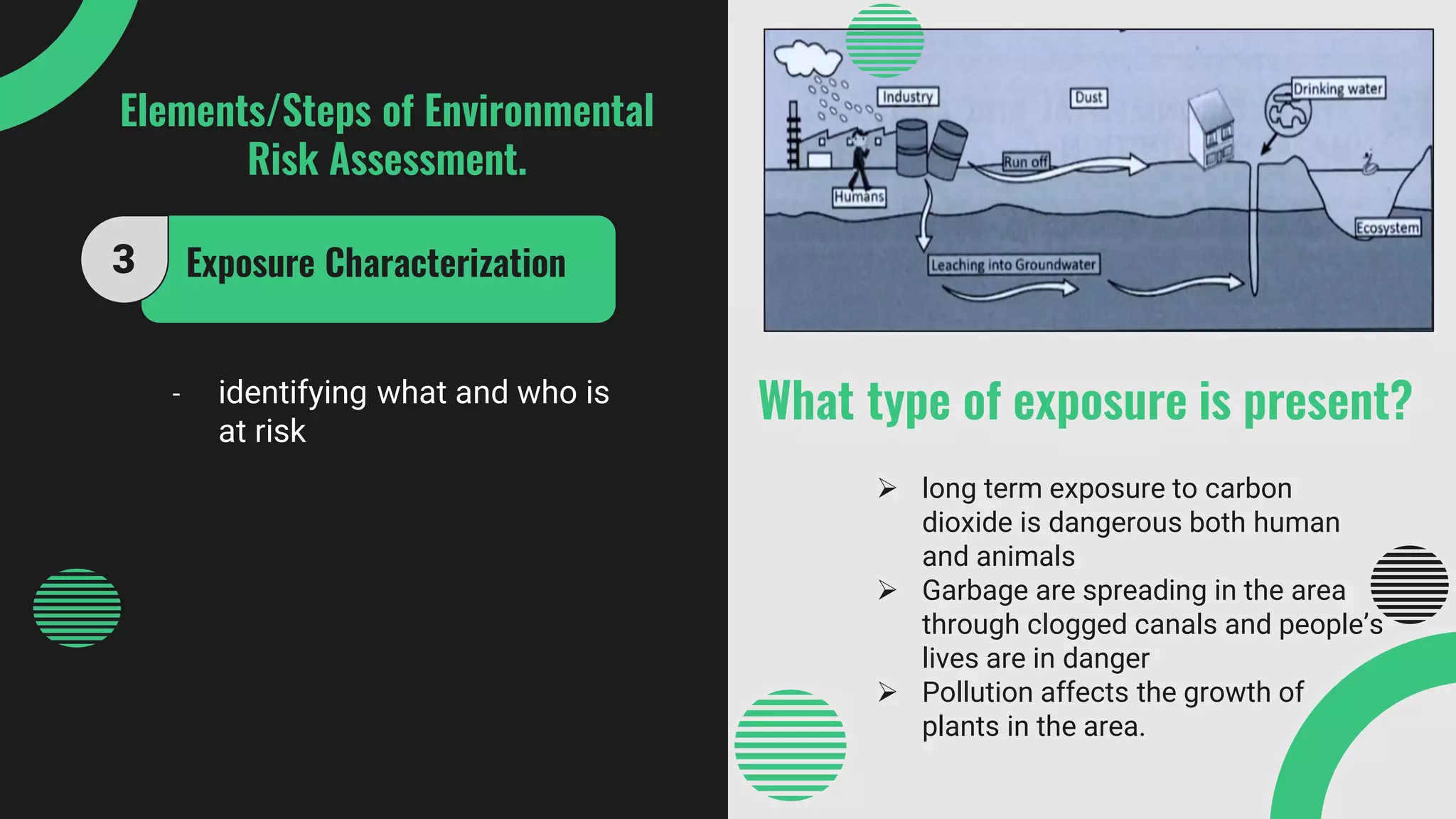
- identifying what and who is
at risk
What type of exposure is present?
➢ long term exposure to carbon
dioxide is dangerous both human
and animals
➢ Garbage are spreading in the area
through clogged canals and people’s
lives are in danger
➢ Pollution affects the growth of
plants in the area.
3
Elements/Steps of Environmental
Risk Assessment.
Exposure Characterization
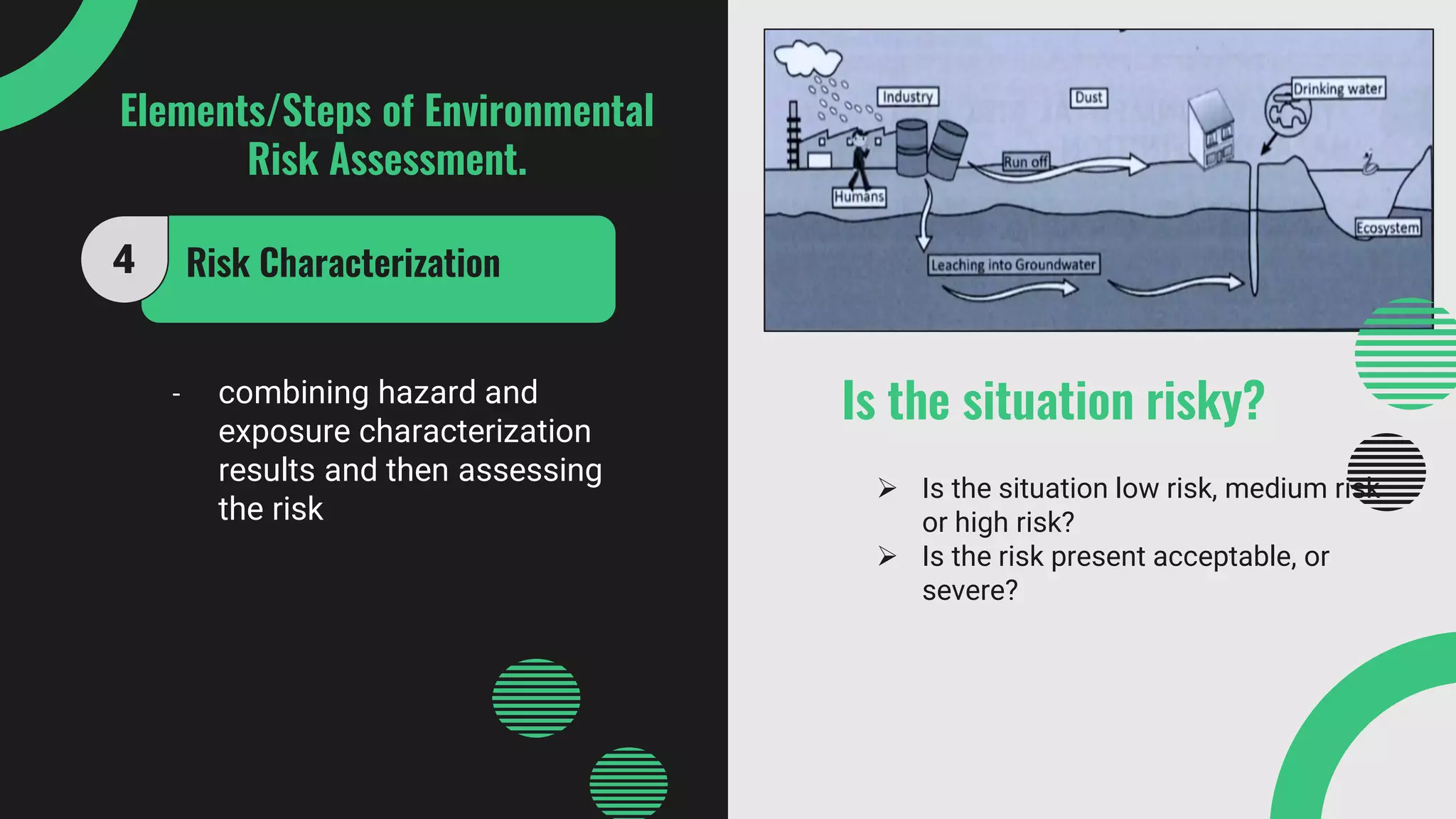
Is the situation risky?
➢ Is the situation low risk, medium risk
or high risk?
➢ Is the risk present acceptable, or
severe?
- combining hazard and
exposure characterization
results and then assessing
the risk
4
Elements/Steps of Environmental
Risk Assessment.
Risk Characterization
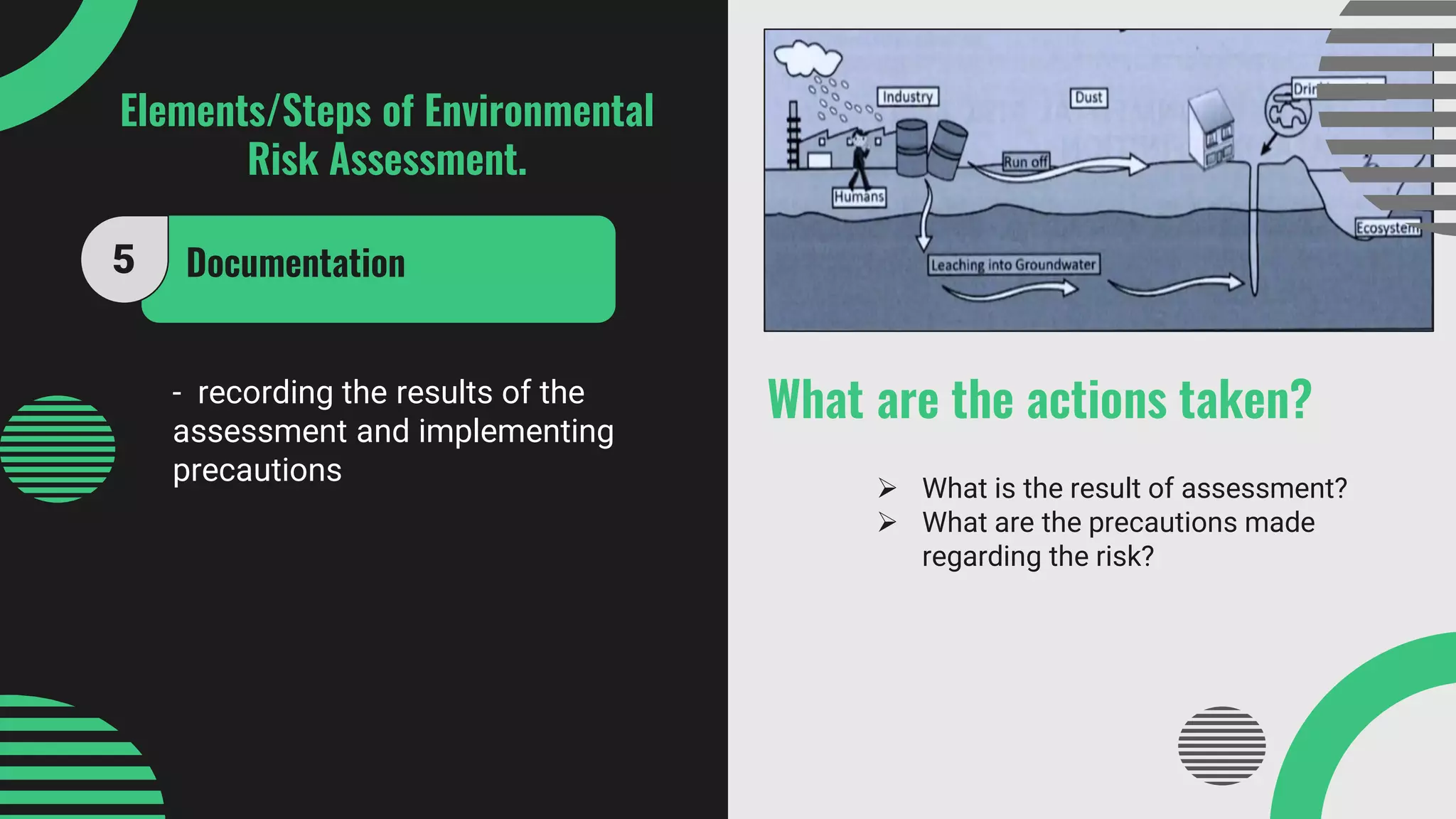
What are the actions taken?
➢ What is the result of assessment?
➢ What are the precautions made
regarding the risk?
- recording the results of the
assessment and implementing
precautions
5
Elements/Steps of Environmental
Risk Assessment.
Documentation
What’s the status of implementation?
➢ Is the precaution/solution being
maintained?
- reviewing the assessment at
regular intervals
6
Elements/Steps of Environmental
Risk Assessment.
Monitoring
1
2
3
4
5
6
Hazard Characterization
Risk Characterization
Documentation
Monitoring
Problem Formulation
Exposure Characterization
(02) Elements/Steps of Environmental Risk Assessment
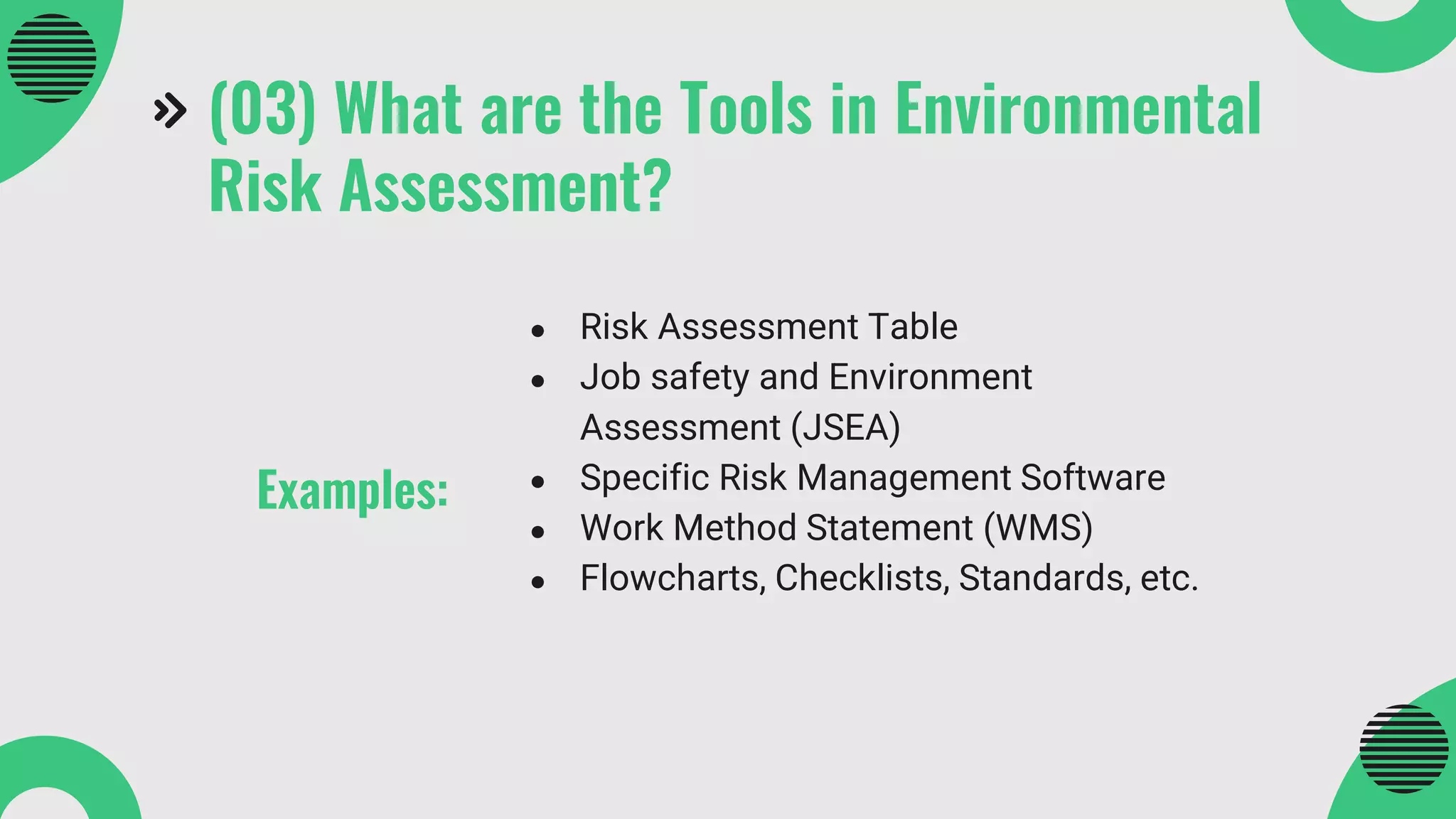
(03) What are the Tools in Environmental
Risk Assessment?
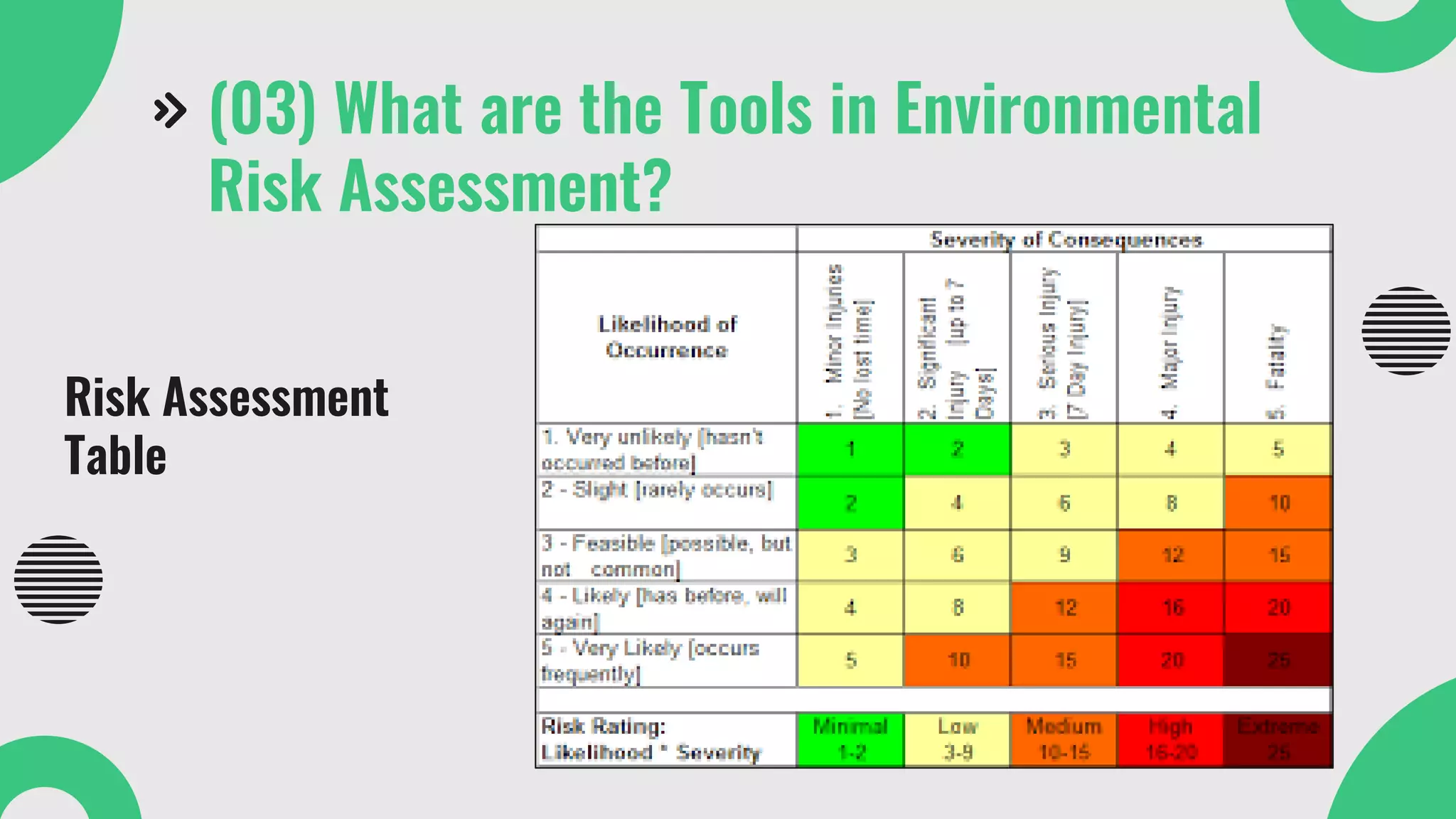
● Risk Assessment Table
● Job safety and Environment
Assessment (JSEA)
● Specific Risk Management Software
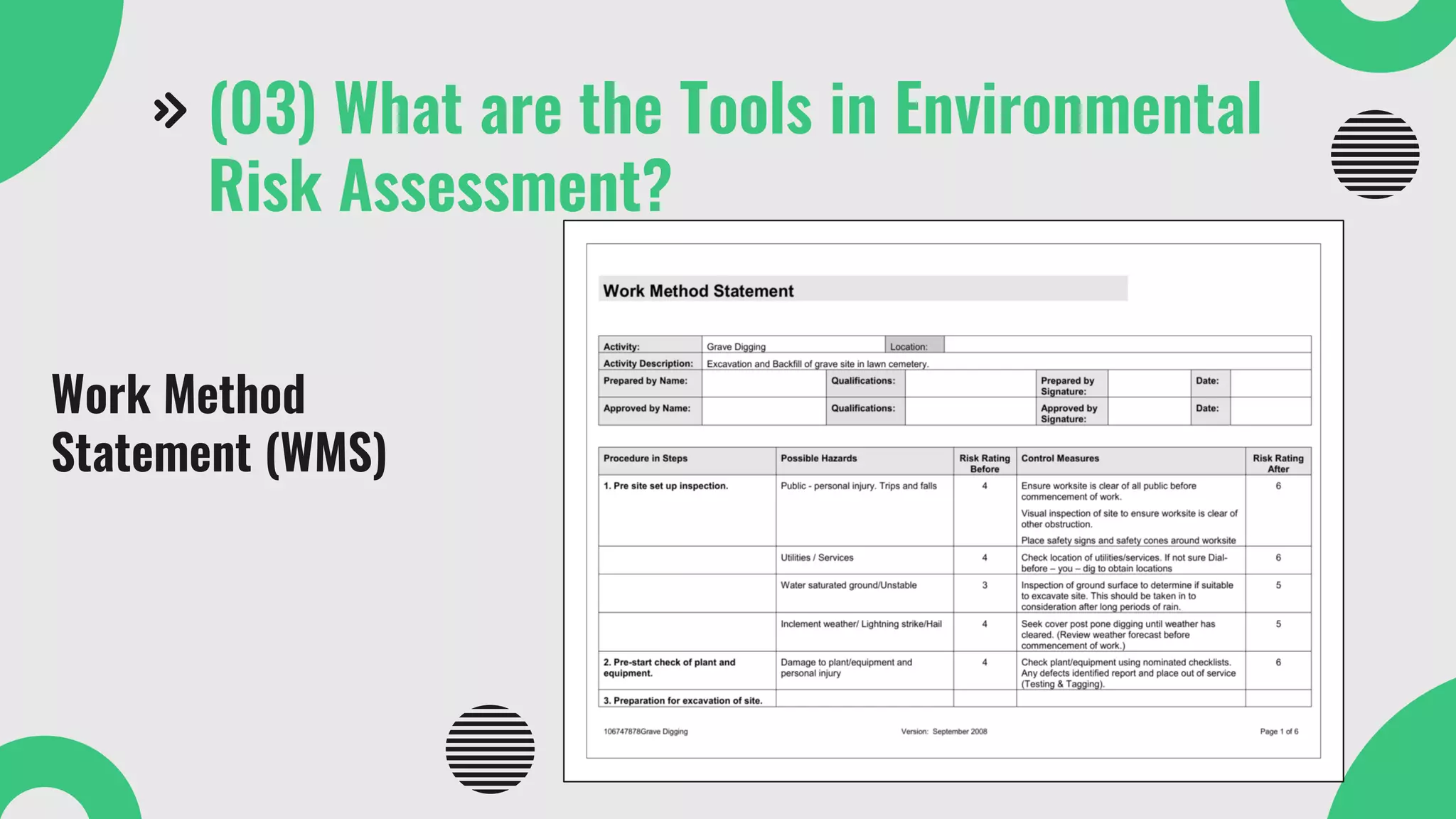
● Work Method Statement (WMS)
● Flowcharts, Checklists, Standards, etc.
Examples:
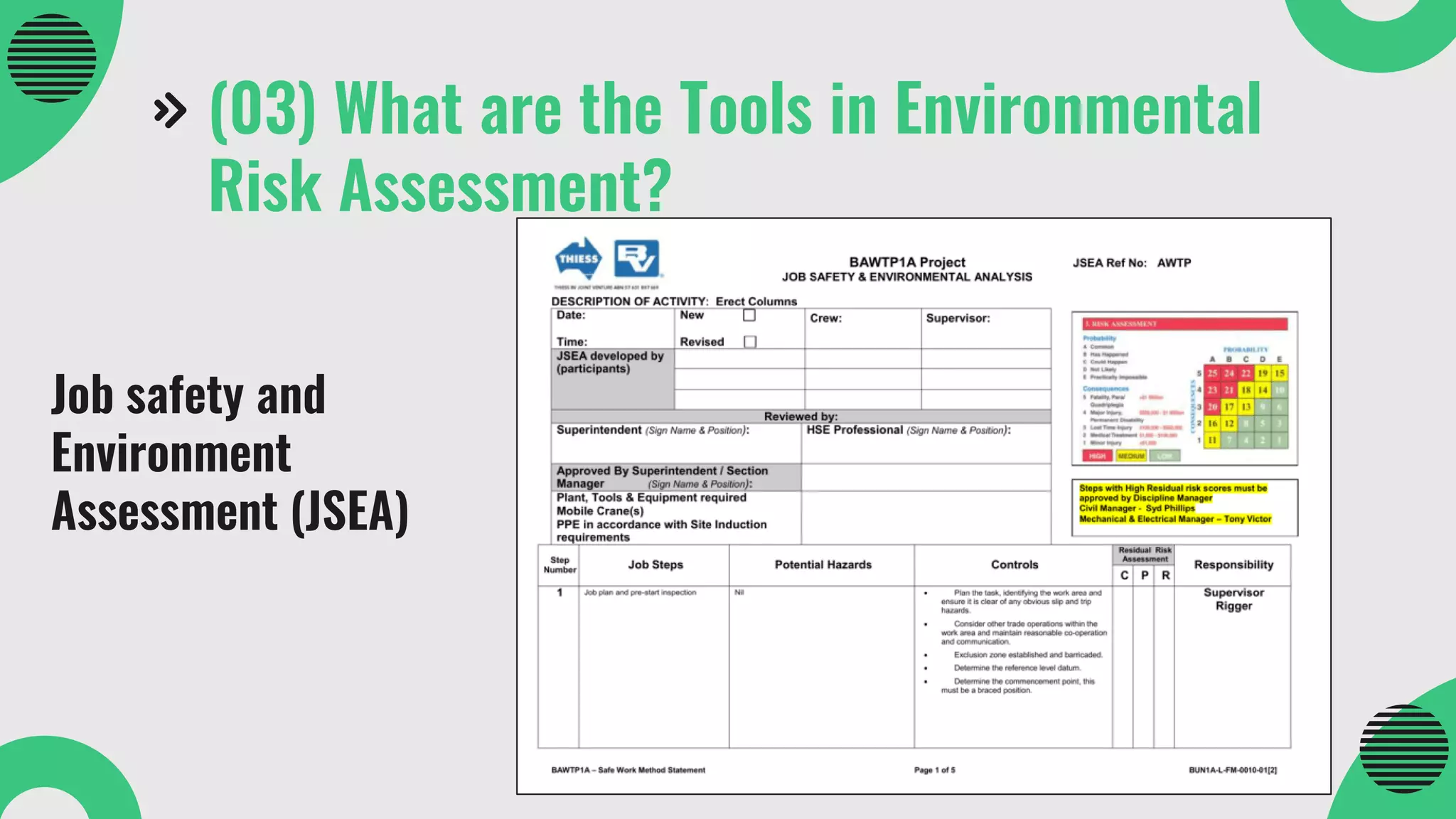
(03) What are the Tools in Environmental
Risk Assessment?
Job safety and
Environment
Assessment (JSEA)
(03) What are the Tools in Environmental
Risk Assessment?
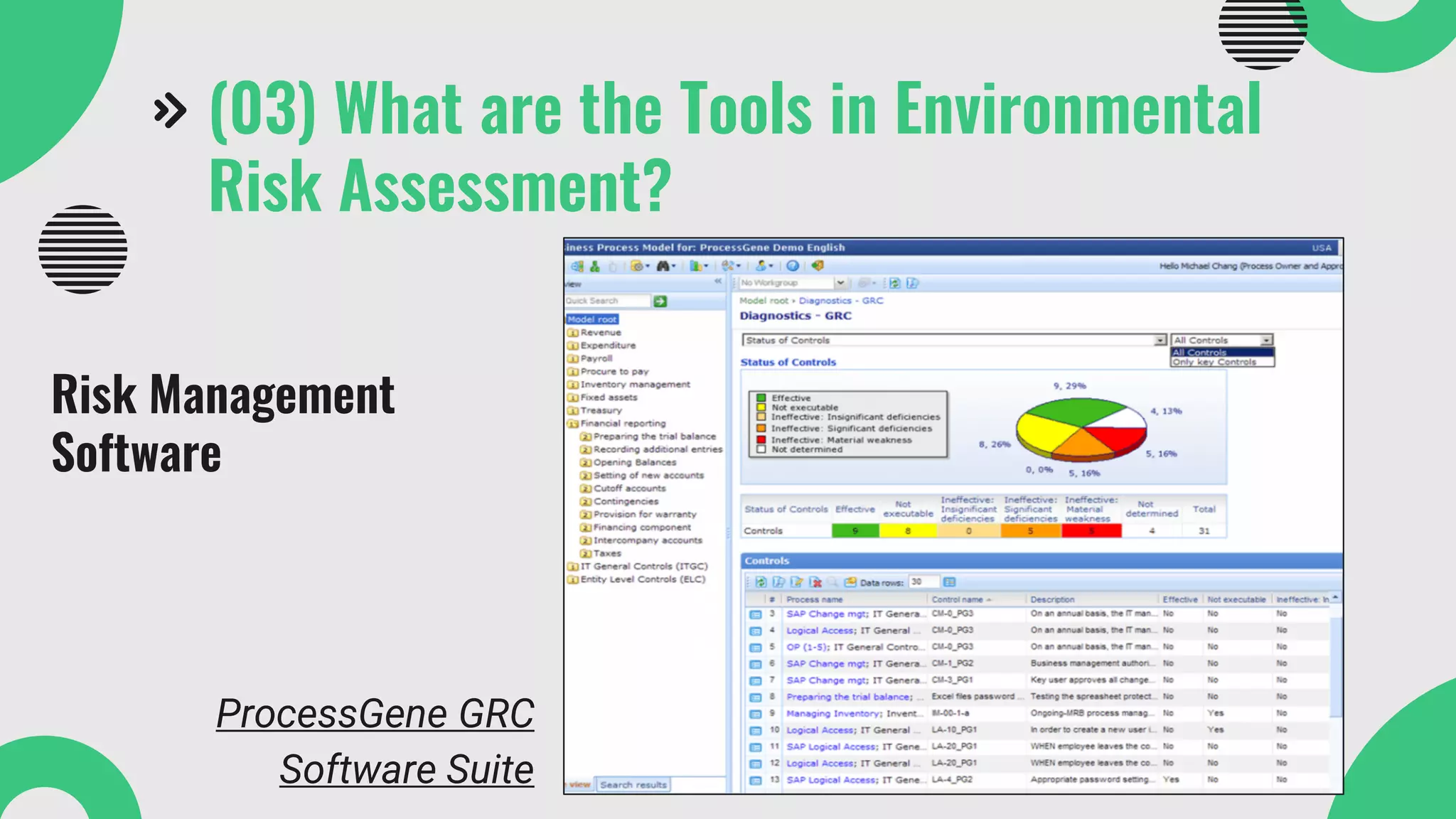
Risk Management
Software
ProcessGene GRC
Software Suite
(03) What are the Tools in Environmental
Risk Assessment?
Work Method
Statement (WMS)
(03) What are the Tools in Environmental
Risk Assessment?
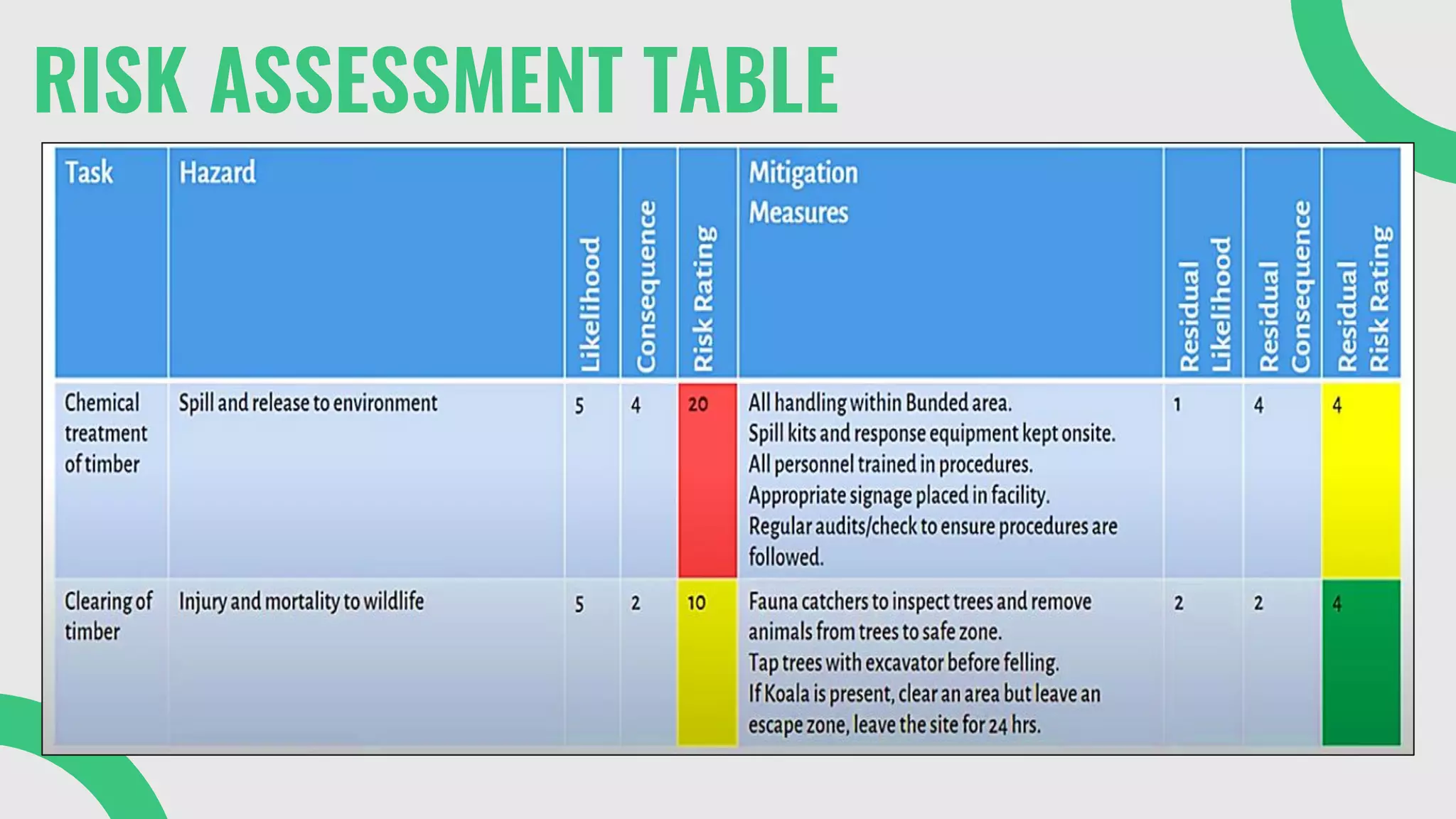
Risk Assessment
Table
(03) Sample Tools in Environmental Risk
Assessment
Risk Assessment Table
*Potential for something to
cause harm.
*Includes substances,
machines, energy forms or
the way work is carried out.
*Refers to the time or
period and/or space or area
*Refers to the probability of
harm after exposure to
hazard
RISK
HAZARD EXPOSURE
X =
RISK
HAZARD EXPOSURE
X =
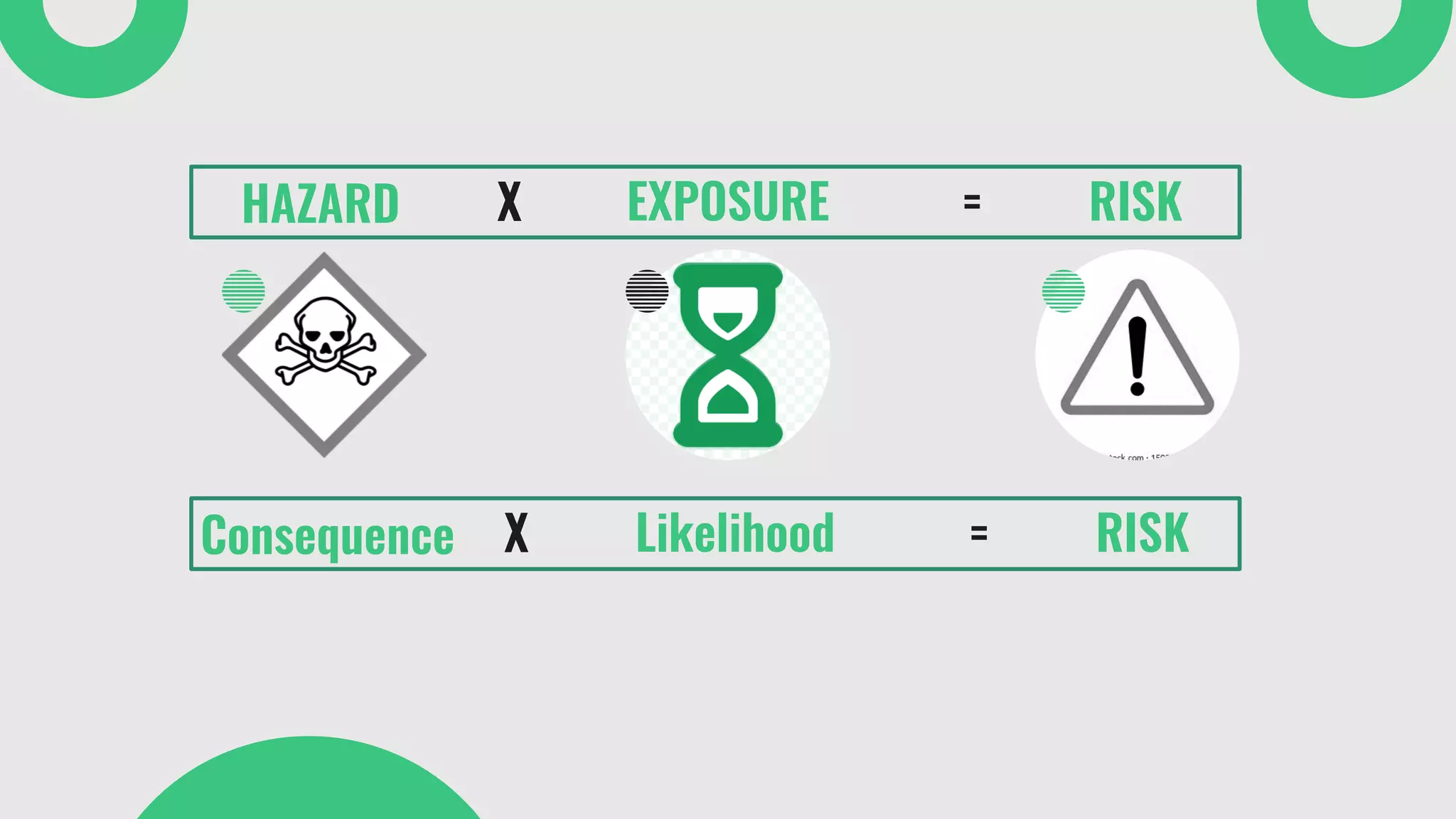
RISK
Consequence Likelihood
X =
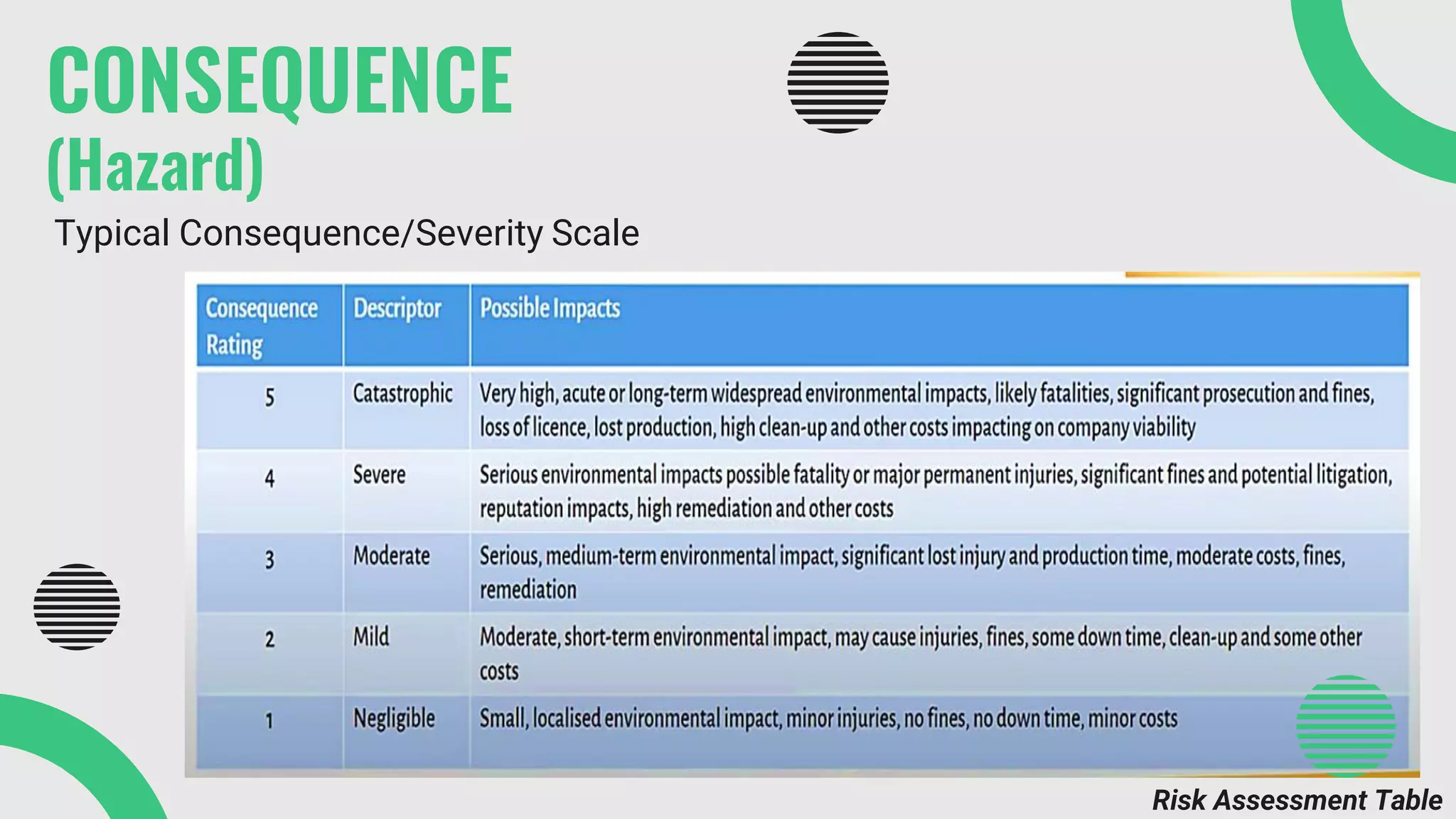
CONSEQUENCE
(Hazard)
Typical Consequence/Severity Scale
Risk Assessment Table
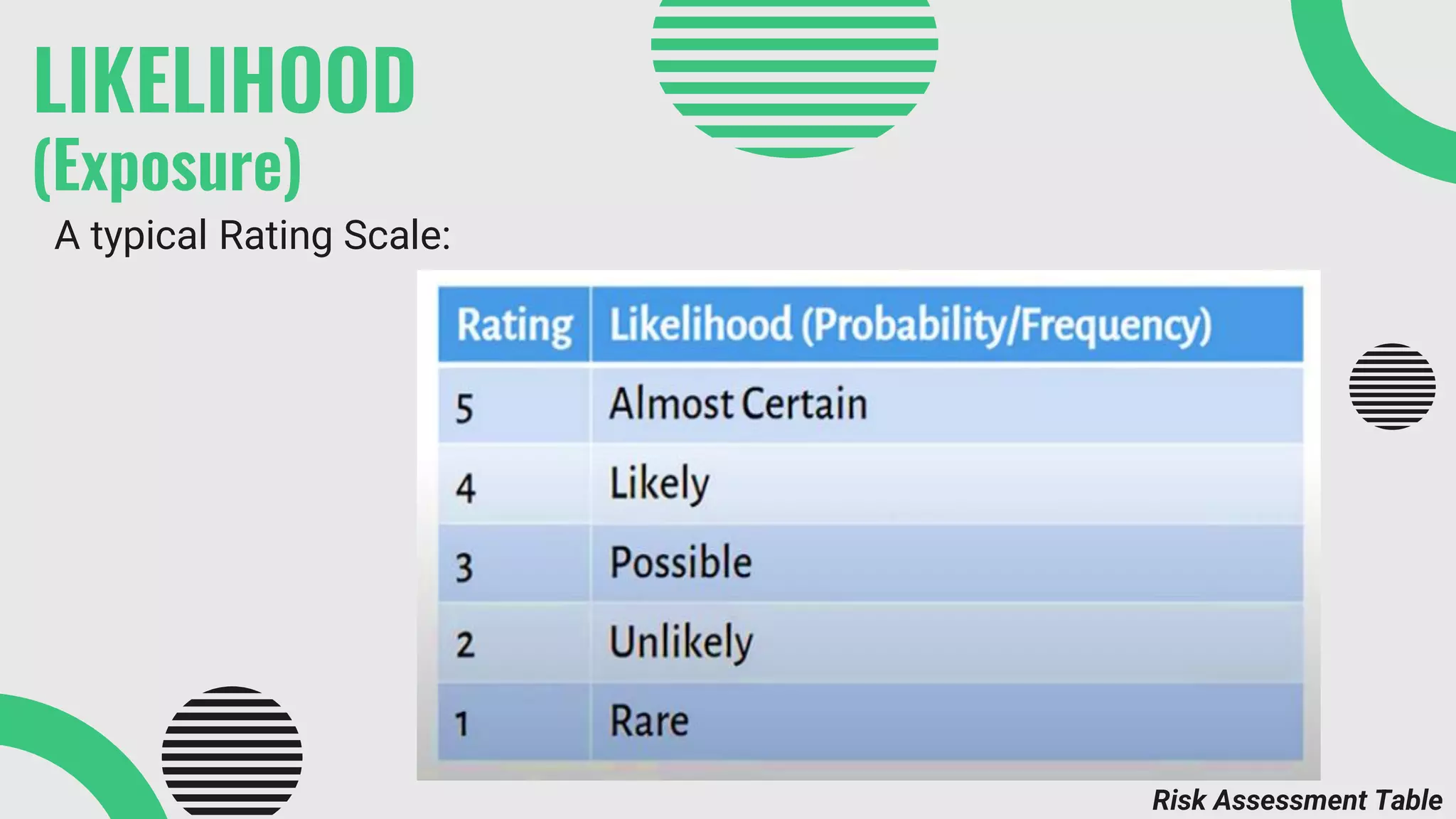
LIKELIHOOD
(Exposure)
A typical Rating Scale:
Risk Assessment Table
RISK MATRIX
Many ways to quantify risk. . . one way is the 5 x 5 matrix
Risk Assessment Table
RISK ASSESSMENT TABLE
___________
ENVIRONMENTAL RISK
MANAGEMENT
ENVIRONMENTAL RISK ASSESSMENT
ENVIRONMENTAL RISK MANAGEMENT
In Risk Management process, the
results of the risk assessment are
integrated with other considerations,
such as economic or legal concerns, to
reach decisions regarding the need for
and practicability of implementing
various risk reduction activities.
(04) What is Environmental Risk
Management (ERM)?
https://www.epa.gov/risk/risk-management
In Risk Management process, the
results of the risk assessment are
integrated with other considerations,
such as economic or legal concerns, to
reach decisions regarding the need for
and practicability of implementing
various risk reduction activities.
(04) What is Environmental Risk
Management (ERM)?
https://www.epa.gov/risk/risk-management
results of the risk assessment
decisions
risk reduction activities.
are important in making
to create
(05) Strategies in Environmental
Risk Management (ERM)
terminate
mitigate
transfer
exploit
accept
RISK MANAGEMENT STRATEGIES
Terminate
Terminate the
source of risk
when possible
Mitigate
Mitigate the
effects by
improving
environmental
management
techniques or
engineering
systems
Transfer
Transfer the risk
through new
technology,
procedure or
investment
Exploit
Exploit the
potential benefit
of the risk by
embracing new
opportunities
Accept
Accept the risk
by not
intervening with
new or existing
situations
RISK MANAGER
An individual, a team, or an
organization with responsibility
for or authority to take action in
response to an identified risk.
RISK ASSESSOR
An individual or a team with the
training and expertise to conduct a
risk assessment.
ENVIRONMENTAL SCIENTIST
Scientists that generate data used in a
risk assessment – specialists in variety
of fields, including geology, hydrogeology,
chemistry, toxicology, and engineering
STAKEHOLDER
Any individual, team, or organization
interested in, responsible for, or
affected by the outcome of a risk
assessment.
(06) Environmental Risk Assessment &
Management – Key Players
What is the
Importance of
Environmental Risk
Assessment and
Management?
• Create awareness of hazards and risk.
• Identify who may be at risk (e.g., employees, cleaners,
visitors, contractors, the public, etc.).
• Determine whether a control program is required for a
particular hazard.
• Determine if existing control measures are adequate or if
more should be done.
• Prevent injuries or illnesses, especially when done at the
design or planning stage.
• Prioritize hazards and control measures.
• Meet legal requirements where applicable.
(07) Importance of Risk Assessment & Management
“HUMAN TEST”
CREDITS: This presentation template was
created by Slidesgo, including icons by
Flaticon, and infographics & images by Freepik
Thanks Do you have any questions?
Resources
● https://www.ccohs.ca/oshanswers/hsprograms/risk_assessment.html
● https://cdn.ymaws.com/www.setac.org/resource/resmgr/publications_and_resources/set
ac_tip_era.pdf
● https://search.epa.gov
● https://www.youtube.com/watch?v=Rv4QKxnrifY
● https://www.youtube.com/watch?v=NCPIgAcR2SI&t=1615s
● https://www.youtube.com/watch?v=kEinQtKEzwc&t=104s

ENVIRONMENTAL RISK ASSESSMENT AND MANAGEMENT

  • 1.
  • 4.
  • 13.
  • 14.
    Objectives of thelesson: 1. Identify the elements of risk assessment and explain the impact of it. 2. Explain the tools and methods of risk assessment and cite some examples. 3. Identify the different risk management and explain the importance and impact to human and environment.
  • 15.
    Definition of EnvironmentalRisk Assessment 01 03 CONTENTS OF THE REPORT Steps/Elements of Environmental Risk Assessment 02 Tools in conducting Environmental Risk Assessment Definition of Environmental Risk Management 04 06 Strategies in Environmental Risk Management 05 Key players in Environmental Risk Assessment & Management 07 Importance of Environmental Risk Assessment and Management
  • 16.
  • 17.
    An environmental RISKassessment (ERA) is a process for evaluating how likely it is that the environment (including human) may be impacted as a result of EXPOSURE to one or more environmental HAZARD, such as chemicals, disease, invasive species, and climate change. (01) What is Environmental Risk Assessment (ERA)?
  • 18.
  • 19.
  • 20.
    An environmental RISKassessment (ERA) is a process for evaluating how likely it is that the environment (including human) may be impacted as a result of EXPOSURE to one or more environmental HAZARD, such as chemicals, disease, invasive species, and climate change. (01) What is Environmental Risk Assessment (ERA)? RISK HAZARD EXPOSURE
  • 21.
    *Potential for somethingto cause harm. *Includes substances, machines, energy forms or the way work is carried out. RISK HAZARD EXPOSURE
  • 22.
    *Potential for somethingto cause harm. *Includes substances, machines, energy forms or the way work is carried out. • Air contaminants • Toxic waste • Radiation • Disease-causing microorganisms and plants • Pesticides • Heavy metals • Chemicals in consumer products • Extreme temperatures • Weather events • The most common environmental health hazards are air and water pollution. RISK HAZARD EXPOSURE X = : Examples
  • 23.
    •*Air contaminants •*Toxic waste •*Radiation •*Disease-causing microorganismsand plants •*Pesticides •*Heavy metals •*Chemicals in consumer products •*Extreme temperatures •*Weather events •*Air and water pollution.
  • 24.
    *Potential for somethingto cause harm. *Includes substances, machines, energy forms or the way work is carried out. *Refers to the time or period and/or space or area *Refers to the probability of harm after exposure to hazard during the work that is being caried out or by the way something is used RISK HAZARD EXPOSURE X =
  • 25.
  • 26.
    Source-Pathway-Receptor Concept Model Source Originof the hazard Pathway Linkage that connects the source of hazard and the receptor living organisms, habitat, or natural resources which could be adversely affected by environmental contaminations Receptor
  • 27.
    If there isno pathway, there is no risk. If the pathway exists, the consequences must be determined
  • 28.
    (02) What arethe Elements/Steps of Environmental Risk Assessment? Hazard Characterization Risk Characterization Documentation Monitoring Problem Formulation Exposure Characterization
  • 29.
    1 2 3 4 5 6 Hazard Characterization Risk Characterization Documentation Monitoring ProblemFormulation Exposure Characterization (02) Elements/Steps of Environmental Risk Assessment
  • 30.
    - the mostcritical step - defining the scope of an ERA by identifying what needs to be protected from harm What are the problems? ➢ Too much solid waste ➢ Improper waste disposal ➢ Too much carbon dioxide emission 1 Problem Formulation Elements/Steps of Environmental Risk Assessment.
  • 31.
    - examining thepotential environmental hazards present in the workplace or site 2 Elements/Steps of Environmental Risk Assessment. Hazard Characterization What are the hazards? ➢ Too much solid waste that causes pollution in water and soil ➢ Improper waste disposal leads to other problems like flood that can spread different kinds of diseases ➢ Too much carbon dioxide poses threat to respiratory system and causes acid rain.
  • 32.
    - identifying whatand who is at risk What type of exposure is present? ➢ long term exposure to carbon dioxide is dangerous both human and animals ➢ Garbage are spreading in the area through clogged canals and people’s lives are in danger ➢ Pollution affects the growth of plants in the area. 3 Elements/Steps of Environmental Risk Assessment. Exposure Characterization
  • 33.
    Is the situationrisky? ➢ Is the situation low risk, medium risk or high risk? ➢ Is the risk present acceptable, or severe? - combining hazard and exposure characterization results and then assessing the risk 4 Elements/Steps of Environmental Risk Assessment. Risk Characterization
  • 34.
    What are theactions taken? ➢ What is the result of assessment? ➢ What are the precautions made regarding the risk? - recording the results of the assessment and implementing precautions 5 Elements/Steps of Environmental Risk Assessment. Documentation
  • 35.
    What’s the statusof implementation? ➢ Is the precaution/solution being maintained? - reviewing the assessment at regular intervals 6 Elements/Steps of Environmental Risk Assessment. Monitoring
  • 36.
    1 2 3 4 5 6 Hazard Characterization Risk Characterization Documentation Monitoring ProblemFormulation Exposure Characterization (02) Elements/Steps of Environmental Risk Assessment
  • 37.
    (03) What arethe Tools in Environmental Risk Assessment? ● Risk Assessment Table ● Job safety and Environment Assessment (JSEA) ● Specific Risk Management Software ● Work Method Statement (WMS) ● Flowcharts, Checklists, Standards, etc. Examples:
  • 38.
    (03) What arethe Tools in Environmental Risk Assessment? Job safety and Environment Assessment (JSEA)
  • 39.
    (03) What arethe Tools in Environmental Risk Assessment? Risk Management Software ProcessGene GRC Software Suite
  • 40.
    (03) What arethe Tools in Environmental Risk Assessment? Work Method Statement (WMS)
  • 41.
    (03) What arethe Tools in Environmental Risk Assessment? Risk Assessment Table
  • 42.
    (03) Sample Toolsin Environmental Risk Assessment Risk Assessment Table
  • 43.
    *Potential for somethingto cause harm. *Includes substances, machines, energy forms or the way work is carried out. *Refers to the time or period and/or space or area *Refers to the probability of harm after exposure to hazard RISK HAZARD EXPOSURE X =
  • 44.
  • 45.
  • 46.
    LIKELIHOOD (Exposure) A typical RatingScale: Risk Assessment Table
  • 47.
    RISK MATRIX Many waysto quantify risk. . . one way is the 5 x 5 matrix Risk Assessment Table
  • 48.
  • 49.
  • 50.
    ENVIRONMENTAL RISK ASSESSMENT ENVIRONMENTALRISK MANAGEMENT ENVIRONMENTAL RISK MANAGEMENT
  • 51.
    In Risk Managementprocess, the results of the risk assessment are integrated with other considerations, such as economic or legal concerns, to reach decisions regarding the need for and practicability of implementing various risk reduction activities. (04) What is Environmental Risk Management (ERM)? https://www.epa.gov/risk/risk-management
  • 52.
    In Risk Managementprocess, the results of the risk assessment are integrated with other considerations, such as economic or legal concerns, to reach decisions regarding the need for and practicability of implementing various risk reduction activities. (04) What is Environmental Risk Management (ERM)? https://www.epa.gov/risk/risk-management
  • 53.
    results of therisk assessment decisions risk reduction activities. are important in making to create
  • 54.
    (05) Strategies inEnvironmental Risk Management (ERM) terminate mitigate transfer exploit accept
  • 55.
    RISK MANAGEMENT STRATEGIES Terminate Terminatethe source of risk when possible Mitigate Mitigate the effects by improving environmental management techniques or engineering systems Transfer Transfer the risk through new technology, procedure or investment Exploit Exploit the potential benefit of the risk by embracing new opportunities Accept Accept the risk by not intervening with new or existing situations
  • 56.
    RISK MANAGER An individual,a team, or an organization with responsibility for or authority to take action in response to an identified risk. RISK ASSESSOR An individual or a team with the training and expertise to conduct a risk assessment. ENVIRONMENTAL SCIENTIST Scientists that generate data used in a risk assessment – specialists in variety of fields, including geology, hydrogeology, chemistry, toxicology, and engineering STAKEHOLDER Any individual, team, or organization interested in, responsible for, or affected by the outcome of a risk assessment. (06) Environmental Risk Assessment & Management – Key Players
  • 57.
    What is the Importanceof Environmental Risk Assessment and Management?
  • 58.
    • Create awarenessof hazards and risk. • Identify who may be at risk (e.g., employees, cleaners, visitors, contractors, the public, etc.). • Determine whether a control program is required for a particular hazard. • Determine if existing control measures are adequate or if more should be done. • Prevent injuries or illnesses, especially when done at the design or planning stage. • Prioritize hazards and control measures. • Meet legal requirements where applicable. (07) Importance of Risk Assessment & Management
  • 59.
  • 67.
    CREDITS: This presentationtemplate was created by Slidesgo, including icons by Flaticon, and infographics & images by Freepik Thanks Do you have any questions?
  • 68.
    Resources ● https://www.ccohs.ca/oshanswers/hsprograms/risk_assessment.html ● https://cdn.ymaws.com/www.setac.org/resource/resmgr/publications_and_resources/set ac_tip_era.pdf ●https://search.epa.gov ● https://www.youtube.com/watch?v=Rv4QKxnrifY ● https://www.youtube.com/watch?v=NCPIgAcR2SI&t=1615s ● https://www.youtube.com/watch?v=kEinQtKEzwc&t=104s