MODULE 1Ver.1School of Post Graduate StudiesEngineering Staff College of India, HyderabadSession by: Dr. N. SaiBhaskar Reddysaibhaskarnakka@gmail.comhttp://e-geo.orgENVIRONMENT MANAGEMENT
Definition1. Environmental management is not, as the phrase could suggest, the management of the environment as such, but rather the management of interaction by the modern human societies with, and impact upon the environment. http://en.wikipedia.org/wiki/Environmental_management2. an attempt to control human impact on andinteraction with the environment in order topreserve natural resources Example:   Environmental management focuses on theimprovement of human welfare for present andfuture generations.Etymology:   1962http://dictionary.reference.com/browse/environmental+management
Carrying CapacityA more common philosophy and impetus behind environmental management is the concept of carrying capacity.
 Environment ResourcesAnything an organism needs that can be taken from the environment.http://highered.mcgraw-hill.com/sites/0070294267/student_view0/glossary_e-l.html
Environmental pollutionEnvironmental pollution is “the contamination of the physical and biological components of the earth/atmosphere system to such an extent that normal environmental processes are adversely affected”. (1)“Pollution is the introduction of contaminants into the environment that cause harm or discomfort to humans or other living organisms, or that damage the environment” which can come “in the form of chemical substances, or energy such as noise, heat or light”. “Pollutants can be naturally occurring substances or energies, but are considered contaminants when in excess of natural levels.” (2)Pollution is “the addition of any substance or form of energy (e.g., heat, sound, radioactivity) to the environment at a rate faster than the environment can accommodate it by dispersion, breakdown, recycling, or storage in some harmless form”. (3)“Pollution is a special case of habitat destruction; it is chemical destruction rather than the more obvious physical destruction. Pollution occurs in all habitats—land, sea, and fresh water—and in the atmosphere.” (4)“Much of what we have come to call pollution is in reality the nonrecoverable matter resources and waste heat.” (5)“Any use of natural resources at a rate higher than nature's capacity to restore itself can result in pollution of air, water, and land.” (6)“Pollution is habitat contamination”. (7)http://www.tropical-rainforest-animals.com/Environmental-Pollution.html
Combination of the environment with waste products and other impurities is simply called pollution. And the substances whose presence in air, water, or soil is harmful to human beings, plants, animals and soil are termed as pollutants. Pollution may beclassified as air pollution, water pollution, soil pollution, sea pollution, radiation and noise pollution. The environment is being severely damaged by the pollution and is becoming hostile or unfit for the survival of many forms of life including man kind. Following are some of the effects of pollution on environment. a. Sulfur dioxide damages the leaves of plants. It corrodes metallic and stonestructure.b. Higher concentrations of carbon dioxide are harmful to animals.c. Carbon monoxide combines with the hemoglobin to reduce oxygen in blood.d. Oxides of nitrogen corrode metals and stones produce the photo-chemical smog that inhibits the plant growth.e. Higher concentrations of ozone reduce air visibility and also cause health problems for example eyes irritation and headache etc. f. Untreated sewage is source of germs causing cholera and typhoid.g. Densely populated bacteria in water due to pollution consume the oxygen of water. This oxygen consumption affects the water animals and even death of fish.http://www.tropical-rainforest-animals.com/pollution-effects.htmlhttp://www.gits4u.com/envo/envo4.htmWhat Is Environmental Pollution? A Short History Of A Concepthttp://reducepollutiontip.com/environmental/permalink.php?article=what+is+environmental+pollution.txt
Videos: Environmental PollutionHOMEhttp://www.youtube.com/watch?v=jqxENMKaeCU
Environmental management systemEnvironmental management system (EMS) refers to the management of an organization's environmental programs in a comprehensive, systematic, planned and documented manner. It includes the organisational structure, planning and resources for developing, implementing and maintaining policy for environmental protection.An Environmental Management System (EMS):
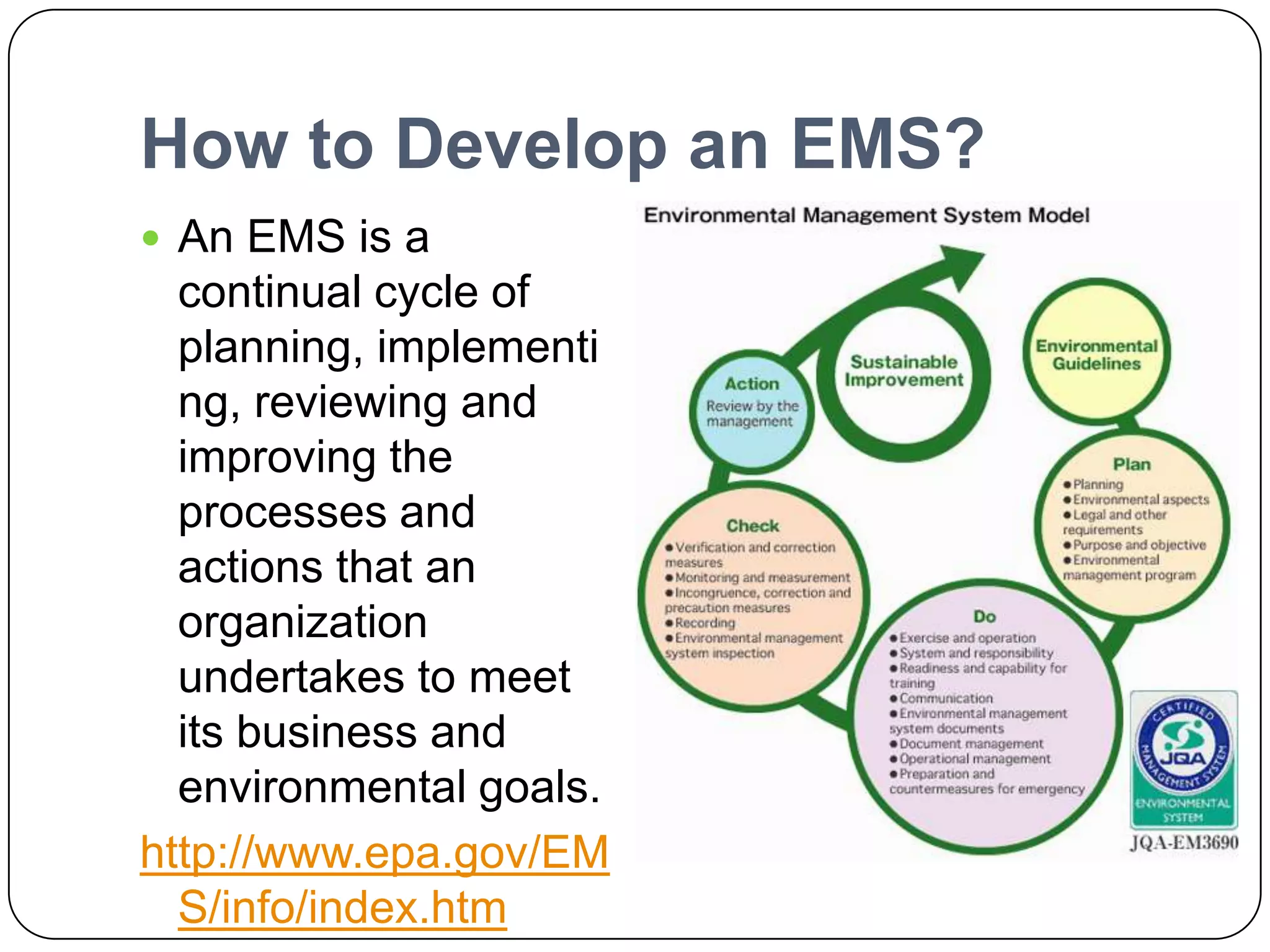
How to Develop an EMS?An EMS is a continual cycle of planning, implementing, reviewing and improving the processes and actions that an organization undertakes to meet its business and environmental goals.http://www.epa.gov/EMS/info/index.htm
Why Develop an EMS?BenefitsEMS can result in both business and environmental benefits. For example, an EMS may help you:Improve environmental performanceEnhance compliancePrevent pollution and conserve resourcesReduce/mitigate risksAttract new customers and markets (or at least retain access to customers and markets with EMS requirements)Increase efficiencyReduce costsEnhance employee morale and possibly enhance recruitment of new employeesEnhance image with public, regulators, lenders, investorsAchieve/improve employee awareness of environmental issues and responsibilitiesQualify for recognition/incentive programs such as the EPA Performance Track Program.http://www.epa.gov/EMS/info/index.htm
http://en.wikipedia.org/wiki/Environmental_management_system#Can_existing_environmental_management_activities_be_integrated_into_the_EMS.3FEMS
What is ISOISO stands for the International Organization for Standardization, located in Geneva, Switzerland. ISO is a non-governmental organization established in 1947. The organization mainly functions to develop voluntary technical standards that aim at making the development, manufacture and supply of goods and services more efficient, safe and clean.ISO 14000 refers to a family of voluntary standards and guidance documents to help organizations address environmental issues. Included in the family are standards for Environmental Management Systems, environmental and EMS auditing, environmental labeling, performance evaluation and life-cycle assessment.
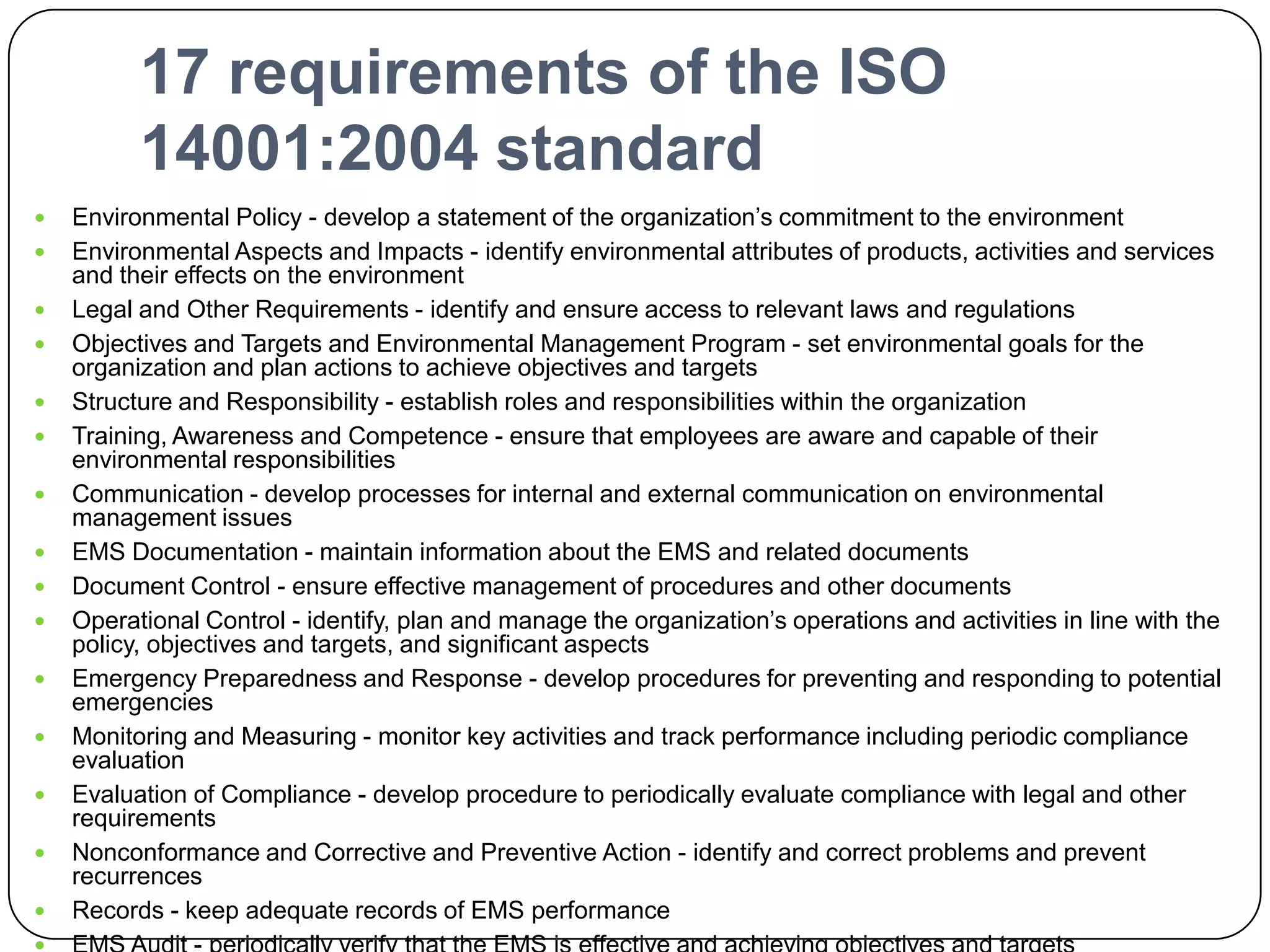
17 requirements of the ISO 14001:2004 standardEnvironmental Policy - develop a statement of the organization’s commitment to the environmentEnvironmental Aspects and Impacts - identify environmental attributes of products, activities and services and their effects on the environmentLegal and Other Requirements - identify and ensure access to relevant laws and regulationsObjectives and Targets and Environmental Management Program - set environmental goals for the organization and plan actions to achieve objectives and targetsStructure and Responsibility - establish roles and responsibilities within the organizationTraining, Awareness and Competence - ensure that employees are aware and capable of their environmental responsibilitiesCommunication - develop processes for internal and external communication on environmental management issuesEMS Documentation - maintain information about the EMS and related documentsDocument Control - ensure effective management of procedures and other documentsOperational Control - identify, plan and manage the organization’s operations and activities in line with the policy, objectives and targets, and significant aspectsEmergency Preparedness and Response - develop procedures for preventing and responding to potential emergenciesMonitoring and Measuring - monitor key activities and track performance including periodic compliance evaluationEvaluation of Compliance - develop procedure to periodically evaluate compliance with legal and other requirementsNonconformance and Corrective and Preventive Action - identify and correct problems and prevent recurrencesRecords - keep adequate records of EMS performanceEMS Audit - periodically verify that the EMS is effective and achieving objectives and targetsManagement Review - review the EMS
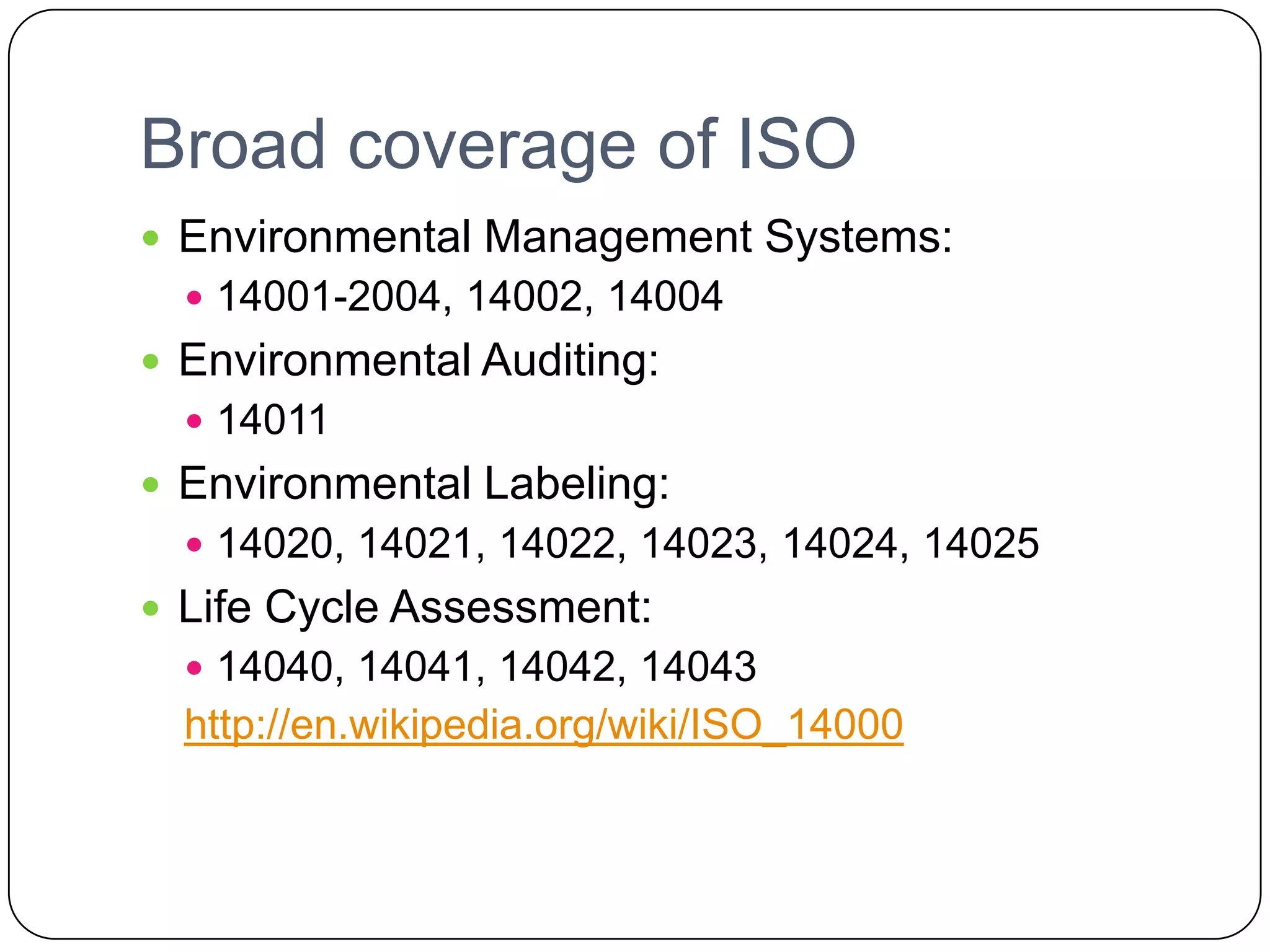
Broad coverage of ISOEnvironmental Management Systems:14001-2004, 14002, 14004Environmental Auditing:14011Environmental Labeling:14020, 14021, 14022, 14023, 14024, 14025Life Cycle Assessment:14040, 14041, 14042, 14043http://en.wikipedia.org/wiki/ISO_14000

Environmental Management Module 1

  • 1.
    MODULE 1Ver.1School ofPost Graduate StudiesEngineering Staff College of India, HyderabadSession by: Dr. N. SaiBhaskar Reddysaibhaskarnakka@gmail.comhttp://e-geo.orgENVIRONMENT MANAGEMENT
  • 2.
    Definition1. Environmental management isnot, as the phrase could suggest, the management of the environment as such, but rather the management of interaction by the modern human societies with, and impact upon the environment. http://en.wikipedia.org/wiki/Environmental_management2. an attempt to control human impact on andinteraction with the environment in order topreserve natural resources Example:   Environmental management focuses on theimprovement of human welfare for present andfuture generations.Etymology:   1962http://dictionary.reference.com/browse/environmental+management
  • 3.
    Carrying CapacityA morecommon philosophy and impetus behind environmental management is the concept of carrying capacity.
  • 4.
     Environment ResourcesAnything anorganism needs that can be taken from the environment.http://highered.mcgraw-hill.com/sites/0070294267/student_view0/glossary_e-l.html
  • 5.
    Environmental pollutionEnvironmental pollution is“the contamination of the physical and biological components of the earth/atmosphere system to such an extent that normal environmental processes are adversely affected”. (1)“Pollution is the introduction of contaminants into the environment that cause harm or discomfort to humans or other living organisms, or that damage the environment” which can come “in the form of chemical substances, or energy such as noise, heat or light”. “Pollutants can be naturally occurring substances or energies, but are considered contaminants when in excess of natural levels.” (2)Pollution is “the addition of any substance or form of energy (e.g., heat, sound, radioactivity) to the environment at a rate faster than the environment can accommodate it by dispersion, breakdown, recycling, or storage in some harmless form”. (3)“Pollution is a special case of habitat destruction; it is chemical destruction rather than the more obvious physical destruction. Pollution occurs in all habitats—land, sea, and fresh water—and in the atmosphere.” (4)“Much of what we have come to call pollution is in reality the nonrecoverable matter resources and waste heat.” (5)“Any use of natural resources at a rate higher than nature's capacity to restore itself can result in pollution of air, water, and land.” (6)“Pollution is habitat contamination”. (7)http://www.tropical-rainforest-animals.com/Environmental-Pollution.html
  • 7.
    Combination of theenvironment with waste products and other impurities is simply called pollution. And the substances whose presence in air, water, or soil is harmful to human beings, plants, animals and soil are termed as pollutants. Pollution may beclassified as air pollution, water pollution, soil pollution, sea pollution, radiation and noise pollution. The environment is being severely damaged by the pollution and is becoming hostile or unfit for the survival of many forms of life including man kind. Following are some of the effects of pollution on environment. a. Sulfur dioxide damages the leaves of plants. It corrodes metallic and stonestructure.b. Higher concentrations of carbon dioxide are harmful to animals.c. Carbon monoxide combines with the hemoglobin to reduce oxygen in blood.d. Oxides of nitrogen corrode metals and stones produce the photo-chemical smog that inhibits the plant growth.e. Higher concentrations of ozone reduce air visibility and also cause health problems for example eyes irritation and headache etc. f. Untreated sewage is source of germs causing cholera and typhoid.g. Densely populated bacteria in water due to pollution consume the oxygen of water. This oxygen consumption affects the water animals and even death of fish.http://www.tropical-rainforest-animals.com/pollution-effects.htmlhttp://www.gits4u.com/envo/envo4.htmWhat Is Environmental Pollution? A Short History Of A Concepthttp://reducepollutiontip.com/environmental/permalink.php?article=what+is+environmental+pollution.txt
  • 8.
  • 9.
    Environmental management systemEnvironmentalmanagement system (EMS) refers to the management of an organization's environmental programs in a comprehensive, systematic, planned and documented manner. It includes the organisational structure, planning and resources for developing, implementing and maintaining policy for environmental protection.An Environmental Management System (EMS):
  • 10.
    How to Developan EMS?An EMS is a continual cycle of planning, implementing, reviewing and improving the processes and actions that an organization undertakes to meet its business and environmental goals.http://www.epa.gov/EMS/info/index.htm
  • 11.
    Why Develop anEMS?BenefitsEMS can result in both business and environmental benefits. For example, an EMS may help you:Improve environmental performanceEnhance compliancePrevent pollution and conserve resourcesReduce/mitigate risksAttract new customers and markets (or at least retain access to customers and markets with EMS requirements)Increase efficiencyReduce costsEnhance employee morale and possibly enhance recruitment of new employeesEnhance image with public, regulators, lenders, investorsAchieve/improve employee awareness of environmental issues and responsibilitiesQualify for recognition/incentive programs such as the EPA Performance Track Program.http://www.epa.gov/EMS/info/index.htm
  • 12.
  • 13.
    What is ISOISOstands for the International Organization for Standardization, located in Geneva, Switzerland. ISO is a non-governmental organization established in 1947. The organization mainly functions to develop voluntary technical standards that aim at making the development, manufacture and supply of goods and services more efficient, safe and clean.ISO 14000 refers to a family of voluntary standards and guidance documents to help organizations address environmental issues. Included in the family are standards for Environmental Management Systems, environmental and EMS auditing, environmental labeling, performance evaluation and life-cycle assessment.
  • 14.
    17 requirements ofthe ISO 14001:2004 standardEnvironmental Policy - develop a statement of the organization’s commitment to the environmentEnvironmental Aspects and Impacts - identify environmental attributes of products, activities and services and their effects on the environmentLegal and Other Requirements - identify and ensure access to relevant laws and regulationsObjectives and Targets and Environmental Management Program - set environmental goals for the organization and plan actions to achieve objectives and targetsStructure and Responsibility - establish roles and responsibilities within the organizationTraining, Awareness and Competence - ensure that employees are aware and capable of their environmental responsibilitiesCommunication - develop processes for internal and external communication on environmental management issuesEMS Documentation - maintain information about the EMS and related documentsDocument Control - ensure effective management of procedures and other documentsOperational Control - identify, plan and manage the organization’s operations and activities in line with the policy, objectives and targets, and significant aspectsEmergency Preparedness and Response - develop procedures for preventing and responding to potential emergenciesMonitoring and Measuring - monitor key activities and track performance including periodic compliance evaluationEvaluation of Compliance - develop procedure to periodically evaluate compliance with legal and other requirementsNonconformance and Corrective and Preventive Action - identify and correct problems and prevent recurrencesRecords - keep adequate records of EMS performanceEMS Audit - periodically verify that the EMS is effective and achieving objectives and targetsManagement Review - review the EMS
  • 15.
    Broad coverage of ISOEnvironmentalManagement Systems:14001-2004, 14002, 14004Environmental Auditing:14011Environmental Labeling:14020, 14021, 14022, 14023, 14024, 14025Life Cycle Assessment:14040, 14041, 14042, 14043http://en.wikipedia.org/wiki/ISO_14000