MSc. Biotechnology
Submitted to : Dr. Neetu Singh
Submitted by : Priya yadav
What are biofuels?
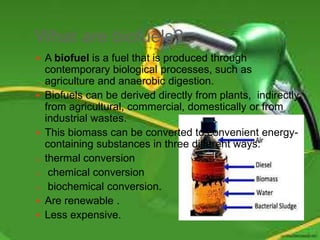
 A biofuel is a fuel that is produced through
contemporary biological processes, such as
agriculture and anaerobic digestion.
 Biofuels can be derived directly from plants, indirectly
from agricultural, commercial, domestically or from
industrial wastes.
 This biomass can be converted to convenient energy-
containing substances in three different ways:
o thermal conversion
o chemical conversion
o biochemical conversion.
 Are renewable .
 Less expensive.
Facts about biofuels
 The United States is the world’s largest bioethanol
producer.
 Each year, more than 22 billion gallons of fuel ethanol are
produced.
 Most gasoline and diesel fuels in North America and
Europe are blended with biofuel.
 Biodiesel accounts for about 3% of the German market
and 0.15% of the U.S. market.
 About 1 billion gallons of biodiesel are produced annually.
 Bioethanol is more popular in the Americas while biodiesel
is more popular in Europe.
 The U.S. and Brazil produce 87% of the world's fuel
ethanol.
 Ethanol is added to gasoline to improve octane and reduce
emissions.
 Biodiesel is added to petroleum-based diesel to reduce
emissions and improve engine life.
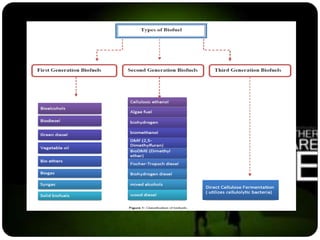
Generations of biofuels
 First-generation biofuels
"First-generation" or conventional biofuels are biofuels
made from food crops grown on arable land.
With this biofuel production generation, food crops are
thus explicitly grown for fuel production.
The sugar, starch, or vegetable oil obtained from the
crops is converted into biodiesel or ethanol, using
transesterification, or yeast fermentation.
 Second-generation biofuels
Second generation biofuels are fuels manufactured
from various types of biomass.
Biomass is derived from plant materials, but can also
include animal materials.
 Third-generation biofuels
From 1978 to 1996, the US NREL experimented with
using algae as a biofuels source in the "Aquatic
Species Program”.
This oil-rich algae can then be extracted from the
system and processed into biofuels, with the dried
remainder further reprocessed to create ethanol.
 Fourth-generation biofuels
fourth-generation biofuels are made using non-arable
land.
This class of biofuels includes electrofuels and
photobiological solar fuels.
Characteristics
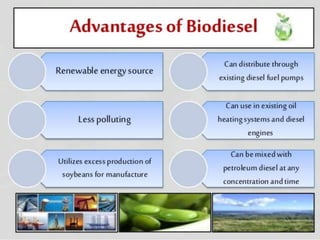
 Everything can be used to produce biodiesel,
from vegetable oil to coffee grounds to exotic
plants like Jatropha, as long as the plant
produces triglycerides (fats and oils).
 A biofuel can be a liquid, a solid or a gas.
 Biofuels can power cars and other vehicles.
 Biodiesel is not toxic or flammable and is
biodegradable.
 Biodiesel has the highest energy balance of any
fuel. 3.2 units of energy are gained for every one
unit of fossil energy needed to produce biodiesel.
EXAMPLES
 Biofuels can be made from human sewage, rotting manure,
used french fry oil, discarded food scraps and plant material,
such as lawn clippings and cornstalks.
 Methane, also known as swamp gas, is a biogas. It is
produced by bacteria doing their job of decomposing manure,
sewage or solid plant waste, such as banana peels or
cornstalks.
 Starchy crops such as sugar beets, corn and sugarcane can
be converted to alcohol biofuels, such as ethanol. Fungi and
bacteria convert the plant material into alcohol by
fermentation, similar to the way grape juice is turned into wine.
 Diesel is a petroleum-based fuel used to power engines in
trucks, trains, large machinery and tractors.
 Both Native Americans and settlers in the Old West burned
dried buffalo or cow manure -- buffalo chips or cow pies -- for
heat and cooking.
 Rotting manure, sewage and garbage can be converted into
gaseous or liquid biofuel to power machines and vehicles.
Types of biofuels
 Ethanol
 Ethanol is essentially pure alcohol.
 It can be made from various sources, but the most common are
corn and sugarcane.
 The ethanol production methods used are enzyme digestion (to
release sugars from stored starches), fermentation of the sugars,
distillation and drying.
 Ethanol can be used in petrol engines as a replacement for
gasoline; it can be mixed with gasoline to any percentage.
 Ethanol has a smaller energy density than that of gasoline; this
means
more fuel- same amount of work.
 Advantage of ethanol is that it has a higher octane rating than
ethanol-free gasoline available at roadside gas stations, which
allows an increase of an engine's compression ratio for
increased thermal efficiency.
 Biodiesel
 It is a petroleum-based diesel fuel and is derived from
vegetable or animal oils.
 It is produced from oils or fats using transesterification and is a
liquid similar in composition to fossil/mineral diesel.
 Chemically, it consists mostly of fatty acid methyl (or ethyl)
esters (FAMEs).
 Biodiesel can be used in any diesel engine when mixed with
mineral diesel.
 Pure biodiesel (B100, also known as "neat" biodiesel) currently
reduces emissions with up to 60% compared to diesel Second
generation B100.
 B100 may become more viscous at lower temperatures,
depending on the feedstock used.
 Biodiesel is also safe to handle and transport because it is
non-toxic and biodegradable, and has a high flash point of
about 300 °F (148 °C) compared to petroleum diesel fuel,
which has a flash point of 125 °F (52 °C
 Other bioalcohols
 Methanol is currently produced from natural gas, a
non-renewable fossil fuel. In the future it is hoped to
be produced from biomass as biomethanol.
 The methanol economy is an alternative to the
hydrogen economy, compared to today's hydrogen
production from natural gas.
 Butanol (C4H9OH) is formed by ABE fermentation
(acetone, butanol, ethanol) and experimental
modifications of the process show potentially high
net energy gains with butanol as the only liquid
product.
 Green diesel
 Green diesel is produced through hydrocracking biological oil
feedstocks, such as vegetable oils and animal fats.
 Hydrocracking is a refinery method that uses elevated
temperatures and pressure in the presence of a catalyst to
break down larger molecules, such as those found in
vegetable oils, into shorter hydrocarbon chains used in diesel
engines.
 It may also be called renewable diesel, hydrotreated
vegetable oil or hydrogen-derived renewable diesel.
 Biofuel gasoline
 In 2013 UK researchers developed a genetically modified
strain of Escherichia coli (E.Coli), which could transform
glucose into biofuel gasoline that does not need to be blended.
 Later in 2013 UCLA researchers engineered a new metabolic
pathway to bypass glycolysis and increase the rate of
conversion of sugars into biofuel.
 KAIST researchers developed a strain capable of producing
short-chain alkanes, free fatty acids, fatty esters and fatty
alcohols through the fatty acyl (acyl carrier protein (ACP)) to
fatty acid to fatty acyl-CoA pathway in vivo.
 Bioethers
 Bioethers (also referred to as fuel ethers or
oxygenated fuels) are cost-effective compounds that
act as octane rating enhancers.
 "Bioethers are produced by the reaction of reactive
iso-olefins, such as iso-butylene, with bioethanol.“
 Bioethers are created by wheat or sugar beet. They
also enhance engine performance, whilst
significantly reducing engine wear and toxic exhaust
emissions.
 When it comes to transportation fuel there are six
ether additives: dimethyl ether (DME), diethyl ether
(DEE), methyl teritiary-butyl ether (MTBE), ethyl ter-
butyl ether (ETBE), ter-amyl methyl ether (TAME),
and ter-amyl ethyl ether (TAEE).
 Biogas
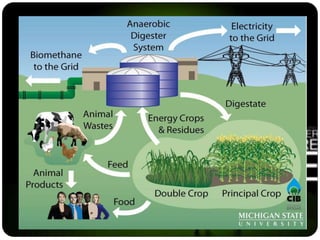
 Biogas is methane produced by the process of anaerobic
digestion of organic material by anaerobes.
 It can be produced either from biodegradable waste
materials or by the use of energy crops fed into
anaerobic digesters to supplement gas yields. The solid
byproduct, digestate, can be used as a biofuel or a
fertilizer.
 Farmers can produce biogas from manure from their
cattle by using anaerobic digesters.
 Vegetable oil
 Straight unmodified edible vegetable oil is generally not
used as fuel, but lower-quality oil has been used for this
purpose.
 Used vegetable oil is processed into biodiesel, or (more
rarely) cleaned of water and particulates and then used
as a fuel.
 Syngas
Syngas, a mixture of carbon monoxide, hydrogen and other
hydrocarbons.
Produced by partial combustion of biomass, that is, combustion
with an amount of oxygen that is not sufficient to convert the biomass
completely to carbon dioxide and water.
Before partial combustion, the biomass is dried, and sometimes
pyrolysed.
The resulting gas mixture, syngas, is more efficient than direct
combustion of the original biofuel.
 Syngas may be burned directly in internal combustion engines,
turbines or high-temperature fuel cells.
 The wood gas generator, a wood-fueled gasification reactor, can be
connected to an internal combustion engine.
 Syngas can be used to produce methanol, DME and hydrogen, or
converted via the Fischer-Tropsch process to produce a diesel
substitute, or a mixture of alcohols that can be blended into gasoline.
 Gasification normally relies on temperatures greater than 700 °C.
 Lower-temperature gasification is desirable when co-producing
biochar, but results in syngas polluted with tar.
 Solid biomass fuels
 Examples include wood, sawdust, grass trimmings,
domestic refuse, charcoal, agricultural waste,
nonfood energy crops, and dried manure.
 When solid biomass is already in a suitable form
(such as firewood), it can burn directly in a stove or
furnace to provide heat or raise steam.
 When solid biomass is in an inconvenient form
(such as sawdust, wood chips, grass, urban waste
wood, agricultural residues), the typical process is to
densify the biomass.
 This process includes grinding the raw biomass to
an appropriate particulate size (known as hogfuel)
 Depending on the densification type, can be from 1
to 3 cm (0.4 to 1.2 in), which is then concentrated
into a fuel product.
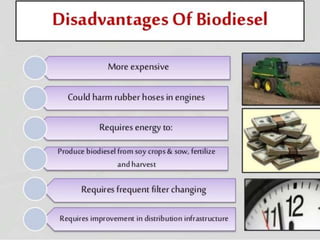
Issues with biodiesel use
 The effect of moderating oil prices.
 The "food vs fuel" debate.
 Food prices, poverty reduction potential, energy
ratio, energy requirements, carbon emissions
levels.
 Sustainable biofuel production, deforestation and
soil erosion, loss of biodiversity, impact on water
resources.
 The possible modifications necessary to run the
engine on biofuel, as well as energy balance and
efficiency.
Organisms used in making
biofuels
Dominant methanogenic groups (archaea) :
 Manure
1) Methanoculleus thermophilicus
(hydrogenotrophic)
2) Methanosarcina thermophila (acetotrophic)
 Fruits and vegetables
1) Methanosphaera stadtmanii (hydrogenotrophic)
2) Methanobrevibacter wolinii (hydrogenotrophic)
 Municipal wastes and sewage sludge
1) Methanosaeta concilii (acetotrophic)
2) Methanosarcina sp (acetotrophic
Some MFC bacteria (electricigens)
• Geobacter species ( G. metallireducens ,G.sulfurreducens
, G. psychrophilus)
(direct membrane electron transfer mechanism
exoelectrogens).
• Desulfuromonas acetoxidans
• Geopsychrobacter
•Shewanella putrefacians
(Produce their own chemical – redox mediators)
• Pseudomonas species
• Geothrix ferementans
•Shewanella oneidenensis
• Pseudomonas aeruginosa
(Use nanowires for electron transfer).
RESEARCH GOING ON
 Animal gut bacteria
Microbial gastrointestinal flora in a variety of animals have
shown potential for the production of biofuels. Recent research
has shown that TU-103, a strain of Clostridium bacteria found
in Zebra feces, can convert nearly any form of cellulose into
butanol fuel.
Microbes in panda waste are being investigated for their use in
creating biofuels from bamboo and other plant materials.
 Fungi
The recent discovery of a variant of the fungus Gliocladium
roseum (later renamed Ascocoryne sarcoides),
Cunninghamella japonica points toward the production of so-
called myco-diesel from cellulose.
 Jatropha
Jatropha curcas, a poisonous shrub-like tree that produces
seeds considered by many to be a viable source of biofuels
feedstock oil.
 Ethanol biofuels (bioethanol)
As the primary source of biofuels in North America,
many organizations are conducting research in the
area of ethanol production.
The National Corn-to-Ethanol Research Center
(NCERC) is a research division of Southern Illinois
University Edwardsville dedicated solely to ethanol-
based biofuel research projects.
CONCLUSION
 With the increasing demand for fuel and depleting
fossil fuel resources, biofuels can act as a perfect
substitute for gasoline and diesel in the future.
 Derived from bio sources, these have least
environmental effects.
 While biodiesel remains more expensive than regular
diesel, consumers need to look beyond the cost per
gallon to really gauge the economic benefits.
Biodiesel vehicles get 30 percent better fuel economy
than gasoline-powered vehicles [Consumer Reports].
 Above all, biofuels can be readily considered as
renewable sources of energy.
REFERENCE
www.wikipedia.com
https://sciencing.com/biofuel-
www.google .com
THANKYO
U

Bio fuels

  • 1.
    MSc. Biotechnology Submitted to: Dr. Neetu Singh Submitted by : Priya yadav
  • 2.
    What are biofuels? A biofuel is a fuel that is produced through contemporary biological processes, such as agriculture and anaerobic digestion.  Biofuels can be derived directly from plants, indirectly from agricultural, commercial, domestically or from industrial wastes.  This biomass can be converted to convenient energy- containing substances in three different ways: o thermal conversion o chemical conversion o biochemical conversion.  Are renewable .  Less expensive.
  • 3.
    Facts about biofuels The United States is the world’s largest bioethanol producer.  Each year, more than 22 billion gallons of fuel ethanol are produced.  Most gasoline and diesel fuels in North America and Europe are blended with biofuel.  Biodiesel accounts for about 3% of the German market and 0.15% of the U.S. market.  About 1 billion gallons of biodiesel are produced annually.  Bioethanol is more popular in the Americas while biodiesel is more popular in Europe.  The U.S. and Brazil produce 87% of the world's fuel ethanol.  Ethanol is added to gasoline to improve octane and reduce emissions.  Biodiesel is added to petroleum-based diesel to reduce emissions and improve engine life.
  • 4.
    Generations of biofuels First-generation biofuels "First-generation" or conventional biofuels are biofuels made from food crops grown on arable land. With this biofuel production generation, food crops are thus explicitly grown for fuel production. The sugar, starch, or vegetable oil obtained from the crops is converted into biodiesel or ethanol, using transesterification, or yeast fermentation.  Second-generation biofuels Second generation biofuels are fuels manufactured from various types of biomass. Biomass is derived from plant materials, but can also include animal materials.
  • 6.
     Third-generation biofuels From1978 to 1996, the US NREL experimented with using algae as a biofuels source in the "Aquatic Species Program”. This oil-rich algae can then be extracted from the system and processed into biofuels, with the dried remainder further reprocessed to create ethanol.  Fourth-generation biofuels fourth-generation biofuels are made using non-arable land. This class of biofuels includes electrofuels and photobiological solar fuels.
  • 7.
    Characteristics  Everything canbe used to produce biodiesel, from vegetable oil to coffee grounds to exotic plants like Jatropha, as long as the plant produces triglycerides (fats and oils).  A biofuel can be a liquid, a solid or a gas.  Biofuels can power cars and other vehicles.  Biodiesel is not toxic or flammable and is biodegradable.  Biodiesel has the highest energy balance of any fuel. 3.2 units of energy are gained for every one unit of fossil energy needed to produce biodiesel.
  • 8.
    EXAMPLES  Biofuels canbe made from human sewage, rotting manure, used french fry oil, discarded food scraps and plant material, such as lawn clippings and cornstalks.  Methane, also known as swamp gas, is a biogas. It is produced by bacteria doing their job of decomposing manure, sewage or solid plant waste, such as banana peels or cornstalks.  Starchy crops such as sugar beets, corn and sugarcane can be converted to alcohol biofuels, such as ethanol. Fungi and bacteria convert the plant material into alcohol by fermentation, similar to the way grape juice is turned into wine.  Diesel is a petroleum-based fuel used to power engines in trucks, trains, large machinery and tractors.  Both Native Americans and settlers in the Old West burned dried buffalo or cow manure -- buffalo chips or cow pies -- for heat and cooking.  Rotting manure, sewage and garbage can be converted into gaseous or liquid biofuel to power machines and vehicles.
  • 9.
    Types of biofuels Ethanol  Ethanol is essentially pure alcohol.  It can be made from various sources, but the most common are corn and sugarcane.  The ethanol production methods used are enzyme digestion (to release sugars from stored starches), fermentation of the sugars, distillation and drying.  Ethanol can be used in petrol engines as a replacement for gasoline; it can be mixed with gasoline to any percentage.  Ethanol has a smaller energy density than that of gasoline; this means more fuel- same amount of work.  Advantage of ethanol is that it has a higher octane rating than ethanol-free gasoline available at roadside gas stations, which allows an increase of an engine's compression ratio for increased thermal efficiency.
  • 11.
     Biodiesel  Itis a petroleum-based diesel fuel and is derived from vegetable or animal oils.  It is produced from oils or fats using transesterification and is a liquid similar in composition to fossil/mineral diesel.  Chemically, it consists mostly of fatty acid methyl (or ethyl) esters (FAMEs).  Biodiesel can be used in any diesel engine when mixed with mineral diesel.  Pure biodiesel (B100, also known as "neat" biodiesel) currently reduces emissions with up to 60% compared to diesel Second generation B100.  B100 may become more viscous at lower temperatures, depending on the feedstock used.  Biodiesel is also safe to handle and transport because it is non-toxic and biodegradable, and has a high flash point of about 300 °F (148 °C) compared to petroleum diesel fuel, which has a flash point of 125 °F (52 °C
  • 12.
     Other bioalcohols Methanol is currently produced from natural gas, a non-renewable fossil fuel. In the future it is hoped to be produced from biomass as biomethanol.  The methanol economy is an alternative to the hydrogen economy, compared to today's hydrogen production from natural gas.  Butanol (C4H9OH) is formed by ABE fermentation (acetone, butanol, ethanol) and experimental modifications of the process show potentially high net energy gains with butanol as the only liquid product.
  • 13.
     Green diesel Green diesel is produced through hydrocracking biological oil feedstocks, such as vegetable oils and animal fats.  Hydrocracking is a refinery method that uses elevated temperatures and pressure in the presence of a catalyst to break down larger molecules, such as those found in vegetable oils, into shorter hydrocarbon chains used in diesel engines.  It may also be called renewable diesel, hydrotreated vegetable oil or hydrogen-derived renewable diesel.  Biofuel gasoline  In 2013 UK researchers developed a genetically modified strain of Escherichia coli (E.Coli), which could transform glucose into biofuel gasoline that does not need to be blended.  Later in 2013 UCLA researchers engineered a new metabolic pathway to bypass glycolysis and increase the rate of conversion of sugars into biofuel.  KAIST researchers developed a strain capable of producing short-chain alkanes, free fatty acids, fatty esters and fatty alcohols through the fatty acyl (acyl carrier protein (ACP)) to fatty acid to fatty acyl-CoA pathway in vivo.
  • 14.
     Bioethers  Bioethers(also referred to as fuel ethers or oxygenated fuels) are cost-effective compounds that act as octane rating enhancers.  "Bioethers are produced by the reaction of reactive iso-olefins, such as iso-butylene, with bioethanol.“  Bioethers are created by wheat or sugar beet. They also enhance engine performance, whilst significantly reducing engine wear and toxic exhaust emissions.  When it comes to transportation fuel there are six ether additives: dimethyl ether (DME), diethyl ether (DEE), methyl teritiary-butyl ether (MTBE), ethyl ter- butyl ether (ETBE), ter-amyl methyl ether (TAME), and ter-amyl ethyl ether (TAEE).
  • 15.
     Biogas  Biogasis methane produced by the process of anaerobic digestion of organic material by anaerobes.  It can be produced either from biodegradable waste materials or by the use of energy crops fed into anaerobic digesters to supplement gas yields. The solid byproduct, digestate, can be used as a biofuel or a fertilizer.  Farmers can produce biogas from manure from their cattle by using anaerobic digesters.  Vegetable oil  Straight unmodified edible vegetable oil is generally not used as fuel, but lower-quality oil has been used for this purpose.  Used vegetable oil is processed into biodiesel, or (more rarely) cleaned of water and particulates and then used as a fuel.
  • 16.
     Syngas Syngas, amixture of carbon monoxide, hydrogen and other hydrocarbons. Produced by partial combustion of biomass, that is, combustion with an amount of oxygen that is not sufficient to convert the biomass completely to carbon dioxide and water. Before partial combustion, the biomass is dried, and sometimes pyrolysed. The resulting gas mixture, syngas, is more efficient than direct combustion of the original biofuel.  Syngas may be burned directly in internal combustion engines, turbines or high-temperature fuel cells.  The wood gas generator, a wood-fueled gasification reactor, can be connected to an internal combustion engine.  Syngas can be used to produce methanol, DME and hydrogen, or converted via the Fischer-Tropsch process to produce a diesel substitute, or a mixture of alcohols that can be blended into gasoline.  Gasification normally relies on temperatures greater than 700 °C.  Lower-temperature gasification is desirable when co-producing biochar, but results in syngas polluted with tar.
  • 17.
     Solid biomassfuels  Examples include wood, sawdust, grass trimmings, domestic refuse, charcoal, agricultural waste, nonfood energy crops, and dried manure.  When solid biomass is already in a suitable form (such as firewood), it can burn directly in a stove or furnace to provide heat or raise steam.  When solid biomass is in an inconvenient form (such as sawdust, wood chips, grass, urban waste wood, agricultural residues), the typical process is to densify the biomass.  This process includes grinding the raw biomass to an appropriate particulate size (known as hogfuel)  Depending on the densification type, can be from 1 to 3 cm (0.4 to 1.2 in), which is then concentrated into a fuel product.
  • 18.
    Issues with biodieseluse  The effect of moderating oil prices.  The "food vs fuel" debate.  Food prices, poverty reduction potential, energy ratio, energy requirements, carbon emissions levels.  Sustainable biofuel production, deforestation and soil erosion, loss of biodiversity, impact on water resources.  The possible modifications necessary to run the engine on biofuel, as well as energy balance and efficiency.
  • 19.
    Organisms used inmaking biofuels Dominant methanogenic groups (archaea) :  Manure 1) Methanoculleus thermophilicus (hydrogenotrophic) 2) Methanosarcina thermophila (acetotrophic)  Fruits and vegetables 1) Methanosphaera stadtmanii (hydrogenotrophic) 2) Methanobrevibacter wolinii (hydrogenotrophic)  Municipal wastes and sewage sludge 1) Methanosaeta concilii (acetotrophic) 2) Methanosarcina sp (acetotrophic
  • 20.
    Some MFC bacteria(electricigens) • Geobacter species ( G. metallireducens ,G.sulfurreducens , G. psychrophilus) (direct membrane electron transfer mechanism exoelectrogens). • Desulfuromonas acetoxidans • Geopsychrobacter •Shewanella putrefacians (Produce their own chemical – redox mediators) • Pseudomonas species • Geothrix ferementans •Shewanella oneidenensis • Pseudomonas aeruginosa (Use nanowires for electron transfer).
  • 21.
    RESEARCH GOING ON Animal gut bacteria Microbial gastrointestinal flora in a variety of animals have shown potential for the production of biofuels. Recent research has shown that TU-103, a strain of Clostridium bacteria found in Zebra feces, can convert nearly any form of cellulose into butanol fuel. Microbes in panda waste are being investigated for their use in creating biofuels from bamboo and other plant materials.  Fungi The recent discovery of a variant of the fungus Gliocladium roseum (later renamed Ascocoryne sarcoides), Cunninghamella japonica points toward the production of so- called myco-diesel from cellulose.  Jatropha Jatropha curcas, a poisonous shrub-like tree that produces seeds considered by many to be a viable source of biofuels feedstock oil.
  • 22.
     Ethanol biofuels(bioethanol) As the primary source of biofuels in North America, many organizations are conducting research in the area of ethanol production. The National Corn-to-Ethanol Research Center (NCERC) is a research division of Southern Illinois University Edwardsville dedicated solely to ethanol- based biofuel research projects.
  • 25.
    CONCLUSION  With theincreasing demand for fuel and depleting fossil fuel resources, biofuels can act as a perfect substitute for gasoline and diesel in the future.  Derived from bio sources, these have least environmental effects.  While biodiesel remains more expensive than regular diesel, consumers need to look beyond the cost per gallon to really gauge the economic benefits. Biodiesel vehicles get 30 percent better fuel economy than gasoline-powered vehicles [Consumer Reports].  Above all, biofuels can be readily considered as renewable sources of energy.
  • 26.
  • 27.