Biofuels
By Group 2
Powering the Future with Renewable
Presenting Members
• Ali Hamza 1008
• Muhammad Zian 1009
• Fatima Zafar 1010
• Saima Rani 1011
• Muhammad Waqar 1013
• Zunaira Fatima 1014
Outlines:
• Introduction to Biofuels
• History of biofuels
• Why Biofuels?
• Classification of biofuels
• 1st-Generation Biofuels
• 2nd-Generation Biofuels
• 3rd Generation Biofuels
• 4th Generation Biofuels
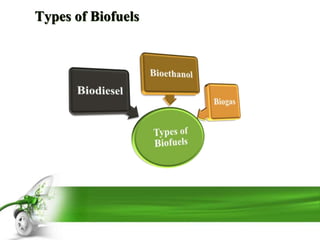
• Types of Biofuels
• Biodiesel & Production
• Bioethanol & Production
• Biogas & Production
• Advantages of Biofuels
• Disadvantages of Biofuels
• Conclusion
• References
What is Biofuel
• A biofuel is a type of fuel whose energy is derived
from biological carbon fixation.
• Fuel which produced from renewable biological
resources such as plants biomass & treated
municipal industrial waste.
• Fuel that is produced over a short period
from biomass, rather than by the very slow natural
processes involved in the formation of fossil fuels,
such as oil.
History of biofuels
• In 1890, Rudolf Diesel 1st-made the biodiesel
from vegetable oil(Peanut).
• Henry Ford designed 1st-T car model to run on
ethanol.
• In 1970, biofuels surged in popularity during
energy crisis.
• In 21st century, people pay attention to the use of
biofuels in response to increasing demands &
tougher emission standards.
Why Biofuels
• To reduce our dependance on fossil fuels
• To reduce reliance on foreign oil
• To lower the emission of greenhouse gases
• To bring business to rural economies
• To make innovations in sustainable energy
production and utilization.
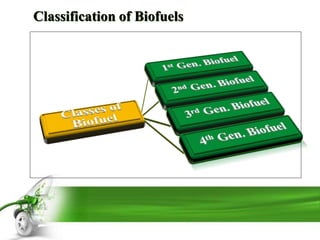
Classification of Biofuels
1st Generation Biofuels
• Prepared from sugar, starchy crops, vegetable oil
or anima fat & also called Conventional Biofuels.
• The starch is fermented into bioethanol, or
vegetable oil processed into biodiesel.
• Used in large quantity have large impact on food
supply.
• Environment friendly as Fossil Fuels.
• For example, Corn, Sugarcane, Wheat.
2nd Generation Biofuels
• Prepared from non-food crops or made from waste
products derived from agriculture and forestry
activities such as rice straw, rice husk, wood
chips, woody crops grass species (lignocellulosic)
& sawdust.
• also called advanced biofuels or sustainable
biofuels.
• includes breaking down complex plant cell
structures into simpler sugars, which can then be
fermented into biofuels.
3rd Generation Biofuels
• Also known as oilgae since they are derived from
algae.
• Often involving the use of microorganisms such
as algae.
• Harvested algal oil is converted into Biodiesel.
• Algae leads to the production biodiesel, gasoline,
butanol, propanol and ethanol with high yield,
approximately 10 times higher than the second
generation biofuel.
4th Generation Biofuels
• Extension of 3rd gen.
• Biofuels formed by using genetically engineered
organisms.
• Have ability to capture more CO2.
• Cyanobacteria are engineered to increase the oil
yield and are used for the efficient production of
bioenergy.
• Include alteration of lipid characteristics & lipid
excretion pathways.
Types of Biofuels
Biodiesel:
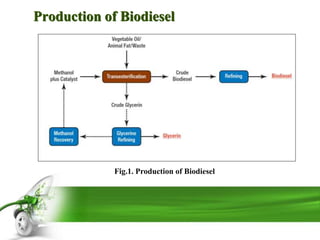
• Biodiesel is the most common biofuel in Europe.
It is produced from oils or fats
using transesterification and is a liquid similar in
composition to fossil/mineral diesel. Chemically,
it consists mostly of fatty acid methyl (or ethyl)
esters (fames).
• Currently reduces emissions with up to 60%
compared to diesel second generation B100.
Conti…
• Biodiesel is also an oxygenated fuel, meaning it
contains a reduced amount of carbon and higher
hydrogen and oxygen content than fossil diesel.
• Non-toxic and biodegradable.
• Safe to handle and transport.
Production of Biodiesel
Fig.1. Production of Biodiesel
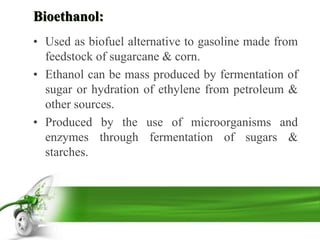
Bioethanol:
• Used as biofuel alternative to gasoline made from
feedstock of sugarcane & corn.
• Ethanol can be mass produced by fermentation of
sugar or hydration of ethylene from petroleum &
other sources.
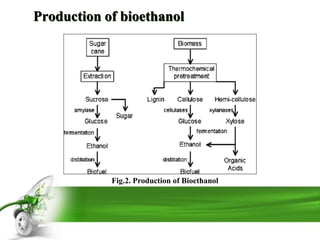
• Produced by the use of microorganisms and
enzymes through fermentation of sugars &
starches.
Production of bioethanol
Fig.2. Production of Bioethanol
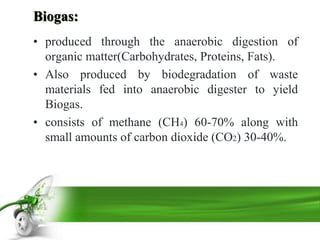
Biogas:
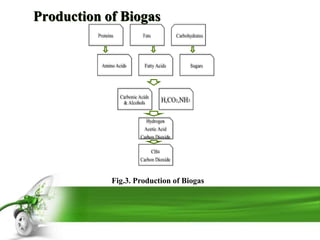
• produced through the anaerobic digestion of
organic matter(Carbohydrates, Proteins, Fats).
• Also produced by biodegradation of waste
materials fed into anaerobic digester to yield
Biogas.
• consists of methane (CH4) 60-70% along with
small amounts of carbon dioxide (CO2) 30-40%.
Production of Biogas
Fig.3. Production of Biogas
Advantages of Biofuels
• Renewable Source
• Reduce Greenhouse Gases
• Economic Security& Energy Security
• Easy to Source
• Lower Level of Pollution
• Support for Agriculture
• Technology Development
• Reduced Dependency on Fossil Fuels
Disadvantages of Biofuels
• Food Shortage & Food Security
• Global Warming & Use of Fertilizers
• High cost of production &
• Impact on Soil Quality, Biodiversity & Water Use
• Dependency on Specific Feedstocks
• Limited Energy Balance
• Emissions from Land Use Change
• Competition with Food Crops
Conclusion
• Biofuels present both opportunities and risks.
• Biofuel production lead to power to local
community, improving agriculture, rural
electrification.
• Its consumption will contribute in solving the
global warming by achieving 100% natural carbon
cycle.
• Lead to the reduction of wastes, cleaning air,
improve balance of payments and introduce new
agricultural markets.
References:
1. Demirbas, A. (2009). Biofuels sources, biofuel policy, biofuel economy and global biofuel
projections. Energy Conversion and Management, 50(9), 2239-2249.
2. Farrell, A. E., Plevin, R. J., Turner, B. T., Jones, A. D., O'Hare, M., & Kammen, D. M. (2006).
Ethanol can contribute to energy and environmental goals. Science, 311(5760), 506-508.
3. Sims, R. E. H., Mabee, W., Saddler, J. N., & Taylor, M. (2010). An overview of second generation
biofuel technologies. Bioresource Technology, 101(6), 1570-1580.
4. International Energy Agency (IEA). (2021). Renewables 2021: Analysis and forecast to 2026. IEA.
5. U.S. Department of Energy. (2022). Bioenergy Technologies Office.
[https://www.energy.gov/eere/bioenergy/bioenergy-technologies-office]
6. Smith, J. A. (Year). "Biofuels: A Comprehensive Review." Journal of Renewable Energy, 25(3), 123-
145.
7. International Energy Agency (IEA). (Year). "Bioenergy Outlook 20XX." Retrieved from IEA
Website.
8. https://afdc.energy.gov/assets/images/fuels/Biodiesel-production-schematic-f282d90a.png
9. European Commission, Directorate-General for Energy. (Year). "Biofuels in the European Union:
Challenges and Opportunities." Retrieved from EU Energy.
10. Gupta, S., & Zhang, Y. (Year). "Sustainable Production of Biofuels: A Review of Current
Technologies and Challenges." Renewable and Sustainable Energy Reviews, 18, 23-42.
11. Renewable Fuels Association (RFA). (Year). "Biofuels and the Future of Sustainable Transportation."
Retrieved from RFA.
12. International Renewable Energy Agency (IRENA). (Year). "Biofuels for a Sustainable Future."
Retrieved from IRENA.
Biofuels, Their Types, Their Classification

Biofuels, Their Types, Their Classification

  • 1.
    Biofuels By Group 2 Poweringthe Future with Renewable
  • 2.
    Presenting Members • AliHamza 1008 • Muhammad Zian 1009 • Fatima Zafar 1010 • Saima Rani 1011 • Muhammad Waqar 1013 • Zunaira Fatima 1014
  • 3.
    Outlines: • Introduction toBiofuels • History of biofuels • Why Biofuels? • Classification of biofuels • 1st-Generation Biofuels • 2nd-Generation Biofuels • 3rd Generation Biofuels • 4th Generation Biofuels • Types of Biofuels • Biodiesel & Production • Bioethanol & Production • Biogas & Production • Advantages of Biofuels • Disadvantages of Biofuels • Conclusion • References
  • 4.
    What is Biofuel •A biofuel is a type of fuel whose energy is derived from biological carbon fixation. • Fuel which produced from renewable biological resources such as plants biomass & treated municipal industrial waste. • Fuel that is produced over a short period from biomass, rather than by the very slow natural processes involved in the formation of fossil fuels, such as oil.
  • 5.
    History of biofuels •In 1890, Rudolf Diesel 1st-made the biodiesel from vegetable oil(Peanut). • Henry Ford designed 1st-T car model to run on ethanol. • In 1970, biofuels surged in popularity during energy crisis. • In 21st century, people pay attention to the use of biofuels in response to increasing demands & tougher emission standards.
  • 6.
    Why Biofuels • Toreduce our dependance on fossil fuels • To reduce reliance on foreign oil • To lower the emission of greenhouse gases • To bring business to rural economies • To make innovations in sustainable energy production and utilization.
  • 7.
  • 8.
    1st Generation Biofuels •Prepared from sugar, starchy crops, vegetable oil or anima fat & also called Conventional Biofuels. • The starch is fermented into bioethanol, or vegetable oil processed into biodiesel. • Used in large quantity have large impact on food supply. • Environment friendly as Fossil Fuels. • For example, Corn, Sugarcane, Wheat.
  • 9.
    2nd Generation Biofuels •Prepared from non-food crops or made from waste products derived from agriculture and forestry activities such as rice straw, rice husk, wood chips, woody crops grass species (lignocellulosic) & sawdust. • also called advanced biofuels or sustainable biofuels. • includes breaking down complex plant cell structures into simpler sugars, which can then be fermented into biofuels.
  • 10.
    3rd Generation Biofuels •Also known as oilgae since they are derived from algae. • Often involving the use of microorganisms such as algae. • Harvested algal oil is converted into Biodiesel. • Algae leads to the production biodiesel, gasoline, butanol, propanol and ethanol with high yield, approximately 10 times higher than the second generation biofuel.
  • 11.
    4th Generation Biofuels •Extension of 3rd gen. • Biofuels formed by using genetically engineered organisms. • Have ability to capture more CO2. • Cyanobacteria are engineered to increase the oil yield and are used for the efficient production of bioenergy. • Include alteration of lipid characteristics & lipid excretion pathways.
  • 12.
  • 13.
    Biodiesel: • Biodiesel isthe most common biofuel in Europe. It is produced from oils or fats using transesterification and is a liquid similar in composition to fossil/mineral diesel. Chemically, it consists mostly of fatty acid methyl (or ethyl) esters (fames). • Currently reduces emissions with up to 60% compared to diesel second generation B100.
  • 14.
    Conti… • Biodiesel isalso an oxygenated fuel, meaning it contains a reduced amount of carbon and higher hydrogen and oxygen content than fossil diesel. • Non-toxic and biodegradable. • Safe to handle and transport.
  • 15.
    Production of Biodiesel Fig.1.Production of Biodiesel
  • 16.
    Bioethanol: • Used asbiofuel alternative to gasoline made from feedstock of sugarcane & corn. • Ethanol can be mass produced by fermentation of sugar or hydration of ethylene from petroleum & other sources. • Produced by the use of microorganisms and enzymes through fermentation of sugars & starches.
  • 17.
    Production of bioethanol Fig.2.Production of Bioethanol
  • 18.
    Biogas: • produced throughthe anaerobic digestion of organic matter(Carbohydrates, Proteins, Fats). • Also produced by biodegradation of waste materials fed into anaerobic digester to yield Biogas. • consists of methane (CH4) 60-70% along with small amounts of carbon dioxide (CO2) 30-40%.
  • 19.
    Production of Biogas Fig.3.Production of Biogas
  • 20.
    Advantages of Biofuels •Renewable Source • Reduce Greenhouse Gases • Economic Security& Energy Security • Easy to Source • Lower Level of Pollution • Support for Agriculture • Technology Development • Reduced Dependency on Fossil Fuels
  • 21.
    Disadvantages of Biofuels •Food Shortage & Food Security • Global Warming & Use of Fertilizers • High cost of production & • Impact on Soil Quality, Biodiversity & Water Use • Dependency on Specific Feedstocks • Limited Energy Balance • Emissions from Land Use Change • Competition with Food Crops
  • 22.
    Conclusion • Biofuels presentboth opportunities and risks. • Biofuel production lead to power to local community, improving agriculture, rural electrification. • Its consumption will contribute in solving the global warming by achieving 100% natural carbon cycle. • Lead to the reduction of wastes, cleaning air, improve balance of payments and introduce new agricultural markets.
  • 23.
    References: 1. Demirbas, A.(2009). Biofuels sources, biofuel policy, biofuel economy and global biofuel projections. Energy Conversion and Management, 50(9), 2239-2249. 2. Farrell, A. E., Plevin, R. J., Turner, B. T., Jones, A. D., O'Hare, M., & Kammen, D. M. (2006). Ethanol can contribute to energy and environmental goals. Science, 311(5760), 506-508. 3. Sims, R. E. H., Mabee, W., Saddler, J. N., & Taylor, M. (2010). An overview of second generation biofuel technologies. Bioresource Technology, 101(6), 1570-1580. 4. International Energy Agency (IEA). (2021). Renewables 2021: Analysis and forecast to 2026. IEA. 5. U.S. Department of Energy. (2022). Bioenergy Technologies Office. [https://www.energy.gov/eere/bioenergy/bioenergy-technologies-office] 6. Smith, J. A. (Year). "Biofuels: A Comprehensive Review." Journal of Renewable Energy, 25(3), 123- 145. 7. International Energy Agency (IEA). (Year). "Bioenergy Outlook 20XX." Retrieved from IEA Website. 8. https://afdc.energy.gov/assets/images/fuels/Biodiesel-production-schematic-f282d90a.png 9. European Commission, Directorate-General for Energy. (Year). "Biofuels in the European Union: Challenges and Opportunities." Retrieved from EU Energy. 10. Gupta, S., & Zhang, Y. (Year). "Sustainable Production of Biofuels: A Review of Current Technologies and Challenges." Renewable and Sustainable Energy Reviews, 18, 23-42. 11. Renewable Fuels Association (RFA). (Year). "Biofuels and the Future of Sustainable Transportation." Retrieved from RFA. 12. International Renewable Energy Agency (IRENA). (Year). "Biofuels for a Sustainable Future." Retrieved from IRENA.