











1
👦Ashesh Ghosh
Materials and Metallurgical Engineering
BUET
Today We Will Know
⊷ What is Fuel?
⊷ Energy Crisis
⊷ What is Biofuel?
⊷ Classifications & Types
• Bioethanol
• Biodiesel
• Biogas
• Algae
⊷ Advantages & Disadvantages
⊷ Are We Ready to Use Biofuel?
2
Fuel
4
Fuel
⊷ Fuels are any materials that store potential energy in forms
that can practicably released and used for work or as heat
energy
⊷ Fuels are required for a variety of purposes, but are utilized
chiefly for Transportation and Power Generation.
5
Transportation
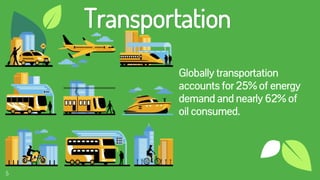
Globally transportation
accounts for 25% of energy
demand and nearly 62% of
oil consumed.
6
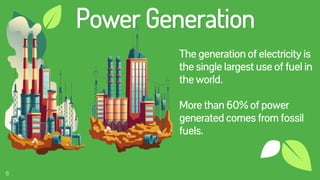
Power Generation
The generation of electricity is
the single largest use of fuel in
the world.
More than 60% of power
generated comes from fossil
fuels.
Energy
Crisis
8
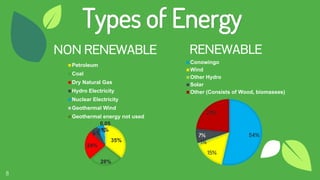
Types of Energy
35%
28%
24%
6%
6%1%
0.05
NON RENEWABLE
Petroleum
Coal
Dry Natural Gas
Hydro Electricity
Nuclear Electricity
Geothermal Wind
Geothermal energy not used
54%
15%
1%
7%
23%
RENEWABLE
Conowingo
Wind
Other Hydro
Solar
Other (Consists of Wood, biomasses)
9
Energy Crisis
200 years ago, the world
experienced an energy revolution
that launched the industrial age.
200 years forward, the
industrialized world’s thirst for
energy has increased
tremendously due to the
overgrowing population, that causes
a serious energy crisis.
10
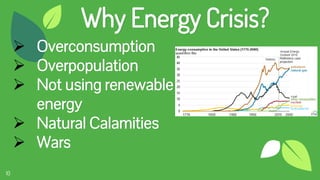
Why Energy Crisis?
 Overconsumption
 Overpopulation
 Not using renewable
energy
 Natural Calamities
 Wars
11
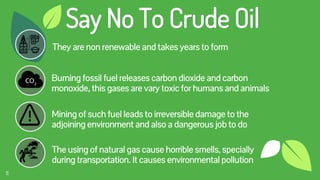
Say No To Crude Oil
They are non renewable and takes years to form
Burning fossil fuel releases carbon dioxide and carbon
monoxide, this gases are vary toxic for humans and animals
Mining of such fuel leads to irreversible damage to the
adjoining environment and also a dangerous job to do
The using of natural gas cause horrible smells, specially
during transportation. It causes environmental pollution
12
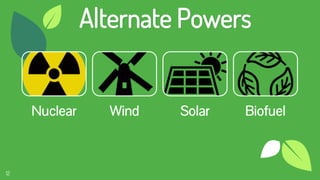
Alternate Powers
Nuclear Wind Solar Biofuel
Biofuel
14
What is Biofuel? A fuel that is produced through contemporary biological process,
such as agriculture and anaerobic digestion
 Not produced by geological process which generates fossil fuels
like coal and petroleum
Biological process: The way a plant grows up utilizing solar energy and
water
Geological process: Dynamics process which works in the earth’s
landforms by exerting high pressure and temperature
Anaerobic digestion: Collection of processes by which micro-organisms
break down biodegradable material in the absence of O2
15
Why Use Biofuels?
Availability
Price
Independence
Healthier
Better to the engine
Have good political implications
16
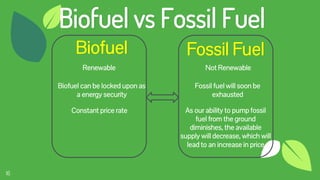
Biofuel vs Fossil Fuel
Renewable
Biofuel can be locked upon as
a energy security
Constant price rate
Biofuel
Not Renewable
Fossil fuel will soon be
exhausted
As our ability to pump fossil
fuel from the ground
diminishes, the available
supply will decrease, which will
lead to an increase in price
Fossil Fuel
17
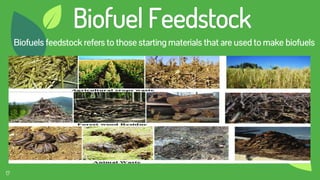
Biofuel Feedstock
Biofuels feedstock refers to those starting materials that are used to make biofuels
Classifications
of
Biofuel
19
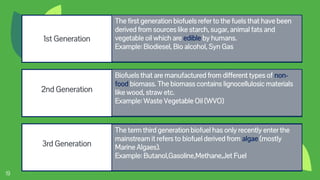
1st Generation
The first generation biofuels refer to the fuels that have been
derived from sources like starch, sugar, animal fats and
vegetable oil which are edible by humans.
Example: Biodiesel, Bio alcohol, Syn Gas
2nd Generation
Biofuels that are manufactured from different types of non-
food biomass. The biomass contains lignocellulosic materials
like wood, straw etc.
Example: Waste Vegetable Oil (WVO)
3rd Generation
The term third generation biofuel has only recently enter the
mainstream it refers to biofuel derived from algae (mostly
Marine Algaes).
Example: Butanol,Gasoline,Methane,Jet Fuel
Types
of
Biofuel
Bioethanol
22
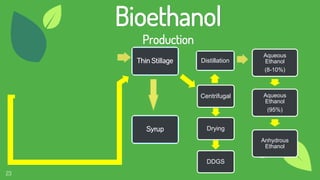
Bioethanol
Bioethanol is produced by the fermentation of
carbohydrate rich source which includes sugar cane,
sugar beet, corn.
It is colorless and clear
One of the widely used alternative automotive fuel in
the world.
23
Bioethanol
Production
Centrifugal
Drying
DDGS
Aqueous
Ethanol
(8-10%)
Aqueous
Ethanol
(95%)
Anhydrous
Ethanol
Thin Stillage
Syrup
Distillation
24
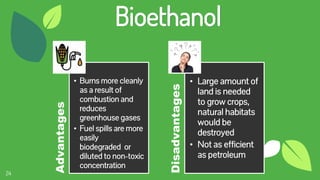
Bioethanol
Advantages
• Burns more cleanly
as a result of
combustion and
reduces
greenhouse gases
• Fuel spills are more
easily
biodegraded or
diluted to non-toxic
concentration
Disadvantages
• Large amount of
land is needed
to grow crops,
natural habitats
would be
destroyed
• Not as efficient
as petroleum
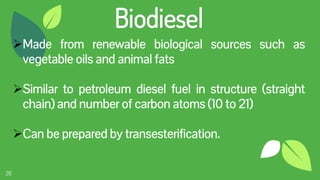
Biodiesel
26
Biodiesel
Made from renewable biological sources such as
vegetable oils and animal fats
Similar to petroleum diesel fuel in structure (straight
chain) and number of carbon atoms (10 to 21)
Can be prepared by transesterification.
27
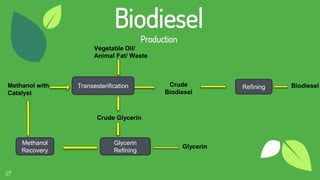
Biodiesel
Production
Refining
Glycerin
Refining
Methanol
Recovery
TransesterificationMethanol with
Catalyst
Crude Glycerin
Glycerin
Crude
Biodiesel
Biodiesel
Vegetable Oil/
Animal Fat/ Waste
28
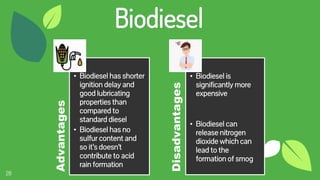
Biodiesel
Advantages
• Biodiesel has shorter
ignition delay and
good lubricating
properties than
compared to
standard diesel
• Biodiesel has no
sulfur content and
so it’s doesn’t
contribute to acid
rain formation
Disadvantages
• Biodiesel is
significantly more
expensive
• Biodiesel can
release nitrogen
dioxide which can
lead to the
formation of smog
Biogas
30
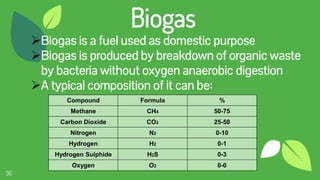
Biogas
Biogas is a fuel used as domestic purpose
Biogas is produced by breakdown of organic waste
by bacteria without oxygen anaerobic digestion
A typical composition of it can be:
Compound Formula %
Methane CH4 50-75
Carbon Dioxide CO2 25-50
Nitrogen N2 0-10
Hydrogen H2 0-1
Hydrogen Sulphide H2S 0-3
Oxygen O2 0-0
31
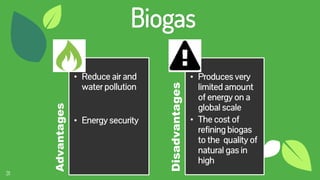
Biogas
Advantages
• Reduce air and
water pollution
• Energy security
Disadvantages
• Produces very
limited amount
of energy on a
global scale
• The cost of
refining biogas
to the quality of
natural gas in
high
Algae
33
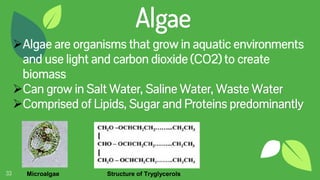
Algae
Algae are organisms that grow in aquatic environments
and use light and carbon dioxide (CO2) to create
biomass
Can grow in Salt Water, Saline Water, Waste Water
Comprised of Lipids, Sugar and Proteins predominantly
Microalgae Structure of Tryglycerols
34
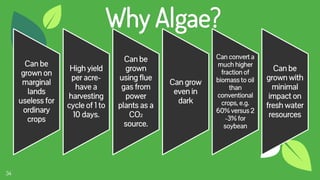
Why Algae?
Can be
grown on
marginal
lands
useless for
ordinary
crops
High yield
per acre-
have a
harvesting
cycle of 1 to
10 days.
Can be
grown
using flue
gas from
power
plants as a
CO2
source.
Can grow
even in
dark
Can convert a
much higher
fraction of
biomass to oil
than
conventional
crops, e.g.
60% versus 2
-3% for
soybean
Can be
grown with
minimal
impact on
fresh water
resources
35
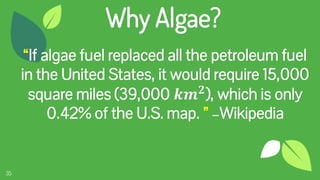
Why Algae?
“If algae fuel replaced all the petroleum fuel
in the United States, it would require 15,000
square miles (39,000 𝒌𝒎 𝟐
), which is only
0.42% of the U.S. map. ” –Wikipedia
36
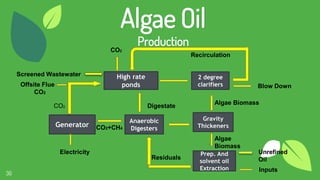
Algae Oil
Production
Unrefined
Oil
Prep. And
solvent oil
Extraction
High rate
ponds
2 degree
clarifiers
Gravity
Thickeners
Anaerobic
Digesters
Generator
CO2
Inputs
Algae Biomass
Algae
Biomass
Blow Down
Recirculation
Screened Wastewater
Offsite Flue
CO2
CO2
Electricity
CO2+CH4
Residuals
Digestate
37
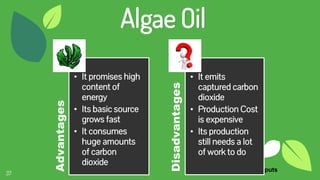
Algae Oil
Inputs
Advantages
• It promises high
content of
energy
• Its basic source
grows fast
• It consumes
huge amounts
of carbon
dioxide
Disadvantages
• It emits
captured carbon
dioxide
• Production Cost
is expensive
• Its production
still needs a lot
of work to do
Conclusion
39
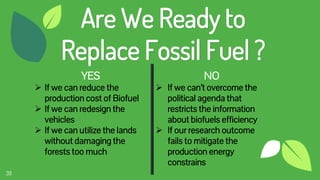
Are We Ready to
Replace Fossil Fuel ?
YES
 If we can reduce the
production cost of Biofuel
 If we can redesign the
vehicles
 If we can utilize the lands
without damaging the
forests too much
NO
 If we can’t overcome the
political agenda that
restricts the information
about biofuels efficiency
 If our research outcome
fails to mitigate the
production energy
constrains
40
Any Questions ?
41
Thank You

Biofuels

  • 1.
    1 👦Ashesh Ghosh Materials andMetallurgical Engineering BUET
  • 2.
    Today We WillKnow ⊷ What is Fuel? ⊷ Energy Crisis ⊷ What is Biofuel? ⊷ Classifications & Types • Bioethanol • Biodiesel • Biogas • Algae ⊷ Advantages & Disadvantages ⊷ Are We Ready to Use Biofuel? 2
  • 3.
  • 4.
    4 Fuel ⊷ Fuels areany materials that store potential energy in forms that can practicably released and used for work or as heat energy ⊷ Fuels are required for a variety of purposes, but are utilized chiefly for Transportation and Power Generation.
  • 5.
    5 Transportation Globally transportation accounts for25% of energy demand and nearly 62% of oil consumed.
  • 6.
    6 Power Generation The generationof electricity is the single largest use of fuel in the world. More than 60% of power generated comes from fossil fuels.
  • 7.
  • 8.
    8 Types of Energy 35% 28% 24% 6% 6%1% 0.05 NONRENEWABLE Petroleum Coal Dry Natural Gas Hydro Electricity Nuclear Electricity Geothermal Wind Geothermal energy not used 54% 15% 1% 7% 23% RENEWABLE Conowingo Wind Other Hydro Solar Other (Consists of Wood, biomasses)
  • 9.
    9 Energy Crisis 200 yearsago, the world experienced an energy revolution that launched the industrial age. 200 years forward, the industrialized world’s thirst for energy has increased tremendously due to the overgrowing population, that causes a serious energy crisis.
  • 10.
    10 Why Energy Crisis? Overconsumption  Overpopulation  Not using renewable energy  Natural Calamities  Wars
  • 11.
    11 Say No ToCrude Oil They are non renewable and takes years to form Burning fossil fuel releases carbon dioxide and carbon monoxide, this gases are vary toxic for humans and animals Mining of such fuel leads to irreversible damage to the adjoining environment and also a dangerous job to do The using of natural gas cause horrible smells, specially during transportation. It causes environmental pollution
  • 12.
  • 13.
  • 14.
    14 What is Biofuel?A fuel that is produced through contemporary biological process, such as agriculture and anaerobic digestion  Not produced by geological process which generates fossil fuels like coal and petroleum Biological process: The way a plant grows up utilizing solar energy and water Geological process: Dynamics process which works in the earth’s landforms by exerting high pressure and temperature Anaerobic digestion: Collection of processes by which micro-organisms break down biodegradable material in the absence of O2
  • 15.
    15 Why Use Biofuels? Availability Price Independence Healthier Betterto the engine Have good political implications
  • 16.
    16 Biofuel vs FossilFuel Renewable Biofuel can be locked upon as a energy security Constant price rate Biofuel Not Renewable Fossil fuel will soon be exhausted As our ability to pump fossil fuel from the ground diminishes, the available supply will decrease, which will lead to an increase in price Fossil Fuel
  • 17.
    17 Biofuel Feedstock Biofuels feedstockrefers to those starting materials that are used to make biofuels
  • 18.
  • 19.
    19 1st Generation The firstgeneration biofuels refer to the fuels that have been derived from sources like starch, sugar, animal fats and vegetable oil which are edible by humans. Example: Biodiesel, Bio alcohol, Syn Gas 2nd Generation Biofuels that are manufactured from different types of non- food biomass. The biomass contains lignocellulosic materials like wood, straw etc. Example: Waste Vegetable Oil (WVO) 3rd Generation The term third generation biofuel has only recently enter the mainstream it refers to biofuel derived from algae (mostly Marine Algaes). Example: Butanol,Gasoline,Methane,Jet Fuel
  • 20.
  • 21.
  • 22.
    22 Bioethanol Bioethanol is producedby the fermentation of carbohydrate rich source which includes sugar cane, sugar beet, corn. It is colorless and clear One of the widely used alternative automotive fuel in the world.
  • 23.
  • 24.
    24 Bioethanol Advantages • Burns morecleanly as a result of combustion and reduces greenhouse gases • Fuel spills are more easily biodegraded or diluted to non-toxic concentration Disadvantages • Large amount of land is needed to grow crops, natural habitats would be destroyed • Not as efficient as petroleum
  • 25.
  • 26.
    26 Biodiesel Made from renewablebiological sources such as vegetable oils and animal fats Similar to petroleum diesel fuel in structure (straight chain) and number of carbon atoms (10 to 21) Can be prepared by transesterification.
  • 27.
  • 28.
    28 Biodiesel Advantages • Biodiesel hasshorter ignition delay and good lubricating properties than compared to standard diesel • Biodiesel has no sulfur content and so it’s doesn’t contribute to acid rain formation Disadvantages • Biodiesel is significantly more expensive • Biodiesel can release nitrogen dioxide which can lead to the formation of smog
  • 29.
  • 30.
    30 Biogas Biogas is afuel used as domestic purpose Biogas is produced by breakdown of organic waste by bacteria without oxygen anaerobic digestion A typical composition of it can be: Compound Formula % Methane CH4 50-75 Carbon Dioxide CO2 25-50 Nitrogen N2 0-10 Hydrogen H2 0-1 Hydrogen Sulphide H2S 0-3 Oxygen O2 0-0
  • 31.
    31 Biogas Advantages • Reduce airand water pollution • Energy security Disadvantages • Produces very limited amount of energy on a global scale • The cost of refining biogas to the quality of natural gas in high
  • 32.
  • 33.
    33 Algae Algae are organismsthat grow in aquatic environments and use light and carbon dioxide (CO2) to create biomass Can grow in Salt Water, Saline Water, Waste Water Comprised of Lipids, Sugar and Proteins predominantly Microalgae Structure of Tryglycerols
  • 34.
    34 Why Algae? Can be grownon marginal lands useless for ordinary crops High yield per acre- have a harvesting cycle of 1 to 10 days. Can be grown using flue gas from power plants as a CO2 source. Can grow even in dark Can convert a much higher fraction of biomass to oil than conventional crops, e.g. 60% versus 2 -3% for soybean Can be grown with minimal impact on fresh water resources
  • 35.
    35 Why Algae? “If algaefuel replaced all the petroleum fuel in the United States, it would require 15,000 square miles (39,000 𝒌𝒎 𝟐 ), which is only 0.42% of the U.S. map. ” –Wikipedia
  • 36.
    36 Algae Oil Production Unrefined Oil Prep. And solventoil Extraction High rate ponds 2 degree clarifiers Gravity Thickeners Anaerobic Digesters Generator CO2 Inputs Algae Biomass Algae Biomass Blow Down Recirculation Screened Wastewater Offsite Flue CO2 CO2 Electricity CO2+CH4 Residuals Digestate
  • 37.
    37 Algae Oil Inputs Advantages • Itpromises high content of energy • Its basic source grows fast • It consumes huge amounts of carbon dioxide Disadvantages • It emits captured carbon dioxide • Production Cost is expensive • Its production still needs a lot of work to do
  • 38.
  • 39.
    39 Are We Readyto Replace Fossil Fuel ? YES  If we can reduce the production cost of Biofuel  If we can redesign the vehicles  If we can utilize the lands without damaging the forests too much NO  If we can’t overcome the political agenda that restricts the information about biofuels efficiency  If our research outcome fails to mitigate the production energy constrains
  • 40.
  • 41.