Business EnvironmentalBusiness Environmental
SScanningcanning
PUTTU GURU PRASAD
M.Com. M.B.A., L.L.B., M.Phil. PGDFTM, APSET.
ICFAI TMF, (PhD) at JNTU K,
Asst.Professor
S&H Department
Business EnvironmentalBusiness Environmental
SScanningcanning
Professor, Lawyer & EntrepreneurProfessor, Lawyer & Entrepreneur
Puttu GuruprasadPuttu Guruprasad
EnvironmentalEnvironmental scanningscanning
EnvironmentalEnvironmental scanningscanning isis aa
processprocess ofof
gathering,gathering, analyzing,analyzing, andand
dispensingdispensing informationinformation forfor
tacticaltactical oror strategicstrategic purposes.purposes.
TheThe environmentalenvironmental scanningscanning
processprocess entailsentails obtainingobtaining bothboth
factualfactual andand subjectivesubjective informationinformation
onon thethe businessbusiness environmentsenvironments inin
KindsKinds ofof environmentalenvironmental scanningscanning
Ad-hocAd-hoc scanningscanning - Short term, infrequent
examinations usually initiated by a crisis
RegularRegular scanningscanning - Studies done on a regular
schedule (e.g. once a year)
ContinuousContinuous scanningscanning (also(also calledcalled continuouscontinuous
learning)learning) - continuous structured data
collection and processing on a broad range of
environmental factors
Environmental scanning usually refers just to the
macro environment, but it can also include industry,
competitor analysis, marketing research (consumer
analysis), new product development (product
innovations) or the company's internal
environment.
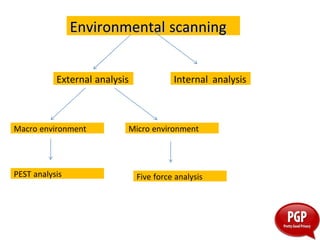
EnvironmentalEnvironmental scanningscanning
External analysis Internal analysis
Macro environment Micro environment
PEST analysis Five force analysis
A scan of the external macro-environment in
which the firm operates can be expressed in
terms of the following factors:
Political Economic Social Technological
The acronym PEST (or sometimes rearranged as
"STEP") is used to describe a framework for the
analysis of these macro environmental factors.
PPoliticalolitical EEconomicconomic SSocialocial TTechnological - PESTechnological - PEST
PoliticalPolitical FactorsFactors :-Political factors include
government regulations and legal issues and define
both formal and informal rules under which the firm
must operate. Some examples include:
tax policy
employment laws
environmental regulations
trade restrictions and tariffs
political stability
Economic Factors :-
Economic factors affect the purchasing
power of potential customers and the firm's
cost of capital. The following are examples
of factors in the macro economy:
economic growth
interest rates
exchange rates
inflation rate
Social Factors
Social factors include the demographic and
cultural aspects of the external macro
environment. These factors affect customer
needs and the size of potential markets.
Some social factors include:
health consciousness
population growth rate
age distribution
emphasis on safety
Technological Factors :-
Technological factors can lower barriers to
entry, reduce minimum efficient production
levels, and influence outsourcing decisions.
Some technological factors include:
R&D activity
Automation
technology incentives
rate of technological change
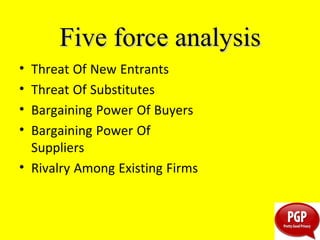
Five force analysisFive force analysis
• Threat Of New Entrants
• Threat Of Substitutes
• Bargaining Power Of Buyers
• Bargaining Power Of
Suppliers
• Rivalry Among Existing Firms
EnvironmentalEnvironmental SScanningcanning
Macro environmental and industry
scanning are useful as they reveal current
conditions of market.
It help managers to predict the future
characteristics of the organizational
environment and hence make decisions
today that will help the firm deal with the
environment of tomorrow
Thank You

4. environmental scanning pgp1

  • 1.
    Business EnvironmentalBusiness Environmental SScanningcanning PUTTUGURU PRASAD M.Com. M.B.A., L.L.B., M.Phil. PGDFTM, APSET. ICFAI TMF, (PhD) at JNTU K, Asst.Professor S&H Department
  • 2.
    Business EnvironmentalBusiness Environmental SScanningcanning Professor,Lawyer & EntrepreneurProfessor, Lawyer & Entrepreneur Puttu GuruprasadPuttu Guruprasad
  • 5.
    EnvironmentalEnvironmental scanningscanning EnvironmentalEnvironmental scanningscanningisis aa processprocess ofof gathering,gathering, analyzing,analyzing, andand dispensingdispensing informationinformation forfor tacticaltactical oror strategicstrategic purposes.purposes. TheThe environmentalenvironmental scanningscanning processprocess entailsentails obtainingobtaining bothboth factualfactual andand subjectivesubjective informationinformation onon thethe businessbusiness environmentsenvironments inin
  • 6.
    KindsKinds ofof environmentalenvironmentalscanningscanning Ad-hocAd-hoc scanningscanning - Short term, infrequent examinations usually initiated by a crisis RegularRegular scanningscanning - Studies done on a regular schedule (e.g. once a year) ContinuousContinuous scanningscanning (also(also calledcalled continuouscontinuous learning)learning) - continuous structured data collection and processing on a broad range of environmental factors
  • 7.
    Environmental scanning usuallyrefers just to the macro environment, but it can also include industry, competitor analysis, marketing research (consumer analysis), new product development (product innovations) or the company's internal environment.
  • 8.
    EnvironmentalEnvironmental scanningscanning External analysisInternal analysis Macro environment Micro environment PEST analysis Five force analysis
  • 9.
    A scan ofthe external macro-environment in which the firm operates can be expressed in terms of the following factors: Political Economic Social Technological The acronym PEST (or sometimes rearranged as "STEP") is used to describe a framework for the analysis of these macro environmental factors. PPoliticalolitical EEconomicconomic SSocialocial TTechnological - PESTechnological - PEST
  • 10.
    PoliticalPolitical FactorsFactors :-Politicalfactors include government regulations and legal issues and define both formal and informal rules under which the firm must operate. Some examples include: tax policy employment laws environmental regulations trade restrictions and tariffs political stability
  • 11.
    Economic Factors :- Economicfactors affect the purchasing power of potential customers and the firm's cost of capital. The following are examples of factors in the macro economy: economic growth interest rates exchange rates inflation rate
  • 12.
    Social Factors Social factorsinclude the demographic and cultural aspects of the external macro environment. These factors affect customer needs and the size of potential markets. Some social factors include: health consciousness population growth rate age distribution emphasis on safety
  • 13.
    Technological Factors :- Technologicalfactors can lower barriers to entry, reduce minimum efficient production levels, and influence outsourcing decisions. Some technological factors include: R&D activity Automation technology incentives rate of technological change
  • 14.
    Five force analysisFiveforce analysis • Threat Of New Entrants • Threat Of Substitutes • Bargaining Power Of Buyers • Bargaining Power Of Suppliers • Rivalry Among Existing Firms
  • 15.
    EnvironmentalEnvironmental SScanningcanning Macro environmentaland industry scanning are useful as they reveal current conditions of market. It help managers to predict the future characteristics of the organizational environment and hence make decisions today that will help the firm deal with the environment of tomorrow
  • 16.