Benefits of an
Effective EMS
EHS Management Strategies. LLC
@ copyright protected do not copy or distribute.
Overview
• Environmental Management System Basics
• ISO 14001 Update
• Getting Started
• Benefits of an EMS
Developing an EMS does not require ISO 14001
EMS Basics
@ copyright protected do not copy or distribute.
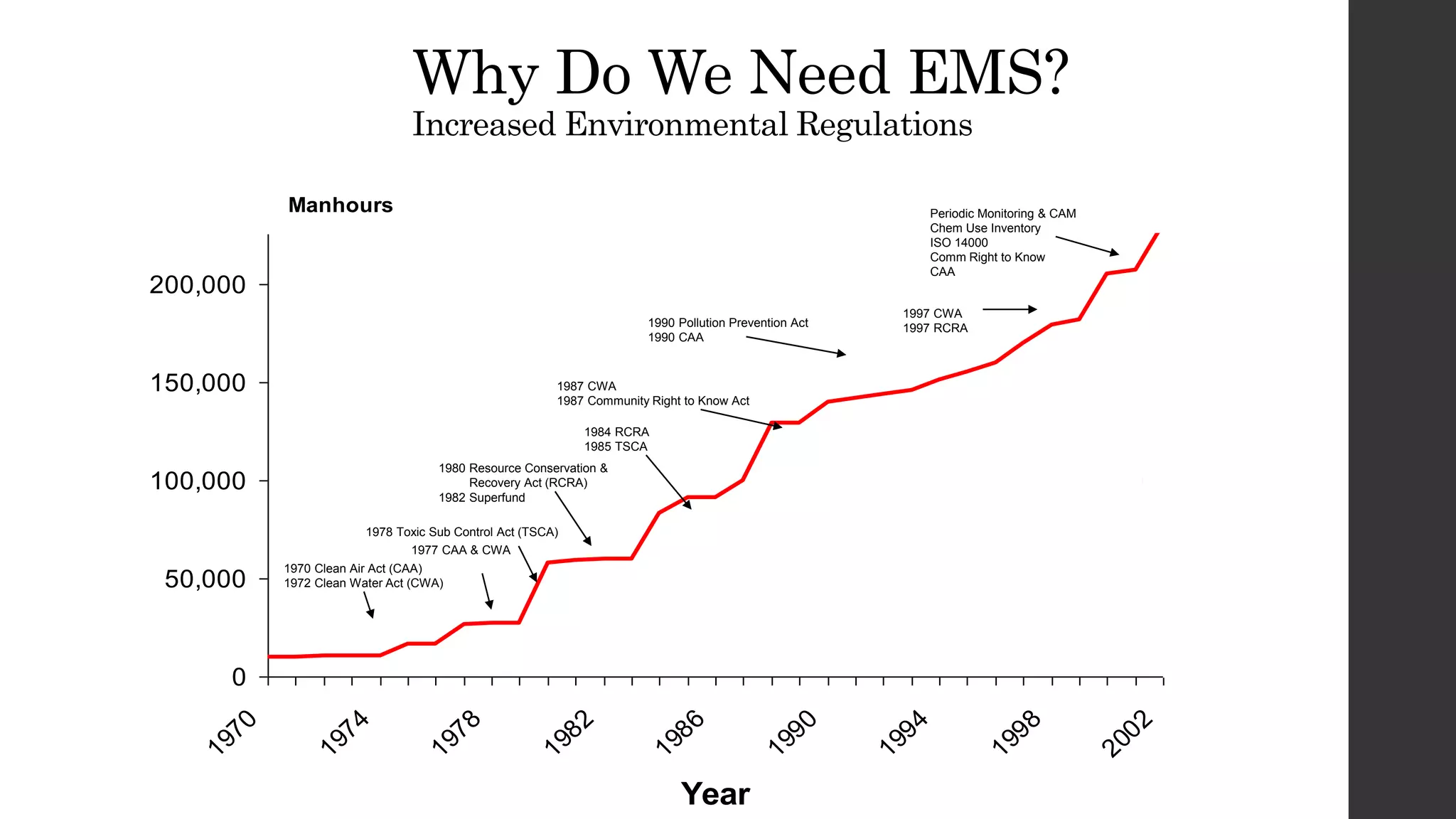
Why Do We Need EMS?
Increased Environmental Regulations
0
50,000
100,000
150,000
200,000
1970
1974
1978
1982
1986
1990
1994
1998
2002
Year
Manhours
1970 Clean Air Act (CAA)
1972 Clean Water Act (CWA)
1977 CAA & CWA
1978 Toxic Sub Control Act (TSCA)
1980 Resource Conservation &
Recovery Act (RCRA)
1982 Superfund
1984 RCRA
1985 TSCA
1987 CWA
1987 Community Right to Know Act
1990 Pollution Prevention Act
1990 CAA
1997 CWA
1997 RCRA
Periodic Monitoring & CAM
Chem Use Inventory
ISO 14000
Comm Right to Know
CAA
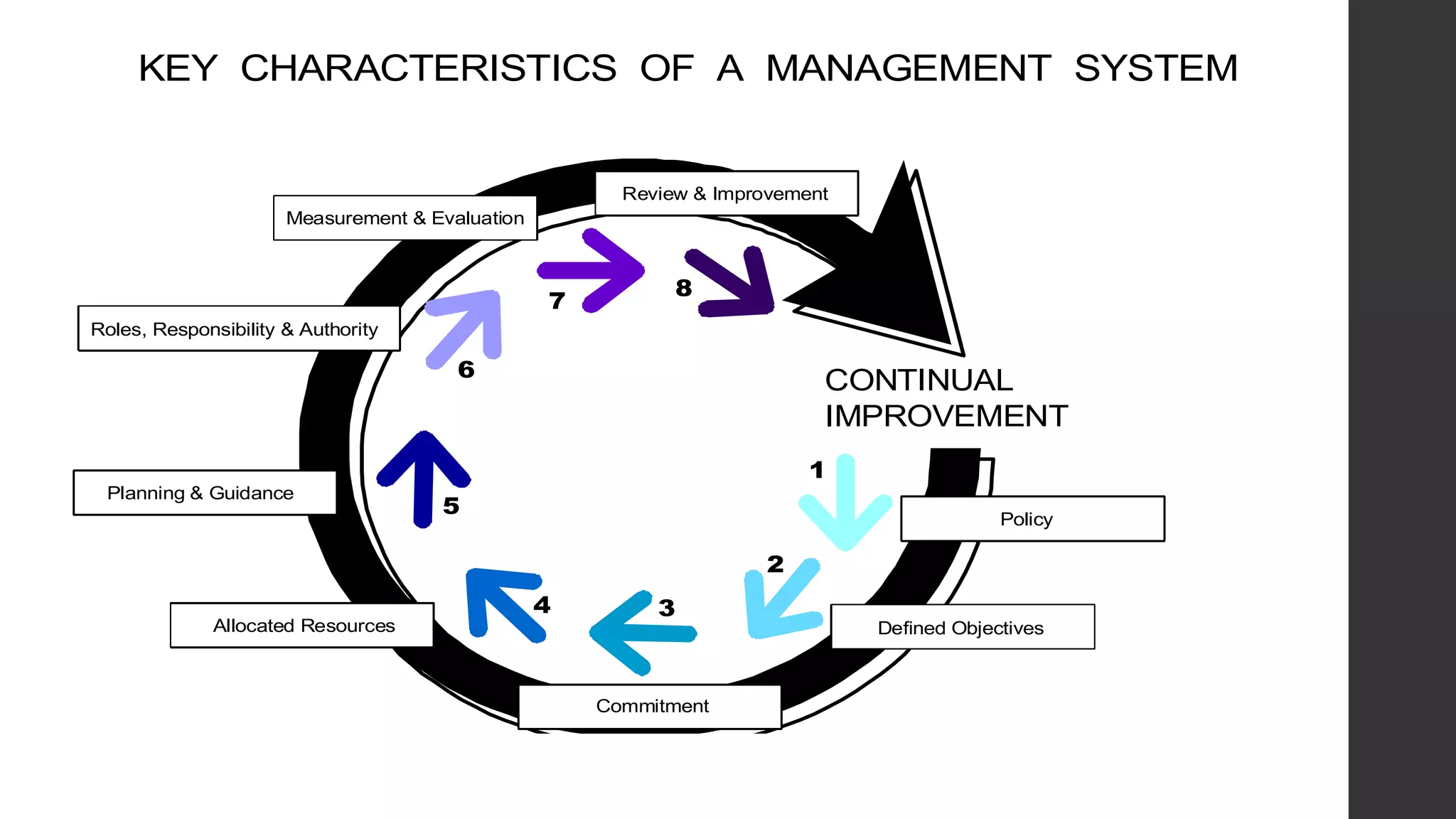
CONTINUAL
IMPROVEMENT
Commitment
Planning & Guidance
Allocated Resources
Roles, Responsibility & Authority
Measurement & Evaluation
Review & Improvement
Commitment
Defined Objectives
1
2
34
5
6
7
KEY CHARACTERISTICS OF A MANAGEMENT SYSTEM
Policy
8
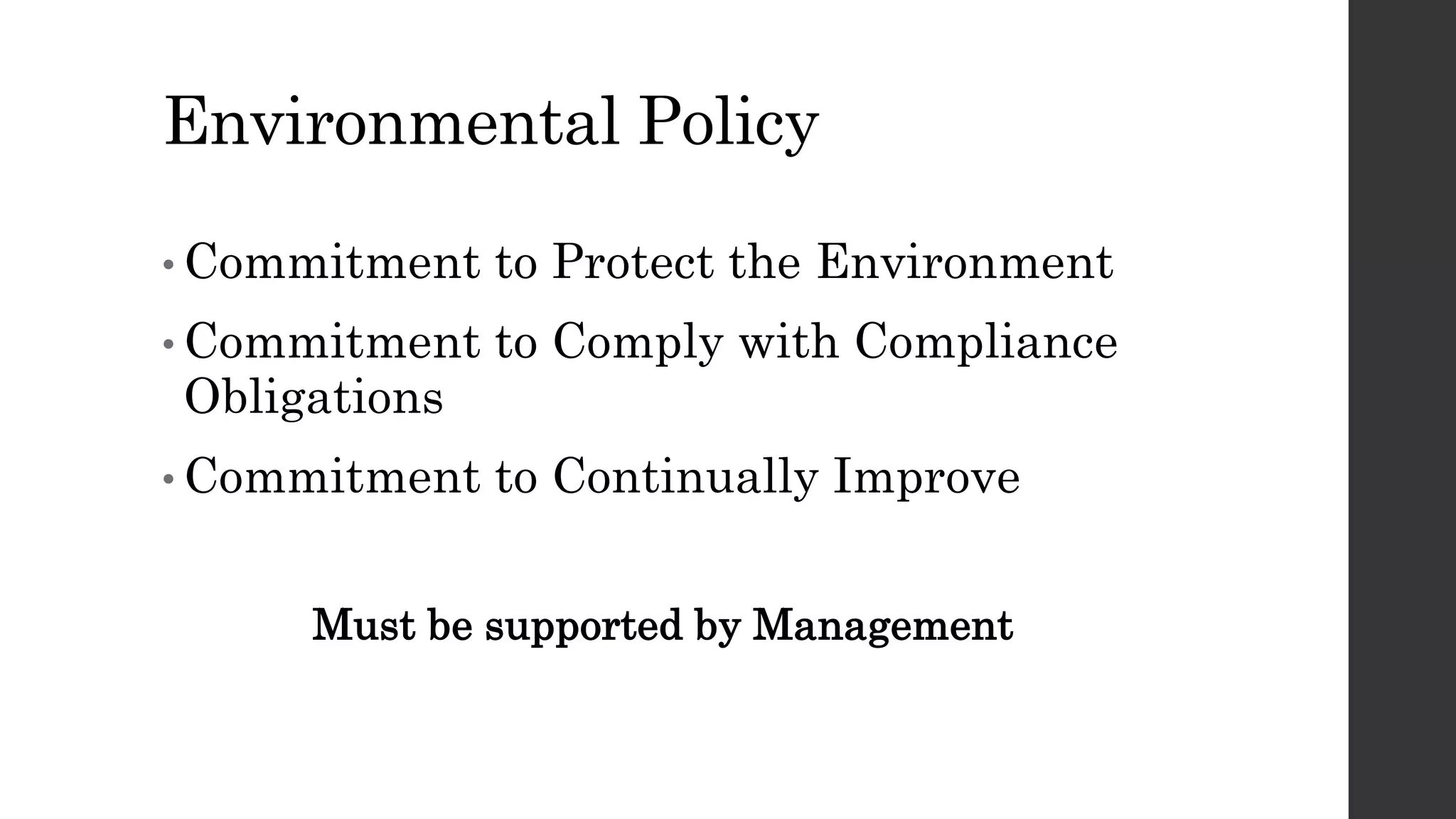
Environmental Policy
• Commitment to Protect the Environment
• Commitment to Comply with Compliance
Obligations
• Commitment to Continually Improve
Must be supported by Management
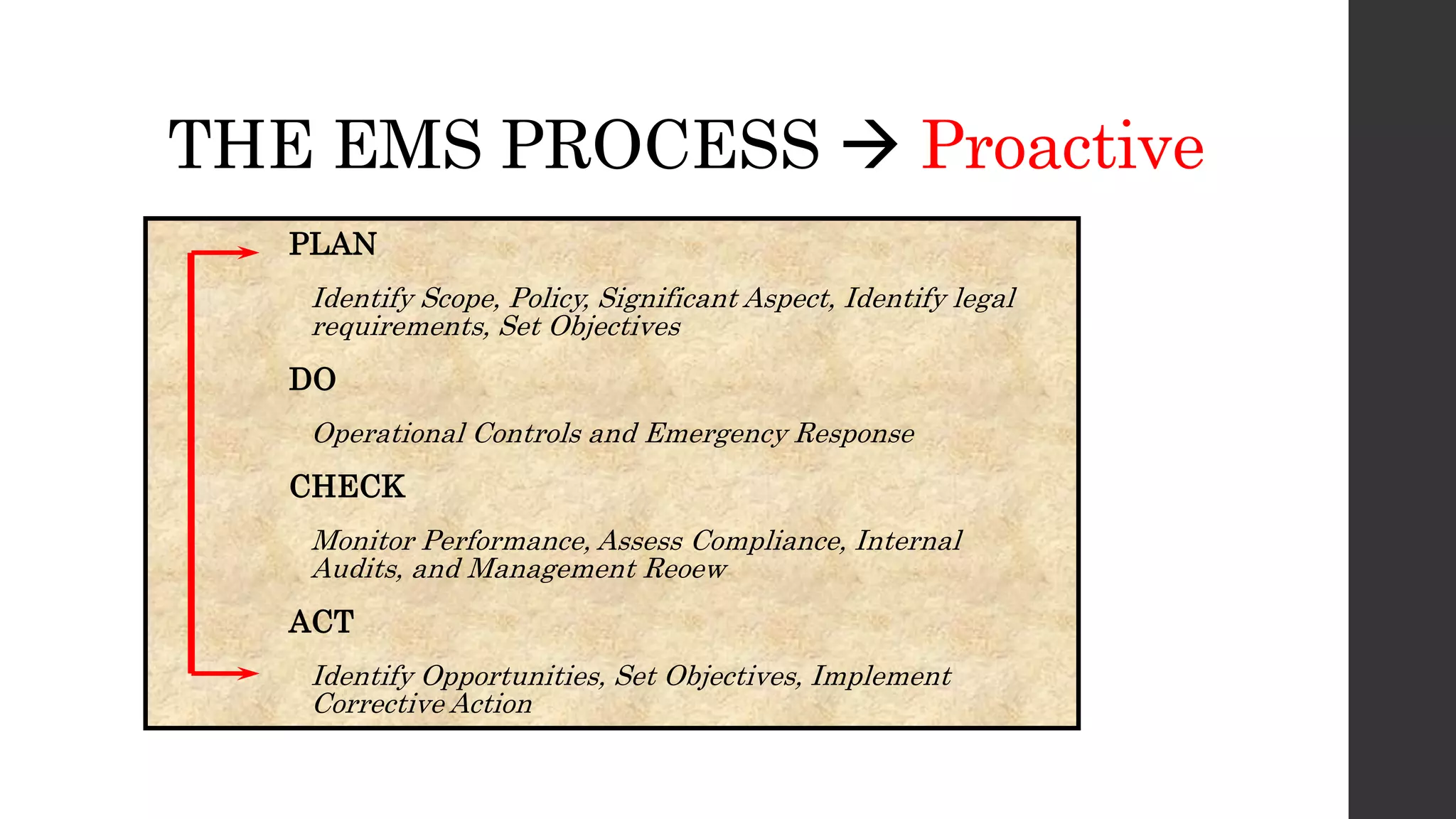
THE EMS PROCESS  Proactive
PLAN
Identify Scope, Policy, Significant Aspect, Identify legal
requirements, Set Objectives
DO
Operational Controls and Emergency Response
CHECK
Monitor Performance, Assess Compliance, Internal
Audits, and Management Reoew
ACT
Identify Opportunities, Set Objectives, Implement
Corrective Action
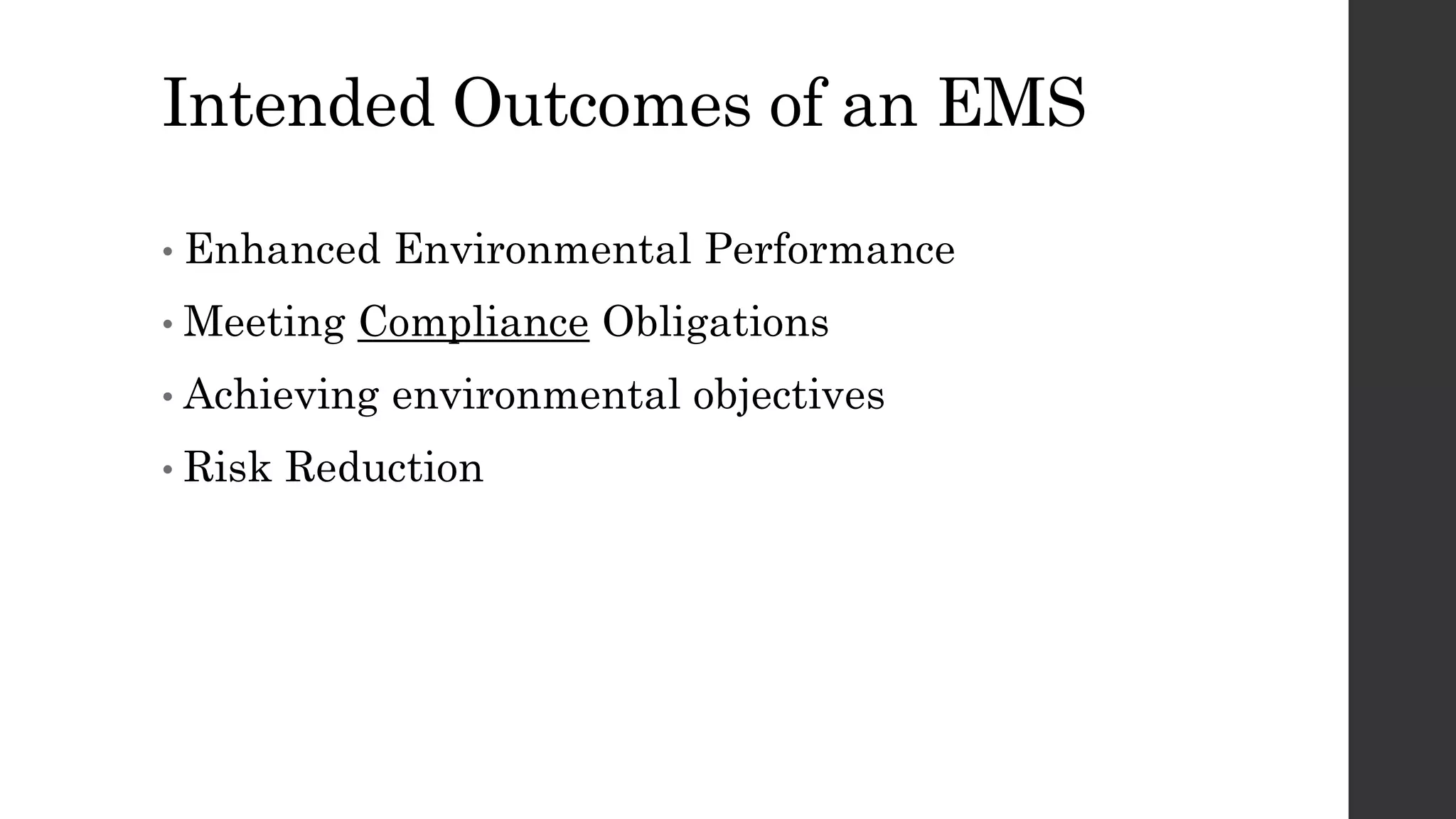
Intended Outcomes of an EMS
• Enhanced Environmental Performance
• Meeting Compliance Obligations
• Achieving environmental objectives
• Risk Reduction
ISO 14001 Standard
Setting Up an ISO 14001 Management System
@ copyright protected do not copy or distribute.
ISO 14001…
 Says WHAT should be done by an organization to
manage its environmental risks, but doesn’t dictate
HOW to do it.
 Is not tied to any regulatory jurisdiction
 Emphasizes:
 Prevention of Pollution
 Compliance
 Continual Improvement
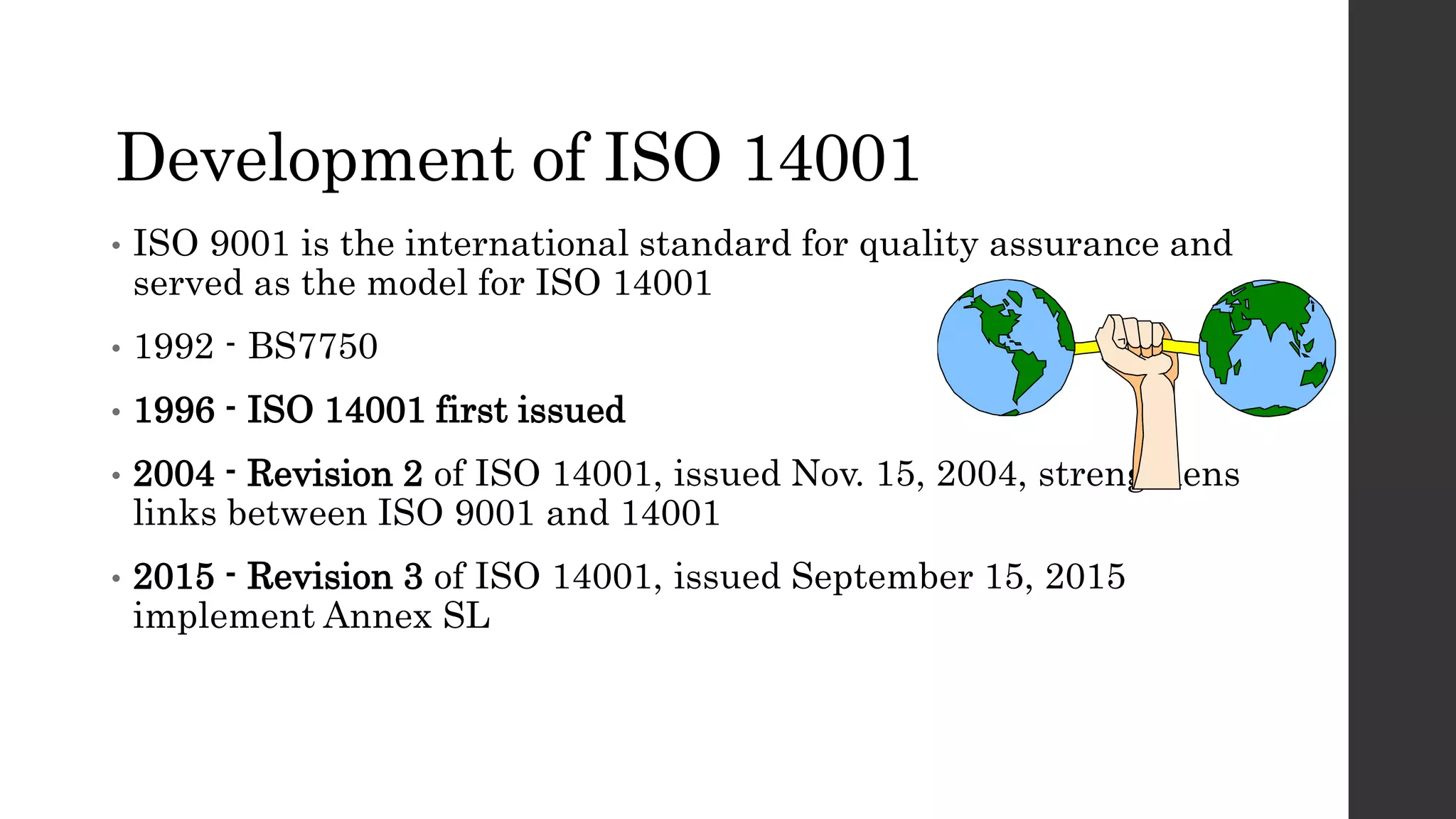
Development of ISO 14001
• ISO 9001 is the international standard for quality assurance and
served as the model for ISO 14001
• 1992 - BS7750
• 1996 - ISO 14001 first issued
• 2004 - Revision 2 of ISO 14001, issued Nov. 15, 2004, strengthens
links between ISO 9001 and 14001
• 2015 - Revision 3 of ISO 14001, issued September 15, 2015
implement Annex SL
Goals of an ISO EMS
• Protect the environment by preventing or mitigating adverse environmental
impacts;
• Mitigate the potential adverse effect of environmental conditions on the
organization;
• Assist an organization in the fulfilment of compliance obligations;
• Enhancing environmental performance;
• Controlling or influencing the way the organization’s products and services are
designed, manufactured, distributed, consumed and disposed by using a life cycle
perspective that can prevent environmental impacts from being unintentionally
shifted elsewhere within the life cycle;
• Achieving financial and operational benefits that can result from implementing
environmentally sound alternatives that strengthen the organization’s market
position;
• Communicating environmental information to relevant interested parties.
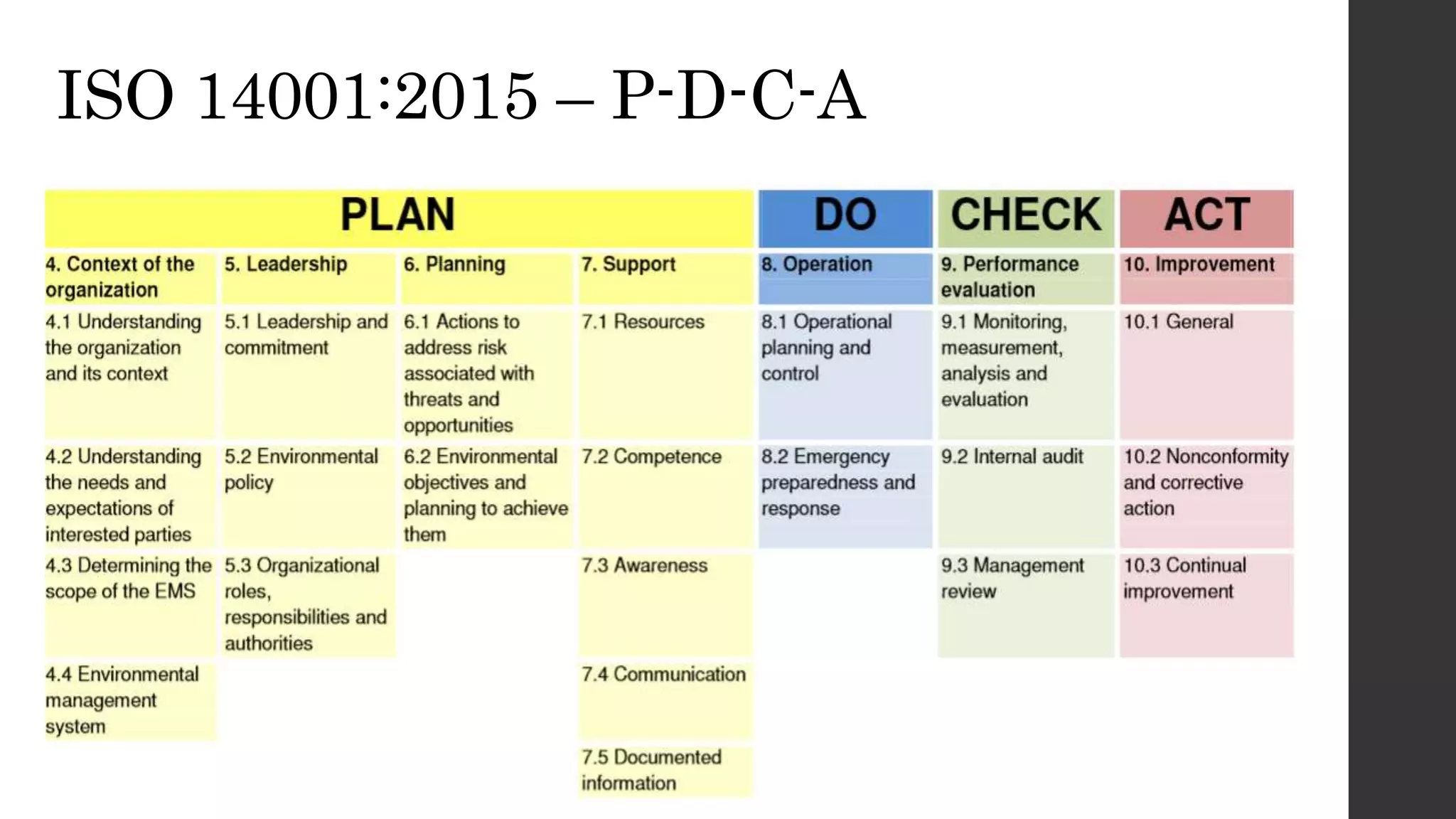
ISO 14001:2015 – P-D-C-A
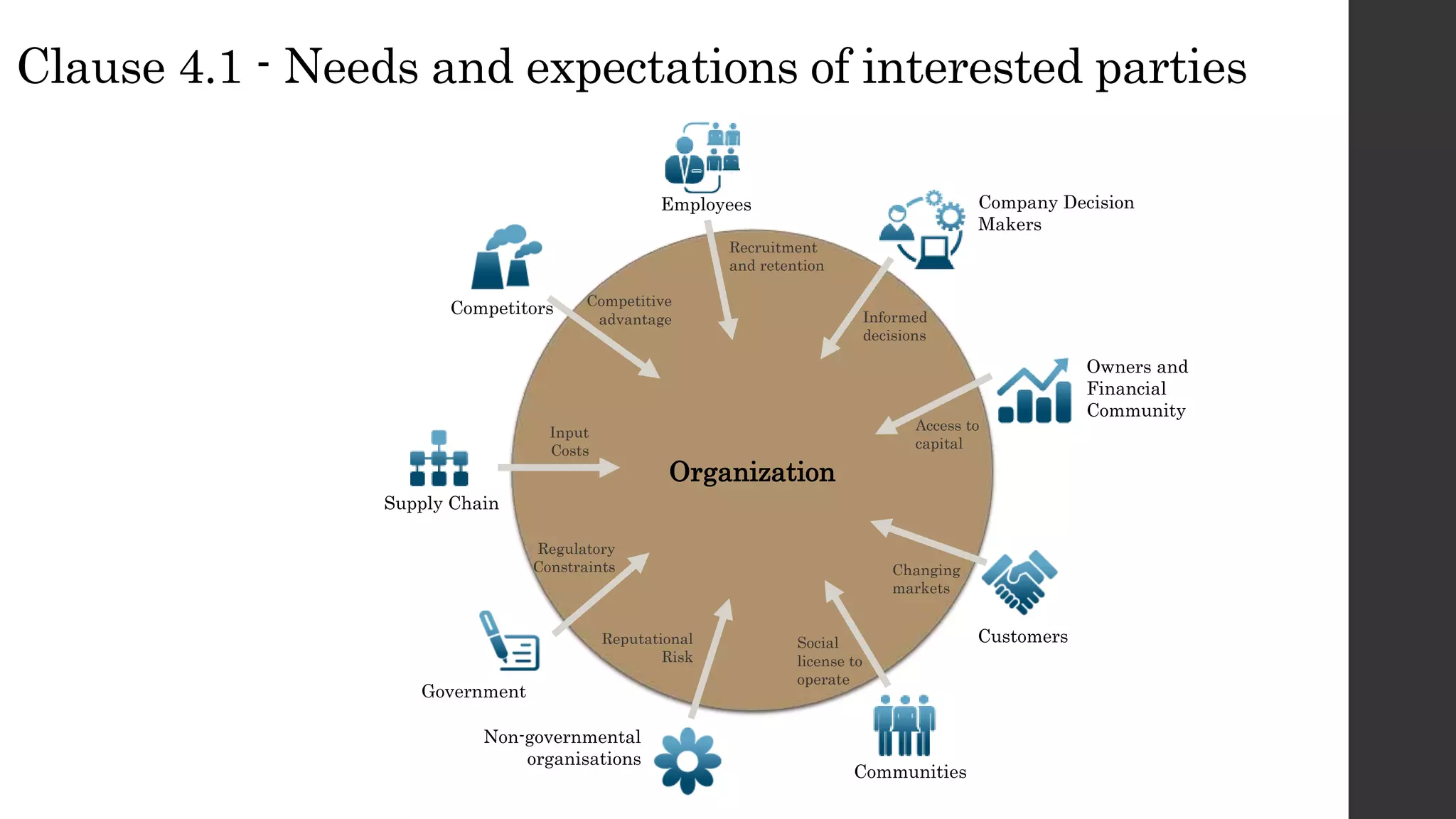
Clause 4.1 - Needs and expectations of interested parties
Organization
Employees
Competitors
Supply Chain
Government
Non-governmental
organisations
Communities
Customers
Owners and
Financial
Community
Company Decision
Makers
Recruitment
and retention
Access to
capital
Changing
markets
Informed
decisions
Social
license to
operate
Reputational
Risk
Regulatory
Constraints
Input
Costs
Competitive
advantage
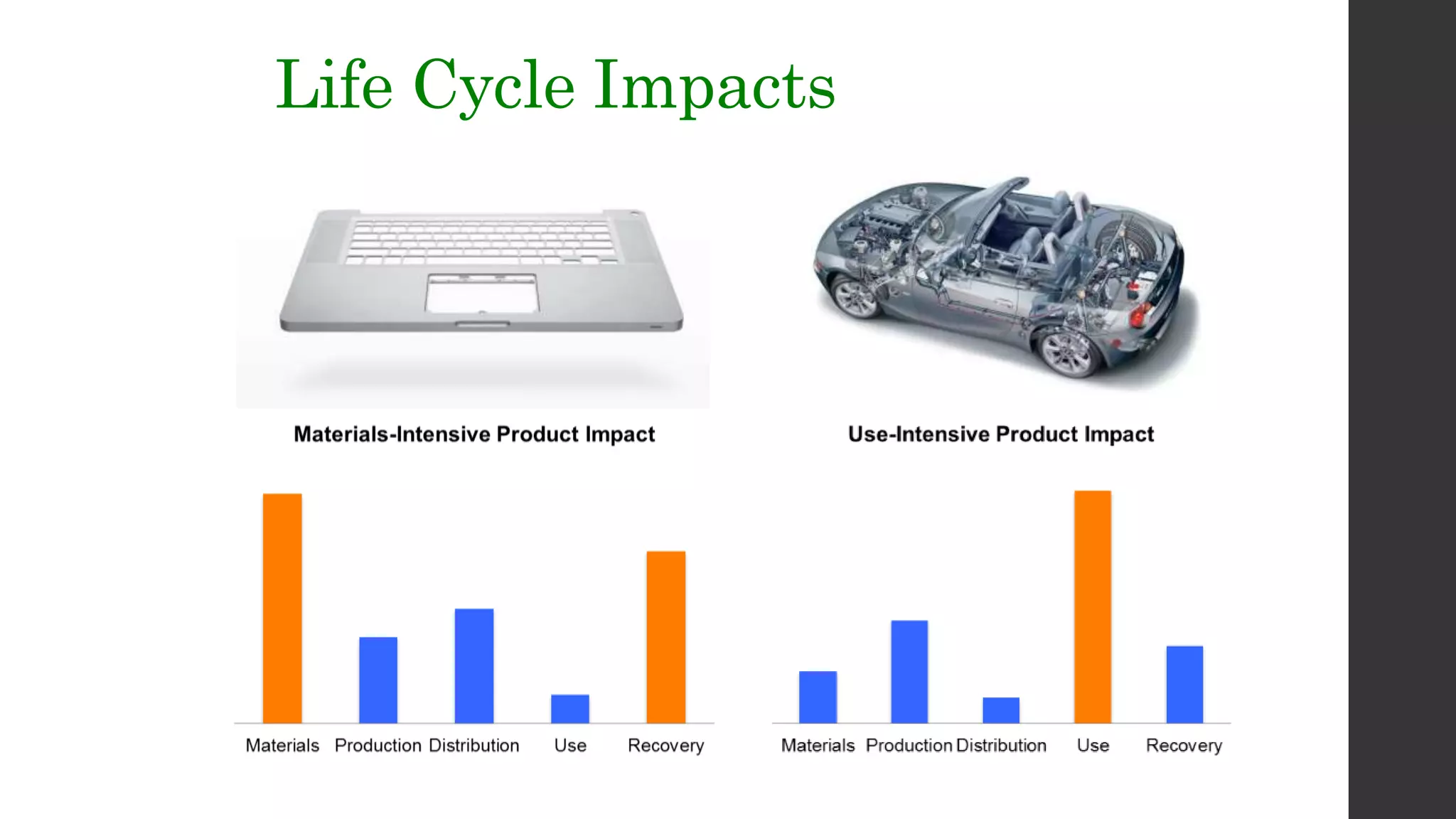
Life Cycle Impacts
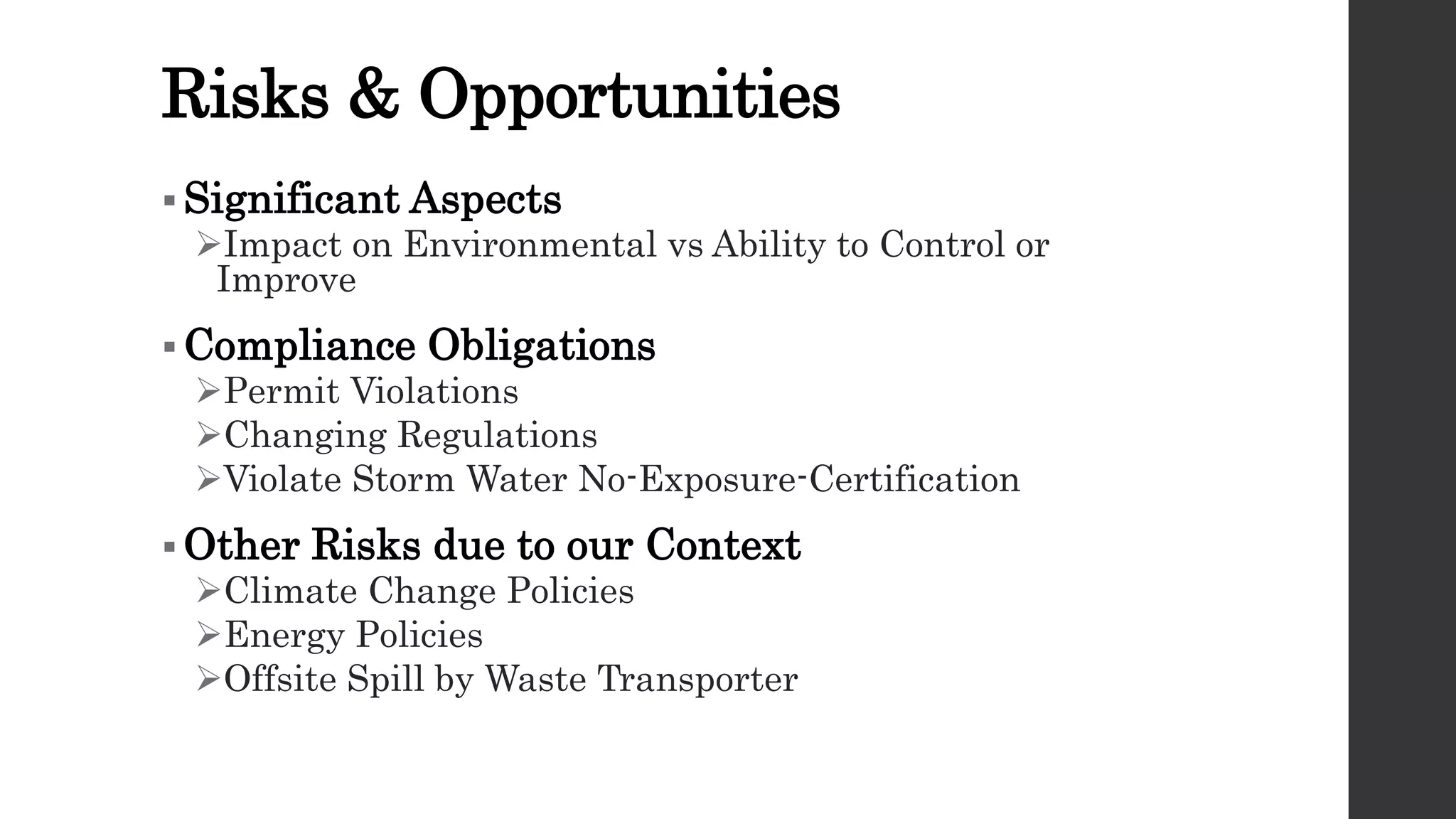
Risks & Opportunities
 Significant Aspects
Impact on Environmental vs Ability to Control or
Improve
 Compliance Obligations
Permit Violations
Changing Regulations
Violate Storm Water No-Exposure-Certification
 Other Risks due to our Context
Climate Change Policies
Energy Policies
Offsite Spill by Waste Transporter
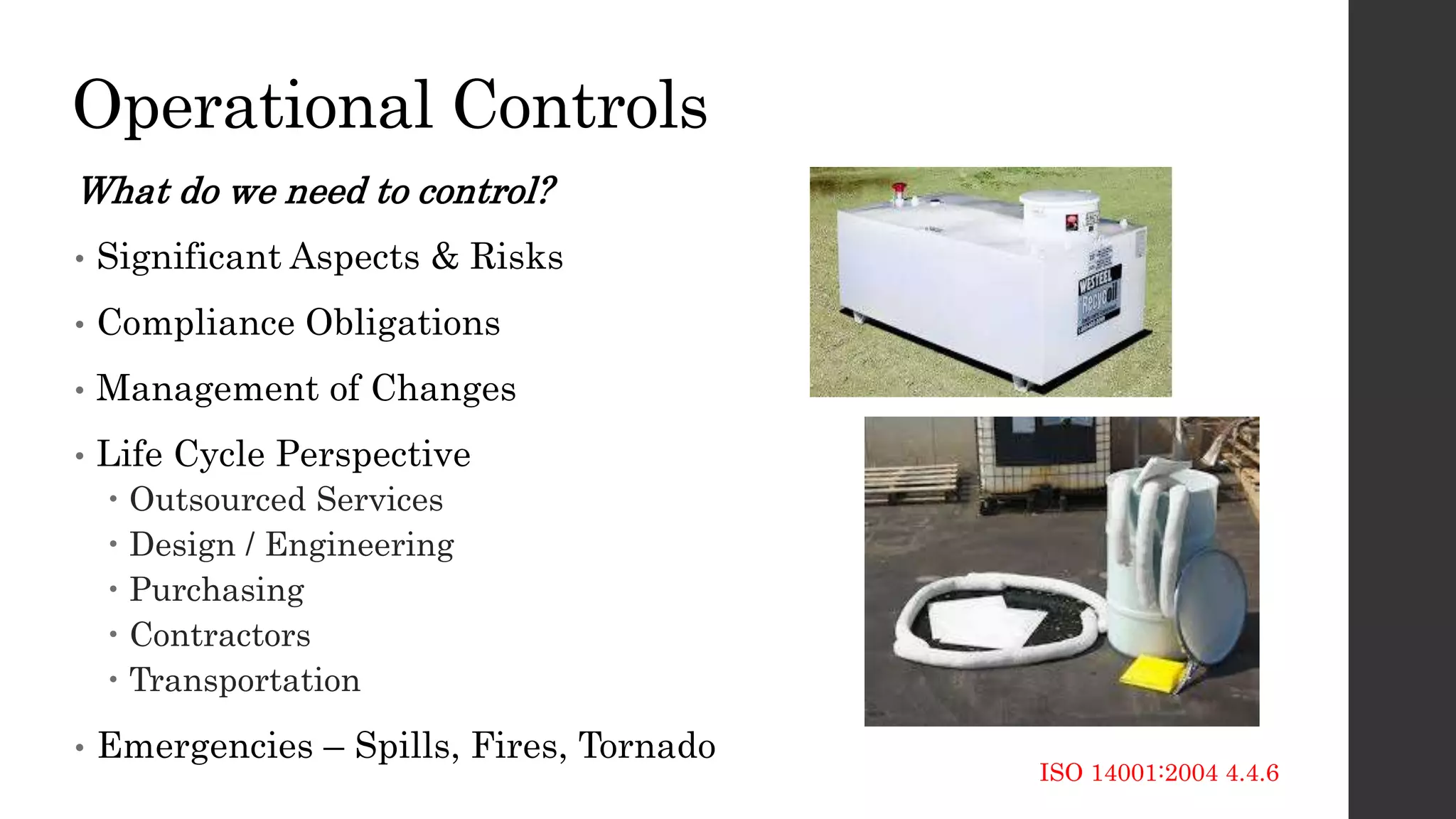
Operational Controls
What do we need to control?
• Significant Aspects & Risks
• Compliance Obligations
• Management of Changes
• Life Cycle Perspective
 Outsourced Services
 Design / Engineering
 Purchasing
 Contractors
 Transportation
• Emergencies – Spills, Fires, Tornado
ISO 14001:2004 4.4.6
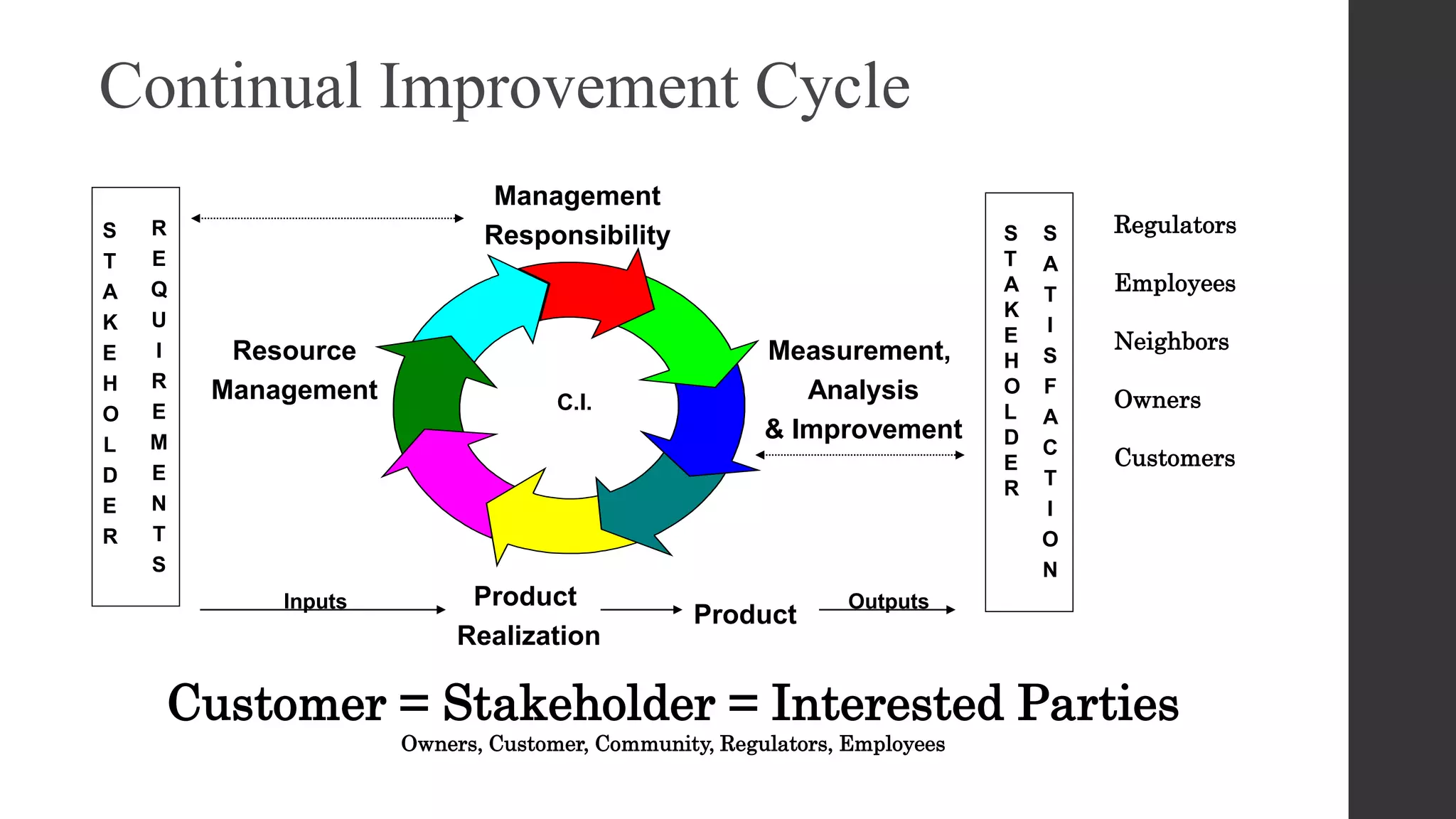
Management
Responsibility
Resource
Management
Product
Realization
Measurement,
Analysis
& Improvement
Inputs
Product
S
T
A
K
E
H
O
L
D
E
R
Outputs
R
E
Q
U
I
R
E
M
E
N
T
S
S
T
A
K
E
H
O
L
D
E
R
S
A
T
I
S
F
A
C
T
I
O
N
C.I.
Continual Improvement Cycle
Customer = Stakeholder = Interested Parties
Owners, Customer, Community, Regulators, Employees
Regulators
Employees
Neighbors
Owners
Customers
Developing an EMS
Setting Up an ISO 14001 Management System
@ copyright protected do not copy or distribute.
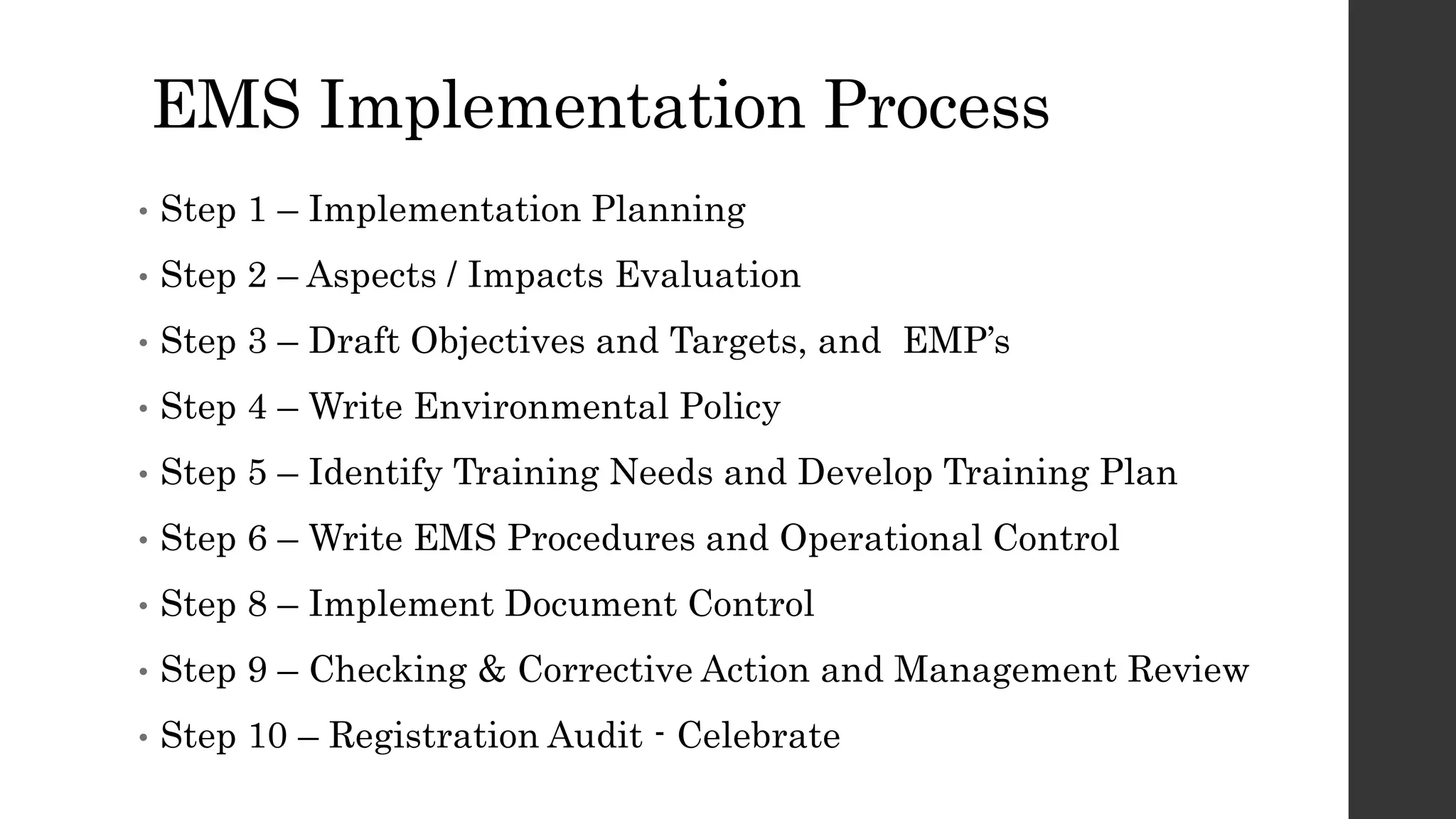
EMS Implementation Process
• Step 1 – Implementation Planning
• Step 2 – Aspects / Impacts Evaluation
• Step 3 – Draft Objectives and Targets, and EMP’s
• Step 4 – Write Environmental Policy
• Step 5 – Identify Training Needs and Develop Training Plan
• Step 6 – Write EMS Procedures and Operational Control
• Step 8 – Implement Document Control
• Step 9 – Checking & Corrective Action and Management Review
• Step 10 – Registration Audit - Celebrate
Implementation Planning
• Management Commitment backed by resources
 Time & Money
• Develop Implementation Schedule
• Select Implementation Team (Cross Functional)
• EMS Training
 CFT training
 Leadership training for Managers
• Select External Resources
 Registrar
 Consultant / Training
• Assess Existing Systems
 Quality, Human Resources, Safety
Implementation Costs per Facility
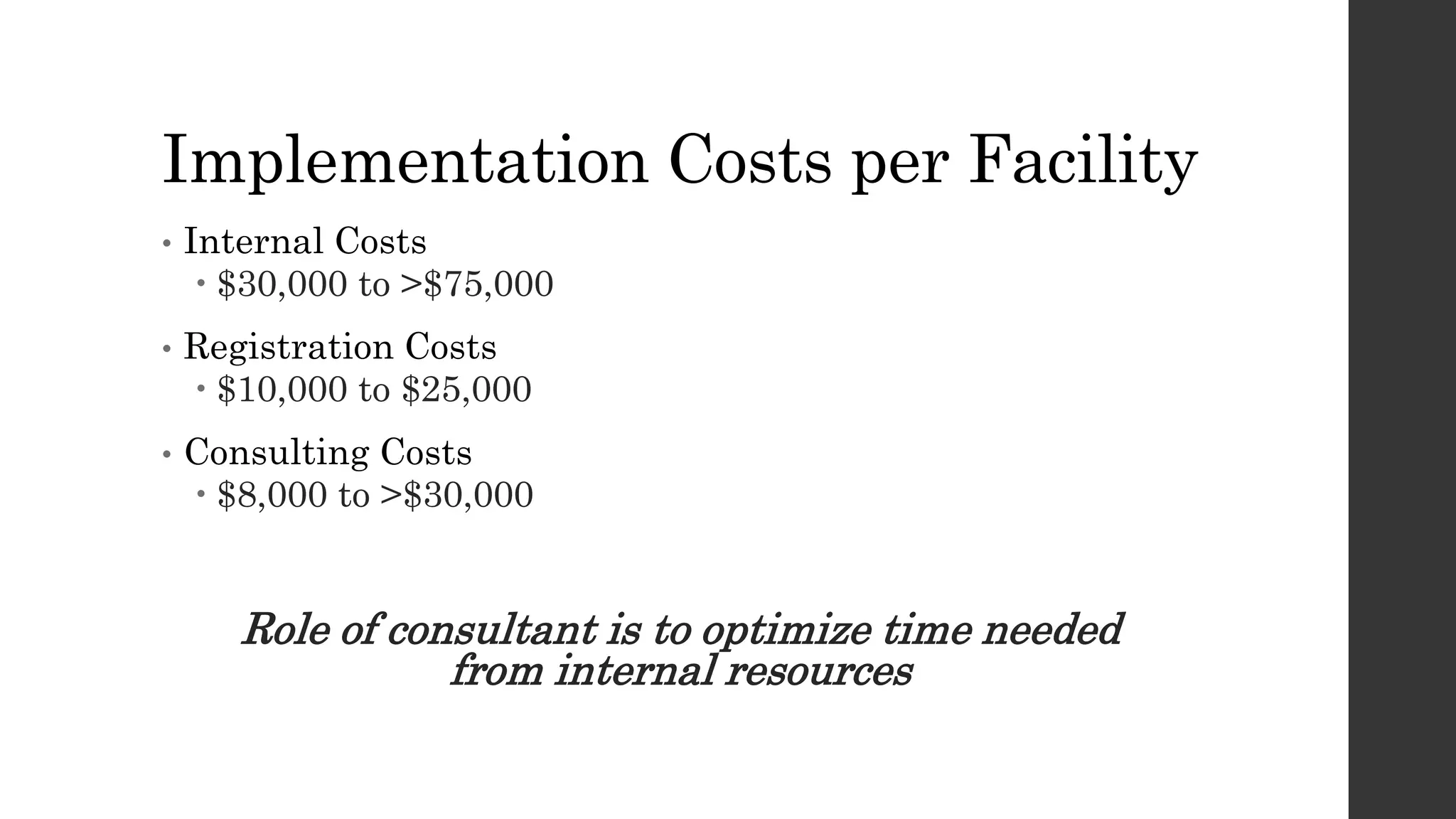
• Internal Costs
 $30,000 to >$75,000
• Registration Costs
 $10,000 to $25,000
• Consulting Costs
 $8,000 to >$30,000
Role of consultant is to optimize time needed
from internal resources
Keys to Success
• Must have Management Support
 Corporate, Division, and Plant Level
• Proper Project Planning
• Adequate Resources
 Internal, External, $$$$$
• Involvement of Personnel at all Levels
 Management, Operations, hourly/union
Benefits of an EMS
ISO 14001:2015
Benefits of an EMS
 Improved Environmental Performance
 Formal Structure To Document And Improve
Performance
 Internal Audits
 Corrective Action Plans
 3rd Party Audits
 Establishes Environmental Ownership
 Drives Ownership And Accountability (Senior
Management to Associates)
 Includes contractors / subcontractors
Benefits of an EMS
• Optimizes Cost – i.e. savings on material costs, waste disposal
costs, energy costs
 Reducing incidents that result in liability
 Demonstrating reasonable care
 Assures customers of environmental commitment
 May improve access to capital and insurance
• Promotes environmental compliance
 Parties that do not comply with environmental laws are
potentially subject to Charges and / or Fines
 Negative publicity could be much more costly than a fine
Benefits of EMS
Some facts and figures about the benefits of ISO 14001 from NDEMS
Study:
• Average savings of $90,320 after 2 ½ years of the study (these savings
include the cost of the EMS design and implementation period)
• 63% of respondents reported improvements in environmental
performance indicators
• 78% of respondents saw operational gains
• 93% of respondents saw an increase in employee involvement in
environmental issues as a result of the EMS design and
implementation period
• 53% of respondents improved their regulatory relationship
Value of Third Party Certification
• Yes, it costs money!!
• Independent review of your processes
• Keep system active through surveillance audit
process
• Demonstration to external stakeholders
 Customers, Bankers, Insurance Companies, Regulatory agencies, Employees
• Good Public Relations
 Michigan Clean Corporate Citizens
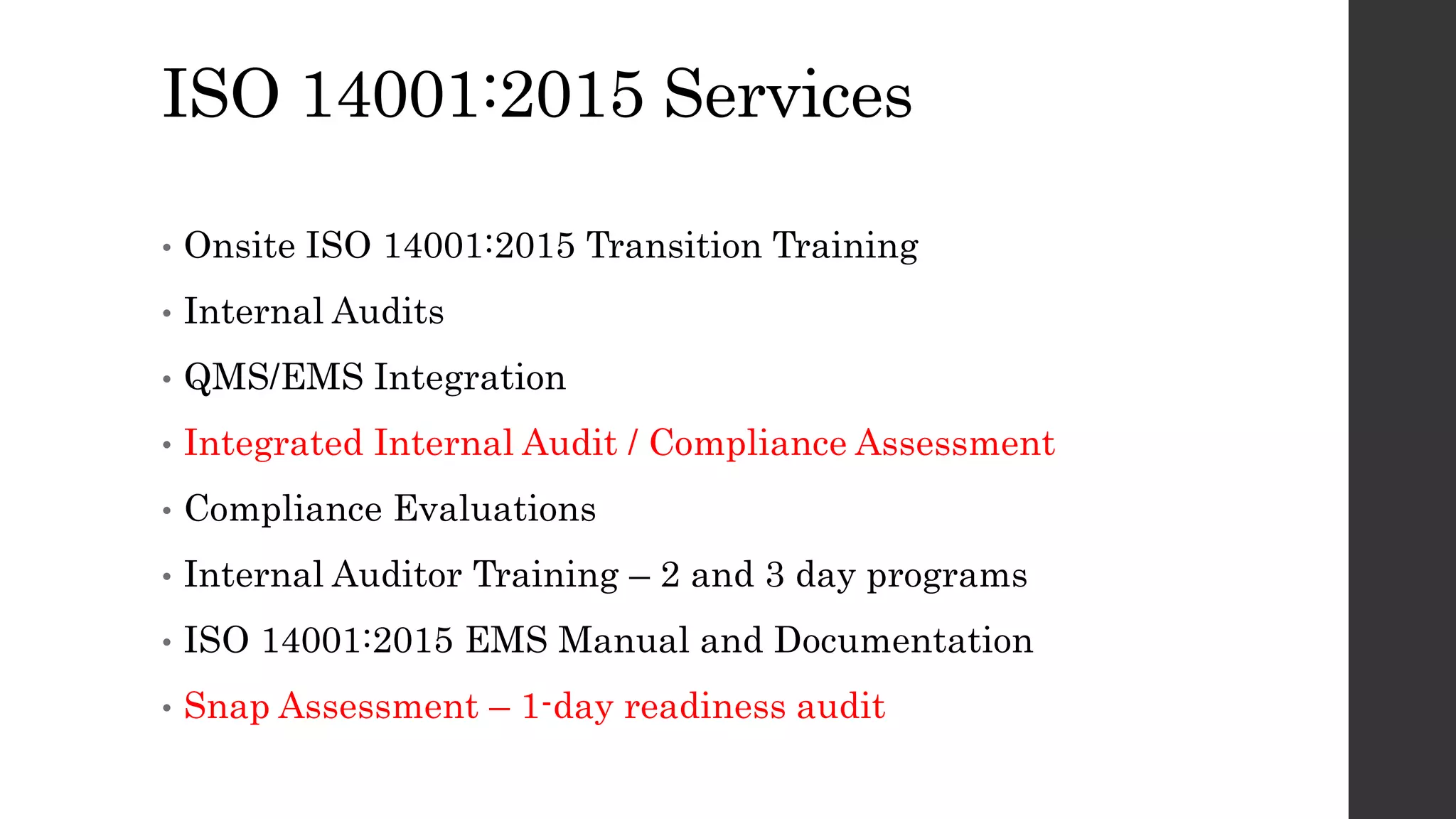
ISO 14001:2015 Services
• Onsite ISO 14001:2015 Transition Training
• Internal Audits
• QMS/EMS Integration
• Integrated Internal Audit / Compliance Assessment
• Compliance Evaluations
• Internal Auditor Training – 2 and 3 day programs
• ISO 14001:2015 EMS Manual and Documentation
• Snap Assessment – 1-day readiness audit
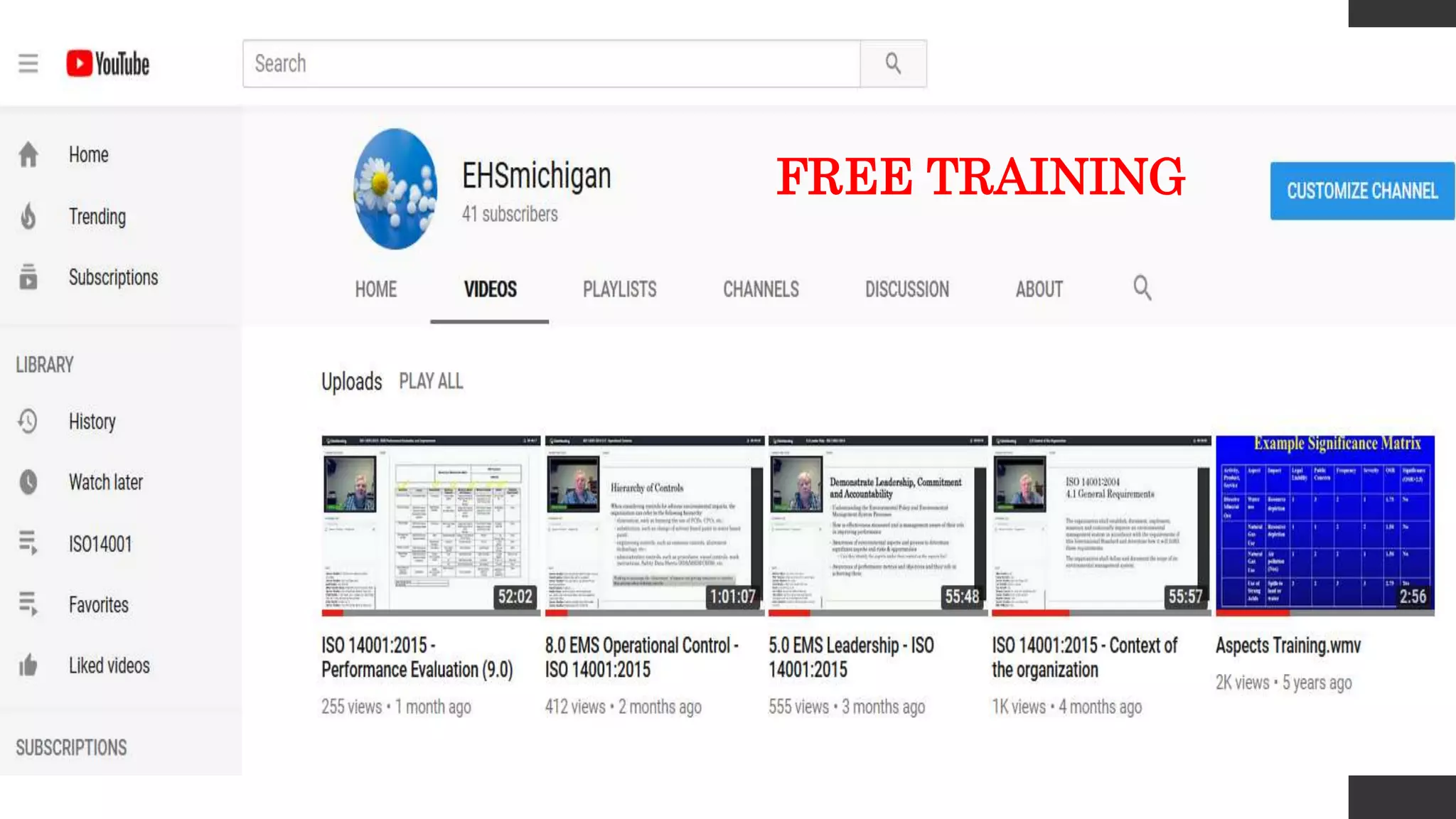
FREE TRAINING
EMS Support
James Charles, PE, CPG
Senior Consultant
EHS Management Strategies, LLC
5605 Kies NE, Suite 100
Rockford, MI 49341
(616) 666-5490
James.Charles@ISO14001-Training.com
www.ISO14001-Training.com
www.ISO45001-Support.com

Developing an EMS and ISO 14001:2015 and Life Cycle Perspective

  • 1.
    Benefits of an EffectiveEMS EHS Management Strategies. LLC @ copyright protected do not copy or distribute.
  • 2.
    Overview • Environmental ManagementSystem Basics • ISO 14001 Update • Getting Started • Benefits of an EMS Developing an EMS does not require ISO 14001
  • 3.
    EMS Basics @ copyrightprotected do not copy or distribute.
  • 4.
    Why Do WeNeed EMS? Increased Environmental Regulations 0 50,000 100,000 150,000 200,000 1970 1974 1978 1982 1986 1990 1994 1998 2002 Year Manhours 1970 Clean Air Act (CAA) 1972 Clean Water Act (CWA) 1977 CAA & CWA 1978 Toxic Sub Control Act (TSCA) 1980 Resource Conservation & Recovery Act (RCRA) 1982 Superfund 1984 RCRA 1985 TSCA 1987 CWA 1987 Community Right to Know Act 1990 Pollution Prevention Act 1990 CAA 1997 CWA 1997 RCRA Periodic Monitoring & CAM Chem Use Inventory ISO 14000 Comm Right to Know CAA
  • 5.
    CONTINUAL IMPROVEMENT Commitment Planning & Guidance AllocatedResources Roles, Responsibility & Authority Measurement & Evaluation Review & Improvement Commitment Defined Objectives 1 2 34 5 6 7 KEY CHARACTERISTICS OF A MANAGEMENT SYSTEM Policy 8
  • 6.
    Environmental Policy • Commitmentto Protect the Environment • Commitment to Comply with Compliance Obligations • Commitment to Continually Improve Must be supported by Management
  • 7.
    THE EMS PROCESS Proactive PLAN Identify Scope, Policy, Significant Aspect, Identify legal requirements, Set Objectives DO Operational Controls and Emergency Response CHECK Monitor Performance, Assess Compliance, Internal Audits, and Management Reoew ACT Identify Opportunities, Set Objectives, Implement Corrective Action
  • 8.
    Intended Outcomes ofan EMS • Enhanced Environmental Performance • Meeting Compliance Obligations • Achieving environmental objectives • Risk Reduction
  • 9.
    ISO 14001 Standard SettingUp an ISO 14001 Management System @ copyright protected do not copy or distribute.
  • 10.
    ISO 14001…  SaysWHAT should be done by an organization to manage its environmental risks, but doesn’t dictate HOW to do it.  Is not tied to any regulatory jurisdiction  Emphasizes:  Prevention of Pollution  Compliance  Continual Improvement
  • 11.
    Development of ISO14001 • ISO 9001 is the international standard for quality assurance and served as the model for ISO 14001 • 1992 - BS7750 • 1996 - ISO 14001 first issued • 2004 - Revision 2 of ISO 14001, issued Nov. 15, 2004, strengthens links between ISO 9001 and 14001 • 2015 - Revision 3 of ISO 14001, issued September 15, 2015 implement Annex SL
  • 12.
    Goals of anISO EMS • Protect the environment by preventing or mitigating adverse environmental impacts; • Mitigate the potential adverse effect of environmental conditions on the organization; • Assist an organization in the fulfilment of compliance obligations; • Enhancing environmental performance; • Controlling or influencing the way the organization’s products and services are designed, manufactured, distributed, consumed and disposed by using a life cycle perspective that can prevent environmental impacts from being unintentionally shifted elsewhere within the life cycle; • Achieving financial and operational benefits that can result from implementing environmentally sound alternatives that strengthen the organization’s market position; • Communicating environmental information to relevant interested parties.
  • 13.
  • 14.
    Clause 4.1 -Needs and expectations of interested parties Organization Employees Competitors Supply Chain Government Non-governmental organisations Communities Customers Owners and Financial Community Company Decision Makers Recruitment and retention Access to capital Changing markets Informed decisions Social license to operate Reputational Risk Regulatory Constraints Input Costs Competitive advantage
  • 15.
  • 16.
    Risks & Opportunities Significant Aspects Impact on Environmental vs Ability to Control or Improve  Compliance Obligations Permit Violations Changing Regulations Violate Storm Water No-Exposure-Certification  Other Risks due to our Context Climate Change Policies Energy Policies Offsite Spill by Waste Transporter
  • 17.
    Operational Controls What dowe need to control? • Significant Aspects & Risks • Compliance Obligations • Management of Changes • Life Cycle Perspective  Outsourced Services  Design / Engineering  Purchasing  Contractors  Transportation • Emergencies – Spills, Fires, Tornado ISO 14001:2004 4.4.6
  • 18.
  • 19.
    Developing an EMS SettingUp an ISO 14001 Management System @ copyright protected do not copy or distribute.
  • 20.
    EMS Implementation Process •Step 1 – Implementation Planning • Step 2 – Aspects / Impacts Evaluation • Step 3 – Draft Objectives and Targets, and EMP’s • Step 4 – Write Environmental Policy • Step 5 – Identify Training Needs and Develop Training Plan • Step 6 – Write EMS Procedures and Operational Control • Step 8 – Implement Document Control • Step 9 – Checking & Corrective Action and Management Review • Step 10 – Registration Audit - Celebrate
  • 21.
    Implementation Planning • ManagementCommitment backed by resources  Time & Money • Develop Implementation Schedule • Select Implementation Team (Cross Functional) • EMS Training  CFT training  Leadership training for Managers • Select External Resources  Registrar  Consultant / Training • Assess Existing Systems  Quality, Human Resources, Safety
  • 22.
    Implementation Costs perFacility • Internal Costs  $30,000 to >$75,000 • Registration Costs  $10,000 to $25,000 • Consulting Costs  $8,000 to >$30,000 Role of consultant is to optimize time needed from internal resources
  • 23.
    Keys to Success •Must have Management Support  Corporate, Division, and Plant Level • Proper Project Planning • Adequate Resources  Internal, External, $$$$$ • Involvement of Personnel at all Levels  Management, Operations, hourly/union
  • 24.
    Benefits of anEMS ISO 14001:2015
  • 25.
    Benefits of anEMS  Improved Environmental Performance  Formal Structure To Document And Improve Performance  Internal Audits  Corrective Action Plans  3rd Party Audits  Establishes Environmental Ownership  Drives Ownership And Accountability (Senior Management to Associates)  Includes contractors / subcontractors
  • 26.
    Benefits of anEMS • Optimizes Cost – i.e. savings on material costs, waste disposal costs, energy costs  Reducing incidents that result in liability  Demonstrating reasonable care  Assures customers of environmental commitment  May improve access to capital and insurance • Promotes environmental compliance  Parties that do not comply with environmental laws are potentially subject to Charges and / or Fines  Negative publicity could be much more costly than a fine
  • 27.
    Benefits of EMS Somefacts and figures about the benefits of ISO 14001 from NDEMS Study: • Average savings of $90,320 after 2 ½ years of the study (these savings include the cost of the EMS design and implementation period) • 63% of respondents reported improvements in environmental performance indicators • 78% of respondents saw operational gains • 93% of respondents saw an increase in employee involvement in environmental issues as a result of the EMS design and implementation period • 53% of respondents improved their regulatory relationship
  • 28.
    Value of ThirdParty Certification • Yes, it costs money!! • Independent review of your processes • Keep system active through surveillance audit process • Demonstration to external stakeholders  Customers, Bankers, Insurance Companies, Regulatory agencies, Employees • Good Public Relations  Michigan Clean Corporate Citizens
  • 29.
    ISO 14001:2015 Services •Onsite ISO 14001:2015 Transition Training • Internal Audits • QMS/EMS Integration • Integrated Internal Audit / Compliance Assessment • Compliance Evaluations • Internal Auditor Training – 2 and 3 day programs • ISO 14001:2015 EMS Manual and Documentation • Snap Assessment – 1-day readiness audit
  • 30.
  • 31.
    EMS Support James Charles,PE, CPG Senior Consultant EHS Management Strategies, LLC 5605 Kies NE, Suite 100 Rockford, MI 49341 (616) 666-5490 James.Charles@ISO14001-Training.com www.ISO14001-Training.com www.ISO45001-Support.com