Environmental
Management
Systems
EMS
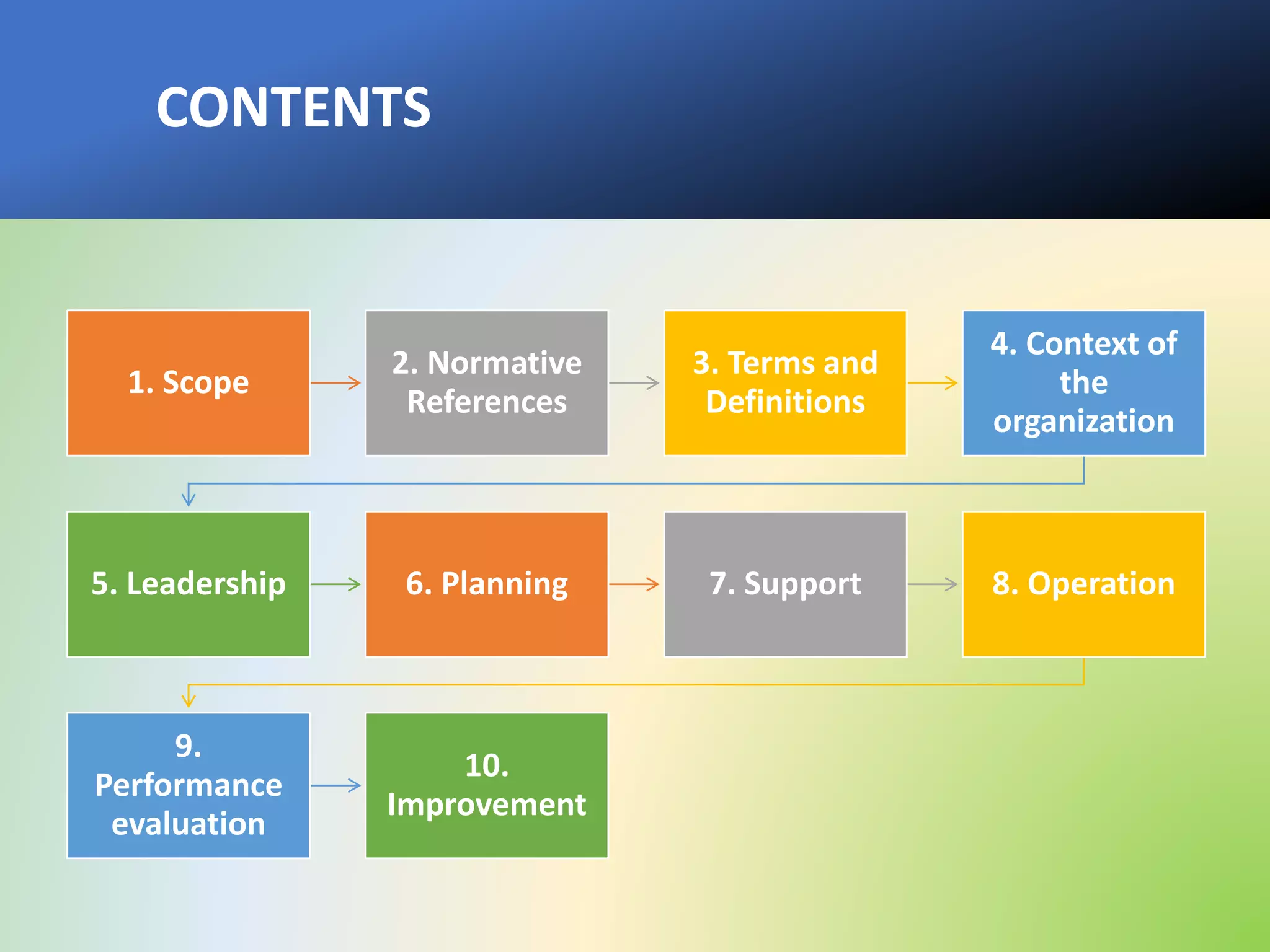
CONTENTS
1. Scope
2. Normative
References
3. Terms and
Definitions
4. Context of
the
organization
5. Leadership 6. Planning 7. Support 8. Operation
9.
Performance
evaluation
10.
Improvement
Scope
SCOPE
This International Standard is applicable to any organization,
regardless of s ize, type and nature, and applies to the
environmental aspects of its activities, products and services
Normative References
NORMATIVE REFERENCES
No normative reference
Terms and Definitions
TERMS RELATED TO ORGANIZATION AND LEADERSHIP
• Set of interrelated or interacting elements of an organization to establish
policies and objectives and processes to achieve those objectives
Management System
• Part of the management system used to manage environmental aspects, fulfil
compliance obligations, and address risks and opportunities
Environmental Management System
• Intentions and direction of an organization related to environmental
performance, as formally expressed by its top management
Environmental Policy
• Person or group
Organization
TERMS RELATED TO ORGANIZATION AND LEADERSHIP
• Person or group of people who directs and controls an organization at
the highest level
Top Management
• Person or organization that can affect, be affected by, or perceive
itself to be affected by a decision or activity
Interested Party
TERMS RELATED TO PLANNING
• Surroundings in which an organization operates, including air, water, land,
natural resources, flora, fauna, humans and their interrelationships
Environment
• Element of an organization's activities or products or services that interacts or
can interact with the environment
Environmental Aspect
• State or characteristic of the environment as determined at a certain point in
time
Environmental Condition
• Change to the environment, whether adverse or beneficial. wholly or partially
resulting from an organization's environmental aspects
Environmental Impact
TERMS RELATED TO PLANNING
• Result to be achieved
Objective
• Objective set by the organization consistent with its environmental policy
Environmental Objective
• Use of processes, practices, techniques, materials, products, services or energy
to avoid, reduce or control (separately or in combination) the creation,
emission or discharge of any type of pollutant or waste, in order to reduce
adverse environmental impacts
Prevention of Pollution
• Need or expectation that is stated, generally implied or obligatory
Requirement
TERMS RELATED TO SUPPORT AND OPERATION
• Ability to apply knowledge and skills to ac hieve intended results
Competence
• Information required to be controlled and maintained by an
organization and the medium on which it is contained
Documented Information
• Consecutive and interlinked stages of a product (or service)
system, from raw material acquisition or generation from natural
resources to final disposal
Life Cycle
TERMS RELATED TO SUPPORT AND OPERATION
• Make an arrangement where an external organization performs part
of an organization’s function or process
Outsource
• Set of interrelated or interacting activities which transforms inputs
into outputs
Process
TERMS RELATED TO PERFORMANCE EVALUATION AND
IMPROVEMENT
• Systematic, independent and documented process for obtaining audit
evidence and evaluating it objectively to determine the extent to
which the audit criteria are fulfilled
Audit
• Fulfilment of a requirement
Conformity
• Non-fulfilment of a requirement
Nonconformity
• Action to eliminate the cause of a nonconformity and to prevent
recurrence
Corrective Action
TERMS RELATED TO PERFORMANCE EVALUATION AND
IMPROVEMENT
• Recurring activity to enhance performance
Continual Improvement
• Extent to which planned activities are realized and planned results achieved
Effectiveness
• Measurable representation of the condition or status of operations,
management or conditions
Indicator
• Determining the status of a system, a process or an activity
Monitoring
TERMS RELATED TO PERFORMANCE EVALUATION AND
IMPROVEMENT
• Process to determine a value
Measurement
• Measurable result
Performance
• Performance related to the management of environmental
aspects
Environmental Performance
Context of the organization
4.1 Understanding the organization and its
context
4.2 Understanding the needs and expectations
of interested parties
4.3 Determining the scope of the environmental
management system
4.4 Environmental management system
Leadership
Leadership
5.1 Leadership and commitment
5.2 Environmental policy
5.3 Organizational roles, responsibilities and authorities
Planning
Planning
6.1 Actions to address risks
and opportunities
6.2 Environmental objectives
and planning to achieve them
Support
Support
7.1 Resources
7.2 Competence
7.3 Awareness
7.4 Communication
7.5 Documented information
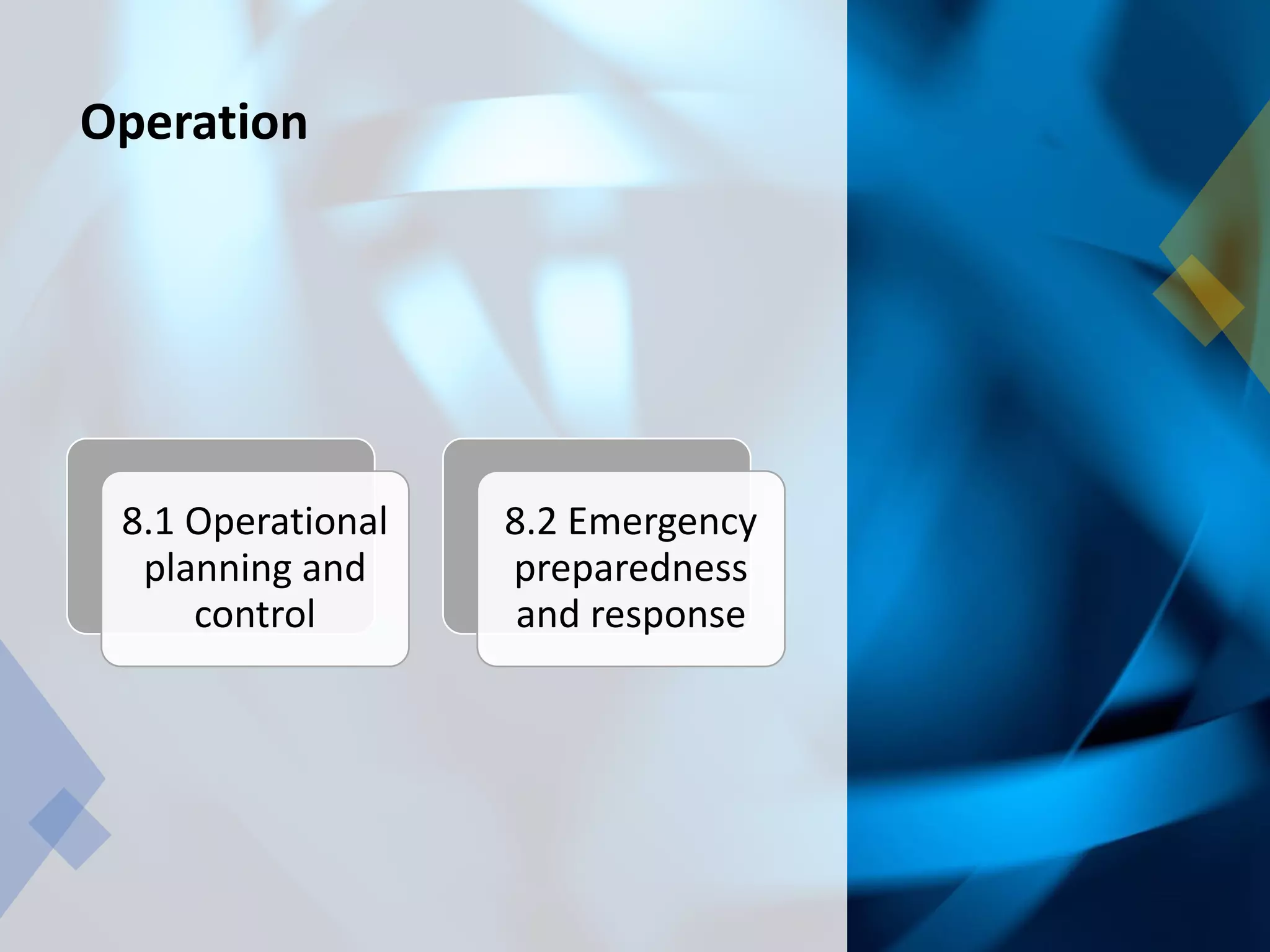
Operation
Operation
8.1 Operational
planning and
control
8.2 Emergency
preparedness
and response
Performance evaluation
Performance
evaluation
9.1 Monitoring,
measurement, analysis
and evaluation
9.2 Internal audit
9.3 Management review
Improvement
Improvement
10.1 General
10.2 Nonconformity and
corrective action
10.3 Continual improvement
Reference:
ISO 14001: 2015
Follow us on LinkedIn:
https://www.linkedin.com/company/
tqm-for-better-future
Thank You!
#TQMforbetterFuture

Environmental Management System | EMS | 14001 : 2015 | ISO

  • 1.
  • 2.
    CONTENTS 1. Scope 2. Normative References 3.Terms and Definitions 4. Context of the organization 5. Leadership 6. Planning 7. Support 8. Operation 9. Performance evaluation 10. Improvement
  • 3.
  • 4.
    SCOPE This International Standardis applicable to any organization, regardless of s ize, type and nature, and applies to the environmental aspects of its activities, products and services
  • 5.
  • 6.
  • 7.
  • 8.
    TERMS RELATED TOORGANIZATION AND LEADERSHIP • Set of interrelated or interacting elements of an organization to establish policies and objectives and processes to achieve those objectives Management System • Part of the management system used to manage environmental aspects, fulfil compliance obligations, and address risks and opportunities Environmental Management System • Intentions and direction of an organization related to environmental performance, as formally expressed by its top management Environmental Policy • Person or group Organization
  • 9.
    TERMS RELATED TOORGANIZATION AND LEADERSHIP • Person or group of people who directs and controls an organization at the highest level Top Management • Person or organization that can affect, be affected by, or perceive itself to be affected by a decision or activity Interested Party
  • 10.
    TERMS RELATED TOPLANNING • Surroundings in which an organization operates, including air, water, land, natural resources, flora, fauna, humans and their interrelationships Environment • Element of an organization's activities or products or services that interacts or can interact with the environment Environmental Aspect • State or characteristic of the environment as determined at a certain point in time Environmental Condition • Change to the environment, whether adverse or beneficial. wholly or partially resulting from an organization's environmental aspects Environmental Impact
  • 11.
    TERMS RELATED TOPLANNING • Result to be achieved Objective • Objective set by the organization consistent with its environmental policy Environmental Objective • Use of processes, practices, techniques, materials, products, services or energy to avoid, reduce or control (separately or in combination) the creation, emission or discharge of any type of pollutant or waste, in order to reduce adverse environmental impacts Prevention of Pollution • Need or expectation that is stated, generally implied or obligatory Requirement
  • 12.
    TERMS RELATED TOSUPPORT AND OPERATION • Ability to apply knowledge and skills to ac hieve intended results Competence • Information required to be controlled and maintained by an organization and the medium on which it is contained Documented Information • Consecutive and interlinked stages of a product (or service) system, from raw material acquisition or generation from natural resources to final disposal Life Cycle
  • 13.
    TERMS RELATED TOSUPPORT AND OPERATION • Make an arrangement where an external organization performs part of an organization’s function or process Outsource • Set of interrelated or interacting activities which transforms inputs into outputs Process
  • 14.
    TERMS RELATED TOPERFORMANCE EVALUATION AND IMPROVEMENT • Systematic, independent and documented process for obtaining audit evidence and evaluating it objectively to determine the extent to which the audit criteria are fulfilled Audit • Fulfilment of a requirement Conformity • Non-fulfilment of a requirement Nonconformity • Action to eliminate the cause of a nonconformity and to prevent recurrence Corrective Action
  • 15.
    TERMS RELATED TOPERFORMANCE EVALUATION AND IMPROVEMENT • Recurring activity to enhance performance Continual Improvement • Extent to which planned activities are realized and planned results achieved Effectiveness • Measurable representation of the condition or status of operations, management or conditions Indicator • Determining the status of a system, a process or an activity Monitoring
  • 16.
    TERMS RELATED TOPERFORMANCE EVALUATION AND IMPROVEMENT • Process to determine a value Measurement • Measurable result Performance • Performance related to the management of environmental aspects Environmental Performance
  • 17.
    Context of theorganization
  • 18.
    Context of theorganization 4.1 Understanding the organization and its context 4.2 Understanding the needs and expectations of interested parties 4.3 Determining the scope of the environmental management system 4.4 Environmental management system
  • 19.
  • 20.
    Leadership 5.1 Leadership andcommitment 5.2 Environmental policy 5.3 Organizational roles, responsibilities and authorities
  • 21.
  • 22.
    Planning 6.1 Actions toaddress risks and opportunities 6.2 Environmental objectives and planning to achieve them
  • 23.
  • 24.
    Support 7.1 Resources 7.2 Competence 7.3Awareness 7.4 Communication 7.5 Documented information
  • 25.
  • 26.
    Operation 8.1 Operational planning and control 8.2Emergency preparedness and response
  • 27.
  • 28.
    Performance evaluation 9.1 Monitoring, measurement, analysis andevaluation 9.2 Internal audit 9.3 Management review
  • 29.
  • 30.
    Improvement 10.1 General 10.2 Nonconformityand corrective action 10.3 Continual improvement
  • 31.
  • 32.
    Follow us onLinkedIn: https://www.linkedin.com/company/ tqm-for-better-future
  • 33.