Renewable Energy Renewable Energy Professor Hector R Rodriguez School of Business Mount Ida College
Society The Corporation and Its Stakeholders People for the Ethical Treatment of Animals Corporate Citizenship The Social Responsibility of Business The Shareholder Primacy Norm CSR, Citizenship and Sustainability Reporting Responsible Investing The Community and the Corporation Taxation and Corporate Citizenship Corporate Philanthropy Programs Employees and the Corporation Managing a Diverse Workforce Environment A Balanced Look at Climate Change Non-anthropogenic Causes of Climate Change Sulfates, Urban Warming and Permafrost Conventional Energy The Kyoto Protocol Green Building Green Information Technology Transportation, Electric Vehicles and the Environment Geo-Engineering Carbon Capture and Storage Renewable Energy Solid, Toxic and Hazardous Waste Forests, Paper and Carbon Sinks Life Cycle Analysis Water Use and Management Water Pollution Course Map – Topics Covered in Course
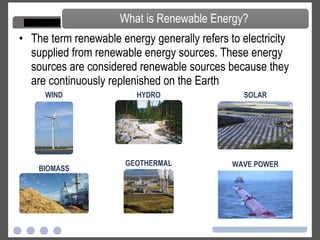
The term renewable energy generally refers to electricity supplied from renewable energy sources. These energy sources are considered renewable sources because they are continuously replenished on the Earth  What is Renewable Energy? WIND HYDRO SOLAR BIOMASS GEOTHERMAL WAVE POWER
Wind Power
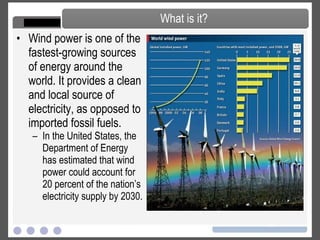
Wind power is one of the fastest-growing sources of energy around the world. It provides a clean and local source of electricity, as opposed to imported fossil fuels.  In the United States, the Department of Energy has estimated that wind power could account for 20 percent of the nation’s electricity supply by 2030. What is it?
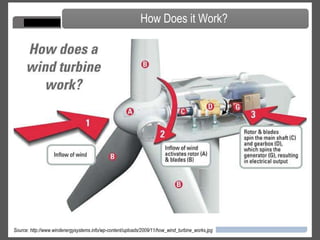
How Does it Work? Source:  http://www.windenergysystems.info/wp-content/uploads/2009/11/how_wind_turbine_works.jpg
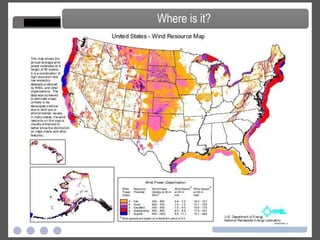
Where is it? (Watch  Video )
Wind Capacity Increasing Source:  American Wind Energy Association U.S. Wind Industry Annual Market Report – Year Ending 2009
2009 U.S. Wind Power Project Locations Source:  American Wind Energy Association U.S. Wind Industry Annual Market Report – Year Ending 2009
Wind Capacity Increasing Source:  American Wind Energy Association U.S. Wind Industry Annual Market Report – Year Ending 2009
At the moment, though, wind accounts for just 1 percent of United States electricity use. It has two main problems.  The wind does not blow all the time, so there must be backup power plants ready to turn on if the wind slows.  The wind sometimes blows the hardest in remote plains, far from cities that need the energy and building transmission lines is expensive and difficult. Other Concerns Locating the wind turbines in or near the flyways of migrating birds may result in them flying into the rotating blades.  Noise caused by rotating blades (inaudible beyond 1.5 miles) Wind Power Challenges Source: Kate Galbraith (Feb. 19, 2009)
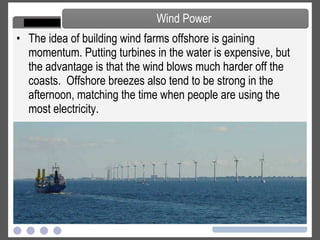
The idea of building wind farms offshore is gaining momentum. Putting turbines in the water is expensive, but the advantage is that the wind blows much harder off the coasts.  Offshore breezes also tend to be strong in the afternoon, matching the time when people are using the most electricity. Wind Power
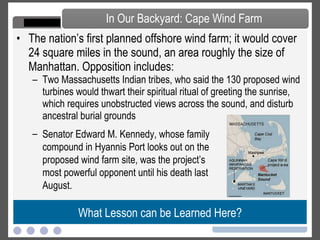
The nation’s first planned offshore wind farm; it would cover 24 square miles in the sound, an area roughly the size of Manhattan. Opposition includes: Two Massachusetts Indian tribes, who said the 130 proposed wind turbines would thwart their spiritual ritual of greeting the sunrise, which requires unobstructed views across the sound, and disturb ancestral burial grounds  In Our Backyard: Cape Wind Farm Senator Edward M. Kennedy, whose family compound in Hyannis Port looks out on the proposed wind farm site, was the project’s most powerful opponent until his death last August.  What Lesson can be Learned Here?
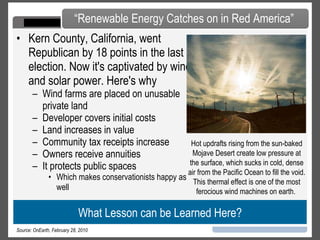
Kern County, California, went Republican by 18 points in the last election. Now it's captivated by wind and solar power. Here's why Wind farms are placed on unusable private land Developer covers initial costs Land increases in value Community tax receipts increase Owners receive annuities It protects public spaces Which makes conservationists happy as well “ Renewable Energy Catches on in Red America” What Lesson can be Learned Here? Source: OnEarth, February 28, 2010 Hot updrafts rising from the sun-baked Mojave Desert create low pressure at the surface, which sucks in cold, dense air from the Pacific Ocean to fill the void. This thermal effect is one of the most ferocious wind machines on earth.
 
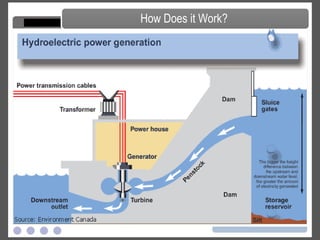
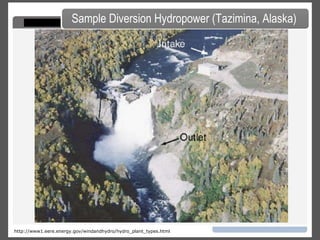
The United States Department of Energy describes the derivation of power from water this way:  "Water constantly moves through a vast global cycle, evaporating from lakes and oceans, forming clouds, precipitating as rain or snow, then flowing back down to the ocean. The energy of this water cycle, which is driven by the sun, can be tapped to produce electricity or for mechanical tasks like grinding grain." The most common method for achieving hydropower is through building an impoundment facility, or dam, where water is backed up into a reservoir and then released through turbines as needed to meet energy demands.  Diversion and micro hydropower are options as well. What is it?
How Does it Work?
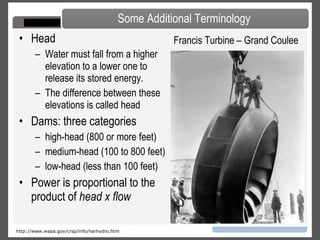
Head  Water must fall from a higher elevation to a lower one to release its stored energy.  The difference between these elevations is called head Dams: three categories high-head (800 or more feet) medium-head (100 to 800 feet) low-head (less than 100 feet)  Power is proportional to the product of  head x flow   Francis Turbine – Grand Coulee http://www.wapa.gov/crsp/info/harhydro.htm Some Additional Terminology
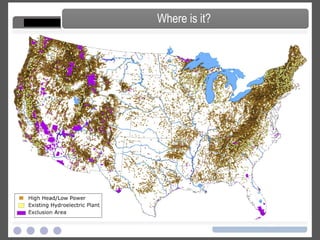
Where is it?
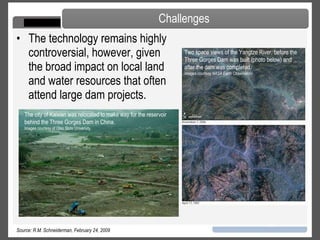
The technology remains highly controversial, however, given the broad impact on local land and water resources that often attend large dam projects. Challenges Source: R.M. Schneiderman, February 24, 2009 The city of Kaixian was relocated to make way for the reservoir behind the Three Gorges Dam in China.  Images courtesy of Ohio State University. Two space views of the Yangtze River, before the Three Gorges Dam was built (photo below) and after the dam was completed. Images courtesy NASA Earth Observatory
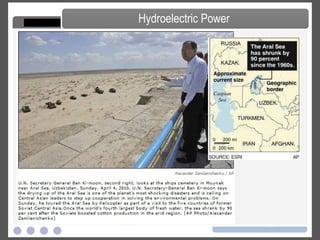
Can sometimes fail, causing catastrophe Johnstown flood (city just east of Pittsburgh, PA) killed 2,200 people when dam broke. Dam failure in China killed 230,000. Dams and Diversions On the downside, dams Drown free flowing rivers Submerge farmlands and towns Block fish migration e.g. salmon Change aquatic habitats for native species
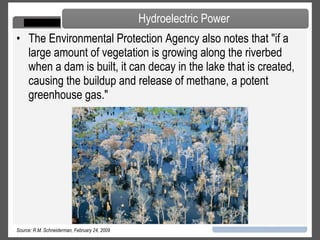
The Environmental Protection Agency also notes that "if a large amount of vegetation is growing along the riverbed when a dam is built, it can decay in the lake that is created, causing the buildup and release of methane, a potent greenhouse gas." Hydroelectric Power Source: R.M. Schneiderman, February 24, 2009
Hydroelectric Power
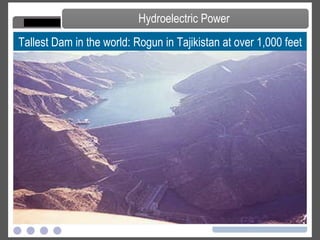
Hydroelectric Power Tallest Dam in the world: Rogun in Tajikistan at over 1,000 feet
http://www1.eere.energy.gov/windandhydro/hydro_plant_types.html Sample Diversion Hydropower (Tazimina, Alaska)
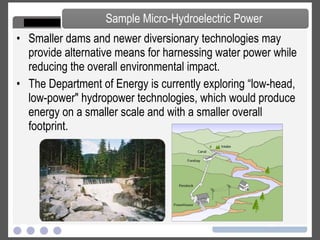
Smaller dams and newer diversionary technologies may provide alternative means for harnessing water power while reducing the overall environmental impact.  The Department of Energy is currently exploring “low-head, low-power" hydropower technologies, which would produce energy on a smaller scale and with a smaller overall footprint.  Sample Micro-Hydroelectric Power
Energy (Pumped) Storage Energy (Pumped) Storage Two way flow Pumped up to a storage reservoir and returned to a lower elevation for power generation A mechanism for energy storage, not net energy production
Energy Storage in Our Backyard – Northfield Mountain In 1972 its 1,080-megawatt hydroelectric plant became operational as the largest such facility in the world. The plant was built entirely underground Purpose – energy storage Water pumped uphill at night Low usage – excess base load capacity Water flows downhill during day/peak periods Helps Xcel to meet surge demand E.g., air conditioning demand on hot summer days
Emerging –  Combined Hydro and Wind Power   (Video)
Solar Power
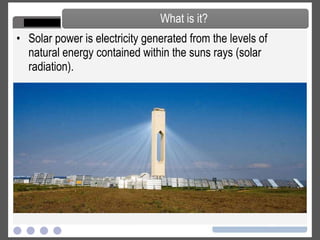
Solar power is electricity generated from the levels of natural energy contained within the suns rays (solar radiation).  What is it? Above a scorched plain outside Seville, Spain, reflected sunlight reflects again off low clouds. Ordinarily the mirrors at Abengoa Solar's PS10 station beam searing, concentrated light to the top of the "power tower," heating a boiler that makes steam to drive a turbine. On overcast days, operators aim the mirrors skyward; sudden sun through clouds could heat the tower so quickly it could be destroyed.
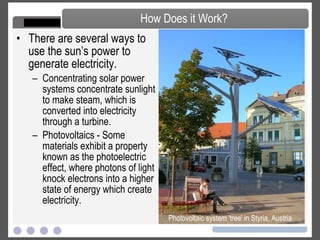
There are several ways to use the sun’s power to generate electricity.  Concentrating solar power systems concentrate sunlight to make steam, which is converted into electricity through a turbine.  Photovoltaics - Some materials exhibit a property known as the photoelectric effect, where photons of light knock electrons into a higher state of energy which create electricity. How Does it Work? Photovoltaic system 'tree' in Styria, Austria
Concentrating Solar At Nevada Solar One near Las Vegas, oil piped down long rows of reflectors soaks up focused sunlight, becoming hot enough to make steam and run a 64-megawatt power plant. Utilities often favor such systems, also called solar thermal, over costlier PV.
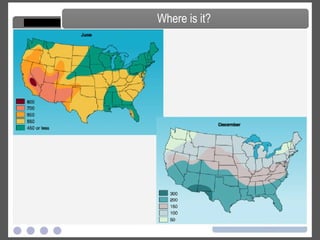
Where is it?
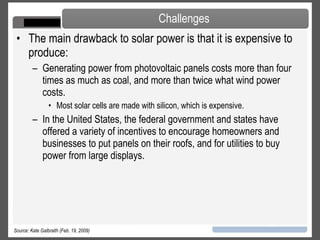
The main drawback to solar power is that it is expensive to produce:  Generating power from photovoltaic panels costs more than four times as much as coal, and more than twice what wind power costs.  Most solar cells are made with silicon, which is expensive.  In the United States, the federal government and states have offered a variety of incentives to encourage homeowners and businesses to put panels on their roofs, and for utilities to buy power from large displays.  Challenges Source: Kate Galbraith (Feb. 19, 2009)
Biofuels
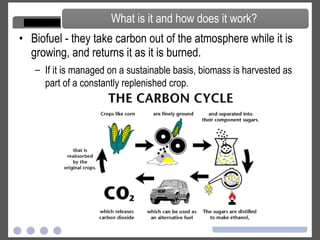
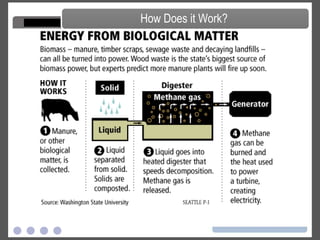
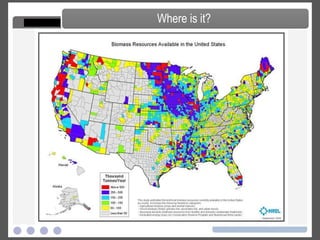
Biofuel - they take carbon out of the atmosphere while it is growing, and returns it as it is burned.  What is it and how does it work? If it is managed on a sustainable basis, biomass is harvested as part of a constantly replenished crop.
How Does it Work?
Where is it?
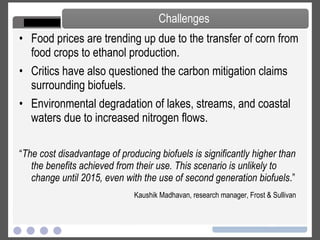
Food prices are trending up due to the transfer of corn from food crops to ethanol production.  Critics have also questioned the carbon mitigation claims surrounding biofuels.  Environmental degradation of lakes, streams, and coastal waters due to increased nitrogen flows. “ The cost disadvantage of producing biofuels is significantly higher than the benefits achieved from their use. This scenario is unlikely to change until 2015, even with the use of second generation biofuels .”  Kaushik Madhavan, research manager, Frost & Sullivan   Challenges
 
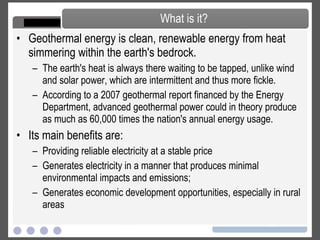
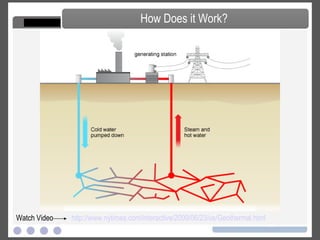
Geothermal energy is clean, renewable energy from heat simmering within the earth's bedrock.  The earth's heat is always there waiting to be tapped, unlike wind and solar power, which are intermittent and thus more fickle.  According to a 2007 geothermal report financed by the Energy Department, advanced geothermal power could in theory produce as much as 60,000 times the nation's annual energy usage.  Its main benefits are: Providing reliable electricity at a stable price Generates electricity in a manner that produces minimal environmental impacts and emissions; Generates economic development opportunities, especially in rural areas What is it?
How Does it Work? http://www.nytimes.com/interactive/2009/06/23/us/Geothermal.html Watch Video
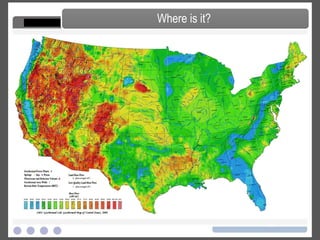
Where is it?
Because large earthquakes tend to originate at great depths, breaking rock that far down carries more serious risk.  Seismologists have long known that human activities can trigger quakes, but they say the science is not developed enough to say for certain what will or will not set off a major temblor. The technique to tap geothermal energy creates earthquakes because it requires injecting water at great pressure down drilled holes to fracture the deep bedrock.  The opening of each fracture is, literally, a tiny earthquake in which subterranean stresses rip apart a weak vein, crack or fault in the rock.  Potential for Earthquakes
Exploration and drilling remain expensive and risky.  Drilling costs alone can account for as much as one-third to one-half of the total cost of a project. Detecting potentially productive geothermal reservoirs is difficult, with only about one in every five exploratory wells drilled confirming a valuable resource.  Using the best geothermal resources often require an expansion of the power transmission system.  Finally, power plants and direct use systems must be located near geothermal resources because it is not economic to transport hot water or steam over long distances. Other Challenges
Wave Power
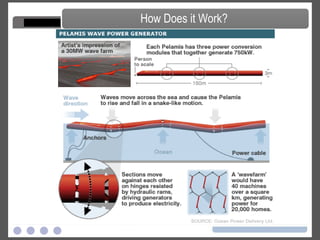
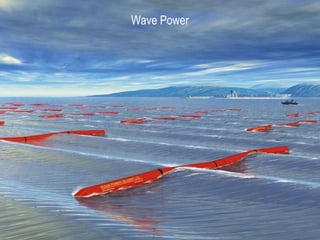
Ocean movements, spurred by the wind or the gravitational pull of the sun and moon, are eminently renewable, emissions-free energy sources. According to the United States Department of Energy, some experts suggest that as much as 0.5 to 5 times the total global annual electricity consumption of electricity could be provided by ocean waves alone. Unlike wind and solar power, wave energy is always available.  Even when the ocean seems calm, swells are moving water up and down sufficiently to generate electricity.  What is it?
How Does it Work?
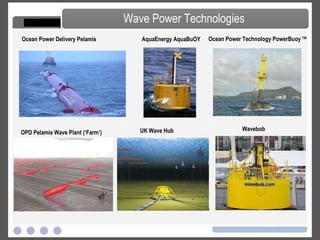
Wave Power Technologies OPD Pelamis Wave Plant (‘Farm’) UK Wave Hub Wavebob Ocean Power Delivery Pelamis Ocean Power Technology PowerBuoy  TM AquaEnergy AquaBuOY
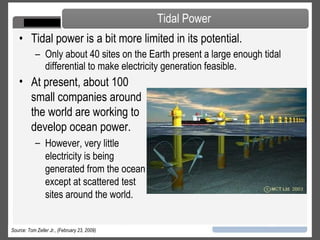
Tidal power is a bit more limited in its potential.  Only about 40 sites on the Earth present a large enough tidal differential to make electricity generation feasible. Tidal Power Source:  Tom Zeller Jr., (February 23, 2009) At present, about 100 small companies around the world are working to develop ocean power.  However, very little electricity is being generated from the ocean except at scattered test sites around the world.
Tidal Power – Emerging Technologies
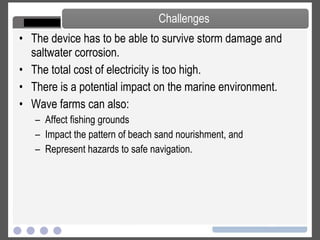
The device has to be able to survive storm damage and saltwater corrosion.  The total cost of electricity is too high. There is a potential impact on the marine environment.  Wave farms can also: Affect fishing grounds  Impact the pattern of beach sand nourishment, and  Represent hazards to safe navigation.  Challenges
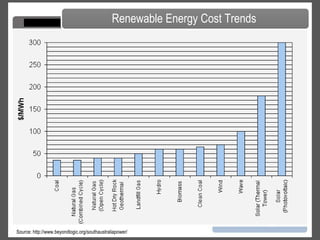
Renewable Energy Costs Source: http://www.beyondlogic.org/southaustraliapower/
Ranking the Renewables
Renewable Futures
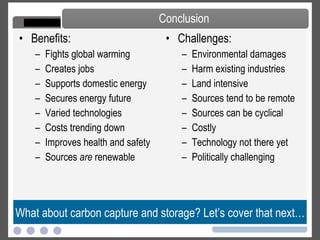
Benefits: Fights global warming Creates jobs Supports domestic energy Secures energy future Varied technologies Costs trending down Improves health and safety Sources  are  renewable Challenges: Environmental damages Harm existing industries Land intensive Sources tend to be remote Sources can be cyclical Costly Technology not there yet Politically challenging Conclusion What about carbon capture and storage? Let’s cover that next…

Renewable Energy

  • 1.
    Renewable Energy RenewableEnergy Professor Hector R Rodriguez School of Business Mount Ida College
  • 2.
    Society The Corporationand Its Stakeholders People for the Ethical Treatment of Animals Corporate Citizenship The Social Responsibility of Business The Shareholder Primacy Norm CSR, Citizenship and Sustainability Reporting Responsible Investing The Community and the Corporation Taxation and Corporate Citizenship Corporate Philanthropy Programs Employees and the Corporation Managing a Diverse Workforce Environment A Balanced Look at Climate Change Non-anthropogenic Causes of Climate Change Sulfates, Urban Warming and Permafrost Conventional Energy The Kyoto Protocol Green Building Green Information Technology Transportation, Electric Vehicles and the Environment Geo-Engineering Carbon Capture and Storage Renewable Energy Solid, Toxic and Hazardous Waste Forests, Paper and Carbon Sinks Life Cycle Analysis Water Use and Management Water Pollution Course Map – Topics Covered in Course
  • 3.
    The term renewableenergy generally refers to electricity supplied from renewable energy sources. These energy sources are considered renewable sources because they are continuously replenished on the Earth What is Renewable Energy? WIND HYDRO SOLAR BIOMASS GEOTHERMAL WAVE POWER
  • 4.
  • 5.
    Wind power isone of the fastest-growing sources of energy around the world. It provides a clean and local source of electricity, as opposed to imported fossil fuels. In the United States, the Department of Energy has estimated that wind power could account for 20 percent of the nation’s electricity supply by 2030. What is it?
  • 6.
    How Does itWork? Source: http://www.windenergysystems.info/wp-content/uploads/2009/11/how_wind_turbine_works.jpg
  • 7.
    Where is it?(Watch Video )
  • 8.
    Wind Capacity IncreasingSource: American Wind Energy Association U.S. Wind Industry Annual Market Report – Year Ending 2009
  • 9.
    2009 U.S. WindPower Project Locations Source: American Wind Energy Association U.S. Wind Industry Annual Market Report – Year Ending 2009
  • 10.
    Wind Capacity IncreasingSource: American Wind Energy Association U.S. Wind Industry Annual Market Report – Year Ending 2009
  • 11.
    At the moment,though, wind accounts for just 1 percent of United States electricity use. It has two main problems. The wind does not blow all the time, so there must be backup power plants ready to turn on if the wind slows. The wind sometimes blows the hardest in remote plains, far from cities that need the energy and building transmission lines is expensive and difficult. Other Concerns Locating the wind turbines in or near the flyways of migrating birds may result in them flying into the rotating blades. Noise caused by rotating blades (inaudible beyond 1.5 miles) Wind Power Challenges Source: Kate Galbraith (Feb. 19, 2009)
  • 12.
    The idea ofbuilding wind farms offshore is gaining momentum. Putting turbines in the water is expensive, but the advantage is that the wind blows much harder off the coasts. Offshore breezes also tend to be strong in the afternoon, matching the time when people are using the most electricity. Wind Power
  • 13.
    The nation’s firstplanned offshore wind farm; it would cover 24 square miles in the sound, an area roughly the size of Manhattan. Opposition includes: Two Massachusetts Indian tribes, who said the 130 proposed wind turbines would thwart their spiritual ritual of greeting the sunrise, which requires unobstructed views across the sound, and disturb ancestral burial grounds In Our Backyard: Cape Wind Farm Senator Edward M. Kennedy, whose family compound in Hyannis Port looks out on the proposed wind farm site, was the project’s most powerful opponent until his death last August. What Lesson can be Learned Here?
  • 14.
    Kern County, California,went Republican by 18 points in the last election. Now it's captivated by wind and solar power. Here's why Wind farms are placed on unusable private land Developer covers initial costs Land increases in value Community tax receipts increase Owners receive annuities It protects public spaces Which makes conservationists happy as well “ Renewable Energy Catches on in Red America” What Lesson can be Learned Here? Source: OnEarth, February 28, 2010 Hot updrafts rising from the sun-baked Mojave Desert create low pressure at the surface, which sucks in cold, dense air from the Pacific Ocean to fill the void. This thermal effect is one of the most ferocious wind machines on earth.
  • 15.
  • 16.
    The United StatesDepartment of Energy describes the derivation of power from water this way: "Water constantly moves through a vast global cycle, evaporating from lakes and oceans, forming clouds, precipitating as rain or snow, then flowing back down to the ocean. The energy of this water cycle, which is driven by the sun, can be tapped to produce electricity or for mechanical tasks like grinding grain." The most common method for achieving hydropower is through building an impoundment facility, or dam, where water is backed up into a reservoir and then released through turbines as needed to meet energy demands. Diversion and micro hydropower are options as well. What is it?
  • 17.
  • 18.
    Head Watermust fall from a higher elevation to a lower one to release its stored energy. The difference between these elevations is called head Dams: three categories high-head (800 or more feet) medium-head (100 to 800 feet) low-head (less than 100 feet) Power is proportional to the product of head x flow Francis Turbine – Grand Coulee http://www.wapa.gov/crsp/info/harhydro.htm Some Additional Terminology
  • 19.
  • 20.
    The technology remainshighly controversial, however, given the broad impact on local land and water resources that often attend large dam projects. Challenges Source: R.M. Schneiderman, February 24, 2009 The city of Kaixian was relocated to make way for the reservoir behind the Three Gorges Dam in China. Images courtesy of Ohio State University. Two space views of the Yangtze River, before the Three Gorges Dam was built (photo below) and after the dam was completed. Images courtesy NASA Earth Observatory
  • 21.
    Can sometimes fail,causing catastrophe Johnstown flood (city just east of Pittsburgh, PA) killed 2,200 people when dam broke. Dam failure in China killed 230,000. Dams and Diversions On the downside, dams Drown free flowing rivers Submerge farmlands and towns Block fish migration e.g. salmon Change aquatic habitats for native species
  • 22.
    The Environmental ProtectionAgency also notes that "if a large amount of vegetation is growing along the riverbed when a dam is built, it can decay in the lake that is created, causing the buildup and release of methane, a potent greenhouse gas." Hydroelectric Power Source: R.M. Schneiderman, February 24, 2009
  • 23.
  • 24.
    Hydroelectric Power TallestDam in the world: Rogun in Tajikistan at over 1,000 feet
  • 25.
  • 26.
    Smaller dams andnewer diversionary technologies may provide alternative means for harnessing water power while reducing the overall environmental impact. The Department of Energy is currently exploring “low-head, low-power" hydropower technologies, which would produce energy on a smaller scale and with a smaller overall footprint. Sample Micro-Hydroelectric Power
  • 27.
    Energy (Pumped) StorageEnergy (Pumped) Storage Two way flow Pumped up to a storage reservoir and returned to a lower elevation for power generation A mechanism for energy storage, not net energy production
  • 28.
    Energy Storage inOur Backyard – Northfield Mountain In 1972 its 1,080-megawatt hydroelectric plant became operational as the largest such facility in the world. The plant was built entirely underground Purpose – energy storage Water pumped uphill at night Low usage – excess base load capacity Water flows downhill during day/peak periods Helps Xcel to meet surge demand E.g., air conditioning demand on hot summer days
  • 29.
    Emerging – Combined Hydro and Wind Power (Video)
  • 30.
  • 31.
    Solar power iselectricity generated from the levels of natural energy contained within the suns rays (solar radiation). What is it? Above a scorched plain outside Seville, Spain, reflected sunlight reflects again off low clouds. Ordinarily the mirrors at Abengoa Solar's PS10 station beam searing, concentrated light to the top of the "power tower," heating a boiler that makes steam to drive a turbine. On overcast days, operators aim the mirrors skyward; sudden sun through clouds could heat the tower so quickly it could be destroyed.
  • 32.
    There are severalways to use the sun’s power to generate electricity. Concentrating solar power systems concentrate sunlight to make steam, which is converted into electricity through a turbine. Photovoltaics - Some materials exhibit a property known as the photoelectric effect, where photons of light knock electrons into a higher state of energy which create electricity. How Does it Work? Photovoltaic system 'tree' in Styria, Austria
  • 33.
    Concentrating Solar AtNevada Solar One near Las Vegas, oil piped down long rows of reflectors soaks up focused sunlight, becoming hot enough to make steam and run a 64-megawatt power plant. Utilities often favor such systems, also called solar thermal, over costlier PV.
  • 34.
  • 35.
    The main drawbackto solar power is that it is expensive to produce: Generating power from photovoltaic panels costs more than four times as much as coal, and more than twice what wind power costs. Most solar cells are made with silicon, which is expensive. In the United States, the federal government and states have offered a variety of incentives to encourage homeowners and businesses to put panels on their roofs, and for utilities to buy power from large displays. Challenges Source: Kate Galbraith (Feb. 19, 2009)
  • 36.
  • 37.
    Biofuel - theytake carbon out of the atmosphere while it is growing, and returns it as it is burned.  What is it and how does it work? If it is managed on a sustainable basis, biomass is harvested as part of a constantly replenished crop.
  • 38.
  • 39.
  • 40.
    Food prices aretrending up due to the transfer of corn from food crops to ethanol production. Critics have also questioned the carbon mitigation claims surrounding biofuels. Environmental degradation of lakes, streams, and coastal waters due to increased nitrogen flows. “ The cost disadvantage of producing biofuels is significantly higher than the benefits achieved from their use. This scenario is unlikely to change until 2015, even with the use of second generation biofuels .” Kaushik Madhavan, research manager, Frost & Sullivan Challenges
  • 41.
  • 42.
    Geothermal energy isclean, renewable energy from heat simmering within the earth's bedrock. The earth's heat is always there waiting to be tapped, unlike wind and solar power, which are intermittent and thus more fickle. According to a 2007 geothermal report financed by the Energy Department, advanced geothermal power could in theory produce as much as 60,000 times the nation's annual energy usage. Its main benefits are: Providing reliable electricity at a stable price Generates electricity in a manner that produces minimal environmental impacts and emissions; Generates economic development opportunities, especially in rural areas What is it?
  • 43.
    How Does itWork? http://www.nytimes.com/interactive/2009/06/23/us/Geothermal.html Watch Video
  • 44.
  • 45.
    Because large earthquakestend to originate at great depths, breaking rock that far down carries more serious risk. Seismologists have long known that human activities can trigger quakes, but they say the science is not developed enough to say for certain what will or will not set off a major temblor. The technique to tap geothermal energy creates earthquakes because it requires injecting water at great pressure down drilled holes to fracture the deep bedrock. The opening of each fracture is, literally, a tiny earthquake in which subterranean stresses rip apart a weak vein, crack or fault in the rock. Potential for Earthquakes
  • 46.
    Exploration and drillingremain expensive and risky. Drilling costs alone can account for as much as one-third to one-half of the total cost of a project. Detecting potentially productive geothermal reservoirs is difficult, with only about one in every five exploratory wells drilled confirming a valuable resource. Using the best geothermal resources often require an expansion of the power transmission system. Finally, power plants and direct use systems must be located near geothermal resources because it is not economic to transport hot water or steam over long distances. Other Challenges
  • 47.
  • 48.
    Ocean movements, spurredby the wind or the gravitational pull of the sun and moon, are eminently renewable, emissions-free energy sources. According to the United States Department of Energy, some experts suggest that as much as 0.5 to 5 times the total global annual electricity consumption of electricity could be provided by ocean waves alone. Unlike wind and solar power, wave energy is always available. Even when the ocean seems calm, swells are moving water up and down sufficiently to generate electricity. What is it?
  • 49.
  • 50.
    Wave Power TechnologiesOPD Pelamis Wave Plant (‘Farm’) UK Wave Hub Wavebob Ocean Power Delivery Pelamis Ocean Power Technology PowerBuoy TM AquaEnergy AquaBuOY
  • 51.
    Tidal power isa bit more limited in its potential. Only about 40 sites on the Earth present a large enough tidal differential to make electricity generation feasible. Tidal Power Source: Tom Zeller Jr., (February 23, 2009) At present, about 100 small companies around the world are working to develop ocean power. However, very little electricity is being generated from the ocean except at scattered test sites around the world.
  • 52.
    Tidal Power –Emerging Technologies
  • 53.
    The device hasto be able to survive storm damage and saltwater corrosion. The total cost of electricity is too high. There is a potential impact on the marine environment. Wave farms can also: Affect fishing grounds Impact the pattern of beach sand nourishment, and Represent hazards to safe navigation. Challenges
  • 54.
    Renewable Energy CostsSource: http://www.beyondlogic.org/southaustraliapower/
  • 55.
  • 56.
  • 57.
    Benefits: Fights globalwarming Creates jobs Supports domestic energy Secures energy future Varied technologies Costs trending down Improves health and safety Sources are renewable Challenges: Environmental damages Harm existing industries Land intensive Sources tend to be remote Sources can be cyclical Costly Technology not there yet Politically challenging Conclusion What about carbon capture and storage? Let’s cover that next…

Editor's Notes

  • #34 Note that in the figures on this slide solar radiation is limited in the Pacific Northwest and the Northeast summer, and more so, in the winter. This points to the fact that an alternative energy future will require that each region and even municipality carefully consider energy options that will work for their particular needs and situation.
  • #35 Note that in the figures on this slide solar radiation is limited in the Pacific Northwest and the Northeast summer, and more so, in the winter. This points to the fact that an alternative energy future will require that each region and even municipality carefully consider energy options that will work for their particular needs and situation.