Solid, Toxic and Hazardous Waste Solid, Toxic and Hazardous Waste Business, Society & Environment Professor Hector R Rodriguez School of Business Mount Ida College
Society The Corporation and Its Stakeholders People for the Ethical Treatment of Animals Corporate Citizenship The Social Responsibility of Business The Shareholder Primacy Norm CSR, Citizenship and Sustainability Reporting Responsible Investing The Community and the Corporation Taxation and Corporate Citizenship Corporate Philanthropy Programs Employees and the Corporation Managing a Diverse Workforce Environment A Balanced Look at Climate Change Non-anthropogenic Causes of Climate Change Sulfates, Urban Warming and Permafrost Conventional Energy The Kyoto Protocol Green Building Green Information Technology Transportation, Electric Vehicles and the Environment Geo-Engineering Carbon Capture and Storage Renewable Energy Solid, Toxic and Hazardous Waste Forests, Paper and Carbon Sinks Life Cycle Analysis Water Use and Management Water Pollution Course Map – Topics Covered in Course
Waste Waste-Disposal Methods Shrinking the Waste Stream Hazardous and Toxic Wastes Outline Why do we care?
Risk Management –  Business activities - may be curtailed if it does not have access to appropriate waste disposal facilities Public relations - Stakeholders may become upset if business is perceived to be a polluter of local landscapes Regulated – hazardous wastes are heavily regulated by state, federal and international agencies Savings – there is a significant opportunity for savings with reduced waste Why Should Business Leaders Care About Waste?
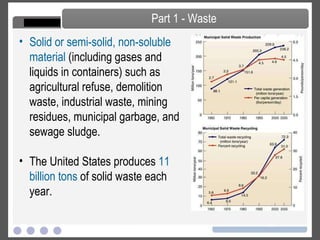
Solid or semi-solid, non-soluble material  (including gases and liquids in containers) such as agricultural refuse, demolition waste, industrial waste, mining residues, municipal garbage, and sewage sludge.  Part 1 - Waste What’s in our waste?
Composition of Domestic U.S. Waste
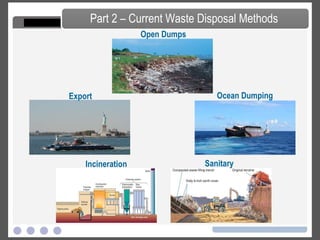
Part 2 – Current Waste Disposal Methods Open Dumps Ocean Dumping Export Sanitary Incineration
Open dumping is a predominant method of waste disposal in developing countries. Illegal dumping classifies as a type of open dumping. Groundwater contamination is one of the many problems with open dumping. Open Dumps
Ocean dumping is the dumping or  placing of materials in designated places in the ocean , often on the continental shelf.  A wide range of materials is involved, including garbage, construction and demolition debris, sewage sludge, dredge material, and waste chemicals.  Ocean Dumping Disposal of dredged material from  a split hull barge Source: http://www.enotes.com/public-health-encyclopedia/ocean-dumping In some cases, ocean dumping is regulated and controlled , while some dumping occurs haphazardly by ships and tankers at sea, or illegally within coastal waters.
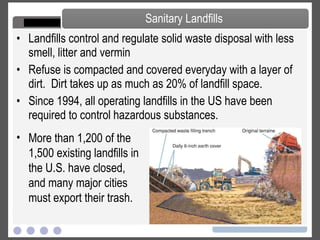
Landfills control and regulate solid waste disposal with less smell, litter and vermin Refuse is compacted and covered everyday with a layer of dirt.  Dirt takes up as much as 20% of landfill space. Since 1994, all operating landfills in the US have been required to control hazardous substances. Sanitary Landfills  (Video) More than 1,200 of the 1,500 existing landfills in the U.S. have closed, and many major cities must export their trash.
Although most industrialized nations in the world have agreed to stop shipping hazardous and toxic waste to less developed countries, the practice still continues. Within rich nations, poor neighborhoods and minority populations are more likely to be the recipients of Locally Unwanted Land Use (LULUs). Exporting Waste
Mayapuri, New Delhi - has hundreds of shops and thousands of workers in the scrap trade, with different shops specializing in different metals, mostly originating from abroad. Exporting Waste
Incineration is burning refuse to  reduce disposal volume by 80-90%. Energy recovery is possible through heat derived from incineration. Steam from this process can be used for heating buildings or generating electricity. Incineration Refuse-derived fuel is when waste is sorted to remove recyclable and unburnable materials.  This yields refuse with a higher energy content than raw trash. Any Disadvantages?
Side Note: Emerging Technologies  (Video)
Part 3 – Shrinking the Waste Stream
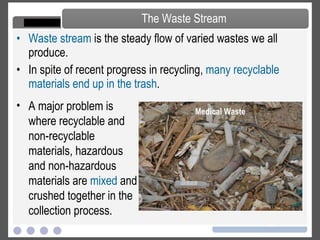
Waste stream  is the steady flow of varied wastes we all produce. In spite of recent progress in recycling,  many recyclable materials end up in the trash .  The Waste Stream A major problem is where recyclable and non-recyclable materials, hazardous and non-hazardous materials are  mixed  and crushed together in the collection process. Medical Waste
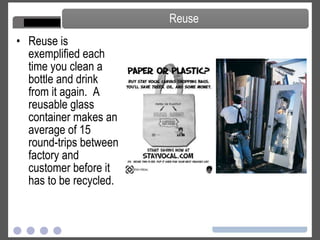
Reuse is exemplified each time you clean a bottle and drink from it again.  A reusable glass container makes an average of 15 round-trips between factory and customer before it has to be recycled. Reuse
Generating less waste by not consuming originally or using more compostable and degradable packaging. Excess packaging of food and consumer products is one of our greatest sources of unnecessary waste. Paper, plastic, glass, and metal packaging material make up 50% of domestic trash by volume. Producing less waste Some environmentalists think that society currently places too much emphasis on recycling, thus ignoring better solutions such as reduced consumption and reuse. Reduce
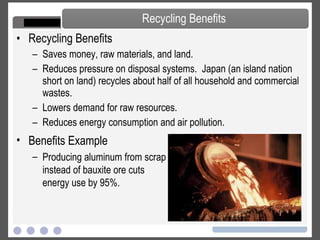
Recycling Benefits Saves money, raw materials, and land. Reduces pressure on disposal systems.  Japan (an island nation short on land) recycles about half of all household and commercial wastes. Lowers demand for raw resources. Reduces energy consumption and air pollution. Recycling Benefits Benefits Example Producing aluminum from scrap instead of bauxite ore cuts energy use by 95%.
U.S. Recycling Rates
Composting is the biological degradation of organic material under aerobic conditions. Composting (watch  video )
Demanufacturing is the disassembly and recycling of obsolete consumer products Refrigerators and air conditioners produce CFC's.  The CFC's can be recycled, thus avoiding their release too the environment. Computers and other electronics produce both toxic and valuable metals A problem is that electronics that are turned in for recycling in the U.S. are sometimes dumped in developing countries where their components end up as environmental toxins. Demanufacturing De-Manufacturing Line (Front End and Back End)
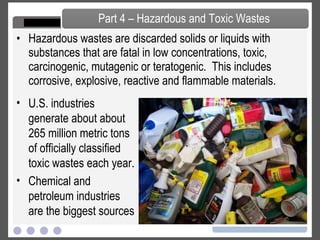
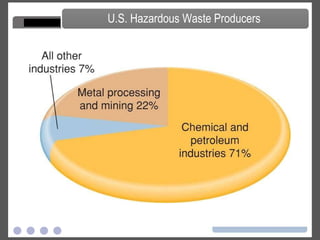
Hazardous wastes are discarded solids or liquids with substances that are fatal in low concentrations, toxic, carcinogenic, mutagenic or teratogenic.  This includes corrosive, explosive, reactive and flammable materials. Part 4 – Hazardous and Toxic Wastes U.S. industries generate about about 265 million metric tons of officially classified toxic wastes each year. Chemical and petroleum industries are the biggest sources
U.S. Hazardous Waste Producers
Resource Conservation and Recovery Act (RCRA) Comprehensive program requiring rigorous testing and management of toxic and hazardous substances with cradle to grave accounting. Comprehensive Environmental Response, Compensation, and Liability Act (CERCLA or Superfund Act) Superfund Amendments and Reauthorization Act (SARA) created a Toxic Release Inventory.  The act requires manufacturing facilities to report annually on releases of hundreds of types of toxins. Hazardous Waste Disposal Legislation
Tracking Toxic and Hazardous Wastes (RCRA) What happens when the system fails?
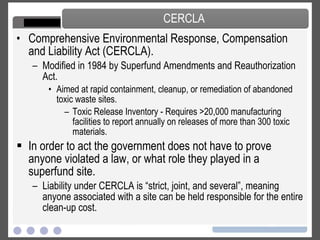
Comprehensive Environmental Response, Compensation and Liability Act (CERCLA). Modified in 1984 by Superfund Amendments and Reauthorization Act. Aimed at rapid containment, cleanup, or remediation of abandoned toxic waste sites. Toxic Release Inventory - Requires >20,000 manufacturing facilities to report annually on releases of more than 300 toxic materials. In order to act the government does not have to prove anyone violated a law, or what role they played in a superfund site. Liability under CERCLA is “strict, joint, and several”, meaning anyone associated with a site can be held responsible for the entire clean-up cost. CERCLA
EPA estimates 36,000 seriously contaminated sites in the U.S. and by 2000, 1,551 sites were placed on the National Priority List for cleanup with with Superfund financing.  Superfund is a revolving pool designed to: Superfund Sites  (Video) Provide immediate response to emergency situations posing imminent hazards. Clean-up abandoned or inactive sites.
Superfund Sites Are all contaminated sites “Superfund Sites?”
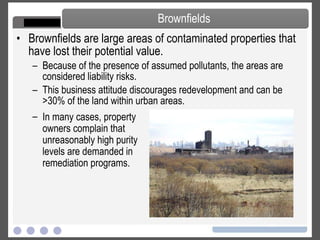
Brownfields are large areas of contaminated properties that have lost their potential value.  Because of the presence of assumed pollutants, the areas are considered liability risks.  This business attitude discourages redevelopment and can be >30% of the land within urban areas.  Brownfields In many cases, property owners complain that unreasonably high purity levels are demanded in remediation programs.
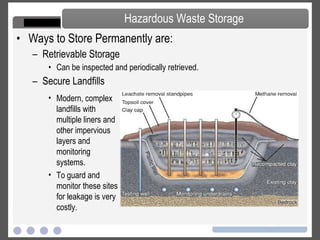
Ways to Store Permanently are: Retrievable Storage Can be inspected and periodically retrieved. Secure Landfills Hazardous Waste Storage Modern, complex landfills with multiple liners and other impervious layers and monitoring systems. To guard and monitor these sites for leakage is very costly.
C overs product marking, take-back and recycling obligations, etc for the UK  Waste Electrical and Electronic Equipment (WEEE)
Worldwide directives on the Restriction of the use of certain Hazardous Substances (RoHS) in electrical and electronic equipment Why important? Cost Dutch Government blocked the shipment of 1.3M Sony Playstation system, 800K accessories - combined value of over US $200M in 2001. Some banned materials –  Lead, Cadmium, Mercury Restriction of Hazardous Substances ( RoHS) Just a sample of hazardous waste regulations…
Waste –  Solid or semi-solid, non-soluble material  Waste-Disposal Methods –  Open dumps,  Ocean dumping,  Sanitary landfill,  Incineration,  Export Shrinking the Waste Stream –  Reuse,  Reduce,  Recycle (e.g. composting and demanufacturing) Hazardous and Toxic Wastes –  Fatal in low concentrations  Heavily regulated Summary

Solid, Toxic and Hazardous Waste

  • 1.
    Solid, Toxic andHazardous Waste Solid, Toxic and Hazardous Waste Business, Society & Environment Professor Hector R Rodriguez School of Business Mount Ida College
  • 2.
    Society The Corporationand Its Stakeholders People for the Ethical Treatment of Animals Corporate Citizenship The Social Responsibility of Business The Shareholder Primacy Norm CSR, Citizenship and Sustainability Reporting Responsible Investing The Community and the Corporation Taxation and Corporate Citizenship Corporate Philanthropy Programs Employees and the Corporation Managing a Diverse Workforce Environment A Balanced Look at Climate Change Non-anthropogenic Causes of Climate Change Sulfates, Urban Warming and Permafrost Conventional Energy The Kyoto Protocol Green Building Green Information Technology Transportation, Electric Vehicles and the Environment Geo-Engineering Carbon Capture and Storage Renewable Energy Solid, Toxic and Hazardous Waste Forests, Paper and Carbon Sinks Life Cycle Analysis Water Use and Management Water Pollution Course Map – Topics Covered in Course
  • 3.
    Waste Waste-Disposal MethodsShrinking the Waste Stream Hazardous and Toxic Wastes Outline Why do we care?
  • 4.
    Risk Management – Business activities - may be curtailed if it does not have access to appropriate waste disposal facilities Public relations - Stakeholders may become upset if business is perceived to be a polluter of local landscapes Regulated – hazardous wastes are heavily regulated by state, federal and international agencies Savings – there is a significant opportunity for savings with reduced waste Why Should Business Leaders Care About Waste?
  • 5.
    Solid or semi-solid,non-soluble material (including gases and liquids in containers) such as agricultural refuse, demolition waste, industrial waste, mining residues, municipal garbage, and sewage sludge. Part 1 - Waste What’s in our waste?
  • 6.
  • 7.
    Part 2 –Current Waste Disposal Methods Open Dumps Ocean Dumping Export Sanitary Incineration
  • 8.
    Open dumping isa predominant method of waste disposal in developing countries. Illegal dumping classifies as a type of open dumping. Groundwater contamination is one of the many problems with open dumping. Open Dumps
  • 9.
    Ocean dumping isthe dumping or placing of materials in designated places in the ocean , often on the continental shelf. A wide range of materials is involved, including garbage, construction and demolition debris, sewage sludge, dredge material, and waste chemicals. Ocean Dumping Disposal of dredged material from a split hull barge Source: http://www.enotes.com/public-health-encyclopedia/ocean-dumping In some cases, ocean dumping is regulated and controlled , while some dumping occurs haphazardly by ships and tankers at sea, or illegally within coastal waters.
  • 10.
    Landfills control andregulate solid waste disposal with less smell, litter and vermin Refuse is compacted and covered everyday with a layer of dirt. Dirt takes up as much as 20% of landfill space. Since 1994, all operating landfills in the US have been required to control hazardous substances. Sanitary Landfills (Video) More than 1,200 of the 1,500 existing landfills in the U.S. have closed, and many major cities must export their trash.
  • 11.
    Although most industrializednations in the world have agreed to stop shipping hazardous and toxic waste to less developed countries, the practice still continues. Within rich nations, poor neighborhoods and minority populations are more likely to be the recipients of Locally Unwanted Land Use (LULUs). Exporting Waste
  • 12.
    Mayapuri, New Delhi- has hundreds of shops and thousands of workers in the scrap trade, with different shops specializing in different metals, mostly originating from abroad. Exporting Waste
  • 13.
    Incineration is burningrefuse to reduce disposal volume by 80-90%. Energy recovery is possible through heat derived from incineration. Steam from this process can be used for heating buildings or generating electricity. Incineration Refuse-derived fuel is when waste is sorted to remove recyclable and unburnable materials. This yields refuse with a higher energy content than raw trash. Any Disadvantages?
  • 14.
    Side Note: EmergingTechnologies (Video)
  • 15.
    Part 3 –Shrinking the Waste Stream
  • 16.
    Waste stream is the steady flow of varied wastes we all produce. In spite of recent progress in recycling, many recyclable materials end up in the trash . The Waste Stream A major problem is where recyclable and non-recyclable materials, hazardous and non-hazardous materials are mixed and crushed together in the collection process. Medical Waste
  • 17.
    Reuse is exemplifiedeach time you clean a bottle and drink from it again. A reusable glass container makes an average of 15 round-trips between factory and customer before it has to be recycled. Reuse
  • 18.
    Generating less wasteby not consuming originally or using more compostable and degradable packaging. Excess packaging of food and consumer products is one of our greatest sources of unnecessary waste. Paper, plastic, glass, and metal packaging material make up 50% of domestic trash by volume. Producing less waste Some environmentalists think that society currently places too much emphasis on recycling, thus ignoring better solutions such as reduced consumption and reuse. Reduce
  • 19.
    Recycling Benefits Savesmoney, raw materials, and land. Reduces pressure on disposal systems. Japan (an island nation short on land) recycles about half of all household and commercial wastes. Lowers demand for raw resources. Reduces energy consumption and air pollution. Recycling Benefits Benefits Example Producing aluminum from scrap instead of bauxite ore cuts energy use by 95%.
  • 20.
  • 21.
    Composting is thebiological degradation of organic material under aerobic conditions. Composting (watch video )
  • 22.
    Demanufacturing is thedisassembly and recycling of obsolete consumer products Refrigerators and air conditioners produce CFC's. The CFC's can be recycled, thus avoiding their release too the environment. Computers and other electronics produce both toxic and valuable metals A problem is that electronics that are turned in for recycling in the U.S. are sometimes dumped in developing countries where their components end up as environmental toxins. Demanufacturing De-Manufacturing Line (Front End and Back End)
  • 23.
    Hazardous wastes arediscarded solids or liquids with substances that are fatal in low concentrations, toxic, carcinogenic, mutagenic or teratogenic. This includes corrosive, explosive, reactive and flammable materials. Part 4 – Hazardous and Toxic Wastes U.S. industries generate about about 265 million metric tons of officially classified toxic wastes each year. Chemical and petroleum industries are the biggest sources
  • 24.
  • 25.
    Resource Conservation andRecovery Act (RCRA) Comprehensive program requiring rigorous testing and management of toxic and hazardous substances with cradle to grave accounting. Comprehensive Environmental Response, Compensation, and Liability Act (CERCLA or Superfund Act) Superfund Amendments and Reauthorization Act (SARA) created a Toxic Release Inventory. The act requires manufacturing facilities to report annually on releases of hundreds of types of toxins. Hazardous Waste Disposal Legislation
  • 26.
    Tracking Toxic andHazardous Wastes (RCRA) What happens when the system fails?
  • 27.
    Comprehensive Environmental Response,Compensation and Liability Act (CERCLA). Modified in 1984 by Superfund Amendments and Reauthorization Act. Aimed at rapid containment, cleanup, or remediation of abandoned toxic waste sites. Toxic Release Inventory - Requires >20,000 manufacturing facilities to report annually on releases of more than 300 toxic materials. In order to act the government does not have to prove anyone violated a law, or what role they played in a superfund site. Liability under CERCLA is “strict, joint, and several”, meaning anyone associated with a site can be held responsible for the entire clean-up cost. CERCLA
  • 28.
    EPA estimates 36,000seriously contaminated sites in the U.S. and by 2000, 1,551 sites were placed on the National Priority List for cleanup with with Superfund financing. Superfund is a revolving pool designed to: Superfund Sites (Video) Provide immediate response to emergency situations posing imminent hazards. Clean-up abandoned or inactive sites.
  • 29.
    Superfund Sites Areall contaminated sites “Superfund Sites?”
  • 30.
    Brownfields are largeareas of contaminated properties that have lost their potential value. Because of the presence of assumed pollutants, the areas are considered liability risks. This business attitude discourages redevelopment and can be >30% of the land within urban areas. Brownfields In many cases, property owners complain that unreasonably high purity levels are demanded in remediation programs.
  • 31.
    Ways to StorePermanently are: Retrievable Storage Can be inspected and periodically retrieved. Secure Landfills Hazardous Waste Storage Modern, complex landfills with multiple liners and other impervious layers and monitoring systems. To guard and monitor these sites for leakage is very costly.
  • 32.
    C overs productmarking, take-back and recycling obligations, etc for the UK Waste Electrical and Electronic Equipment (WEEE)
  • 33.
    Worldwide directives onthe Restriction of the use of certain Hazardous Substances (RoHS) in electrical and electronic equipment Why important? Cost Dutch Government blocked the shipment of 1.3M Sony Playstation system, 800K accessories - combined value of over US $200M in 2001. Some banned materials – Lead, Cadmium, Mercury Restriction of Hazardous Substances ( RoHS) Just a sample of hazardous waste regulations…
  • 34.
    Waste – Solid or semi-solid, non-soluble material Waste-Disposal Methods – Open dumps, Ocean dumping, Sanitary landfill, Incineration, Export Shrinking the Waste Stream – Reuse, Reduce, Recycle (e.g. composting and demanufacturing) Hazardous and Toxic Wastes – Fatal in low concentrations Heavily regulated Summary

Editor's Notes

  • #14 The Forest Stewardship Council (FSC) FSC is an international certification and labeling system that guarantees that the forest products you purchase come from responsibly managed forests and verified recycled sources.
  • #15 The FSC was founded in 1993 as a voluntary and market-based mechanism for ensuring that the world’s forests are managed in an environmentally responsible, socially acceptable and economically viable manner. Under FSC certification, forestry companies are independently audited to meet the FSC’s strict forest management standards. Beyond the forest, all producers along the supply chain must be chain of custody certified. At every stage of manufacturing or distribution, the fibre going into a product is tracked and identified. The FSC system not only makes certain that wood fibre used in a product is from a sustainable source, but it ensures that claims regarding the recycled content of products are verifiable. In an unbroken chain of commitment from forest to consumer, the FSC label carries the promise that a product comes from a forest friendly source.
  • #16 Fibre in an FSC-certified paper is tracked through the Chain of Custody certification system. Chain of Custody certification applies to all members in the supply chain for an FSC-certified paper product. FSC-certified fibre is tracked through the entire supply chain - from forest, to pulp mill, to manufacturer, to final paper product. This guarantees that when a paper product carries the FSC label, it has come from a responsibly managed forest and can be traced back to the FSC-certified forest from which it came.
  • #17 Fibre in an FSC-certified paper is tracked through the Chain of Custody certification system. Chain of Custody certification applies to all members in the supply chain for an FSC-certified paper product. FSC-certified fibre is tracked through the entire supply chain - from forest, to pulp mill, to manufacturer, to final paper product. This guarantees that when a paper product carries the FSC label, it has come from a responsibly managed forest and can be traced back to the FSC-certified forest from which it came.