Environmental and Safety Issues
in Supply Chain Management
Lijo M Loyid
MBA (FT)
School of Management Studies
CUSAT, Kochi - 22
Introduction
• Environmental Health and Safety (EHS) covers
a wide range of environment, health and
safety management issues.
• EHS issues are major challenges that face
companies in today's business world.
• A major concern is the protection of
employee's health in the workplace, and
today that is addressed with an increasing
amount of federal and local legislation.
Introduction
• In addition companies are becoming more
concerned with the environment in their
communities and where they do business.
• As well as local concerns, companies are more
aware of their responsibility of the health and
safety of workers at vendors and facilities
along their complex supply chains.
Environment
• Each facility that a company owns should be
safe for the employees that work there.
• As such each company should have a set of
EHS guidelines that they can use to ensure
employee safety.
• These guidelines may be based on federal or
local regulations that determine the minimum
limits on certain key elements.
Environment
• Air Quality
– Air quality is important for the health and safety
of the employees of a facility as well as the local
surrounding community. Companies need an
approach for the management of sources of
emissions that can occur during a manufacturing
process. A manufacturing location can generate
air contaminants such as sulfur dioxide (SO2),
nitrogen dioxide (NO2), ozone (O3), and
particulate matter (PM).
Environment
• Energy Conservation
– Companies are not only eager to reduce the
amount of energy they expend to the
environmental aspect, but to reduce their overall
energy consumption, which will improve the
bottom line. Many facilities can reduce energy
consumption by reducing the use of motors,
pumps, fans, lighting systems, compressed air
systems and heating, ventilation and air
conditioning systems (HVAC).
Environment
• Water Conservation
– Reducing the consumption of water is a key
environmental goal for any company, but again,
like energy conservation, reducing water
consumption will improve the bottom line. One
aspect of water consumption that companies are
aware of is that of wastewater. Contaminated
water is harmful to the environment and must be
treated before discharging.
Environment
• Hazardous Materials
– Companies that work with hazardous materials
have to ensure that their employees are safe and
are trained on the how to deal with these types of
materials. Disposal of used hazmats, as well as
plans on what to do in an emergency concerning
hazmats are important EHS topics.
Environment
• Waste Management
– All companies produce waste and it is important
to the environment how that waste is dealt with.
Because of the increasing cost of waste removal,
companies are trying to avoid or minimize
generating waste and considering reuse or
recycling of the waste they generate.
Occupational Health and Safety
• Companies have to minimize the risks to
occupational health and safety. The tasks of
EHS are to eliminate any potential hazards, or
minimize hazards that may occur as part of
the manufacturing process.
• Biological Hazards
– These hazards can represent potential for illness
or injury due to single acute exposure or chronic
repetitive exposure.
Occupational Health and Safety
• Education and Training
– It is important that all employees are trained in
basic rules that apply at the site, and how to
prevent injuries to themselves to fellow
employees. Any training should include basic
hazard awareness, site specific hazards, safe work
practices, and emergency procedures for fire,
evacuation, and natural disaster.
Occupational Health and Safety
• Physical Hazards
– In any facility there are physical hazards that can
cause injury, either due to a single event or due to
repetitive use over a period of time. Noise and
vibration can cause injuries due to over exposure.
– There should be some measures to eliminate any
potential physical hazards, or minimize physical
hazards that may occur as part of the
manufacturing process.
Occupational Health and Safety
• Chemical Hazards
– Similar to physical hazards, a single chemical
exposure can cause injury or exposure to a
chemical over a period of time can be hazardous
to an employee. There are many chemical hazards
in a plant, such as corrosive, oxidizing, and
reactive chemicals, as well as fires from the
ignition of flammable materials or gases.
Community Health and Safety
• The health and safety of the employees is one
aspect of EHS but the community where the
facility is located is also the responsibility of a
company. It is vital that a company ensures
that the processes it uses does not negatively
impact the well being of the community that
surrounds them.
Community Health and Safety
• Water Quality
– As part of the manufacturing process, water may
become contaminated and it is imperative that
there is no contamination of water sources that
the community depend upon. In addition, there
must also be awareness that the facility should
not monopolize the local water availability to the
detriment of the community.
Community Health and Safety
• Infrastructure
– The development of the facility should not impact
the community. It is important that the
community should not be impacted by dangerous
structures, traffic, or emissions. Care to include
safety contingencies for the community, for
example in the event of fire, should be built into
the plans for any facility.
Community Health and Safety
• Transportation
– The transportation of materials into and out of a
facility should be examined so not impact the
community. Traffic safety is very important as it is
a leading cause of injuries worldwide. In addition
the transportation of hazardous materials should
be considered when reviewing traffic options at a
facility.
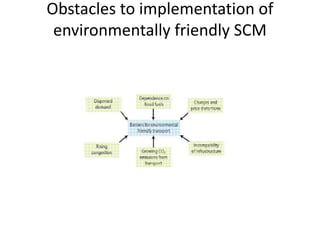
Obstacles to implementation of
environmentally friendly SCM
• Trade globalization, off shoring of manufacturing
operations to low-cost countries, just-in-time
deliveries; all these stimulate growth of the
international freight of goods between continents
and countries.
• Frequent and prompt deliveries require more
means of transport, whereas the absence of cooperation
among companies and processes
coordination result in increased congestion on
main roads.
Obstacles to implementation of
environmentally friendly SCM
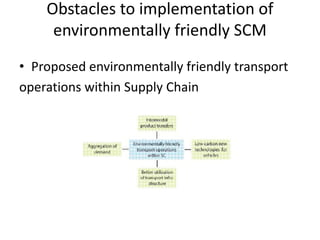
• Environmentally friendly transport operations
within the supply chain require an
implementation of resource efficient policies, a
reduction of energy consumption, an
introduction of cleaner energy and a better
utilization of the infrastructure.
• There are still obstacles on the way to the
creation of an efficient environmentally friendly
transport system within the supply chain
Obstacles to implementation of
environmentally friendly SCM
• The important role to play in the investments
process should have not only regional and
national governances but also multinational
and multimodal logistics operators.
• The important role to play in the investments
process should have not only regional and
national governances but also multinational
and multimodal logistics operators.
Obstacles to implementation of
environmentally friendly SCM
Obstacles to implementation of
environmentally friendly SCM
• Proposed environmentally friendly transport
operations within Supply Chain
HOW COMPANIES ADDRESSES THE
ENVIRONMENTAL AND SAFETY ISSUES
IN SCM
• In order to ensure that environmental and
Safety issues are maintained, companies have
taken various measures. The following are
some of the companies that have addressed
their concerns.
• Sony
• Adidas Group
• Vodafone
HOW COMPANIES ADDRESSES THE
ENVIRONMENTAL AND SAFETY ISSUES
IN SCM
• Sony
– Sony is committed to conducting its operations in
a socially and environmentally responsible
manner and to sourcing from suppliers that share
its values. Accordingly, in order to enable positive
change in its supply chain, Sony works closely with
its suppliers and subcontractors to address human
rights, labor, health and safety, and environmental
protection issues related to the procurement of
raw materials and components
HOW COMPANIES ADDRESSES THE
ENVIRONMENTAL AND SAFETY ISSUES
IN SCM
• Sony
– Compliance with "Sony Group Code of
Conduct"
in Business
– Managing Chemical Substances in
Procurement
– Participation in the Electronic Industry
Citizenship Coalition (EICC)
HOW COMPANIES ADDRESSES THE
ENVIRONMENTAL AND SAFETY ISSUES
IN SCM
• Adidas Group
– “As our supply chain is large, multi-tiered and
varied, we have a detailed and systematic
approach to managing the relationships with our
suppliers. To enforce compliance with our
Standards we have a multi-level monitoring and
enforcement process in place, including the use of
an innovative rating system for the assessment of
our suppliers”.
HOW COMPANIES ADDRESSES THE
ENVIRONMENTAL AND SAFETY ISSUES
IN SCM
• Vodafone
– Vodafone addresses it priority areas to include
the following:-
• Safety of contractors working on our network
infrastructure in emerging markets (see Health and
safety)
• Social and environmental standards in suppliers’
operations and factories
• Mining of minerals in conflict regions
HOW GOVERNMENTS ADDRESSES THE
ENVIRONMENTAL AND SAFETY ISSUES
IN SCM
Various governments have introduced
measures and rules to ensure that
Environmental and Safety Issues are
addressed and maintained in Supply Chain
Management. The following are few examples
which show how governments are concerned
with Environment and Safety in Supply Chain
Management.
HOW GOVERNMENTS ADDRESSES THE
ENVIRONMENTAL AND SAFETY ISSUES
IN SCM• China’s Government
– Companies doing business in China have had difficulty
maintaining quality throughout the supply chain, as
illustrated by recent food and product safety scandals. For
example, in last year’s melamine-tainted milk scandal,
inherent problems in manufacturing processes and supply
chains led to a breakdown of quality assurance.
– Companies investing in China should be aware of several
potential pitfalls when trying to build and manage supply
chains ethically in China. The PRC Administration of
Quality, Supervision, Inspection, and Quarantine (AQSIQ)—
China’s primary quality watchdog—launched a food and
toy recall system in August 2007.
HOW GOVERNMENTS ADDRESSES THE
ENVIRONMENTAL AND SAFETY ISSUES
IN SCM• America
– Safety in American warehouses is regulated by a
series of standards from the Occupational Safety
and Health Administration, commonly known as
OHSA. The US Congress created OSHA under the
Occupational Safety and Health Act, which was
signed into law by President Nixon on December
29, 1970. The main focus of OSHA is to prevent
work-related injuries, illnesses, and deaths.
CONCLUSION
• Environmental and safety issues are diversified in
supply chain of all sectors. Supply chain risk has
become a major area of concern for companies in the
agribusiness sector, as well as for their customers,
financiers, and external stakeholders.
• Environmental supply chain management consists of
the purchasing function's involvement in activities that
include reduction, recycling, reuse and the substitution
of materials.
• Companies can implement a variety of strategies to
manage supply chain environmental risks utilizing
operational and strategic levers.

Environmental and safety issues

  • 1.
    Environmental and SafetyIssues in Supply Chain Management Lijo M Loyid MBA (FT) School of Management Studies CUSAT, Kochi - 22
  • 2.
    Introduction • Environmental Healthand Safety (EHS) covers a wide range of environment, health and safety management issues. • EHS issues are major challenges that face companies in today's business world. • A major concern is the protection of employee's health in the workplace, and today that is addressed with an increasing amount of federal and local legislation.
  • 3.
    Introduction • In additioncompanies are becoming more concerned with the environment in their communities and where they do business. • As well as local concerns, companies are more aware of their responsibility of the health and safety of workers at vendors and facilities along their complex supply chains.
  • 4.
    Environment • Each facilitythat a company owns should be safe for the employees that work there. • As such each company should have a set of EHS guidelines that they can use to ensure employee safety. • These guidelines may be based on federal or local regulations that determine the minimum limits on certain key elements.
  • 5.
    Environment • Air Quality –Air quality is important for the health and safety of the employees of a facility as well as the local surrounding community. Companies need an approach for the management of sources of emissions that can occur during a manufacturing process. A manufacturing location can generate air contaminants such as sulfur dioxide (SO2), nitrogen dioxide (NO2), ozone (O3), and particulate matter (PM).
  • 6.
    Environment • Energy Conservation –Companies are not only eager to reduce the amount of energy they expend to the environmental aspect, but to reduce their overall energy consumption, which will improve the bottom line. Many facilities can reduce energy consumption by reducing the use of motors, pumps, fans, lighting systems, compressed air systems and heating, ventilation and air conditioning systems (HVAC).
  • 7.
    Environment • Water Conservation –Reducing the consumption of water is a key environmental goal for any company, but again, like energy conservation, reducing water consumption will improve the bottom line. One aspect of water consumption that companies are aware of is that of wastewater. Contaminated water is harmful to the environment and must be treated before discharging.
  • 8.
    Environment • Hazardous Materials –Companies that work with hazardous materials have to ensure that their employees are safe and are trained on the how to deal with these types of materials. Disposal of used hazmats, as well as plans on what to do in an emergency concerning hazmats are important EHS topics.
  • 9.
    Environment • Waste Management –All companies produce waste and it is important to the environment how that waste is dealt with. Because of the increasing cost of waste removal, companies are trying to avoid or minimize generating waste and considering reuse or recycling of the waste they generate.
  • 10.
    Occupational Health andSafety • Companies have to minimize the risks to occupational health and safety. The tasks of EHS are to eliminate any potential hazards, or minimize hazards that may occur as part of the manufacturing process. • Biological Hazards – These hazards can represent potential for illness or injury due to single acute exposure or chronic repetitive exposure.
  • 11.
    Occupational Health andSafety • Education and Training – It is important that all employees are trained in basic rules that apply at the site, and how to prevent injuries to themselves to fellow employees. Any training should include basic hazard awareness, site specific hazards, safe work practices, and emergency procedures for fire, evacuation, and natural disaster.
  • 12.
    Occupational Health andSafety • Physical Hazards – In any facility there are physical hazards that can cause injury, either due to a single event or due to repetitive use over a period of time. Noise and vibration can cause injuries due to over exposure. – There should be some measures to eliminate any potential physical hazards, or minimize physical hazards that may occur as part of the manufacturing process.
  • 13.
    Occupational Health andSafety • Chemical Hazards – Similar to physical hazards, a single chemical exposure can cause injury or exposure to a chemical over a period of time can be hazardous to an employee. There are many chemical hazards in a plant, such as corrosive, oxidizing, and reactive chemicals, as well as fires from the ignition of flammable materials or gases.
  • 14.
    Community Health andSafety • The health and safety of the employees is one aspect of EHS but the community where the facility is located is also the responsibility of a company. It is vital that a company ensures that the processes it uses does not negatively impact the well being of the community that surrounds them.
  • 15.
    Community Health andSafety • Water Quality – As part of the manufacturing process, water may become contaminated and it is imperative that there is no contamination of water sources that the community depend upon. In addition, there must also be awareness that the facility should not monopolize the local water availability to the detriment of the community.
  • 16.
    Community Health andSafety • Infrastructure – The development of the facility should not impact the community. It is important that the community should not be impacted by dangerous structures, traffic, or emissions. Care to include safety contingencies for the community, for example in the event of fire, should be built into the plans for any facility.
  • 17.
    Community Health andSafety • Transportation – The transportation of materials into and out of a facility should be examined so not impact the community. Traffic safety is very important as it is a leading cause of injuries worldwide. In addition the transportation of hazardous materials should be considered when reviewing traffic options at a facility.
  • 18.
    Obstacles to implementationof environmentally friendly SCM • Trade globalization, off shoring of manufacturing operations to low-cost countries, just-in-time deliveries; all these stimulate growth of the international freight of goods between continents and countries. • Frequent and prompt deliveries require more means of transport, whereas the absence of cooperation among companies and processes coordination result in increased congestion on main roads.
  • 19.
    Obstacles to implementationof environmentally friendly SCM • Environmentally friendly transport operations within the supply chain require an implementation of resource efficient policies, a reduction of energy consumption, an introduction of cleaner energy and a better utilization of the infrastructure. • There are still obstacles on the way to the creation of an efficient environmentally friendly transport system within the supply chain
  • 20.
    Obstacles to implementationof environmentally friendly SCM • The important role to play in the investments process should have not only regional and national governances but also multinational and multimodal logistics operators. • The important role to play in the investments process should have not only regional and national governances but also multinational and multimodal logistics operators.
  • 21.
    Obstacles to implementationof environmentally friendly SCM
  • 22.
    Obstacles to implementationof environmentally friendly SCM • Proposed environmentally friendly transport operations within Supply Chain
  • 23.
    HOW COMPANIES ADDRESSESTHE ENVIRONMENTAL AND SAFETY ISSUES IN SCM • In order to ensure that environmental and Safety issues are maintained, companies have taken various measures. The following are some of the companies that have addressed their concerns. • Sony • Adidas Group • Vodafone
  • 24.
    HOW COMPANIES ADDRESSESTHE ENVIRONMENTAL AND SAFETY ISSUES IN SCM • Sony – Sony is committed to conducting its operations in a socially and environmentally responsible manner and to sourcing from suppliers that share its values. Accordingly, in order to enable positive change in its supply chain, Sony works closely with its suppliers and subcontractors to address human rights, labor, health and safety, and environmental protection issues related to the procurement of raw materials and components
  • 25.
    HOW COMPANIES ADDRESSESTHE ENVIRONMENTAL AND SAFETY ISSUES IN SCM • Sony – Compliance with "Sony Group Code of Conduct" in Business – Managing Chemical Substances in Procurement – Participation in the Electronic Industry Citizenship Coalition (EICC)
  • 26.
    HOW COMPANIES ADDRESSESTHE ENVIRONMENTAL AND SAFETY ISSUES IN SCM • Adidas Group – “As our supply chain is large, multi-tiered and varied, we have a detailed and systematic approach to managing the relationships with our suppliers. To enforce compliance with our Standards we have a multi-level monitoring and enforcement process in place, including the use of an innovative rating system for the assessment of our suppliers”.
  • 27.
    HOW COMPANIES ADDRESSESTHE ENVIRONMENTAL AND SAFETY ISSUES IN SCM • Vodafone – Vodafone addresses it priority areas to include the following:- • Safety of contractors working on our network infrastructure in emerging markets (see Health and safety) • Social and environmental standards in suppliers’ operations and factories • Mining of minerals in conflict regions
  • 28.
    HOW GOVERNMENTS ADDRESSESTHE ENVIRONMENTAL AND SAFETY ISSUES IN SCM Various governments have introduced measures and rules to ensure that Environmental and Safety Issues are addressed and maintained in Supply Chain Management. The following are few examples which show how governments are concerned with Environment and Safety in Supply Chain Management.
  • 29.
    HOW GOVERNMENTS ADDRESSESTHE ENVIRONMENTAL AND SAFETY ISSUES IN SCM• China’s Government – Companies doing business in China have had difficulty maintaining quality throughout the supply chain, as illustrated by recent food and product safety scandals. For example, in last year’s melamine-tainted milk scandal, inherent problems in manufacturing processes and supply chains led to a breakdown of quality assurance. – Companies investing in China should be aware of several potential pitfalls when trying to build and manage supply chains ethically in China. The PRC Administration of Quality, Supervision, Inspection, and Quarantine (AQSIQ)— China’s primary quality watchdog—launched a food and toy recall system in August 2007.
  • 30.
    HOW GOVERNMENTS ADDRESSESTHE ENVIRONMENTAL AND SAFETY ISSUES IN SCM• America – Safety in American warehouses is regulated by a series of standards from the Occupational Safety and Health Administration, commonly known as OHSA. The US Congress created OSHA under the Occupational Safety and Health Act, which was signed into law by President Nixon on December 29, 1970. The main focus of OSHA is to prevent work-related injuries, illnesses, and deaths.
  • 31.
    CONCLUSION • Environmental andsafety issues are diversified in supply chain of all sectors. Supply chain risk has become a major area of concern for companies in the agribusiness sector, as well as for their customers, financiers, and external stakeholders. • Environmental supply chain management consists of the purchasing function's involvement in activities that include reduction, recycling, reuse and the substitution of materials. • Companies can implement a variety of strategies to manage supply chain environmental risks utilizing operational and strategic levers.