Welcome to this presentation
Logistics and stock
management
MUTABAZI Placide, RN, PhD
Topics
1. Introduction to Logistic and Stock
Management.
2. Material Handling
1.INTRODUCTION TO LOGISTIC
MANAGEMENT
• Logistics is the management of the flow of goods
between the point of origin and the point of
consumption in order to meet some requirements, for
example, of customers or corporations.
• The resources managed in logistics can include physical
items, such as food, materials, animals, equipment and
liquids, as well as abstract items, such as time,
information, particles, and energy.
• The logistics of physical items usually involves the
integration of information flow, material
handling, production, packaging, inventory,
transportation, warehousing, and often security.
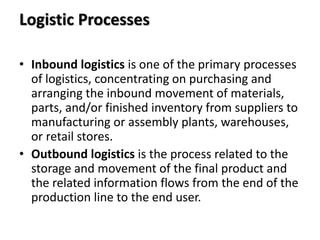
• Inbound logistics is one of the primary processes
of logistics, concentrating on purchasing and
arranging the inbound movement of materials,
parts, and/or finished inventory from suppliers to
manufacturing or assembly plants, warehouses,
or retail stores.
• Outbound logistics is the process related to the
storage and movement of the final product and
the related information flows from the end of the
production line to the end user.
Logistic Processes
CONT’D
• The services performed by logisticians, the
main fields of logistics can be broken down as
follows:
• Procurement logistics
• Production logistics
• Distribution logistics
• After-sales logistics
• Disposal logistics
CONT’D
• Reverse logistics
• Green logistics
• Global logistics
• Domestics logistics
• Concierge Service
• RAM logistics
CONT’D
• Procurement logistics consists of activities such
as market research, requirements planning,
make-or-buy decisions, supplier management,
ordering, and order controlling. The targets in
procurement logistics might be contradictory:
maximizing efficiency by concentrating on core
competences, outsourcing while maintaining the
autonomy of the company, or minimizing
procurement costs while maximizing security
within the supply process.
CONT’D
• Production logistics connects procurement to distribution
logistics. Its main function is to use available production
capacities to produce the products needed in distribution
logistics. Production logistics activities are related to
organizational concepts, layout planning, production
planning, and control.
• Distribution logistics has, as main tasks, the delivery of the
finished products to the customer. It consists of order
processing, warehousing, and transportation. Distribution
logistics is necessary because the time, place, and quantity
of production differ with the time, place, and quantity of
consumption.
CONT’D
• Disposal logistics has as its main function to reduce logistics cost(s) and
enhance service(s) related to the disposal of waste produced during the
operation of a business.
• Reverse logistics denotes all those operations related to the reuse of
products and materials. The reverse logistics process includes the
management and the sale of surpluses, as well as products being returned
to vendors from buyers. Reverse logistics stands for all operations related
to the reuse of products and materials. It is "the process of planning,
implementing, and controlling the efficient, cost effective flow of raw
materials, in-process inventory, finished goods and related information
from the point of consumption to the point of origin for the purpose of
recapturing value or proper disposal. More precisely, reverse logistics is
the process of moving goods from their typical final destination for the
purpose of capturing value, or proper disposal. The opposite of reverse
logistics is forward logistics.
CONT’D
• Green Logistics describes all attempts to
measure and minimize the ecological impact
of logistics activities. This includes all activities
of the forward and reverse flows. This can be
achieved through intermodal freight
transport, path optimization, vehicle
saturation and city logistics.
Stock management
• It is in direct touch with the user department
it provides un interrupted service to the user
function.
Material handling: a job, a joke, a
potential danger!
Background
• Work accidents attributed to materials handling
vary from 20 to 50%,
• Material handling account for 21% of the
permanent disabilities and over 25% of the
temporary disabilities
• Many accidents still tend to occur during the
handling of final products either manually or by
fork-lift trucks and cranes
• It is usually found that each part of material is
handled more than 50-60 times while it
passes through the chain of manufacture.
• The number of people required at transport
and handling workplaces is still relatively
high, and they are often exposed to the risks
associated with such sites
• The consequently high liability of many types of
human errors and omissions may create hazardous
situations.
• For safety purposes, it is useful to depict materials
handling as a system in which the various elements
are interrelated.
• It is unavoidable for human to not handle any
materials in any sort ( kick moto, car, goods, chair,
chemicals, etc) whether you’re logistician or not?
Definition-material handling
• It is that function of logistic that deals with the
preparation, placing, and positioning of
materials to facilitate their movement or
storage.
• It involves movement handling and storage of
material during different stage of production.
Objectives
1. Minimize cost of material handling.
2. Minimize delays and interruptions by making
available the materials at the point of use at
right quantity and at right time.
3. Increase the productive capacity of the
production facilities by effective utilization of
capacity and enhancing productivity.
4. Safety in material handling through
improvement in working condition.
5. Maximum utilization of material handling
equipment.
6. Prevention of damages to materials.
7. Lower investment in process inventory.
Principles of material handling
• 1. Planning principle: All handling activities
should be planned.
• 2. Systems principle: Plan a system integrating as
many handling activities as possible and co-
coordinating the full scope of operations
(receiving, storage, production, inspection,
packing, warehousing, supply and
transportation).
• 3. Space utilization principle: Make optimum use
of cubic space.
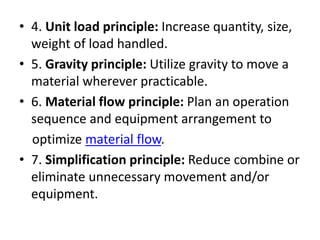
• 4. Unit load principle: Increase quantity, size,
weight of load handled.
• 5. Gravity principle: Utilize gravity to move a
material wherever practicable.
• 6. Material flow principle: Plan an operation
sequence and equipment arrangement to
optimize material flow.
• 7. Simplification principle: Reduce combine or
eliminate unnecessary movement and/or
equipment.
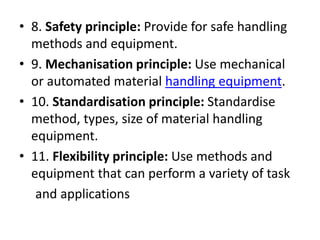
• 8. Safety principle: Provide for safe handling
methods and equipment.
• 9. Mechanisation principle: Use mechanical
or automated material handling equipment.
• 10. Standardisation principle: Standardise
method, types, size of material handling
equipment.
• 11. Flexibility principle: Use methods and
equipment that can perform a variety of task
and applications
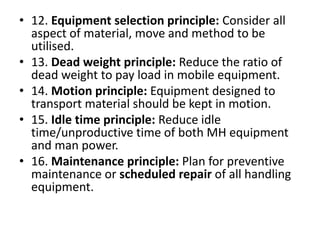
• 12. Equipment selection principle: Consider all
aspect of material, move and method to be
utilised.
• 13. Dead weight principle: Reduce the ratio of
dead weight to pay load in mobile equipment.
• 14. Motion principle: Equipment designed to
transport material should be kept in motion.
• 15. Idle time principle: Reduce idle
time/unproductive time of both MH equipment
and man power.
• 16. Maintenance principle: Plan for preventive
maintenance or scheduled repair of all handling
equipment.
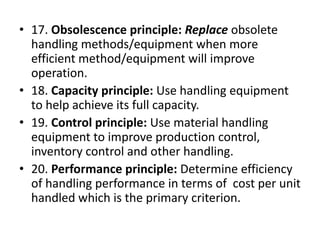
• 17. Obsolescence principle: Replace obsolete
handling methods/equipment when more
efficient method/equipment will improve
operation.
• 18. Capacity principle: Use handling equipment
to help achieve its full capacity.
• 19. Control principle: Use material handling
equipment to improve production control,
inventory control and other handling.
• 20. Performance principle: Determine efficiency
of handling performance in terms of cost per unit
handled which is the primary criterion.
Factors considered when selecting
handling equipment
Selection of material handling is an important
decision as it affects both cost and efficiency of
handling system. The following factors are to be
taken into account while selecting material
handling equipment.
• 1. PROPERTIES OF THE MATERIAL
Whether it is solid, liquid or gas, and in what
size, shape and weight it is to be moved, are
important considerations and can already lead
to a preliminary elimination from the range of
available equipment under review.
Similarly, if a material is fragile, corrosive or
toxic this will imply that certain handling
methods and containers will be preferable to
others.
2. LAYOUT AND CHARACTERISTICS OF THE
BUILDING
Another restricting factor is the availability of
space for handling.
Layout itself will indicate the type of production
operation (continuous, intermittent, fixed
position or group) and can indicate some items
of equipment that will be more suitable than
others.
Floor capacity also helps in selecting the best
material handling equipment.
• 3. ACTIVITY FLOW
If the flow is fairly constant between two fixed
positions that are not likely to change, fixed
equipment such as conveyors or chutes can be
successfully used. If, on the other hand, the flow
is not constant and the direction changes
occasionally from one point to another because
several products are being produced
simultaneously, moving equipment such as
trucks would be preferable.
• 4. COST CONSIDERATIONS
The most important considerations.
The above factors can help to narrow the range of
suitable equipment, while costing can help in taking a
final decision. Several cost elements need to be taken
into consideration when comparisons are made
between various items of equipment that are all
capable of handling the same load.
Initial investment and operating and maintenance
costs are the major cost to be considered. By
calculating and comparing the total cost for each of
the items of equipment under consideration, a more
rational decision can be reached on the most
appropriate choice.
5. NATURE OF OPERATIONS
Selection of equipment also depends on
nature of operations like whether handling is
temporary or permanent, whether the flow is
continuous or intermittent and material flow
pattern-vertical or horizontal.
6. ENGINEERING FACTORS
Selection of equipment also depends on
engineering factors like door and ceiling
dimensions, floor space, floor conditions and
structural strength
Material handling & real life
• Human errors may create hazardous situations in
material handling
• Moto vehicles were washed with sand until the Yamaha AG 100
specifications were cleaned up.
• Laptop washed by water(its great enemy)
• Human omissions may create hazardous situations in
material handling
• Forgetting car key
• Ineffective material handling may generate
signals(smelling, physiological change in body) for
which person should pay attention
• Broken halothane inhalator caused mild headache downlaod
workers
Conclusion
• Material handling is unavoidable and is very cost
in terms of accidents & damage when serious
measures are not taken.
• Materials should be handled by a right person in
a right place under a thorough supervision of a
right person.

Material handling by Dr MUTABAZI Placide

  • 1.
    Welcome to thispresentation Logistics and stock management MUTABAZI Placide, RN, PhD
  • 2.
    Topics 1. Introduction toLogistic and Stock Management. 2. Material Handling
  • 3.
    1.INTRODUCTION TO LOGISTIC MANAGEMENT •Logistics is the management of the flow of goods between the point of origin and the point of consumption in order to meet some requirements, for example, of customers or corporations. • The resources managed in logistics can include physical items, such as food, materials, animals, equipment and liquids, as well as abstract items, such as time, information, particles, and energy. • The logistics of physical items usually involves the integration of information flow, material handling, production, packaging, inventory, transportation, warehousing, and often security.
  • 4.
    • Inbound logisticsis one of the primary processes of logistics, concentrating on purchasing and arranging the inbound movement of materials, parts, and/or finished inventory from suppliers to manufacturing or assembly plants, warehouses, or retail stores. • Outbound logistics is the process related to the storage and movement of the final product and the related information flows from the end of the production line to the end user. Logistic Processes
  • 5.
    CONT’D • The servicesperformed by logisticians, the main fields of logistics can be broken down as follows: • Procurement logistics • Production logistics • Distribution logistics • After-sales logistics • Disposal logistics
  • 6.
    CONT’D • Reverse logistics •Green logistics • Global logistics • Domestics logistics • Concierge Service • RAM logistics
  • 7.
    CONT’D • Procurement logisticsconsists of activities such as market research, requirements planning, make-or-buy decisions, supplier management, ordering, and order controlling. The targets in procurement logistics might be contradictory: maximizing efficiency by concentrating on core competences, outsourcing while maintaining the autonomy of the company, or minimizing procurement costs while maximizing security within the supply process.
  • 8.
    CONT’D • Production logisticsconnects procurement to distribution logistics. Its main function is to use available production capacities to produce the products needed in distribution logistics. Production logistics activities are related to organizational concepts, layout planning, production planning, and control. • Distribution logistics has, as main tasks, the delivery of the finished products to the customer. It consists of order processing, warehousing, and transportation. Distribution logistics is necessary because the time, place, and quantity of production differ with the time, place, and quantity of consumption.
  • 9.
    CONT’D • Disposal logisticshas as its main function to reduce logistics cost(s) and enhance service(s) related to the disposal of waste produced during the operation of a business. • Reverse logistics denotes all those operations related to the reuse of products and materials. The reverse logistics process includes the management and the sale of surpluses, as well as products being returned to vendors from buyers. Reverse logistics stands for all operations related to the reuse of products and materials. It is "the process of planning, implementing, and controlling the efficient, cost effective flow of raw materials, in-process inventory, finished goods and related information from the point of consumption to the point of origin for the purpose of recapturing value or proper disposal. More precisely, reverse logistics is the process of moving goods from their typical final destination for the purpose of capturing value, or proper disposal. The opposite of reverse logistics is forward logistics.
  • 10.
    CONT’D • Green Logisticsdescribes all attempts to measure and minimize the ecological impact of logistics activities. This includes all activities of the forward and reverse flows. This can be achieved through intermodal freight transport, path optimization, vehicle saturation and city logistics.
  • 11.
    Stock management • Itis in direct touch with the user department it provides un interrupted service to the user function.
  • 12.
    Material handling: ajob, a joke, a potential danger!
  • 13.
    Background • Work accidentsattributed to materials handling vary from 20 to 50%, • Material handling account for 21% of the permanent disabilities and over 25% of the temporary disabilities • Many accidents still tend to occur during the handling of final products either manually or by fork-lift trucks and cranes
  • 14.
    • It isusually found that each part of material is handled more than 50-60 times while it passes through the chain of manufacture. • The number of people required at transport and handling workplaces is still relatively high, and they are often exposed to the risks associated with such sites
  • 15.
    • The consequentlyhigh liability of many types of human errors and omissions may create hazardous situations. • For safety purposes, it is useful to depict materials handling as a system in which the various elements are interrelated. • It is unavoidable for human to not handle any materials in any sort ( kick moto, car, goods, chair, chemicals, etc) whether you’re logistician or not?
  • 16.
    Definition-material handling • Itis that function of logistic that deals with the preparation, placing, and positioning of materials to facilitate their movement or storage. • It involves movement handling and storage of material during different stage of production.
  • 17.
    Objectives 1. Minimize costof material handling. 2. Minimize delays and interruptions by making available the materials at the point of use at right quantity and at right time. 3. Increase the productive capacity of the production facilities by effective utilization of capacity and enhancing productivity.
  • 18.
    4. Safety inmaterial handling through improvement in working condition. 5. Maximum utilization of material handling equipment. 6. Prevention of damages to materials. 7. Lower investment in process inventory.
  • 19.
    Principles of materialhandling • 1. Planning principle: All handling activities should be planned. • 2. Systems principle: Plan a system integrating as many handling activities as possible and co- coordinating the full scope of operations (receiving, storage, production, inspection, packing, warehousing, supply and transportation). • 3. Space utilization principle: Make optimum use of cubic space.
  • 20.
    • 4. Unitload principle: Increase quantity, size, weight of load handled. • 5. Gravity principle: Utilize gravity to move a material wherever practicable. • 6. Material flow principle: Plan an operation sequence and equipment arrangement to optimize material flow. • 7. Simplification principle: Reduce combine or eliminate unnecessary movement and/or equipment.
  • 21.
    • 8. Safetyprinciple: Provide for safe handling methods and equipment. • 9. Mechanisation principle: Use mechanical or automated material handling equipment. • 10. Standardisation principle: Standardise method, types, size of material handling equipment. • 11. Flexibility principle: Use methods and equipment that can perform a variety of task and applications
  • 22.
    • 12. Equipmentselection principle: Consider all aspect of material, move and method to be utilised. • 13. Dead weight principle: Reduce the ratio of dead weight to pay load in mobile equipment. • 14. Motion principle: Equipment designed to transport material should be kept in motion. • 15. Idle time principle: Reduce idle time/unproductive time of both MH equipment and man power. • 16. Maintenance principle: Plan for preventive maintenance or scheduled repair of all handling equipment.
  • 23.
    • 17. Obsolescenceprinciple: Replace obsolete handling methods/equipment when more efficient method/equipment will improve operation. • 18. Capacity principle: Use handling equipment to help achieve its full capacity. • 19. Control principle: Use material handling equipment to improve production control, inventory control and other handling. • 20. Performance principle: Determine efficiency of handling performance in terms of cost per unit handled which is the primary criterion.
  • 24.
    Factors considered whenselecting handling equipment Selection of material handling is an important decision as it affects both cost and efficiency of handling system. The following factors are to be taken into account while selecting material handling equipment.
  • 25.
    • 1. PROPERTIESOF THE MATERIAL Whether it is solid, liquid or gas, and in what size, shape and weight it is to be moved, are important considerations and can already lead to a preliminary elimination from the range of available equipment under review. Similarly, if a material is fragile, corrosive or toxic this will imply that certain handling methods and containers will be preferable to others.
  • 26.
    2. LAYOUT ANDCHARACTERISTICS OF THE BUILDING Another restricting factor is the availability of space for handling. Layout itself will indicate the type of production operation (continuous, intermittent, fixed position or group) and can indicate some items of equipment that will be more suitable than others. Floor capacity also helps in selecting the best material handling equipment.
  • 27.
    • 3. ACTIVITYFLOW If the flow is fairly constant between two fixed positions that are not likely to change, fixed equipment such as conveyors or chutes can be successfully used. If, on the other hand, the flow is not constant and the direction changes occasionally from one point to another because several products are being produced simultaneously, moving equipment such as trucks would be preferable.
  • 28.
    • 4. COSTCONSIDERATIONS The most important considerations. The above factors can help to narrow the range of suitable equipment, while costing can help in taking a final decision. Several cost elements need to be taken into consideration when comparisons are made between various items of equipment that are all capable of handling the same load. Initial investment and operating and maintenance costs are the major cost to be considered. By calculating and comparing the total cost for each of the items of equipment under consideration, a more rational decision can be reached on the most appropriate choice.
  • 29.
    5. NATURE OFOPERATIONS Selection of equipment also depends on nature of operations like whether handling is temporary or permanent, whether the flow is continuous or intermittent and material flow pattern-vertical or horizontal. 6. ENGINEERING FACTORS Selection of equipment also depends on engineering factors like door and ceiling dimensions, floor space, floor conditions and structural strength
  • 30.
    Material handling &real life • Human errors may create hazardous situations in material handling • Moto vehicles were washed with sand until the Yamaha AG 100 specifications were cleaned up. • Laptop washed by water(its great enemy) • Human omissions may create hazardous situations in material handling • Forgetting car key • Ineffective material handling may generate signals(smelling, physiological change in body) for which person should pay attention • Broken halothane inhalator caused mild headache downlaod workers
  • 31.
    Conclusion • Material handlingis unavoidable and is very cost in terms of accidents & damage when serious measures are not taken. • Materials should be handled by a right person in a right place under a thorough supervision of a right person.