Environmental Management
Topic III: EMS and ISO 14001
Samir Meramo, PhD.
Intro to EMS
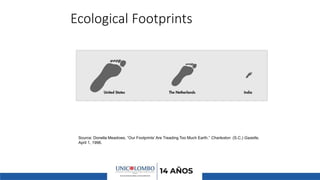
Ecological Footprints
Source: Donella Meadows, “Our Footprints’ Are Treading Too Much Earth,” Charleston (S.C.) Gazette,
April 1, 1996.
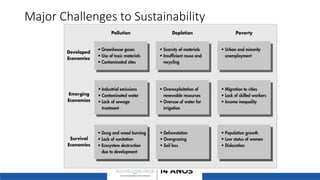
Major Challenges to Sustainability
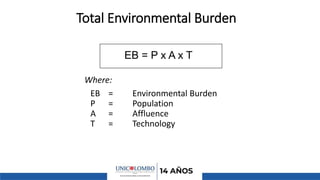
Total Environmental Burden
Where:
EB = Environmental Burden
P = Population
A = Affluence
T = Technology
EB = P x A x T
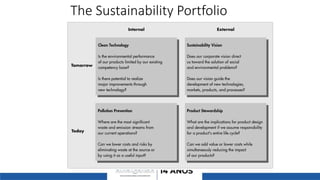
The Sustainability Portfolio
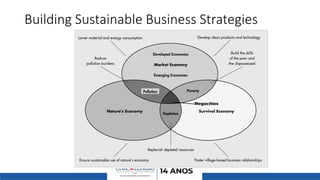
Building Sustainable Business Strategies
Megacities
Integrating Sustainability into Strategic
Decisions: Points of Focus
• Philosophical and ethical underpinnings
• Strategies
• Production and operations systems
• Structures
• Change processes
Incorporating Sustainability in Organizational
Philosophy & Ethics
• Adopt ecocentric management
• Align the management processes of the business
organization with the biophysical processes of the natural
environment
• Pursue an enterprise strategy
• Reflect a firm’s responsibilities to the larger society in
strategic decisions
• Ask “what do we stand for?”
• Rely on stakeholder analysis
Strategies for Sustainability
• Strategic vision links enterprise strategy to strategic actions
• Strategic actions thus reflect sustainability
• Process-driven strategies
• Market driven strategies
• Both of these strategies can be economically feasible and and even
lucrative for firms
• The move to sustainability is sequential
• First, pollution prevention
• Second, product stewardship
• Finally, sustainable development strategies
Aligning Production with Nature
• Involves the development of ecologically based networks of firms
and stakeholders
• Relies on appropriate technologies
• These stress low total costs, small scale, and compatibility with human
creativity
• Requires movement through three stages
• Type 1, the traditional linear model of production
• Type 2, where recycling of materials and energy becomes
institutionalized
• Type 3, where the only inputs to the system are renewable energy and a
closed-loop system of operations and materials usage
Structures for Sustainability
• Schumacher argued for a need to create “smallness” within
large organizations
• Push responsibility and autonomy farther down the organizational
hierarchy
• Create intellectually and spiritually fulfilling jobs
• Senge urged managers to create learning organizations by
instilling learning disciplines
• Systems thinking
• Personal mastery
• A shared organizational vision
• A willingness to question mental models
• Team learning processes
Creating Sustainable Cultures
• Strategic changes to enhance sustainability require cultural change to be
successful
• This will necessitate “third-order” change
• First-order change: new ways to reinforce current values, objectives and modes of
operation
• Second-order change: modifying these organizational dimensions
• Third-order change: discontinuous and simultaneous shifts to entirely new values,
objectives, and modes of operation
• Third-order change necessitates a new culture
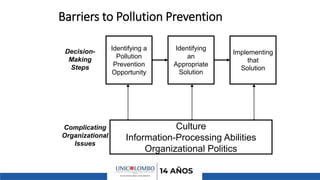
Barriers to Pollution Prevention
Identifying a
Pollution
Prevention
Opportunity
Identifying
an
Appropriate
Solution
Implementing
that
Solution
Decision-
Making
Steps
Culture
Information-Processing Abilities
Organizational Politics
Complicating
Organizational
Issues
ISO 14001: 2015 Guidelines
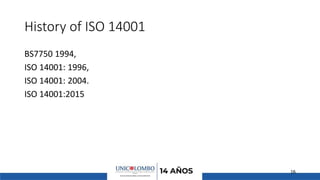
History of ISO 14001
BS7750 1994,
ISO 14001: 1996,
ISO 14001: 2004.
ISO 14001:2015
16
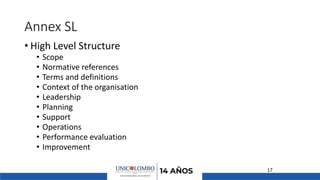
Annex SL
• High Level Structure
• Scope
• Normative references
• Terms and definitions
• Context of the organisation
• Leadership
• Planning
• Support
• Operations
• Performance evaluation
• Improvement
17
Main changes to systems.
• No requirement for a ‘manual’ or ‘documented procedures’
• No requirement for a ‘Management Representative’
One ghost which has been laid to rest is the belief that everyone
needs work instructions no matter how experienced or senior they are
in the organisation.
18
ISO 14001 -2015 Key changes
• Context of the organisation
• Interested parties- more specific
• Scope – more specific
• Leadership – some specifics
19
4.0 Context of the organisation
• Scope – fully define?
• Interested parties – who? What?
• Threats and Opportunities What?
• Compliance obligations What?
20
Threats and Opportunities
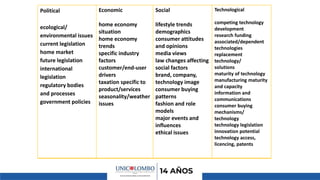
• SWOT analysis
• PEST analysis
• Listing and dealing with the outcomes
21
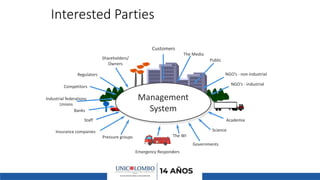
Management
System
P
Customers
The Media
Public
NGO’s - non industrial
NGO’s - industrial
Academia
Science
Governments
Industrial federations
Unions
Banks
Insurance companies
Pressure groups
Shareholders/
Owners
Regulators
Competitors
Interested Parties
Emergency Responders
Staff
The WI
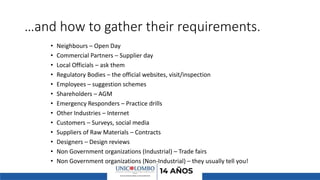
…and how to gather their requirements.
• Neighbours – Open Day
• Commercial Partners – Supplier day
• Local Officials – ask them
• Regulatory Bodies – the official websites, visit/inspection
• Employees – suggestion schemes
• Shareholders – AGM
• Emergency Responders – Practice drills
• Other Industries – Internet
• Customers – Surveys, social media
• Suppliers of Raw Materials – Contracts
• Designers – Design reviews
• Non Government organizations (Industrial) – Trade fairs
• Non Government organizations (Non-Industrial) – they usually tell you!
Political
ecological/
environmental issues
current legislation
home market
future legislation
international
legislation
regulatory bodies
and processes
government policies
Economic
home economy
situation
home economy
trends
specific industry
factors
customer/end-user
drivers
taxation specific to
product/services
seasonality/weather
issues
Social
lifestyle trends
demographics
consumer attitudes
and opinions
media views
law changes affecting
social factors
brand, company,
technology image
consumer buying
patterns
fashion and role
models
major events and
influences
ethical issues
Technological
competing technology
development
research funding
associated/dependent
technologies
replacement
technology/
solutions
maturity of technology
manufacturing maturity
and capacity
information and
communications
consumer buying
mechanisms/
technology
technology legislation
innovation potential
technology access,
licencing, patents
5.0 Leadership
• 5.1 Leadership and commitment
• 5.2 Policy
• 5.3 Organisational roles responsibilities and authorities.
Top management now have to demonstrate greater involvement in the operation
of the management system.
Policy more specifics and includes internal communication and available to
interested parties
25
6 Planning
• Action to address risks and
opportunities and needs
and expectations of
interested parties
• Environmental aspects –
life cycle perspective,
interested parties?
• Compliance Obligations- was legal and
other requirements –no real change.
• Planning action – take action to
address significant aspects,
compliance obligations and risks and
opportunities
26
6 Planning (Continued)
• Environmental Objectives and planning to achieve them – no real
change apart from need to state method of evaluation
27
7 Support
• Resources- no change
• Competence - no real change
• Awareness –no real change
• Communication –what, when, how,
who? Reliable and accurate
• Documented information – no
need for manual and procedures
–BUT…
28
8 Operation
• No real change on the need for
and extent of operational control
with respect to design, purchase
and operation
• Emergency preparedness and
response – no great change but
now a requirement to
‘periodically review’
29
9 Performance Evaluation
• Monitoring measurement and
evaluation of environmental
performance – what, how, when
+ analysis and communication.
• Evaluation of compliance – no
real change
• Internal audit –no real change.
• Management review – as before
+ review of context etc.,
30
10 Improvement
• Non-conformance and corrective action –no real change
• Continual improvement – no real change- continually improve the
suitability, adequacy and effectiveness of the EMS to enhance
environmental performance.
31
Assignment IV: EMS case study
In groups (2 people), the students need to prepare a complete presentation of
the ESM of a company as case study.
The presentation should include:
• Background and context of the organization
• Structure of the ESM (Following ISO 14001:2015 guidelines)
• Concluding Remarks
Assignment IV: EMS case study
Please, note:
• Presentation day: 18th-March
• Each group has 15 mins (No more!)
• Format: PowerPoint presentation or other
• Note: The score will depend not only on the content but also on the creativity
to present the slides.

EMS AND ISO 140001.pdf

  • 1.
    Environmental Management Topic III:EMS and ISO 14001 Samir Meramo, PhD.
  • 2.
  • 3.
    Ecological Footprints Source: DonellaMeadows, “Our Footprints’ Are Treading Too Much Earth,” Charleston (S.C.) Gazette, April 1, 1996.
  • 4.
    Major Challenges toSustainability
  • 5.
    Total Environmental Burden Where: EB= Environmental Burden P = Population A = Affluence T = Technology EB = P x A x T
  • 6.
  • 7.
    Building Sustainable BusinessStrategies Megacities
  • 8.
    Integrating Sustainability intoStrategic Decisions: Points of Focus • Philosophical and ethical underpinnings • Strategies • Production and operations systems • Structures • Change processes
  • 9.
    Incorporating Sustainability inOrganizational Philosophy & Ethics • Adopt ecocentric management • Align the management processes of the business organization with the biophysical processes of the natural environment • Pursue an enterprise strategy • Reflect a firm’s responsibilities to the larger society in strategic decisions • Ask “what do we stand for?” • Rely on stakeholder analysis
  • 10.
    Strategies for Sustainability •Strategic vision links enterprise strategy to strategic actions • Strategic actions thus reflect sustainability • Process-driven strategies • Market driven strategies • Both of these strategies can be economically feasible and and even lucrative for firms • The move to sustainability is sequential • First, pollution prevention • Second, product stewardship • Finally, sustainable development strategies
  • 11.
    Aligning Production withNature • Involves the development of ecologically based networks of firms and stakeholders • Relies on appropriate technologies • These stress low total costs, small scale, and compatibility with human creativity • Requires movement through three stages • Type 1, the traditional linear model of production • Type 2, where recycling of materials and energy becomes institutionalized • Type 3, where the only inputs to the system are renewable energy and a closed-loop system of operations and materials usage
  • 12.
    Structures for Sustainability •Schumacher argued for a need to create “smallness” within large organizations • Push responsibility and autonomy farther down the organizational hierarchy • Create intellectually and spiritually fulfilling jobs • Senge urged managers to create learning organizations by instilling learning disciplines • Systems thinking • Personal mastery • A shared organizational vision • A willingness to question mental models • Team learning processes
  • 13.
    Creating Sustainable Cultures •Strategic changes to enhance sustainability require cultural change to be successful • This will necessitate “third-order” change • First-order change: new ways to reinforce current values, objectives and modes of operation • Second-order change: modifying these organizational dimensions • Third-order change: discontinuous and simultaneous shifts to entirely new values, objectives, and modes of operation • Third-order change necessitates a new culture
  • 14.
    Barriers to PollutionPrevention Identifying a Pollution Prevention Opportunity Identifying an Appropriate Solution Implementing that Solution Decision- Making Steps Culture Information-Processing Abilities Organizational Politics Complicating Organizational Issues
  • 15.
    ISO 14001: 2015Guidelines
  • 16.
    History of ISO14001 BS7750 1994, ISO 14001: 1996, ISO 14001: 2004. ISO 14001:2015 16
  • 17.
    Annex SL • HighLevel Structure • Scope • Normative references • Terms and definitions • Context of the organisation • Leadership • Planning • Support • Operations • Performance evaluation • Improvement 17
  • 18.
    Main changes tosystems. • No requirement for a ‘manual’ or ‘documented procedures’ • No requirement for a ‘Management Representative’ One ghost which has been laid to rest is the belief that everyone needs work instructions no matter how experienced or senior they are in the organisation. 18
  • 19.
    ISO 14001 -2015Key changes • Context of the organisation • Interested parties- more specific • Scope – more specific • Leadership – some specifics 19
  • 20.
    4.0 Context ofthe organisation • Scope – fully define? • Interested parties – who? What? • Threats and Opportunities What? • Compliance obligations What? 20
  • 21.
    Threats and Opportunities •SWOT analysis • PEST analysis • Listing and dealing with the outcomes 21
  • 22.
    Management System P Customers The Media Public NGO’s -non industrial NGO’s - industrial Academia Science Governments Industrial federations Unions Banks Insurance companies Pressure groups Shareholders/ Owners Regulators Competitors Interested Parties Emergency Responders Staff The WI
  • 23.
    …and how togather their requirements. • Neighbours – Open Day • Commercial Partners – Supplier day • Local Officials – ask them • Regulatory Bodies – the official websites, visit/inspection • Employees – suggestion schemes • Shareholders – AGM • Emergency Responders – Practice drills • Other Industries – Internet • Customers – Surveys, social media • Suppliers of Raw Materials – Contracts • Designers – Design reviews • Non Government organizations (Industrial) – Trade fairs • Non Government organizations (Non-Industrial) – they usually tell you!
  • 24.
    Political ecological/ environmental issues current legislation homemarket future legislation international legislation regulatory bodies and processes government policies Economic home economy situation home economy trends specific industry factors customer/end-user drivers taxation specific to product/services seasonality/weather issues Social lifestyle trends demographics consumer attitudes and opinions media views law changes affecting social factors brand, company, technology image consumer buying patterns fashion and role models major events and influences ethical issues Technological competing technology development research funding associated/dependent technologies replacement technology/ solutions maturity of technology manufacturing maturity and capacity information and communications consumer buying mechanisms/ technology technology legislation innovation potential technology access, licencing, patents
  • 25.
    5.0 Leadership • 5.1Leadership and commitment • 5.2 Policy • 5.3 Organisational roles responsibilities and authorities. Top management now have to demonstrate greater involvement in the operation of the management system. Policy more specifics and includes internal communication and available to interested parties 25
  • 26.
    6 Planning • Actionto address risks and opportunities and needs and expectations of interested parties • Environmental aspects – life cycle perspective, interested parties? • Compliance Obligations- was legal and other requirements –no real change. • Planning action – take action to address significant aspects, compliance obligations and risks and opportunities 26
  • 27.
    6 Planning (Continued) •Environmental Objectives and planning to achieve them – no real change apart from need to state method of evaluation 27
  • 28.
    7 Support • Resources-no change • Competence - no real change • Awareness –no real change • Communication –what, when, how, who? Reliable and accurate • Documented information – no need for manual and procedures –BUT… 28
  • 29.
    8 Operation • Noreal change on the need for and extent of operational control with respect to design, purchase and operation • Emergency preparedness and response – no great change but now a requirement to ‘periodically review’ 29
  • 30.
    9 Performance Evaluation •Monitoring measurement and evaluation of environmental performance – what, how, when + analysis and communication. • Evaluation of compliance – no real change • Internal audit –no real change. • Management review – as before + review of context etc., 30
  • 31.
    10 Improvement • Non-conformanceand corrective action –no real change • Continual improvement – no real change- continually improve the suitability, adequacy and effectiveness of the EMS to enhance environmental performance. 31
  • 32.
    Assignment IV: EMScase study In groups (2 people), the students need to prepare a complete presentation of the ESM of a company as case study. The presentation should include: • Background and context of the organization • Structure of the ESM (Following ISO 14001:2015 guidelines) • Concluding Remarks
  • 33.
    Assignment IV: EMScase study Please, note: • Presentation day: 18th-March • Each group has 15 mins (No more!) • Format: PowerPoint presentation or other • Note: The score will depend not only on the content but also on the creativity to present the slides.