GREEN TECHNOLOGY FOR SUSTAINABLE
DEVELOPMENT
by Prem Kumar.U
Asst.Prof. in Management,
GKMCMT,
Trivandrum
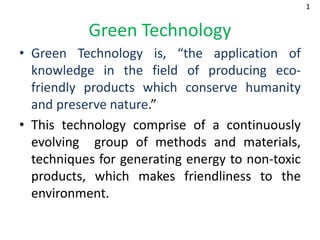
Green Technology
• Green Technology is, “the application of
knowledge in the field of producing eco-
friendly products which conserve humanity
and preserve nature.”
• This technology comprise of a continuously
evolving group of methods and materials,
techniques for generating energy to non-toxic
products, which makes friendliness to the
environment.
1
• This technology comprise of
• Continuously evolving group of methods and
materials,
• Techniques for generating energy to non-toxic
products,
• Product makes friendliness to the
environment.
2
• Objectives of Green Technology
• Sustainable development
• Elimination of Wastage
• Re-usability
• Innovation
• Feasibility
3
• Sustainable Development
• Meeting the present human needs
• Preserving the environment
• Making the environment suitable for future
generations
• World Commission on Environment and
Development (WCED), the Brundtland
commission coined “Sustainable
Development”.
4
• Elimination of Wastage
• Products are eco-friendly
card board coat hanger,
green technology remote controller,
eco-friendly umbrella,
eco-friendly clothes especially for babies and
older generation,
eco-friendly car racer,
eco-friendly earrings
5
Sony Conductor TV Remote – a student from Dong Hwa University Taiwan
Dr. Kerry Kirwan, Warwick Manufacturing group(WMG) UK
(Eco one)
Moss Carpet – Nguyen La Chanh Switzerland
• Reusability
• Cradle to cradle products
• - advocated by Jeff Werner(designer at Beaty Bio diversity
museum, Canada)
• Not Cradle to grave products
• Can be reused by the manufacturer
• People are interested to return the reused as
they can enjoy discount in next purchase.
• Some of them have a second use
• E.g., different bottles, tea bags etc
6
• Innovation
• Renovation of existing product
• Eco-friendly expansion
• Newly built products
7
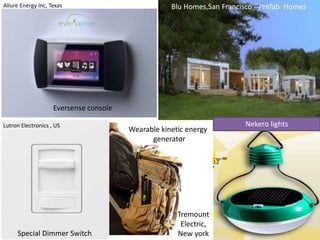
Eversense console
Blu Homes,San Francisco --Prefab Homes
Special Dimmer Switch
Wearable kinetic energy
generator
Nekero lights
Allure Energy Inc, Texas
Lutron Electronics , US
Tremount
Electric,
New york
• Feasibility
• Identify the requirement of economic
feasibility
• Biogas, agri-recycling are on the examples of
feasibility
• Selection of technology is based on suitability.
8
• Areas of Green technology
• Green Chemistry
• Green Nanotechnology
• Green IT
• Green Buildings
• Green Energy
9
• Green Chemistry
• It is a philosophy of engineering and
chemical research which results in the
generation of products and processes
that reduce the utilization and
production of hazardous substances.
• This can be practically used in
biochemistry, analytical chemistry,
organic chemistry and towards physical
chemistry.
10
• Paul Anastas, the then scientific advisor to the
United States Environmental Protection
Agency and John C Warner, a American
chemist developed 12 principles of green
chemistry.
• Better to prevent waste before it is formed,
• Synthetic methods should be framed to
incorporate all materials.
• Generation of synthetic methodologies to
produce output which are no toxic to human
and to the environment,
11
• Design of chemical products in such manner
to conserve efficiency
• Use safer auxiliary substances (e.g., solvents,
separation agents, etc)
• Recognition of energy requirement for
environmental and economic impacts
• A raw material or feed stock should be
renewable
• Unnecessary derivatization (blocking group,
protection/de-protection, temporary
modification) is avoided
13
• Catalytic reagents are superior to
stoichiometic reagents
• Chemical products should be designed in such
a way that at the end of their function they do
not persist in the environment
• Analytical methodologies need to be further
developed to all for real-time
• Substances and the form of a substance used
in a chemical process should be to minimize
potential for chemical accidents
14
• Green Nanotechnology
• In this, outputs which are built up with the
help of nanotechnology is used to enhance
environmental sustainability.
• Nano Technology materials act as catalyst and
increases efficiency of current manufacturing
operations.
• The principles of green chemistry and green
engineering are used.
15
• Nanotechnology works with materials, devices,
and other structures with at least one dimension
sized from 1 to 100 nanometres.
• Nanotechnology is the engineering of functional
systems at the molecular scale.S
• In its original sense, 'nanotechnology' refers to
the projected ability to construct items from the
bottom up, using techniques and tools being
developed today to make complete, high
performance products.
• 1 nanometre = 1 billionth of a metre. = 10-9 of a
metre
11One billion = 109 1wwwwwwwww
• Woodrow Wilson Institute, Washington 2007,
in its report gives certain Green Nano
recommendations;.
• Identify green in Nanotechnology, for that a
life cycle approach should be used,
• Make sure that Nano products are being made
using green methods,
• Construct a database of current research in
green nano.
16
• Fields in which Green Nanotechnology can be
applied
• Energy,
• Health,
• Information and communication,
• Consumer goods,
• Heavy Industries.
17
• Green Buildings
• It refers to a building structure, where by
using process that are environmentally
responsible and maintaining resource
efficiency throughout the building’s life from
its designing to its demolition.
• known as green construction or sustainable
building.
18
• LEED (Leadership in Energy and
Environmental Design) is system which rates
buildings. This system was developed by
U.S.Green Building Council (GBC). The rating
system looks into six major areas;
• Sustainable sites,
• Water efficiency,
• Energy and atmosphere,
• Materials and resources,
• Indoor environment quality,
• Innovation and design process.
• Green IT
• Commonly called as Green computing or ICT
Sustainability which deals with the practice of
environmentally sustainable computing.
• It is the study and practice of designing,
manufacturing, using and disposing of
computers, servers, and associated sub-
systems
19
• San Murugesan, Member, Global Science and
Technology Forum (GSTF) Advisory Board in
his article, Hamessing Green I.T., defines the
field of green computing as, “the study and
practice of designing, manufacturing, using
and disposing of computers, servers, and
associated sub-systems—such as monitors,
printers, storage devices, and networking and
communication systems—efficiently and
effectively with minimal or no impact on the
environment.”
20
• Objectives of Green IT
• Limit the use of hazardous materials which are
harmful to environment,
• Ensure continual improvement in Green IT
position,
• Absorb Green IT Culture,
• Protect Natural resources,
• Promote recyclability or biodegradability of
obsolete and outdated products and factory,
• Obtain maximum energy efficiency during the life
span of the product,
• Better manage risk,
• Resolve resource constraints.
21
• Green Energy
• It is produced from alternative energy sources
that get powered by different natural events.
Here the energy is received from nature. The
main sources of green energy are water, wind
and solar energy
22
• Water energy – Water contains two types of
energy. The first being the kinetic energy, due
to this, it can flow and can form waves.
• The second, the potential energy which is
stored in the water is a useful source when
water is flowing.
• Hydro electric power is obtained from falling
water or stream.
• In India Only 16% of electricity has been
obtained as hydel power
23
• Wind energy
• It is the wind power which results in turning
wind turbines. Wind turbines produce
mechanical power or electricity from kinetic
energy.
• Indian wind energy has an installed capacity of
14158 MW
• India ranked 5th in terms of wind power.
24
• Solar energy
• Sun, the source of solar energy is one of the
richest bases of energy. These technologies
are characterized as passive solar and active
solar according the way in which sunlight is
captured.
• Active solar techniques include using
photovoltaic panels, solar thermal collectors
to produces energy. Passive solar technique
is not utilized for the manufacture of
electricity, but for light dispersing, designing
light space etc ie., solar architecture.
25
• Major Corporations following Green Technology
in India
• ITC Limited
• Tata Metaliks Limited (TML)
• Tamil Nadu Newsprint and Papers Limited
• Wipro Technologies
• HCL Technologies
• ONGC
• IndusInd Bank
• IDEA Cellular
• Hero Honda Motors
• Suzlon Energy
Conclusion
• Green Technology is blessing to modern
industrialized world.
• The part and parcel of this technology can be had
from Green chemistry, Green nanotechnology,
Green building, Green IT and Green Energy.
• By introducing this knowledge, sustainable
development, preservation of nature,
conservation of human population and other
living beings, elimination of wastage, reusability,,
innovation of existing one, feasibility, etc are
made possible in a more successful manner.
26
So, be green and be with
green.
THANK YOU.

Green technology

  • 1.
    GREEN TECHNOLOGY FORSUSTAINABLE DEVELOPMENT by Prem Kumar.U Asst.Prof. in Management, GKMCMT, Trivandrum
  • 2.
    Green Technology • GreenTechnology is, “the application of knowledge in the field of producing eco- friendly products which conserve humanity and preserve nature.” • This technology comprise of a continuously evolving group of methods and materials, techniques for generating energy to non-toxic products, which makes friendliness to the environment. 1
  • 3.
    • This technologycomprise of • Continuously evolving group of methods and materials, • Techniques for generating energy to non-toxic products, • Product makes friendliness to the environment. 2
  • 4.
    • Objectives ofGreen Technology • Sustainable development • Elimination of Wastage • Re-usability • Innovation • Feasibility 3
  • 5.
    • Sustainable Development •Meeting the present human needs • Preserving the environment • Making the environment suitable for future generations • World Commission on Environment and Development (WCED), the Brundtland commission coined “Sustainable Development”. 4
  • 6.
    • Elimination ofWastage • Products are eco-friendly card board coat hanger, green technology remote controller, eco-friendly umbrella, eco-friendly clothes especially for babies and older generation, eco-friendly car racer, eco-friendly earrings 5
  • 8.
    Sony Conductor TVRemote – a student from Dong Hwa University Taiwan
  • 9.
    Dr. Kerry Kirwan,Warwick Manufacturing group(WMG) UK (Eco one)
  • 10.
    Moss Carpet –Nguyen La Chanh Switzerland
  • 11.
    • Reusability • Cradleto cradle products • - advocated by Jeff Werner(designer at Beaty Bio diversity museum, Canada) • Not Cradle to grave products • Can be reused by the manufacturer • People are interested to return the reused as they can enjoy discount in next purchase. • Some of them have a second use • E.g., different bottles, tea bags etc 6
  • 12.
    • Innovation • Renovationof existing product • Eco-friendly expansion • Newly built products 7
  • 13.
    Eversense console Blu Homes,SanFrancisco --Prefab Homes Special Dimmer Switch Wearable kinetic energy generator Nekero lights Allure Energy Inc, Texas Lutron Electronics , US Tremount Electric, New york
  • 14.
    • Feasibility • Identifythe requirement of economic feasibility • Biogas, agri-recycling are on the examples of feasibility • Selection of technology is based on suitability. 8
  • 15.
    • Areas ofGreen technology • Green Chemistry • Green Nanotechnology • Green IT • Green Buildings • Green Energy 9
  • 16.
    • Green Chemistry •It is a philosophy of engineering and chemical research which results in the generation of products and processes that reduce the utilization and production of hazardous substances. • This can be practically used in biochemistry, analytical chemistry, organic chemistry and towards physical chemistry. 10
  • 17.
    • Paul Anastas,the then scientific advisor to the United States Environmental Protection Agency and John C Warner, a American chemist developed 12 principles of green chemistry. • Better to prevent waste before it is formed, • Synthetic methods should be framed to incorporate all materials. • Generation of synthetic methodologies to produce output which are no toxic to human and to the environment, 11
  • 18.
    • Design ofchemical products in such manner to conserve efficiency • Use safer auxiliary substances (e.g., solvents, separation agents, etc) • Recognition of energy requirement for environmental and economic impacts • A raw material or feed stock should be renewable • Unnecessary derivatization (blocking group, protection/de-protection, temporary modification) is avoided 13
  • 19.
    • Catalytic reagentsare superior to stoichiometic reagents • Chemical products should be designed in such a way that at the end of their function they do not persist in the environment • Analytical methodologies need to be further developed to all for real-time • Substances and the form of a substance used in a chemical process should be to minimize potential for chemical accidents 14
  • 20.
    • Green Nanotechnology •In this, outputs which are built up with the help of nanotechnology is used to enhance environmental sustainability. • Nano Technology materials act as catalyst and increases efficiency of current manufacturing operations. • The principles of green chemistry and green engineering are used. 15
  • 21.
    • Nanotechnology workswith materials, devices, and other structures with at least one dimension sized from 1 to 100 nanometres. • Nanotechnology is the engineering of functional systems at the molecular scale.S • In its original sense, 'nanotechnology' refers to the projected ability to construct items from the bottom up, using techniques and tools being developed today to make complete, high performance products. • 1 nanometre = 1 billionth of a metre. = 10-9 of a metre 11One billion = 109 1wwwwwwwww
  • 22.
    • Woodrow WilsonInstitute, Washington 2007, in its report gives certain Green Nano recommendations;. • Identify green in Nanotechnology, for that a life cycle approach should be used, • Make sure that Nano products are being made using green methods, • Construct a database of current research in green nano. 16
  • 23.
    • Fields inwhich Green Nanotechnology can be applied • Energy, • Health, • Information and communication, • Consumer goods, • Heavy Industries. 17
  • 24.
    • Green Buildings •It refers to a building structure, where by using process that are environmentally responsible and maintaining resource efficiency throughout the building’s life from its designing to its demolition. • known as green construction or sustainable building. 18
  • 25.
    • LEED (Leadershipin Energy and Environmental Design) is system which rates buildings. This system was developed by U.S.Green Building Council (GBC). The rating system looks into six major areas; • Sustainable sites, • Water efficiency, • Energy and atmosphere, • Materials and resources, • Indoor environment quality, • Innovation and design process.
  • 26.
    • Green IT •Commonly called as Green computing or ICT Sustainability which deals with the practice of environmentally sustainable computing. • It is the study and practice of designing, manufacturing, using and disposing of computers, servers, and associated sub- systems 19
  • 27.
    • San Murugesan,Member, Global Science and Technology Forum (GSTF) Advisory Board in his article, Hamessing Green I.T., defines the field of green computing as, “the study and practice of designing, manufacturing, using and disposing of computers, servers, and associated sub-systems—such as monitors, printers, storage devices, and networking and communication systems—efficiently and effectively with minimal or no impact on the environment.” 20
  • 28.
    • Objectives ofGreen IT • Limit the use of hazardous materials which are harmful to environment, • Ensure continual improvement in Green IT position, • Absorb Green IT Culture, • Protect Natural resources, • Promote recyclability or biodegradability of obsolete and outdated products and factory, • Obtain maximum energy efficiency during the life span of the product, • Better manage risk, • Resolve resource constraints. 21
  • 29.
    • Green Energy •It is produced from alternative energy sources that get powered by different natural events. Here the energy is received from nature. The main sources of green energy are water, wind and solar energy 22
  • 30.
    • Water energy– Water contains two types of energy. The first being the kinetic energy, due to this, it can flow and can form waves. • The second, the potential energy which is stored in the water is a useful source when water is flowing. • Hydro electric power is obtained from falling water or stream. • In India Only 16% of electricity has been obtained as hydel power 23
  • 31.
    • Wind energy •It is the wind power which results in turning wind turbines. Wind turbines produce mechanical power or electricity from kinetic energy. • Indian wind energy has an installed capacity of 14158 MW • India ranked 5th in terms of wind power. 24
  • 32.
    • Solar energy •Sun, the source of solar energy is one of the richest bases of energy. These technologies are characterized as passive solar and active solar according the way in which sunlight is captured. • Active solar techniques include using photovoltaic panels, solar thermal collectors to produces energy. Passive solar technique is not utilized for the manufacture of electricity, but for light dispersing, designing light space etc ie., solar architecture. 25
  • 33.
    • Major Corporationsfollowing Green Technology in India • ITC Limited • Tata Metaliks Limited (TML) • Tamil Nadu Newsprint and Papers Limited • Wipro Technologies • HCL Technologies • ONGC • IndusInd Bank • IDEA Cellular • Hero Honda Motors • Suzlon Energy
  • 36.
    Conclusion • Green Technologyis blessing to modern industrialized world. • The part and parcel of this technology can be had from Green chemistry, Green nanotechnology, Green building, Green IT and Green Energy. • By introducing this knowledge, sustainable development, preservation of nature, conservation of human population and other living beings, elimination of wastage, reusability,, innovation of existing one, feasibility, etc are made possible in a more successful manner. 26
  • 37.
    So, be greenand be with green. THANK YOU.