Entity
Dr. Gowthami V
• An entity is referred to as an object or thing that exists in
the real world.
• For example, customer, car, pen, etc.
• Entities are stored in the database, and they should be
distinguishable, i.e., they should be easily identifiable from
the group.
• For example, a group of pens that are from the same
company cannot be identified, so they are only objects, but
pens with different colours become unique and will be
called an entity like a red pen, green pen, blue pen, black
pen, etc.
• An entity has some attributes which depict the entity's
characteristics.
• For example, an entity "Student" has attributes such as
"Student_roll_no", "Student_name", "Student_subject", and
"Student_marks".
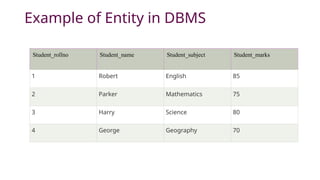
Example of Entity in DBMS
Student_rollno Student_name Student_subject Student_marks
1 Robert English 85
2 Parker Mathematics 75
3 Harry Science 80
4 George Geography 70
Kinds of Entity:
1. Tangible Entity:
• It is an entity in DBMS, which is a physical object that we
can touch or see. In simple words, an entity that has a
physical existence in the real world is called a tangible entity.
• For example, in a database, a table represents a tangible
entity because it contains a physical object that we can see
and touch in the real world. It includes colleges, bank
lockers, mobiles, cars, watches, pens, paintings, etc.
2. Intangible Entity:
• It is an entity in DBMS, which is a non-physical object that
we cannot see or touch.
• In simple words, an entity that does not have any physical
existence in the real world is known as an intangible entity.
• For example, a bank account logically exists, but we cannot
see or touch it
Entity Type:
• A collection of entities with general characteristics is known
as an entity type.
• For example, a database of a corporate company has entity
types such as employees, departments, etc.
• In DBMS, every entity type contains a set of attributes that
explain the entity.
• The Employee entity type can have attributes such as name,
age, address, phone number, and salary.
• The Department entity type can have attributes such as
name, number, and location in the department.
Kinds of Entity Type
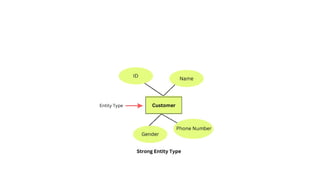
• 1. Strong Entity Type: It is an entity that has its own
existence and is independent.
• The entity relationship diagram represents a strong entity
type with the help of a single rectangle.
Example:
• "Customer" is the entity type with attributes such as ID,
Name, Gender, and Phone Number.
• Customer is a strong entity type as it has a unique ID for
each customer.
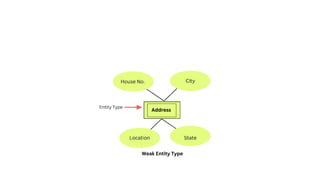
• 2. Weak Entity Type:
• It is an entity that does not have its own existence and relies
on a strong entity for its existence.
• The Entity Relationship Diagram represents the weak entity
type using double rectangles.
Example
• "Address" is a weak entity type with attributes such as
House No., City, Location, and State.
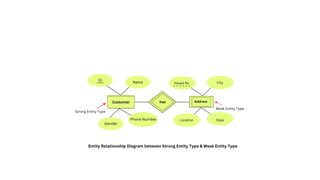
• The relationship between a strong and a weak entity type is
known as an identifying relationship.
• Using a double diamond, the Entity-Relationship Diagram
represents a relationship between the strong and the
weak entity type.
• Let us see an example of the relationship between the
Strong entity type and weak entity type with the help of ER
Diagram
Entity Set
• An entity set is a group of entities of the same entity type.
• For example, an entity set of students, an entity set of
motorbikes, an entity of smartphones, an entity of
customers, etc.
• Entity sets can be classified into two types
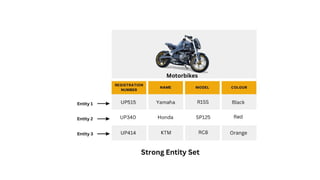
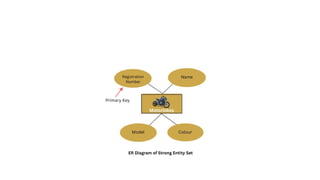
1. Strong Entity Set:
• In a DBMS, a strong entity set consists of a primary key.
• For example, an entity of motorbikes with the attributes,
motorbike's registration number, motorbike's name,
motorbike's model, and motorbike's colour.
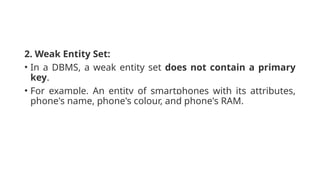
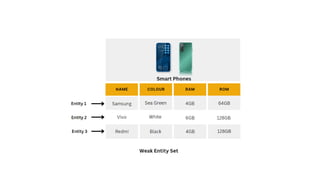
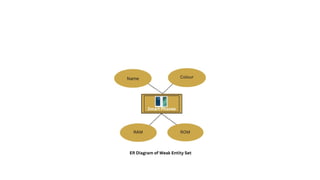
2. Weak Entity Set:
• In a DBMS, a weak entity set does not contain a primary
key.
• For example, An entity of smartphones with its attributes,
phone's name, phone's colour, and phone's RAM.
Entity of Database Management System.pptx

Entity of Database Management System.pptx

  • 1.
  • 2.
    • An entityis referred to as an object or thing that exists in the real world. • For example, customer, car, pen, etc. • Entities are stored in the database, and they should be distinguishable, i.e., they should be easily identifiable from the group. • For example, a group of pens that are from the same company cannot be identified, so they are only objects, but pens with different colours become unique and will be called an entity like a red pen, green pen, blue pen, black pen, etc.
  • 3.
    • An entityhas some attributes which depict the entity's characteristics. • For example, an entity "Student" has attributes such as "Student_roll_no", "Student_name", "Student_subject", and "Student_marks".
  • 4.
    Example of Entityin DBMS Student_rollno Student_name Student_subject Student_marks 1 Robert English 85 2 Parker Mathematics 75 3 Harry Science 80 4 George Geography 70
  • 5.
    Kinds of Entity: 1.Tangible Entity: • It is an entity in DBMS, which is a physical object that we can touch or see. In simple words, an entity that has a physical existence in the real world is called a tangible entity. • For example, in a database, a table represents a tangible entity because it contains a physical object that we can see and touch in the real world. It includes colleges, bank lockers, mobiles, cars, watches, pens, paintings, etc.
  • 6.
    2. Intangible Entity: •It is an entity in DBMS, which is a non-physical object that we cannot see or touch. • In simple words, an entity that does not have any physical existence in the real world is known as an intangible entity. • For example, a bank account logically exists, but we cannot see or touch it
  • 7.
    Entity Type: • Acollection of entities with general characteristics is known as an entity type. • For example, a database of a corporate company has entity types such as employees, departments, etc. • In DBMS, every entity type contains a set of attributes that explain the entity. • The Employee entity type can have attributes such as name, age, address, phone number, and salary. • The Department entity type can have attributes such as name, number, and location in the department.
  • 8.
    Kinds of EntityType • 1. Strong Entity Type: It is an entity that has its own existence and is independent. • The entity relationship diagram represents a strong entity type with the help of a single rectangle. Example: • "Customer" is the entity type with attributes such as ID, Name, Gender, and Phone Number. • Customer is a strong entity type as it has a unique ID for each customer.
  • 10.
    • 2. WeakEntity Type: • It is an entity that does not have its own existence and relies on a strong entity for its existence. • The Entity Relationship Diagram represents the weak entity type using double rectangles.
  • 12.
    Example • "Address" isa weak entity type with attributes such as House No., City, Location, and State. • The relationship between a strong and a weak entity type is known as an identifying relationship. • Using a double diamond, the Entity-Relationship Diagram represents a relationship between the strong and the weak entity type. • Let us see an example of the relationship between the Strong entity type and weak entity type with the help of ER Diagram
  • 14.
    Entity Set • Anentity set is a group of entities of the same entity type. • For example, an entity set of students, an entity set of motorbikes, an entity of smartphones, an entity of customers, etc. • Entity sets can be classified into two types
  • 15.
    1. Strong EntitySet: • In a DBMS, a strong entity set consists of a primary key. • For example, an entity of motorbikes with the attributes, motorbike's registration number, motorbike's name, motorbike's model, and motorbike's colour.
  • 18.
    2. Weak EntitySet: • In a DBMS, a weak entity set does not contain a primary key. • For example, An entity of smartphones with its attributes, phone's name, phone's colour, and phone's RAM.