Introduction to Data Structure
zaid shabbir
Basic Terminologies
● Data Structure
– Data: are simply a value are set of values of
different type which is called data types like
string, integer, char etc.
– Structure: Way of organizing information, so that
it is easier to use
– In simple words we can define data structures as
● Its a way organizing data in such a way so
that data can be easier to use.
zaid shabbir
Basic Terminologies
● Data Structure ..
– A data structure is a particular way of
organizing data in a computer so that it
can be used effi ciently.
– A scheme for organizing related pieces of
information.
zaid shabbir
Why Data Structure
● Human requirement with computer are going to
complex day by day. To solve the complex
requirements in efficient way we need this
study.
● Provide fastest solution of human requirements.
● Provide efficient solution of complex problem.
– Space
– Time
zaid shabbir
Study in Data Structure
● Logical or mathematical description of the
structure.
● Implementation of structure on a computer
using different computer languages ( C, C++,
JAVA, pl-languages etc.)
● Qunatitative analysis of the structure, which
includes determining the amount of memory
needed to store the structure and the time
required to process the structure.
zaid shabbir
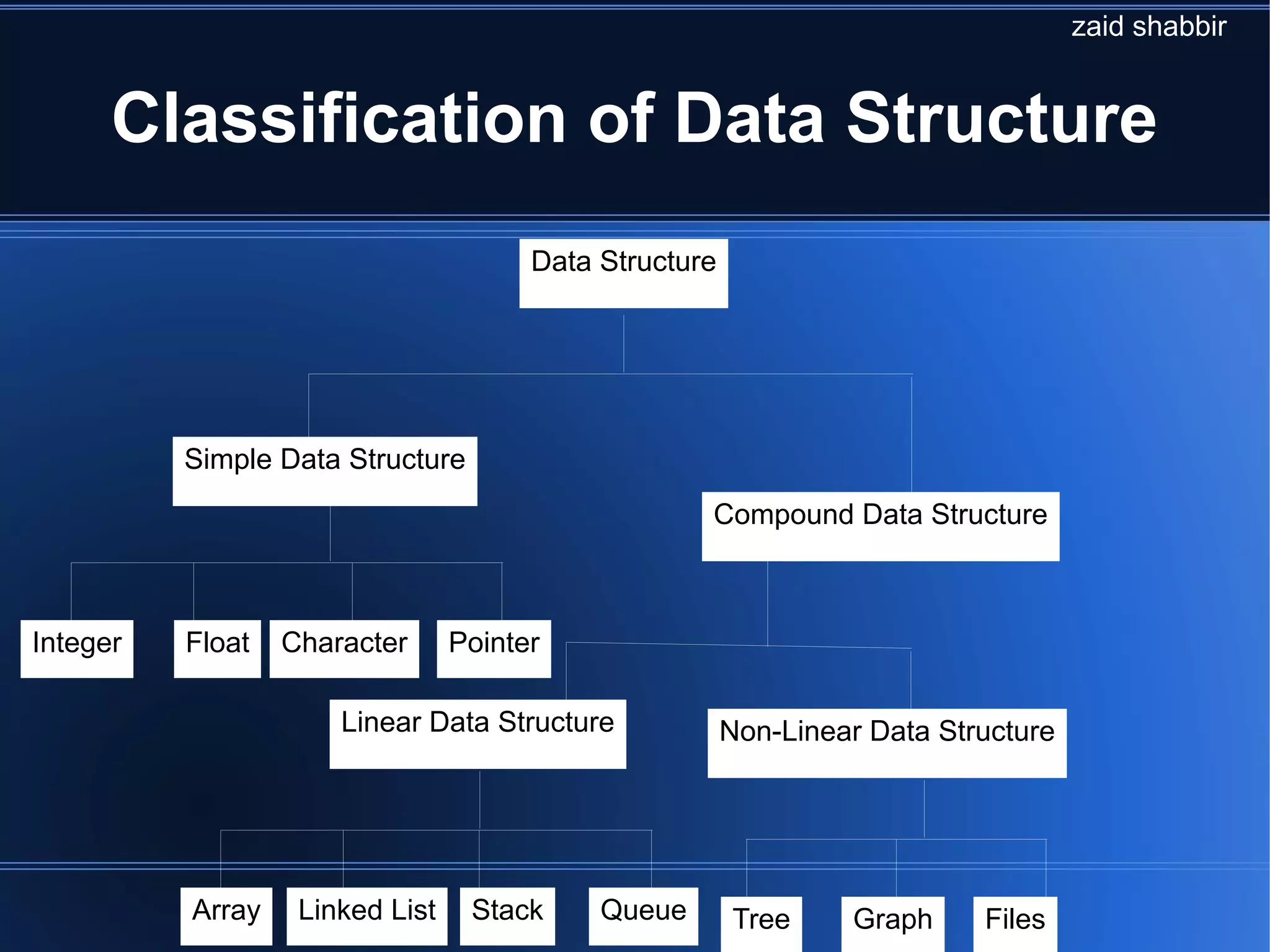
Classification of Data Structure
Data Structure
Simple Data Structure
Compound Data Structure
Linear Data Structure Non-Linear Data Structure
Array Linked List Stack Queue Tree Graph Files
Integer Float Character Pointer
zaid shabbir
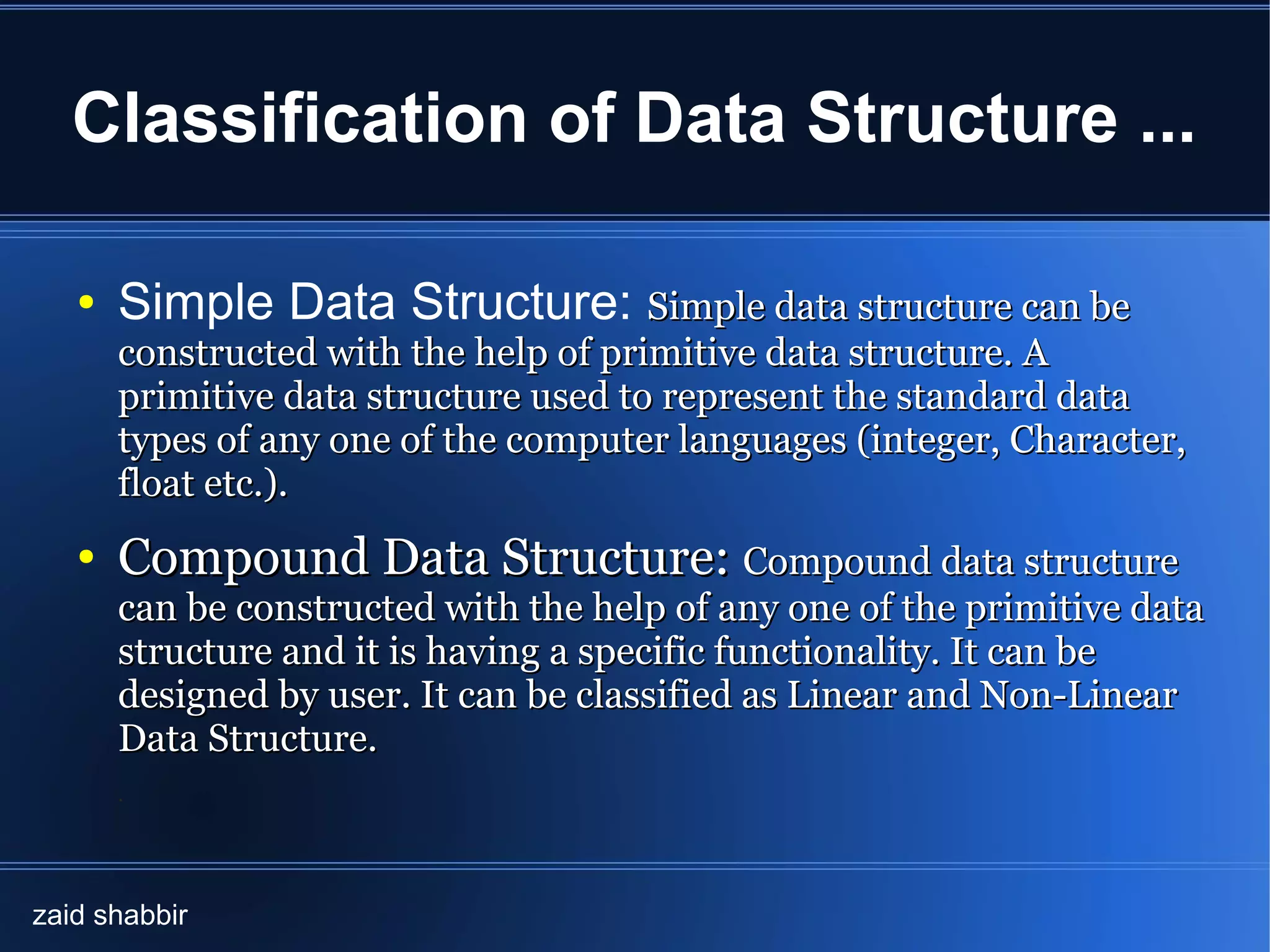
Classification of Data Structure ...
● Simple Data Structure: Simple data structure can beSimple data structure can be
constructed with the help of primitive data structure. Aconstructed with the help of primitive data structure. A
primitive data structure used to represent the standard dataprimitive data structure used to represent the standard data
types of any one of the computer languages (integer, Character,types of any one of the computer languages (integer, Character,
float etc.).float etc.).
●
Compound Data Structure:Compound Data Structure: Compound data structureCompound data structure
can be constructed with the help of any one of the primitive datacan be constructed with the help of any one of the primitive data
structure and it is having a specific functionality. It can bestructure and it is having a specific functionality. It can be
designed by user. It can be classified as Linear and Non-Lineardesigned by user. It can be classified as Linear and Non-Linear
Data Structure.Data Structure.
.
zaid shabbir
Classification of Data Structure ...
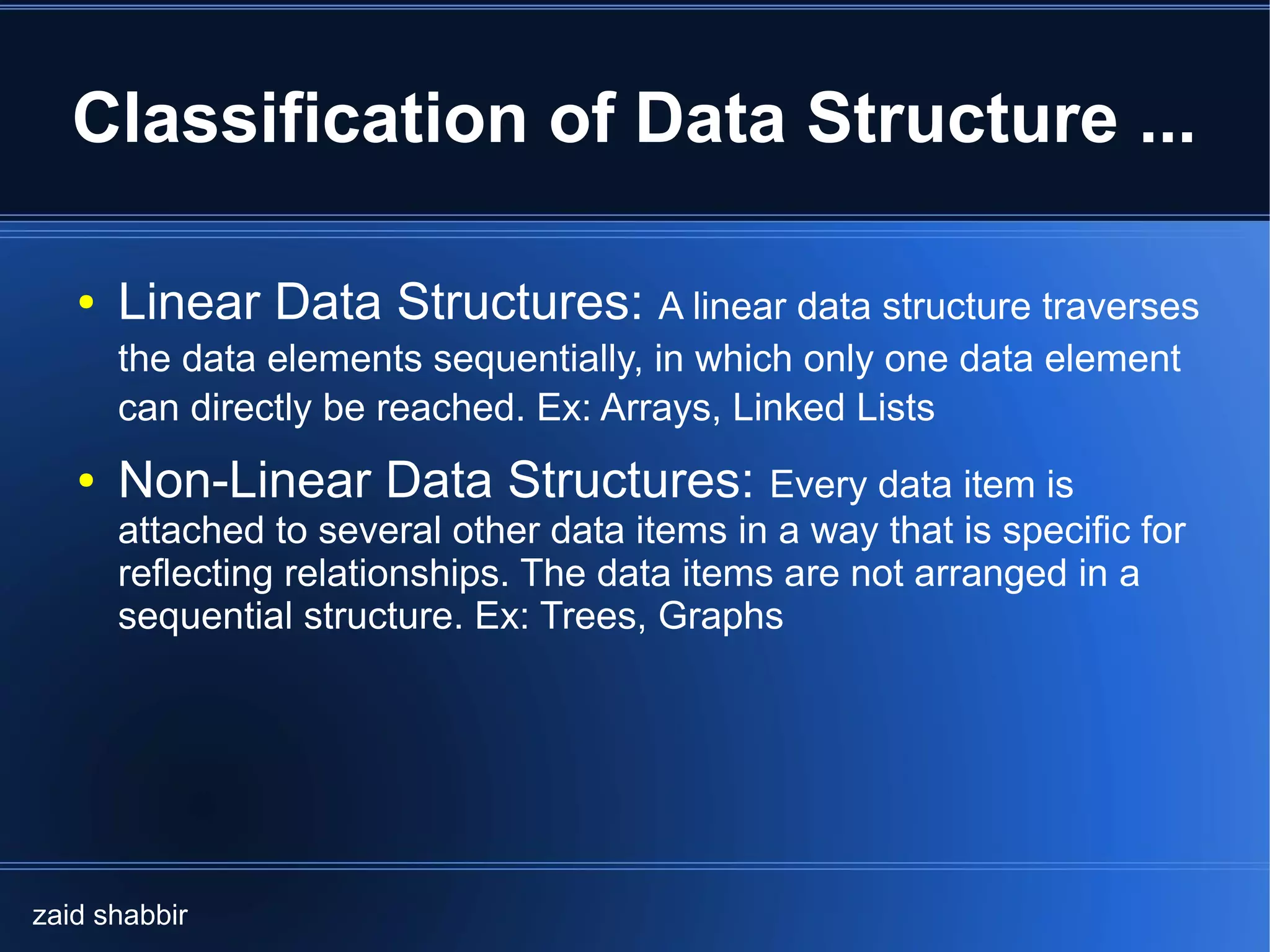
● Linear Data Structures: A linear data structure traverses
the data elements sequentially, in which only one data element
can directly be reached. Ex: Arrays, Linked Lists
● Non-Linear Data Structures: Every data item is
attached to several other data items in a way that is specific for
reflecting relationships. The data items are not arranged in a
sequential structure. Ex: Trees, Graphs
zaid shabbir
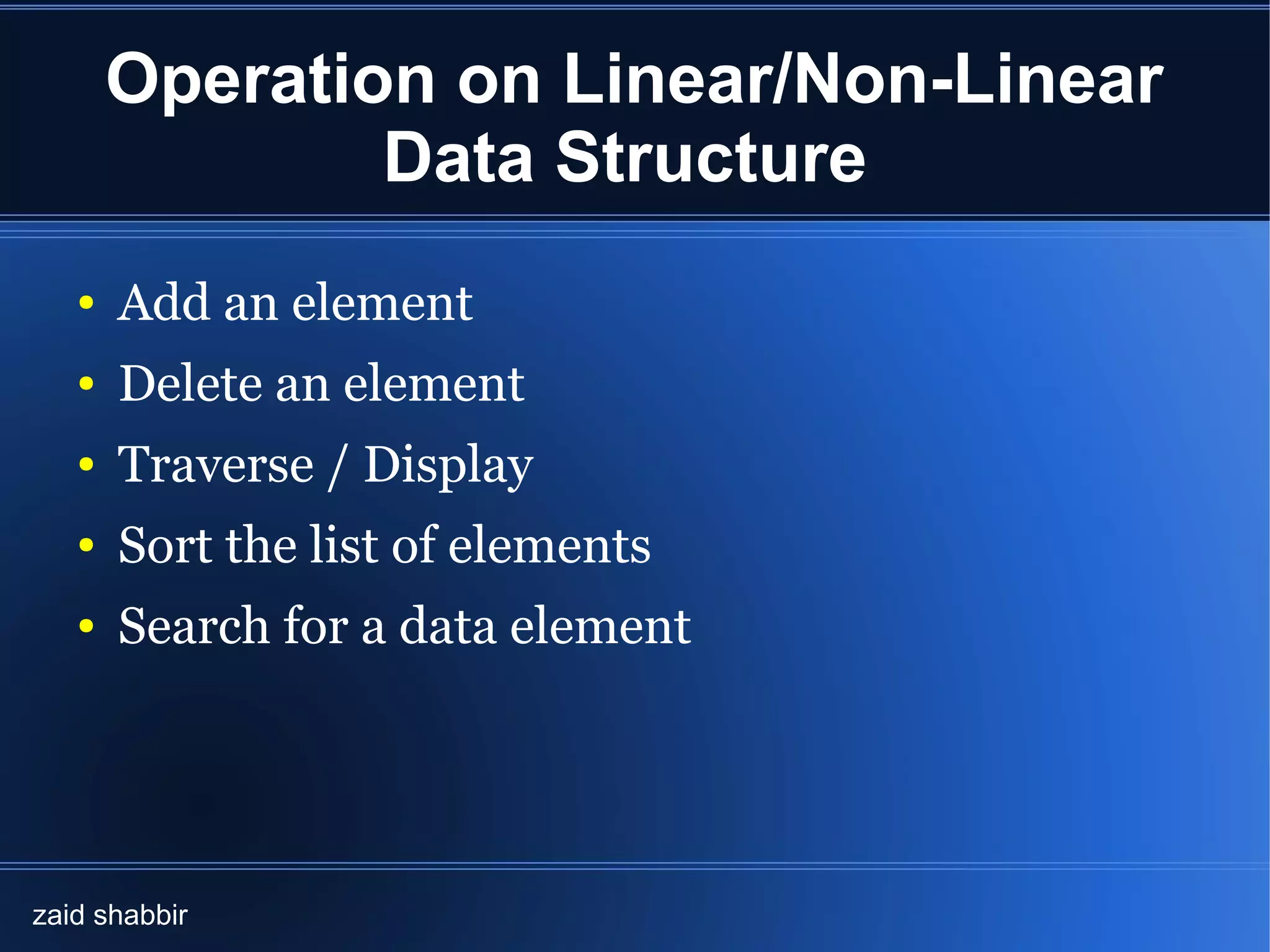
Operation on Linear/Non-Linear
Data Structure
● Add an element
● Delete an element
● Traverse / Display
● Sort the list of elements
● Search for a data element
zaid shabbir
Types of Data Structure
●
Array: is commonly used in computer
programming to mean a contiguous block of
memory locations, where each memory location
stores one fixed-length data item. e.g. Array of
Integers int a[10], Array of Character char b[10]
Array of Integers
0 1 2 3 4 5 6 7 8 9
5 6 4 3 7 8 9 2 1 2
Array of Character
0 1 2 3 4 5 6 7 8 9
5 6 4 3 7 8 9 2 1 2
zaid shabbir
Types of Data Structure ...
Stack: A stack is a data
structure in which items can
be inserted only from one
end and get items back from
the same end. There , the last
item inserted into stack, is
the the first item to be taken
out from the stack. In short
its also called Last in First
out [LIFO]. zaid shabbir
Types of Data Structure ...
Queue: A queue is two
ended data structure in
which items can be
inserted from one end and
taken out from the other
end. Therefore , the first
item inserted into queue is
the first item to be taken
out from the queue. This
property is called First in
First out [FIFO]. zaid shabbir
Types of Data Structure ...
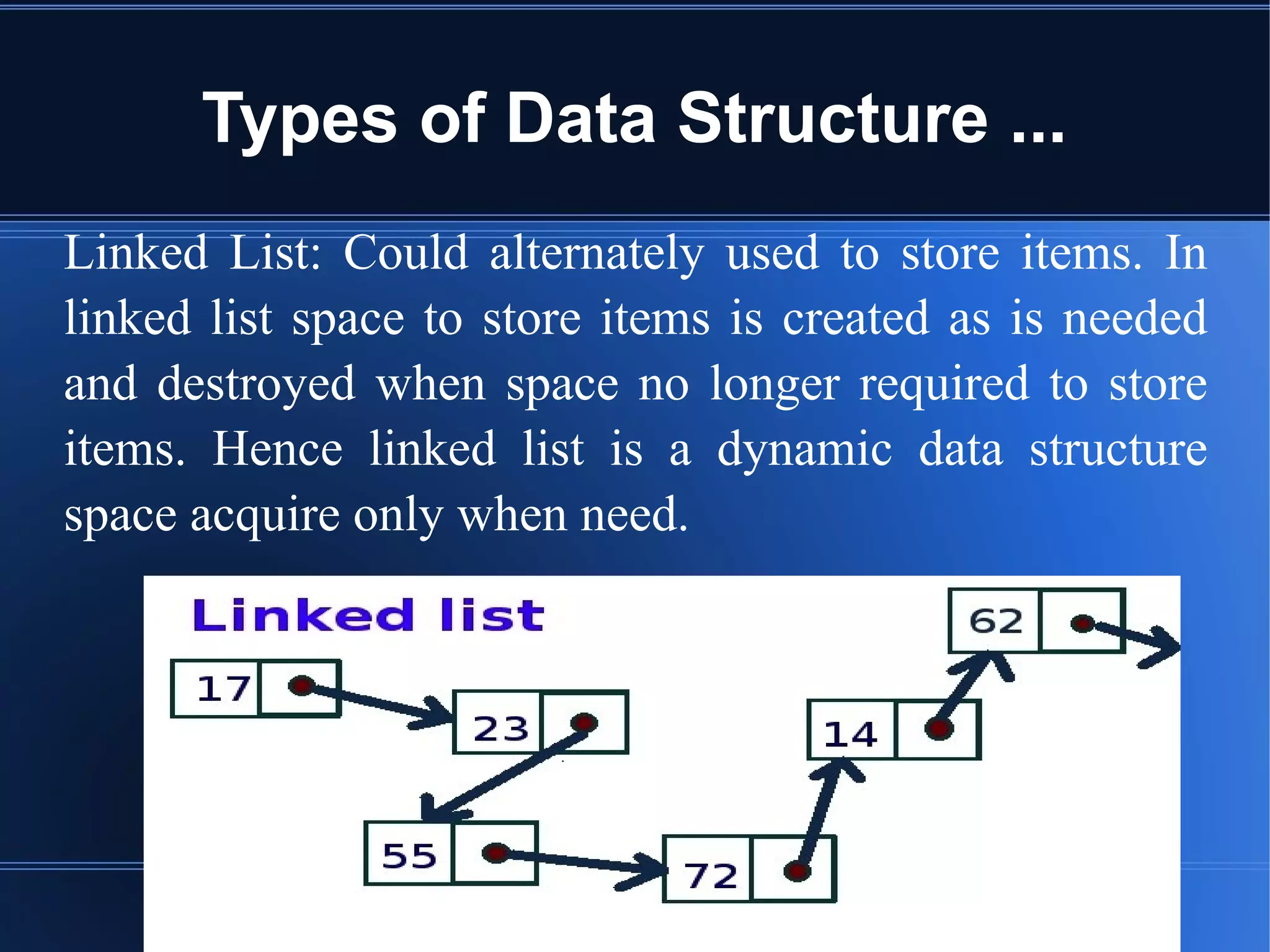
Linked List: Could alternately used to store items. In
linked list space to store items is created as is needed
and destroyed when space no longer required to store
items. Hence linked list is a dynamic data structure
space acquire only when need.
Types of Data Structure ...
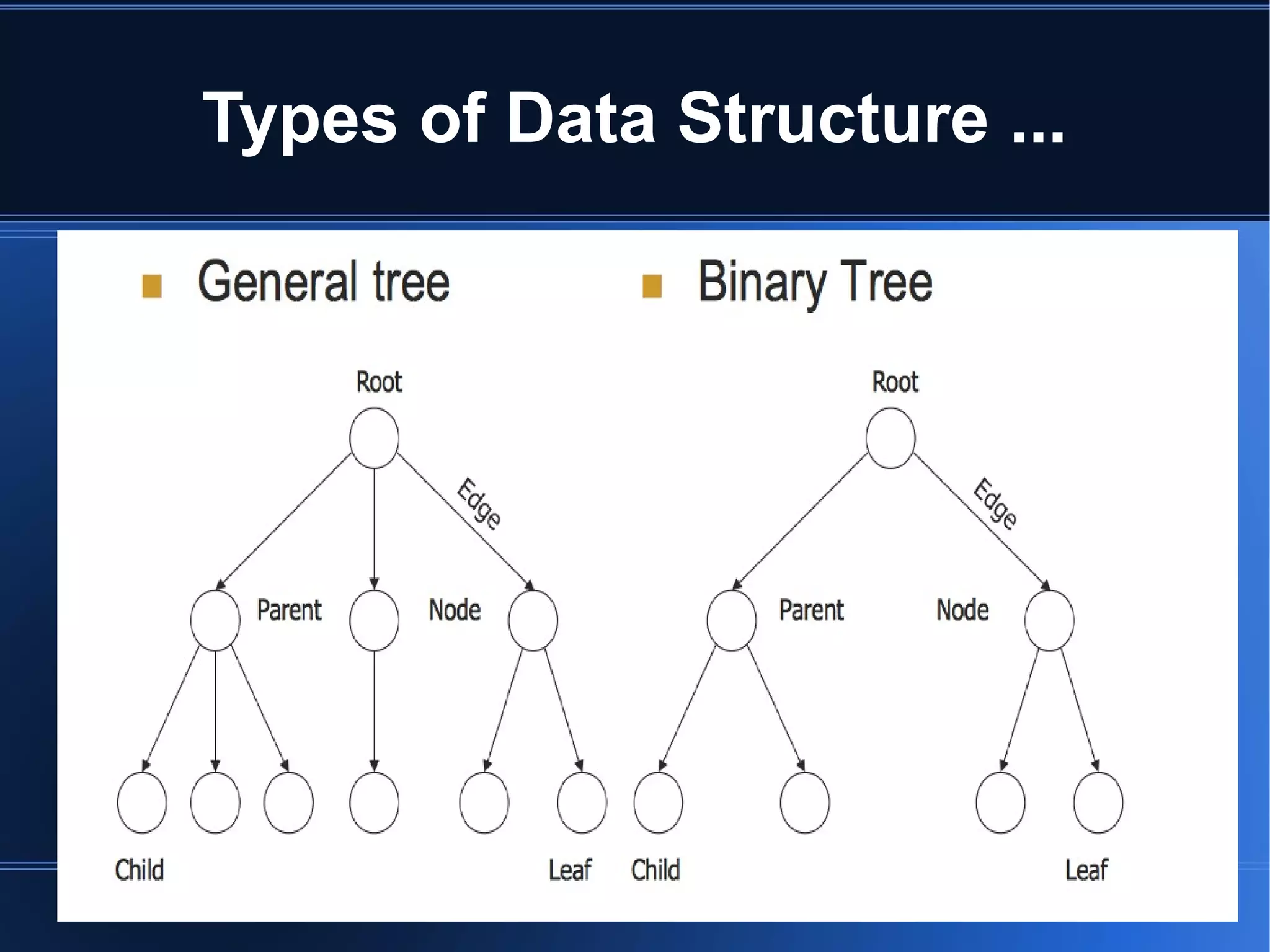
Tree: is a non-linear data
structure which is
mainly used to represent
data containing a
hierarchical relationship
between elements.
Binary Tree: A binary
tree is a tree such that
every node has at most 2
child and each node is
labeled as either left of
right child.
zaid shabbir
Types of Data Structure ...
Graph: It is a set of items connected by edges.
Each item is called a vertex or node. Trees are
just like a special kinds of graphs. Graphs are
usually represented by G = (V, E), where V is the
set vertices and E is the set of Edges.
zaid shabbir
Types of Data Structure ...
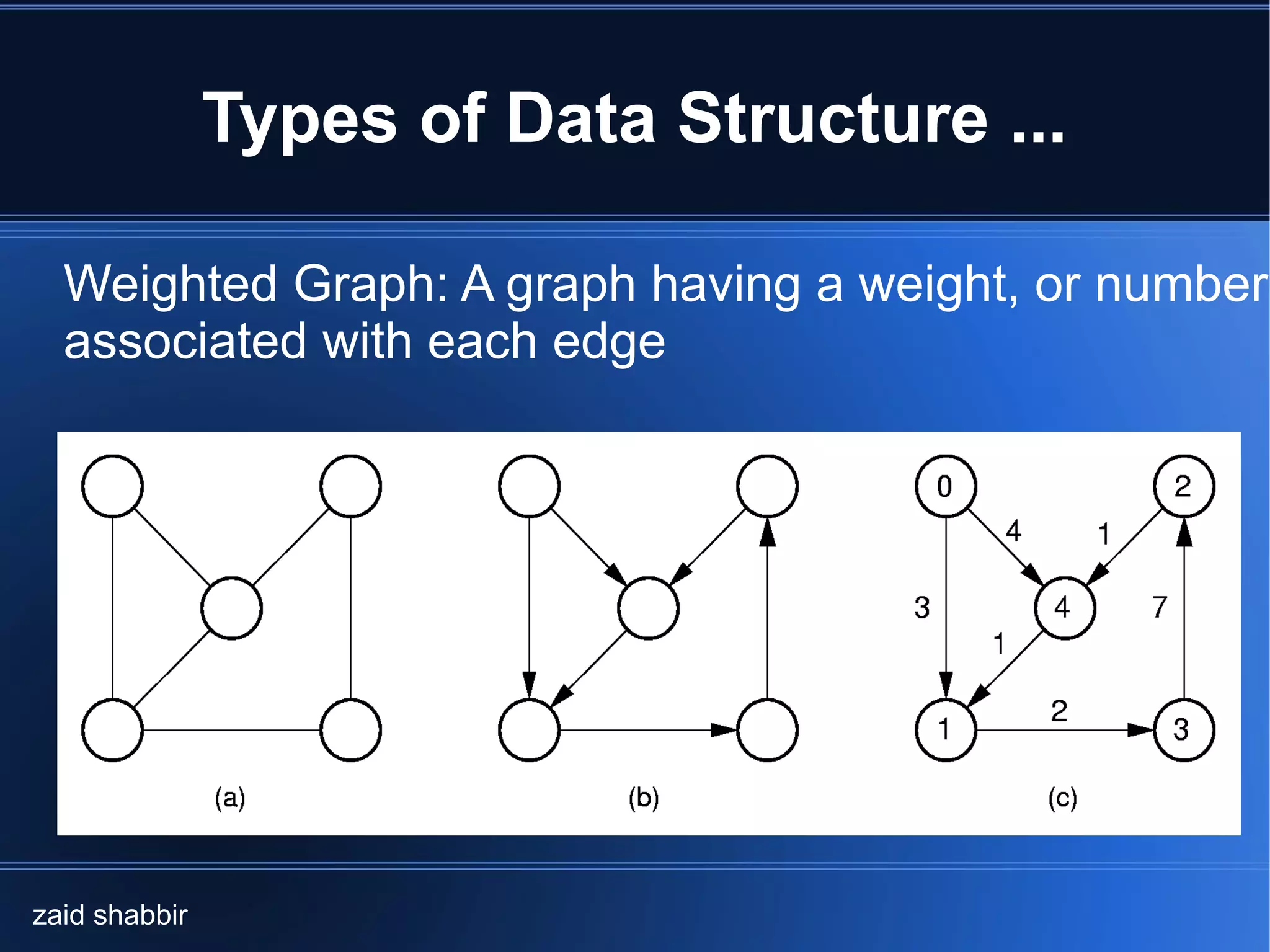
Undirected Graph: A graph
whose edges are
unordered pair of vertices.
That is each edge connects
two vertices. In an
undirected graph, direction
is not important, if the path
is available, it can be
traversed in any direction.
zaid shabbir
Types of Data Structure ...
Directed Graph: In directed graph a directional
edge connect two node/vertex. If there is one edge
from one vertex to other then only this path can be
followed.
Types of Data Structure ...
Weighted Graph: A graph having a weight, or number
associated with each edge
zaid shabbir
Selecting a Data Structure
● Analyze the problem to determine the resource
constraints a solution must meet.
● Determine the basic operations that must be
supported. Quantify the resource constraints
for each operation.
● Select the data structure that best meets these
requirements.
zaid shabbir

Introduction to data structure

  • 1.
    Introduction to DataStructure zaid shabbir
  • 2.
    Basic Terminologies ● DataStructure – Data: are simply a value are set of values of different type which is called data types like string, integer, char etc. – Structure: Way of organizing information, so that it is easier to use – In simple words we can define data structures as ● Its a way organizing data in such a way so that data can be easier to use. zaid shabbir
  • 3.
    Basic Terminologies ● DataStructure .. – A data structure is a particular way of organizing data in a computer so that it can be used effi ciently. – A scheme for organizing related pieces of information. zaid shabbir
  • 4.
    Why Data Structure ●Human requirement with computer are going to complex day by day. To solve the complex requirements in efficient way we need this study. ● Provide fastest solution of human requirements. ● Provide efficient solution of complex problem. – Space – Time zaid shabbir
  • 5.
    Study in DataStructure ● Logical or mathematical description of the structure. ● Implementation of structure on a computer using different computer languages ( C, C++, JAVA, pl-languages etc.) ● Qunatitative analysis of the structure, which includes determining the amount of memory needed to store the structure and the time required to process the structure. zaid shabbir
  • 6.
    Classification of DataStructure Data Structure Simple Data Structure Compound Data Structure Linear Data Structure Non-Linear Data Structure Array Linked List Stack Queue Tree Graph Files Integer Float Character Pointer zaid shabbir
  • 7.
    Classification of DataStructure ... ● Simple Data Structure: Simple data structure can beSimple data structure can be constructed with the help of primitive data structure. Aconstructed with the help of primitive data structure. A primitive data structure used to represent the standard dataprimitive data structure used to represent the standard data types of any one of the computer languages (integer, Character,types of any one of the computer languages (integer, Character, float etc.).float etc.). ● Compound Data Structure:Compound Data Structure: Compound data structureCompound data structure can be constructed with the help of any one of the primitive datacan be constructed with the help of any one of the primitive data structure and it is having a specific functionality. It can bestructure and it is having a specific functionality. It can be designed by user. It can be classified as Linear and Non-Lineardesigned by user. It can be classified as Linear and Non-Linear Data Structure.Data Structure. . zaid shabbir
  • 8.
    Classification of DataStructure ... ● Linear Data Structures: A linear data structure traverses the data elements sequentially, in which only one data element can directly be reached. Ex: Arrays, Linked Lists ● Non-Linear Data Structures: Every data item is attached to several other data items in a way that is specific for reflecting relationships. The data items are not arranged in a sequential structure. Ex: Trees, Graphs zaid shabbir
  • 9.
    Operation on Linear/Non-Linear DataStructure ● Add an element ● Delete an element ● Traverse / Display ● Sort the list of elements ● Search for a data element zaid shabbir
  • 10.
    Types of DataStructure ● Array: is commonly used in computer programming to mean a contiguous block of memory locations, where each memory location stores one fixed-length data item. e.g. Array of Integers int a[10], Array of Character char b[10] Array of Integers 0 1 2 3 4 5 6 7 8 9 5 6 4 3 7 8 9 2 1 2 Array of Character 0 1 2 3 4 5 6 7 8 9 5 6 4 3 7 8 9 2 1 2 zaid shabbir
  • 11.
    Types of DataStructure ... Stack: A stack is a data structure in which items can be inserted only from one end and get items back from the same end. There , the last item inserted into stack, is the the first item to be taken out from the stack. In short its also called Last in First out [LIFO]. zaid shabbir
  • 12.
    Types of DataStructure ... Queue: A queue is two ended data structure in which items can be inserted from one end and taken out from the other end. Therefore , the first item inserted into queue is the first item to be taken out from the queue. This property is called First in First out [FIFO]. zaid shabbir
  • 13.
    Types of DataStructure ... Linked List: Could alternately used to store items. In linked list space to store items is created as is needed and destroyed when space no longer required to store items. Hence linked list is a dynamic data structure space acquire only when need.
  • 14.
    Types of DataStructure ... Tree: is a non-linear data structure which is mainly used to represent data containing a hierarchical relationship between elements. Binary Tree: A binary tree is a tree such that every node has at most 2 child and each node is labeled as either left of right child. zaid shabbir
  • 15.
    Types of DataStructure ...
  • 16.
    Types of DataStructure ... Graph: It is a set of items connected by edges. Each item is called a vertex or node. Trees are just like a special kinds of graphs. Graphs are usually represented by G = (V, E), where V is the set vertices and E is the set of Edges. zaid shabbir
  • 17.
    Types of DataStructure ... Undirected Graph: A graph whose edges are unordered pair of vertices. That is each edge connects two vertices. In an undirected graph, direction is not important, if the path is available, it can be traversed in any direction. zaid shabbir
  • 18.
    Types of DataStructure ... Directed Graph: In directed graph a directional edge connect two node/vertex. If there is one edge from one vertex to other then only this path can be followed.
  • 19.
    Types of DataStructure ... Weighted Graph: A graph having a weight, or number associated with each edge zaid shabbir
  • 20.
    Selecting a DataStructure ● Analyze the problem to determine the resource constraints a solution must meet. ● Determine the basic operations that must be supported. Quantify the resource constraints for each operation. ● Select the data structure that best meets these requirements. zaid shabbir