The Relational Model
Logical View of Data
Keys
Integrity Rules
Relational Model:
Relational Model represents how data is stored in Relational Databases. A
relational database stores data in the form of relations (tables).
Objectives
- To promote high degree of data independence
- Eliminate redundancy and consistency problems.
- Ease of use of DBA as well as normal users.
- To provide a community view of the data of spartan simplicity, so that a wide
variety of users can interact with a common model.
The main use of Relational model is data storage and processing.
Relational Model
Relational Database:
A Relational database is a database that organizes data into tables which can be linked—
or related—based on data common to each.
Relational Database Components
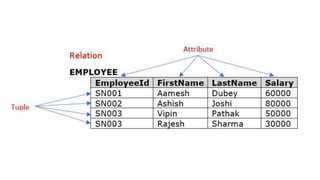
1. Relation: A relation is nothing but a table with rows and columns.
2. Attributes: Attributes are the properties that define a relation.
3. Tuple: Each row in the relation is known as tuple.
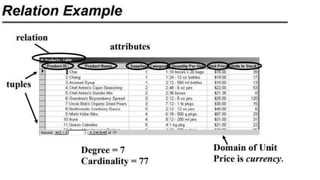
4. Domain: A domain is a unique set of values permitted for an attribute in a table.
5. Degree: The number of attributes in a relation.
6. Cardinality: The number of tuples in a relation.
Relational Database
Properties of
Relations
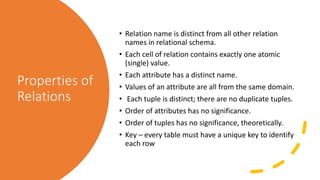
• Relation name is distinct from all other relation
names in relational schema.
• Each cell of relation contains exactly one atomic
(single) value.
• Each attribute has a distinct name.
• Values of an attribute are all from the same domain.
• Each tuple is distinct; there are no duplicate tuples.
• Order of attributes has no significance.
• Order of tuples has no significance, theoretically.
• Key – every table must have a unique key to identify
each row
Relational Keys
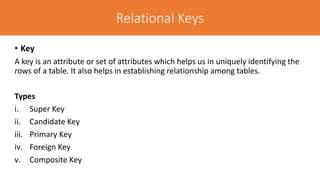
• Key
A key is an attribute or set of attributes which helps us in uniquely identifying the
rows of a table. It also helps in establishing relationship among tables.
Types
i. Super Key
ii. Candidate Key
iii. Primary Key
iv. Foreign Key
v. Composite Key
Relational Keys
Super Key
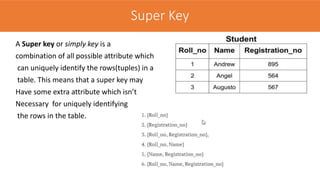
A Super key or simply key is a
combination of all possible attribute which
can uniquely identify the rows(tuples) in a
table. This means that a super key may
Have some extra attribute which isn’t
Necessary for uniquely identifying
the rows in the table.
Super Key
Candidate Key
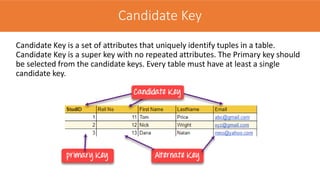
Candidate Key is a set of attributes that uniquely identify tuples in a table.
Candidate Key is a super key with no repeated attributes. The Primary key should
be selected from the candidate keys. Every table must have at least a single
candidate key.
Candidate Key
Primary Key
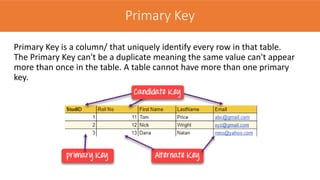
Primary Key is a column/ that uniquely identify every row in that table.
The Primary Key can't be a duplicate meaning the same value can't appear
more than once in the table. A table cannot have more than one primary
key.
Primary Key
Alternate/Secondary Key
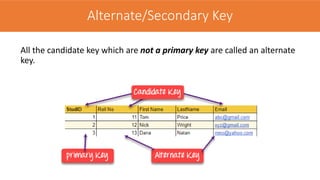
All the candidate key which are not a primary key are called an alternate
key.
Alternate/Secondary Key
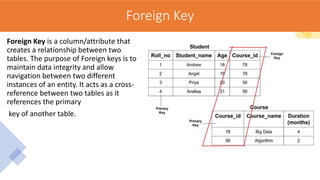
Foreign Key is a column/attribute that
creates a relationship between two
tables. The purpose of Foreign keys is to
maintain data integrity and allow
navigation between two different
instances of an entity. It acts as a cross-
reference between two tables as it
references the primary
key of another table.
Foreign Key
Composite Key
A key that has more than one attributes is known as composite key. It is
also known as compound key.
Any key such as super key, primary key, candidate key etc. can be called
composite key if it has more than one attributes.
Composite Key
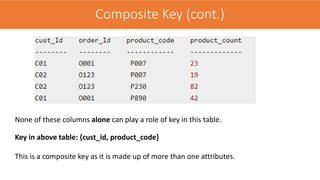
None of these columns alone can play a role of key in this table.
Key in above table: {cust_id, product_code}
This is a composite key as it is made up of more than one attributes.
Composite Key(cont.)
Composite Key (cont.)
A relation schema represents name of the relation with its attributes.
So, A set of table attributes is called a relation schema. For that reason, a relation
schema is also known as table schema. A relation schema can be thought of as the
basic information describing a table or relation. Hence, it is the logical definition of a
table.
e.g.; STUDENT (ROLL_NO, NAME, ADDRESS, PHONE and AGE) is a relation schema
for STUDENT.
If a schema has more than 1 relation, it is called Relational Schema aka Database
Schema. You could say that a database schema is made up of lots of relation
schema and shows how they work together.
Relation Schema
Integrity
Rules
Integrity rules refer to reliability, validity and
authority towards the data. They needed to
inform the DBMS about certain constraints in the
real world.
There are two principal rules:
1. Entity integrity &
2. Referential integrity
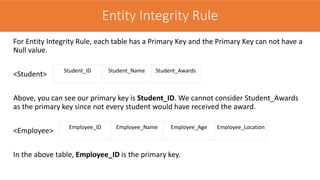
For Entity Integrity Rule, each table has a Primary Key and the Primary Key can not have a
Null value.
<Student>
Above, you can see our primary key is Student_ID. We cannot consider Student_Awards
as the primary key since not every student would have received the award.
<Employee>
In the above table, Employee_ID is the primary key.
Entity Integrity Rule
Student_ID Student_Name Student_Awards
Employee_ID Employee_Name Employee_Age Employee_Location
So let us now summarize the Entity Integrity Rule −
i. Make sure that each tuple in a table is unique.
ii. Every table mush has a primary key, for example, Student_ID for a Student
table.
iii. Every entity is unique.
iv. The relations Primary Key must have unique values for each row.
v. Primary Key cannot have NULL value and must be unique.
vi. Example can be an Employee_ID cannot be null in an Employee table
Entity Integrity (cont.)
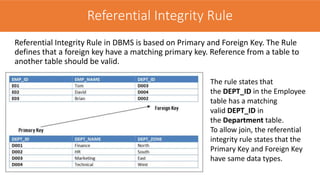
Referential Integrity Rule in DBMS is based on Primary and Foreign Key. The Rule
defines that a foreign key have a matching primary key. Reference from a table to
another table should be valid.
Referential Integrity Rule
The rule states that
the DEPT_ID in the Employee
table has a matching
valid DEPT_ID in
the Department table.
To allow join, the referential
integrity rule states that the
Primary Key and Foreign Key
have same data types.
These are additional rules specified by users or database administrators that
define or constraint some aspect of the enterprise.
They are alsoknown as business rules.
For example :
The Cust_No in Customer table is given a range from 0001-5000.
General Constraints
Thank you.

The Relational Database Model

  • 1.
    The Relational Model LogicalView of Data Keys Integrity Rules
  • 2.
    Relational Model: Relational Modelrepresents how data is stored in Relational Databases. A relational database stores data in the form of relations (tables). Objectives - To promote high degree of data independence - Eliminate redundancy and consistency problems. - Ease of use of DBA as well as normal users. - To provide a community view of the data of spartan simplicity, so that a wide variety of users can interact with a common model. The main use of Relational model is data storage and processing. Relational Model
  • 3.
    Relational Database: A Relationaldatabase is a database that organizes data into tables which can be linked— or related—based on data common to each. Relational Database Components 1. Relation: A relation is nothing but a table with rows and columns. 2. Attributes: Attributes are the properties that define a relation. 3. Tuple: Each row in the relation is known as tuple. 4. Domain: A domain is a unique set of values permitted for an attribute in a table. 5. Degree: The number of attributes in a relation. 6. Cardinality: The number of tuples in a relation. Relational Database
  • 6.
    Properties of Relations • Relationname is distinct from all other relation names in relational schema. • Each cell of relation contains exactly one atomic (single) value. • Each attribute has a distinct name. • Values of an attribute are all from the same domain. • Each tuple is distinct; there are no duplicate tuples. • Order of attributes has no significance. • Order of tuples has no significance, theoretically. • Key – every table must have a unique key to identify each row
  • 7.
    Relational Keys • Key Akey is an attribute or set of attributes which helps us in uniquely identifying the rows of a table. It also helps in establishing relationship among tables. Types i. Super Key ii. Candidate Key iii. Primary Key iv. Foreign Key v. Composite Key Relational Keys
  • 8.
    Super Key A Superkey or simply key is a combination of all possible attribute which can uniquely identify the rows(tuples) in a table. This means that a super key may Have some extra attribute which isn’t Necessary for uniquely identifying the rows in the table. Super Key
  • 9.
    Candidate Key Candidate Keyis a set of attributes that uniquely identify tuples in a table. Candidate Key is a super key with no repeated attributes. The Primary key should be selected from the candidate keys. Every table must have at least a single candidate key. Candidate Key
  • 10.
    Primary Key Primary Keyis a column/ that uniquely identify every row in that table. The Primary Key can't be a duplicate meaning the same value can't appear more than once in the table. A table cannot have more than one primary key. Primary Key
  • 11.
    Alternate/Secondary Key All thecandidate key which are not a primary key are called an alternate key. Alternate/Secondary Key
  • 12.
    Foreign Key isa column/attribute that creates a relationship between two tables. The purpose of Foreign keys is to maintain data integrity and allow navigation between two different instances of an entity. It acts as a cross- reference between two tables as it references the primary key of another table. Foreign Key
  • 13.
    Composite Key A keythat has more than one attributes is known as composite key. It is also known as compound key. Any key such as super key, primary key, candidate key etc. can be called composite key if it has more than one attributes. Composite Key
  • 14.
    None of thesecolumns alone can play a role of key in this table. Key in above table: {cust_id, product_code} This is a composite key as it is made up of more than one attributes. Composite Key(cont.) Composite Key (cont.)
  • 15.
    A relation schemarepresents name of the relation with its attributes. So, A set of table attributes is called a relation schema. For that reason, a relation schema is also known as table schema. A relation schema can be thought of as the basic information describing a table or relation. Hence, it is the logical definition of a table. e.g.; STUDENT (ROLL_NO, NAME, ADDRESS, PHONE and AGE) is a relation schema for STUDENT. If a schema has more than 1 relation, it is called Relational Schema aka Database Schema. You could say that a database schema is made up of lots of relation schema and shows how they work together. Relation Schema
  • 16.
    Integrity Rules Integrity rules referto reliability, validity and authority towards the data. They needed to inform the DBMS about certain constraints in the real world. There are two principal rules: 1. Entity integrity & 2. Referential integrity
  • 17.
    For Entity IntegrityRule, each table has a Primary Key and the Primary Key can not have a Null value. <Student> Above, you can see our primary key is Student_ID. We cannot consider Student_Awards as the primary key since not every student would have received the award. <Employee> In the above table, Employee_ID is the primary key. Entity Integrity Rule Student_ID Student_Name Student_Awards Employee_ID Employee_Name Employee_Age Employee_Location
  • 18.
    So let usnow summarize the Entity Integrity Rule − i. Make sure that each tuple in a table is unique. ii. Every table mush has a primary key, for example, Student_ID for a Student table. iii. Every entity is unique. iv. The relations Primary Key must have unique values for each row. v. Primary Key cannot have NULL value and must be unique. vi. Example can be an Employee_ID cannot be null in an Employee table Entity Integrity (cont.)
  • 19.
    Referential Integrity Rulein DBMS is based on Primary and Foreign Key. The Rule defines that a foreign key have a matching primary key. Reference from a table to another table should be valid. Referential Integrity Rule The rule states that the DEPT_ID in the Employee table has a matching valid DEPT_ID in the Department table. To allow join, the referential integrity rule states that the Primary Key and Foreign Key have same data types.
  • 20.
    These are additionalrules specified by users or database administrators that define or constraint some aspect of the enterprise. They are alsoknown as business rules. For example : The Cust_No in Customer table is given a range from 0001-5000. General Constraints
  • 21.