Entities
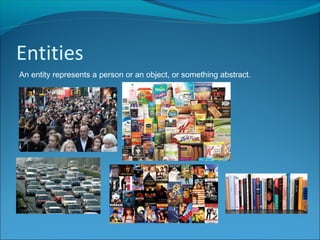
An entity represents a person or an object, or something abstract.
Attributes
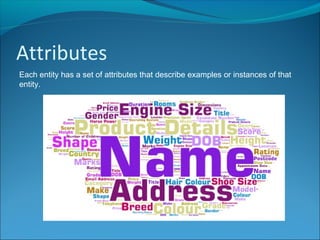
Each entity has a set of attributes that describe examples or instances of that
entity.
Notation
The entity name should be written in capital letters, and in singular. The attributes should
follow in a bracketed list.
Person
PUPIL (candidate_number, forename, surname, dob, tutor_group)
Object
CAR (registration_plate, make, model, colour)
Abstract
DOCTOR APPOINTMENT (date, time, consultant, location)
Databases
Entities and attributes are part of the data modelling process. When moving from data
modelling to implementation:
Entities become tables in a database
Attributes become fields in a database
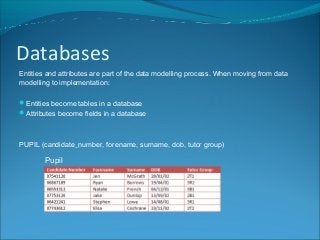
PUPIL (candidate_number, forename, surname, dob, tutor group)
Pupil
Databases
Entities and attributes are part of the data modelling process. When moving from data
modelling to implementation:
Entities become tables in a database
Attributes become fields in a database
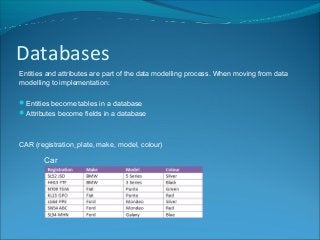
CAR (registration_plate, make, model, colour)
Car
Databases
Entities and attributes are part of the data modelling process. When moving from data
modelling to implementation:
Entities become tables in a database
Attributes become fields in a database
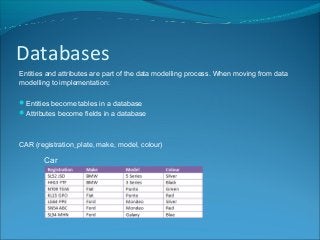
CAR (registration_plate, make, model, colour)
Car

Entities and attributes

  • 2.
    Entities An entity representsa person or an object, or something abstract.
  • 3.
    Attributes Each entity hasa set of attributes that describe examples or instances of that entity.
  • 4.
    Notation The entity nameshould be written in capital letters, and in singular. The attributes should follow in a bracketed list. Person PUPIL (candidate_number, forename, surname, dob, tutor_group) Object CAR (registration_plate, make, model, colour) Abstract DOCTOR APPOINTMENT (date, time, consultant, location)
  • 5.
    Databases Entities and attributesare part of the data modelling process. When moving from data modelling to implementation: Entities become tables in a database Attributes become fields in a database PUPIL (candidate_number, forename, surname, dob, tutor group) Pupil
  • 6.
    Databases Entities and attributesare part of the data modelling process. When moving from data modelling to implementation: Entities become tables in a database Attributes become fields in a database CAR (registration_plate, make, model, colour) Car
  • 7.
    Databases Entities and attributesare part of the data modelling process. When moving from data modelling to implementation: Entities become tables in a database Attributes become fields in a database CAR (registration_plate, make, model, colour) Car