Database Modelling
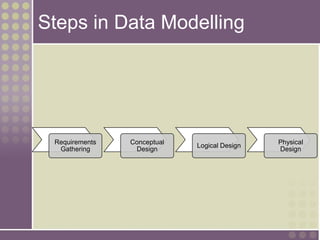
Steps in Data Modelling
Requirements
Gathering
Conceptual
Design
Logical Design
Physical
Design
Data Modeling
Data modeling – a technique for organizing
and documenting a system’s data.
Sometimes called database modeling.
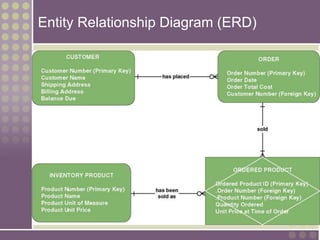
Entity relationship diagram (ERD) – a
data model utilizing several notations to
depict data in terms of the entities and
relationships described by that data.
Entity Relationship Diagram (ERD)
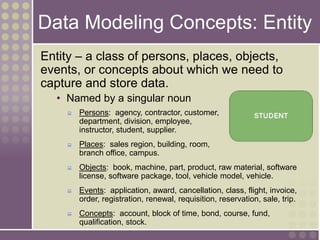
 Persons: agency, contractor, customer,
department, division, employee,
instructor, student, supplier.
 Places: sales region, building, room,
branch office, campus.
 Objects: book, machine, part, product, raw material, software
license, software package, tool, vehicle model, vehicle.
 Events: application, award, cancellation, class, flight, invoice,
order, registration, renewal, requisition, reservation, sale, trip.
 Concepts: account, block of time, bond, course, fund,
qualification, stock.
Data Modeling Concepts: Entity
Entity – a class of persons, places, objects,
events, or concepts about which we need to
capture and store data.
• Named by a singular noun
Data Modeling Concepts: Entity
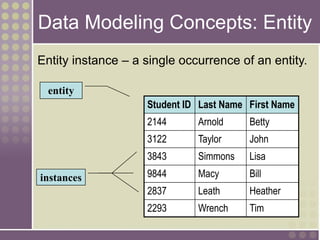
Entity instance – a single occurrence of an entity.
Student ID Last Name First Name
2144 Arnold Betty
3122 Taylor John
3843 Simmons Lisa
9844 Macy Bill
2837 Leath Heather
2293 Wrench Tim
instances
entity
Data Modeling Concepts: Attributes
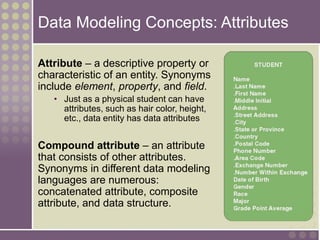
Attribute – a descriptive property or
characteristic of an entity. Synonyms
include element, property, and field.
• Just as a physical student can have
attributes, such as hair color, height,
etc., data entity has data attributes
Compound attribute – an attribute
that consists of other attributes.
Synonyms in different data modeling
languages are numerous:
concatenated attribute, composite
attribute, and data structure.
Data Modeling Concepts: Data Type
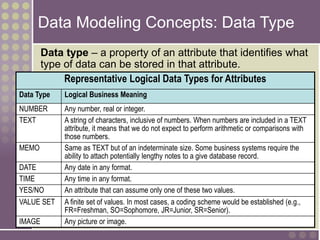
Data type – a property of an attribute that identifies what
type of data can be stored in that attribute.
Representative Logical Data Types for Attributes
Data Type Logical Business Meaning
NUMBER Any number, real or integer.
TEXT A string of characters, inclusive of numbers. When numbers are included in a TEXT
attribute, it means that we do not expect to perform arithmetic or comparisons with
those numbers.
MEMO Same as TEXT but of an indeterminate size. Some business systems require the
ability to attach potentially lengthy notes to a give database record.
DATE Any date in any format.
TIME Any time in any format.
YES/NO An attribute that can assume only one of these two values.
VALUE SET A finite set of values. In most cases, a coding scheme would be established (e.g.,
FR=Freshman, SO=Sophomore, JR=Junior, SR=Senior).
IMAGE Any picture or image.
Data Modeling Concepts: Domains
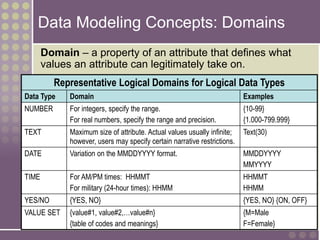
Domain – a property of an attribute that defines what
values an attribute can legitimately take on.
Representative Logical Domains for Logical Data Types
Data Type Domain Examples
NUMBER For integers, specify the range.
For real numbers, specify the range and precision.
{10-99}
{1.000-799.999}
TEXT Maximum size of attribute. Actual values usually infinite;
however, users may specify certain narrative restrictions.
Text(30)
DATE Variation on the MMDDYYYY format. MMDDYYYY
MMYYYY
TIME For AM/PM times: HHMMT
For military (24-hour times): HHMM
HHMMT
HHMM
YES/NO {YES, NO} {YES, NO} {ON, OFF}
VALUE SET {value#1, value#2,…value#n}
{table of codes and meanings}
{M=Male
F=Female}
Data Modeling Concepts: Default Value
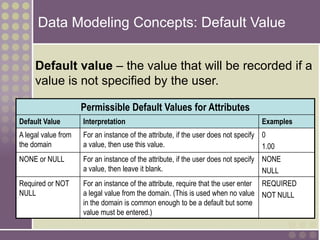
Default value – the value that will be recorded if a
value is not specified by the user.
Permissible Default Values for Attributes
Default Value Interpretation Examples
A legal value from
the domain
For an instance of the attribute, if the user does not specify
a value, then use this value.
0
1.00
NONE or NULL For an instance of the attribute, if the user does not specify
a value, then leave it blank.
NONE
NULL
Required or NOT
NULL
For an instance of the attribute, require that the user enter
a legal value from the domain. (This is used when no value
in the domain is common enough to be a default but some
value must be entered.)
REQUIRED
NOT NULL
Data Modeling Concepts: Identification
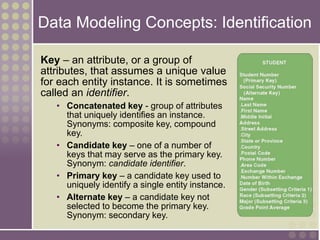
Key – an attribute, or a group of
attributes, that assumes a unique value
for each entity instance. It is sometimes
called an identifier.
• Concatenated key - group of attributes
that uniquely identifies an instance.
Synonyms: composite key, compound
key.
• Candidate key – one of a number of
keys that may serve as the primary key.
Synonym: candidate identifier.
• Primary key – a candidate key used to
uniquely identify a single entity instance.
• Alternate key – a candidate key not
selected to become the primary key.
Synonym: secondary key.
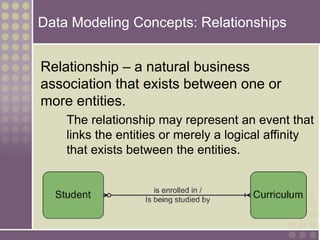
Data Modeling Concepts: Relationships
Relationship – a natural business
association that exists between one or
more entities.
The relationship may represent an event that
links the entities or merely a logical affinity
that exists between the entities.
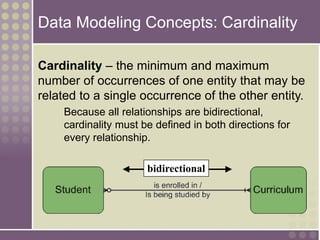
Data Modeling Concepts: Cardinality
Cardinality – the minimum and maximum
number of occurrences of one entity that may be
related to a single occurrence of the other entity.
Because all relationships are bidirectional,
cardinality must be defined in both directions for
every relationship.
bidirectional
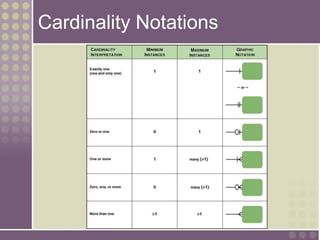
Cardinality Notations
Data Modeling Concepts: Foreign Keys
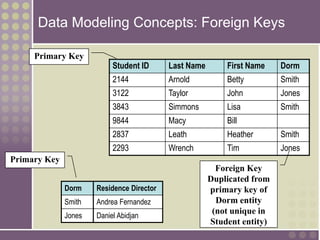
Foreign key – a primary key of an entity that is
used in another entity to identify instances of a
relationship.
• A foreign key is a primary key of one entity that is
contributed to (duplicated in) another entity to identify
instances of a relationship.
• A foreign key always matches the primary key in the
another entity
• A foreign key may or may not be unique (generally
not)
• The entity with the foreign key is called the child.
• The entity with the matching primary key is called the
parent.
Data Modeling Concepts: Foreign Keys
Student ID Last Name First Name Dorm
2144 Arnold Betty Smith
3122 Taylor John Jones
3843 Simmons Lisa Smith
9844 Macy Bill
2837 Leath Heather Smith
2293 Wrench Tim Jones
Dorm Residence Director
Smith Andrea Fernandez
Jones Daniel Abidjan
Primary Key
Primary Key
Foreign Key
Duplicated from
primary key of
Dorm entity
(not unique in
Student entity)
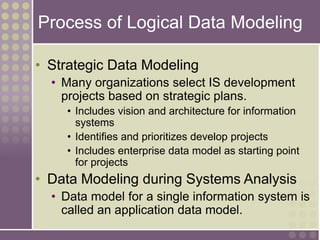
Process of Logical Data Modeling
• Strategic Data Modeling
• Many organizations select IS development
projects based on strategic plans.
• Includes vision and architecture for information
systems
• Identifies and prioritizes develop projects
• Includes enterprise data model as starting point
for projects
• Data Modeling during Systems Analysis
• Data model for a single information system is
called an application data model.
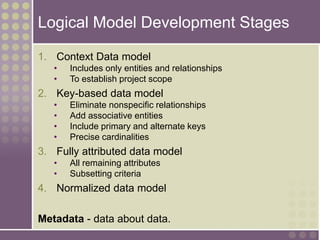
Logical Model Development Stages
1. Context Data model
• Includes only entities and relationships
• To establish project scope
2. Key-based data model
• Eliminate nonspecific relationships
• Add associative entities
• Include primary and alternate keys
• Precise cardinalities
3. Fully attributed data model
• All remaining attributes
• Subsetting criteria
4. Normalized data model
Metadata - data about data.
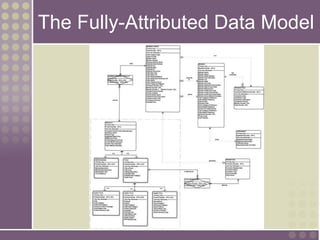
The Fully-Attributed Data Model
What is a Good Data Model?
• A good data model is simple.
• Data attributes that describe any given entity
should describe only that entity.
• Each attribute of an entity instance can have only
one value.
• A good data model is essentially
nonredundant.
• Each data attribute, other than foreign keys,
describes at most one entity.
• Look for the same attribute recorded more than
once under different names.
• A good data model should be flexible and
adaptable to future needs.

Summary data modelling

  • 1.
  • 2.
    Steps in DataModelling Requirements Gathering Conceptual Design Logical Design Physical Design
  • 3.
    Data Modeling Data modeling– a technique for organizing and documenting a system’s data. Sometimes called database modeling. Entity relationship diagram (ERD) – a data model utilizing several notations to depict data in terms of the entities and relationships described by that data.
  • 4.
  • 5.
     Persons: agency,contractor, customer, department, division, employee, instructor, student, supplier.  Places: sales region, building, room, branch office, campus.  Objects: book, machine, part, product, raw material, software license, software package, tool, vehicle model, vehicle.  Events: application, award, cancellation, class, flight, invoice, order, registration, renewal, requisition, reservation, sale, trip.  Concepts: account, block of time, bond, course, fund, qualification, stock. Data Modeling Concepts: Entity Entity – a class of persons, places, objects, events, or concepts about which we need to capture and store data. • Named by a singular noun
  • 6.
    Data Modeling Concepts:Entity Entity instance – a single occurrence of an entity. Student ID Last Name First Name 2144 Arnold Betty 3122 Taylor John 3843 Simmons Lisa 9844 Macy Bill 2837 Leath Heather 2293 Wrench Tim instances entity
  • 7.
    Data Modeling Concepts:Attributes Attribute – a descriptive property or characteristic of an entity. Synonyms include element, property, and field. • Just as a physical student can have attributes, such as hair color, height, etc., data entity has data attributes Compound attribute – an attribute that consists of other attributes. Synonyms in different data modeling languages are numerous: concatenated attribute, composite attribute, and data structure.
  • 8.
    Data Modeling Concepts:Data Type Data type – a property of an attribute that identifies what type of data can be stored in that attribute. Representative Logical Data Types for Attributes Data Type Logical Business Meaning NUMBER Any number, real or integer. TEXT A string of characters, inclusive of numbers. When numbers are included in a TEXT attribute, it means that we do not expect to perform arithmetic or comparisons with those numbers. MEMO Same as TEXT but of an indeterminate size. Some business systems require the ability to attach potentially lengthy notes to a give database record. DATE Any date in any format. TIME Any time in any format. YES/NO An attribute that can assume only one of these two values. VALUE SET A finite set of values. In most cases, a coding scheme would be established (e.g., FR=Freshman, SO=Sophomore, JR=Junior, SR=Senior). IMAGE Any picture or image.
  • 9.
    Data Modeling Concepts:Domains Domain – a property of an attribute that defines what values an attribute can legitimately take on. Representative Logical Domains for Logical Data Types Data Type Domain Examples NUMBER For integers, specify the range. For real numbers, specify the range and precision. {10-99} {1.000-799.999} TEXT Maximum size of attribute. Actual values usually infinite; however, users may specify certain narrative restrictions. Text(30) DATE Variation on the MMDDYYYY format. MMDDYYYY MMYYYY TIME For AM/PM times: HHMMT For military (24-hour times): HHMM HHMMT HHMM YES/NO {YES, NO} {YES, NO} {ON, OFF} VALUE SET {value#1, value#2,…value#n} {table of codes and meanings} {M=Male F=Female}
  • 10.
    Data Modeling Concepts:Default Value Default value – the value that will be recorded if a value is not specified by the user. Permissible Default Values for Attributes Default Value Interpretation Examples A legal value from the domain For an instance of the attribute, if the user does not specify a value, then use this value. 0 1.00 NONE or NULL For an instance of the attribute, if the user does not specify a value, then leave it blank. NONE NULL Required or NOT NULL For an instance of the attribute, require that the user enter a legal value from the domain. (This is used when no value in the domain is common enough to be a default but some value must be entered.) REQUIRED NOT NULL
  • 11.
    Data Modeling Concepts:Identification Key – an attribute, or a group of attributes, that assumes a unique value for each entity instance. It is sometimes called an identifier. • Concatenated key - group of attributes that uniquely identifies an instance. Synonyms: composite key, compound key. • Candidate key – one of a number of keys that may serve as the primary key. Synonym: candidate identifier. • Primary key – a candidate key used to uniquely identify a single entity instance. • Alternate key – a candidate key not selected to become the primary key. Synonym: secondary key.
  • 12.
    Data Modeling Concepts:Relationships Relationship – a natural business association that exists between one or more entities. The relationship may represent an event that links the entities or merely a logical affinity that exists between the entities.
  • 13.
    Data Modeling Concepts:Cardinality Cardinality – the minimum and maximum number of occurrences of one entity that may be related to a single occurrence of the other entity. Because all relationships are bidirectional, cardinality must be defined in both directions for every relationship. bidirectional
  • 14.
  • 15.
    Data Modeling Concepts:Foreign Keys Foreign key – a primary key of an entity that is used in another entity to identify instances of a relationship. • A foreign key is a primary key of one entity that is contributed to (duplicated in) another entity to identify instances of a relationship. • A foreign key always matches the primary key in the another entity • A foreign key may or may not be unique (generally not) • The entity with the foreign key is called the child. • The entity with the matching primary key is called the parent.
  • 16.
    Data Modeling Concepts:Foreign Keys Student ID Last Name First Name Dorm 2144 Arnold Betty Smith 3122 Taylor John Jones 3843 Simmons Lisa Smith 9844 Macy Bill 2837 Leath Heather Smith 2293 Wrench Tim Jones Dorm Residence Director Smith Andrea Fernandez Jones Daniel Abidjan Primary Key Primary Key Foreign Key Duplicated from primary key of Dorm entity (not unique in Student entity)
  • 17.
    Process of LogicalData Modeling • Strategic Data Modeling • Many organizations select IS development projects based on strategic plans. • Includes vision and architecture for information systems • Identifies and prioritizes develop projects • Includes enterprise data model as starting point for projects • Data Modeling during Systems Analysis • Data model for a single information system is called an application data model.
  • 18.
    Logical Model DevelopmentStages 1. Context Data model • Includes only entities and relationships • To establish project scope 2. Key-based data model • Eliminate nonspecific relationships • Add associative entities • Include primary and alternate keys • Precise cardinalities 3. Fully attributed data model • All remaining attributes • Subsetting criteria 4. Normalized data model Metadata - data about data.
  • 19.
  • 20.
    What is aGood Data Model? • A good data model is simple. • Data attributes that describe any given entity should describe only that entity. • Each attribute of an entity instance can have only one value. • A good data model is essentially nonredundant. • Each data attribute, other than foreign keys, describes at most one entity. • Look for the same attribute recorded more than once under different names. • A good data model should be flexible and adaptable to future needs.