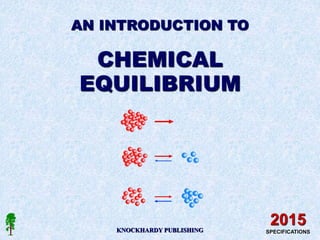
AN INTRODUCTION TO
CHEMICAL
EQUILIBRIUM
KNOCKHARDY PUBLISHING
2015
SPECIFICATIONS
INTRODUCTION
This Powerpoint show is one of several produced to help students understand
selected topics at AS and A2 level Chemistry. It is based on the requirements of the
AQA and OCR specifications but is suitable for other examination boards.
Individual students may use the material at home for revision purposes or it may be
used for classroom teaching if an interactive white board is available.
Accompanying notes on this, and the full range of AS and A2 topics, are available
from the KNOCKHARDY SCIENCE WEBSITE at...
www.knockhardy.org.uk/sci.htm
Navigation is achieved by...
either clicking on the grey arrows at the foot of each page
or using the left and right arrow keys on the keyboard
KNOCKHARDY PUBLISHING
CHEMICAL EQUILIBRIUM
CONTENTS
• Concentration change during a chemical reaction
• Dynamic equilibrium
• Equilibrium constants
• Le Chatelier’s Principle
• Haber process
• Check list
CHEMICAL EQUILIBRIUM
In an ordinary reaction; all reactants end
up as products; there is 100% conversion
CONCENTRATION CHANGE IN A REACTION
As the rate of reaction is dependant on the concentration of reactants... the forward
reaction starts off fast but slows as the reactants get less concentrated
FASTEST AT
THE START
SLOWS DOWN
AS REACTANTS
ARE USED UP
TOTAL
CONVERSION
TO PRODUCTS
THE STEEPER THE
GRADIENT, THE FASTER
THE REACTION
In an ordinary reaction; all reactants end
up as products; there is 100% conversion
CONCENTRATION CHANGE IN A REACTION
As the rate of reaction is dependant on the concentration of reactants... the forward
reaction starts off fast but slows as the reactants get less concentrated
FASTEST AT
THE START
SLOWS DOWN
AS REACTANTS
ARE USED UP
TOTAL
CONVERSION
TO PRODUCTS
THE STEEPER THE
GRADIENT, THE FASTER
THE REACTION
In an ordinary reaction; all reactants end
up as products; there is 100% conversion
CONCENTRATION CHANGE IN A REACTION
As the rate of reaction is dependant on the concentration of reactants... the forward
reaction starts off fast but slows as the reactants get less concentrated
FASTEST AT
THE START
SLOWS DOWN
AS REACTANTS
ARE USED UP
TOTAL
CONVERSION
TO PRODUCTS
THE STEEPER THE
GRADIENT, THE FASTER
THE REACTION
Initially, there is no backward reaction but, as products form, it speeds up and
provided the temperature remains constant there will come a time when the backward
and forward reactions are equal and opposite; the reaction has reached equilibrium.
EQUILIBRIUM REACTIONS
In an equilibrium reaction, not all the
reactants end up as products; there is not a
100% conversion.
BUT IT DOESN’T MEAN THE REACTION
IS STUCK IN THE MIDDLE
FASTEST AT THE START
NO BACKWARD REACTION
FORWARD REACTION SLOWS DOWN
AS REACTANTS ARE USED UP
BACKWARD REACTION
STARTS TO INCREASE
AT EQUILIBRIUM THE BACKWARD
AND FORWARD REACTIONS ARE
EQUAL AND OPPOSITE
Initially, there is no backward reaction but, as products form, it speeds up and
provided the temperature remains constant there will come a time when the backward
and forward reactions are equal and opposite; the reaction has reached equilibrium.
EQUILIBRIUM REACTIONS
In an equilibrium reaction, not all the
reactants end up as products; there is not a
100% conversion.
BUT IT DOESN’T MEAN THE REACTION
IS STUCK IN THE MIDDLE
FASTEST AT THE START
NO BACKWARD REACTION
FORWARD REACTION SLOWS DOWN
AS REACTANTS ARE USED UP
BACKWARD REACTION
STARTS TO INCREASE
AT EQUILIBRIUM THE BACKWARD
AND FORWARD REACTIONS ARE
EQUAL AND OPPOSITE
Initially, there is no backward reaction but, as products form, it speeds up and
provided the temperature remains constant there will come a time when the backward
and forward reactions are equal and opposite; the reaction has reached equilibrium.
EQUILIBRIUM REACTIONS
In an equilibrium reaction, not all the
reactants end up as products; there is not a
100% conversion.
BUT IT DOESN’T MEAN THE REACTION
IS STUCK IN THE MIDDLE
FASTEST AT THE START
NO BACKWARD REACTION
FORWARD REACTION SLOWS DOWN
AS REACTANTS ARE USED UP
BACKWARD REACTION
STARTS TO INCREASE
AT EQUILIBRIUM THE BACKWARD
AND FORWARD REACTIONS ARE
EQUAL AND OPPOSITE
Initially, there is no backward reaction but, as products form, it speeds up and
provided the temperature remains constant there will come a time when the backward
and forward reactions are equal and opposite; the reaction has reached equilibrium.
EQUILIBRIUM REACTIONS
In an equilibrium reaction, not all the
reactants end up as products; there is not a
100% conversion.
BUT IT DOESN’T MEAN THE REACTION
IS STUCK IN THE MIDDLE
FASTEST AT THE START
NO BACKWARD REACTION
FORWARD REACTION SLOWS DOWN
AS REACTANTS ARE USED UP
BACKWARD REACTION
STARTS TO INCREASE
AT EQUILIBRIUM THE BACKWARD
AND FORWARD REACTIONS ARE
EQUAL AND OPPOSITE
IMPORTANT REMINDERS
• a reversible chemical reaction is a dynamic process
• everything may appear stationary but the reactions are moving both ways
• the position of equilibrium can be varied by changing certain conditions
Trying to get up a “down” escalator gives an excellent idea of a non-chemical
situation involving dynamic equilibrium.
DYNAMIC EQUILIBRIUM
IMPORTANT REMINDERS
• a reversible chemical reaction is a dynamic process
• everything may appear stationary but the reactions are moving both ways
• the position of equilibrium can be varied by changing certain conditions
Trying to get up a “down” escalator gives an excellent idea of a non-chemical
situation involving dynamic equilibrium.
Summary When a chemical equilibrium is established ...
• both the reactants and the products are present at all times
• the equilibrium can be approached from either side
• the reaction is dynamic - it is moving forwards and backwards
• the concentrations of reactants and products remain constant
DYNAMIC EQUILIBRIUM
Simply states
“If the concentrations of all the substances present at equilibrium are raised to the
power of the number of moles they appear in the equation, the product of the
concentrations of the products divided by the product of the concentrations of the
reactants is a constant, provided the temperature remains constant”
There are several forms of the constant; all vary with temperature.
Kc the equilibrium values are expressed as concentrations of mol dm-3
Kp the equilibrium values are expressed as partial pressures
The partial pressure expression can be used for reactions involving gases
THE EQUILIBRIUM LAW
for an equilibrium reaction of the form...
aA + bB cC + dD
then (at constant temperature) [C]c . [D]d = a constant, (Kc)
[A]a . [B]b
where [ ] denotes the equilibrium concentration in mol dm-3
Kc is known as the Equilibrium Constant
THE EQUILIBRIUM CONSTANT Kc
for an equilibrium reaction of the form...
aA + bB cC + dD
then (at constant temperature) [C]c . [D]d = a constant, (Kc)
[A]a . [B]b
where [ ] denotes the equilibrium concentration in mol dm-3
Kc is known as the Equilibrium Constant
THE EQUILIBRIUM CONSTANT Kc
Example Fe3+(aq) + NCS¯(aq) FeNCS2+(aq)
Kc = [ FeNCS2+ ] with units of dm3 mol-1
[ Fe3+ ] [ NCS¯ ]
for an equilibrium reaction of the form...
aA + bB cC + dD
then (at constant temperature) [C]c . [D]d = a constant, (Kc)
[A]a . [B]b
where [ ] denotes the equilibrium concentration in mol dm-3
Kc is known as the Equilibrium Constant
THE EQUILIBRIUM CONSTANT Kc
VALUE OF Kc
AFFECTED by a change of temperature
NOT AFFECTED by a change in concentration of reactants or products
a change of pressure
adding a catalyst
”When a change is applied to a system in dynamic equilibrium, the
system reacts in such a way as to oppose the effect of the change.”
Everyday example
A rose bush grows with increased vigour after it has been pruned.
Chemistry example
If you do something to a reaction that is in a state of equilibrium, the equilibrium
position will change to oppose what you have just done
LE CHATELIER’S PRINCIPLE
CONCENTRATION
FACTORS AFFECTING THE POSITION OF EQUILIBRIUM
The equilibrium constant is not affected by a change in
concentration at constant temperature. To maintain the
constant, the composition of the equilibrium mixture changes.
If you increase the concentration of a substance, the value of
Kc will theoretically be affected. As it must remain constant at
a particular temperature, the concentrations of the other
species change to keep the constant the same.
CONCENTRATION
example CH3CH2OH(l) + CH3COOH(l) CH3COOC2H5(l) + H2O(l)
the equilibrium constant Kc = [CH3COOC2H5] [H2O] = 4 (at 298K)
[CH3CH2OH] [CH3COOH]
FACTORS AFFECTING THE POSITION OF EQUILIBRIUM
CONCENTRATION
example CH3CH2OH(l) + CH3COOH(l) CH3COOC2H5(l) + H2O(l)
the equilibrium constant Kc = [CH3COOC2H5] [H2O] = 4 (at 298K)
[CH3CH2OH] [CH3COOH]
increasing
[CH3CH2OH] - will make the bottom line larger so Kc will be smaller
- to keep it constant, some CH3CH2OH reacts with CH3COOH
- this reduces the value of the bottom line and increases the top
- eventually the value of the constant will be restored
FACTORS AFFECTING THE POSITION OF EQUILIBRIUM
CONCENTRATION
example CH3CH2OH(l) + CH3COOH(l) CH3COOC2H5(l) + H2O(l)
the equilibrium constant Kc = [CH3COOC2H5] [H2O] = 4 (at 298K)
[CH3CH2OH] [CH3COOH]
increasing
[CH3CH2OH] - will make the bottom line larger so Kc will be smaller
- to keep it constant, some CH3CH2OH reacts with CH3COOH
- this reduces the value of the bottom line and increases the top
- eventually the value of the constant will be restored
decreasing
[H2O] - will make the top line smaller
- some CH3CH2OH reacts with CH3COOH to replace the H2O
- more CH3COOC2H5 is also produced
- this reduces the value of the bottom line and increases the top
FACTORS AFFECTING THE POSITION OF EQUILIBRIUM
CONCENTRATION
example CH3CH2OH(l) + CH3COOH(l) CH3COOC2H5(l) + H2O(l)
the equilibrium constant Kc = [CH3COOC2H5] [H2O] = 4 (at 298K)
[CH3CH2OH] [CH3COOH]
increasing
[CH3CH2OH] - will make the bottom line larger so Kc will be smaller
- to keep it constant, some CH3CH2OH reacts with CH3COOH
- this reduces the value of the bottom line and increases the top
- eventually the value of the constant will be restored
decreasing
[H2O] - will make the top line smaller
- some CH3CH2OH reacts with CH3COOH to replace the H2O
- more CH3COOC2H5 is also produced
- this reduces the value of the bottom line and increases the top
FACTORS AFFECTING THE POSITION OF EQUILIBRIUM
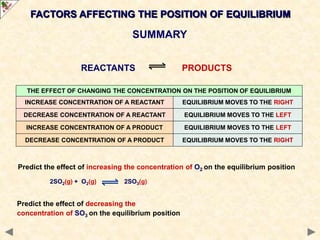
SUMMARY
REACTANTS PRODUCTS
INCREASE CONCENTRATION OF A REACTANT EQUILIBRIUM MOVES TO THE RIGHT
THE EFFECT OF CHANGING THE CONCENTRATION ON THE POSITION OF EQUILIBRIUM
DECREASE CONCENTRATION OF A REACTANT EQUILIBRIUM MOVES TO THE LEFT
INCREASE CONCENTRATION OF A PRODUCT EQUILIBRIUM MOVES TO THE LEFT
DECREASE CONCENTRATION OF A PRODUCT EQUILIBRIUM MOVES TO THE RIGHT
FACTORS AFFECTING THE POSITION OF EQUILIBRIUM
Predict the effect of increasing the concentration of O2 on the equilibrium position
2SO2(g) + O2(g) 2SO3(g)
SUMMARY
REACTANTS PRODUCTS
INCREASE CONCENTRATION OF A REACTANT EQUILIBRIUM MOVES TO THE RIGHT
THE EFFECT OF CHANGING THE CONCENTRATION ON THE POSITION OF EQUILIBRIUM
DECREASE CONCENTRATION OF A REACTANT EQUILIBRIUM MOVES TO THE LEFT
INCREASE CONCENTRATION OF A PRODUCT EQUILIBRIUM MOVES TO THE LEFT
DECREASE CONCENTRATION OF A PRODUCT EQUILIBRIUM MOVES TO THE RIGHT
Predict the effect of decreasing the
concentration of SO3 on the equilibrium position
FACTORS AFFECTING THE POSITION OF EQUILIBRIUM
Predict the effect of increasing the concentration of O2 on the equilibrium position
2SO2(g) + O2(g) 2SO3(g) EQUILIBRIUM MOVES TO RHS
SUMMARY
REACTANTS PRODUCTS
INCREASE CONCENTRATION OF A REACTANT EQUILIBRIUM MOVES TO THE RIGHT
THE EFFECT OF CHANGING THE CONCENTRATION ON THE POSITION OF EQUILIBRIUM
DECREASE CONCENTRATION OF A REACTANT EQUILIBRIUM MOVES TO THE LEFT
INCREASE CONCENTRATION OF A PRODUCT EQUILIBRIUM MOVES TO THE LEFT
DECREASE CONCENTRATION OF A PRODUCT EQUILIBRIUM MOVES TO THE RIGHT
Predict the effect of decreasing the
concentration of SO3 on the equilibrium position EQUILIBRIUM MOVES TO RHS
PRESSURE
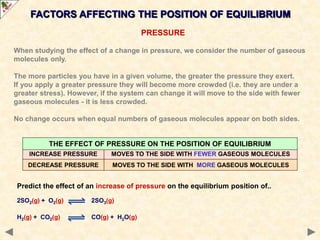
When studying the effect of a change in pressure, we consider the number of gaseous
molecules only.
The more particles you have in a given volume, the greater the pressure they exert.
If you apply a greater pressure they will become more crowded (i.e. they are under a
greater stress). However, if the system can change it will move to the side with fewer
gaseous molecules - it is less crowded.
No change occurs when equal numbers of gaseous molecules appear on both sides.
FACTORS AFFECTING THE POSITION OF EQUILIBRIUM
PRESSURE
When studying the effect of a change in pressure, we consider the number of gaseous
molecules only.
The more particles you have in a given volume, the greater the pressure they exert.
If you apply a greater pressure they will become more crowded (i.e. they are under a
greater stress). However, if the system can change it will move to the side with fewer
gaseous molecules - it is less crowded.
No change occurs when equal numbers of gaseous molecules appear on both sides.
INCREASE PRESSURE MOVES TO THE SIDE WITH FEWER GASEOUS MOLECULES
DECREASE PRESSURE MOVES TO THE SIDE WITH MORE GASEOUS MOLECULES
THE EFFECT OF PRESSURE ON THE POSITION OF EQUILIBRIUM
FACTORS AFFECTING THE POSITION OF EQUILIBRIUM
PRESSURE
When studying the effect of a change in pressure, we consider the number of gaseous
molecules only.
The more particles you have in a given volume, the greater the pressure they exert.
If you apply a greater pressure they will become more crowded (i.e. they are under a
greater stress). However, if the system can change it will move to the side with fewer
gaseous molecules - it is less crowded.
No change occurs when equal numbers of gaseous molecules appear on both sides.
INCREASE PRESSURE MOVES TO THE SIDE WITH FEWER GASEOUS MOLECULES
DECREASE PRESSURE MOVES TO THE SIDE WITH MORE GASEOUS MOLECULES
THE EFFECT OF PRESSURE ON THE POSITION OF EQUILIBRIUM
Predict the effect of an increase of pressure on the equilibrium position of..
2SO2(g) + O2(g) 2SO3(g)
H2(g) + CO2(g) CO(g) + H2O(g)
FACTORS AFFECTING THE POSITION OF EQUILIBRIUM
PRESSURE
When studying the effect of a change in pressure, we consider the number of gaseous
molecules only.
The more particles you have in a given volume, the greater the pressure they exert.
If you apply a greater pressure they will become more crowded (i.e. they are under a
greater stress). However, if the system can change it will move to the side with fewer
gaseous molecules - it is less crowded.
No change occurs when equal numbers of gaseous molecules appear on both sides.
INCREASE PRESSURE MOVES TO THE SIDE WITH FEWER GASEOUS MOLECULES
DECREASE PRESSURE MOVES TO THE SIDE WITH MORE GASEOUS MOLECULES
THE EFFECT OF PRESSURE ON THE POSITION OF EQUILIBRIUM
Predict the effect of an increase of pressure on the equilibrium position of..
2SO2(g) + O2(g) 2SO3(g) MOVES TO RHS :- fewer gaseous molecules
H2(g) + CO2(g) CO(g) + H2O(g) NO CHANGE:- equal numbers on both sides
FACTORS AFFECTING THE POSITION OF EQUILIBRIUM
TEMPERATURE
• temperature is the only thing that can change the value of the equilibrium constant.
• altering the temperature affects the rate of both backward and forward reactions
• it alters the rates to different extents
• the equilibrium thus moves producing a new equilibrium constant.
• the direction of movement depends on the sign of the enthalpy change.
FACTORS AFFECTING THE POSITION OF EQUILIBRIUM
TEMPERATURE
• temperature is the only thing that can change the value of the equilibrium constant.
• altering the temperature affects the rate of both backward and forward reactions
• it alters the rates to different extents
• the equilibrium thus moves producing a new equilibrium constant.
• the direction of movement depends on the sign of the enthalpy change.
REACTION TYPE DH INCREASE TEMP DECREASE TEMP
EXOTHERMIC - TO THE LEFT TO THE RIGHT
ENDOTHERMIC + TO THE RIGHT TO THE LEFT
FACTORS AFFECTING THE POSITION OF EQUILIBRIUM
TEMPERATURE
• temperature is the only thing that can change the value of the equilibrium constant.
• altering the temperature affects the rate of both backward and forward reactions
• it alters the rates to different extents
• the equilibrium thus moves producing a new equilibrium constant.
• the direction of movement depends on the sign of the enthalpy change.
REACTION TYPE DH INCREASE TEMP DECREASE TEMP
EXOTHERMIC - TO THE LEFT TO THE RIGHT
ENDOTHERMIC + TO THE RIGHT TO THE LEFT
Predict the effect of a temperature increase on the equilibrium position of...
H2(g) + CO2(g) CO(g) + H2O(g) DH = + 40 kJ mol-1
2SO2(g) + O2(g) 2SO3(g) DH = - ive
FACTORS AFFECTING THE POSITION OF EQUILIBRIUM
TEMPERATURE
• temperature is the only thing that can change the value of the equilibrium constant.
• altering the temperature affects the rate of both backward and forward reactions
• it alters the rates to different extents
• the equilibrium thus moves producing a new equilibrium constant.
• the direction of movement depends on the sign of the enthalpy change.
REACTION TYPE DH INCREASE TEMP DECREASE TEMP
EXOTHERMIC - TO THE LEFT TO THE RIGHT
ENDOTHERMIC + TO THE RIGHT TO THE LEFT
Predict the effect of a temperature increase on the equilibrium position of...
H2(g) + CO2(g) CO(g) + H2O(g) DH = + 40 kJ mol-1 moves to the RHS
2SO2(g) + O2(g) 2SO3(g) DH = - ive moves to the LHS
FACTORS AFFECTING THE POSITION OF EQUILIBRIUM
CATALYSTS
FACTORS AFFECTING THE POSITION OF EQUILIBRIUM
Ea
MAXWELL-BOLTZMANN DISTRIBUTION
OF MOLECULAR ENERGY
EXTRA MOLECULES
WITH SUFFICIENT
ENERGY TO
OVERCOME THE
ENERGY BARRIER
MOLECULAR
ENERGY
NUMBER
OF
MOLECUES
WITH
A
PARTICULAR
ENERGY
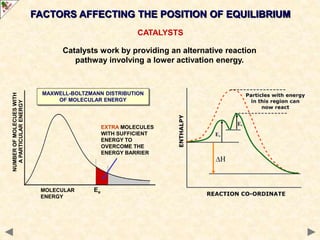
Catalysts work by providing an alternative reaction
pathway involving a lower activation energy.
CATALYSTS
An increase in temperature is used to speed up chemical reactions but it can have an
undesired effect when the reaction is reversible and exothermic.
In this case you get to the equilibrium position quicker but with a reduced yield because
the increased temperature moves the equilibrium to the left.
In many industrial processes a compromise temperature is used (see Haber and
Contact Processes). To reduce the problem one must look for a way of increasing the
rate of a reaction without decreasing the yield i.e. with a catalyst.
FACTORS AFFECTING THE POSITION OF EQUILIBRIUM
CATALYSTS
An increase in temperature is used to speed up chemical reactions but it can have an
undesired effect when the reaction is reversible and exothermic.
In this case you get to the equilibrium position quicker but with a reduced yield because
the increased temperature moves the equilibrium to the left.
In many industrial processes a compromise temperature is used (see Haber and
Contact Processes). To reduce the problem one must look for a way of increasing the
rate of a reaction without decreasing the yield i.e. with a catalyst.
Adding a catalyst DOES NOT AFFECT THE POSITION OF EQUILIBRIUM. However, it
does increase the rate of attainment of equilibrium. This is especially important in
reversible, exothermic industrial reactions such as the Haber or Contact Processes
where economic factors are paramount.
FACTORS AFFECTING THE POSITION OF EQUILIBRIUM
N2(g) + 3H2(g) 2NH3(g) : DH = - 92 kJ mol-1
Conditions Pressure 20000 kPa (200 atmospheres)
Temperature 380-450°C
Catalyst iron
HABER PROCESS
N2(g) + 3H2(g) 2NH3(g) : DH = - 92 kJ mol-1
Conditions Pressure 20000 kPa (200 atmospheres)
Temperature 380-450°C
Catalyst iron
Equilibrium theory favours
low temperature exothermic reaction - higher yield at lower temperature
high pressure decrease in number of gaseous molecules
HABER PROCESS
N2(g) + 3H2(g) 2NH3(g) : DH = - 92 kJ mol-1
Conditions Pressure 20000 kPa (200 atmospheres)
Temperature 380-450°C
Catalyst iron
Equilibrium theory favours
low temperature exothermic reaction - higher yield at lower temperature
high pressure decrease in number of gaseous molecules
Kinetic theory favours
high temperature greater average energy + more frequent collisions
high pressure more frequent collisions for gaseous molecules
catalyst lower activation energy
HABER PROCESS
N2(g) + 3H2(g) 2NH3(g) : DH = - 92 kJ mol-1
Conditions Pressure 20000 kPa (200 atmospheres)
Temperature 380-450°C
Catalyst iron
Equilibrium theory favours
low temperature exothermic reaction - higher yield at lower temperature
high pressure decrease in number of gaseous molecules
Kinetic theory favours
high temperature greater average energy + more frequent collisions
high pressure more frequent collisions for gaseous molecules
catalyst lower activation energy
Compromise conditions
Which is better? A low yield in a shorter time or
a high yield over a longer period.
The conditions used are a compromise with the catalyst
enabling the rate to be kept up, even at a lower temperature.
HABER PROCESS
IMPORTANT USES OF AMMONIA AND ITS COMPOUNDS
MAKING
FERTILISERS 80% of the ammonia produced goes to make fertilisers such as
ammonium nitrate (NITRAM) and ammonium sulphate
NH3 + HNO3 ——> NH4NO3
2NH3 + H2SO4 ——> (NH4)2SO4
MAKING
NITRIC ACID ammonia can be oxidised to nitric acid
nitric acid is used to manufacture... fertilisers (ammonium nitrate)
explosives (TNT)
polyamide polymers (NYLON)
HABER PROCESS
REVISION CHECK
What should you be able to do?
Understand how concentration changes during chemical reactions
Recall the the characteristics of dynamic equilibrium
Construct an expression for the equilibrium constant Kc
Recall the factors which can affect the position of equilibrium
Apply Le Chatelier’s Principle to predict changes in the position of equilibrium
Recall and explain the conditions used in the Haber process
Recall the importance of ammonia and its compounds
CAN YOU DO ALL OF THESE? YES NO
You need to go over the
relevant topic(s) again
Click on the button to
return to the menu
WELL DONE!
Try some past paper questions
© 2015 JONATHAN HOPTON & KNOCKHARDY PUBLISHING
AN INTRODUCTION TO
CHEMICAL
EQUILIBRIUM
THE END

EQUILIBRIUM.ppt

  • 1.
  • 2.
    INTRODUCTION This Powerpoint showis one of several produced to help students understand selected topics at AS and A2 level Chemistry. It is based on the requirements of the AQA and OCR specifications but is suitable for other examination boards. Individual students may use the material at home for revision purposes or it may be used for classroom teaching if an interactive white board is available. Accompanying notes on this, and the full range of AS and A2 topics, are available from the KNOCKHARDY SCIENCE WEBSITE at... www.knockhardy.org.uk/sci.htm Navigation is achieved by... either clicking on the grey arrows at the foot of each page or using the left and right arrow keys on the keyboard KNOCKHARDY PUBLISHING CHEMICAL EQUILIBRIUM
  • 3.
    CONTENTS • Concentration changeduring a chemical reaction • Dynamic equilibrium • Equilibrium constants • Le Chatelier’s Principle • Haber process • Check list CHEMICAL EQUILIBRIUM
  • 4.
    In an ordinaryreaction; all reactants end up as products; there is 100% conversion CONCENTRATION CHANGE IN A REACTION As the rate of reaction is dependant on the concentration of reactants... the forward reaction starts off fast but slows as the reactants get less concentrated FASTEST AT THE START SLOWS DOWN AS REACTANTS ARE USED UP TOTAL CONVERSION TO PRODUCTS THE STEEPER THE GRADIENT, THE FASTER THE REACTION
  • 5.
    In an ordinaryreaction; all reactants end up as products; there is 100% conversion CONCENTRATION CHANGE IN A REACTION As the rate of reaction is dependant on the concentration of reactants... the forward reaction starts off fast but slows as the reactants get less concentrated FASTEST AT THE START SLOWS DOWN AS REACTANTS ARE USED UP TOTAL CONVERSION TO PRODUCTS THE STEEPER THE GRADIENT, THE FASTER THE REACTION
  • 6.
    In an ordinaryreaction; all reactants end up as products; there is 100% conversion CONCENTRATION CHANGE IN A REACTION As the rate of reaction is dependant on the concentration of reactants... the forward reaction starts off fast but slows as the reactants get less concentrated FASTEST AT THE START SLOWS DOWN AS REACTANTS ARE USED UP TOTAL CONVERSION TO PRODUCTS THE STEEPER THE GRADIENT, THE FASTER THE REACTION
  • 7.
    Initially, there isno backward reaction but, as products form, it speeds up and provided the temperature remains constant there will come a time when the backward and forward reactions are equal and opposite; the reaction has reached equilibrium. EQUILIBRIUM REACTIONS In an equilibrium reaction, not all the reactants end up as products; there is not a 100% conversion. BUT IT DOESN’T MEAN THE REACTION IS STUCK IN THE MIDDLE FASTEST AT THE START NO BACKWARD REACTION FORWARD REACTION SLOWS DOWN AS REACTANTS ARE USED UP BACKWARD REACTION STARTS TO INCREASE AT EQUILIBRIUM THE BACKWARD AND FORWARD REACTIONS ARE EQUAL AND OPPOSITE
  • 8.
    Initially, there isno backward reaction but, as products form, it speeds up and provided the temperature remains constant there will come a time when the backward and forward reactions are equal and opposite; the reaction has reached equilibrium. EQUILIBRIUM REACTIONS In an equilibrium reaction, not all the reactants end up as products; there is not a 100% conversion. BUT IT DOESN’T MEAN THE REACTION IS STUCK IN THE MIDDLE FASTEST AT THE START NO BACKWARD REACTION FORWARD REACTION SLOWS DOWN AS REACTANTS ARE USED UP BACKWARD REACTION STARTS TO INCREASE AT EQUILIBRIUM THE BACKWARD AND FORWARD REACTIONS ARE EQUAL AND OPPOSITE
  • 9.
    Initially, there isno backward reaction but, as products form, it speeds up and provided the temperature remains constant there will come a time when the backward and forward reactions are equal and opposite; the reaction has reached equilibrium. EQUILIBRIUM REACTIONS In an equilibrium reaction, not all the reactants end up as products; there is not a 100% conversion. BUT IT DOESN’T MEAN THE REACTION IS STUCK IN THE MIDDLE FASTEST AT THE START NO BACKWARD REACTION FORWARD REACTION SLOWS DOWN AS REACTANTS ARE USED UP BACKWARD REACTION STARTS TO INCREASE AT EQUILIBRIUM THE BACKWARD AND FORWARD REACTIONS ARE EQUAL AND OPPOSITE
  • 10.
    Initially, there isno backward reaction but, as products form, it speeds up and provided the temperature remains constant there will come a time when the backward and forward reactions are equal and opposite; the reaction has reached equilibrium. EQUILIBRIUM REACTIONS In an equilibrium reaction, not all the reactants end up as products; there is not a 100% conversion. BUT IT DOESN’T MEAN THE REACTION IS STUCK IN THE MIDDLE FASTEST AT THE START NO BACKWARD REACTION FORWARD REACTION SLOWS DOWN AS REACTANTS ARE USED UP BACKWARD REACTION STARTS TO INCREASE AT EQUILIBRIUM THE BACKWARD AND FORWARD REACTIONS ARE EQUAL AND OPPOSITE
  • 11.
    IMPORTANT REMINDERS • areversible chemical reaction is a dynamic process • everything may appear stationary but the reactions are moving both ways • the position of equilibrium can be varied by changing certain conditions Trying to get up a “down” escalator gives an excellent idea of a non-chemical situation involving dynamic equilibrium. DYNAMIC EQUILIBRIUM
  • 12.
    IMPORTANT REMINDERS • areversible chemical reaction is a dynamic process • everything may appear stationary but the reactions are moving both ways • the position of equilibrium can be varied by changing certain conditions Trying to get up a “down” escalator gives an excellent idea of a non-chemical situation involving dynamic equilibrium. Summary When a chemical equilibrium is established ... • both the reactants and the products are present at all times • the equilibrium can be approached from either side • the reaction is dynamic - it is moving forwards and backwards • the concentrations of reactants and products remain constant DYNAMIC EQUILIBRIUM
  • 13.
    Simply states “If theconcentrations of all the substances present at equilibrium are raised to the power of the number of moles they appear in the equation, the product of the concentrations of the products divided by the product of the concentrations of the reactants is a constant, provided the temperature remains constant” There are several forms of the constant; all vary with temperature. Kc the equilibrium values are expressed as concentrations of mol dm-3 Kp the equilibrium values are expressed as partial pressures The partial pressure expression can be used for reactions involving gases THE EQUILIBRIUM LAW
  • 14.
    for an equilibriumreaction of the form... aA + bB cC + dD then (at constant temperature) [C]c . [D]d = a constant, (Kc) [A]a . [B]b where [ ] denotes the equilibrium concentration in mol dm-3 Kc is known as the Equilibrium Constant THE EQUILIBRIUM CONSTANT Kc
  • 15.
    for an equilibriumreaction of the form... aA + bB cC + dD then (at constant temperature) [C]c . [D]d = a constant, (Kc) [A]a . [B]b where [ ] denotes the equilibrium concentration in mol dm-3 Kc is known as the Equilibrium Constant THE EQUILIBRIUM CONSTANT Kc Example Fe3+(aq) + NCS¯(aq) FeNCS2+(aq) Kc = [ FeNCS2+ ] with units of dm3 mol-1 [ Fe3+ ] [ NCS¯ ]
  • 16.
    for an equilibriumreaction of the form... aA + bB cC + dD then (at constant temperature) [C]c . [D]d = a constant, (Kc) [A]a . [B]b where [ ] denotes the equilibrium concentration in mol dm-3 Kc is known as the Equilibrium Constant THE EQUILIBRIUM CONSTANT Kc VALUE OF Kc AFFECTED by a change of temperature NOT AFFECTED by a change in concentration of reactants or products a change of pressure adding a catalyst
  • 17.
    ”When a changeis applied to a system in dynamic equilibrium, the system reacts in such a way as to oppose the effect of the change.” Everyday example A rose bush grows with increased vigour after it has been pruned. Chemistry example If you do something to a reaction that is in a state of equilibrium, the equilibrium position will change to oppose what you have just done LE CHATELIER’S PRINCIPLE
  • 18.
    CONCENTRATION FACTORS AFFECTING THEPOSITION OF EQUILIBRIUM The equilibrium constant is not affected by a change in concentration at constant temperature. To maintain the constant, the composition of the equilibrium mixture changes. If you increase the concentration of a substance, the value of Kc will theoretically be affected. As it must remain constant at a particular temperature, the concentrations of the other species change to keep the constant the same.
  • 19.
    CONCENTRATION example CH3CH2OH(l) +CH3COOH(l) CH3COOC2H5(l) + H2O(l) the equilibrium constant Kc = [CH3COOC2H5] [H2O] = 4 (at 298K) [CH3CH2OH] [CH3COOH] FACTORS AFFECTING THE POSITION OF EQUILIBRIUM
  • 20.
    CONCENTRATION example CH3CH2OH(l) +CH3COOH(l) CH3COOC2H5(l) + H2O(l) the equilibrium constant Kc = [CH3COOC2H5] [H2O] = 4 (at 298K) [CH3CH2OH] [CH3COOH] increasing [CH3CH2OH] - will make the bottom line larger so Kc will be smaller - to keep it constant, some CH3CH2OH reacts with CH3COOH - this reduces the value of the bottom line and increases the top - eventually the value of the constant will be restored FACTORS AFFECTING THE POSITION OF EQUILIBRIUM
  • 21.
    CONCENTRATION example CH3CH2OH(l) +CH3COOH(l) CH3COOC2H5(l) + H2O(l) the equilibrium constant Kc = [CH3COOC2H5] [H2O] = 4 (at 298K) [CH3CH2OH] [CH3COOH] increasing [CH3CH2OH] - will make the bottom line larger so Kc will be smaller - to keep it constant, some CH3CH2OH reacts with CH3COOH - this reduces the value of the bottom line and increases the top - eventually the value of the constant will be restored decreasing [H2O] - will make the top line smaller - some CH3CH2OH reacts with CH3COOH to replace the H2O - more CH3COOC2H5 is also produced - this reduces the value of the bottom line and increases the top FACTORS AFFECTING THE POSITION OF EQUILIBRIUM
  • 22.
    CONCENTRATION example CH3CH2OH(l) +CH3COOH(l) CH3COOC2H5(l) + H2O(l) the equilibrium constant Kc = [CH3COOC2H5] [H2O] = 4 (at 298K) [CH3CH2OH] [CH3COOH] increasing [CH3CH2OH] - will make the bottom line larger so Kc will be smaller - to keep it constant, some CH3CH2OH reacts with CH3COOH - this reduces the value of the bottom line and increases the top - eventually the value of the constant will be restored decreasing [H2O] - will make the top line smaller - some CH3CH2OH reacts with CH3COOH to replace the H2O - more CH3COOC2H5 is also produced - this reduces the value of the bottom line and increases the top FACTORS AFFECTING THE POSITION OF EQUILIBRIUM
  • 23.
    SUMMARY REACTANTS PRODUCTS INCREASE CONCENTRATIONOF A REACTANT EQUILIBRIUM MOVES TO THE RIGHT THE EFFECT OF CHANGING THE CONCENTRATION ON THE POSITION OF EQUILIBRIUM DECREASE CONCENTRATION OF A REACTANT EQUILIBRIUM MOVES TO THE LEFT INCREASE CONCENTRATION OF A PRODUCT EQUILIBRIUM MOVES TO THE LEFT DECREASE CONCENTRATION OF A PRODUCT EQUILIBRIUM MOVES TO THE RIGHT FACTORS AFFECTING THE POSITION OF EQUILIBRIUM
  • 24.
    FACTORS AFFECTING THEPOSITION OF EQUILIBRIUM Predict the effect of increasing the concentration of O2 on the equilibrium position 2SO2(g) + O2(g) 2SO3(g) SUMMARY REACTANTS PRODUCTS INCREASE CONCENTRATION OF A REACTANT EQUILIBRIUM MOVES TO THE RIGHT THE EFFECT OF CHANGING THE CONCENTRATION ON THE POSITION OF EQUILIBRIUM DECREASE CONCENTRATION OF A REACTANT EQUILIBRIUM MOVES TO THE LEFT INCREASE CONCENTRATION OF A PRODUCT EQUILIBRIUM MOVES TO THE LEFT DECREASE CONCENTRATION OF A PRODUCT EQUILIBRIUM MOVES TO THE RIGHT Predict the effect of decreasing the concentration of SO3 on the equilibrium position
  • 25.
    FACTORS AFFECTING THEPOSITION OF EQUILIBRIUM Predict the effect of increasing the concentration of O2 on the equilibrium position 2SO2(g) + O2(g) 2SO3(g) EQUILIBRIUM MOVES TO RHS SUMMARY REACTANTS PRODUCTS INCREASE CONCENTRATION OF A REACTANT EQUILIBRIUM MOVES TO THE RIGHT THE EFFECT OF CHANGING THE CONCENTRATION ON THE POSITION OF EQUILIBRIUM DECREASE CONCENTRATION OF A REACTANT EQUILIBRIUM MOVES TO THE LEFT INCREASE CONCENTRATION OF A PRODUCT EQUILIBRIUM MOVES TO THE LEFT DECREASE CONCENTRATION OF A PRODUCT EQUILIBRIUM MOVES TO THE RIGHT Predict the effect of decreasing the concentration of SO3 on the equilibrium position EQUILIBRIUM MOVES TO RHS
  • 26.
    PRESSURE When studying theeffect of a change in pressure, we consider the number of gaseous molecules only. The more particles you have in a given volume, the greater the pressure they exert. If you apply a greater pressure they will become more crowded (i.e. they are under a greater stress). However, if the system can change it will move to the side with fewer gaseous molecules - it is less crowded. No change occurs when equal numbers of gaseous molecules appear on both sides. FACTORS AFFECTING THE POSITION OF EQUILIBRIUM
  • 27.
    PRESSURE When studying theeffect of a change in pressure, we consider the number of gaseous molecules only. The more particles you have in a given volume, the greater the pressure they exert. If you apply a greater pressure they will become more crowded (i.e. they are under a greater stress). However, if the system can change it will move to the side with fewer gaseous molecules - it is less crowded. No change occurs when equal numbers of gaseous molecules appear on both sides. INCREASE PRESSURE MOVES TO THE SIDE WITH FEWER GASEOUS MOLECULES DECREASE PRESSURE MOVES TO THE SIDE WITH MORE GASEOUS MOLECULES THE EFFECT OF PRESSURE ON THE POSITION OF EQUILIBRIUM FACTORS AFFECTING THE POSITION OF EQUILIBRIUM
  • 28.
    PRESSURE When studying theeffect of a change in pressure, we consider the number of gaseous molecules only. The more particles you have in a given volume, the greater the pressure they exert. If you apply a greater pressure they will become more crowded (i.e. they are under a greater stress). However, if the system can change it will move to the side with fewer gaseous molecules - it is less crowded. No change occurs when equal numbers of gaseous molecules appear on both sides. INCREASE PRESSURE MOVES TO THE SIDE WITH FEWER GASEOUS MOLECULES DECREASE PRESSURE MOVES TO THE SIDE WITH MORE GASEOUS MOLECULES THE EFFECT OF PRESSURE ON THE POSITION OF EQUILIBRIUM Predict the effect of an increase of pressure on the equilibrium position of.. 2SO2(g) + O2(g) 2SO3(g) H2(g) + CO2(g) CO(g) + H2O(g) FACTORS AFFECTING THE POSITION OF EQUILIBRIUM
  • 29.
    PRESSURE When studying theeffect of a change in pressure, we consider the number of gaseous molecules only. The more particles you have in a given volume, the greater the pressure they exert. If you apply a greater pressure they will become more crowded (i.e. they are under a greater stress). However, if the system can change it will move to the side with fewer gaseous molecules - it is less crowded. No change occurs when equal numbers of gaseous molecules appear on both sides. INCREASE PRESSURE MOVES TO THE SIDE WITH FEWER GASEOUS MOLECULES DECREASE PRESSURE MOVES TO THE SIDE WITH MORE GASEOUS MOLECULES THE EFFECT OF PRESSURE ON THE POSITION OF EQUILIBRIUM Predict the effect of an increase of pressure on the equilibrium position of.. 2SO2(g) + O2(g) 2SO3(g) MOVES TO RHS :- fewer gaseous molecules H2(g) + CO2(g) CO(g) + H2O(g) NO CHANGE:- equal numbers on both sides FACTORS AFFECTING THE POSITION OF EQUILIBRIUM
  • 30.
    TEMPERATURE • temperature isthe only thing that can change the value of the equilibrium constant. • altering the temperature affects the rate of both backward and forward reactions • it alters the rates to different extents • the equilibrium thus moves producing a new equilibrium constant. • the direction of movement depends on the sign of the enthalpy change. FACTORS AFFECTING THE POSITION OF EQUILIBRIUM
  • 31.
    TEMPERATURE • temperature isthe only thing that can change the value of the equilibrium constant. • altering the temperature affects the rate of both backward and forward reactions • it alters the rates to different extents • the equilibrium thus moves producing a new equilibrium constant. • the direction of movement depends on the sign of the enthalpy change. REACTION TYPE DH INCREASE TEMP DECREASE TEMP EXOTHERMIC - TO THE LEFT TO THE RIGHT ENDOTHERMIC + TO THE RIGHT TO THE LEFT FACTORS AFFECTING THE POSITION OF EQUILIBRIUM
  • 32.
    TEMPERATURE • temperature isthe only thing that can change the value of the equilibrium constant. • altering the temperature affects the rate of both backward and forward reactions • it alters the rates to different extents • the equilibrium thus moves producing a new equilibrium constant. • the direction of movement depends on the sign of the enthalpy change. REACTION TYPE DH INCREASE TEMP DECREASE TEMP EXOTHERMIC - TO THE LEFT TO THE RIGHT ENDOTHERMIC + TO THE RIGHT TO THE LEFT Predict the effect of a temperature increase on the equilibrium position of... H2(g) + CO2(g) CO(g) + H2O(g) DH = + 40 kJ mol-1 2SO2(g) + O2(g) 2SO3(g) DH = - ive FACTORS AFFECTING THE POSITION OF EQUILIBRIUM
  • 33.
    TEMPERATURE • temperature isthe only thing that can change the value of the equilibrium constant. • altering the temperature affects the rate of both backward and forward reactions • it alters the rates to different extents • the equilibrium thus moves producing a new equilibrium constant. • the direction of movement depends on the sign of the enthalpy change. REACTION TYPE DH INCREASE TEMP DECREASE TEMP EXOTHERMIC - TO THE LEFT TO THE RIGHT ENDOTHERMIC + TO THE RIGHT TO THE LEFT Predict the effect of a temperature increase on the equilibrium position of... H2(g) + CO2(g) CO(g) + H2O(g) DH = + 40 kJ mol-1 moves to the RHS 2SO2(g) + O2(g) 2SO3(g) DH = - ive moves to the LHS FACTORS AFFECTING THE POSITION OF EQUILIBRIUM
  • 34.
    CATALYSTS FACTORS AFFECTING THEPOSITION OF EQUILIBRIUM Ea MAXWELL-BOLTZMANN DISTRIBUTION OF MOLECULAR ENERGY EXTRA MOLECULES WITH SUFFICIENT ENERGY TO OVERCOME THE ENERGY BARRIER MOLECULAR ENERGY NUMBER OF MOLECUES WITH A PARTICULAR ENERGY Catalysts work by providing an alternative reaction pathway involving a lower activation energy.
  • 35.
    CATALYSTS An increase intemperature is used to speed up chemical reactions but it can have an undesired effect when the reaction is reversible and exothermic. In this case you get to the equilibrium position quicker but with a reduced yield because the increased temperature moves the equilibrium to the left. In many industrial processes a compromise temperature is used (see Haber and Contact Processes). To reduce the problem one must look for a way of increasing the rate of a reaction without decreasing the yield i.e. with a catalyst. FACTORS AFFECTING THE POSITION OF EQUILIBRIUM
  • 36.
    CATALYSTS An increase intemperature is used to speed up chemical reactions but it can have an undesired effect when the reaction is reversible and exothermic. In this case you get to the equilibrium position quicker but with a reduced yield because the increased temperature moves the equilibrium to the left. In many industrial processes a compromise temperature is used (see Haber and Contact Processes). To reduce the problem one must look for a way of increasing the rate of a reaction without decreasing the yield i.e. with a catalyst. Adding a catalyst DOES NOT AFFECT THE POSITION OF EQUILIBRIUM. However, it does increase the rate of attainment of equilibrium. This is especially important in reversible, exothermic industrial reactions such as the Haber or Contact Processes where economic factors are paramount. FACTORS AFFECTING THE POSITION OF EQUILIBRIUM
  • 37.
    N2(g) + 3H2(g)2NH3(g) : DH = - 92 kJ mol-1 Conditions Pressure 20000 kPa (200 atmospheres) Temperature 380-450°C Catalyst iron HABER PROCESS
  • 38.
    N2(g) + 3H2(g)2NH3(g) : DH = - 92 kJ mol-1 Conditions Pressure 20000 kPa (200 atmospheres) Temperature 380-450°C Catalyst iron Equilibrium theory favours low temperature exothermic reaction - higher yield at lower temperature high pressure decrease in number of gaseous molecules HABER PROCESS
  • 39.
    N2(g) + 3H2(g)2NH3(g) : DH = - 92 kJ mol-1 Conditions Pressure 20000 kPa (200 atmospheres) Temperature 380-450°C Catalyst iron Equilibrium theory favours low temperature exothermic reaction - higher yield at lower temperature high pressure decrease in number of gaseous molecules Kinetic theory favours high temperature greater average energy + more frequent collisions high pressure more frequent collisions for gaseous molecules catalyst lower activation energy HABER PROCESS
  • 40.
    N2(g) + 3H2(g)2NH3(g) : DH = - 92 kJ mol-1 Conditions Pressure 20000 kPa (200 atmospheres) Temperature 380-450°C Catalyst iron Equilibrium theory favours low temperature exothermic reaction - higher yield at lower temperature high pressure decrease in number of gaseous molecules Kinetic theory favours high temperature greater average energy + more frequent collisions high pressure more frequent collisions for gaseous molecules catalyst lower activation energy Compromise conditions Which is better? A low yield in a shorter time or a high yield over a longer period. The conditions used are a compromise with the catalyst enabling the rate to be kept up, even at a lower temperature. HABER PROCESS
  • 41.
    IMPORTANT USES OFAMMONIA AND ITS COMPOUNDS MAKING FERTILISERS 80% of the ammonia produced goes to make fertilisers such as ammonium nitrate (NITRAM) and ammonium sulphate NH3 + HNO3 ——> NH4NO3 2NH3 + H2SO4 ——> (NH4)2SO4 MAKING NITRIC ACID ammonia can be oxidised to nitric acid nitric acid is used to manufacture... fertilisers (ammonium nitrate) explosives (TNT) polyamide polymers (NYLON) HABER PROCESS
  • 42.
    REVISION CHECK What shouldyou be able to do? Understand how concentration changes during chemical reactions Recall the the characteristics of dynamic equilibrium Construct an expression for the equilibrium constant Kc Recall the factors which can affect the position of equilibrium Apply Le Chatelier’s Principle to predict changes in the position of equilibrium Recall and explain the conditions used in the Haber process Recall the importance of ammonia and its compounds CAN YOU DO ALL OF THESE? YES NO
  • 43.
    You need togo over the relevant topic(s) again Click on the button to return to the menu
  • 44.
    WELL DONE! Try somepast paper questions
  • 45.
    © 2015 JONATHANHOPTON & KNOCKHARDY PUBLISHING AN INTRODUCTION TO CHEMICAL EQUILIBRIUM THE END