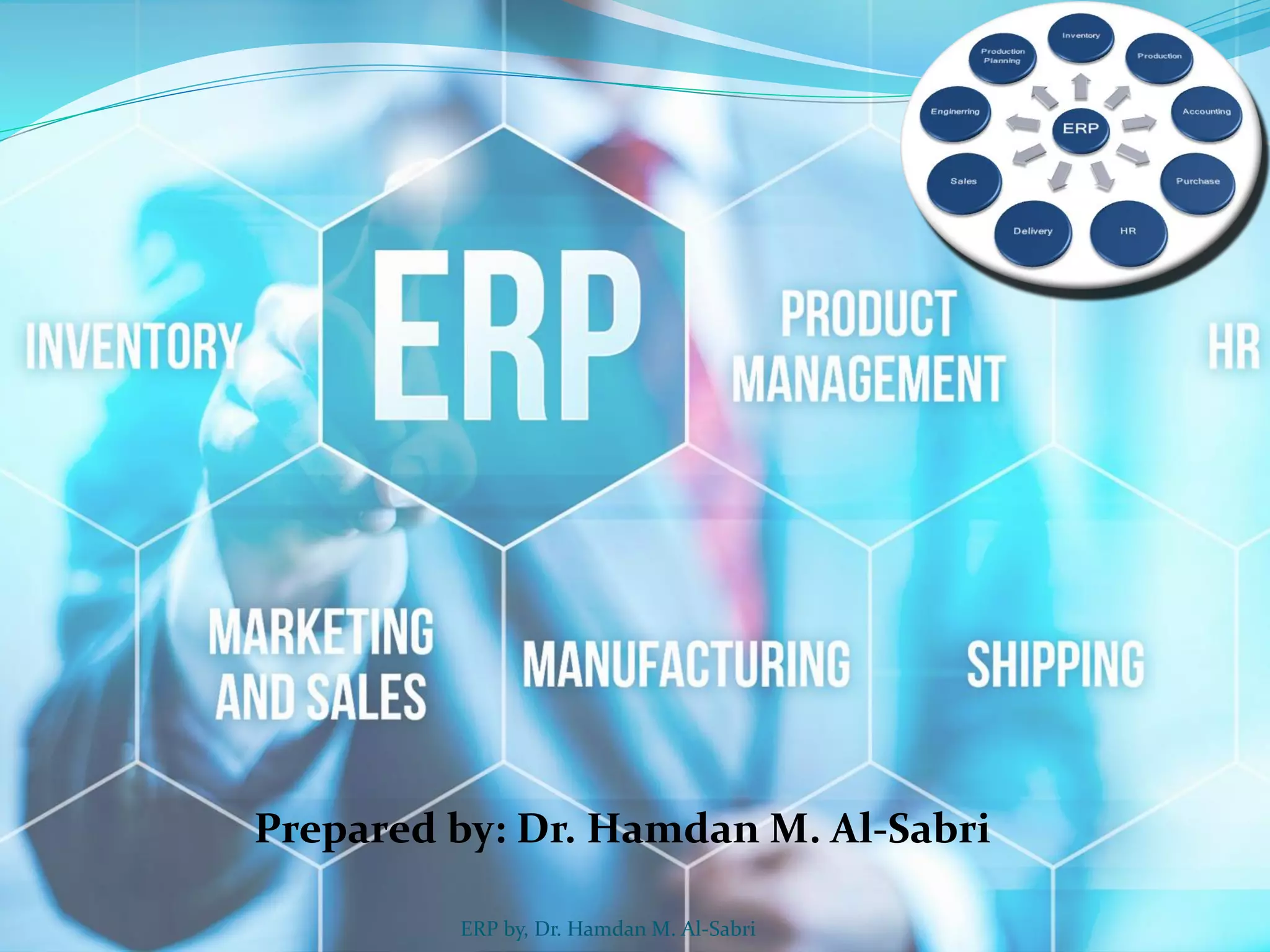

Prepared by: Dr. Hamdan M. Al-Sabri
ERP by, Dr. Hamdan M. Al-Sabri
Outline
 What is ERP and its History ?
 ERP Components.
 Commercial Applications.
 The steps to Successful of ERP Implementation.
 Consulting Services.
 ERP System Architecture.
 Characteristics of ERP systems.
ERP by, Dr. Hamdan M. Al-Sabri
Enterprise resource planning (ERP) :
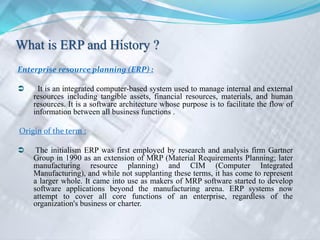
 It is an integrated computer-based system used to manage internal and external
resources including tangible assets, financial resources, materials, and human
resources. It is a software architecture whose purpose is to facilitate the flow of
information between all business functions .
Origin of the term :
 The initialism ERP was first employed by research and analysis firm Gartner
Group in 1990 as an extension of MRP (Material Requirements Planning; later
manufacturing resource planning) and CIM (Computer Integrated
Manufacturing), and while not supplanting these terms, it has come to represent
a larger whole. It came into use as makers of MRP software started to develop
software applications beyond the manufacturing arena. ERP systems now
attempt to cover all core functions of an enterprise, regardless of the
organization's business or charter.
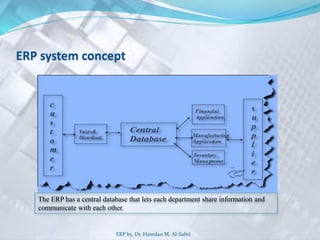
ERP system concept
The ERP has a central database that lets each department share information and
communicate with each other.
ERP by, Dr. Hamdan M. Al-Sabri
ERP Components
 Transactional Backbone
 Financials
 Distribution
 Human Resources
 Product lifecycle management
 Advanced Applications
 Customer Relationship Management (CRM)
 Supply chain management
 Purchasing
 Manufacturing
 Distribution
 Warehouse Management System
 Management Portal/Dashboard
 Decision Support System
 These modules can exist in a complete system or utilized in an ad-hoc fashion.
ERP by, Dr. Hamdan M. Al-Sabri
Commercial Applications
 Manufacturing :
 scheduling, capacity , quality control, cost management, manufacturing process .
 Supply chain management :
 Order to cash, inventory, order entry, purchasing, supplier scheduling, inspection of goods, claim processing .
 Financials :
 General ledger, cash management, accounts payable, accounts receivable .
 Project management :
 Costing, billing, time and expense, performance units, activity management .
 Human resources :
 payroll, training, time and attendance, rostering , benefits
 Customer relationship management :
 Sales and marketing, commissions, service, customer contact and call center support.
 Data services :
 Various "self-service" interfaces for customers, suppliers, and/or employees .
 Access control :
 Management of user privileges for various processes .
ERP by, Dr. Hamdan M. Al-Sabri
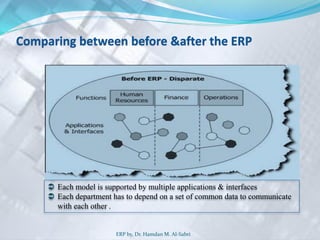
Comparing between before &after the ERP
 Each model is supported by multiple applications & interfaces
 Each department has to depend on a set of common data to communicate
with each other .
ERP by, Dr. Hamdan M. Al-Sabri
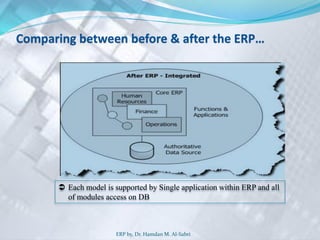
Comparing between before & after the ERP…
 Each model is supported by Single application within ERP and all
of modules access on DB
ERP by, Dr. Hamdan M. Al-Sabri
5 Steps To Successful ERP Implementation
 STRATEGIC PLANNING :
 Assign a project team.
 Examine current business processes and information flow.
 Set objectives.
 Develop a project plan.
 PROCEDURE REVIEW :
 Review software capabilities.
 Identify manual processes.
 Develop standard operating procedures.
 DATA COLLECTION & CLEAN-UP:
 Convert data.
 Collect new data.
 Review all data input.
 Clean-up data.
ERP by, Dr. Hamdan M. Al-Sabri
5 Steps To Successful ERP Implementation..
 TRAINING AND TESTING :
 Pre-test the database.
 Verify testing.
 Train the Trainer.
 Perform final testing.
 GO LIVE AND EVALUATION :
 Develop a final Go-Live Checklist.
 Evaluate the solution.
ERP by, Dr. Hamdan M. Al-Sabri
Consulting services
Many organizations offer consulting services for ERP
implementation.
Responsibilities of consulting team are :
 Selecting.
 Planning.
 Training.
 Testing.
 Implementation.
 Delivery.
ERP by, Dr. Hamdan M. Al-Sabri
Reasons why companies undertake ERP
Integrate financial information.
Integrate customer order information.
Standardize and speed up manufacturing processes.
Reduce inventory.
Standardize HR information.
ERP by, Dr. Hamdan M. Al-Sabri
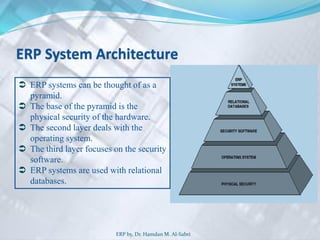
ERP System Architecture
 ERP systems can be thought of as a
pyramid.
 The base of the pyramid is the
physical security of the hardware.
 The second layer deals with the
operating system.
 The third layer focuses on the security
software.
 ERP systems are used with relational
databases.
ERP by, Dr. Hamdan M. Al-Sabri
Characteristics of ERP systems
Modular design comprising many business modules such as
Financial, Manufacturing , … etc.
Use centralized common database system DB.
Avoid data and operation redundancy:
 Modules access the same data from the central database ,
which avoids multiple data input and output operation .
System heavily dependent on networking on a large scale.
Vulnerability by increased access is a price that is paid
for higher integration and faster processing of data in
an integrated manner.
Help support the decision-making .
ERP by, Dr. Hamdan M. Al-Sabri
Thanks
ERP by, Dr. Hamdan M. Al-Sabri

Enterprise resource planning

  • 1.
    Prepared by: Dr.Hamdan M. Al-Sabri ERP by, Dr. Hamdan M. Al-Sabri
  • 2.
    Outline  What isERP and its History ?  ERP Components.  Commercial Applications.  The steps to Successful of ERP Implementation.  Consulting Services.  ERP System Architecture.  Characteristics of ERP systems. ERP by, Dr. Hamdan M. Al-Sabri
  • 3.
    Enterprise resource planning(ERP) :  It is an integrated computer-based system used to manage internal and external resources including tangible assets, financial resources, materials, and human resources. It is a software architecture whose purpose is to facilitate the flow of information between all business functions . Origin of the term :  The initialism ERP was first employed by research and analysis firm Gartner Group in 1990 as an extension of MRP (Material Requirements Planning; later manufacturing resource planning) and CIM (Computer Integrated Manufacturing), and while not supplanting these terms, it has come to represent a larger whole. It came into use as makers of MRP software started to develop software applications beyond the manufacturing arena. ERP systems now attempt to cover all core functions of an enterprise, regardless of the organization's business or charter.
  • 4.
    ERP system concept TheERP has a central database that lets each department share information and communicate with each other. ERP by, Dr. Hamdan M. Al-Sabri
  • 5.
    ERP Components  TransactionalBackbone  Financials  Distribution  Human Resources  Product lifecycle management  Advanced Applications  Customer Relationship Management (CRM)  Supply chain management  Purchasing  Manufacturing  Distribution  Warehouse Management System  Management Portal/Dashboard  Decision Support System  These modules can exist in a complete system or utilized in an ad-hoc fashion. ERP by, Dr. Hamdan M. Al-Sabri
  • 6.
    Commercial Applications  Manufacturing:  scheduling, capacity , quality control, cost management, manufacturing process .  Supply chain management :  Order to cash, inventory, order entry, purchasing, supplier scheduling, inspection of goods, claim processing .  Financials :  General ledger, cash management, accounts payable, accounts receivable .  Project management :  Costing, billing, time and expense, performance units, activity management .  Human resources :  payroll, training, time and attendance, rostering , benefits  Customer relationship management :  Sales and marketing, commissions, service, customer contact and call center support.  Data services :  Various "self-service" interfaces for customers, suppliers, and/or employees .  Access control :  Management of user privileges for various processes . ERP by, Dr. Hamdan M. Al-Sabri
  • 7.
    Comparing between before&after the ERP  Each model is supported by multiple applications & interfaces  Each department has to depend on a set of common data to communicate with each other . ERP by, Dr. Hamdan M. Al-Sabri
  • 8.
    Comparing between before& after the ERP…  Each model is supported by Single application within ERP and all of modules access on DB ERP by, Dr. Hamdan M. Al-Sabri
  • 9.
    5 Steps ToSuccessful ERP Implementation  STRATEGIC PLANNING :  Assign a project team.  Examine current business processes and information flow.  Set objectives.  Develop a project plan.  PROCEDURE REVIEW :  Review software capabilities.  Identify manual processes.  Develop standard operating procedures.  DATA COLLECTION & CLEAN-UP:  Convert data.  Collect new data.  Review all data input.  Clean-up data. ERP by, Dr. Hamdan M. Al-Sabri
  • 10.
    5 Steps ToSuccessful ERP Implementation..  TRAINING AND TESTING :  Pre-test the database.  Verify testing.  Train the Trainer.  Perform final testing.  GO LIVE AND EVALUATION :  Develop a final Go-Live Checklist.  Evaluate the solution. ERP by, Dr. Hamdan M. Al-Sabri
  • 11.
    Consulting services Many organizationsoffer consulting services for ERP implementation. Responsibilities of consulting team are :  Selecting.  Planning.  Training.  Testing.  Implementation.  Delivery. ERP by, Dr. Hamdan M. Al-Sabri
  • 12.
    Reasons why companiesundertake ERP Integrate financial information. Integrate customer order information. Standardize and speed up manufacturing processes. Reduce inventory. Standardize HR information. ERP by, Dr. Hamdan M. Al-Sabri
  • 13.
    ERP System Architecture ERP systems can be thought of as a pyramid.  The base of the pyramid is the physical security of the hardware.  The second layer deals with the operating system.  The third layer focuses on the security software.  ERP systems are used with relational databases. ERP by, Dr. Hamdan M. Al-Sabri
  • 14.
    Characteristics of ERPsystems Modular design comprising many business modules such as Financial, Manufacturing , … etc. Use centralized common database system DB. Avoid data and operation redundancy:  Modules access the same data from the central database , which avoids multiple data input and output operation . System heavily dependent on networking on a large scale. Vulnerability by increased access is a price that is paid for higher integration and faster processing of data in an integrated manner. Help support the decision-making . ERP by, Dr. Hamdan M. Al-Sabri
  • 15.
    Thanks ERP by, Dr.Hamdan M. Al-Sabri