
Developing a Research Proposal in the field
of Software Engineering: Model-Driven
Requirements Matching as an Example
PREPARED BY : DR. HAMDAN M. AL-SABRI 2015
College of Computer and Information Sciences
Information Systems
Outline
 Introduction
 Concept Definition
 Pervious Studies
 Knowledge Gap
 Research Objectives
 Research Significance
 Research Methodology and Techniques
 Delimitations and assumptions
 Research Strategies
 Timetable and initial division of Thesis
 Conclusion Developing a Research Proposal, by Dr. Hamdan Al-Sabri
Introduction
2015 1
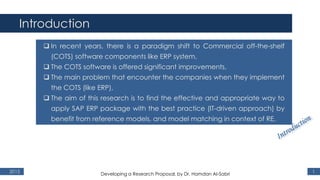
 In recent years, there is a paradigm shift to Commercial off-the-shelf
(COTS) software components like ERP system,
 The COTS software is offered significant improvements,
 The main problem that encounter the companies when they implement
the COTS (like ERP),
 The aim of this research is to find the effective and appropriate way to
apply SAP ERP package with the best practice (IT-driven approach) by
benefit from reference models, and model matching in context of RE.
Developing a Research Proposal, by Dr. Hamdan Al-Sabri
Concept Definition
2015 2
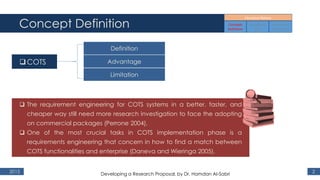
COTS
Definition
Advantage
Limitation
 The requirement engineering for COTS systems in a better, faster, and
cheaper way still need more research investigation to face the adopting
on commercial packages (Perrone 2004),
 One of the most crucial tasks in COTS implementation phase is a
requirements engineering that concern in how to find a match between
COTS functionalities and enterprise (Daneva and Wieringa 2005).
Developing a Research Proposal, by Dr. Hamdan Al-Sabri
Concept Definition
2015 3
ERP
Definition
Benefits
Imp. Problems
ERP Vendors
Risky& Project failure
Misalignment
Pre-defined the Req.
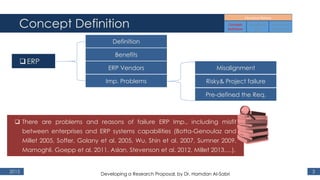
 There are problems and reasons of failure ERP Imp., including misfit
between enterprises and ERP systems capabilities (Botta-Genoulaz and
Millet 2005, Soffer, Golany et al. 2005, Wu, Shin et al. 2007, Sumner 2009,
Mamoghli, Goepp et al. 2011, Aslan, Stevenson et al. 2012, Millet 2013,…).
Developing a Research Proposal, by Dr. Hamdan Al-Sabri
Concept Definition
2015 4
SAP ERP
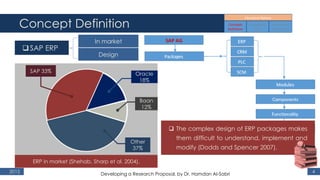
ERP in market (Shehab, Sharp et al. 2004).
Oracle
18%
Other
37%
SAP 33%
Baan
12%
In market
Design
 The complex design of ERP packages makes
them difficult to understand, implement and
modify (Dodds and Spencer 2007).
Developing a Research Proposal, by Dr. Hamdan Al-Sabri
Concept Definition
2015 5
 SAP
implementation
involves
Configuration
Customization
Enhancement
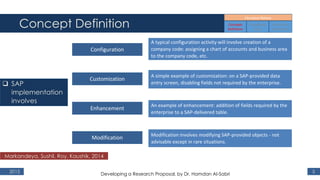
Modification Modification involves modifying SAP-provided objects - not
advisable except in rare situations.
A typical configuration activity will involve creation of a
company code: assigning a chart of accounts and business area
to the company code, etc.
A simple example of customization: on a SAP-provided data
entry screen, disabling fields not required by the enterprise.
An example of enhancement: addition of fields required by the
enterprise to a SAP-delivered table.
Markandeya, Sushil, Roy, Kaushik, 2014
Developing a Research Proposal, by Dr. Hamdan Al-Sabri
Concept Definition
2015 6
ERP Imp. approaches
IT-driven
P-driven
Hybrid
Advantage
disadvantage
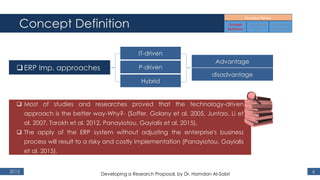
 Most of studies and researches proved that the technology-driven
approach is the better way-Why?- (Soffer, Golany et al. 2005, Juntao, Li et
al. 2007, Tarokh et al. 2012, Panayiotou, Gayialis et al. 2015),
 The apply of the ERP system without adjusting the enterprise's business
process will result to a risky and costly implementation (Panayiotou, Gayialis
et al. 2015).
Developing a Research Proposal, by Dr. Hamdan Al-Sabri
Concept Definition
2015 7
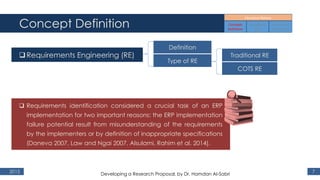
Requirements Engineering (RE)
 Requirements identification considered a crucial task of an ERP
implementation for two important reasons: the ERP implementation
failure potential result from misunderstanding of the requirements
by the implementers or by definition of inappropriate specifications
(Daneva 2007, Law and Ngai 2007, Alsulami, Rahim et al. 2014).
Definition
Type of RE
Traditional RE
COTS RE
Developing a Research Proposal, by Dr. Hamdan Al-Sabri
Concept Definition
2015 8
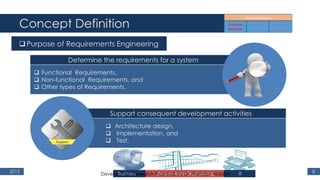
Purpose of Requirements Engineering
Determine the requirements for a system
 Functional Requirements,
 Non-functional Requirements, and
 Other types of Requirements.
Support consequent development activities
 Architecture design,
 Implementation, and
 Test.
Business ITRequirement EngineeringDeveloping a Research Proposal, by Dr. Hamdan Al-Sabri
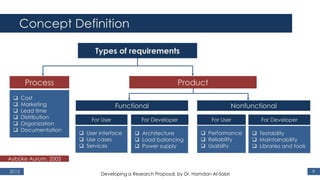
Types of requirements
Process Product
 Cost
 Marketing
 Lead time
 Distribution
 Organization
 Documentation
Functional Nonfunctional
For User
 User interface
 Use cases
 Services
For Developer
 Architecture
 Load balancing
 Power supply
For User
 Performance
 Reliability
 Usability
For Developer
 Testability
 Maintainability
 Libraries and tools
2015 9
Concept Definition
Aybüke Aurum, 2005
Developing a Research Proposal, by Dr. Hamdan Al-Sabri
Concept Definition
2015 10
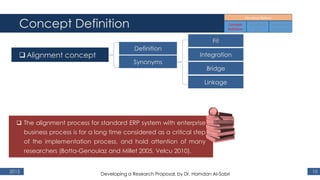
Alignment concept
 The alignment process for standard ERP system with enterprise
business process is for a long time considered as a critical step
of the implementation process, and hold attention of many
researchers (Botta-Genoulaz and Millet 2005, Velcu 2010).
Definition
Synonyms
Fit
Integration
Bridge
Linkage
Developing a Research Proposal, by Dr. Hamdan Al-Sabri
Concept Definition
2015 11
Model
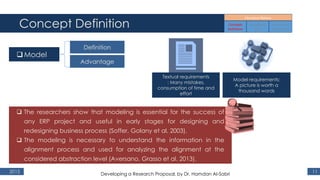
 The researchers show that modeling is essential for the success of
any ERP project and useful in early stages for designing and
redesigning business process (Soffer, Golany et al. 2003).
 The modeling is necessary to understand the information in the
alignment process and used for analyzing the alignment at the
considered abstraction level (Aversano, Grasso et al. 2013).
Definition
Advantage
Textual requirements
: Many mistakes,
consumption of time and
effort
Model requirements:
A picture is worth a
thousand words
Developing a Research Proposal, by Dr. Hamdan Al-Sabri
Concept Definition
2015 12
Reference model (RM)
Definition
Benefits
Forms of RM
Cost reduction
Time reduction
Increase model Qu.
Risk reduction
Transparency
Common language
Basis for benchmarking
Industry RM
Software RM
Procedural RM
Company RM
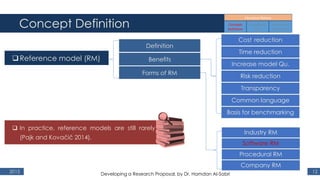
 In practice, reference models are still rarely
(Pajk and Kovačič 2014).
Developing a Research Proposal, by Dr. Hamdan Al-Sabri
Concept Definition
2015 13
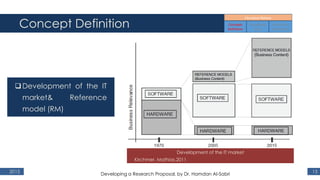
Development of the IT
market& Reference
model (RM)
Development of the IT market
Kirchmer, Mathias,2011
Developing a Research Proposal, by Dr. Hamdan Al-Sabri
Concept Definition
2015 14
Reference model (RM)
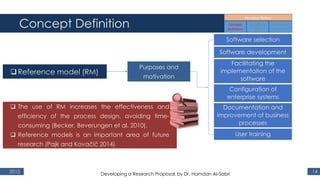
 The use of RM increases the effectiveness and
efficiency of the process design, avoiding time-
consuming (Becker, Beverungen et al. 2010).
 Reference models is an important area of future
research (Pajk and Kovačič 2014)
Purposes and
motivation
Software selection
Software development
Facilitating the
implementation of the
software
Configuration of
enterprise systems
Documentation and
improvement of business
processes
User training
Developing a Research Proposal, by Dr. Hamdan Al-Sabri
Concept Definition
2015 15
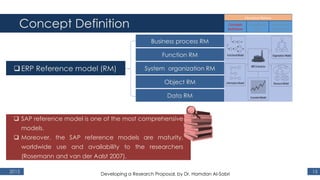
ERP Reference model (RM)
Business process RM
Function RM
System organization RM
Object RM
Data RM
 SAP reference model is one of the most comprehensive
models.
 Moreover, the SAP reference models are maturity,
worldwide use and availability to the researchers
(Rosemann and van der Aalst 2007).
Developing a Research Proposal, by Dr. Hamdan Al-Sabri
Concept Definition
2015 16
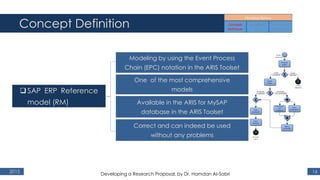
SAP ERP Reference
model (RM)
Modeling by using the Event Process
Chain (EPC) notation in the ARIS Toolset
One of the most comprehensive
models
Available in the ARIS for MySAP
database in the ARIS Toolset
Correct and can indeed be used
without any problems
Developing a Research Proposal, by Dr. Hamdan Al-Sabri
Concept Definition
2015 17
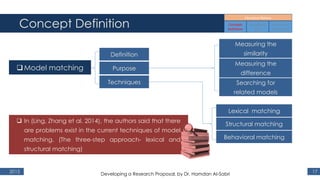
Model matching
Definition
Purpose
Techniques
Measuring the
similarity
Measuring the
difference
Searching for
related models
Lexical matching
Structural matching
Behavioral matching
 In (Ling, Zhang et al. 2014), the authors said that there
are problems exist in the current techniques of model
matching. (The three-step approach- lexical and
structural matching)
Developing a Research Proposal, by Dr. Hamdan Al-Sabri
Concept Definition
2015 18
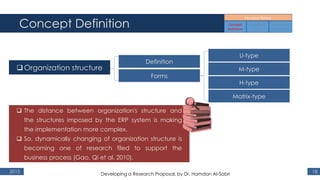
Organization structure
Definition
Forms
U-type
M-type
H-type
Matrix-type
 The distance between organization's structure and
the structures imposed by the ERP system is making
the implementation more complex.
 So, dynamically changing of organization structure is
becoming one of research filed to support the
business process (Gao, Qi et al. 2010).
Developing a Research Proposal, by Dr. Hamdan Al-Sabri
Concept Definition
2015 19
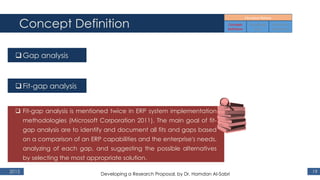
Gap analysis
Fit-gap analysis
 Fit-gap analysis is mentioned twice in ERP system implementation
methodologies (Microsoft Corporation 2011). The main goal of fit-
gap analysis are to identify and document all fits and gaps based
on a comparison of an ERP capabilities and the enterprise's needs,
analyzing of each gap, and suggesting the possible alternatives
by selecting the most appropriate solution.
Developing a Research Proposal, by Dr. Hamdan Al-Sabri
Pervious Studies
2015 20
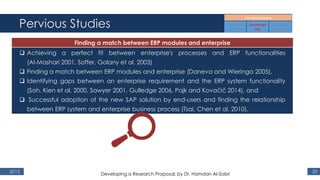
Finding a match between ERP modules and enterprise
 Achieving a perfect fit between enterprise's processes and ERP functionalities
(Al‐Mashari 2001, Soffer, Golany et al. 2003)
 Finding a match between ERP modules and enterprise (Daneva and Wieringa 2005),
 Identifying gaps between an enterprise requirement and the ERP system functionality
(Soh, Kien et al. 2000, Sawyer 2001, Gulledge 2006, Pajk and Kovačič 2014), and
 Successful adoption of the new SAP solution by end-users and finding the relationship
between ERP system and enterprise business process (Tsai, Chen et al. 2010).
Developing a Research Proposal, by Dr. Hamdan Al-Sabri
Pervious Studies
2015 21
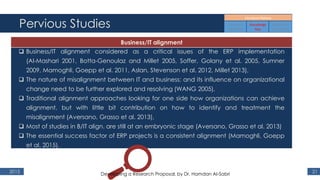
Business/IT alignment
 Business/IT alignment considered as a critical issues of the ERP implementation
(Al‐Mashari 2001, Botta-Genoulaz and Millet 2005, Soffer, Golany et al. 2005, Sumner
2009, Mamoghli, Goepp et al. 2011, Aslan, Stevenson et al. 2012, Millet 2013),
 The nature of misalignment between IT and business; and its influence on organizational
change need to be further explored and resolving (WANG 2005),
 Traditional alignment approaches looking for one side how organizations can achieve
alignment, but with little bit contribution on how to identify and treatment the
misalignment (Aversano, Grasso et al. 2013),
 Most of studies in B/IT align. are still at an embryonic stage (Aversano, Grasso et al. 2013)
 The essential success factor of ERP projects is a consistent alignment (Mamoghli, Goepp
et al. 2015).
Developing a Research Proposal, by Dr. Hamdan Al-Sabri
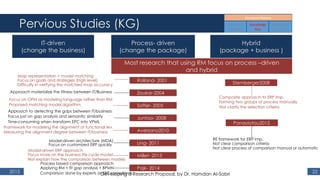
Pervious Studies (KG)
2015 22
IT-driven
(change the business)
Process- driven
(change the package)
Hybrid
(package + business )
Most research that using RM focus on process –driven
and hybrid
Approach materialize the fitness between IT/Business Zoukar-2004
Focus on OPM as modeling language rather than RM
Proposed matching model algorithm Soffer- 2005
Juntao- 2008
Approach to detecting the gaps between IT/business
Focus just on gap analysis and semantic similarity
Time-consuming when transform EPC into VPML
Aversano2010
Framework for modeling the alignment at functional lev.
Measuring the alignment degree between IT/business
Ling- 2011Focus on customized ERP quickly
Model-driven architecture (MDA)
Millet- 2013
Model-driven ERP approach
Focus more on the business life cycle model
Not explain how the comparison between models
Pajk- 2014
Process based comparison approach
Applying RM + fit gap analysis + BPMN
Comparison done by experts or ERP consultants
Map representation + model matching
Focus on goals and strategies (high level)
Difficulty in verifying the matched map accuracy
Rolland- 2001
Stemberger2008
Composite approach to ERP Imp.
Not clarify the selection criteria
Forming two groups of process manually
RE framework for ERP Imp.
Not clear comparison criteria
Not clear process of comparison manual or automatic
Panayiotou2015
Developing a Research Proposal, by Dr. Hamdan Al-Sabri
Pervious Studies (KG)
2015 23
IT-driven
(change the business)
Process- driven
(change the package)
Hybrid
(package + business )
Not focus on RM and
focuses on BPR life
cycle
However, LR proven
that IT-driven is better
in ERP Imp. (best
practice)
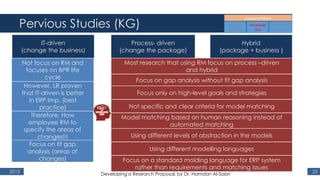
Most research that using RM focus on process –driven
and hybrid
Focus on gap analysis without fit gap analysis
Therefore, How
employee RM to
specify the areas of
changes!!!
Model matching based on human reasoning instead of
automated matching
Using different levels of abstraction in the models
Using different modelling languages
Not specific and clear criteria for model matching
Focus on a standard molding language for ERP system
rather than requirements and matching issues
Focus on fit gap
analysis (areas of
changes)
Focus only on high-level goals and strategies
Developing a Research Proposal, by Dr. Hamdan Al-Sabri
Research Objectives
2015 24
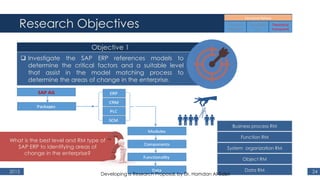
Business process RM
Function RM
System organization RM
Object RM
Data RM
Objective 1
 Investigate the SAP ERP references models to
determine the critical factors and a suitable level
that assist in the model matching process to
determine the areas of change in the enterprise.
What is the best level and RM type of
SAP ERP to identifying areas of
change in the enterprise?
Developing a Research Proposal, by Dr. Hamdan Al-Sabri
Research Objectives
2015 25
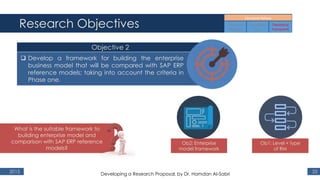
Objective 2
 Develop a framework for building the enterprise
business model that will be compared with SAP ERP
reference models; taking into account the criteria in
Phase one.
Ob2: Enterprise
model framework
Ob1: Level + type
of RM
What is the suitable framework to
building enterprise model and
comparison with SAP ERP reference
models?
Developing a Research Proposal, by Dr. Hamdan Al-Sabri
Research Objectives
2015 26
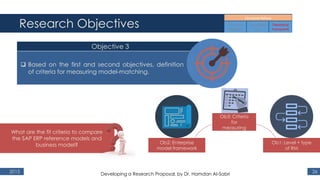
Objective 3
 Based on the first and second objectives, definition
of criteria for measuring model-matching.
Ob2: Enterprise
model framework
Ob1: Level + type
of RM
What are the fit criteria to compare
the SAP ERP reference models and
business model?
Ob3: Criteria
for
measuring
Developing a Research Proposal, by Dr. Hamdan Al-Sabri
Research Objectives
2015 27
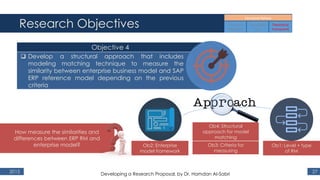
Objective 4
 Develop a structural approach that includes
modeling matching technique to measure the
similarity between enterprise business model and SAP
ERP reference model depending on the previous
criteria
Ob2: Enterprise
model framework
Ob1: Level + type
of RM
How measure the similarities and
differences between ERP RM and
enterprise model?
Ob4: Structural
approach for model
matching
Ob3: Criteria for
measuring
Developing a Research Proposal, by Dr. Hamdan Al-Sabri
Research Objectives
2015 28
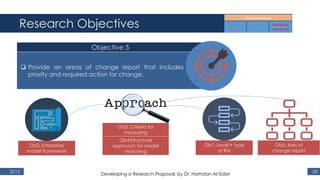
Objective 5
 Provide an areas of change report that includes
priority and required action for change.
Ob2: Enterprise
model framework
Ob1: Level + type
of RM
Ob5: Ares of
change report
Ob4:Structural
approach for model
matching
Ob3: Criteria for
measuring
Developing a Research Proposal, by Dr. Hamdan Al-Sabri
Research Significance
2015 29
Research Significance
 Accelerate the ERP implementation via pre-defined the areas of
change in the enterprise,
 Defining a clear adoption roadmap through evaluating the
readiness of the enterprise,
 Helping the enterprise become ready for the impact of change,
 Providing the stakeholders, ERP consultants, and decision makers
with the necessary knowledge and better basis for bridging the gap
between the ERP package and business
 Increasing the transparency into the entire enterprise through make
the implementation process understandable,
 …….
Developing a Research Proposal, by Dr. Hamdan Al-Sabri
Research Methodology and Techniques
2015 30
 Conduct the literature review for previous studies that employed the reference
models to solve the alignment problem in ERP implementation.
 Access to SAP business process repository and the ARIS for MySAP database in the
ARIS toolset, a commercial product of IDS-Scheer, to get SAP ERP reference models,
 Investigates and study the SAP ERP reference models for specifying the fit level to
solve alignment problem by determining the areas of changes in enterprise,
 Using ARIS tool for dealing with SAP ERP reference models that modeled by Event
process chain (EPC), for building the business model and organizational chart
 Studying most widely the methods and techniques that used to measure the
similarities and differences between models
 Designing the Model-Driven Requirements Matching by using the ARIS or BPMN
notation to represent the approach inputs, process, and outputs etc.,
 A case study and feasibility assessment will use for validation in this research
Developing a Research Proposal, by Dr. Hamdan Al-Sabri
Delimitations and assumptions
2015 31
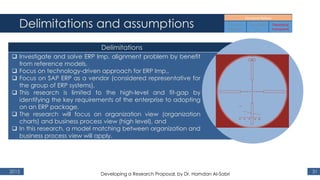
Delimitations
 Investigate and solve ERP Imp. alignment problem by benefit
from reference models,
 Focus on technology-driven approach for ERP Imp.,
 Focus on SAP ERP as a vendor (considered representative for
the group of ERP systems),
 This research is limited to the high-level and fit-gap by
identifying the key requirements of the enterprise to adopting
on an ERP package,
 The research will focus on organization view (organization
charts) and business process view (high level), and
 In this research, a model matching between organization and
business process view will apply.
Developing a Research Proposal, by Dr. Hamdan Al-Sabri
Delimitations and assumptions
2015 32
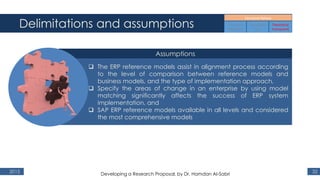
Assumptions
 The ERP reference models assist in alignment process according
to the level of comparison between reference models and
business models, and the type of implementation approach,
 Specify the areas of change in an enterprise by using model
matching significantly affects the success of ERP system
implementation, and
 SAP ERP reference models available in all levels and considered
the most comprehensive models
Developing a Research Proposal, by Dr. Hamdan Al-Sabri
Research Framework (Sum up)
2015 33
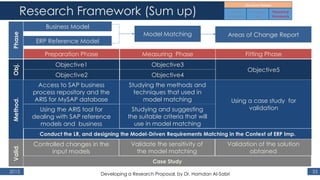
PhaseObj.Method.Valid.
Preparation Phase Measuring Phase Fitting Phase
Business Model
ERP Reference Model
Model Matching Areas of Change Report
Objective1
Objective2
Objective3
Objective4
Objective5
Studying the methods and
techniques that used in
model matching
Studying and suggesting
the suitable criteria that will
use in model matching
Using a case study for
validationUsing the ARIS tool for
dealing with SAP reference
models and business
Access to SAP business
process repository and the
ARIS for MySAP database
Conduct the LR, and designing the Model-Driven Requirements Matching in the Context of ERP Imp.
Case Study
Controlled changes in the
input models
Validate the sensitivity of
the model matching
Validation of the solution
obtained
Developing a Research Proposal, by Dr. Hamdan Al-Sabri
Research Strategies in RE
2015 34
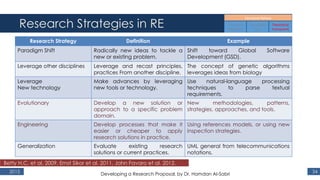
Betty H.C. et al. 2009, Ernst Sikor et al. 2011, John Favaro et al. 2012.
ExampleDefinitionResearch Strategy
Shift toward Global Software
Development (GSD).
Radically new ideas to tackle a
new or existing problem.
Paradigm Shift
The concept of genetic algorithms
leverages ideas from biology
Leverage and recast principles,
practices From another discipline.
Leverage other disciplines
Use natural-language processing
techniques to parse textual
requirements.
Make advances by leveraging
new tools or technology.
Leverage
New technology
New methodologies, patterns,
strategies, approaches, and tools.
Develop a new solution or
approach to a specific problem
domain.
Evolutionary
Using references models, or using new
inspection strategies.
Develop processes that make it
easier or cheaper to apply
research solutions in practice.
Engineering
UML general from telecommunications
notations.
Evaluate existing research
solutions or current practices.
Generalization
Developing a Research Proposal, by Dr. Hamdan Al-Sabri
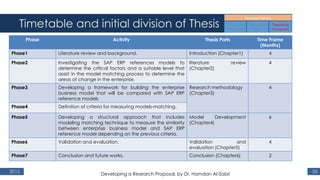
Timetable and initial division of Thesis
2015 35
Time Frame
(Months)
Thesis PartsActivityPhase
4Introduction (Chapter1)Literature review and background.Phase1
4literature review
(Chapter2)
Investigating the SAP ERP references models to
determine the critical factors and a suitable level that
assist in the model matching process to determine the
areas of change in the enterprise.
Phase2
4Research methodology
(Chapter3)
Developing a framework for building the enterprise
business model that will be compared with SAP ERP
reference models
Phase3
Definition of criteria for measuring models-matching.Phase4
6Model Development
(Chapter4)
Developing a structural approach that includes
modeling matching technique to measure the similarity
between enterprise business model and SAP ERP
reference model depending on the previous criteria.
Phase5
4Validation and
evaluation (Chapter5)
Validation and evaluation.Phase6
2Conclusion (Chapter6)Conclusion and future works.Phase7
Developing a Research Proposal, by Dr. Hamdan Al-Sabri
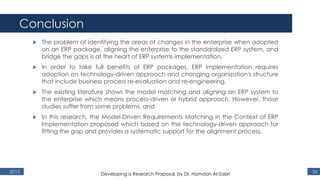
Conclusion
2015 36
 The problem of identifying the areas of changes in the enterprise when adopted
on an ERP package, aligning the enterprise to the standardized ERP system, and
bridge the gaps is at the heart of ERP systems implementation,
 In order to take full benefits of ERP packages, ERP implementation requires
adoption on technology-driven approach and changing organization's structure
that include business process re-evaluation and re-engineering,
 The existing literature shows the model matching and aligning an ERP system to
the enterprise which means process-driven or hybrid approach. However, those
studies suffer from some problems, and
 In this research, the Model-Driven Requirements Matching in the Context of ERP
Implementation proposed which based on the technology-driven approach for
fitting the gap and provides a systematic support for the alignment process,
Developing a Research Proposal, by Dr. Hamdan Al-Sabri
Thanks, Questions
Developing a Research Proposal, by Dr. Hamdan Al-Sabri
References
2015
 Addo-Tenkorang, R. and P. Helo (2011). Enterprise resource planning (ERP): A review literature
report. Proceedings of the World Congress on Engineering and Computer Science.
 Adisa, F., et al. (2010). "Living Requirements Space: An open access tool for enterprise resource
planning systems requirements gathering." Online Information Review 34(4): 540-564.
 Al‐Mashari, M. (2001). "Process orientation through enterprise resource planning (ERP): a review
of critical issues." Knowledge and Process Management 8(3): 175-185.
 Aloini, D., et al. (2012). "Modelling and assessing ERP project risks: A Petri Net approach."
European journal of operational research 220(2): 484-495.
 Alotaibi, Y. (2014). "Business process modelling challenges and solutions: a literature review."
Journal of Intelligent Manufacturing: 1-23.
 Alsulami, M., et al. (2014). "CONSOLIDATING UNDERSTANDING OF ERP CONFLICTS: A DIALECTIC
PERSPECTIVE.“
 Amid, A., et al. (2012). "Identification and classification of ERP critical failure factors in Iranian
industries." Information systems 37(3): 227-237.
Developing a Research Proposal, by Dr. Hamdan Al-Sabri
References…
2015
 Arif, M., et al. (2005). "Enterprise information systems: technology first or process first?"
Business Process Management Journal 11(1): 5-21.
 Aslan, B., et al. (2012). "Enterprise resource planning systems: An assessment of applicability
to make-to-order companies." Computers in Industry 63(7): 692-705.
 Aversano, L., et al. (2010). Measuring the alignment between business processes and
software systems: a case study. Proceedings of the 2010 ACM Symposium on Applied
Computing, ACM.
 Aversano, L., et al. (2013). A literature review of Business/IT alignment strategies. Enterprise
Information Systems, Springer: 471-488.
 Becker, J., et al. (2010). "The challenge of conceptual modeling for product–service
systems: status-quo and perspectives for reference models and modeling languages."
Information systems and e-business management 8(1): 33-66.
 Becker, M. and R. Laue (2012). "A comparative survey of business process similarity
measures." Computers in Industry 63(2): 148-167.
Developing a Research Proposal, by Dr. Hamdan Al-Sabri
References…
2015
 Benbasat, I., et al. (1987). "The case research strategy in studies of information systems." MIS
quarterly: 369-386.
 Boehm, B. (2000). "Requirements that handle IKIWISI, COTS, and rapid change." Computer
33(7): 99-102.
 Bonner, M. (2000). "Roadmap to ERP Success." Control Magazine 26(08): 14.
 Botta-Genoulaz, V. and P.-A. Millet (2005). "A classification for better use of ERP systems."
Computers in Industry 56(6): 573-587.
 Brehm, L., et al. (2001). Tailoring ERP systems: a spectrum of choices and their implications.
System Sciences, 2001. Proceedings of the 34th Annual Hawaii International Conference
on, IEEE.
 Brockmans, S., et al. (2006). Semantic Alignment of Business Processes. ICEIS (3).
 Brown, C. and I. Vessey (1999). ERP implementation approaches: toward a contingency
framework. Proceedings of the 20th international conference on Information Systems,
Association for Information Systems.
Developing a Research Proposal, by Dr. Hamdan Al-Sabri
References…
2015
 Chan, Y. E. and B. H. Reich (2007). "IT alignment: what have we learned?" Journal of
information technology 22(4): 297-315.
 Chand, D., et al. (2005). "A balanced scorecard based framework for assessing the
strategic impacts of ERP systems." Computers in Industry 56(6): 558-572.
 Chiplunkar, C., et al. (2003). "Application of principles of event related open systems to
business process reengineering." Computers & Industrial Engineering 45(3): 347-374.
 Christofi, M., et al. (2013). "Towards ERP success in SMEs through business process review
prior to implementation." Journal of Systems and Information Technology 15(4): 304-323.
 Chung, L. and K. Cooper (2002). A knowledge-based COTS-aware requirements
engineering approach. Proceedings of the 14th international conference on Software
engineering and knowledge engineering, ACM.
 Ciborra, C. U. (1997). "De profundis? Deconstructing the concept of strategic alignment."
Scandinavian journal of information systems 9(1): 2.
 Constantine, J. A. and S. Solak (2010). "SysML modeling of off‐the‐shelf‐option acquisition
for risk mitigation in military programs." Systems Engineering 13(1): 80-94.
Developing a Research Proposal, by Dr. Hamdan Al-Sabri
References…
2015 1
 Corrales, J. C., et al. (2006). BPEL processes matchmaking for service discovery. On the
Move to Meaningful Internet Systems 2006: CoopIS, DOA, GADA, and ODBASE, Springer:
237-254.
 Curran, T., et al. (1997). SAP R/3 business blueprint: understanding the business process
reference model, Prentice-Hall, Inc.
 Daneva, M. (2003). Six degrees of success or failure in ERP requirements engineering:
experiences with the ASAP process. International Workshop on COTS and Product
Software: Why Requirements are so Important, Citeseer.
 Daneva, M. (2007). Understanding success and failure profiles of ERP requirements
engineering: an empirical study. Software Engineering and Advanced Applications, 2007.
33rd EUROMICRO Conference on, IEEE.
 Daneva, M. and R. Wieringa (2005). Requirements engineering for cross-organizational ERP
implementation undocumented assumptions and potential mismatches. Requirements
Engineering, 2005. Proceedings. 13th IEEE International Conference on, IEEE.
Developing a Research Proposal, by Dr. Hamdan Al-Sabri
References…
2015
 Dijkman, R., et al. (2009). Aligning business process models. Enterprise Distributed Object
Computing Conference, 2009. EDOC'09. IEEE International, IEEE.
 Dijkman, R., et al. (2011). "Similarity of business process models: Metrics and evaluation."
Information systems 36(2): 498-516.
 Dodds, T. and R. Spencer (2007). "Next-generation administrative systems: Philosophy,
principles, and technology." Research Bulletin(19).
 Dumas, M., et al. (2013). Fundamentals of business process management, Springer.
 Ehie, I. C. and M. Madsen (2005). "Identifying critical issues in enterprise resource planning
(ERP) implementation." Computers in Industry 56(6): 545-557.
 Etien, A. and C. Rolland (2005). "Measuring the fitness relationship." Requirements
Engineering 10(3): 184-197.
 Fettke, P. and P. Loos (2003). "Classification of reference models: a methodology and its
application." Information systems and e-business management 1(1): 35-53.
Developing a Research Proposal, by Dr. Hamdan Al-Sabri
References…
2015
 Finnegan, R. (2008). Requirements engineering methodologies for COTS systems.
Electro/Information Technology, 2008. EIT 2008. IEEE International Conference on, IEEE.
 Finney, S. and M. Corbett (2007). "ERP implementation: a compilation and analysis of
critical success factors." Business Process Management Journal 13(3): 329-347.
 Frick, N. and P. Schubert (2009). "Future requirements of ERP software from the vendors'
point of view."
 Fryling, M. (2014). ERP Customization vs. Business Process Reengineering: Technical and
Functional Perceptions. Proceedings of the Conference for Information Systems Applied
Research ISSN.
 Gable, G., et al. (1997). "Large packaged software: the need for research." PACIS 1997
Proceedings: 37.
 Gable, G. G. (1998). "Large Package Software-A Neglected Technology?" Journal of
Global Information Management 6: 3-4.
Developing a Research Proposal, by Dr. Hamdan Al-Sabri
References…
2015
 Gao, C., et al. (2010). Organization Structure Modeling for Manufacturing ERP. System
Science, Engineering Design and Manufacturing Informatization (ICSEM), 2010
International Conference on, IEEE.
 Ghosh, R. (2012). "A Comprehensive Study on ERP Failures Stressing on Reluctance to
Change as a Cause of Failure." Journal of Marketing and Management 3(1): 123-134.
 Gibson, N., et al. (1999). Enterprise resource planning: a business approach to systems
development. Systems Sciences, 1999. HICSS-32. Proceedings of the 32nd Annual Hawaii
International Conference on, IEEE.
 Goodhue, D. L. and R. L. Thompson (1995). "Task-technology fit and individual
performance." MIS quarterly: 213-236.
 Gruhn, V. and R. Laue (2007). "What business process modelers can learn from
programmers." Science of Computer Programming 65(1): 4-13.
 Gulla, J. A. and T. Brasethvik (2000). On the challenges of business modeling in large-scale
reengineering projects. Requirements Engineering, 2000. Proceedings. 4th International
Conference on, IEEE.
Developing a Research Proposal, by Dr. Hamdan Al-Sabri
References…
2015
 Gulledge, T. and G. Simon (2005). "The evolution of SAP implementation environments: A
case study from a complex public sector project." Industrial Management & Data Systems
105(6): 714-736.
 Gulledge, T. R. (2006). "ERP gap-fit analysis from a business process orientation."
International Journal of Services and Standards 2(4): 339-348.
 Gunasekaran, A. and B. Kobu (2002). "Modelling and analysis of business process
reengineering." International Journal of Production Research 40(11): 2521-2546.
 Gunasekaran, A., et al. (2006). "Information technology and systems justification: A review
for research and applications." European journal of operational research 173(3): 957-983.
 Helo, P., et al. (2008). "Expectation and reality in ERP implementation: consultant and
solution provider perspective." Industrial Management & Data Systems 108(8): 1045-1059.
 Henderson, J. C. and N. Venkatraman (1992). Strategic alignment: a model for
organizational transformation through information technology, Oxford University Press, New
York.
Developing a Research Proposal, by Dr. Hamdan Al-Sabri
References…
2015
 Henderson, J. C. and N. Venkatraman (1993). "Strategic alignment: Leveraging information
technology for transforming organizations." IBM systems journal 32(1): 4-16.
 Hilt, B. (2007). "Predefined reference models–a» living guide «containing proven process
knowledge that anyone can use." IDS Scheer AG: ARIS Expert Paper.
 Hollingsworth, D. (1995). "The workflow reference model."
 Hung, R. Y.-Y. (2006). "Business process management as competitive advantage: a review
and empirical study." Total Quality Management & Business Excellence 17(1): 21-40.
 Isoda, S. (2001). "Object-oriented real-world modeling revisited." Journal of Systems and
Software 59(2): 153-162.
 Jacobs, F. R. and E. Bendoly (2003). "Enterprise resource planning: developments and
directions for operations management research." European journal of operational
research 146(2): 233-240.
 Jacobson, I., et al. (1999). The unified modeling language user guide, Addison Wesley.
Developing a Research Proposal, by Dr. Hamdan Al-Sabri
References…
2015
 Juntao, G. and Z. Li (2008). Detecting Gaps between ERP Software and Organizational
Needs: A Semantic Similarity Based Approach. Semantic Computing and Systems, 2008.
WSCS'08. IEEE International Workshop on, IEEE.
 Juntao, G., et al. (2007). Procuring requirements for ERP software based on semantic
similarity. Semantic Computing, 2007. ICSC 2007. International Conference on, IEEE.
 Keller, G., et al. (1992). "Semantische Prozebmodellierung auf der Grundlage." publication
of the Institut für Wirtschaftsinformatik, paper 89.
 Kirchmer, M. (2011). Reference Models to Empower MPE. High Performance Through
Process Excellence, Springer: 87-101.
 Klaus, H., et al. (2000). "What is ERP?" Information systems frontiers 2(2): 141-162.
 Kohl, R. J. (2005). "Requirements engineering changes for COTS-intensive systems." IEEE
software 22(4): 63-64.
 Kontio, J. (1995). A Systematic Process for Reusable Software Component Selection,
Citeseer.
Developing a Research Proposal, by Dr. Hamdan Al-Sabri
References…
2015
 Kristiansen, R., et al. (2006). Use of Tailored Process Models to Support ERP End-Users. ISTA,
Citeseer.
 Krumbholz, M. a., et al. (2000). "Implementing enterprise resource planning packages in
different corporate and national cultures." Journal of information technology 15(4): 267-
279.
 Küster, J. M., et al. (2006). Improving business process models with reference models in
business-driven development. Business Process Management Workshops, Springer.
 Larsen, T. J. (2009). "A multilevel explanation of end-user computing satisfaction with an
enterprise resource planning system within an international manufacturing organization."
Computers in Industry 60(9): 657-668.
 Law, C. C. and E. W. Ngai (2007). "ERP systems adoption: An exploratory study of the
organizational factors and impacts of ERP success." Information & Management 44(4): 418-
432.
 Le, T. L. and C. Rolland (2001). Functional matching in COTS-based development context.
INFORSID, Citeseer.
Developing a Research Proposal, by Dr. Hamdan Al-Sabri
References…
2015
 Leung, C. (2008). ERP Implementation Failure Rate. Retrieved 25 September 2008.
 Light, B. (2001). "The maintenance implications of the customization of ERP software."
Journal of software maintenance and evolution: research and practice 13(6): 415-429.
 Ling, J., et al. (2014). Business Process Model Alignment: An Approach to Support Fast
Discovering Complex Matches. Enterprise Interoperability VI, Springer: 41-51.
 Ling, S. and P. HaiXia (2011). Study on Model-Driven ERP System Implementation for Textile
Enterprises. Proceedings of the 2011 Third International Workshop on Education Technology
and Computer Science-Volume 01, IEEE Computer Society.
 Mamoghli, S., et al. (2011). "A decision algorithm for ERP systems alignment." International
Journal of Business Information Systems 8(1): 23-45.
 Mamoghli, S., et al. (2015). "An operational “Risk Factor Driven” approach for the
mitigation and monitoring of the “Misalignment Risk” in Enterprise Resource Planning
projects." Computers in Industry 70: 1-12.
Developing a Research Proposal, by Dr. Hamdan Al-Sabri
References…
2015
 Markus, M. L. (2004). "Technochange management: using IT to drive organizational
change." Journal of information technology 19(1): 4-20.
 McAdam, R. and A. Galloway (2005). "Enterprise resource planning and organisational
innovation: a management perspective." Industrial Management & Data Systems 105(3):
280-290.
 McCormack, K. P. (2007). Business process maturity: theory and application, BookSurge.
 Microsoft Corporation, m. (2011). "Microsoft Dynamics Sure Step methodology."
 Mili, H., et al. (2010). "Business process modeling languages: Sorting through the alphabet
soup." ACM Computing Surveys (CSUR) 43(1): 4.
 Millet, P.-A. (2013). "Toward a model-driven, alignment-oriented ERP methodology."
Computers in Industry 64(4): 402-411.
 Nazemi, E., et al. (2012). "ERP: a literature survey." The International Journal of Advanced
Manufacturing Technology 61(9-12): 999-1018.
 Nejati, S., et al. (2007). Matching and merging of statecharts specifications. Proceedings of
the 29th international conference on Software Engineering, IEEE Computer Society.
Developing a Research Proposal, by Dr. Hamdan Al-Sabri
References…
2015
 Ngai, E. W., et al. (2008). "Examining the critical success factors in the adoption of
enterprise resource planning." Computers in Industry 59(6): 548-564.
 Ochs, M., et al. (2001). A method for efficient measurement-based COTS assessment and
selection method description and evaluation results. Software Metrics Symposium, 2001.
METRICS 2001. Proceedings. Seventh International, IEEE.
 Osei‐Bryson, K. M., et al. (2008). "Exploring managerial factors affecting ERP
implementation: an investigation of the Klein‐Sorra model using regression splines."
Information Systems Journal 18(5): 499-527.
 Ould, M. A. and M. Ould (1995). Business Processes: Modelling and analysis for re-
engineering and improvement, Wiley Chichester.
 Pajk, D. and A. Kovačič (2014). "Fit Gap Analysis–The Role of Business Process Reference
Models." Economic and Business Review 15(4): 319-338.
 Panayiotou, N. A., et al. (2015). "A business process modeling-enabled requirements
engineering framework for ERP implementation." Business Process Management Journal
21(3).
Developing a Research Proposal, by Dr. Hamdan Al-Sabri
References…
2015
 Parr, A. N. and G. Shanks (2000). A taxonomy of ERP implementation approaches. System
Sciences, 2000. Proceedings of the 33rd Annual Hawaii International Conference on, IEEE.
 Perrone, V. (2004). A wish list for requirements engineering for COTS-based information
systems. COTS-Based Software Systems, Springer: 146-158.
 Porter, M. E. (1996). "What is strategy?" Published November.
 Powell, D., et al. (2013). "The concurrent application of lean production and ERP: Towards
an ERP-based lean implementation process." Computers in Industry 64(3): 324-335.
 Prieto-Díaz, R. (1993). "Status report: Software reusability." Software, IEEE 10(3): 61-66.
 Prieto-Diaz, R. and P. Freeman (1987). "Classifying software for reusability." Software, IEEE
4(1): 6-16.
 Quiescenti, M., et al. (2006). "Business process-oriented design of Enterprise Resource
Planning (ERP) systems for small and medium enterprises." International Journal of
Production Research 44(18-19): 3797-3811.
 Rebstock, M. and J. G. Selig (2000). "Development and implementation strategies for
international ERP software projects." ECIS 2000 Proceedings: 76.
Developing a Research Proposal, by Dr. Hamdan Al-Sabri
References…
2015
 Recker, J., et al. (2012). "How novices design business processes." Information systems 37(6):
557-573.
 Rolland, C. (1999). "Requirements engineering for COTS based systems." Information and
Software Technology 41(14): 985-990.
 Rolland, C. and N. Prakash (2000). "Bridging the gap between organisational needs and
ERP functionality." Requirements Engineering 5(3): 180-193.
 Rolland, C. and N. Prakash (2001). Matching ERP system functionality to customer
requirements. Requirements Engineering, 2001. Proceedings. Fifth IEEE International
Symposium on, IEEE.
 Rosemann, M. (2000). "Using reference models within the enterprise resource planning
lifecycle." Australian Accounting Review 10(22): 19-30.
 Rosemann, M. and W. M. van der Aalst (2007). "A configurable reference modelling
language." Information systems 32(1): 1-23.
Developing a Research Proposal, by Dr. Hamdan Al-Sabri
References…
2015
 Sawyer, S. (2001). "A market-based perspective on information systems development."
Communications of the ACM 44(11): 97-102.
 Scheer, A.-W. and F. Habermann (2000). "Enterprise resource planning: making ERP a
success." Communications of the ACM 43(4): 57-61.
 Scheer, A.-W. and M. Nüttgens (2000). ARIS architecture and reference models for business
process management, Springer.
 Shanks, G. (2000). "A model of ERP project implementation." Journal of information
technology 15(4): 289-303.
 Shehab, E., et al. (2004). "Enterprise resource planning: An integrative review." Business
Process Management Journal 10(4): 359-386.
 Soffer, P. (2003). Aligning an Enterprise System with Enterprise Requirements: An Iterative
Process. ICEIS (3), Citeseer.
 Soffer, P., et al. (2003). "ERP modeling: a comprehensive approach." Information systems
28(6): 673-690.
Developing a Research Proposal, by Dr. Hamdan Al-Sabri
References…
2015
 Soffer, P., et al. (2005). "Aligning an ERP system with enterprise requirements: An object-process
based approach." Computers in Industry 56(6): 639-662.
 Soffer, P., et al. (2001). "Modelling off-the-shelf information systems requirements: an ontological
approach." Requirements Engineering 6(3): 183-199.
 Soh, C., et al. (2000). "Enterprise resource planning: cultural fits and misfits: is ERP a universal
solution?" Communications of the ACM 43(4): 47-51.
 Sommerville, I. (2008). Construction by configuration: Challenges for software engineering
research and practice. Software Engineering, 2008. ASWEC 2008. 19th Australian Conference
on, IEEE.
 Štemberger, M., et al. (2009). "Business Process Modelling as a Critical Success Factor in
Implementing an ERP System." South East European Journal of Economics and Business 4(2): 89-
96.
 Štemberger, M. I. and A. Kovacic (2008). The role of business process modelling in ERP
implementation projects. Computer Modeling and Simulation, 2008. UKSIM 2008. Tenth
International Conference on, IEEE.
 Sumner, M. R. (2009). "How alignment strategies influence ERP project success." Enterprise
Information Systems 3(4): 425-448.
Developing a Research Proposal, by Dr. Hamdan Al-Sabri
References…
2015
 Tsai, W.-H., et al. (2010). "A study of the impact of business process on the ERP system
effectiveness." International Journal of Business and Management 5(9): p26.
 Van der Aalst, W. M. and A. Weijters (2004). "Process mining: a research agenda."
Computers in Industry 53(3): 231-244.
 Van Dongen, B. and M. Jansen-Vullers (2005). EPC Verification in the ARIS for MySAP
reference model database. EPK.
 Van Stijn, E. and A. Wensley (2001). "Organizational memory and the completeness of
process modeling in ERP systems: some concerns, methods and directions for future
research." Business Process Management Journal 7(3): 181-194.
 Velcu, O. (2010). "Strategic alignment of ERP implementation stages: An empirical
investigation." Information & Management 47(3): 158-166.
 WANG, E. T. (2005). "Understanding Misalignments of Enterprise Resource Planning System."
 Weil, P. and M. Broadbent (1998). "Leveraging the new infrastructure." Harvard Business
School Press. Boston.
Developing a Research Proposal, by Dr. Hamdan Al-Sabri
References…
2015
 Weske, M., et al. (2004). "Advances in business process management." Data & Knowledge
Engineering 50(1): 1-8.
 Wiegers, K. and J. Beatty (2013). Software requirements, Pearson Education.
 Winkelmann, A. (2012). "Reference model maintenance based on ERP system
implementations." AIS Transactions on Enterprise Systems 3(1): 1-9.
 Wu, J.-H., et al. (2007). "A methodology for ERP misfit analysis." Information & Management
44(8): 666-680.
 Yeh, T.-M., et al. (2007). "Service quality and ERP implementation: A conceptual and
empirical study of semiconductor-related industries in Taiwan." Computers in Industry 58(8):
844-854.
 Yin, R. K. (2013). Case study research: Design and methods, Sage publications.
 Yu, C.-S. (2005). "Causes influencing the effectiveness of the post-implementation ERP
system." Industrial Management & Data Systems 105(1): 115-132.
Developing a Research Proposal, by Dr. Hamdan Al-Sabri
References…
2015
 Ziemba, E. and I. Oblak (2013). Critical success factors for ERP systems implementation in
public administration. Proceedings of the Informing Science and Information Technology
Education Conference.
 Zoukar, I. and C. Salinesi (2004). Engineering the Fitness Relationship between an ERP and
the Supply Chain Process at SNCF. Information Resources Management Association.
Developing a Research Proposal, by Dr. Hamdan Al-Sabri

Developing a research proposal in the field of software engineering model driven requirements matching as an example

  • 1.
    Developing a ResearchProposal in the field of Software Engineering: Model-Driven Requirements Matching as an Example PREPARED BY : DR. HAMDAN M. AL-SABRI 2015 College of Computer and Information Sciences Information Systems
  • 2.
    Outline  Introduction  ConceptDefinition  Pervious Studies  Knowledge Gap  Research Objectives  Research Significance  Research Methodology and Techniques  Delimitations and assumptions  Research Strategies  Timetable and initial division of Thesis  Conclusion Developing a Research Proposal, by Dr. Hamdan Al-Sabri
  • 3.
    Introduction 2015 1  Inrecent years, there is a paradigm shift to Commercial off-the-shelf (COTS) software components like ERP system,  The COTS software is offered significant improvements,  The main problem that encounter the companies when they implement the COTS (like ERP),  The aim of this research is to find the effective and appropriate way to apply SAP ERP package with the best practice (IT-driven approach) by benefit from reference models, and model matching in context of RE. Developing a Research Proposal, by Dr. Hamdan Al-Sabri
  • 4.
    Concept Definition 2015 2 COTS Definition Advantage Limitation The requirement engineering for COTS systems in a better, faster, and cheaper way still need more research investigation to face the adopting on commercial packages (Perrone 2004),  One of the most crucial tasks in COTS implementation phase is a requirements engineering that concern in how to find a match between COTS functionalities and enterprise (Daneva and Wieringa 2005). Developing a Research Proposal, by Dr. Hamdan Al-Sabri
  • 5.
    Concept Definition 2015 3 ERP Definition Benefits Imp.Problems ERP Vendors Risky& Project failure Misalignment Pre-defined the Req.  There are problems and reasons of failure ERP Imp., including misfit between enterprises and ERP systems capabilities (Botta-Genoulaz and Millet 2005, Soffer, Golany et al. 2005, Wu, Shin et al. 2007, Sumner 2009, Mamoghli, Goepp et al. 2011, Aslan, Stevenson et al. 2012, Millet 2013,…). Developing a Research Proposal, by Dr. Hamdan Al-Sabri
  • 6.
    Concept Definition 2015 4 SAPERP ERP in market (Shehab, Sharp et al. 2004). Oracle 18% Other 37% SAP 33% Baan 12% In market Design  The complex design of ERP packages makes them difficult to understand, implement and modify (Dodds and Spencer 2007). Developing a Research Proposal, by Dr. Hamdan Al-Sabri
  • 7.
    Concept Definition 2015 5 SAP implementation involves Configuration Customization Enhancement Modification Modification involves modifying SAP-provided objects - not advisable except in rare situations. A typical configuration activity will involve creation of a company code: assigning a chart of accounts and business area to the company code, etc. A simple example of customization: on a SAP-provided data entry screen, disabling fields not required by the enterprise. An example of enhancement: addition of fields required by the enterprise to a SAP-delivered table. Markandeya, Sushil, Roy, Kaushik, 2014 Developing a Research Proposal, by Dr. Hamdan Al-Sabri
  • 8.
    Concept Definition 2015 6 ERPImp. approaches IT-driven P-driven Hybrid Advantage disadvantage  Most of studies and researches proved that the technology-driven approach is the better way-Why?- (Soffer, Golany et al. 2005, Juntao, Li et al. 2007, Tarokh et al. 2012, Panayiotou, Gayialis et al. 2015),  The apply of the ERP system without adjusting the enterprise's business process will result to a risky and costly implementation (Panayiotou, Gayialis et al. 2015). Developing a Research Proposal, by Dr. Hamdan Al-Sabri
  • 9.
    Concept Definition 2015 7 RequirementsEngineering (RE)  Requirements identification considered a crucial task of an ERP implementation for two important reasons: the ERP implementation failure potential result from misunderstanding of the requirements by the implementers or by definition of inappropriate specifications (Daneva 2007, Law and Ngai 2007, Alsulami, Rahim et al. 2014). Definition Type of RE Traditional RE COTS RE Developing a Research Proposal, by Dr. Hamdan Al-Sabri
  • 10.
    Concept Definition 2015 8 Purposeof Requirements Engineering Determine the requirements for a system  Functional Requirements,  Non-functional Requirements, and  Other types of Requirements. Support consequent development activities  Architecture design,  Implementation, and  Test. Business ITRequirement EngineeringDeveloping a Research Proposal, by Dr. Hamdan Al-Sabri
  • 11.
    Types of requirements ProcessProduct  Cost  Marketing  Lead time  Distribution  Organization  Documentation Functional Nonfunctional For User  User interface  Use cases  Services For Developer  Architecture  Load balancing  Power supply For User  Performance  Reliability  Usability For Developer  Testability  Maintainability  Libraries and tools 2015 9 Concept Definition Aybüke Aurum, 2005 Developing a Research Proposal, by Dr. Hamdan Al-Sabri
  • 12.
    Concept Definition 2015 10 Alignmentconcept  The alignment process for standard ERP system with enterprise business process is for a long time considered as a critical step of the implementation process, and hold attention of many researchers (Botta-Genoulaz and Millet 2005, Velcu 2010). Definition Synonyms Fit Integration Bridge Linkage Developing a Research Proposal, by Dr. Hamdan Al-Sabri
  • 13.
    Concept Definition 2015 11 Model The researchers show that modeling is essential for the success of any ERP project and useful in early stages for designing and redesigning business process (Soffer, Golany et al. 2003).  The modeling is necessary to understand the information in the alignment process and used for analyzing the alignment at the considered abstraction level (Aversano, Grasso et al. 2013). Definition Advantage Textual requirements : Many mistakes, consumption of time and effort Model requirements: A picture is worth a thousand words Developing a Research Proposal, by Dr. Hamdan Al-Sabri
  • 14.
    Concept Definition 2015 12 Referencemodel (RM) Definition Benefits Forms of RM Cost reduction Time reduction Increase model Qu. Risk reduction Transparency Common language Basis for benchmarking Industry RM Software RM Procedural RM Company RM  In practice, reference models are still rarely (Pajk and Kovačič 2014). Developing a Research Proposal, by Dr. Hamdan Al-Sabri
  • 15.
    Concept Definition 2015 13 Developmentof the IT market& Reference model (RM) Development of the IT market Kirchmer, Mathias,2011 Developing a Research Proposal, by Dr. Hamdan Al-Sabri
  • 16.
    Concept Definition 2015 14 Referencemodel (RM)  The use of RM increases the effectiveness and efficiency of the process design, avoiding time- consuming (Becker, Beverungen et al. 2010).  Reference models is an important area of future research (Pajk and Kovačič 2014) Purposes and motivation Software selection Software development Facilitating the implementation of the software Configuration of enterprise systems Documentation and improvement of business processes User training Developing a Research Proposal, by Dr. Hamdan Al-Sabri
  • 17.
    Concept Definition 2015 15 ERPReference model (RM) Business process RM Function RM System organization RM Object RM Data RM  SAP reference model is one of the most comprehensive models.  Moreover, the SAP reference models are maturity, worldwide use and availability to the researchers (Rosemann and van der Aalst 2007). Developing a Research Proposal, by Dr. Hamdan Al-Sabri
  • 18.
    Concept Definition 2015 16 SAPERP Reference model (RM) Modeling by using the Event Process Chain (EPC) notation in the ARIS Toolset One of the most comprehensive models Available in the ARIS for MySAP database in the ARIS Toolset Correct and can indeed be used without any problems Developing a Research Proposal, by Dr. Hamdan Al-Sabri
  • 19.
    Concept Definition 2015 17 Modelmatching Definition Purpose Techniques Measuring the similarity Measuring the difference Searching for related models Lexical matching Structural matching Behavioral matching  In (Ling, Zhang et al. 2014), the authors said that there are problems exist in the current techniques of model matching. (The three-step approach- lexical and structural matching) Developing a Research Proposal, by Dr. Hamdan Al-Sabri
  • 20.
    Concept Definition 2015 18 Organizationstructure Definition Forms U-type M-type H-type Matrix-type  The distance between organization's structure and the structures imposed by the ERP system is making the implementation more complex.  So, dynamically changing of organization structure is becoming one of research filed to support the business process (Gao, Qi et al. 2010). Developing a Research Proposal, by Dr. Hamdan Al-Sabri
  • 21.
    Concept Definition 2015 19 Gapanalysis Fit-gap analysis  Fit-gap analysis is mentioned twice in ERP system implementation methodologies (Microsoft Corporation 2011). The main goal of fit- gap analysis are to identify and document all fits and gaps based on a comparison of an ERP capabilities and the enterprise's needs, analyzing of each gap, and suggesting the possible alternatives by selecting the most appropriate solution. Developing a Research Proposal, by Dr. Hamdan Al-Sabri
  • 22.
    Pervious Studies 2015 20 Findinga match between ERP modules and enterprise  Achieving a perfect fit between enterprise's processes and ERP functionalities (Al‐Mashari 2001, Soffer, Golany et al. 2003)  Finding a match between ERP modules and enterprise (Daneva and Wieringa 2005),  Identifying gaps between an enterprise requirement and the ERP system functionality (Soh, Kien et al. 2000, Sawyer 2001, Gulledge 2006, Pajk and Kovačič 2014), and  Successful adoption of the new SAP solution by end-users and finding the relationship between ERP system and enterprise business process (Tsai, Chen et al. 2010). Developing a Research Proposal, by Dr. Hamdan Al-Sabri
  • 23.
    Pervious Studies 2015 21 Business/ITalignment  Business/IT alignment considered as a critical issues of the ERP implementation (Al‐Mashari 2001, Botta-Genoulaz and Millet 2005, Soffer, Golany et al. 2005, Sumner 2009, Mamoghli, Goepp et al. 2011, Aslan, Stevenson et al. 2012, Millet 2013),  The nature of misalignment between IT and business; and its influence on organizational change need to be further explored and resolving (WANG 2005),  Traditional alignment approaches looking for one side how organizations can achieve alignment, but with little bit contribution on how to identify and treatment the misalignment (Aversano, Grasso et al. 2013),  Most of studies in B/IT align. are still at an embryonic stage (Aversano, Grasso et al. 2013)  The essential success factor of ERP projects is a consistent alignment (Mamoghli, Goepp et al. 2015). Developing a Research Proposal, by Dr. Hamdan Al-Sabri
  • 24.
    Pervious Studies (KG) 201522 IT-driven (change the business) Process- driven (change the package) Hybrid (package + business ) Most research that using RM focus on process –driven and hybrid Approach materialize the fitness between IT/Business Zoukar-2004 Focus on OPM as modeling language rather than RM Proposed matching model algorithm Soffer- 2005 Juntao- 2008 Approach to detecting the gaps between IT/business Focus just on gap analysis and semantic similarity Time-consuming when transform EPC into VPML Aversano2010 Framework for modeling the alignment at functional lev. Measuring the alignment degree between IT/business Ling- 2011Focus on customized ERP quickly Model-driven architecture (MDA) Millet- 2013 Model-driven ERP approach Focus more on the business life cycle model Not explain how the comparison between models Pajk- 2014 Process based comparison approach Applying RM + fit gap analysis + BPMN Comparison done by experts or ERP consultants Map representation + model matching Focus on goals and strategies (high level) Difficulty in verifying the matched map accuracy Rolland- 2001 Stemberger2008 Composite approach to ERP Imp. Not clarify the selection criteria Forming two groups of process manually RE framework for ERP Imp. Not clear comparison criteria Not clear process of comparison manual or automatic Panayiotou2015 Developing a Research Proposal, by Dr. Hamdan Al-Sabri
  • 25.
    Pervious Studies (KG) 201523 IT-driven (change the business) Process- driven (change the package) Hybrid (package + business ) Not focus on RM and focuses on BPR life cycle However, LR proven that IT-driven is better in ERP Imp. (best practice) Most research that using RM focus on process –driven and hybrid Focus on gap analysis without fit gap analysis Therefore, How employee RM to specify the areas of changes!!! Model matching based on human reasoning instead of automated matching Using different levels of abstraction in the models Using different modelling languages Not specific and clear criteria for model matching Focus on a standard molding language for ERP system rather than requirements and matching issues Focus on fit gap analysis (areas of changes) Focus only on high-level goals and strategies Developing a Research Proposal, by Dr. Hamdan Al-Sabri
  • 26.
    Research Objectives 2015 24 Businessprocess RM Function RM System organization RM Object RM Data RM Objective 1  Investigate the SAP ERP references models to determine the critical factors and a suitable level that assist in the model matching process to determine the areas of change in the enterprise. What is the best level and RM type of SAP ERP to identifying areas of change in the enterprise? Developing a Research Proposal, by Dr. Hamdan Al-Sabri
  • 27.
    Research Objectives 2015 25 Objective2  Develop a framework for building the enterprise business model that will be compared with SAP ERP reference models; taking into account the criteria in Phase one. Ob2: Enterprise model framework Ob1: Level + type of RM What is the suitable framework to building enterprise model and comparison with SAP ERP reference models? Developing a Research Proposal, by Dr. Hamdan Al-Sabri
  • 28.
    Research Objectives 2015 26 Objective3  Based on the first and second objectives, definition of criteria for measuring model-matching. Ob2: Enterprise model framework Ob1: Level + type of RM What are the fit criteria to compare the SAP ERP reference models and business model? Ob3: Criteria for measuring Developing a Research Proposal, by Dr. Hamdan Al-Sabri
  • 29.
    Research Objectives 2015 27 Objective4  Develop a structural approach that includes modeling matching technique to measure the similarity between enterprise business model and SAP ERP reference model depending on the previous criteria Ob2: Enterprise model framework Ob1: Level + type of RM How measure the similarities and differences between ERP RM and enterprise model? Ob4: Structural approach for model matching Ob3: Criteria for measuring Developing a Research Proposal, by Dr. Hamdan Al-Sabri
  • 30.
    Research Objectives 2015 28 Objective5  Provide an areas of change report that includes priority and required action for change. Ob2: Enterprise model framework Ob1: Level + type of RM Ob5: Ares of change report Ob4:Structural approach for model matching Ob3: Criteria for measuring Developing a Research Proposal, by Dr. Hamdan Al-Sabri
  • 31.
    Research Significance 2015 29 ResearchSignificance  Accelerate the ERP implementation via pre-defined the areas of change in the enterprise,  Defining a clear adoption roadmap through evaluating the readiness of the enterprise,  Helping the enterprise become ready for the impact of change,  Providing the stakeholders, ERP consultants, and decision makers with the necessary knowledge and better basis for bridging the gap between the ERP package and business  Increasing the transparency into the entire enterprise through make the implementation process understandable,  ……. Developing a Research Proposal, by Dr. Hamdan Al-Sabri
  • 32.
    Research Methodology andTechniques 2015 30  Conduct the literature review for previous studies that employed the reference models to solve the alignment problem in ERP implementation.  Access to SAP business process repository and the ARIS for MySAP database in the ARIS toolset, a commercial product of IDS-Scheer, to get SAP ERP reference models,  Investigates and study the SAP ERP reference models for specifying the fit level to solve alignment problem by determining the areas of changes in enterprise,  Using ARIS tool for dealing with SAP ERP reference models that modeled by Event process chain (EPC), for building the business model and organizational chart  Studying most widely the methods and techniques that used to measure the similarities and differences between models  Designing the Model-Driven Requirements Matching by using the ARIS or BPMN notation to represent the approach inputs, process, and outputs etc.,  A case study and feasibility assessment will use for validation in this research Developing a Research Proposal, by Dr. Hamdan Al-Sabri
  • 33.
    Delimitations and assumptions 201531 Delimitations  Investigate and solve ERP Imp. alignment problem by benefit from reference models,  Focus on technology-driven approach for ERP Imp.,  Focus on SAP ERP as a vendor (considered representative for the group of ERP systems),  This research is limited to the high-level and fit-gap by identifying the key requirements of the enterprise to adopting on an ERP package,  The research will focus on organization view (organization charts) and business process view (high level), and  In this research, a model matching between organization and business process view will apply. Developing a Research Proposal, by Dr. Hamdan Al-Sabri
  • 34.
    Delimitations and assumptions 201532 Assumptions  The ERP reference models assist in alignment process according to the level of comparison between reference models and business models, and the type of implementation approach,  Specify the areas of change in an enterprise by using model matching significantly affects the success of ERP system implementation, and  SAP ERP reference models available in all levels and considered the most comprehensive models Developing a Research Proposal, by Dr. Hamdan Al-Sabri
  • 35.
    Research Framework (Sumup) 2015 33 PhaseObj.Method.Valid. Preparation Phase Measuring Phase Fitting Phase Business Model ERP Reference Model Model Matching Areas of Change Report Objective1 Objective2 Objective3 Objective4 Objective5 Studying the methods and techniques that used in model matching Studying and suggesting the suitable criteria that will use in model matching Using a case study for validationUsing the ARIS tool for dealing with SAP reference models and business Access to SAP business process repository and the ARIS for MySAP database Conduct the LR, and designing the Model-Driven Requirements Matching in the Context of ERP Imp. Case Study Controlled changes in the input models Validate the sensitivity of the model matching Validation of the solution obtained Developing a Research Proposal, by Dr. Hamdan Al-Sabri
  • 36.
    Research Strategies inRE 2015 34 Betty H.C. et al. 2009, Ernst Sikor et al. 2011, John Favaro et al. 2012. ExampleDefinitionResearch Strategy Shift toward Global Software Development (GSD). Radically new ideas to tackle a new or existing problem. Paradigm Shift The concept of genetic algorithms leverages ideas from biology Leverage and recast principles, practices From another discipline. Leverage other disciplines Use natural-language processing techniques to parse textual requirements. Make advances by leveraging new tools or technology. Leverage New technology New methodologies, patterns, strategies, approaches, and tools. Develop a new solution or approach to a specific problem domain. Evolutionary Using references models, or using new inspection strategies. Develop processes that make it easier or cheaper to apply research solutions in practice. Engineering UML general from telecommunications notations. Evaluate existing research solutions or current practices. Generalization Developing a Research Proposal, by Dr. Hamdan Al-Sabri
  • 37.
    Timetable and initialdivision of Thesis 2015 35 Time Frame (Months) Thesis PartsActivityPhase 4Introduction (Chapter1)Literature review and background.Phase1 4literature review (Chapter2) Investigating the SAP ERP references models to determine the critical factors and a suitable level that assist in the model matching process to determine the areas of change in the enterprise. Phase2 4Research methodology (Chapter3) Developing a framework for building the enterprise business model that will be compared with SAP ERP reference models Phase3 Definition of criteria for measuring models-matching.Phase4 6Model Development (Chapter4) Developing a structural approach that includes modeling matching technique to measure the similarity between enterprise business model and SAP ERP reference model depending on the previous criteria. Phase5 4Validation and evaluation (Chapter5) Validation and evaluation.Phase6 2Conclusion (Chapter6)Conclusion and future works.Phase7 Developing a Research Proposal, by Dr. Hamdan Al-Sabri
  • 38.
    Conclusion 2015 36  Theproblem of identifying the areas of changes in the enterprise when adopted on an ERP package, aligning the enterprise to the standardized ERP system, and bridge the gaps is at the heart of ERP systems implementation,  In order to take full benefits of ERP packages, ERP implementation requires adoption on technology-driven approach and changing organization's structure that include business process re-evaluation and re-engineering,  The existing literature shows the model matching and aligning an ERP system to the enterprise which means process-driven or hybrid approach. However, those studies suffer from some problems, and  In this research, the Model-Driven Requirements Matching in the Context of ERP Implementation proposed which based on the technology-driven approach for fitting the gap and provides a systematic support for the alignment process, Developing a Research Proposal, by Dr. Hamdan Al-Sabri
  • 39.
    Thanks, Questions Developing aResearch Proposal, by Dr. Hamdan Al-Sabri
  • 40.
    References 2015  Addo-Tenkorang, R.and P. Helo (2011). Enterprise resource planning (ERP): A review literature report. Proceedings of the World Congress on Engineering and Computer Science.  Adisa, F., et al. (2010). "Living Requirements Space: An open access tool for enterprise resource planning systems requirements gathering." Online Information Review 34(4): 540-564.  Al‐Mashari, M. (2001). "Process orientation through enterprise resource planning (ERP): a review of critical issues." Knowledge and Process Management 8(3): 175-185.  Aloini, D., et al. (2012). "Modelling and assessing ERP project risks: A Petri Net approach." European journal of operational research 220(2): 484-495.  Alotaibi, Y. (2014). "Business process modelling challenges and solutions: a literature review." Journal of Intelligent Manufacturing: 1-23.  Alsulami, M., et al. (2014). "CONSOLIDATING UNDERSTANDING OF ERP CONFLICTS: A DIALECTIC PERSPECTIVE.“  Amid, A., et al. (2012). "Identification and classification of ERP critical failure factors in Iranian industries." Information systems 37(3): 227-237. Developing a Research Proposal, by Dr. Hamdan Al-Sabri
  • 41.
    References… 2015  Arif, M.,et al. (2005). "Enterprise information systems: technology first or process first?" Business Process Management Journal 11(1): 5-21.  Aslan, B., et al. (2012). "Enterprise resource planning systems: An assessment of applicability to make-to-order companies." Computers in Industry 63(7): 692-705.  Aversano, L., et al. (2010). Measuring the alignment between business processes and software systems: a case study. Proceedings of the 2010 ACM Symposium on Applied Computing, ACM.  Aversano, L., et al. (2013). A literature review of Business/IT alignment strategies. Enterprise Information Systems, Springer: 471-488.  Becker, J., et al. (2010). "The challenge of conceptual modeling for product–service systems: status-quo and perspectives for reference models and modeling languages." Information systems and e-business management 8(1): 33-66.  Becker, M. and R. Laue (2012). "A comparative survey of business process similarity measures." Computers in Industry 63(2): 148-167. Developing a Research Proposal, by Dr. Hamdan Al-Sabri
  • 42.
    References… 2015  Benbasat, I.,et al. (1987). "The case research strategy in studies of information systems." MIS quarterly: 369-386.  Boehm, B. (2000). "Requirements that handle IKIWISI, COTS, and rapid change." Computer 33(7): 99-102.  Bonner, M. (2000). "Roadmap to ERP Success." Control Magazine 26(08): 14.  Botta-Genoulaz, V. and P.-A. Millet (2005). "A classification for better use of ERP systems." Computers in Industry 56(6): 573-587.  Brehm, L., et al. (2001). Tailoring ERP systems: a spectrum of choices and their implications. System Sciences, 2001. Proceedings of the 34th Annual Hawaii International Conference on, IEEE.  Brockmans, S., et al. (2006). Semantic Alignment of Business Processes. ICEIS (3).  Brown, C. and I. Vessey (1999). ERP implementation approaches: toward a contingency framework. Proceedings of the 20th international conference on Information Systems, Association for Information Systems. Developing a Research Proposal, by Dr. Hamdan Al-Sabri
  • 43.
    References… 2015  Chan, Y.E. and B. H. Reich (2007). "IT alignment: what have we learned?" Journal of information technology 22(4): 297-315.  Chand, D., et al. (2005). "A balanced scorecard based framework for assessing the strategic impacts of ERP systems." Computers in Industry 56(6): 558-572.  Chiplunkar, C., et al. (2003). "Application of principles of event related open systems to business process reengineering." Computers & Industrial Engineering 45(3): 347-374.  Christofi, M., et al. (2013). "Towards ERP success in SMEs through business process review prior to implementation." Journal of Systems and Information Technology 15(4): 304-323.  Chung, L. and K. Cooper (2002). A knowledge-based COTS-aware requirements engineering approach. Proceedings of the 14th international conference on Software engineering and knowledge engineering, ACM.  Ciborra, C. U. (1997). "De profundis? Deconstructing the concept of strategic alignment." Scandinavian journal of information systems 9(1): 2.  Constantine, J. A. and S. Solak (2010). "SysML modeling of off‐the‐shelf‐option acquisition for risk mitigation in military programs." Systems Engineering 13(1): 80-94. Developing a Research Proposal, by Dr. Hamdan Al-Sabri
  • 44.
    References… 2015 1  Corrales,J. C., et al. (2006). BPEL processes matchmaking for service discovery. On the Move to Meaningful Internet Systems 2006: CoopIS, DOA, GADA, and ODBASE, Springer: 237-254.  Curran, T., et al. (1997). SAP R/3 business blueprint: understanding the business process reference model, Prentice-Hall, Inc.  Daneva, M. (2003). Six degrees of success or failure in ERP requirements engineering: experiences with the ASAP process. International Workshop on COTS and Product Software: Why Requirements are so Important, Citeseer.  Daneva, M. (2007). Understanding success and failure profiles of ERP requirements engineering: an empirical study. Software Engineering and Advanced Applications, 2007. 33rd EUROMICRO Conference on, IEEE.  Daneva, M. and R. Wieringa (2005). Requirements engineering for cross-organizational ERP implementation undocumented assumptions and potential mismatches. Requirements Engineering, 2005. Proceedings. 13th IEEE International Conference on, IEEE. Developing a Research Proposal, by Dr. Hamdan Al-Sabri
  • 45.
    References… 2015  Dijkman, R.,et al. (2009). Aligning business process models. Enterprise Distributed Object Computing Conference, 2009. EDOC'09. IEEE International, IEEE.  Dijkman, R., et al. (2011). "Similarity of business process models: Metrics and evaluation." Information systems 36(2): 498-516.  Dodds, T. and R. Spencer (2007). "Next-generation administrative systems: Philosophy, principles, and technology." Research Bulletin(19).  Dumas, M., et al. (2013). Fundamentals of business process management, Springer.  Ehie, I. C. and M. Madsen (2005). "Identifying critical issues in enterprise resource planning (ERP) implementation." Computers in Industry 56(6): 545-557.  Etien, A. and C. Rolland (2005). "Measuring the fitness relationship." Requirements Engineering 10(3): 184-197.  Fettke, P. and P. Loos (2003). "Classification of reference models: a methodology and its application." Information systems and e-business management 1(1): 35-53. Developing a Research Proposal, by Dr. Hamdan Al-Sabri
  • 46.
    References… 2015  Finnegan, R.(2008). Requirements engineering methodologies for COTS systems. Electro/Information Technology, 2008. EIT 2008. IEEE International Conference on, IEEE.  Finney, S. and M. Corbett (2007). "ERP implementation: a compilation and analysis of critical success factors." Business Process Management Journal 13(3): 329-347.  Frick, N. and P. Schubert (2009). "Future requirements of ERP software from the vendors' point of view."  Fryling, M. (2014). ERP Customization vs. Business Process Reengineering: Technical and Functional Perceptions. Proceedings of the Conference for Information Systems Applied Research ISSN.  Gable, G., et al. (1997). "Large packaged software: the need for research." PACIS 1997 Proceedings: 37.  Gable, G. G. (1998). "Large Package Software-A Neglected Technology?" Journal of Global Information Management 6: 3-4. Developing a Research Proposal, by Dr. Hamdan Al-Sabri
  • 47.
    References… 2015  Gao, C.,et al. (2010). Organization Structure Modeling for Manufacturing ERP. System Science, Engineering Design and Manufacturing Informatization (ICSEM), 2010 International Conference on, IEEE.  Ghosh, R. (2012). "A Comprehensive Study on ERP Failures Stressing on Reluctance to Change as a Cause of Failure." Journal of Marketing and Management 3(1): 123-134.  Gibson, N., et al. (1999). Enterprise resource planning: a business approach to systems development. Systems Sciences, 1999. HICSS-32. Proceedings of the 32nd Annual Hawaii International Conference on, IEEE.  Goodhue, D. L. and R. L. Thompson (1995). "Task-technology fit and individual performance." MIS quarterly: 213-236.  Gruhn, V. and R. Laue (2007). "What business process modelers can learn from programmers." Science of Computer Programming 65(1): 4-13.  Gulla, J. A. and T. Brasethvik (2000). On the challenges of business modeling in large-scale reengineering projects. Requirements Engineering, 2000. Proceedings. 4th International Conference on, IEEE. Developing a Research Proposal, by Dr. Hamdan Al-Sabri
  • 48.
    References… 2015  Gulledge, T.and G. Simon (2005). "The evolution of SAP implementation environments: A case study from a complex public sector project." Industrial Management & Data Systems 105(6): 714-736.  Gulledge, T. R. (2006). "ERP gap-fit analysis from a business process orientation." International Journal of Services and Standards 2(4): 339-348.  Gunasekaran, A. and B. Kobu (2002). "Modelling and analysis of business process reengineering." International Journal of Production Research 40(11): 2521-2546.  Gunasekaran, A., et al. (2006). "Information technology and systems justification: A review for research and applications." European journal of operational research 173(3): 957-983.  Helo, P., et al. (2008). "Expectation and reality in ERP implementation: consultant and solution provider perspective." Industrial Management & Data Systems 108(8): 1045-1059.  Henderson, J. C. and N. Venkatraman (1992). Strategic alignment: a model for organizational transformation through information technology, Oxford University Press, New York. Developing a Research Proposal, by Dr. Hamdan Al-Sabri
  • 49.
    References… 2015  Henderson, J.C. and N. Venkatraman (1993). "Strategic alignment: Leveraging information technology for transforming organizations." IBM systems journal 32(1): 4-16.  Hilt, B. (2007). "Predefined reference models–a» living guide «containing proven process knowledge that anyone can use." IDS Scheer AG: ARIS Expert Paper.  Hollingsworth, D. (1995). "The workflow reference model."  Hung, R. Y.-Y. (2006). "Business process management as competitive advantage: a review and empirical study." Total Quality Management & Business Excellence 17(1): 21-40.  Isoda, S. (2001). "Object-oriented real-world modeling revisited." Journal of Systems and Software 59(2): 153-162.  Jacobs, F. R. and E. Bendoly (2003). "Enterprise resource planning: developments and directions for operations management research." European journal of operational research 146(2): 233-240.  Jacobson, I., et al. (1999). The unified modeling language user guide, Addison Wesley. Developing a Research Proposal, by Dr. Hamdan Al-Sabri
  • 50.
    References… 2015  Juntao, G.and Z. Li (2008). Detecting Gaps between ERP Software and Organizational Needs: A Semantic Similarity Based Approach. Semantic Computing and Systems, 2008. WSCS'08. IEEE International Workshop on, IEEE.  Juntao, G., et al. (2007). Procuring requirements for ERP software based on semantic similarity. Semantic Computing, 2007. ICSC 2007. International Conference on, IEEE.  Keller, G., et al. (1992). "Semantische Prozebmodellierung auf der Grundlage." publication of the Institut für Wirtschaftsinformatik, paper 89.  Kirchmer, M. (2011). Reference Models to Empower MPE. High Performance Through Process Excellence, Springer: 87-101.  Klaus, H., et al. (2000). "What is ERP?" Information systems frontiers 2(2): 141-162.  Kohl, R. J. (2005). "Requirements engineering changes for COTS-intensive systems." IEEE software 22(4): 63-64.  Kontio, J. (1995). A Systematic Process for Reusable Software Component Selection, Citeseer. Developing a Research Proposal, by Dr. Hamdan Al-Sabri
  • 51.
    References… 2015  Kristiansen, R.,et al. (2006). Use of Tailored Process Models to Support ERP End-Users. ISTA, Citeseer.  Krumbholz, M. a., et al. (2000). "Implementing enterprise resource planning packages in different corporate and national cultures." Journal of information technology 15(4): 267- 279.  Küster, J. M., et al. (2006). Improving business process models with reference models in business-driven development. Business Process Management Workshops, Springer.  Larsen, T. J. (2009). "A multilevel explanation of end-user computing satisfaction with an enterprise resource planning system within an international manufacturing organization." Computers in Industry 60(9): 657-668.  Law, C. C. and E. W. Ngai (2007). "ERP systems adoption: An exploratory study of the organizational factors and impacts of ERP success." Information & Management 44(4): 418- 432.  Le, T. L. and C. Rolland (2001). Functional matching in COTS-based development context. INFORSID, Citeseer. Developing a Research Proposal, by Dr. Hamdan Al-Sabri
  • 52.
    References… 2015  Leung, C.(2008). ERP Implementation Failure Rate. Retrieved 25 September 2008.  Light, B. (2001). "The maintenance implications of the customization of ERP software." Journal of software maintenance and evolution: research and practice 13(6): 415-429.  Ling, J., et al. (2014). Business Process Model Alignment: An Approach to Support Fast Discovering Complex Matches. Enterprise Interoperability VI, Springer: 41-51.  Ling, S. and P. HaiXia (2011). Study on Model-Driven ERP System Implementation for Textile Enterprises. Proceedings of the 2011 Third International Workshop on Education Technology and Computer Science-Volume 01, IEEE Computer Society.  Mamoghli, S., et al. (2011). "A decision algorithm for ERP systems alignment." International Journal of Business Information Systems 8(1): 23-45.  Mamoghli, S., et al. (2015). "An operational “Risk Factor Driven” approach for the mitigation and monitoring of the “Misalignment Risk” in Enterprise Resource Planning projects." Computers in Industry 70: 1-12. Developing a Research Proposal, by Dr. Hamdan Al-Sabri
  • 53.
    References… 2015  Markus, M.L. (2004). "Technochange management: using IT to drive organizational change." Journal of information technology 19(1): 4-20.  McAdam, R. and A. Galloway (2005). "Enterprise resource planning and organisational innovation: a management perspective." Industrial Management & Data Systems 105(3): 280-290.  McCormack, K. P. (2007). Business process maturity: theory and application, BookSurge.  Microsoft Corporation, m. (2011). "Microsoft Dynamics Sure Step methodology."  Mili, H., et al. (2010). "Business process modeling languages: Sorting through the alphabet soup." ACM Computing Surveys (CSUR) 43(1): 4.  Millet, P.-A. (2013). "Toward a model-driven, alignment-oriented ERP methodology." Computers in Industry 64(4): 402-411.  Nazemi, E., et al. (2012). "ERP: a literature survey." The International Journal of Advanced Manufacturing Technology 61(9-12): 999-1018.  Nejati, S., et al. (2007). Matching and merging of statecharts specifications. Proceedings of the 29th international conference on Software Engineering, IEEE Computer Society. Developing a Research Proposal, by Dr. Hamdan Al-Sabri
  • 54.
    References… 2015  Ngai, E.W., et al. (2008). "Examining the critical success factors in the adoption of enterprise resource planning." Computers in Industry 59(6): 548-564.  Ochs, M., et al. (2001). A method for efficient measurement-based COTS assessment and selection method description and evaluation results. Software Metrics Symposium, 2001. METRICS 2001. Proceedings. Seventh International, IEEE.  Osei‐Bryson, K. M., et al. (2008). "Exploring managerial factors affecting ERP implementation: an investigation of the Klein‐Sorra model using regression splines." Information Systems Journal 18(5): 499-527.  Ould, M. A. and M. Ould (1995). Business Processes: Modelling and analysis for re- engineering and improvement, Wiley Chichester.  Pajk, D. and A. Kovačič (2014). "Fit Gap Analysis–The Role of Business Process Reference Models." Economic and Business Review 15(4): 319-338.  Panayiotou, N. A., et al. (2015). "A business process modeling-enabled requirements engineering framework for ERP implementation." Business Process Management Journal 21(3). Developing a Research Proposal, by Dr. Hamdan Al-Sabri
  • 55.
    References… 2015  Parr, A.N. and G. Shanks (2000). A taxonomy of ERP implementation approaches. System Sciences, 2000. Proceedings of the 33rd Annual Hawaii International Conference on, IEEE.  Perrone, V. (2004). A wish list for requirements engineering for COTS-based information systems. COTS-Based Software Systems, Springer: 146-158.  Porter, M. E. (1996). "What is strategy?" Published November.  Powell, D., et al. (2013). "The concurrent application of lean production and ERP: Towards an ERP-based lean implementation process." Computers in Industry 64(3): 324-335.  Prieto-Díaz, R. (1993). "Status report: Software reusability." Software, IEEE 10(3): 61-66.  Prieto-Diaz, R. and P. Freeman (1987). "Classifying software for reusability." Software, IEEE 4(1): 6-16.  Quiescenti, M., et al. (2006). "Business process-oriented design of Enterprise Resource Planning (ERP) systems for small and medium enterprises." International Journal of Production Research 44(18-19): 3797-3811.  Rebstock, M. and J. G. Selig (2000). "Development and implementation strategies for international ERP software projects." ECIS 2000 Proceedings: 76. Developing a Research Proposal, by Dr. Hamdan Al-Sabri
  • 56.
    References… 2015  Recker, J.,et al. (2012). "How novices design business processes." Information systems 37(6): 557-573.  Rolland, C. (1999). "Requirements engineering for COTS based systems." Information and Software Technology 41(14): 985-990.  Rolland, C. and N. Prakash (2000). "Bridging the gap between organisational needs and ERP functionality." Requirements Engineering 5(3): 180-193.  Rolland, C. and N. Prakash (2001). Matching ERP system functionality to customer requirements. Requirements Engineering, 2001. Proceedings. Fifth IEEE International Symposium on, IEEE.  Rosemann, M. (2000). "Using reference models within the enterprise resource planning lifecycle." Australian Accounting Review 10(22): 19-30.  Rosemann, M. and W. M. van der Aalst (2007). "A configurable reference modelling language." Information systems 32(1): 1-23. Developing a Research Proposal, by Dr. Hamdan Al-Sabri
  • 57.
    References… 2015  Sawyer, S.(2001). "A market-based perspective on information systems development." Communications of the ACM 44(11): 97-102.  Scheer, A.-W. and F. Habermann (2000). "Enterprise resource planning: making ERP a success." Communications of the ACM 43(4): 57-61.  Scheer, A.-W. and M. Nüttgens (2000). ARIS architecture and reference models for business process management, Springer.  Shanks, G. (2000). "A model of ERP project implementation." Journal of information technology 15(4): 289-303.  Shehab, E., et al. (2004). "Enterprise resource planning: An integrative review." Business Process Management Journal 10(4): 359-386.  Soffer, P. (2003). Aligning an Enterprise System with Enterprise Requirements: An Iterative Process. ICEIS (3), Citeseer.  Soffer, P., et al. (2003). "ERP modeling: a comprehensive approach." Information systems 28(6): 673-690. Developing a Research Proposal, by Dr. Hamdan Al-Sabri
  • 58.
    References… 2015  Soffer, P.,et al. (2005). "Aligning an ERP system with enterprise requirements: An object-process based approach." Computers in Industry 56(6): 639-662.  Soffer, P., et al. (2001). "Modelling off-the-shelf information systems requirements: an ontological approach." Requirements Engineering 6(3): 183-199.  Soh, C., et al. (2000). "Enterprise resource planning: cultural fits and misfits: is ERP a universal solution?" Communications of the ACM 43(4): 47-51.  Sommerville, I. (2008). Construction by configuration: Challenges for software engineering research and practice. Software Engineering, 2008. ASWEC 2008. 19th Australian Conference on, IEEE.  Štemberger, M., et al. (2009). "Business Process Modelling as a Critical Success Factor in Implementing an ERP System." South East European Journal of Economics and Business 4(2): 89- 96.  Štemberger, M. I. and A. Kovacic (2008). The role of business process modelling in ERP implementation projects. Computer Modeling and Simulation, 2008. UKSIM 2008. Tenth International Conference on, IEEE.  Sumner, M. R. (2009). "How alignment strategies influence ERP project success." Enterprise Information Systems 3(4): 425-448. Developing a Research Proposal, by Dr. Hamdan Al-Sabri
  • 59.
    References… 2015  Tsai, W.-H.,et al. (2010). "A study of the impact of business process on the ERP system effectiveness." International Journal of Business and Management 5(9): p26.  Van der Aalst, W. M. and A. Weijters (2004). "Process mining: a research agenda." Computers in Industry 53(3): 231-244.  Van Dongen, B. and M. Jansen-Vullers (2005). EPC Verification in the ARIS for MySAP reference model database. EPK.  Van Stijn, E. and A. Wensley (2001). "Organizational memory and the completeness of process modeling in ERP systems: some concerns, methods and directions for future research." Business Process Management Journal 7(3): 181-194.  Velcu, O. (2010). "Strategic alignment of ERP implementation stages: An empirical investigation." Information & Management 47(3): 158-166.  WANG, E. T. (2005). "Understanding Misalignments of Enterprise Resource Planning System."  Weil, P. and M. Broadbent (1998). "Leveraging the new infrastructure." Harvard Business School Press. Boston. Developing a Research Proposal, by Dr. Hamdan Al-Sabri
  • 60.
    References… 2015  Weske, M.,et al. (2004). "Advances in business process management." Data & Knowledge Engineering 50(1): 1-8.  Wiegers, K. and J. Beatty (2013). Software requirements, Pearson Education.  Winkelmann, A. (2012). "Reference model maintenance based on ERP system implementations." AIS Transactions on Enterprise Systems 3(1): 1-9.  Wu, J.-H., et al. (2007). "A methodology for ERP misfit analysis." Information & Management 44(8): 666-680.  Yeh, T.-M., et al. (2007). "Service quality and ERP implementation: A conceptual and empirical study of semiconductor-related industries in Taiwan." Computers in Industry 58(8): 844-854.  Yin, R. K. (2013). Case study research: Design and methods, Sage publications.  Yu, C.-S. (2005). "Causes influencing the effectiveness of the post-implementation ERP system." Industrial Management & Data Systems 105(1): 115-132. Developing a Research Proposal, by Dr. Hamdan Al-Sabri
  • 61.
    References… 2015  Ziemba, E.and I. Oblak (2013). Critical success factors for ERP systems implementation in public administration. Proceedings of the Informing Science and Information Technology Education Conference.  Zoukar, I. and C. Salinesi (2004). Engineering the Fitness Relationship between an ERP and the Supply Chain Process at SNCF. Information Resources Management Association. Developing a Research Proposal, by Dr. Hamdan Al-Sabri