Download as PDF, PPTX

![[8] Process Research in Requirements Elicitation
(ieee,2013)
Prepared by: Dr.Hamdan Al-Sabri
• The aim of this paper is to present an overview of the
methodological opportunities of applying process research to
study real-world, industrial requirements elicitation practices.
• Empirical requirements elicitation research needs more real-
world process thinking, considering phenomena dynamically –
in terms of movement, activity, events, change, and temporal
evolution [14].
• Attention should be given to considerations of how and why
things change, act, and evolve over time.](https://image.slidesharecdn.com/requirementselicitationrequirementsengineering-170928201126/85/Requirements-elicitation-requirements-engineering-2-320.jpg)
![[8]..The Dynamic Nature of the Requirements
Elicitation Process
Prepared by: Dr.Hamdan Al-Sabri](https://image.slidesharecdn.com/requirementselicitationrequirementsengineering-170928201126/85/Requirements-elicitation-requirements-engineering-3-320.jpg)
![[8]..Process Research Strategies
• Process research addresses dynamic questions about
temporally evolving phenomena [15]. It is concerned with
understanding how patterns in events, activities, and choices
evolve over time and why they evolve in this way.
• [10] Define process research “as the dynamic study of
behavior in organizations, focusing on organizational context,
sequences of incidents, activities and actions, which unfold
over time.”
Prepared by: Dr.Hamdan Al-Sabri](https://image.slidesharecdn.com/requirementselicitationrequirementsengineering-170928201126/85/Requirements-elicitation-requirements-engineering-4-320.jpg)
![Longitudinal Fieldwork
• Longitudinal research may study phenomena by tracing them
backward into the past, by following them forward into the
future, by examining how they are constituted, or by doing all
of these at the same time [15].
Prepared by: Dr.Hamdan Al-Sabri](https://image.slidesharecdn.com/requirementselicitationrequirementsengineering-170928201126/85/Requirements-elicitation-requirements-engineering-5-320.jpg)
![Contextualization
• The environments of software organizations differ, as do their
sizes, customer types, countries or geography, and history. All
these factors influence elicitation practices in unique ways.
• Additionally, the human factors underlying the organizational
culture differ from one organization to the next and also
influence the way software is developed [7].
• Contextualization requires immersion and a focus on relevant
phenomena.
Prepared by: Dr.Hamdan Al-Sabri](https://image.slidesharecdn.com/requirementselicitationrequirementsengineering-170928201126/85/Requirements-elicitation-requirements-engineering-6-320.jpg)
![[9] Effect-oriented Requirements Elicitation and
Specification (ieee,2013)
• this paper, they introduce a requirements engineering
method and specification guideline that supports the
deductive derivation and specification of measures from a
causal chain of goals, deficits, hypotheses and solutions for
evaluating a system’s effect on its application environment.
Prepared by: Dr.Hamdan Al-Sabri](https://image.slidesharecdn.com/requirementselicitationrequirementsengineering-170928201126/85/Requirements-elicitation-requirements-engineering-7-320.jpg)
![[9] ..
• Context and Solution Analysis Phase for TLPA
Prepared by: Dr.Hamdan Al-Sabri](https://image.slidesharecdn.com/requirementselicitationrequirementsengineering-170928201126/85/Requirements-elicitation-requirements-engineering-8-320.jpg)
![[9] ..
• Context and Solution Analysis Phase for TLPA
Prepared by: Dr.Hamdan Al-Sabri](https://image.slidesharecdn.com/requirementselicitationrequirementsengineering-170928201126/85/Requirements-elicitation-requirements-engineering-9-320.jpg)
![[9] ..
• Context and Solution Analysis Phase for TLPA
Prepared by: Dr.Hamdan Al-Sabri](https://image.slidesharecdn.com/requirementselicitationrequirementsengineering-170928201126/85/Requirements-elicitation-requirements-engineering-10-320.jpg)
![[9] ..
• Development Phase for TLPA
Prepared by: Dr.Hamdan Al-Sabri](https://image.slidesharecdn.com/requirementselicitationrequirementsengineering-170928201126/85/Requirements-elicitation-requirements-engineering-11-320.jpg)
![[9] ..
• Evaluation Phase for TLPA
Prepared by: Dr.Hamdan Al-Sabri](https://image.slidesharecdn.com/requirementselicitationrequirementsengineering-170928201126/85/Requirements-elicitation-requirements-engineering-12-320.jpg)
![[9] ..
• Evaluation Phase for TLPA
Prepared by: Dr.Hamdan Al-Sabri](https://image.slidesharecdn.com/requirementselicitationrequirementsengineering-170928201126/85/Requirements-elicitation-requirements-engineering-13-320.jpg)
![[9] ..
Prepared by: Dr.Hamdan Al-Sabri](https://image.slidesharecdn.com/requirementselicitationrequirementsengineering-170928201126/85/Requirements-elicitation-requirements-engineering-14-320.jpg)
![[10] Using Task-oriented Requirements
Engineering in Different Domains (ieee,2009)
• In this paper, they present experiences made with the task-
oriented requirements engineering framework “TORE” in four
different case studies.
Prepared by: Dr.Hamdan Al-Sabri](https://image.slidesharecdn.com/requirementselicitationrequirementsengineering-170928201126/85/Requirements-elicitation-requirements-engineering-15-320.jpg)
![[10] ..
Prepared by: Dr.Hamdan Al-Sabri](https://image.slidesharecdn.com/requirementselicitationrequirementsengineering-170928201126/85/Requirements-elicitation-requirements-engineering-16-320.jpg)
![[11] The state of the art in automated
requirements elicitation (ELSERVER, 2013)
• This paper aims to capture the current state of automated
requirements elicitation and derive future research directions
by identifying gaps in the existing body of knowledge and
through relating existing works to each other.
Prepared by: Dr.Hamdan Al-Sabri](https://image.slidesharecdn.com/requirementselicitationrequirementsengineering-170928201126/85/Requirements-elicitation-requirements-engineering-17-320.jpg)
![[11] ..
• [16] Defines requirements elicitation as a core RE activity
aiming to (1) determine relevant requirements sources (2)
identify requirements from these sources and (3) develop
new requirements.
• Automated requirements elicitation primarily focuses on
identify requirements from these sources (second activity).
Prepared by: Dr.Hamdan Al-Sabri](https://image.slidesharecdn.com/requirementselicitationrequirementsengineering-170928201126/85/Requirements-elicitation-requirements-engineering-18-320.jpg)
![[11] .. Degree of automation
• A complete automation of RE tasks can lead to a loss of
information or erroneous results [18].
• A technological concept closely related to automated
elicitation is the reuse of existing requirements or knowledge
[11,21,24].
Prepared by: Dr.Hamdan Al-Sabri](https://image.slidesharecdn.com/requirementselicitationrequirementsengineering-170928201126/85/Requirements-elicitation-requirements-engineering-19-320.jpg)
![[12] A Proposal of a Process Model for Requirements
Elicitation in Information Mining Projects
(IFIP, 2013)
•
Prepared by: Dr.Hamdan Al-Sabri](https://image.slidesharecdn.com/requirementselicitationrequirementsengineering-170928201126/85/Requirements-elicitation-requirements-engineering-20-320.jpg)
![[13] Is Knowledge Power? The Role of Knowledge
in Automated Requirements Elicitation
(Springer, 2013)
•
Prepared by: Dr.Hamdan Al-Sabri](https://image.slidesharecdn.com/requirementselicitationrequirementsengineering-170928201126/85/Requirements-elicitation-requirements-engineering-21-320.jpg)
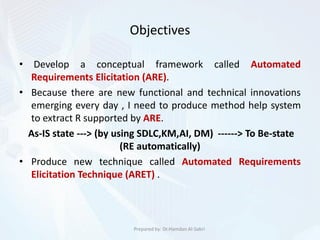

The document discusses research on automated requirements elicitation techniques. It proposes developing a conceptual framework called Automated Requirements Elicitation (ARE) to help extract requirements supported by automated methods. The goal is to improve on the traditional requirements elicitation process by developing a new technique called Automated Requirements Elicitation Technique (ARET) which would allow requirements to be elicited automatically given new functional and technical innovations.


