Introduction 
Evolution of ERP 
characteristics 
What drives ERP? 
Why companies undertake ERP? 
Components Of ERP 
ERP implementation. 
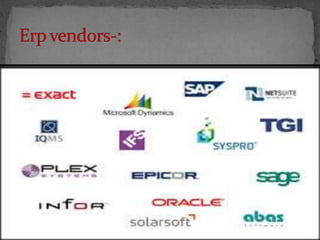
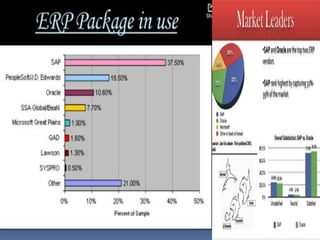
ERP vendors. 
ERP pros & cons. 
Conclusion
An Enterprise resource planning system is a fully integrated business 
management system covering functional areas of an enterprise. 
Like Logistics,Production, Finance, Accounting and Human Resources. 
It organizes and integrates operation processes and information flow to 
make optimum use of resources such as men, material, money and 
machine. 
ERP is a software allows an organisaton to use a system of integrated 
application to manage the business.
 ERP is a Business Management softwarethat allows an 
organisation to use a system of integrated application 
to manage the business. 
 ERP systems are large computer systems that 
integrates applicationprograms in 
accounting(accounts receivable),sales(order 
booking),manufacturing(product shipping) and the 
other function in the firm.
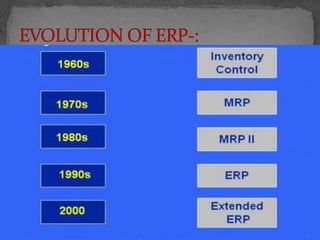
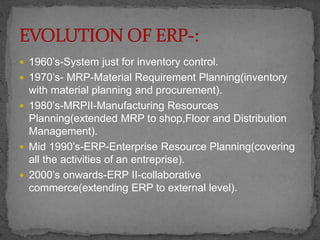
 1960’s-System just for inventory control. 
 1970’s- MRP-Material Requirement Planning(inventory 
with material planning and procurement). 
 1980’s-MRPII-Manufacturing Resources 
Planning(extended MRP to shop,Floor and Distribution 
Management). 
 Mid 1990’s-ERP-Enterprise Resource Planning(covering 
all the activities of an entreprise). 
 2000’s onwards-ERP II-collaborative 
commerce(extending ERP to external level).
 Flexibility 
 Modular & Open 
 Comprehensive 
 Beyond The Company 
 Best Business Practices
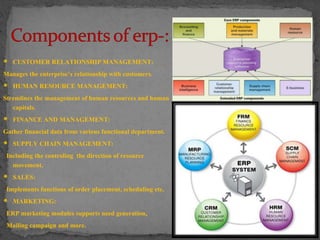
 CUSTOMER RELATIONSHIP MANAGEMENT: 
Manages the enterprise’s relationship with customers. 
 HUMAN RESOURCE MANAGEMENT: 
Stremlines the management of human resources and human 
capitals. 
 FINANCE AND MANAGEMENT: 
Gather financial data from various functional department. 
 SUPPLY CHAIN MANAGEMENT: 
Including the controling the direction of resource 
movement. 
 SALES: 
Implements functions of order placement, scheduling etc. 
 MARKETING: 
ERP marketing modules supports need generation, 
Mailing campaign and more.
 Integration 
Reducing operational cost 
Ideal application 
 Technology 
Software enhances management activities 
 Improve Efficiency Of a Business 
 Easy Reporting & Data Accessibility 
 Increased Security 
 Accuracy& consistency 
 Better Resources Mgt
1. Identifying the Needs 
2. Evaluating the “AS IS” situation of 
the business 
3. ‘Would Be’ situation 
4. Reengineering the business process 
5. Evaluation of various ERP packages 
6. Finalisation of the ERP package 
7. Installation of Hardware and 
Networks 
8. Finalising the Implementation 
Consultants 
9. Implementation of ERP package
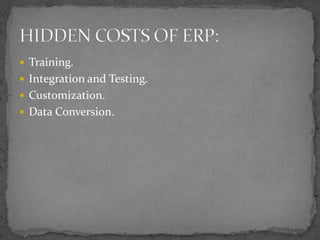
 Training. 
 Integration and Testing. 
 Customization. 
 Data Conversion.
 Calculating RETURN ON INVESTMENT(ROI). 
 Obtaining support from major executives and third 
parties. 
 Major BUSINESS PROCESS REENGINEERING(BPR). 
 ERP is cost prohibitive. 
 Scope Creep. 
 Difficulty of training end users.
 ERP, the business management modular system, mainly represents the 
INTEGRATION & the powerful dynamic internal COMMUNICATION. 
 ERP come to existence as a more mature IT management system gradually after 
other old mates. 
 ERP approach has been adopted to achieve customer dealing flexibility, internal 
management consistency & competitive ability. 
 Fortunately, being MODULAR is a main aspect of ERP implementation, however, 
the process still complex & requires unhurried decision. 
 Consultants & third-party staff are usually outsourced.
PRESENTED BY-: 
SRUTEE AGRAWAL 
SEEMA AGRAWAL 
ANJALI MISHRA 
LAGNA NAYAK 
RIKA RANI 
MAHAPATRA
Enterprise  resource planning

Enterprise resource planning

  • 2.
    Introduction Evolution ofERP characteristics What drives ERP? Why companies undertake ERP? Components Of ERP ERP implementation. ERP vendors. ERP pros & cons. Conclusion
  • 3.
    An Enterprise resourceplanning system is a fully integrated business management system covering functional areas of an enterprise. Like Logistics,Production, Finance, Accounting and Human Resources. It organizes and integrates operation processes and information flow to make optimum use of resources such as men, material, money and machine. ERP is a software allows an organisaton to use a system of integrated application to manage the business.
  • 4.
     ERP isa Business Management softwarethat allows an organisation to use a system of integrated application to manage the business.  ERP systems are large computer systems that integrates applicationprograms in accounting(accounts receivable),sales(order booking),manufacturing(product shipping) and the other function in the firm.
  • 6.
     1960’s-System justfor inventory control.  1970’s- MRP-Material Requirement Planning(inventory with material planning and procurement).  1980’s-MRPII-Manufacturing Resources Planning(extended MRP to shop,Floor and Distribution Management).  Mid 1990’s-ERP-Enterprise Resource Planning(covering all the activities of an entreprise).  2000’s onwards-ERP II-collaborative commerce(extending ERP to external level).
  • 7.
     Flexibility Modular & Open  Comprehensive  Beyond The Company  Best Business Practices
  • 9.
     CUSTOMER RELATIONSHIPMANAGEMENT: Manages the enterprise’s relationship with customers.  HUMAN RESOURCE MANAGEMENT: Stremlines the management of human resources and human capitals.  FINANCE AND MANAGEMENT: Gather financial data from various functional department.  SUPPLY CHAIN MANAGEMENT: Including the controling the direction of resource movement.  SALES: Implements functions of order placement, scheduling etc.  MARKETING: ERP marketing modules supports need generation, Mailing campaign and more.
  • 10.
     Integration Reducingoperational cost Ideal application  Technology Software enhances management activities  Improve Efficiency Of a Business  Easy Reporting & Data Accessibility  Increased Security  Accuracy& consistency  Better Resources Mgt
  • 11.
    1. Identifying theNeeds 2. Evaluating the “AS IS” situation of the business 3. ‘Would Be’ situation 4. Reengineering the business process 5. Evaluation of various ERP packages 6. Finalisation of the ERP package 7. Installation of Hardware and Networks 8. Finalising the Implementation Consultants 9. Implementation of ERP package
  • 16.
     Training. Integration and Testing.  Customization.  Data Conversion.
  • 17.
     Calculating RETURNON INVESTMENT(ROI).  Obtaining support from major executives and third parties.  Major BUSINESS PROCESS REENGINEERING(BPR).  ERP is cost prohibitive.  Scope Creep.  Difficulty of training end users.
  • 18.
     ERP, thebusiness management modular system, mainly represents the INTEGRATION & the powerful dynamic internal COMMUNICATION.  ERP come to existence as a more mature IT management system gradually after other old mates.  ERP approach has been adopted to achieve customer dealing flexibility, internal management consistency & competitive ability.  Fortunately, being MODULAR is a main aspect of ERP implementation, however, the process still complex & requires unhurried decision.  Consultants & third-party staff are usually outsourced.
  • 21.
    PRESENTED BY-: SRUTEEAGRAWAL SEEMA AGRAWAL ANJALI MISHRA LAGNA NAYAK RIKA RANI MAHAPATRA