Prepared by:
Soumen Giri
M.Tech. 1St yr.
Materials Science Centre
IIT Kharagpur
1
INTRODUCTION
• Full definition of ERP system
• Goal of ERP
• Why ERP?
• Steps to implement an ERP system
• Difficulty of implementation
• Offices before and after ERP
• The ERP Modules
• Advantages & disadvantages of ERP
• Costs of ERP
• Conclusions
2
Definition of ERP
 ERP is usually referred to as category of business
management software-typically a suite of integrated
applications-that an organization can use to collect, store,
manage, and interpret data from the following business
activities (e.g.; production planning, manufacturing,
marketing and sales etc.).
 ERP provides an integrated and continuous updated view
of core business processes using common data bases
maintained by a database management system.
3https://en.wikipedia.org/wiki/Enterprise_resource_planning
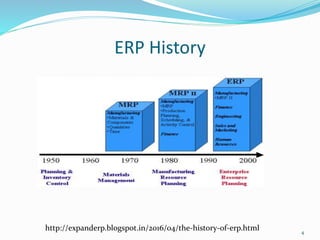
ERP History
http://expanderp.blogspot.in/2016/04/the-history-of-erp.html 4
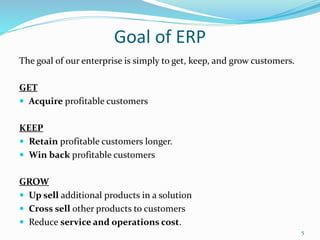
Goal of ERP
The goal of our enterprise is simply to get, keep, and grow customers.
GET
 Acquire profitable customers
KEEP
 Retain profitable customers longer.
 Win back profitable customers
GROW
 Up sell additional products in a solution
 Cross sell other products to customers
 Reduce service and operations cost.
5
Why ERP?
• ERP offers solutions for all business
functions.
• Packages available for organizations of all
sizes and types.
• Global nature (multi currency).
6
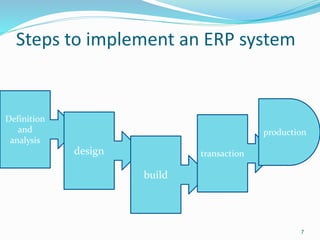
Steps to implement an ERP system
7
Definition
and
analysis
design
build
transaction
production
Difficulty of implementation
• Very complex.
• Overpriced and time intensive, typical: over $10,000,000
and over a year to implement.
• Company may implement only certain modules of entire
ERP system.
• You will need an outside consultant.
8
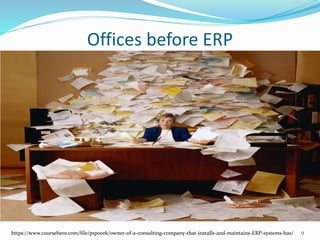
Offices before ERP
https://www.coursehero.com/file/p1poork/owner-of-a-consulting-company-that-installs-and-maintains-ERP-systems-has/ 9
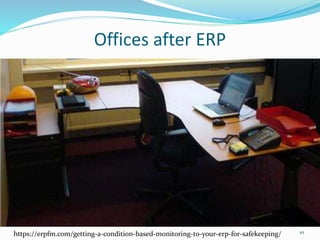
Offices after ERP
https://erpfm.com/getting-a-condition-based-monitoring-to-your-erp-for-safekeeping/ 10
The ERP modules
 Financials
 Production Management
 HR Management
 Sales & Marketing
 Asset Management
 Quality Management
 Material Management
 Event Planning
11
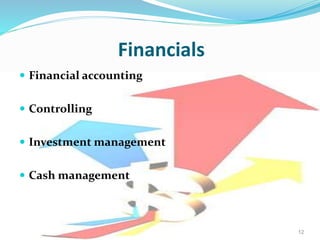
 Financial accounting
 Controlling
 Investment management
 Cash management
12
fiFinancials
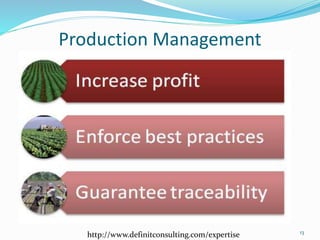
Production Management
http://www.definitconsulting.com/expertise 13
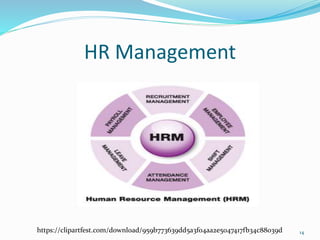
HR Management
https://clipartfest.com/download/959b773639dd5a3f04aa2e5047417fb34c88039d 14
Sales & Marketing
http://www.zigmaindia.com/erp.html 15
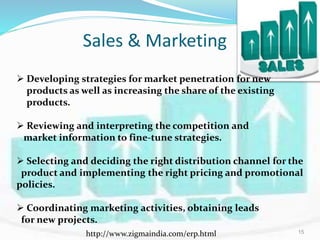
 Developing strategies for market penetration for new
products as well as increasing the share of the existing
products.
 Reviewing and interpreting the competition and
market information to fine-tune strategies.
 Selecting and deciding the right distribution channel for the
product and implementing the right pricing and promotional
policies.
 Coordinating marketing activities, obtaining leads
for new projects.
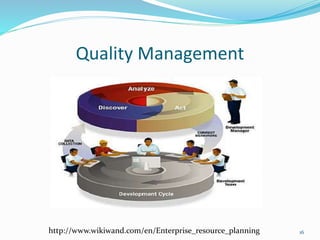
Quality Management
http://www.wikiwand.com/en/Enterprise_resource_planning 16
Advantages of ERP
 Integration
 Efficiency
 Cost reduction
 Less personnel
 Accuracy
Disadvantages of ERP
 Take time to implement
 Security issues
17
Costs of ERP
 Direct costs
..hardware
.. Software
..and people on the project
 Indirect costs
..the total cycle life of ERP
..maintenance and upgrades
..increasing salaries and the on going production
18
New developments in ERP
Availability of web-based and wireless ERP
systems.
Adoption of easy to install ERP systems.
Linkage to other software systems, e.g., supply
chain management system, customer relationship
management system etc.
19
Conclusions
• To successfully implement; a proper mix of
people, processes and technology should be
maintained.
• Technology is an enabler, not the driver (It
is there to assist the organization to achieve
business goals).
20
THANKS FOR
YOUR
ATTENTION
21

ERP

Editor's Notes

  • #13 financial accounting     A field of accounting that treats money as a means of measuring economic performance instead of as a factor of production. It encompasses the entire system of monitoring and control of money as it flows in and out of an organization as assets and liabilities, and revenues and expenses. controlling    The basic management function of (1) establishing benchmarks or standards, (2) comparing actual performance against them, and (3) taking corrective action, if required. Investment management A generic term that most commonly refers to the buying and selling of investments within a portfolio.  Cash management is a broad term that refers to the collection, concentration, and disbursement of cash.
  • #16 Sales is sales! It's converting an inquiry or lead into a contract or shipment. Sales is not market research, business development or advertising. Marketing is finding out what people want, why they want it and how much they’ll spend. Don't confuse marketing with advertising.