ENTERPRISE INFORMATION SYSTEMS
2008
E: goutama@gmail.com
T: @goudotmobi
W: www.about.me/goudotmobi
  Intro	
  to	
  Enterprise	
  Information	
  Systems	
  (EIS)	
  
  Supply	
  Chain	
  Management	
  
  Customer	
  Relationship	
  Management	
  
  Business	
  Intelligence	
  
  Knowledge	
  Management	
  
  Business	
  Process	
  Management	
  
Enterprise	
  Information	
  Systems	
  Training	
   2008	
   2	
  
Enterprise	
  Information	
  Systems	
  Training	
   2008	
   3	
  
  Generally	
  any	
  kind	
  of	
  computing	
  system	
  that	
  is	
  of	
  
"enterprise	
  class"	
  
  Large	
  volumes	
  of	
  data	
  and	
  capable	
  of	
  supporting	
  some	
  
large	
  organization	
  ("an	
  enterprise")	
  
  Provides	
  a	
  technology	
  platform	
  that	
  enable	
  organizations	
  
to	
  integrate	
  and	
  coordinate	
  their	
  business	
  processes	
  
  Single	
  system	
  central	
  to	
  organization	
  &	
  ensure	
  that	
  
information	
  can	
  be	
  shared	
  across	
  all	
  functional	
  levels	
  and	
  
management	
  hierarchies	
  	
  
  Housed	
  in	
  one	
  or	
  more	
  Data	
  centers	
  ,	
  run	
  Enterprise	
  
software,	
  and	
  could	
  include	
  applications	
  such	
  as	
  Content	
  
management	
  systems	
  and	
  typically	
  cross	
  organizational	
  
borders.	
  
Enterprise	
  Information	
  Systems	
  Training	
   2008	
   4	
  
  Software	
  that	
  solves	
  an	
  enterprise	
  problem	
  	
  
  Written	
  using	
  Enterprise	
  Software	
  Architecture	
  
  Software	
  that	
  models	
  entire	
  business	
  enterprise	
  and	
  
is	
  the	
  core	
  IT	
  system	
  of	
  governing	
  enterprise	
  	
  
  Software	
  that	
  is	
  a	
  core	
  of	
  business	
  communications	
  
within	
  the	
  enterprise	
  
  	
  As	
  a	
  suite	
  of	
  programs	
  that	
  have	
  attached	
  
development	
  tools	
  to	
  modify	
  the	
  common	
  programs	
  
for	
  the	
  specific	
  enterprise	
  
  Development	
  tools	
  used	
  are	
  complex	
  programming	
  
tools	
  that	
  require	
  specialist	
  capabilities	
  
  Key	
  elements:	
  Performance,	
  Scalability	
  &	
  
Robustness	
  
2008	
  Enterprise	
  Information	
  Systems	
  Training	
   5	
  
Enterprise	
  Information	
  Systems	
  Training	
   2008	
   6	
  
  Process	
  of	
  planning,	
  implementing	
  and	
  
controlling	
  supply	
  chain	
  operations	
  efficiently	
  
&	
  effectively	
  
  Spans	
  all	
  movement	
  &	
  storage	
  of	
  raw	
  
materials,	
  work-­‐in-­‐process	
  inventory,	
  and	
  
finished	
  goods	
  from	
  point-­‐of-­‐origin	
  to	
  point-­‐
of-­‐consumption	
  
  Software:	
  Tools/modules	
  used	
  in	
  executing	
  
supply	
  chain	
  transactions,	
  managing	
  supplier	
  
relationships	
  &	
  controlling	
  associated	
  
business	
  processes	
  
2008	
  Enterprise	
  Information	
  Systems	
  Training	
   7	
  
  Plan	


   Managing	
  all	
  resources	
  to	
  meet	
  customer	
  demand	


   Developing	
  a	
  set	
  of	
  metrics	
  to	
  monitor	
  the	
  supply	
  chain	


   To	
  achieve	
  efficiency,	
  cost	
  saving,	
  high	
  quality	
  &	
  value	
  
  Source	


   Choose	
  suppliers	
  to	
  deliver	
  goods	
  &	
  services	


   Develop	
  a	
  set	
  of	
  pricing,	
  delivery	
  &	
  payment	
  processes	
  with	
  suppliers	


   Create	
  metrics	
  for	
  monitoring	
  &	
  improving	
  relationships	
  
	
   Put	
  together	
  processes	
  for	
  managing	
  inventory	
  of	
  goods	
  &	
  services	
  
  Make	
  
	
   Schedule	
  activities	
  for	
  production,	
  testing,	
  packaging	
  &	
  preparation	
  
for	
  delivery	
  
	
   Measure	
  quality	
  levels,	
  production	
  output	
  and	
  worker	
  productivity	
  
2008	
  Enterprise	
  Information	
  Systems	
  Training	
   8	
  
  Deliver	


   Coordinate	
  receipt	
  of	
  orders	
  from	
  customers	
  
	
   Develop	
  a	
  network	
  of	
  warehouses,	
  pick	
  
carriers	
  to	
  get	
  products	
  to	
  customers	


   Set	
  up	
  invoicing	
  system	
  to	
  receive	
  payments	
  
  Return	


   Create	
  a	
  network	
  for	
  receiving	
  defective	
  
and	
  excess	
  products	
  back	
  from	
  customers	
  
2008	
  Enterprise	
  Information	
  Systems	
  Training	
   9	
  
  Internal	
  resistance	
  to	
  change	
  
	
   Convince	
  people	
  to	
  use	
  the	
  software	
  worth	
  
the	
  time	
  
	
   Otherwise,	
  they	
  will	
  easily	
  find	
  ways	
  to	
  
work	
  around	
  it	
  
  Many	
  mistakes	
  at	
  first	
  
	
   First	
  bits	
  of	
  information	
  they	
  get	
  from	
  a	
  
system	
  might	
  need	
  some	
  tweaking	
  
	
   Warned	
  about	
  system's	
  initial	
  naiveté,	
  they	
  
will	
  think	
  it	
  is	
  useful	
  
2008	
  Enterprise	
  Information	
  Systems	
  Training	
   10	
  
Enterprise	
  Information	
  Systems	
  Training	
   2008	
   11	
  
  Processes	
  to	
  handle	
  its	
  contact	
  with	
  customers	
  by	
  storing	
  
information	
  on	
  current	
  and	
  prospective	
  customers	
  
  Related	
  Aspects	
  
	
   Front	
  office	
  operations:	
  	
  Direct	
  interaction	
  with	
  
customers	
  e.g.	
  face	
  to	
  face	
  meetings,	
  phone	
  calls,	
  e-­‐mail	
  
	
   Back	
  office	
  operations:	
  Operations	
  that	
  affect	
  activities	
  
of	
  front	
  office	
  e.g.	
  billing,	
  maintenance,	
  planning,	
  finance,	
  
manufacturing	
  
	
   Business	
  relationships:	
  Interaction	
  with	
  other	
  
companies	
  &	
  partners	
  e.g.	
  suppliers/vendors	
  and	
  retail	
  
outlets/distributors	
  
	
   Analysis:	
  Analyze	
  Key	
  CRM	
  data	
  to	
  plan	
  target-­‐
marketing	
  campaigns,	
  conceive	
  business	
  strategies,	
  &	
  
judge	
  success	
  of	
  CRM	
  activities	
  e.g.,	
  market	
  share,	
  number	
  
&	
  types	
  of	
  customers,	
  revenue,	
  profitability	
  
2008	
  Enterprise	
  Information	
  Systems	
  Training	
   12	
  
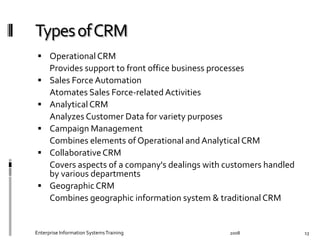
  Operational	
  CRM	
  
	
   Provides	
  support	
  to	
  front	
  office	
  business	
  processes	
  
  Sales	
  Force	
  Automation	


   Atomates	
  Sales	
  Force-­‐related	
  Activities	
  
  Analytical	
  CRM	
  
	
   Analyzes	
  Customer	
  Data	
  for	
  variety	
  purposes	
  
  Campaign	
  Management	
  
	
   Combines	
  elements	
  of	
  Operational	
  and	
  Analytical	
  CRM	
  
  Collaborative	
  CRM	
  
	
   Covers	
  aspects	
  of	
  a	
  company's	
  dealings	
  with	
  customers	
  
handled	
  by	
  various	
  departments	
  	
  
  Geographic	
  CRM	
  
	
   Combines	
  geographic	
  information	
  system	
  &	
  traditional	
  CRM	
  
2008	
  Enterprise	
  Information	
  Systems	
  Training	
   13	
  
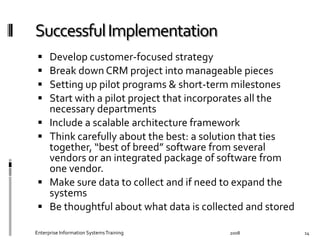
  Develop	
  customer-­‐focused	
  strategy	
  
  Break	
  down	
  CRM	
  project	
  into	
  manageable	
  pieces	
  	
  
  Setting	
  up	
  pilot	
  programs	
  &	
  short-­‐term	
  milestones	
  
  Start	
  with	
  a	
  pilot	
  project	
  that	
  incorporates	
  all	
  the	
  
necessary	
  departments	
  
  Include	
  a	
  scalable	
  architecture	
  framework	
  
  Think	
  carefully	
  about	
  the	
  best:	
  a	
  solution	
  that	
  ties	
  
together,	
  “best	
  of	
  breed”	
  software	
  from	
  several	
  
vendors	
  or	
  an	
  integrated	
  package	
  of	
  software	
  from	
  
one	
  vendor.	
  	
  
  Make	
  sure	
  data	
  to	
  collect	
  and	
  if	
  need	
  to	
  expand	
  the	
  
systems	
  
  Be	
  thoughtful	
  about	
  what	
  data	
  is	
  collected	
  and	
  stored	
  
2008	
  Enterprise	
  Information	
  Systems	
  Training	
   14	
  
Enterprise	
  Information	
  Systems	
  Training	
   2008	
   15	
  
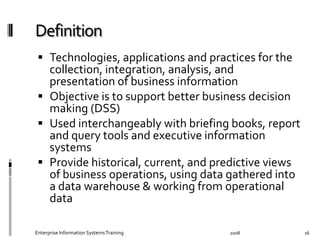
  Technologies,	
  applications	
  and	
  practices	
  for	
  the	
  
collection,	
  integration,	
  analysis,	
  and	
  
presentation	
  of	
  business	
  information	
  
  Objective	
  is	
  to	
  support	
  better	
  business	
  decision	
  
making	
  (DSS)	
  
  Used	
  interchangeably	
  with	
  briefing	
  books,	
  report	
  
and	
  query	
  tools	
  and	
  executive	
  information	
  
systems	
  
  Provide	
  historical,	
  current,	
  and	
  predictive	
  views	
  
of	
  business	
  operations,	
  using	
  data	
  gathered	
  into	
  
a	
  data	
  warehouse	
  &	
  working	
  from	
  operational	
  
data	
  
2008	
  Enterprise	
  Information	
  Systems	
  Training	
   16	
  
  Software	
  elements	
  support	
  the	
  use	
  of	
  this	
  
information	
  by	
  assisting	
  in	
  the	
  extraction,	
  
analysis,	
  and	
  reporting	
  of	
  information	
  
  Applications	
  tackle	
  sales,	
  production,	
  
financial	
  &	
  other	
  sources	
  of	
  business	
  data	
  for	
  
purposes	
  that	
  include	
  business	
  performance	
  
management	
  (BPM)	
  	
  
  Information	
  gathered	
  on	
  comparable	
  
companies	
  to	
  produce	
  benchmarks	
  
2008	
  Enterprise	
  Information	
  Systems	
  Training	
   17	
  
  User	
  resistance	
  	
  
  Standard	
  data	
   	
  
  BI	
  tools	
  	
  
  Doesn’t	
  understand	
  business	
  processes	
  well	
  
enough	
  to	
  improve	
  them	
  
  Doesn’t	
  understand	
  all	
  activities	
  that	
  make	
  up	
  a	
  
particular	
  business	
  process:	
  how	
  information	
  &	
  
data	
  flow	
  across	
  various	
  processes,	
  how	
  data	
  is	
  
passed	
  between	
  business	
  users,	
  &	
  how	
  people	
  
use	
  it	
  to	
  execute	
  part	
  of	
  the	
  process	
  
2008	
  Enterprise	
  Information	
  Systems	
  Training	
   18	
  
  Make	
  sure	
  your	
  data	
  is	
  clean	
  
  Train	
  users	
  effectively	
  
  Deploy	
  and	
  adjust	
  quickly	
  
  Deliver	
  reports	
  that	
  provide	
  the	
  most	
  value	
  
quickly	
  
  Take	
  an	
  integrated	
  approach	
  to	
  build	
  data	
  
warehouse	
  from	
  the	
  beginning	
  
  Define	
  ROI	
  clearly	
  
  Outline	
  specific	
  benefits	
  expected	
  to	
  achieve	
  
  Do	
  a	
  reality	
  check	
  every	
  quarter	
  or	
  six	
  months	
  
  Focus	
  on	
  business	
  objectives	
  
2008	
  Enterprise	
  Information	
  Systems	
  Training	
   19	
  
  Identify	
  cost-­‐cutting	
  ideas	
  
  Uncover	
  business	
  opportunities	
  
  Roll	
  ERP	
  data	
  into	
  accessible	
  reports	
  
  React	
  quickly	
  to	
  retail	
  demand	
  	
  
  Optimize	
  prices	
  
2008	
  Enterprise	
  Information	
  Systems	
  Training	
   20	
  
Enterprise	
  Information	
  Systems	
  Training	
   2008	
   21	
  
  A	
  range	
  of	
  practices	
  used	
  by	
  organisations	
  to	
  
identify,	
  create,	
  represent,	
  distribute	
  and	
  enable	
  
adoption	
  of	
  what	
  it	
  knows,	
  and	
  how	
  it	
  knows	
  it	
  
  Tied	
  to	
  organisational	
  objectives	
  such	
  as	
  
improved	
  performance,	
  competitive	
  advantage,	
  
innovation,	
  developmental	
  processes,	
  lessons	
  
learnt	
  transfer	
  and	
  the	
  general	
  development	
  of	
  
collaborative	
  practices	
  
  Frequently	
  linked	
  and	
  related	
  to	
  learning	
  
organization,	
  lifelong	
  learning	
  and	
  continuous	
  
improvement	
  
Enterprise	
  Information	
  Systems	
  Training	
   2008	
   22	
  
  Foster	
  innovation	
  by	
  encouraging	
  the	
  free	
  flow	
  
of	
  ideas	
  	
  
  Improve	
  customer	
  service	
  by	
  streamlining	
  
response	
  time	
  	
  
  Boost	
  revenues	
  by	
  getting	
  products	
  &	
  services	
  to	
  
market	
  faster	
  	
  
  Enhance	
  employee	
  retention	
  rates	
  by	
  
recognizing	
  values	
  of	
  employees'	
  knowledge	
  &	
  
rewarding	
  for	
  it	
  	
  
  Streamline	
  operations	
  &	
  reduce	
  costs	
  by	
  
eliminating	
  redundant/unnecessary	
  processes	
  	
  
2008	
  Enterprise	
  Information	
  Systems	
  Training	
   23	
  
  Getting	
  Employees	
  on	
  Board	
  
	
   Ignorance	
  on	
  people	
  &	
  cultural	
  issues	
  
	
   Should	
  have	
  a	
  culture	
  that	
  recognizes	
  tacit	
  knowledge	
  
and	
  encourages	
  employees	
  to	
  share	
  it	


  Ongoing	
  Maintenance	
  
	
   KM	
  Content	
  should	
  be	
  constantly	
  updated,	
  amended	
  and	
  
deleted	
  
	
   Constantly	
  evolving	
  business	
  practices.	
  
  Dealing	
  with	
  a	
  Data	
  Deluge	
  
	
   Companies	
  diligently	
  need	
  to	
  be	
  on	
  the	
  lookout	
  for	
  
information	
  overload.	
  Quantity	
  rarely	
  equals	
  quality,	
  and	
  
KM	
  is	
  no	
  exception.	
  Indeed,	
  the	
  point	
  of	
  a	
  KM	
  program	
  is	
  to	
  
identify	
  and	
  disseminate	
  knowledge	
  gems	
  from	
  a	
  sea	
  of	
  
information.	
  
2008	
  Enterprise	
  Information	
  Systems	
  Training	
   24	
  
  Dimension	
  of	
  knowledge	
  
	
   Tacit	
  vs	
  Explicit	
  Knowledge	


  Knowledge	
  	
  Access	
  Stages	
  
	
   Knowledge	
  may	
  be	
  accessed	
  at	
  three	
  stages:	
  before,	
  during,	
  or	
  after	
  
knowledge-­‐related	
  activities	
  
  Adhoc	
  knowledge	
  access	
  
	
   To	
  make	
  knowledge	
  requests	
  of	
  subject	
  matter	
  experts	
  on	
  ad	
  hoc	
  basis	
  
	
   Response	
  from	
  expert	
  individual	
  is	
  rich	
  in	
  content	
  and	
  contextualized	
  to	
  
particular	
  problem	
  &	
  personalized	
  to	
  the	
  particular	
  person/people	
  addressing	
  it	
  
	
   Workload	
  on	
  knowledge	
  user	
  is	
  reduced	
  in	
  validating	
  historically	
  collected	
  
knowledge;	
  it	
  is	
  only	
  recorded	
  when	
  needed	
  to	
  reduce	
  information	
  overload	
  
	
   Downside,	
  availability	
  and	
  memory	
  recall	
  skill	
  of	
  specific	
  individuals	
  in	
  the	
  
organization	
  
	
   Be	
  accompanied	
  by	
  a	
  knowledge	
  retention	
  program	
  to	
  capture	
  critical	
  
knowledge	
  in	
  time	
  before	
  staff	
  is	
  leaving	
  or	
  before	
  long	
  breaks	
  in	
  use	
  of	
  the	
  
experience	
  occur	
  
2008	
  Enterprise	
  Information	
  Systems	
  Training	
   25	
  
  Making	
  available	
  increased	
  knowledge	
  content	
  in	
  the	
  
development	
  and	
  provision	
  of	
  products	
  and	
  services	
  
  Achieving	
  shorter	
  new	
  product	
  development	
  cycles	
  
  Facilitating	
  and	
  managing	
  organizational	
  innovation	
  and	
  
learning	
  
  Leveraging	
  people	
  expertise	
  across	
  organization	
  
  Increasing	
  network	
  connectivity	
  between	
  employees	
  and	
  
external	
  groups	
  	
  
  Improving	
  information	
  flow	
  
  Managing	
  data	
  proliferation	
  and	
  information	
  in	
  complex	
  
business	
  environments	
  	
  
  Allowing	
  employees	
  to	
  access	
  appropriate	
  information	
  
sources	
  
  Managing	
  intellectual	
  capital	
  &	
  assets	
  in	
  the	
  workforce	
  
2008	
  Enterprise	
  Information	
  Systems	
  Training	
   26	
  
  Expert	
  Systems,	
  Knowledge	
  Bases,	
  
Information	
  Management,	
  Software	
  Help	
  
Desk	
  Tools,	
  Document	
  Management	
  Systems	
  
  E-­‐learning,	
  Web	
  Conferencing,	
  Collaborative	
  
Software,	
  CMS,	
  email	
  lists,wikis,	
  blogs	
  
  KM	
  practice	
  will	
  continue	
  to	
  evolve	
  with	
  
growth	
  of	
  collaboration	
  applications,	
  visual	
  
tools	
  and	
  other	
  technologies	
  
2008	
  Enterprise	
  Information	
  Systems	
  Training	
   27	
  
Enterprise	
  Information	
  Systems	
  Training	
   2008	
   28	
  
  A	
  method	
  of	
  aligning	
  an	
  organization	
  with	
  
the	
  wants	
  and	
  needs	
  of	
  clients	
  
  A	
  holistic	
  management	
  approach	
  promotes	
  
business	
  effectiveness	
  &	
  efficiency	
  while	
  
striving	
  for	
  innovation,	
  flexibility	
  &	
  
integration	
  with	
  technology	
  
  Attempts	
  to	
  continuously	
  improve	
  processes	
  
(define,	
  measure	
  and	
  improve)	
  
2008	
  Enterprise	
  Information	
  Systems	
  Training	
   29	
  
  BPMN	
  (business	
  process	
  modeling	
  notation)	
  
Focuses	
  on	
  business	
  process	
  graphical	
  modeling	
  
  BPEL	
  (business	
  process	
  execution	
  language)	
  
	
   Focuses	
  on	
  process	
  execution	
  &	
  system-­‐to-­‐
system	
  communication	
  
  BPML	
  (business	
  process	
  modeling	
  language)	
  
XML-­‐based	
  execution	
  language	
  standard	
  based	
  
upon	
  Pi-­‐Calculus	
  &	
  Web	
  services	
  
  BPQL	
  (business	
  process	
  query	
  language)	
  
	
   Focuses	
  on	
  administrative	
  &	
  monitoring	
  aspects	
  
2008	
  Enterprise	
  Information	
  Systems	
  Training	
   30	
  
  Modelling	
  
	
   Takes	
  theoretical	
  design	
  and	
  introduces	
  combinations	
  of	
  variables	
  to	
  
determine	
  how	
  process	
  might	
  operate	
  under	
  different	
  circumstances	
  
	
   Involves	
  running	
  "what-­‐if	
  analysis"	
  on	
  the	
  processes	
  
  Execution	
  
	
   Develop	
  or	
  purchase	
  an	
  application	
  that	
  executes	
  the	
  process	
  
required	
  steps	
  
	
   Use	
  a	
  combination	
  of	
  software	
  and	
  human	
  intervention	


   Use	
  Business	
  rules	
  to	
  provide	
  definitions	
  for	
  governing	
  behavior	
  &	
  
the	
  engine	
  can	
  be	
  used	
  to	
  drive	
  process	
  execution	
  and	
  resolution	
  
  Monitoring	
  
	
   Encompasses	
  tracking	
  of	
  individual	
  processes	
  so	
  info	
  can	
  be	
  seen	
  and	
  
statistics	
  on	
  the	
  performance	
  of	
  one	
  or	
  more	
  processes	
  provided	
  
	
   Used	
  to	
  work	
  with	
  customers	
  and	
  suppliers	
  to	
  improve	
  their	
  
connected	
  processes	
  
	
   Business	
  Activity	
  Monitoring	
  (BAM)	
  extends	
  and	
  expands	
  the	
  
monitoring	
  tools	
  
2008	
  Enterprise	
  Information	
  Systems	
  Training	
   31	
  
  Process	
  Mining	


   A	
  collection	
  of	
  methods	
  and	
  tools	
  related	
  to	
  process	
  
monitoring	
  
	
   To	
  analyze	
  event	
  logs	
  extracted	
  through	
  process	
  
monitoring	
  and	
  compare	
  with	
  an	
  'a	
  priori'	
  process	
  model	
  
  Optimization	
  
	
   Retrieving	
  process	
  performance	
  information	
  from	
  
modeling	
  or	
  monitoring	
  phase	


   Identifying	
  potential/actual	
  bottlenecks	
  and	
  potential	
  
rooms	
  for	
  cost	
  savings	
  or	
  other	
  improvements	


   Applying	
  enhancements	
  in	
  process	
  design,	
  continuing	
  
value	
  cycle	
  of	
  business	
  process	
  management	
  
2008	
  Enterprise	
  Information	
  Systems	
  Training	
   32	
  
  Dynamic	
  processes	
  
  Processes	
  that	
  involve	
  people,	
  cross	
  business	
  unit,	
  division,	
  
department,	
  workgroup	
  or	
  other	
  functionally	
  organized	
  
groups	
  of	
  people	
  
  Complex	
  processes	
  that	
  requires	
  orchestration	
  of	
  a	
  variety	
  
of	
  people	
  from	
  different	
  functional	
  departments	
  using	
  
different	
  software	
  applications	
  and/or	
  data	
  to	
  do	
  their	
  step	
  
in	
  the	
  process.	
  
  Measurable	
  mission-­‐critical	
  processes	
  
  Processes	
  that	
  cannot	
  be	
  completed	
  without	
  calling	
  on	
  
more	
  than	
  one	
  legacy	
  application	
  
  Processes	
  with	
  exceptions	
  that	
  handled	
  manually	
  	
  
  Processes	
  with	
  exceptions	
  that	
  require	
  quick	
  turnarounds	
  
2008	
  Enterprise	
  Information	
  Systems	
  Training	
   33	
  
  reduced	
  number	
  of	
  returned	
  shipments	
  	
  
  reduced	
  cycle	
  time	
  for	
  special	
  orders	
  	
  
  increased	
  revenues	
  recovered	
  from	
  credit	
  
disputes	
  	
  
  increased	
  consistency	
  of	
  task	
  completion/
improved	
  productivity	
  	
  
  reduced	
  time	
  required	
  to	
  onboard	
  new	
  
employees	
  
2008	
  Enterprise	
  Information	
  Systems	
  Training	
   34	
  
 Enterprise	
  Information	
  Systems:	
  A	
  
Pattern-­‐Based	
  Approach	
  by	
  Cheryl	
  
Dunn,	
  J.	
  Owen	
  Cherrington	
  and	
  Anita	
  
Sawyer	
  Hollander,	
  USA,	
  2006,	
  453p	
  
 Handbook	
  of	
  Enterprise	
  Systems	
  
Architecture	
  in	
  Practice	
  by	
  Pallab	
  
Saha	
  (Editor),	
  IGI	
  Globa,	
  USA,	
  2007,	
  
500p	
  
2008	
  Enterprise	
  Information	
  Systems	
  Training	
   35	
  
  LinkedIn:	
  www.linkedin.com/in/goutama	
  
  Email:	
  goutama@gmail.com	
  
  Google+:	
  www.gplus.to/goudotmobi	
  
  Skype:	
  goudotinfo	
  
  Twitter:	
  @goudotmobi	
  
2008	
  Enterprise	
  Information	
  Systems	
  Training	
   36	
  
2008	
   37	
  Enterprise	
  Information	
  Systems	
  Training	
  
2008	
   38	
  Enterprise	
  Information	
  Systems	
  Training	
  

Enterprise Information Systems

  • 1.
    ENTERPRISE INFORMATION SYSTEMS 2008 E:goutama@gmail.com T: @goudotmobi W: www.about.me/goudotmobi
  • 2.
      Intro  to  Enterprise  Information  Systems  (EIS)     Supply  Chain  Management     Customer  Relationship  Management     Business  Intelligence     Knowledge  Management     Business  Process  Management   Enterprise  Information  Systems  Training   2008   2  
  • 3.
    Enterprise  Information  Systems  Training   2008   3  
  • 4.
      Generally  any  kind  of  computing  system  that  is  of   "enterprise  class"     Large  volumes  of  data  and  capable  of  supporting  some   large  organization  ("an  enterprise")     Provides  a  technology  platform  that  enable  organizations   to  integrate  and  coordinate  their  business  processes     Single  system  central  to  organization  &  ensure  that   information  can  be  shared  across  all  functional  levels  and   management  hierarchies       Housed  in  one  or  more  Data  centers  ,  run  Enterprise   software,  and  could  include  applications  such  as  Content   management  systems  and  typically  cross  organizational   borders.   Enterprise  Information  Systems  Training   2008   4  
  • 5.
      Software  that  solves  an  enterprise  problem       Written  using  Enterprise  Software  Architecture     Software  that  models  entire  business  enterprise  and   is  the  core  IT  system  of  governing  enterprise       Software  that  is  a  core  of  business  communications   within  the  enterprise      As  a  suite  of  programs  that  have  attached   development  tools  to  modify  the  common  programs   for  the  specific  enterprise     Development  tools  used  are  complex  programming   tools  that  require  specialist  capabilities     Key  elements:  Performance,  Scalability  &   Robustness   2008  Enterprise  Information  Systems  Training   5  
  • 6.
    Enterprise  Information  Systems  Training   2008   6  
  • 7.
      Process  of  planning,  implementing  and   controlling  supply  chain  operations  efficiently   &  effectively     Spans  all  movement  &  storage  of  raw   materials,  work-­‐in-­‐process  inventory,  and   finished  goods  from  point-­‐of-­‐origin  to  point-­‐ of-­‐consumption     Software:  Tools/modules  used  in  executing   supply  chain  transactions,  managing  supplier   relationships  &  controlling  associated   business  processes   2008  Enterprise  Information  Systems  Training   7  
  • 8.
      Plan       Managing  all  resources  to  meet  customer  demand       Developing  a  set  of  metrics  to  monitor  the  supply  chain       To  achieve  efficiency,  cost  saving,  high  quality  &  value     Source       Choose  suppliers  to  deliver  goods  &  services       Develop  a  set  of  pricing,  delivery  &  payment  processes  with  suppliers       Create  metrics  for  monitoring  &  improving  relationships     Put  together  processes  for  managing  inventory  of  goods  &  services     Make     Schedule  activities  for  production,  testing,  packaging  &  preparation   for  delivery     Measure  quality  levels,  production  output  and  worker  productivity   2008  Enterprise  Information  Systems  Training   8  
  • 9.
      Deliver       Coordinate  receipt  of  orders  from  customers     Develop  a  network  of  warehouses,  pick   carriers  to  get  products  to  customers       Set  up  invoicing  system  to  receive  payments     Return       Create  a  network  for  receiving  defective   and  excess  products  back  from  customers   2008  Enterprise  Information  Systems  Training   9  
  • 10.
      Internal  resistance  to  change     Convince  people  to  use  the  software  worth   the  time     Otherwise,  they  will  easily  find  ways  to   work  around  it     Many  mistakes  at  first     First  bits  of  information  they  get  from  a   system  might  need  some  tweaking     Warned  about  system's  initial  naiveté,  they   will  think  it  is  useful   2008  Enterprise  Information  Systems  Training   10  
  • 11.
    Enterprise  Information  Systems  Training   2008   11  
  • 12.
      Processes  to  handle  its  contact  with  customers  by  storing   information  on  current  and  prospective  customers     Related  Aspects     Front  office  operations:    Direct  interaction  with   customers  e.g.  face  to  face  meetings,  phone  calls,  e-­‐mail     Back  office  operations:  Operations  that  affect  activities   of  front  office  e.g.  billing,  maintenance,  planning,  finance,   manufacturing     Business  relationships:  Interaction  with  other   companies  &  partners  e.g.  suppliers/vendors  and  retail   outlets/distributors     Analysis:  Analyze  Key  CRM  data  to  plan  target-­‐ marketing  campaigns,  conceive  business  strategies,  &   judge  success  of  CRM  activities  e.g.,  market  share,  number   &  types  of  customers,  revenue,  profitability   2008  Enterprise  Information  Systems  Training   12  
  • 13.
      Operational  CRM     Provides  support  to  front  office  business  processes     Sales  Force  Automation       Atomates  Sales  Force-­‐related  Activities     Analytical  CRM     Analyzes  Customer  Data  for  variety  purposes     Campaign  Management     Combines  elements  of  Operational  and  Analytical  CRM     Collaborative  CRM     Covers  aspects  of  a  company's  dealings  with  customers   handled  by  various  departments       Geographic  CRM     Combines  geographic  information  system  &  traditional  CRM   2008  Enterprise  Information  Systems  Training   13  
  • 14.
      Develop  customer-­‐focused  strategy     Break  down  CRM  project  into  manageable  pieces       Setting  up  pilot  programs  &  short-­‐term  milestones     Start  with  a  pilot  project  that  incorporates  all  the   necessary  departments     Include  a  scalable  architecture  framework     Think  carefully  about  the  best:  a  solution  that  ties   together,  “best  of  breed”  software  from  several   vendors  or  an  integrated  package  of  software  from   one  vendor.       Make  sure  data  to  collect  and  if  need  to  expand  the   systems     Be  thoughtful  about  what  data  is  collected  and  stored   2008  Enterprise  Information  Systems  Training   14  
  • 15.
    Enterprise  Information  Systems  Training   2008   15  
  • 16.
      Technologies,  applications  and  practices  for  the   collection,  integration,  analysis,  and   presentation  of  business  information     Objective  is  to  support  better  business  decision   making  (DSS)     Used  interchangeably  with  briefing  books,  report   and  query  tools  and  executive  information   systems     Provide  historical,  current,  and  predictive  views   of  business  operations,  using  data  gathered  into   a  data  warehouse  &  working  from  operational   data   2008  Enterprise  Information  Systems  Training   16  
  • 17.
      Software  elements  support  the  use  of  this   information  by  assisting  in  the  extraction,   analysis,  and  reporting  of  information     Applications  tackle  sales,  production,   financial  &  other  sources  of  business  data  for   purposes  that  include  business  performance   management  (BPM)       Information  gathered  on  comparable   companies  to  produce  benchmarks   2008  Enterprise  Information  Systems  Training   17  
  • 18.
      User  resistance       Standard  data       BI  tools       Doesn’t  understand  business  processes  well   enough  to  improve  them     Doesn’t  understand  all  activities  that  make  up  a   particular  business  process:  how  information  &   data  flow  across  various  processes,  how  data  is   passed  between  business  users,  &  how  people   use  it  to  execute  part  of  the  process   2008  Enterprise  Information  Systems  Training   18  
  • 19.
      Make  sure  your  data  is  clean     Train  users  effectively     Deploy  and  adjust  quickly     Deliver  reports  that  provide  the  most  value   quickly     Take  an  integrated  approach  to  build  data   warehouse  from  the  beginning     Define  ROI  clearly     Outline  specific  benefits  expected  to  achieve     Do  a  reality  check  every  quarter  or  six  months     Focus  on  business  objectives   2008  Enterprise  Information  Systems  Training   19  
  • 20.
      Identify  cost-­‐cutting  ideas     Uncover  business  opportunities     Roll  ERP  data  into  accessible  reports     React  quickly  to  retail  demand       Optimize  prices   2008  Enterprise  Information  Systems  Training   20  
  • 21.
    Enterprise  Information  Systems  Training   2008   21  
  • 22.
      A  range  of  practices  used  by  organisations  to   identify,  create,  represent,  distribute  and  enable   adoption  of  what  it  knows,  and  how  it  knows  it     Tied  to  organisational  objectives  such  as   improved  performance,  competitive  advantage,   innovation,  developmental  processes,  lessons   learnt  transfer  and  the  general  development  of   collaborative  practices     Frequently  linked  and  related  to  learning   organization,  lifelong  learning  and  continuous   improvement   Enterprise  Information  Systems  Training   2008   22  
  • 23.
      Foster  innovation  by  encouraging  the  free  flow   of  ideas       Improve  customer  service  by  streamlining   response  time       Boost  revenues  by  getting  products  &  services  to   market  faster       Enhance  employee  retention  rates  by   recognizing  values  of  employees'  knowledge  &   rewarding  for  it       Streamline  operations  &  reduce  costs  by   eliminating  redundant/unnecessary  processes     2008  Enterprise  Information  Systems  Training   23  
  • 24.
      Getting  Employees  on  Board     Ignorance  on  people  &  cultural  issues     Should  have  a  culture  that  recognizes  tacit  knowledge   and  encourages  employees  to  share  it         Ongoing  Maintenance     KM  Content  should  be  constantly  updated,  amended  and   deleted     Constantly  evolving  business  practices.     Dealing  with  a  Data  Deluge     Companies  diligently  need  to  be  on  the  lookout  for   information  overload.  Quantity  rarely  equals  quality,  and   KM  is  no  exception.  Indeed,  the  point  of  a  KM  program  is  to   identify  and  disseminate  knowledge  gems  from  a  sea  of   information.   2008  Enterprise  Information  Systems  Training   24  
  • 25.
      Dimension  of  knowledge     Tacit  vs  Explicit  Knowledge         Knowledge    Access  Stages     Knowledge  may  be  accessed  at  three  stages:  before,  during,  or  after   knowledge-­‐related  activities     Adhoc  knowledge  access     To  make  knowledge  requests  of  subject  matter  experts  on  ad  hoc  basis     Response  from  expert  individual  is  rich  in  content  and  contextualized  to   particular  problem  &  personalized  to  the  particular  person/people  addressing  it     Workload  on  knowledge  user  is  reduced  in  validating  historically  collected   knowledge;  it  is  only  recorded  when  needed  to  reduce  information  overload     Downside,  availability  and  memory  recall  skill  of  specific  individuals  in  the   organization     Be  accompanied  by  a  knowledge  retention  program  to  capture  critical   knowledge  in  time  before  staff  is  leaving  or  before  long  breaks  in  use  of  the   experience  occur   2008  Enterprise  Information  Systems  Training   25  
  • 26.
      Making  available  increased  knowledge  content  in  the   development  and  provision  of  products  and  services     Achieving  shorter  new  product  development  cycles     Facilitating  and  managing  organizational  innovation  and   learning     Leveraging  people  expertise  across  organization     Increasing  network  connectivity  between  employees  and   external  groups       Improving  information  flow     Managing  data  proliferation  and  information  in  complex   business  environments       Allowing  employees  to  access  appropriate  information   sources     Managing  intellectual  capital  &  assets  in  the  workforce   2008  Enterprise  Information  Systems  Training   26  
  • 27.
      Expert  Systems,  Knowledge  Bases,   Information  Management,  Software  Help   Desk  Tools,  Document  Management  Systems     E-­‐learning,  Web  Conferencing,  Collaborative   Software,  CMS,  email  lists,wikis,  blogs     KM  practice  will  continue  to  evolve  with   growth  of  collaboration  applications,  visual   tools  and  other  technologies   2008  Enterprise  Information  Systems  Training   27  
  • 28.
    Enterprise  Information  Systems  Training   2008   28  
  • 29.
      A  method  of  aligning  an  organization  with   the  wants  and  needs  of  clients     A  holistic  management  approach  promotes   business  effectiveness  &  efficiency  while   striving  for  innovation,  flexibility  &   integration  with  technology     Attempts  to  continuously  improve  processes   (define,  measure  and  improve)   2008  Enterprise  Information  Systems  Training   29  
  • 30.
      BPMN  (business  process  modeling  notation)   Focuses  on  business  process  graphical  modeling     BPEL  (business  process  execution  language)     Focuses  on  process  execution  &  system-­‐to-­‐ system  communication     BPML  (business  process  modeling  language)   XML-­‐based  execution  language  standard  based   upon  Pi-­‐Calculus  &  Web  services     BPQL  (business  process  query  language)     Focuses  on  administrative  &  monitoring  aspects   2008  Enterprise  Information  Systems  Training   30  
  • 31.
      Modelling     Takes  theoretical  design  and  introduces  combinations  of  variables  to   determine  how  process  might  operate  under  different  circumstances     Involves  running  "what-­‐if  analysis"  on  the  processes     Execution     Develop  or  purchase  an  application  that  executes  the  process   required  steps     Use  a  combination  of  software  and  human  intervention       Use  Business  rules  to  provide  definitions  for  governing  behavior  &   the  engine  can  be  used  to  drive  process  execution  and  resolution     Monitoring     Encompasses  tracking  of  individual  processes  so  info  can  be  seen  and   statistics  on  the  performance  of  one  or  more  processes  provided     Used  to  work  with  customers  and  suppliers  to  improve  their   connected  processes     Business  Activity  Monitoring  (BAM)  extends  and  expands  the   monitoring  tools   2008  Enterprise  Information  Systems  Training   31  
  • 32.
      Process  Mining       A  collection  of  methods  and  tools  related  to  process   monitoring     To  analyze  event  logs  extracted  through  process   monitoring  and  compare  with  an  'a  priori'  process  model     Optimization     Retrieving  process  performance  information  from   modeling  or  monitoring  phase       Identifying  potential/actual  bottlenecks  and  potential   rooms  for  cost  savings  or  other  improvements       Applying  enhancements  in  process  design,  continuing   value  cycle  of  business  process  management   2008  Enterprise  Information  Systems  Training   32  
  • 33.
      Dynamic  processes     Processes  that  involve  people,  cross  business  unit,  division,   department,  workgroup  or  other  functionally  organized   groups  of  people     Complex  processes  that  requires  orchestration  of  a  variety   of  people  from  different  functional  departments  using   different  software  applications  and/or  data  to  do  their  step   in  the  process.     Measurable  mission-­‐critical  processes     Processes  that  cannot  be  completed  without  calling  on   more  than  one  legacy  application     Processes  with  exceptions  that  handled  manually       Processes  with  exceptions  that  require  quick  turnarounds   2008  Enterprise  Information  Systems  Training   33  
  • 34.
      reduced  number  of  returned  shipments       reduced  cycle  time  for  special  orders       increased  revenues  recovered  from  credit   disputes       increased  consistency  of  task  completion/ improved  productivity       reduced  time  required  to  onboard  new   employees   2008  Enterprise  Information  Systems  Training   34  
  • 35.
     Enterprise  Information  Systems:  A   Pattern-­‐Based  Approach  by  Cheryl   Dunn,  J.  Owen  Cherrington  and  Anita   Sawyer  Hollander,  USA,  2006,  453p    Handbook  of  Enterprise  Systems   Architecture  in  Practice  by  Pallab   Saha  (Editor),  IGI  Globa,  USA,  2007,   500p   2008  Enterprise  Information  Systems  Training   35  
  • 36.
      LinkedIn:  www.linkedin.com/in/goutama     Email:  goutama@gmail.com     Google+:  www.gplus.to/goudotmobi     Skype:  goudotinfo     Twitter:  @goudotmobi   2008  Enterprise  Information  Systems  Training   36  
  • 37.
    2008   37  Enterprise  Information  Systems  Training  
  • 38.
    2008   38  Enterprise  Information  Systems  Training