Enterprise Business
Systems
Chapter 8 Enterprise Business Systems 2
Supply Chain Management (SCM)
 Fundamentally, supply chain management
helps a company
Get the right products
To the right place
At the right time
In the proper quantity
At an acceptable cost
Chapter 8 Enterprise Business Systems 3
Goals of SCM
 The goal of SCM is to efficiently
Forecast demand
Control inventory
Enhance relationships with customers,
suppliers, distributors, and others
Receive feedback on the status of every link
in the supply chain
Chapter 8 Enterprise Business Systems 4
What is a Supply Chain?
 The interrelationships
With suppliers, customers, distributors, and
other businesses
Needed to design, build, and sell a product
 Each supply chain process should add value to
the products or services a company produces
Frequently called a value chain
Chapter 8 Enterprise Business Systems 5
Supply Chain Life Cycle
Chapter 8 Enterprise Business Systems 6
Electronic Data Interchange
 One of the earliest uses of information
technology for supply chain management
 The electronic exchange of business transaction
documents between supply chain trading
partners
 The almost complete automation of an e-
commerce supply chain process
 Many transactions occur over the Internet, using
secure virtual private networks
Chapter 8 Enterprise Business Systems 7
Typical EDI Activities
Chapter 8 Enterprise Business Systems 8
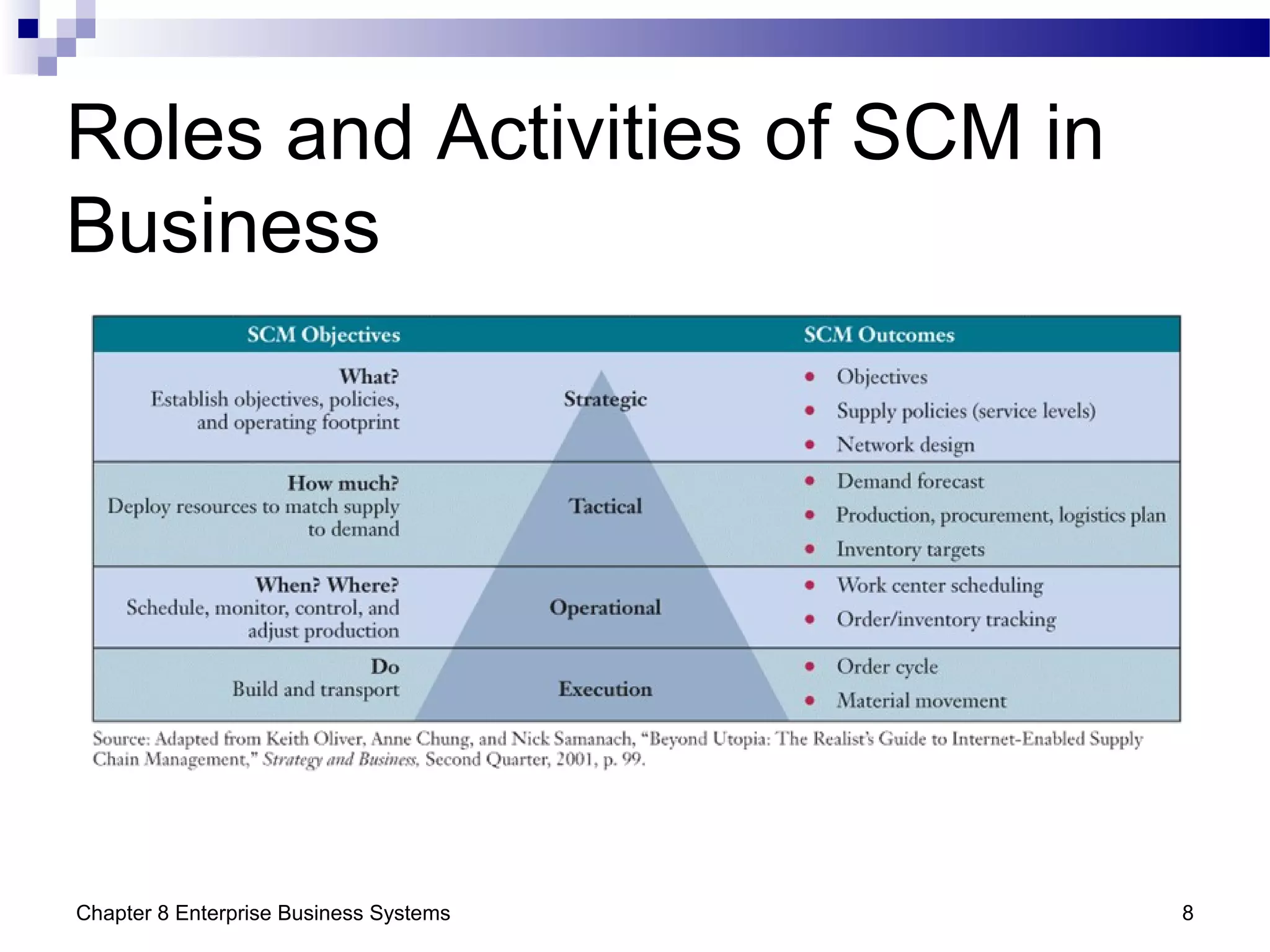
Roles and Activities of SCM in
Business
Chapter 8 Enterprise Business Systems 9
Planning & Execution Functions
of SCM
 Planning
Supply chain design
Collaborative demand and supply planning
 Execution
Materials management
Collaborative manufacturing
Collaborative fulfillment
Supply chain event management
Supply chain performance management
Chapter 8 Enterprise Business Systems 10
Benefits and Challenges of SCM
 Key Benefits
Faster, more accurate order processing
Reductions in inventory levels
Quicker times to market
Lower transaction and materials costs
Strategic relationships with supplier
Chapter 8 Enterprise Business Systems 11
Goals and Objectives of SCM
Chapter 8 Enterprise Business Systems 12
Benefits and Challenges of SCM
 Key Challenges
Lack of demand planning knowledge, tools,
and guidelines
Inaccurate data provided by other information
systems
Lack of collaboration among marketing,
production, and inventory management
SCM tools are immature, incomplete, and
hard to implement
Chapter 8 Enterprise Business Systems 13
Trends in SCM
Chapter 8 Enterprise Business Systems 14
ERP: The Business Backbone
 ERP is a cross-functional enterprise backbone
that integrates and automates processes within
Manufacturing
Logistics
Distribution
Accounting
Finance
Human resources
Chapter 8 Enterprise Business Systems 15
What is ERP?
 Enterprise resource planning is a cross-
functional enterprise system
An integrated suite of software modules
Supports basic internal business processes
Facilitates business, supplier, and customer
information flows
Chapter 8 Enterprise Business Systems 16
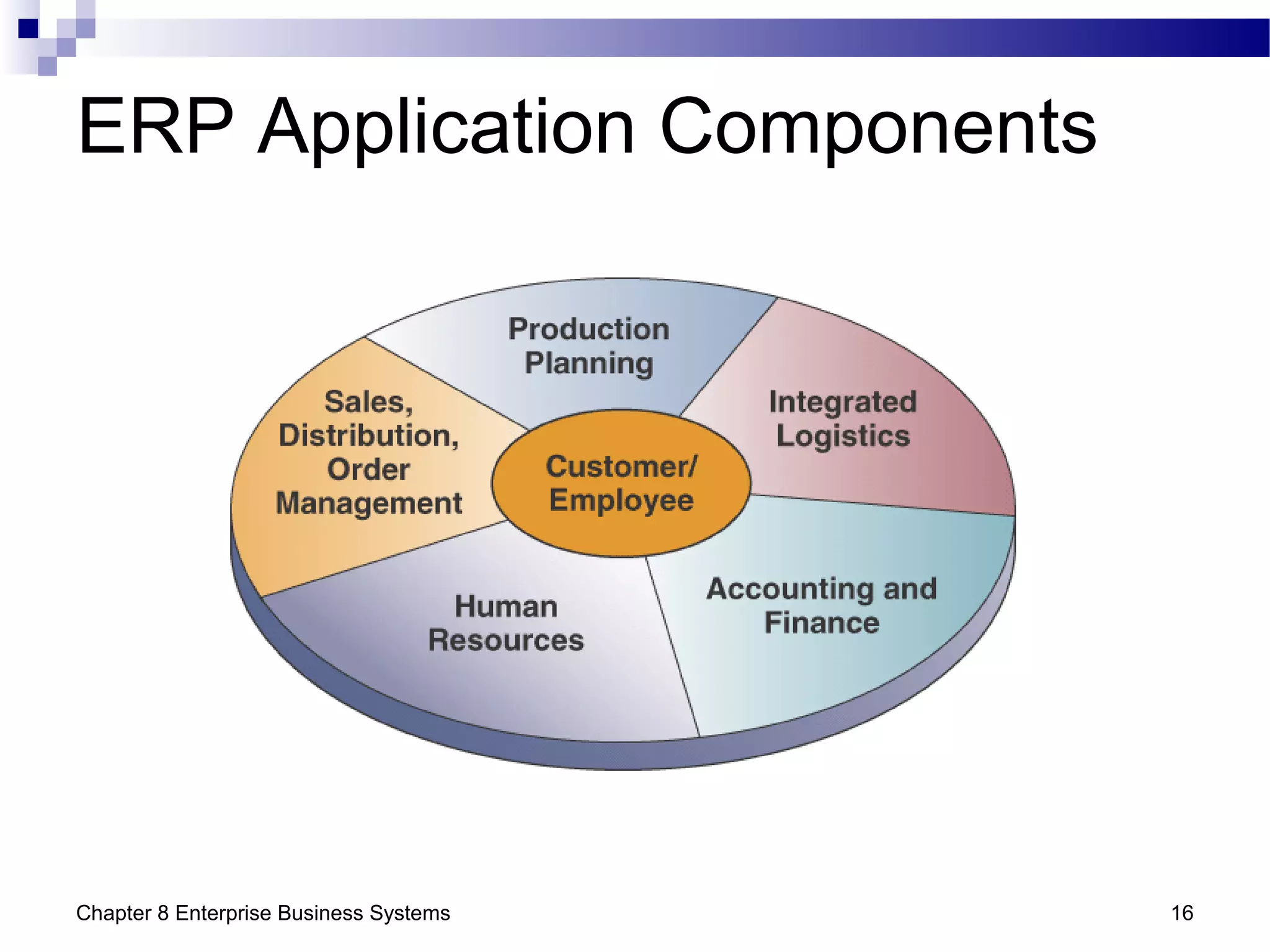
ERP Application Components
Chapter 8 Enterprise Business Systems 17
ERP Process and Information
Flows
Chapter 8 Enterprise Business Systems 18
Benefits and Challenges of ERP
 ERP Business Benefits
Quality and efficiency
Decreased costs
Decision support
Enterprise agility
 ERP Costs
Risks and costs are considerable
Hardware and software are a small part
of total costs
Failure can cripple or kill a business
Chapter 8 Enterprise Business Systems 19
Costs of Implementing a New ERP
Chapter 8 Enterprise Business Systems 20
Causes of ERP Failures
 Most common causes of ERP failure
Under-estimating the complexity of planning,
development, training
Failure to involve affected employees in
planning and development
Trying to do too much too fast
Insufficient training
Insufficient data conversion and testing
Over-reliance on ERP vendor or consultants
Chapter 8 Enterprise Business Systems 21
Trends in ERP
Chapter 8 Enterprise Business Systems 22
Customer Relationship
Management
 A customer-centric focus
Customer relationships have become a
company’s most valued asset
Every company’s strategy should be to
find and retain the most profitable
customers possible
Chapter 8 Enterprise Business Systems 23
What is CRM?
 Managing the full range of the customer
relationship involves
Providing customer-facing employees with a
single, complete view of every customer at
every touch point and across all channels
Providing the customer with a single, complete
view of the company and its extended
channels
 CRM uses IT to create a cross-functional
enterprise system that integrates and automates
many of the customer-serving processes
Chapter 8 Enterprise Business Systems 24
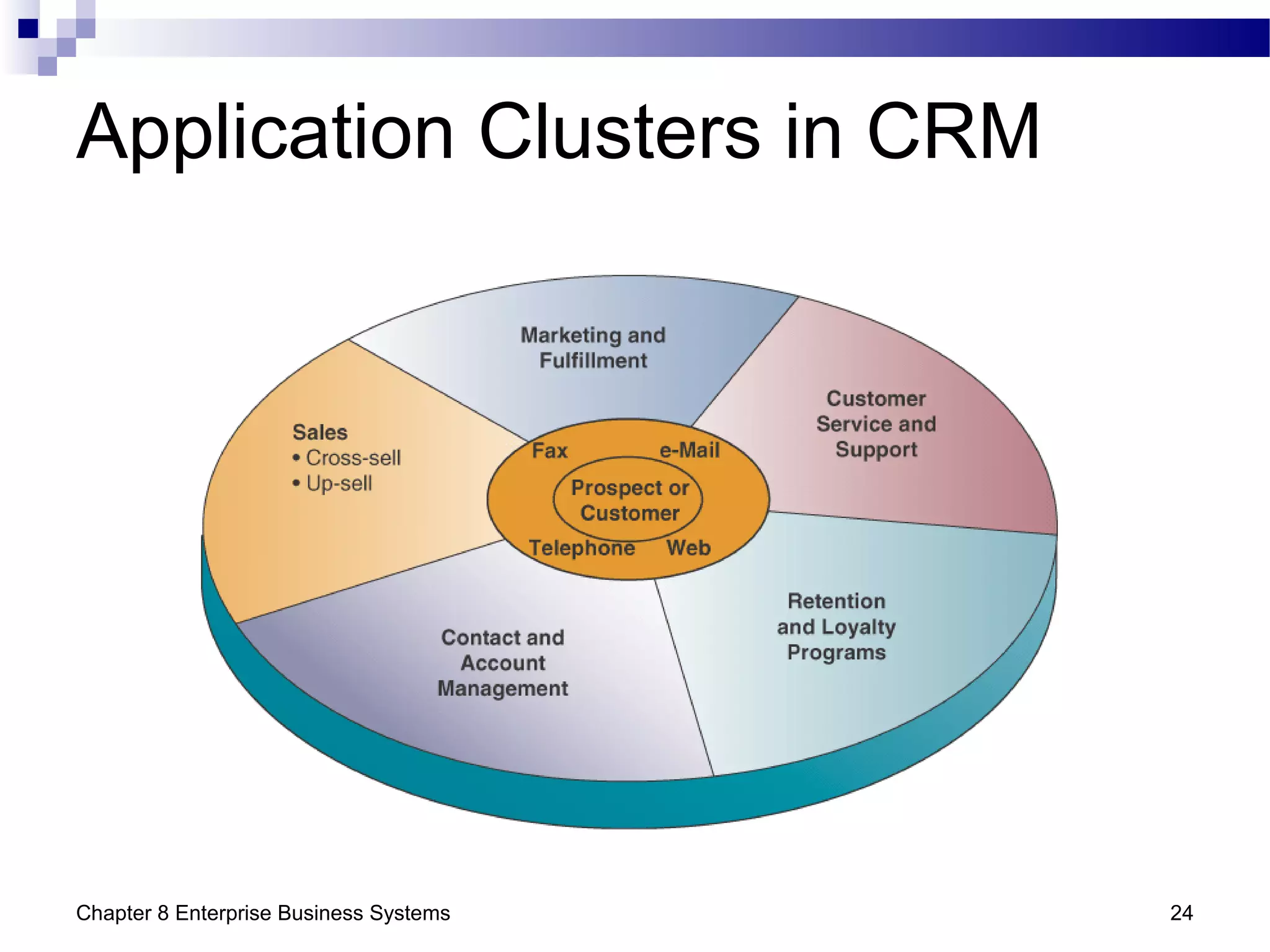
Application Clusters in CRM
Chapter 8 Enterprise Business Systems 25
Contact and Account Management
 CRM helps sales, marketing, and service
professionals capture and track relevant
data about
Every past and planned contact with
prospects and customers
Other business and life cycle events of
customers
 Data are captured through customer touchpoints
Telephone, fax, e-mail
Websites, retail stores, kiosks
Personal contact
Chapter 8 Enterprise Business Systems 26
Sales
 A CRM system provides sales reps with the
tools and data resources they need to
Support and manage their sales activities
Optimize cross- and up-selling
 CRM also provides the means to check on a
customer’s account status and history before
scheduling a sales call
Chapter 8 Enterprise Business Systems 27
Marketing and Fulfillment
 CRM systems help with direct marketing
campaigns by automatic such tasks as
Qualifying leads for targeted marketing
Scheduling and tracking mailings
Capturing and managing responses
Analyzing the business value of the campaign
Fulfilling responses and requests
Chapter 8 Enterprise Business Systems 28
Customer Service and Support
 A CRM system gives service reps real-time
access to the same database used by sales and
marketing
Requests for service are created, assigned,
and managed
Call center software routes calls to agents
Help desk software provides service data
and suggestions for solving problems
 Web-based self-service enables customers to
access personalized support information
Chapter 8 Enterprise Business Systems 29
Retention and Loyalty Programs
 It costs 6 times more to sell to a new customer
 An unhappy customer will tell 8-10 others
 Boosting customer retention by 5 percent can boost profits
by 85 percent
 The odds of selling to an existing customer are 50 percent;
a new one 15 percent
 About 70 percent of customers will do business with the
company again if a problem is quickly taken care of
 Enhancing and optimizing customer retention and loyalty
is a primary objective of CRM
 Identify, reward, and market to the most loyal
and profitable customers
 Evaluate targeted marketing and relationship programs
Chapter 8 Enterprise Business Systems 30
The Three Phases of CRM
Chapter 8 Enterprise Business Systems 31
Benefits of CRM
 Benefits of CRM
Identify and target the best customers
Real-time customization and personalization
of products and services
Track when and how a customer contacts
the company
Provide a consistent customer experience
Provide superior service and support across
all customer contact points
Chapter 8 Enterprise Business Systems 32
CRM Failures
 Business benefits of CRM are not guaranteed
50 percent of CRM projects did not produce
promised results
20 percent damaged customer relationships
 Reasons for failure
Lack of understanding and preparation
Not solving business process problems first
No participation on part of business
stakeholders involved
Chapter 8 Enterprise Business Systems 33
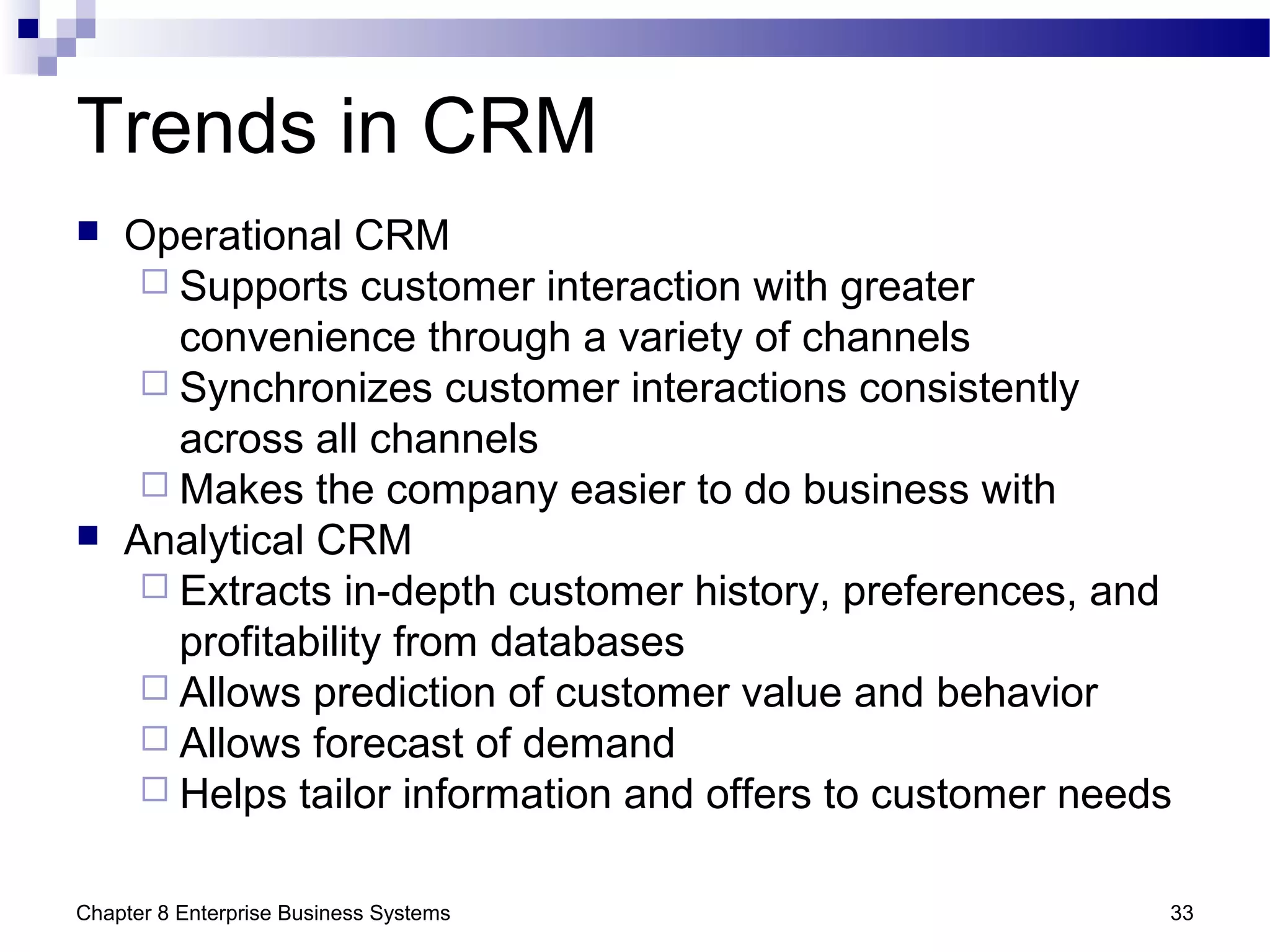
Trends in CRM
 Operational CRM
 Supports customer interaction with greater
convenience through a variety of channels
 Synchronizes customer interactions consistently
across all channels
 Makes the company easier to do business with
 Analytical CRM
 Extracts in-depth customer history, preferences, and
profitability from databases
 Allows prediction of customer value and behavior
 Allows forecast of demand
 Helps tailor information and offers to customer needs
Chapter 8 Enterprise Business Systems 34
Trends in CRM
 Collaborative CRM
 Easy collaboration with customers, suppliers, and partners
 Improves efficiency and integration throughout supply
chain
 Greater responsiveness to customer needs through
outside sourcing of products
and services
 Portal-based CRM
 Provides users with tools and information that fit their
needs
 Empowers employees to respond to customer demands
more quickly
 Helps reps become truly customer-faced
 Provides instant access to all internal and external
customer information

IT Supply Chain Management

  • 1.
  • 2.
    Chapter 8 EnterpriseBusiness Systems 2 Supply Chain Management (SCM)  Fundamentally, supply chain management helps a company Get the right products To the right place At the right time In the proper quantity At an acceptable cost
  • 3.
    Chapter 8 EnterpriseBusiness Systems 3 Goals of SCM  The goal of SCM is to efficiently Forecast demand Control inventory Enhance relationships with customers, suppliers, distributors, and others Receive feedback on the status of every link in the supply chain
  • 4.
    Chapter 8 EnterpriseBusiness Systems 4 What is a Supply Chain?  The interrelationships With suppliers, customers, distributors, and other businesses Needed to design, build, and sell a product  Each supply chain process should add value to the products or services a company produces Frequently called a value chain
  • 5.
    Chapter 8 EnterpriseBusiness Systems 5 Supply Chain Life Cycle
  • 6.
    Chapter 8 EnterpriseBusiness Systems 6 Electronic Data Interchange  One of the earliest uses of information technology for supply chain management  The electronic exchange of business transaction documents between supply chain trading partners  The almost complete automation of an e- commerce supply chain process  Many transactions occur over the Internet, using secure virtual private networks
  • 7.
    Chapter 8 EnterpriseBusiness Systems 7 Typical EDI Activities
  • 8.
    Chapter 8 EnterpriseBusiness Systems 8 Roles and Activities of SCM in Business
  • 9.
    Chapter 8 EnterpriseBusiness Systems 9 Planning & Execution Functions of SCM  Planning Supply chain design Collaborative demand and supply planning  Execution Materials management Collaborative manufacturing Collaborative fulfillment Supply chain event management Supply chain performance management
  • 10.
    Chapter 8 EnterpriseBusiness Systems 10 Benefits and Challenges of SCM  Key Benefits Faster, more accurate order processing Reductions in inventory levels Quicker times to market Lower transaction and materials costs Strategic relationships with supplier
  • 11.
    Chapter 8 EnterpriseBusiness Systems 11 Goals and Objectives of SCM
  • 12.
    Chapter 8 EnterpriseBusiness Systems 12 Benefits and Challenges of SCM  Key Challenges Lack of demand planning knowledge, tools, and guidelines Inaccurate data provided by other information systems Lack of collaboration among marketing, production, and inventory management SCM tools are immature, incomplete, and hard to implement
  • 13.
    Chapter 8 EnterpriseBusiness Systems 13 Trends in SCM
  • 14.
    Chapter 8 EnterpriseBusiness Systems 14 ERP: The Business Backbone  ERP is a cross-functional enterprise backbone that integrates and automates processes within Manufacturing Logistics Distribution Accounting Finance Human resources
  • 15.
    Chapter 8 EnterpriseBusiness Systems 15 What is ERP?  Enterprise resource planning is a cross- functional enterprise system An integrated suite of software modules Supports basic internal business processes Facilitates business, supplier, and customer information flows
  • 16.
    Chapter 8 EnterpriseBusiness Systems 16 ERP Application Components
  • 17.
    Chapter 8 EnterpriseBusiness Systems 17 ERP Process and Information Flows
  • 18.
    Chapter 8 EnterpriseBusiness Systems 18 Benefits and Challenges of ERP  ERP Business Benefits Quality and efficiency Decreased costs Decision support Enterprise agility  ERP Costs Risks and costs are considerable Hardware and software are a small part of total costs Failure can cripple or kill a business
  • 19.
    Chapter 8 EnterpriseBusiness Systems 19 Costs of Implementing a New ERP
  • 20.
    Chapter 8 EnterpriseBusiness Systems 20 Causes of ERP Failures  Most common causes of ERP failure Under-estimating the complexity of planning, development, training Failure to involve affected employees in planning and development Trying to do too much too fast Insufficient training Insufficient data conversion and testing Over-reliance on ERP vendor or consultants
  • 21.
    Chapter 8 EnterpriseBusiness Systems 21 Trends in ERP
  • 22.
    Chapter 8 EnterpriseBusiness Systems 22 Customer Relationship Management  A customer-centric focus Customer relationships have become a company’s most valued asset Every company’s strategy should be to find and retain the most profitable customers possible
  • 23.
    Chapter 8 EnterpriseBusiness Systems 23 What is CRM?  Managing the full range of the customer relationship involves Providing customer-facing employees with a single, complete view of every customer at every touch point and across all channels Providing the customer with a single, complete view of the company and its extended channels  CRM uses IT to create a cross-functional enterprise system that integrates and automates many of the customer-serving processes
  • 24.
    Chapter 8 EnterpriseBusiness Systems 24 Application Clusters in CRM
  • 25.
    Chapter 8 EnterpriseBusiness Systems 25 Contact and Account Management  CRM helps sales, marketing, and service professionals capture and track relevant data about Every past and planned contact with prospects and customers Other business and life cycle events of customers  Data are captured through customer touchpoints Telephone, fax, e-mail Websites, retail stores, kiosks Personal contact
  • 26.
    Chapter 8 EnterpriseBusiness Systems 26 Sales  A CRM system provides sales reps with the tools and data resources they need to Support and manage their sales activities Optimize cross- and up-selling  CRM also provides the means to check on a customer’s account status and history before scheduling a sales call
  • 27.
    Chapter 8 EnterpriseBusiness Systems 27 Marketing and Fulfillment  CRM systems help with direct marketing campaigns by automatic such tasks as Qualifying leads for targeted marketing Scheduling and tracking mailings Capturing and managing responses Analyzing the business value of the campaign Fulfilling responses and requests
  • 28.
    Chapter 8 EnterpriseBusiness Systems 28 Customer Service and Support  A CRM system gives service reps real-time access to the same database used by sales and marketing Requests for service are created, assigned, and managed Call center software routes calls to agents Help desk software provides service data and suggestions for solving problems  Web-based self-service enables customers to access personalized support information
  • 29.
    Chapter 8 EnterpriseBusiness Systems 29 Retention and Loyalty Programs  It costs 6 times more to sell to a new customer  An unhappy customer will tell 8-10 others  Boosting customer retention by 5 percent can boost profits by 85 percent  The odds of selling to an existing customer are 50 percent; a new one 15 percent  About 70 percent of customers will do business with the company again if a problem is quickly taken care of  Enhancing and optimizing customer retention and loyalty is a primary objective of CRM  Identify, reward, and market to the most loyal and profitable customers  Evaluate targeted marketing and relationship programs
  • 30.
    Chapter 8 EnterpriseBusiness Systems 30 The Three Phases of CRM
  • 31.
    Chapter 8 EnterpriseBusiness Systems 31 Benefits of CRM  Benefits of CRM Identify and target the best customers Real-time customization and personalization of products and services Track when and how a customer contacts the company Provide a consistent customer experience Provide superior service and support across all customer contact points
  • 32.
    Chapter 8 EnterpriseBusiness Systems 32 CRM Failures  Business benefits of CRM are not guaranteed 50 percent of CRM projects did not produce promised results 20 percent damaged customer relationships  Reasons for failure Lack of understanding and preparation Not solving business process problems first No participation on part of business stakeholders involved
  • 33.
    Chapter 8 EnterpriseBusiness Systems 33 Trends in CRM  Operational CRM  Supports customer interaction with greater convenience through a variety of channels  Synchronizes customer interactions consistently across all channels  Makes the company easier to do business with  Analytical CRM  Extracts in-depth customer history, preferences, and profitability from databases  Allows prediction of customer value and behavior  Allows forecast of demand  Helps tailor information and offers to customer needs
  • 34.
    Chapter 8 EnterpriseBusiness Systems 34 Trends in CRM  Collaborative CRM  Easy collaboration with customers, suppliers, and partners  Improves efficiency and integration throughout supply chain  Greater responsiveness to customer needs through outside sourcing of products and services  Portal-based CRM  Provides users with tools and information that fit their needs  Empowers employees to respond to customer demands more quickly  Helps reps become truly customer-faced  Provides instant access to all internal and external customer information