Copyright © Institut Lean France 2011


Lean Enterprise 2.0

   Dr Yves Caseau
Lean Enterprise 2.0
      A Paradigm Shift in Management &
An Answer to the Complexities of the 21st Century

                 October 13th, 2011
                 Dr. Yves CASEAU
                 Executive Vice-President,
                 Technologies, Services & Innovation

LeanITSummitYCS2011 – v0.5
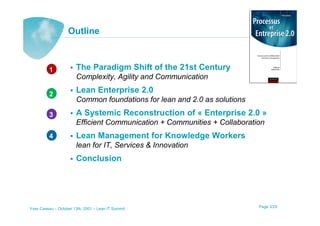
Outline


          1            The Paradigm Shift of the 21st Century
                       Complexity, Agility and Communication

          2
                       Lean Enterprise 2.0
                       Common foundations for lean and 2.0 as solutions
          3            A Systemic Reconstruction of « Enterprise 2.0 »
                       Efficient Communication + Communities + Collaboration
          4            Lean Management for Knowledge Workers
                       lean for IT, Services & Innovation
                       Conclusion


Yves Caseau – October 13th, 2001 – Lean IT Summit                         Page 3/25
1              Companies are Facing a Complex World

       A Complex World:
               Hyper-competition, globalization, time is shrinking
               The power has shifted to the consumers (F. Dupuy)
               T. Friedman : « All that is easy has been done, what’s left is the hard
               stuff »
       Complicated problems require specialists,
         Complex problems require everyone
               Diversity of skills and viewpoints …
               … organized into teams
       Complex problems are solved “on the gemba”,
         where they occur, one at a time
               Abstractions hide too much, decomposition does not work !
               “Reproducible conditions” … do not always exist (isolation is impossible)
               Communication is hard (cf. IT when specifying is harder than coding)
Yves Caseau – October 13th, 2001 – Lean IT Summit                                 Page 4/25
1              21st-Century Companies must be Agile

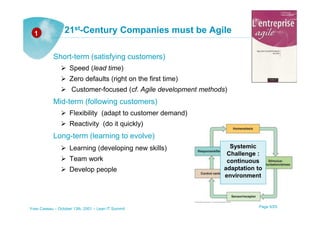
            Short-term (satisfying customers)
                    Speed (lead time)
                    Zero defaults (right on the first time)
                     Customer-focused (cf. Agile development methods)
            Mid-term (following customers)
                    Flexibility (adapt to customer demand)
                    Reactivity (do it quickly)
            Long-term (learning to evolve)
                    Learning (developing new skills)                  Systemic
                                                                     Challenge :
                    Team work                                        continuous
                    Develop people                                  adaptation to
                                                                    environment


Yves Caseau – October 13th, 2001 – Lean IT Summit                              Page 5/25
Networked Enterprise:
  1               Mimicking Biology to Adapt to Complexity


           Organization & Management need to evolve:
                    Control & command → recognition & response (L. Morris)
                     domain-centered dynamic organization, self-organization (C. Shirky)

           Strength of Weak Ties (M. Granovetter)
                    To innovate or to react to a crisis, one must enroll her/his “distant”
                    acquaintances ( “weak ties” : people you see rarely)
                    Homophily : “the tendency of individuals to associate and bond with similar others”
                    why we cannot rely on “strong ties” only ☺

           « Chinese Strategy » = develop « situation potential » (F. Jullien)
                    From detailed planning to opportunistic reaction
                    Benefits of exercises, practical training and “serious games”
                    Build-up “reflexes” (A.N. Whitehead, N. Taleb)

Yves Caseau – October 13th, 2001 – Lean IT Summit                                                Page 6/25
Collaboration & Cooperation :
  1              A « New Scientific Management »


   F. Taylor’s scientific management has reached its limits :
           Decomposition & specialization is a « projection » of a collective goal onto
           a set of individuals, who may work independently …
           Complex domains require to work together, as a team
           We are moving from « complicated » (many parts) to « complex » (inter-
           related)
   Complex work requires orchestration
           Multiple information flows (one needs to say what s/he is doing)
           The more we breakdown and specialize, the more we need to talk !
   Collaboration vs. Cooperation: both are necessary
           Collaboration: a common result, a shared goal, indistinct responsibility
           Cooperation: common result, but goals and responsibilities are distinct


Yves Caseau – October 13th, 2001 – Lean IT Summit                                Page 7/25
Part II


                       The Paradigm Shift of the 21st Century
                       Complexity, Agility and Communication

          2
                       Lean Enterprise 2.0
                       Common foundations for lean and 2.0 as solutions
                       A Systemic Reconstruction of « Enterprise 2.0 »
                       Efficient Communication + Communities + Collaboration
                       Lean Management for Knowledge Workers
                       lean for IT, Services & Innovation
                       Conclusion


Yves Caseau – October 13th, 2001 – Lean IT Summit                         Page 8/25
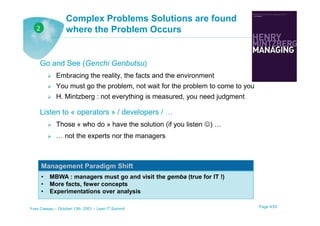
Complex Problems Solutions are found
   2              where the Problem Occurs


     Go and See (Genchi Genbutsu)
             Embracing the reality, the facts and the environment
             You must go the problem, not wait for the problem to come to you
             H. Mintzberg : not everything is measured, you need judgment

     Listen to « operators » / developers / …
             Those « who do » have the solution (if you listen ☺) …
             … not the experts nor the managers


       Management Paradigm Shift
       •   MBWA : managers must go and visit the gemba (true for IT !)
       •   More facts, fewer concepts
       •   Experimentations over analysis

Yves Caseau – October 13th, 2001 – Lean IT Summit                               Page 9/25
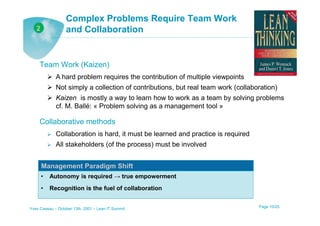
Complex Problems Require Team Work
   2              and Collaboration


     Team Work (Kaizen)
             A hard problem requires the contribution of multiple viewpoints
             Not simply a collection of contributions, but real team work (collaboration)
             Kaizen is mostly a way to learn how to work as a team by solving problems
             cf. M. Ballé: « Problem solving as a management tool »

     Collaborative methods
             Collaboration is hard, it must be learned and practice is required
             All stakeholders (of the process) must be involved


       Management Paradigm Shift
       •   Autonomy is required → true empowerment
       •   Recognition is the fuel of collaboration


Yves Caseau – October 13th, 2001 – Lean IT Summit                                 Page 10/25
Need for Innovation and
   2
                   « Everyone’s Brain »


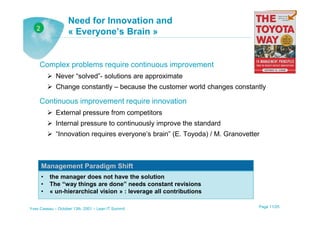
     Complex problems require continuous improvement
             Never “solved”- solutions are approximate
             Change constantly – because the customer world changes constantly

     Continuous improvement require innovation
             External pressure from competitors
             Internal pressure to continuously improve the standard
             “Innovation requires everyone’s brain” (E. Toyoda) / M. Granovetter


       Management Paradigm Shift
       •   the manager does not have the solution
       •   The “way things are done” needs constant revisions
       •   « un-hierarchical vision » : leverage all contributions

Yves Caseau – October 13th, 2001 – Lean IT Summit                              Page 11/25
Complexity Requires Continuous Skill
   2                Learning


     Complex problems require skills:
             Cf. lean : emphasize product and technical skills
             The more complex, the more skills matter
             Cf. « The Mythical Man Month » ☺
                                                                   Assumption:
     Skill set is not static                                       all that is not
                                                                    complex is
             Human capital : process to acquire skills             automated or
                                                                    de-localized
             “Double loop learning” (C. Agyris)
             cf. M. Ballé : The lean managers does not teach how
             to solve, but how to learn
          Learn
       Management Paragdim Shift
          Learn to learn (lean – M. Balle)
       • Coach (and not teacher !) → humility
       •   Learn – by oneself, from pairs, from sensei


Yves Caseau – October 13th, 2001 – Lean IT Summit                        Page 12/25
Part III


                       The Paradigm Shift of the 21st Century
                       Complexity, Agility and Communication
                       Lean Enterprise 2.0
                       Common foundations for lean and 2.0 as solutions
          3            A Systemic Reconstruction of « Enterprise 2.0 »
                       Efficient Communication + Communities + Collaboration
                       Lean Management for Knowledge Workers
                       lean for IT, Services & Innovation
                       Conclusion


Yves Caseau – October 13th, 2001 – Lean IT Summit                         Page 13/25
3
                  Enterprise 2.0 as a Cure
                  for « Common Congestion »


     E2.0 solves « 1.0 problems » for today’s companies
      (consequence of scale + complexity)
                                                                       Companies who adopt
             Congestion of information flows, “workable time”          2.0 the fastest are those
             Problems that plague large companies / increasingly       who need it the least ☺


     E2.0 = communication + communities + collaboration
             tools, but mostly behavior and culture
             methods that require learning and practice

     E2.0 is geared towards “knowledge workers”
             suited for services, IT, innovation, product development, …
             … domains where complexity abounds and where lean
             management is also welcome


Yves Caseau – October 13th, 2001 – Lean IT Summit                                 Page 14/25
Efficient Communication (1) : Faster

          Managing information flows efficiently is a key part of
           organization design (March & Simon)
                   Ever-increasing : consequence of 21st century “Post-Taylorism”
                   complex → need to share context, to explain one’s work to co-workers
                   Communicating takes time, it is not “information transfer”
                   but a process (D. Wolton)

          Enterprise 2.0 practices (& tools) improve flow efficiency
                   Short messages (micro-blogging)
                   Woven in the fabric of work
                   (interstice – recycle “crumbs of time”)
                • Instant messaging
                   “Self semantic organization” (relevant pieces are linked together)
                • The pieces arrive where they should be ☺
                • Less sorting !
Yves Caseau – October 13th, 2001 – Lean IT Summit                                   Page 15/25
Efficient Communication (2):
   3
                      Reaching your Target !


       Most tools are designed to communicate with “those whom you know”
                Telephone, email, …
                Hence the « club effect » (well documented)

       Enterprise 2.0 tools to help reach a « new audience »
                Project-based, topic-based, community-based
                Address people through their functions
                Discover who knows/does/is-responsible-for what

       This may sound worrisome to lean practitioners … it is ☺
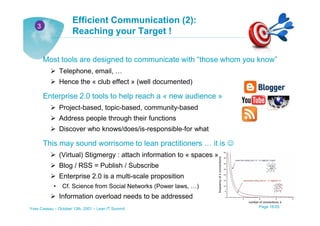
                (Virtual) Stigmergy : attach information to « spaces »
                Blog / RSS = Publish / Subscribe
                Enterprise 2.0 is a multi-scale proposition
            •    Cf. Science from Social Networks (Power laws, …)
                Information overload needs to be addressed
Yves Caseau – October 13th, 2001 – Lean IT Summit                        Page 16/25
3
   4
                 The Power of Communities


     SWT (Strength of Weak Ties)
               Create networks of people from different organizations
               and different localization who share an interest
               This network breaks the « silos » and opens
               communication channels that favors innovation
               and speed

     Self-organization
               Usual project organization for an emerging topic:
               approve topic / select project leader + team / create committees
           •    6 weeks to 6 months ☺
               ESSP (Emergent Social Software Platform – Mc Affee) promote self-organization
           •    A few days down to a few hours


Yves Caseau – October 13th, 2001 – Lean IT Summit                                 Page 17/25
3
                 Entreprise 2.0 Collaboration


    Sharing & co-editing artifacts
             Wikis, documents,..
             Maps, 3D Models, …

    Knowing what’s on your colleague’s minds
             Micro-blogging
             Comments, votes, one-click sharing

    Collaboration requires more than sharing (Push vs. Pull):
             Bernard Charles - Dassault Systèmes – :
             « Collaboration requires to share what one doesn’t know –
             with respect to a common goal – trust and truthfulness
             are required”
             Honesty and Truthfulness (cf. E. Deming or J. Collins)
         •    “Great companies confront continually with the brutal facts of reality”

Yves Caseau – October 13th, 2001 – Lean IT Summit                                       Page 18/25
A Lean Perspective on Information
   3
                 Overload


       « WIP (work in process) » : how to avoid information overload
                The scarce resource is not information, it’s the reader’s attention
                Multiple sources show that the quality of a decision does not necessarily
                improve with additional information
       Eliminate waste: redundant efforts
                Redundancy occurs when everyone shares the same information(E2.0                   )
       A systemic (lean) approach:
                A formal role map (who does what) : KW need well-defined processes
                Visual Management: who needs what ? (E2.0 ☺)
                Higher standards for documents/messages : push the constraint
                upstream !
                       E.g., guidelines for « proper usage » of email
                       Makes the reader’s life easier and the writer’s harder ☺

Yves Caseau – October 13th, 2001 – Lean IT Summit                                     Page 19/25
Part IV


                       The Paradigm Shift of the 21st Century
                       Complexity, Agility and Communication
                       Lean Enterprise 2.0
                       Common foundations for lean and 2.0 as solutions
                       A Systemic Reconstruction of « Enterprise 2.0 »
                       Efficient Communication + Communities + Collaboration

           4           Lean Management for Knowledge Workers
                       lean for IT, Services & Innovation
                       Conclusion


Yves Caseau – October 13th, 2001 – Lean IT Summit                         Page 20/25
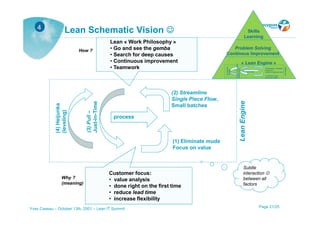
4                  Lean Schematic Vision ☺                                                                                            Skills
                                                                                                                                        Learning
                                              Lean « Work Philosophy »
                            How ?             • Go and see the gemba                            Problem Solving
                                              • Search for deep causes                       Continous Improvement
                                              • Continuous improvement                                                               « Lean Engine »


                                                                                                            (3) Pull – flux tendus
                                              • Teamwork


                                                                                             (4) Heijunka


                                                                                                                                                                                           Lean Engine
                                                                                                                                                            (2) Streamline (fluidifier)


                                                                                                            Juste-à-temps
                                                                                             (lissage)
                                                                                                                                                            Fractionner
                                                                                                                                               processu     (réduire la taille des lots)
                                                                                                                                               s
                                                                                                                                                             (1) Éliminer muda
                                                                                                                                                             Focus sur valeur


                                                                       (2) Streamline
                                                                       Single Piece Flow,


                                                                                                                                 Lean Engine
                               Just-in-Time
             (4) Heijunka


                                                                       Small batches
             (leveling)


                               (3) Pull –


                                               process


                                                                        (1) Eliminate muda
                                                                        Focus on value


                                                                                                                                      Subtle
                                              Customer focus:                                                                         interaction ☺
                   Why ?                      • value analysis                                                                        between all
                   (meaning)                                                                                                          factors
                                              • done right on the first time
                                              • reduce lead time
                                              • increase flexibility
Yves Caseau – October 13th, 2001 – Lean IT Summit                                                                                                         Page 21/25
4
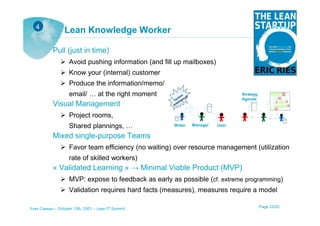
                 Lean Knowledge Worker

           Pull (just in time)
                    Avoid pushing information (and fill up mailboxes)
                    Know your (internal) customer
                    Produce the information/memo/
                    email/ … at the right moment                                 Strategy
                                                                                 Agenda
           Visual Management
                    Project rooms,
                    Shared plannings, …                Writer   Manager   User

           Mixed single-purpose Teams
                    Favor team efficiency (no waiting) over resource management (utilization
                    rate of skilled workers)
           « Validated Learning » → Minimal Viable Product (MVP)
                    MVP: expose to feedback as early as possible (cf. extreme programming)
                    Validation requires hard facts (measures), measures require a model

Yves Caseau – October 13th, 2001 – Lean IT Summit                                           Page 22/25
4
                 Lean Project Development

       Reduce WIP (… and accelerate lead time)
               Fewer projects, shorter roadmaps, less details over 6 months ☺

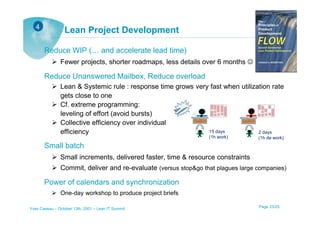
       Reduce Unanswered Mailbox, Reduce overload
               Lean & Systemic rule : response time grows very fast when utilization rate
               gets close to one
               Cf. extreme programming:
               leveling of effort (avoid bursts)
               Collective efficiency over individual
               efficiency                                     15 days           2 days
                                                                 (1h work)        (1h de work)
       Small batch
               Small increments, delivered faster, time & resource constraints
               Commit, deliver and re-evaluate (versus stop&go that plagues large companies)

       Power of calendars and synchronization
               One-day workshop to produce project briefs

Yves Caseau – October 13th, 2001 – Lean IT Summit                                 Page 23/25
4              Lean Management May Benefit from « 2.0 »

               Problem solving (in addition to kaizen)
                       Asynchronous / de-localized problem solving still works …
                       Blogs, wiki, co-edition, …

               Team work
                       Microblogging strengthens the “contextual connection”
                       Creates a sense of community for large (process-wide) communities

               Electronic Visual Management
                       Anywhere, any time access to shared information
                       Not a substitute, but a complement !

               Learning and Capitalization
                       Self-organized community sites

               Information Management « 5S »
                       « folksonomy » (tags), wikis, …
Yves Caseau – October 13th, 2001 – Lean IT Summit                                  Page 24/25
Creativity and Innovation May Benefit
   4
                 from Tools & Methods, too !

            2.0 Tools which may facilitate problem solving:
                    Network weaving (leveraging weak ties ☺)
                    self-organization (“communities of practice”)
                    Co-design (Wiki, shared documents, …)
                    Content weaving: creaking links and paths between
                    documents (2.0 : dynamic, community-based and valued)

            Creativity Methods (beyond 2.0)
                    Same as for lean, there exist methods to develop/increase
                    creativity
                     CPS, ASIT, Triz, ToC, Bono’s Hats, ….
                    A strong potential that is underutilized today


Yves Caseau – October 13th, 2001 – Lean IT Summit                               Page 25/25
Conclusion


  • « Scientific Management » from F. Taylor has reached its
    limits in the 21st century – it is time for an overhaul

  • « Enterprise 2.0 » and « Lean management » approaches differ,
    but share interesting common grounds and both rely
    on culture transformation, including management ☺

  • These common grounds are an answer to the ever-increasing
    complexity of the enterprise and its environment:
              Both rely on collaboration and teamwork, with a claim on « everyone’s
              brain »
              Both propose methods to grow skills and promote learning
              Both favor « ground work » and « facing hard facts » as opposed to
              delegating analysis to experts and managers, or working on
              abstract/aggregated models.

Yves Caseau – October 13th, 2001 – Lean IT Summit                              Page 26/25
Copyright © Institut Lean France 2011


www.lean-it-summit.com

Enterprise 2.0 by Dr Yves Caseau

  • 1.
    Copyright © InstitutLean France 2011 Lean Enterprise 2.0 Dr Yves Caseau
  • 2.
    Lean Enterprise 2.0 A Paradigm Shift in Management & An Answer to the Complexities of the 21st Century October 13th, 2011 Dr. Yves CASEAU Executive Vice-President, Technologies, Services & Innovation LeanITSummitYCS2011 – v0.5
  • 3.
    Outline 1 The Paradigm Shift of the 21st Century Complexity, Agility and Communication 2 Lean Enterprise 2.0 Common foundations for lean and 2.0 as solutions 3 A Systemic Reconstruction of « Enterprise 2.0 » Efficient Communication + Communities + Collaboration 4 Lean Management for Knowledge Workers lean for IT, Services & Innovation Conclusion Yves Caseau – October 13th, 2001 – Lean IT Summit Page 3/25
  • 4.
    1 Companies are Facing a Complex World A Complex World: Hyper-competition, globalization, time is shrinking The power has shifted to the consumers (F. Dupuy) T. Friedman : « All that is easy has been done, what’s left is the hard stuff » Complicated problems require specialists, Complex problems require everyone Diversity of skills and viewpoints … … organized into teams Complex problems are solved “on the gemba”, where they occur, one at a time Abstractions hide too much, decomposition does not work ! “Reproducible conditions” … do not always exist (isolation is impossible) Communication is hard (cf. IT when specifying is harder than coding) Yves Caseau – October 13th, 2001 – Lean IT Summit Page 4/25
  • 5.
    1 21st-Century Companies must be Agile Short-term (satisfying customers) Speed (lead time) Zero defaults (right on the first time) Customer-focused (cf. Agile development methods) Mid-term (following customers) Flexibility (adapt to customer demand) Reactivity (do it quickly) Long-term (learning to evolve) Learning (developing new skills) Systemic Challenge : Team work continuous Develop people adaptation to environment Yves Caseau – October 13th, 2001 – Lean IT Summit Page 5/25
  • 6.
    Networked Enterprise: 1 Mimicking Biology to Adapt to Complexity Organization & Management need to evolve: Control & command → recognition & response (L. Morris) domain-centered dynamic organization, self-organization (C. Shirky) Strength of Weak Ties (M. Granovetter) To innovate or to react to a crisis, one must enroll her/his “distant” acquaintances ( “weak ties” : people you see rarely) Homophily : “the tendency of individuals to associate and bond with similar others” why we cannot rely on “strong ties” only ☺ « Chinese Strategy » = develop « situation potential » (F. Jullien) From detailed planning to opportunistic reaction Benefits of exercises, practical training and “serious games” Build-up “reflexes” (A.N. Whitehead, N. Taleb) Yves Caseau – October 13th, 2001 – Lean IT Summit Page 6/25
  • 7.
    Collaboration & Cooperation: 1 A « New Scientific Management » F. Taylor’s scientific management has reached its limits : Decomposition & specialization is a « projection » of a collective goal onto a set of individuals, who may work independently … Complex domains require to work together, as a team We are moving from « complicated » (many parts) to « complex » (inter- related) Complex work requires orchestration Multiple information flows (one needs to say what s/he is doing) The more we breakdown and specialize, the more we need to talk ! Collaboration vs. Cooperation: both are necessary Collaboration: a common result, a shared goal, indistinct responsibility Cooperation: common result, but goals and responsibilities are distinct Yves Caseau – October 13th, 2001 – Lean IT Summit Page 7/25
  • 8.
    Part II The Paradigm Shift of the 21st Century Complexity, Agility and Communication 2 Lean Enterprise 2.0 Common foundations for lean and 2.0 as solutions A Systemic Reconstruction of « Enterprise 2.0 » Efficient Communication + Communities + Collaboration Lean Management for Knowledge Workers lean for IT, Services & Innovation Conclusion Yves Caseau – October 13th, 2001 – Lean IT Summit Page 8/25
  • 9.
    Complex Problems Solutionsare found 2 where the Problem Occurs Go and See (Genchi Genbutsu) Embracing the reality, the facts and the environment You must go the problem, not wait for the problem to come to you H. Mintzberg : not everything is measured, you need judgment Listen to « operators » / developers / … Those « who do » have the solution (if you listen ☺) … … not the experts nor the managers Management Paradigm Shift • MBWA : managers must go and visit the gemba (true for IT !) • More facts, fewer concepts • Experimentations over analysis Yves Caseau – October 13th, 2001 – Lean IT Summit Page 9/25
  • 10.
    Complex Problems RequireTeam Work 2 and Collaboration Team Work (Kaizen) A hard problem requires the contribution of multiple viewpoints Not simply a collection of contributions, but real team work (collaboration) Kaizen is mostly a way to learn how to work as a team by solving problems cf. M. Ballé: « Problem solving as a management tool » Collaborative methods Collaboration is hard, it must be learned and practice is required All stakeholders (of the process) must be involved Management Paradigm Shift • Autonomy is required → true empowerment • Recognition is the fuel of collaboration Yves Caseau – October 13th, 2001 – Lean IT Summit Page 10/25
  • 11.
    Need for Innovationand 2 « Everyone’s Brain » Complex problems require continuous improvement Never “solved”- solutions are approximate Change constantly – because the customer world changes constantly Continuous improvement require innovation External pressure from competitors Internal pressure to continuously improve the standard “Innovation requires everyone’s brain” (E. Toyoda) / M. Granovetter Management Paradigm Shift • the manager does not have the solution • The “way things are done” needs constant revisions • « un-hierarchical vision » : leverage all contributions Yves Caseau – October 13th, 2001 – Lean IT Summit Page 11/25
  • 12.
    Complexity Requires ContinuousSkill 2 Learning Complex problems require skills: Cf. lean : emphasize product and technical skills The more complex, the more skills matter Cf. « The Mythical Man Month » ☺ Assumption: Skill set is not static all that is not complex is Human capital : process to acquire skills automated or de-localized “Double loop learning” (C. Agyris) cf. M. Ballé : The lean managers does not teach how to solve, but how to learn Learn Management Paragdim Shift Learn to learn (lean – M. Balle) • Coach (and not teacher !) → humility • Learn – by oneself, from pairs, from sensei Yves Caseau – October 13th, 2001 – Lean IT Summit Page 12/25
  • 13.
    Part III The Paradigm Shift of the 21st Century Complexity, Agility and Communication Lean Enterprise 2.0 Common foundations for lean and 2.0 as solutions 3 A Systemic Reconstruction of « Enterprise 2.0 » Efficient Communication + Communities + Collaboration Lean Management for Knowledge Workers lean for IT, Services & Innovation Conclusion Yves Caseau – October 13th, 2001 – Lean IT Summit Page 13/25
  • 14.
    3 Enterprise 2.0 as a Cure for « Common Congestion » E2.0 solves « 1.0 problems » for today’s companies (consequence of scale + complexity) Companies who adopt Congestion of information flows, “workable time” 2.0 the fastest are those Problems that plague large companies / increasingly who need it the least ☺ E2.0 = communication + communities + collaboration tools, but mostly behavior and culture methods that require learning and practice E2.0 is geared towards “knowledge workers” suited for services, IT, innovation, product development, … … domains where complexity abounds and where lean management is also welcome Yves Caseau – October 13th, 2001 – Lean IT Summit Page 14/25
  • 15.
    Efficient Communication (1): Faster Managing information flows efficiently is a key part of organization design (March & Simon) Ever-increasing : consequence of 21st century “Post-Taylorism” complex → need to share context, to explain one’s work to co-workers Communicating takes time, it is not “information transfer” but a process (D. Wolton) Enterprise 2.0 practices (& tools) improve flow efficiency Short messages (micro-blogging) Woven in the fabric of work (interstice – recycle “crumbs of time”) • Instant messaging “Self semantic organization” (relevant pieces are linked together) • The pieces arrive where they should be ☺ • Less sorting ! Yves Caseau – October 13th, 2001 – Lean IT Summit Page 15/25
  • 16.
    Efficient Communication (2): 3 Reaching your Target ! Most tools are designed to communicate with “those whom you know” Telephone, email, … Hence the « club effect » (well documented) Enterprise 2.0 tools to help reach a « new audience » Project-based, topic-based, community-based Address people through their functions Discover who knows/does/is-responsible-for what This may sound worrisome to lean practitioners … it is ☺ (Virtual) Stigmergy : attach information to « spaces » Blog / RSS = Publish / Subscribe Enterprise 2.0 is a multi-scale proposition • Cf. Science from Social Networks (Power laws, …) Information overload needs to be addressed Yves Caseau – October 13th, 2001 – Lean IT Summit Page 16/25
  • 17.
    3 4 The Power of Communities SWT (Strength of Weak Ties) Create networks of people from different organizations and different localization who share an interest This network breaks the « silos » and opens communication channels that favors innovation and speed Self-organization Usual project organization for an emerging topic: approve topic / select project leader + team / create committees • 6 weeks to 6 months ☺ ESSP (Emergent Social Software Platform – Mc Affee) promote self-organization • A few days down to a few hours Yves Caseau – October 13th, 2001 – Lean IT Summit Page 17/25
  • 18.
    3 Entreprise 2.0 Collaboration Sharing & co-editing artifacts Wikis, documents,.. Maps, 3D Models, … Knowing what’s on your colleague’s minds Micro-blogging Comments, votes, one-click sharing Collaboration requires more than sharing (Push vs. Pull): Bernard Charles - Dassault Systèmes – : « Collaboration requires to share what one doesn’t know – with respect to a common goal – trust and truthfulness are required” Honesty and Truthfulness (cf. E. Deming or J. Collins) • “Great companies confront continually with the brutal facts of reality” Yves Caseau – October 13th, 2001 – Lean IT Summit Page 18/25
  • 19.
    A Lean Perspectiveon Information 3 Overload « WIP (work in process) » : how to avoid information overload The scarce resource is not information, it’s the reader’s attention Multiple sources show that the quality of a decision does not necessarily improve with additional information Eliminate waste: redundant efforts Redundancy occurs when everyone shares the same information(E2.0 ) A systemic (lean) approach: A formal role map (who does what) : KW need well-defined processes Visual Management: who needs what ? (E2.0 ☺) Higher standards for documents/messages : push the constraint upstream ! E.g., guidelines for « proper usage » of email Makes the reader’s life easier and the writer’s harder ☺ Yves Caseau – October 13th, 2001 – Lean IT Summit Page 19/25
  • 20.
    Part IV The Paradigm Shift of the 21st Century Complexity, Agility and Communication Lean Enterprise 2.0 Common foundations for lean and 2.0 as solutions A Systemic Reconstruction of « Enterprise 2.0 » Efficient Communication + Communities + Collaboration 4 Lean Management for Knowledge Workers lean for IT, Services & Innovation Conclusion Yves Caseau – October 13th, 2001 – Lean IT Summit Page 20/25
  • 21.
    4 Lean Schematic Vision ☺ Skills Learning Lean « Work Philosophy » How ? • Go and see the gemba Problem Solving • Search for deep causes Continous Improvement • Continuous improvement « Lean Engine » (3) Pull – flux tendus • Teamwork (4) Heijunka Lean Engine (2) Streamline (fluidifier) Juste-à-temps (lissage) Fractionner processu (réduire la taille des lots) s (1) Éliminer muda Focus sur valeur (2) Streamline Single Piece Flow, Lean Engine Just-in-Time (4) Heijunka Small batches (leveling) (3) Pull – process (1) Eliminate muda Focus on value Subtle Customer focus: interaction ☺ Why ? • value analysis between all (meaning) factors • done right on the first time • reduce lead time • increase flexibility Yves Caseau – October 13th, 2001 – Lean IT Summit Page 21/25
  • 22.
    4 Lean Knowledge Worker Pull (just in time) Avoid pushing information (and fill up mailboxes) Know your (internal) customer Produce the information/memo/ email/ … at the right moment Strategy Agenda Visual Management Project rooms, Shared plannings, … Writer Manager User Mixed single-purpose Teams Favor team efficiency (no waiting) over resource management (utilization rate of skilled workers) « Validated Learning » → Minimal Viable Product (MVP) MVP: expose to feedback as early as possible (cf. extreme programming) Validation requires hard facts (measures), measures require a model Yves Caseau – October 13th, 2001 – Lean IT Summit Page 22/25
  • 23.
    4 Lean Project Development Reduce WIP (… and accelerate lead time) Fewer projects, shorter roadmaps, less details over 6 months ☺ Reduce Unanswered Mailbox, Reduce overload Lean & Systemic rule : response time grows very fast when utilization rate gets close to one Cf. extreme programming: leveling of effort (avoid bursts) Collective efficiency over individual efficiency 15 days 2 days (1h work) (1h de work) Small batch Small increments, delivered faster, time & resource constraints Commit, deliver and re-evaluate (versus stop&go that plagues large companies) Power of calendars and synchronization One-day workshop to produce project briefs Yves Caseau – October 13th, 2001 – Lean IT Summit Page 23/25
  • 24.
    4 Lean Management May Benefit from « 2.0 » Problem solving (in addition to kaizen) Asynchronous / de-localized problem solving still works … Blogs, wiki, co-edition, … Team work Microblogging strengthens the “contextual connection” Creates a sense of community for large (process-wide) communities Electronic Visual Management Anywhere, any time access to shared information Not a substitute, but a complement ! Learning and Capitalization Self-organized community sites Information Management « 5S » « folksonomy » (tags), wikis, … Yves Caseau – October 13th, 2001 – Lean IT Summit Page 24/25
  • 25.
    Creativity and InnovationMay Benefit 4 from Tools & Methods, too ! 2.0 Tools which may facilitate problem solving: Network weaving (leveraging weak ties ☺) self-organization (“communities of practice”) Co-design (Wiki, shared documents, …) Content weaving: creaking links and paths between documents (2.0 : dynamic, community-based and valued) Creativity Methods (beyond 2.0) Same as for lean, there exist methods to develop/increase creativity CPS, ASIT, Triz, ToC, Bono’s Hats, …. A strong potential that is underutilized today Yves Caseau – October 13th, 2001 – Lean IT Summit Page 25/25
  • 26.
    Conclusion •« Scientific Management » from F. Taylor has reached its limits in the 21st century – it is time for an overhaul • « Enterprise 2.0 » and « Lean management » approaches differ, but share interesting common grounds and both rely on culture transformation, including management ☺ • These common grounds are an answer to the ever-increasing complexity of the enterprise and its environment: Both rely on collaboration and teamwork, with a claim on « everyone’s brain » Both propose methods to grow skills and promote learning Both favor « ground work » and « facing hard facts » as opposed to delegating analysis to experts and managers, or working on abstract/aggregated models. Yves Caseau – October 13th, 2001 – Lean IT Summit Page 26/25
  • 27.
    Copyright © InstitutLean France 2011 www.lean-it-summit.com