Learning Lean Collaboratively


           John Shook
      Lean Enterprise Institute

             October 1, 2012
First, What is Lean
     Thinking & Practice?

Systemically develop people and
continuously improve processes
 to provide value and prosperity
   while consuming the fewest
       possible resources
Second, Why Learn Lean Collaboratively?
• Lean = learning
• Successful change requires dispersing learning
  through an organization quickly and
  effectively
• Learning collaboratively is a way to scale
  learning – in an organization and beyond
• So, let’s borrow the learning curve of Lean
  thinkers who are succeeding through
  collaborative learning groups
Third, What is
    Collaborative Learning?
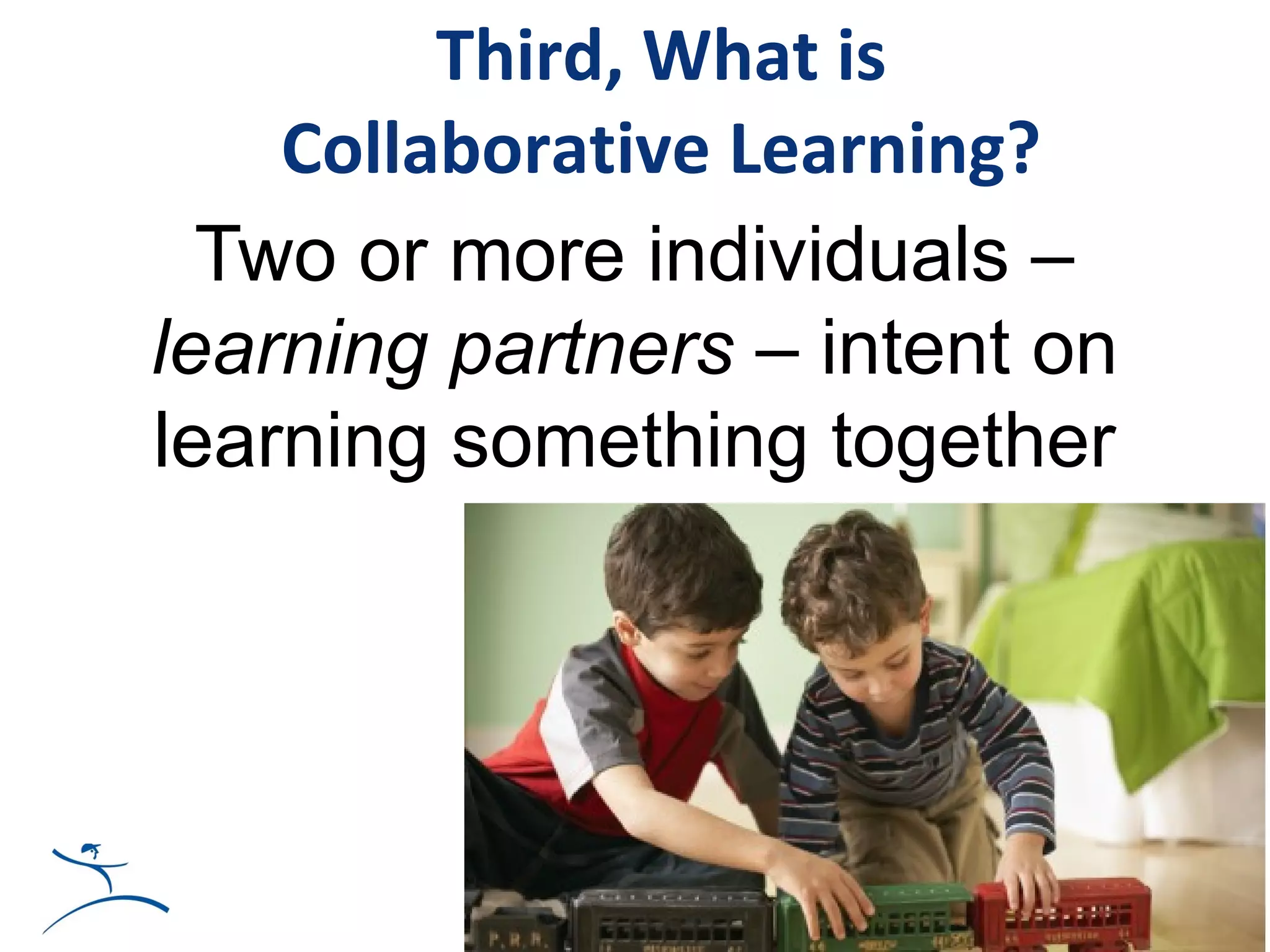
  Two or more individuals –
learning partners – intent on
learning something together
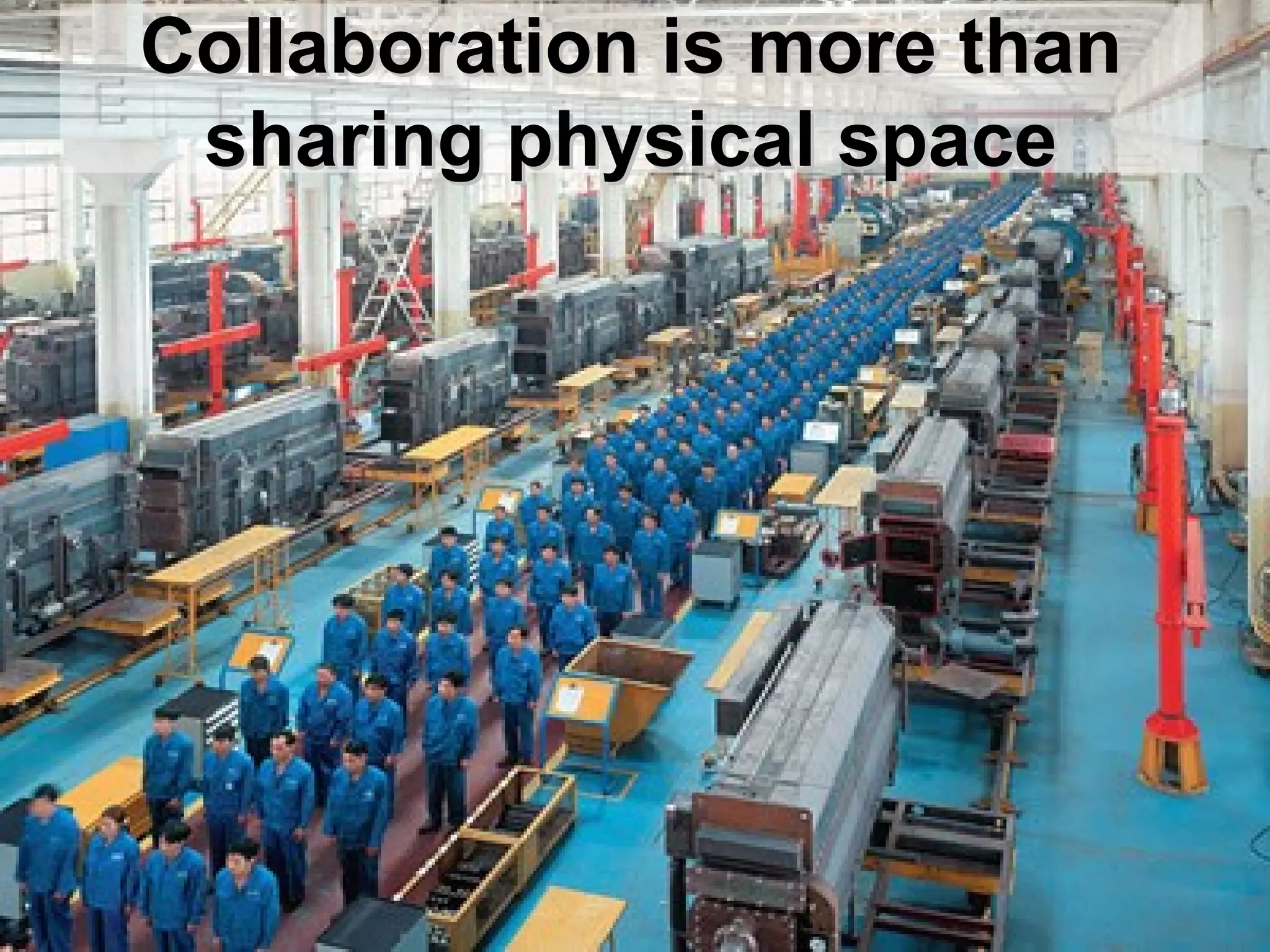
Collaboration is more than
 sharing physical space
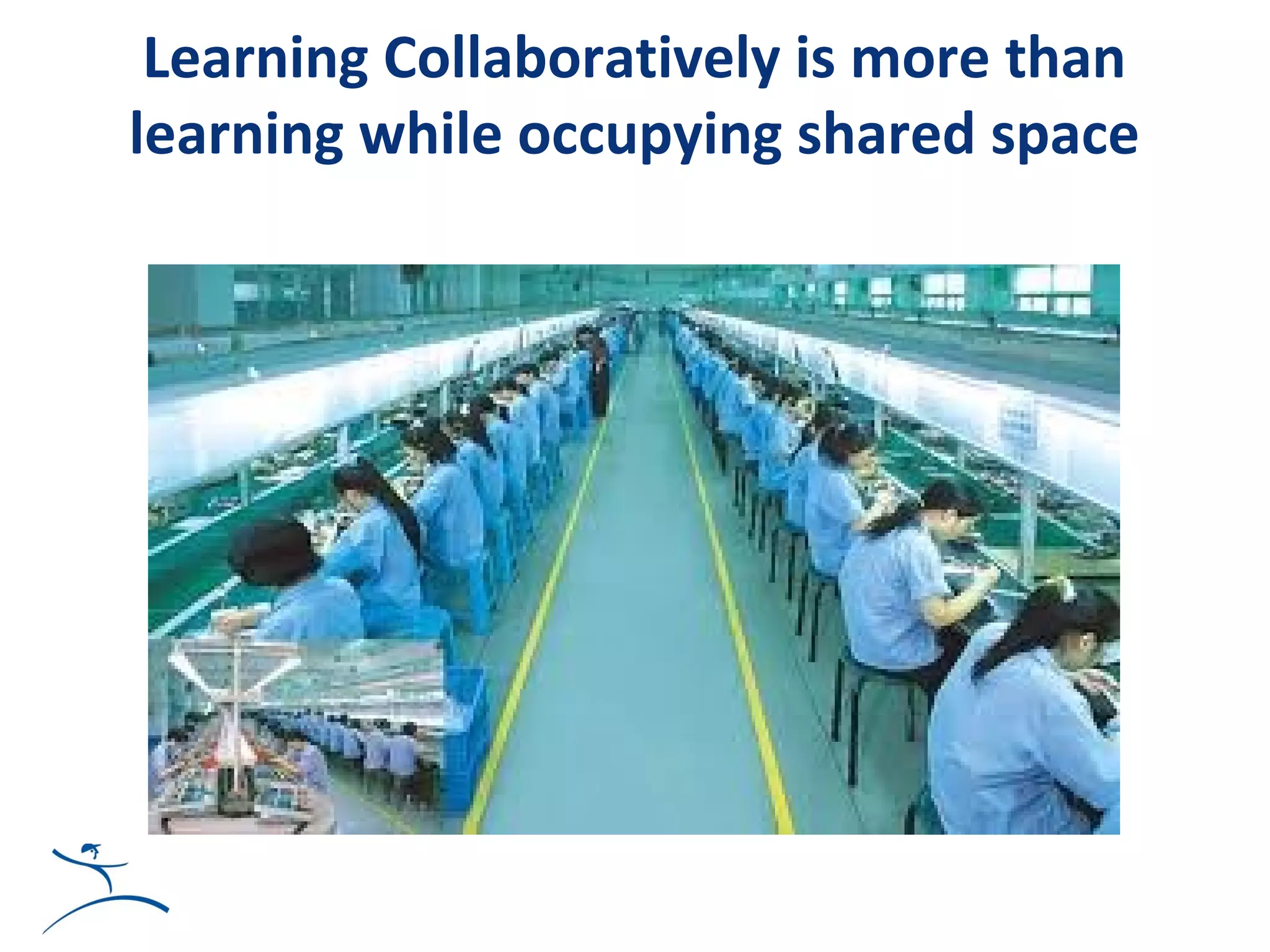
Learning Collaboratively is more than
learning while occupying shared space
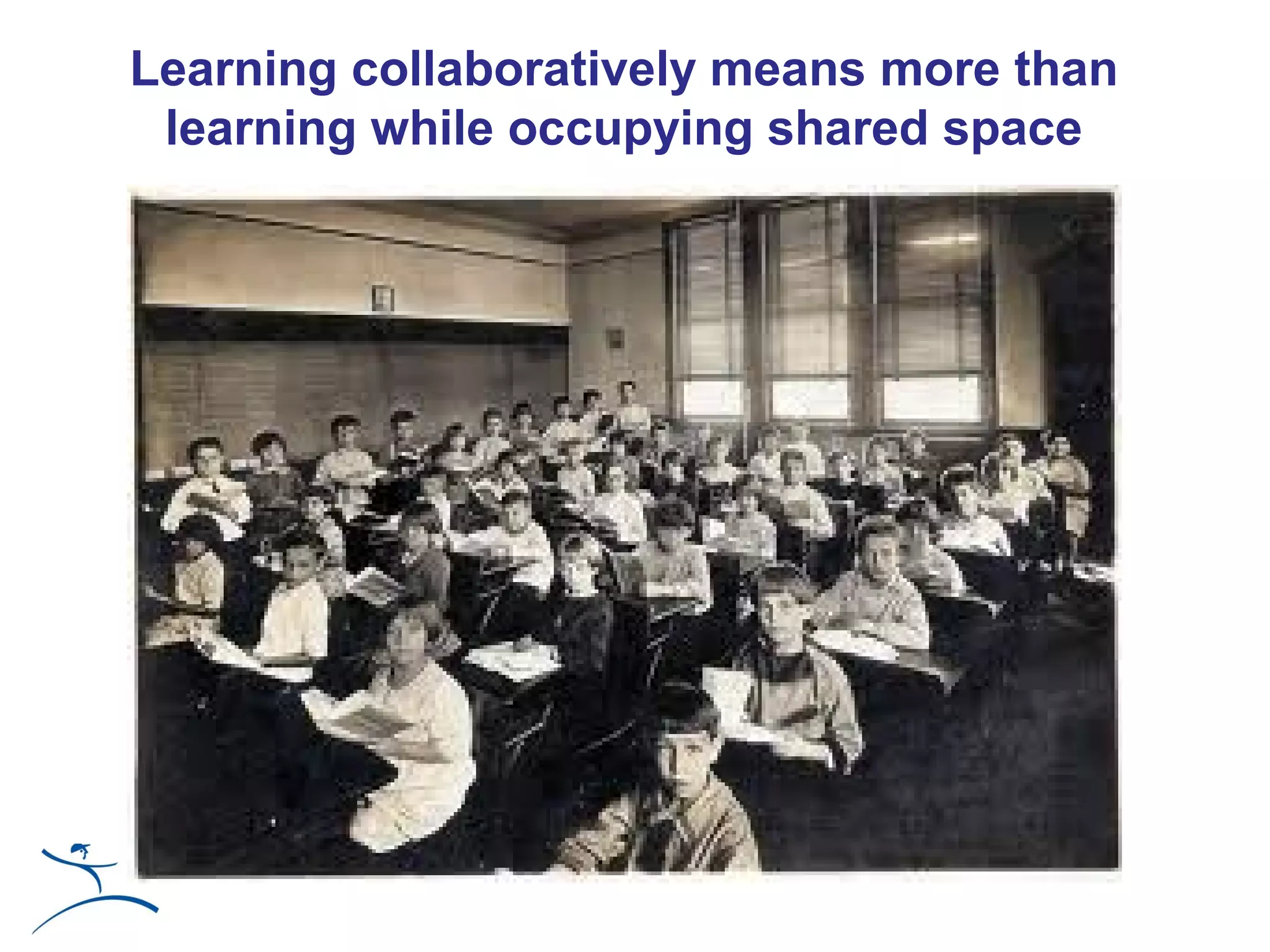
Learning collaboratively means more than
 learning while occupying shared space
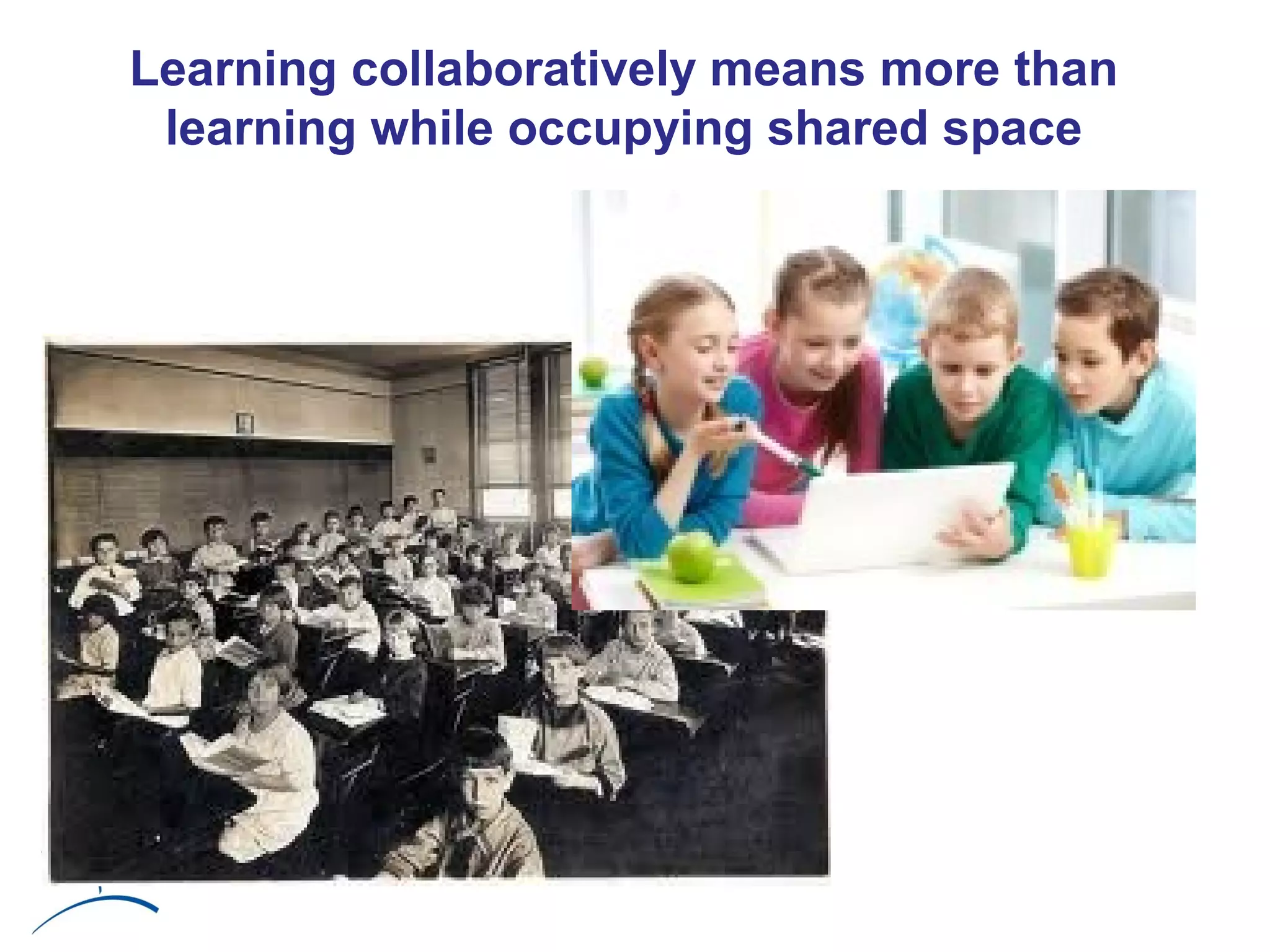
Learning collaboratively means more than
 learning while occupying shared space
Fourth, What is
     Collaborative Lean Learning
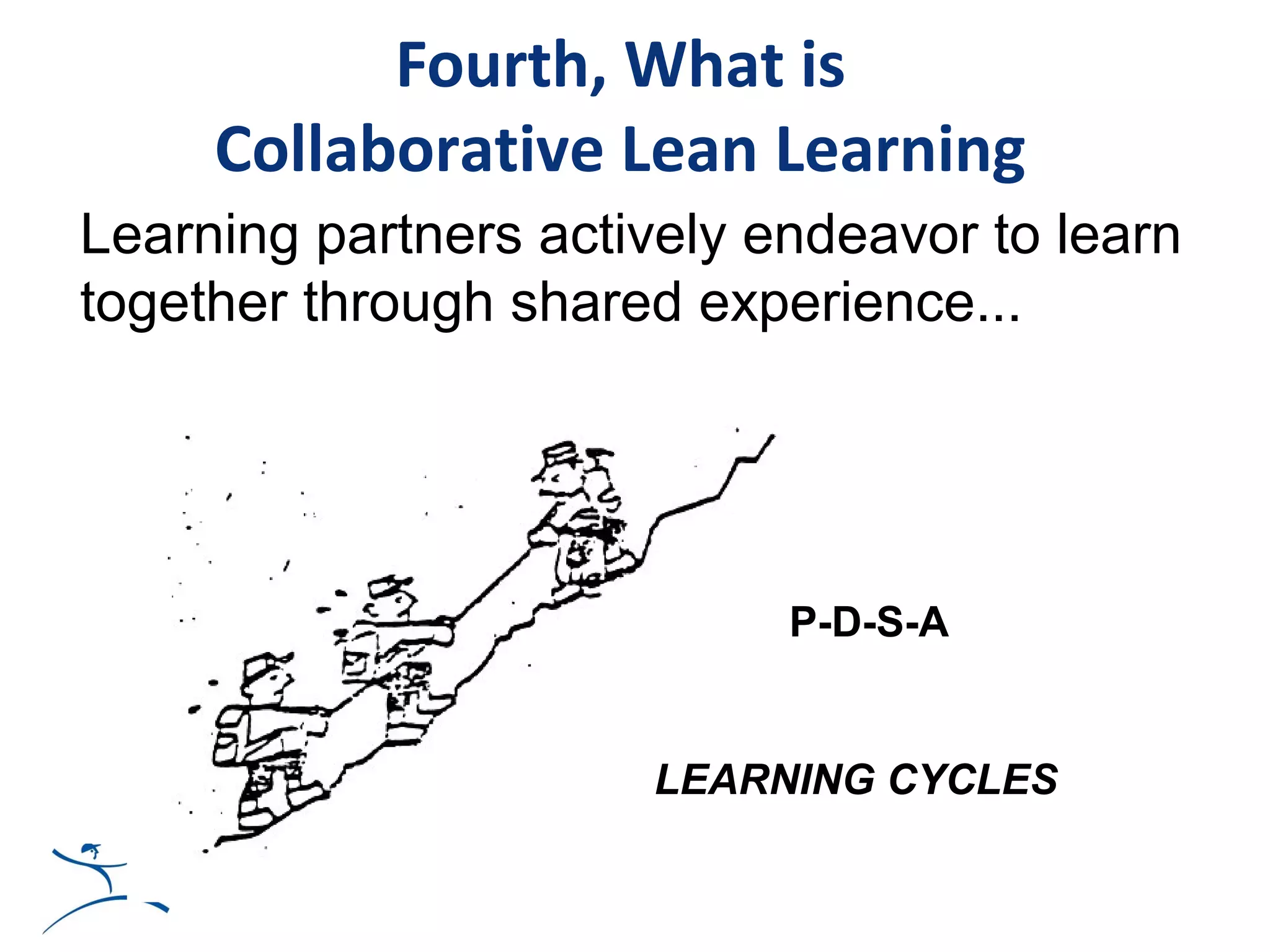
Learning partners actively endeavor to learn
together through shared experience...


                            P-D-S-A
                                 t

                      LEARNING CYCLES
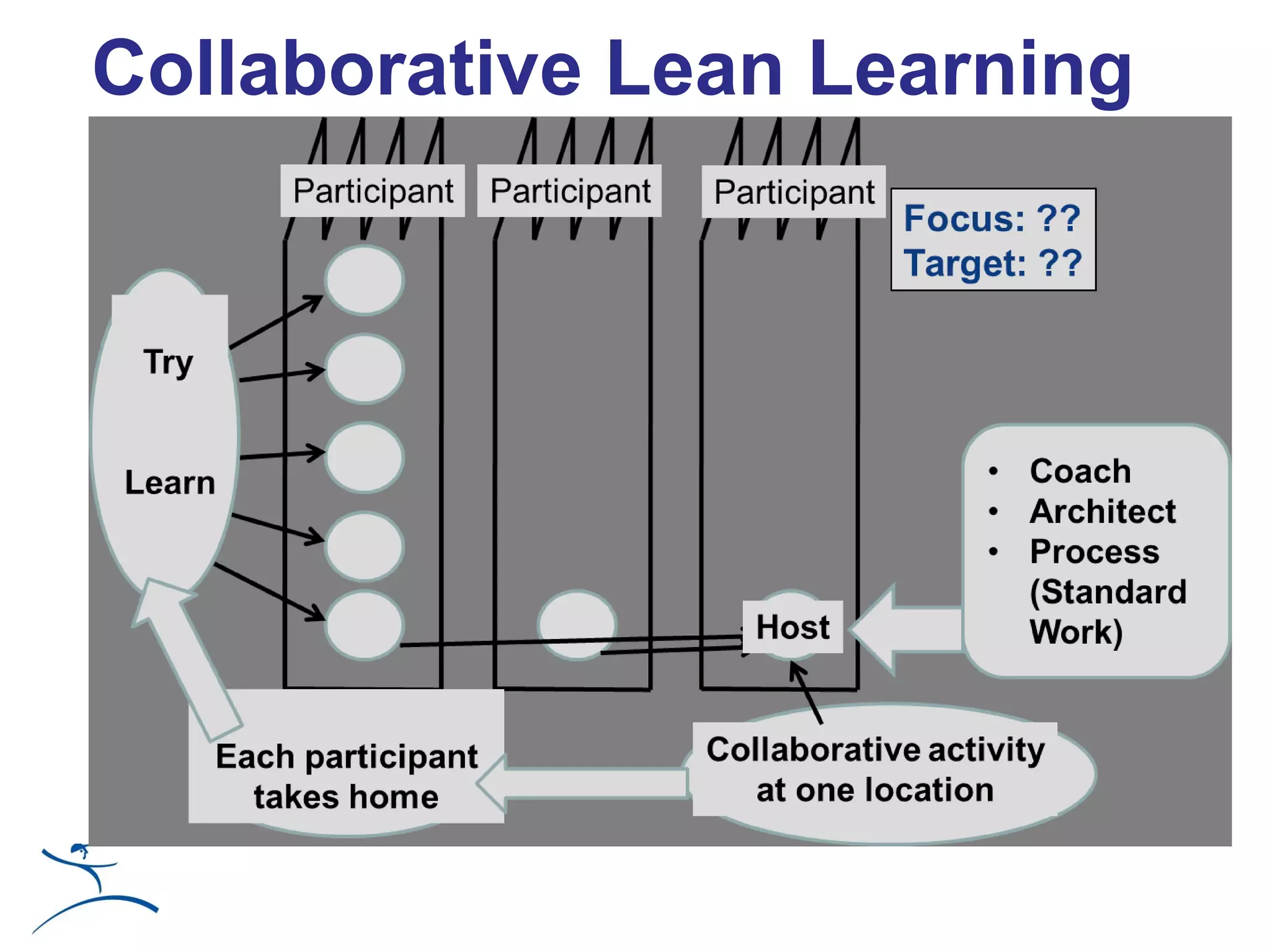
Collaborative Lean Learning
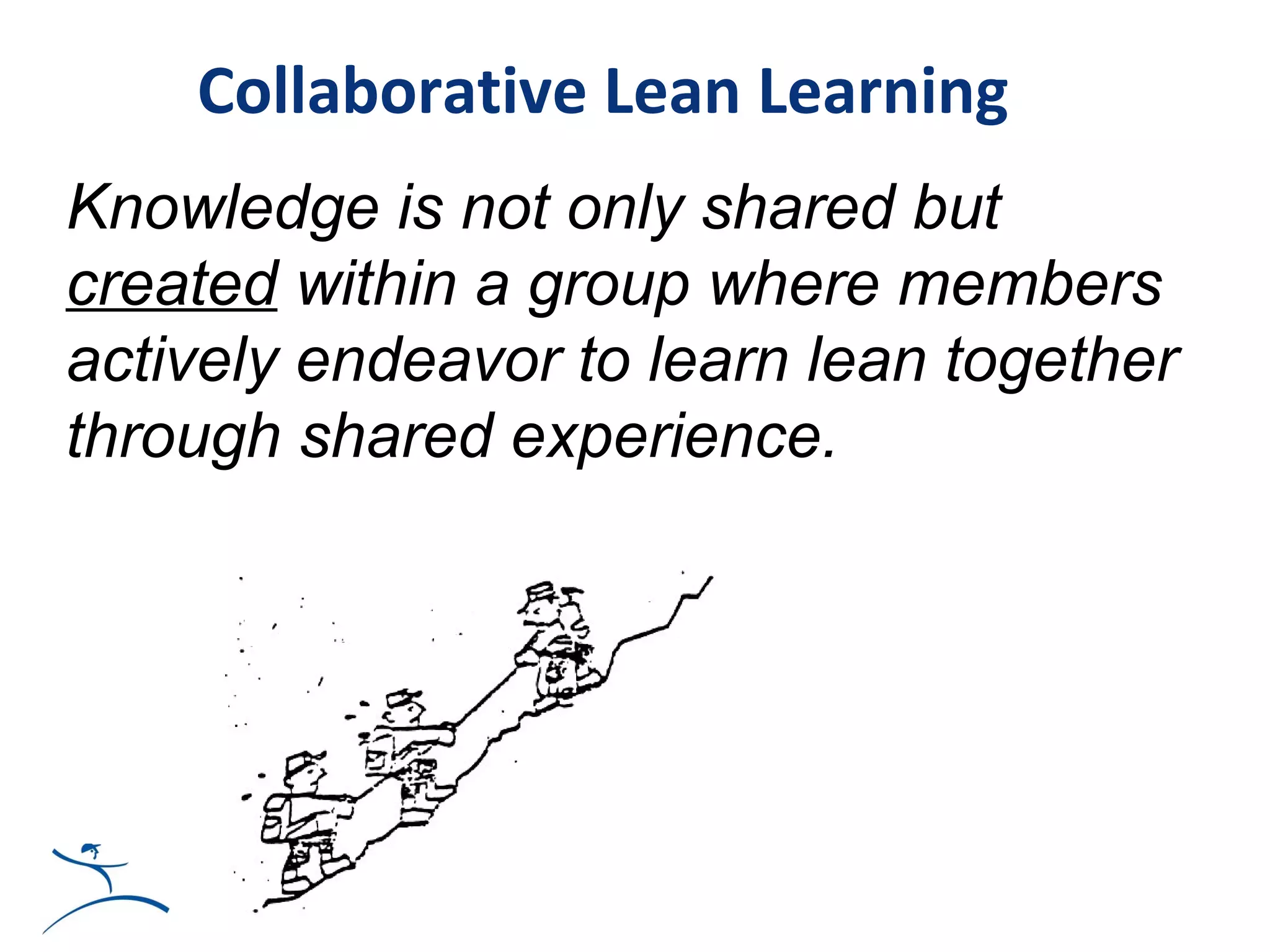
Knowledge is not only shared but
created within a group where members
actively endeavor to learn lean together
through shared experience.


                           t
Collaborative Lean Learning

Individuals working together…
– capitalizing on one another’s knowledge
  and skill,
• both technically and socially,
•recognizing that learning is not just an
individual but also a social act,
• to solve a problem, complete a task, or
create a product, or answer a question.
Elements of successful
     Collaborative Lean Learning
• All learner partners actively participate
• Mutual Respect:
  Openness in sharing experience, knowledge,
   challenges, struggles;
• Teachers are learners; learners are
  teachers
• Problems to be addressed are important
  and challenging to all partners:
  “What problem are we trying to solve?”
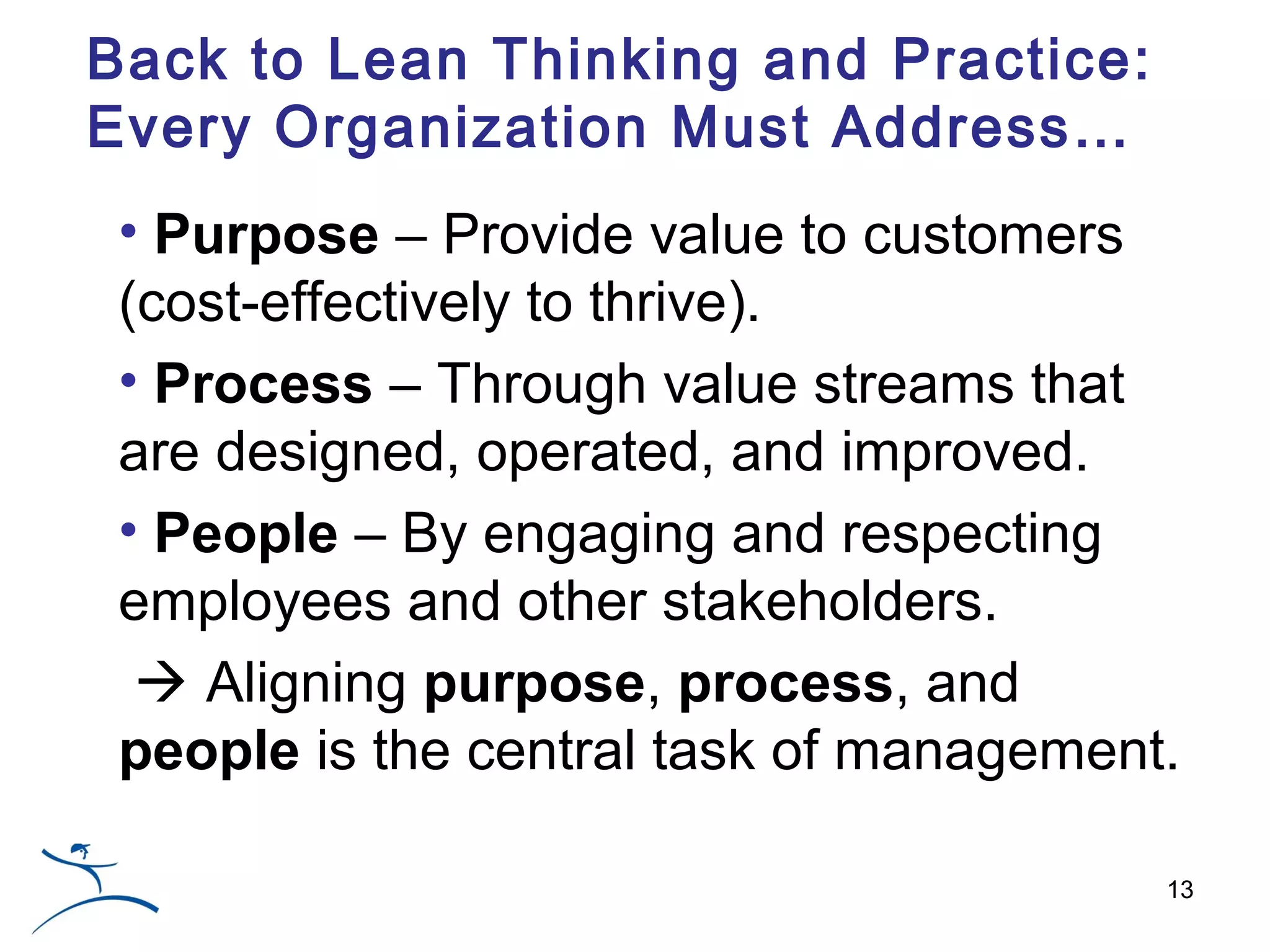
Back to Lean Thinking and Practice:
Every Organization Must Address…
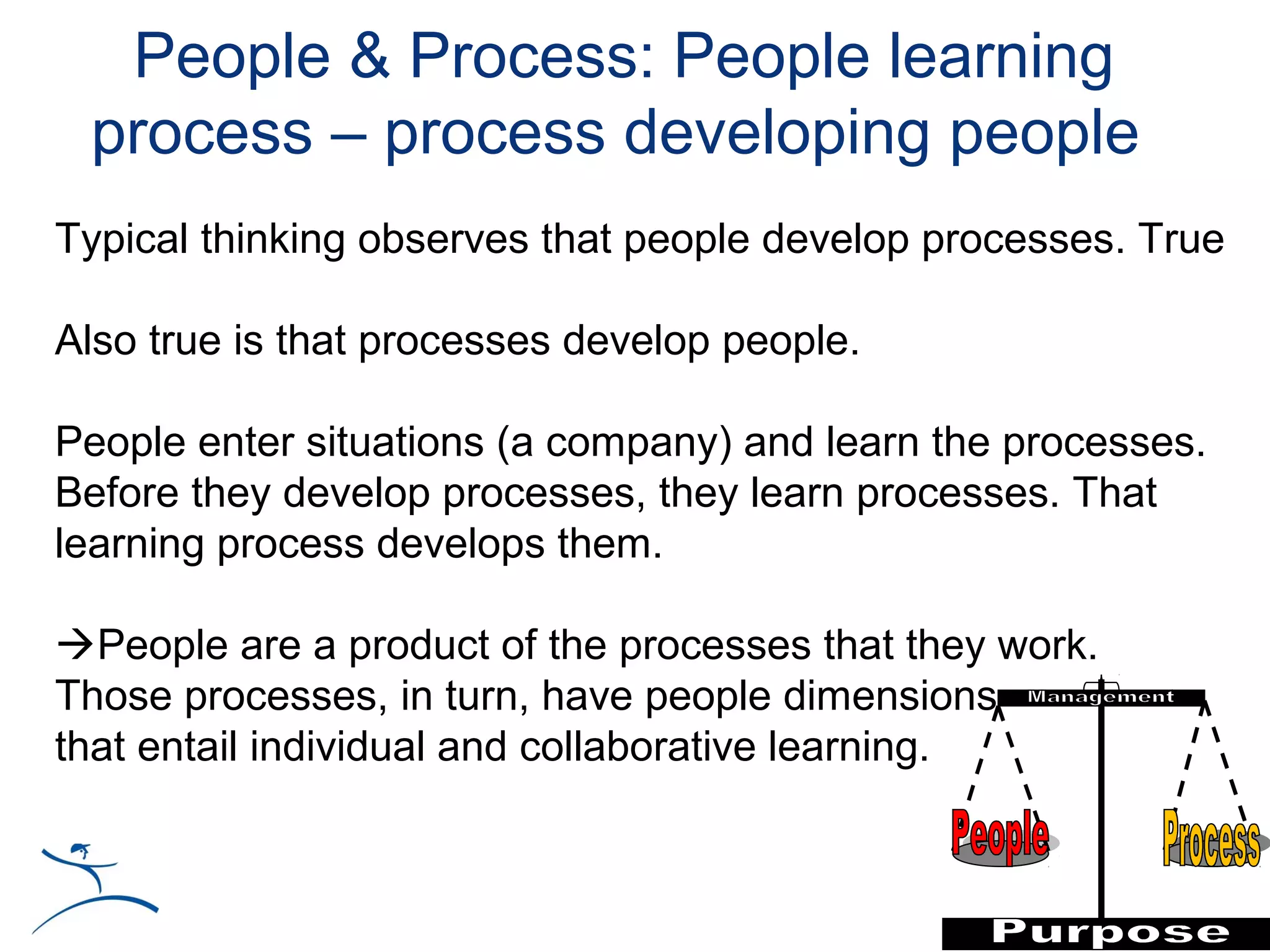
 • Purpose – Provide value to customers
 (cost-effectively to thrive).
 • Process – Through value streams that
 are designed, operated, and improved.
 • People – By engaging and respecting
 employees and other stakeholders.
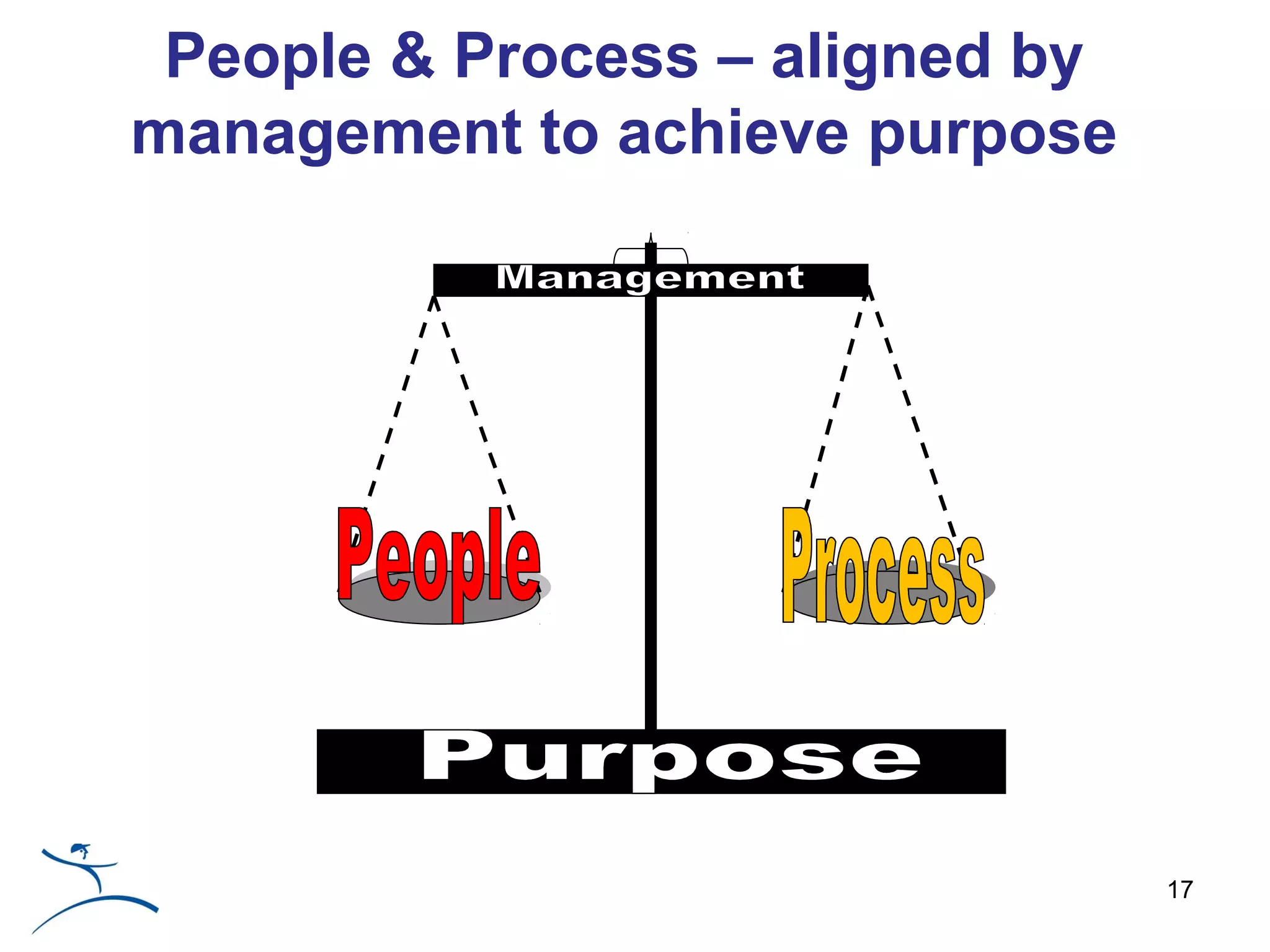
   Aligning purpose, process, and
 people is the central task of management.

                                         13
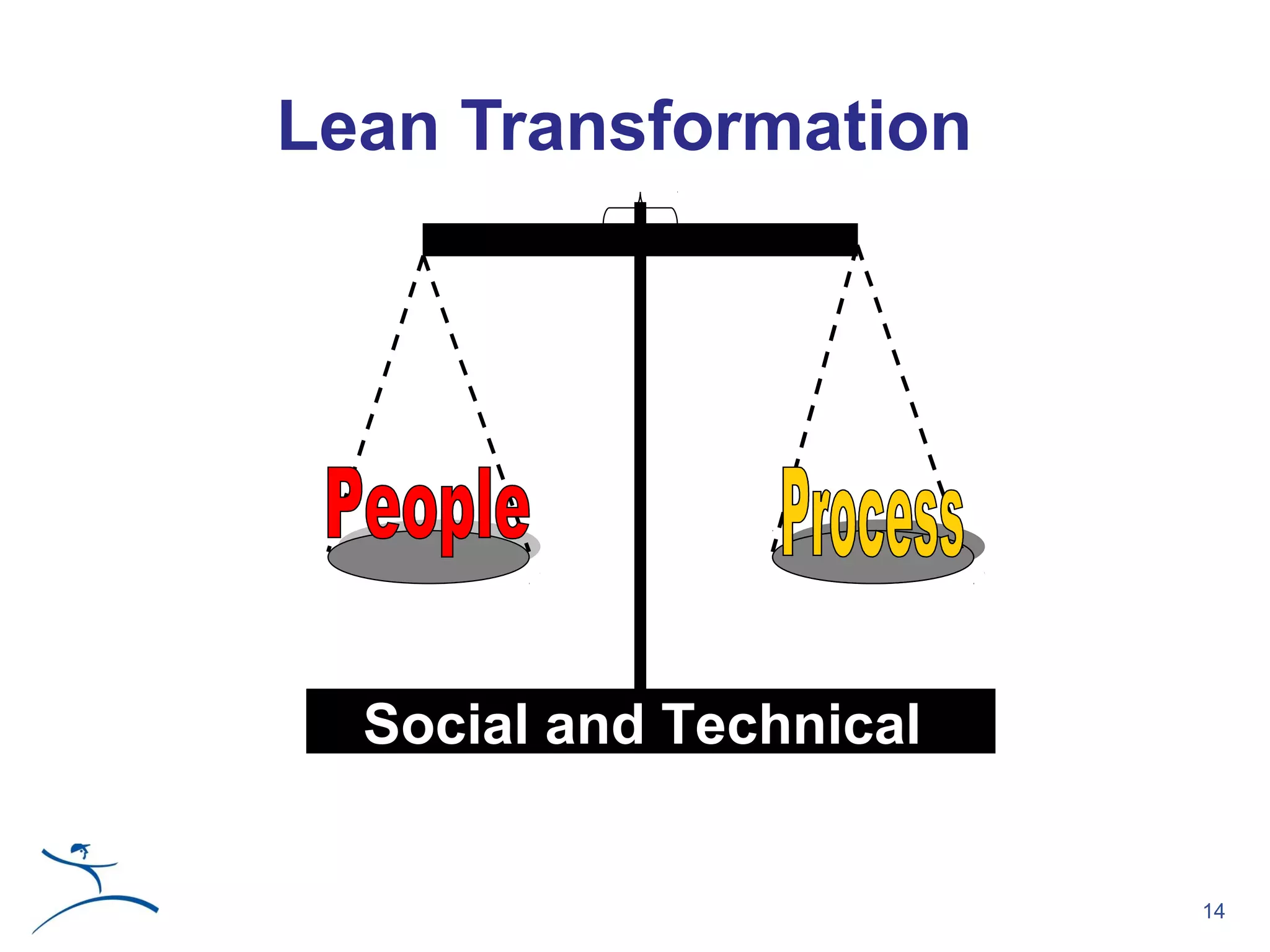
Lean Transformation


  Social and Technical


                         14
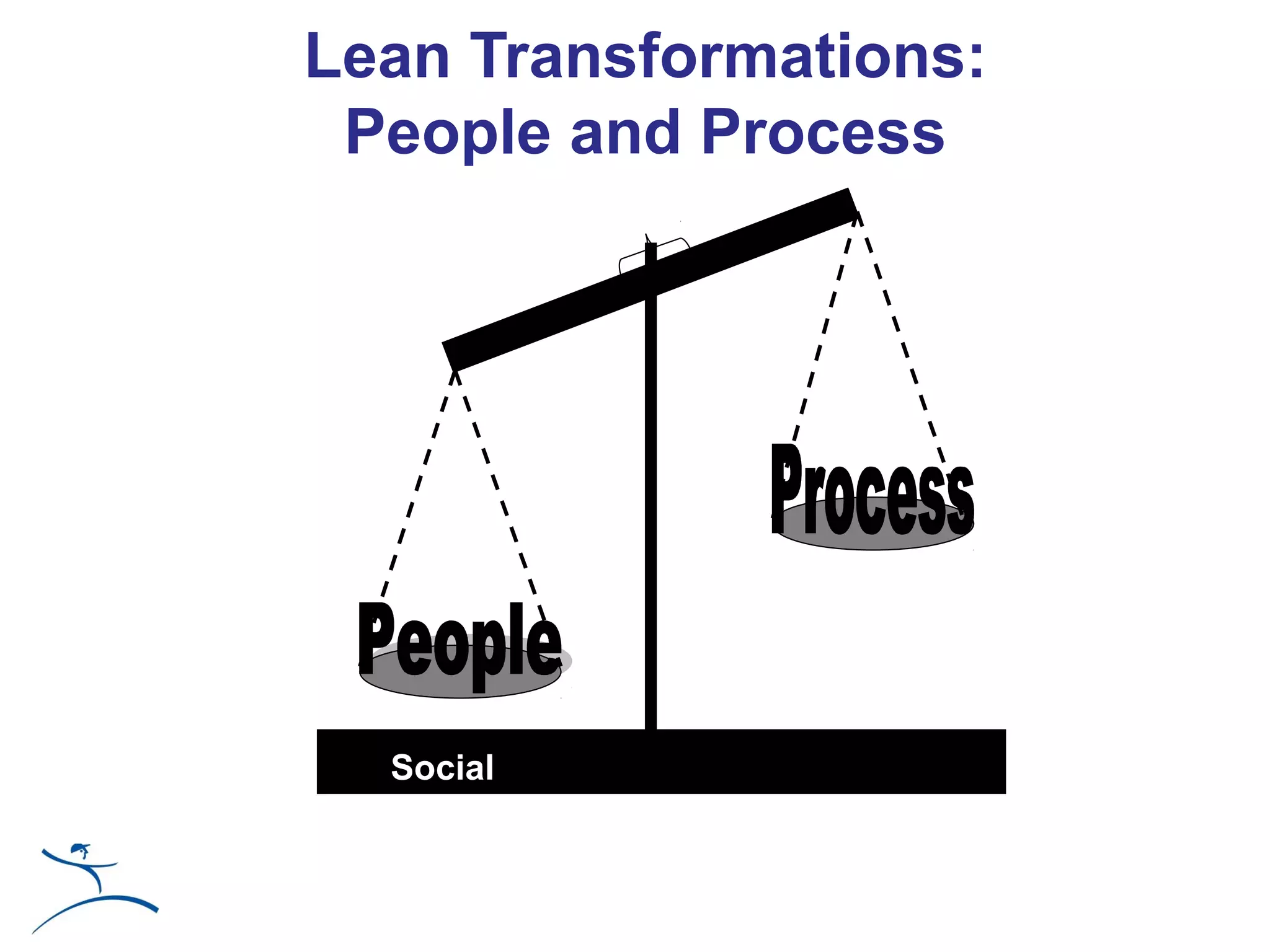
Lean Transformations:
 People and Process


  Social
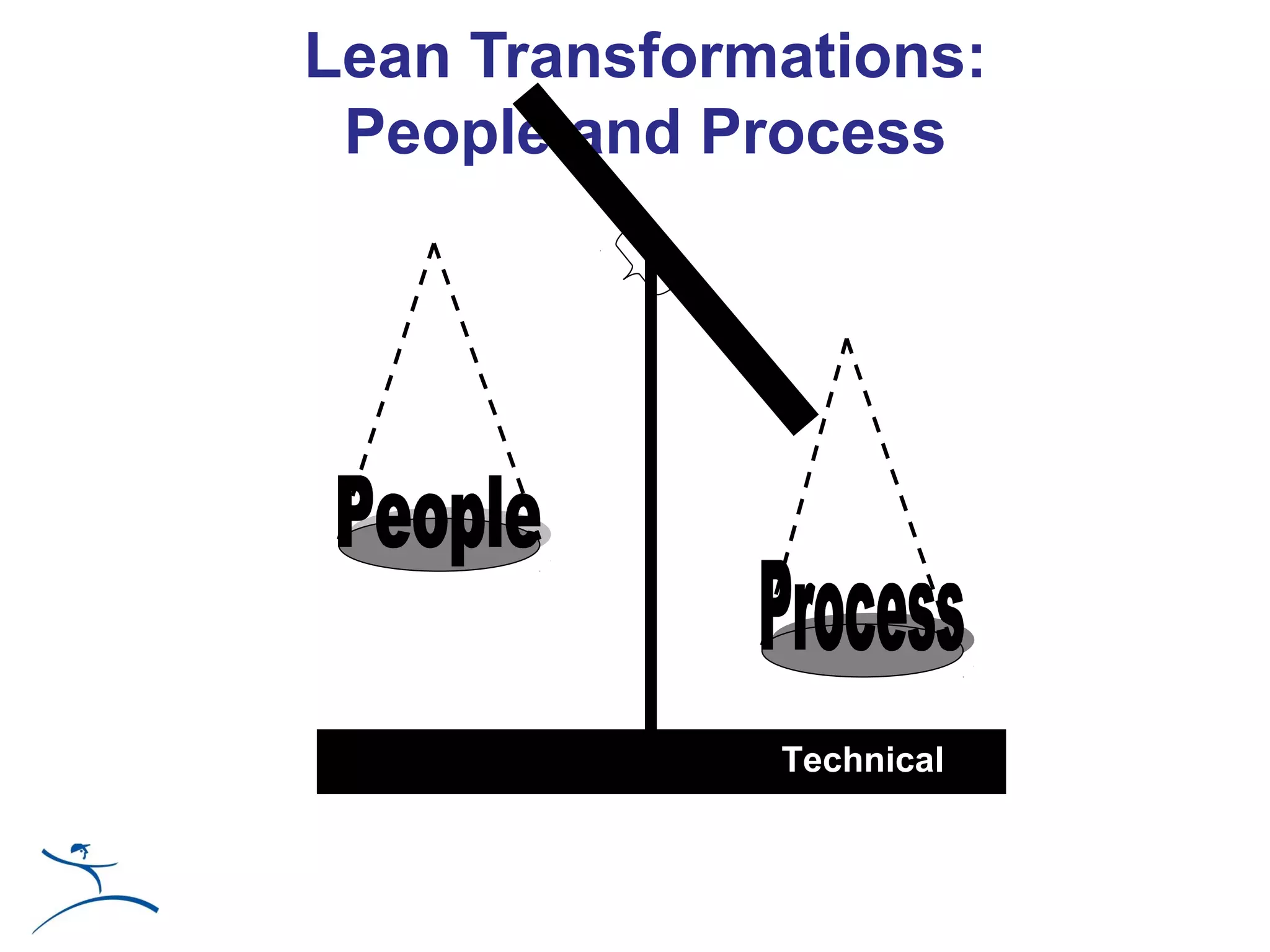
Lean Transformations:
 People and Process


              Technical
People & Process – aligned by
management to achieve purpose


                                 17
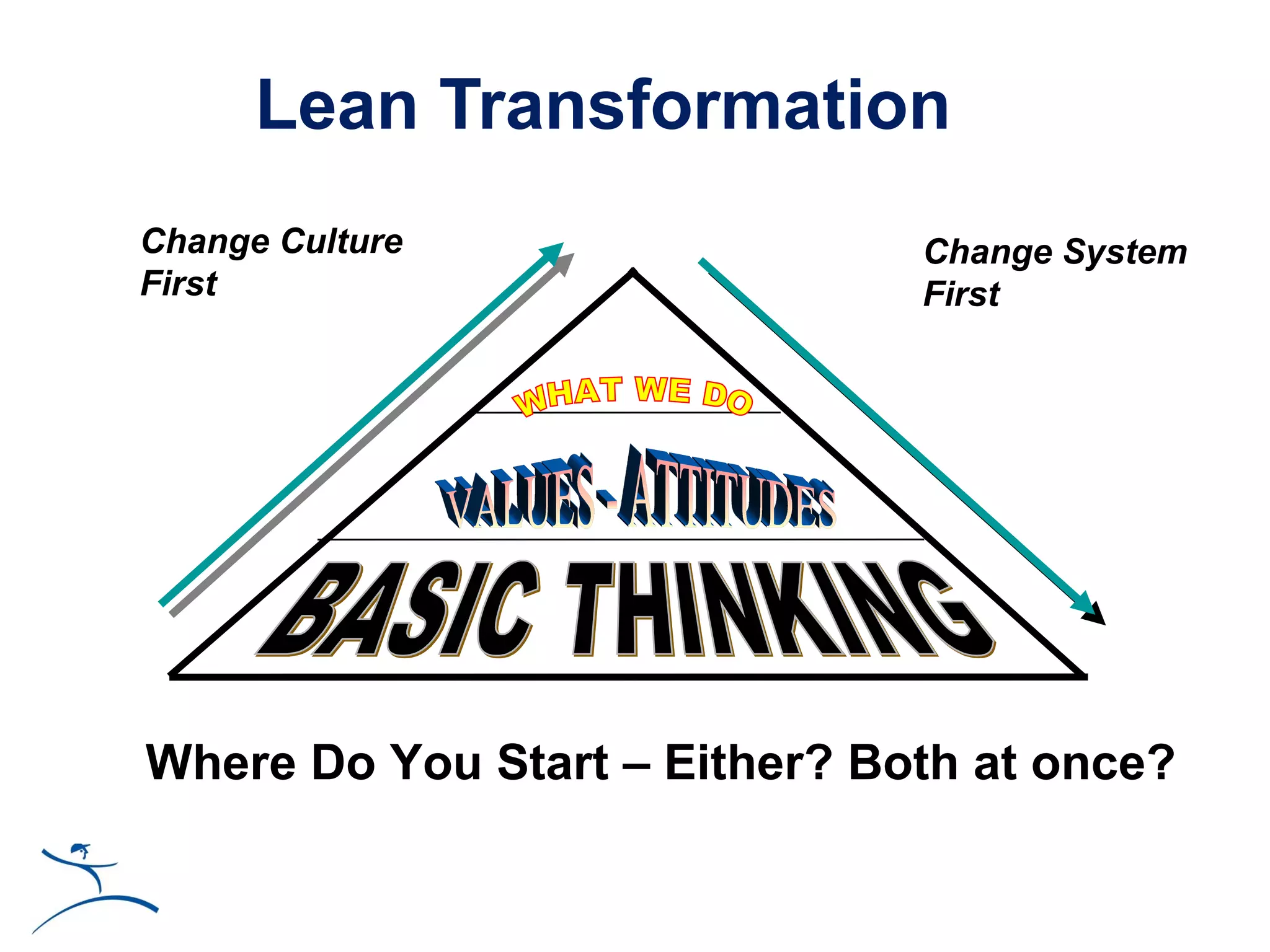
Lean Transformation
Change Culture                 Change System
First                          First


Where Do You Start – Either? Both at once?
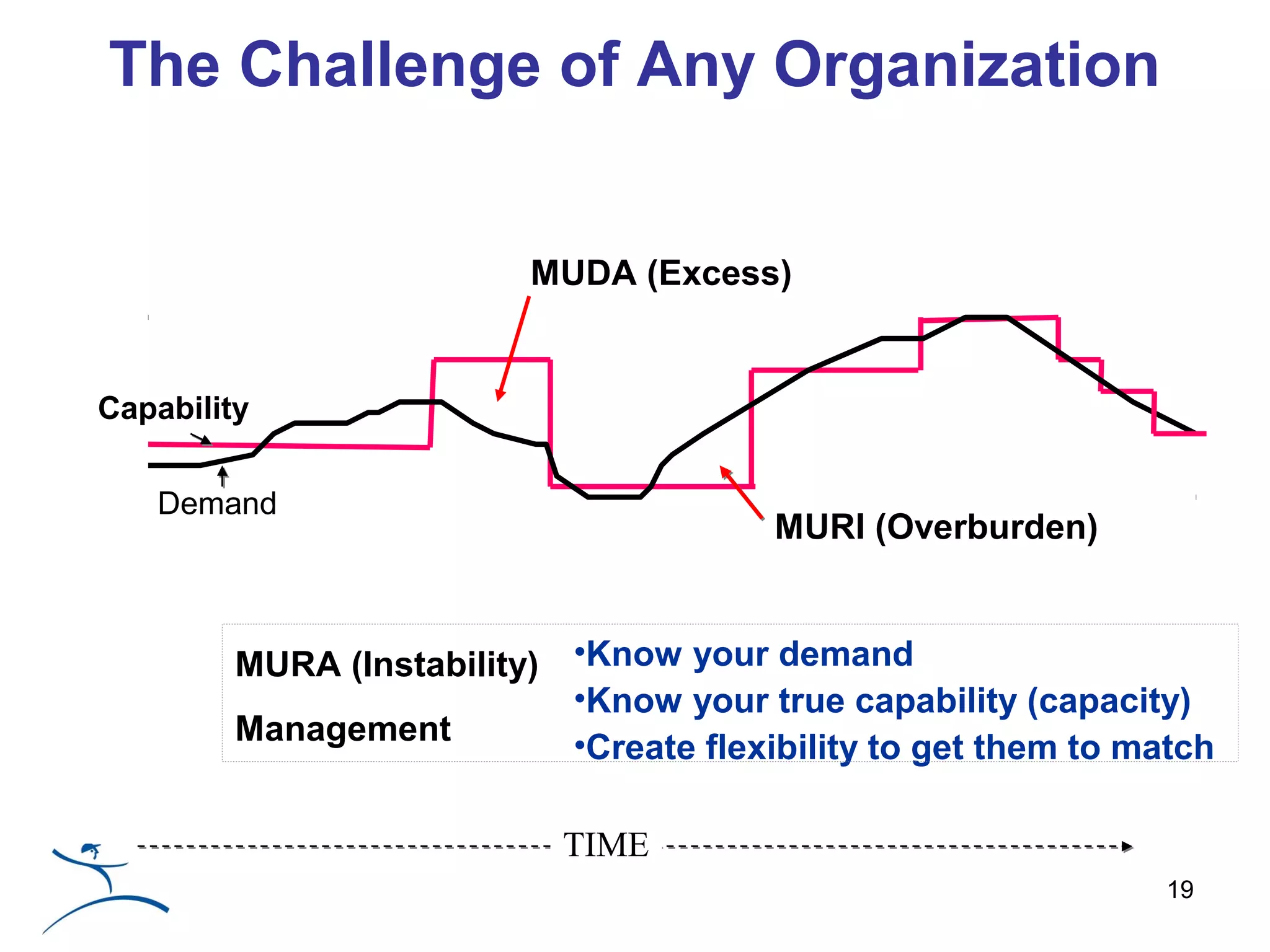
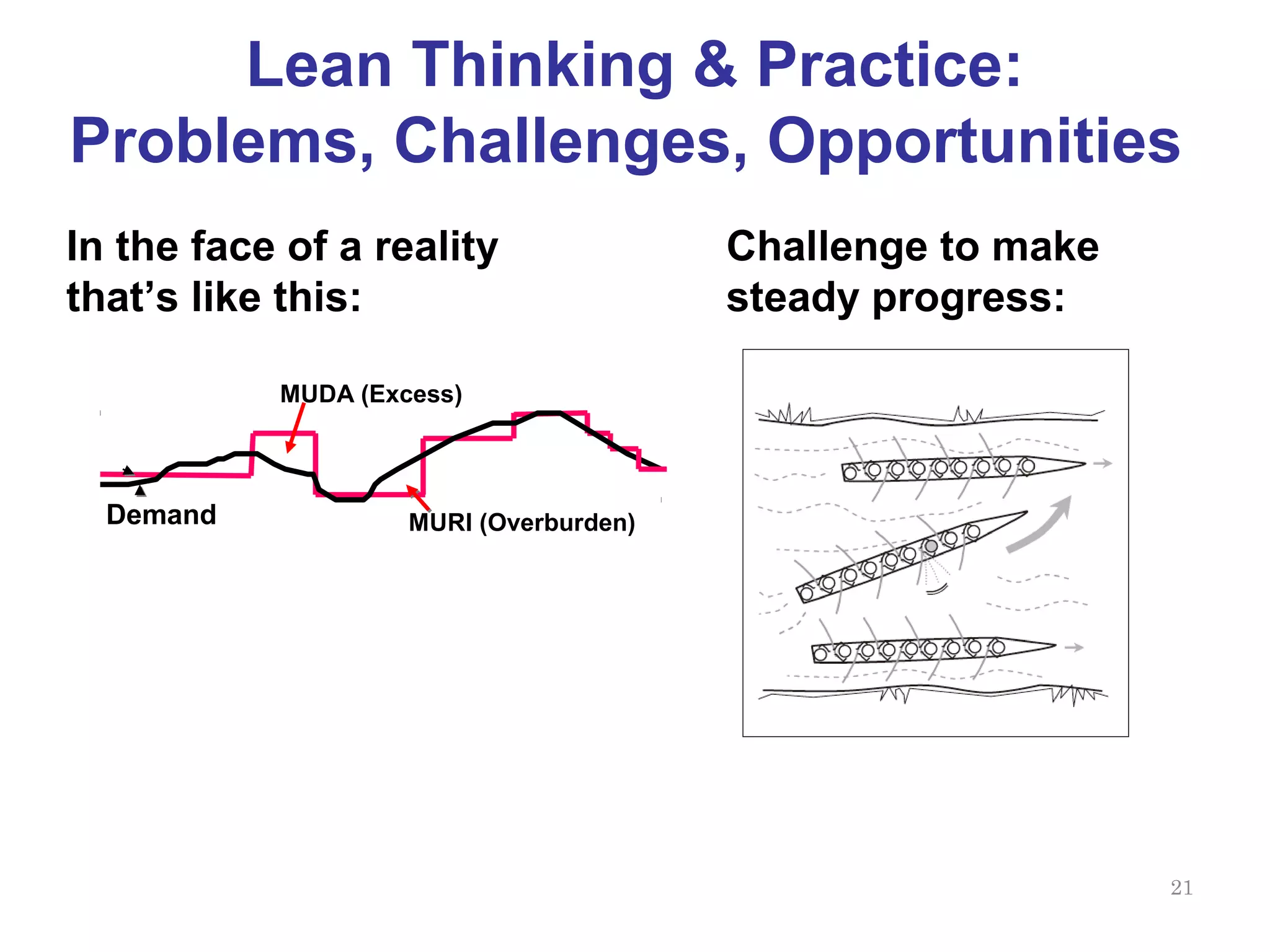
The Challenge of Any Organization


                          MUDA (Excess)


Capability


   Demand
                                         MURI (Overburden)


         MURA (Instability) •Know your demand
                            •Know your true capability (capacity)
         Management         •Create flexibility to get them to match

                            TIME
                                                                 19
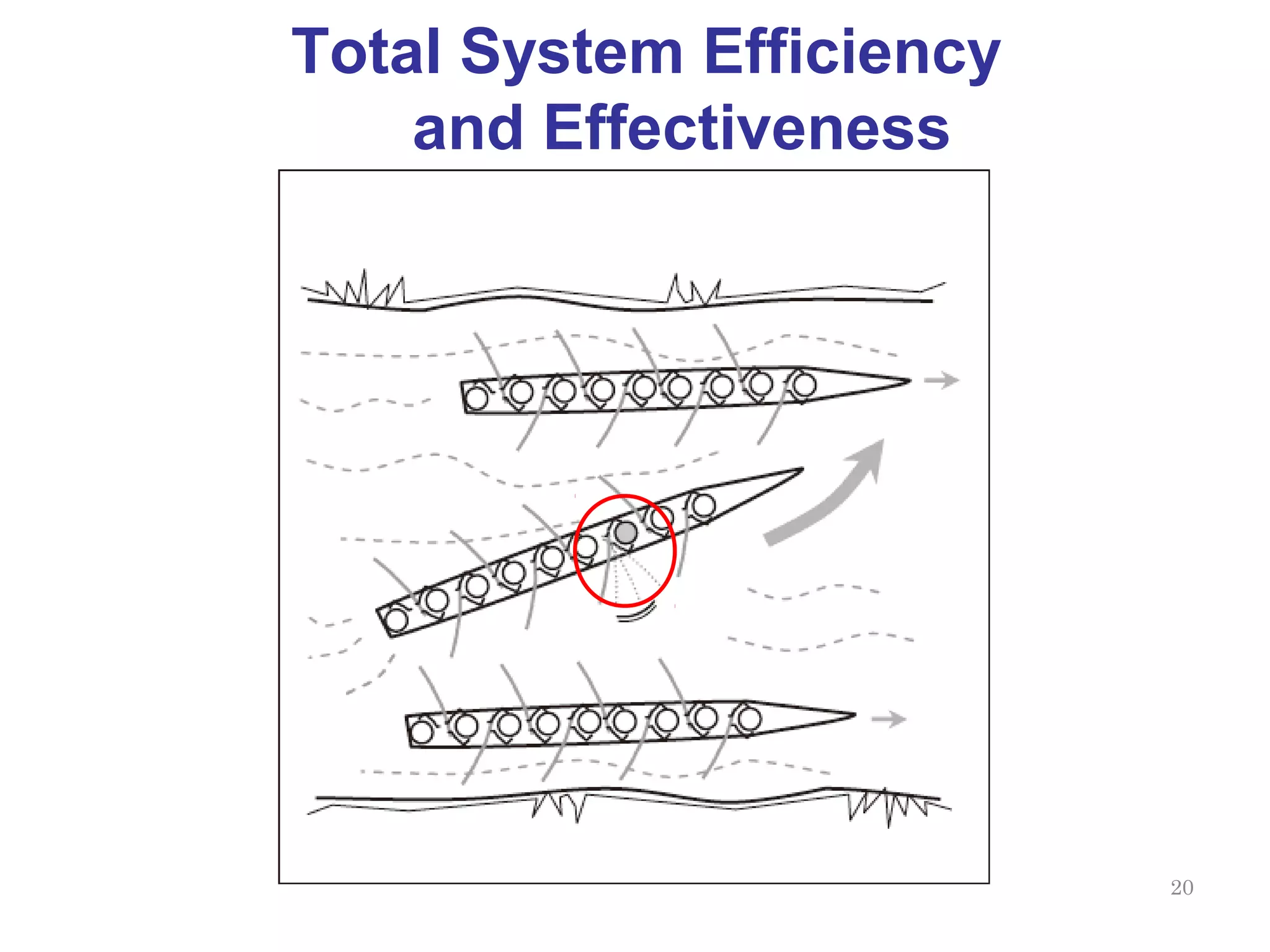
Total System Efficiency
    and Effectiveness


                          20
Lean Thinking & Practice:
Problems, Challenges, Opportunities
In the face of a reality                Challenge to make
that’s like this:                       steady progress:

           MUDA (Excess)


  Demand            MURI (Overburden)


                                                            21
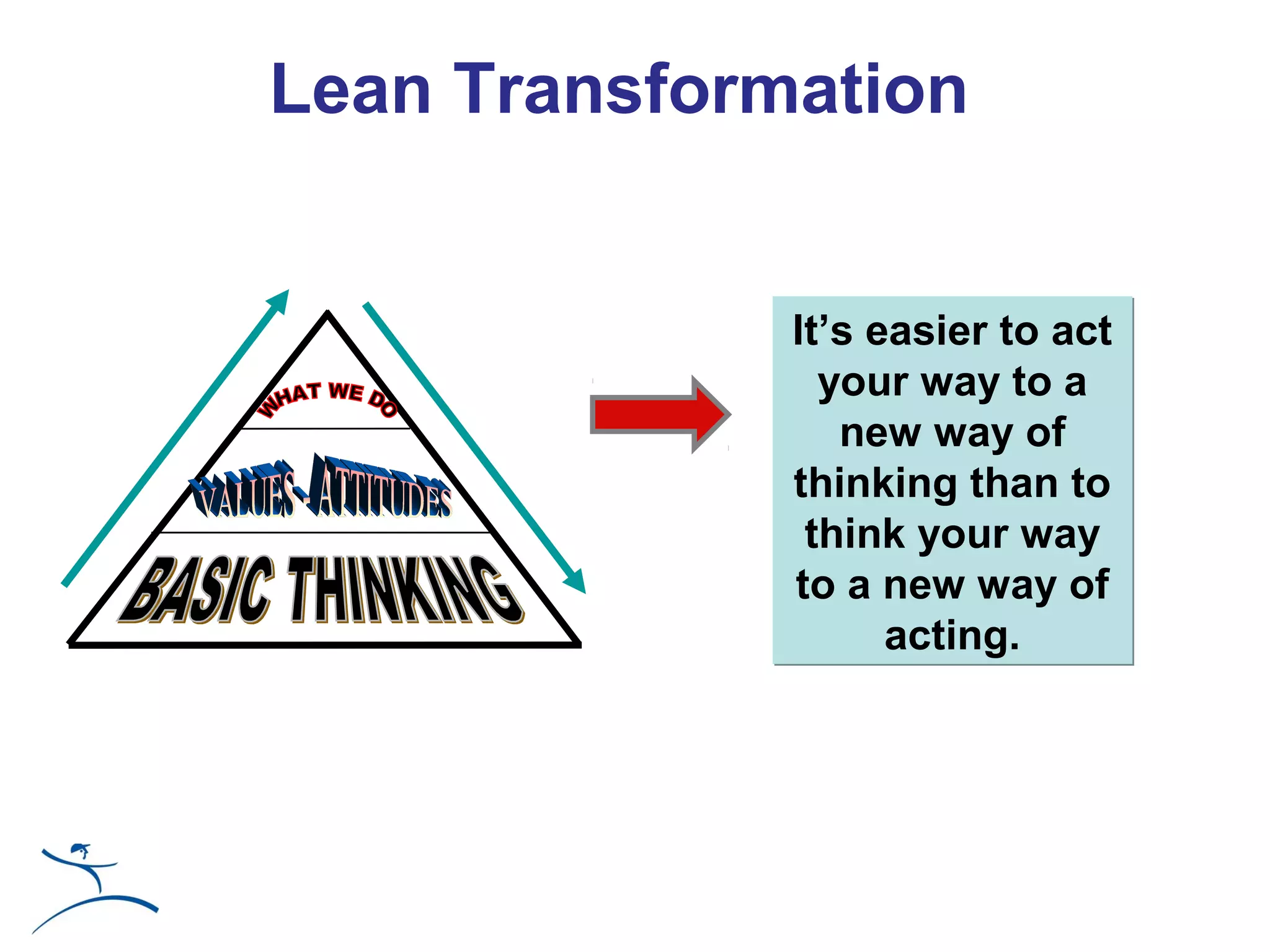
Lean Transformation


              It’s easier to act
                your way to a
                 new way of
              thinking than to
               think your way
              to a new way of
                    acting.
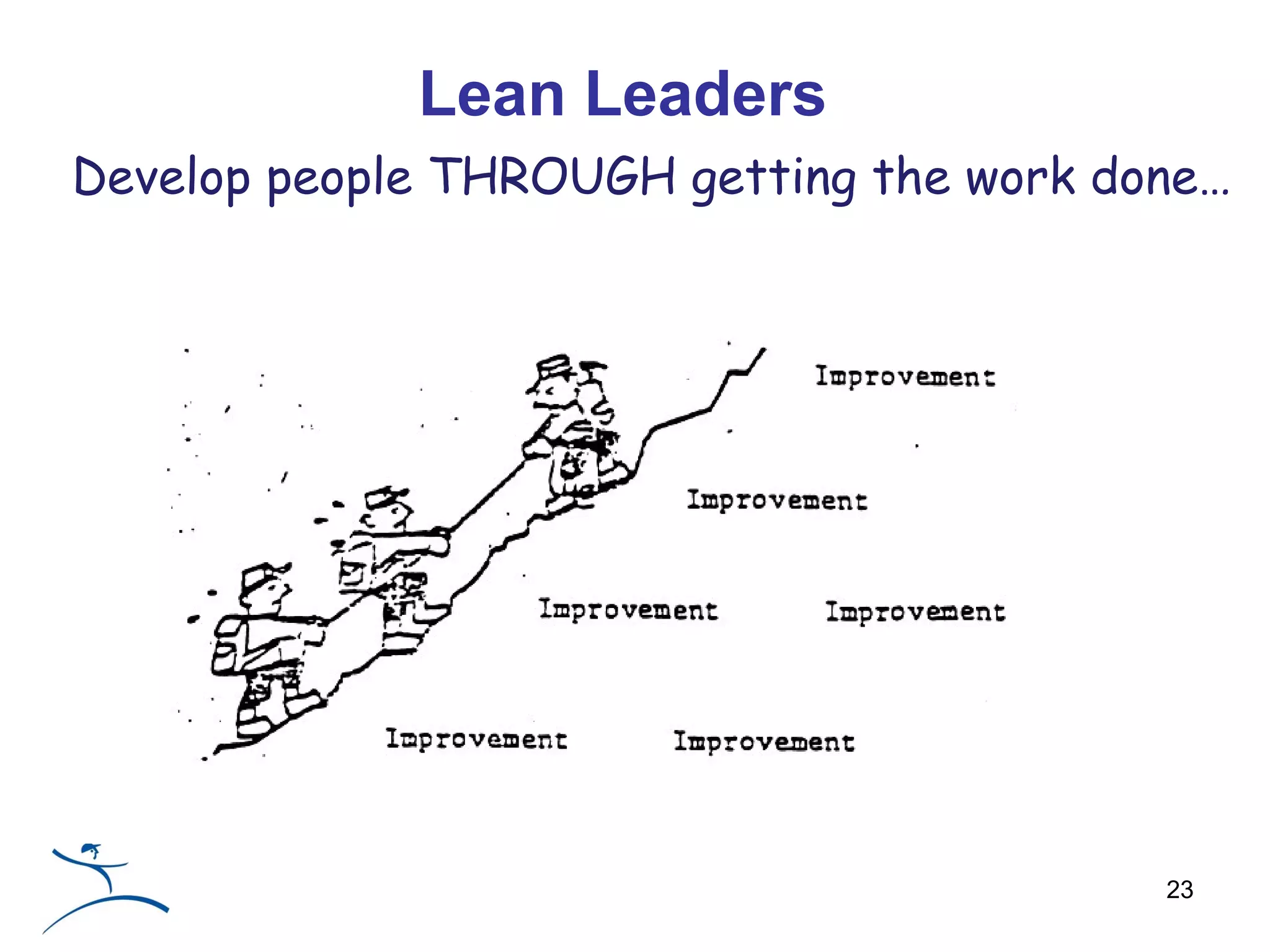
Lean Leaders
Develop people THROUGH getting the work done…


                                          23
People & Process: People learning
 process – process developing people
Typical thinking observes that people develop processes. True

Also true is that processes develop people.

People enter situations (a company) and learn the processes.
Before they develop processes, they learn processes. That
learning process develops them.

People are a product of the processes that they work.
Those processes, in turn, have people dimensions
that entail individual and collaborative learning.
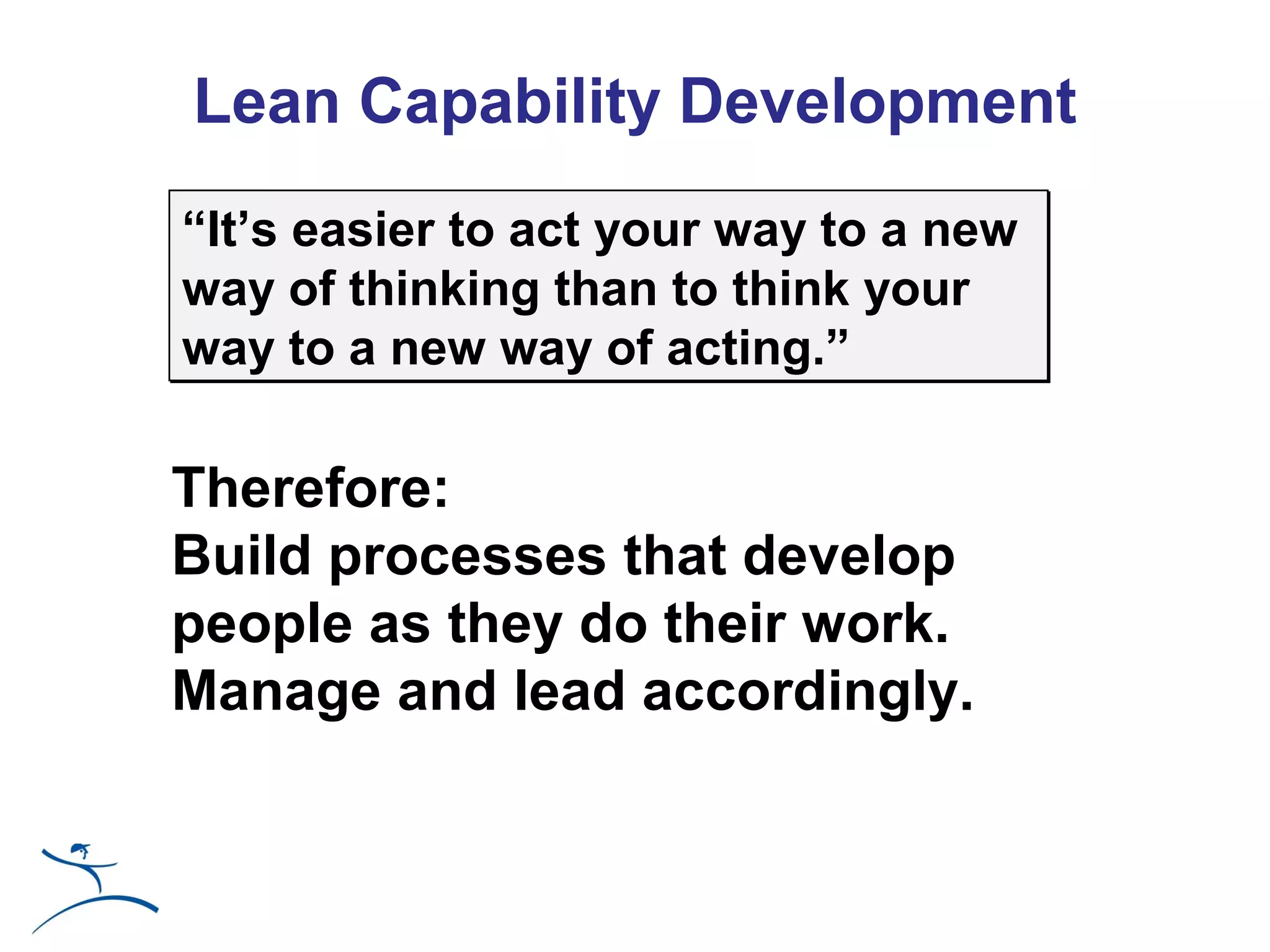
Lean Capability Development
“It’s easier to act your way to a new
way of thinking than to think your
way to a new way of acting.”

Therefore:
Build processes that develop
people as they do their work.
Manage and lead accordingly.
Lean Enterprise
– the ultimate “social-technical system”

 • The process of doing the work
   is integrated with the process of
   improving the work
 • And…


                                           26
Lean Enterprise
– the ultimate “social-technical system”

 • The process of doing the work
   is integrated with the process of
   improving the work, and
 • The operating processes ARE
   people development processes!

                                           27
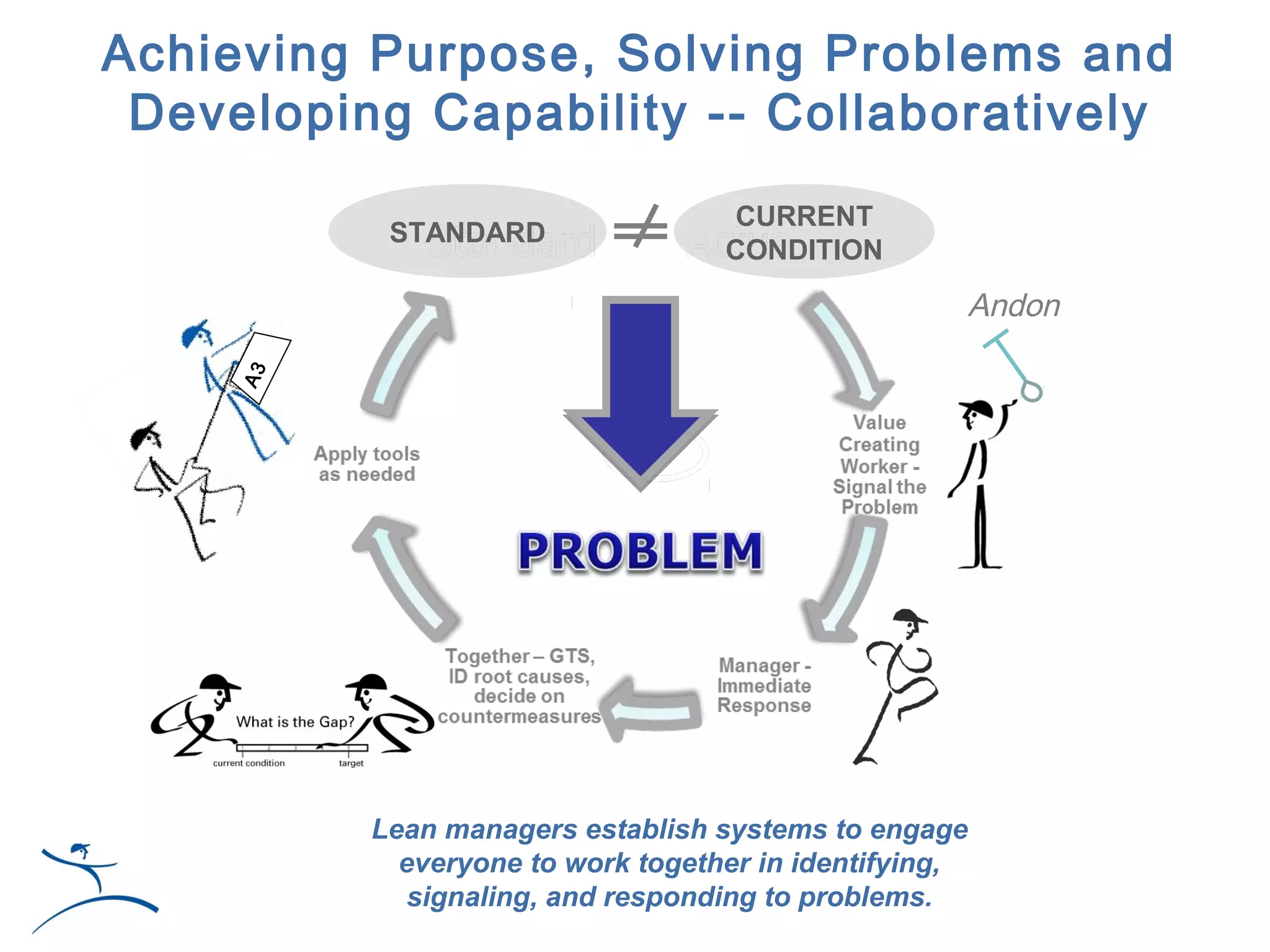
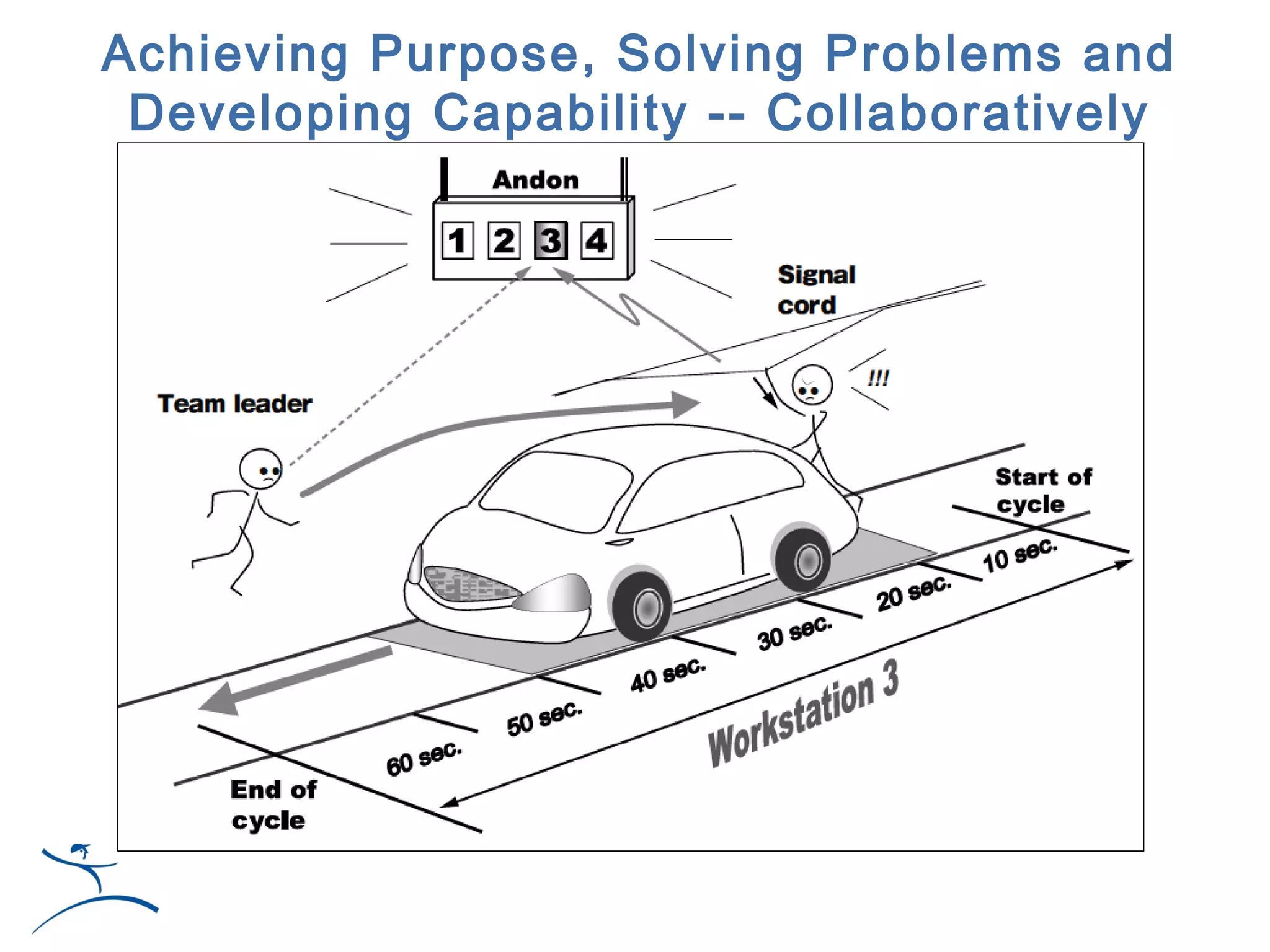
Achieving Purpose, Solving Problems and
 Developing Capability -- Collaboratively
                                   CURRENT
           STANDARD
                                   CONDITION

                                                    Andon
     A3


          Lean managers establish systems to engage
            everyone to work together in identifying,
             signaling, and responding to problems.
Achieving Purpose, Solving Problems and
 Developing Capability -- Collaboratively
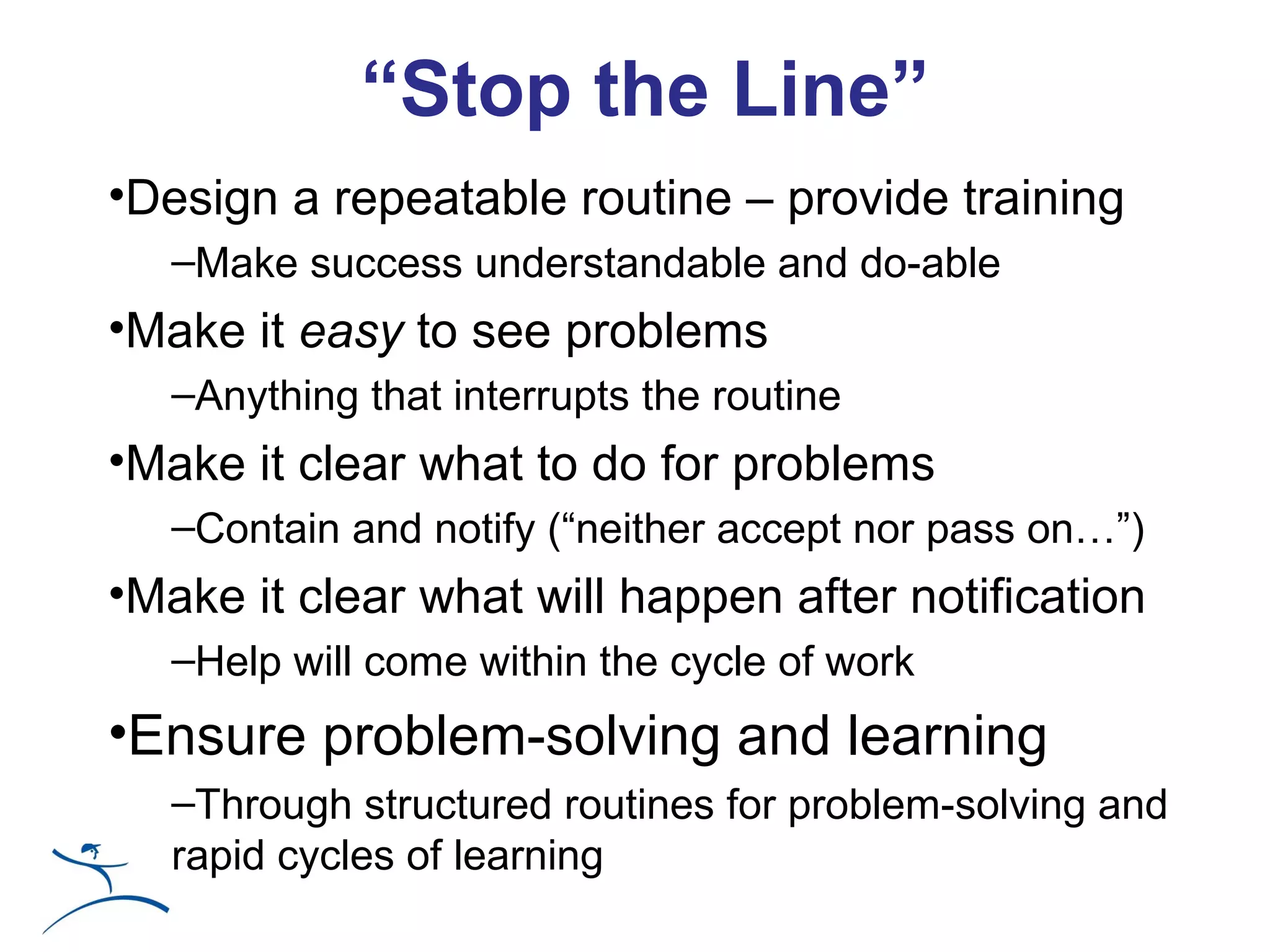
“Stop the Line”
•Design a repeatable routine – provide training
   –Make success understandable and do-able
•Make it easy to see problems
   –Anything that interrupts the routine
•Make it clear what to do for problems
   –Contain and notify (“neither accept nor pass on…”)
•Make it clear what will happen after notification
   –Help will come within the cycle of work
•Ensure problem-solving and learning
   –Through structured routines for problem-solving and
   rapid cycles of learning
31
john shook
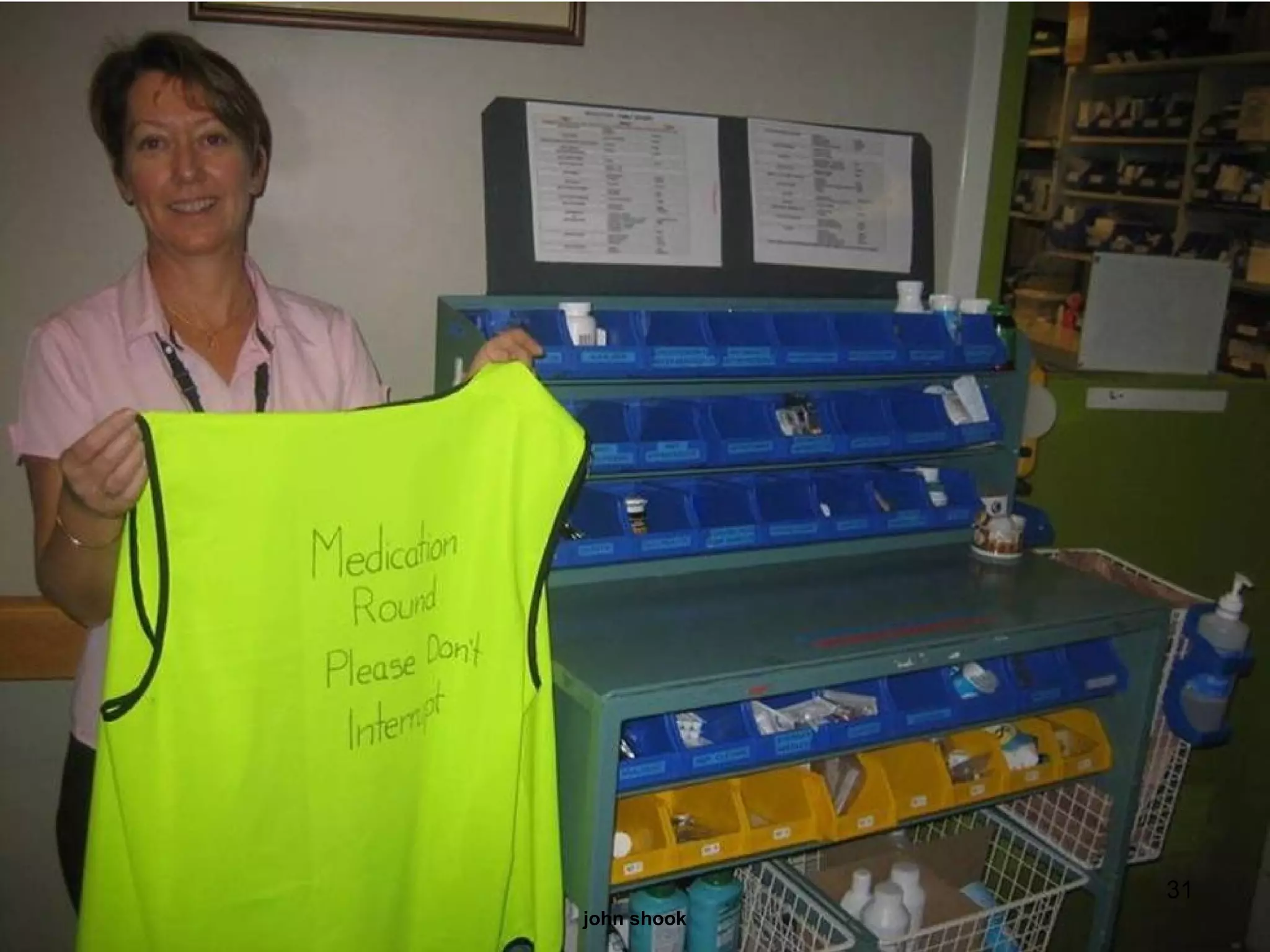
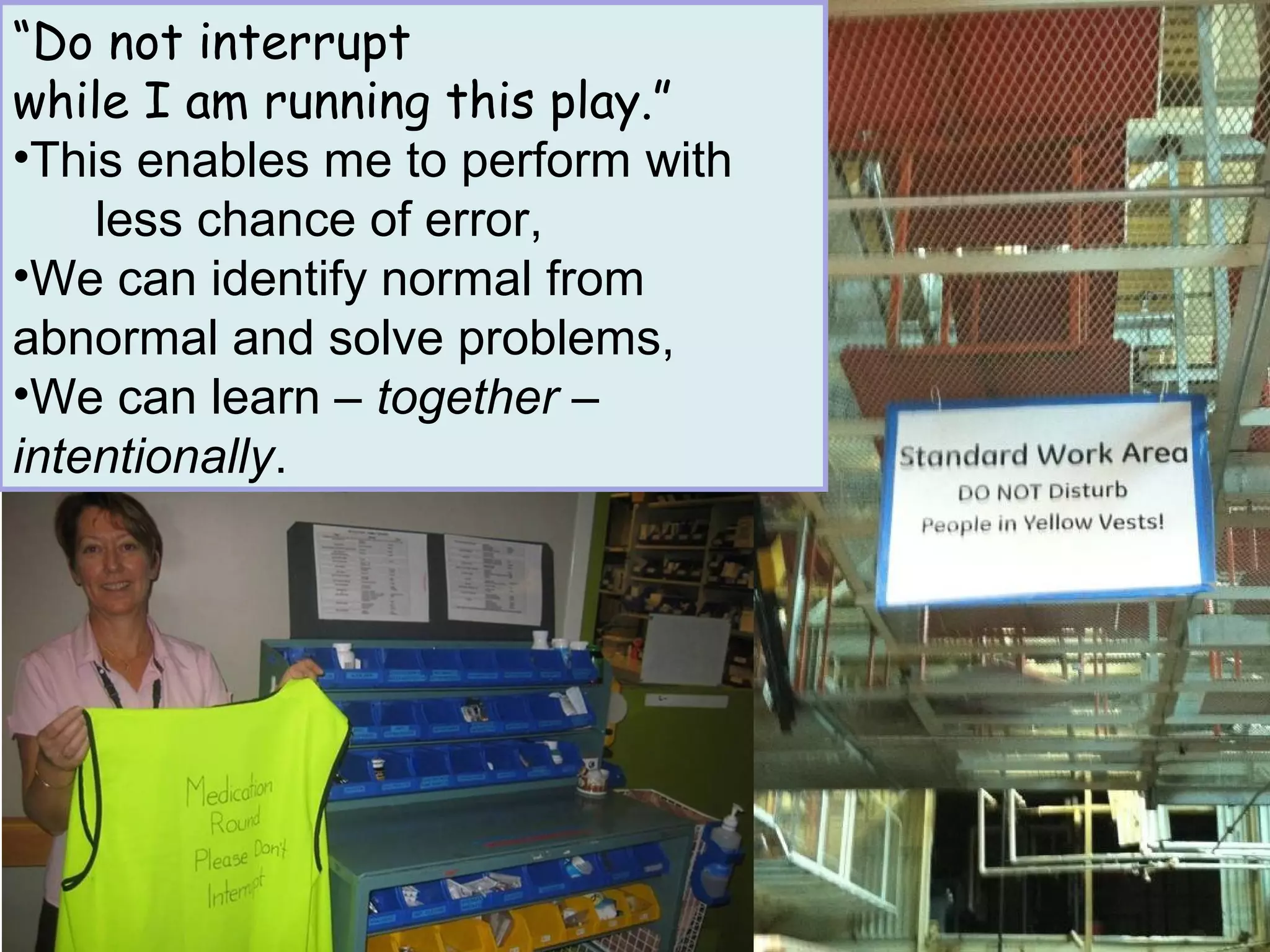
“Do not interrupt
while I am running this play.”
•This enables me to perform with
    less chance of error,
•We can identify normal from
abnormal and solve problems,
•We can learn – together –
intentionally.


                                      32
                         john shook
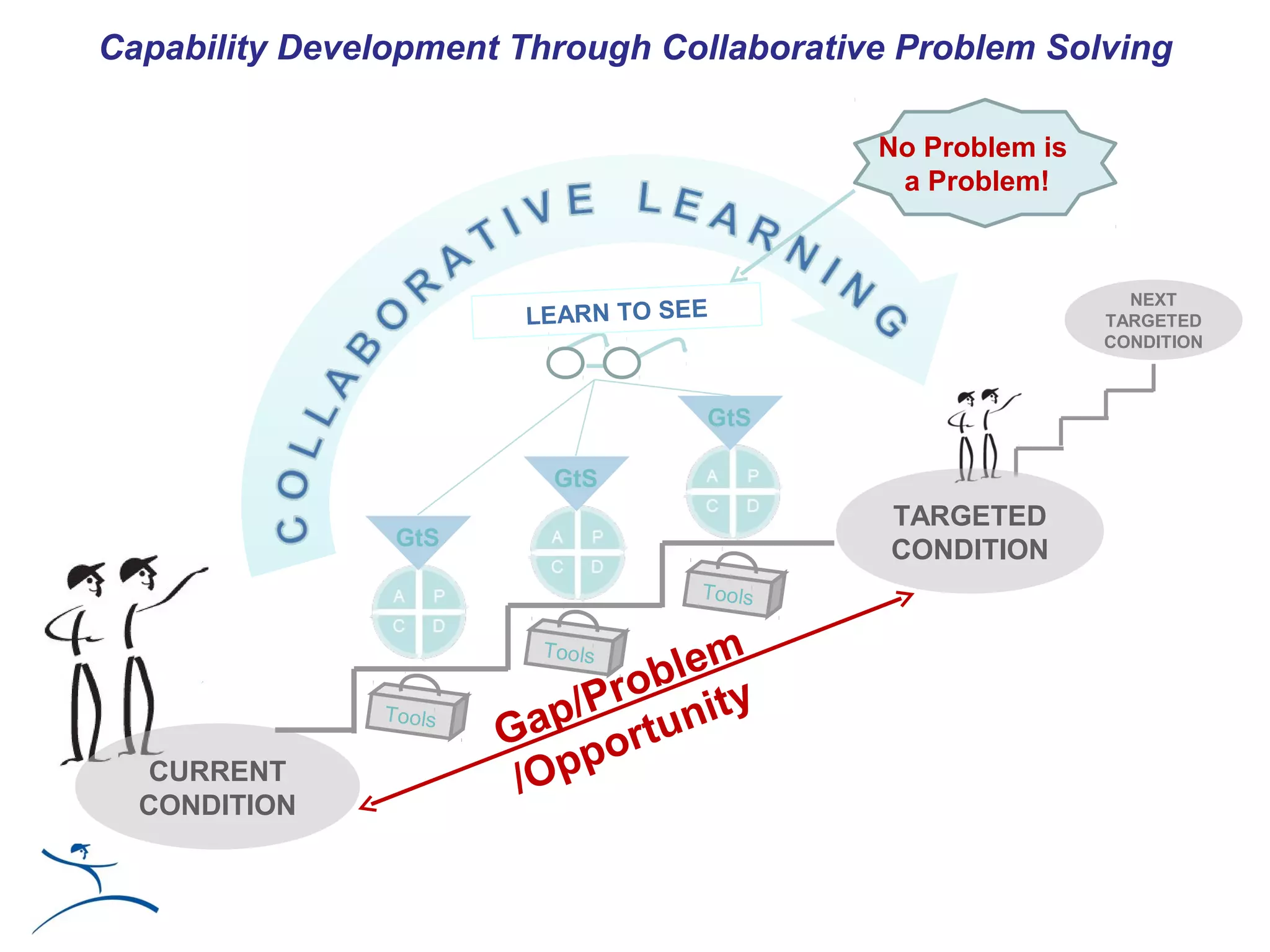
Capability Development Through Collaborative Problem Solving

                                           No Problem is
                                            a Problem!


                                                             NEXT
                        LEARN TO SEE                       TARGETED
                                                           CONDITION


                                   GtS

                          GtS
                                            TARGETED
                GtS
                                            CONDITION
                                   Tools


                                  m
                               ble
                         Tools

                           /Pro nity
                       Gap ortu
               Tools

                            p
  CURRENT
  CONDITION
                        /Op
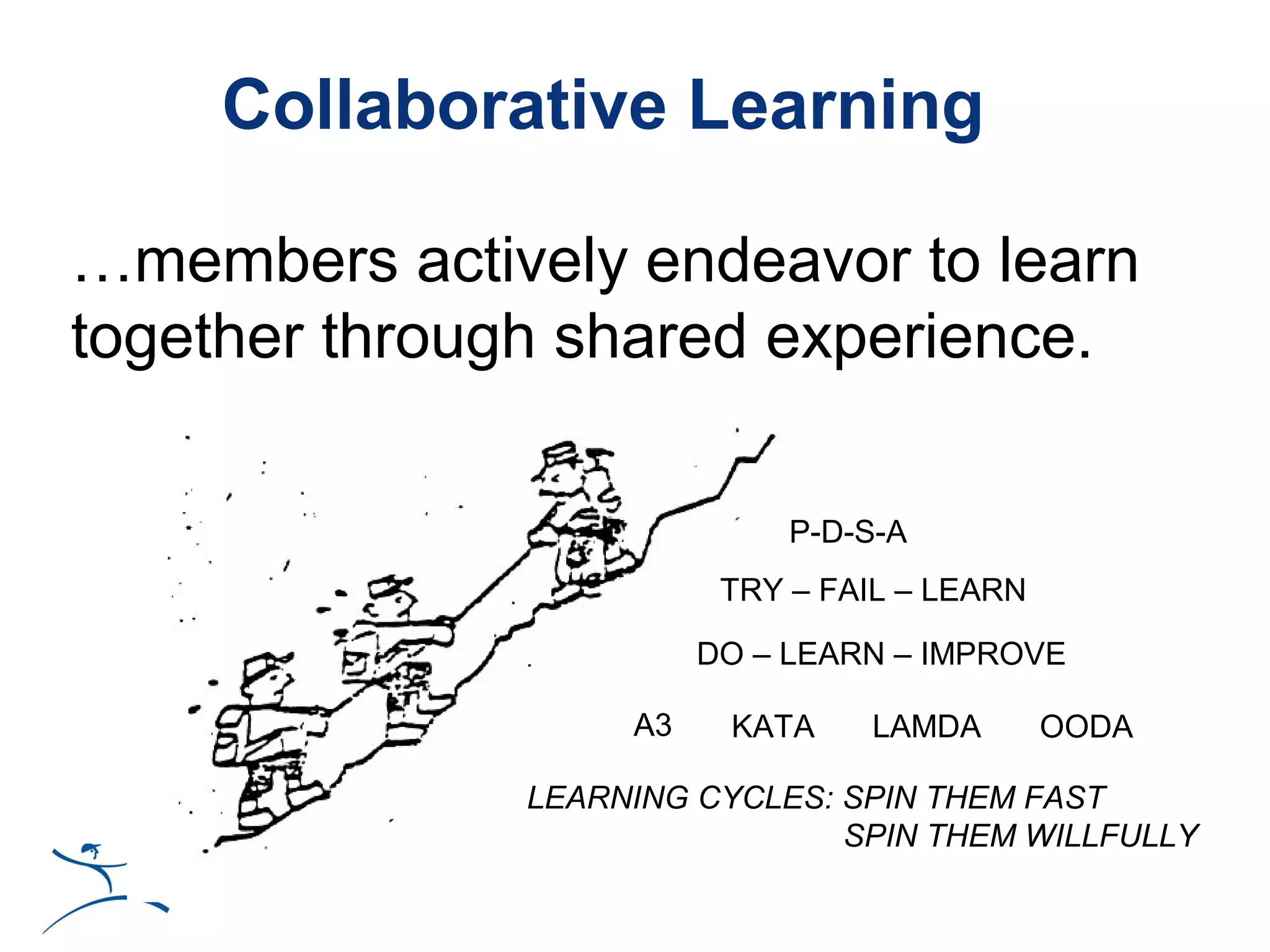
Collaborative Learning

…members actively endeavor to learn
together through shared experience.

                            P-D-S-A
                        TRY – FAIL – LEARN

                      DO – LEARN – IMPROVE
                                   t
                   A3  KATA    LAMDA     OODA

              LEARNING CYCLES: SPIN THEM FAST
                               SPIN THEM WILLFULLY
When (and why) not to pursue
    Collaborative Learning or…
What pitfalls to avoid when you do.

After all, every yin has its yang.
Collaborative Learner Beware…

• Groupthink
  – Everyone follows an attractive thread
  – Design by committee
     • For example “limiting statements” (S Bahri)
  – “Democracy” to the point of lack of
    leadership
Collaborative Learner Beware…
• Groupthink
  – Everyone follows an attractive thread
  – Design by committee
  – “Democracy” to the point of lack of leadership
• Brainstorming as a group becomes too
  easy; no individual steps up to:
   – take ownership
   – go through the intense pain of truly thinking
     something through deeply
Collaborative Learner Beware…
•   Groupthink
     – Everyone follows an attractive thread
     – Design by committee
     – “Democracy” to the point of lack of leadership
•   Brainstorming as a group becomes too easy; no individual steps up to:
     – take ownership
     – go through the intense pain of truly thinking something through deeply

• “Collaboration Fatigue” – Dr. Gigi Hirsch of
  MIT
     – Beware the trade-off between inclusiveness
       versus effectiveness and efficiency
Collaborative Learning and
 Successful Lean Transformation
• We are all teachers. We are all teaching all the
  time.
• We can teach more effectively, or less
  effectively. Whether our teaching is more or less
  effective depends on two things: intention and
  skill.
• Skill can be acquired, if we simply have the
  intention.
• Thus, effective “teaching”, effective “learning”,
  effective “leadership” is, more than anything
  else, a matter of choice.
How to transform to a lean operating
      and management system?
 Three things:
 1.Intent: manifested in a willful decision
 2.Process: a means by which the
 decision can be actualized
 3.Practice, practice, practice…
   – Right practice
   – Perhaps with a coach!
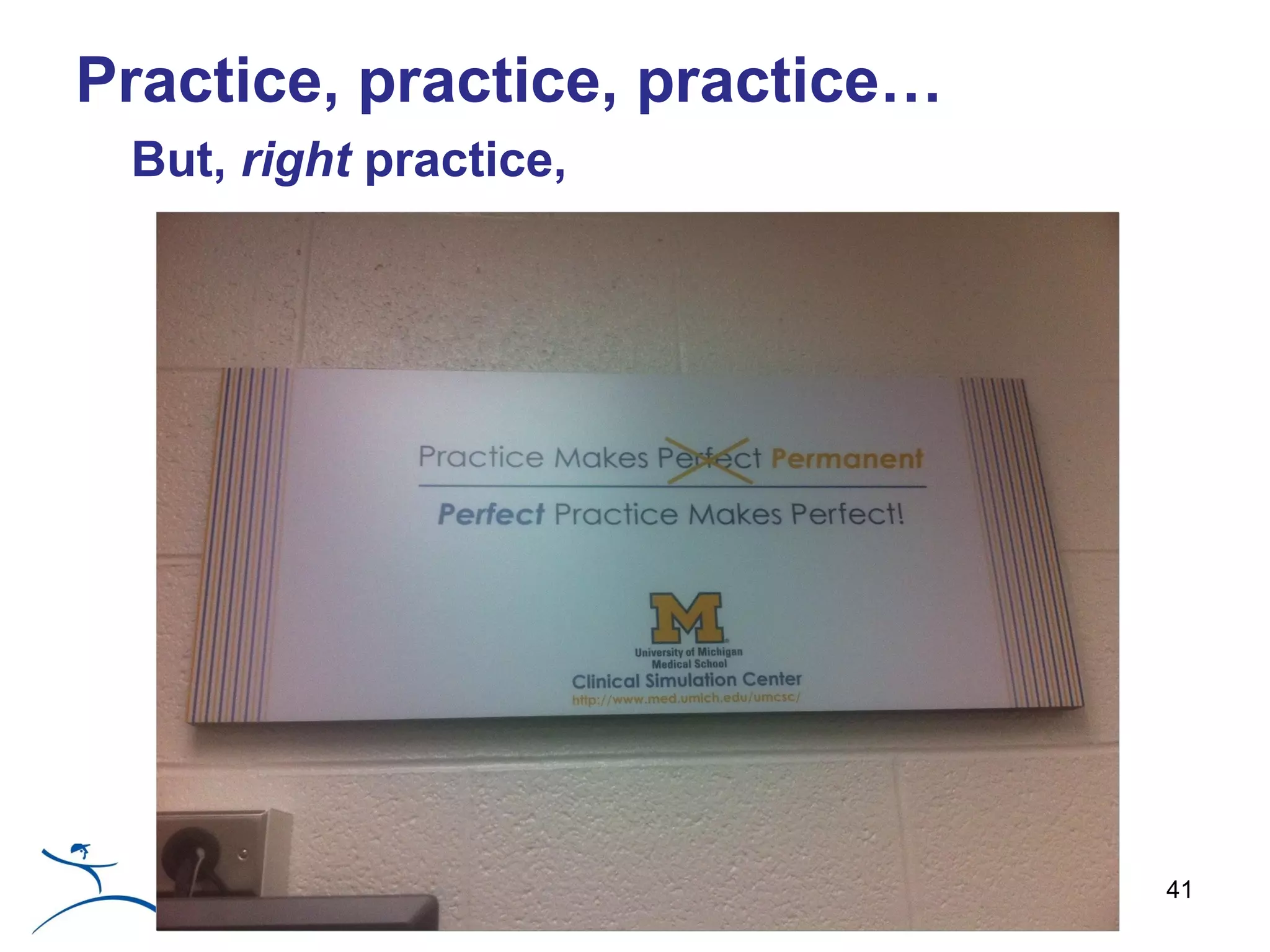
Practice, practice, practice…
 But, right practice,


                                     41
                        john shook
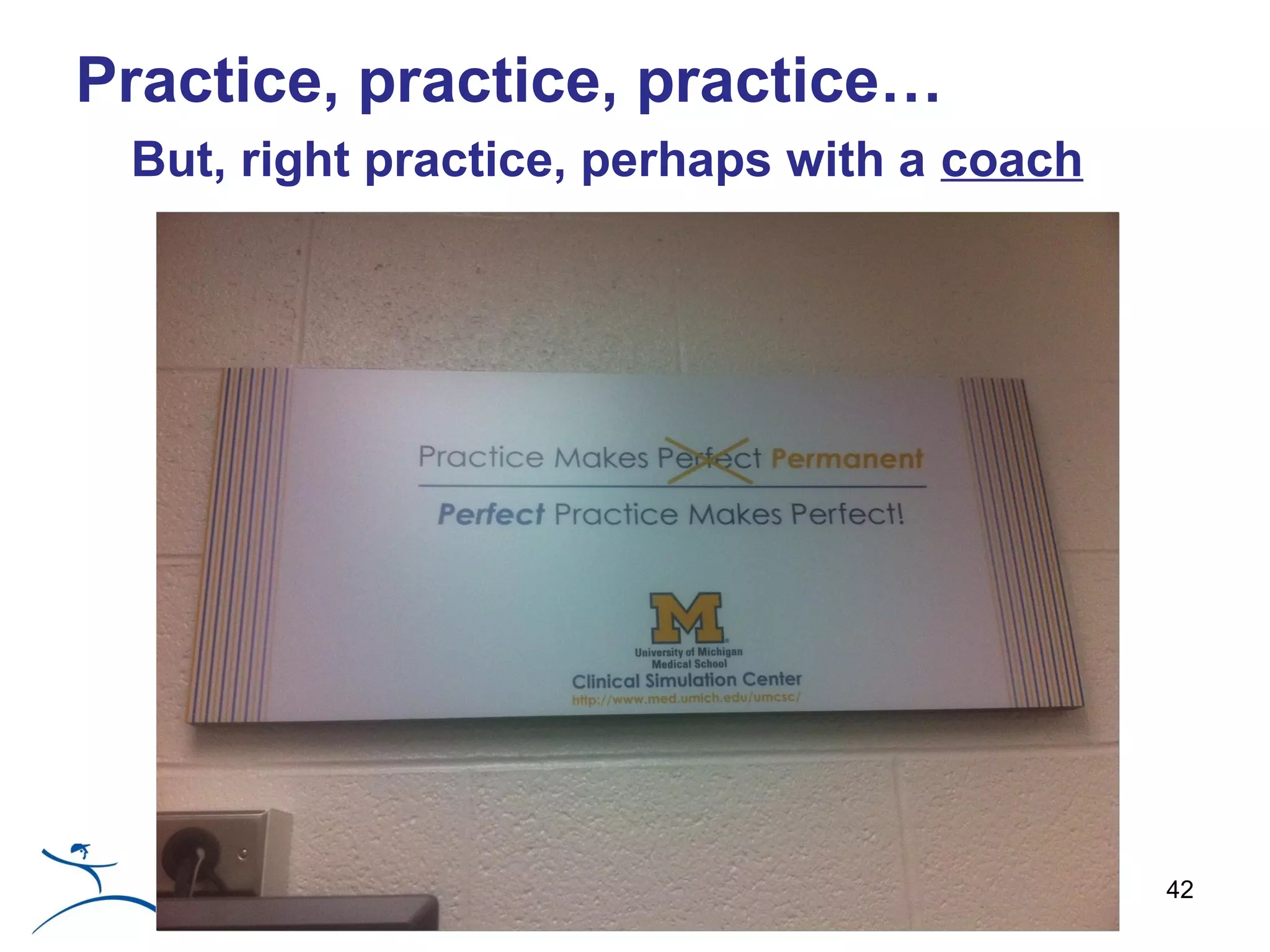
Practice, practice, practice…
 But, right practice, perhaps with a coach


                                             42
                    john shook
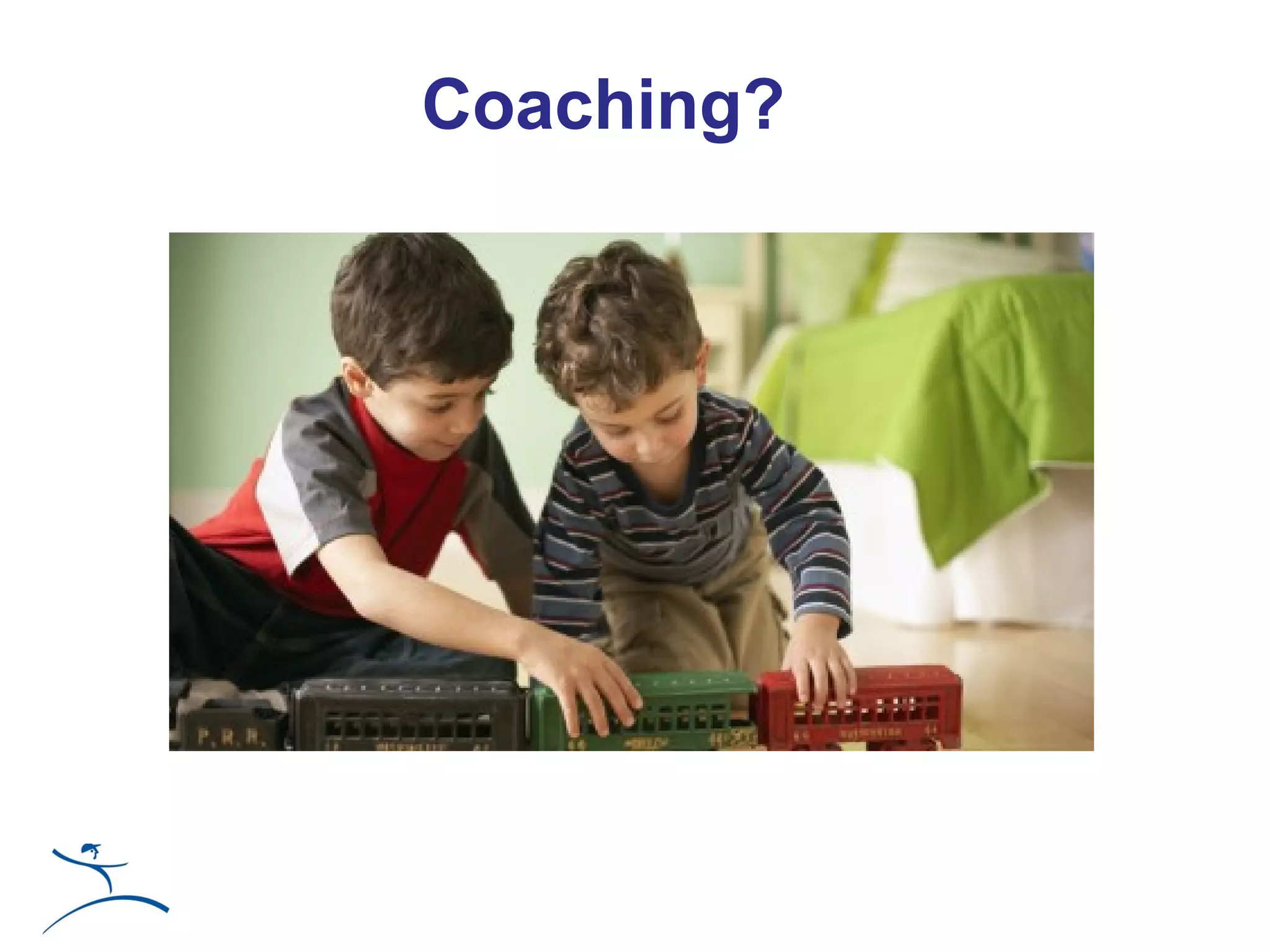
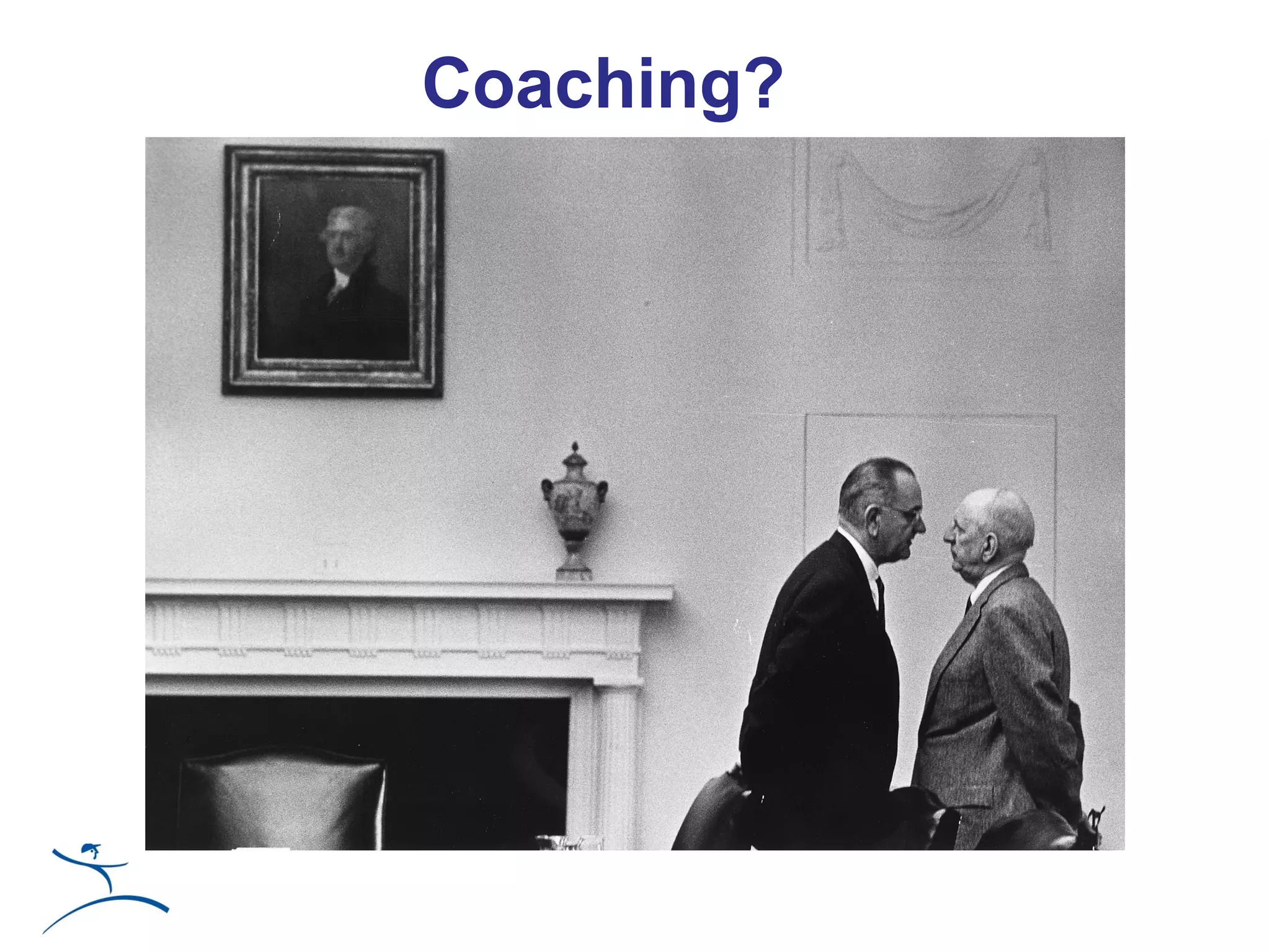
Coaching?
Coaching?
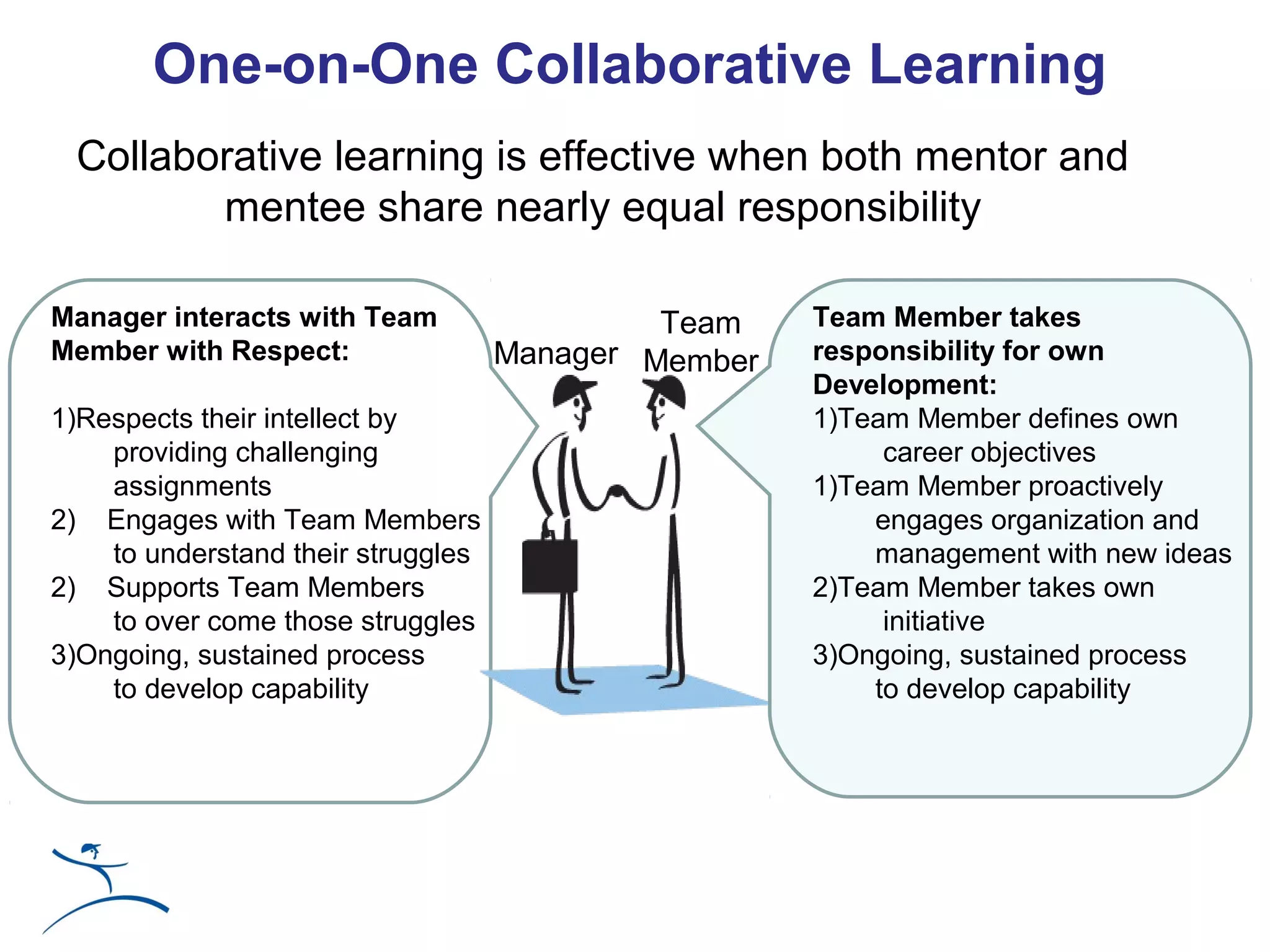
One-on-One Collaborative Learning
 Collaborative learning is effective when both mentor and
        mentee share nearly equal responsibility

Manager interacts with Team                  Team    Team Member takes
Member with Respect:                Manager Member   responsibility for own
                                                     Development:
1)Respects their intellect by                        1)Team Member defines own
    providing challenging                                 career objectives
    assignments                                      1)Team Member proactively
2) Engages with Team Members                             engages organization and
    to understand their struggles                        management with new ideas
2) Supports Team Members                             2)Team Member takes own
    to over come those struggles                          initiative
3)Ongoing, sustained process                         3)Ongoing, sustained process
    to develop capability                                to develop capability
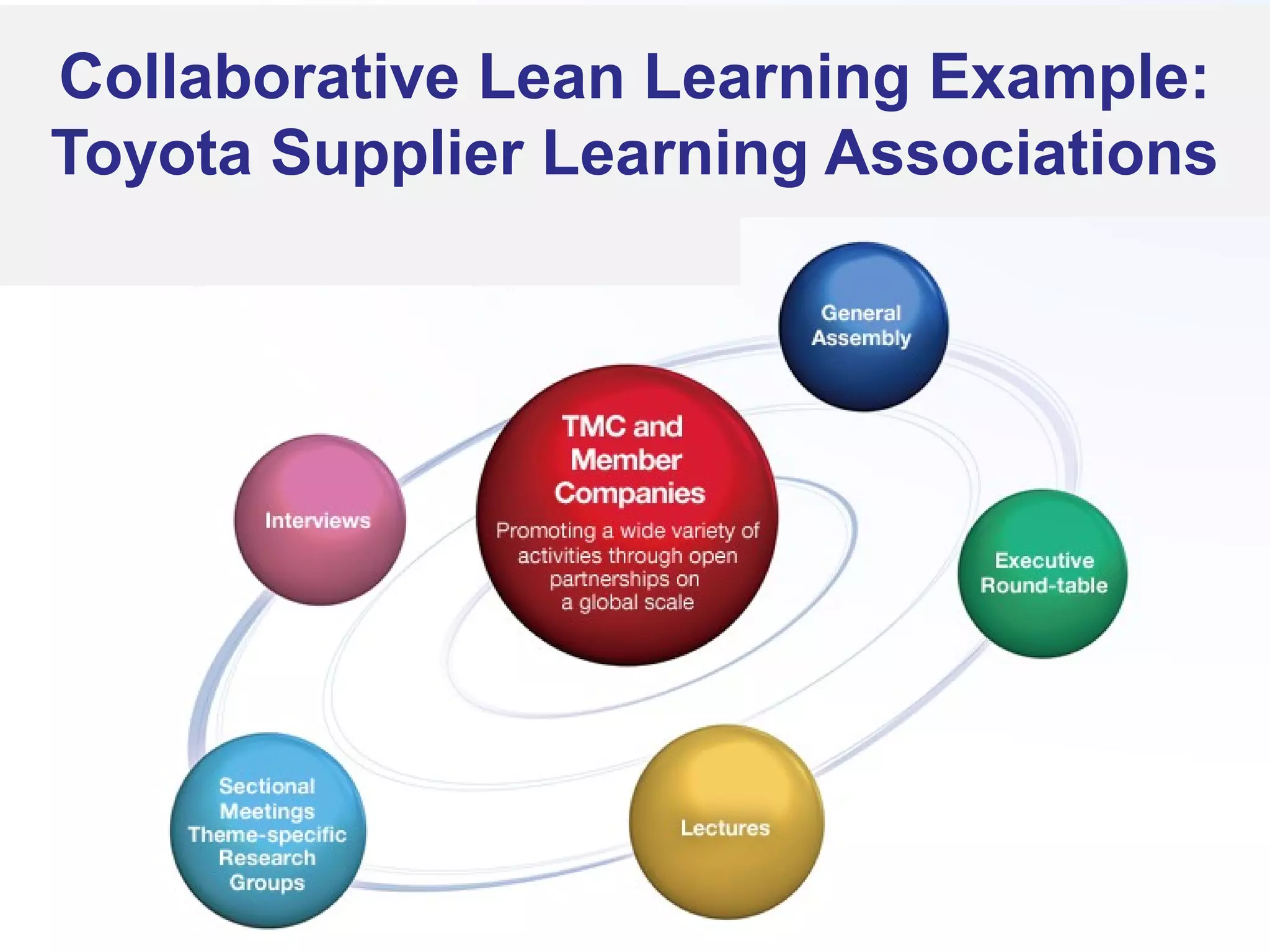
Collaborative Lean Learning Example:
Toyota Supplier Learning Associations
Collaborative Lean Learning Example:
                Toyota’s TSSC
TSSC, the Toyota Production System Support Center,
mission: Help North American companies to learn the Toyota
Production System.

•Over 20 years, TSSC has collaborated with more than 150
organizations to learn TPS.
•Organizations demonstrate dramatic improvements in
Productivity, Quality, and Lead Time.
•Through collaboration and learning with organizations in
many sectors, Toyota benefits by bringing this learning back
into its own organization.
Collaborative Lean Learning
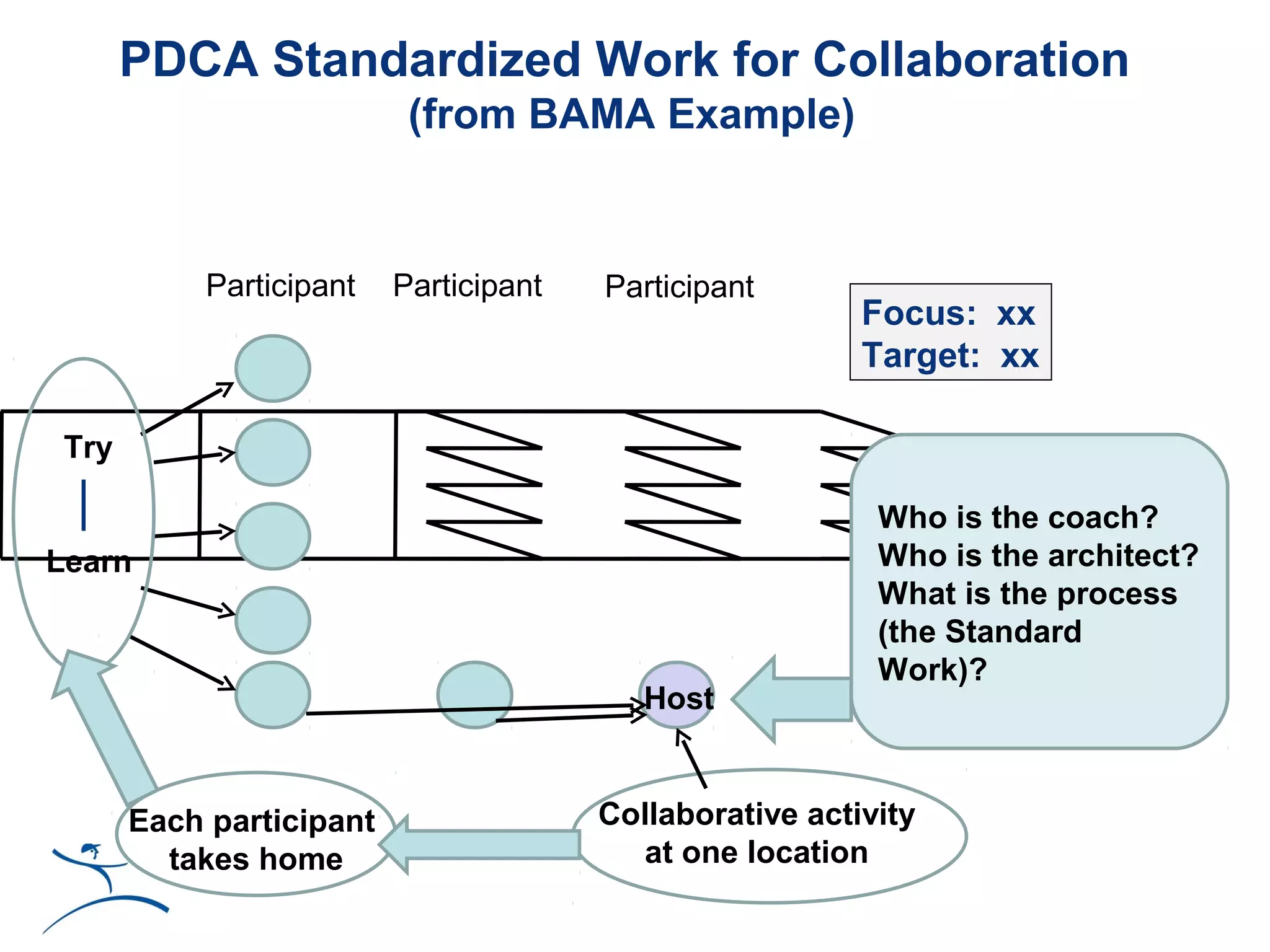
PDCA Standardized Work for Collaboration
                           (from BAMA Example)


            Participant   Participant   Participant
                                                          Focus: xx
                                                          Target: xx

 Try

                                                           Who is the coach?
Learn                                                      Who is the architect?
                                                           What is the process
                                                           (the Standard
                                                           Work)?
                                           Host


       Each participant                 Collaborative activity
         takes home                       at one location
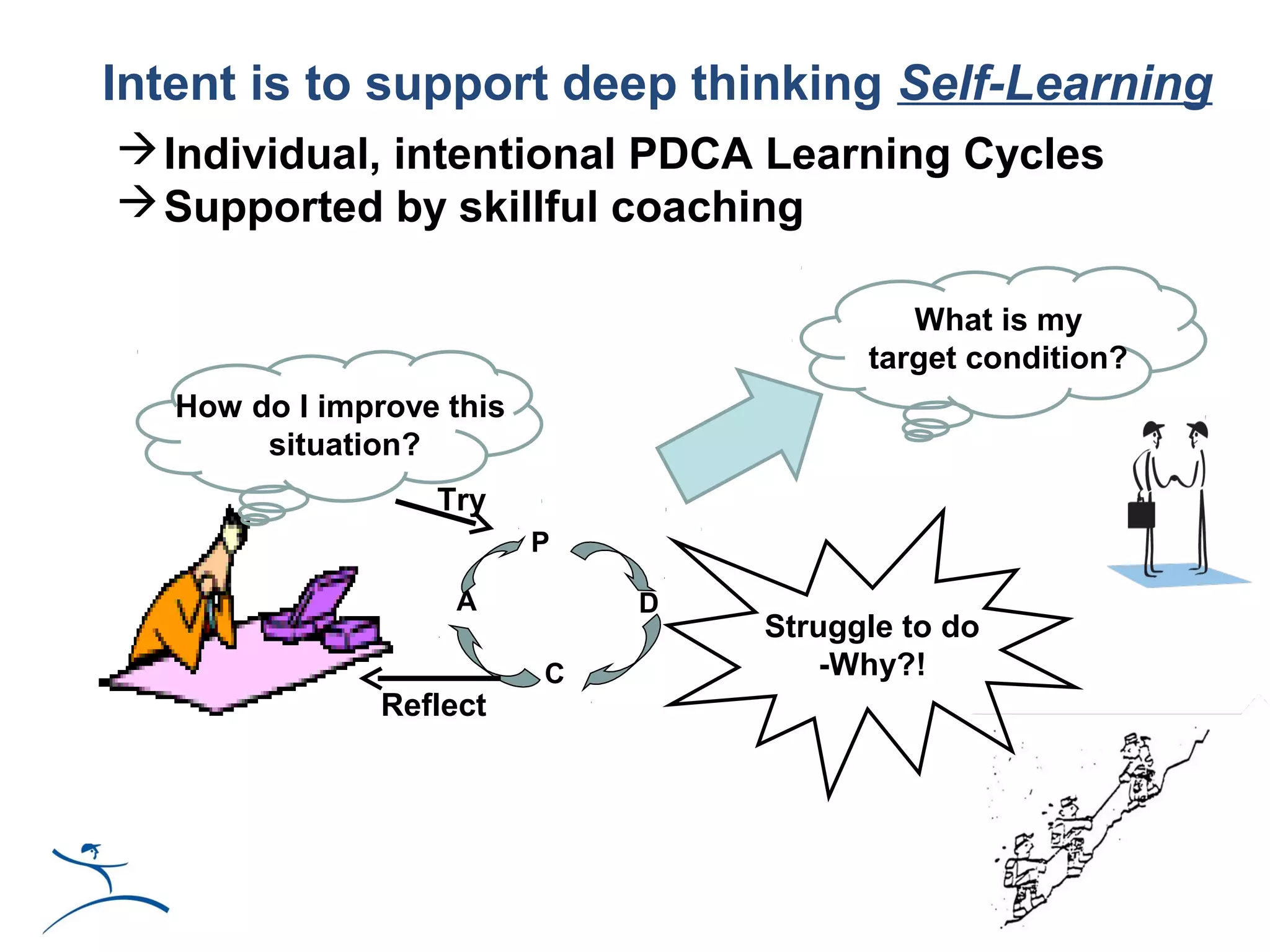
Intent is to support deep thinking Self-Learning
 Individual, intentional PDCA Learning Cycles
 Supported by skillful coaching

                                            What is my
                                         target condition?
   How do I improve this
        situation?
                   Try
                           P

                     A         D
                                   Struggle to do
                           C           -Why?!
                Reflect
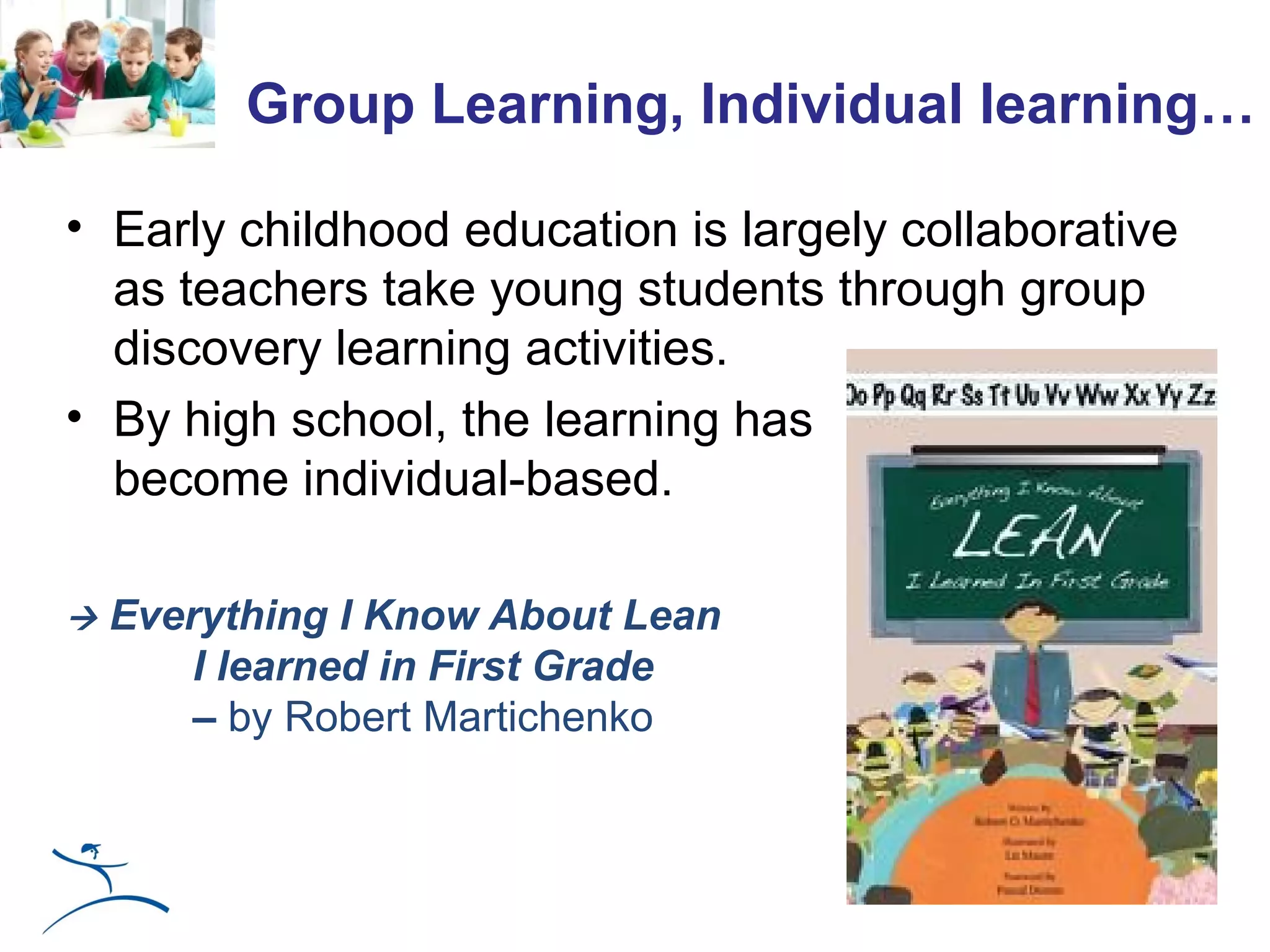
Group Learning, Individual learning…

• Early childhood education is largely collaborative
  as teachers take young students through group
  discovery learning activities.
• By high school, the learning has
  become individual-based.

   Everything I Know About Lean
        I learned in First Grade
        – by Robert Martichenko
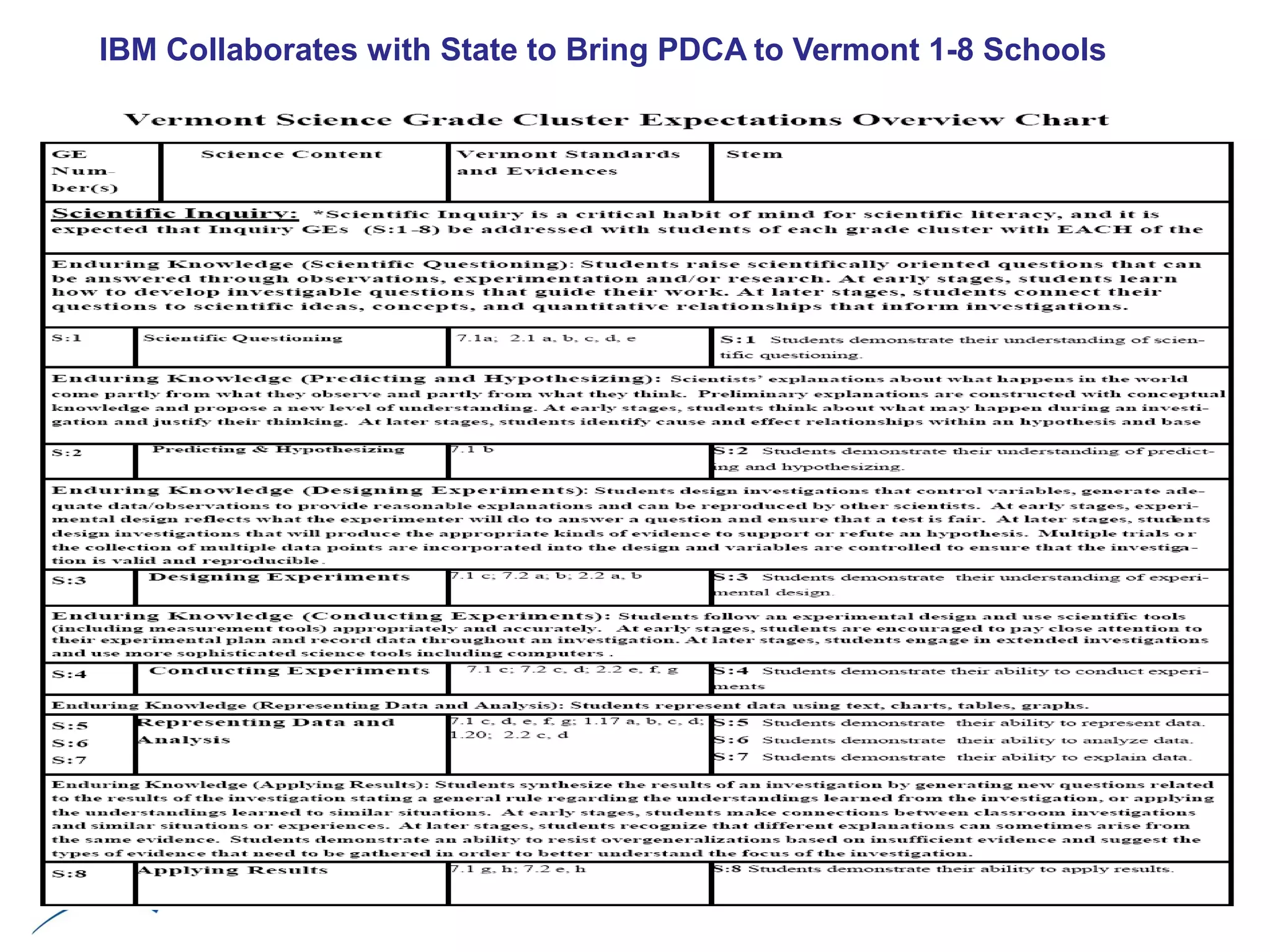
IBM Collaborates with State to Bring PDCA to Vermont 1-8 Schools
What will you do?


Find someone to learn with:

…NOW
 Assignment
What will you do?


Assignment – One Minute

One thing you will do this week about
the one thing you wish to change
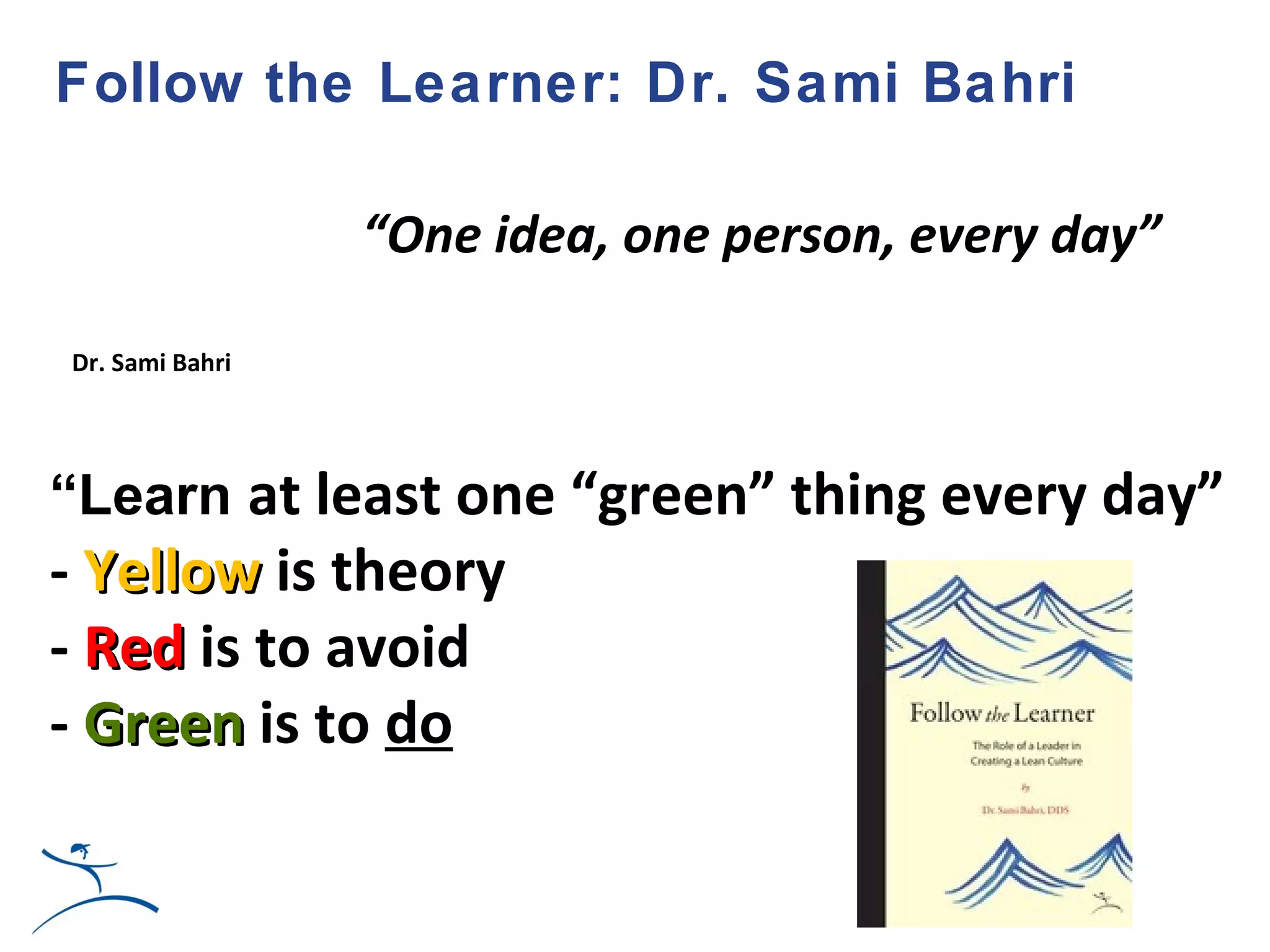
Follow the Learner: Dr. Sami Bahri

                 “One idea, one person, every day”

Dr. Sami Bahri


“Learn at least one “green” thing every day”
- Yellow is theory
- Red is to avoid
- Green is to do
What will you do?
Assignment – One Minute

One thing you will do this week about
the one thing you wish to change
One more minute: share that with
the learning partner sitting beside
you and discuss how your partner
can help you with that problem
The following slides contain
  supplemental Information
  about the Lean Enterprise
Institute and its mission, basic
approach, and major activities.
Lean Enterprise Institute

• Founded in 1997 by Dr. James Womack,
  principle scientist of the MIT research that
  resulted in “The Machine That Changed the
  World”
• Non-profit education and research institute
• Based in Cambridge MA, with 17 global
  affiliates
• Over 230,000 members from all industries
• Mission: Advance Lean Thinking and Practice in
  all things, everywhere
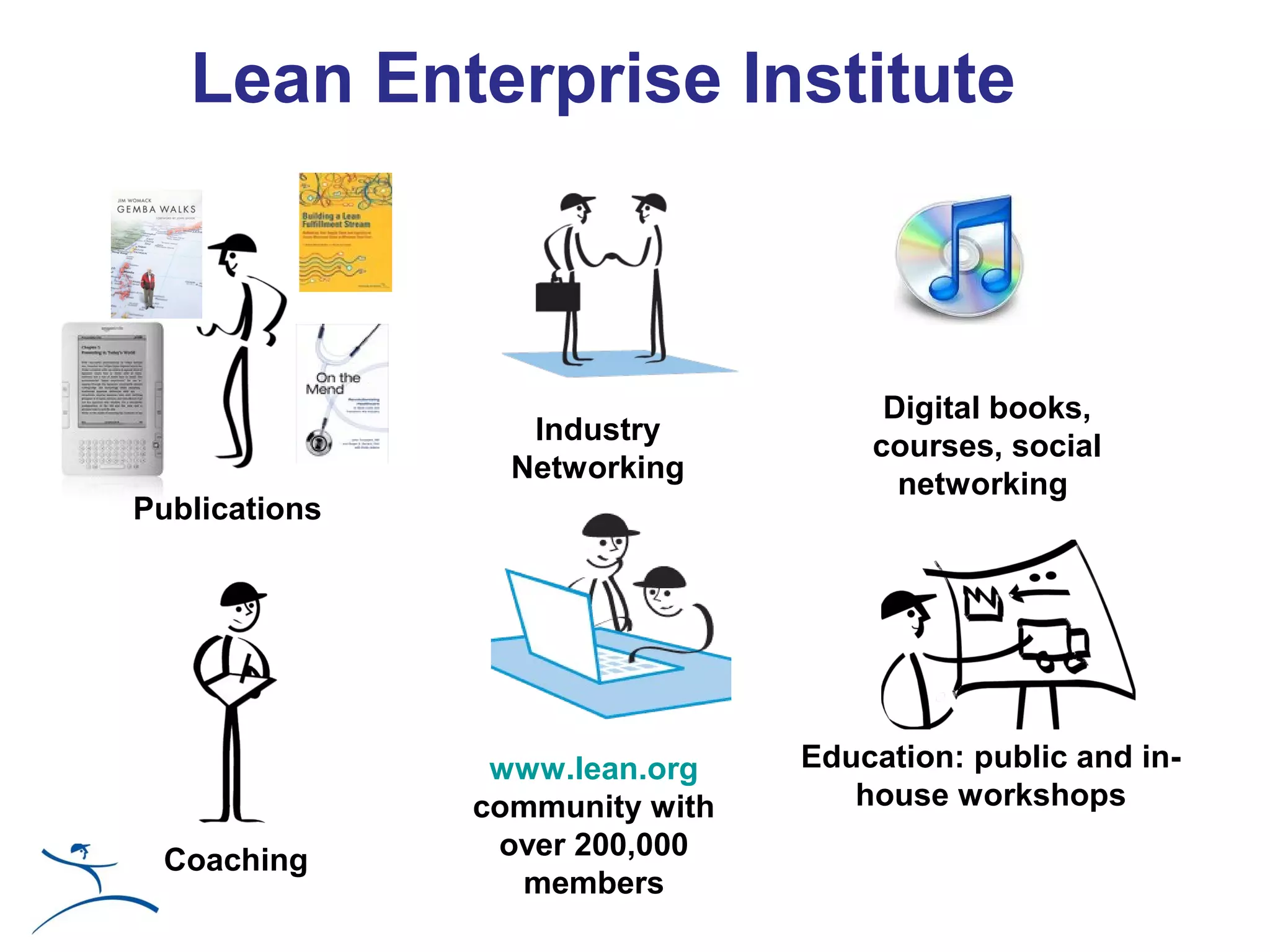
Lean Enterprise Institute


                                     Digital books,
                  Industry
                                    courses, social
                 Networking
                                      networking
Publications


                www.lean.org    Education: public and in-
               community with      house workshops

 Coaching       over 200,000
                 members
Since its founding in 1997, LEI has …

•Changed the language of management
•Registered over 230,000 Lean Thinking Practitioners and Leaders to its online Lean Community.
•Sent over 100 e-letters to over 150,000 subscribers
•Trained almost 20,000 people at public workshops
•Moderated eight online Forums with nearly 17,000 subscribers.
•Delivered onsite training to over 2,000 people at over 100 companies.
•Partnered with companies committed to implementing and spreading the methodology for creating a
lean enterprise through experiments and shared learning.
•Collaborated with over 50 independent faculty members.
•Developed over 40 workshops for executives, managers, and technical professionals at every
experience level in manufacturing, service, healthcare, and administrative value streams.
•Produced 20 webinars on a wide range of lean management topics.
•Produced 20 publications and sold over 600,000 books, workbooks, and training aids.
•Hosted eight major Summit conferences with more than 7,000 attendees.
•Created a web site with thousands of pages of resources
•Founded the Lean Educators Academic Network.
•Founded the Healthcare Value Leaders Network, including the first Healthcare Transformation
Summit.
•Formed the Lean Global Network, a network of 17 not-for-profit institutes on six continents. And
supported over 40 world-wide events since LGN was officially formed in 2007.
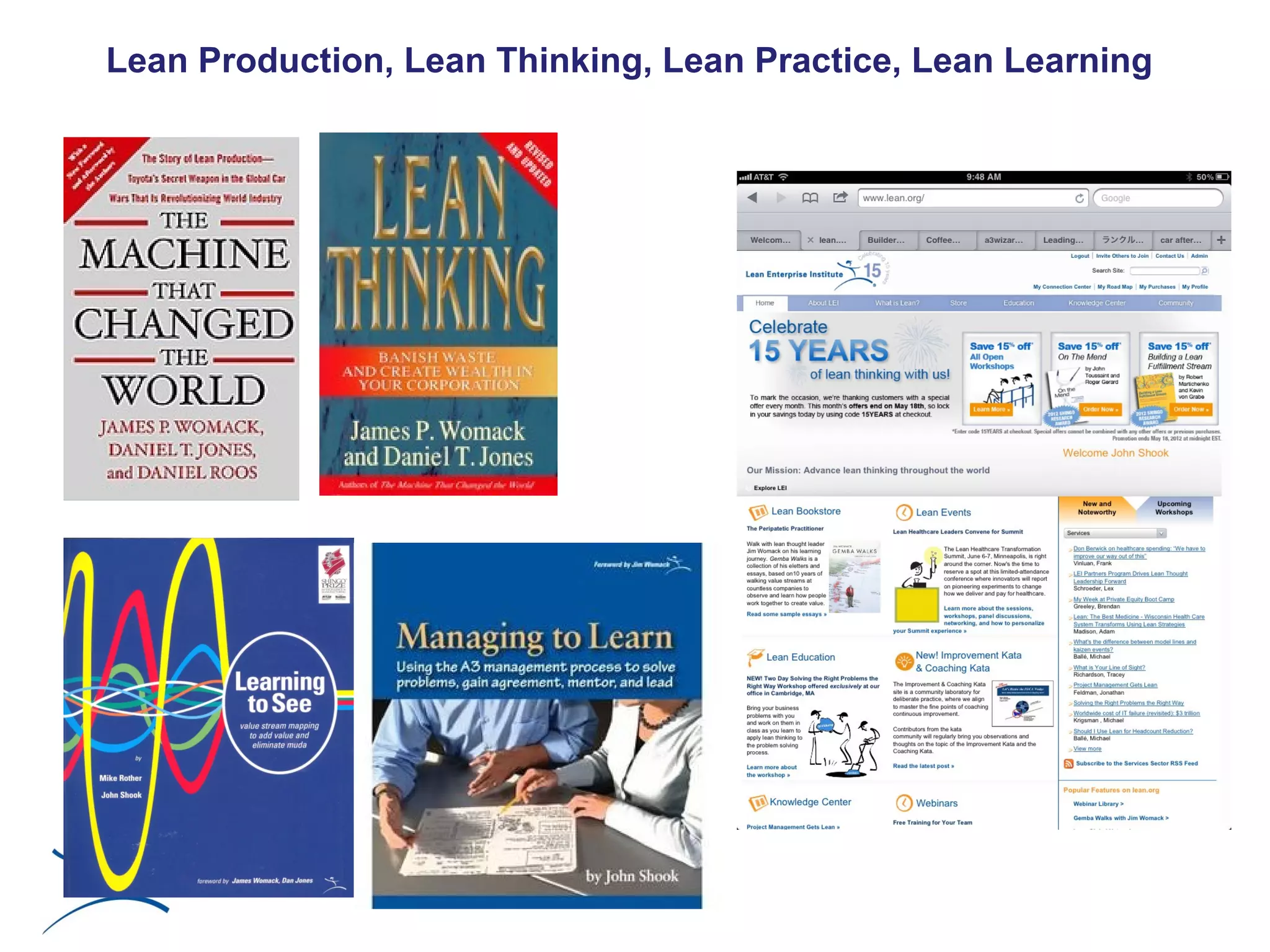
Lean Production, Lean Thinking, Lean Practice, Lean Learning
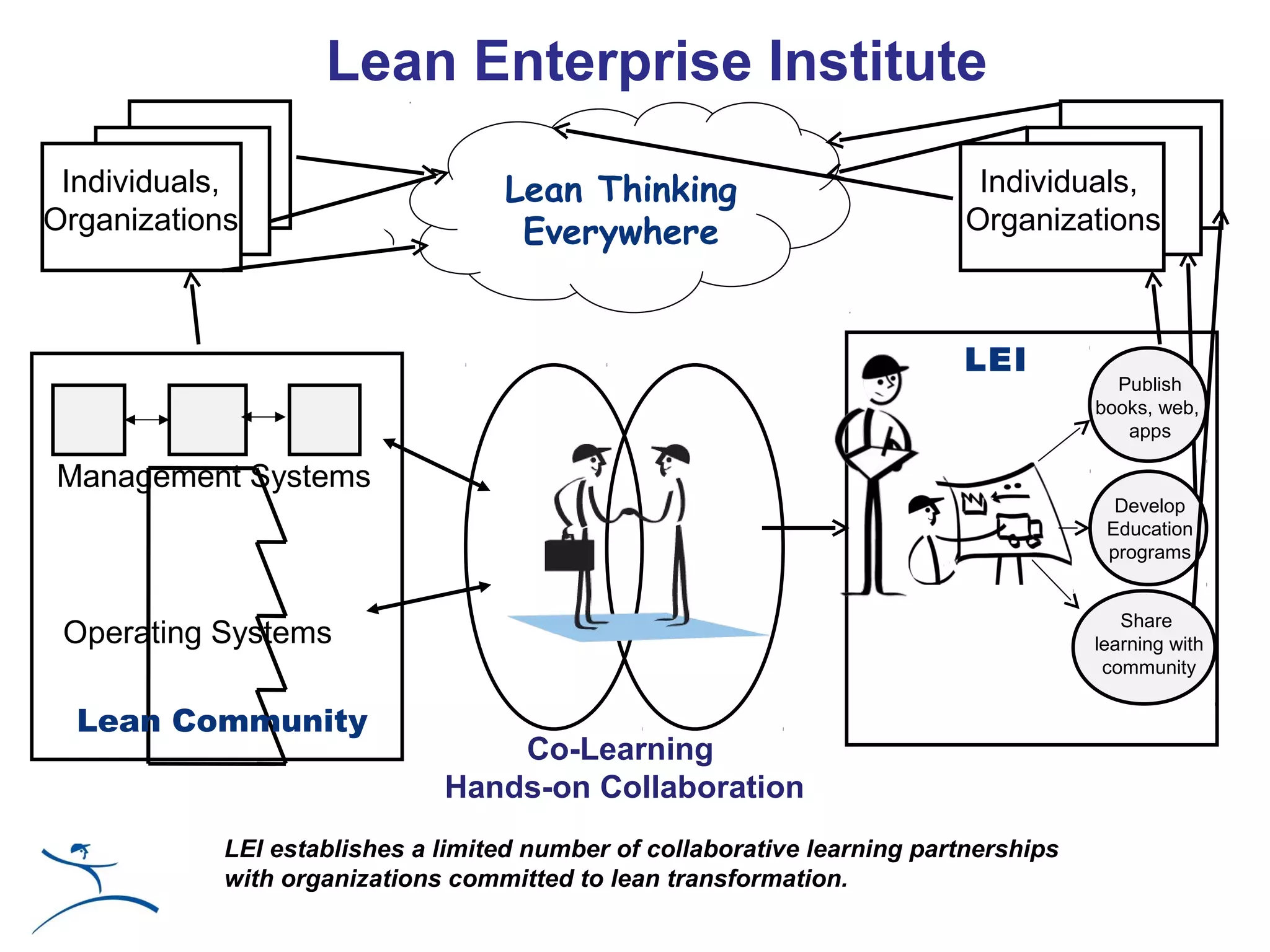
Lean Enterprise Institute
 Individuals,                      Lean Thinking                            Individuals,
Organizations                       Everywhere                             Organizations


                                                                           LEI
                                                                                        Publish
                                                                                      books, web,
                                                                                         apps

Management Systems
                                                                                        Develop
                                                                                       Education
                                                                                       programs


                                                                                         Share
 Operating Systems                                                                    learning with
                                                                                       community

  Lean Community
                                  Co-Learning
                              Hands-on Collaboration
            LEI establishes a limited number of collaborative learning partnerships
            with organizations committed to lean transformation.
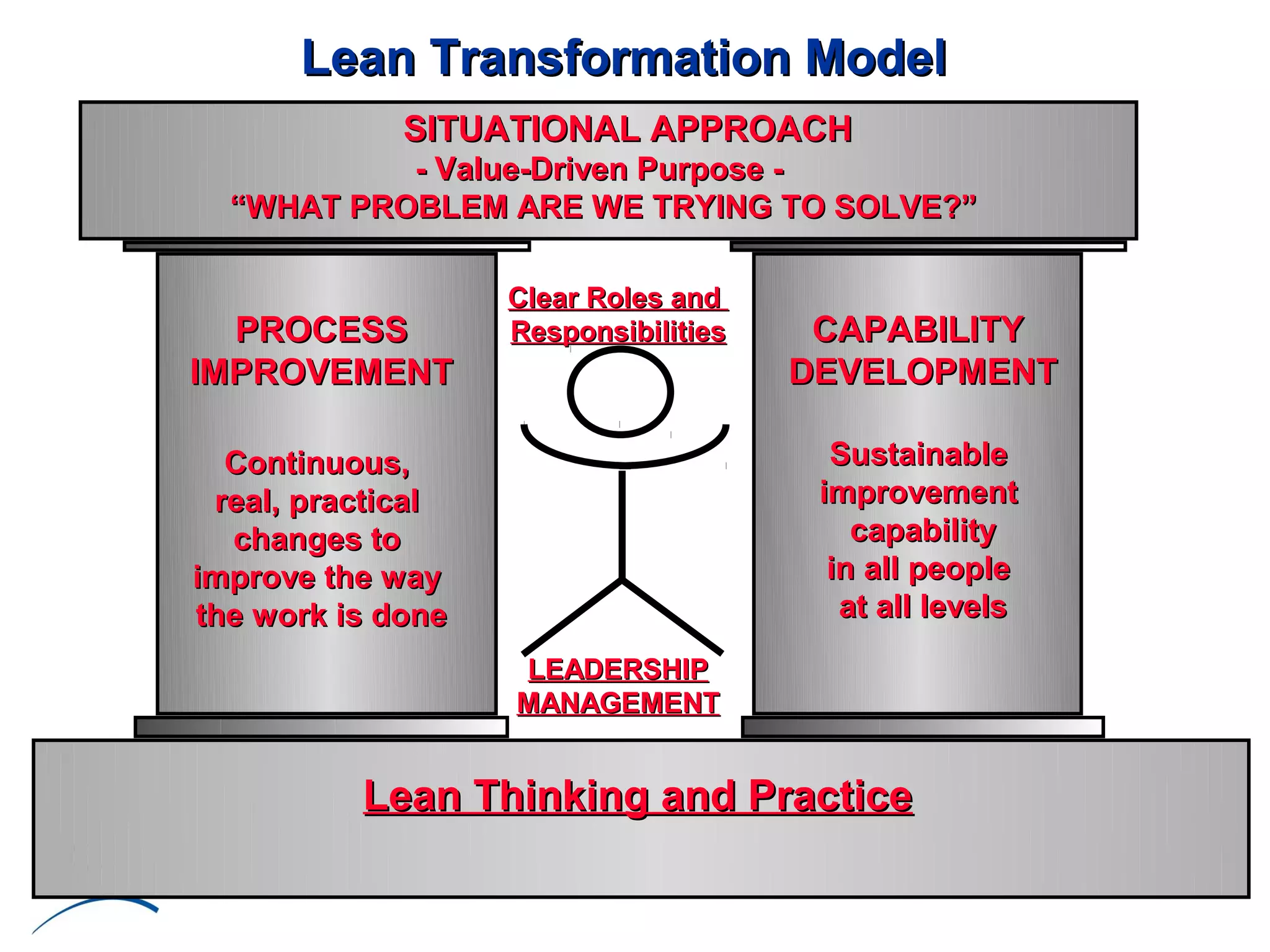
Lean Transformation Model
             SITUATIONAL APPROACH
           - Value-Driven Purpose -
  “WHAT PROBLEM ARE WE TRYING TO SOLVE?”

                   Clear Roles and
  PROCESS          Responsibilities    CAPABILITY
IMPROVEMENT                           DEVELOPMENT

  Continuous,                           Sustainable
 real, practical                       improvement
  changes to                              capability
improve the way                         in all people
the work is done                         at all levels
                   LEADERSHIP
                   MANAGEMENT


          Lean Thinking and Practice
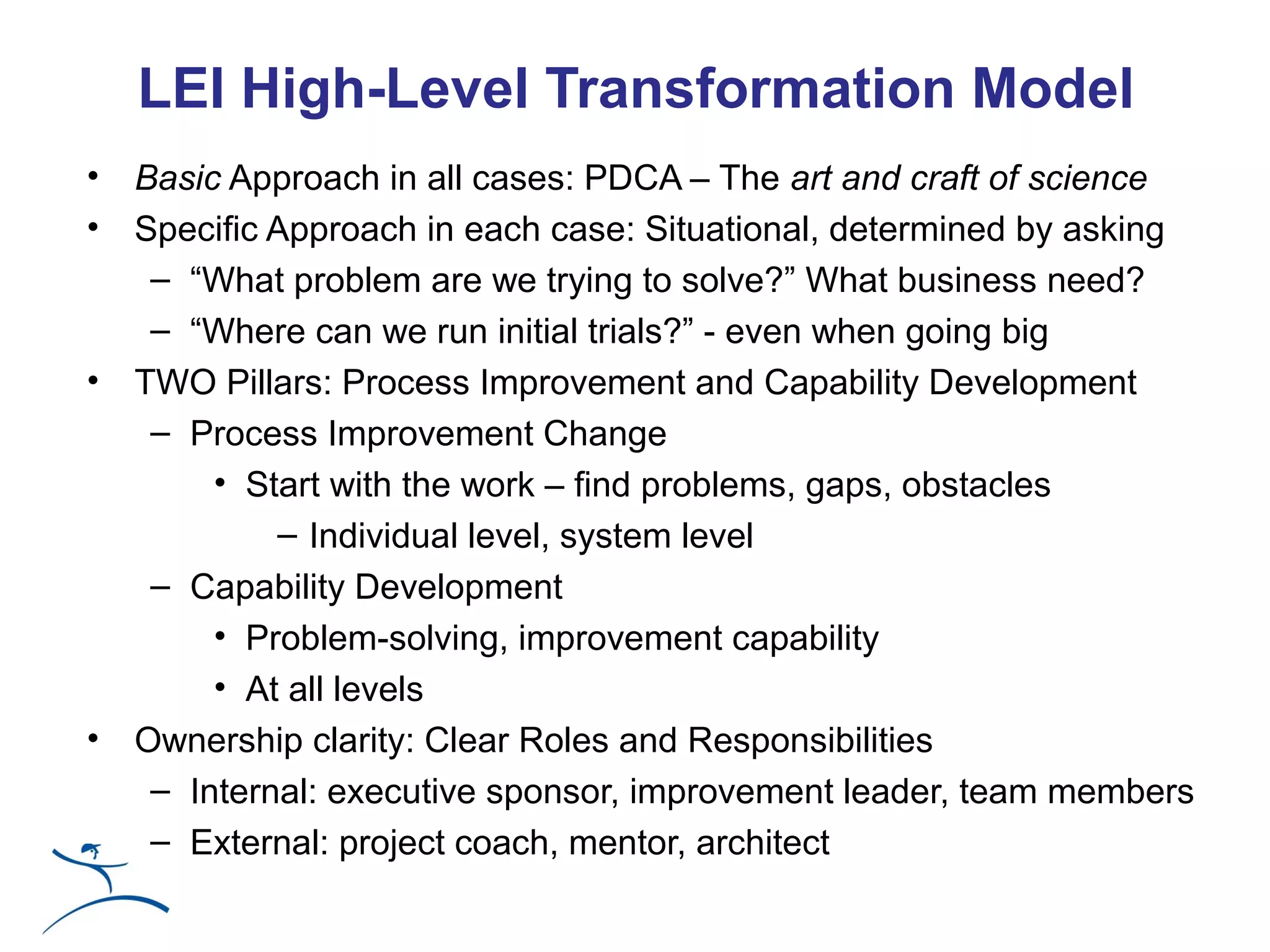
LEI High-Level Transformation Model
•   Basic Approach in all cases: PDCA – The art and craft of science
•   Specific Approach in each case: Situational, determined by asking
     – “What problem are we trying to solve?” What business need?
     – “Where can we run initial trials?” - even when going big
•   TWO Pillars: Process Improvement and Capability Development
     – Process Improvement Change
         • Start with the work – find problems, gaps, obstacles
             – Individual level, system level
     – Capability Development
         • Problem-solving, improvement capability
         • At all levels
•   Ownership clarity: Clear Roles and Responsibilities
     – Internal: executive sponsor, improvement leader, team members
     – External: project coach, mentor, architect
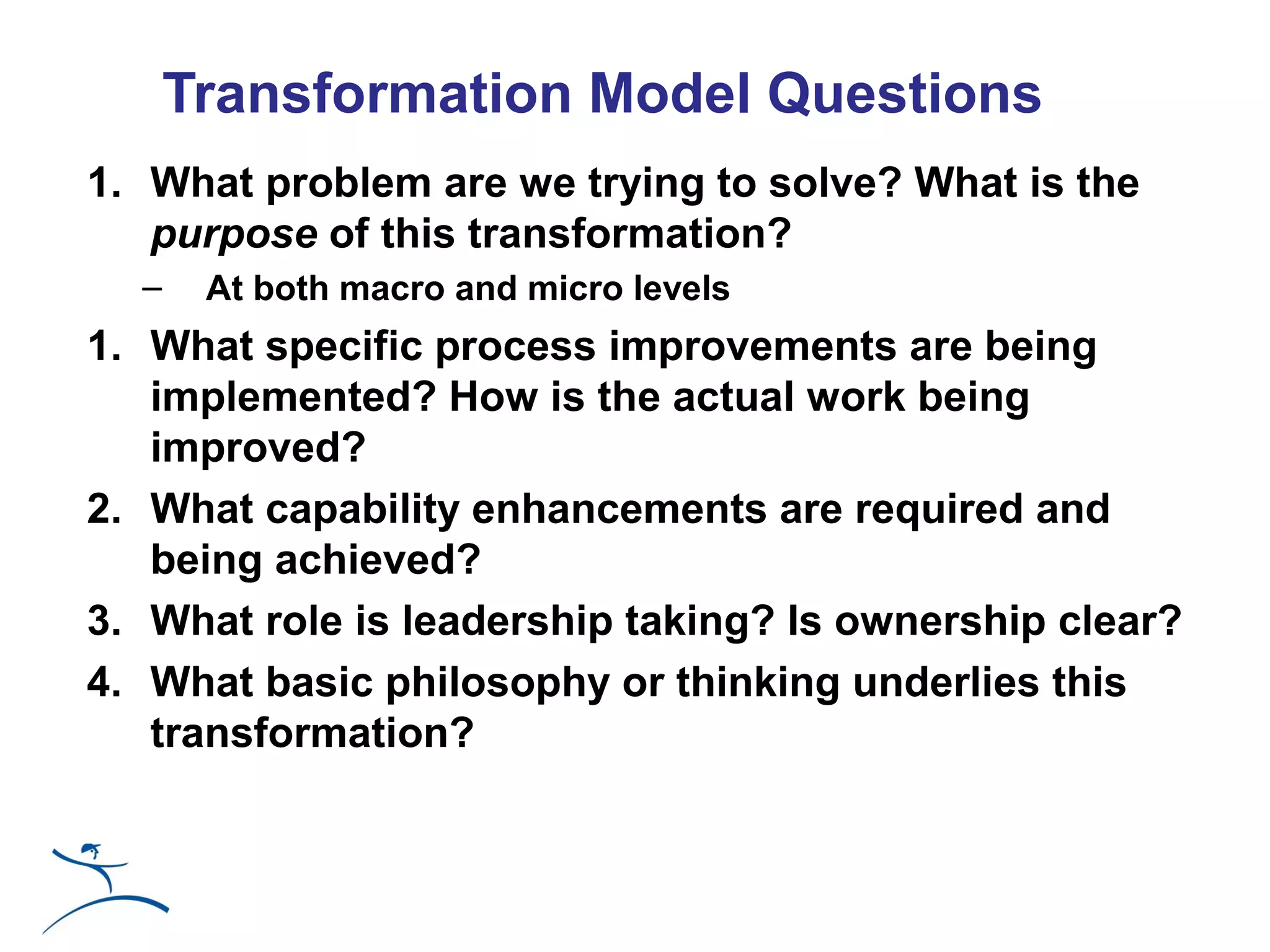
Transformation Model Questions
1. What problem are we trying to solve? What is the
   purpose of this transformation?
  –    At both macro and micro levels
1. What specific process improvements are being
   implemented? How is the actual work being
   improved?
2. What capability enhancements are required and
   being achieved?
3. What role is leadership taking? Is ownership clear?
4. What basic philosophy or thinking underlies this
   transformation?
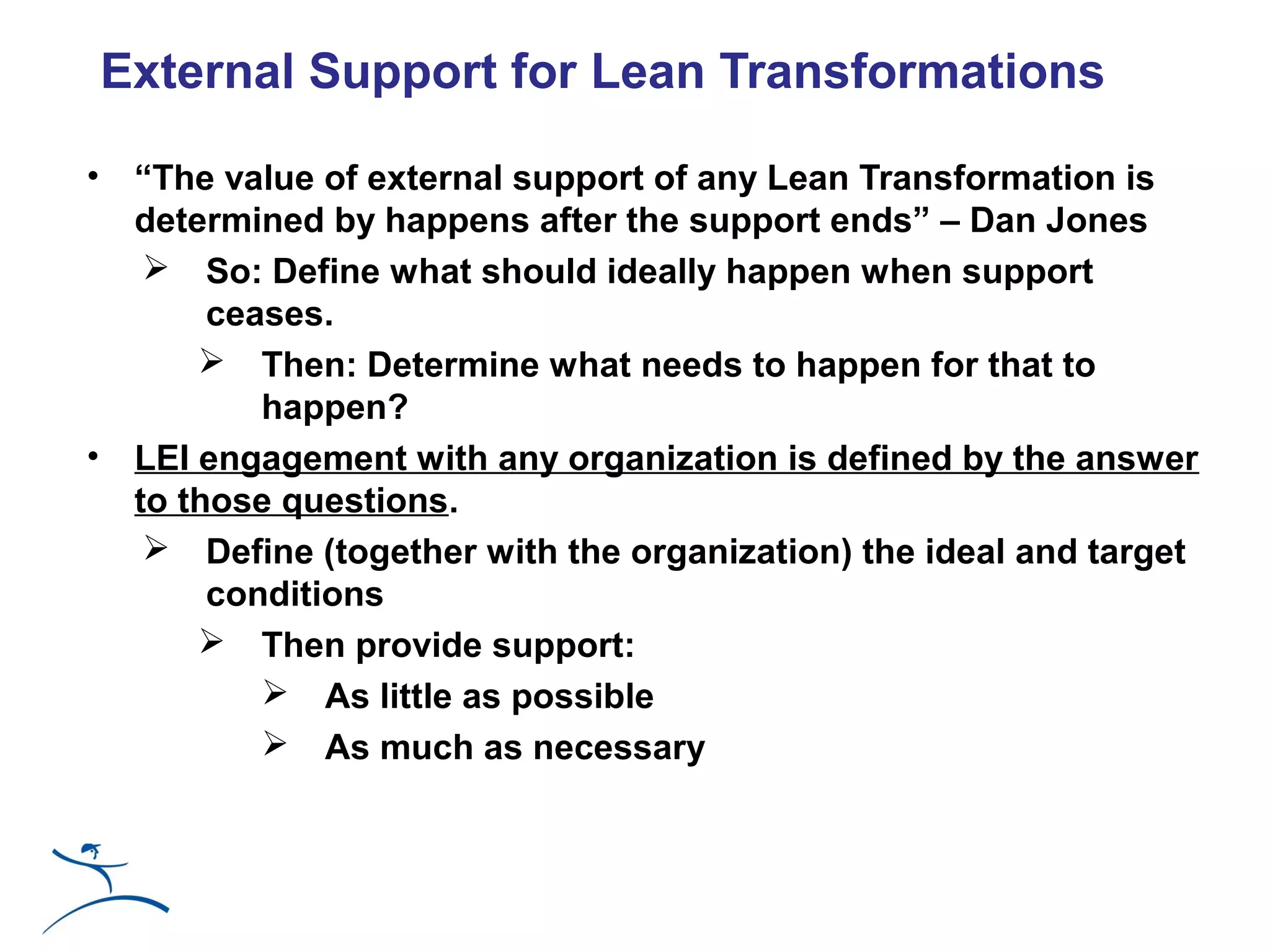
External Support for Lean Transformations

•    “The value of external support of any Lean Transformation is
     determined by happens after the support ends” – Dan Jones
       So: Define what should ideally happen when support
          ceases.
          Then: Determine what needs to happen for that to
             happen?
•    LEI engagement with any organization is defined by the answer
     to those questions.
       Define (together with the organization) the ideal and target
          conditions
          Then provide support:
              As little as possible
              As much as necessary
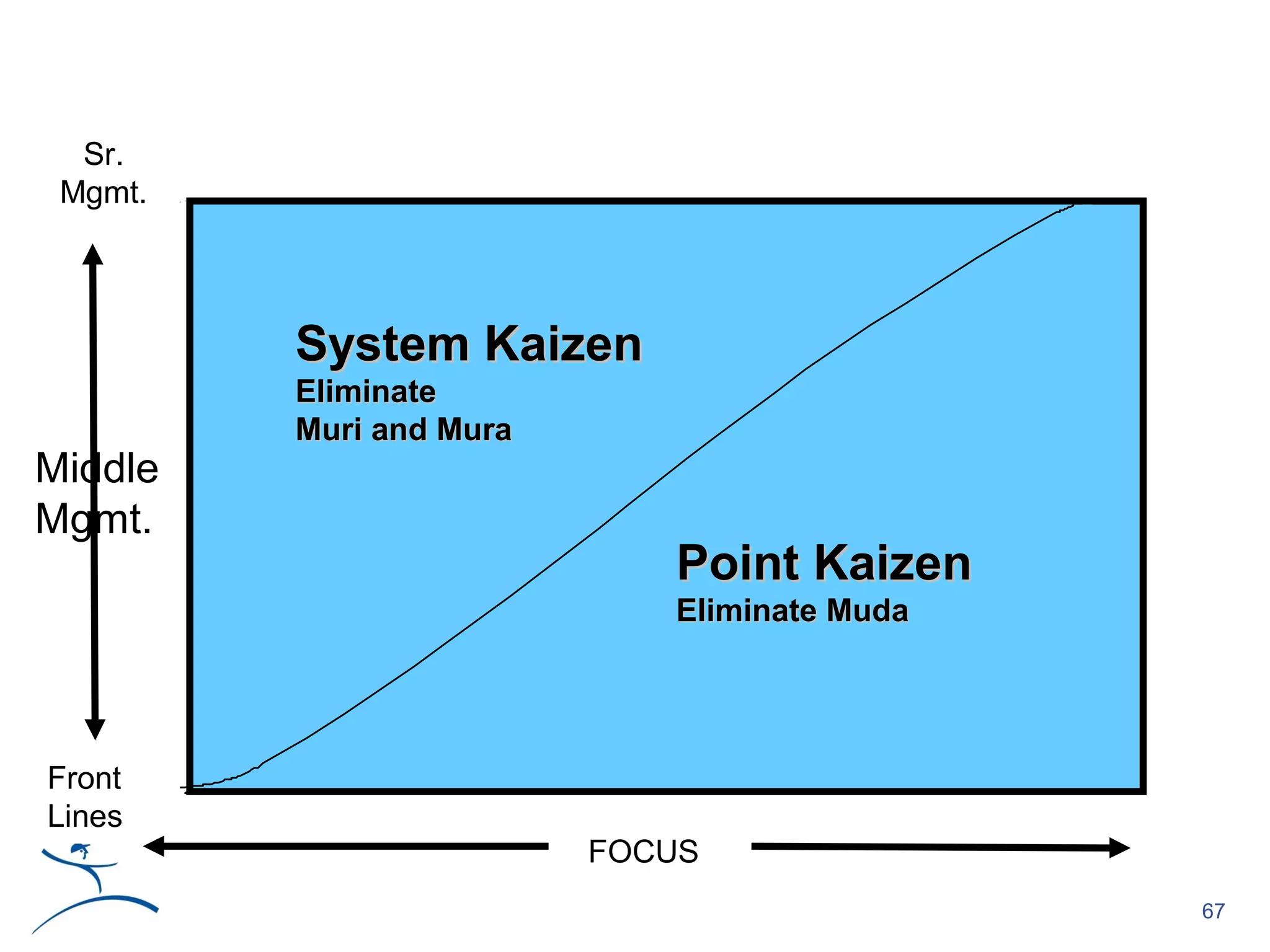
Sr.
 Mgmt.


         System Kaizen
         Eliminate
         Muri and Mura
Middle
Mgmt.
                            Point Kaizen
                            Eliminate Muda


Front
Lines
                         FOCUS
                                             67
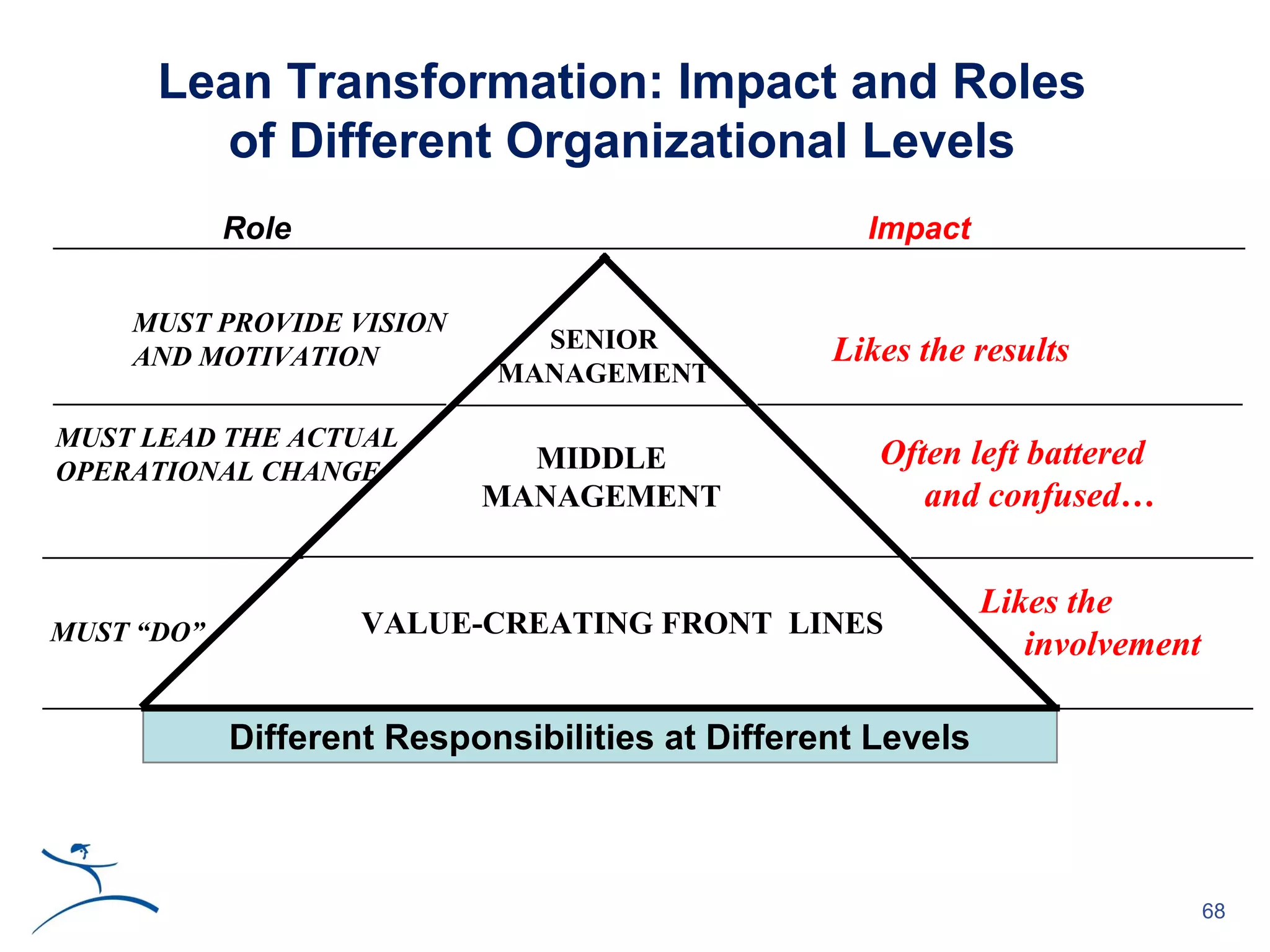
Lean Transformation: Impact and Roles
        of Different Organizational Levels
            Role                                   Impact

    MUST PROVIDE VISION
                              SENIOR             Likes the results
    AND MOTIVATION
                            MANAGEMENT

MUST LEAD THE ACTUAL
OPERATIONAL CHANGE           MIDDLE                 Often left battered
                           MANAGEMENT                  and confused…


                                                             Likes the
MUST “DO”           VALUE-CREATING FRONT LINES
                                                                involvement

            Different Responsibilities at Different Levels


                                                                              68
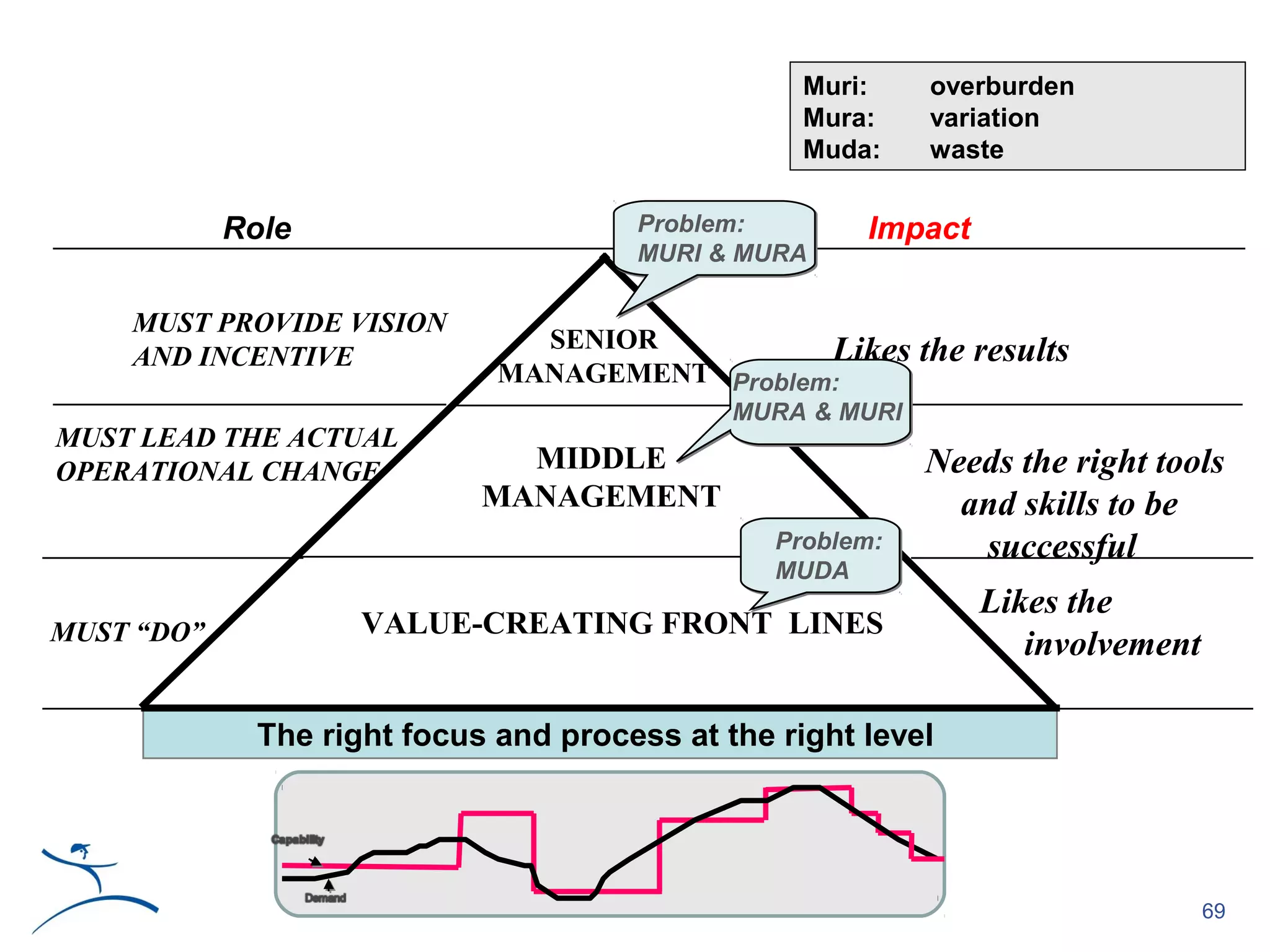
Muri:    overburden
                                                   Mura:    variation
                                                   Muda:    waste


            Role                       Problem:        Impact
                                       MURI & MURA

    MUST PROVIDE VISION
                                SENIOR          Likes       the results
    AND INCENTIVE
                              MANAGEMENT Problem:
                                              MURA & MURI
MUST LEAD THE ACTUAL
OPERATIONAL CHANGE             MIDDLE                       Needs the right tools
                             MANAGEMENT                       and skills to be
                                                 Problem:      successful
                                                 MUDA
                                                                Likes the
MUST “DO”            VALUE-CREATING FRONT LINES
                                                                   involvement

              The right focus and process at the right level


                                                                                 69
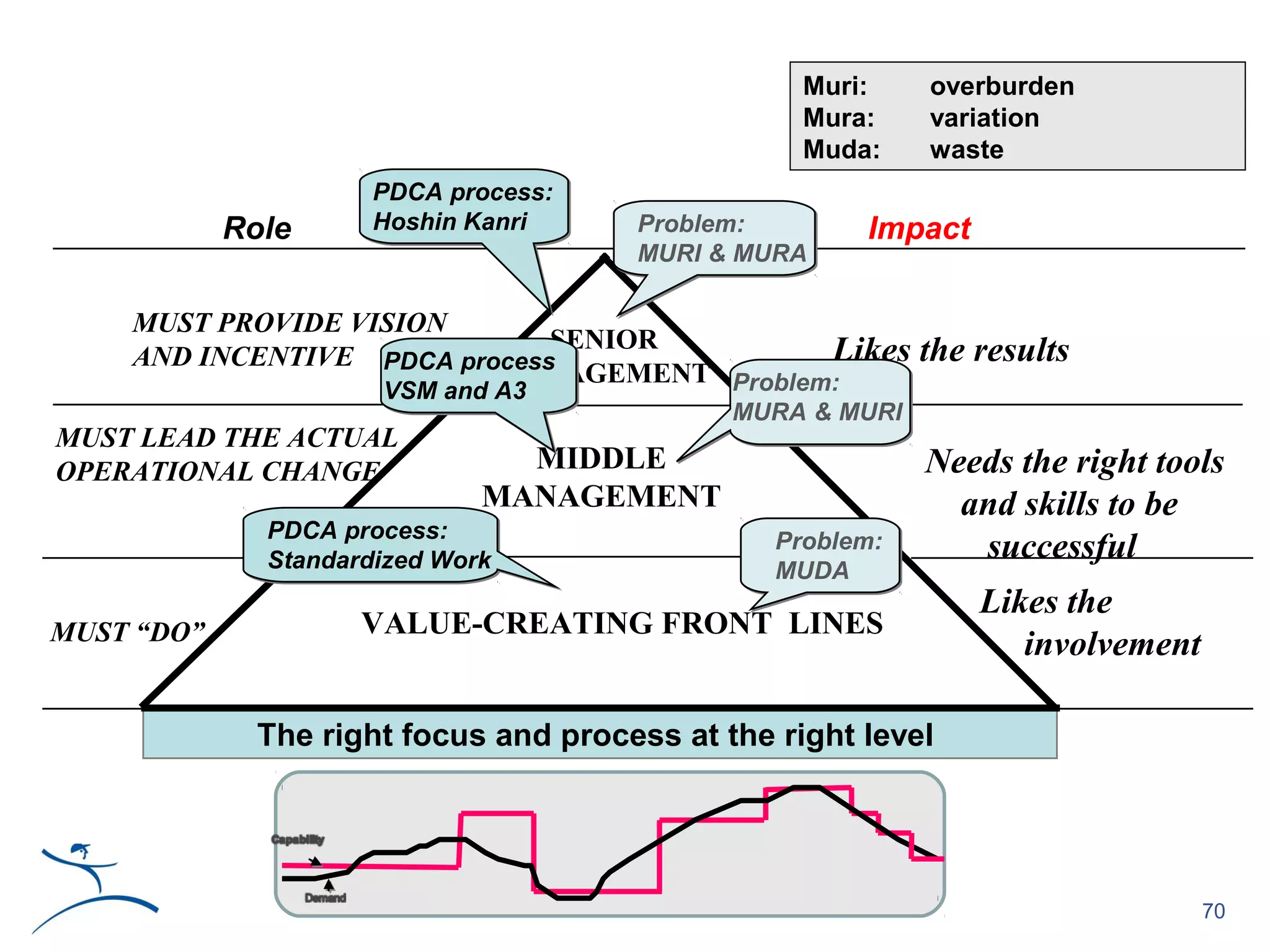
Muri:    overburden
                                                   Mura:    variation
                                                   Muda:    waste
                      PDCA process:
            Role      Hoshin Kanri     Problem:        Impact
                                       MURI & MURA

    MUST PROVIDE VISION
                              SENIOR         Likes          the results
    AND INCENTIVE PDCA process
                           MANAGEMENT Problem:
                   VSM and A3
                                              MURA & MURI
MUST LEAD THE ACTUAL
OPERATIONAL CHANGE              MIDDLE                      Needs the right tools
                              MANAGEMENT                      and skills to be
              PDCA process:
              Standardized Work
                                                 Problem:      successful
                                                 MUDA
                                                                Likes the
MUST “DO”            VALUE-CREATING FRONT LINES
                                                                   involvement

              The right focus and process at the right level


                                                                                 70
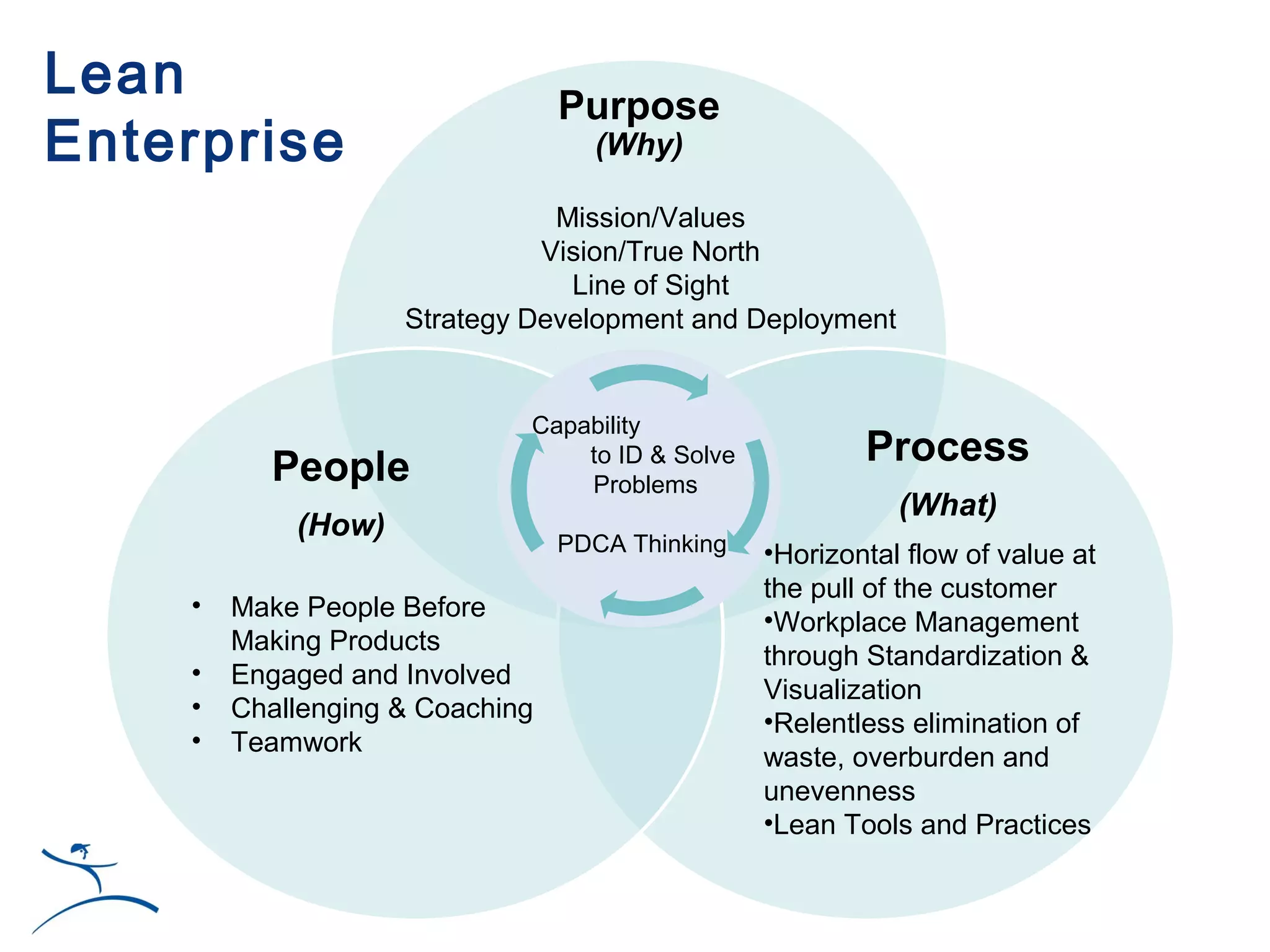
Lean                             Purpose
Enterprise                         (Why)

                               Mission/Values
                              Vision/True North
                                Line of Sight
                    Strategy Development and Deployment


                             Capability
          People                 to ID & Solve           Process
                                 Problems
                                                            (What)
            (How)
                                 PDCA Thinking   •Horizontal flow of value at
                                                 the pull of the customer
    •   Make People Before                       •Workplace Management
        Making Products
                                                 through Standardization &
    •   Engaged and Involved
                                                 Visualization
    •   Challenging & Coaching                   •Relentless elimination of
    •   Teamwork
                                                 waste, overburden and
                                                 unevenness
                                                 •Lean Tools and Practices
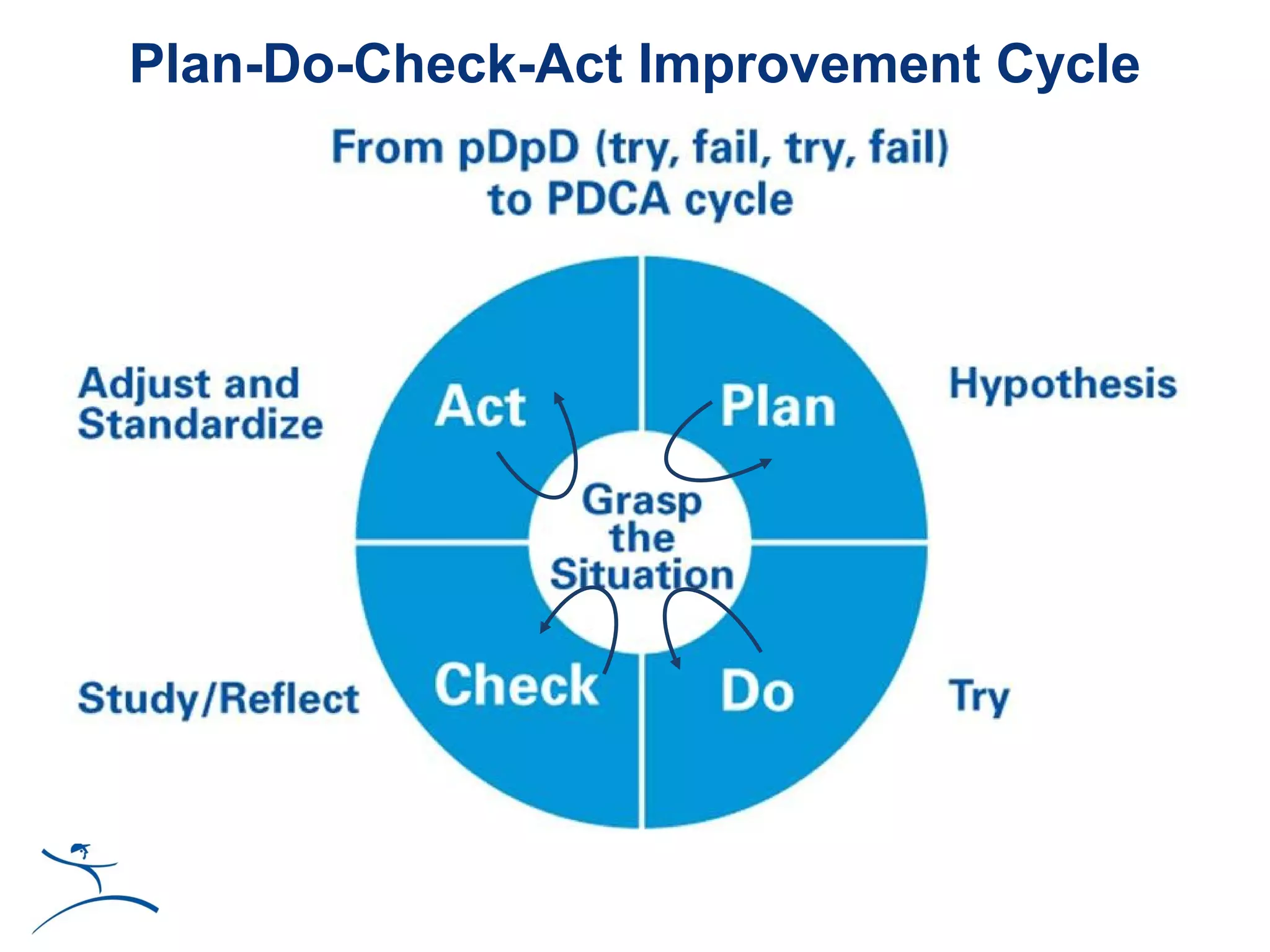
Plan-Do-Check-Act Improvement Cycle
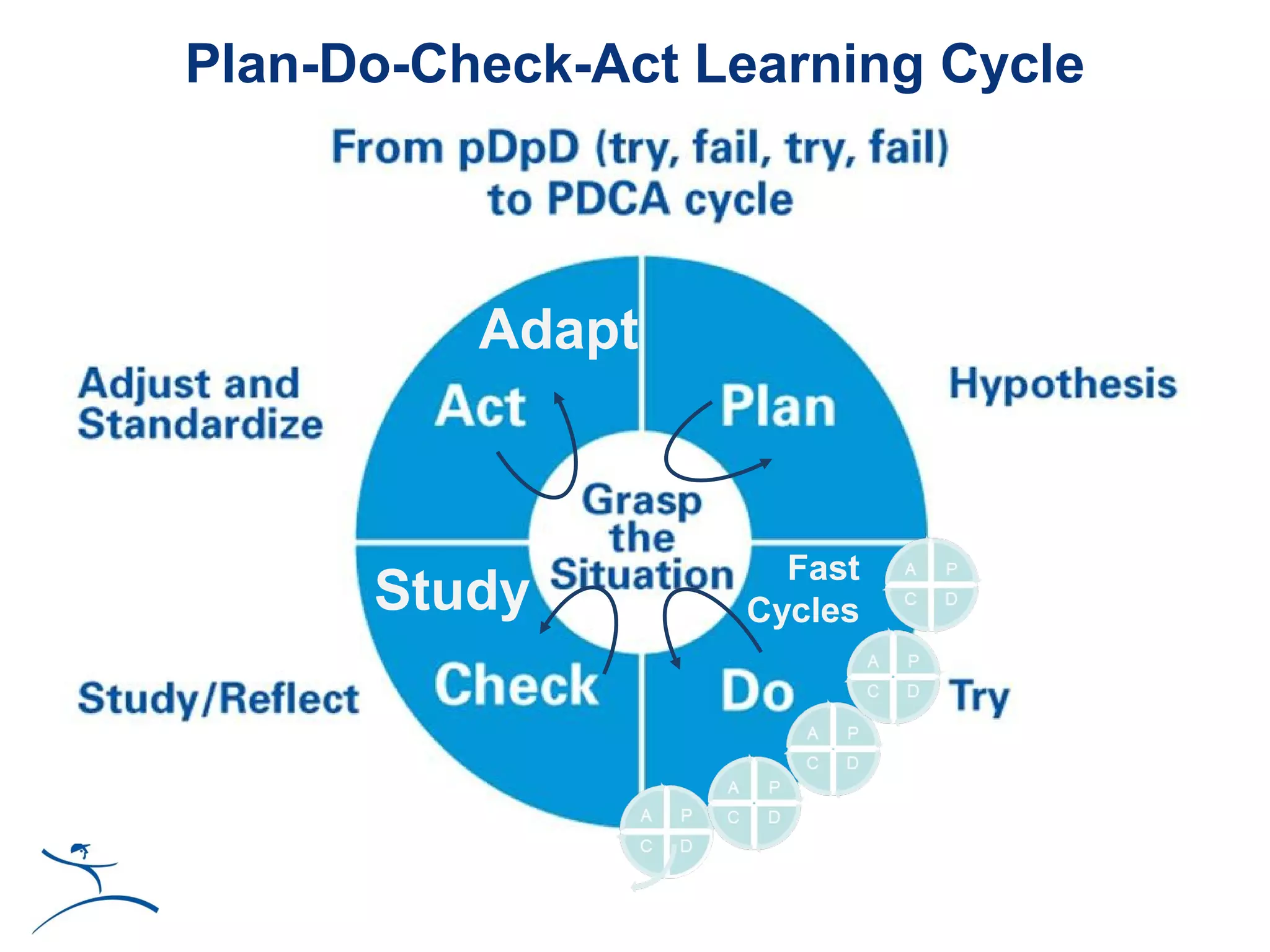
Plan-Do-Check-Act Learning Cycle


          Adapt


                     Fast
      Study        Cycles
LEI has sponsored the founding of three
 organizations to promote lean thinking
    through a collaborative process

•Lean Global Network to advance the application
of lean thinking in every endeavor, everywhere
•Lean Education Academic Network - LEAN - to
advance lean thinking in education
•Healthcare Value Network to advance lean
thinking in healthcare
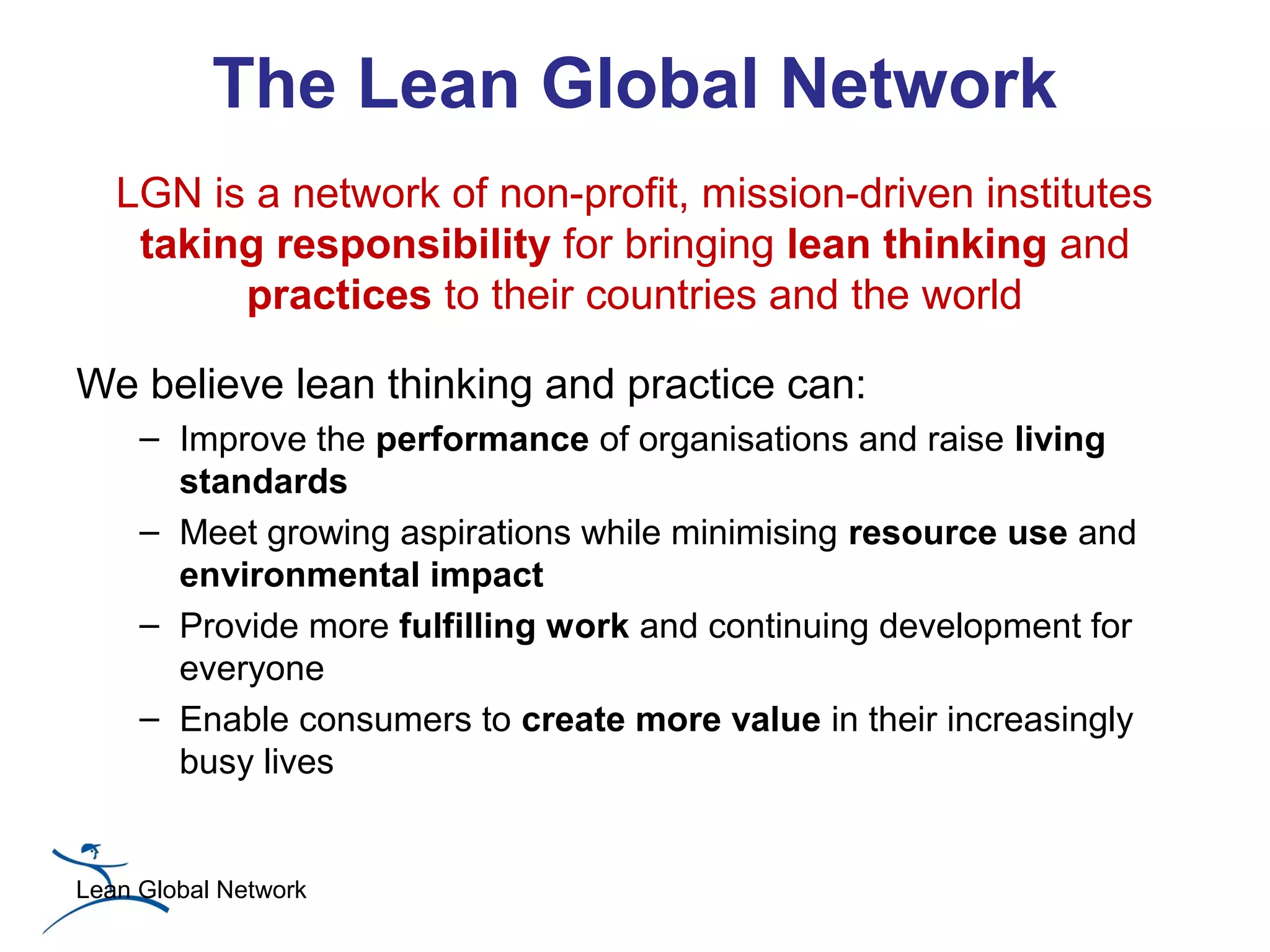
The Lean Global Network
   LGN is a network of non-profit, mission-driven institutes
    taking responsibility for bringing lean thinking and
         practices to their countries and the world

We believe lean thinking and practice can:
     – Improve the performance of organisations and raise living
       standards
     – Meet growing aspirations while minimising resource use and
       environmental impact
     – Provide more fulfilling work and continuing development for
       everyone
     – Enable consumers to create more value in their increasingly
       busy lives


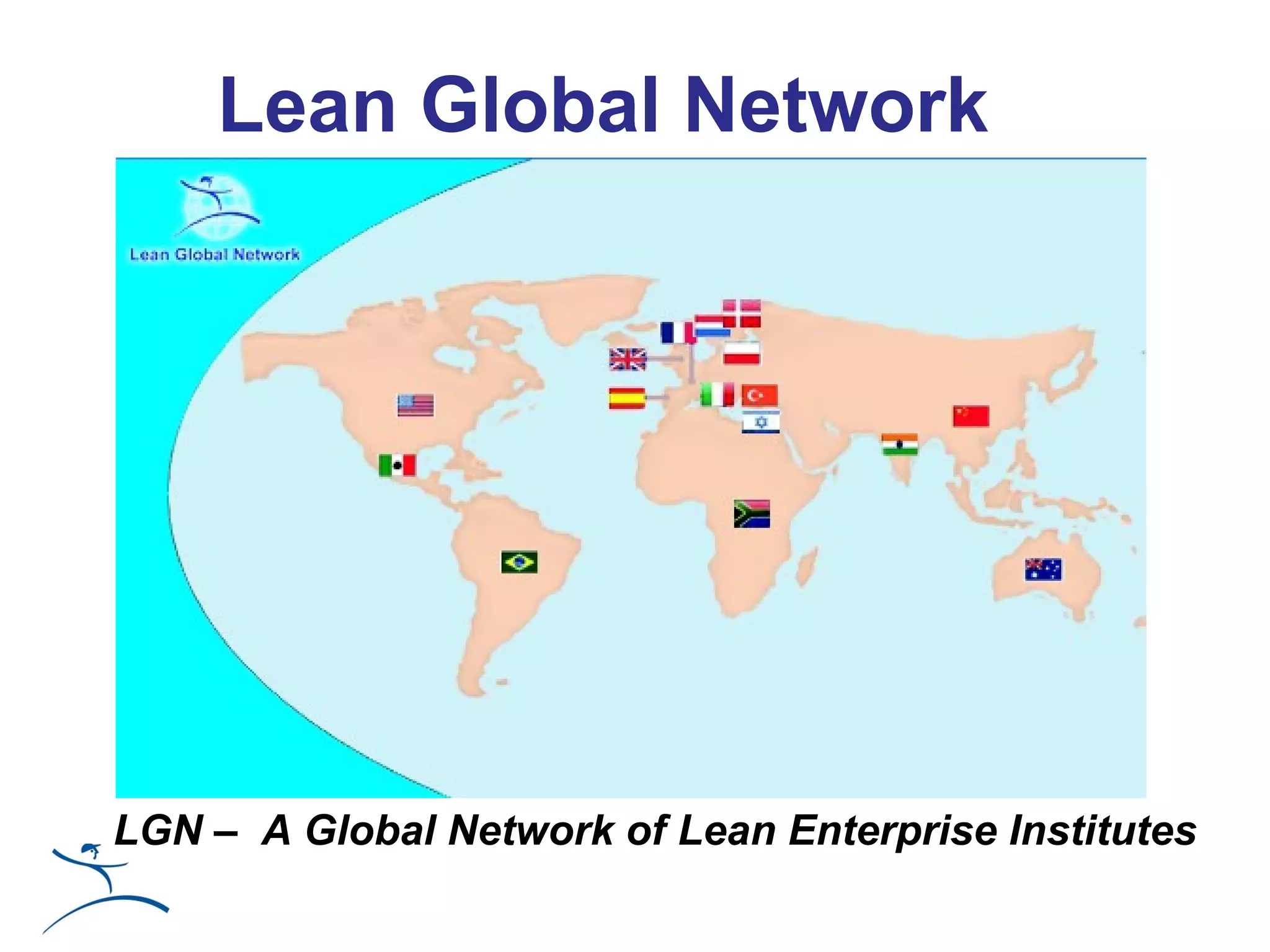
Lean Global Network
Lean Global Network


LGN – A Global Network of Lean Enterprise Institutes
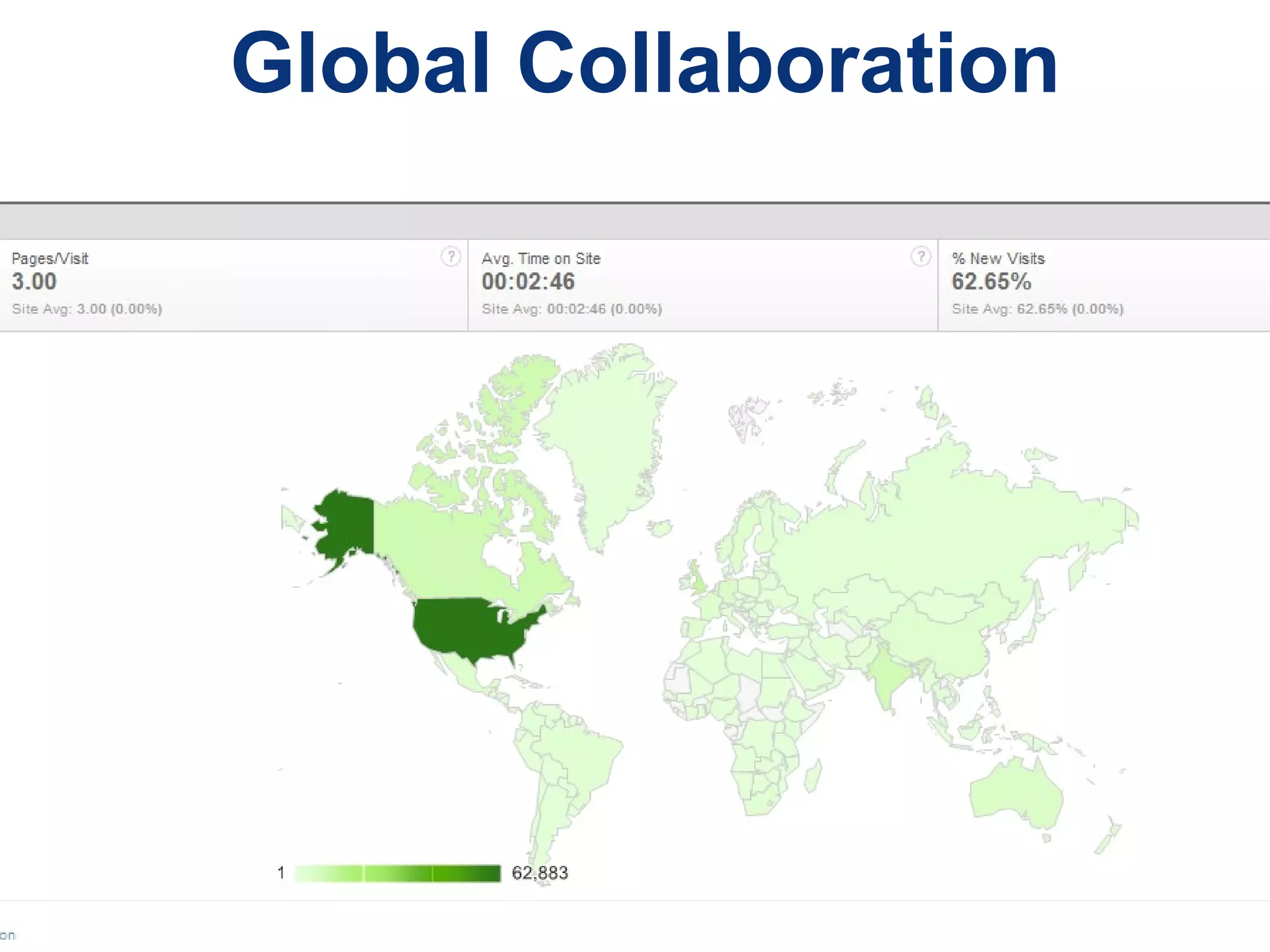
Global Collaboration
John Shook
• Currently leader of the Lean Enterprise Institute
• Eleven years with Toyota in Japan and the USA
  • Production and management system transfer
  • Engineering and PD system transfer
  • Toyota Production System dissemination
• U of Michigan – seven years Director of “Japan
  Technology Management Program”; created
  and taught Industrial Engineering “lean” course
• Consultant for 15 years

Lean Learning: Iowa Lean Consortium Presentation

  • 1.
    Learning Lean Collaboratively John Shook Lean Enterprise Institute October 1, 2012
  • 2.
    First, What isLean Thinking & Practice? Systemically develop people and continuously improve processes to provide value and prosperity while consuming the fewest possible resources
  • 3.
    Second, Why LearnLean Collaboratively? • Lean = learning • Successful change requires dispersing learning through an organization quickly and effectively • Learning collaboratively is a way to scale learning – in an organization and beyond • So, let’s borrow the learning curve of Lean thinkers who are succeeding through collaborative learning groups
  • 4.
    Third, What is Collaborative Learning? Two or more individuals – learning partners – intent on learning something together
  • 5.
    Collaboration is morethan sharing physical space
  • 6.
    Learning Collaboratively ismore than learning while occupying shared space
  • 7.
    Learning collaboratively meansmore than learning while occupying shared space
  • 8.
    Learning collaboratively meansmore than learning while occupying shared space
  • 9.
    Fourth, What is Collaborative Lean Learning Learning partners actively endeavor to learn together through shared experience... P-D-S-A t LEARNING CYCLES
  • 10.
    Collaborative Lean Learning Knowledgeis not only shared but created within a group where members actively endeavor to learn lean together through shared experience. t
  • 11.
    Collaborative Lean Learning Individualsworking together… – capitalizing on one another’s knowledge and skill, • both technically and socially, •recognizing that learning is not just an individual but also a social act, • to solve a problem, complete a task, or create a product, or answer a question.
  • 12.
    Elements of successful Collaborative Lean Learning • All learner partners actively participate • Mutual Respect: Openness in sharing experience, knowledge, challenges, struggles; • Teachers are learners; learners are teachers • Problems to be addressed are important and challenging to all partners: “What problem are we trying to solve?”
  • 13.
    Back to LeanThinking and Practice: Every Organization Must Address… • Purpose – Provide value to customers (cost-effectively to thrive). • Process – Through value streams that are designed, operated, and improved. • People – By engaging and respecting employees and other stakeholders.  Aligning purpose, process, and people is the central task of management. 13
  • 14.
    Lean Transformation Social and Technical 14
  • 15.
    Lean Transformations: Peopleand Process Social
  • 16.
    Lean Transformations: Peopleand Process Technical
  • 17.
    People & Process– aligned by management to achieve purpose 17
  • 18.
    Lean Transformation Change Culture Change System First First Where Do You Start – Either? Both at once?
  • 19.
    The Challenge ofAny Organization MUDA (Excess) Capability Demand MURI (Overburden) MURA (Instability) •Know your demand •Know your true capability (capacity) Management •Create flexibility to get them to match TIME 19
  • 20.
    Total System Efficiency and Effectiveness 20
  • 21.
    Lean Thinking &Practice: Problems, Challenges, Opportunities In the face of a reality Challenge to make that’s like this: steady progress: MUDA (Excess) Demand MURI (Overburden) 21
  • 22.
    Lean Transformation It’s easier to act your way to a new way of thinking than to think your way to a new way of acting.
  • 23.
    Lean Leaders Develop peopleTHROUGH getting the work done… 23
  • 24.
    People & Process:People learning process – process developing people Typical thinking observes that people develop processes. True Also true is that processes develop people. People enter situations (a company) and learn the processes. Before they develop processes, they learn processes. That learning process develops them. People are a product of the processes that they work. Those processes, in turn, have people dimensions that entail individual and collaborative learning.
  • 25.
    Lean Capability Development “It’seasier to act your way to a new way of thinking than to think your way to a new way of acting.” Therefore: Build processes that develop people as they do their work. Manage and lead accordingly.
  • 26.
    Lean Enterprise – theultimate “social-technical system” • The process of doing the work is integrated with the process of improving the work • And… 26
  • 27.
    Lean Enterprise – theultimate “social-technical system” • The process of doing the work is integrated with the process of improving the work, and • The operating processes ARE people development processes! 27
  • 28.
    Achieving Purpose, SolvingProblems and Developing Capability -- Collaboratively CURRENT STANDARD CONDITION Andon A3 Lean managers establish systems to engage everyone to work together in identifying, signaling, and responding to problems.
  • 29.
    Achieving Purpose, SolvingProblems and Developing Capability -- Collaboratively
  • 30.
    “Stop the Line” •Designa repeatable routine – provide training –Make success understandable and do-able •Make it easy to see problems –Anything that interrupts the routine •Make it clear what to do for problems –Contain and notify (“neither accept nor pass on…”) •Make it clear what will happen after notification –Help will come within the cycle of work •Ensure problem-solving and learning –Through structured routines for problem-solving and rapid cycles of learning
  • 31.
  • 32.
    “Do not interrupt whileI am running this play.” •This enables me to perform with less chance of error, •We can identify normal from abnormal and solve problems, •We can learn – together – intentionally. 32 john shook
  • 33.
    Capability Development ThroughCollaborative Problem Solving No Problem is a Problem! NEXT LEARN TO SEE TARGETED CONDITION GtS GtS TARGETED GtS CONDITION Tools m ble Tools /Pro nity Gap ortu Tools p CURRENT CONDITION /Op
  • 34.
    Collaborative Learning …members activelyendeavor to learn together through shared experience. P-D-S-A TRY – FAIL – LEARN DO – LEARN – IMPROVE t A3 KATA LAMDA OODA LEARNING CYCLES: SPIN THEM FAST SPIN THEM WILLFULLY
  • 35.
    When (and why)not to pursue Collaborative Learning or… What pitfalls to avoid when you do. After all, every yin has its yang.
  • 36.
    Collaborative Learner Beware… •Groupthink – Everyone follows an attractive thread – Design by committee • For example “limiting statements” (S Bahri) – “Democracy” to the point of lack of leadership
  • 37.
    Collaborative Learner Beware… •Groupthink – Everyone follows an attractive thread – Design by committee – “Democracy” to the point of lack of leadership • Brainstorming as a group becomes too easy; no individual steps up to: – take ownership – go through the intense pain of truly thinking something through deeply
  • 38.
    Collaborative Learner Beware… • Groupthink – Everyone follows an attractive thread – Design by committee – “Democracy” to the point of lack of leadership • Brainstorming as a group becomes too easy; no individual steps up to: – take ownership – go through the intense pain of truly thinking something through deeply • “Collaboration Fatigue” – Dr. Gigi Hirsch of MIT – Beware the trade-off between inclusiveness versus effectiveness and efficiency
  • 39.
    Collaborative Learning and Successful Lean Transformation • We are all teachers. We are all teaching all the time. • We can teach more effectively, or less effectively. Whether our teaching is more or less effective depends on two things: intention and skill. • Skill can be acquired, if we simply have the intention. • Thus, effective “teaching”, effective “learning”, effective “leadership” is, more than anything else, a matter of choice.
  • 40.
    How to transformto a lean operating and management system? Three things: 1.Intent: manifested in a willful decision 2.Process: a means by which the decision can be actualized 3.Practice, practice, practice… – Right practice – Perhaps with a coach!
  • 41.
    Practice, practice, practice… But, right practice, 41 john shook
  • 42.
    Practice, practice, practice… But, right practice, perhaps with a coach 42 john shook
  • 43.
  • 44.
  • 45.
    One-on-One Collaborative Learning Collaborative learning is effective when both mentor and mentee share nearly equal responsibility Manager interacts with Team Team Team Member takes Member with Respect: Manager Member responsibility for own Development: 1)Respects their intellect by 1)Team Member defines own providing challenging career objectives assignments 1)Team Member proactively 2) Engages with Team Members engages organization and to understand their struggles management with new ideas 2) Supports Team Members 2)Team Member takes own to over come those struggles initiative 3)Ongoing, sustained process 3)Ongoing, sustained process to develop capability to develop capability
  • 46.
    Collaborative Lean LearningExample: Toyota Supplier Learning Associations
  • 47.
    Collaborative Lean LearningExample: Toyota’s TSSC TSSC, the Toyota Production System Support Center, mission: Help North American companies to learn the Toyota Production System. •Over 20 years, TSSC has collaborated with more than 150 organizations to learn TPS. •Organizations demonstrate dramatic improvements in Productivity, Quality, and Lead Time. •Through collaboration and learning with organizations in many sectors, Toyota benefits by bringing this learning back into its own organization.
  • 48.
  • 49.
    PDCA Standardized Workfor Collaboration (from BAMA Example) Participant Participant Participant Focus: xx Target: xx Try Who is the coach? Learn Who is the architect? What is the process (the Standard Work)? Host Each participant Collaborative activity takes home at one location
  • 50.
    Intent is tosupport deep thinking Self-Learning  Individual, intentional PDCA Learning Cycles  Supported by skillful coaching What is my target condition? How do I improve this situation? Try P A D Struggle to do C -Why?! Reflect
  • 51.
    Group Learning, Individuallearning… • Early childhood education is largely collaborative as teachers take young students through group discovery learning activities. • By high school, the learning has become individual-based.  Everything I Know About Lean I learned in First Grade – by Robert Martichenko
  • 52.
    IBM Collaborates withState to Bring PDCA to Vermont 1-8 Schools
  • 53.
    What will youdo? Find someone to learn with: …NOW  Assignment
  • 54.
    What will youdo? Assignment – One Minute One thing you will do this week about the one thing you wish to change
  • 55.
    Follow the Learner:Dr. Sami Bahri “One idea, one person, every day” Dr. Sami Bahri “Learn at least one “green” thing every day” - Yellow is theory - Red is to avoid - Green is to do
  • 56.
    What will youdo? Assignment – One Minute One thing you will do this week about the one thing you wish to change One more minute: share that with the learning partner sitting beside you and discuss how your partner can help you with that problem
  • 57.
    The following slidescontain supplemental Information about the Lean Enterprise Institute and its mission, basic approach, and major activities.
  • 58.
    Lean Enterprise Institute •Founded in 1997 by Dr. James Womack, principle scientist of the MIT research that resulted in “The Machine That Changed the World” • Non-profit education and research institute • Based in Cambridge MA, with 17 global affiliates • Over 230,000 members from all industries • Mission: Advance Lean Thinking and Practice in all things, everywhere
  • 59.
    Lean Enterprise Institute Digital books, Industry courses, social Networking networking Publications www.lean.org Education: public and in- community with house workshops Coaching over 200,000 members
  • 60.
    Since its foundingin 1997, LEI has … •Changed the language of management •Registered over 230,000 Lean Thinking Practitioners and Leaders to its online Lean Community. •Sent over 100 e-letters to over 150,000 subscribers •Trained almost 20,000 people at public workshops •Moderated eight online Forums with nearly 17,000 subscribers. •Delivered onsite training to over 2,000 people at over 100 companies. •Partnered with companies committed to implementing and spreading the methodology for creating a lean enterprise through experiments and shared learning. •Collaborated with over 50 independent faculty members. •Developed over 40 workshops for executives, managers, and technical professionals at every experience level in manufacturing, service, healthcare, and administrative value streams. •Produced 20 webinars on a wide range of lean management topics. •Produced 20 publications and sold over 600,000 books, workbooks, and training aids. •Hosted eight major Summit conferences with more than 7,000 attendees. •Created a web site with thousands of pages of resources •Founded the Lean Educators Academic Network. •Founded the Healthcare Value Leaders Network, including the first Healthcare Transformation Summit. •Formed the Lean Global Network, a network of 17 not-for-profit institutes on six continents. And supported over 40 world-wide events since LGN was officially formed in 2007.
  • 61.
    Lean Production, LeanThinking, Lean Practice, Lean Learning
  • 62.
    Lean Enterprise Institute Individuals, Lean Thinking Individuals, Organizations Everywhere Organizations LEI Publish books, web, apps Management Systems Develop Education programs Share Operating Systems learning with community Lean Community Co-Learning Hands-on Collaboration LEI establishes a limited number of collaborative learning partnerships with organizations committed to lean transformation.
  • 63.
    Lean Transformation Model SITUATIONAL APPROACH - Value-Driven Purpose - “WHAT PROBLEM ARE WE TRYING TO SOLVE?” Clear Roles and PROCESS Responsibilities CAPABILITY IMPROVEMENT DEVELOPMENT Continuous, Sustainable real, practical improvement changes to capability improve the way in all people the work is done at all levels LEADERSHIP MANAGEMENT Lean Thinking and Practice
  • 64.
    LEI High-Level TransformationModel • Basic Approach in all cases: PDCA – The art and craft of science • Specific Approach in each case: Situational, determined by asking – “What problem are we trying to solve?” What business need? – “Where can we run initial trials?” - even when going big • TWO Pillars: Process Improvement and Capability Development – Process Improvement Change • Start with the work – find problems, gaps, obstacles – Individual level, system level – Capability Development • Problem-solving, improvement capability • At all levels • Ownership clarity: Clear Roles and Responsibilities – Internal: executive sponsor, improvement leader, team members – External: project coach, mentor, architect
  • 65.
    Transformation Model Questions 1.What problem are we trying to solve? What is the purpose of this transformation? – At both macro and micro levels 1. What specific process improvements are being implemented? How is the actual work being improved? 2. What capability enhancements are required and being achieved? 3. What role is leadership taking? Is ownership clear? 4. What basic philosophy or thinking underlies this transformation?
  • 66.
    External Support forLean Transformations • “The value of external support of any Lean Transformation is determined by happens after the support ends” – Dan Jones  So: Define what should ideally happen when support ceases.  Then: Determine what needs to happen for that to happen? • LEI engagement with any organization is defined by the answer to those questions.  Define (together with the organization) the ideal and target conditions  Then provide support:  As little as possible  As much as necessary
  • 67.
    Sr. Mgmt. System Kaizen Eliminate Muri and Mura Middle Mgmt. Point Kaizen Eliminate Muda Front Lines FOCUS 67
  • 68.
    Lean Transformation: Impactand Roles of Different Organizational Levels Role Impact MUST PROVIDE VISION SENIOR Likes the results AND MOTIVATION MANAGEMENT MUST LEAD THE ACTUAL OPERATIONAL CHANGE MIDDLE Often left battered MANAGEMENT and confused… Likes the MUST “DO” VALUE-CREATING FRONT LINES involvement Different Responsibilities at Different Levels 68
  • 69.
    Muri: overburden Mura: variation Muda: waste Role Problem: Impact MURI & MURA MUST PROVIDE VISION SENIOR Likes the results AND INCENTIVE MANAGEMENT Problem: MURA & MURI MUST LEAD THE ACTUAL OPERATIONAL CHANGE MIDDLE Needs the right tools MANAGEMENT and skills to be Problem: successful MUDA Likes the MUST “DO” VALUE-CREATING FRONT LINES involvement The right focus and process at the right level 69
  • 70.
    Muri: overburden Mura: variation Muda: waste PDCA process: Role Hoshin Kanri Problem: Impact MURI & MURA MUST PROVIDE VISION SENIOR Likes the results AND INCENTIVE PDCA process MANAGEMENT Problem: VSM and A3 MURA & MURI MUST LEAD THE ACTUAL OPERATIONAL CHANGE MIDDLE Needs the right tools MANAGEMENT and skills to be PDCA process: Standardized Work Problem: successful MUDA Likes the MUST “DO” VALUE-CREATING FRONT LINES involvement The right focus and process at the right level 70
  • 71.
    Lean Purpose Enterprise (Why) Mission/Values Vision/True North Line of Sight Strategy Development and Deployment Capability People to ID & Solve Process Problems (What) (How) PDCA Thinking •Horizontal flow of value at the pull of the customer • Make People Before •Workplace Management Making Products through Standardization & • Engaged and Involved Visualization • Challenging & Coaching •Relentless elimination of • Teamwork waste, overburden and unevenness •Lean Tools and Practices
  • 72.
  • 73.
    Plan-Do-Check-Act Learning Cycle Adapt Fast Study Cycles
  • 74.
    LEI has sponsoredthe founding of three organizations to promote lean thinking through a collaborative process •Lean Global Network to advance the application of lean thinking in every endeavor, everywhere •Lean Education Academic Network - LEAN - to advance lean thinking in education •Healthcare Value Network to advance lean thinking in healthcare
  • 75.
    The Lean GlobalNetwork LGN is a network of non-profit, mission-driven institutes taking responsibility for bringing lean thinking and practices to their countries and the world We believe lean thinking and practice can: – Improve the performance of organisations and raise living standards – Meet growing aspirations while minimising resource use and environmental impact – Provide more fulfilling work and continuing development for everyone – Enable consumers to create more value in their increasingly busy lives Lean Global Network
  • 76.
    Lean Global Network LGN– A Global Network of Lean Enterprise Institutes
  • 77.
  • 78.
    John Shook • Currentlyleader of the Lean Enterprise Institute • Eleven years with Toyota in Japan and the USA • Production and management system transfer • Engineering and PD system transfer • Toyota Production System dissemination • U of Michigan – seven years Director of “Japan Technology Management Program”; created and taught Industrial Engineering “lean” course • Consultant for 15 years