Copyright © Institut Lean France 2011


 Lean Software Management:
 BBC Worldwide Case Study
Peter Middleton, Queen’s University Belfast
   David Joyce, ThoughtWorks Australia
Lean Software Management:
 BBC Worldwide Case Study

Peter Middleton, Queen’s University Belfast
                    &
   David Joyce, ThoughtWorks Australia

           14 October 2011
       European Lean IT Summit
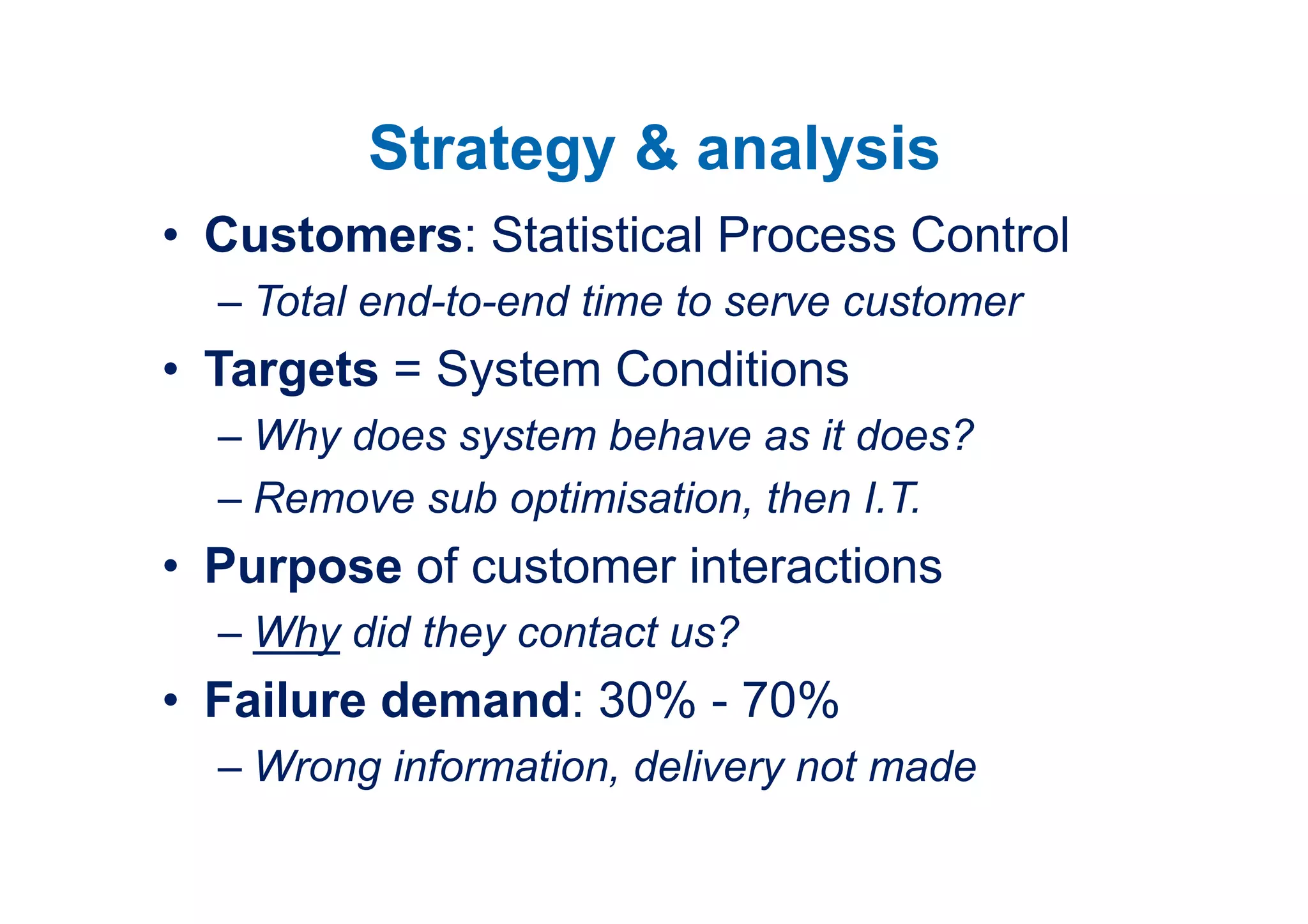
Strategy & analysis
• Customers: Statistical Process Control
  – Total end-to-end time to serve customer
• Targets = System Conditions
  – Why does system behave as it does?
  – Remove sub optimisation, then I.T.
• Purpose of customer interactions
  – Why did they contact us?
• Failure demand: 30% - 70%
  – Wrong information, delivery not made
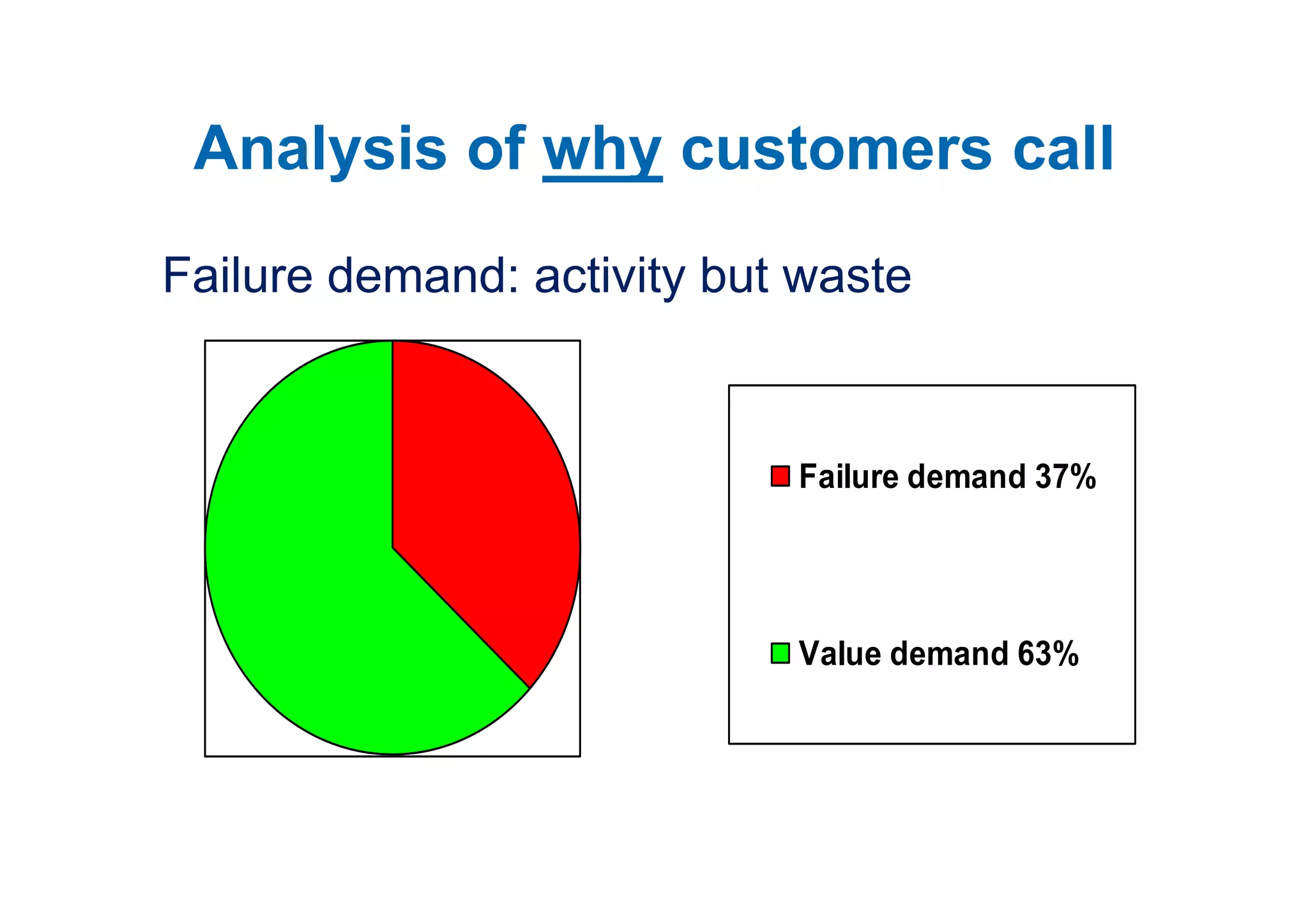
Analysis of why customers call
Failure demand: activity but waste


                            Failure demand 37%


                            Value demand 63%
Foundations
• PRINCE2 unrealistic : ‘Ensuring that the
  information required for the project team is available’


• Failure demand: 30% - 70% of all
  demand is caused by failures in the
  system itself

• Targets cause massive waste due to sub
  optimisation. Measures drive behaviour.
BBC Worldwide
      Digital Hub Software Team
•   Media Village, White City, West London
•   9 staff: Analyst, Architect, QA, Developers
•   Operating cost: £1.5m p.a.
•   C#, .NET, MS SQL Server
•   Created and maintained software
•   12 months data: Oct 2008 – Oct 2009
•   Reported to Business & Project Boards
•   Waterfall          Agile       Lean
Engineering Practices
•   Test Driven Development (unit tests)
•   Automated Acceptance Testing
•   Source Control Software
•   Bug tracking software
•   Decoupling – improve legacy code
•   Minimum Marketable Feature concept
•   Daily Stand Up (15 minutes)
Lean Software – key idea
• Reduce Work in Process:
  – Analysis
  – Specifications
  – Design
  – Untested code
• Benefits: (flow: concept to cash)
  – Visible management & less risk
  – Flexibility
  – Productivity
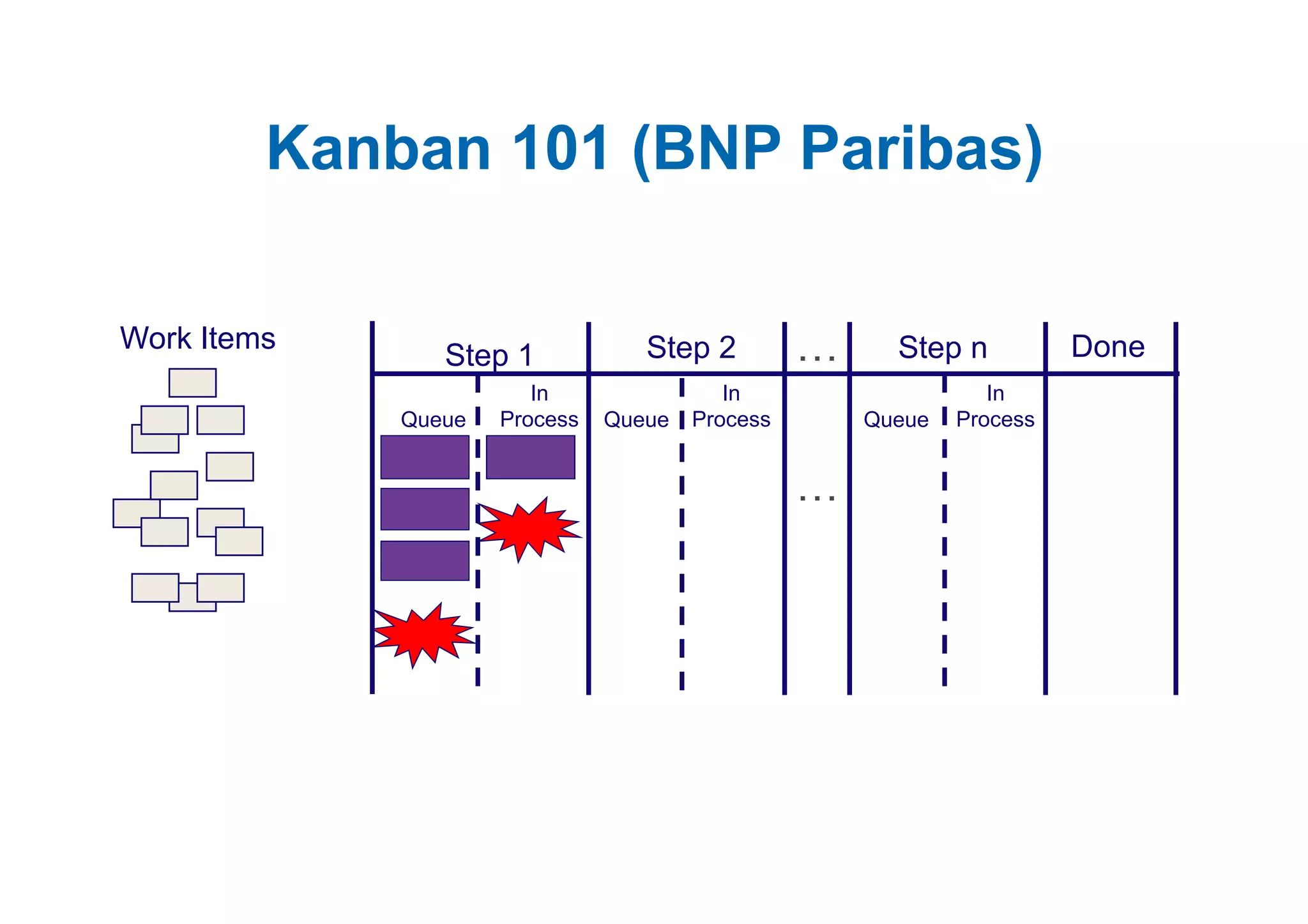
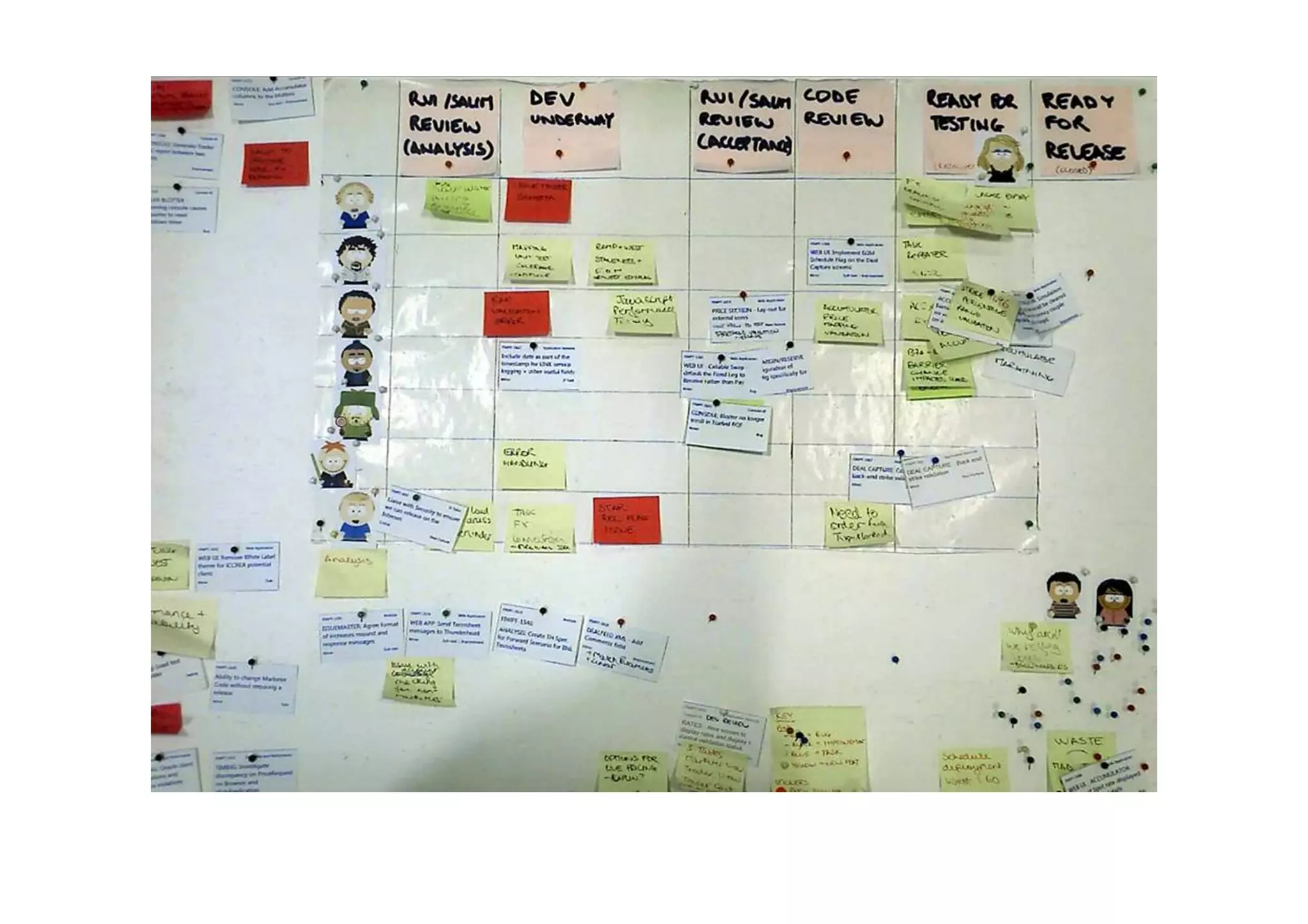
Kanban 101 (BNP Paribas)

Work Items                        Step 2         …     Step n          Done
                Step 1
                        In                In                    In
             Queue   Process   Queue   Process       Queue   Process


                                                 …
BBC
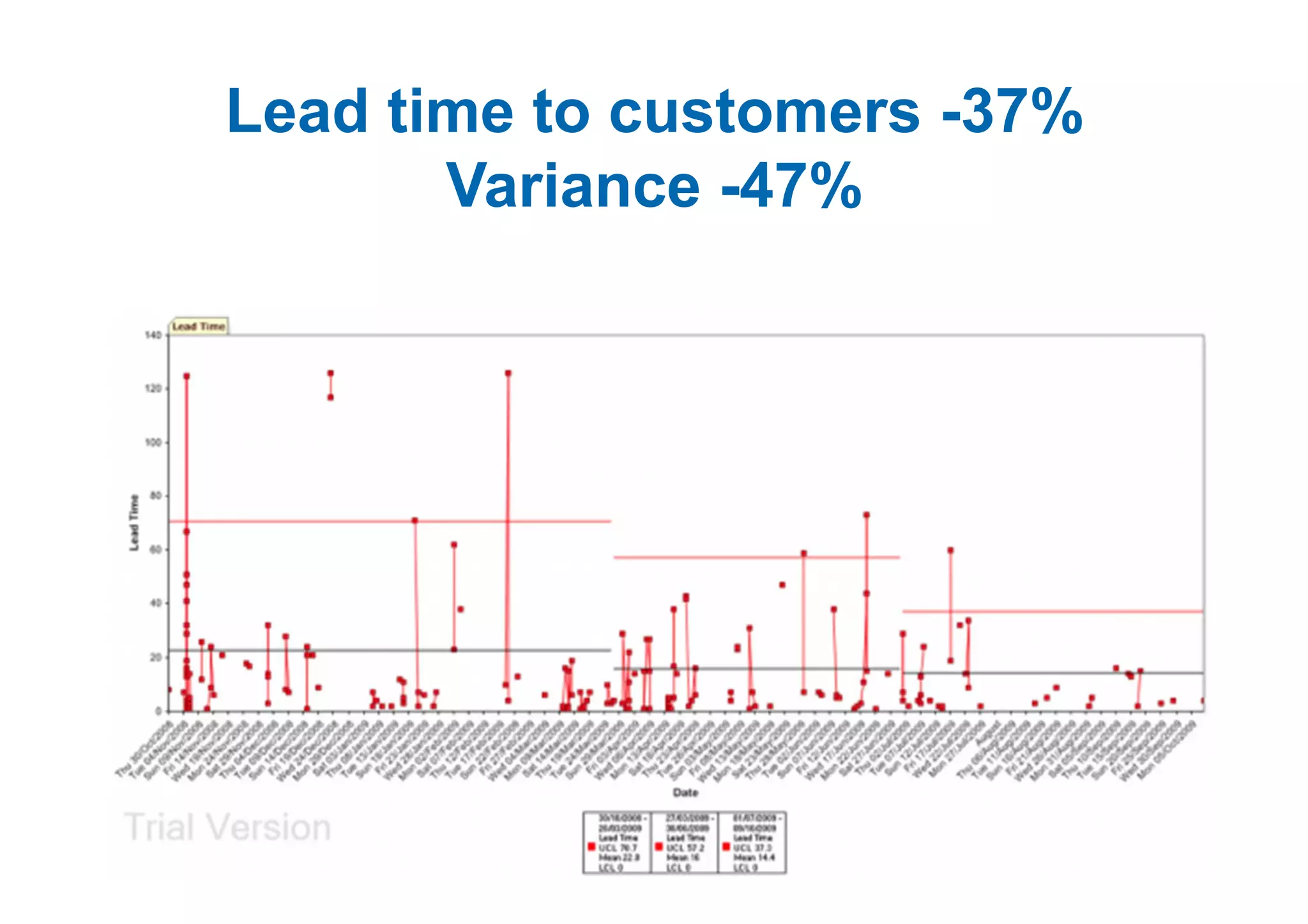
Lead time to customers -37%
       Variance -47%
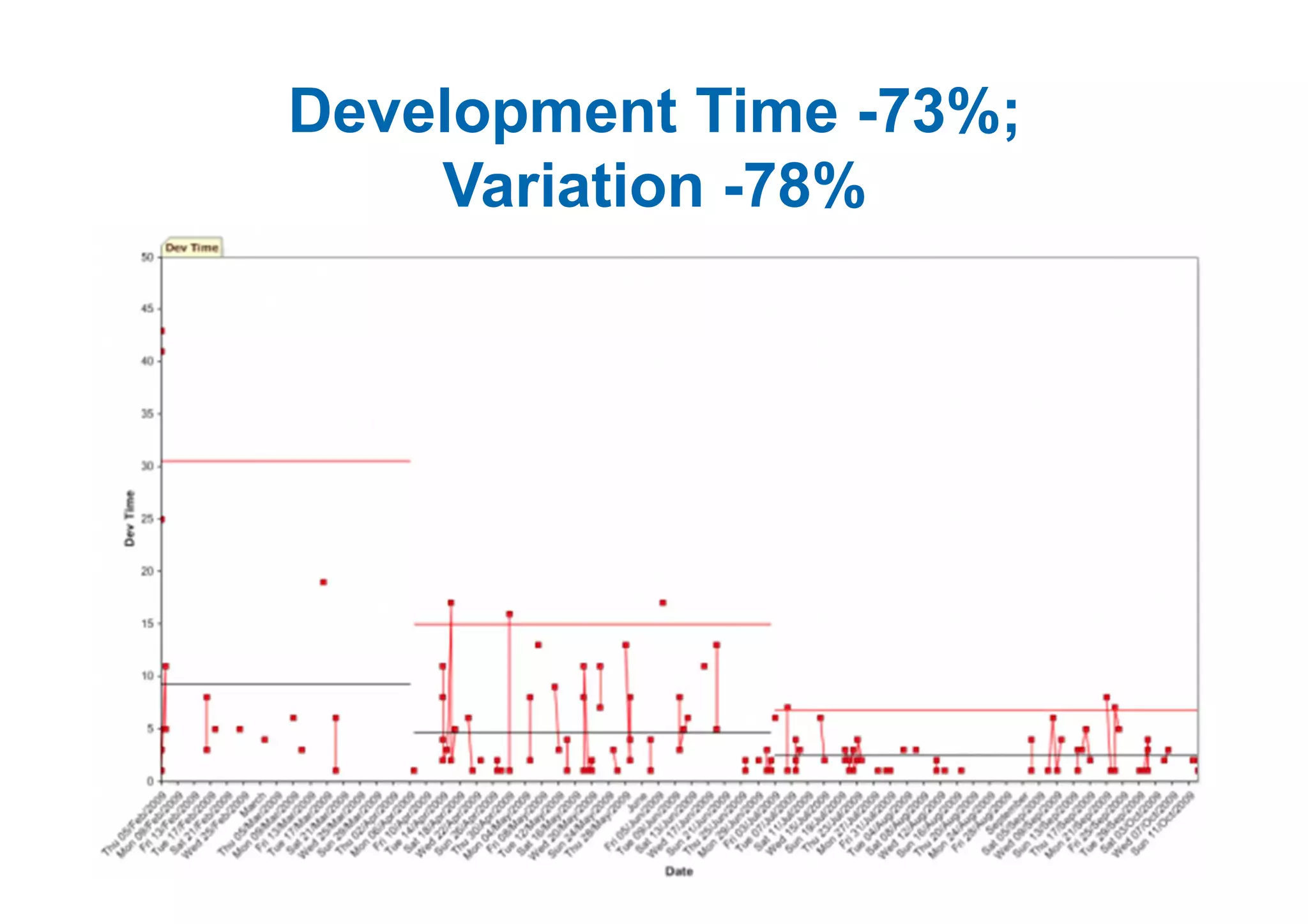
Development Time -73%;
    Variation -78%
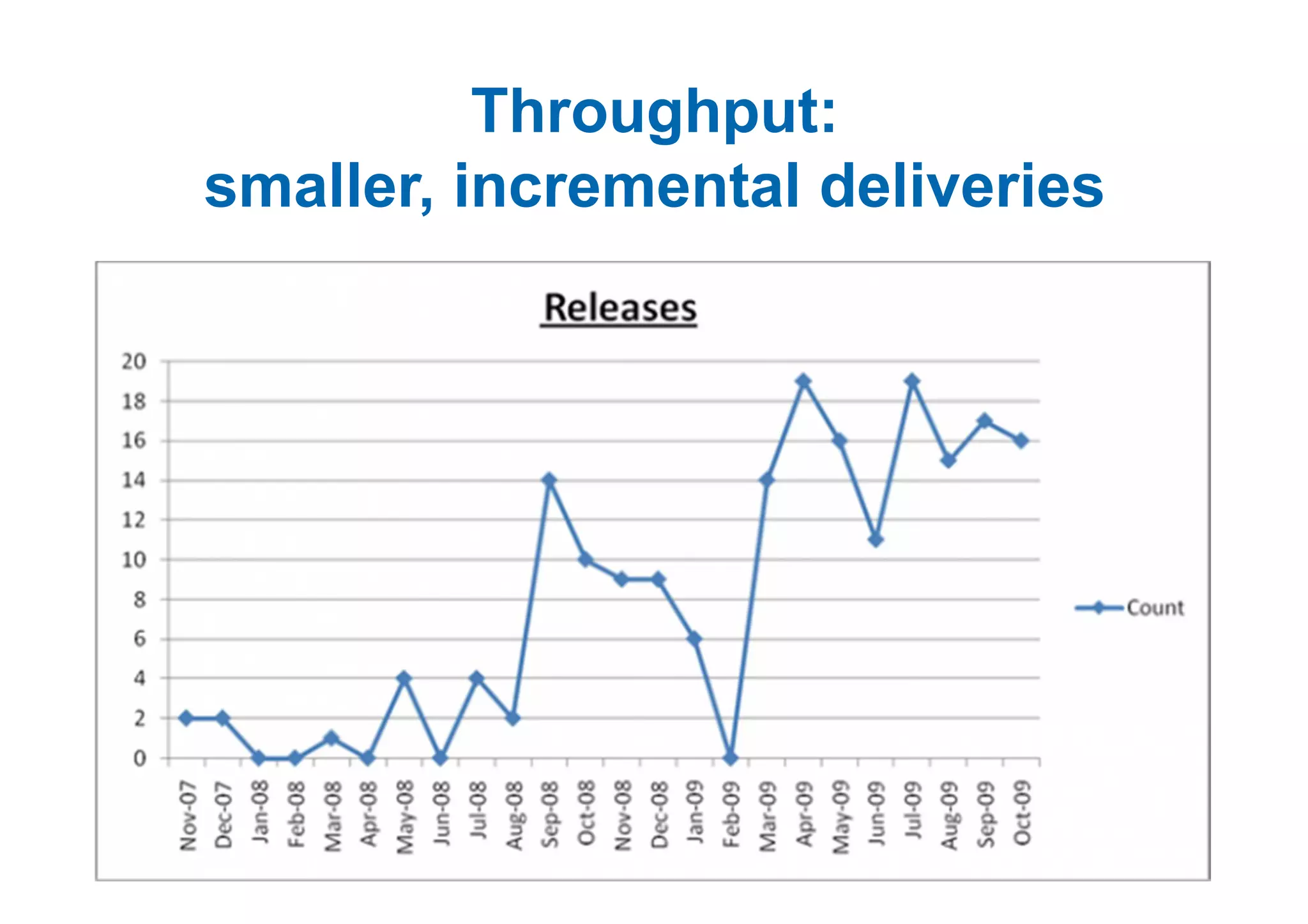
Throughput:
smaller, incremental deliveries
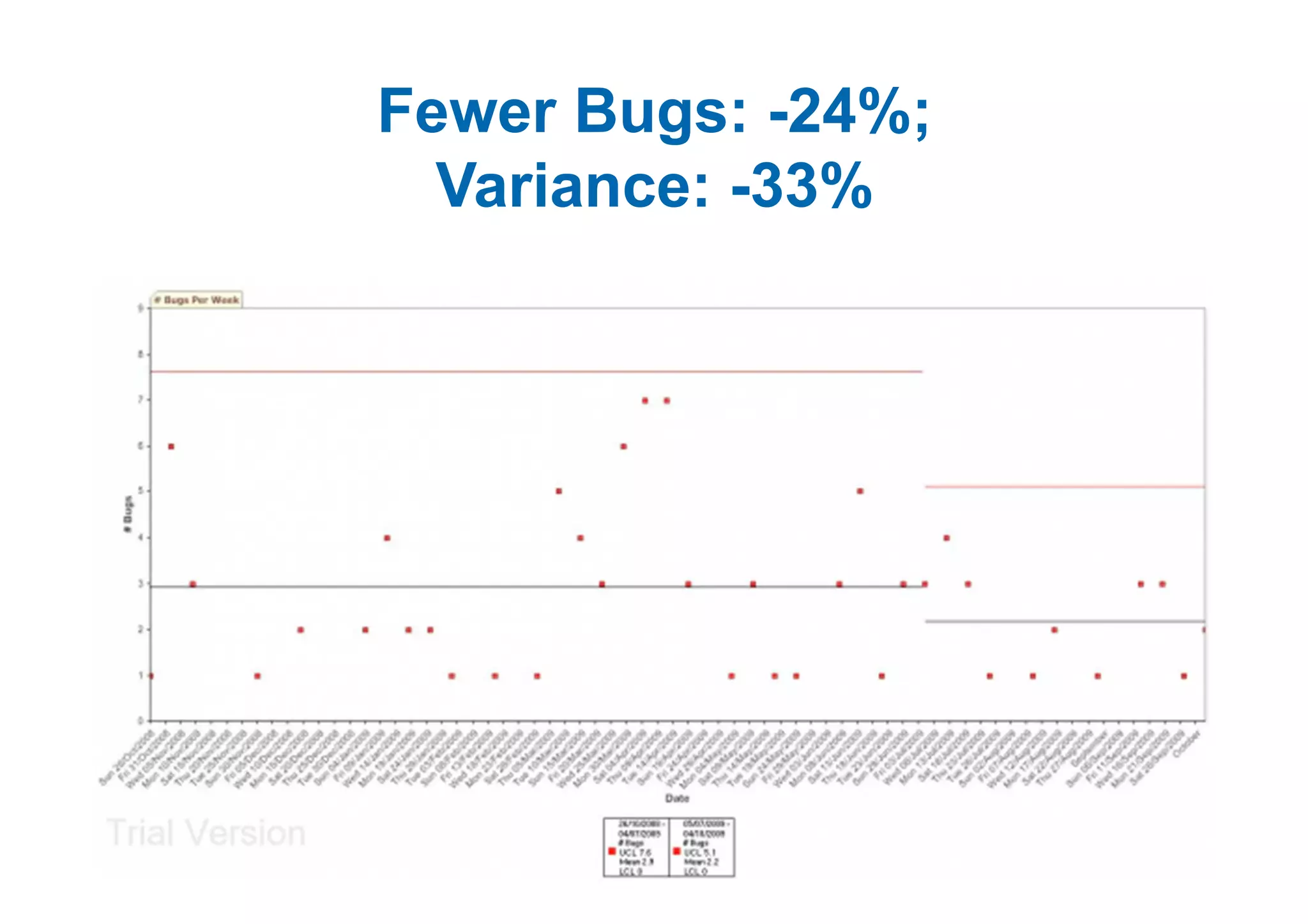
Fewer Bugs: -24%;
  Variance: -33%
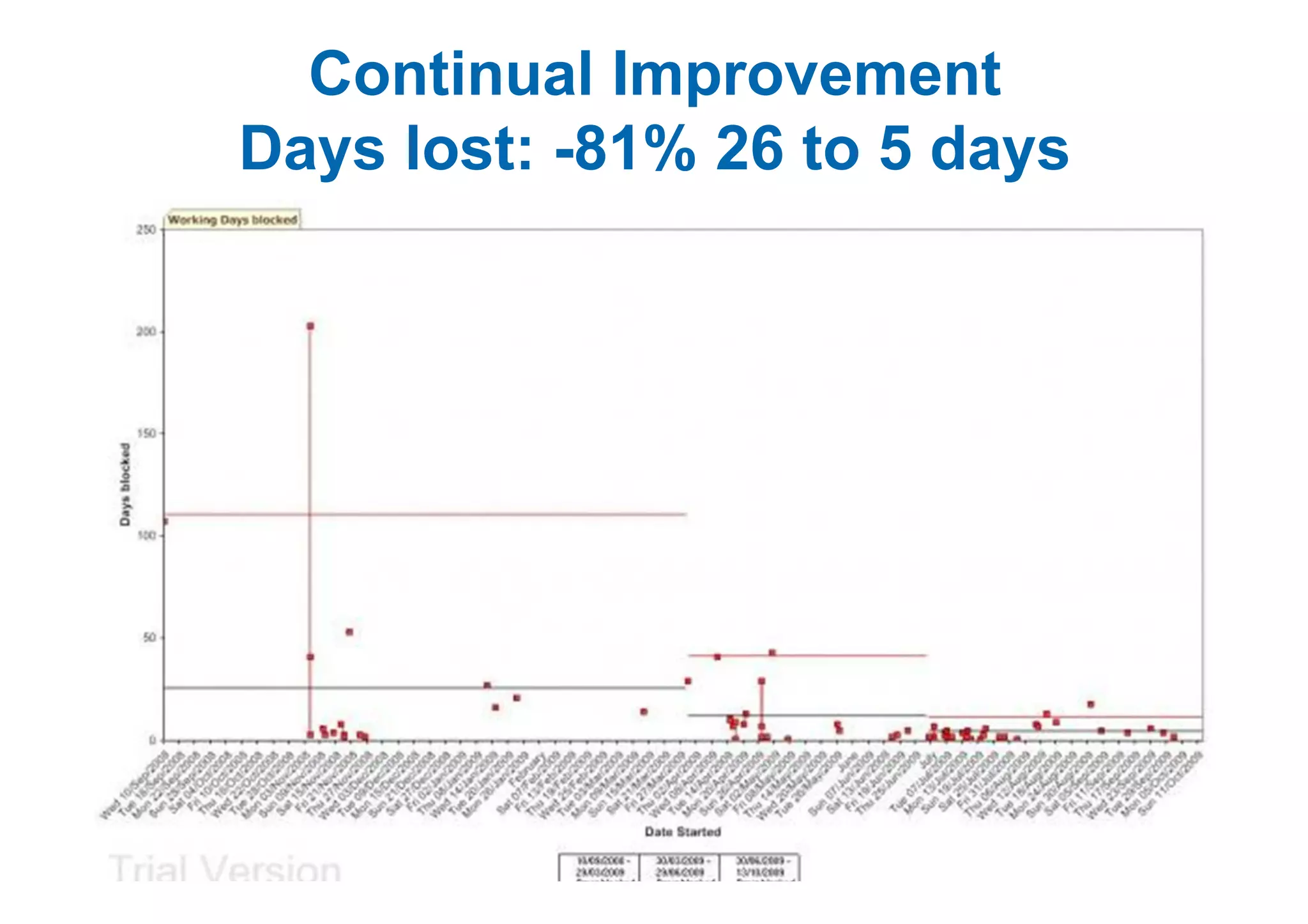
Continual Improvement
Days lost: -81% 26 to 5 days
Possible problems
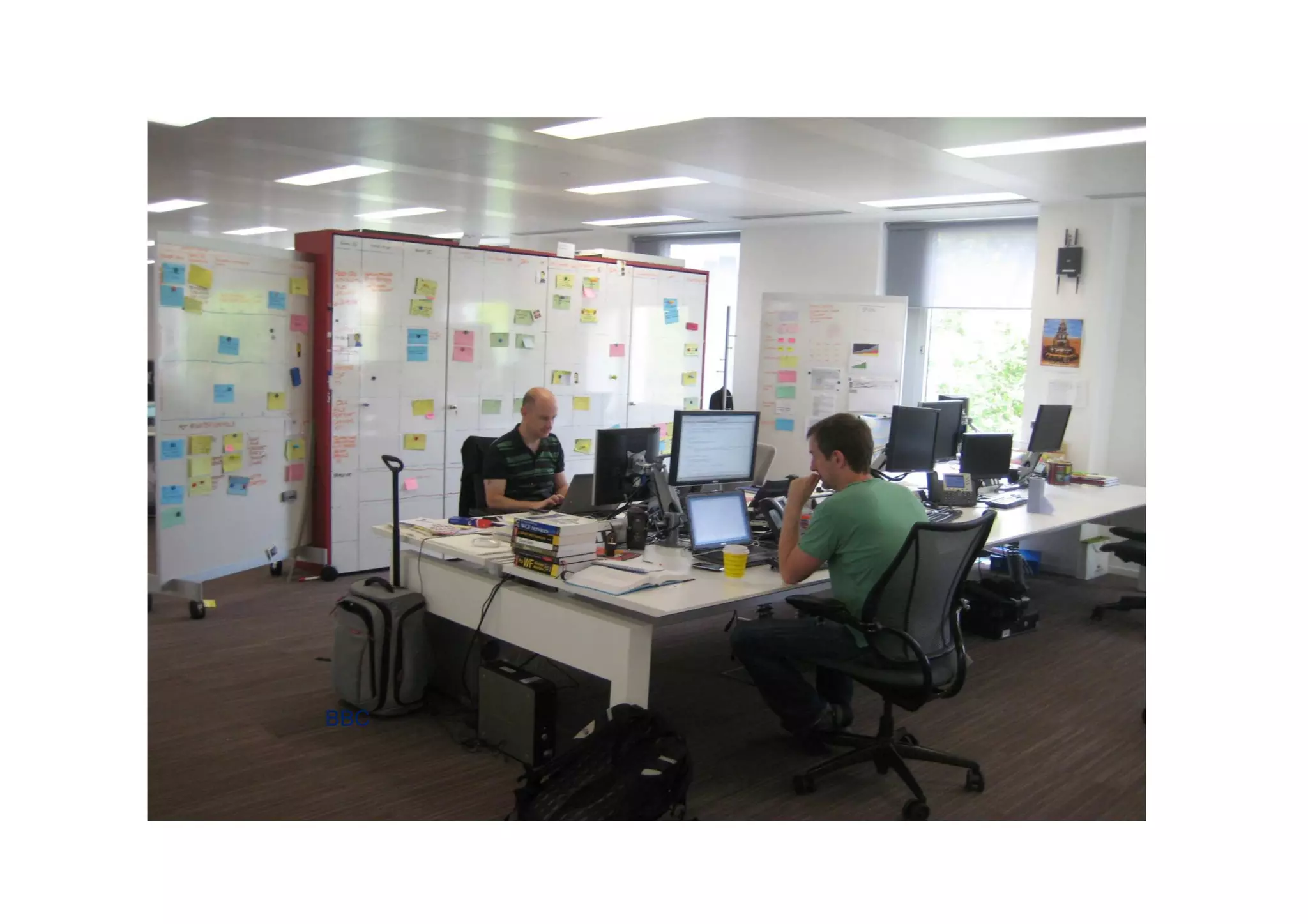
1. Space needed for Kanban & info boards
2. Plan driven, document centric process
3. Poor fit with standardised reporting
4. Remit of IT – upstream & downstream
5. Command & control compliance model
6. Staff initiative and multi skilling
Lean handles risk by low WIP, transparency,
   small units & frequent deliverables
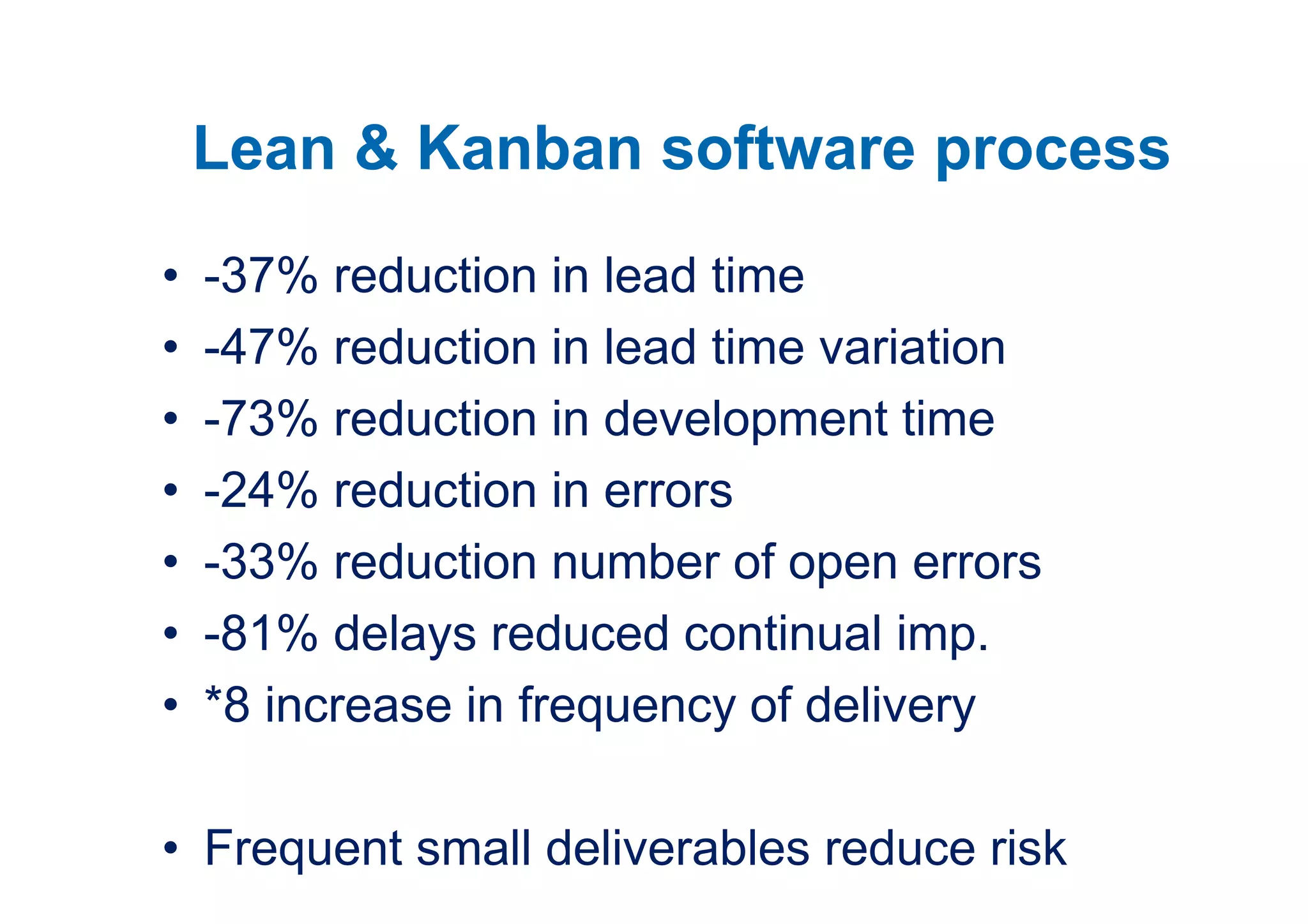
Lean & Kanban software process
•   -37% reduction in lead time
•   -47% reduction in lead time variation
•   -73% reduction in development time
•   -24% reduction in errors
•   -33% reduction number of open errors
•   -81% delays reduced continual imp.
•   *8 increase in frequency of delivery

• Frequent small deliverables reduce risk
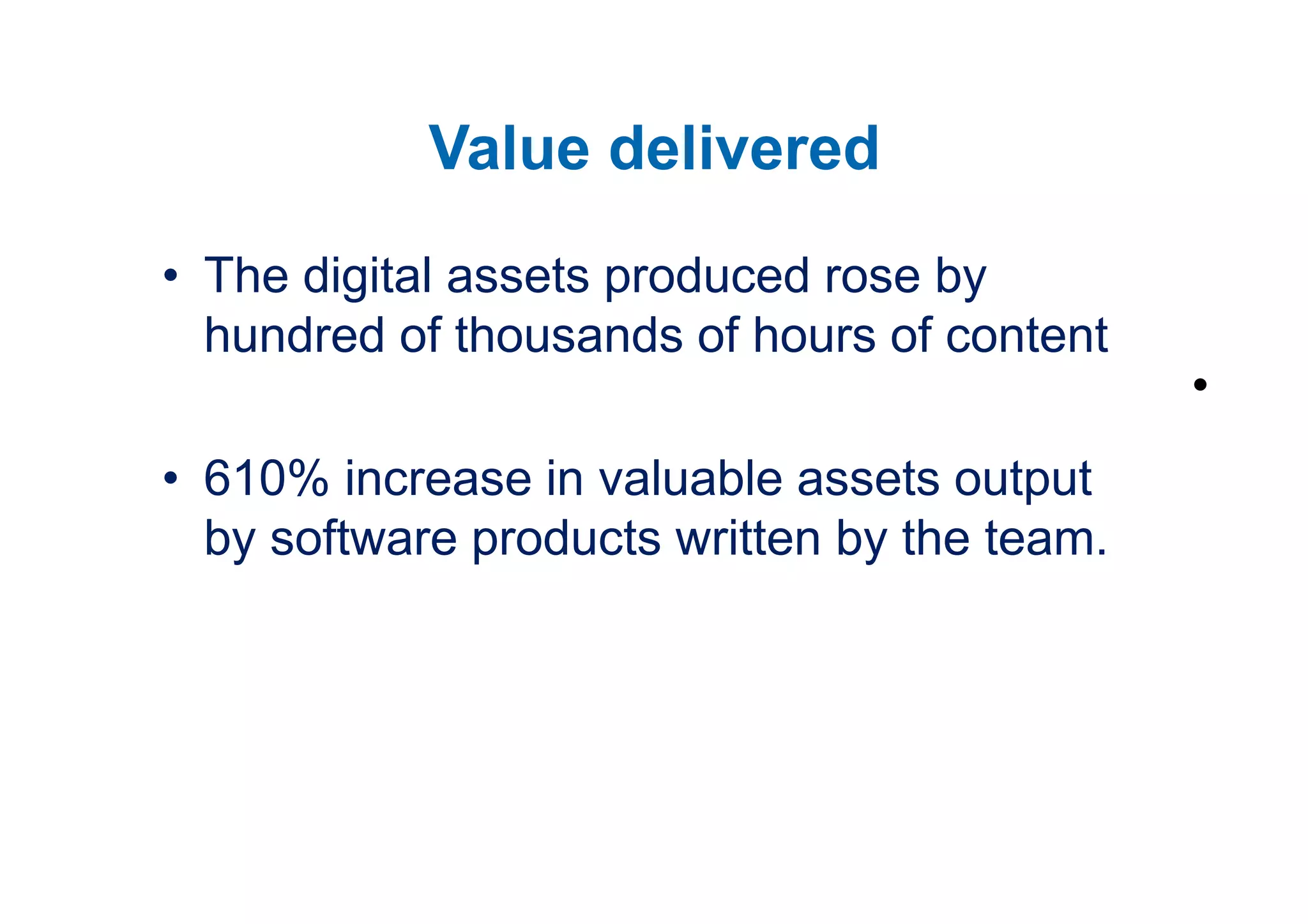
Value delivered
• The digital assets produced rose by
  hundred of thousands of hours of content
                                              •
• 610% increase in valuable assets output
  by software products written by the team.
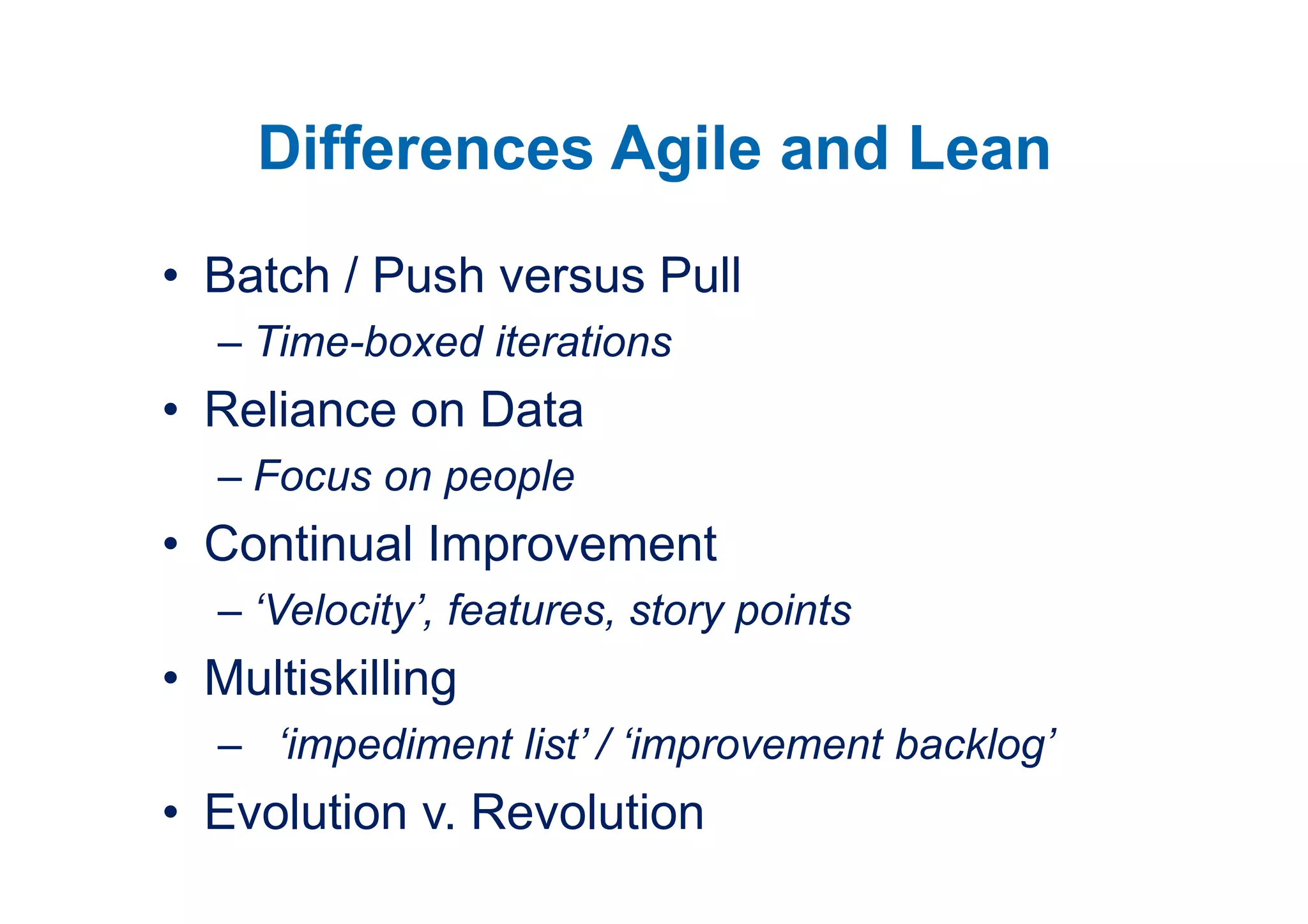
Differences Agile and Lean
• Batch / Push versus Pull
  – Time-boxed iterations
• Reliance on Data
  – Focus on people
• Continual Improvement
  – ‘Velocity’, features, story points
• Multiskilling
  – ‘impediment list’ / ‘improvement backlog’
• Evolution v. Revolution
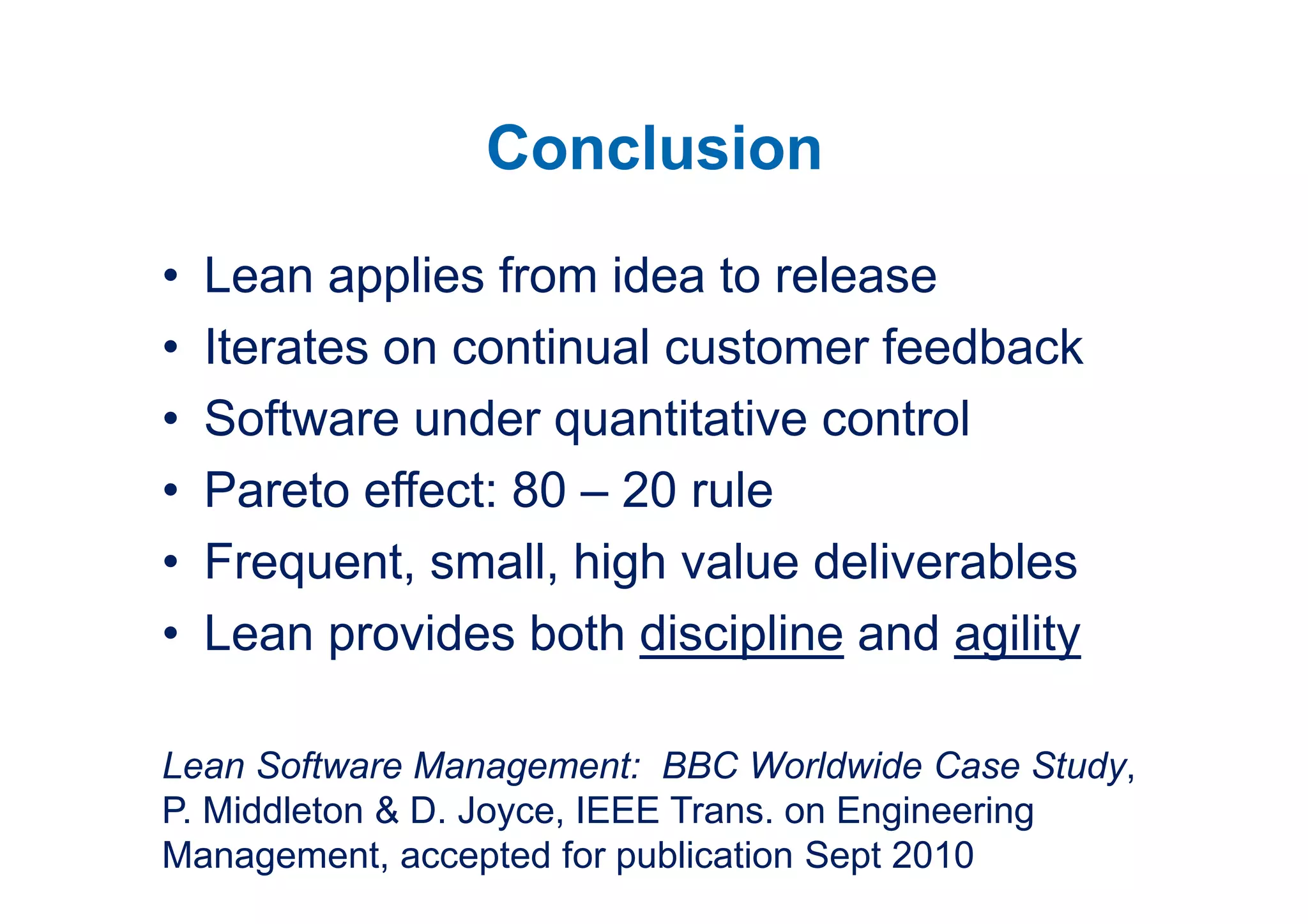
Conclusion
•   Lean applies from idea to release
•   Iterates on continual customer feedback
•   Software under quantitative control
•   Pareto effect: 80 – 20 rule
•   Frequent, small, high value deliverables
•   Lean provides both discipline and agility

Lean Software Management: BBC Worldwide Case Study,
P. Middleton & D. Joyce, IEEE Trans. on Engineering
Management, accepted for publication Sept 2010
Follow up
• to the IEEE article
  http://leanandkanban.wordpress.com/2011
  /04/09/lean-software-management-bbc-
  worldwide-case-study/

• p.middleton@qub.ac.uk
• dpjoyce@googlemail.com
• Twitter: @dpjoyce
Copyright © Institut Lean France 2011


www.lean-it-summit.com

Lean Software management: BBC Worldwide case study

  • 1.
    Copyright © InstitutLean France 2011 Lean Software Management: BBC Worldwide Case Study Peter Middleton, Queen’s University Belfast David Joyce, ThoughtWorks Australia
  • 2.
    Lean Software Management: BBC Worldwide Case Study Peter Middleton, Queen’s University Belfast & David Joyce, ThoughtWorks Australia 14 October 2011 European Lean IT Summit
  • 3.
    Strategy & analysis •Customers: Statistical Process Control – Total end-to-end time to serve customer • Targets = System Conditions – Why does system behave as it does? – Remove sub optimisation, then I.T. • Purpose of customer interactions – Why did they contact us? • Failure demand: 30% - 70% – Wrong information, delivery not made
  • 4.
    Analysis of whycustomers call Failure demand: activity but waste Failure demand 37% Value demand 63%
  • 5.
    Foundations • PRINCE2 unrealistic: ‘Ensuring that the information required for the project team is available’ • Failure demand: 30% - 70% of all demand is caused by failures in the system itself • Targets cause massive waste due to sub optimisation. Measures drive behaviour.
  • 6.
    BBC Worldwide Digital Hub Software Team • Media Village, White City, West London • 9 staff: Analyst, Architect, QA, Developers • Operating cost: £1.5m p.a. • C#, .NET, MS SQL Server • Created and maintained software • 12 months data: Oct 2008 – Oct 2009 • Reported to Business & Project Boards • Waterfall Agile Lean
  • 7.
    Engineering Practices • Test Driven Development (unit tests) • Automated Acceptance Testing • Source Control Software • Bug tracking software • Decoupling – improve legacy code • Minimum Marketable Feature concept • Daily Stand Up (15 minutes)
  • 10.
    Lean Software –key idea • Reduce Work in Process: – Analysis – Specifications – Design – Untested code • Benefits: (flow: concept to cash) – Visible management & less risk – Flexibility – Productivity
  • 12.
    Kanban 101 (BNPParibas) Work Items Step 2 … Step n Done Step 1 In In In Queue Process Queue Process Queue Process …
  • 14.
  • 15.
    Lead time tocustomers -37% Variance -47%
  • 16.
  • 17.
  • 18.
    Fewer Bugs: -24%; Variance: -33%
  • 19.
  • 20.
    Possible problems 1. Spaceneeded for Kanban & info boards 2. Plan driven, document centric process 3. Poor fit with standardised reporting 4. Remit of IT – upstream & downstream 5. Command & control compliance model 6. Staff initiative and multi skilling Lean handles risk by low WIP, transparency, small units & frequent deliverables
  • 21.
    Lean & Kanbansoftware process • -37% reduction in lead time • -47% reduction in lead time variation • -73% reduction in development time • -24% reduction in errors • -33% reduction number of open errors • -81% delays reduced continual imp. • *8 increase in frequency of delivery • Frequent small deliverables reduce risk
  • 22.
    Value delivered • Thedigital assets produced rose by hundred of thousands of hours of content • • 610% increase in valuable assets output by software products written by the team.
  • 23.
    Differences Agile andLean • Batch / Push versus Pull – Time-boxed iterations • Reliance on Data – Focus on people • Continual Improvement – ‘Velocity’, features, story points • Multiskilling – ‘impediment list’ / ‘improvement backlog’ • Evolution v. Revolution
  • 24.
    Conclusion • Lean applies from idea to release • Iterates on continual customer feedback • Software under quantitative control • Pareto effect: 80 – 20 rule • Frequent, small, high value deliverables • Lean provides both discipline and agility Lean Software Management: BBC Worldwide Case Study, P. Middleton & D. Joyce, IEEE Trans. on Engineering Management, accepted for publication Sept 2010
  • 25.
    Follow up • tothe IEEE article http://leanandkanban.wordpress.com/2011 /04/09/lean-software-management-bbc- worldwide-case-study/ • p.middleton@qub.ac.uk • dpjoyce@googlemail.com • Twitter: @dpjoyce
  • 26.
    Copyright © InstitutLean France 2011 www.lean-it-summit.com