

403 – Career Development

       Why become a Lean Leader?

        How adopting the Lean philosophy
          will make you a better Leader


4th April 2012
AUA Conference, Manchester

                                      John Evans
            The Lean University, Cardiff University
The Plan
• Why adopting Lean should be essential for all HE personnel
• Doing so will continuously improve the way that you work,
  ensuring everything you do adds value

Delegates will -
• Have an appreciation for the 5 principles of Lean & how they
 apply in a HE Environment
• Be able to identify wasteful activity within your organisation &
 categorise it
• Understand how adopting the Lean philosophy with enhance
 leadership skills
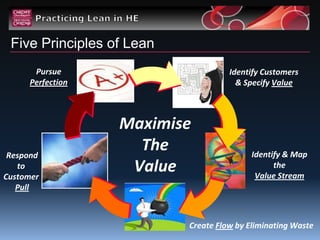
Five Principles of Lean
      Pursue                         Identify Customers
     Perfection                        & Specify Value


                  Maximise
 Respond
                    The                    Identify & Map
   to
Customer
                   Value                         the
                                            Value Stream
   Pull


                           Create Flow by Eliminating Waste
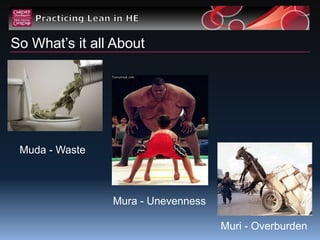
So What‟s it all About


 Muda - Waste


                Mura - Unevenness

                                    Muri - Overburden
Is This a Typical Day?
“I‟ve produced all this information and no-one uses it!”
 “I can‟t get on with my job because I am waiting for someone else!”

“My diary is full of meetings where we don‟t do anything!”
     “That piece of work has disappeared into a black hole!”
                                 “My in-tray is full of overdue work!”
         “I‟ve been hunting for that information for ages!”
“I‟ve sent that back twice and it‟s still not right!”
                         “I haven‟t got time to do my job properly!”
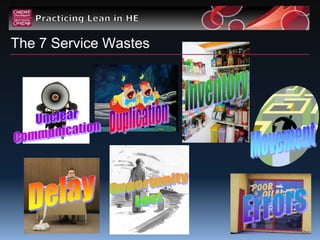
The 7 Service Wastes
Can you Identify


       A little Game with Post-its & Paper
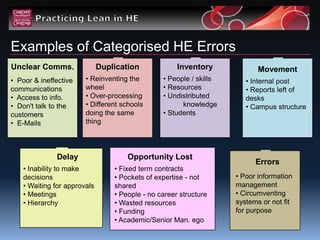
Examples of Categorised HE Errors
Unclear Comms.                Duplication             Inventory             Movement
• Poor & ineffective    • Reinventing the        • People / skills      • Internal post
communications          wheel                    • Resources            • Reports left of
• Access to info.       • Over-processing        • Undistributed        desks
• Don't talk to the     • Different schools            knowledge        • Campus structure
customers               doing the same           • Students
• E-Mails               thing


              Delay                   Opportunity Lost
                                                                           Errors
    • Inability to make           • Fixed term contracts
    decisions                     • Pockets of expertise - not       • Poor information
    • Waiting for approvals       shared                             management
    • Meetings                    • People - no career structure     • Circumventing
    • Hierarchy                   • Wasted resources                 systems or not fit
                                  • Funding                          for purpose
                                  • Academic/Senior Man. ego
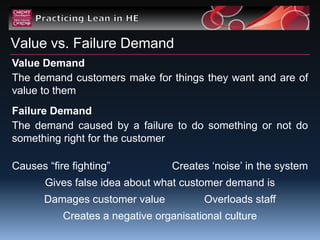
Value vs. Failure Demand
Value Demand
The demand customers make for things they want and are of
value to them
Failure Demand
The demand caused by a failure to do something or not do
something right for the customer

Causes “fire fighting”            Creates „noise‟ in the system
       Gives false idea about what customer demand is
       Damages customer value           Overloads staff
           Creates a negative organisational culture
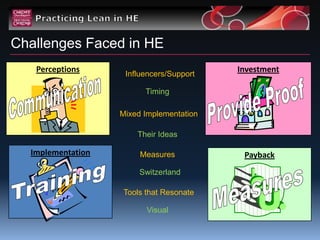
Challenges Faced in HE
   Perceptions                            Investment
                    Influencers/Support

                         Timing

                   Mixed Implementation

                       Their Ideas

  Implementation        Measures           Payback
                        Switzerland

                   Tools that Resonate

                         Visual
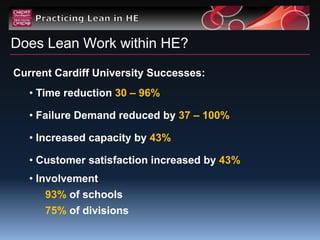
Does Lean Work within HE?
Current Cardiff University Successes:
   • Time reduction 30 – 96%

   • Failure Demand reduced by 37 – 100%

   • Increased capacity by 43%

   • Customer satisfaction increased by 43%
   • Involvement
      93% of schools
      75% of divisions
Perusing Perfection: A Typical Day?
“I know and understand what my customers want from me”
“I understand who can help me & how long they need to do their job”
“All my meetings are productive & are used to make decisions”
“I know exactly where all work is at
any given time no matter who has it”
                   “All my work meets the agreed delivery time”
“I can find any information I need in 30 seconds”
                   “All work is right first time”
   “I feel I have more control over what and how I do my work”
          “Everything I do is value added and valued”
Lean Leader: Personal Reflection
• Real improvements can be done with little effort and cost
• Don‟t be afraid of getting things wrong – the answers are there
• Engage all who are involved in the process (if they want to)
• Some people will not change, don‟t let them dictate
• Encourage teams to think and act, not individuals forcing
 change
• Trust and support colleagues - they will come up with solutions
• Upper management involvement is essential to implement
 sustained change
• Once started it won‟t stop
• Start small, think big, communicate
DUNS: Last Exercise

             Name:
             John Evans/evansjd8@cf.ac.uk

             What I Did:
             Listened to a Lean presentation at the
             AUA

             What I Understood:
             Understood how to identify wastes and
             categorise it

             Next Steps:
             Apply Lean to cleaning up the office
             space and files
How was that for You?


                How Was That for You?
Contact Details
Address:     Lean University Team, Cardiff University
             McKenzie House, 30-36 Newport Road
             Cardiff. CF24 0DE
E-mail:             lean@cardiff.ac.uk
Tel:                02920 870 445
Presenter‟s E-mail: evansjd8@cardiff.ac.uk

Useful Websites
      www.cardiff.ac.uk/lean
      www.leanenterprise.org.uk
      www.leanuk.org
Further Reading

  • The New Lean Toolbox Towards Fast, Flexible Flow -
    John Bicheno
  • Lean Thinking: Banish Waste and Create Wealth in your
    Corporation – James P. Womack & Daniel T. Jones
  • Staying Lean - Thriving, Not Just Surviving - Peter
    Hines, Pauline Found, Gary Griffiths, Richard Harrison
  • Lean Lexicon - Chet Marchwinski & John Shook
  • Learning to See - Mike Rother & John Shook
  • Freedom from Command and Control – John Seddon

403 - Why become a Lean Leader

  • 1.
    403 – CareerDevelopment Why become a Lean Leader? How adopting the Lean philosophy will make you a better Leader 4th April 2012 AUA Conference, Manchester John Evans The Lean University, Cardiff University
  • 2.
    The Plan • Whyadopting Lean should be essential for all HE personnel • Doing so will continuously improve the way that you work, ensuring everything you do adds value Delegates will - • Have an appreciation for the 5 principles of Lean & how they apply in a HE Environment • Be able to identify wasteful activity within your organisation & categorise it • Understand how adopting the Lean philosophy with enhance leadership skills
  • 4.
    Five Principles ofLean Pursue Identify Customers Perfection & Specify Value Maximise Respond The Identify & Map to Customer Value the Value Stream Pull Create Flow by Eliminating Waste
  • 5.
    So What‟s itall About Muda - Waste Mura - Unevenness Muri - Overburden
  • 6.
    Is This aTypical Day? “I‟ve produced all this information and no-one uses it!” “I can‟t get on with my job because I am waiting for someone else!” “My diary is full of meetings where we don‟t do anything!” “That piece of work has disappeared into a black hole!” “My in-tray is full of overdue work!” “I‟ve been hunting for that information for ages!” “I‟ve sent that back twice and it‟s still not right!” “I haven‟t got time to do my job properly!”
  • 7.
  • 8.
    Can you Identify A little Game with Post-its & Paper
  • 9.
    Examples of CategorisedHE Errors Unclear Comms. Duplication Inventory Movement • Poor & ineffective • Reinventing the • People / skills • Internal post communications wheel • Resources • Reports left of • Access to info. • Over-processing • Undistributed desks • Don't talk to the • Different schools knowledge • Campus structure customers doing the same • Students • E-Mails thing Delay Opportunity Lost Errors • Inability to make • Fixed term contracts decisions • Pockets of expertise - not • Poor information • Waiting for approvals shared management • Meetings • People - no career structure • Circumventing • Hierarchy • Wasted resources systems or not fit • Funding for purpose • Academic/Senior Man. ego
  • 10.
    Value vs. FailureDemand Value Demand The demand customers make for things they want and are of value to them Failure Demand The demand caused by a failure to do something or not do something right for the customer Causes “fire fighting” Creates „noise‟ in the system Gives false idea about what customer demand is Damages customer value Overloads staff Creates a negative organisational culture
  • 11.
    Challenges Faced inHE Perceptions Investment Influencers/Support Timing Mixed Implementation Their Ideas Implementation Measures Payback Switzerland Tools that Resonate Visual
  • 12.
    Does Lean Workwithin HE? Current Cardiff University Successes: • Time reduction 30 – 96% • Failure Demand reduced by 37 – 100% • Increased capacity by 43% • Customer satisfaction increased by 43% • Involvement 93% of schools 75% of divisions
  • 13.
    Perusing Perfection: ATypical Day? “I know and understand what my customers want from me” “I understand who can help me & how long they need to do their job” “All my meetings are productive & are used to make decisions” “I know exactly where all work is at any given time no matter who has it” “All my work meets the agreed delivery time” “I can find any information I need in 30 seconds” “All work is right first time” “I feel I have more control over what and how I do my work” “Everything I do is value added and valued”
  • 14.
    Lean Leader: PersonalReflection • Real improvements can be done with little effort and cost • Don‟t be afraid of getting things wrong – the answers are there • Engage all who are involved in the process (if they want to) • Some people will not change, don‟t let them dictate • Encourage teams to think and act, not individuals forcing change • Trust and support colleagues - they will come up with solutions • Upper management involvement is essential to implement sustained change • Once started it won‟t stop • Start small, think big, communicate
  • 15.
    DUNS: Last Exercise Name: John Evans/evansjd8@cf.ac.uk What I Did: Listened to a Lean presentation at the AUA What I Understood: Understood how to identify wastes and categorise it Next Steps: Apply Lean to cleaning up the office space and files
  • 16.
    How was thatfor You? How Was That for You?
  • 17.
    Contact Details Address: Lean University Team, Cardiff University McKenzie House, 30-36 Newport Road Cardiff. CF24 0DE E-mail: lean@cardiff.ac.uk Tel: 02920 870 445 Presenter‟s E-mail: evansjd8@cardiff.ac.uk Useful Websites www.cardiff.ac.uk/lean www.leanenterprise.org.uk www.leanuk.org
  • 18.
    Further Reading • The New Lean Toolbox Towards Fast, Flexible Flow - John Bicheno • Lean Thinking: Banish Waste and Create Wealth in your Corporation – James P. Womack & Daniel T. Jones • Staying Lean - Thriving, Not Just Surviving - Peter Hines, Pauline Found, Gary Griffiths, Richard Harrison • Lean Lexicon - Chet Marchwinski & John Shook • Learning to See - Mike Rother & John Shook • Freedom from Command and Control – John Seddon