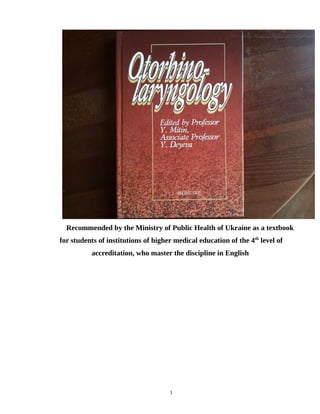
Recommended by the Ministry of Public Health of Ukraine as a textbook
for students of institutions of higher medical education of the 4th
level of
accreditation, who master the discipline in English
1
2
3
Authors: Y. Mitin, Y. Deyeva, J. Gomza, V. Didkovsky, L. Krinichko, A. Motailo, G.
Tereschenko, Y. Shevchuk
The main questions of diseases of the ear, nose, and throat are examined in the
textbook. The anatomy, physiology, pathology and treatment of ENT diseases are
described.
The classic and modern data of scientific investigations in different branches of
otorhinolaryngology are given.
The textbook is for students of institutions of higher medical education (the 3rd
–
4th
level of accreditation).
4
CHAPTER 1
General description and history of otorhinolaryngology
Otorhinolaryngology is a clinical discipline, which studies the morphology,
physiology and pathology of the ear, upper respiratory tracts and adjacent areas. The
term is derived from four Greek words: otos – ear, rhinos – nose, lагуngos – larynx
and logos – studies. The first letters of the words marking the main branches of the
speciality form the abbreviation ORL or LOR (in English-speaking countries – ENT).
Otorhinolaryngology studies norms and pathology of most analyzers: auditory,
vestibular, olfactory and gustatory. Disorders in analyzers activity decrease
occupational capability and working capacity causing depression of the person.
It should be noted that otorhinolaryngology is a surgical speciality, which
encompasses a large range of operations: on the ear, nose cavity, paranazal sinuses,
pharynx, larynx, and trachea.
Development of otorhinolaryngology as a separate discipline began in the
middle of the 19th
century. Before that, the treatment of a small number of known ear
diseases was taught in the course of surgery, and of diseases of the upper respiratory
tract – in the course of therapy. Anatomico-topographical unity of the ear, throat and
nose, their physiological correlation and practical application of endoscopy methods
in ENT research were the reasons for ENT diseases joining.
It is important to know the main stages of otorhinolaryngology development. In
1841 German doctor F. Ноfmаnn suggested to examine deep areas of the ear, nose
and throat using a mirror without a small round part of amalgam in the center. Later
doctor A.F. Trolch created a frontal reflector on its basis. In 1854 M. Garsia, a Spanish
singer and one of the most prominent teachers of singing, professor of the Paris
Conservatoire and Royal Academy of Music in London (Fig. 1) offered the indirect
laryngoscopy method. By means of using a laryngeal mirror M. Garsia studied the
physiology of singer’s voice. In a year this method was introduced into practice. Then
5
the methods of postnasal (1859), anterior, and middle rhinoscopy were offered. Later
direct methods were developed: esophagoscopy (Kussmaul, 1868), direct
laryngoscopy (Kirsten, 1894), bronchoscopy (Killian, 1897), respiratory
bronchoscopy (Fridel, 1956), fibrobronchoscopy (Іkedа, 1969). Otosurgery was
founded by German doctor I. Schwartze, who offered mastoid process trepanation
(anthrotomy) in his work in 1873. Puncture of the maxillary sinus through the
inferior nasal meatus was first perfomed and described by M. Schmidt in 1888.
American G.W. Caldwell in 1893 and Frenchman H. Luc in 1897 independently
worked out the method of radical surgical intervention at chronic maxillary sinusitis.
In Ukraine, due to privat-docent courses in at several universities,
otorhinolaryngology was popularized and introduced into medical practice and
education. At the medical department of the Kyivievs Ssnt. Vladimir Volodymyr
Uuniversity some ENT diseases were mentioned during lectures on surgery, therapy
and other disciplines some ENT – diseases were mentioned. So, in 1860-–1862 the
first lectures on larynx diseases were given by Ddoctor of Mmedicine I. Lazarevich,
the associate professor of obstetrics I. Lazarevych (the course name of the academic
course was The " Respiratory Ttract and Iits Partsbranches Ddiseases and Llarynx
sufferingLesions") and lectures on ear diseases were given by Professor Yu.
Shymanovsky in a course on theoretical and operative surgery. From 1864 to 1866 L.
Marovsky lectured a privat-docent course on rhinology and laryngology, in 1864 he
was elected an associate professor of diagnostics and laryngoscopy. His works were
About Croup Treatment, About Deafness Reasons etc. From 1871 to 1880 M.
Uspensky lectured a privat-docent course on otiatrics, and then from 1882 to 1884 N.
Zuk delivered the course Throat Diseases.
Mykola Volkovych (1858–1928; Fig. 2), a surgeon and otorhinolaryngologist,
professor and academician, was the first in Ukraine to begin a systematic lecture
course on otorhinolaryngology. From 1889 to 1903 he conducted an elective course
on otorhinolaryngology at the medical department of the Kyivievs Ssnt. Vladimir
6
Volodymyr Uuniversity. He was one of the first, who paid proper attention to the
study of upper respiratory tracts scleroma and took an active part in the study of
etiology, pathogeny and treatment of this disease. The scientist also introduced a
surgical direction in otorhinolaryngology development. He widely performed
operations on the paranasal sinuses and mastoid process. He was the first in Russia to
publish a report on two examples of larynx extirpation in case of cancer and develop
surgical treatment of chronic larynx stenoses.
Otorhinolaryngology was also developing in Odessa, Kharkiv and other cities
of Ukraine. In 1921 otorhinolaryngology became a required subject of medical
departments of universities, which was very important for the development of the
speciality.
The otorhinolaryngology department of the Kyiv Medical Institute was
originated in 1922, when Alexander Puchkovsky became the head of the department.
He graduated from the Petersburg Military Medical Academy. The scientist made a
great contribution to the development of otorhinolaryngology in Odesa. A.
Puchkovsky was a prominent Ukrainian scientist researching scleroma, tuberculosis
of the upper respiratory tracts, ENT-oncology, reconstructive surgery. The Kharkiv
otorhinolaryngology department was founded by professor S. Surukchi (1922), in
Dnepropetrovsk – by professor S. Kompaneyets (1921), in Lviv – by professor A.
Yurash (1908).
The appearance of fundamental works since the 20–30s was a considerable
contribution into the development of otorhinolaryngology in Ukraine. S.
Kompaneyets, A. Puchkovsky, and O. Kolomiychenko studied the questions of
diagnostics and treatment of purulent otitis and concomitant intracranial
complications. M. Horshak founded a school of head and neck oncology. G.
Trombitsky, M. Pitenko and S. Kompaneyets investigated the problem of regional and
professional ENT-pathology. Works of M. Volkovich, V. Drobotko, L. Zarytsky, V.
7
Yaroslavsky, A. Puchkovsky, S. Myhailovsky played a great role in the study of
etiology, pathogeny, epidemiology, diagnostics and treatment of respiratory scleroma.
In 1924 the publishing of the Journal of Ear, Nasal and Pharynx Diseases
began. In 1930 in Kharkiv the Otolaryngology Research Institute was organized,
which existed for 25 years. Here the problems of tonsillitis, nose physiology and
pathologies, prophylaxis and treatment of deafness and hearing loss were studied. In
1960 the Kyiv Research Institute of Otolaryngology was opened. Professor O.
Kolomyichenko (Fig. 3), Corresponding Member of the Ukrainian Academy of
Sciences and Lenin Prize Laureate, was the initiator and director of this institute till
1974. Professor A. Tsyhanov, State Prize Laureate, succeeded Professor O.
Kolomyichenko at this position. Since 1985 Professor Dmytro Zabolotny,
Corresponding Member of the Ukrainian Academy of Medical Science, is the head of
the institute.
According to the data of 2006, there are approximately 3,650 otolaryngology
specialists in Ukraine and ENT-departments can treat about 8,600 patients.
8
CHAPTER 2
Clinical anatomy, physiology, and methods of researching the
auditory analyzer
The auditory analyzer is divided into a peripheral section, conduction
pathways, and a cortical center. The peripheral section is divided according to its
function into sound-conducting and sound-perceiving systems.
The sound-conducting system consists of the external, middle ear, peri- and
endolymphatic spaces of the inner ear, basal and vestibular membranes of cochlea.
The sound-perceiving system is the receptor of auditory analyzer represented by the
spiral organ (organ of Corti). The sound-conducting system delivers sound to the
receptor. The sound-perceiving system transforms mechanical vibrations into a
nervous impulse.
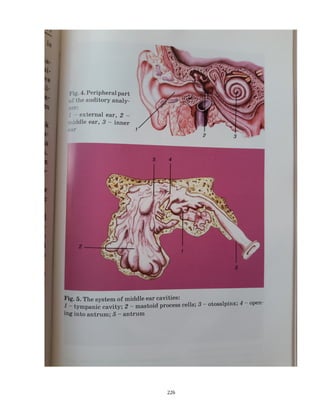
The peripheral section of the auditory analyzer anatomically consists of three
parts: the external, middle and inner ear (Fig. 4).
The external ear consists of the auricle and external acoustic meatus. The
auricle collects and directs sound waves into the external acoustic meatus. The
external acoustic meatus deliveres sound vibrations to the ear drum (tympanic
membrane). The external ear is innervated by the branches of the 5th
, 7th
and 10th
cranial nerves.
The middle ear consists of an air cavities system represented by the tympanic
cavity, mastoid process cells and auditory tube (otosalpinx) (Fig. 5).
The tympanic cavity has six walls. The external wall of tympanic cavity is the
eardrum, the internal one is the lateral wall of the inner ear, the superior wall is the
tegmental wall separating the tympanic cavity from the middle cranial fossa, the
inferior wall is a bone separating the tympanic cavity from the bulb of jugular vein.
In its middle the internal wall has a peak (promontory) formed by the base of cochlea.
Behind and above the promontory the oval window is located, which is closed by the
9
base of stapes. Under and behind the peak there is a round window closed by the
secondary tympanic membrane.
In clinical practice the tympanic cavity is divided into 3 floors: the superior one
is epitympanum, the middle one – mesotympanum, and the inferior one –
hypotimpanum. The epitympanum is situated above the short malleus process (lateral
process); the mezotympanum is between the short process and the inferior wall of
external acoustic meatus; the hypotimpanum is a small cavity located below eardrum
attachment.
There are auditory ossicles (malleus, incus, stapes) and muscles in the drum
cavity, which form an anatomically and functionally united system. The malleus is
very tightly fixed with the manubrium to the eardrum, and its head is united with the
incus by means of an articulation and a ligament. The incus attaches to the head of
stapes with its long limb. The base of stapes is fastened in the oval window with a
round ligament. The chain of auditory ossicles decreases the amplitude of sound
vibrations and simultaneously increases the force of sound pressure on the oval
window.
The mechanism of sound conduction is realized due to the muscles of drum
cavity: m. tensor tympani and m. stapedius. These muscles have two functions:
adaptative and protective. The adaptive function is conditioned by reciprocal
innervation: if one muscle contracts, the other relaxes reflexively.
During muscle traction of tensor tympani the m. stapedius relaxes. It results in
the retraction of the eardrum into the tympanic cavity and pressure of the bases of
stape on the labyrinth. This causes an increase of internal labyrinth pressure and
prevents low and weak sounds penetration into the internal ear.
Due to reduction of m. stapedius and weakening of m. tensor tympani, the
stapes are pulled out to the drum cavities, which reduces internal labyrinth pressure. It
is an obstacle for the transmission of higher sounds but facilitates low and weak
sounds conduction. The protective function of these muscles is realized by
10
simultaneous tetanic reduction of both muscles when very loud sounds take place. It
protects the labyrinth from loud acute sounds, because during this reduction the base
of stapes begins to turn round close to its longitudinal axis, but does not move inside
the internal ear.
The auditory tube (otosalpinx) is important in the mechanism of sound
conduction. This is the only organ, which connects the middle ear cavity with the
environment. The otosalpinx is a narrow canal, 30–38 mm long, which begins in the
front wall of drum cavity and ends with a pharyngeal opening in the cavity of the
nasal part of throat at the level of the back-end of inferior nasal concha. The auditory
tube consists of cartilaginous and bony parts. It balances the pressure in the tympanic
cavity. The otosalpinx is usually closed, it is opened during swallowing and yawning,
as a result air gets into the drum cavity. This function of the otosalpinx is named
barofunction. The otosalpinx performs two functions: draining and protective. The
protective function is realized by the stratified ciliated epithelium. The cilia blink in
the direction of the pharyngeal opening and that removes foreign parts from the
otosalpinx mucosa.
The mastoid process located abehind the auricle is a part of the temporal bone.
It contains a number of air cells, the biggest one called antrum. Mastoid air cells are
covered with the fibrous tunic with pavement epithelium. Air cells unite with one
another and also with the drum cavity.
The middle ear is innervated by branches of the facial, glossopharyngeal,
trigeminal nerves and from the carotic plexus.
The internal ear is an ear labyrinth in the thickness of temporal bone pyramid.
The ear labyrinth may be divided into three parts: the front part is the cochlea, the
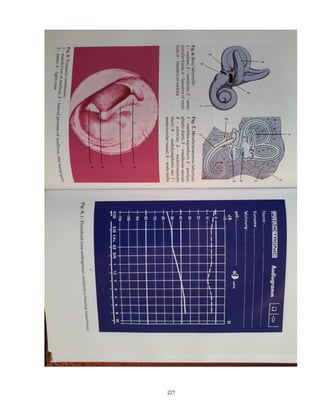
middle one – the vestibule, and the back part – the semicircular canals (Fig. 6). There
is a bone labyrinth with a membranous labyrinth inside which repeats the bone
labyrinth form (Fig. 7). The membranous labyrinth is a sac containing high-
potassium, low-sodium fluid (endolymph). There is low-potassium and high-sodium
11
fluid (perilymph) between the bone labyrinth wall and the membranous labyrinth
wall. Within the cochlea there are three fluid-filled spaces: the scala media (filled with
endolymph), the scala tympani, and the scala vestibuli (both filled with perilymph).
The internal fluid spaces of the saccule, utricle, and semicircular ducts contain
endolymph. The vestibule contains two bony depressions – the spherical recess holds
the saccule, and the elliptical recess holds the utricle. The saccule and utricle consist
of supporting and hair cells covered with gelatinous otolithic membrane, which
contains a number of small calcium phosphate crystals (otoconia). There are three
semicircular canals – anterior, posterior and lateral. Each semicircular canal contains a
semicircular duct that has an ampullated and a nonampullated ends joined within the
utricle. The cochlea consists of 2 ½ turns, with a total average length of 32 mm. The
vestibular membrane separates the scala vestibule from the scala media, and the basic
membrane separates the scala media from the scala tympani. The receptor of the
auditory analyzer is the spiral organ (organ of Corti), wich is located on the basic
membrane. The spiral organ is a complex structure consisting of supporting cells,
three layers of outer hair cells and a single layer of inner hair cells. The hair cells
carry out the transformation of sound irritation (mechanical vibrations) into a nervous
impulse.
The mechanism of sound conduction is the following: sound vibrations are
concentrated by the auricle in the external acoustic meatus and through it reach the
eardrum. Eardrum vibrations pass to the chain of otosteons. Vibrations of the base of
stapes pass to the liquid environment of the internal ear, through it sound vibrations
reach the spiral organ.
The primary analysis of the sound, taking place in the internal ear, divides
complex sounds into parts, due to the perception of certain frequencies by definite
areas of the spirale organ. Mechanical energy of a sound wave is transformed into
electric energy in the hair cells of the spiral organ, which leads to nervous impulse
appearance. Then this impulse passes to the peripheral processes (dendrites) of bipolar
12
cells and to the spiral neuroganglion (the first neuron of the auditory way). Then the
impulse goes to the cochlear nerve (ramus n. vestibulocochlearis) and through the
pontocerebellar angle reaches the myelencephalon. Here, in the ventral and dorsal
nuclei, the second neuron lies. Then the fibre partially decussates in the pons and goes
to the olive (the third neuron). Axons of the third neuron go to the back of the tectal
plate of the midbrain tegmen and the medial geniculate body (the fourth neuron).
Fibres of the fourth neuron end in the temporal lobe. Due to the partial decussation of
the second neuron axons, each cochlea has bilateral connection with the cortex.
An adequate irritant of the auditory analyzer is sound – periodic oscillation of
environment (air) molecules. There are several principles concerning the adequate
irritant of the auditory analyzer.
The 1st
principle – the auditory analyzer perceives sound frequencies of certain
range, which is named the auditory range (volume) of human ear. A person perceives
sounds with vibration frequency from 16 to 20,000 vibrations a second. The sound
with the frequency less than 16 vibrations a second is named infrasound, more than 20
KHz – ultrasound.
The 2nd
principle – the auditory analyzer has different sensitiveness to the
sounds of different frequency. Thus, our ear is the most sensitive to the sounds from
1,000 to 3,000 vibrations a second. These frequencies are named the range of
speaking frequencies because we mainly speak on these frequencies. Perception of
sounds decreases from this optimum area. At 200 to 10,000 vibrations a second the
threshold force of sound is 1,000 times bigger than of the sounds with 1,000 to 3,000
vibrations a second.
The 3rd
principle – a man is able to distinguish the pitch of sound. If this ability
is high, we talk about absolute hearing. In addition, the human ear is able to
differentiate sound intervals (the distance between two degrees of scale) and is also
sensitive to consonances and dissonances.
13
All this together with musical memory makes an ear for music. All these
abilities of musical ear are possible to be developed. Fully natural is the rhythm
feeling.
The 4th
principle – a man is able to determine the location of the source of
sound. This phenomenon is named ototopics. Ototopics is explained by the presence
of two ears, in this connection it has the second name of binaural hearing.
To understand the auditory analyzer physiology and master methods of its
research one should know that the auditory analyzer gives a possibility to distinguish
sounds by pitch, intensity, and timbre.
The pitch of sound concerns its frequency: the number of oscillations a second
and is expressed in hertzs (Hz). The intensity of sound is represented by its strength
and is expressed in decibels (dB). Timbre chatacterizes the sound and depends on
overtones, because bodies oscillate not only fully but also partially.
Inspection of the ear includes examination of the auricle, palpation of the
auricle, tragus, mastoid process, leadthrough otoscopies, and also inspection of
auditory function.
Otoscopy is executed to determinate the state of the external acoustic meatus
and middle ear. Such research is perfomed by means of a frontal reflector and ear
watering-cans of different diameter or by applying a special device – otoscope.
If otoscopy is carried out using a frontal reflector one is to look through the
reflector opening with the left eye. Light source must be on the right side of the
patient. The patient must be seated in a definite position: his head should be bent to
the shoulder, which is opposite to the examined ear. During otoscopy the axis of the
acoustic meatus must be on the visual line. One must examine the width of the
external acoustic meatus to define the proper diameter of the watering-can before its
introduction. A watering-can with a proper diameter should be chosen to prevent
unpleasant sensations of the patient. Also, the external acoustic meatus must be
cleaned before examination if it is necessary.
14
The watering-can must be taken with the index finger and thumb of the right
hand for right ear examination, and with the left hand – for left ear examination. Then
the auricle is pulled up and backwards with the other hand (in little children –
downwards and backwards), and with subtle rotatory motions the narrow end of the
watering-can is brought to the external auditory meatus. All the walls are examined by
careful pushing of the watering-can into the depth of the external meatus. Due to the
change of the inclination angle of the head it becomes possible to observe the
tympanic membrane (Fig. 8). A normal tympanic membrane looks like a pearl grey
oval membrane ≈ 8×9 mm in diameter and ≈ 0.1 mm thick.
It has special features:
1) in the center of the membrane there is a convexity;
2) above the convexity there is the malleus fold, which looks like a grey strip
during otoscopy;
3) in the upper part the strip trasforms into the malleus prominence, which is
formed by the short process of malleus;
4) anterior and posterior folds spread behind and in front of the malleus
prominence;
5) during otoscopy it is possible to observe a pyramid of light – corneal reflex
(cone of light) behind and in front of the convexity; the corneal reflex arises due to
light reflection from the shining surface of the tympanic membrane exactly in the
places where surface is perpendicular to light rays, which fall from the frontal
reflector.
The methods of hearing testing can be divided into 4 groups:
- the 1st
group – testing of hearing by speech. Hearing is explored by whisper and by
speech with normal loudness. A normal ear perceives whisper at an average distance
of 6–7 m;
- the 2nd
group – testing of hearing by means of tuning forks.
15
The most informative experiments are the Byng’s, Federici’s, Veber’s, Rynne’s,
Schwabach’s, and Gellee’s ones.
Testing of hearing by means of speech and tuning forks is named acumetry;
- the 3rd
group – audiometry methods – methods, which test hearing by means of
electronic apparatus (audiometers).
Depending on the patient’s participation, audiometry is divided into subjective
and objective. At subjective audiometry the result depends on the answers of the
inspected. These methods include pure-tone audiometry and superthreshold
audiometry (the Lüsher’s test and SISI test research volume function), speech
audiometry, determination of auditory sensitivity to ultrasound.
Pure-tone audiometry is the basic and most widespread audiometry method.
Audiometry results are shown in an audiogram (Fig. 9). It is a graph, the horizontal
line of which represents sound frequency in Hz, and the vertical line – sound intensity
in dB. Zero level in an audiogram is standard norm. Research results are reflected in
an audiogram as two curves, which characterize sound perception through air and
bone. Pure-tone audiometry allows defining the type of hearing disorders: sound
conducting, sound perceiving or of mixed pathology.
Results of objective audiometry do not depend on the patient’s answers. Here
belong the following methods: impedometry (registration of acoustic resistance or
impedance of the middle ear), brainstem auditory evoked potentials (computer
audiometry), electrocochleography (registration of potentials arising in the cochlea
due to sounds), otoacustic emission;
- the 4th group – the use of conditional and unconditional reflexes. Unconditional
reflexes are used for approximate determination of hearing presence in babies. In
response to loud sounds due to the auropalpebral reflex the child’s eyelids close or
blink more frequently than usually. Due to the auropupillar reflex the child’s pupil is
narrow when sound irritation takes place and dilates when sound abates.
Game audiometry is based on the formation of conditional reflexes in children.
16
CHAPTER 3
Clinical anatomy, physiology, and methods of researching the
vestibular analyzer
The vestibular analyzer performs the function of equilibrium of body both in the
state of rest and during motion. The receptors located in the vestibule (otoconic
apparatus) are responsible for the function of equilibrium in the state of rest, and the
receptors of semicircular canals (ampullary apparatus) are responsible for the function
of equilibrium during motion. Together they perform the statokinematic function. The
vestibular apparatus unlike other analyzers is never in the state of rest because
gravitational force constantly acts on it.
The vestibular analyzer, as well as other analyzers, consists of a peripheral part
(receptor), a conducting part with kernels in the brainstem, and a central part.
The vestibular analyzer receptors are located in the inner ear. In the saccules of
the vestibule (utriculus et sacculus) the otoconic apparatus is located as macula
utriculi and macula sacculi. The otoconic apparatus is accumulation of
neuroepithelial or sense cells located between supporting cells. From the upper part of
the sense cells hairs detach, which interlace and form loops. Microcrystals of calcium
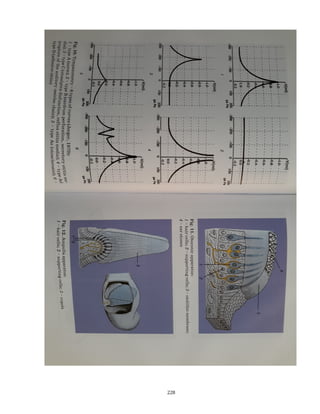
salts – statoconia – are located in the loops (Fig. 10). All of them are soldered with the
jellylike substance and form the otolithic membrane (membrana statoconiorum). An
impulse arises in the receptor at tangential displacement of the otolithic membrane
(that is forward and downwards, backwards and downwards, parallel to the planes of
macula).
Any force is an adequate irritant of the otoconic apparatus that can cause
rectilineal acceleration:
1) beginning or ending of steady rectilineal motion, its acceleration or
deceleration;
2) centrifugal force;
17
3) change of head or body position in space;
4) gravitational force.
The excitability threshold of the otoconic apparatus is 0.001–0.03 g (g –
acceleration of gravity, which makes 9.8 m/s²).
In every semicircular canal on one of its ends there is an ampule with an
ampullar crest. On this crest there is a receptor named the ampullary apparatus. It
consists of sense neuroepithelial cells with hairs on the upper part and supporting
cells. The hairs of sense cells are covered with jellylike substance and form a brush
(cupula terminalis), which is displaced at endolymph motions (Fig. 11). As a result of
this displacement a nervous impulse arises in the sense cells.
Angular acceleration is an adequate irritant of the ampullary apparatus. The
excitation threshold of semicircular ducts is angular acceleration of 0.12–2 m/c².
In the sense cells of ampullary and otoconic apparatus peripheral nerve fibres
(dendrites) go from the bipolar nerve cells of the vestibule to the neuroganglion
(ganglion vestibulare), located in the internal acoustic meatus. Axons of bipolar cells
form the vestibular part of the 8th
cranial nerve, which enters the brainstem through
the pontocerebellar trigone and approaches the vestibular nuclei located in the
diamond-shaped fossa of medulla oblongata. There are four vestibular nuclei on each
side: medial, lateral, superior and inferior. The nuclei are joined by commissural
fibres. The vestibular ways have not been studied higher. It is known that the cortical
part is in the anterior part of the temporal brain part.
The apparatus promotes irritation transformation into reflexes, which can be
divided into three groups.
1. Vestibulosomatic – reflexes from the vestibular apparatus on the skeletal
muscles of neck, trunk, extremities, eyes. These reflexes are identified by the
Romberg’s sign, gait, coordination tests (finger-nose, indicator, knee-heel),
nystagmus.
18
2. Vestibulovegetative – reflexes from the vestibular apparatus on the smooth
muscles of internals. These reflexes declare themselves by skin redness, increased
perspiration, change of cardiac and respiratory activity, nausea, vomiting, frequent
urination.
3. Vestibulosensory – reflexes conditioned by the connection of the vestibular
apparatus with the cortex of the large hemispheres. Normally these reflexes declare
themselves by a conscious feeling of location in space, vestibular illusion of
contrarotation; at a pathology dizziness and violation of spatial feeling are observed.
Nystagmus is one of the most valuable indexes, which characterize the state of
the vestibular analyzer. Nystagmus is involuntary rhythmic repeating movements of
the eyeballs. The following varieties of nystagmus are distinguished: vestibular –
arises at irritation of the receptors of vestibular analyzer nuclei and optokinetic –
arises at irritation of the visual analyzer (looking at the object, which is moving
evenly). A slow and a rapid components are distinguished in nystagmus. The slow
component of nystagmus is conditioned by the irritation of vestibular analyzer
receptors. The slow down movement of eyes in response causes the central reaction,
and the eyes return to initial position. It is a quick component of nystagmus of cortical
genesises. Nystagmus direction is the most evidently observed after the rapid
component. Three degrees of nystagmus are distinguished: the 1st
degree – nystagmus
appears at a glance to the quick component, the 2nd
degree – at a glance to the quick
component and straight ahead, the 3rd
degree – at a glance to the quick component,
straight ahead and to the opposite side.
When down movement of the hands and trunk arises opposite to the nystagmus
direction, it is named harmonic. Harmonic down movement of the hands and trunk is
characteristic of peripheral vestibular syndrome.
Methods of researching the vestibular analyzer
19
The tests characterizing the state of the vestibular analyzer are conducted in a
certain sequence. The analysis of the test results is to be conducted paying attention to
such two moments.
1. Changes characteristic of a labyrinth pathology (peripheral vestibular
syndrome) or of a pathology of the central parts of the vestibular analyzer (central
vestibular syndrome).
2. When we come to a conclusion that we are dealing with peripheral vestibular
syndrome, we must specify if it is contingently caused by irritation (hyperreflexia) or
oppression (hyporeflexia) of the right or left labyrinth.
A vestibulometry chart includes:
1) study of complaints and disease anamnesis;
2) research of spontaneous vestibular reactions;
3) experimental tests;
4) decoding and estimation of results.
Inspection of the patient begins with a careful study of complaints and disease
anamnesis. At a pathology of the vestibular analyzer this information quite often
influences the setting of diagnosis.
Dizziness consists in specific complaints, disordered sense of balance and
violated gait accompanied by nausea and vomiting. Under dizziness we understand
seeming rotation of surrounding objects. Systematized dizziness is characteristic of
peripheral vestibular symptom complex: the patient notes that objects swim from right
to left or vice versa.
It should be noted that in connection with anatomic adjacency of the receptors
of the auditory and vestibular analyzers in the internal ear typical complaints of
peripheral vestibular syndrome are of hearing impairment and sonitus. Thus, the
peripheral vestibular syndrome is also named the cochleovestibular syndrome.
Therefore at differentiation of peripheral and central vestibular syndromes hearing
must be tested.
20
The following group of tests is directed at the research of spontaneous
vestibular reactions: spontaneous nystagmus determination, research of spontaneous
missing, firmness of static equilibrium, motions with eyes closed.
To determine the presence or absence of spontaneous nystagmus the doctor sits
down against the patient, puts the index finger on the right or on the left at the
distance of 60–70 cm from the eyes at an angle of 45°. If spontaneous nystagmus is
observed, its characteristics are determined: the plane, direction, and amplitude; it is
either clonic (only the quick component is visible) or tonic (the slow component also
becomes visible). One should avoid extremely avert stare as the patient can develop
brief nystagmus motions (end-position nystagmus).
Position nystagmus is a variety of spontaneous nystagmus. It should be studied
as follows. At first nystagmus is to be explored in the patient in sitting or standing
posture. After this the patient is examined lying on the back, lying on the left and right
side, and lying on the back with the head thrown back. The doctor notes in what
position of the head nystagmus appears in the patient, changes of nystagmus
parameters depending on the position of the head. Position nystagmus can be of
peripheral and central origin. Nystagmus with abrupt changes of direction, rhythm
and amplitude regardless of the patient’s position is characteristic of central vestibular
syndrome.
Research of pressure nystagmus is of great value. Its onset is usually related to
the destruction of the bony labyrinth capsule at purulent otitis media, that is to the
labyrinth fistula. Therefore this phenomenon is also named the fistula symptom. The
bone defect, which has appeared, opens the membranous labyrinth. The change of
pressure in the external acoustic meatus and drum cavity is passed onto its wall
causing displacement of the endolymph and irritation of the vestibular analyzer
receptors.
This test is conducted as follows. The doctor sits down against the patient, who
is looking straight ahead. The doctor presses on the tragus with the index finger to the
21
right and to the left in turn. If the labyrinth is in normal condition, nystagmus is not
observed. If there is a fistula in the lateral semicircular canal, nystagmus is observed
accompanied by imbalance, nausea or vomiting.
The tests, which allow exposing spontaneous missing, are important tests of
determining spontaneous vestibular disorders, disturbance of static balance and gait.
The following tests are simple and informative: the test of outstretched arms,
indicator, finger-nose, and “writing test”.
The test of outstretched arms is conducted as follows. The patient is sitting with
the eyes closed and stretches the arms out in front of him.
The index fingers are aimed straight, the other fingers make fists. The doctor is
sitting against the patient holding the index fingers against the patient’s fingers,
observing the motions of the latter. A healthy man holds hands in such position
without any substantial displacements during a long period of time. A patient with a
labyrinth pathology moves both arms toward the slow nystagmus component
(harmonious deviation). At a pathology in the posterior cranial fossa the arm on the
affected side deviates to the side or inwards, on the unaffected side the arm keeps the
given position; in such a case nystagmus is directed to the side of affection
(disharmonious deviation).
The pointing test also characterizes the state of coordination. During this test
the patient is sitting holding the hands on the knees. At first with the eyes opened, and
then – closed he must touch with the index fingers the doctor’s index fingers. If a
labyrinth pathology is observed, the patient will miss in the direction of the slow
nystagmus component with both hands. Disharmonious declination of one hand
characterises central vestibular syndrome.
The finger-nose test is a variety of the pointing test. At labyrinth diseases the
patient misses in the direction of the slow nystagmus component.
The test of “vertical writing”, offered by Fukuda, is referred to spontaneous
tests. The patient is sitting at a table and writes a vertical column of ten figures “30”
22
(one under another) in such a way that the hand is not touching the paper. For the first
time the patient writes with the eyes opened (control), and then with the eyes closed.
Inclination of the column of figures, written with the eyes closed, more than by 10
testifies to the asymmetry of muscles tone.
The Romberg’s station test is used to determine the stability of static
equilibrium. In the Romberg’s position at labyrinth parafunction the patient falls on
one side, opposite to the direction of spontaneous nystagmus. At labyrinth
parafunction the change of the direction of falling is observed at the change of head
position. At cerebellum pathologies the change of head position does not influence the
direction of falling. The patient falls on the affected side only.
A change of the tone of extremities and trunk muscles arises if the vestibular
analyzer is affected, which is seen in the gait. Study the following gait types.
1) Walking along a straight line: first with the face forward, and then with the
back. At a labyrinth pathology, as well as in the Romberg’s position, the patient
inclines to one side, opposite to spontaneous nystagmus. At central vestibular
syndrome, nystagmus and patient’s inclination are observed in the direction of the
affected side, i.e. they are disharmonious.
2) Flank gait: with attached steps to the right and to the left. At a labyrinth
pathology the flank gait is not violated. If the cerebellum is affected, the patient can
not execute the flank gait in the direction of the affected side.
The next group of tests of researching the vestibular analyzer is experimental.
The most widespread methods of experimental irritation are caloric and rotatory types
of stimulation.
In clinical practice the method of caloric test by N. Blagoveshchenskaya is now
widely used. Infuse 60–100 ml of cold or hot water into the acoustic meatus during 10
s. By means of stop-watch determine the latent period of nystagmus: the time from
the beginning of water infusion to the appearance of the first nystagmic eye
movements. Normally the latent period is 20–30 s. Decrease of the latent period and
23
increase of the frank one (N = 40–60 s) testifies to hyperreflexia of the labyrinth
proper. And vice versa, increse of the latent period and reduction of the frank one
testifies to hyporeflexia.
The classic rotatory Barany test consists in uniform rotation of the patient in the
Barany arm-chair with the eyes closed during 20 s up to 10 turns. After the arm-chair
is stopped the duration and description of nystagmus are determined.
If condition of the ampula receptor is normal, the duration of postrotatory
nystagmus in the Barany test makes 20–30 s. Nystagmus duration less than 20 s
testifies to labyrinth hyporeflexia, more than 30 s – to labyrinth hyperreflexia.
The Barany test is simple and accessible, which made it rather widely used in
clinical examination. However, at quite strong supraliminal stimuli there are applied
such irritants that are not always tolerated well by the patient. In this connection other
rotatory methods have been offered, one of them being cupulometry.
Cupulometry is a method of researching threshold values of vestibular analyzer
reflexes arising in response to uniformly increasing superthreshold stimuli.
Cupulometry is to be conducted with an electric rotatory arm-chair with a sufficient
range of angular velocity – from 0 to 90–120º/s².
The visual method of nystagmus estimation is subjective and has certain
failings, which do not eliminate possible diagnostic pitfalls. In this connection the
objective method of electronystagmography registration is widely used at this time.
As a result of the conducted research of the vestibular analyzer a proper
conclusion can be made:
1) vestibular analyzer without pathology;
2) peripheral vestibular syndrome with hyporeflexia or hyperreflexia of one or
another labyrinth;
3) central vestibular syndrome.
Vestibulometry is used not only in clinical practice but also in vocational
aptitude test. Vestibulometry helps to determine if an individual is ready for certain
24
professions such as a driver, a pilot, a sailor or a cosmonaut. These professions require
estimating the state of the otolithic apparatus. People of these professions mainly deal
with prolonged influence of rectilinear accelerations, which irritate the statoconial
membrane.
Statoconial membrane density has been researched by means of tests of
otolithic reactions (OR) by V. Wojaczek and tests by K. Hilov on four-stem swing.
Otolithic reaction consists of four moments:
1. The patient is sitting in a special chair, closes his eyes and leans forward by
90º.
2. Five turns are conducted to the right or to the left in 10 s, after which the
ampulla receptor gets irritated.
3. After the chair is stopped, we do not change the patient’s position and after 5
s we expect irritation of the copular apparatus to diminish.
4. The patient is offered to open the eyes and rise. The change of the patient’s
position and his orientation show the adequacy of otolithic apparatus irritation.
Research results are estimated according to the V. Wojaczek’s Otolithic Reactions
Chart:
Somatic Reactions Vegetative Reactions
0 – no reaction
1 – insignificant displacement of the
body
2 – significant displacement of the body
3 – the patient falls
0 – no reaction
1 – subjective sensation of dizziness and
nausea
2 – paleness or redness, changes of
cardiac and respiratory activity
3 – nausea and vomiting
Estimation of OR results is important for delivering judgement concerning
vocational aptitude and readiness of people, whose professional activity depends on
the vestibular analyzer. We should consider the degree of evident vegetative reactions.
25
So, if OR test of the patient shows the second or third degree of reaction, the patient is
considered unfit for the occupation. Considerable displacement of the head and trunk
(3º of somatic reactions) without any vegetative reaction is not considered a
contraindication to professional activities provided that somatic reflexes are brought
to physiological end points by special training.
People of maritime and aviation professions experience a significant load on
the vestibular apparatus and the otolithic system in particular.
Therefore one-time research with the help of OR appears insufficient. Research
of otolithic apparatus sensitivity is a necessity for irritations cumulation. For this
purpose we use the K. Khilov’s test of balancing on the four-stem swing.
During the main part of the research the patient is sitting on a swinging
platform with the eyes closed. Swinging is conducted for 15 min. The time of
vegetative reactions (skin pallor, nausea, and vomiting) appearance is a sign of the
patient’s sensitivity to vestibular irritation. 4 degrees of cumulation are distinguished:
0 degree – vegetative symptoms are absent during 15 min of swinging;
I degree – nausea and vomiting appear in 15 min of swinging;
II degree – nausea and vomiting appear in 5–10 min of swinging;
III degree – vomiting appears during the first 5 min of swinging.
People, who got through 15 min of swinging with no obvious vegetative
symptoms, are considered resistant to statoconial membrane irritation. Nonpersistent
persons are those with the second and third degree of cumulation. Individuals, who
have the first cumulation degree, are subject to retest.
For more careful selection of candidates for aviation and space professions we
use the test of sensitivity to acceleration – the Coriolis’ test. Accelerations appear
when an individual is exposed to mutually perpendicular forces. They can be
produced by rotation of the patient vertically and horizontally at the same time. This
can be achieved by rotating the patient in a chair, asking him to continuously bow his
head forward and backwards or to the left and to the right. Thus, permanent angular
26
motions perpendicular to plane’s motion, for example in an aircraft, produce Coriolis
acceleration. To determine sensitivity to Coriolis acceleration the test of continuous
Coriolis acceleration cumulation in S. Markoryan’s modification was used (1966).
The patient revolves in an arm-chair at a speed of 1 turn a second with the eyes closed
and vertical head position. In the end of the 5th
turn against the background of steady
rotation the patient begins to flex the head from the right shoulder to the left one. The
patient must report if and when he starts feeling heat, cold, illusion of swinging, bad
general condition, vegetative discomfort (e.g. nausea). During rotation one should
start recording the results after the onset of vegetative disorders of the patient: face
skin paleness, appearance of cold sweat, swallowing movements, and vomiturition. If
any vegetative disorder appears in the patient, the test is stopped. Individuals, who get
through the test for longer than 3 min are considered apt for aerial, nautical and space
professions with their vegetative stability being good. Individuals, who got through
the test for less than a minute and started manifesting vegetative symptoms, are
considered inapt and unsuitable for any work with load on the vestibular system.
During occupational selection the type, amount and results of different tests are
regulated by specific orders and instructions from different organizations with
different assessment criteria for different professions.
27
CHAPTER 4
Ear diseases
4.1. Ear maldevelopments
There are maldevelopments of the external, middle and inner ear. However,
auricle maldevelopments are observed more frequently.
Possible anomalies are observed in the 1) auricle, 2) auricle, external auditory
canal, tympanic cavity, 3) external, middle ear; face bones defects also take place.
There are such auricle maldevelopments: macrotia – a large auricle; microtia –
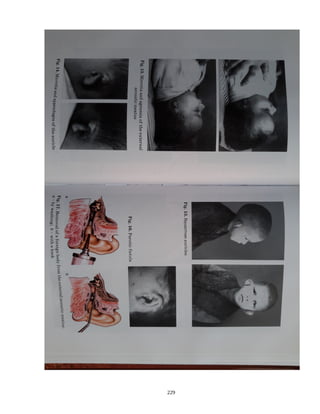
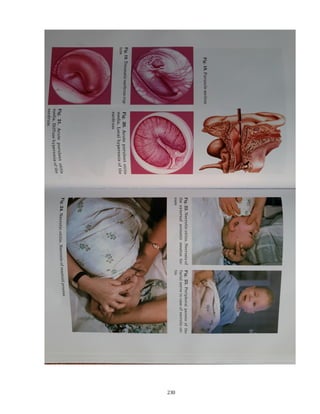
a small, deformed auricle (Fig. 12, 13); anotia – absence of auricle; squarrose auricles
(Fig. 14); auricle appendages – small cutaneous formations, which are located in front
of the auricle and consist of skin, hypoderm and cartilage (Fig. 13); parotic fistulas,
which are frequently located near the base of the crus of helix (Fig. 15).
Auricle anomalies lead to cosmetic defects of the face often accompanied by
hypoplasia (Fig. 12) or agenesia of the external acoustic meatus, can combine with
middle ear hypogenesis.
Maldevelopments of the external acoustic meatus and middle ear lead to the
conductive type of hearing loss.
The treatment of ear maldevelopments is surgical. Plastic operations are to be
performed. In case of macrotia the auricle must be reduced to normal size. When
auricle microtia or underdevelopment is present, a new auricle is to be formed. If
atresia of the external acoustic meatus takes place, a new external auditory canal must
be formed.
4.2. Traumatic injuries of ear
4.2.1. Auricle wounds
There are distinguished traumas of the auricle and traumas of the external
acoustic meatus.
28
Auricle damages are subdivided into gunshot wounds, cut or lacerated wounds,
ruptures and burns. Often there are bite wounds as a result of a dog’s or human bite.
Sometimes partial or complete abruption of the auricle can take place. The external
auditory canal is often injured by different objects: spokes, matches, etc. It often takes
place during combing or ear cleaning.
Treatment. The sooner the injured patient comes to the hospital, the better
treatment results will be. First of all the initial surgical d-bridement of the wound is
conducted. The wound is washed with 3 % hydrogen peroxide, then dried with gauze
tampons. The skin around the wound is treated with iodine and alcohol. The wound
edges are jointed and sutured. In case of complete auricle abruption a plastic operation
is carried out. After it the sutures are processed with iodine or alcohol and a tight
aseptic bandage is applied. Tetanus antitoxin and tetanus vaccine are injected into the
patient. Antibiotics are prescribed. If the patient was bitten by an unknown dog, he
must take a complete course of inoculations against hydrophobia under observation of
an infection disease doctor.
4.2.2. Othematoma
Othematoma is accumulation of blood between the perichondrium and
auricular cartilage. It appears as a result of a blunt injury of the ear, but sometimes
spontaneously. It happens more often to boxers and wrestlers.
Clinical presentation. The auricle skin is purple. The auricle, especially in its
superior part, is thickened. The bulge is elastic, tense, more evident on the anterior
surface of the auricle. On this surface the perichondrium is less densely connected to
the cartilage. Fluctuation is observed. The patient complains of obtuse pain in this
area, sometimes sense shock of the auricle.
Treatment. The ear is processed with iodine or alcohol. Othematoma is
punctured, its contents are drained. A tight compressive aseptic bandage is applied. In
case of suppuration of othematoma contents it is incised. The cavity is washed with
29
antibiotic solution, a rubber drain is inserted with gauze tampons saturated with
hypertensive solution. An aseptic bandage is applied. Antibiotics prescription is
obligatory.
4.2.3. Auricular chondroperichondritis
Auricular chondroperichondritis is purulent inflammation of perichondrium
and auricular cartilage. More frequently it develops as a result of auricular hematoma
suppuration. It can take place after insect bites, burns, frostbite of the auricle.
Pseudomonas aeruginosa is often found by means of bacteriological investigation.
Clinical presentation. Intense pain in the auricle is observed. The auricle
becomes red and thick. The temperature of the patient’s body increases. In serious
cases pus appears between the perichondrium and cartilage. Purulent melting of the
auricular cartilage takes place. Dead tissue tears away, and as a result the auricle
deforms strongly and becomes shrunken.
Treatment. Broad spectrum antibiotics are prescribed. The abscess is incised,
cavities are washed with antibiotic solution. Rubber drains are put in. Gauze tampons
with hypertensive sodium chloride solution are applied to the ear. A pressure bandage
is applied on the ear. The cavities are washed daily with antibiotics to their complete
cleansing, aseptic salve dressings are applied. Such physiotherapeutic procedures as
ultraviolet radiation or therapeutic laser are used.
4.2.4. Frostbite and burns of the auricle
Frostbite of auricle takes place under the action of very low temperature. It
happens more frequently than frostbite of other parts of body because the skin of
auricle is thin and there is no hypoderm.
There are differentiated three stages of frostbite:
1. Erubescence.
2. Formation of blisters with transparent contents.
30
3. Auricle necrosis.
Treatment. At the first stage of frostbite one should carefully rub the auricle
with alcohol and apply dry bulky dressing. At the second stage – conduct section of
blisters. The section is conducted in aseptic conditions. Then antiinflammatory
ointments are applied on the frost-bitten areas. In case of the third degree of frostbite
surgical d-bridement is conducted. Necrotizing areas are removed. One should
appoint antibiotics internally or parenterally depending on the patient’s weight.
Antiinflammatory ointments are used.
Auricle burns are caused by hot water, steam, molten metal, some chemical
substances, electric current.
Four degrees of burns are distinguished.
1. Erubescence.
2. Formation of blisters with transparent contents.
3. Necrotic patches.
4. Charred auricle.
Treatment. Burns of the 1st
–2nd
degrees are treated with antiinflammatory
aerosols. If the burn is of the 2nd
degree, section of blisters is conducted in aseptic
conditions. Antiinflammatory hormonal ointments are used. At burns of the 3rd
–4th
degrees burn shock is possible. Intensive anti-shock therapy is administered. Surgical
removal of necrotizing areas is conducted. Antiinflammatory ointments are used.
Antibiotics are administered.
4.2.5. Injuries of the internal and middle ear
Eardrum damage is the most frequent trauma occurring at peacetime. Eardrum
trauma can be direct or indirect. A direct eardrum trauma happens as a result of
foreign body removal, when the eardrum is injured with a pin or a match during
cleaning of the external acoustic meatus. Indirect eardrum ruptures may be caused by
31
basal skull fracture, a blow in the ear, jumps into the water from a height, rapid
decompression (in divers), petard explosion close by, etc.
Eardrum trauma can be accompanied by onset of a sudden acute pain in the ear,
noise, hearing loss. Otoscopy of the external acoustic meatus detects blood,
hemorrhages, eardrum perforation of different size and form. As a result of eardrum
rupture an infection that can result in the development of acute suppurative otitis gets
into the tympanic cavity.
In case of mastoid process damage infection penetrates the bone causing
osteomyelitis, which is accompanied by the clinical picture of acute mastoiditis.
In case of a middle ear trauma there can be a rupture of the auditory ossicles
chain resulting in hearing impairment of conductive type.
Possible traumas of the labyrinth are direct and indirect. At peacetime the
former are rarely observed, sometimes as a result of surgical interference on the
middle ear. There can be stapes dislocation in the oval window, an injure of the lateral
semicircular canal. Indirect traumas of the labyrinth are observed in case of basal
skull fractures, which include periotic bone fractures and injure of the great blood
vessels of the cranial cavity.
The clinical picture in case of basal skull fractures is characterized by the
syncopal state of the patient. It is possible to detect hemorrhages under the
conjunctiva and in the area of eyelids.
In case of longitudinal fractures of the periotic bone eardrum perforation takes
place, through which blood and cerebrospinal fluid flow. The function of the cochlear
and vestibular apparatus is slightly violated. In case of transverse fractures of the
periotic bone the cochlear and vestibular function is completely impaired and
facioplegia is observed.
Such patients require skull roentgenography, lumbal puncture, eyeground
inspection, and study of the functional state of the cochlear and vestibular apparatus.
32
The labyrinth can be also damaged as a result of acute atmospheric pressure
fluctuations – that is a barotrauma. It happens in divers, pilots of airplanes. Action of
intensive sound causes an acoustic trauma. The cochlea can be damaged during
operations on the middle ear. All this results in the development of sensorineural
hearing loss.
Treatment. Eardrum rupture needs careful adjustment of perforation edges.
With the help of the operating microscope the edges of the ruptured eardrum are
straightened and adjusted. Fibrin tape is applied above the adjusted edges to preserve
their integrity. A sterile turunda is introduced into the external auditory canal.
Antiinflammatory treatment is administered. Such microsurgical interference is
possible only during the first days after the trauma, until suppuration signs appear.
In case of mastoid bone injure surgical debridement is conducted with removal
of the broken bone. The wound is not sutured, it is treated by the open method.
Traumas of the labyrinth caused by basal skull fractures need careful
transportation of the patient. In hospital otorrhagia is stopped by introduction of
sterile turundas into the external auditory canal. In case of heavy bleeding or
meningitis signs surgical interference is conducted on the middle ear.
In case of an acoustic trauma of the labyrinth antineuritic complex therapy is
prescribed.
4.3. Foreign bodies of the external auditory canal
Foreign bodies are more frequently found in children, who push various objects
into the ear. In adults these can be pieces of matches, cotton wool, corn, metal parts,
etc. Different insects can get into the external auditory canal, e.g. cockroaches,
bedbugs.
Clinical presentation. Usually foreign bodies do not cause unpleasant
sensations. But if a foreign body is sharp, it can cause blood-tinged discharge from the
33
ear, pain. Especially acute pain arises if insects get into the ear. There can be cough,
dizziness. Foreign bodies are clearly seen during otoscopy.
Treatment. The ear is to be washed with warm water by means of the Janet’s
syringe. If washing is ineffective, the otolaryngologist removes the foreign body with
a blunt hook (Fig. 16). It is impossible to remove the foreign body with pincers
because this instrument pushes the foreign body deeper into the external auditory
canal.
If an insect gets into the ear, at first it is necessary to stop its movement. For
this purpose alcohol or warmed vegetable oil is applied into the ear by dropping. Then
the foreign body is washed out with a syringe.
4.4. Auricle diseases
4.4.1. External otitis
External diffuse otitis. Otomycosis
Generalized bacteriogenous inflammation of the external acoustic meatus skin
is named external diffuse otitis.
Etiology. The inflammation is caused by staphylococcus, streptococcus,
hemophilic bacillus, blue pus bacillus, etc.
Clinical presentation. Patients complain of pain in the ear, itch, burning. Pain
is less intensive than at a furuncle. Pain in the ear increases at mastication, opening of
mouth, pressure on the tragus – unlike middle otitis, at which pain increases at
pressure on the mastoid process. Origin of the disease is usually related to a
mechanical injury of the ear by a finger or pins, matches and other objects. Often
external otitis arises as a result of skin irritation by purulent discharge at middle otitis.
Otoscopy findings: the skin of the external auditory canal is hyperemic, infiltrated.
The external acoustic meatus is narrow. Transparent excretions, which are interfused
with deadened epithelium, can ooze from the skin. Then excretions can become
34
purulent and form a stinking mass, which fills the external auditory canal. Hearing
can get worse.
Treatment. Tableted antibiotics are administered during 7–10 days.
Antihistaminic and calcium preparations are prescribed. Local administration:
washing-out of the ear with disinfectant solutions. Then the ear is dried with cotton
wool and processed with antibacterial ointments on turundas. Physiotherapeutic
procedures are administered.
Otomycosis is external diffuse otitis caused by fungi.
Clinical presentation. Similar to ordinary external diffuse otitis, but pain is far
less evident. More apparent itch. Otoscopy: hyperemia and skin infiltration are less
evident. Characteristic presence of transparent excretions in the external auditory
canal, there can be yellow-brown or black stratifications on the skin of the external
auditory canal. Duration of the disease is protracted, persistent.
Treatment. Application of turundas with antifungal agents to the external
auditory canal is administered during 1 month. Ultraviolet radiation is prescribed.
Furuncle of the external auditory canal (external limited otitis)
A furuncle is inflammation of a hair follicle or an oil-gland. These appendages
of skin are located only in the membranous-cartilaginous part of the external auditory
canal, they are not present in its osseous part. Therefore, if inflammation takes place
in the osseous part, it is not furuncle but some other disease.
Etiology: bacterial flora, staphylococcus is found the most frequently. The
following factors contribute to disease development: decline of organism resistance,
mechanical irritation of the skin of the external auditory canal, especially in patients
with purulent discharge from the ear. Recurrent furuncles of the external auditory
canal quite often testify to the presence of diabetes and are a manifestation of general
furunculosis.
35
Clinical presentation. Patients complain of acute pain in the ear. Occlusion of
the external acoustic meatus with a furuncle or pus can injure hearing. Body
temperature rises. The regional lymph nodes located under the auricle and on the
mastoid can multiply.
There are 2 stages of the disease:
1. Infiltration stage.
2. Abscess formation.
Otoscopy shows a narrow external acoustic meatus, hyperemic, infiltrated skin
of a limited area of the membranous-cartilaginous part of the external auditory canal.
At the stage of abscess formation it is possible to see an eminence with a white apex
in the center of hyperemia; lancing of the furuncle can show pus in the external
acoustic meatus. Pressure on the tragus and opening of mouth are acutely painful.
Treatment. At the infiltration stage disinfectants on turundas are administered
locally as well as physiotherapeutic methods on the ear. At the stage of abscess
formation furuncle section, pus removal, washing-out of the furuncle cavity with
antibiotic solution are conducted (Fig. 17). Then the cavity is drained with a rubber
strip and gauze turundas saturated with hypertensive sodium chloride solution.
Antibiotics are given by a five-day course. Tableted antibiotics are administered.
4.4.2. Auricle eczema
Auricle eczema is one of local manifestations of a common skin disease –
eczema. This is a neuroallergic inflammation of surface layers of skin with evident
itch.
Clinical presentation. Small transparent blisters appear on the skin of the
external auditory canal and auricle. Then they burst, and on their place multiple small
erosions with abundant oozing lesion appear. After this crusts form on their place. The
acute process lasts 1.5–2 months. There can be chronic eczema.
36
Treatment is aimed at removing the irritating factor and treating concomitant
diseases. Antihistaminic preparations, depressants, calcium preparations, and ascorbic
acid are administered. Locally: antiseptic solutions and corticosteroid ointments are
applied.
4.4.3. Auricle erysipelas
This is an acute streptococcus disease of skin with formation of a sharply
limited inflammation focus. If the skin of the auricle and external acoustic meatus is
affected, we talk about auricle erysipelas.
Etiology: streptococcus, which penetrates through small skin lesions.
Clinical presentation. Body temperature rises. The auricle becomes very
hyperemic, somewhat infiltrated, the external auditory canal becomes narrow.
Treatment. Antibiotics of penicillin group are administered during 7–10 days.
Antiseptic ointments are applied locally. Physical procedures – ultraviolet radiation on
the auricle is administered.
4.4.4. Cerumen
Cerumen is earwax accumulation in the external auditory canal as a result of
surplus secretion of the earwax glands or violation of its normal evacuation. The
increase of earwax viscidity and exostosis promote violation of earwax evacuation
from the external auditory canal. Earwax can have admixtures of epidermis, which
peels as a result of inflammatory diseases of the skin of the external acoustic meatus.
Clinical presentation. Usually there are no evident symptoms. The patient has
to consult a doctor after water gets into the ear, when cerumen is soaked and swelled,
completely obstructing the external acoustic meatus. Hereupon the patient’s hearing
gets worse suddenly. There can be complaints of ear noise, sensation of pressure in
the auditory channel, or sensation of the voice echoed in the head – autophony.
Diagnostics is not difficult. Earwax is usually clearly seen at otoscopy.
37
Treatment. Washing-out of the external acoustic meatus is performed with the
Janet’s syringe. By drawing the auricle back and up, water sheet is directed at the
posterosuperior wall of the external acoustic meatus. Water must have the body
temperature not to cause thermal irritation of the labyrinth and cause no dizziness.
Usually earwax is easily washed. The external acoustic meatus is dried with cotton
wool. On the 2nd
–3rd
hour a turunda is introduced with antiseptic. If the first washing
does not appear effective, it is recommended to apply 3 % hydrogen peroxide by
dropping in the ear 2–3 times per day during 3 days, whereupon to repeat the
procedure.
It should be remembered that at dry perforation of the eardrum water can get
into the tympanic cavity and cause exacerbation of inflammatory process. Therefore
before washing the ear one should carefully obtain anamnesis and find out from the
patient whether there was some time with no purulent discharge from the ear. In such
a case washing is contraindicated and cerumen is removed with a blunt hook.
4.5. Diseases of the middle ear
4.5.1. Acute suppurative otitis media
Acute suppurative otitis media is acute purulent inflammation of the mucous
tunic of middle ear air cavities.
Typical features are:
1. It happens often.
2. Can result in evident loss of hearing.
3. Passes into chronic otitis.
4. Can lead to intracranial complications.
Etiology. Viruses and bacteria cause acute purulent otitis media. These are
viruses, which cause acute respiratory diseases, flu virus. Among bacteria it is more
frequent in all staphylococci, streptococci, pneumococci, hemophilic bacilli,
morhaxella.
38
Pathogeny. The disease develops against the background of depressed
organism resistance.
Infection gets into the middle ear in the following ways:
1. From the nasal cavity through the auditory tube. It often happens at acute
rhinitis.
2. Through the external auditory canal – when the eardrum is damaged. It takes
place at eardrum rupture as a result of a trauma (more frequently after a blow in the
ear; Fig. 18).
At fresh eardrum ruptures such help is rendered: under the operating
microscope the edges of the torn eardrum are adjusted to each other. They accrete
thereupon.
3. Through blood – hematogenic way. This way is basic at infectious diseases –
influenza, scarlatina, etc.
In the pathogenesis of acute otitis media the state of nose, paranasal sinuses,
and nasopharynx plays an important role. Chronic rhinitis, nasal septum deviation,
purulent sinusitis contribute to disease onset.
Clinical presentation. Acute suppurative otitis media is characterized by
stormy development. It has three stages:
1) nonperforated;
2) perforated;
3) reparative.
The symptoms of acute suppurative otitis media depend on the stage.
The 1st
stage. The basic complaint of the patient is pulsing, shooting, stabbing
pain in the ear. Pain is felt deep inside the ear. It is caused by the fact that pus forms in
the tympanic cavity. It holds apart the tympanic cavity walls, presses on the eardrum.
The patient’s condition gets worse. General weakness appears. Sleep and appetite get
worse. Body temperature rises to 38–39º C and higher. Inflammatory changes appear
in the blood test. Otoscopy findings: at first eardrum reddening appears (hyperemia;
39
Fig. 19). The eardrum becomes thick later. When much pus is accumulated in the
tympanic cavity, the eardrum bulges outside (Fig. 20).
The 2nd
stage. Perforation takes place at this stage – that is eardrum rupture.
Purulent discharge exudes from the ear. Pain gets better in the ear, general condition
improves, body temperature decreases. Otoscopy shows the pulsating reflex – pus
exudes through the perforation drop by drop synchronously with pulse.
The 3rd
stage. The inflammatory process subsides, purulent discharge stops.
The eardrum recovers normal color. Still, hearing impairment remains. Hearing is
restored slowly. Small perforation heals completely leaving no scars. Large
perforation can not be closed up.
In children acute otitis media arises more often. This is predefined by the
anatomic features of the children’s ear. The disease usually begins suddenly, at night.
Body temperature is very high – 39–40º C. The child feels uneasy, twists the head
round, seizes the affected ear with a hand. General condition gets considerably worse.
Babies can have vomit, gastroenteric upset.
At infectious diseases the clinical course of acute otitis media also has its
peculiarities. The severest changes in the ear are observed at scarlet fever. Necrosis
begins in the ear (Fig. 21, 22, 23). All middle ear structures disintegrate. The auditory
ossicles are destroyed. Excretions from the ear begin to stink. There is hemorrhagic
otitis at influenza. Blood accumulates in the tympanic cavity. Blisters with bloody
content form on the eardrum and osseous part of the external auditory canal (Fig. 24).
At tuberculous otitis there are numerous eardrum perforations, malodorous pus
(Fig. 25).
Treatment depends on the stage of the disease.
The 1st
stage. Home or bed rest is prescribed. At severe condition
hospitalization is administered. The diet is vitaminized, which is easily digested.
Antibiotics and vasoconstrictive nasal drops are administered. Analgesics are used.
Antihistaminic and calcium preparations are prescribed. Antibacterial ear drops are
40
used. At the beginning of the disease, when there is no pus in the tympanic cavity yet,
physiotherapeutic methods are applied. But when pus appears in the tympanic cavity,
physiotherapeutic procedures are contraindicated.
Severe pain in the ear, eardrum prolapse are indications to the auripuncture or
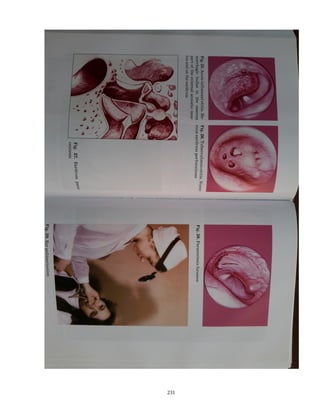
paracentesis (Fig. 26, 27). The eardrum is punctured with a special spear-shaped
needle. Pus is aspirated. Antibiotic solution is introduced with a syringe into the
middle ear cavity. Solution penetration into the nasopharynx testifies to the fact that
the otosalpinx is free. The patient admits that the taste of medicine appears in the
mouth or nose.
The 2nd
stage. At the perforating stage of otitis the ear is to be cleaned 2–3
times a day with dry cotton wool on an ear probe. Use 3 % hydrogen peroxide to
soften pus. Usually the ear is cleaned with an aspirator. After this antibacterial drops
on turundas are introduced into the ear. A turunda is to be brought deeply into the
external auditory canal, up to the eardrum.
The 3rd
stage. At the reparative stage treatment consists in rehabilitation of ear
functioning. Ear inflation is conducted as well as otosalpinx catheterization and
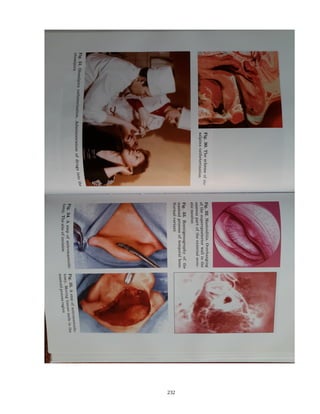
eardrums pneumomassage (Fig. 28, 29, 30).
4.5.2. Mastoiditis
Mastoiditis is a purulent inflammatory disease of the mastoid bone. More
frequently it arises as a complication of acute otitis media, or develops at exacerbation
of chronic otitis media.
Organism reactivity decrease is one of the factors of disease onset. Inefficient
treatment of acute otitis – too late auripuncture or paracentesis – also results in
mastoiditis development.
Clinical presentation. General and local symptoms of mastoiditis are
distinguished. General symptoms are the same as at acute suppurative otitis media.
Body temperature rises. The patient feels worse. Blood test shows inflammatory
41
changes. Unlike acute otitis, pain in the ear does not get better even when perforation
takes place. Pain is very intensive, pulsating. Local symptoms are the following.
1. Pain at pressure on the mastoid.
2. Slight swelling of the mastoid, sticking out auricle.
3. Otoscopy: purulent discharge increase. Pus pulsation recommences, pus
becomes thick. Characteristic symptom: overhang of the superoposterior wall of the
osseous part of the external auditory canal (Fig. 31).
4. Sometimes pus can break from the mastoid outside. Thus subperiosteal
abscess develops. It can result in formation of a fistula, through which pus will ooze.
There can be an atypical course of mastoiditis. Then there is no eardrum
perforation and purulent discharge from the ear.
In children of the first year of life the mastoid structure has peculiar features.
Therefore antritis is talked about – inflammation of the mucous tunic of the mastoid
cavity.
Valuable information for diagnosis verification is provided by CT or
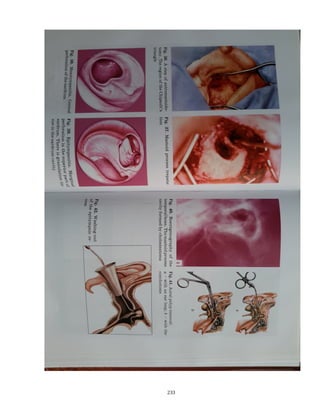
roentgenography (Fig. 32).
Treatment. Conservative and surgical types of mastoiditis treatment are
distinguished. Conservative treatment is the same as at acute otitis media of the
second stage. Ear cleaning is conducted, disinfectants are applied by dropping into the
ear. Antibiotics prescription is obligatory, preferably intramuscularly.
Antiinflammatory medicines are administered, such as aspirin. Antihistaminic
medicines, vitamins, and calcium preparations are prescribed.
If these measures are ineffective, elective operation is to be conducted –
mastoid trepanation (mastoidotomy; Fig. 33, 34, 35, 36).
In case of subperiosteal abscess or development of intracranial complications
the operation must be conducted urgently, without waiting.
In children antritis is treated by mastoideocentesis – puncture of the mastoid
cavity with diagnostic and medical purposes.
42
4.5.3. Chronic purulent otitis media
Chronic purulent otitis media is a long-term inflammatory infectious disease
of the middle ear cavities, which has a clinical course with periods of remission and
exacerbation. Beginning of the disease is related to acute otitis the patient had in
childhood.
Disease outcome:
1. Hearing loss.
2. Facial paralysis, labyrinthitis.
3. Life-threatening ntracranial complications.
Etiology. Staphylococcus or mixed microbial flora, moulds.
Pathogenesis. High virulence of microorganisms and weakened resistance are
instrumental in transition from acute otitis to chronic. The presence of other
concomitant diseases is of great importance. The state of the nasal cavity, paranasal
sinuses and pharynx play a certain role. Quite frequently recurrent acute suppurative
otitis media passes to chronic.
Clinical presentation. Obligatory signs are as follows:
1. Long-term purulent discharge from the ear. The disease lasts for years.
2. Constant eardrum perforation with callous edges.
3. Hearing impairment, ear noise.
The disease may have two forms: mesotympanitis and epitympanitis.
Mesotympanitis is a benign form of chronic otitis. At mesotympanitis the
middle and inferior parts of the tympanic cavity are affected. Patients complain of
purulent discharge from the ear and hearing impairment. Pain in the ear appears only
in the period of exacerbation. General condition is not violated in the period of
remission. During exacerbation purulent discharge from the ears increases. Pain
appears in the ear, febricula. Body temperature rises. Blood test shows inflammatory
changes.
43
Diagnosis is determined on the basis of otoscopy. There is odourless
mucopurulent content in the external auditory canal. Sometimes excretions from the
ear can have objectionable odor. It happens in slipshod patients, because of bad ear
hygiene. After washing and careful care of the ear an unpleasant smell disappears.
The eardrum has almost normal color. Eardrum perforation is central. It means that
around the perforation the eardrum limbus is preserved (Fig. 37). Perforation can be
large. Then it is possible to examine the tympanic cavity through it. Pus and thickened
mucous tunic will be visible in the tympanic cavity. Granulations are possible. Large
granulation has the name of aural polyp. A polyp can be large, it can even block the
external auditory canal. This results in pus deposit in the middle ear cavities and leads
to complications. In such a case polyp removal is the first aid.
Hearing gets worse at mesotympanitis. Sound transmission is violated. It can be
determined by audiometry.
Epitympanitis (attic disease) is a poor quality form of chronic otitis. At this
form there is destruction of the bone walls of the middle ear cavities. It can lead to
severe complications. At epitympanitis the superior floor of the tympanic cavity is
necessarily affected. Other floors can also be affected. The main feature of
epitympanitis is affection of not only the mucous tunic of the tympanic cavity, but
also of the bony structures. Bone affection is named caries.
Patients have the same complaints as at mesotympanitis. Besides, they can
complain of headache and dizziness. In the period of remission general condition is
satisfactory. Temperature rises during exacerbation, pain appears in the ear. The
patient feels febricula. Purulent discharge from the ear increases. Blood test shows
inflammatory changes.
Diagnosis is determined on the basis of otoscopy. At epitympanitis there is pus
in the external auditory canal. The amount of pus is often small. Pus always has
unpleasant smell. It takes place as a result of bone caries. Unpleasant smell is the
same as at teeth decay. Abundant excretion at epitympanitis is observed in two cases:
44
first – at cholesteatoma suppuration; second – at extradural abscess, when pus is
accumulated between the bone and dura mater of brain. Excretions are abundant,
malodorous, appear shortly after ear cleaning. In such cases the ear must be operated.
Eardrum perforation at epitympanitis is marginal. It reaches the bony
eardrumtympanic ring. The perforation necessarily takes part in the superior part of
the eardrum (Fig. 38).
Epitympanitis is characterised by the presence of a passage in the epitympanic
recess. One should conduct perforation probing with the Wojaczek ’s probe. If there is
a passway, the probe easily falls into the attic.
One of epitympanitis complications is cholesteatoma – stratification of furfures
and cholesterol. It has a shell. Cholesteatoma in the ear is an inflammation product. It
often festers. The danger of cholesteatoma consists in bone destruction. Depending on
the direction of cholesteatoma growth it can ruin the Fallopian aqueduct, external
semicircular canal, superior wall of the tympanic cavity or mastoid. Then there is
facial paralysis, labyrinthitis or intracranial complications.
Roentgenological study helps to detect cholesteatoma. A roentgenogram of the
temporal bone is made in the Schuller’s view (Fig. 32, 39).
Ear affection at epitympanitis is more evident than at mesotympanitis. Except
for sound conduction violation, violation of sound sensation takes place. Audiometry
shows it.
In most patients chronic otitis media has an allergic component.
Complex research of a patient with chronic otitis media must include
consultations of a neurologist and an oculist. It is necessary to timely diagnose the
origin of intracranial complications. There must be conducted X-ray study of the
temporal bone and audiometry.
Treatment. Common medical measures include organism hardening. The
measures are taken to strengthen general reactivity of the organism. Calcium
45
preparations, vitamins, and antiallergic preparations are administered. Routine
common uviolizing, rational nutrition are recommended.
Antibiotics are used only at exacerbation of the process.
Necessarily inspect the nose, nasopharynx and pharynx, paranasal sinuses.
These organs are sanitized if it is necessary.
Local treatment of chronic otitis media consists of two stages.
1. Ear cleaning.
2. Introduction of medications into the tympanic cavity.
Before local treatment granulation and polyps are removed from the tympanic
cavity. Large granulation or ear polyps are removed with the conchotome, curet or
loop (Fig. 40). Small granulation is cauterized with silver nitrate.
The 1st
stage. Ear cleaning. 3 % hydrogen peroxide is applied by dropping into
the ear. Pus is removed with an ear probe and cotton wool. It is possible to wash pus
from the tympanic cavity with disinfectant solutions. For pus softening the ear is to be
washed with enzymes. At presence of large perforation, washing is carried out with
the Janet’s syringe. To wash the attic use the Hartman’s canula (Fig. 41). After
washing carefully dry the ear with an ear probe with cotton wool, or with a blunt
canula connected to an aspirator. Careful ear cleaning guarantees successful treatment.
The 2nd
stage. Introduction of medications into the tympanic cavity. Substances
are introduced into the tympanic cavity in such medical forms: 1) solutions (drops); 2)
powders; 3) ointments. Mainly these are exsiccants.
Alcoholic solutions of antiseptic preparations are used. Solutions of antibiotics
are administered upon obtaining results of ear microflora analysis on antibiotics
sensitivity. Astringents are used, e.g. 1–2 % nitric silver solution.
After ear cleaning it is possible to blow powders into the tympanic cavity: boric
acid, antibiotics, sulfanilamides. Insufflations are conducted carefully, not to inject
surplus powder.
46
Purulent otitis media of mycotic origin is an otomycosis variety. Antifungal
agents are used to treat it.
At allergic manifestations of otitis antiallergic and corticosteroid drops are
used.
To treat chronic otitis media varied physiotherapeutic procedures are used –
electrophoresis with antibiotics, 1–2 % solution of nitric silver solution. Ultraviolet
radiation and aeroionotherapy are applied on the ear. Mud therapy is used: mud
applications on the mastoid. Mud therapy application is possible only in the period of
remission. At otomycosis laser is used.
Medicinal substances, which are introduced into the ear, must be changed every
2–3 weeks. Durable use of alcoholic solutions is not advisable.
The main recommendation to patients with chronic otitis media – to protect the
ear from water. During bathing or washing of hair the patient must close the ear with
cotton wool soaked with vaseline, olive oil, or any other ointment.
The described treatment is used more frequently at mesotympanitis.
At epitympanitis it is also possible to begin with conservative treatment.
However, surgical method is basic in epitympanitis treatment.
One should distinguish two types of operations in the surgical treatment of
chronic otitis media.
1. Sanation operations. Radical operation is basic. It eliminates the purulent focus in
the ear. Its purpose is to prevent intracranial complications.
2. Hearing improvement operations – tympanoplasty. Five types of tympanoplasty are
distinguished by Wulstein.
4.5.4. Labyrinthitis
Labyrinthitis is a complication of acute and chronic otitis media. It is an
inflammatory infectious disease of the inner ear. Infection from the middle ear cavity
gets into the inner ear and causes an inflammatory process in it. Rarely labyrinthitis
47
can arise as a result of meningitis or an infectious disease (for example, epidemic
parotitis).
Etiology. The direct reason for labyrinthitis is microbes, which are causative
agents of acute and chronic otitis media. Necrotizing labyrinthitis usually arises at
tubercular or scarlatinal otitis.
Classification. Acute and chronic types of labyrinthitis are distinguished. There
are the following forms of acute and chronic labyrinthitis:
a) erosive;
b) purulent;
c) necrotizing.
Chronic labyrinthitis is subdivided into:
1) limited;
2) diffuse.
Diffuse labyrinthitis is a process, which affects all structures of the inner ear.
Limited – a process, which affects a part of the labyrinth only. Limited labyrinthitis
arises, when there is a fistula in the lateral semicircular canal. A fistula appears as a
result of caries.
We will describe labyrinthitis forms.
Limited labyrinthitis is observed at chronic otitis media complicated by caries
and cholesteatoma. The bony capsule of the lateral semicircular canal gradually
collapses and a fistula is formed.
Clinical presentation. Patients complain of periodic dizzinesses accompanied
by nausea or vomit, unbalance. Nystagmus can appear – rhythmic horizontal
twitching of the eyeballs. Nystagmus is directed at the affected ear. If dizziness is
present, the patient complains of rotation of surrounding objects or his own body in
one direction.
The symptom of fistula is another important sign. Nystagmus appears if the
tragus is pressed with a finger. This nystagmus is named pressure nystagmus. The
48
eyeballs begin twitching to the affected side. Sometimes nystagmus is caused by
cleaning of the ear with a cottonwool tampon. At this moment the patient feels
dizziness. The nystagmus caused by irritation of the labyrinth is accompanied by
dizziness, nausea and declining or falling to the side, opposite to the affected ear.
At limited labyrinthitis hearing is not necessarily impaired. Hearing loss
depends on the presence of inflammatory process in the middle ear. Vestibulometry
allows confirming the diagnosis.
After a sanation operation on the ear the process is usually stopped. Self-
recovery without operation is rarely observed.
Treatment of limited labyrinthitis. At exacerbation of the process bed rest,
antibiotics, sulfanilamides, and dehydratation are administered. Sanation operation is
conducted on the middle ear.
Acute diffuse serosal labyrinthitis can develop at acute middle otitis or
exacerbation of chronic otitis media.
Clinical presentation. The auditory and vestibular functions are violated.
Evident lowering of the ear is characteristic. Nystagmus appears. At first it is directed
at the affected ear, then it changes direction and to the opposite site. Dizziness, nausea
and vomit appear. Equilibrium is violated. Vestibular symptoms are most evident.
Dizziness increases and is accompanied by vomit at the change of head position. At
dizziness the patient feels rotation of objects or his body. Vestibulometry allows
confirming the diagnosis.
Treatment. Rest, antiinflamatory and dehydration therapy are administered. At
acute middle otitis medicinal treatment often leads to convalescence. At mastoiditis
and chronic otitis media routine surgical treatment is used. Sanation operation is
conducted on the middle ear. If it is not conducted, intracranial complications may
take place. Operation is conducted immediately against the background of antibiotic
treatment.
49
Acute diffuse purulent labyrinthitis. This form of labyrinthitis has an
extraordinarily severe clinical course and complications. It always ends with complete
loss of hearing and vestibular function. In addition, intracranial complications may
arise. Meningitis and cerebellum abscess can develop.
Clinical presentation. Beginning and clinical course of the disease are stormy.
Evident dizziness, nausea and vomit, acute balance disturbance, spontaneous
nystagmus are basic symptoms. Complete and irreversible loss of the auditory and
vestibular functions happens very quickly – that is the difference between purulent
and serosal labyrinthitis. At the beginning of purulent labyrinthitis nystagmus appears
directed at the affected ear, but already in a few hours nystagmus changes its
direction.
At unfavorable clinical course there can be complications – meningitis,
cerebellum abscess.
Treatment. Operation is conducted immediately against the background of
antibiotic treatment.
Necrotizing labyrinthitis is observed mainly at scarlatinal and tubercular
otitis, sometimes at rubeola. Due to antibiotics use it is observed rarely.
Clinical presentation of necrotizing labyrinthitis is similar to the clinical
presentation of purulent labyrinthitis, but the clinical course is severer.
Necrotizing labyrinthitis is an indication to operation on the ear with
interference on the labyrinth.
4.6. Otogenic intracranial complications and otogenic sepsis
Otogenic intracranial complications are severe, life-threatening diseases. They
arise because of penetration of infection from the ear into the cranial cavity. It takes
place in case of acute and chronic otitis media. Meningitis or meningoencephalitis
frequently arises against the background of acute purulent otitis media. More
frequently otitis is complicated by meningitis. Rarer abscesses of the brain and
50
cerebellum develop. Even rarer there are sigmoid sinus thrombosis and otogenic
sepsis. Sometimes there can be a few complications simultaneously, for example sinus
thrombosis and cerebellum abscess, or meningitis and abscess of the cerebral
hemispheres.
Etiology. The reason for otogenic intracranial complications is the same
microbes, which cause otitis. Staphilococci, streptococci, and pneumococci prevail in
case of acute otitis. In case of chronic otitis – also certain Proteus, Pseudomonas
aerogenosis, etc.
Pathogenesis. Depending on the stages of infection spread from the ear into the
cranial cavity abscesses may be located above the dura mater (extradural abscess) and
between the brain tunics (subdural abscess). The inflammatory process can pass to the
venous sinus. As a result sinus thrombosis forms. If infection penetration is deep,
disseminate meningitis develops. If the process spreads, the cerebrum tissue can be
affected.
It results in the formation of cerebral hemispheres and cerebellum abscesses
(Fig. 42). We will consider basic types of otogenic intracranial complications.
Otogenic disseminate purulent meningitis is brain tunic inflammation. The
arachnoid and vascular membranes are affected. The infection penetrates from the
middle and internal ear. Meningitis can arise due to other otogenic complications, for
example sinus thrombosis.
Clinical presentation. Headache is the most frequent and the first symptom of
otogenic meningitis. Headache is very intensive. The reason for this is intracranial
pressure rise. Any external irritation increases pain. For example, touching the
patient’s skin, loud sounds, bright illumination. Therefore such a patient must be
treated in certain conditions without such irritations. Nausea and vomiting are the next
symptoms. Frequently they appear at the height of headache and are not connected
with food intake. Quite often vomiting temporarily improves headache.
51
The general condition of the patient is grave. At later stages loss of
consciousness passing to delirium can appear.
Quite often patients assume the position of a gun cock or a hunting dog. They
lie on the side or on the back with bent feet and thrown back head. The patient
reflexively assumes the given position because it relieves headache.
Body temperature is permanent, it rises to 38.5–39° C and higher. Pulse is rapid
and corresponds to body temperature.
Meningitis is characterised by meningeal symptoms:
1. Neck muscles rigidity. The doctor places the hands under the patient’s
head and flexes it forward. In case of meningitis the patient’s neck flexes badly.
The chin does not reach the breastbone.
2. The Kernig’s symptom. The patient is lying on the back, legs bent in the
hip and knee joints. Try to unbend the leg in the knee joint. In case of meningitis
the leg can not be unbent completely.
3. The Brudzinski’s symptoms superior and inferior. During research of
neck muscles rigidity the patient’s legs are bent and pulled up to the abdomen. It is
the superior Brudzinski’s symptom. The inferior symptom: during extension of a
patient’s leg the other leg bends in the knee and hip joints.
In case of severe course of the disease there is observed eyeballs bulging,
differently sized right and left orbits.
Diagnostics. Blood test data of meningitis patients show inflammation signs.
During eyeground examination stagnation is determined.
Research of the cerebrospinal fluid taken by spinal puncture has a large value
for meningitis diagnostics. Characteristic fluid changes are found in meningitis
patiens.
Otogenic sepsis. In case of purulent middle ear inflammation, both acute and
chronic, infection is generalized, microbes get into the blood. There is sepsis. It is
more frequent as a result of sinus thrombosis.
52
Clinical presentation of otogenic sepsis and sigmoid sinus thrombosis. The
symptoms observed in case of this disease are divided into two groups:
1. General symptoms, characteristic of sepsis of any nature.
2. Local symptoms conditioned by sigmoid sinus affection.
General symptoms. One of the most expository sepsis symptoms is hectic
fever. There is rapid increase of body temperature to 39–41° C, accompanied by chill.
Then in a few hours temperature quickly (critically) falls. Temperature drops are
accompanied by profuse sweat. There can be several rises of temperature during the
day, therefore the patient’s temperature must be taken every 2 hours. Body
temperature of younger children is permanent. Pulse accelerates according to the rise
of body temperature. The patient’s skin is pale with a sallow tint. It can be sclera
jaundice.
There are changes characteristic of an inflammatory process in the blood test.
Bacterial inoculation of blood is very important. In case of sepsis microbes can be
found in blood. Blood for the test is to be taken during chill when body temperature
rises.
At otogenic sepsis microbes spread in the blood vessels and settle in other
organs. There are abscesses in the lungs, joints, subcutaneous adipose tissue, and
muscles. More frequently patients die from pulmonary complications.
Local symptoms: there is edema and pain of soft tissues on the posterior margin
of the mastoid, painful neck palpation on the affected side. Often the patient’s head is
flexed toward the injury.
Otogenic abscesses of the cerebral hemispheres and cerebellum are abscesses,
which appear in the brain and cerebellum because of purulent otitis media.
Clinical presentation. There are four stages of the clinical presentation of
abscess:
53
1. The initial stage lasts for 2–3 weeks. The inflammatory process is
characteristic. There are light meningeal symptoms: headache, sickness, body
temperature rise, nausea, and vomiting.
2. The latent stage also lasts for 2–3 weeks. At this stage all symptoms either
disappear generally, or declare themselves weakly.
3. The frank stage lasts for a few weeks. It is characterized by a large variety of
symptoms. The patient feels weakness, appetite absence, exhaustion. Body
temperature rises. Blood test shows inflammatory changes. However, these
manifestations are considerably less evident than in case of meningitis and sepsis.
There is headache, which increases during pattering with a finger on the skull above
the area, where abscess is located. There is nausea and vomiting, which are not related
to food intake. Pulse slows down to 45 bpm. The ophthalmologist determines
stagnation on the eyeground. Cervical muscles rigidity and the Kernig’s symptom can
appear.
If abscess is located in the cerebral hemispheres, there will be paresises and
paralyses of extremities. There can be facial paresis, when the face becomes
asymmetric. There are cramps and other neurological symptoms. The patient falls on
the side opposite to the affection. There can be dizziness. Hallucinations take place.
The patient’s speech is violated. Sometimes it becomes incomprehensible, just
senseless words. The patient can forget how to read and write.
There are such symptoms of cerebellum abscess. Muscle tone of extremities
decreases on the side of affection. The patient’s hand resists poorly during unbending.
During examination of walking and Romberg’s position the patient bends to the
affected side. Impossibility of flanking gait on the affected side is characteristic.
During the pointing test the patient can not touch the tip of nose with the hand. The
hand deviates to the affected side on the side of injury. There is spontaneous
nystagmus directed at the affected side.
54
Abscesses of the brain and cerebellum can lead to impairment of consciousness,
breathing and cardiac activity.
4. The terminal stage of brain abscess. It is the last stage of abscess. Usually
lasts for a few days and leads to patient’s death. Brain edema develops. The patient’s
condition gets worse sharply. Intoxication becomes more intensive. Breathing and
cardiac activity stops, the patient dies.
Diagnostics of brain and cerebellum abscess. There are such modern methods
of diagnosing these complications:
1. Echoencephalography.
2. Radioisotopic encephalography.
3. Computer tomography (CT) and magnetic resonance tomography (MRT).
Medical treatment of intracranial complications. Mainly otolaryngologists
and neurosurgeons administer medical treatment of patients with otogenic intracranial
complications. However, neurologists, internists, pediatricians, infectiologists, and
oculists must take an active part in the treatment.
Medical treatment of patients with otogenic intracranial complications includes
surgical interference and intensive drug therapy.
Surgical interference directed at removal of purulent nidus from the middle ear
and complication elimination. In case of acute purulent otitis media operation is
conducted – extended antromastoidotomy. In case of chronic purulent otitis media
extended radical surgery is performed. At otogenic meningitis the middle and
posterior cranial fossae are dissected during the operation.
If sigmoid sinus thrombosis and otogenic sepsis are present, an operation on the
ear is performed. The posterior cranial fossa is necessarily opened. The sigmoid sinus
is punctured. If it is necessary, the sigmoid sinus is opened and the blood clot is
removed.
In case of otogenic brain and cerebellum abscesses the otolaryngologist
conducts antromastoidotomy or a radical operation. Then he opens the posterior or
55
middle cranial fossa and punctures the brain tissue. After this the doctor opens the
abscess and inserts drainage tube in the needle direction. If abscesses are plural or the
abscess is located far from the affected ear, the abscess is opened by the
neurosurgeon.
Simultaneously with surgical treatment intensive drug therapy is administered.
1. Antibiotics are prescribed. Ceftriaxon, ceftazidime, vancomycin, metrogyl,
penicillin in large doses introduced in injections.
2. Antiedemics are introduced intravenously. These are haemodez-N, blood
plasma, albumen, mannitol, lasix, 40 % glucose solution, 10 % solution of sodium
chloride, hexamethylenetetramine (urotropin), 5 % solution of ascorbic acid, retinol
(vitamin A), hydrocortisone. Arterial pressure is controlled.
3. Antiallergic drugs are introduced intramuscularly. These include dimedrol,
pipolphen, suprastin, etc.
4. During psychomotor agitation sodium oxybutyrate and seduxen are
introduced intravenously with 40 % glucose solution.
5. In case of staphylococcus infection immunotherapy is conducted.
Antistaphylococcic immunoglobulin is introduced intramuscularly.
6. Cardiac glycosides, analeptical drugs, anesthetics (in case of necessity) are
administered.
7. All patients with otogenic meningitis suspected must undergo spinal
puncture. Antibiotics are introduced into the spinal canal in case of need.
8. Heparin, syncumar, and neodicumarinum are administered using the
guidance of coagulogram to treat sigmoid sinus thrombosis.
It is very important to fight against brain edema. Use mannitol, 40 % glucose
solution with insulin, magnesium sulfate, lasix intravenously. Steroids are
administered: prednisolone, hydrokortisone or dexamethasone. Introduce 5 % solution
of ascorbic acid, 10 % solution of calcium chloride intravenously. Introduce
56
aminophylline, trental intravenously to improve cerebral circulation. Introduce
sodium oxybutyrate, glutamic acid, thiopental sodium intravenously (slowly!).
4.7. NONPURULENT EAR DISEASES
These diseases include reflux otitis media, otosclerosis, sensoneural hearing
loss, Meniere’s disease.
The diseases have such symptoms:
1) hearing disorder;
2) ear noise;
3) no signs of purulent ear inflammation.
At the same time these diseases substantially differ from one another.
4.7.1. Reflux otitis media. Secretory otitis media
The basic cause of the disease is auditory tube dysfunction.
Reflux otitis media is characterized by inflammation of the mucous membrane
of the middle ear, auditory tube obturation, loss of hearing, and (quite often) presence
of liquid in the middle ear.
Pathogenesis. The auditory tube connects the middle ear and the nasal cavity.
Various inflammatory diseases of the nasal cavity, like rhinitis, sinusitis, adenoid
affection, may result in reflux otitis media. Swelling of the auditory tube mucosa
obstructs air flow passing through the tube to the tympanic cavity. As a result,
pressure in the tympanic cavity becomes negative, tympanic membrane bending
forms, the middle ear mucosa swells. Quite often this causes production of liquid,
called exudate, in the ear cavity. Exudate accumulates in the middle ear, developing
secretory otitis media. The allergic component plays an important part in the
development of secretory otitis media. Persistance of secretory otitis media may lead
to the formation of adhesions in the tympanic cavity, developing adhesive otitis.
57
Clinical presentation. The main complaints of the patient are hearing loss and
low frequency noise in the ear, resembling that of the sea or forest. Patients may also
have the sensation of fullness and fluctuation in the ear. Hearing may improve or
worsen spontaneously, during sneezing or swallowing. In rare cases, the patient’s ear
may be slightly sore. General condition of the patient is practically normal.
Otoscopy shows that the tympanic membrane is grey or pink, depressed.
During secretory otitis media one might see the level of liquid or air bubbles in the
liquid.
Audiometrically – conductive type of hearing loss. Impedometry is another
important diagnostic method, which enables to differentiate secretory otitis media
from auditory tube dysfunction as well as other middle ear pathologies.
Reflux otitis media treatment. Basic treatment is sympathomimetic solution
drops (such as naphthizin, mesatone, nazol, etc.) as well as antihistamines, calcium,
vitamins. Physiotherapheutic procedures, such as ultraviolet rays, “Luch 2”, dimedrol
electrophoresis in the nose, calcium chloride and antibiotics.
Politzerization can be used to recover auditory tube patency. If it is
unsuccessful, the Eustachian tube may be catheterized. Various medications can be
introduced into the middle ear through a catherter. Eardrum massage by the Ziegle’s
method may also be effective.
If there is exudate in the middle ear, the tympanic membrane is punctured. If
exudate reaccumulates, paracentesis and shunting of the tympanic cavity should be
done. The shunt can be left in the ear for several months. In case of adhesive otitis
intramuscular injection of lidase or lidase electrophoresis on the mastoid should be
conducted.
Sanation of the nose, paranasal sinuses and larynx is necessary during the whole
period of reflux otitis media treatment.
4.7.2. Otosclerosis
58
Otosclerosis is a progressive dystrophic process in the ear labyrinth.
Otosclerosis causes stapes immobilization. The disease is considered to be heritable
and women are most likely to be affected.
Clinical presentation: loss of hearing and permanent, loud, annoying noise in
the ears, which is especially hard for patients, more than at any other ear disease.
Noise has a low frequency and is often compared to that of a generator. Loss of
hearing is usually bilateral, but might as well be on one side only.
Characteristic symptoms of otosclerosis are:
1) improvement of hearing, while being in a noisy environment;
2) deteriorated understanding of spoken speech during swallowing or
chewing.
Some patients complain of short-term dizziness during motion, rapid head
movements forward or backwards.
Otosclerosis has a characteristic otoscopic picture. The auditory canals are
widened. The skin in the osseous part of the external auditory canal is thin and easily
damaged, without serum. The eardrum is thinned, the external wall of the tympanic
membrane, resembling a pink spot, can be seen through it.
Otosclerosis is mainly diagnosed by testing of hearing. In the audiogram,
hearing loss is characteristically low-frequency, with higher frequencies being
affected later. Patients with otosclerosis must necessarily undergo impedometry.
Vestibulometry may also be used as an additional diagnostic method.
Treatment. The basic treatment for otosclerosis is surgical. Surgery is
conducted under a microscope, with special surgical instruments.
Conservative treatment is less effective and is only used in case if, for some
reason, surgery can not be conducted. Sodium fluoride is given orally for 1–3 years.
Electrophoresis of sodium fluoride in combination with vitamine C on the mastoid or
in the ear, as well as electrophoresis of magnesium sulfate in the ear may be used.
59
4.7.3. Sensoneural loss of hearing
Sensoneural loss of hearing is an inner ear disease characterized by impaired
sound perception due to the damage of spiral organ cells in most cases.
Etiology. Causes of the disease can be different:
1. Infection: upper respiratory infection, influenza, meningitis, syphilis, epidemic
parotitis. Quite often – acute otitis media.
2. Damage due to intoxication:
a) by industrial poisons – mercury, lead, phosphorus, arsenic, petrol;
b) medications – quinine, salicylates, gentamicin, streptomycin, kanamycin,
neomycin, amikacin.
3. A trauma: injury of the cranial axis, barotrauma in divers, acoustic trauma due
to exposure to very high noise; vibration trauma.
4. Vascular disorders: essential hypertension, atherosclerosis, neck
osteochondrosis.
5. Intracranial tumor.
6. Allergy.
7. Hereditary diseases.
8. Hearing impairment in the elderly.
9. Congenital abnormalities.
Clinical presentation. Hearing loss and high frequency ear noise resembling a
slight squeak, crack or ringing. Rarely patients complain of disequilibrium and
dizziness. General condition is usually normal. Otoscopic picture without significant
changes. There is a common joke that during sensoneural hearing loss the doctor can
not see anything while the patient can not hear anything.
Diagnosis is confirmed by testing hearing ability, mainly by behavioral
audiometry. Audiogram shows sound perception dysfunction. Diagnosis can also be
confirmed by impedometry.
60
Treatment. Effectiveness of treatment depends on how long the patient has
been affected. If sensoneural hearing loss occurred acutely, suddenly, the patient has
to be urgently hospitalized. In case of chronic sensoneural hearing loss conservative
treatment is usually ineffective.
Treatment should be complex and consists of several components:
1. Elimination of the disease reason.
2. Medications used to treat neuritis:
1) vitamins of group B, A, E;
2) cocarboxylase;
3) ATP;
4) aloe, Fibs, apilac;
5) nicotinic acid, papaverine, dibasol;
6) trental, cinnarizine, stugeron;
7) proserin, galantamine;
8) unitol;
9) magnesium sulfate;
10) heparin;
11) prednisolone;
12) rheopolyglucin;
13) cavinton;
14) 5 %glucose solution, isotonic solution of sodium chloride;
15) etroma-30;
16) preductal;
17) tanakan.
3. Hyperbaric oxygenation.
4. Reflexotherapy – needles, laser.
5. Magnetotherapy.
61
In case of ineffectiveness of above listed methods, the following means of
treatment are used:
1. Reeducation (“education”) of hearing.
2. Hearing aids used to amplify the incoming sound.
3. Polysensor training.
4. Electronic cochlear implants. Practically deaf patients have
electrodes connected to a special device implanted in the cochlea.
4.7.4. Meniere’s disease
This disease was first described by French physician Meniere in the 19th
century. Meniere’s disease affects the inner ear and is usually manifested by attacks of
dizziness, ringing in the ears and loss of hearing. Reason for the disease is edema
(hydrops) of the labyrinth.
Clinical presentation. Clinically the disease is manifested with a recurrent
group of symptoms, including dizziness, disequilibrium, nausea, vomit, change of
heart activity, skin paleness, cold sweat, progressive deafness. Patients have a
sensation of pressure in the ears during the attack. The disease may affect only one ear
or both. If in the period between attacks hearing worsens, it impairs more during an
attack. Characteristically, hearing dysfunction usually advances disequilibrium. That
is, before the attack of dizziness a hearing aura may occur letting the patient know
that an attack will follow. Spontaneous nystagmus may be observed during the attack.
Attacks usually last for a couple of (usually 2–8) hours. However, duration may
vary from less than an hour to several weeks. There are always periods of remission
between attacks and they also have different duration. Attacks may occur everyday or
once in a few years. Sensation of dizziness is completely absent during remissions.
Loss of hearing, however, persists and progresses with every attack.
Diagnostic tests include audiometry, impedometry, vestibulometry. Conductive
hearing loss in the beginning and sensory hearing loss later can be seen in the
62
audiogram. Glycerol test is positive. It is done as follows: the patient is given medical
glycerine. Audiometry is conducted repeatedly in 1.5–2 h after taking glycerine. In
case of Meniere’s disease audiogram shows improved hearing after taking glycerine.
Meniere’s disease is a serious pathology. Patients affected with it usually have
disability of II or III group.
The following aid is given during the attack:
1. The patient requires bed rest. Bright light and loud noise must be avoided.
2. The patient’s legs are kept warm, mustard plasters are applied on the neck.
3. Drug therapy:
1) i.v. injection of 40 % glucose solution and 0.5 % novocaine solution;
2) i.m. injection of pipolphen and aminazine;
3) subcutaneous injection of atropine or platyphyllin and caffeine.
4. Meatotympanic novocaine block.
In periods of remission treatment is as follows:
1. 15 drop by drop i.v. injections of 4 % sodium hydrocarbonate solution.
2. Etroma-30 pills and preductal.
3. Polyvitamins.
4. Hyperbaric oxygenation – 10 courses.
5. Reflexotheraphy.
6. Physical activity.
7. Diet with reduced amount of liquid and salt.
8. Sanation of the upper respiratory tract.
In case of ineffectiveness of conservative treatment, surgery of labyrinth
destruction or decompression is done.
4.8. Hearing loss, deafness, deaf-mutism
63
Hearing impairment is a serious problem not only in otorhinolaryngology, but
is, first of all, an important social problem. A person with hearing loss is unable to
socialize, which leads to social isolation.
This is especially important for children. A child with poor hearing has
difficulties speaking. The worse hearing, the bigger speech dysfunction, and the worse
learning skills.
Depending on the level of hearing damage, two types of hearing impairment are
distinguished: hearing loss and deafness.
Clinical presentation. Patients affected with hearing loss are having difficulties
discriminating speech, but are still able to do this in certain circumstances – e.g. if
spoken loud by the ear or with a hearing aid and sound amplifiers. In case of deafness,
the patient is not able to hear at all, even if sound is amplified. Thus, the ability of
speech discrimination is the main criteria to distinguish hearing loss, deafness and
normal hearing. Causes of hearing impairment may be various diseases of the middle
and inner ear the individual has had during lifetime.
With otoscopic examination one can observe symptoms of the disease, which
has been the cause of hearing impairment – most often those of chronic otitis media.
Diagnosis can be confirmed with the help of audiologic tests, mainly audiometry.
Treatment of hearing loss and deafness. Firstly, the disease causing hearing
impairment has to be treated. If ineffective, implants and hearing aid may be used. If
the patient is still not able to hear with hearing aid, cochlear implants are suggested.
However, it must be taken into consideration that all above listed methods have
certain advantages and disadvantages. The doctor must take an individual decision in
every particular case.
Prelingual hearing impairment takes place when:
1) deafness is congenital or acquired;
2) the patient is unable to develop speech, while the speech apparatus is
intact.
64
Causes of deaf-mutism may be congenital abnormalities of the labyrinth in the
fetus. Labyrinth maldevelopments are usually due to intoxications or infectious
diseases affecting the mother in the period of pregnancy. Deafness may also be the
result of a birth trauma.
Acquired deaf-mutism is mostly the result of infectious diseases at early age,
like cerebrospinal meningitis, mumps, measles. It might also occur due to usage of
ototoxic antibiotics. An ear trauma due to exposure to very loud noise may be another
reason for deaf-mutism.
Clinical presentation of deaf-mutism. Otoscopically the outer and middle ears
stay intact in most cases of deaf-mutism. Diagnosis can be confirmed with audiologic
tests, first of all, testing conditioned reflexes to sound in infants. Auropalpebral and
auropupilar reflexes are absent. Using tonal behavioral audiometry in infants is
impossible, thus general methods of inspection are objective audiometric methods,
namely impedometry, averaged electroencephalic audiometry (registration of cerebral
impulses induced by sound). In children of 2–3 years playing audiometry may be
used.
Treatment of deaf-mutism is ineffective. Children usually undergo special
training of speech reading in special schools or preschool educational institutions,
which use methods of teaching with manual and digital alphabet (dactyl). Quite often
these methods are successful and children are not only able to learn to understand
spoken speech by lip reading, but also to speak themselves. If a child has at least a
small ability to hear, it should be trained by a deaf-and-dumb teacher and might
possibly be taught to speak correctly.
65
CHAPTER 5
Diseases of the nose and paranasal sinuses
5.1. CLINICALANATOMY OF THE NOSE AND PARANASAL SINUSES
The external nose and nasal cavity are distinguished.
The external nose reminds a trihedral pyramid by its form. The superior part
of the nose situated under the frontal bone is named the root of nose. Two lateral
surfaces of the nose join at an angle and form the dorsum of nose, which passes to the
tip of nose. The wings of nose also form the lateral surface of the external nose. The
lower free edge of the nasal wings together with the mobile part of nasal septum
forms the nostrils.
The nasal bone consists of paired nasal bones connected with the nasal
outgrowths of the frontal bone and two frontal (nasal) outgrowths of the maxillary
sinus (Fig. 49).
The cartilaginous part of the external nose consists of paired lateral cartilages,
large and small alar cartilages. There are few small additional cartilages behind the
three-cornered (lateral) and alar cartilages. The cartilaginous part of nose is mobile.
The muscles of external nose are of no practical importance. They take part in
narrowing and widening of the nose wings.
Blood supply of the external nose. The skin of nose collects blood from the
facial artery (external maxillary) and branches of maxillary (internal maxillary) artery.
On the tip of nose arteries form very wide vasculature that explains fast healing of
wounds in this area and also evident bleeding, if the area is damaged. Venous outflow
from the area of external nose is carried out due to the anterior facial vein, which
passes to the superior ophthalmic vein that falls into the cavernous sinus (middle
cranial fossa). These circumstances make the situation dangerous at development of a
furuncle in the area of external nose because of the possibility of purulent embolus
distribution in the venous ducts in the orbit and cranial cavity, which can result in the
development of orbit phlegmon and sepsis.
66
The lymphatic vessels of external nose flow into the large lymphatic vessels of
face, which go to the lymph nodes of submaxillary area.
Innervation of the external nose is carried out by the first and second branches
of trigeminal nerve and the motor branches of facial nerve, which innervate the
muscles of nose.
The nasal cavity is divided by the nasal septum into two halves – right and
left, which do not unite. The nasal cavity is opened by orifices in the nose (nostrils) at
the front, and unites by the choanae with the nasopharynx from behind. Each half of
the nasal cavity has external, internal, superior and inferior walls. The external wall is
the medial wall of the maxillary sinus. In this area three nasal turbinates (nasal
conchae) are located – inferior, middle and superior. Accordingly, one distinguishes
three nasal passages (nasal meatuses). In addition, there is a common nasal meatus
between the nasal septum and nasal turbinate (Fig. 50). The nasal septum is the
medial wall of nasal cavity. It consists of an osseous part (the vertical plate of the
ethmoid bone and vomer) and quadrangular cartilage (Fig. 51). The superior wall is
formed by the cribriform lamina of ethmoid bone, which is a border between the
cavity of nose and anterior cranial fossa. The inferior wall is formed by the floor of
nasal cavity and separates the latter from the oral cavity.
There is a venous plexus in the submucous layer of nasal turbinate. It enables
the nasal turbinates to expand and to narrow the passway of general nasal passages
being influenced by chemical and temperature irritants.
The nasal cavity is connected with the paranasal sinuses. The maxillary, frontal
sinuses, front and middle cells of ethmoid bone open into the middle nasal passage by
narrow openings. These openings are located under the middle nasal turbinate in the
semilunar hiatus. The back cells of ethmoid bone are opened into the superior nasal
passage. The basic sinus is opened above the posterior end of the superior nasal
turbinate.
67
The nasolacrimal canal is opened under the inferior nasal turbinate by 1.5–2
cm behind its front end.
The entrance of nose is covered with skin, which has hairs and oil glands and
gradually passes to the mucosa covering the nasal cavity.
One should distinguish respiratory and olfactory areas in the nasal cavity. The
space between the middle nasal turbinate and nasal septum is the olfactory area. The
part of the nasal cavity situated under the olfactory region is the respiratory area.
The mucous tunic of the respiratory area is covered with stratified cylindrical
ciliated epithelium, the cilia of which move in the direction of the choana. In this
mucous tunic there are a lot of glands producing serosal or mucous secret.
The mucosa of the olfactory area consists of olfactory and supporting cells.
Olfactory cells make the first neuron of the olfactory tract, their central processes pass
through openings of the cribriform plate to the cranial cavity and enter the olfactory
bulb. Farther the cycle of neurons achieves the central departments of the olfactory
analyzer, which is in the temporal part of cortex.
Blood supply of the nasal cavity is carried out due to the branches of the
internal carotid (the anterior and posterior ethmoidal arteries) and branches of the
external carotid – maxillary and sphenopalatine arteries. A great practical value
belongs to the knowledge that there is a vascular plexus (the Kiesselbach’s area) in
the anterior part of the nasal septum, since it is the reason for about 90 % nasal
hemorrhages. The veins of nose cavity pass along with the same arteries. The outflow
of venous blood from the nasal cavity goes directly to the veins of orbit and to the
cavernous sinus (the middle cranial fossa).
The lymph from the nasal cavity outflows to the nodes located under the
mandible, and also to the occipital and deep neck lymph glands.
Innervation of the nasal mucosa, except for the olfactory nerve, is carried out
by sensible parts of the first and second branches of the trigeminus.
68
There are such paranasal sinuses – maxillary, frontal, ethmoid bone cells,
sphenoidal (Fig. 52).
Formation of the paranasal sinuses begins on the 9–10th
week of embryogenesis
and ends at 14–15 years. Sinuses appear as a result of bone resorbtion. The ethmoidal
labyrinth and maxillary sinus become pneumatized quicker, frontal and sphenoidal –
slower.
The maxillary sinuses are cavities located in the maxillary bone on either side.
Inside the sinus walls are covered with mucous tunic, whose superior layer is covered
with ciliated epithelium. Its natural opening is in the middle nasal passage. On the
anterior wall of the maxillary sinus the canine fossa is located. The superior sinus wall
abuts upon the orbit, posterior – upon the pterygopalatine and infratemporal fossae,
inferior – upon the oral cavity and alveolar maxillary process. The interior of the sinus
abuts upon the nasal cavity and ethmoidal labyrinth. The volume of sinus can be up to
20 cm3
.
The frontal sinus is an air-containing cavity in the thickness of the frontal bone.
It is characterized by a variety of forms and sizes. The posterior sinus wall is
separated from the anterior cranial fossa with a thin bone lamella, the inferior wall
abuts upon the ethmoidal labyrinth orbit, the anterior one forms the respective area of
face. The frontal sinus is opened to the anterior part of the middle nasal passage with
the frontonasal canal.
The ethmoidal sinus consists of a group of pneumatic cells in the amount of 9–
10, which are grouped into anterior, middle and posterior cells. The anterior and
middle cells are opened into the middle nasal passage, posterior – to the superior
ones. The ethmoidal labyrinth abuts on the basic maxillary sinus, orbit, and cavity of
skull.
The cuneiform sinus is in the body of sphenoidal bone. It is paired, because of
being sagittally separated with a bony lamella. The sinus abuts from above upon the
crossing of the visual nerves and hypophysis (the Turkish saddle), on each side – upon
69
the internal carotid and cavernous venous sinuses, the inferior sinus wall partly forms
the vault of pharynx. The sphenoidal sinus is opened into the sphenoethmoid area.
Each of above mentioned sinuses is paired, that is there are eight of them. Four
on one side are opened into one (respective) half of the nasal cavity, the other four –
into the other half.
Blood supply of the paranasal sinuses is provided by the branches of external
and internal carotid arteries.
5.2. PHYSIOLOGY OF THE NOSE AND PARANASAL SINUSES
The nasal cavity performs respiratory, protective, olfactory and resonating
functions.
At normal physiological breathing the air, which gets into the nasal cavity, is
swirled in the nasal passages and goes down through the choanae in nasopharynx. The
amount of air at normal nasal breathing equals 500 ml at one inspiration. It has been
established that during breathing through the mouth lung ventilation decreases by 25–
30 % and it influences blood saturation with oxygen and carbon dioxide.
The presence of reflexogenic zones in the nasal mucosa provides influence on
different organism systems. For example, at irritation of the nasal mucous tunic with
tobacco smoke respiratory rate and depth are changed; under the influence of
chloroform complete respiratory standstill can occur. As a result of labored nasal
breathing there is possible arterial pressure rise, lacrimation, myosis, change of blood
composition. The “nasobronchial” reflex is observed. It has been noted that in 54–80
% cases allergic rhinitis precedes bronchial asthma.
The protective function consists in warming, moistening, dust protection and
disinfection of air, neutralization of unhealthy gaseous matters, and also removal of
extraneous bodies by reflexive actions of sneezing and lacrimation.
Evident vascularization of the nasal mucosa, cavernous bodies and air
turbulence contribute to warming of air. Air is moistened with interstitial lymph and
70
tear liquid due to the function of the secretory glands of nasal cavity. Due to the
presence of hairs in the area of vestibule of nose and the secret covering the nasal
mucosa in a thin layer the air, passing through the nasal cavity clears from dust.
Disinfection is provided by the action of lysozyme, nasal secret, on the microbes,
which get into the nose. Sinuosity of the nasal passages, a large area of moistened
mucous tunic is an original filter that detains bacteria and other extraneous bodies.
Finally, defense nasal reflexes – sneezing and lacrimation – contribute to removal of
extraneous bodies from the nasal cavity.
Irritation of the peripheral receptor of olfactory analyzer, located in the
olfactory area of nasal cavity, with odorous substances causes human olfactory
sensations. Together with olfactory area irritation there is the irritation of the
trigeminus and gustatory receptors. The olfactory analyzer differentiates by smell not
only air acting from outside, but also food in the oral cavity. An odorous substance
gets with the air flow on the surface of sense cells of olfactory epithelium –
chemoreceptors. Then it dissolves in the mucus layer, into which the chemoreceptors
are submerged. It affects specific nervous tissue that spreads by the tracts of olfactory
nerve in subcortical and cortical centers.
For a man the olfactory function is not vitally important, but it takes part in
gastric secretion and spatial orientation. Inhalation of a certain smell during long time
weakens the olfactory function, and adaptation and fatigue ensue. Olfactory
hallucinations and illusions are possible.
Due to the language or resonant function of the nose and paranasal sinuses
voice acquires a certain timbre, coloring; it changes at pathology of these structures.
Abnormal connection of the oral cavity with the nasal one and resonant obstacles
during communication lead to different types of rhinolalia (open and closed).
The paranasal sinuses as organs filled with air reduce the viscerocranium
weight and play a certain protective role (amortizing the blow in this area). At normal
71
state the sinuses are the reservoir of heat for warming the air passing through the
nose.
5.3. METHODS OF RESEARCHING THE NOSE AND PARANASAL SINUSES
The patient’s omplaints and anamnesis are the most important in the research
of the nose and paranasal sinuses.
The external nose. One pays attention to the form of external nose, marking
deviations from the middle line of the dorsum of nose, its falling back. If a nasal bone
fracture is suspected, the external nose is to be palpate; bone structures displacement
and presence or absence of bony crepitus is taken into account.
The nasal cavity. Visual inspection of the vestibule of nose is conducted
without a special tool – using the frontal reflector and raising the tip of nose with a
finger. For inner nose structures inspection anterior rhinoscopy is used: rhinoscope
branches are introduced into the area of nose entrance. Attention is paid to the state of
the mucous tunic of anterior ends of nasal turbinates, nasal septum, floor of nasal
cavity, nasal passages.
In some patients it is impossible to thoroughly examine the anterior parts of
nasal cavity as a result of inferior nasal turbinates swelling or hypertrophy. In such
cases vasoconstrictive agents (e.g. adrenalin) are administered to moisten the nasal
mucosa. In 1–2 min the nasal passages expand, which enables deep examination of
the nasal cavity.
The ear speculum can be used to examine the nasal cavity of little children.
For the examination of posterior parts of nasal cavity and adjacent areas
posterior rhinoscopy is used. A spatula and a little epipharyngeal mirror are needed for
this purpose, and also, as well as at anterior rhinoscopy, a source of light and a frontal
reflector. The spatula presses the tongue in such a way that the oral part of pharynx is
visible and the soft palate hangs down freely. Offering the patient to breathe through
the nose, one should bring a warmed mirror, turned with the mirror surface upwards,
72
behind the uvula (Fig. 53). In the mirror the following structures are seen – the
choanae with the posterior ends of nasal turbinates, vomer, superior part of
nasopharynx, openings of auditory tubes, posterior wall of soft palate and
nasopharynx, adenoid gland. It is hard to conduct posterior rhinoscopy in 10–12-year-
old or younger children; in this case finger investigation of nasopharynx is resorted to.
Farther, in case of necessity, additional methods of researching the external
nose and nasal cavity are applied: X-ray investigation, computer and magnetic
resonance tomography, research of olfactory function, nasal cavity patency (acoustic
rhinometry), bacteriological and morphological examination.
To determine airflow passing one should close one and then the other nostril,
pressing the wing of nose to the nasal septum. Offer the patient to take a deep breath
through the nose. During that bring a bit of cotton wool to the nose. By the motion of
the bit during breathing it is possible to define the degree of nose patency.
With the help of anterior and posterior rhinoscopy it is possible to detect the
paranasal sinuses pathology by the presence of purulent content in the middle nasal
passage, choanae and on the nasopharynx walls.
X-ray investigation and computer tomography are very valuable methods of
determining the state of paranasal sinuses. Contrast radiography is also used, with
contrast media introduced into the sinuses. Sometimes diaphanoscopy is applied.
Exploratory puncture of the maxillary sinus with the Kulikovsky’s needle is used
under the inferior nasal passage, which enables to define the presence of any content
in the cavity, aspirate it, rinse the sinus, and introduce medications.
5.4. NOSE MALDEVELOPMENTS
As a rule, nose anomalies are observed in combination with maldevelopments
of adjacent areas, namely the dentoalveolar system.
Adverse imapct of external and internal factors on the embryo is considered to
be the reason for anomalies. Anomalies of nose have the character of development
73
delay or, vice versa, overgrowth during antenatal life. Except for chemical and
infectious-toxic influences on the embryo, one should take into consideration possible
changes in the human chromosome set, which cause various deviations from normal
development.
Cleft palate is the most frequent form of congenital anomalies. External nose
deformation depends on cleft lip and palate.
One should distinguish such nose maldevelopments: cleft nose, nose
enlargement or absence, internal fistulas of nose, nasal cysts, double nose.
Maldevelopments of nasal cavity can have the appearance of maldevelopments of
nasal turbinate, nasal septum and vomer, openings of nasal cavity. Congenital atresiae
are of major clinical importance.
The treatment consists in early surgical treatment.
5.5. NOSE AND NASAL CAVITY TRAUMAS
These injuries can be of domestic or occupational origin.
A severe contusion in the area of nose usually leads to damage of skin and bony
skeleton. The cartilage of nasal septum is damaged rarer due to its mobility. Bone
fractures can be open with skin damage and closed, displaced or undisplaced. Except
for the nasal bones, the anterior processes of upper jaw can be damaged by a blow.
Pain and nosebleed are the main symptoms of nose trauma. Severe traumas are
accompanied by brain concussion with fainting fit and shock. If the cribriform plate of
ethmoid bone is damaged, nasal liquorrhea can be observed. In the initial period after
a trauma reactive edema and hematoma are observed in the area of external nose.
With the help of palpation it is possible to find out pathological mobility of bone
structures, their crepitation. Localization and character of bone damage are detected
during X-ray investigation.
The walls of ethmoidal labyrinth, ear bone, anterior and superior walls of
maxillary sinus, frontal sinus walls, are quite often injured together with the nose. In
74
most cases such traumas are followed by damages of the eyeball, maxillofacial area,
and cavity of skull. Face asymmetry declares itself through different deformations of
the external nose, bony walls of orbits, hypodermic hemorrhages and edemata,
emphysema. Orbit hematocele and emphysema are side symptoms of bursts of
paranasal sinus walls. Roentgenologically hematocele appears as a decrease of
pneumatization of the damaged paranasal sinus. If orbit emphysema is present, the air
is observed in X-ray photograph as a light thin strip above the eyeball.
Often, after experiencing a paranasal sinuses trauma, mucocele takes place as a
result of their openings closure. The clinical course is slow. More frequently tumor-
like face deformation becomes noticeable in 5–7 years after the trauma. At first there
are no subjective sensations. Characteristic symptoms appear only from the moment
of bony walls deformation: a dense elastic tumor near the internal corner of orbit, the
eye is displaced outwards and downwards when the frontal sinus is damaged, and
upwards – when the maxillary sinus is affected. At the stage of bony wall thinning the
mucocele can produce parchment crunch at palpation. X-ray investigation and
computer tomography help in diagnostics.
Mucocele treatment is only surgical.
The therapy for nose and paranasal sinuses traumas first of all consists in
bleeding arrest and anesthetizing. To arrest nosebleed anterior and posterior types of
nasal packing are applied. For the treatment of pain shock painkillers should be
injected as well as neuroleptanalgesia drugs, antihistaminic preparations,
corticosteroids. In case of considerable loss of blood and threatening hypovolemic
shock transfusion of blood substitutes is administered. At skin damage management
of wounds is conducted, antitetanus serum is injected.
Nasal bones redressment is carried out as soon as possible, but only after
resuscitation. Redressment is carried out at local anesthesia, depending on the degree
and kind of deformation. The side deviation of the dorsum of nose is treated by
pressing with the thumbs of both hands on the displaced parts of nasal skeleton. If the
75
nasal bones are falling back, reposition from the side of nasal cavity is carried out
with elevators (Fig. 54). Nasal gauze packs are used for fixation. From the outside the
nasal bones are fixed with a bandage of plaster or thermoplastic material.
Bursts of paranasal sinus walls are accompanied by hemorrhages in their
cavities with formation of blood clots, whose infection quite often causes purulent
sinusitis. The disease may be prevented by timely removal of sinus content, which is
achieved due to sinus rinsing with antiseptic solutions. The fracture fragments need
revision of the affected paranasal sinuses, which is provided by maxillary, frontal or
ethmoidal sinusotomy. Bone fragments, if possible, are preserved, the smallest ones
with no blood supply are removed.
5.6. EXTERNAL NOSE DEFORMATIONS
There are such nose deformations: hump of the dorsum of nose –
rhinokyphosis; forward curvature of the dorsum of nose – rhinolordosis; side
deviation of external nose – rhinoscoliosis; soft nose without skeleton; too narrow
nose; pathologically wide nose; hanging down nose – rhinoptosis.
The treatment surgical. The volume of surgical interference depends on the
type of deformations of external nose and intranasal structures.
5.7. FOREIGN BODIES OF NOSE AND PARANASAL SINUSES
Foreign bodies of nasal cavity are the most frequent in children. These can be
toys, buttons, small objects, corns, seeds, etc. They can also get into the nose from the
side of nasal part of throat during vomiting.
Diagnostics of foreign bodies of nose is not difficult. At anterior rhinoscopy a
foreign body is more frequently discovered in the inferior nasal passage or in the
general one.
76
Often children hide the fact of foreign body and it stays for a long time is in
the nasal cavity. If this occurs there are the phenomena of stubborn one-sided rhinitis
with purulent excretions from a nose, which worsen breathing through a nose.
Foreign bodies must be removed from the nose by a specialist under direct
vision. Round foreign bodies can only be removed with a hook. It is impermissible to
push a foreign body through to nasopharynx because it can get into the trachea or
bronchi.
A nasal concrement or rhinolith appears as a result of accumulation of mineral
salts, which are contained in the secret of mucous and lacrimal glands, around an
extraneous body, clot of mucus or blood, etc. A rhinolith increases in size very slowly
and can be in the nasal cavity during years and even decades.
The treatment consists in rhinolith removal through natural ways. A large
rhinolith is preliminary crushed with tongs.
5.8. DISEASES OF EXTERNAL NOSE
5.8.1. Sycosis and eczema of nose entrance
Sycosis is purulent inflammation without necrosis of hair follicles of the
vestibule of nose. Disease etiology is purulent infection that gets into follicles and
forms infiltration, which in the future passes into suppuration. Small pustules appear
in the area of vestibule of nose filled with pus and penetrated with hairs. The skin
round the pustules is red and infiltrated. Sycosis develops more frequently if a
permanent source of infection is present in the nasal cavity. The disease has a
prolonged character, which is inclined to recurrence.
Patients complain of dryness, burning, itch, pain in the tip of nose and vestibule
of nose.
First of all the treatment consists in the elimination of the main disease cause.
The skin around the tip of nose is processed with 2 % salicylic alcohol. Astringents
and antiseptic lavages are also administered. The damaged surface is smeared 2–3
77
times a day with antibacterial or anti-inflammatory ointments. Ultraviolet radiation is
administered as a physiotherapeutic procedure.
Eczema is an erythematic vesicular inflammation accompanied by itch of
damaged skin, develops acutely, but afterwards acquires a chronic clinical course with
propensity to frequent relapses.
More frequently it is localized at the entrance of nose. Considerable thickening
and reddening of skin is observed, after that blisters appear, which are plasma-filled
and later become dry and purulent. The clinical course of eczema may be acute or
chronic. Acute form has three phases: erythematic (reddening and edema of skin),
erosive (oozing lesion), and squamous (peeling stage). Bacteriological examination
finds aurococcus. The main symptoms are: pain in the nose, itching, reddening and
thickening of nose entrance, crusts, scratching, fissures, blisters with serosal content,
oozing lesion of the skin of entrance of nose.
The treatment consists in paranasal sinuses sanation, hyposensitization and
general health-improving therapy. Locally, corticosteroid and antibacterial ointments
are applied.
5.8.2. Furuncle
Furuncle of nose is one of the most widespread diseases in otolaryngology
practice. This is a purulent inflammation of hair follicles and oil-glands with partial
necrosis and suppuration of surrounding tissues. A furuncle appears in the places of
hairs and oil-glands accumulation. The reason for furuncle development is penetration
of staphylococcus infection through minor damages, which is manifestation of general
furunculosis (in patients with diabetes mellitus).
At first a furuncle manifests limited hyperemia with skin tension, its central
cone-shaped area rises above the surface. Sometimes during 3–5 days there is abscess
formation with the following tearing-away of the bar and necrotizing tissue. Low-
78
grade fever is observed, but temperature can rise considerably, general condition of
the patient gets worse. Regional adenitis develops.
Furuncle of nose is considered a very serious disease in connection with
possible origin of severe complications: orbit phlegmons, meningitis, cavernous sinus
thrombosis with sepsis. Therefore at nose furuncle urgent hospitalization is necessery.
Treatment. Antibiotics are administered internally or intramuscularly.
Antibacterial and anti-inflammatory ointments are applied locally. Physiotherapeutical
procedures are prescribed at the infiltration or recovery stage.
For the prophylaxis of thrombophlebitis development anticoagulants, mainly
aspirin, are prescribed. Only at the stage of abscess formation surgical operation is
nessesary.
5.8.3. Red Nose
Permanent reddening of the external nose depends on many reasons and can
cause, especially in women, psyche violations.
The tip of nose gets red, beginning from the place of nasal bones connection
with the triangular cartilage. Reddening can be of different tints: from rose to bright
red and navy blue. It can be temporal, appearing after psychical loads, food intake,
blowing, or permanent of different intensity.
Permanent red nose is difficult to treat. It is necessary to eliminate neoformed
vessels. Cryotherapy is effective. In persons with disorders of the vegetovascular
system it is advisable to use common treatment.
5.8.4. Rhinophyma
Rhinophyma is characterized by hypertrophy of the skin of wings, tip and
dorsum of nose in the form of separate lobular eminences. Extended, winding blood
vessels and increased in size oil-gland openings appear on the skin. Secret easily
exudes from oil-gland openings.
79
Basically men of senior age suffer from rhinophyma. More frequently
rhinophyma arises in persons, who consume alcohol extensively and work outdoor for
a long time. Disorders caused by rhinophyma lead to cosmetic defects, especially
when a hypertrophy is knobby and acutely visible on the person’s face.
Surgical treatment of rhinophyma is the most effective: hypertrophied parts
of skin are incised with a scalpel.
5.8.5. Erysipelas of nose
Erysipelatous inflammation of the external nose arises as a result of
erysipelatous inflammation of the facial skin and scalp. Erysipelas is an infectious
disease of streptococcus etiology. The infection can damage the skin and mucous
tunic of nasal cavity at presence of sinusitis, fissures and eczema of the entrance of
nose, folliculitis, itch and microtraumas.
The symptoms are: intensive skin hyperemia, which passes to the upper lip and
at the same time is sharply separated from the unaffected skin, slight swelling, acute
pain at touching. There are violations of general condition, temperature rise,
headache, pain in the nose, enlarged and painful mental and submaxillary lymph
nodes. Increased erythrocyte sedimentation rate and leukocytosis are observed in a
blood.
The treatment is always administered in hospital, in case of disseminated
erysipelatous inflammation of the face – preferably in the infectious department.
Antibiotics, ultraviolet radiation of nose are applied. In case of sinusitis paranasal
sinuses sanation is obligatory.
5.8.6. Frostbite of nose
One differentiates 4 degrees of frostbite. In patients with the 1st
degree of
frostbite the nasal skin becomes pale as a result of minute vessel spasm; in this case,
the patient either feels nothing or feels unpleasant tension in the nose. In this period
80
the nose can lose sensitiveness completely. Reddenning and swelling of skin appear
on condition of warming the nose. In 8–10 days all these symptoms disappear.
In patients with the 2nd
degree skin frostbite acquires a violaceous tint, blisters
appear on it.
At deep frostbite (the 3rd
and 4th
degrees), the affected part of nose becomes
fragile.
In case of fresh frostbite, when the degree of tissue damage is not yet known, it
is advisable to apply medications (to cover the nose with a tissue moistened with
alcohol, lavage with acetic acid solution). At frostbite of the 2nd
and 3rd
degrees there
are applied preparations, which improve regeneration of tissue and prevent secondary
infection (ointments with antibiotics and corticosteroids).
5.8.7. Burn of external nose
A burn can be caused by chemical, thermal and radial influence. As well as in
case of burns of other localization one should distinguish 4 degrees of nose burn.
In case of burn with acids the skin is moistured with 2–3 % of sodium
bicarbonate solution for acid neutralization; in case of burn with alkalis – with 4%
solution of boric, acetic or citric acids.
The burns of a 1 degree are processed by a 70% solution of alcohol, and also
solutions which contain anesthetics.
A surface with burns of the 2nd
–4th
degrees is an entry of infection. Therefore
antimicrobial and anti-inflammatory preparations are administered locally, as well as
preparations, which influence trophic processes in tissues. The burnt surface is
processed 1–2 times a day with anti-frostbite mixtures.
To treat patients with burns of the 3rd
and 4th
degrees bandages with vinylin are
used. To remove necrotized tissue enzymatic agents are administered.
5.9. DISEASES OF NASAL CAVITY
81
5.9.1. Nasal hemorrhage
Nosebleed arises as a result of local (traumas, benign and malignant tumors of
nasal cavity, atrophic rhinitis, ulcers of syphilitic, tubercular or other nature) or
general (diseases of the cardiovascular system and blood, infectious diseases, hypo- or
avitaminosis, physical overload, etc.) reasons.
The anteroinferior part (the Kiesselbach’s area) of nasal septum is the most
frequent place of hemorrhage; rarer nosebleed takes place in the anterior and posterior
ethmoidal arteries, pterygopalatine artery, posterior artery of nasal septum, veins
accompanying the above-mentioned arteries, and also cavernous venous bodies of
inferior and middle nasal turbinates.
Sometimes it is very difficult to define the reason for nosebleed. It should be
remembered bleeding from the nose can be observed as a result of pulmonary,
esophageal, gastric and posttraumatic intracranial hemorrhage. In such cases in
patients with nosebleed blood from the nose can enter the nasal part of throat, and
then get swallowed or aspirated.
The bleeding source is found by rhinoscopy, pharyngoscopy, and investigation
of other ENT organs.
By the degree there distinguished insignificant, moderate and severe types of
nosebleed.
Treatment. In case of nosebleed the patient should take a semisitting position
with the head inclined forward. Cold is applied to the area of external nose. Finger
occlusion of nasal wings during few minutes is sufficient to stop bleeding from the
anterosuperior area of nasal septum. In case of recurent bleeding it is possible to
process the bleeding area with 5 % solution of aminocapronic acid or cauterize with a
strong solution of trichloroacetic acid, silver nitrate, or with chromic acid.
In case of bleeding from the middle and posterior departments of nasal cavity
it is necessary to conduct anterior nasal packing (Fig. 55). At presence of intensive
82
bleeding from the posterior departments of nasal cavity posterior nasal packing is
resorted to (Fig. 56).
Simultaneously with the therapy of the underlying disease, the symptom of
which is bleeding, common hemostatic treatment is applied: intravenous drop-by-drop
introduction of 100.0–150.0 ml of 5 % aminocapronic acid solution, dicynon, calcium
chloride, vitamin C, vicasol, rutin internally. In especially severe cases – blood (50.0–
100.0 – with a hemostatic purpose), transfusions of erythrocyte and thrombocyte
masses. Sometimes bandaging of the external carotid artery is necessary.
5.9.2. Hematoma and abscess of nasal septum
A hematoma is accumulation of blood between the nasal septum
perichondrium and its cartilage on both sides simultaneously. It arises mainly as a
result of a nose trauma. The accumulated blood usually does not resolve without
assistance, and in a few days after hematoma formation is infected and transformed
into an abscess.
The patient complains of acute difficulty of nasal breathing and sensation of
weight in the head. If the tip of nose is raised, a slight swelling of red color and round
form is evidently seen, it fluctuates at touching. Temperature of body is within the
norm. Exploratory puncture helps to diagnose the disease.
Treatment. Hematoma is punctured from both sides, blood is removed with a
syringe. After it anterior nasal packing is conducted to press the mucous tunic and
perichondrium to the cartilage and prevent repeated blood accumulation in this way. If
there is no effect, surgical treatment is used: section of the mucous tunic of nasal
septum. After the blood and fibrinous stratifications are removed from the cavity of
hematoma, the nasal cavity is packed on both sides.
Abscess of nasal septum is more frequently caused by purulent hematoma,
rarer – by perichondritis, infectious diseases, furuncle of the vestibule of nose,
osteomyelitis of upper incisor roots. The patients complain of headache, temperature
83
rise. Slight swelling and reddenning of the external nose and adjacent areas of face are
marked. Abscess causes rapid destruction of nasal septum cartilage with the following
falling-back of the dorsum of nose in its cartilaginous part; sometimes causes orbital
and intracranial complications.
The treatment is only surgical. The abscess is asymmetrically cut on either
side. The cavity is washed with an antiseptic solution, gauze turundas with
hypertensive solution are applied, both nostrils are tamponed. Antibacterial therapy is
prescribed.
5.9.3. Deviation of nasal septum
Nasal septum deviation belongs to facial skeleton maldevelopments or arises as
a result of a nose trauma. On the injured part there are bones or cartilaginous bulges in
the form of a crest or a spike (Fig. 57).
Labored nasal breathing is the main symptom of nasal septum deviation.
Touching the nasal turbinate, the crest or spike can cause a number of pathological
changes: vasomotor rhinitis, headache, cough, bronchial asthma attack, tubootitis,
paranasal sinuses inflammation.
The treatment is surgical. It is recommended to the patients with labored nasal
breathing or on condition of development of pathologies caused by the action of the
thorn or spike.
5.9.4. Synechia of nasal cavity
Synechia is adhesion between the nasal septum and nasal turbinates. Often
synechias are caused by traumas of nose, nasal cavity surgeries. After removing
tampons from the nasal cavity the nasal mucosa is to be processed carefully in order
to prevent synechias formation. If synechias are formed, they must be incised with a
scalpel or scissors and, at the time of postoperative tissue edema, one should lay
sterile strips between the operated surfaces.
84
5.9.5. Acute rhinitis
Acute inflammation of the mucous tunic of nose more frequently develops as a
result of defense mechanisms dysfunction after hypothermy or fall of body-part
temperature. It contributes to saprophytic microflora activation on the nasal mucosa.
Acute rhinitis can arise as a result of irritants action on the mucous tunic; it can be the
initial stage of influenza and other acute respiratory viral infections.
The clinical course of acute rhinitis has 3 stages: the dry stage, the stage of
secretion, the stage of mucopurulent excretions.
During the dry stage patients complain of dryness, heat, tickling in the nose,
lacrimation, sneezing. There are disorders of general condition, headache, rarely –
temperature rise. In a few hours or on the next day the process passes to the second
stage – the stage of secretion characterized by nasal breathing disorders, hyposmia,
liquid excretions from the nose. The mucous tunic of nose at examination is acutely
hyperemic, edematic, covered with liquid excretions, nasal passages are rather narrow.
In 2–3 days mucopurulent excretions appear from the nose, and the process
passes to the third stage. The general condition of the patient gets better, nasal
breathing improves, headache disappears. The mucosa of nasal turbinate is
hyperemic, edematic, there are mucopurulent excretions in the inferior nasal passage.
Gradually the amount of excretions diminishes, they cease afterwards, and complete
convalescence comes.
Treatment. In the first 2 days of illness it is useful to apply counter-attracting
therapy (hot footbath, hot tea, and then sleep). Such physiotherapeutic methods as
UHF-radiation on the nose and endonasal ultraviolet radiation are applied. At the
second stage of disease vasoconstrictive nasal drops are prescribed.
5.9.6. Chronic rhinitis
85
Chronic rhinitis is a nonspecific inflammatory-dystrophic process of the nasal
mucosa. In some cases the process spreads onto the nasal cartilages and bones.
Such forms of chronic rhinitis are distinguished:
1) chronic catarrhal rhinitis;
2) chronic hypertrophic rhinitis:
- diffuse;
- limited;
3) chronic atrophic rhinitis:
- simple;
- ozena;
4) vasomotor rhinitis:
- allergic form – permanent or seasonal form (pollinosis);
- neurovegetative form.
Chronic catarrhal rhinitis
Chronic catarrhal inflammation, which violates the tone of nasal mucosa
vessels, underlies this disease. Inflammation arises as a result of frequent infections,
action of harmful factors, as a secondary process at a pathology of nose and
nasopharinx (nasal septum deviation, adenoids, sinusites, foreign bodies).
Patients complain of heavy nasal breathing (at cold temperature, lying on one
side) and evident mucous excretions from the nose. At acute condition of the chronic
process the amount of excretions increases considerably, they become purulent.
Anterior rhinoscopy: the turbinate mucosa is hyperemic, has a cyanochroic tint. In the
general nasal passage there are plenty of mucopurulent excretions, they accumulate on
the floor of nasal cavity. Decongestants diminish edema of the turbinate mucosa that
testifies to hypertrophy absence.
The treatment of chronic catarrhal rhinitis is conservative. Astringents and
physiotherapeutic procedures are used.
86
Chronic hypertrophic rhinitis
The disease is characterized by the presence of hypertrophic changes of the
nasal cavity mucosa. Sometimes the osseous basis of turbinates is hypertrophied.
Hypertrophy can be: diffuse, when hypertrophic changes affect the whole
inferior or middle nasal turbinate; limited, when only the anterior or posterior, inferior
or middle nasal turbinates are hypertrophied (Fig. 58).
Labored nasal breathing is the basic complaint of patients. Mucous or
mucopurulent excretions can appear from the nose. Except for that, there can be
complaints related to heavy nasal breathing: headache, fatigue, nasality.
Anterior rhinoscopy shows enlarged nasal turbinates, narrowed nasal passages,
mucous tunic can be pale, cyanochroic. Knobby hypertrophied ends of the inferior
nasal turbinates remind a mulberry, but hypertrophy can also be smooth. After
conducting a test with decongestants the volume of turbinates generally does not
change.
Conservative therapy of hypertrophic rhinitis is not effective. At moderately
evident hypertrophy the turbinates are cauterized with an electrocauter, as a result
fulguration of hypertrophied areas takes place and the nasal turbinate diminishes due
to scarring. Also, cryodestruction is widely applied with the purpose of turbinate
tissue dissolution. At considerable hypertrophy the nasal turbinates or their parts are
resected.
Simple atrophic rhinitis
Simple chronic atrophic rhinitis can be diffused and local. At the diffuse form
the process spreads on all the respiratory area of nasal cavity; at the local form it
affects the anterior departments of nasal cavity.
87
Patients complain of dry nose, crusts formation. At diffuse changes there can be
headache; if the nasal septum mucosa and anterior ends of nasal turbinates are
affected, there is bleeding.
Rhinoscopy picture: the nasal passages are wide, the nasal turbinates are
diminished, with pale, thin, dry mucosa covered with crusts or thick mucus. After
crusts removal the posterior pharynx wall becomes visible.
The treatment is divided into general and local. The general treatment consists
in stimulants administration: vitamins of B, A, D groups, nicotinic acid, iron-
containing drugs. In the local therapy stimulating procedures are used. They are based
on the use of iodine preparations, which irritate the mucosa and stimulate the function
of glands, for example, Lugol’s iodine; alkaline-potassium, oil inhalations. It is
necessary to conduct repeated courses of treatment.
Ozena
Ozena is a chronic disease of the nasal cavity characterized by atrophy of the
mucosa and osteochondrous skeleton of nose, crusts in the nasal cavity, which have a
stinking odor; hypo- or anosmia are characteristic. By the clinical constellation ozena
belongs to human chronic infectious diseases caused by Klebsiella ozaenae.
Prevalence of ozena is characterized by endemicity. Ozena is more frequently
met in the countries of East Asia (Japan, China, India), Spain, Bulgaria, Greece,
Tunis, Latin America (Argentina, Brazil). Ozena is widespread in Ukraine, Russia and
Byelorussia, especially in large cities. Some authors consider ozena an inherited
disease, others connect the disease with endocrine system disorders, peculiarities of
nasal cavity structure, iron dysbolism in the organism.
The disease is characterized by a triad of symptoms: atrophy of the mucosa and
osteochondrous skeleton of nose; crusts with unpleasant smell in the nasal cavity;
hypo- or anosmia, as the atrophy process spreads not only on the respiratory, but also
the olfactory area of nasal cavity.
88
Examination shows dry, thinned mucosa covered with viscous substance or
grey-green crusts with stinking odor (Fig. 59, 60). At the late stages of ozena, after
complete mucosa atrophy, crusts do not appear, and the mucosa reminds a serosa or a
scar. The inferior nasal turbinate is obsolete, the nasal passages are wide, it becomes
possible to exaine the superior parts of nasal cavity and lateral walls of pharynx.
Treatment. Intravenous injection of streptomycin – 500,000 IU daily, a course
dose is 15 g. Repeated introduction of the same amount of preparation in 4–6 months.
Lately ozena is successfully treated with fluoroquinolones. Daily introduce turundas,
impregnated with an antibiotocs solution, into the nasal cavity. With the purpose of
iron deficiency elimination a preparation of soluble iron is administered parenterally
(20 injections for the course of treatment). The second course of iron preparations
treatment is conducted in 4–6 months.
One of the methods of combined ozena treatment is surgical interference. The
most widespread is the method of nasal cavity narrowing by means of introducing a
transplant under the nasal mucosa. For this aim preserved pachymeninxis used.
Vasomotor rhinitis
Two forms of vasomotor rhinitis are distinguished: allergic and
neurovegetative. It is not always easy to differentiate them clearly, especially the
permanent allergic and neurovegetative forms. Probably, in a number of surveys it is
possible to talk about the mixed form of vasomotor rhinitis.
Allergic form
In the etiology of this form the leading role is played by an allergen – a
substance, to which the organism is hypersensitive. Encounter of the man with such
substance immediately causes a rhinitis attack. Therefore such patients are to be
carefully examined by an allergist. The allergic form of rhinitis may be of two types:
seasonal and permanent.
89
By the seasonal type, three periods of morbidity are differentiated during a year.
Spring (from the end of March to the end of May) corresponds to the period of trees
flourishing, summer (from the beginning of June to the end of July) – the period of
pratal herbs and cereals flowering, summer-autumn (from the middle of July to the
end of September) – the period of weeds flowering. The phenomena of rhinitis arise at
the same time of year, during flowering of some plant.
The permanent type is conditioned by allergens, with which a man is
constantly contacting (house dust, fur of animals, forage for fish, paper dust; various
microflora that results in bacterial allergy development).
The patient complains of sneezing, heavy breathing, profuse liquid transparent
discharge from the nose. Attacks of sneezing alternate with calm periods. An attack is
often accompanied by reddening of face, conjunctiva, dacryagogue. The olfactory
function is impaired.
Rhinoscopy shows considerable edema of the nasal mucosa, it is pinkish,
almost white. Decongestants are ineffective. Polypuses can take place. There is an
extraordinarily quick edema reaction of paranasal sinuses mucosa. A high level of
eosinophiles is determined in blood and nasal discharge.
The treatment of the allergic form of vasomotor rhinitis includes allergen
elimination, sanation of the upper respiratory tracts and nasal cavity. Limited use of
decongestants is recommended. Specific desensebilisation is conducted (it consists in
injections of small, increasing doses of antigen according to a special chart).
Neurovegetative form
The reason for neurovegetative form development is disfunction of the
vegetative nervous system, which results in the violation of the vascular and secretory
innervation of nasal mucosa. The neurovegetative form mostly arises in persons, who
have general vegetative disorders. This form quite often arises after an acute
90
respiratory viral infection accompanied by acute rhinitis. Long-term disorderly use of
decongestants promotes development of the disease.
Rhinoscopy determines increasing volume of nasal turbinates, nasal passages
narrowing (still, they are free). The turbinates mucosa is cyanochroic, with grey and
white spots – areas of ischemia (Fig. 61). Decongestants have an evident action at this
form.
The treatment of the neurovegetative form of vasomotor rhinitis includes
surgical correction of anatomic defects of the nasal cavity, decline of nervous system
reactivity, use of vitamins, immunotheraphy. Methods of reflex therapy are also used;
sparing surgical methods of treatment are ultrasonic destruction, cryolysis of nasal
turbinates.
5.10. OLFACTORY ANALYZER DYSFUNCTION
Disorders of the sense of smell may be congenital and acquired. Acquired
disorders include conductive perceptive disorders of olfactory sensation. Conductive
disorders are the result of limited passage of odorous substance molecules to the
olfactory area of nose as a result of violated aerodynamics of nasal cavity or trophism
of its mucous tunic. The reason for these disorders can be nasal septum deviations,
imperforation of nasal cavity synechia, polypous formations of nasal cavity.
Perceptive disorders of the sense of smell are the result of odor perception disorder.
These disorders can be caused by infectious diseases (influenza), intoxications (with
aminoglycoside antibiotics), inflammatory diseases of paranasal sinuses. There are
central disorders of the sense of smell at central nervous system illnesses (tumors,
brain abscesses, etc.), head injuries. The function of olfactory sensation can be
depressed (hyposmia), absent (anosmia), altered (cacosmia).
Treatment. At conductive hyposmia it is necessary to conduct surgical
correction of the nasal cavity and eliminate the mechanical obstruction hampering
odorous substance passage to the olfactory fissure. At perceptive hyposmia
91
antineuritic therapy is administered. The treatment of hyposmia of central genesis is
provided by neurologists and neurosurgeons.
5.11. INFLAMMATORY DISEASES OF PARANASAL SINUSES
Sinusitis or inflammation of paranasal sinuses is an inflammatory process that
damages the mucous tunic, submucous layer and sometimes periosteum and bony
walls of paranasal sinuses.
According to generally accepted statistics, sinusitis is a widespread disease,
which affects 25–30 % of the total number of in-patients and 15–16 % of ambulatory
patients.
More frequently the maxillary sinus is affected (maxillary sinusitis), the second
place is taken by the ethmoidal sinus (ethmoiditis), the third – by the frontal sinus
(frontitis), and the fourth – by the sphenoidal sinus (sphenoiditis).
In younger children the most spread is ethmoiditis, which makes about 80–92
% of all paranasal sinuses diseases in the children of this age group. It is related to the
features of children’s paranasal sinuses formation. Sinuses form as a result of bone
resorption. The ethmoidal labyrinth and sphenoidal sinus get pneumatized the most
quickly, the frontal and maxillary sinuses – slower. For this reason ethmoiditis of
younger children is observed more often.
An inflammatory process can affect one or a couple of sinuses. If one sinus is
affected, the process is named monosinusitis, a couple of sinuses – polysinusitis.
Hemisinusitis (all sinuses are affected on one side) and pansinusitis (all sinuses are
affected on both sides) are polysinusitis varieties. More frequently the combination of
maxillary sinusitis and ethmoiditis is observed.
The immediate cause of sinusitis is various microorganisms: viral and bacterial
flora. The process mainly begins as a result of acute respiratory viral infection.
Bacterial infection is secondary.
92
By origin sinusitis is divided into primary and secondary. Primary sinusitis is
rarely met, at a trauma or allergy. More frequently sinusites are secondary: the
inflammatory process spreads from other foci of infection. In this connection sinusites
are divided into rhinogenous, odontogenous, traumatic, hematogenic, allergic.
Rhinogenous sinusitis is a process of infection penetration into the sinus from
the nasal cavity. It develops after an acute respiratory viral infection, e.g. acute
rhinitis.
Odontogenous sinusitis can arise only in the maxillary sinus. The roots of the
4th
, 5th
, and 6th
upper teeth contact with the inferior wall of maxillary sinus. Thus, the
pathological process can spread from the roots of teeth or alveolar process onto the
inferior wall of maxillary sinus.
Hematogenic sinusitis arises as a result of infection penetration through the
blood vessels.
Traumatic sinusitis is a consequence of craniofacial traumas, which are often
accompanied by deformations of the facial walls of sinuses and orbit. Such
deformations need correction by surgical interference.
Allergic sinusitis develops in the case when an allergic process arises in the
sinuses. In most cases this is polysinusitis.
The factors promoting sinusitis development: reactivity impairment, general
weakness of the organism, pathological changes of the nose and nasopharynx that
violate draining capability of paranasal sinuses and promote penetration infection into
the sinuses.
Sinusitis may be acute and chronic.
5.11.1. Acute sinusitis
At acute sinusitis there is arterial hyperemia, infiltration, edema, and exudation
in the mucous tunic of paranasal sinuses. Exudates are mucous, serosal or
hemorrhagic at first, but quickly become purulent.
93
By the character of inflammatory process acute sinusitis is divided into
catarrhal, purulent, and necrotizing.
Clinical presentation of acute sinusitis consists of general and local symptoms.
General symptoms are the response of the whole organism to the inflammatory
process. Local symptoms are conditioned by the localization of inflammatory process
in one paranasal sinus.
General sinusitis symptoms are: feeling unwell, body temperature rise, loss of
appetite, sleeping disturbance, inflammatory changes in blood. These symptoms are
present at any inflammatory process.
Local symptoms: pain localized in the affected sinus, nasal stuffiness, purulent
nasal discharge, edema of soft facial tissues, lacrimation, violated sense of smell.
Acute maxillary sinusitis
If the process is unilateral, which is observed more frequently, it is
characterized by unilateral rhinitis: purulent discharge from the affected half of nose,
impaired function of nasal breathing on this side. If both sinuses are affected, rhinitis
is bilateral.
Headache and pain localized in the projection of maxillary sinus are typical
signs. Pain can spread to the orbit, teeth, brow and temples, spread on the
corresponding half of face. Such spread is related to general innervation of this area
with the trigeminus. The origin of pain is explained by narrowing or closing of sinus
opening as a result of mucous tunic edema. It results in the delay of secret evacuation.
The secret presses on the walls of sinus, which results in headache and feeling of
pressure in the area of maxillary sinus.
An edema can appear in the area of the facial wall of maxillary sinus, the
edema can spread on the inferior eyelid.
The sense of smell is impaired in most cases, but the previous symptoms
disturb patients so much that they do not pay attention to the violated sense of smell.
94
Anterior rhinoscopy shows hyperemia and nasal mucosa edema on the side of
pathological process. Purulent content is in the middle nasal passage, because the
maxillary sinus is opened into this passage.
Odontogenous maxillary sinusitis arises as a result of infection spread from
the foci of acute and chronic inflammation in the area of upper teeth (mainly the 4th
,
5th
and 6th
upper teeth), openings of the maxillary sinus, and pushing through of a
tooth root inti the sinus during odontectomy.
Odontogenous maxillary sinusitis is always unilateral, spread in adults.
The clinical picture of acute odontogenous maxillary sinusitis can mask as
symptoms of the basic disease. The pain symptom is insignificant. It allows assuming
that the clinical course of odontogenous maxillary sinusitis is chronic initially.
Odontogenous maxillary sinusitis is accompanied by foul-smelling pyosis that
testifies to originality of the bacterial flora, which causes an inflammatory process in
the teeth. A fistula, opened into the oral cavity, can form.
Acute ethmoiditis
Anatomic proximity, venous and lymphatic connection of the ethmoidal sinus
with other paranasal sinuses explains frequent combination of ethmoiditis with other
sinusites. Ethmoiditis is often unrecognized. The structure of ethmoidal sinus is
clinically important, because the inflammatory process can be limited by a group of
cells.
Headache is localized near the root of nose and internal corners of eyes if the
anterior cells are affected. If the inner cells are affected, the pain is in the temples and
crown (migraine character of pain), if the posterior cells – pain irradiates into the back
of head.
Nasal discharge, labored nasal breathing, hyposmia also belong to the main
complaints of patients with acute ethmoiditis.
95
At anterior rhinoscopy the nasal mucosa in the areas of the middle and superior
nasal passages is swollen, hyperemic, secretion of pus is observed often. Isolated
acute ethmoiditis is rarely observed. Mostly inflammation of ethmoidal sinus cells
combines with the disease of maxillary and frontal sinuses, inflammation of posterior
cells – with the disease of sphenoidal sinus.
Acute frontitis
The most characteristic subjective symptom of frontitis is pain in the frontal
area, which increases at palpation or percussion of the anterior wall of frontal sinus,
especially at pressure on the superointernal corner of eye socket, where the thinnest
inferior (orbital) wall of frontal sinus is located.
Except for pain, patients complain of fever, labored nasal breathing, nasal
discharge. At the same time reddening and edema of skin can appear in the areas of
forehead and superior eyelid.
Rhinoscopy shows mucopurulent secret under the anterior end of middle
turbinate. The mucous tunic of middle turbinate is hyperemic and swollen.
Acute sphenoiditis
Sphenoiditis is characterized by pain in the back of head, rarely in the area of
forehead, temples. Body temperature rises. Violation of the sense of smell, undue
fatigability, and sometimes depression are observed.
Anterior rhinoscopy shows edema and hyperemia of the mucous tunic of
anterior nasal passage and mucopurulent or purulent discharge from the olfactory pit
(between the nasal septum and middle turbinate). Posterior rhinoscopy shows pus in
the superior nasal passage or posterior wall of nasopharynx.
To confirm the diagnosis of sinusitis auxiliary research methods are resorted to.
More frequently X-ray study is used. There are other methods of investigating the
paranasal sinuses: diaphanoscopy (X-raying of paranasal sinuses with a special lamp
96
in a dark room); thermovision (infrared thermography); echography (based on the use
of ultrasound); UHF-radiometry (a thermography variety); computer tomography
(CT) and magnetic resonance imaging (MRI); optical rhinoscopy and puncture.
In the ENT practice diagnostic and therapeutic puncture of maxillary and
frontal sinuses is often conducted (Fig. 62).
The method of probing paranasal sinuses is carried out through the natural
openings.
Acute sinusitis treatment
Patients with acute sinusitis require bed rest, and in severe cases – treatment in
hospital.
Such patients need anti-inflammatory therapy. Vasoconstrictors, which decrease
the volume of nasal mucosa and extend sinuses openings in the nasal cavity, are
administered – this improves exudate evacuation from the sinuses.
Symptomatic therapy includes the use of painkillers, febrifuges, cardiacs and
vascular medicines.
In case of odontogenous maxillary sinusitis the tooth, which has caused the
disease, must be treated.
Paranasal sinus puncture. The first puncture is both diagnostic and therapeutic,
subsequent punctures are medical. It is possible to lavage the sinus and introduce
medicines into it by drainage, that is through the puncture opening.
In most cases conservative treatment is sufficient at acute sinusitis.
Indications to immediate surgical interference at acute sinusitis are local and
general complications: necrotizing sinusitis, orbit abscess or phlegmon, intracranial
abscess, meningitis, sepsis. In these cases one performs maxillary and frontal
sinusotomy, opens ethmoidal cells through the maxillary sinus if necessary. Quite
often surgical treatment is conducted at odontogenous maxillary sinusitis
accompanied by maxillary bone osteomyelitis.
97
5.11.2. Chronic sinusitis
The reason for chronic sinusitis is uncured acute sinusitis. The following
factors lead to the transformation from acute to chronic sinusitis: changed reactivity
of the organism, depressed resistance, labored secret evacuation from the paranasal
sinuses (nasal septum deviation, chronic hypertrophic rhinitis), sinus mucosa
dysfunction.
At a chronic process the sinus is filled with edematous mucous tunic and pus.
Then hyperplasia and cysts are formed. Pseudocholesteatoma, periostitis,
osteomyelitis, and fistulas are sometimes observed. There are polypous changes in the
mucous tunic at the stage of hyperplasia.
Chronic sinusitis is divided into purulent (78 % casesw), purulent-polypous,
polypous (there are approximately 22 % cases of the two last forms).
Chronic sinusitis has a clinical course with periods of remission and
exacerbation. The clinical course of chronic sinusitis is protracted, in the period of
remission it is characterized by the absence of general symptoms and headache. The
patient complains of performance decrement, purulent nasal discharge begins to stink
because of anaerobes. Mucous tunic hyperplasia and polypuses formation result from
labored or absent nasal breathing. The sense of smell is impaired.
Exacerbation of chronic process can be accompanied by fever, worsened
general condition, pain in the cheek and its edema. Inflammatory changes in blood are
observed.
Chronic maxillary sinusitis
At the exudate form one of basic complaints is mono- or bilateral rhinitis. At
the purulent form secretions often have an unpleasant smell. At a chronic process
intensity of pain is less than at acute form. There is impairment of the sense of smell
and even complete its absence.
98
Among the objective signs of chronic maxillary sinusitis purulent content in the
middle nasal passage takes the first place. Also there is hypertrophy of the nasal
mucosa, polypuses appear. It is necessary to remember about the possibility of
odontogenous origin of maxillary sinsitis, especially if caries in the roots of the 4th
, 5th
and 6th
upper teeth is observed.
Chronic frontitis
Chronic frontitis is often accompanied by affection of ethmoidal sinus cells.
Headache is a permanent symptom of chronic frontitis. Pain is localized in the area of
affected sinus. Nasal discharge can be permanent, abundant in the morning, when the
patient gets up from the bed.
Objective symptoms are characterized by the presence of purulent excretions,
polypuses, mucous tunic hypertrophy in the middle nasal passage. During frontitis
exacerbation soft tissue edema is observed in the superointernal angle of orbit, painful
at palpation.
Chronic ethmoiditis
Almost always chronic ethmoiditis combines with chronic diseases of other
paranasal sinuses.
Headache is localized in the area of the bridge of nose, rarer near the internal
angle of orbit. Patients are disturbed by labored nasal breathing and nasal discharge.
Impaired sense of smell is observed.
Polypuses are observed at rhinoscopy and can be plural because they locate on
numerous openings of ethmoid cells. Polypuses are not only in the middle nasal
passage, but also in the nasal cavity (Fig. 63). Isolated purulent form of ethmoiditis is
rarely observed.
Chronic sphenoiditis
99
An isolated damage of the sphenoidal sinus or its combination with the disease
of the posterior ethmoidal labyrinth cells is possible.
Headache is the basic sign of chronic sphenoiditis and has a local character. If
the sinus is small, pain is localized in the region of the crown of head, if it is large –
pain can spread onto the hind head. The next patient’s complaint is mucus outflow on
the posterior pharynx wall. Often visual impairment is observed because the visual
nerves cross on the thin superior wall of sphenoidal sinus.
During objective research insignificant mucus or mucopurulent content is
observed in the area of superior nasal passage.
Chronic sinusitis treatment
The most effective treatment of chronic purulent or polypous-purulent sinusitis
is surgical.
Surgical interferences on the maxillary sinus can be extra- and intranasal.
The intranasal maxillary sinus is opened through the inferior nasal passage. The
mucous tunic of sinus is not removed. Through the opening, which was surgically
formed, the sinus is lavaged.
Of all extranasal methods of maxillary sinus opening the Caldwell–Luck’s
operation is the most widespread (Fig. 64 a, b, c, d, e). The mucous tunic is incised by
the oral cavity on the transitional fold of the upper lip from the 2nd
to 6th
teeth. The
facial wall is opened in the area of canine fossa. After this thorough examination of
the maxillary sinus is possible. It is possible to remove pathological content from it
(polypuses, cysts, hypertrophied mucous tunic). Operation ends with formation of
connection with the nasal cavity.
On the frontal sinus the operation of N.V. Beloholovov or Ritter is used. All
these surgical interferences are directed at eradication of pathological tissues from the
paranasal sinuses and recovery of the mucous tunic function.
100
The wide use of endoscopic methods of diagnostics and surgery began in the
1960s, after the optical systems of Hopkins were developed. It gives a possibility to
conduct operations on the paranasal sinuses without damaging unaffected tissues,
preserving the architectonics of nasal cavity.
5.12. RHINOGENOUS, ORBITALAND INTRACRANIAL COMPLICATIONS
Such pathologies occur as a result of infection spread from the nasal cavity and
paranasal sinuses to the orbit and cranial cavity. The diseases, causing these
complications include: nasal furunculosis, nasal septum abscess, acute and chronic
paranasal sinusitis, traumas of nose and paranasal cavities, surgical operations on
these organs.
These complications are made possible by anatomical proximity of the nasal
cavity and paranasal sinuses with the orbit and cranial cavity, as well as their vascular
and neural connection.
Sinusitis complications are rare. The main reason for the complications is
microbial factor: staphylococci, streptococci, pneumococci, proteus, Pseudomonas
spp. The condition, favourable for anaerobic infection development, is insufficient
ventilation of paranasal sinuses through their natural openings. At acute process
monoflora is discovered in most cases, at chronic – microbial associations. A big part
in complications occurrence is played by influenza.
The channels of infection spread from the nasal cavity and paranasal sinuses
into the orbit include: contact, hematogenic, lymphatic, traumatic.
Orbital complications include: reactive edema of the connective (cellular) tissue
of orbit and eyelids, periostitis (purulent and nonpurulent), eyelid abscess,
subperiosteal abscess, retrobulbar abscess, orbit phlegmon.
Reactive swelling of the orbit and eyelids usually occurs in children with an
upper respiratory infection complicated by acute ethmoiditis. Skin swelling on the
101
eyelids, narrowing of orbital fissure, swelling and hyperemia of conjunctiva are the
main symptoms. However, they are not permanent and if sinusitis is treated and the
passage is recovered, orbital complications disappear.
Nonpurulent periostitis. Depending on what sinus is affected, frontal,
ethmoidal or maxillary, a slight swelling appears on the medial or inferior wall of
orbit, which is painful at palpation. Swelling reduces with process regression.
Purulent periostitis is severer, causing general reaction of the organism – fever,
dizziness, headache. Locally an intensively painful infiltrate appears on the wall of
orbit. The periosteum is detached from the bone, periosteal abscess develops.
Eyelid abscess can be primary or secondary relative to other orbital
complications. General symptoms of the disease are hyperthermia, dizziness,
headache. Typical local symptoms are swelling of eyelids and conjunctiva, chemosis.
The orbital fissure is extremely narrowed or completely obstructed (closed). The
eyeball, however, preserves the ability to move.
Subperiosteal abscess develops as a result of pus outflow from the paranasal
sinus under the orbit periosteum from the affected osseous wall. Mobility of the
eyeball is extremely limited, exophthalmos may occur as a result of cellular tissue
swelling. Pus rarely breaks through the orbital cavity, it usually finds passage on the
outside, forming a fistula.
Retrobulbar abscess occurs as a result of subperiostal abscess opening into the
orbit. Retrobulbar abscess has a more severe course compared to that of subperiosteal
abscess. Characteristically, high septic fever and grave general intoxication occur.
Swelling and skin hyperemia of both eyelids, extreme constriction of orbital fissure,
swelling of conjunctiva and chemosis are the main local symptoms. Movement of the
eyeball is limited in every direction; exophthalmos takes place.
Quite often, retrobulbar abscess can be the reason for various kinds of visual
impairments, especially if it is caused by inflammation of ethmoid cells. Acuity of
102
vision may be reduced to complete blindness. Narrowing of the field of vision,
paralysis and paresis of optic nerves may occur.
Orbital phlegmon is characterized by production of pus throughout all the
orbital cellular tissue. General and local symptoms are more evident at this pathology.
Characteristically, severe intoxication, septic temperature, fever and cephalea
(increasing when the eyeball is pressed) occur, along with local symptoms, such as
swelling and hyperemia of the eyelids and soft tissues of cheek. Sometimes swelling
has a purple-blue tint. The orbital fissure is closed, conjunctiva swelling and chemosis
occur. Movement of the eyeball may be limited up to complete loss of mobility.
Exophthalmos and visual impairment may also occur.
Increase of thrombosis and infection spread by venous plexuses is typical of
phlegmon. This may lead to thrombosis of facial veins and spread of the process onto
the cavernous, transverse and saggital sinuses.
Treatment of orbital complications. In complex treatment of orbital
rhinogenous complications the character of eye and paranasal cavities affection
should be taken into consideration.
Treatment mainly consists in antibacterial therapy. Disintoxicants are also used
for elimination of general symptoms (neohemodes, polyglucin, albumin, glucose
solution with ascorbic acid). Hyposensitization is also advisable (dimedrol, suprastin,
diazolin, promethazine, tavegil) to reduce inflammatory reactions and vascular
permeability.
In the complex treatment of rhinogenous complications glucocorticoids can also
be used as they have a strong anti-inflammatory effect.
Anticoagulants are recommended for thrombosis prevention.
To reduce swelling of nasal mucosa and nasal obstruction, various
sympathomimetic drops are used (adrenaline, ephedrine, naphthizin, halazolin,
sanotin).
103
For pus evacuation from the paranasal sinuses and infusion of various
medications into the sinuses, the sinuses are punctured. Along with conservative
therapy, surgical treatment of paranasal sinusitis is also used. The volume of surgical
interference depends on the intensity of sinus affection and the character of
complications. Surgery aims at creating a passage between the paranasal sinuses and
nasal cavity, sinus drainage improvement, as well as sinus sanation and evacuation of
pus from it. Incision and drainage of the orbit is also possible through the sinus.
However, abscesses of the eyelids and orbit are usually opened and drained from the
outside.
Intracranial rhinogenous complications include: extradural abscess, subdural
abscess, brain abscess, meningitis, thrombosis of cavernous and superior saggital
sinuses, rhinogenous sepsis.
Extradural abscess. Pus is accumulated between the dura mater and bone. At
frontitis or ethmoiditis the abscess is localized in the anterior cranial fossa, at
sphenoiditis – in the middle one.
The most characteristic symptom is headache and sometimes – nausea.
Subdural abscess. Pus is located between the dura mater and arachnoid
membrane. Symptoms are more evident due to affection of cerebral membranes and
brain tissue. Subdural abscess may turn to purulent meningitis if granulation barrier is
affected.
Abscess of the frontal lobe of brain. Four stages can be distinguished: 1) initial;
2) latent; 3) evident; 4) terminal. At the evident stage, symptoms can be divided into
four groups:
1. General symptoms occurring during any septic (purulent) process:
general weakness, loss of appetite, furred tongue, fever, typical changes in
blood formula.
2. General brain symptoms caused by increasing intracranial pressure
(hypertonic syndrome): headache, vomiting, bradycardia, retinal changes.
104
3. Cranial symptoms caused by reactions of the unaffected parts of brain
(dislocation symptoms): paresis, paralysis, speech disturbance.
4. Local symptoms caused by disfunction of the affected parts of brain:
frontal ataxia – inability to stand (astasia) and walk (abasia) without
assistance, apraxia – a disorder of the central nervous system caused by brain
damage and characterized by impaired ability to carry out purposeful
muscular movements.
Diffuse purulent meningitis. Symptoms occur due to increased intracranial
pressure: headache, vomiting, nausea.
The disease is extremely severe, causing high fever and general response of the
organism.
Pathognomonic symptoms of the disease are meningeal: rigid neck, the
Kernig’s symptom, superior and inferior Brudzinski’s signs. “Gun cock” and
“gundog” positions may also be observed.
The final diagnosis is based on cerebrospinal fluid examination. The fluid
outflows under high pressure during lumbar puncture, is turbid. Characteristics of the
liquor are: pleocytosis, high protein concentration, positive Pandy’s and Nonne–
Apelt’s globulin reactions, reduced concentration of glucose and chlorides.
Thrombosis of the cavernous and superior saggital sinuses is the most
frequent intracranial rhinogenous complication. The symptoms are divided into two
groups:
1. General symptoms typical of sepsis: hectic fever, which is accompanied by
tremor if it increased; if decreased, with profuse sweat. Metastatic pustules.
2. Local symptoms caused by vasal dysfunctions.
Characteristic symptoms of cavernous sinus thrombosis are: exophthalmos,
limited eyeball movements, swelling of eyelids and conjunctiva, chemosis,
hemorrhages into cellular tissue, choked disk, and optic nerve neuritis. Thrombosis of
the superior saggital sinus is characterized by swelling and hyperemia of the skin of
105
forehead and nose bridge, spreading on the scalp. The disease can be complicated by
fronal bone osteomyelitis and subperiosteal abscess.
Treatment of rhinogenous intracranial complications. Complex therapy of such
patients consists of the following components: timely incision of the main affected
areas (maxillary sinusotomy, ethmoidectomy, frontotomy), adequate antibacterial,
dehydrating and anti-intoxication therapy, vasoactive medications, antiocoagulants.
Prognosis of rhinogenous intracranial complications is severe.
106
CHAPTER 6
Pharynx diseases
6.1. CLINICALANATOMY OF THE PHARYNX
The pharynx is a cavity with muscular walls, located between the skull base and
the VI–VII cervical vertebra. Its length comprises 12–14 cm.
Taking into account the anatomic, physiological and clinical peculiarities, the
pharynx is divided into three parts: superior – the nasopharynx (pars nasalis
pharyngis), middle – oropharynx (pars oralis pharyngis), inferior – laryngopharynx
(pars laryngea pharyngis) (Fig. 66). The boundary between the nasopharynx and
oropharynx is a conventional line, which is an extension of the hard palate backwards.
The oropharynx and laryngopharynx are separated by the level of the epiglottis upper
end.
The nasopharynx is connected with the nasal cavity (cavitas nasi) by means of
two choanae, with the tympanic cavities (cavitas tympanica) – by means of auditory
tubes (tuba acustica), foramens of which are located on the side walls of nasopharynx
at the level of the posterior ends of inferior nasal conchas (concha nasalis inferior).
From the rear of auditory tubes foramens pharyngeal recesses are located. In these
recesses the tonsils of torus tubaris are located (tonsilla tubaris). At the posterior and
superoposterior walls there is also located a mass of lymphoid tissue – the pharyngeal
tonsil (tonsilla pharyngealis). Involution of this tonsil takes place before the period of
puberty.
The oral part of throat is a downward extension of the nasal part of cavity. It is
connected with the oral cavity by means of the fauces. The fauces is a foramen,
limited from the top with the soft palate, from below with the root of tongue, from the
sides by the anterior and posterior palatal arches, between which palatal tonsils are
located. There are also located masses of lymphoid tissue – lateral lines and lymphoid
follicles on the lateral and posterior walls of oropharynx.
107
Due to palate movements the oral and nasal parts of pharynx can hermetically
separate themselves from one another. The laryngeal and oral parts of pharynx do not
have physiological delimitation.
The larypharynx begins from the superior margin of epiglottis and narrows
downwards passing into the esophagus. It looks like a watering pot. The root of
tongue is its anterior wall, and the lingual tonsil is located on it. Between the lingual
surface of epiglottis and the root of tongue two depressions are located – valleculae.
From the sides of larypharynx piriform recesses are located, passing into the
esophagus at the rear from the plate of cricoid cartilage. Foreign bodies are most often
localized in the piriform recesses and valleculae.
The pharynx is covered with mucous membrane from the inside, with columnar
ciliated epithelium in the nasal part and stratified squamous epithelium in the oral and
laryngeal parts. The fibrous tunic is located deeper and represents connective tissue
mass, which is associated with the mucous membrane and muscular layer. The
muscular tunic of pharynx is located behind the fibrous tunic, including two groups of
striated muscles:
1) constrictors muscles of pharynx with circular location of fibers;
2) levator muscles of pharynx, whose fibres have a longitudinal direction.
The pharyngeal muscles provide undulatory motions of pharynx, resulting in
food pushing into the esophagus.
From the outside the muscles are covered with adventitial tunic – external
connective tissue membrane. Cellular tissue, by means of which the adventitial tunic
is connected with surrounding anatomic formations, provides considerable mobility of
pharynx.
The retropharyngeal space is located between the adventitial tunic (from the
front), prevertebral fascia (from behind), and fascial plates (from the sides), which
stretch from the prevertebral fascia to the pharynx adventitia. At the level of
nasopharynx this space is divided into two halves with a sagittal septum. It is filled
108
with cellular tissue and in children it contains lymph nodes, whose infection leads to
retropharyngeal abscess onset. Downwards the cellular tissue of retropharyngeal
space passes to the cellular tissue outside of esophagus and lower – to the cellular
tissue of mediastinum.
In the pharynx two masses of lymphoid tissue are located – tonsils: two
palatine, pharyngeal, two tonsils of torus tubaris and a lingual tonsil. The total number
of pharyngeal tonsils comprises six. The tonsils are located in the form of a ring,
which is called lymphoid ring.
The structure of a palatine tonsil is shown in the Fig. 67. It has a
pseudocapsule, which covers the tonsil only from the side of pharyngeal tissues.
There is no capsule from the side of fauces, and the tonsil surface is covered with
stratified squamous epithelium. It is characteristic of all tonsils, except for the
nasopharyngeal one, the surface of which is covered with stratified ciliated
epithelium. In the tonsil depth connective tissue bands are going from the
pseudocapsule; the tonsil tissue is located between the bands. The tissue consists of:
1) stroma – spongy adenoid tissue, formed by stellate cells, appendices of which
are interwoven with the argyrophilic fibers;
2) parenchyma – diffuse cluster of lymphoid elements;
3) follicles representing a ball-shaped cluster of lymphocytes.
On the fauces surface of tonsil there are located foramina leading to lacuna. The
number of lacuna comprises 12–20 in one tonsil, due to whar the total area of tonsil
surface comprises about 300 cm2
, thus acutely increasing the area of antigens contact,
which are received with food and air, with lymphoid tissue.
Blood supply of the pharynx is mainly provided by means of external carotid
artery branches. The pharynx is innervated by means of the branches of trigeminal,
glossopharyngeal, vagus and accessory nerves.
6.2. PHYSIOLOGY OF THE PHARYNX
109
The pharynx performs four vitally important functions:
1) respiratory;
2) protective;
3) phonation and speech production;
4) takes part in the acts of swallowing and sucking.
All three parts of pharynx take part in respiration. In case of nasal patency
impairment the patient breathes through mouth. Defense reactions arise in response to
chemical, mechanical, thermal irritations. The mucous tunic, muscles, nerve endings,
glands, vessels and lymphoid tissue of pharynx provide expectoration of secretion,
narrowing of the pharynx lumen, prevention of foreign bodies deeper penetration,
warming and wetting of atmospheric air, bactericidal action.
Swallowing is a complex process, consisting of two consecutive phases. The first
one is voluntary, which consists in lifting of the tongue and pushing of a bolus
through the anterior palatine arches. The second phase is stipulated by unconditioned
reflex: a bolus is moved to the opening of esophagus. By this the soft palate is lifted,
blocking passage to the nasopharynx, and thus prevents food from finding its way to
the pharynx. At the same time the larynx is lifted, the epiglottis – lowered, and,
pressing on the tongue root, blocks the aperture of larynx.
Newborns consume food only by means of sucking. Activity of the pharynx is
adapted for simultaneous sucking of milk and nasal breathing. It occurs due to
coordination of soft palate muscles and pharynx walls contraction: during respiration
swallowing movements are inhibited, and during swallowing the reflex of respiration
inhibition takes place.
The phonation function of pharynx is a result of resounding arising in the larynx.
The pharyngeal, nasal, oral cavities and accessory sinuses of nose are resounding
cavities. Voice tembre formation takes place owing to them. During vowel
pronunciation the soft palate is lifted, delimitating the oral and nasal parts of pharynx.
During consonant pronunciation the soft palate remaines lowered.
110
Special attention should be paid to tonsils functions. According to modern
conceptions, they perform three functions:
1) protective (immune);
2) hemopoietic;
3) neuroreflectory.
The protective function of tonsils consists in local tissue and system immunity
formation. Local immunity is provided by macrophages, complement system,
lysozyme, interferons. Lysozyme concentration in the tonsils exceeds its
concentration in blood plasma by 300 times. Interferons are antivirus protection
factors. Tonsils provide system immunity performing the information function, taking
part in antibody production and immune memory cells formation.
The hemopoietic function consists in lymphocyte formation in the tonsils from
their precursors, reproduction of T- and B-lymphocytes, brought here from central
organs. Newly formed lymphocytes partially get into the systemic blood flow,
partially migrate into the crypta lumen.
The neuroreflectory function consists in the presence of reflex bonds of the
tonsils with internal organs. The most significant are tonsilocardiac reflexes: in case
of tonsils stimulation (by pricking or cooling) there arise changes in cardiac activity,
which are registered during ECG. Changes during ECG are not registered in case of
similar stimulation application to the buccal mucosa, posterior pharyngeal wall or
after tonsils anesthesia. This testifies to the fact that tonsils are the source of nervous
impulse to the heart. There are data confirming availability of tonsils reflex bonds
with the kidneys and liver. These reflexes are physiological and perform the
protective function, changing the activity of internal organs according to exogenous
irritants.
It also should be noted that under the conditions of an inflammatory process in
the tonsils there may arise a pathologic impulse, which causes abnormalities of the
heart other organs. These changes can have a stable character in contrast to the
111
physiologic reflex reactions, described above, which have a reverse (retroactive)
character.
Thus, we can draw a conclusion about the important role played by the tonsils in
human body.
6.3. METHODS OF EXAMINATION
One usually begins examination of the patient with pharynx diseases with
studying of the patient’s complaints and anamnesis obtaining.
Then the external examination of the neck is carried out, paying attention to its
symmetry, skin changes character, fistulas presence. Neck palpation is conducted
symmetrically with two hands on both sides, special attention is paid to lymph node
condition (their painfulness, elasticity, mobility), presence of painful zones, tumors,
aneurysms, bony prominences of the spinal column. For examination of
retromandibular, submaxillary and mental lymph nodes it is necessary to flex the head
of a patient downwards in order to relax the platysma.
Then one procedes to the methods of visual examination of the pharynx.
Pharyngoscopy is conducted by lamplight using special instruments. The physician
and the patient are sitting opposite one another. A table with instruments and the
source of light are located on the right of the patient. Using an overhead mirror the
physician examines all three parts of the pharynx in turn: superior (nasal) –
pharyngorrhinoscopy, middle (oral) – mesopharyngoscopy, inferior (laryngeal) –
hypopharyngoscopy. One begins examination observing the extent of free and
painless opening of the mouth by the patient.
For epipharyngoscopy it is necessary to have a spatula (tongue depressor) and an
epipharyngeal mirror with a diameter from 5 to 10 mm (depending on the patient’s
age). During examination the patient opens the mouth and exercises nasal breathing in
order to make soft palate hang down freely, not touching the posterior pharyngeal
wall. An increased pharyngeal reflex can be reduced by putting anesthetics on the
112
mucous tunic of the posterior pharyngeal wall and root of tongue: 3 % pantocaine, 5
% tetracaine, 10 % lidocaine solution. The physician presses the back of tongue
(dorsum linguae) with a spatula, holding it in the left hand. He takes an epipharyngeal
mirror, previously warmed on a spirit lamp or in hot water, with the right hand with its
mirror surface upwards and warily, not touching the root of tongue, introduces it
behind the soft palate in such a way that light from the frontal mirror reflects in the
nasopharynx. Warily turning the mirror from side to side, the physician illuminates
not only the pharyngeal arch, but also the anterior and lateral walls of the
nasopharynx, getting their reflection in the mirror.
During epipharyngoscopy one can see under standard conditions a pharyngeal
tonsil at the superior walls of the nasopharynx or reveal symptoms of a disease, for
instance of tumor, etc. On the lateral walls one can see openings of auditory tubes
(ostium tubae auditivae), which have cushions of mucous tunic (torus tubarius) in the
front and from behind. The pharyngeal recess is located behind the posterior cushion.
In the front one can see the choanae, vomer, posterior ends of the inferior and middle
turbinates (concha nasalis).
In children finger examination is conducted when it is impossible to establish
contact and provide epipharyngoscopy. The physician approaches the child from the
right side and tightly presses to him the child’s head in such a manner that his second
finger is located in the middle of the patient’s left cheek. The child is offered to open
the mouth. Under this condition the second finger of the physician presses the child’s
cheek between the line of jaws occlusion. Almost simultaneously with this the
physician introduces the second finger of the right hand into the pharynx. After taking
his hand out of the mouth, the physician removes the other hand, with which he kept
the child’s head and cheek. This examination is applied when adenoid enlargement or
a tumor are suspected.
One begins mesopharyngoscopy from oral cavity investigation (oroscopy),
bearing in mind that the oral cavity mucosa is affected at a number of pharynx
113
diseases. During mesopharyngoscopy the physician takes a spatula with his left hand,
putting his right hand on the patient’s head and fixing it. The physician puts the
spatula on the anterior two thirds of the tongue and warily, slowly presses on the back
of tongue downwards. Strong pressure may cause vomiting. Mesopharyngoscopy
enables examination of the soft palate and its mobility, inspection of the uvula,
palatine arches, palatine tonsils, posterior and lateral walls of pharynx, root of tongue
(Fig. 68). Attention is paid to the color of pharynx mucosa, relief of the posterior
pharyngeal wall surface, presence of lymphoid tissue mass in the form of granules or
lateral lines. There are detected such diseases of this part: abscesses, tumors,
extraneous bodies, etc.
Examination of the palatine tonsils detects their dimensions, palatine arches,
determines if their fusion with the tonsils, presence and character of content in the
lacuna. For detection of lacuna content it is necessary to press with a spatula on the
anterior palatine arch; the free surface the tonsil hidden behind the palatine arch can
also be examined.
In order to assess soft palate mobility one offers the examined person to
pronounce the sound [a].
One can examine a larger area of the inferior pharynx part, lingual tonsil and
sometimes (especially in children) superior margin of epiglottis by firm pressure on
the root of tongue downwards. Yet more detailed examination of the laryngopharynx
is provided by using a laryngeal mirror, like in case of laryngoscopy.
Hypopharyngoscopy is conducted, using laryngeal mirrors having a diameter of 19,
15, 25 mm. In the mirror one can see reflection of such structures as the root of
tongue, free margin of epiglottis, piriform recesses, posterior and lateral walls of
laryngopharynx and its transition to the esophagus. Examination of the inferior part
pharynx both in children and adults is also conducted during direct laryngoscopy.
If diphtheric incrustation is found, its bacteriologic study is conducted; if
leptotrichosis is suspected – one carries out bacterioscopy. When a malignant
114
neoplasm is suspected, one should conduct cytologic screening of the punctate or
histologic study of biopsy material.
Additional methods of pharynx study should include roentgenography,
thermography, ultrasound study, computer tomography or magnetic resonance
imaging.
6.4. TRAUMAS AND BURNS OF THE PHARYNX
Pharynx injuries are classified into external and internal. Internal injuries
mostly happen in peacetime and occur as a result of foreign bodies getting into or
passing through the natural passages (bones, splinters of glass, small toys). External
injuries mainly happen in wartime. The wounds are classified into stabs (punctured),
cut (incised), contused (bruise), gunshot (missile). Gunshot wounds, in their turn, can
be bullet and missile, and, depending on the wound tract passage – blunt
(nonperforating), perforating, gutter (tangential).
Pharynx injuries (wounds) are also classified into isolated (independent) and
combined, penetrating and nonpenetrating. Internal injuries are mostly isolated and
external – combined, since an injuring object damages the neck and face tissues (the
nose and paranasal sinuses, orbit, larynx, spinal column, neck vessels and nerves).
Internal injuries of the pharynx can be minor (a scratch on the mucous tunic) or
substantial with damages of all layers of the wall and wound tract penetration into the
parapharyngeal space, which happens rather rarely. Anamnesis of patients with
internal pharynx injuries is rather typical: swallowing of a foreign body. The patient
complains of throat discomfort and pain, sometimes he/she can precisely localize the
site of injury. During examination there are exposed scratches, hemorrhages on the
pharynx mucous tunic, later an inflammatory process arises on the site of injury –
infection with abscess or phlegmon formation and reactive enlargment of regional
lymph nodes.
115
External pharynx injuries are usually characterized by a more severe course
than internal ones, owing to damaging of the adjacent tissue, vessels and nerves,
bringing to respiratory and speech disorders, hemorrhages and paresis. Blood
penetration (permeation) into the air passages brings to the onset of aspiration
pneumonia. Subsequently, in connection with addition of neck tissue inflammation
and possible spread of suppurative process on the mediastinum fat the patient’s state
substantially impairs and he/she can die. In case of external pharynx traumas not only
otolaryngological examination is conducted, but also roentgenological study enabling
to estimate the damaged area amount, localization of foreign bodies, bone fragments
location.
The treatment of patients with internal pharynx injuries should be started from
foreign bodies removal, after it antibacterial therapy is prescribed, as well as spare
diet, antiseptic solution for pharynx rinsing.
In the presence of external pharynx injuries the danger to patient’s life should
be eliminated first of all. Hemorrhage is stopped by nasopharynx packing, vessel
ligation in the wound, and in case of need by superficial cervical artery ligation. If the
wound reaches the larynx, labored breathing may arise resulting both from the wound
itself and from subsequent edema and inflammation. In such cases tracheostomy is
conducted. After that surgical debridement of the wound is carried out with removal
of bone fragments and foreign bodies. Sometimes traumas are accompanied by
dysphagia, which may result in food penetration into the respiratory tracts and
subsequently lead to aspiration pneumonia onset.
In order to prevent these complications a gastric tube is inserted. In the
presence of external damages antitetanus serum should be injected. In case of pus
abscess formation in the pharynx wall, they are dissected through the pharyngeal
cavity or external approach is used.
Pharynx burns can be thermal, chemical, electric, radiation. Usually they are
combined with burns of the oral cavity, other parts of upper airways, esophagus and
116
stomach. Chemical burns result from domestic or professional accidents or suicide
attempts.
Usually thermal burns occur during swallowing of hot food, more often of hot
fluid, sometimes in case of hot steam or hot air penetration into the pharyngeal cavity.
Chemical burns result from swallowing of acids, concentrated alkaline solutions or
liquid ammonia.
Usually the burns, restricted by the oral and pharyngeal cavities, do not expose
the patient to substantial danger unlike the burns, which spread to the larynx, trachea,
esophagus, and stomach. In case of chemical burns, the severity of patient’s state
depends on the amount, concentration of the substance and duration of its influence
on the tissues. Acids and alkalis have different mechanisms of body tissue damage.
Acids subtract water from proteins, causing sedimentation and formation of a thick
eschar. Alkalis saponify fats and penetrate deeply into tissues; it makes alkaline burns
more dangerous to patients.
In cases of thermal and chemical burns tissue changes are clinically classified
into the following way:
- I degree – erythema;
- II degree – blisters formation;
- III degree – necrosis.
Burns of the 1st
degree are characterized by catarrhal inflammation of the
pharynx mucosa and end with complete recovery without scar formation. In case of
mucous tunic necrotizing there arise scar folds, which do not violate the elasticity of
the whole wall of an organ. When necrosis spreads over the muscular layer, elasticity
and motility of walls are violated.
The clinical picture of burns is characterized by growing pharynx pain during
the first hours, increasing during swallowing. In case of burn spreading to the larynx
and trachea, there can arise respiratory impairment.
117
At 1st
degree burns the general state of the patient is affected insufficiently, the
damaged mucous tunic is hyperemic, surface epithelium layers are exfoliated on the
3rd
–4th
day. 2nd
degree burns are characterized by a more severe general state due to
substantial intoxication, which is mostly expressed on the 6th
–7th
day, during
necrotized masses exfoliation. There arise surface scars, without impairing the
function of an organ. Burns of the 3rd
degree are accompanied by severe intoxication,
deep damage of the wall tissue. In several weeks after necrotic incrustations removal
gross scars form.
In case of chemical burns first aid should be aimed at neutralization of
poisonous substance aftereffects. If a burn was caused by an alkali, the patient is
given a week solution of a citric or acetic acid for gargling or gastric lavage. In case
of acid burns, the patient is proposed a sodium hydrocarbonate or magnesium oxide
solution. In the absence of these solutions the victims are given water with milk or
raw glair. Simultaneously antishock measures (introduction of anesthetic, cardio-
vascular, antibacterial drugs) and disintoxication therapy are provided
(rheopolyglucin, neohemodez, 5 % glucose solution).
If a burn is accompanied by a laryngeal edema and respiration impairment,
prednisolone and dexamethasone are introduced intravenously; tracheostomy is
conducted in case of necessity.
Subsequently hormonal drugs (glucocorticoids) and bougienage are
administered.
6.5. FOREIGN BODIES
Foreign bodies of pharynx is a widespread pathology. Basically they penetrate
into the pharynx during food intakr (fish bones, etc.), more seldom – during
conversation, laughing or because of victim’s inattention and carelessness (dentures,
coins, hairpins, nails, glass, small toys, etc.). In conditions of hot climate leeches can
118
be foreign bodies of pharynx getting into the pharyngeal cavity with water from open
reservoirs. Leeches are mostly localized in the nasopharynx.
Patients with foreign bodies of pharynx complain of stabbing pain in the throat,
painful swallowing. If a foreign body narrows the entrance to the larynx, there can
appear cough, dysphasia and respiration impairment. Prolonged stay of a foreign body
in the pharynx leads to inflammation in tissues.
Diagnostics of pharynx foreign bodies is based on the anamnesis data,
examination, and in case of necessity – palpation and radiography. It should be
mentioned that in many patients with suspected foreign body only marks of a mucous
tunic trauma are shown by examination. Sometimes paresthesia and neurosis are the
cause of complaints of a foreign body when objective examination does not show its
presence.
Examination of patients begins with inspection. It is rather difficult to find
small foreign bodies. Indirect hypopharyngoscopy sometimes shows saliva detention
in the piriform recess (“saliva lake”), and that is an indirect sign of foreign body
presence in this site; when a foreign body penetrates into the depth of tissues, digital
investigation is employed. When there is suspicion of metal foreign body presence, it
is expedient to employ X-ray investigation.
Removal of the foreign body is carried out after preliminary surface anesthesia
of the mucous tunic of posterior pharynx wall. The root of tongue and piriform
recesses are processed with 10 % lidocaine solution, 5 % tetracaine or 2 % pantocaine
solution. This procedure is conducted using forceps or a packer.
If a foreign body is not timely removed, there could arise complications in the
form of an inflammatory processes (abscesses, phlegmons) or a hemorrhage from the
site of its localization.
6.6. ACUTE PHARYNGITIS
119
Acute pharyngitis represents an acute inflammatory process of the mucosa of
posterior pharyngeal wall. It may be caused by infectious agents (Streptococcus,
Staphylococcus, flu viruses, adenoviruses) penetrating into the organism from the
environment, or saprophytes, which activate under the influence of unfavourable
factors, for instance, local or general supercooling. Quite often it arises against the
background of an acute respiratory disease. In such a case pharyngitis is usually
combined with acute rhinitis or laryngitis. Onset of acute pharyngitis is also provoked
by thermal or chemical irritative substances, which get into the pharyngeal cavity with
air or food (alcohol, dust, tobacco smoke, industrial fumes, hot, cold or poignant
food).
Patients complain of pharynx dryness, ache, which increases during
swallowing. They can be anxious about coughing. Most patients have normal body
temperature or increased to low-grade fever. The general condition of the patient is
not changed.
Objective examination: the mucosa of posterior pharyngeal wall is hyperemic,
swollen, here and there covered with mucilaginous and purulent secretion.
Inflammatory changes are spreading over the palatine arches and uvula (Fig. 69). The
lymphoid follicles are also hyperemic, swollen, enlarged. The regional lympha nodes
can be enlarged too.
The treatment begins with administration of a diet to the patient – warm
pharyngitises, non-irritating food. Recommendations include: gargling of the pharynx
with warm disinfectant solutions (furacin, tinctures of medicinal plants), soluble drugs
(faringosept, falimint, septolete, decamethoxin, strepsils), aerosol irrigation of the
pharynx (inhalypt, cameton, jox).
6.7. CHRONIC PHARYNGITIS
There are a couple of reasons leading to chronic inflammation of the
pharyngeal mucous tunic. Chronic pharyngitis can result from repeated acute. In this
120
instance chronic disease is caused by climatic conditions, occupational hazards
(temperature fluctuations, air dryness, fumes, gases and dust at chemicals plants),
pernicious habits (alcohol and tobacco abuse), consumption of poignant or irritating
food. Among the causes promoting chronic pharyngitis we should mention nasal
respiration impairment, chronic rhynitis, chronic inflammatory processes in adjacent
organs (purulent processes in the paranasal sinuses, chronic tonsillitis, chronic
pathology of the oral cavity).
The diseases of internal organs play a certain role in supporting of mucous tunic
chronic inflammations: diabetes mellitus, hyperthyrosis, chronic gastritises,
enteritises, colitises, venous system congestion in case of heart, lungs, liver diseases
etc.
Chronic pharyngitis is classified as catarrhal, hypertrophic and atrophic.
Chronic catarrhal process is characterized by the least changes. Patients complain
of unpleasant sensations in the pharynx, tickling, smart, and dryness causing thre
necessity of permanent hawking and spitting of accumulated secretion. The
pharyngeal mucous tunic is hyperemic, edematous, thickened, its vessels are dilated,
the surface is covered with mucus here and there.
If there is chronic hypertrophic pharyngitis, the complaints are similar to the
above mentioned, but are manifested to a greater degree. There can be complaints of
stuffiness in ears arising after making several swallows. Pharyngoscopy can
distinguish two forms of chronic hypertrophic pharyngitis: chronic granular
(follicular) pharyngitis and chronic lateral pharyngitis. At the first form on the
posterior pharyngeal wall there are visible round lymphoid formations having the size
from 1–2 to 3–5 mm, which rise over the mucous tunic surface. At the second form
there is a hypertrophy of lymphoid cushions on the lateral pharyngeal walls.
Sometimes both these forms are combined in one patient. Sometimes the palatine and
lingual tonsils are also affected by the chronic inflammatory process: they are
changed and hyperemic.
121
The main complaint of the patients with chronic atrophic pharyngitis is sensation
of dryness and scratching in the throat, which is most evident in the morning. There
can appear offensive breath. Examination shows thinning of the mucous tunic. Its
surface is pale, shiny and looks lacquered. Here and there it can be covered with
greenish or grayish crusts; after their removal hyperemic surface can be seen.
The reatment should consist of general and local measures. First of all irritating
factors, which can stimulate pharyngitis, should be eliminated: smoking should be
quit, paranasal sinuses sanation is to be provided, the influence of occupations
hazards should be eliminated, internal organs are to be treated, metabolic
derangements are subject to correction. A spare non-irritating diet is prescribed to the
patient. Alkaline solution inhalations are applied locally (0.5–2 % solution of sodium
bicarbonate). The same solution is used for gargling. The mucous tunic is covered
with 3–5 % of collargol or protargol, iodoglycerin. Cryotherapy is effective in case of
chronic hypertrophic pharyngitis. During chronic atrophic pharyngitis treatment a
good effect is achieved by helium-neon laser irradiation on the posterior pharyngeal
wall, and in cases of catarrhal and hypertrophic pharyngitis – by short ultraviolet rays
application. In case of lateral and granular pharyngitis a good result is achieved by 2–
3 % lunar caustic chemocautery of the lymphoid cushions and granules.
6.8. LEPTOTRICHOSIS
The old name of this disease is pharyngomycosis. Its causative agent is a thread
bacterium Leptotrix buccalis, which is normally located in the oral cavity saprophyte.
Therefore this disease is not a real mycosis.
Leptotrichosis is characterized by appearance of white or yellow thorns on the
surface of pharyngeal lymphoid formations. They have a conical or round from,
associated with epithelium. Sometimes the thorns can be located on the tongue
surface of epiglottis. Microscopic investigation finds Leptotrix buccalis in large
122
quantities in these formations. The disease is based on hyperkeratosis of pavement
epithelium covering the lymphoid tissue.
The promoting factors of the disease are the following: protracted antibiotic
therapy, hypovitaminosis, diabetes mellitus, systemic blood diseases, AIDS, that is to
say pathologies, which considerably disturb organism resistance. There should be
mentioned traumatic injuries of the pharyngeal mucous tunic, a local factor favouring
the onset of leptotrichosis.
The course of the disease has a chronic character and can stay undiagnosed. The
reason for it is nearly absolute absence of patients’ complaints. Sometimes patients
are disturbed by discomfort or scratching in the throat. Localization on the epiglottis
surface can cause convulsive cough.
There should be conducted differential diagnostics between leptotrichosis
and lacunar tonsillitis. In case of leptotrichosis the patient is not disturbed by
throat pain, there are absent both general and local inflammatory effects.
Microscopic investigation of a spinule piece enables precise leptotrichosis
diagnosis.
The treatment of leptotrichosis is quite complicated. There has been
revealed insufficient effectiveness of previously offered methods of
tonsillectomy, processing with iodine, antiseptic solutions gargling,
electrocauterization of plugs, nystatin, levorin, decaris therapy. At present stage
cryotherapy is applied: consecutive local freezing of affected areas on both
tonsils. In this case clearance of the pharyngeal lymphoid tissue from spinules is
explained by the increase of humoral and local immunity under
cryotonsillotomy effect. There is also applied ultraviolet and laser irradiation
against the background of hyposensitization and vitamine therapy.
6.9. ACUTE AND CHRONIC TONSILLITIS
123
6.9.1. Clinical classification of tonsillitis
Tonsillitis is an inflammation of lymphoid tissue of the pharyngeal ring.
The synonym of acute tonsillitis is angina. When using this term we mostly
mean an acute inflammatory process in the palatine tonsils. When formulating
diagnosis we put the name of the affected tonsil (pharyngeal, lingual,
laryngeal) before the word “angina” if inflammation arises in the tissue of
other tonsils.
The classification by academician I.E. Soldatov is generally accepted.
TONSILLITIS CLASSIFICATION
Acute
1. Primary: catarrhal, lacunar, follicular, necrotic.
2. Secondary: a) in case of acute infectious diseases (diphtheria, scarlet fever,
tularemia, typhoid fever); b) in case of circulatory diseases (infectious
mononucleosis, agranulocytosis, leucosis, alimentary toxic aleukia).
Chronic
1. Nonspecific: a) compensated form; b) decompensated form.
2. Specific: in case of infectious granuloma (tuberculosis, syphilis).
6.9.2. Acute primary tonsillitis
Acute tonsillitis is a general disease with evident local tissue alterations.
At acute primary tonsillitis the tonsils are the first to be affected. However,
for the most part, angina proceeds with pronounced general changes: it can
cause complications in the heart, kidneys and joints.
Primary tonsillitis is sometimes called nonspecific since it is caused
by common microflora. According to different authors, in 79–89–98 % of
124
cases the disease is caused by the group A ß-hemolytic streptococcus.
Staphylococcus plays a considerable part in the etiology of angina.
Widespread use of antibiotics in the last few decades has brought about
antibiotic-resistant strains formation. This makes the problem of
staphylococcosis particularly urgent. Pathogenic properties of
streptococci and staphylococci are connected with their ability to release
enzymes (hyaluronidase, enterotoxin, hemolysin, neurotoxin, etc.).
Tonsillomycosis is rather rare. It is characterized by slightly marked
inflammatory changes and absence of intoxication.
Causative agents of angina either enter the body from outside or its
own saprophytic flora acquires pathogenic properties. Infection
transmission may be respiratory or contact when people use common dishes
or towels. Carious teeth, purulent nose diseases and diseases of paranasal
sinuses can be the focus of infection.
Irritating agents, which affect general and local reactivity of the body,
play a large role in causing the onset of the disease. To such factors belong
general and local supercooling, overfatigue, intoxication and hypovitaminosis.
Catarrhal angina. Sick people complain of throat dryness and moderate
pain in the throat, becoming more intense in swallowing, general weakness
and headache. Sometimes it is accompanied by rheumatic joint pains. The
fever is usually low-grade. In children catarrhal angina can be
accompanied by considerable body temperature rise and general condition
disorder. There is excess of leucocytes, leukogram deviation to the left and
ESR increase.
Examination shows that the tonsils are hyperemic, edematic and covered
with mucus. The mucous membrane around the tonsils is hyperemic, but there
is no extensive oropharynx hyperemia, which is typical of acute pharyngitis.
125
Lacunar and follicular angina. Catarrhal angina lasts for 3–4 days, but
in the absence of treatment during the first two days after the onset it can turn
into lacunar and follicular angina. Such types of angina are characterized by a
severer clinical course with evident intoxication. There is general condition
disturbance of the patient, body temperature reaches 40° C. The patient suffers
from headache, joint and low-back pain. The pain in the throat is rather
intense and can irradiate into the ear.
Lacunar and follicular angina is accompanied by retromandibular and
cervical lymph nodes expansion and painfulness. Blood examination data:
evident leucocytosis, leukogram deviation to the left and ESR increase up to
40–50 mm/h.
Pharyngoscopic picture enables to diagnose the disease. The mucous
membrane of palatine tonsils of the patient suffering from lacunar angina is
hyperemic. There appear white and yellow patches in the lacunae. They
expand, may become confluent and cover all the surface of the tonsils without
exceeding their limits. The patches are easily removed, not leaving any
bleeding areas on the surface.
Follicular angina is characterized by yellowish and yellowish-white
spots of the size of a pinhead on the hyperemic and edematic mucous
membrane of the tonsil. Those are festering follicles.
Angina treatment includes various measures. Firstly, it is necessary to
take a pharyngeal and nasal mucosa swab for diphtheria bacillus (BL) and
conduct common blood analysis to find out possible blood diseases that could
have caused the angina. Secondly, the patient should be prescribed bed rest. He
is to be isolated at home or in the conditions of an in-patient department
depending on the severity of the general patient’s condition. Milk and vegetable
diet as well as drinking a lot of liquid are recommended.
126
Drug therapy consists in taking antibiotics: penicillin, ampicillin,
oxacillin, erythromycin, cephasolin, etc. in general therapeutic doses.
Antibiotic treatment is conducted for 5–6 days. The patients are also
prescribed antihistamines, vitamins B and C, and symptomatic drugs
(analgetics, febrifuges, cardiac drugs, etc.). As local therapy oropharynx
gargles with warm disinfectant solutions (nitrofurazone,
ethoxydiaminoacridine lactate, chamomile and sage decoctions) are
recommended. In case of regional lymphadenitis there are prescribed thermal
procedures on the neck region: warm dressing, hot compress.
Tonsil smearing is contraindicated, since it can cause infection
generalization. It does not refere, though, to Vincent’s (Plaut’s, Henoch’s
ulceromembranous) angina.
Vincent’s (Plaut's, Henoch’s, Simanovsky’s ulceromembranous)
angina. In 1890 during an epidemic in Saint Petersburg N.P. Simanovsky was
the first to give the description of this kind of angina as a disease caused by an
unknown agent. Plaut and Vincent discovered the pathogen of this disease in
1898.
The disease is caused by the symbiosis of two agents, which usually
vegetate in the oral cavity of healthy people. These are Fusobacterium (B.
fusiformis) and oral cavity spirochete (spirochete buccalis). There are several
causes of ulceromembranous angina. They can be divided into general
(hypovitaminosis, alimentary dropsy, cachexy caused by neoplasms, radiation
sickness, reactivity decrease resulting from acute and chronic infections) and
local (carious teeth, gum illnesses, mouth breathing).
Morphologically, the disease manifests itself through necrotic changes of
the oral surface of the palatine tonsil apex with formation of a sore, whose
bottom is covered with yellowish-whitish loose fibrous film. Underneath the
film there is necrotizing lymphoid tissue.
127
At the periphery of necrotic tissue there is located a zone of reactive
inflammation, containing the disease pathogens.
The disease onset is accompanied by a sense of discomfort in the throat
and foreign substance sensation at swallowing. Patients may get offensive
breath or drooling. The patient feels well; fever response is usually absent.
Temperature rise may indicate complications development.
Blood analysis reveals moderate leucocytosis with a higher rate of
lymphocytes and monocytes. ESR increases, but slightly. Pharyngoscopy
shows yellowish-whitish patches on the surface of one (rarely both) of the
tonsils (Fig. 72). Such patches are more often located on the superior pole of
tonsil. They are easily removed. After being removed or after voluntary film
rejection there develops a rather deep slightly bleeding sore. The regional
lymph nodes on the affected side expand. Later the sore deepens and with
time the whole tonsil can necrotize, the process may even spread to the
adjacent tissue. The illness usually continues from 1 to 4 weeks. The sores
usually heal without significant cicatricial deformities.
The presence of Fusobacteria in the pharynx swab and mouth cavity
spirochetes does not give grounds for diagnosis since these organisms may
be saprophytes. It is necessary to make a differential diagnosis for malignant
growth, tuberculosis and syphilis.
The treatment first of all includes benzylpenicillin introduction
intramuscularly as it has spirochetocidal effect. Local treatment includes
oropharynx gargles with disinfectant solutions (hydrogen peroxide,
ethoxydiaminoacridine, potassium permanganate), removal of patches from
the sores and their cautery with 10 % solution of lunar caustic, 10 % solution
of neoarsphenamine in glycerin. The patients also need a full value diet and
vitamin therapy.
128
6.9.3. Acute secondary tonsillitis
Pharyngeal diphtheria
Diphtheria is an acute infectious disease. It is caused by diphtheria
coryneformic bacteria, which are gram-positive bacilli, first discovered in
1883 by E. Klebs in diphtheritic membranes sections. In 1884 F. Löffler
isolated it as a pure growth. Diphtheria causative agents are divided into
toxigenic and nontoxigenic strains.
Only a human being (an ill person, a reconvalescent, a bacteria carrier)
can be a source of infection. The pathogen is found in the body of a
reconvalescent for 2–7 weeks, usually 20–25 days. It is mostly a respiratory
infection but sometimes the disease is transmitted through household goods
(toys, kitchenware, linen) and food.
The incubation period lasts for 2–10 days. The infection usually enters
through the mucous membrane of palatine tonsils and rarely through other
parts of pharynx, nose, larynx, even more rarely through the eyes, genital
organs or affected skin. The disease incidence increases during cold seasons.
The disease can affect people of any age, however, the peculiarity of the modern
clinical course of diphtheria is that it mostly affects adult population.
Diphtheria is an acute anthroponous toxicoinfectious disease, which is
characterized by local fibrous inflammation of the mucous membrane,
general intoxication, cardiovascular and nervous systems affection.
Pathogenesis. Coryneformic bacteria release a very strong exotoxin,
which is the main cause of their pathogenicity. This exotoxin inhibits cell
protein biosynthesis. In the places of pathogen localization under the action
of the toxin there occur reddening, edema, later coagulation necrosis of
129
epithelial tissue and vascular hyperpermeability that causes transudation of
the exudate containing fibrinogen. Fibrinogen turns into fibrin causing the
appearance of a thick plica matted together with adjacent tissues. Spreading in
lymphogenic way, this exotoxin causes regional lymphatic edemas and in case
of toxic disease forms – edemas of the submaxillary and neck subcutaneous fat.
Hematogenic spread of the exotoxin in the body causes myocarditis,
polyneuritis, paralyses, nephrosis and other complications.
Clinical picture. Pharyngeal diphtheria amounts to 90 % of all the
cases among adults. In case of pharyngeal diphtheria, toxicosis is especially
evident. Depending on the degree of toxicosis there are distinguished the
following forms of diphtheria: subtoxic, toxic, hypertoxic and hemorrhagic.
The principal criteria for the assessment of disease severity are the intensity of
general toxicosis and the nature of complications, but not the extent of changes
in the pharynx.
Subtoxic form of diphtheria can be both localized and extensive. In case
of the localized form inflammation process does not go beyond the tonsil;
in case of the extensive form the soft palate and palatine arches are
covered with films (Fig. 73).
After the patches have been rejected there remains a little bleeding
erosion, which quickly epithelizes. The general condition of the patient in case
of subtoxic form is not much affected, intoxication is insignificant. It may
result in disease not being diagnosed and causing complications (soft palate
paralysis, etc.) development 1 or 2 weeks after recovery.
In case of the toxic form of diphtheria the general condition of the
patient is more affected, there is moderate intoxication. The patient has a rapid
arythmic pulse, which is a sign of toxic heart affection. The area of diphtheritic
patches grows and they spread to the mucous membrane of rhinopharynx,
130
larynx and trachea. The lymph nodes expand. There occurs an edema of the
neck subcutaneous fat, which can spread to the collar bones in serious cases.
In case of hemorrhagic diphtheria there occur hemorrhages into the
mucous membrane and cutaneous covering, diphtheria films become brown,
blood-soaked.
The following differential diagnostic signs characterize diphtheria:
1. Acute onset.
2. General intoxication syndrome (including the catarrhal form).
3. Body temperature and degree of intoxication do not correspond to the
intensity of local changes.
4. Moderate pain in the throat not corresponding to the intensity of local
changes.
5. Snuffling voice because of soft palate movement restriction.
6. Pharynx edema prevails over hyperemia.
7. Lymph nodes do not always expand, enlarged lymph nodes are
moderately painful.
There may be a combination of oropharynx diphtheria with diphtheria of
other localization. In this case it is a question of combined forms (oropharynx
and nose, oropharynx and larynx). In some cases there can be atypical froms of
diphtheria (in vaccinated patients or patients with removed tonsils, when
diphtheria is combined with an acute respiratory viral infection, paratonsillitis,
paratonsillar abscess, Vincent’s angina, etc.).
Pharynx diphtheria is first of all diagnosed on the basis of clinical
presentation, but it is necessary to conduct a microbiological examination of
a pharynx and nose swab, which includes bacterioscopy and bacteriological
examination (pathogen culture isolation). Bacterioscopy enables getting a
preliminary answer in 1 or 2 hours: whether or not there have been found
bacteria similar to the diphtheria pathogen. A negative result is no reason for
131
cancelling the diagnosis. The goal of bacteriological examination is to isolate
the diphtheria coryneformic bacterium. When the result is negative, the answer
is given in 48 hours. If the result is positive, 69–72 hours (3–4 days) are needed
to get the answer.
Treatment. A diphtheria patient is subject to hospitalization
irrespective of the clinical form. The patient is prescribed bed rest and semi-
fluid food rich in vitamins. The basis of specific treatment is antidiphtheric
antitoxic serum introduction. For each case there is a determined curative
individual dose (single and course) considering the form, severity,
complications and their character and the patient’s age: from 30,000 to 400,000
IU.
In the course of diphtheria treatment there are prescribed antibiotics to
prevent bacterial complications. There are used penicillin, ampicillin,
tetracycline, chloramphenicol, erythromycin, etc. Complex treatment also
includes disintoxication therapy and antihistaminic medications. The patients
are discharged after all the pathologic changes have been eliminated and when
two consecutive examinations find no diphtheria coryneformic bacteria in
swabs.
Scarlatinal angina
If the patient suffers from scarlet fever, the mucous membrane of
oropharynx is sharply hyperemic. The hyperemic soft palate considerably
differs from the normally colored mucosa of hard palate, there can appear
punctate hemorrhages. The tonsils are edematic, partially covered with whitish-
grey patches. The regional lymph nodes are enlarged, sclerotic and painful. The
tongue is covered with fur, and from the 4th
–5th
day until the 10th
day it acquires
scarlet coloring (raspberry tongue). The disease continues longer than
nonspecific angina, 2 or 3 weeks. Over this period body temperature is
132
high. Scarlet fever is characterized by eruption that appears at the end of the
first day, there are observed the erupted neck and chest rash. For the next 2–3
days the rash spreads all over the whole body.
The treatment of scarlet fever is complex. It includes compulsory
antibiotic, desintoxicating, desensitizing and symptomatic treatment.
It is necessary to remember that measles is never accompanied by
angina. Upper airways catarrhal inflammation as well as inflammation of the
oropharynx mucosa are distinguishing characteristics of measles. Therefore,
at the initial stage the disease can be wrongly diagnosed as catarrhal angina.
The rash on the soft and sometimes on the hard palate in the form of red spots,
which merge in 1–2 days, distinguishes measles from nonspecific angina.
Pathognomonic measles syndrome is the appearance of Filatov–Koplik spots –
formations on the buccal mucosa opposite the upper molar teeth in the form
of small whitish spots rising over the mucosa surface. The patches on the
tonsils are not characteristic of measles.
Infectious mononucleosis angina
According to the modern theory, the causative agent of the disease is a
lymphotropic virus. There are two ways of infection spread: respiratory and
immediate contagion. The sites of entry are the mucous membrane of the nose
and pharynx.
The disease is characterized by temperature rise up to 39–40 °C. The
patient is bothered by sore throat. In 2–3 days there expand the submaxillary
and neck lymph nodes, with the rest expanding later. They are sclerotic and
painless when palpated, not suppurating. Most patients have enlarged liver and
spleen simultaneously with the lymph nodes.
The changes in oropharynx usually occur after the lymph nodes have
expanded. They resemble nonspecific angina – catarrhal, lacunar, rarely
133
ulceromembranous. Later there appear yellowish-whitish patches, which
resemble diphtheria. These patches persist on the tonsils for a week, but can
reappear later. Blood analysis of infectious mononucleosis patients shows
leucocytosis, considerable rise in the number of monocytes (up to 70–75 %) and
ESR increase (20–30 ml/h).
The treatment includes antibiotics to prevent secondary infection
and antiseptic gargles as local treatment. In case of persistent disease a short
course of corticosteroids is prescribed.
Agranulocytic angina
Agranulocytic angina accompanies the clinicohematologic syndrome,
which is called agranulocytosis and is not an independent disease, but an
effect of the influence of various factors (irradiation, cytostatic agents, etc.) on
hematosis. Changes in hematosis lie in it being inhibited, which causes a fall in
the number of granular leucocytes (neutrophils, eosinophils, basophils) and
sometimes their complete disappearance. Simultaneously, there increases
the number of lymphocytes and monocytes. It causes body resistance reduction
and secondary infection complications.
The disease declares itself with temperature rise up to 40° C, the patients
are bothered by sore throat. The general condition of the patients is severe,
the temperature is hectic, the skin acquires characteristic coloring, and there
is joint pain and a weak rapid pulse. Pharyngoscopy detects necrotic areas on
the palatine tonsils, extending to the oropharynx walls, oral cavity and larynx.
The diagnosis is based on the changes found in blood examination data.
To prevent infectious complications the patients are prescribed
antibiotics. Packed white blood cells are transfused intravenously. To stimulate
hematosis it is recommended to take pentoxyl, lestacin or tezan. The disease
requires an intensive therapy.
134
Leukemic angina
The cause of acute leukemic tonsillitis as well as of other hematopoietic
apparatus diseases is the reduction of body reactivity. General and local
immunity is reduced enough to cause susceptibility to inflammatory and
necrotic processes, generally in places of microflora concentration (the oral
cavity, tonsils, intestines). If leucosis is not diagnosed, the development of
such complications can be mistaken for primary disease. Angina is
accompanied by severe general condition, high body temperature,
intoxication, large liver mass, enlarged spleen and lymphadenopathy.
Pharyngoscopy shows hyperemic and edematic tonsils. Later tonsils
affection may become hemorrhagic, necrotic or gangrenous.
The diagnosis is based on the changes found in blood composition.
Medical care consists in underlying disease treatment and symptomatic
therapy.
6.9.4. Acute primary tonsillitis complications
Most often acute tonsillitis ends in recovery, but it can develop such
complications:
1. Paratonsillitis and paratonsillar abscess.
2. Intratonsillar abscess.
3. Lateropharyngeal abscess.
4. Neck adenophlegmon.
5. Diffuse Dupuytren’s phlegmon.
6. Tonsillar mediastinitis.
135
7. Tonsillar sepsis.
Paratonsillitis and paratonsillar abscess
Paratonsillitis is a disease characterized by inflammatory infiltration of
the peritonsillar fat. This illness is a result of bacterial infection spreading from
the tonsil to the peritonsillar fat. Sometimes the disease has an odontogenic
origin when there is a tooth pathology, even more rarely it can be caused by
foreign bodies found in the pharynx. Paratonsillitis patients are bothered by sore
throat, body temperature rise, headache and general condition aggravation.
Speech becomes nasalized and inarticulate. The pain irradiates to the ear and
intensifies at swallowing. It is mainly unilateral since the process is also
generally unilateral. Occasionally, though, paratonsillitis and paratonsillar
abscess is bilateral. Inflammatory process in the peritonsillar fat more often
occurs in the anterior and anterosuperior parts between the tonsil capsule and
the superior part of palatine arch. This is supratonsillar localization of the
process. Occasionally there is posterior supratonsillar localization – between the
tonsil and the posterior arch, inferior — between the inferior pole of tonsil and the
lateral wall of pharynx, and lateral – between the lateral wall of pharynx and the
middle part of tonsil. Paratonsillitis develops lymphadenitis: examination shows
that the retromandibular region is edematic and painful.
The diagnosis is based on the pharyngoscopic picture: fauces asymmetry
due to unilateral diverticulum of the tonsil as well as of the tissues above the
tonsil or at its side. Masseteric musculature trismus is more characteristic of
paratonsillar abscess in contrast to paratonsillitis. Masseteric musculature
trismus is a reflex contraction of masticatory muscles in response to pain
coming from the pharynx. The patient with trismus gets pain when opening the
mouth (by 2–3 fingers width). If the physician is still uncertain whether it is
paratonsillitis or paratonsillar abscess, puncture is conducted in the place where
136
the tissues surrounding the tonsil protrude the most. If no pus is found, the
physician is convinced that he deals with paratonsillitis. At the same time an
antibiotic (mostly of penicillin series) is introduced through the same needle.
That prevents paratonsillitis from turning into paratonsillar abscess.
In case of edematic form of paratonsillitis the disease is accompanied
by evident pharyngeal tissue edema, which can descend to the laryngopharynx
and even spread to the external pharynx ring. If edema spreads to the
pharyngeal tissues, a question of possible tracheostomy arises.
Blood examination shows ESR increase, leucocytes excess and
leukogram deviation to the left.
The treatment of paratonsillitis consists in antibiotic treatment and
oropharynx gargles with disinfectant solutions. In case of edematic form it is
necessary to provide antiedematous treatment, sometimes even using
glucocorticosteroids.
Paratonsillar abscess (phlegmonous angina) represents the next stage
of the inflammatory process in the peritonsillar fat when its suppurative
melting takes place.
The complains described in the Paratonsillitis section remain and new
ones develop. Pain in the throat sometimes increases to the extent when the
patient refuses to eat. There develops inflammatory trismus of the masticatory
muscles, which causes limited opening of mouth. The patient is unable to
even swallow his saliva causing hypersalivation. Painful opening of mouth
and sialorrhea make mouth cavity sanation very uncomfortable, which results in
offensive breath. Spread of the inflammatory process to the soft palate disturbs
its mobility causing rhinolalia.
The patient’s general condition is of moderate severity or severe due to
intoxication. The patient’s head is bent to the affected side, because this
relieves the pain by weakening tissue tension.
137
There is a high body temperature. The retromandibular lymph nodes on
the side affected by paratonsillar abscess are enlarged and sharply painful when
palpated. The diagnose is based on the pharyngoscopic picture. Since the
process is more often unilateral, the pharynx is asymmetrical. The tonsils
and surrounding tissues on the side affected by the abscess are bulging (Fig.
74). If there is uncertainty about it being an abscess or paratonsillitis, a
peritonsillar fat puncture is done. Blood examination reveals considerable
leucocytes excess and ESR increase.
The treatment of paratonsillar abscess consists in abscess opening
and antibacterial treatment. The abscess is opened in the place where
inflammatory infiltration is bulging the most or, in case of an
anterosuperior abscess, along the imaginary line between the base of uvula
and the last grinder tooth of the lower jaw on the border between the medium
and upper thirds of this line (Fig. 75). The incision is not made very deep
because a greater blood vessel can be damaged. To promote emptying of
the abscess the incision edges are to be pulled apart for the next 2–3 days.
Sometimes, in case of paratonsillar abscess, abscess-tonsillectomy is
conducted, i.e. removal of tonsils (or one tonsil on the affected side). Abscess-
tonsillectomy is indicated when edema spreads to the larynx, in case of
abscess recurrence, continuous process, bleeding during abscess opening.
The patients are also prescribed antibiotics, desensitizing preparations,
disinfecting gargles and symptomatic treatment (analgetics, antifebriles,
etc.). In case of lymphadenitis it is advisable to apply a compress.
Lateropharyngeal abscess
Other names of this disease are lateral pharyngeal abscess and
parapharyngeal abscess. Lateropharyngeal abscess is suppuration of lateral
pharyngeal space fat.
138
Inflammatory infiltration of this fat is called “parapharyngitis”. Unlike
paratonsillitis, the inflammatory process in case of lateropharyngeal abscess
takes place behind the posterior palatine arch, which is slightly involved in the
inflammatory process.
Parapharyngeal abscess may occur for several reasons: spread of
infection from the palatine tonsil during angina in case of 7–8 teeth being
affected or traumatic injury of the pharyngeal mucosa.
The patients with lateropharyngeal abscess are bothered by intensive
pain in the throat increasing at swallowing and temperature rise. The general
condition is grave, breathing sometimes becomes heavy. Blood examination
reveals inflammatory changes.
The disease is diagnosed by means of pharyngoscopy. The lateral wall of
the pharynx is hyperemic and edematic. Its most prominent part is located at the
back of the tonsil, which together with the arches is slightly involved in the
process and usually bulges a little. The inflammatory process of the lateral
pharyngeal wall may cause rigidity of the cervical muscles on the affected
side. For this reason the patient’s head is bent to the affected side. Opening of
mouth causes pain.
The treatment consists in abscess opening from the side of the
pharyngeal cavity. In some cases the abscess is opened from the outside,
through the neck integument. The patients are prescribed large doses of
antibiotics, desensitizing preparations and symptomatic treatment.
Intratonsillar abscess
In case of intratonsillar abscess the abscess is located within the tonsil
itself. It is usually not large due to peculiarities of tonsil structure consisting
of deep, branched lacunas. As a result there is a possibility of spontaneous
intratonsillar abscess burst.
139
The patient with intratonsillar abscess complains of sore throat and
discomfort in swallowing. The general condition does not change much.
Oropharyngoscopy shows that the tonsil is hyperemic and edematic. It
bulges into the fauces lumen. 2 or 3 days after the disease onset the edges of
tonsil become smooth, its hyperemia increases, the place of abscess
formation is localized.
Abscess opening does not usually present any difficulty. Puncture is
usually followed by intratonsillar abscess opening. There often occurs
spontaneous abscess burst. The opening is usually followed by drug
therapy including antibacterial and hyposensitizing preparations and
disinfecting gargles.
Neck adenophlegmon
As a result of infection penetrating from the tonsil to the cervical lymph
nodes (often the superior ones located along the anterior margin of
sternocleidomastoid muscle) there develops acute lymphadenitis followed by
abscess formation, node necrosis and adenophlegmon formation.
Adenophlegmon is suppurative inflammation of the fat surrounding the
lymph nodes, it is a lymphadenitis complication.
The patient is bothered by swelling the size of a hen’s egg or larger
with vague outline located in the superior part of one of the lateral neck parts.
The pain is acute. The general condition of the patient is considerably affected:
very high temperature, headache and evident weakness.
The skin over the lymph nodes is hyperemic, painful when palpated,
the lymph nodes merge with each other and adjacent tissue and become slow-
moving. Adenophlegmon infiltrate is solid with a vague outline and malacia
focuses. To determine abscess localization there is conducted a puncture with
a thick needle.
140
The treatment consists in abscess opening and drainage along with
antibacterial therapy.
Diffuse Dupuytren’s phlegmon
Diffuse infection of the neck fat is called diffuse Dupuytren’s phlegmon.
It is a severe inflammatory disease requiring urgent surgical intervention. The
clinical course of phlegmon is acute. It can be located in any adipose tissue
space of the neck. The peculiarities of the anatomical structure of neck
promote rapid extension of suppurative process from one adipose tissue space
to another and even to the mediastinum, skull cavity, axillary region,
infraclavicular fossa and the anterior thoracic wall.
The patient complains of neck size increase due to painful thickening
of the tissue and neck tissue reddening. The temperature rises up to 38–39° C.
The patient’s general condition is severe. There is evident inflammatory
deviation of peripheral blood. Objectively, the disease manifests itself in
hyperemic skin, extensive neck tissue thickening painful when palpated. The
neck size increases, the skin folds become smooth.
The treatment is solely surgical – opening and draining of all the
adipose tissue spaces of the neck, to which the abscess has spread (Fig. 76 a,
b, c). The surgical treatment is accompanied by massive antibacterial and
disintoxicating therapy.
Tonsillar mediastinitis
The disease has an aggressive clinical behavior. Body temperature rises
up to 39–40° C. There is throbbing pain behind the breast bone, dyspnea,
cyanosis, tachycardia and severe intoxication. The regions of thoracic
vertebrae, over the collar bones, the breast bone and the lateral surface of neck
141
are edematic. Percussion reveals dilatation and dullness in the mediastinum
region.
The disease is diagnosed by means of thorax radiography, which
shows dilatation of the mediastinum shadow. There is evident inflammatory
deviation in blood.
The treatment includes antibacterial therapy and surgical
intervention.
Tonsillar sepsis
Tonsillar sepsis is an extremely severe disease, in which the infection
enters the blood flow through the tonsils. Sepsis may follow acute tonsillitis or
paratonsillar abscess or occur when chronic tonsillitis exacerbates. Sepsis can
develop at any stage of angina.
The infection may spread 1) through veins in case of thrombosis of
the small tonsil and peritonsillar adipose tissue veins, causing thrombosis of
major cervical veins, 2) through the lymph followed by contamination of the
whole venous system.
The disease is characterized by very high body temperature (40 and
over 40° C) of continuous and hectic character. The general condition of the
patient is very severe, the pulse is rapid and weak, and the tongue is dry
and furred. Sometimes there is jaundice and sclera icteritiousness. The
pharynx may have signs of angina. There is cervical lymphadenitis. The
clinical course of sepsis is very rapid. In blood there are deviations
characteristic of an inflammatory disease. There may occur metastatic
suppurative ulcers.
Diagnosing requires excluding other infection entries, the ear in
particular.
142
The treatment of tonsilar sepsis is first of all surgical: the tonsils are
removed. The patients are prescribed massive antibacterial, disinfecting and
desensitizing therapy. If such treatment has no effect, the internal jugular vein
is ligated.
6.9.5. Retropharyngeal abscess
Retropharyngeal abscess is suppurative inflammation of lymph nodes and
loose adipose tissue located in the retropharyngeal space. This illness more often
affects small children of their first year of life, occasionally, though, it may affect
children up to 3 years of age. This illness does not affect older persons since after
the age of 3 these lymph nodes empty.
The prevertebral lymph nodes get infected as a result of acute rhinopharyngitis, sometimes
ofaninjuryofthemucousmembraneoftheposteriorpharyngealwall.
The disease is characterized by pain in the throat increasing at swallowing. The child
refuses from food, becomes anxious, has tumultuous dream. Body temperature is high. If the
abscess is located in the rhinopharynx, nasal breathing is heavy, rhinolalia is observed.
Examination and palpation of the posterior pharyngeal wall reveals a fluctuating protrusion. The
mucous membrane is hyperemic, edematic and infiltrated. There are detected inflammatory
deviationsinbloodcomposition:leucocytosis,leukogramdeviationtotheleftandESRincrease.
The treatment consists in urgent abscess opening. The incision is
made vertically from top to bottom in the most bulging part of abscess (Fig. 77).
After the abscess is opened the child’s head is flexed down or an electric suction
unit is brought to the place of the assumed incision to prevent pus aspiration.
Antibacterial therapy is prescribed.
6.9.6. Chronic tonsillitis
Chronic tonsillitis can be specific and nonspecific. Specific chronic tonsillitis is
affection of tonsils with infectious granuloma (tuberculosis, syphilis, scleroma).
143
Chronic nonspecific tonsillitis is an infectious disease characterized by local
manifestations in the form of a long-standing inflammatory reaction of tonsils,
morphologic changes, exudation and proliferation.
Below we will view the problem of chronic nonspecific tonsillitis. The
importance of this problem is first of all determined by its high morbidity rate:
according to different authors, from 2 to 15 % of the world’s population suffers
from chronic tonsillitis. Secondly, chronic tonsillitis causes a lot of diseases and
their aggravation. To these belong cardiovascular diseases (among them
rheumatism), kidney and joint diseases and thyrotoxicosis.
The formation of a chronic inflammation focus in the tonsils and
development of tonsillar processes in the body are due to continuous
interaction of microorganisms and the macroorganism.
Among the causative agents of chronic tonsillitis the leading role is
played by the association of a group A ß-hemolytic streptococcus,
staphylococcus and adenoviruses.
As for microorganisms, attention should be paid to altered general
and local reactivity, and allergic states, which may precede or be the
consequence of chronic tonsillitis. The following factors cause reactivity
increase: 1) hypothermia or fall of body-part temperature; 2) unbalanced
diet – protein excess and vitamin deficiency; 3) unfavourable work and life
conditions; 4) other focuses of chronic infection – carious teeth, periodontosis,
purulent sinusitis, labored nasal breathing (adenoids, nasal septum deviation).
In case of chronic tonsillitis the palatine tonsils change into the focus of
body sensitization and the source of bacterial and tissue antigens. Toxic
action of microorganisms causes activity inhibition of oxidation-reduction
processes in the tonsils, clinically manifesting themselves in the form of
hypovitaminosis; there are changes of the function of the hypothalamic-
pituitary-suprarenal system, an important component of adaptive responses and
144
defense reactions of the body. The nerve apparatus of the tonsils is involved in
the process causing disturbance of the neuroreflex connections between the
tonsils and some organs, the heart in particular.
According to the chronic tonsillitis classification by I.E. Soldatov there
are distinguished compensated and decompansated forms, which are
interpreted as follows: in case of the compensated form there are only local
signs of chronic tonsils inflammation, the decompensated form is combined
with a series of pathological body states.
The following are the most probable signs of chronic tonsillitis:
1. Hyperemia and roller-shaped thickening of the palatine arch edges.
2. Cicatrical adhesions between the tonsils and palatine arches.
3. Loosened or cicatricial and sclerotic tonsils.
4. Presence of caseous and purulent masses and liquid pus in the
tonsil lacunas (Fig. 78).
5. Regional lymphadenitis – retromandibular lymph nodes enlargement.
The decompensated form of chronic tonsillitis is not only characterized
by local signs of chronic inflammation but also decompensation manifestations
in the form of recurrent acute tonsillitis, paratonsillitis, paratonsillar abscesses,
various diseases of distant organs and systems (the heart, kidneys, joints, etc.).
When wording the diagnosis it is necessary to indicate not only the
clinical form of the disease but also the specific type of
decompensation if it is decompensated. It enables to choose correct
treatment (conservative, sparing surgical, surgical).
Here are some examples of diagnosis:
 Chronic tonsillitis, compensated form.
 Chronic tonsillitis, decompensated form – angina recurrence, rheumatism.
Methods of treating chronic tonsillitis are divided into the following
groups:
145
1. Conservative treatment is administered in case of the compensated
form and decompansation manifesting itself in recurrent anginas.
2. Sparing surgical: galvanocautery, surgical diathermy, palatine
tonsils frigotherapy, lacunotomy, lacuna scraping. Sparing surgical
treatment is administered in case of the decompensated form
manifesting itself in recurrent anginas and if conservative treatment
appeared to be ineffective.
3. Surgical – tonsillectomy. It is administered if conservative
treatment of the decompensated form is ineffective and in case of
decompensation manifesting itself in affection of distant organs and
systems of the organism.
The regimen of conservative treatment is as follows:
a) improvement of body reactivity: regular regime, tempering,
regular meals, balneology, climatotherapy, vitamin therapy,
immunostimulants, systemic action preparations (imudon,
ribomunyl, bronchomunal, tonsilgon N, umcalor, tonsillotren,
influcid);
b) hyposensitizing medicines: calcium drugs, antihistaminic drugs;
c) local action sanitation methods: lavage of palatine tonsil
lacunas with disinfectant solutions, suction of lacuna
contents, covering tonsils with Lugol’s solution in glycerin.
Physiotherapy: tonsils exposure to ultraviolet radiation, UHF-therapy,
”Luch-2” application to the retromandibular lymph nodes, palatine tonsil ultrasonic
exposure, mud therapy, interferon phonophoresis, helium-neon laser irradiation of
the tonsils.
The conservative treatment is provided as different courses two times a
year (in spring and autumn).
146
The surgical treatment of chronic tonsillitis is represented by tonsillectomy. It
is administered if the conservative treatment appears ineffective to cure the
decompensated form and in case of decompensation manifested in the form of distant
organs and body systems affection. Tonsillectomy is absolutely contraindicated in
case of hemophilia and other blood diseases accompanied by bleeding,
cardiovascular diseases with blood circulation insufficiency of II and III degrees,
severe hypertension, diabetes and acute inflammatory diseases.
Tonsillectomy is to be conducted in the conditions of an ENT in-patient
department. Before the operation laboratory examination is carried out (common
blood analysis to determine the number of thrombocytes, blood coagulation period,
common urine analysis) and physical examination.
The operation is frequently carried out under local anesthesia preceded by
premedication (anesthetics and sedatives). Anesthetization includes mucous
membrane surface preparation with 2 % tetracaine solution or 5 % trimecain and
infiltration of the tissues surrounding the tonsil with 1 % novocaine solution (Fig. 79
a). After anesthetization the mucous membrane is incised along the margin of the
anterior palatine arch (Fig. 79 a). Then the tonsil is extracapsularly, bluntly
separated to the inferior pole with an elevator (Fig. 79 b). The anterior pole is cut
off with a snare (Fig. 79 c). Then bleeding from the tonsillar niches is arrested and
the patient is taken to the ward. On the 2nd
or 3rd
day after the operation the patient is
discharged from hospital to be supervised by an out-patient department doctor. Still,
such patients should avoid physical loads and keep to a sparing diet for 2 weeks.
Prevention procedures of chronic tonsillitis are conducted in two ways: 1)
improvement of the general organism reactivity; 2) sanitation of other focuses of
chronic infection: carious teeth, periodontosis, purulent sinusitis.
147
6.10. HYPERTROPHY OF LYMPHOID PHARYNGEAL TISSUE
6.10.1. Pharyngeal tonsil hypertrophy
Pharyngeal tonsil hypertrophy (adenoid enlargement) in young children may
long be considered a physiological phenomenon, reflecting the formation of the
system protecting the respiratory tracts from microorganism penetration with the air
flow. At the age of 12 the pharyngeal tonsil begins to diminish, often to
complete atrophy at older age.
The causes of pharyngeal tonsil hypertrophy are different: hereditary
predisposition, unbalanced diet, bad living conditions, acute respiratory viral
infections.
The main symptom of adenoid enlargement is labored noasal breathing. There
may be mucous and mucopurulent nasal discharge and impaired function of the
auditory tubes. Children sleep badly, often snoring. The child becomes sluggish and
apathetic. Phonation and articulation are impaired. The facial skeleton development
is disordered: the drooping lower jaw becomes narrow and elongated, the hard palate
is high, occlusion is disturbed. There develops a characteristic adenoid type of face.
Headache and some mental deficiency are possible.
The disease is diagnosed based on the results of anterior and postnasa
rhinoscopy and digital investigation of the oropharynx (Fig. 80). There are three stages
depending on the size of adenoids: the 1st
– the adenoids cover only the superior 1/3
of choanae; the 2nd
– they cover the upper half of choanae; the 3rd
– the adenoids
completely cover the choanas.
The treatment of adenoid vegetation is usually surgical, that is adenotomy.
The operation is performed with a fenestrated adenotome under local anesthesia
(Fig. 81). Conservative treatment is carried out when the adenoids are not large or
when the operation is contraindicated. As local treatment aerosol irrigations
with kalanchoe, propolis and eucalyptus emulsions are used. General treatment:
148
respiratory “nose” gymnastics, physiotherapy, vitamins and hyposensitizing
preparations.
6.10.2. Palatine tonsil hypertrophy
Palatine tonsil hypertrophy also occurs at early age and is considered a
lymphoid tissue hyperplasia manifestation. It is usually accompanied by adenoids.
Among the hypertrophy causes there are the following: unfavourable life
conditions, unbalanced diet and retrosternal gland malfunction. Most often
inflammatory changes of tonsils are absent.
There are three stages of palatine tonsil hypertrophy: the 1st
– the tonsils take
1/3 of the space between the anterior palatine arch and the middle line of throat; the
2nd
– the tonsils take 2/3 of the space; the 3rd
– the tonsils touch each other. Clinical
manifestations of palatine tonsil hypertrophy are the following: 1) labored mouth
breathing – dyspnea, especially in horizontal position; 2) dysphagia; 3) phonation
impairment – rhinolalia; 4) cough.
In case of minor hypertrophy the treatment is conservative: alkaline gargles,
tonsils covering with the Lugol’s solution, vitamin therapy, iron and iodine
preparations. If the conservative treatment is not effective, tonsillotomy is
performed – the operation of partial tonsil removal by means of the tonsillotome
(Fig. 82).
6.10.3. Lingual tonsil hypertrophy
Lingual tonsil hypertrophy is usually found in adult people. The causes are
those of pharyngeal tonsil hypertrophy. The patient complains of foreign body
sensation in the throat, discomfort in swallowing and occasional cough. The disease is
diagnosed by means of hypopharyngoscopy.
The treatment is mainly conservative: alkaline gargles of the fauces,
hyposensitizing and vitamin therapy. If the treatment is not effective, surgical
149
methods are used: ultrasound disintegration, surgical laser exposure, cryoablation,
conchotomy.
150
CHAPTER 7
Larynx diseases
7.1. CLINICALANATOMY AND PHYSIOLOGY OF THE LARYNX
The larynx is a component of the superior part of respiratory tracts. It is located
in the anterior part of neck under the hyoid (os hyoidea) at the front of the spine.
From above the larynx abuts upon the laryngeal part of hypopharynx, and below
passes to the trachea, which is the initial part of the lower respiratory tracts. Between
the larynx and trachea at the front and the spine from behind the neck part of gullet is
located. On each side of the larynx there pass neurovascular fascicles, which are
covered with the clavisternomastoid muscles (m. sternocleidomastoideus).
The larynx also borders on mobile formations, therefore it moves. It rises at
swallowing, due to what food and liquid moves to the gullet not getting into the
respiratory tracts, and during exhalation. During inhalation the larynx descends.
Respiratory movements become full-blown in case of laryngostenosis.
The larynx consists of cartilages: three pair and three odd (Fig. 83). The odd
cartilage consists of the cricoid (cartilago cricoidea), thyroid (cartilago thyroidea),
and epiglottic (cartilago epiglottica) cartilages. The pair cartilages consist of the
arytenoid (cartilago arytenoides), corniculate (cartilago corniculata) and Morgagni’s
(cartilago cuneiformes) cartilages.
The cricoid is the basis of larynx. By form it reminds a finger-ring, the extended
part of which is a plate (lamina) turned to the back and a narrow arc (arcus) turned to
the front. The cricoid is connected to the thyroid and arytenoid cartilages. The
thyroid cartilage consists of two plates, connected angularly to the back, and is
located above the cricoid. Between the plates there is an incisure (incisura thyroidea
superior). From each side of the posterior end of plates go superior and inferior horns
(cornu superior et inferior). The superior horns are connected with the hyoid bone,
the inferior ones are joined with the lateral surface of the arch of cricoid cartilage. The
151
superior corner of thyroid cartilage is well seen in thin men and is named the Adam’s
apple (pomum adami). The epiglottic cartilage looks like a petal and joins the
thyroid cartilage in the area of its incisure. The arytenoid cartilages got the name
because they remind a bucket. In the arytenoid cartilages there can be distinguished:
the foundation (basis), which has two processes – external muscular (processus
muscularis) and internal vocal (processus vocalis), and the apex (apex). They are
located on the superior margin of the plate of cricoid cartilage. The corniculate and
Morgagni’s cartilages are in the layer of aryepiglottic folds. These cartilages are
sesamoid. They strengthen the external ring of larynx.
In the larynx there are distinguished two paired joints. The cricothyroid
articulation (articulatio cricothyroidea) is formed by the lateral surface of the arch
of cricoid cartilage and the inferior horns of thyroid cartilage. Because of motions in
this joint the thyroid cartilage leans forward and back, which results in pulling or
weakening of the vocal folds. The cricoarytenoid articulation (articulatio
cricoarytenoidea) is formed by the upper bound of the plate of cricoid cartilage and
the inferior surface of arytenoid cartilage. Motions of two kinds are accomplished in
this joint: 1) rotation around the vertical axis of arytenoid cartilage – at this time the
vocal processes together with the vocal cords are drawn together or dispersed; 2)
sliding motions of the arytenoid cartilages on the upper bound of plate – the cartilages
part and are drawn together, that is the glottis dilates and narrows.
Larynx ligaments. The thyrohyoid membrane (membrana thyrohyoidea) is
located between the hyoid and the superior edge of thyroid cartilage. With this
membrane the larynx is suspended to the hyoid. Through its lateral parts passes the
neurovascular fascicle of larynx, which it is to be taken into account during anesthesia
of the superior laryngeal nerve, its blockade. The epiglottis is joined with the thyroid
cartilage with the help of the thyroepiglottic ligament (lig. thyroepiglotticum). The
larynx is connected to the trachea by means of the cricotracheal ligament (lig.
cricotracheale). The internal surface of laryngeal cartilages is joined by the
152
fibroelastic membrane (membrana fibroelastica laryngis), which consists of two
parts: 1) the quadrangular membrane (membrana quadrangularis); 2) the elastic cone
(conus elasticus). The inferior part of elastic cone is connected to the inferior edge of
thyroid cartilage and the superior edge of cricoid cartilage and is called the
cricothyroid, or conical, ligament (lig. cricothyroideum seu conicum). Dissection of
this ligament is called conicotomy. This operation is conducted in extreme conditions,
when there is no time to perform tracheostomy. From the arytenoid cartilage the
aryepiglottic folds go to the epiglottis. The middle and lateral glossoepiglottic folds
(plica glossoepiglotticum medianum et lateralis) are connected to the epiglottis with
the root of tongue. The recesses between the middle and lateral ligaments are called
valleculae. Foreign bodies get in them quite often.
Muscles of larynx (Fig. 84). The muscles of larynx are subdivided into
laryngeal-skeletal (external) and intrinsic (internal).
The external muscles can also be subdivided into two groups. The muscles of
the first group have one end attached to the larynx, and the other – to the bones of
skeleton. These are: the sternothyroid (m. sternothyroideus), sternohyoid (m.
sternohyoideus) and thyrohyoid (m. thyrohyoideus) muscles. The muscles, which
influence the larynx indirectly, are referred to the second group, by their effect on the
hyoid. One end of these muscles is attached to the hyoid, and the other – to some
other bone of skeleton: the omohyoid (m. omohyoideus), stylohyoid (m.
stylohyoideus), and digastric (m. digastricus) muscles. These muscles elevate and
descend the larynx.
The internal muscles set the laryngeal cartilages in motion, change the width of
laryngeal cavity, and also the width of glottis limited by the vocal folds. The
characteristic feature of these muscles is that with one end they are attached to one
cartilage, and with the other – to another. The most efficient classification of the
internal laryngeal muscles was made by M.S. Grachova (1956):
153
1. The basic dilator of larynx is the posterior cricoarytenoid muscle (m.
cricoarythenoideus posterior seu posticus). It is paired: begins from the posterior
surface of cricoid and joins the muscular process of arytenoid cartilage, at reduction
pulls the muscular process back and to the medial side. Due to this the vocal process
of arytenoid cartilage turns laterally and the fissure of glottis dilates.
2. The basic narrower of larynx – the cricothyroid muscle (m. cricothyroideus
seu anticus) paired. With one end it is attached to the arch of cricoid cartilage, and
with the other – to the plate of thyroid cartilage and its inferior horn. This muscle
inclines the thyroid cartilage forward, removing it from the arytenoid cartilages,
which results in the tension of vocal folds and glottis narrowing.
3. Helping muscles. They help either the basic dilator or the basic narrower. Due
to reciprocal innervation some of them contract, and the others relax simultaneously.
If the basic dilator works, the helping muscules are also instrumental in glottis
expansion; and if the basic narrower operates, they stipulate glottis narrowing. Three
muscles form this group: the lateral cricoarytenoid (m. cricoarytenoideus lateralis),
transverse arytenoid (m. arytenoideus transversus), and oblique arytenoid (m.
arytenoideus obliquus) muscles.
The paired lateral cricoarytenoid muscle begins from the lateral surface of
cricoid and joins the muscular process of arytenoid cartilage. The muscle pulls the
arytenoid cartilage forward and downward, here the vocal processes and the adjacent
vocal cords are drawn together, the glottis is narrowed. The transverse arytenoid
muscle is the only unpaired muscle of larynx. It stretches between the posterior
surfaces of arytenoid cartilages. Contracting, this muscle draws arytenoid cartilages
together and as a result the glottis is narrowed, mainly in the posterior part. The paired
oblique arytenoid muscle lies to the back from the transverse arytenoid muscle. The
muscles stretch from basis of one arytenoid cartilage to the apex of the other,
intersecting with each other at a sharp angle. Their reduction is instrumental in the
narrowing of the aperture of larynx and vestibule of larynx.
154
4. The muscles managing the vocal folds. These muscles are instrumental in
relaxing or straining the vocal folds. To this group of muscles belong: the vocal (m.
vocalis), thyroarytenoid (m. thyroarytenoideus) and cricothyroid (m. cricothyroideus seu
anticus) muscles.
The paired vocal muscle lies in the thickness of vocal fold, begins from the
inferior angle of thyroid cartilage and joins the lateral surface of vocal process. At
reduction of this muscle the vocal process is displaced forward, which causes vocal
folds weakening.
The paired thyroarytenoid muscle begins from the internal surface of the plate of
thyroid cartilage and joins the muscular process of arytenoid. Contraction of this
muscle on both sides results in narrowing of the supraglottal part of larynx (regio
supraglottica), pulling of the vocal process forward and vocal folds relaxation.
The cricothyroid muscle strains the vocal folds.
5. The muscles managing the epiglottis. The aryepiglottic (m. aryepiglotticus),
oblique arytenoid (m. arytenoideus obliquus) and thyroepiglottic (m.
thyroepiglotticus) muscles belong to this group.
The paired arytenoid muscle is the continuation of the oblique arytenoid muscle,
begins from the apex of arytenoid cartilage and joins the edge of epiglottis. This
muscle pulls down the
epiglottis and closes the the aperture of larynx.
The paired thyroepiglottic muscle begins from the internal surface of the plate of
thyroid cartilage, attaches to the edge of epiglottis and partly passes to the
aryepiglottic fold. During reduction the muscle draws aside the epiglottis and opens
the aperture of larynx, operates as a dilator of the aperture and vestibule of larynx.
The laryngeal cavity (cavitas laryngis) reminds an hourglass by form: in the
middle part it is narrow, the superior and inferior parts are wide.
The aperture of larynx (aditus laryngis) is limited at the front by the epiglottis,
from behind – by the apices of arytenoid cartilages with a fold of mucous membrane
155
between them (plica interarythenoidea), from sides – by aryepiglottic folds (plica
aryepiglottica). On each side of the aryepiglottic folds there are piriform recesses
(recessus piriformis), which are a part of the throat and pass to the gullet. Between the
tongue and the lingual surface of epiglottis there are recesses – valleculae. The
piriform recesses, as well as the valleculae, are not an uncommon localization of
foreign bodies, usually fish, rarer meat bones. Saliva in the piriform recesses can
testify to impaired permeability of the gullet, in particular in case of foreign bodies
getting into it.
The mucous membrane of larynx is covered with stratified ciliated epithelium,
except for the vocal folds, lingual surface of epiglottis, and interarytenoid region,
where laminated epithelium is flat. Larynx cancer frequently arises exactly in these
parts. The mucous membrane of larynx in the area of the laryngeal surface of
epiglottis and vocal folds is fayed with subjacent tissues. In other areas (the arytenoid
cartilages, piriform recesses, infraglottic cavity) under the mucous membrane there is
a layer of cellular tissue, because of which edemata may arise in these places.
There are three parts of larynx (Fig. 85):
1. The superior part, or the vestibule of larynx (vestibulum laryngis), extends from
the aperture of larynx to the vestibular folds (plica vestibularis).
2. The middle part of larynx corresponds to the vocal folds, between which the
fissure of glottis is located (rima glottidis).
3. The inferior part is the infraglottic cavity (cavitas infraglotticum). It conically
broadens downwards and passes to the cavity of trachea. This part of larynx
has peculiar features of structure. Under the mucous membrane loose
connective tissue is located, which quite often causes edemata, especially in
younger children. Edema and infiltration of the mucous membrane and
submucous layer of infraglottic cavity is one of the basic components of
respiratory tracts obstruction at acute laryngotracheitis in children.
156
The recess between the vestibular and vocal folds is called the laryngeal
ventricle (ventriculum laryngis).
In the larynx there is lymphoid tissue in the form of masses in the laryngeal
ventricles, piriform recesses, and valleculae. The largest mass of this tissue is in the
laryngeal ventricles (folliculi lymphatici laryngei) – it is the so-called laryngeal tonsil.
Inflammation of lymphoid laryngeal tissue is called flegmonaes laryngitis.
The blood supply of larynx is provided by the superior branch of external
carotid and inferior thyroid arteries (аа. thyroidea superior et inferior) – a branch of
the thyrocervical trunk. From the superior thyroid artery go the superior and middle
laryngeal arteries (аа. laryngeae superior et media); from the inferior thyroid artery
goes the inferior laryngeal artery (a. laryngea inferior). The venous outflow is carried
out through the plexus of similar veins in the internal jugular vein.
The lymphatic system of larynx consists of two parts, which are separated
from each other by the vocal folds. The superior part is more developed, the outflow
from it takes place in the cervical lymph nodes along the internal jugular vein; from
the inferior part – into the nodes located in front of the cricothyroid ligament or on the
isthmus of thyroid along the internal jugular vein, and into the tracheal nodes. The
superior and inferior networks anastomose between themselves through not numerous
vessels of vocal folds.
Larynx innervation. Sympathetic innervation of the larynx is provided
by the sympathetic trunk (truncus sympathicus), the nerves of larynx separate from
the superior sympathetic and stellate ganglia (ganglion stellatum).
Parasympathetic innervation of larynx is carried out by the vagus due to
the superior and inferior (recurrent) laryngeal nerve (n. laryngeus superior et
inferior). The recurrent nerve innerves the muscles of the corresponding half of
larynx. Because of its prelum there may be a failure of mobility of a half of larynx in
the thoracic cavity (tumor of mediastinum or apex of lung). In this connection
hoarseness can be the first symptom of these diseases.
157
Sensory nerve fibers are distributed in the larynx unevenly. In the larynx there
are three reflexogenic zones, to some extent corresponding to the parts of larynx. The
first and second reflexogenic zones provide the respiratory function, the third one
provides the act of phonation.
Larynx functions. The larynx performs the respiratory, protective and
phonation functions.
Respiratory function. The amount of air entering lower respiratory tracts is
regulated by means of expansion and narrowing of the glottis by the neuromuscular
apparatus of larynx. The larynx regulates the function of external respiration,
influences the filling of alveoles with air, diffusion of gases in them, blood filling of
heart cavities.
Protective function. At swallowing the epiglottis and other elements of
vestibule of larynx cover the aperture of larynx and at the same time separate the
respiratory tracts from the gullet. There is an important nocifensor of the larynx –
reflex cough, which is instrumental in the evacuation of solid, fluid and gaseous
particles.
Phonation function. Formation of sounds takes place at exhalation – at vocal
folds closing. Due to of vocal folds vibrations in case of their rhythmic reduction the
air flow is also vibrating. Vocal folds vibration is the reason for sound formation.
7.2. METHODS OF LARYNX RESEARCH
The basic method of larynx research is mirror, or indirect, laryngoscopy
(Fig. 86). The research is conducted with a laryngeal mirror – a round mirror (the
diameter is 10–40 mm) fastened at the angle of 125° to a straight metallic bar. For
the mirror not to grow misted during examination, the mirror surface is slightly warmed
above the spirit lamp. The reverse surface of the mirror must be not hotter in order to
avoid a gullet burn. To check of degree of mirror heating it is put with the reverse side
to the back of the hand.
158
The laryngeal mirror is taken in the right hand, the proglossis is held in a napkin
with two fingers of the left hand, and the index finger moves to the upper lip of the
patient. The mirror is brought into the mouth cavity and fixed against the soft palate. It
is not advisable to touch the root of tongue and posterior wall of gullet with the mirror,
it can cause vomiting. The research is conducted on condition of clear breathing,
phonation of the sounds [i] or [e] and deep breath. During indirect laryngoscopy the
state of the mucous tunic of larynx, form and dimensions of the glottis, mobility of the
larynx during phonation, state of the subglottal space and superior part of trachea are
estimated.
If indirect laryngoscopy is impossible, direct laryngoscopy is conducted (Fig.
87). Indications to direct laryngoscopy are: 1) examination of the larynx in younger
children and also in adults if detailed indirect laryngoscopy is not successful; 2)
endolaryngeal interferences, which can not be conducted at mirror laryngoscopy due to
their considerable duration and complexity; 3) introduction of an intratracheal tube or a
bronchoscope cone into the trachea; 4) examination and maneuvers in the hypopharynx
and the area of the opening in gullet; 5) bronchoscopy.
The method of direct laryngoscopy consists in straightening of the angle between
the mouth cavity and the gullet with the laryngoscope blade, which allows examining
the larynx and trachea. All laryngoscopes used in otorhinolaryngology can be divided
into two groups:
1) laryngoscopes kept in the doctor’s hand during direct laryngoscopy;
2) laryngoscopes introduced into the larynx and fixed, due to what the hands of the
doctor conducting manipulation remain free; this type of laryngoscopy is named
suspension or support.
Microlaryngoscopy is the research of the larynx with an operating
microscope with the focal distance of 300–400 mm (Fig. 88). This research can be
conducted both at mirror and direct laryngoscopy. On the basis of microlaryngoscopy
the microsurgery of larynx developed.
159
Laryngostroboscopy is an important method of larynx research. The method is
based on examination of the larynx in flashing light, which allows seeing separate
vibrations of the vocal folds. This method allows estimating vibrations of the vocal folds
and defining such pathoses as: dysphonia, non-malignant, pretumor and infiltration
processes.
The method consisting in the use of the operating microscope in combination with
the electronic stroboscope has been developed, it is called microlaryngostroboscopy.
The method of fibrolaryngoscopy is an achievement of medical technology of
recent years. It allows conducting target biopsy and obtaining high-quality
endophotographies of the larynx.
Among the methods of larynx research roentgen diagnosis takes a special
place. In otorhinolaryngological practice lateral and frontal projections are used
during plain roentgenography and tomography.
Tomography is an obligatory component of roentgenological study of the
patients with larynx tumor suspected or with chronic stenosis of the larynx and
trachea. Tomography allows getting frontal images of the larynx and defining the
state of the organ. During recent years CT and MRI are used comparatively widely,
the advantage of which is the possibility to receive clear images of the larynx areas
on the transverse incision, define the depth of cartilage injury more precisely,
identify vessels and muscles.
7.3. LARYNX EDEMA
The edema of larynx is not an independent disease, but only one of
manifestations of many pathological processes. Larynx edema can be of
inflammatory and noninflammatory nature. It is very important to diagnose the
type of the disease, since medical approach depends on it.
Inflammatory edema is mainly a result of a purulent process. Therefore in the
treatment suppuration opening is basic. The inflammatory edema of larynx can
160
develop in the presence of a purulent process in the gullet (paratonsillar abscess),
parapharyngeal and retropharyngeal spaces (retropharyngeal and lateropharyngeal
abscesses), in the area of cervical spine, root of tongue, soft tissues of the floor of
mouth cavity, and also of acute thyroiditis, flegmonaes laryngitis, flegmonous
laryngitis and laryngeal chondroperichondritis.
The noninflammatory edema of larynx (Fig. 89) occurs at idiosyncrasy to
some food products (to strawberry, eggs, crayfish, etc.) or to medications
(antibiotics, iodine, etc.). The angioneurotic Quincke’s edema, at which larynx
edema combines with edema of face and neck, belongs to the same group of
larynx edema reasons.
Larynx edema can develop at cardiovascular system diseases, accompanied by
insufficiency of blood circulation of the ІІ–ІІІ degree, renal diseases, hepatocirrhosis,
cachexy.
One of the frequent reasons for larynx edema is traumas, divided into:
1. Mechanical injuries (a blow in the region of larynx).
2. Traumas caused by protracted tracheobronchoscopy or an intratracheal tube during
intratracheal anesthesia.
3. Traumas obtained during endolaryngeal surgical interference, strumectomy.
4. Thermal injuries – burns of the larynx with hot food, larynx frostbite.
5. Chemical injuries by acids and alkalis (Fig. 90). Such injure is possible in case of
poisoning, when man by chance or for suicide drinks strong acid or caustic alkali.
6. Traumas by foreign objects.
7. Radiation injuries. The edema arises after radiation therapy of oncological
diseases of the organs of neck.
Larynx edema usually develops in those areas of cellular tissue concentration in
the submucous layer, i.e. on the lingual surface of epiglottis, aryepiglottic folds,
posterior wall of aperture of larynx, infraglottic cavity.
161
Larynx edema, especially in its inferior floor, is accompanied by considerably
labored breathing.
7.4. LARYNGOSTENOSIS
Laryngostenosis is narrowing of its aperture, resulting in labored breathing
through it. Laryngostenosis, similarly to larynx edema, is not an independent
nosologic unit. This pathosis can be a manifestation of different larynx diseases.
Acute and chronic types of laryngostenosis are distinguished. They differ by
the time of stenosis development. Acute stenosis is occuring quickly (during a few
seconds, minutes, hours or days), breathing through the larynx becomes labored.
Foreign object getting into the aperture of larynx results in quick laryngostenosis.
Chronic stenosis develops during a few weeks, months or years.
Reasons for acute laryngostenosis:
1. Edema.
2. Trauma.
3. Foreign bodies of the larynx and large foreign bodies in the opening
into gullet.
4. Acute laryngotracheitis in children.
5. Laryngeal diphtheria.
6. Laryngospasm.
Reasons for chronic laryngostenosis:
1. Tumors and cysts of larynx.
2. Infectious granulomas – gummatous syphilis of larynx, tuberculosis of
larynx, scleroma.
3. Cicatrical changes caused by laryngeal chondroperichondritis, burns,
traumatic injuries, gunshot wounds, protracted intubation during ALV or in children in
162
connection with acute laryngotracheitis; sometimes – after tracheostomy, especially in
younger children.
4. Congenital pathologies of larynx.
5. Bilateral paralyses of the sublaryngeal nerves. Such paralysis can be
a result of ARVI; an intraoperational trauma during strumectomy, when both
recurrent nerves intersect; a pathological process in the mediastinum – a
malignant tumor; enlarged lymph nodes in case of megakaryoblastoma, which
squeeze both recurrent nerves. Such chronic laryngostenosis is called middle,
as the vocal folds do not separate during inhalation, but are located close to the
middle line.
Regardless of the reason for laryngostenosis, the clinical picture is always
the same: shortness of breath is the first symptom, the clinical manifestation of
which is the increase of inhalation duration. This symptom is the most essential
during differential diagnostics with bronchial asthma, which is characterized by
expiratory dyspnea, i.e. labored exhalation.
Depending on stenosis intensity there are distinguished four stages of the
clinical course of laryngostenosis. Determination of the clinical stage of
laryngostenosis is exceptionally important, because medical approach depends
on it.
 The 1st
stage is the stage of compensated breathing or compensation.
 The 2nd
stage is the stage of undercompensation of breathing, or
subcompensation.
 The 3rd
stage is the stage of decompensation of breathing, or
decompensation.
 The 4th
stage is the stage of asphyxia, or terminal.
163
Duration of stages varies depending on the course of stenosis. So, they are
most evidently observed at chronic stenosis, while there are only the 3rd
and 4th
stages at acute stenosis (aspiration of a large foreign body).
We will consider the clinical presentation of laryngostenosis stages.
At the 1st
stage respiration becomes infrequent and deeper, pauses between
inhalation and exhalation decrease, pulse slows down, inspiratory dyspnea
appears only at physical activity.
The 2nd
stage is characterized by the fact that an evident effort is already
required for inhalation, breathing becomes noisy, audible at a distance. The
thorax musculature takes an active part in the act of breathing, which causes
retraction of supraclavicular, subclavian, jugular fossae, intercostal spaces and
epigastrium. The cutaneous coverings are pale. The patient is restless.
At the 3rd
stage the patient’s state is grave. Tachypnoe and hypopnoe are
observed. The patient takes a forced semisitting position with the head thrown
back, the larynx accomplishes maximal excursions downward at inhalation and
upwards at exhalation. The cutaneous coverings have a cyanotic tint, there is
acrocyanosis at the beginning, after that there is spread cyanosis, hyperhidrosis
appears. The pulse is frequent, of poor volume, especially during inhalation.
At the 4th
stage the patient develops rapid fatigability and apathy, hypopnoe is
observed, respiration is tidal, the skin has pale grey color, the pulse is frequent,
threadlike, the pupils are dilated. Then loss of consciousness takes place, possibly
involuntary urination, defecation and death.
The outline of rendering aid at laryngostenosis:
1. The patient must receive intravenously:
 Sol. Glucosae 40 % – 20.0;
 Sol. Calcii chloridi 10 % – 10.0;
 Sol. Acidi ascorbinici 5 % – 5.0;
164
 Sol. Euphyllini 2.4 % – 5.0–10.0;
 Sol. Prednisoloni 60–90 mg.
Hypertensive solutions of glucose, calcium chloride and ascorbic acid perform
dehydration action. Two last preparations belong to hyposensitization
preparations, which diminish permeability of the vascular wall. Aminophylline
performs spasmolytic action. Except for it, aminophylline is a weak diuretic,
which also contributes to edema decrease. Corticosteroids are the most active
decongestants at the moment.
2. Intramuscular injections of Sol. Dimedroli 1 % 2.0; Sol. Pipolpheni 2.5
% 2.0 or another antihistaminic preparation.
3. Counter-attracting procedures: hot foot baths, mustard plasters on the thorax
and gastrocnemius muscles. The mechanism of counter-attracting procedures
action consists in dilatation of peripheral vessels, their volume increase.
Redistribution of blood results in diminishing of blood filling of laryngeal vessels,
which is instrumental in its edema decrease. It is necessary to conduct counter-
attracting procedures in the absence of cardiovascular insufficiency and evident
hypothermia, as they can worsen the state of the patient.
4. Wet oxygen inhalations. For moistening oxygen is run through the Bobrov’s
apparatus or a similar device. It must be done, because oxygen dries out the mucous
membrane of respiratory tracts and can increase respiratory failure.
5. At inflammatory edema of the larynx it is necessary to conduct dissection of
abscess in the larynx or organs adjacent to it.
At the 3rd
and 4th
stages of stenosis artificial renewal of airways patency is
always conducted. There are only two such methods: intubation and tracheostomy.
7.5. ACUTE LARYNGITIS
165
Among acute inflammatory laryngeal diseases acute laryngitis (laryngitis
acuta) is the most frequent. Under this term we understand a catarrhal inflammation
of the mucous membrane, submucous layer, and internal muscles of the larynx.
Inflammation of laryngeal muscles results in incomplete closure of the vocal
folds, hoarseness, sometimes for a long time.
Acute laryngitis comparatively rarely develops as an independent disease.
Usually it is a symptom of AVRI (flu, adenoviral infection, parainfluenza), at
which the mucous membrane of the nose and gullet, and sometimes of the lower
respiratory tracts, is also involved in the inflammatory process. If the inflammatory
process is mostly observed in the larynx, isolated acute laryngitis is taking place.
Thus, respiratory viruses are the most widespread reason for acute laryngitis
development. Bacterial flora (mostly coccal) also can cause acute inflammation of
the laryngeal mucous membrane, both independently and in association with
respiratory viruses.
A viral-bacterial infection is realized in the form of acute laryngitis under the
influence of such factors: 1) thermal irritation, both local (consuming very cold or
hot food) and general (supercooling of feet); 2) abuse of alcohol and tobacco; 3)
overstrain of the vocal apparatus; 4) influence of dust, gases and other occupational
hazards.
The clinical picture of acute laryngitis is characterized by onset at good
general condition of the patient or indisposition. Body temperature remains
normal or rises a little, subjective symptoms include pharyngoxerosis, sensation of
burning, scratching, tickling, foreign body presence in the larynx, sometimes
sickliness is observed at swallowing. Sometimes there are fits of spasmic cough,
which are badly tolerated by the patients. The voice gets tired quickly at the
beginning, afterwards becomes hoarse, sometimes there is aphonia (i.e. loss of the
voice). Dry cough is replaced by productive, there is profuse discharge of sputum,
first mucous, and then mucopurulent.
166
The disease is diagnosed on the basis of laryngoscopy data (Fig. 91). At
acute laryngitis the mucous membrane is hyperemic, slightly edematous, the vocal
folds are pink or even bright red, incrassate, in the aperture of larynx there is
viscous secret in the form of mucopurulent cords. Quite often it is possible to find
incomplete closure of the vocal folds at phonation. Edema of the laryngeal mucous
membrane can be more or less evident, therefore labored breathing is uncommon at
this disease.
Acute laryngitis treatment. In case of acute laryngitis arising against the
background of an acute infectious disease, the patient is prescribed bed rest and
given a sick-leave certificate. In all other cases treatment is conducted in a
policlinic without release from work. An exception is made for persons of
“speaking” professions (teachers, actors, announcers, etc.), who get a sick-leave
certificate even at normal body temperature and normal general condition.
The patients are forbidden to eat spicy and hot food, drink alcohol, and
smoke.
For elimination of cough and unpleasant sensations in the larynx the patients
are prescribed codeine, dionin, tusuprex. Mucus thinning and dryness elimination
are achieved by administration of alkaline mineral water (Yesentuki No. 4,
Borzhomi), warmed up or in half with hot milk. At surplus of thick viscid discharge
expectorants and mucolytic agents are administered: Thermopsis, ipecacuanha,
broncholitin, libecsin, mucaltin, terpinhydrat, ACC, tusin.
Evident antiphlogistic effect is produced by local application of heat in the
form of vapor inhalations, hot compresses, microwave therapy (“Luch–2”), on the
area of the larynx. Inhalations can not be simply vapor, but with addition of
medicinal substances: oily, alkaline, with solutions of antibiotics and
sulfanilamides. In case of viscous sputum inhalations are effective with proteolytic
enzymes – trypsin or chymotrypsin. In case of acute laryngitis and pharyngitis
167
mixtures for spraying and inhalation in aerosol sprays are widely used – cameton,
inhacamph, inhalypt, camphomen, collustan, bioparox.
Widely applied are instillations of medicinal substances into the larynx with a
laryngeal syringe. For instillations 1 % oily solution of menthol, antibiotics,
hydrocortisone, 3 % solution of collargol or protargol are used.
In the treatment of acute laryngitis there are also used sudorific counter-
attractions (hot foot baths, mustard plasters on the gastrocnemius muscles, larynx
and thorax).
If the disease course is protracted and local treatment is ineffective,
antiphlogistics of systemic action are used: antibiotics, sulfanilamides and
antihistaminics, preparations of calcium, ascorbic acid.
At correct approach and treatment acute catarrhal laryngitis is completely
eliminated during 5–10 days.
7.6. FLEGMONAES LARYNGITIS
Under the term “flegmonaes laryngitis” (angina laryngea) we understand acute
heterospecific inflammation of the lymphoid laryngeal tissue located in the
laryngeal ventricles, aryepiglottic folds, interarytenoid space, and piriform recesses.
Inflammation of lymphoid tissue is accompanied by development of edema and
mucous membrane infiltration.
Labored breathing through the larynx and dyspnea the basic symptom of
flegmonaes laryngitis. In this connection the term “angina” is the most appropriate,
because it originates from the Latin verb angо – to smother.
The disease is more frequently caused by pathogenic cocci (staphylococcuss,
streptococci, diplococci, pneumococcus). The factors, which cause infection
realization in the form of the described disease, include fall of body-part temperature
and hypothermia.
168
Clinical presentation. The patients complain of pharyngalgia increasing at
swallowing, hoarseness, often labored breathing.
The disease is characterized by considerable violation of the general patient’s
state, body temperature rises to 38–39° С. Palpation of the area of larynx can be
painful. The regional lymph nodes of neck are enlarged and become painful at
palpation. Laryngoscopy shows hyperemia and infiltration of the mucous membrane
of epiglottis, aryepiglottic, vestibular and vocal folds, piriform recesses. Edema
causing labored breathing is sometimes most evident. Therefore patients with
flegmonaes laryngitis must be necessarily hospitalized, because at any minute
tracheostomy can be required.
Treatment. Patients with flegmonaes laryngitis are prescribed antibacterial
therapy. Presciption of dehydratation therapy is obligatory, as there is a threat of
laryngostenosis development. To diminish laryngeal edema there is prescribed
intravenous introduction of 40 % glucose solution, 10 % calcium chloride solution,
60–90 mg of prednisolone, diuretics (lasix, verospiron), intramuscular introduction of
antihistaminic drugs (diphenhydramine hydrochloride, pipolphen, suprastin, etc.). It is
possible to use counter-attracting procedures – hot foot baths.
In the area of the most evident edema of laryngeal mucosa it is possible to make
notches to diminish manifestations of shortness of breath. If decompensated
laryngostenosis develops, tracheostomy is performed. At a favourable course the
disease ends in convalescence in 6–8 days. Sometimes the process passes to
diffuse purulent inflammation of the submucous layer, muscles, intermuscular
cellular tissue. Phlegmonous laryngitis develops.
7.7. PHLEGMONOUS LARYNGITIS
Under phlegmonous laryngitis (laryngitis phlegmonosa) we understand an
acute inflammatory disease of the larynx, at which the purulent process spreads not
169
only to the submucous layer but also to the laryngeal muscles, ligaments, and
sometimes the perichondrium and cartilages are involved in this process (abscesses
can appear in the area of epiglottis, aryepiglottis folds, arytenoid cartilages).
Purulent inflammation of the epiglottis (epiglottitis) is a frequent manifestation of
phlegmonous laryngitis and its abscess formation (epiglottis abscess).
The reasons for the disease can be flegmonaes laryngitis, external traumas of
the larynx and affection of its mucous membrane (foreign body, chemical and
thermal burns, etc.). Supercooling contributes much to disease development.
Phlegmonous laryngitis as a deuteropathy can occur at paratonsilitis, abscess of the
root of tongue, erysipelas, typhus, diphtheria of larynx, blood diseases, sepsis. In
rare cases it can complicate the course of cancer, tuberculosis, syphilis of larynx.
The direct reason for phlegmonous laryngitis is bacterial flora – more
frequently coccal (streptococci, staphylococcuss, pneumococcus). The
inflammatory process in the larynx is accompanied by infiltration and accumulation
of purulent exudate in places with well-developed submucous layer, gradually
becoming generalized. In cases when a tendency to process limitation is marked,
abscesses are formed. At high virulence of the flora and decline of organism
resistance the purulent process can spread onto the perichondrium and further onto
interstitial fissures of neck to attain the mediastinum.
Clinical presentation. The disease begins acutely. The patients complain of
general weakness, indisposition, pharyngalgia, fervescence. Severe pains are
marked at the development of abscess on the epiglottis and aryepiglottic folds. If
the inflammatory process is localized in the area of glottis, hoarseness and labored
breathing appear. Acute laryngostenosis develops quite often and urgent
tracheostomy is required for its elimination. The most frequent symptoms of the
disease are edema, infiltration, abscess of the mucous membrane of epiglottis,
aryepiglottic folds, area of arytenoid cartilages or the part of larynx with
perichondritis manifestations. The mucous membrane is usually bright red. A
170
limited area of infiltration is revealed in cases of abscess formation with
translucent pus on the top. Isolated abscesses more frequently appear on the
lingual surface of aryepiglottic folds and epiglottis. Palpation of the larynx is
painful.
At phlegmonous laryngitis mobility of the arytenoid cartilages and vocal folds
is limited in combination with edema of the mucous membrane, which results in
the development of increasing stenosis, asphyxia and oxymortia. Sometimes the
process spreads outside the larynx. In these cases there are deep abscesses of the
neck, thrombosis of the internal jugular vein, mediastinitis, sepsis. Pneumonia
complicated with abscess can develop because of pus aspiration.
One of various phlegmonous laryngitis manifestations is acute inflammation
of the epiglottis with edema development and abscess formation.
The treatment of phlegmonous laryngitis includes administration of large
doses of broad-spectrum antibiotics. In case of abscess it is necessary to open it
with a laryngeal knife. At acute stenosis urgent tracheostomy is performed. At
abscesses spread onto the neck or mediastinum the abscesses are to be opened or
mediastinotomy is to be conducted.
The prognosis is always favourable at uncomplicated course of the
inflammatory process. At complications development the prognosis depends on
their severity.
7.8. LARYNGEAL CHONDROPERICHONDRITIS
An inflammatory process in the larynx can spread onto the perichondrium and
cartilages, which results in laryngeal chondroperichondritis (chondroperichondritis
laringis) development. There are distinguished primary chondroperichondritis (arises in
hematogenic way at infectious diseases) and secondary (the laryngeal mucous
membrane is affected first, and then – of the perichondrium and cartilages). There
are also differentiated limited and generalized, acute and chronic types of
171
chondroperichondritis. Both perichondrium leaves are usually affected, in this
connection division of chondroperichondritis into superficial and internal is
conditional.
Frequent reasons for the disease are: 1) mechanical injuries; 2) gunshot
wounds; 3) foreign bodies; 4) protracted intubation; 5) high tracheostomy with
cricoid lesion and subsequent pressure on the tracheal cannulae; as a result cartilage
pressure sores form; 6) radiation therapy of malignant tumors of larynx.
Perichondritis is usually purulent. Pus scales the perichondrium off, violates
cartilage supply. The cartilage deprived of supply resolves or necrotizes with
formation of sequestra, which get released through fistulas. The perichondrium
leaves can form a sequestral capsule around the necrotizing cartilage. Another form
of the disease is sclerosing. Infiltration does not pass to suppuration, and
granulations develop with subsequent scarring.
Clinical presentation. The patient complains of pain in the area of larynx, with
pain in swallowing, body temperature rise, hoarseness, labored breathing. The state
of the patient is grave. There are observed smoothed out larynx contours, some
increase of neck volume, bulge of cartilages and acute pain at palpation,
fluctuation and neck lymphadenitis arise sometimes. For a laryngoscopy picture the
oedematousness and infiltration of mucous membrane is characteristic from one
side or on either side (at a widespread process). Mobility of one or both halves of
the larynx is impaired. Laryngostenosis usually develops at bilateral affection of
the arytenoid cartilages and especially often at cricoid affection. Purulent
chondroperichondritis can be complicated by aspiration pneumonia and sepsis. At
chronic chondroperichondritis symptoms are less evident. Persistent cicatrical
stenoses of the larynx are referred to late complications of chondroperichondritis.
Roentgenological study of the larynx, which shows a bulge of soft tissues
shade and a changed picture of normal cartilages ossification, helps in disease
172
diagnostics. Chronic chondroperichondritis is characterized by “chaotic
decalcification”.
Antibiotics, sulfanilamides and antiedematous preparations are used in the
treatment of laryngeal chondroperichondritis. At decompensated laryngostenosis
development tracheostomy is conducted. Abscesses must be opened. Spontaneous
dissection of abscess can result in pus axsufflation and development of severe
pulmonary complications. Inefficient treatment can result in gross deformation of
the larynx.
7.9. ACUTE OBSTRUCTING LARYNGOTRACHEOBRONCHITIS IN
CHILDREN
Acute obstructing laryngotracheobronchitis (laryngotracheobronchitis acuta) is a
widespread disease in children, which develops as an ARVI manifestation, and is
accompanied by obstruction of the larynx, trachea and bronchial tubes; in this
connection it is dangerous for the child’s life. If the inflammatory process
affects only the larynx and trachea, we use the term “acute obstructing
laryngotracheitis”. Now to determine this pathological process, which is an AVRI
syndrome, we use the term “acute laryngotracheitis” and necessarily specify the
stage of laryngostenosis in the diagnosis. 99 % cases of acute laryngostenosis in
younger children appear to be acute obstructing laryngotracheitis.
Acute obstructing laryngotracheitis has a double nature:
1) as a clinical manifestation of a viral infection;
2) as a complication of ARVI caused by secondary bacterial microflora.
Respiratory viruses are the primary factor of disease origin, and bacterial flora
often acompanies it, changing the course of the disease and determining its
termination.
ARVI only in some children will be realized as acute obstructing
laryngotracheobronchitis. There are risk factors which considerably promote the
173
probability of this syndrome development against the background of ARVI: 1) the
age of 6 months–2 years; 2) male sex; 3) exudate-catarrhal or thymicolymphatic
diathesis; 4) previous allergization; 5) complicated obstetric anamnesis and
unfavorable course of the neonatal period; 6) prophylactic immunizations
synchronized with ARVI.
Acute obstructing laryngotracheitis develops in younger children, more
frequently from 6 months to 3 years. Till 4 months this disease does not occur
practically, at the age from 4 to 6 months isolated cases are known, most cases
take place during the second half-year of life. The highest morbidity is observed
in children of the second year of life. Boys are ill with acute laryngitis 2–3 times
more frequently than girls. These facts testify to a high reactivity of children
of certain age, and also that glottis narrowness does not matter in
laryngostenosis development.
Clinical presentation. Acute obstructing laryngotracheobronchitis is
characterized by three symptoms: 1) change of voice; 2) barking cough; 3)
labored breathing. The change of voice depends on how much the vocal folds
are involved in the inflammatory process; however, aphonia is not
characteristic of this disease. The barking cough is related to the fact that
during cough air passes through the narrowed glottis; in case of an isolated
edema of the subglottal space there is a ringing barking cough. Labored
breathing is conditioned by edema and infiltration of the mucous membrane of
the larynx and trachea, most of all of the subglottal space, by the spasm of the
muscles of larynx, trachea and bronchial tubes, hypersecretion of the glands of
tracheal mucosa, mucopurulent crusts formation.
Acute laryngotracheobronchitis can arise for the first time or repeatedly
(primary or recurrent). The disease can develop in one of such clinical
variants. The first variant has acute beginning, more frequently at night, during
sleep, with attacks of labored breathing against the background of good health, in
174
the absence of other ARVI symptoms. The second variant of laryngostenosis
occurs suddenly, but against the background of other ARVI signs (cough, cold,
feeling unwell, fervescence). The third variant has a gradual augmenting of
symptoms of laryngotracheitis against the background of ARVI.
At the first variant the state of the child depends on the degree of evident
laryngostenosis. The second and third variants are characterized by the fact that
the severity of the general child’s condition depends not only on the degree of
laryngostenosis intensity, but also on the degree of toxicosis, especially in case
of flu and pneumonia, which often occur in younger children at early terms of a
viral disease.
The course of acute laryngotracheobronchitis can be of two kinds: disease
symptoms augment to a certain limit, and then the child’s condition gradually
normalizes; undulating course – periods of improvement and recrudescence
change each other.
In 1976 at The First Soviet Conference on Child’s Otolaryngology the clinical
classification of acute laryngotracheitis was accepted.
CLINICAL CLASSIFICATION OF ACUTE LARYNGOTRACHEITIS
I. The type of ARVI:
1) flu, parainfluenza, adenoviral infection, respiratory syncytial infection;
2) ARVI is diagnosed if clinical decoding is impossible or there is no instant
diagnosis.
II. The form and clinical variant:
1) primary/recurrent form;
2) onset in the absence of other ARVI symptoms;
3) onset against the background of ARVI;
4) gradual augmenting of symptoms against the background of ARVI.
175
III. The course:
1) continuous;
2) undulating.
IV. The stage of laryngostenosis:
1) compensated;
2) undercompensation;
3) decompensated;
4) terminal.
In most patients, the final diagnosis is possible after laryngoscopy. The following
laryngoscopy picture is typical: hyperemia and infiltration of the mucous membrane of
the larynx, the aperture of larynx is narrowed due to bright red hydropic infiltrated
elevations in the subglottal space (Fig. 92). In the trachea there is thick purulent content
frequently expectorate by the child during direct laryngoscopy.
Differential diagnostics is conducted on the basis of acute laryngotracheitis
symptom – labored breathing; here it is differentiated from the following diseases:
diphtheria of larynx, retropharyngeal abscess, foreign body of larynx, bronchial
asthma, pneumonia with an asthmatic component, laryngostenosis at measles,
scarlatina, chickenpox, uremia.
Patients with acute obstructing laryngotracheobronchitis often have
complications, mainly pneumonias. Otitis, stomatitis, anemia, parenteral dyspepsia,
pyelonephritis can also occur.
Presently, organization of departments for patients with acute obstructing
laryngotracheobronchitis is being conducted in two directions: in multifield
children’s hospitals of large cities and in infectious hospitals of small towns. An
advantage of organizing such a department on the basis of a multifield hospital is
the present ability to combine efforts of otorhinolaryngologists, pediatricians and
experts in resuscitation, which makes full-blown help to the patients possible.
176
Treatment. Obligatory medical measures include administration of interferon
and antigrippal gamma globulin antibiotics.
The patients, in whom acute obstructing laryngotracheobronchitis is
accompanied by laryngostenosis at the stage of undercompensation, are prescribed the
following treatment:
1. Intravenous stream introduction of 10–20 ml of 20 % glucose solution, 10 %
calcium chloride solution (1 ml per year of life), 2.4 % solution of aminophylline
(0.2 ml per kg of body weight), prednisolone solution (2–3 mg per kg of body
weight).
2. Intramuscular introduction of antihistaminic drugs (1 ml of 1 % dymerol).
3. Counter-attracting procedures (hot foot baths, mustard plasters on the thorax) and
inhalations are very effective. Antihistamines, anticonvulsive drugs and proteolytic
enzymes are included in the formulation of inhalation mixtures.
At symptoms of laryngostenosis decompensation the child is placed under an
awning of polyethylene film or in an oxygen tent, which turns into a head tent (Fig.
93). The principle of this method consists in creating a limited volume of air of the
microclimate with high humidity, increased concentration of oxygen and different
medicinal substances. All these measures are conducted against the background of
correcting the basic parameters of homeostasis – infusional therapy,
corticosteroid hormones, fight against acidosis, elimination of potassium deficit,
introduction of antipsychotics, sedatives, proteolytic enzymes and cardiac
glycosides.
The patients with acute laryngotracheitis, at which decompensated
laryngostenosis develops, make 2.8 % of the number of children hospitalized to the
laryngitis department. It is necessary to select two stages of intensive therapy of
patients with acute laryngotracheitis at decompensated laryngostenosis: the 1st
stage
is prolonged intubation, the 2nd
stage is tracheostomy.
177
Prophylaxis of acute laryngotracheobronchitis consists sticking to the
hygienical regimen of children, tempering, clinical supervision of children
frequently ill with ARVI, sanation of chronic infection foci.
7.10. Laryngeal Diphtheria
Laryngeal diphtheria, also known as diphtherial or “true” croup, mostly affects children
aged 1–3 years, more rarely 3–5 years. In children of older age laryngeal diphtheria is less
likely to occur. In latest years, however, some epidemiological changes have been
observed among adults, especially city dwellers.
Laryngeal diphtheria is usually an extension of the pharyngeal and nasal form and
is in this case called descending croup. Rarely, the larynx may be the only site
involved (primary croup).
The cause of the infection is Corynebacterium diphtheriae (Klebs-Loeffler bacillus)
spreading by direct physical contact, breathing aerosolized secretions of infected
individuals or, rarely, by contact with fomites (inanimate objects) and by food (e.g.
milk).
Clinically laryngeal diphtheria is manifested by laryngeal stenosis, characterized by
the following symptoms:
1)formation of fibrinous membranes in the laryngeal cavity;
2) mucous membrane swelling;
1) spasm of the inner laryngeal muscles.
One can observe diphtherial membranes during laryngeal inspection. Removal of the
latter leaves a bleeding wound on the surface of the mucous membrane.
Symptoms of diphtheria occur somewhat consequently, dividing the course of the
disease into following stages:
1)dysphonic, or of croupous cough;
2)stenotic;
178
3)asphyctic.
The fist stage is manifested by catarrhal changes of the mucous membrane, common
intoxication symptoms, fever, as well as gradually developing barking cough. The
barking cough is a diagnostic symptom, caused by air passage through the narrowed
aperture of larynx. A significant symptom is voice change: from hoarseness to complete
aphonia. Duration of the first stage may vary from several hours to several days.
Swelling and hyperemia of the mucous membrane of larynx are local symptoms
observed during laryngoscopy. Membranes at this stage are absent.
Along with aphonia and cough, a symptom characteristic of the second stage of the
disease is inspiratory stridor (labored breathing). The reason for this is obstruction of
the laryngeal cavity with diphtherial membranes and reflective spasm of the laryngeal
muscles, caused by nerve endings irritation with bacillary toxin, swelling of the mucous
membrane, common inflammation.
Stridor will be provoked or worsened by agitation or crying, usually present at this
stage of the disease. Inspiration becomes noisy, and may be heard at a distance.
Along with gradual narrowing of the airway, the child becomes more agitated,
acrocyanosis and increased heart rate are observed.
During laryngeal inspection at this stage, one shall see the narrowed aperture of
larynx, swelling of the mucous membrane, as well as diphtherial membranes,
localized mainly on the vocal cords and underlying regions.
After a while the child becomes tired and relatively calm, but breathing at this time
is rather superficial.
The third stage is characterized by the terminal stage of laryngeal stenosis. The
patient becomes rather dull, sleepy, breathes frequently, the pulse is week and rare. On
this stage, death may occur.
The diagnosis is given on the basis of typical symptoms, such as laryngeal stenosis,
combined afection of the larynx and pharynx and diphtherial membranes on the
laryngeal mucosa. Laryngoscopic picture plays an important role for diagnosis (Fig. 94).
179
The diagnosis of diphtheria can be confirmed by the results of the culture obtained
from the nose, pharynx or larynx. However, bacteriologic tests are not always
positive, therefore they are of secondary importance in diagnosis estimation.
The diagnosis of diphtheria is especially problematic in adults due to atypical clinical
picture. In early periods, disease may not be clinically manifested, symptoms of laryngeal
stenosis may occur only with membranes formation in the trachea and bronchus.
If there is a suspicion of diphtheria, the patient must be isolated and hospitalized in an
infectious department.
The treatment of laryngeal diphtheria has to be started immediately after the disease
is suspected. The diphtheria antitoxin should be injected, even before the results of
bacteriological tests are available. Antiallergic therapy should also be administered, to
prevent any allergic reaction to the antitoxin.
The patient is provided with bed rest during the course of treatment. The blood
circulatory system must be controlled throughout the whole treatment course.
Euphyllinum 2.4 % 0.2 ml per 1 kg of weight is administered to relieve laryngeal
muscle spasm. Vitamins of B group and ascorbic acid are injected intramuscularly.
Inhalations might also be helpful for diphtherial membrane removal. For prevention of
secondary infection antibiotics are administered.
In case of the terminal stage of laryngeal stenosis, tracheotomy must be performed.
Hospitalization should last until the patient is completely healthy and results of
bacteriological tests done at least 3 times in 2 days’ interval are negative.
7.11. CHRONIC LARYNGITIS
Chronic inflammatory processes in the larynx make about 8 % of chronic
laryngeal diseases. They are also a social problem, because they may cause changes
of the voice. This affects people of many professions, sometimes for a long period of
time. In addition, against the background of chronic larynx diseases, there is a great
possibility of larynx cancer. Out of 16 to 20 patients 5 had larynx cancer after
180
previously diagnosed chronic laryngitis. Chronic inflammation affects protective
functions and abilities of the larynx, therefore, results in accumulation of
cancerogenic substances in the tissues and becomes the origin of a chain of precancer
changes of the larynx.
The reasons for chronic laryngitis:
1. Untreated acute laryngitis.
2. Smoking and alcohol consumption. Smoking has been acknowledged as a
cancerogenic factor in the whole world, therefore alcohol consumption together with
smoking is obviously much more harmful.
3. Frequent action of cold and heat, especially rapid changes of those two.
4. Inhalation of dust (fluorine, silicium, cement) or evaporations of chemical
substances.
5. Overstrain of the voice. Pathologies of the larynx in people of “speaking”
professions are studies by a section of otorhinolaryngology called phoniatrics.
6. At younger age chronic laryngitis can develop after scarlet fever, measles,
and whooping cough.
All these reasons can be enhanced by the following: 1) some features of the
development of a particular human body; 2) pathological changes in the nose,
paranasal sinuses, gullet, trachea, bronchial tubes, lungs; 3) conditions of the heart,
kidneys, digestive system, metabolic disorders; 4) reflexo-vascular reasons; 5)
bacterial, food, and inhalation allergy.
Most frequently staphylococcus is found as a typical nasal flora in the larynx,
alone or in conjunction with streptococcus. Sometimes fungi are to be found.
Because of the specific activity of the mentioned above reasons and factors the
trophical function of tissues is disturbed. In response to this some dystrophic changes
take place. In laryngitis development we can distinguish such forms:
1) chronic catarrhal laryngitis;
2) chronic hyperplastic (hypertrophic) laryngitis;
181
3) chronic atrophic laryngitis.
7.11.1. Chronic catarrhal laryngitis
In case of catarrhal laryngitis, disorders of local blood circulation and changes
in the gingival epithelium are the first to take place. The epithelium in some parts can
transform from cylindrical to pavement, become loose and desquamated.
The basic symptom, which describes all forms of chronic laryngitis, is
hoarseness. It can be of different degree – from very insignificant to complete
aphonia.
Clinically, as a result of catarrhal laryngitis, severe voice disorders take place:
rapid voice fatigability, hoarseness and coughing, considerable coughing up of
sputum. With disease aggravation these disorders become more significant.
The disease is diagnosed on the basis of laryngoscopy: we can see changes of
the color of mucous membranes. This obviously affects the vocal cords and we can
see their severe redness. The cords are becoming thicker in this condition.
The treatment in case of chronic laryngitis generally consists in the elimination
of the specified reasons, especially prevention of voice overstrain. Sanation of
infection foci is needed in the upper parts of the respiratory system. Provision of nasal
breathing is very important at this point. The most widely used method of treatment is
inhalation and introduction of specific medical substances into the larynx.
In case of chronic catarrhal laryngitis we use a variety of antibiotics,
suspensions of hydrocortisone, proteolytic enzymes, Chlorbutanolhydrate,
Galaskorbin, collargol and protargol, oil solution of vitamin A, AEVIT. Usually ten
intakes or injections are made every day as a course of treatment. Inhalations can be
alkaline-and-oil, with 2 % oil citral solution and extracts of medicinal plants
(calendula, eucalyptus, dogrose).
7.11.2. Chronic hyperplastic laryngitis
182
Morphologically hyperplastic laryngitis is characterized by connective tissue
excrescence in the laryngeal mucous membrane, increase of the quantity of cellular
elements in the gingival epithelium, and transformation of epithelium type to any
other (metaplasia).
Chronic hyperplastic laryngitis has two forms:
1. Chronic diffuse hyperplastic laryngitis.
2. Chronic local hyperplastic laryngitis.
In case of the diffuse form hyperplasia spreads over the mucous membrane
almost of the whole larynx.
Clinically, the symptoms of chronic diffuse hyperplastic laryngitis are: tickling
in the throat, sensation of a foreign body in the larynx, cough, which especially often
appears to be in the location of the process in the interarytenoid space. Other clinical
symptoms include voice changes, from insignificant hoarseness to aphonia,
accumulation of viscous mucopurulent sputum. During a prolonged period of talking
the voice gets tired. Sometimes one can feel pain in the larynx.
Diagnosis can be offered after larynx examination. Laryngoscopy in case of the
diffuse form of chronic hyperplastic laryngitis shows thickened mucous membrane
with intensifying hyperemia.
The treatment of diffuse chronic hyperplastic laryngitis includes binding and
cauterization methods, which instrumentally help to decrease the tissues volume and
glands secretion. Rinsing of the laryngeal mucous membrane with 1–2 % solution of
silver nitrate, 2–3 % solution of tannin and glycerin is considered effective. Solutions
of collargol and protargol are used as well.
Inhalation therapy is widely used. Antibiotic inhalations with hydrocortisone
are effective. The course of inhalations includes 10–12 procedures. For larynx
instillation there are used water solutions of Chlorbutanolhydrate, Galaskorbin, oil
solution of vitamin A, AEVIT, dilute alkaline solutions (including mineral water), 1–2
% solution of menthol.
183
An important factor in the treatment of all forms of chronic laryngitis is
elimination of harmful factors, which support the disease. Such factors include voice
fatigue, smoking, excessive alcohol intake. It is important that the air, which the
patients is breathing in, is clean, has appropriate temperature and humidity. The
treatment includes elimination of pathological processes in the nose and gullet.
General body strengthening measures and antiallergic treatment are necessary. It is
also important to pay attention to the state of the cardiovascular system, as some heart
conditions can cause stagnation in the upper respiratory tract.
Electrophysiological procedures are not to be administered to hyperplastic
laryngitis patients, keeping oncological issues in mind.
In case of local hyperplastic laryngitis separate areas of the laryngeal mucous
membrane are involved in the process – the laryngeal ventricles, vocal and vestibular
chords, interarytenoid space.
These forms of local hyperplastic laryngitis are differentiated:
1. Epidermic nodules of the vocal folds, which appear on the border of the
anterior and middle thirds of the vocal cords, on symmetrical areas, remind a millet
seet by their size (Fig. 95). Usually these formations appear in case of prolonged
overstrain of the voice, especially observed in singers. Therefore they were named the
singer’s nodules. The epidermic nodules of the vocal cords in younger patients and
children are called “nodules of a shouter”. The treatment is mostly surgical. If the
vocal cords are small, there is a possibility of remission and their size decrease, but
only if the patient considers voice loudness.
2. Monochorditis is a manifestation of an inflammatory process in one of the
vocal cords. Mainly monochorditis becomes a professional disease. The treatment of
this condition is conservative. One is appointed general body strengthening measures
and antiallergic treatment, inhalations and instillations.
184
3. Dyskeratosis of the laryngeal mucous membrane includes leukoplakia or
leukokeratosis and pachydermia. Dyskeratosis takes one of the most important larynx
cancer development factors.
By its origin dyskeratosis is a chronic inflammatory process of the mucous
membrane, which is induced by bacterial, chemical and thermal agents. Among its
development factors we may name some general ones, such as metabolic or
alimentary vitamin A deficiency, hormonal disorders. At the initial stage of
dyskeratosis development elimination of the immediate cause may prevent the
development of the disease completely. Remission of the process at early stages is
very likely. At later stages epithelium proliferation becomes more progressive and the
condition procedes to the precancer stage with possible further malignization.
Leukoplakia is a condition, which declares itself as white spots on the mucous
membrane of the larynx.
Pachydermia develops against the background of an inflammatory process.
During laryngoscopic study pachydermia reminds discal bulges of epithelium, which
are more frequently localized on the posterior third of the vocal cords (contact
pachydermia; Fig. 96) or interarytenoid space.
Pachydermia more frequently occurs in people of the age from 40 to 60 years,
frequently men are affected. Hoarseness is a basic symptom.
The treatment of chronic hyperplastic laryngitis and dyskeratosis includes
elimination of the direct causes of the pathological process: sanation of the nose and
paranasal sinuses, nasopharynx and pharynx, no smoking and alcohol abuse.
Inhalation therapy is widely used as well as introduction of medications directly into
the larynx. Most widely, broad-spectrum antibiotics are used, suspensions of
hydrocortisone, proteolytic enzymes, alkaline solutions, oil solution of vitamin A. If
the conservative treatment is ineffective, surgical removal of the affected tissues is to
be conducted. The surgical procedures are conducted with the help of a microscope.
Some tissue samples are sent for histological research.
185
4. Renke’s edema (oedema Renke; laryngitis hypertrophicus chronicus). In
case of this form of laryngitis we see an edematous swelling in the anterior two thirds
of the vocal cords reminding a sail. Change of the voice is the basic symptom of this
condition. Surgical treatment is used to remove the affected mucous membrane of the
vocal cords. This surgical procedure is called decortication of the chords.
5. Hyperplasia of the mucous membrane of the laryngeal ventricle, the so-
called prolapse of the laryngeal ventricle, is clinically presented by changes of the
voice. The treatment is surgical: extraction of the hyperplastic area of the mucous
membrane.
7.11.3. Chronic atrophic laryngitis
One of the possible conditions of onset and development of chronic atrophic
laryngitis, except for the listed above, is a disorder of carbohydrate metabolism. It is a
disease of the kidneys.
Clinical picture. In case of atrophic laryngitis the patients are disturbed by
dryness in the nose and throat, tickling, sensation of a foreign body in the throat; they
cough up sputum, which is discharged with difficulty. This condition is manifested by
voice change during the day. In case of a serious atrophic process in the larynx there
is a persistent voice disturbance, which sometimes may lead to aphonia and
respiratory impairment if the condition is as severe as crust development. In such
cases during laryngoscopy we may observe atrophic changes of the whole mucous
tunic of the larynx. It looks dry, rough, without luster of the whole area. Crusts are
located on the vocal cords and on the vestibular part of the interarytenoid space.
During phonation joining of the vocal cords is impossible because of vocal muscles
weakness.
The treatment in case of chronic atrophic laryngitis is classified into general and
local.
186
Local prescriptions include inhalations: vapor, alkaline, alkaline-oil, alkaline-
potassium. Alkaline-potassium inhalations have a strong effect because they have
iodine basis. Iodine irritates the mucous tunic and activates the serous and lacrimal
glands. A soothing oil inhalation is conducted in 15 min after alkaline-potassium
inhalations.
In addition to inhalations we may apply rinsing with weak salines, instilling the
Lugol’s solution directly into the larynx, chlorobutanol hydrate, peach kernel or brier
oil. It is also advised to use proteolytic enzymes for inhalations. 10 mg of a prepared
solution is used to instil into the larynx with an inhalation. This solution is dissolved
in 5 ml of sodium chloride isotonic solution.
Darsonvalism or mud application are prescribed for the treatment of the larynx
area. The larynx mucous tunic may be exposed to helium-neon laser rays.
In case of atrophic laryngitis we also prescribe general treatment: biogenic
stimulators – aloe, vitreous body, autochemotherapy, Novocaine injections – 5 ml
intramuscularly or intravenously in 0.5 %, 1 %, 2% solutions, nicotinic and ascorbic
acids, B group vitamins, glucose. We may also advise sanatorium-and-spa treatment
at the southern coast of the Crimea.
For chronic laryngitis prevention it is very important to conduct periodical
treatment of chronic diseases of the nose and nasal sinuses. Prevention of chronic
tonsillitis is mandatory.
7.12. LARYNX INTUBATION, TRACHEOTOMY, TRACHEOSTOMY,
CONICOTOMY
Larynx intubation and pharyngotomy manipulations (tracheotomy, tracheostomy,
and conicotomy) are aimed to restore the patency of the upper respiratory tract.
Larynx intubation is a procedure of introducing a special tube into the larynx to
restore its patency.
187
There are two types of intubation: with ordinary tubes used for endotracheal
anesthesia (they can be used for artificial lung ventilation) and thermoplastic tubes,
which become soft under the influence of body temperature and do not cause
decubitus ulcers during prolonged stay in the laryngeal lumen. The second type of
intubation is called prolonged intubation. It was proposed to render aid to children
suffering from acute laryngotracheitis and became a tracheostomy competitor.
Prolonged intubation implies tube insertion for a long (from 2–3 to 7–10 days)
period. Mind that prolonged intubation does not exclude tracheostomy. During
rendering aid to children suffering from acute laryngotracheitis these methods have
different possibilities in correction of external respiration. Restoration of the upper
respiratory tract patency should be begun with intubation. If no effect is seen, it is
necessary to conduct tracheostomy.
Tracheostomy is a procedure aimed at creating a temporary or permanent
opening into the trachea. Therefore obstacles to the process of air passing into the
trachea should be located above tracheostomy. The term “tracheostomy” implies
dissection of trachea rings, which is a stage of tracheostomy itself.
Tracheostomy indications can be divided into three groups.
Group 1: elimination of the cause of obstruction of the upper respiratory tract (a
foreign body, paralysis and spasm of the vocal cords, edema, tumors, infections,
granulomas, etc.).
Group 2: sanation of the lower respiratory tract.
Group 3: conducting prolonged artificial lung ventilation.
Generally tracheostomy is classified into upper, middle and lower types
depending on the level of trachea rings being dissected with respect to the isthmus of
thyroid: above the isthmus – the upper type, below the isthmus – the lower type, at the
middle type – the rings are dissected at the level of the isthmus, after isthmus
transection.
188
It should be taken into consideration that children have the larynx located higher
than adults (the III, IV cervical vertebra for children and IV–VII cervical vertebra for
adults). Thus children have the inferior rings of trachea more accessible. Because of
that lower tracheostomy is more widely used in children and upper tracheostomy – in
adults. Middle tracheostomy is conducted in cases when the upper and lower types are
impossible to perform. These cases include specific anatomic structure of the organs
of neck, which make tracheostomy difficult. Most often this concerns hypersthenic
person or patients with thyroid tumors.
Tracheostomy technique. During tracheostomy the patient lies on his back, a
bolster is put under his shoulders, his head is thrown back (Fig. 97). This position
enables the closest approach of the larynx and trachea to the anterior surface of the
neck, making the procedure significantly easier.
Operation can be conducted under local or general anesthesia. But, if possible,
such operations should be conducted under intubation narcosis. Preliminary trachea
intubation makes the technical part of the procedure much easier. Under extreme
conditions the operation may be conducted without anesthesia.
During the procedure we should distinguish such reference points: the superior
angle of the thyroid cartilage and the arch of cricoid cartilage. Dissection of skin,
subcutaneous adipose tissue and superficial fascia is conducted from the inferior edge
of the thyroid cartilage to the jugular fossa, precisely along the medium line of the
neck (Fig. 98). The median cervical vein is shifted or ligated and then transected.
Then the white line is to be found and the muscles along it are separated by the so-
called blunt method. The isthmus of thyroid is then exposed (Fig. 99). If the upper
tracheostomy is performed, the inferior edge of the thyroid cartilage is found and with
transverse incision one transects the fascia, which attaches the thyroid gland capsule
to the cricoid cartilage. By the blunt method the isthmus of thyroid is separated and
pulled downwards. In case of the lower tracheostomy the isthmus of thyroid is pulled
upwards. After exposing the trachea rings above or below the isthmus, they are
189
incised vertically (Fig. 100, 101). Before trachea transection, if the operation is
conducted under local anesthesia, 0.5 ml of pantocaine solution (1–2 %) is introduced
with a syringe through the space between the rings. This is done to inhibit the cough
reflex. In order to facilitate tracheal cannula insertion into the trachea lumen, the
angles of incision are moved apart using the Trousseau’s dilator or rhinoscope, then
the tracheal cannula is inserted (Fig. 102).
Complications of tracheostomy: hemorrhage during operation, emphysema of
subcutaneous adipose tissue, pneumothorax, pneumomediastinum, respiratory arrest
after trachea lumen transection, delayed erosive bleeding, esophagus injury, and onset
of purulent tracheobronchitis in postoperative period.
In extreme conditions, when there is no time and possibility to conduct
tracheostomy, conicotomy or cricoconicotomy is conducted, which is performed by
means of incising the conoid ligament alone or together with the arch of the cricoid
cartilage. If one moves his finger along the median line of the neck from the chin
downwards, he can feel a gap between the thyroid and cricoid cartilages. This would
be the conoid ligament. After detecting the conoid ligament by palpation it is incised
through all layers of the soft tissues of the anterior neck surface.
Other complications of the procedure also include larynx perichondritis, which
afterwards requires typical tracheostomy to be conducted and tracheal cannula to be
re-inserted into the trachea lumen.
Though the aim of conicotomy is the same as of tracheostomy, it is not a variety
of the latter, much because it is conducted within the larynx, but not within the
trachea. Tracheostomy, conicotomy, and cricoconicotomy are combined in one group
of pharyngotomy operations.
190
CHAPTER 8
Infectious granulomas of the upper respiratory tract
8.1 SCLEROMA
Scleroma is a chronic specific inflammatory disease of the upper respiratory
tract. Scleroma is an endemic illness, mostly spread on the territories of Belorussia,
western regions of Ukraine, Lithuania and Poland. Most often people living in damp
regions are affected. The disease is caused by Klebsiella scleromae (Frisch–Volkovich
bacillus).
Clinical presentation. There are 3 periods in the course of scleroma: initial,
active and residual.
In the initial (latent, preclinical) period the only specific manifestations of the
disease are positive reaction of complement fixation and agglutination. These
reactions advance occurrence of characteristic local clinical changes by several years.
In this period nonspecific general symptoms, such as reduced physical and mental
activity, loss of appetite, fatigue, sleep disorders, are likely to be observed.
In the active (clinical) period scleroma is generally manifested with two forms:
productive (granulomatous) and dystrophic.
The productive form is characterized by granulomatous cartilaginous
formations, which are later replaced by scar tissue. This clinical form has 3 clinical-
morphological stages: infiltrative, infiltrative-cicatricial, and cicatricial. However,
these stages do not necessarily occur one after another and fresh granulations can
often be discovered along with a long-term scarification process.
The most frequent localization of productive process at scleroma includes the
vestibule of nose, choanae, superior part of the soft palate (palatum molle),
infraglottic cavity, and bifurcation of trachea. Important criteria in the differential
diagnosis of scleroma – sceroma infiltrates never ulcerate.
The dystrophic form of scleroma is characterized by atrophy of the mucous
membrane of the upper respiratory tract, formation of scabs and changes in the
191
nervous system, like hyperesthesia of the mucous membrane and hyporeflexia. More
often these two forms combine, resulting in a mixed form of scleroma. Sometimes the
organ of sight and mouth cavity may be affected.
In the residual period the pathologic process abates: serologic reactions become
negative, Klebsiella scleromae can not be found in respiratory tract excretions and the
only remaining symptoms are atrophy of the mucous membrane and scars.
The diagnosis is estimated with help of anamnesis, results of clinical
examination, and additional diagnostic methods. The following laboratory tests are
usually used: seroreaction – the reaction of complement fixation with scleroma
antigen and reaction of agglutination of non-mucous forms of scleroma bacillus;
bacteriological test – finding Klebsiella scleromae in upper respiratory tract
excretions; morphological – cytological and histological tests.
Treatment. The means and methods used to treat scleroma can be divided into 3
groups:
I. Etiotropic therapy – elimination of Klebsiella scleromae. Common medication
used for this purpose is streptomycin: 0.5 g twice a day, up to 100–200 g of
medication per course (during 2–3 months). Antibiotics of quinolones and
aminoglycosides are used as well. The use of medications helping antibiotics
pass through the deeper tissue layers are suggested (hyaluronidase, lidaza,
pyrogenal).
II. Pathogenetic therapy is used in the 2nd
and 3rd
periods of the disease and is
based on excision of infiltrates and scars by surgical methods, bouginage of the
narrowed areas of the respiratory tract.
III. Synogenetic therapy aimed at normalization of general functions of the
organism affected during the illness. In case of scleroma, mainly hypoxia is to
be eliminated. The following means are used to achieve this: oxygenotheraphy,
cocarboxilase, vitamins, glucose, ferum, corticosteroids.
192
8.2. SYPHILIS
The causative agent of syphilis is Treponema pallidum. Syphilis of the upper
respiratory tract can occur as a primary sclerosis or might as well be secondary or
tertiary.
The clinical presentation of syphilis depends on the period and localization of
the pathologic process. Symptoms of primary syphilis are hard chancre or primary
sore, which may be localized near the vestibule of nose, wings of nose, anterior parts
of nasal mucosa and nasal septum, lips, buccal mucosa, tongue, soft palate, palatine
tonsils and other parts of the oral cavity.
Clinically, in the place of primary sclerosis, a hard dense red-brown infiltrate is
formed. The size and shape of the formation may vary. The ulcer of hard chancre is
usually not deep and flat, covered with fatty incrustation, has regular, smooth edges.
Soon after primary affection a reaction of the regional lymph nodes can be observed.
They become bigger, harder and are painless. Treated or not, hard chancre disappears,
but may, in some cases, leave pigmentation or a spot with pigmented borders.
Hard chancre has a specific form if localized on the tongue surface: it projects
sharply above the surface, resembling a saucer turned upside down, covered with
erosion of fleshy color. Primary syphilis of the throat is mostly localized on the tonsils
(60–65 %) and in this case may declare itself as ulcer, angina or combination of these
two. Typical hard chancre is not sore. A hard infiltrate is usually localized on the
superior part of tonsil, causing hyperemia of the nearby mucous membrane, forming
chancre-amigdalitis, which is unilateral, resembles angina and causes minimal
subjective sensations. In case of syphilis of the palatine tonsils, there is a
discoordination between general condition of the patient and local symptoms, which
must be taken into consideration by the doctor.
Hard chancre of the larynx has an appearance of tumor with sharp edges and is
covered with off-grey incrustation in some time; unpainful, dense adenitis can be
observed on the neck and under the lower jaw.
193
Secondary syphilis of the nose develops during the first months after primary
affection and coincides with appearance of rash on the skin and mucous membranes.
Rash may occur in the form of roseola, erythema, papules and pustules, which have a
specific appearance when located on the mucous membrane. Erythema is a purple
spot with acute edges. Papules are flat formations of various configuration and
whitish borders. Patients with nose syphilis complain of the sensation of objectionable
odor, which is considered to be a form of subjective cacosmia.
Secondary affection of the mucosa of the mouth cavity, throat and larynx does
not cause subjective sensations, remaining unnoticed by the patient and thus making
him a source or infection for a long period of time. Roseolae also have a specific
appearance when localized on the oral mucosa, namely they form an copper-colored
evident area called erithematous angina.
A specific manifestation of secondary syphilis in the larynx is syphilitic
chorditis, characterized by separate or associated, slightly elevated reddish plaques on
the vocal and vestibular chords.
Ulcerous laryngitis is the most dangerous manifestation of secondary syphilis of
the larynx. Depending on the localization of ulcers on the laryngeal mucosa,
symptoms may be different. If localized in the vestibular area, ulcers may cause
dysphagia. If the vocal chords are affected, a persistent change of voice occurs. If no
specific treatment provided, ulcerous syphilitic laryngitis may lead to laryngostenosis.
The tertiary period of syphilis is characterized by formation of gummatous
infiltrates and dark (purple) syphilide.
In the upper respiratory tract tertiary syphilis mostly has a gummatous
character, usually localized on the soft palate, tongue, nasal cavity, on the back of
throat. Gummatous infiltrate soon decomposes, leaving a crateriform gummatose
ulcer. The bottom of ulcer is covered with pus and decomposed tissue, has borders
formed by dense infiltrate. If ulcer is localized on the nasal septum, it may cause
194
perforation. If the superior parts of the vomer and alar cartilages are affected, a
characteristic saddle-like nose deformation occurs.
Gummous process in the soft palate, palatine arches, and tongue causes their
destruction and narrowing of the fauces due to affected tissues cicatrization. In more
severe cases the hard palate may be affected creating a passage between the nasal and
oral cavities, which results in rhinolalia and in food particles getting into the nose.
Penetration of the ulcer into the larynx thickness may lead to perichondritis of
larynx. In more severe cases, cartilage sequestration and replacement of a
sequestrated part with connective tissue causes persistent laryngostenosis.
The diagnosis of syphilis is based on clinical examination, microscopy of
Treponema pallidum in the dark field (in the material taken from a chancre or another
early lesion) and a complex of seroreactions (Wasserman reaction).
Treatment. In order to prevent complications mainly benzylpenicillin and its
derivatives, as well as bismuth salts, are used. The course of treatment usually takes
place in the dermatovenerological department.
8.3. TUBERCULOSIS
The causative organism of tuberculosis is Mycobacterium tuberculosis (Koch’s
bacillus). Tuberculosis of the upper respiratory tract occurs as a complication of an
active primary or secondary process in the lungs, when patients excrete
mycobacterium with sputum. In this case, the channel of infection is called
sputogenic.
In rarer cases, the infection can spread by lymphogenic or hematogenic
channels.
Nose tuberculosis is a rare pathology and is usually manifested with an
infiltrate, ulcer or tuberculoma. In most cases, tuberculous formations are localized on
the mucous tunic of the anterior part of nasal septum or anterior part of nasal turbinate
and sometimes – on the middle turbinate and base of nose.
195
Subjective symptoms are slightly manifested in the beginning. Along with
infiltrate growth, the patients complain of labored nasal breathing. After infiltrates
destruction and ulcers formation nasal discharge may be serous and/or contain pus or
sometimes blood. The scabs formed after ulcerations cause obstruction of the nose
and sensation of tickling. Scabs removal may cause hemorrhage (nosebleed), making
the tuberculous ulcer visible. There is a possibility of perforation of the septal
cartilage.
Pharyngeal and oral tuberculosis occurs rarely. The main symptom is formation
of miliary tubercles on the mucosa of soft palate, palatal arches and tonsils.
Objectively, they look like grayish-yellow dots on the swollen, red, infiltrated mucous
membrane. The patients, however, do not have any subjective sensations until the
formation of pale pink blunt-edged ulcers. The surface of the ulcers may be covered
with a purulent plaque, with granulatations on the bottom of the ulcer under it. Main
subjective symptom of pharyngeal tuberculosis is painful swallowing.
Tuberculosis of larynx. Among all the organs of the upper respiratory tract the
larynx is the one most often affected (90–95 % cases). Larynx tuberculosis is an
especially common complication in patients excreting mycobateria.
The symptoms of larynx tuberculosis may vary. The patients usually complain
of pain, dryness of throat and hoarseness.
Laryngoscopy at the initial stage of affection shows hyperemia and infiltration
of certain areas (mostly of the dorsal part) of the vocal chords. The process is usually
unilateral – monochorditis. The infiltrate is ulcerated later. Ulcers are usually
localized on the high edge of vocal chords and have a pale grey floor. In case of such
localization the vocal chord resembles a saw blade. The tuberculous process may be
localized in interarytenoid space forming an infiltrate (tuberculoma), which might
become rather large resembling a tumor. Infiltrate destruction leads to formation of
large ulcers. Along with the epiglottis, vestibular folds and interarytenoid space, the
arytenoid cartilages are also affected, usually on both sides, causing swelling of the
196
mucous membrane and further formation of ulcers, involving the perichondria of
cartilages. Affection of the arythenoid cartilages may lead to their immobilization,
which, if bilateral, may cause labored breathing.
The disease is diagnosed on the basis of anamnesis and clinical presentation of
the disease, roentgenography and discovering tubercle bacillus in the sputum.
The treatment of upper respiratory tract tuberculosis should be initiated at early
stages of the disease, is usually complex and lasts for a long period. Antituberculous
medications of the first order, like streptomycin, isoniazid, ftivazide, etc., are used. To
increase accumulation of antituberculous medications in the affected areas, they are
given locally in the form of aerosols, as well as orally and enterally.
To relieve pain, oil inhalations and local analgesics are applied. Ulcers are
cauterized with trichloracetic acid or silver nitrate solution.
The prevention is based on rational treatment of pulmonary tuberculosis.
197
CHAPTER 9
Tumors of the ear and upper respiratory tract
9.1. TUMORS OF THE EAR
9.1.1. Benign tumors of the ear
These are such types of benign tumors: papilloma, fibroma, angioma,
chondroma, osteoma, glomus tumor, neurinoma, etc. Among tumor-like formations
we shall name cysts (atheroma, dermoid cyst, cholesteatoma).
The diagnosis of benign tumors of the external ear is based on endoscopic and
histological analysis. Osteomas of the external auditory canal are diagnosed with the
help of X-ray.
Glomus tumors develop from glomus particles, which are localized in the
cavity of the middle ear, on the bulb of jugular vein. The tumor is growing very
slowly, has an infiltrative development, which causes destruction of middle ear
formations.
Among benign tumors of the inner ear the most widespread is neurinoma of the
VIII nerve, which develops from the nerve sheath.
The treatment of benign tumors of the ear is mostly surgical.
9.1.2. Malignant tumors of the ear
Among malignant tumors of the ear the most common is squamous cell
carcinoma. In children it is sarcoma, less frequently adenocarcinoma, melanoma.
Cancer of the outer ear most often has a wart-like appearance. Another
possibility is flat ulcer with clear infiltrated borders. Further growth of cancer is
followed by infiltration and necrosis of adjacent tissues and afterwards by defects
formation. The course of malignant tumors of the middle ear is slow. On the outside
they look like a granulating and bleeding ulcer or a polyp. Cancer of the middle ear
198
frequently develops on the basis of chronic otitis media, and clinically at different
stages it does not differ from purulent inflammation of the middle ear.
The diagnosis is based on histological study; dissemination of the process is
evaluated by X-ray. If cancer of the middle ear is present, paralysis of the VII nerve
begins at early stages. Afterwards the tumor is metastasizing to the salivary gland and
lymph nodes of the neck. Onset of vestibular symptoms and metastases is a signal that
cancer is at an extensive stage.
The treatment of ear cancer is surgical and radiation.
9.2. TUMORS OF THE NOSE AND PARANASAL SINUSES
9.2.1. Benign tumors of the nose and paranasal sinuses
Among benign tumors of the nose the most frequent is papilloma. It is wart-like
formations of the mucus membrane that look like a cauliflower. Papilloma may be
located in the nostrils, on the nasal septum or on the inferior nasal turbinate. The
patient complains of a foreign body in the nose and labored nasal breathing. The
tumor is growing slowly; if removed, it frequently relapses, may become malignant,
therefore removal must be radical.
Hemangioma is a blood vessel tumor that most often develops in the
cartilaginous part of the nasal septum. They have a textured surface, reddish-bluish
color, often they bleed. One of the most spread hemangiomas is bleeding polyp
(angiofibroma). The patients mostly complain of only left or right nasal breathing and
frequent hemorrhages. The treatment consists in removal of hemangioma with
adjacent tissues of the nasal septum.
Osteomas most frequently develop in the frontal sinuses. They can be detected
by X-ray of the sinuses. Osteoma may be the cause of headache, olfactory and sight
impairment. If the tumor develops to a large one, it can spread to the cranial cavity,
nasal cavity, orbit, may as well create deformations of the facial skeleton. Surgical
199
treatment is administered only if the tumor is considered to be of medium or large
size.
9.2.2. Malignant tumors of the nose and paranasal sinuses
Primary malignant tumors of the nose and paranasal sinuses are a rare
pathology and make only 3 % of all malignant tumors of the upper respiratory tract.
Initial stages of tumor development are practically asymptomatic, which determines
late appealing for medical aid and a high percentage of diagnostic pitfalls.
The most frequent type of malignant tumors of the nose and paranasal cavities
is squamous cell carcinoma. Clinically we determine endophytic and exophytic forms
of cancer. The main symptoms of the exophytic form are labored nasal breathing,
blood admixture in nasal discharge, and furthermore ulcer development and tumor
disintegration. During rhinoscopy we can see a superficial, slightly bleeding tumor
with a wide floor. X-ray, CT scan or MRI scan show destructive changes of the facial
skeleton.
The tumor of the endophytic form can grow into the nasal cavities, mostly into
the maxillary sinus and ethmoidal labyrinth. It may also grow into the orbit, alveolar
process and cranial cavity. In this case one has symptoms of cerebral nerves affection,
such as toothache, deformation of the facial side of paranasal sinuses and eyeball
displacement.
Melanoma more often affects the nasal cavity than any other parts of the upper
respiratory tract. It is common for melanoma to be dark-red and bleed. Hemorrhages
make surgical interventions more difficult to perform. Radiation therapy affects these
tumors very slowly.
Esthesioneuroblastoma originates from neuroepithelial olfactory cells. Its
clinical manifestations include a high rate of growth, especially into the paranasal
sinuses and cranial cavity.
200
Sarcoma is observed less frequently. It is a smooth or tubercular tumor. Often
ulcers do not form, as in case of cancer. Metastases are observed more rarely than at
cancer. Sarcoma may grow into adjacent tissues.
The treatment of malignant tumors of the nose and paranasal sinuses is
conducted in three ways: surgical, radiation and chemotherapy.
9.3. TUMORS OF THE GULLET
9.3.1. Benign tumors of the gullet
Among benign tumors of the gullet most spread are papillomas and fibromas
with a pedicle. They may be small and soft, located on the soft palate or palatine arch
and often do not disturb the patients. The diagnosis is not complicated and consists in
histological study. The treatment is surgical.
Other benign tumors of the nasal part of gullet include juvenile angiofibroma
with skull base affection, which appears in young males in the pubertal period. In
most cases after 25 years of age tumor involution starts.
Most often the tumor develops from the sphenoidal bone and in some time fills
the nasal part of gullet. Most likely angiofibroma will grow into the sphenoidal sinus,
ethmoidal labyrinth, nasal cavity and maxillary sinus. At later stages the tumor may
grow into the pterygopalatine and infratemporal fossae, orbit, middle or more rarely
anterior cranial fossa, affecting the pituitary gland and visual nerves.
The symptoms and duration of the process depend on the tumor location and
direction of its development. At initial stages there is a little disturbance in nasal
breathing. Then, it gets severer, discharge becomes purulent. The voice becomes
snuffling; one can feel dumb pressure on the head. The most common symptoms are
frequent nosebleeds, which cause anemia. At later stages, angiofibroma starts to push
other tissues aside while growing, causing severe asymmetry of the face, eyeball
displacement, visual impairment and violation of blood circulation in different parts
of the brain. Such tumor can be considered conditionally benign.
201
The diagnosis is based on anterior and posterior rhinoscopy, finger examination
of the nasal part of gullet. The tumor is very tight, smooth or textured, color may vary
from pale pink to bright red. X-ray, CT scan, MRI or angiography may help to
diagnose the disease properly. Biopsy should be performed carefully, because it may
lead to severe bleeding.
Differential diagnosis should be performed with adenoids, choanal polyp,
sarcoma, cancer, and secondary tumors, which grow into the nasal part of gullet.
The treatment is surgical. To reduce bleeding before surgery, sclerosing
solution is introduced into the tumor, sometimes the external carotid artery may be
ligated. Another treatment method is cryogenic. The tumor is frozen part by part and
then removed.
9.3.2. Malignant tumors of the gullet
The most widespread malignant tumors of the gullet are cancer and tonsillar
tumors. More rarely sarcomas and neuroectodermal tumors are observed.
Cancer is often appearing in persons older than 40. In the gullet the endophytic
form of cancer is observed more frequently – it is a textured, tight infiltrate with
ulcers. Exophytic forms are rare: formations on a wide basis that look like a
cauliflower. Sometimes a mixed form may appear.
If the tumor is localized in the nasal part of gullet, early symptoms will include
labored nasal breathing, headache, ear noise, hearing impairment. If on top of the
tumors ulcers start developing the patient may have mucous blood-tinged nasal
discharge or bloody and purulent discharge. Later, when the tumor takes the nasal
cavity, the voice timbre changes, the patient begins to twang. The symptoms of
ventral nerves affection testify to process dissemination.
Cancer of the oral part of gullet is mostly localized on the tonsils and palatine
arches. At early stages such cancer is characterized by sensation of a foreign body,
painful swallowing that may irradiate to the ear. Later other symptoms may join the
202
process, which are caused by tumor growth into the mastication muscles and root of
tongue. Tumor disintegration leads to hemoptysis. Cachexia starts to develop.
Cancer of the laryngeal part of gullet most frequently develops in the piriform
recesses. At initial stages the patients may complain of labored swallowing and
periodic pains in the throat. If the process is well-developed, symptoms of larynx
affection may appear – hoarseness and labored breathing. Sometimes narrowing of the
piriform recesses may occur, with saliva accumulating inside.
Cancer of the gullet may metastasize into the local lymph nodes, located near
the jaw and neck.
The diagnosis is based on anamnesis, pharyngo- and laryngoscopy, X-ray and
biopsy.
The treatment of cancer of the nasal part of gullet consists in radiation and
chemotherapy. If cancer of the oral and laryngeal part of gullet is present, the main
treatment method consists in the combination of radiation and surgical treatment.
In the group of tonsillar tumors we should name lymphoepithelioma (or the
Schmincke’s tumor) and reticulosarcoma. Tonsillar tumors are developing from the
lymphoid tissues, which are a part of tonsillar formations. These tumors are difficult
to differentiate and are highly radiation sensitivity. More often the tumors develop
from the palatine tonsils, rarely from the pharyngeal, eustachian and lingual tonsils.
Clinically they are characterized by high infiltrative growth, early metastasis to
local lymph nodes and high propensity to multiple metastases to remote organs. First,
we can observe emlargement of one of the tonsils of dense elastic consistency. The
tumor spreads to another tonsil of the gullet, ulcers may appear. This may cause
soreness. Then the tumor spreads beyond the gullet boundaries, grows into the gums
and nasal cavity.
The main treatment method is irradiation in case of radiosensitive tonsils.
Surgical treatment is forbidden, because it may cause tumor dissemination. At the
stage of generalization or relapse, chemotherapy is to be used.
203
9.4. TUMORS OF THE LARYNX
9.4.1. Benign tumors of the larynx
Among bening tumors of the larynx the most frequent are papillomas and
fibromas. This tumor is morely likely to appear in children, mostly boys. Papillomas
of the larynx are mostly multiple. This process is named laryngeal papillomatosis. An
important clinical manifestation of this process is a high rate of relapse after the
papillomas extraction. After puberty propensity to relapses and growth decreases.
The clinical picture of laryngeal papillomatosis is characterized by hoarseness
that progresses in time. On the basis of hoarseness laryngeal stenosis develops.
The diagnosis is based on laryngoscopy. From the outside papillomas look like
a cauliflower, the color is pale pink or blue, relapse papillomas may be pink.
Papillomas may be localized on the mucous membrane of the vocal, vestibular and
aryepiglottic folds. They may also be found on the arytenoid cartilage, laryngeal
ventricles, interarytenoid space, laryngeal and lingual surface of epiglottis.
Movements of the larynx are not disturbed, because papillomas do not grow into the
muscles and nervous formation of the gullet. The diagnosis is confirmed by
histological study.
The treatment of laryngeal papillomatosis has two stages: surgical intervention
and antirelapse therapy. Surgical intervention is conducted to remove papillomas with
a laryngeal curette or laryngeal forceps. The operation is carried out under anesthesia
using the guidance of direct laryngoscopy and a special microscope, which helps to
remove papillomas more effectively and carefully.
To prevent relapse of papillomas destructive laser is to be used (CO2 laser in
particular). For antirelapse treatment some medications are widely used: 30 %
alcoholic solution of podophyllin, 0.5 % ointment of colchamine. The mucous
membrane should be processed with these medications in the places of papillomas
removal. Also a cytostatic drug prospedin may be used (as an ointment, inhalation,
intramuscular injection), also interferon or raeferon.
204
Fibroma of the larynx most frequently affects grownups, rarely children.
Mostly, fibromas look like peas, with smooth surface and grayish-white color. Most
often fibroma has a thin pedicle, which is growing from the subglottal space, rarely it
may be located on the voice fold.
Fibroma is a formation created of fibrous connective tissue, covered with
pavement epitellium. When the tumor has a lot of blood vessels, it is called
angiofibroma. Normally, fibroma is grey, angiofibroma may be pink or red, depending
on the quantity of blood vessels.
The main clinical manifestation of laryngeal fibroma is the change of the voice.
Labored breathing is rare, because the tumor is commonly small in size.
The diagnosis is based on laryngoscopy. In the fissure of glottis we may see a
round formation on a pedicle, which comes out from the subglottal space or the vocal
fold.
The treatment is surgical. Mostly the tumor is being extracted with a laryngeal
curette during mirror laryngoscopy. Relapse is the most unlikly.
9.4.2. Malignant tumors of the larynx
Laryngeal cancer is the most common pathology among malignant tumors of
the upper respiratory tract. The disease mostly affects males over 40. Chemical
affection of the larynx, alcohol abuse and smoking are the factors causing the
development of these tumors. Laryngeal cancer may develop on the basis of chronic
diseases of the larynx. Precancer conditions of the larynx include: chronic
hyperplastic laryngitis, dyskeratosis (leukoplakia, pachydermia), papillomatosis after
puberty.
The clinical picture of laryngeal cancer is determined by the primary location
of the tumor: the vestibular space (70 % cases), vocal folds (25 %), subglottal space
(5 %).
205
For epiglottic cancer it is common to have no symptoms at all and late
diagnosis. The main complaint of all the patients with laryngeal diseases – hoarseness
– takes the last place, if the tumor is localized in the epiglottic space. With the
epiglottic localization of the tumor, the patients complain of unpleasant sensation and
pain in the gullet. Pain irradiation to the ear should attract doctor’s attention. With
time, dysphagic violations and sensation of a foreign body increase when coughing. If
ulcers begin to appear or the tumor starts to disintegrate, hemoptysis and offensive
breath appears. Stenosis of the larynx with this localization of laryngeal cancer is rare.
From the upper tract tumors, cancer of the epiglottis occurs most often. From the
epiglottis the cancer may spread to the vestibular part of larynx, tongue root and other
areas of the laryngeal part of gullet.
Cancer of the vocal folds declares itself early with hoarseness. Later cough
adds, as well as pain and laryngeal stenosis. The patients with this localization of
cancer appeal for medical help at early stages. This helps to start the treatment earlier.
Cancer of the subglottal part of larynx is characterized by slow spread of the
laryngeal stenosis on the basis of hoarseness. Later, dry and barking cough appears,
later on joined by pain, which is caused by growth of the tumor into the cartilage.
The diagnosis of laryngeal cancer is based on the laryngoscopic picture, X-ray
and biopsy.
Indirect laryngoscopy is the main and the easiest method of diagnostics. An
important criterion for proper diagnosis is to determine the restriction of motions of a
specific part of larynx.
X-ray study of the larynx may specify and document the clinical data. Among
roentgenological methods the first place is taken by CT, because the larynx and
surrounding tissues are very close and tight. In CT scan we can see, which layer and is
affected and to what extent, which helps to determine the volume of surgical
intervention.
206
The final stage of patient examination is biopsy. It has to be conducted in all
patients, who might have laryngeal cancer. Special oncological treatment may not be
started without histological confirmation of the diagnosis.
Among the treatment methods in case of laryngeal cancer we should use
combined method (radiation plus surgery), combined therapy (different forms of
radiation), and complex therapy (radiation and surgery are added by chemotherapy
and hormone therapy).
The main types of surgical intervention are organ-sparing operations and
laryngeal resections. Their aim is to remove the part of larynx affected by the tumor.
If metastases to the local lymph nodes are multiple and slightly displaced, the Krayl
operation is performed. It involves removal in one block of the sternocleidomastoid
muscle, accessory nerve, internal and external jugular veins, and omohyoid muscle.
Vocal rehabilitation after larynx extirpation includes tracheoesophageal shunting.
207
CHAPTER 10
Foreign bodies of the pharynx, trachea and bronchi
Aspiration of foreign bodies into the respiratory tracts is observed mainly in
childrens.
The occurence of foreign bodies is the following: in the pharynx – 13 %; in the
trachea – 22 %; in the bronchi – 65 %.
The knowledge of clinical anatomy and physiology is of particular importance
for understanding of the pathogenesis and clinical picture of trachea and bronchus
foreign bodies. The trachea branches off from the pharynx at the level of VII cervical
vertebra (vertebra prominens), its length comprises 11–13 cm in adults. The trachea
has cartilaginous and membranous parts. The cartilaginous part is formed by 15–20
horseshoe-shaped hyaline cartilages. The posterior membranous part is formed by
collagen and elastic fibers. The tracheal mucous tunic is lined with stratified columnar
ciliated epithelium.
The place of trachea branching into the primary bronchi is called bifurcation.
Here, between the bronchi the carina of trachea is located. The right bronchus is wider
than the left one, branches off at a significantly smaller angle, as if it is a trachea
extension. This anatomic peculiarity explains the larger incidence of foreign bodies
penetration exactly into the right bronchus.
The main function of the trachea and bronchi is the respiratory one. Here also the
inhaled air is warmed, cleaned from dust and microbes.
Pharyngeal foreign bodies are characterized by acute, rapid onset of the disease,
apparent stenosis, inspiratory dyspnea, cyanosis, spasmodic cough. The degree of
respiratory impairment in many respects is connected with foreign body dimensions,
edema of the pharyngeal mucosa, spasm of the fissure of glottis. Hoarseness or
aphonia indicate foreign body localization in the subglottal space or directly in the
fissure of glottis.
208
During examination attention is attracted by apparent inspiratory dyspnea and
retraction of yielding chest areas. Lung percussion and auscultation results are not
very typical.
During diagnostics of pharyngeal foreign bodies it is necessary to conduct direct
laryngoscopy, which enables their extraction. In rare cases at quick augmentation of
life-threatening asphyxia urgent tracheostomy is indicated.
The presence of tracheal foreign bodies is also accompanied by rapid progress of
symptoms. Characteristic of it is repeated spasmodic barking cough, quite often
turning into vomiting. Acute respiratory impairment can be caused by a shift of a
foreign body and vocal ligament spasm if the aspirated body hits against them.
Sometimes dull retrosternal pain is observed.
A pathognomonic sign of a foreign body shift in the trachea is the crack sign and
floating determination during auscultation. Quite often during respiration a cracking
sound can be heard from a distance, its intensity changes with the change of the
patient’s body position. The change of foreign body position in the trachea bifurcation
area disturbs ventilation in one, then in another bronchus, which is seen in the
intermediate clinical picture. Physical examination data are changing quickly.
The treatment consists in urgent endoscopic investigation of the
tracheobronchial tree (superior tracheobronchoscopy) and foreign body extraction.
There are distinguished three periods of the clinical course of bronchial foreign
bodies: the period of acute respiratory impairment, the latent period, and the
complications period.
The period of acute respiratory impairment corresponds to the moment of foreign
body aspiration and passage through the larynx and trachea. The main symptom is a
cough arising immediately after aspiration and quite often accompanied by vomiting.
These effects in a child can be short-term and parents do not pay attention to them. In
connection with this not always there is a clear indication at foreign body aspiration in
anamnesis.
209
The latent period comes after foreign body shift to a bronchus, the farther from
the main bronchus the foreign body is located, the less the clinical symptoms are
manifested. In this period external manifestation of foreign body aspiration
disappears. The duration of this period lasts from several hours to 7–10 days.
Depending on the dimensions and origin of the foreign body there develops partial,
valvular or complete bronchostenosis. More often valvular bronchostenosis is
observed, when the foreign body gets into a valve. In this case more air comes in
through the narrowed bronchial lumen in larger volume than comes out. It promotes
the development of pulmonary emphysema on the side of foreign body location. X-
ray investigation of such patients shows typical displacement of the mediastinum
during respiration to the bronchostenosis side, that is presence of a foreign body
(positive Holzknecht–Jakobsohn’s symptom). It is connected with the fact that
excursion of the unaffected lung is always exceeding that of the lung affected by the
pathologic process.
Complete bronchostenosis causes atelectasis and partial – decrease of the
limpidity of corresponding lung part.
Prolonged presence of a foreign body leads to onset of such complications as
pulmonary atelectasis, severe pneumonias. There gradually develop chronic
pulmonary processes: lung abscess, pneumosclerosis.
The treatment of bronchial foreign bodies consists in their extraction during
upper bronchoscopy using a breathing bronchoscope.
210
CHAPTER 11
Foreign bodies of the esophagus
Foreign bodies of the esophagus represent a complex problem of practical
otorhinolaryngology. Untimely diagnostics and extraction of esophagus foreign
bodies quite often result in the onset of severe, sometimes life-threatening
complications. Early diagnostics and urgent extraction of foreign bodies using
contemporary anesthetic methods form the basis of complications prevention.
First of all we should dwell on esophagus clinical anatomy. The esophagus
represents a muscle tube, approximately 25 cm long, including the muscular and
submucous layers and mucous tunic. The esophagus muscular layer in its superior
parts is an extension of pharyngeal striated muscle fibers. In the middle parts of
esophagus striated muscle fibers pass to nonstriated muscle fibers, in the inferior parts
the esophagus wall consists only of nonstriated muscle fibers. The submucous layer is
represented by most evident dense connective tissue, owing to this the mucous tunic
has many folds. These numerous folds are so close to each other that almost
completely fill the esophagus lumen, shaping it into a star-like semblance in
transverse sections.
The esophagus begins at the level of VI–VII cervical vertebrae, is located in front
of the spinal column and behind the trachea, consists of 3 parts: cervical, thoracic and
abdominal. At the beginning the esophagus parts to the left from the median line and
only in the middle of the thoracic part the aorta pushes it to the right. In the thorax the
esophagus borders on many vitally important organs: at the level of IV–V thoracic
vertebrae it adjoins to the posterior tracheal wall, lower – to the heart sac, where the
bursa covers the posterior surface of heart. In the abdominal cavity the esophagus
borders upon the posterior margin of the left part of liver. The posterior wall of
esophagus is separated from the spinal column to the level of IX thoracic vertebra
with dense tissue, owing to what the esophagus is flexible and easily shifts; it is
211
particularly important for esophagoscopy. The prespinal cellular tissue, representing
extension of the parapharyngeal tissue, can be a way of inflammatory process
spreading from the retropharyngeal area to the posterior mediastinum. Below IX
thoracic vertebra the posterior esophagus wall joins the thoracic aorta. The pleural
leaves adjoin it from the sides.
The esophagus has three physiologic formations. The first one is located in the
initial part, at 15–16 cm distance from the upper incisors edge (opening into the
esophagus); the second – at the level of IV thoracic vertebra, in the place of trachea
bifurcation into two main bronchi (24–26 cm from the upper incisors edge); the third
– in the place of esophagus passing through the diaphragm (38–40 cm from the upper
incisors). Foreign bodies stay exactly in these constrictions.
Foreign bodies get into the esophagus during meal more often. Foreign body
penetration into the esophagus may be caused by a pathology of the teeth and jaw
(absence of teeth, dentures shielding the hard palate), swallowing of inadequately
chewed food, decrease of pharyngeal mucosa reflexes at the time of alcoholic
intoxication, carelessness during meal, the bad habit to keep different objects in the
mouth, pathologic changes of the esophagus walls (scarring structures, varix
dilatation).
The clinical picture in esophagus foreign bodies is extremely diverse and is
stipulated by foreign body character, dimensions, form, its localization and duration
of stay in the esophagus.
The patients complain of pain in the inferior part of pharynx or in the esophagus,
both during swallowing and rest, exsessive salivation, difficulty of food passing or its
complete arrest. Characteristic is pain irradiation into the patient’s back. Complete
obstruction is observed in case of food accumulation, in general in case of scarry
stricture of the esophagus.
Usually general condition of the patient is not disturbed, provided foreign body
presence in the esophagus is uncomplicated. Neck palpation quite often shows
212
painfulness along the tracheoesophageal sulcus, more often on the left. In case of
complications there are evident painful sites, infiltrate, and subcutaneous emphysema
on the neck.
Then pharyngoscopy and mirror laryngoscopy are necessarily conducted, as the
esophageal foreign body may be stimulated by possible foreign bodies of
laryngopharynx. In 30 % patients the Jackson’s symptom is determined: saliva
accumulation in the piriform recesses on the affected side. This symptom can be
positive even in the presence of an esophageal mucosa trauma.
Radiologic investigation is started from lateral low-contrast radiography of the
cervical esophagus part following the G.M. Zemtsov’s technique (Fig. 111).
It is possible to see in these X-ray pictures not only shadows of small foreign
bodies, located in the cervical esophagus part, but as well tissue reaction to foreign
body presence in the form of mucous tunic edema, paraesophageal tissue thickening,
air in the soft tissues of neck. If low-contrast investigation does not bring enough
information, contrast radioscopy and esophagus radiography are conducted (Fig. 112).
Esophagoscopy is the main method of direct esophagus investigation, during
which the foreign body is extracted. For this purpose esophagoscopes with rigid tubes
are used. Esophagoscopy is conducted both under local and general anesthesia.
In case of doubtful diagnosis of esophagus foreign body fiberoptic
esophagoscopy should be used, during which small foreign bodies can be extracted.
In case of uncomplicated esophagoscopy spare diet is recommended to the
patient. In case of need anti-inflammatory treatment is prescribed.
Penetrating and nonpenetrating injuries of the esophagus are attributed to
complications in presence of foreign bodies. A penetrating esophagus injury is
esophagus perforation, which can be inflicted by the foreign body itself or by
instruments (Fig. 113).
The clinical picture of perforation is characterized by severe pain in the cervical
region and behind the brestbone, formation of subcutaneous cervical and
213
supraclavicular areas emphysema, body temperature rise, dilatation of the
retrotracheal space with air presence in the paraesophageal tissue. A penetrating injury
of the esophagus wall is accompanied by esophagus content spread into the adjacent
tissue, causing a rapid onset of suppuration. Suppurative inflammation spreads to the
mediastinum causing mediastinitis.
In case of small perforations presence in the cervical part of esophagus and
absence of mediastinitis symptoms one can refrain from urgent surgical intervention.
Parenteral feeding and anti-inflammatory therapy are prescribed to the patients. On
condition of symptoms augmentation surgical treatment is indicated, cervical
mediastinotomy is conducted.
In presence of perforation pf the inferior parts of esophagus and mediastinitis
symptoms the patients should be treated in the chest surgery department with urgent
mediastinotomy.
214
CONTENTS
Chapter 1. General description and history of object otorhinolaryngology
Chapter 2. Clinical anatomy, physiology and research methods of auditory
analyzer
Chapter 3. Clinical anatomy, physiology and research methods of vestibular
analyzer
Chapter 4. Diseases of ear
4.1. Anomalies of ear development
4.2. Traumatic damages of ear
4.2.1.Wounds of auricle
4.2.2. Othematoma
4.2.3. Auricular chondroperichondritis
4.2.4. Frostbite and burns of auricle
4.2.5. Wound of internal and middle ear
4.3. Foreign bodies of external auditory canal
4.4. Disease of auricle
4.4.1. External otitis
4.4.2. Eczema of auricle
4.4.3. Erysipelas of auricle
4.4.4. Cerumen
4.5. Disease of middle ear
4.5.1. Acute suppurative otitis media.
4.5.2. Mastoiditis
4.5.3. Chronic otitis media
4.5.4. Labyrinthitis
4.6. Otogenic intracranial complications and otogenniс sepsis
4.7. Not purulent ear diseases.
4.7.1. Reflux otitis media. Secretory otitis media
215
4.7.2. Otosclerosis
4.7.3. Sensoneural hearing loss
1.7.4. Meniere’s disease
1.8. Hearing loss, deafness, pre-lingual deafness
Chapter 5. Diseases of nose and paranasal sinuses
5.1. Clinical anatomy of nose and paranasal sinuses
5.2. Physiology of nose and paranasal sinuses
5.3. Research methods of nose and paranasal sinuses
5.4. Anomalies of development of nose
5.5. Nose and nasal cavity traumas
5.6. Deformations of external nose.
5.7. Foreign bodies of nose and paranasal sinuses
5.8. Diseases of external nose
5.8.1. Sycosis and eczema of nose entrance
5.8.2. Furuncle
5.8.3. Red nose
5.8.4. Rhinophyma
5.8.5. Erysipelas of nose
5.8.6. Frostbite of nose
5.8.7. Burn of external nose
5.9. Disease of nasal cavity
5.9.1. Nosebleed
5.9.2. Hematoma and abscess of nasal septum
5.9.3.Deviation of nasal septum
5.9.4. Synechias of nasal cavity
5.9.5. Acute rhinitis
5.9.6. Chronic rhinitis
5.10. Olfactory analyzer dysfunction
216
5.11. Inflammatory diseases of paranasal sinuses
5.11.1. Acute sinusitis
5.11.2. Chronic sinusitis
5.12. Rhinogenous orbital and intracranial complications
Chapter 6. Pharynx diseases.
6.1. Clinical anatomy of a pharynx.
6.2. Physiology of a pharynx.
6.3. Methods of examination.
6.4. Traumas and burns of a pharynx
6.5. Foreign bodies
6.6. Acute pharyngitis
6.7. A chronic pharyngitis
6.8. Leptotrichosis
6.9. Acute and chronic tonsillitis
6.9.1. Clinical classification of tonsillitis
6.9.2. Acute primary tonsillitis
6.9.3. Acute sesondary tonsillitis
6.9.4. Acute primary tonsillitis complications
6.9.5. Retropharyngeal abscess
6.9.6. Chronic tonsillitis
6.10. Hypertrophy of lymphadenoid pharynx tissue
6.10.1. Pharyngeal tonsil hypertrophy
6.10.2. Hypertrophy of palatine tonsils
6.10.3. Lingual tonsil hypertrophy
Chapter 7.Diseases of larynx
7.1. Clinical anatomy and physiology of larynx
7.2. Methods of larynx research
7.3. Edema of larynx
217
7.4. Laryngostenosis
7.5. Acute laryngitis
7.6. Flegmonaes laryngitis
7.7. Phlegmonous laryngitis
7.8. Chondroperichondritis larynges
7.9.Acute obstructing laryngotracheobronchitis at children
7.11. Chronical laryngitis
7.11.1. Chronical catarrhalis laryngitis
7.11.2. Chronical hyperplastykal laryngitis.
7.11.3. Chronic atrophic laryngitis.
7.12. A larynx intubation, tracheotomy, tracheostomy, conicotomy
Chapter 8. Infectious granulomae of upper respiratory tract
8.1 Scleroma
8.2. Syphilis
8.3 Tuberculosis
Chapter 9. Tumors of the ear and upper respiratory tract
9.1. Tumors of the ear
9.1.1. Benign tumors of the ear
9.1.2. Malignant tumors of the ear
9.2. Tumors of the nose and paranasal sinuses
9.2.1. Benign tumors of the nose and paranasal sinuses
9.2.2. Malignant tumors of the nose and paranasal sinuses
9.3. Tumors of the gullet
9.3.1. Benign tumors of the gullet
9.3.2. Malignant tumors of the gullet
9.4. Tumors of the larynx
9.4.1. Benign tumors of the larynx
9.4.2. Malignant tumors of the larynx
218
Chapter 10. Foreign bodies of a pharynx, trachea and bronchus.
Chapter 11. Foreign bodies of esophagus
219
Figures
Fig. 1. Professor of the Paris Conservatoire and Royal Academy of Music in
London M. Garcia at the age of 101 (1805–1906).
Fig. 2. Professor M. Volkovich (1858–1928).
Fig. 3. Corresponding Member of the Academy of Sciences of Ukraine, Lenin
Prize Laureate, Professor O. Kolomiychenko (1898–1974).
Fig. 4. Peripheral part of the auditory analyzer: 1 – external ear, 2 – middle ear, 3
– inner ear.
Fig. 5. The system of middle ear cavities: 1 – tympanic cavity; 2 – mastoid process
cells; 3 – otosalpinx; 4 – opening into antrum; 5 – antrum.
Fig. 6. Bony labyrinth: 1 – cochlea; 2 – vestibule; 3 – semicircular ducts; 4 –
fenestra of vestibule; 5 – fenestra of cochlea.
Fig. 7. Membranaceous labyrinth: 1 – cochlea aqueduct; 2 – perilymphatic duct; 3 –
vestibular saccule; 4 – utricle; 5 – endolymphatic duct; 6 – endolymphatic sac; 7
– semicircular canal; 8 – scala media.
Fig. 8. Tympanic membrane: 1 – manubrium of malleus; 2 – lateral process of
malleus, the tense part; 3 – umbo; 4 – light cone.
Fig. 9. Threshold tone audiograms: 1 – conductive hearing impairment; 2 – hearing
impairment as sound perception pathology; 3 – hearing impairment as a mixed
pathology.
Fig. 10. Tympanometry – 6 types of curves (Jerger, 1970): 1 – type A (norm); 2 –
type B (eardrum perforation, secretory otitis media); 3 – type C (otosalpinx
disfunction, reflux otitis media); 4 – type Ad (rupture of the auditory ossicles
chain); 5 – type As (otosclerosis).
Fig. 11. Otoconic apparatus: 1 – hair cells; 2 – supporting cells; 3 – otolithic
membrane; 4 – ear stones.
Fig. 12. Ampulla apparatus: 1 – hair cells; 2 – supporting cells; 3 – cupola.
Fig. 13. Microtia and agenesia of the external acoustic meatus.
220
Fig. 14. Microtia and appendages of the auricle.
Fig. 15. Sticking out auricles.
Fig. 16. Parotic fistula.
Fig. 17. Removal of a foreign body from the external acoustic meatus: a – by
washing; b – with a hook.
Fig. 18. Furuncle section.
Fig. 19. Traumatic eardrum rupture.
Fig. 20. Acute purulent otitis media. Local hyperemia of the eardrum.
Fig. 21. Acute purulent otitis media. Diffuse hyperemia of the eardrum.
Fig. 22. Necrotic otitis. Necrosis of the external acoustic meatus tissues.
Fig. 23. Peripheral paresis of the facial nerve in case of necrotic otitis.
Fig. 24. Necrotic otitis. Necrosis of mastoid process.
Fig. 25. Acute influenzal otitis. Hemorrhagic bullae in the osseous part of the
external acoustic meatus and on the eardrum.
Fig. 26. Tuberculosus otitis. Numerous eardrum perforations.
Fig. 27. Eardrum paracentesis.
Fig. 28. Paracentesis foramen.
Fig. 29. Ear politzerization.
Fig. 30. The scheme of otosalpinx catheterization.
Fig. 31. Otosalpinx catheterization. Administration of drugs into the otosalpinx.
Fig. 32. Mastoiditis. Overhanging of the superoposterior wall in the osseous part of
the external acoustic meatus.
Fig. 33. Roentgenography of the mastoid process of temporal bone. Normal
variant.
Fig. 34. A step of antromastoidotomy. The place of incision.
Fig. 35. A step of antromastoidotomy. Moving tissues aside in the mastoid process
region.
Fig. 36. A step of antromastoidotomy. The region of the Chipault’s triangle.
221
Fig. 37. Mastoid process trepanation.
Fig. 38. Mesotympanitis. Central perforation of the eardrum.
Fig. 39. Epitympanitis. Marginal perforation in the superior part of eardrum. There is
granulation tissue in the eardrum cavity.
Fig. 40. Roentgenography of the temporal bone. The mastoid process cavity formed
by cholesteatoma.
Fig. 41. Aural polyp removal: a – with an ear loop; b – with the conchotome.
Fig. 42. Washing-out of the epitympnic recess.
Fig. 43. Purulent process spreading in the middle ear: 1 – pus spreading under the
neck muscles or in the mastoid process area (in its interior part); 2 – cerebellum
abscess; 3 – perisinuous abscess; 4 – sinusothrombosis; 5 – subperiostal abscess; 6 –
extradural abscess; 7 – temporal lobe brain abscess.
Fig. 44. Secretory otitis media. Air bubbles behind the eardrum.
Fig. 45. An audiogram of secretory otitis media.
Fig. 46. Shunting of the eardrum cavity.
Fig. 47. Surgery at otosclerosis. The first step. Incision of the external acoustic
meatus tissues.
Fig. 48. Surgery at otosclerosis. The second step. The stapes base and
incudostapedial joint are opened.
Fig. 49. Surgery at otosclerosis. The third step.
Fig. 50. Nose skeleton: 1 – nasal bone; 2 – anterior process of maxilla; 3 – lateral
nasal cartilages; 4 – major alar cartilages; 5 – minor alar cartilages.
Fig. 51. Lateral wall of nasal cavity: 1 – frontal sinus; 2 – superior nasal concha; 3 –
sphenoidal sinus; 4 – superior nasal meatus; 5 – middle nasal concha; 6 – middle
nasal meatus; 7 – inferor nasal concha; 8 – inferior nasal meatus.
Fig. 52. Nasal septum: 1 – nasal bone; 2 – nasal septum cartilage; 3 – alveolar
process; 4 – perpendicular plate of ethmoidal bone; 5 – vomer; 6 – palatine bone; 7 –
frontal sinus; 8 – sphenoidal sinus.
222
Fig. 53. Frontal section under the nasal cavity and sinuses: 1 – frontal sinus; 2 –
ethmoid sinus; 3 – middle nasal meatus; 4 – inferor nasal concha; 5 – nasal septum; 6
– maxillary sinus.
Fig. 54. Posterior rhinoscopy.
Fig. 55. Reposition of the nasal bones.
Fig. 56. Anterior nasal packing.
Fig. 57. Posterior nasal packing.
Fig. 58. Nasal septum deviation.
Fig. 59. Hypertrophy of the posterior ends of inferior nasal turbinates.
Fig. 60. Ozena. Anterior rhinoscopy.
Fig. 61. Ozena. Posterior rhinoscopy.
Fig. 62. Vasculomotor rhinitis, neurovegetative form. Anterior rhinoscopy. The
Wojaczek’s areas of ischemia.
Fig. 63. Maxillary sinus puncture.
Fig. 64. Polypous sinusitis. Anterior rhinoscopy.
Fig. 65. Steps of operation on the maxillary sinus: a – anesthesia; b – incision; c –
anterior wall opening; d – the anterior wall is removed, there are polypi in the sinus; e
– polypi are removed.
Fig. 66. A patient with orbit phlegmon.
Fig. 67. Saggital planes of the pharynx and nose.
Fig. 68. Palatine tonsil section: 1 – fibrous pseudocapsule; 2 – fibrous trabecules; 3 –
follicles; 4 –lacunas; 5 – diffuse cluster of lymphocytes.
Fig. 69. Mesopharyngoscopy.
Fig. 70. Acute pharyngitis.
Fig. 71. Catarrhal angina.
Fig. 72. Lacunar (left) and follicular (right) angina.
Fig. 73. Necrotic angina.
Fig. 74. Oropharynx diphtheria.
223
Fig. 75. Paratonsillar abscess.
Fig. 76. Paratonsillar abscess opening.
Fig. 77. Opening and draining of neck phlegmon (a, b, c).
Fig. 78. Puncture and opening of retropharyngeal abscess.
Fig. 79. Local signs of chronic tonsillitis.
Fig. 80. Steps of tonsillectomy: a – sites of anesthetic drugs introduction; b – tonsil
separation; c – tonsil incision.
Fig. 81. Adenoids.
Fig. 82. Adenotomy.
Fig. 83. Tonsillotomy.
Fig. 84. Cartilages and muscles of the larynx: a – front view, b – lateral view.
Fig. 85. Laryngeal muscles.
Fig. 86. Transverse section of the larynx: 1 – vestibule of larynx; 2 – middle part of
larynx; 3 – subglottal space.
Fig. 87. Mirror, or indirect, laryngoscopy.
Fig. 88. Direct laryngoscopy.
Fig. 89. Microlaryngoscopy.
Fig. 90. Noninflammatory edema of larynx.
Fig. 91. Edema of the larynx caused by its burn.
Fig. 92. Acute catarrhal laryngitis.
Fig. 93. View of the larynx in a child with acute laryngotracheitis (edema and
infiltration of the subglottal space tissues).
Fig. 94. Treatment under the oxygen tent of a child with acute laryngotracheitis.
Fig. 95. Diphtheria of larynx.
Fig. 96. Epidermic nodules of the vocal cords.
Fig. 97. Pachydermia of the vocal cords.
Fig. 98. Tracheostomy technique. Position of the patient.
224
Fig. 99. Tracheostomy technique. Dissection of skin, subcutaneous adipose tissue
and superficial fascia is conducted from the inferior edge of the thyroid cartilage to
the jugular fossa, precisely along the medium line of the neck.
Fig. 100. Tracheostomy technique.
Fig. 101. Tracheostomy technique. The rings of trachea.
Fig. 102. Tracheostomy technique. Incision of the trachea.
Fig. 103. Tracheostomy technique. Insertion of the tracheal cannula.
Fig. 104. Cancer of the left palatine tonsil.
Fig. 105. Papillomatosis of larynx.
Fig. 106. Fibroma of larynx.
Fig. 107. Removal of laryngeal fibroma.
Fig. 108. Cancer of the vestibule of larynx.
Fig. 109. Cancer of the vocal cord.
Fig. 110. Normal tomography of the larynx.
Fig. 111. Tomography of the larynx: tumor of the left superior part of larynx.
Fig. 112. Lateral low-contrast radiography of the cervical esophageal part by the
G.M. Zemtsov’s technique. The foreign body is a bone with meat.
Fig. 113. X-ray pictures of the esophagus. The foreign body is a cherrystone in the
cicatrically strictured esophagus.
Fig. 114. X-ray pictures of the esophagus. Esophagus perforation. Contrast in the
paraesophageal space.
225
226
227
228
229
230
231
232
233
234
235
236
237
238
239
240
241
242
243
244
245
Ent book

Ent book

  • 1.
    Recommended by theMinistry of Public Health of Ukraine as a textbook for students of institutions of higher medical education of the 4th level of accreditation, who master the discipline in English 1
  • 2.
  • 3.
  • 4.
    Authors: Y. Mitin,Y. Deyeva, J. Gomza, V. Didkovsky, L. Krinichko, A. Motailo, G. Tereschenko, Y. Shevchuk The main questions of diseases of the ear, nose, and throat are examined in the textbook. The anatomy, physiology, pathology and treatment of ENT diseases are described. The classic and modern data of scientific investigations in different branches of otorhinolaryngology are given. The textbook is for students of institutions of higher medical education (the 3rd – 4th level of accreditation). 4
  • 5.
    CHAPTER 1 General descriptionand history of otorhinolaryngology Otorhinolaryngology is a clinical discipline, which studies the morphology, physiology and pathology of the ear, upper respiratory tracts and adjacent areas. The term is derived from four Greek words: otos – ear, rhinos – nose, lагуngos – larynx and logos – studies. The first letters of the words marking the main branches of the speciality form the abbreviation ORL or LOR (in English-speaking countries – ENT). Otorhinolaryngology studies norms and pathology of most analyzers: auditory, vestibular, olfactory and gustatory. Disorders in analyzers activity decrease occupational capability and working capacity causing depression of the person. It should be noted that otorhinolaryngology is a surgical speciality, which encompasses a large range of operations: on the ear, nose cavity, paranazal sinuses, pharynx, larynx, and trachea. Development of otorhinolaryngology as a separate discipline began in the middle of the 19th century. Before that, the treatment of a small number of known ear diseases was taught in the course of surgery, and of diseases of the upper respiratory tract – in the course of therapy. Anatomico-topographical unity of the ear, throat and nose, their physiological correlation and practical application of endoscopy methods in ENT research were the reasons for ENT diseases joining. It is important to know the main stages of otorhinolaryngology development. In 1841 German doctor F. Ноfmаnn suggested to examine deep areas of the ear, nose and throat using a mirror without a small round part of amalgam in the center. Later doctor A.F. Trolch created a frontal reflector on its basis. In 1854 M. Garsia, a Spanish singer and one of the most prominent teachers of singing, professor of the Paris Conservatoire and Royal Academy of Music in London (Fig. 1) offered the indirect laryngoscopy method. By means of using a laryngeal mirror M. Garsia studied the physiology of singer’s voice. In a year this method was introduced into practice. Then 5
  • 6.
    the methods ofpostnasal (1859), anterior, and middle rhinoscopy were offered. Later direct methods were developed: esophagoscopy (Kussmaul, 1868), direct laryngoscopy (Kirsten, 1894), bronchoscopy (Killian, 1897), respiratory bronchoscopy (Fridel, 1956), fibrobronchoscopy (Іkedа, 1969). Otosurgery was founded by German doctor I. Schwartze, who offered mastoid process trepanation (anthrotomy) in his work in 1873. Puncture of the maxillary sinus through the inferior nasal meatus was first perfomed and described by M. Schmidt in 1888. American G.W. Caldwell in 1893 and Frenchman H. Luc in 1897 independently worked out the method of radical surgical intervention at chronic maxillary sinusitis. In Ukraine, due to privat-docent courses in at several universities, otorhinolaryngology was popularized and introduced into medical practice and education. At the medical department of the Kyivievs Ssnt. Vladimir Volodymyr Uuniversity some ENT diseases were mentioned during lectures on surgery, therapy and other disciplines some ENT – diseases were mentioned. So, in 1860-–1862 the first lectures on larynx diseases were given by Ddoctor of Mmedicine I. Lazarevich, the associate professor of obstetrics I. Lazarevych (the course name of the academic course was The " Respiratory Ttract and Iits Partsbranches Ddiseases and Llarynx sufferingLesions") and lectures on ear diseases were given by Professor Yu. Shymanovsky in a course on theoretical and operative surgery. From 1864 to 1866 L. Marovsky lectured a privat-docent course on rhinology and laryngology, in 1864 he was elected an associate professor of diagnostics and laryngoscopy. His works were About Croup Treatment, About Deafness Reasons etc. From 1871 to 1880 M. Uspensky lectured a privat-docent course on otiatrics, and then from 1882 to 1884 N. Zuk delivered the course Throat Diseases. Mykola Volkovych (1858–1928; Fig. 2), a surgeon and otorhinolaryngologist, professor and academician, was the first in Ukraine to begin a systematic lecture course on otorhinolaryngology. From 1889 to 1903 he conducted an elective course on otorhinolaryngology at the medical department of the Kyivievs Ssnt. Vladimir 6
  • 7.
    Volodymyr Uuniversity. Hewas one of the first, who paid proper attention to the study of upper respiratory tracts scleroma and took an active part in the study of etiology, pathogeny and treatment of this disease. The scientist also introduced a surgical direction in otorhinolaryngology development. He widely performed operations on the paranasal sinuses and mastoid process. He was the first in Russia to publish a report on two examples of larynx extirpation in case of cancer and develop surgical treatment of chronic larynx stenoses. Otorhinolaryngology was also developing in Odessa, Kharkiv and other cities of Ukraine. In 1921 otorhinolaryngology became a required subject of medical departments of universities, which was very important for the development of the speciality. The otorhinolaryngology department of the Kyiv Medical Institute was originated in 1922, when Alexander Puchkovsky became the head of the department. He graduated from the Petersburg Military Medical Academy. The scientist made a great contribution to the development of otorhinolaryngology in Odesa. A. Puchkovsky was a prominent Ukrainian scientist researching scleroma, tuberculosis of the upper respiratory tracts, ENT-oncology, reconstructive surgery. The Kharkiv otorhinolaryngology department was founded by professor S. Surukchi (1922), in Dnepropetrovsk – by professor S. Kompaneyets (1921), in Lviv – by professor A. Yurash (1908). The appearance of fundamental works since the 20–30s was a considerable contribution into the development of otorhinolaryngology in Ukraine. S. Kompaneyets, A. Puchkovsky, and O. Kolomiychenko studied the questions of diagnostics and treatment of purulent otitis and concomitant intracranial complications. M. Horshak founded a school of head and neck oncology. G. Trombitsky, M. Pitenko and S. Kompaneyets investigated the problem of regional and professional ENT-pathology. Works of M. Volkovich, V. Drobotko, L. Zarytsky, V. 7
  • 8.
    Yaroslavsky, A. Puchkovsky,S. Myhailovsky played a great role in the study of etiology, pathogeny, epidemiology, diagnostics and treatment of respiratory scleroma. In 1924 the publishing of the Journal of Ear, Nasal and Pharynx Diseases began. In 1930 in Kharkiv the Otolaryngology Research Institute was organized, which existed for 25 years. Here the problems of tonsillitis, nose physiology and pathologies, prophylaxis and treatment of deafness and hearing loss were studied. In 1960 the Kyiv Research Institute of Otolaryngology was opened. Professor O. Kolomyichenko (Fig. 3), Corresponding Member of the Ukrainian Academy of Sciences and Lenin Prize Laureate, was the initiator and director of this institute till 1974. Professor A. Tsyhanov, State Prize Laureate, succeeded Professor O. Kolomyichenko at this position. Since 1985 Professor Dmytro Zabolotny, Corresponding Member of the Ukrainian Academy of Medical Science, is the head of the institute. According to the data of 2006, there are approximately 3,650 otolaryngology specialists in Ukraine and ENT-departments can treat about 8,600 patients. 8
  • 9.
    CHAPTER 2 Clinical anatomy,physiology, and methods of researching the auditory analyzer The auditory analyzer is divided into a peripheral section, conduction pathways, and a cortical center. The peripheral section is divided according to its function into sound-conducting and sound-perceiving systems. The sound-conducting system consists of the external, middle ear, peri- and endolymphatic spaces of the inner ear, basal and vestibular membranes of cochlea. The sound-perceiving system is the receptor of auditory analyzer represented by the spiral organ (organ of Corti). The sound-conducting system delivers sound to the receptor. The sound-perceiving system transforms mechanical vibrations into a nervous impulse. The peripheral section of the auditory analyzer anatomically consists of three parts: the external, middle and inner ear (Fig. 4). The external ear consists of the auricle and external acoustic meatus. The auricle collects and directs sound waves into the external acoustic meatus. The external acoustic meatus deliveres sound vibrations to the ear drum (tympanic membrane). The external ear is innervated by the branches of the 5th , 7th and 10th cranial nerves. The middle ear consists of an air cavities system represented by the tympanic cavity, mastoid process cells and auditory tube (otosalpinx) (Fig. 5). The tympanic cavity has six walls. The external wall of tympanic cavity is the eardrum, the internal one is the lateral wall of the inner ear, the superior wall is the tegmental wall separating the tympanic cavity from the middle cranial fossa, the inferior wall is a bone separating the tympanic cavity from the bulb of jugular vein. In its middle the internal wall has a peak (promontory) formed by the base of cochlea. Behind and above the promontory the oval window is located, which is closed by the 9
  • 10.
    base of stapes.Under and behind the peak there is a round window closed by the secondary tympanic membrane. In clinical practice the tympanic cavity is divided into 3 floors: the superior one is epitympanum, the middle one – mesotympanum, and the inferior one – hypotimpanum. The epitympanum is situated above the short malleus process (lateral process); the mezotympanum is between the short process and the inferior wall of external acoustic meatus; the hypotimpanum is a small cavity located below eardrum attachment. There are auditory ossicles (malleus, incus, stapes) and muscles in the drum cavity, which form an anatomically and functionally united system. The malleus is very tightly fixed with the manubrium to the eardrum, and its head is united with the incus by means of an articulation and a ligament. The incus attaches to the head of stapes with its long limb. The base of stapes is fastened in the oval window with a round ligament. The chain of auditory ossicles decreases the amplitude of sound vibrations and simultaneously increases the force of sound pressure on the oval window. The mechanism of sound conduction is realized due to the muscles of drum cavity: m. tensor tympani and m. stapedius. These muscles have two functions: adaptative and protective. The adaptive function is conditioned by reciprocal innervation: if one muscle contracts, the other relaxes reflexively. During muscle traction of tensor tympani the m. stapedius relaxes. It results in the retraction of the eardrum into the tympanic cavity and pressure of the bases of stape on the labyrinth. This causes an increase of internal labyrinth pressure and prevents low and weak sounds penetration into the internal ear. Due to reduction of m. stapedius and weakening of m. tensor tympani, the stapes are pulled out to the drum cavities, which reduces internal labyrinth pressure. It is an obstacle for the transmission of higher sounds but facilitates low and weak sounds conduction. The protective function of these muscles is realized by 10
  • 11.
    simultaneous tetanic reductionof both muscles when very loud sounds take place. It protects the labyrinth from loud acute sounds, because during this reduction the base of stapes begins to turn round close to its longitudinal axis, but does not move inside the internal ear. The auditory tube (otosalpinx) is important in the mechanism of sound conduction. This is the only organ, which connects the middle ear cavity with the environment. The otosalpinx is a narrow canal, 30–38 mm long, which begins in the front wall of drum cavity and ends with a pharyngeal opening in the cavity of the nasal part of throat at the level of the back-end of inferior nasal concha. The auditory tube consists of cartilaginous and bony parts. It balances the pressure in the tympanic cavity. The otosalpinx is usually closed, it is opened during swallowing and yawning, as a result air gets into the drum cavity. This function of the otosalpinx is named barofunction. The otosalpinx performs two functions: draining and protective. The protective function is realized by the stratified ciliated epithelium. The cilia blink in the direction of the pharyngeal opening and that removes foreign parts from the otosalpinx mucosa. The mastoid process located abehind the auricle is a part of the temporal bone. It contains a number of air cells, the biggest one called antrum. Mastoid air cells are covered with the fibrous tunic with pavement epithelium. Air cells unite with one another and also with the drum cavity. The middle ear is innervated by branches of the facial, glossopharyngeal, trigeminal nerves and from the carotic plexus. The internal ear is an ear labyrinth in the thickness of temporal bone pyramid. The ear labyrinth may be divided into three parts: the front part is the cochlea, the middle one – the vestibule, and the back part – the semicircular canals (Fig. 6). There is a bone labyrinth with a membranous labyrinth inside which repeats the bone labyrinth form (Fig. 7). The membranous labyrinth is a sac containing high- potassium, low-sodium fluid (endolymph). There is low-potassium and high-sodium 11
  • 12.
    fluid (perilymph) betweenthe bone labyrinth wall and the membranous labyrinth wall. Within the cochlea there are three fluid-filled spaces: the scala media (filled with endolymph), the scala tympani, and the scala vestibuli (both filled with perilymph). The internal fluid spaces of the saccule, utricle, and semicircular ducts contain endolymph. The vestibule contains two bony depressions – the spherical recess holds the saccule, and the elliptical recess holds the utricle. The saccule and utricle consist of supporting and hair cells covered with gelatinous otolithic membrane, which contains a number of small calcium phosphate crystals (otoconia). There are three semicircular canals – anterior, posterior and lateral. Each semicircular canal contains a semicircular duct that has an ampullated and a nonampullated ends joined within the utricle. The cochlea consists of 2 ½ turns, with a total average length of 32 mm. The vestibular membrane separates the scala vestibule from the scala media, and the basic membrane separates the scala media from the scala tympani. The receptor of the auditory analyzer is the spiral organ (organ of Corti), wich is located on the basic membrane. The spiral organ is a complex structure consisting of supporting cells, three layers of outer hair cells and a single layer of inner hair cells. The hair cells carry out the transformation of sound irritation (mechanical vibrations) into a nervous impulse. The mechanism of sound conduction is the following: sound vibrations are concentrated by the auricle in the external acoustic meatus and through it reach the eardrum. Eardrum vibrations pass to the chain of otosteons. Vibrations of the base of stapes pass to the liquid environment of the internal ear, through it sound vibrations reach the spiral organ. The primary analysis of the sound, taking place in the internal ear, divides complex sounds into parts, due to the perception of certain frequencies by definite areas of the spirale organ. Mechanical energy of a sound wave is transformed into electric energy in the hair cells of the spiral organ, which leads to nervous impulse appearance. Then this impulse passes to the peripheral processes (dendrites) of bipolar 12
  • 13.
    cells and tothe spiral neuroganglion (the first neuron of the auditory way). Then the impulse goes to the cochlear nerve (ramus n. vestibulocochlearis) and through the pontocerebellar angle reaches the myelencephalon. Here, in the ventral and dorsal nuclei, the second neuron lies. Then the fibre partially decussates in the pons and goes to the olive (the third neuron). Axons of the third neuron go to the back of the tectal plate of the midbrain tegmen and the medial geniculate body (the fourth neuron). Fibres of the fourth neuron end in the temporal lobe. Due to the partial decussation of the second neuron axons, each cochlea has bilateral connection with the cortex. An adequate irritant of the auditory analyzer is sound – periodic oscillation of environment (air) molecules. There are several principles concerning the adequate irritant of the auditory analyzer. The 1st principle – the auditory analyzer perceives sound frequencies of certain range, which is named the auditory range (volume) of human ear. A person perceives sounds with vibration frequency from 16 to 20,000 vibrations a second. The sound with the frequency less than 16 vibrations a second is named infrasound, more than 20 KHz – ultrasound. The 2nd principle – the auditory analyzer has different sensitiveness to the sounds of different frequency. Thus, our ear is the most sensitive to the sounds from 1,000 to 3,000 vibrations a second. These frequencies are named the range of speaking frequencies because we mainly speak on these frequencies. Perception of sounds decreases from this optimum area. At 200 to 10,000 vibrations a second the threshold force of sound is 1,000 times bigger than of the sounds with 1,000 to 3,000 vibrations a second. The 3rd principle – a man is able to distinguish the pitch of sound. If this ability is high, we talk about absolute hearing. In addition, the human ear is able to differentiate sound intervals (the distance between two degrees of scale) and is also sensitive to consonances and dissonances. 13
  • 14.
    All this togetherwith musical memory makes an ear for music. All these abilities of musical ear are possible to be developed. Fully natural is the rhythm feeling. The 4th principle – a man is able to determine the location of the source of sound. This phenomenon is named ototopics. Ototopics is explained by the presence of two ears, in this connection it has the second name of binaural hearing. To understand the auditory analyzer physiology and master methods of its research one should know that the auditory analyzer gives a possibility to distinguish sounds by pitch, intensity, and timbre. The pitch of sound concerns its frequency: the number of oscillations a second and is expressed in hertzs (Hz). The intensity of sound is represented by its strength and is expressed in decibels (dB). Timbre chatacterizes the sound and depends on overtones, because bodies oscillate not only fully but also partially. Inspection of the ear includes examination of the auricle, palpation of the auricle, tragus, mastoid process, leadthrough otoscopies, and also inspection of auditory function. Otoscopy is executed to determinate the state of the external acoustic meatus and middle ear. Such research is perfomed by means of a frontal reflector and ear watering-cans of different diameter or by applying a special device – otoscope. If otoscopy is carried out using a frontal reflector one is to look through the reflector opening with the left eye. Light source must be on the right side of the patient. The patient must be seated in a definite position: his head should be bent to the shoulder, which is opposite to the examined ear. During otoscopy the axis of the acoustic meatus must be on the visual line. One must examine the width of the external acoustic meatus to define the proper diameter of the watering-can before its introduction. A watering-can with a proper diameter should be chosen to prevent unpleasant sensations of the patient. Also, the external acoustic meatus must be cleaned before examination if it is necessary. 14
  • 15.
    The watering-can mustbe taken with the index finger and thumb of the right hand for right ear examination, and with the left hand – for left ear examination. Then the auricle is pulled up and backwards with the other hand (in little children – downwards and backwards), and with subtle rotatory motions the narrow end of the watering-can is brought to the external auditory meatus. All the walls are examined by careful pushing of the watering-can into the depth of the external meatus. Due to the change of the inclination angle of the head it becomes possible to observe the tympanic membrane (Fig. 8). A normal tympanic membrane looks like a pearl grey oval membrane ≈ 8×9 mm in diameter and ≈ 0.1 mm thick. It has special features: 1) in the center of the membrane there is a convexity; 2) above the convexity there is the malleus fold, which looks like a grey strip during otoscopy; 3) in the upper part the strip trasforms into the malleus prominence, which is formed by the short process of malleus; 4) anterior and posterior folds spread behind and in front of the malleus prominence; 5) during otoscopy it is possible to observe a pyramid of light – corneal reflex (cone of light) behind and in front of the convexity; the corneal reflex arises due to light reflection from the shining surface of the tympanic membrane exactly in the places where surface is perpendicular to light rays, which fall from the frontal reflector. The methods of hearing testing can be divided into 4 groups: - the 1st group – testing of hearing by speech. Hearing is explored by whisper and by speech with normal loudness. A normal ear perceives whisper at an average distance of 6–7 m; - the 2nd group – testing of hearing by means of tuning forks. 15
  • 16.
    The most informativeexperiments are the Byng’s, Federici’s, Veber’s, Rynne’s, Schwabach’s, and Gellee’s ones. Testing of hearing by means of speech and tuning forks is named acumetry; - the 3rd group – audiometry methods – methods, which test hearing by means of electronic apparatus (audiometers). Depending on the patient’s participation, audiometry is divided into subjective and objective. At subjective audiometry the result depends on the answers of the inspected. These methods include pure-tone audiometry and superthreshold audiometry (the Lüsher’s test and SISI test research volume function), speech audiometry, determination of auditory sensitivity to ultrasound. Pure-tone audiometry is the basic and most widespread audiometry method. Audiometry results are shown in an audiogram (Fig. 9). It is a graph, the horizontal line of which represents sound frequency in Hz, and the vertical line – sound intensity in dB. Zero level in an audiogram is standard norm. Research results are reflected in an audiogram as two curves, which characterize sound perception through air and bone. Pure-tone audiometry allows defining the type of hearing disorders: sound conducting, sound perceiving or of mixed pathology. Results of objective audiometry do not depend on the patient’s answers. Here belong the following methods: impedometry (registration of acoustic resistance or impedance of the middle ear), brainstem auditory evoked potentials (computer audiometry), electrocochleography (registration of potentials arising in the cochlea due to sounds), otoacustic emission; - the 4th group – the use of conditional and unconditional reflexes. Unconditional reflexes are used for approximate determination of hearing presence in babies. In response to loud sounds due to the auropalpebral reflex the child’s eyelids close or blink more frequently than usually. Due to the auropupillar reflex the child’s pupil is narrow when sound irritation takes place and dilates when sound abates. Game audiometry is based on the formation of conditional reflexes in children. 16
  • 17.
    CHAPTER 3 Clinical anatomy,physiology, and methods of researching the vestibular analyzer The vestibular analyzer performs the function of equilibrium of body both in the state of rest and during motion. The receptors located in the vestibule (otoconic apparatus) are responsible for the function of equilibrium in the state of rest, and the receptors of semicircular canals (ampullary apparatus) are responsible for the function of equilibrium during motion. Together they perform the statokinematic function. The vestibular apparatus unlike other analyzers is never in the state of rest because gravitational force constantly acts on it. The vestibular analyzer, as well as other analyzers, consists of a peripheral part (receptor), a conducting part with kernels in the brainstem, and a central part. The vestibular analyzer receptors are located in the inner ear. In the saccules of the vestibule (utriculus et sacculus) the otoconic apparatus is located as macula utriculi and macula sacculi. The otoconic apparatus is accumulation of neuroepithelial or sense cells located between supporting cells. From the upper part of the sense cells hairs detach, which interlace and form loops. Microcrystals of calcium salts – statoconia – are located in the loops (Fig. 10). All of them are soldered with the jellylike substance and form the otolithic membrane (membrana statoconiorum). An impulse arises in the receptor at tangential displacement of the otolithic membrane (that is forward and downwards, backwards and downwards, parallel to the planes of macula). Any force is an adequate irritant of the otoconic apparatus that can cause rectilineal acceleration: 1) beginning or ending of steady rectilineal motion, its acceleration or deceleration; 2) centrifugal force; 17
  • 18.
    3) change ofhead or body position in space; 4) gravitational force. The excitability threshold of the otoconic apparatus is 0.001–0.03 g (g – acceleration of gravity, which makes 9.8 m/s²). In every semicircular canal on one of its ends there is an ampule with an ampullar crest. On this crest there is a receptor named the ampullary apparatus. It consists of sense neuroepithelial cells with hairs on the upper part and supporting cells. The hairs of sense cells are covered with jellylike substance and form a brush (cupula terminalis), which is displaced at endolymph motions (Fig. 11). As a result of this displacement a nervous impulse arises in the sense cells. Angular acceleration is an adequate irritant of the ampullary apparatus. The excitation threshold of semicircular ducts is angular acceleration of 0.12–2 m/c². In the sense cells of ampullary and otoconic apparatus peripheral nerve fibres (dendrites) go from the bipolar nerve cells of the vestibule to the neuroganglion (ganglion vestibulare), located in the internal acoustic meatus. Axons of bipolar cells form the vestibular part of the 8th cranial nerve, which enters the brainstem through the pontocerebellar trigone and approaches the vestibular nuclei located in the diamond-shaped fossa of medulla oblongata. There are four vestibular nuclei on each side: medial, lateral, superior and inferior. The nuclei are joined by commissural fibres. The vestibular ways have not been studied higher. It is known that the cortical part is in the anterior part of the temporal brain part. The apparatus promotes irritation transformation into reflexes, which can be divided into three groups. 1. Vestibulosomatic – reflexes from the vestibular apparatus on the skeletal muscles of neck, trunk, extremities, eyes. These reflexes are identified by the Romberg’s sign, gait, coordination tests (finger-nose, indicator, knee-heel), nystagmus. 18
  • 19.
    2. Vestibulovegetative –reflexes from the vestibular apparatus on the smooth muscles of internals. These reflexes declare themselves by skin redness, increased perspiration, change of cardiac and respiratory activity, nausea, vomiting, frequent urination. 3. Vestibulosensory – reflexes conditioned by the connection of the vestibular apparatus with the cortex of the large hemispheres. Normally these reflexes declare themselves by a conscious feeling of location in space, vestibular illusion of contrarotation; at a pathology dizziness and violation of spatial feeling are observed. Nystagmus is one of the most valuable indexes, which characterize the state of the vestibular analyzer. Nystagmus is involuntary rhythmic repeating movements of the eyeballs. The following varieties of nystagmus are distinguished: vestibular – arises at irritation of the receptors of vestibular analyzer nuclei and optokinetic – arises at irritation of the visual analyzer (looking at the object, which is moving evenly). A slow and a rapid components are distinguished in nystagmus. The slow component of nystagmus is conditioned by the irritation of vestibular analyzer receptors. The slow down movement of eyes in response causes the central reaction, and the eyes return to initial position. It is a quick component of nystagmus of cortical genesises. Nystagmus direction is the most evidently observed after the rapid component. Three degrees of nystagmus are distinguished: the 1st degree – nystagmus appears at a glance to the quick component, the 2nd degree – at a glance to the quick component and straight ahead, the 3rd degree – at a glance to the quick component, straight ahead and to the opposite side. When down movement of the hands and trunk arises opposite to the nystagmus direction, it is named harmonic. Harmonic down movement of the hands and trunk is characteristic of peripheral vestibular syndrome. Methods of researching the vestibular analyzer 19
  • 20.
    The tests characterizingthe state of the vestibular analyzer are conducted in a certain sequence. The analysis of the test results is to be conducted paying attention to such two moments. 1. Changes characteristic of a labyrinth pathology (peripheral vestibular syndrome) or of a pathology of the central parts of the vestibular analyzer (central vestibular syndrome). 2. When we come to a conclusion that we are dealing with peripheral vestibular syndrome, we must specify if it is contingently caused by irritation (hyperreflexia) or oppression (hyporeflexia) of the right or left labyrinth. A vestibulometry chart includes: 1) study of complaints and disease anamnesis; 2) research of spontaneous vestibular reactions; 3) experimental tests; 4) decoding and estimation of results. Inspection of the patient begins with a careful study of complaints and disease anamnesis. At a pathology of the vestibular analyzer this information quite often influences the setting of diagnosis. Dizziness consists in specific complaints, disordered sense of balance and violated gait accompanied by nausea and vomiting. Under dizziness we understand seeming rotation of surrounding objects. Systematized dizziness is characteristic of peripheral vestibular symptom complex: the patient notes that objects swim from right to left or vice versa. It should be noted that in connection with anatomic adjacency of the receptors of the auditory and vestibular analyzers in the internal ear typical complaints of peripheral vestibular syndrome are of hearing impairment and sonitus. Thus, the peripheral vestibular syndrome is also named the cochleovestibular syndrome. Therefore at differentiation of peripheral and central vestibular syndromes hearing must be tested. 20
  • 21.
    The following groupof tests is directed at the research of spontaneous vestibular reactions: spontaneous nystagmus determination, research of spontaneous missing, firmness of static equilibrium, motions with eyes closed. To determine the presence or absence of spontaneous nystagmus the doctor sits down against the patient, puts the index finger on the right or on the left at the distance of 60–70 cm from the eyes at an angle of 45°. If spontaneous nystagmus is observed, its characteristics are determined: the plane, direction, and amplitude; it is either clonic (only the quick component is visible) or tonic (the slow component also becomes visible). One should avoid extremely avert stare as the patient can develop brief nystagmus motions (end-position nystagmus). Position nystagmus is a variety of spontaneous nystagmus. It should be studied as follows. At first nystagmus is to be explored in the patient in sitting or standing posture. After this the patient is examined lying on the back, lying on the left and right side, and lying on the back with the head thrown back. The doctor notes in what position of the head nystagmus appears in the patient, changes of nystagmus parameters depending on the position of the head. Position nystagmus can be of peripheral and central origin. Nystagmus with abrupt changes of direction, rhythm and amplitude regardless of the patient’s position is characteristic of central vestibular syndrome. Research of pressure nystagmus is of great value. Its onset is usually related to the destruction of the bony labyrinth capsule at purulent otitis media, that is to the labyrinth fistula. Therefore this phenomenon is also named the fistula symptom. The bone defect, which has appeared, opens the membranous labyrinth. The change of pressure in the external acoustic meatus and drum cavity is passed onto its wall causing displacement of the endolymph and irritation of the vestibular analyzer receptors. This test is conducted as follows. The doctor sits down against the patient, who is looking straight ahead. The doctor presses on the tragus with the index finger to the 21
  • 22.
    right and tothe left in turn. If the labyrinth is in normal condition, nystagmus is not observed. If there is a fistula in the lateral semicircular canal, nystagmus is observed accompanied by imbalance, nausea or vomiting. The tests, which allow exposing spontaneous missing, are important tests of determining spontaneous vestibular disorders, disturbance of static balance and gait. The following tests are simple and informative: the test of outstretched arms, indicator, finger-nose, and “writing test”. The test of outstretched arms is conducted as follows. The patient is sitting with the eyes closed and stretches the arms out in front of him. The index fingers are aimed straight, the other fingers make fists. The doctor is sitting against the patient holding the index fingers against the patient’s fingers, observing the motions of the latter. A healthy man holds hands in such position without any substantial displacements during a long period of time. A patient with a labyrinth pathology moves both arms toward the slow nystagmus component (harmonious deviation). At a pathology in the posterior cranial fossa the arm on the affected side deviates to the side or inwards, on the unaffected side the arm keeps the given position; in such a case nystagmus is directed to the side of affection (disharmonious deviation). The pointing test also characterizes the state of coordination. During this test the patient is sitting holding the hands on the knees. At first with the eyes opened, and then – closed he must touch with the index fingers the doctor’s index fingers. If a labyrinth pathology is observed, the patient will miss in the direction of the slow nystagmus component with both hands. Disharmonious declination of one hand characterises central vestibular syndrome. The finger-nose test is a variety of the pointing test. At labyrinth diseases the patient misses in the direction of the slow nystagmus component. The test of “vertical writing”, offered by Fukuda, is referred to spontaneous tests. The patient is sitting at a table and writes a vertical column of ten figures “30” 22
  • 23.
    (one under another)in such a way that the hand is not touching the paper. For the first time the patient writes with the eyes opened (control), and then with the eyes closed. Inclination of the column of figures, written with the eyes closed, more than by 10 testifies to the asymmetry of muscles tone. The Romberg’s station test is used to determine the stability of static equilibrium. In the Romberg’s position at labyrinth parafunction the patient falls on one side, opposite to the direction of spontaneous nystagmus. At labyrinth parafunction the change of the direction of falling is observed at the change of head position. At cerebellum pathologies the change of head position does not influence the direction of falling. The patient falls on the affected side only. A change of the tone of extremities and trunk muscles arises if the vestibular analyzer is affected, which is seen in the gait. Study the following gait types. 1) Walking along a straight line: first with the face forward, and then with the back. At a labyrinth pathology, as well as in the Romberg’s position, the patient inclines to one side, opposite to spontaneous nystagmus. At central vestibular syndrome, nystagmus and patient’s inclination are observed in the direction of the affected side, i.e. they are disharmonious. 2) Flank gait: with attached steps to the right and to the left. At a labyrinth pathology the flank gait is not violated. If the cerebellum is affected, the patient can not execute the flank gait in the direction of the affected side. The next group of tests of researching the vestibular analyzer is experimental. The most widespread methods of experimental irritation are caloric and rotatory types of stimulation. In clinical practice the method of caloric test by N. Blagoveshchenskaya is now widely used. Infuse 60–100 ml of cold or hot water into the acoustic meatus during 10 s. By means of stop-watch determine the latent period of nystagmus: the time from the beginning of water infusion to the appearance of the first nystagmic eye movements. Normally the latent period is 20–30 s. Decrease of the latent period and 23
  • 24.
    increase of thefrank one (N = 40–60 s) testifies to hyperreflexia of the labyrinth proper. And vice versa, increse of the latent period and reduction of the frank one testifies to hyporeflexia. The classic rotatory Barany test consists in uniform rotation of the patient in the Barany arm-chair with the eyes closed during 20 s up to 10 turns. After the arm-chair is stopped the duration and description of nystagmus are determined. If condition of the ampula receptor is normal, the duration of postrotatory nystagmus in the Barany test makes 20–30 s. Nystagmus duration less than 20 s testifies to labyrinth hyporeflexia, more than 30 s – to labyrinth hyperreflexia. The Barany test is simple and accessible, which made it rather widely used in clinical examination. However, at quite strong supraliminal stimuli there are applied such irritants that are not always tolerated well by the patient. In this connection other rotatory methods have been offered, one of them being cupulometry. Cupulometry is a method of researching threshold values of vestibular analyzer reflexes arising in response to uniformly increasing superthreshold stimuli. Cupulometry is to be conducted with an electric rotatory arm-chair with a sufficient range of angular velocity – from 0 to 90–120º/s². The visual method of nystagmus estimation is subjective and has certain failings, which do not eliminate possible diagnostic pitfalls. In this connection the objective method of electronystagmography registration is widely used at this time. As a result of the conducted research of the vestibular analyzer a proper conclusion can be made: 1) vestibular analyzer without pathology; 2) peripheral vestibular syndrome with hyporeflexia or hyperreflexia of one or another labyrinth; 3) central vestibular syndrome. Vestibulometry is used not only in clinical practice but also in vocational aptitude test. Vestibulometry helps to determine if an individual is ready for certain 24
  • 25.
    professions such asa driver, a pilot, a sailor or a cosmonaut. These professions require estimating the state of the otolithic apparatus. People of these professions mainly deal with prolonged influence of rectilinear accelerations, which irritate the statoconial membrane. Statoconial membrane density has been researched by means of tests of otolithic reactions (OR) by V. Wojaczek and tests by K. Hilov on four-stem swing. Otolithic reaction consists of four moments: 1. The patient is sitting in a special chair, closes his eyes and leans forward by 90º. 2. Five turns are conducted to the right or to the left in 10 s, after which the ampulla receptor gets irritated. 3. After the chair is stopped, we do not change the patient’s position and after 5 s we expect irritation of the copular apparatus to diminish. 4. The patient is offered to open the eyes and rise. The change of the patient’s position and his orientation show the adequacy of otolithic apparatus irritation. Research results are estimated according to the V. Wojaczek’s Otolithic Reactions Chart: Somatic Reactions Vegetative Reactions 0 – no reaction 1 – insignificant displacement of the body 2 – significant displacement of the body 3 – the patient falls 0 – no reaction 1 – subjective sensation of dizziness and nausea 2 – paleness or redness, changes of cardiac and respiratory activity 3 – nausea and vomiting Estimation of OR results is important for delivering judgement concerning vocational aptitude and readiness of people, whose professional activity depends on the vestibular analyzer. We should consider the degree of evident vegetative reactions. 25
  • 26.
    So, if ORtest of the patient shows the second or third degree of reaction, the patient is considered unfit for the occupation. Considerable displacement of the head and trunk (3º of somatic reactions) without any vegetative reaction is not considered a contraindication to professional activities provided that somatic reflexes are brought to physiological end points by special training. People of maritime and aviation professions experience a significant load on the vestibular apparatus and the otolithic system in particular. Therefore one-time research with the help of OR appears insufficient. Research of otolithic apparatus sensitivity is a necessity for irritations cumulation. For this purpose we use the K. Khilov’s test of balancing on the four-stem swing. During the main part of the research the patient is sitting on a swinging platform with the eyes closed. Swinging is conducted for 15 min. The time of vegetative reactions (skin pallor, nausea, and vomiting) appearance is a sign of the patient’s sensitivity to vestibular irritation. 4 degrees of cumulation are distinguished: 0 degree – vegetative symptoms are absent during 15 min of swinging; I degree – nausea and vomiting appear in 15 min of swinging; II degree – nausea and vomiting appear in 5–10 min of swinging; III degree – vomiting appears during the first 5 min of swinging. People, who got through 15 min of swinging with no obvious vegetative symptoms, are considered resistant to statoconial membrane irritation. Nonpersistent persons are those with the second and third degree of cumulation. Individuals, who have the first cumulation degree, are subject to retest. For more careful selection of candidates for aviation and space professions we use the test of sensitivity to acceleration – the Coriolis’ test. Accelerations appear when an individual is exposed to mutually perpendicular forces. They can be produced by rotation of the patient vertically and horizontally at the same time. This can be achieved by rotating the patient in a chair, asking him to continuously bow his head forward and backwards or to the left and to the right. Thus, permanent angular 26
  • 27.
    motions perpendicular toplane’s motion, for example in an aircraft, produce Coriolis acceleration. To determine sensitivity to Coriolis acceleration the test of continuous Coriolis acceleration cumulation in S. Markoryan’s modification was used (1966). The patient revolves in an arm-chair at a speed of 1 turn a second with the eyes closed and vertical head position. In the end of the 5th turn against the background of steady rotation the patient begins to flex the head from the right shoulder to the left one. The patient must report if and when he starts feeling heat, cold, illusion of swinging, bad general condition, vegetative discomfort (e.g. nausea). During rotation one should start recording the results after the onset of vegetative disorders of the patient: face skin paleness, appearance of cold sweat, swallowing movements, and vomiturition. If any vegetative disorder appears in the patient, the test is stopped. Individuals, who get through the test for longer than 3 min are considered apt for aerial, nautical and space professions with their vegetative stability being good. Individuals, who got through the test for less than a minute and started manifesting vegetative symptoms, are considered inapt and unsuitable for any work with load on the vestibular system. During occupational selection the type, amount and results of different tests are regulated by specific orders and instructions from different organizations with different assessment criteria for different professions. 27
  • 28.
    CHAPTER 4 Ear diseases 4.1.Ear maldevelopments There are maldevelopments of the external, middle and inner ear. However, auricle maldevelopments are observed more frequently. Possible anomalies are observed in the 1) auricle, 2) auricle, external auditory canal, tympanic cavity, 3) external, middle ear; face bones defects also take place. There are such auricle maldevelopments: macrotia – a large auricle; microtia – a small, deformed auricle (Fig. 12, 13); anotia – absence of auricle; squarrose auricles (Fig. 14); auricle appendages – small cutaneous formations, which are located in front of the auricle and consist of skin, hypoderm and cartilage (Fig. 13); parotic fistulas, which are frequently located near the base of the crus of helix (Fig. 15). Auricle anomalies lead to cosmetic defects of the face often accompanied by hypoplasia (Fig. 12) or agenesia of the external acoustic meatus, can combine with middle ear hypogenesis. Maldevelopments of the external acoustic meatus and middle ear lead to the conductive type of hearing loss. The treatment of ear maldevelopments is surgical. Plastic operations are to be performed. In case of macrotia the auricle must be reduced to normal size. When auricle microtia or underdevelopment is present, a new auricle is to be formed. If atresia of the external acoustic meatus takes place, a new external auditory canal must be formed. 4.2. Traumatic injuries of ear 4.2.1. Auricle wounds There are distinguished traumas of the auricle and traumas of the external acoustic meatus. 28
  • 29.
    Auricle damages aresubdivided into gunshot wounds, cut or lacerated wounds, ruptures and burns. Often there are bite wounds as a result of a dog’s or human bite. Sometimes partial or complete abruption of the auricle can take place. The external auditory canal is often injured by different objects: spokes, matches, etc. It often takes place during combing or ear cleaning. Treatment. The sooner the injured patient comes to the hospital, the better treatment results will be. First of all the initial surgical d-bridement of the wound is conducted. The wound is washed with 3 % hydrogen peroxide, then dried with gauze tampons. The skin around the wound is treated with iodine and alcohol. The wound edges are jointed and sutured. In case of complete auricle abruption a plastic operation is carried out. After it the sutures are processed with iodine or alcohol and a tight aseptic bandage is applied. Tetanus antitoxin and tetanus vaccine are injected into the patient. Antibiotics are prescribed. If the patient was bitten by an unknown dog, he must take a complete course of inoculations against hydrophobia under observation of an infection disease doctor. 4.2.2. Othematoma Othematoma is accumulation of blood between the perichondrium and auricular cartilage. It appears as a result of a blunt injury of the ear, but sometimes spontaneously. It happens more often to boxers and wrestlers. Clinical presentation. The auricle skin is purple. The auricle, especially in its superior part, is thickened. The bulge is elastic, tense, more evident on the anterior surface of the auricle. On this surface the perichondrium is less densely connected to the cartilage. Fluctuation is observed. The patient complains of obtuse pain in this area, sometimes sense shock of the auricle. Treatment. The ear is processed with iodine or alcohol. Othematoma is punctured, its contents are drained. A tight compressive aseptic bandage is applied. In case of suppuration of othematoma contents it is incised. The cavity is washed with 29
  • 30.
    antibiotic solution, arubber drain is inserted with gauze tampons saturated with hypertensive solution. An aseptic bandage is applied. Antibiotics prescription is obligatory. 4.2.3. Auricular chondroperichondritis Auricular chondroperichondritis is purulent inflammation of perichondrium and auricular cartilage. More frequently it develops as a result of auricular hematoma suppuration. It can take place after insect bites, burns, frostbite of the auricle. Pseudomonas aeruginosa is often found by means of bacteriological investigation. Clinical presentation. Intense pain in the auricle is observed. The auricle becomes red and thick. The temperature of the patient’s body increases. In serious cases pus appears between the perichondrium and cartilage. Purulent melting of the auricular cartilage takes place. Dead tissue tears away, and as a result the auricle deforms strongly and becomes shrunken. Treatment. Broad spectrum antibiotics are prescribed. The abscess is incised, cavities are washed with antibiotic solution. Rubber drains are put in. Gauze tampons with hypertensive sodium chloride solution are applied to the ear. A pressure bandage is applied on the ear. The cavities are washed daily with antibiotics to their complete cleansing, aseptic salve dressings are applied. Such physiotherapeutic procedures as ultraviolet radiation or therapeutic laser are used. 4.2.4. Frostbite and burns of the auricle Frostbite of auricle takes place under the action of very low temperature. It happens more frequently than frostbite of other parts of body because the skin of auricle is thin and there is no hypoderm. There are differentiated three stages of frostbite: 1. Erubescence. 2. Formation of blisters with transparent contents. 30
  • 31.
    3. Auricle necrosis. Treatment.At the first stage of frostbite one should carefully rub the auricle with alcohol and apply dry bulky dressing. At the second stage – conduct section of blisters. The section is conducted in aseptic conditions. Then antiinflammatory ointments are applied on the frost-bitten areas. In case of the third degree of frostbite surgical d-bridement is conducted. Necrotizing areas are removed. One should appoint antibiotics internally or parenterally depending on the patient’s weight. Antiinflammatory ointments are used. Auricle burns are caused by hot water, steam, molten metal, some chemical substances, electric current. Four degrees of burns are distinguished. 1. Erubescence. 2. Formation of blisters with transparent contents. 3. Necrotic patches. 4. Charred auricle. Treatment. Burns of the 1st –2nd degrees are treated with antiinflammatory aerosols. If the burn is of the 2nd degree, section of blisters is conducted in aseptic conditions. Antiinflammatory hormonal ointments are used. At burns of the 3rd –4th degrees burn shock is possible. Intensive anti-shock therapy is administered. Surgical removal of necrotizing areas is conducted. Antiinflammatory ointments are used. Antibiotics are administered. 4.2.5. Injuries of the internal and middle ear Eardrum damage is the most frequent trauma occurring at peacetime. Eardrum trauma can be direct or indirect. A direct eardrum trauma happens as a result of foreign body removal, when the eardrum is injured with a pin or a match during cleaning of the external acoustic meatus. Indirect eardrum ruptures may be caused by 31
  • 32.
    basal skull fracture,a blow in the ear, jumps into the water from a height, rapid decompression (in divers), petard explosion close by, etc. Eardrum trauma can be accompanied by onset of a sudden acute pain in the ear, noise, hearing loss. Otoscopy of the external acoustic meatus detects blood, hemorrhages, eardrum perforation of different size and form. As a result of eardrum rupture an infection that can result in the development of acute suppurative otitis gets into the tympanic cavity. In case of mastoid process damage infection penetrates the bone causing osteomyelitis, which is accompanied by the clinical picture of acute mastoiditis. In case of a middle ear trauma there can be a rupture of the auditory ossicles chain resulting in hearing impairment of conductive type. Possible traumas of the labyrinth are direct and indirect. At peacetime the former are rarely observed, sometimes as a result of surgical interference on the middle ear. There can be stapes dislocation in the oval window, an injure of the lateral semicircular canal. Indirect traumas of the labyrinth are observed in case of basal skull fractures, which include periotic bone fractures and injure of the great blood vessels of the cranial cavity. The clinical picture in case of basal skull fractures is characterized by the syncopal state of the patient. It is possible to detect hemorrhages under the conjunctiva and in the area of eyelids. In case of longitudinal fractures of the periotic bone eardrum perforation takes place, through which blood and cerebrospinal fluid flow. The function of the cochlear and vestibular apparatus is slightly violated. In case of transverse fractures of the periotic bone the cochlear and vestibular function is completely impaired and facioplegia is observed. Such patients require skull roentgenography, lumbal puncture, eyeground inspection, and study of the functional state of the cochlear and vestibular apparatus. 32
  • 33.
    The labyrinth canbe also damaged as a result of acute atmospheric pressure fluctuations – that is a barotrauma. It happens in divers, pilots of airplanes. Action of intensive sound causes an acoustic trauma. The cochlea can be damaged during operations on the middle ear. All this results in the development of sensorineural hearing loss. Treatment. Eardrum rupture needs careful adjustment of perforation edges. With the help of the operating microscope the edges of the ruptured eardrum are straightened and adjusted. Fibrin tape is applied above the adjusted edges to preserve their integrity. A sterile turunda is introduced into the external auditory canal. Antiinflammatory treatment is administered. Such microsurgical interference is possible only during the first days after the trauma, until suppuration signs appear. In case of mastoid bone injure surgical debridement is conducted with removal of the broken bone. The wound is not sutured, it is treated by the open method. Traumas of the labyrinth caused by basal skull fractures need careful transportation of the patient. In hospital otorrhagia is stopped by introduction of sterile turundas into the external auditory canal. In case of heavy bleeding or meningitis signs surgical interference is conducted on the middle ear. In case of an acoustic trauma of the labyrinth antineuritic complex therapy is prescribed. 4.3. Foreign bodies of the external auditory canal Foreign bodies are more frequently found in children, who push various objects into the ear. In adults these can be pieces of matches, cotton wool, corn, metal parts, etc. Different insects can get into the external auditory canal, e.g. cockroaches, bedbugs. Clinical presentation. Usually foreign bodies do not cause unpleasant sensations. But if a foreign body is sharp, it can cause blood-tinged discharge from the 33
  • 34.
    ear, pain. Especiallyacute pain arises if insects get into the ear. There can be cough, dizziness. Foreign bodies are clearly seen during otoscopy. Treatment. The ear is to be washed with warm water by means of the Janet’s syringe. If washing is ineffective, the otolaryngologist removes the foreign body with a blunt hook (Fig. 16). It is impossible to remove the foreign body with pincers because this instrument pushes the foreign body deeper into the external auditory canal. If an insect gets into the ear, at first it is necessary to stop its movement. For this purpose alcohol or warmed vegetable oil is applied into the ear by dropping. Then the foreign body is washed out with a syringe. 4.4. Auricle diseases 4.4.1. External otitis External diffuse otitis. Otomycosis Generalized bacteriogenous inflammation of the external acoustic meatus skin is named external diffuse otitis. Etiology. The inflammation is caused by staphylococcus, streptococcus, hemophilic bacillus, blue pus bacillus, etc. Clinical presentation. Patients complain of pain in the ear, itch, burning. Pain is less intensive than at a furuncle. Pain in the ear increases at mastication, opening of mouth, pressure on the tragus – unlike middle otitis, at which pain increases at pressure on the mastoid process. Origin of the disease is usually related to a mechanical injury of the ear by a finger or pins, matches and other objects. Often external otitis arises as a result of skin irritation by purulent discharge at middle otitis. Otoscopy findings: the skin of the external auditory canal is hyperemic, infiltrated. The external acoustic meatus is narrow. Transparent excretions, which are interfused with deadened epithelium, can ooze from the skin. Then excretions can become 34
  • 35.
    purulent and forma stinking mass, which fills the external auditory canal. Hearing can get worse. Treatment. Tableted antibiotics are administered during 7–10 days. Antihistaminic and calcium preparations are prescribed. Local administration: washing-out of the ear with disinfectant solutions. Then the ear is dried with cotton wool and processed with antibacterial ointments on turundas. Physiotherapeutic procedures are administered. Otomycosis is external diffuse otitis caused by fungi. Clinical presentation. Similar to ordinary external diffuse otitis, but pain is far less evident. More apparent itch. Otoscopy: hyperemia and skin infiltration are less evident. Characteristic presence of transparent excretions in the external auditory canal, there can be yellow-brown or black stratifications on the skin of the external auditory canal. Duration of the disease is protracted, persistent. Treatment. Application of turundas with antifungal agents to the external auditory canal is administered during 1 month. Ultraviolet radiation is prescribed. Furuncle of the external auditory canal (external limited otitis) A furuncle is inflammation of a hair follicle or an oil-gland. These appendages of skin are located only in the membranous-cartilaginous part of the external auditory canal, they are not present in its osseous part. Therefore, if inflammation takes place in the osseous part, it is not furuncle but some other disease. Etiology: bacterial flora, staphylococcus is found the most frequently. The following factors contribute to disease development: decline of organism resistance, mechanical irritation of the skin of the external auditory canal, especially in patients with purulent discharge from the ear. Recurrent furuncles of the external auditory canal quite often testify to the presence of diabetes and are a manifestation of general furunculosis. 35
  • 36.
    Clinical presentation. Patientscomplain of acute pain in the ear. Occlusion of the external acoustic meatus with a furuncle or pus can injure hearing. Body temperature rises. The regional lymph nodes located under the auricle and on the mastoid can multiply. There are 2 stages of the disease: 1. Infiltration stage. 2. Abscess formation. Otoscopy shows a narrow external acoustic meatus, hyperemic, infiltrated skin of a limited area of the membranous-cartilaginous part of the external auditory canal. At the stage of abscess formation it is possible to see an eminence with a white apex in the center of hyperemia; lancing of the furuncle can show pus in the external acoustic meatus. Pressure on the tragus and opening of mouth are acutely painful. Treatment. At the infiltration stage disinfectants on turundas are administered locally as well as physiotherapeutic methods on the ear. At the stage of abscess formation furuncle section, pus removal, washing-out of the furuncle cavity with antibiotic solution are conducted (Fig. 17). Then the cavity is drained with a rubber strip and gauze turundas saturated with hypertensive sodium chloride solution. Antibiotics are given by a five-day course. Tableted antibiotics are administered. 4.4.2. Auricle eczema Auricle eczema is one of local manifestations of a common skin disease – eczema. This is a neuroallergic inflammation of surface layers of skin with evident itch. Clinical presentation. Small transparent blisters appear on the skin of the external auditory canal and auricle. Then they burst, and on their place multiple small erosions with abundant oozing lesion appear. After this crusts form on their place. The acute process lasts 1.5–2 months. There can be chronic eczema. 36
  • 37.
    Treatment is aimedat removing the irritating factor and treating concomitant diseases. Antihistaminic preparations, depressants, calcium preparations, and ascorbic acid are administered. Locally: antiseptic solutions and corticosteroid ointments are applied. 4.4.3. Auricle erysipelas This is an acute streptococcus disease of skin with formation of a sharply limited inflammation focus. If the skin of the auricle and external acoustic meatus is affected, we talk about auricle erysipelas. Etiology: streptococcus, which penetrates through small skin lesions. Clinical presentation. Body temperature rises. The auricle becomes very hyperemic, somewhat infiltrated, the external auditory canal becomes narrow. Treatment. Antibiotics of penicillin group are administered during 7–10 days. Antiseptic ointments are applied locally. Physical procedures – ultraviolet radiation on the auricle is administered. 4.4.4. Cerumen Cerumen is earwax accumulation in the external auditory canal as a result of surplus secretion of the earwax glands or violation of its normal evacuation. The increase of earwax viscidity and exostosis promote violation of earwax evacuation from the external auditory canal. Earwax can have admixtures of epidermis, which peels as a result of inflammatory diseases of the skin of the external acoustic meatus. Clinical presentation. Usually there are no evident symptoms. The patient has to consult a doctor after water gets into the ear, when cerumen is soaked and swelled, completely obstructing the external acoustic meatus. Hereupon the patient’s hearing gets worse suddenly. There can be complaints of ear noise, sensation of pressure in the auditory channel, or sensation of the voice echoed in the head – autophony. Diagnostics is not difficult. Earwax is usually clearly seen at otoscopy. 37
  • 38.
    Treatment. Washing-out ofthe external acoustic meatus is performed with the Janet’s syringe. By drawing the auricle back and up, water sheet is directed at the posterosuperior wall of the external acoustic meatus. Water must have the body temperature not to cause thermal irritation of the labyrinth and cause no dizziness. Usually earwax is easily washed. The external acoustic meatus is dried with cotton wool. On the 2nd –3rd hour a turunda is introduced with antiseptic. If the first washing does not appear effective, it is recommended to apply 3 % hydrogen peroxide by dropping in the ear 2–3 times per day during 3 days, whereupon to repeat the procedure. It should be remembered that at dry perforation of the eardrum water can get into the tympanic cavity and cause exacerbation of inflammatory process. Therefore before washing the ear one should carefully obtain anamnesis and find out from the patient whether there was some time with no purulent discharge from the ear. In such a case washing is contraindicated and cerumen is removed with a blunt hook. 4.5. Diseases of the middle ear 4.5.1. Acute suppurative otitis media Acute suppurative otitis media is acute purulent inflammation of the mucous tunic of middle ear air cavities. Typical features are: 1. It happens often. 2. Can result in evident loss of hearing. 3. Passes into chronic otitis. 4. Can lead to intracranial complications. Etiology. Viruses and bacteria cause acute purulent otitis media. These are viruses, which cause acute respiratory diseases, flu virus. Among bacteria it is more frequent in all staphylococci, streptococci, pneumococci, hemophilic bacilli, morhaxella. 38
  • 39.
    Pathogeny. The diseasedevelops against the background of depressed organism resistance. Infection gets into the middle ear in the following ways: 1. From the nasal cavity through the auditory tube. It often happens at acute rhinitis. 2. Through the external auditory canal – when the eardrum is damaged. It takes place at eardrum rupture as a result of a trauma (more frequently after a blow in the ear; Fig. 18). At fresh eardrum ruptures such help is rendered: under the operating microscope the edges of the torn eardrum are adjusted to each other. They accrete thereupon. 3. Through blood – hematogenic way. This way is basic at infectious diseases – influenza, scarlatina, etc. In the pathogenesis of acute otitis media the state of nose, paranasal sinuses, and nasopharynx plays an important role. Chronic rhinitis, nasal septum deviation, purulent sinusitis contribute to disease onset. Clinical presentation. Acute suppurative otitis media is characterized by stormy development. It has three stages: 1) nonperforated; 2) perforated; 3) reparative. The symptoms of acute suppurative otitis media depend on the stage. The 1st stage. The basic complaint of the patient is pulsing, shooting, stabbing pain in the ear. Pain is felt deep inside the ear. It is caused by the fact that pus forms in the tympanic cavity. It holds apart the tympanic cavity walls, presses on the eardrum. The patient’s condition gets worse. General weakness appears. Sleep and appetite get worse. Body temperature rises to 38–39º C and higher. Inflammatory changes appear in the blood test. Otoscopy findings: at first eardrum reddening appears (hyperemia; 39
  • 40.
    Fig. 19). Theeardrum becomes thick later. When much pus is accumulated in the tympanic cavity, the eardrum bulges outside (Fig. 20). The 2nd stage. Perforation takes place at this stage – that is eardrum rupture. Purulent discharge exudes from the ear. Pain gets better in the ear, general condition improves, body temperature decreases. Otoscopy shows the pulsating reflex – pus exudes through the perforation drop by drop synchronously with pulse. The 3rd stage. The inflammatory process subsides, purulent discharge stops. The eardrum recovers normal color. Still, hearing impairment remains. Hearing is restored slowly. Small perforation heals completely leaving no scars. Large perforation can not be closed up. In children acute otitis media arises more often. This is predefined by the anatomic features of the children’s ear. The disease usually begins suddenly, at night. Body temperature is very high – 39–40º C. The child feels uneasy, twists the head round, seizes the affected ear with a hand. General condition gets considerably worse. Babies can have vomit, gastroenteric upset. At infectious diseases the clinical course of acute otitis media also has its peculiarities. The severest changes in the ear are observed at scarlet fever. Necrosis begins in the ear (Fig. 21, 22, 23). All middle ear structures disintegrate. The auditory ossicles are destroyed. Excretions from the ear begin to stink. There is hemorrhagic otitis at influenza. Blood accumulates in the tympanic cavity. Blisters with bloody content form on the eardrum and osseous part of the external auditory canal (Fig. 24). At tuberculous otitis there are numerous eardrum perforations, malodorous pus (Fig. 25). Treatment depends on the stage of the disease. The 1st stage. Home or bed rest is prescribed. At severe condition hospitalization is administered. The diet is vitaminized, which is easily digested. Antibiotics and vasoconstrictive nasal drops are administered. Analgesics are used. Antihistaminic and calcium preparations are prescribed. Antibacterial ear drops are 40
  • 41.
    used. At thebeginning of the disease, when there is no pus in the tympanic cavity yet, physiotherapeutic methods are applied. But when pus appears in the tympanic cavity, physiotherapeutic procedures are contraindicated. Severe pain in the ear, eardrum prolapse are indications to the auripuncture or paracentesis (Fig. 26, 27). The eardrum is punctured with a special spear-shaped needle. Pus is aspirated. Antibiotic solution is introduced with a syringe into the middle ear cavity. Solution penetration into the nasopharynx testifies to the fact that the otosalpinx is free. The patient admits that the taste of medicine appears in the mouth or nose. The 2nd stage. At the perforating stage of otitis the ear is to be cleaned 2–3 times a day with dry cotton wool on an ear probe. Use 3 % hydrogen peroxide to soften pus. Usually the ear is cleaned with an aspirator. After this antibacterial drops on turundas are introduced into the ear. A turunda is to be brought deeply into the external auditory canal, up to the eardrum. The 3rd stage. At the reparative stage treatment consists in rehabilitation of ear functioning. Ear inflation is conducted as well as otosalpinx catheterization and eardrums pneumomassage (Fig. 28, 29, 30). 4.5.2. Mastoiditis Mastoiditis is a purulent inflammatory disease of the mastoid bone. More frequently it arises as a complication of acute otitis media, or develops at exacerbation of chronic otitis media. Organism reactivity decrease is one of the factors of disease onset. Inefficient treatment of acute otitis – too late auripuncture or paracentesis – also results in mastoiditis development. Clinical presentation. General and local symptoms of mastoiditis are distinguished. General symptoms are the same as at acute suppurative otitis media. Body temperature rises. The patient feels worse. Blood test shows inflammatory 41
  • 42.
    changes. Unlike acuteotitis, pain in the ear does not get better even when perforation takes place. Pain is very intensive, pulsating. Local symptoms are the following. 1. Pain at pressure on the mastoid. 2. Slight swelling of the mastoid, sticking out auricle. 3. Otoscopy: purulent discharge increase. Pus pulsation recommences, pus becomes thick. Characteristic symptom: overhang of the superoposterior wall of the osseous part of the external auditory canal (Fig. 31). 4. Sometimes pus can break from the mastoid outside. Thus subperiosteal abscess develops. It can result in formation of a fistula, through which pus will ooze. There can be an atypical course of mastoiditis. Then there is no eardrum perforation and purulent discharge from the ear. In children of the first year of life the mastoid structure has peculiar features. Therefore antritis is talked about – inflammation of the mucous tunic of the mastoid cavity. Valuable information for diagnosis verification is provided by CT or roentgenography (Fig. 32). Treatment. Conservative and surgical types of mastoiditis treatment are distinguished. Conservative treatment is the same as at acute otitis media of the second stage. Ear cleaning is conducted, disinfectants are applied by dropping into the ear. Antibiotics prescription is obligatory, preferably intramuscularly. Antiinflammatory medicines are administered, such as aspirin. Antihistaminic medicines, vitamins, and calcium preparations are prescribed. If these measures are ineffective, elective operation is to be conducted – mastoid trepanation (mastoidotomy; Fig. 33, 34, 35, 36). In case of subperiosteal abscess or development of intracranial complications the operation must be conducted urgently, without waiting. In children antritis is treated by mastoideocentesis – puncture of the mastoid cavity with diagnostic and medical purposes. 42
  • 43.
    4.5.3. Chronic purulentotitis media Chronic purulent otitis media is a long-term inflammatory infectious disease of the middle ear cavities, which has a clinical course with periods of remission and exacerbation. Beginning of the disease is related to acute otitis the patient had in childhood. Disease outcome: 1. Hearing loss. 2. Facial paralysis, labyrinthitis. 3. Life-threatening ntracranial complications. Etiology. Staphylococcus or mixed microbial flora, moulds. Pathogenesis. High virulence of microorganisms and weakened resistance are instrumental in transition from acute otitis to chronic. The presence of other concomitant diseases is of great importance. The state of the nasal cavity, paranasal sinuses and pharynx play a certain role. Quite frequently recurrent acute suppurative otitis media passes to chronic. Clinical presentation. Obligatory signs are as follows: 1. Long-term purulent discharge from the ear. The disease lasts for years. 2. Constant eardrum perforation with callous edges. 3. Hearing impairment, ear noise. The disease may have two forms: mesotympanitis and epitympanitis. Mesotympanitis is a benign form of chronic otitis. At mesotympanitis the middle and inferior parts of the tympanic cavity are affected. Patients complain of purulent discharge from the ear and hearing impairment. Pain in the ear appears only in the period of exacerbation. General condition is not violated in the period of remission. During exacerbation purulent discharge from the ears increases. Pain appears in the ear, febricula. Body temperature rises. Blood test shows inflammatory changes. 43
  • 44.
    Diagnosis is determinedon the basis of otoscopy. There is odourless mucopurulent content in the external auditory canal. Sometimes excretions from the ear can have objectionable odor. It happens in slipshod patients, because of bad ear hygiene. After washing and careful care of the ear an unpleasant smell disappears. The eardrum has almost normal color. Eardrum perforation is central. It means that around the perforation the eardrum limbus is preserved (Fig. 37). Perforation can be large. Then it is possible to examine the tympanic cavity through it. Pus and thickened mucous tunic will be visible in the tympanic cavity. Granulations are possible. Large granulation has the name of aural polyp. A polyp can be large, it can even block the external auditory canal. This results in pus deposit in the middle ear cavities and leads to complications. In such a case polyp removal is the first aid. Hearing gets worse at mesotympanitis. Sound transmission is violated. It can be determined by audiometry. Epitympanitis (attic disease) is a poor quality form of chronic otitis. At this form there is destruction of the bone walls of the middle ear cavities. It can lead to severe complications. At epitympanitis the superior floor of the tympanic cavity is necessarily affected. Other floors can also be affected. The main feature of epitympanitis is affection of not only the mucous tunic of the tympanic cavity, but also of the bony structures. Bone affection is named caries. Patients have the same complaints as at mesotympanitis. Besides, they can complain of headache and dizziness. In the period of remission general condition is satisfactory. Temperature rises during exacerbation, pain appears in the ear. The patient feels febricula. Purulent discharge from the ear increases. Blood test shows inflammatory changes. Diagnosis is determined on the basis of otoscopy. At epitympanitis there is pus in the external auditory canal. The amount of pus is often small. Pus always has unpleasant smell. It takes place as a result of bone caries. Unpleasant smell is the same as at teeth decay. Abundant excretion at epitympanitis is observed in two cases: 44
  • 45.
    first – atcholesteatoma suppuration; second – at extradural abscess, when pus is accumulated between the bone and dura mater of brain. Excretions are abundant, malodorous, appear shortly after ear cleaning. In such cases the ear must be operated. Eardrum perforation at epitympanitis is marginal. It reaches the bony eardrumtympanic ring. The perforation necessarily takes part in the superior part of the eardrum (Fig. 38). Epitympanitis is characterised by the presence of a passage in the epitympanic recess. One should conduct perforation probing with the Wojaczek ’s probe. If there is a passway, the probe easily falls into the attic. One of epitympanitis complications is cholesteatoma – stratification of furfures and cholesterol. It has a shell. Cholesteatoma in the ear is an inflammation product. It often festers. The danger of cholesteatoma consists in bone destruction. Depending on the direction of cholesteatoma growth it can ruin the Fallopian aqueduct, external semicircular canal, superior wall of the tympanic cavity or mastoid. Then there is facial paralysis, labyrinthitis or intracranial complications. Roentgenological study helps to detect cholesteatoma. A roentgenogram of the temporal bone is made in the Schuller’s view (Fig. 32, 39). Ear affection at epitympanitis is more evident than at mesotympanitis. Except for sound conduction violation, violation of sound sensation takes place. Audiometry shows it. In most patients chronic otitis media has an allergic component. Complex research of a patient with chronic otitis media must include consultations of a neurologist and an oculist. It is necessary to timely diagnose the origin of intracranial complications. There must be conducted X-ray study of the temporal bone and audiometry. Treatment. Common medical measures include organism hardening. The measures are taken to strengthen general reactivity of the organism. Calcium 45
  • 46.
    preparations, vitamins, andantiallergic preparations are administered. Routine common uviolizing, rational nutrition are recommended. Antibiotics are used only at exacerbation of the process. Necessarily inspect the nose, nasopharynx and pharynx, paranasal sinuses. These organs are sanitized if it is necessary. Local treatment of chronic otitis media consists of two stages. 1. Ear cleaning. 2. Introduction of medications into the tympanic cavity. Before local treatment granulation and polyps are removed from the tympanic cavity. Large granulation or ear polyps are removed with the conchotome, curet or loop (Fig. 40). Small granulation is cauterized with silver nitrate. The 1st stage. Ear cleaning. 3 % hydrogen peroxide is applied by dropping into the ear. Pus is removed with an ear probe and cotton wool. It is possible to wash pus from the tympanic cavity with disinfectant solutions. For pus softening the ear is to be washed with enzymes. At presence of large perforation, washing is carried out with the Janet’s syringe. To wash the attic use the Hartman’s canula (Fig. 41). After washing carefully dry the ear with an ear probe with cotton wool, or with a blunt canula connected to an aspirator. Careful ear cleaning guarantees successful treatment. The 2nd stage. Introduction of medications into the tympanic cavity. Substances are introduced into the tympanic cavity in such medical forms: 1) solutions (drops); 2) powders; 3) ointments. Mainly these are exsiccants. Alcoholic solutions of antiseptic preparations are used. Solutions of antibiotics are administered upon obtaining results of ear microflora analysis on antibiotics sensitivity. Astringents are used, e.g. 1–2 % nitric silver solution. After ear cleaning it is possible to blow powders into the tympanic cavity: boric acid, antibiotics, sulfanilamides. Insufflations are conducted carefully, not to inject surplus powder. 46
  • 47.
    Purulent otitis mediaof mycotic origin is an otomycosis variety. Antifungal agents are used to treat it. At allergic manifestations of otitis antiallergic and corticosteroid drops are used. To treat chronic otitis media varied physiotherapeutic procedures are used – electrophoresis with antibiotics, 1–2 % solution of nitric silver solution. Ultraviolet radiation and aeroionotherapy are applied on the ear. Mud therapy is used: mud applications on the mastoid. Mud therapy application is possible only in the period of remission. At otomycosis laser is used. Medicinal substances, which are introduced into the ear, must be changed every 2–3 weeks. Durable use of alcoholic solutions is not advisable. The main recommendation to patients with chronic otitis media – to protect the ear from water. During bathing or washing of hair the patient must close the ear with cotton wool soaked with vaseline, olive oil, or any other ointment. The described treatment is used more frequently at mesotympanitis. At epitympanitis it is also possible to begin with conservative treatment. However, surgical method is basic in epitympanitis treatment. One should distinguish two types of operations in the surgical treatment of chronic otitis media. 1. Sanation operations. Radical operation is basic. It eliminates the purulent focus in the ear. Its purpose is to prevent intracranial complications. 2. Hearing improvement operations – tympanoplasty. Five types of tympanoplasty are distinguished by Wulstein. 4.5.4. Labyrinthitis Labyrinthitis is a complication of acute and chronic otitis media. It is an inflammatory infectious disease of the inner ear. Infection from the middle ear cavity gets into the inner ear and causes an inflammatory process in it. Rarely labyrinthitis 47
  • 48.
    can arise asa result of meningitis or an infectious disease (for example, epidemic parotitis). Etiology. The direct reason for labyrinthitis is microbes, which are causative agents of acute and chronic otitis media. Necrotizing labyrinthitis usually arises at tubercular or scarlatinal otitis. Classification. Acute and chronic types of labyrinthitis are distinguished. There are the following forms of acute and chronic labyrinthitis: a) erosive; b) purulent; c) necrotizing. Chronic labyrinthitis is subdivided into: 1) limited; 2) diffuse. Diffuse labyrinthitis is a process, which affects all structures of the inner ear. Limited – a process, which affects a part of the labyrinth only. Limited labyrinthitis arises, when there is a fistula in the lateral semicircular canal. A fistula appears as a result of caries. We will describe labyrinthitis forms. Limited labyrinthitis is observed at chronic otitis media complicated by caries and cholesteatoma. The bony capsule of the lateral semicircular canal gradually collapses and a fistula is formed. Clinical presentation. Patients complain of periodic dizzinesses accompanied by nausea or vomit, unbalance. Nystagmus can appear – rhythmic horizontal twitching of the eyeballs. Nystagmus is directed at the affected ear. If dizziness is present, the patient complains of rotation of surrounding objects or his own body in one direction. The symptom of fistula is another important sign. Nystagmus appears if the tragus is pressed with a finger. This nystagmus is named pressure nystagmus. The 48
  • 49.
    eyeballs begin twitchingto the affected side. Sometimes nystagmus is caused by cleaning of the ear with a cottonwool tampon. At this moment the patient feels dizziness. The nystagmus caused by irritation of the labyrinth is accompanied by dizziness, nausea and declining or falling to the side, opposite to the affected ear. At limited labyrinthitis hearing is not necessarily impaired. Hearing loss depends on the presence of inflammatory process in the middle ear. Vestibulometry allows confirming the diagnosis. After a sanation operation on the ear the process is usually stopped. Self- recovery without operation is rarely observed. Treatment of limited labyrinthitis. At exacerbation of the process bed rest, antibiotics, sulfanilamides, and dehydratation are administered. Sanation operation is conducted on the middle ear. Acute diffuse serosal labyrinthitis can develop at acute middle otitis or exacerbation of chronic otitis media. Clinical presentation. The auditory and vestibular functions are violated. Evident lowering of the ear is characteristic. Nystagmus appears. At first it is directed at the affected ear, then it changes direction and to the opposite site. Dizziness, nausea and vomit appear. Equilibrium is violated. Vestibular symptoms are most evident. Dizziness increases and is accompanied by vomit at the change of head position. At dizziness the patient feels rotation of objects or his body. Vestibulometry allows confirming the diagnosis. Treatment. Rest, antiinflamatory and dehydration therapy are administered. At acute middle otitis medicinal treatment often leads to convalescence. At mastoiditis and chronic otitis media routine surgical treatment is used. Sanation operation is conducted on the middle ear. If it is not conducted, intracranial complications may take place. Operation is conducted immediately against the background of antibiotic treatment. 49
  • 50.
    Acute diffuse purulentlabyrinthitis. This form of labyrinthitis has an extraordinarily severe clinical course and complications. It always ends with complete loss of hearing and vestibular function. In addition, intracranial complications may arise. Meningitis and cerebellum abscess can develop. Clinical presentation. Beginning and clinical course of the disease are stormy. Evident dizziness, nausea and vomit, acute balance disturbance, spontaneous nystagmus are basic symptoms. Complete and irreversible loss of the auditory and vestibular functions happens very quickly – that is the difference between purulent and serosal labyrinthitis. At the beginning of purulent labyrinthitis nystagmus appears directed at the affected ear, but already in a few hours nystagmus changes its direction. At unfavorable clinical course there can be complications – meningitis, cerebellum abscess. Treatment. Operation is conducted immediately against the background of antibiotic treatment. Necrotizing labyrinthitis is observed mainly at scarlatinal and tubercular otitis, sometimes at rubeola. Due to antibiotics use it is observed rarely. Clinical presentation of necrotizing labyrinthitis is similar to the clinical presentation of purulent labyrinthitis, but the clinical course is severer. Necrotizing labyrinthitis is an indication to operation on the ear with interference on the labyrinth. 4.6. Otogenic intracranial complications and otogenic sepsis Otogenic intracranial complications are severe, life-threatening diseases. They arise because of penetration of infection from the ear into the cranial cavity. It takes place in case of acute and chronic otitis media. Meningitis or meningoencephalitis frequently arises against the background of acute purulent otitis media. More frequently otitis is complicated by meningitis. Rarer abscesses of the brain and 50
  • 51.
    cerebellum develop. Evenrarer there are sigmoid sinus thrombosis and otogenic sepsis. Sometimes there can be a few complications simultaneously, for example sinus thrombosis and cerebellum abscess, or meningitis and abscess of the cerebral hemispheres. Etiology. The reason for otogenic intracranial complications is the same microbes, which cause otitis. Staphilococci, streptococci, and pneumococci prevail in case of acute otitis. In case of chronic otitis – also certain Proteus, Pseudomonas aerogenosis, etc. Pathogenesis. Depending on the stages of infection spread from the ear into the cranial cavity abscesses may be located above the dura mater (extradural abscess) and between the brain tunics (subdural abscess). The inflammatory process can pass to the venous sinus. As a result sinus thrombosis forms. If infection penetration is deep, disseminate meningitis develops. If the process spreads, the cerebrum tissue can be affected. It results in the formation of cerebral hemispheres and cerebellum abscesses (Fig. 42). We will consider basic types of otogenic intracranial complications. Otogenic disseminate purulent meningitis is brain tunic inflammation. The arachnoid and vascular membranes are affected. The infection penetrates from the middle and internal ear. Meningitis can arise due to other otogenic complications, for example sinus thrombosis. Clinical presentation. Headache is the most frequent and the first symptom of otogenic meningitis. Headache is very intensive. The reason for this is intracranial pressure rise. Any external irritation increases pain. For example, touching the patient’s skin, loud sounds, bright illumination. Therefore such a patient must be treated in certain conditions without such irritations. Nausea and vomiting are the next symptoms. Frequently they appear at the height of headache and are not connected with food intake. Quite often vomiting temporarily improves headache. 51
  • 52.
    The general conditionof the patient is grave. At later stages loss of consciousness passing to delirium can appear. Quite often patients assume the position of a gun cock or a hunting dog. They lie on the side or on the back with bent feet and thrown back head. The patient reflexively assumes the given position because it relieves headache. Body temperature is permanent, it rises to 38.5–39° C and higher. Pulse is rapid and corresponds to body temperature. Meningitis is characterised by meningeal symptoms: 1. Neck muscles rigidity. The doctor places the hands under the patient’s head and flexes it forward. In case of meningitis the patient’s neck flexes badly. The chin does not reach the breastbone. 2. The Kernig’s symptom. The patient is lying on the back, legs bent in the hip and knee joints. Try to unbend the leg in the knee joint. In case of meningitis the leg can not be unbent completely. 3. The Brudzinski’s symptoms superior and inferior. During research of neck muscles rigidity the patient’s legs are bent and pulled up to the abdomen. It is the superior Brudzinski’s symptom. The inferior symptom: during extension of a patient’s leg the other leg bends in the knee and hip joints. In case of severe course of the disease there is observed eyeballs bulging, differently sized right and left orbits. Diagnostics. Blood test data of meningitis patients show inflammation signs. During eyeground examination stagnation is determined. Research of the cerebrospinal fluid taken by spinal puncture has a large value for meningitis diagnostics. Characteristic fluid changes are found in meningitis patiens. Otogenic sepsis. In case of purulent middle ear inflammation, both acute and chronic, infection is generalized, microbes get into the blood. There is sepsis. It is more frequent as a result of sinus thrombosis. 52
  • 53.
    Clinical presentation ofotogenic sepsis and sigmoid sinus thrombosis. The symptoms observed in case of this disease are divided into two groups: 1. General symptoms, characteristic of sepsis of any nature. 2. Local symptoms conditioned by sigmoid sinus affection. General symptoms. One of the most expository sepsis symptoms is hectic fever. There is rapid increase of body temperature to 39–41° C, accompanied by chill. Then in a few hours temperature quickly (critically) falls. Temperature drops are accompanied by profuse sweat. There can be several rises of temperature during the day, therefore the patient’s temperature must be taken every 2 hours. Body temperature of younger children is permanent. Pulse accelerates according to the rise of body temperature. The patient’s skin is pale with a sallow tint. It can be sclera jaundice. There are changes characteristic of an inflammatory process in the blood test. Bacterial inoculation of blood is very important. In case of sepsis microbes can be found in blood. Blood for the test is to be taken during chill when body temperature rises. At otogenic sepsis microbes spread in the blood vessels and settle in other organs. There are abscesses in the lungs, joints, subcutaneous adipose tissue, and muscles. More frequently patients die from pulmonary complications. Local symptoms: there is edema and pain of soft tissues on the posterior margin of the mastoid, painful neck palpation on the affected side. Often the patient’s head is flexed toward the injury. Otogenic abscesses of the cerebral hemispheres and cerebellum are abscesses, which appear in the brain and cerebellum because of purulent otitis media. Clinical presentation. There are four stages of the clinical presentation of abscess: 53
  • 54.
    1. The initialstage lasts for 2–3 weeks. The inflammatory process is characteristic. There are light meningeal symptoms: headache, sickness, body temperature rise, nausea, and vomiting. 2. The latent stage also lasts for 2–3 weeks. At this stage all symptoms either disappear generally, or declare themselves weakly. 3. The frank stage lasts for a few weeks. It is characterized by a large variety of symptoms. The patient feels weakness, appetite absence, exhaustion. Body temperature rises. Blood test shows inflammatory changes. However, these manifestations are considerably less evident than in case of meningitis and sepsis. There is headache, which increases during pattering with a finger on the skull above the area, where abscess is located. There is nausea and vomiting, which are not related to food intake. Pulse slows down to 45 bpm. The ophthalmologist determines stagnation on the eyeground. Cervical muscles rigidity and the Kernig’s symptom can appear. If abscess is located in the cerebral hemispheres, there will be paresises and paralyses of extremities. There can be facial paresis, when the face becomes asymmetric. There are cramps and other neurological symptoms. The patient falls on the side opposite to the affection. There can be dizziness. Hallucinations take place. The patient’s speech is violated. Sometimes it becomes incomprehensible, just senseless words. The patient can forget how to read and write. There are such symptoms of cerebellum abscess. Muscle tone of extremities decreases on the side of affection. The patient’s hand resists poorly during unbending. During examination of walking and Romberg’s position the patient bends to the affected side. Impossibility of flanking gait on the affected side is characteristic. During the pointing test the patient can not touch the tip of nose with the hand. The hand deviates to the affected side on the side of injury. There is spontaneous nystagmus directed at the affected side. 54
  • 55.
    Abscesses of thebrain and cerebellum can lead to impairment of consciousness, breathing and cardiac activity. 4. The terminal stage of brain abscess. It is the last stage of abscess. Usually lasts for a few days and leads to patient’s death. Brain edema develops. The patient’s condition gets worse sharply. Intoxication becomes more intensive. Breathing and cardiac activity stops, the patient dies. Diagnostics of brain and cerebellum abscess. There are such modern methods of diagnosing these complications: 1. Echoencephalography. 2. Radioisotopic encephalography. 3. Computer tomography (CT) and magnetic resonance tomography (MRT). Medical treatment of intracranial complications. Mainly otolaryngologists and neurosurgeons administer medical treatment of patients with otogenic intracranial complications. However, neurologists, internists, pediatricians, infectiologists, and oculists must take an active part in the treatment. Medical treatment of patients with otogenic intracranial complications includes surgical interference and intensive drug therapy. Surgical interference directed at removal of purulent nidus from the middle ear and complication elimination. In case of acute purulent otitis media operation is conducted – extended antromastoidotomy. In case of chronic purulent otitis media extended radical surgery is performed. At otogenic meningitis the middle and posterior cranial fossae are dissected during the operation. If sigmoid sinus thrombosis and otogenic sepsis are present, an operation on the ear is performed. The posterior cranial fossa is necessarily opened. The sigmoid sinus is punctured. If it is necessary, the sigmoid sinus is opened and the blood clot is removed. In case of otogenic brain and cerebellum abscesses the otolaryngologist conducts antromastoidotomy or a radical operation. Then he opens the posterior or 55
  • 56.
    middle cranial fossaand punctures the brain tissue. After this the doctor opens the abscess and inserts drainage tube in the needle direction. If abscesses are plural or the abscess is located far from the affected ear, the abscess is opened by the neurosurgeon. Simultaneously with surgical treatment intensive drug therapy is administered. 1. Antibiotics are prescribed. Ceftriaxon, ceftazidime, vancomycin, metrogyl, penicillin in large doses introduced in injections. 2. Antiedemics are introduced intravenously. These are haemodez-N, blood plasma, albumen, mannitol, lasix, 40 % glucose solution, 10 % solution of sodium chloride, hexamethylenetetramine (urotropin), 5 % solution of ascorbic acid, retinol (vitamin A), hydrocortisone. Arterial pressure is controlled. 3. Antiallergic drugs are introduced intramuscularly. These include dimedrol, pipolphen, suprastin, etc. 4. During psychomotor agitation sodium oxybutyrate and seduxen are introduced intravenously with 40 % glucose solution. 5. In case of staphylococcus infection immunotherapy is conducted. Antistaphylococcic immunoglobulin is introduced intramuscularly. 6. Cardiac glycosides, analeptical drugs, anesthetics (in case of necessity) are administered. 7. All patients with otogenic meningitis suspected must undergo spinal puncture. Antibiotics are introduced into the spinal canal in case of need. 8. Heparin, syncumar, and neodicumarinum are administered using the guidance of coagulogram to treat sigmoid sinus thrombosis. It is very important to fight against brain edema. Use mannitol, 40 % glucose solution with insulin, magnesium sulfate, lasix intravenously. Steroids are administered: prednisolone, hydrokortisone or dexamethasone. Introduce 5 % solution of ascorbic acid, 10 % solution of calcium chloride intravenously. Introduce 56
  • 57.
    aminophylline, trental intravenouslyto improve cerebral circulation. Introduce sodium oxybutyrate, glutamic acid, thiopental sodium intravenously (slowly!). 4.7. NONPURULENT EAR DISEASES These diseases include reflux otitis media, otosclerosis, sensoneural hearing loss, Meniere’s disease. The diseases have such symptoms: 1) hearing disorder; 2) ear noise; 3) no signs of purulent ear inflammation. At the same time these diseases substantially differ from one another. 4.7.1. Reflux otitis media. Secretory otitis media The basic cause of the disease is auditory tube dysfunction. Reflux otitis media is characterized by inflammation of the mucous membrane of the middle ear, auditory tube obturation, loss of hearing, and (quite often) presence of liquid in the middle ear. Pathogenesis. The auditory tube connects the middle ear and the nasal cavity. Various inflammatory diseases of the nasal cavity, like rhinitis, sinusitis, adenoid affection, may result in reflux otitis media. Swelling of the auditory tube mucosa obstructs air flow passing through the tube to the tympanic cavity. As a result, pressure in the tympanic cavity becomes negative, tympanic membrane bending forms, the middle ear mucosa swells. Quite often this causes production of liquid, called exudate, in the ear cavity. Exudate accumulates in the middle ear, developing secretory otitis media. The allergic component plays an important part in the development of secretory otitis media. Persistance of secretory otitis media may lead to the formation of adhesions in the tympanic cavity, developing adhesive otitis. 57
  • 58.
    Clinical presentation. Themain complaints of the patient are hearing loss and low frequency noise in the ear, resembling that of the sea or forest. Patients may also have the sensation of fullness and fluctuation in the ear. Hearing may improve or worsen spontaneously, during sneezing or swallowing. In rare cases, the patient’s ear may be slightly sore. General condition of the patient is practically normal. Otoscopy shows that the tympanic membrane is grey or pink, depressed. During secretory otitis media one might see the level of liquid or air bubbles in the liquid. Audiometrically – conductive type of hearing loss. Impedometry is another important diagnostic method, which enables to differentiate secretory otitis media from auditory tube dysfunction as well as other middle ear pathologies. Reflux otitis media treatment. Basic treatment is sympathomimetic solution drops (such as naphthizin, mesatone, nazol, etc.) as well as antihistamines, calcium, vitamins. Physiotherapheutic procedures, such as ultraviolet rays, “Luch 2”, dimedrol electrophoresis in the nose, calcium chloride and antibiotics. Politzerization can be used to recover auditory tube patency. If it is unsuccessful, the Eustachian tube may be catheterized. Various medications can be introduced into the middle ear through a catherter. Eardrum massage by the Ziegle’s method may also be effective. If there is exudate in the middle ear, the tympanic membrane is punctured. If exudate reaccumulates, paracentesis and shunting of the tympanic cavity should be done. The shunt can be left in the ear for several months. In case of adhesive otitis intramuscular injection of lidase or lidase electrophoresis on the mastoid should be conducted. Sanation of the nose, paranasal sinuses and larynx is necessary during the whole period of reflux otitis media treatment. 4.7.2. Otosclerosis 58
  • 59.
    Otosclerosis is aprogressive dystrophic process in the ear labyrinth. Otosclerosis causes stapes immobilization. The disease is considered to be heritable and women are most likely to be affected. Clinical presentation: loss of hearing and permanent, loud, annoying noise in the ears, which is especially hard for patients, more than at any other ear disease. Noise has a low frequency and is often compared to that of a generator. Loss of hearing is usually bilateral, but might as well be on one side only. Characteristic symptoms of otosclerosis are: 1) improvement of hearing, while being in a noisy environment; 2) deteriorated understanding of spoken speech during swallowing or chewing. Some patients complain of short-term dizziness during motion, rapid head movements forward or backwards. Otosclerosis has a characteristic otoscopic picture. The auditory canals are widened. The skin in the osseous part of the external auditory canal is thin and easily damaged, without serum. The eardrum is thinned, the external wall of the tympanic membrane, resembling a pink spot, can be seen through it. Otosclerosis is mainly diagnosed by testing of hearing. In the audiogram, hearing loss is characteristically low-frequency, with higher frequencies being affected later. Patients with otosclerosis must necessarily undergo impedometry. Vestibulometry may also be used as an additional diagnostic method. Treatment. The basic treatment for otosclerosis is surgical. Surgery is conducted under a microscope, with special surgical instruments. Conservative treatment is less effective and is only used in case if, for some reason, surgery can not be conducted. Sodium fluoride is given orally for 1–3 years. Electrophoresis of sodium fluoride in combination with vitamine C on the mastoid or in the ear, as well as electrophoresis of magnesium sulfate in the ear may be used. 59
  • 60.
    4.7.3. Sensoneural lossof hearing Sensoneural loss of hearing is an inner ear disease characterized by impaired sound perception due to the damage of spiral organ cells in most cases. Etiology. Causes of the disease can be different: 1. Infection: upper respiratory infection, influenza, meningitis, syphilis, epidemic parotitis. Quite often – acute otitis media. 2. Damage due to intoxication: a) by industrial poisons – mercury, lead, phosphorus, arsenic, petrol; b) medications – quinine, salicylates, gentamicin, streptomycin, kanamycin, neomycin, amikacin. 3. A trauma: injury of the cranial axis, barotrauma in divers, acoustic trauma due to exposure to very high noise; vibration trauma. 4. Vascular disorders: essential hypertension, atherosclerosis, neck osteochondrosis. 5. Intracranial tumor. 6. Allergy. 7. Hereditary diseases. 8. Hearing impairment in the elderly. 9. Congenital abnormalities. Clinical presentation. Hearing loss and high frequency ear noise resembling a slight squeak, crack or ringing. Rarely patients complain of disequilibrium and dizziness. General condition is usually normal. Otoscopic picture without significant changes. There is a common joke that during sensoneural hearing loss the doctor can not see anything while the patient can not hear anything. Diagnosis is confirmed by testing hearing ability, mainly by behavioral audiometry. Audiogram shows sound perception dysfunction. Diagnosis can also be confirmed by impedometry. 60
  • 61.
    Treatment. Effectiveness oftreatment depends on how long the patient has been affected. If sensoneural hearing loss occurred acutely, suddenly, the patient has to be urgently hospitalized. In case of chronic sensoneural hearing loss conservative treatment is usually ineffective. Treatment should be complex and consists of several components: 1. Elimination of the disease reason. 2. Medications used to treat neuritis: 1) vitamins of group B, A, E; 2) cocarboxylase; 3) ATP; 4) aloe, Fibs, apilac; 5) nicotinic acid, papaverine, dibasol; 6) trental, cinnarizine, stugeron; 7) proserin, galantamine; 8) unitol; 9) magnesium sulfate; 10) heparin; 11) prednisolone; 12) rheopolyglucin; 13) cavinton; 14) 5 %glucose solution, isotonic solution of sodium chloride; 15) etroma-30; 16) preductal; 17) tanakan. 3. Hyperbaric oxygenation. 4. Reflexotherapy – needles, laser. 5. Magnetotherapy. 61
  • 62.
    In case ofineffectiveness of above listed methods, the following means of treatment are used: 1. Reeducation (“education”) of hearing. 2. Hearing aids used to amplify the incoming sound. 3. Polysensor training. 4. Electronic cochlear implants. Practically deaf patients have electrodes connected to a special device implanted in the cochlea. 4.7.4. Meniere’s disease This disease was first described by French physician Meniere in the 19th century. Meniere’s disease affects the inner ear and is usually manifested by attacks of dizziness, ringing in the ears and loss of hearing. Reason for the disease is edema (hydrops) of the labyrinth. Clinical presentation. Clinically the disease is manifested with a recurrent group of symptoms, including dizziness, disequilibrium, nausea, vomit, change of heart activity, skin paleness, cold sweat, progressive deafness. Patients have a sensation of pressure in the ears during the attack. The disease may affect only one ear or both. If in the period between attacks hearing worsens, it impairs more during an attack. Characteristically, hearing dysfunction usually advances disequilibrium. That is, before the attack of dizziness a hearing aura may occur letting the patient know that an attack will follow. Spontaneous nystagmus may be observed during the attack. Attacks usually last for a couple of (usually 2–8) hours. However, duration may vary from less than an hour to several weeks. There are always periods of remission between attacks and they also have different duration. Attacks may occur everyday or once in a few years. Sensation of dizziness is completely absent during remissions. Loss of hearing, however, persists and progresses with every attack. Diagnostic tests include audiometry, impedometry, vestibulometry. Conductive hearing loss in the beginning and sensory hearing loss later can be seen in the 62
  • 63.
    audiogram. Glycerol testis positive. It is done as follows: the patient is given medical glycerine. Audiometry is conducted repeatedly in 1.5–2 h after taking glycerine. In case of Meniere’s disease audiogram shows improved hearing after taking glycerine. Meniere’s disease is a serious pathology. Patients affected with it usually have disability of II or III group. The following aid is given during the attack: 1. The patient requires bed rest. Bright light and loud noise must be avoided. 2. The patient’s legs are kept warm, mustard plasters are applied on the neck. 3. Drug therapy: 1) i.v. injection of 40 % glucose solution and 0.5 % novocaine solution; 2) i.m. injection of pipolphen and aminazine; 3) subcutaneous injection of atropine or platyphyllin and caffeine. 4. Meatotympanic novocaine block. In periods of remission treatment is as follows: 1. 15 drop by drop i.v. injections of 4 % sodium hydrocarbonate solution. 2. Etroma-30 pills and preductal. 3. Polyvitamins. 4. Hyperbaric oxygenation – 10 courses. 5. Reflexotheraphy. 6. Physical activity. 7. Diet with reduced amount of liquid and salt. 8. Sanation of the upper respiratory tract. In case of ineffectiveness of conservative treatment, surgery of labyrinth destruction or decompression is done. 4.8. Hearing loss, deafness, deaf-mutism 63
  • 64.
    Hearing impairment isa serious problem not only in otorhinolaryngology, but is, first of all, an important social problem. A person with hearing loss is unable to socialize, which leads to social isolation. This is especially important for children. A child with poor hearing has difficulties speaking. The worse hearing, the bigger speech dysfunction, and the worse learning skills. Depending on the level of hearing damage, two types of hearing impairment are distinguished: hearing loss and deafness. Clinical presentation. Patients affected with hearing loss are having difficulties discriminating speech, but are still able to do this in certain circumstances – e.g. if spoken loud by the ear or with a hearing aid and sound amplifiers. In case of deafness, the patient is not able to hear at all, even if sound is amplified. Thus, the ability of speech discrimination is the main criteria to distinguish hearing loss, deafness and normal hearing. Causes of hearing impairment may be various diseases of the middle and inner ear the individual has had during lifetime. With otoscopic examination one can observe symptoms of the disease, which has been the cause of hearing impairment – most often those of chronic otitis media. Diagnosis can be confirmed with the help of audiologic tests, mainly audiometry. Treatment of hearing loss and deafness. Firstly, the disease causing hearing impairment has to be treated. If ineffective, implants and hearing aid may be used. If the patient is still not able to hear with hearing aid, cochlear implants are suggested. However, it must be taken into consideration that all above listed methods have certain advantages and disadvantages. The doctor must take an individual decision in every particular case. Prelingual hearing impairment takes place when: 1) deafness is congenital or acquired; 2) the patient is unable to develop speech, while the speech apparatus is intact. 64
  • 65.
    Causes of deaf-mutismmay be congenital abnormalities of the labyrinth in the fetus. Labyrinth maldevelopments are usually due to intoxications or infectious diseases affecting the mother in the period of pregnancy. Deafness may also be the result of a birth trauma. Acquired deaf-mutism is mostly the result of infectious diseases at early age, like cerebrospinal meningitis, mumps, measles. It might also occur due to usage of ototoxic antibiotics. An ear trauma due to exposure to very loud noise may be another reason for deaf-mutism. Clinical presentation of deaf-mutism. Otoscopically the outer and middle ears stay intact in most cases of deaf-mutism. Diagnosis can be confirmed with audiologic tests, first of all, testing conditioned reflexes to sound in infants. Auropalpebral and auropupilar reflexes are absent. Using tonal behavioral audiometry in infants is impossible, thus general methods of inspection are objective audiometric methods, namely impedometry, averaged electroencephalic audiometry (registration of cerebral impulses induced by sound). In children of 2–3 years playing audiometry may be used. Treatment of deaf-mutism is ineffective. Children usually undergo special training of speech reading in special schools or preschool educational institutions, which use methods of teaching with manual and digital alphabet (dactyl). Quite often these methods are successful and children are not only able to learn to understand spoken speech by lip reading, but also to speak themselves. If a child has at least a small ability to hear, it should be trained by a deaf-and-dumb teacher and might possibly be taught to speak correctly. 65
  • 66.
    CHAPTER 5 Diseases ofthe nose and paranasal sinuses 5.1. CLINICALANATOMY OF THE NOSE AND PARANASAL SINUSES The external nose and nasal cavity are distinguished. The external nose reminds a trihedral pyramid by its form. The superior part of the nose situated under the frontal bone is named the root of nose. Two lateral surfaces of the nose join at an angle and form the dorsum of nose, which passes to the tip of nose. The wings of nose also form the lateral surface of the external nose. The lower free edge of the nasal wings together with the mobile part of nasal septum forms the nostrils. The nasal bone consists of paired nasal bones connected with the nasal outgrowths of the frontal bone and two frontal (nasal) outgrowths of the maxillary sinus (Fig. 49). The cartilaginous part of the external nose consists of paired lateral cartilages, large and small alar cartilages. There are few small additional cartilages behind the three-cornered (lateral) and alar cartilages. The cartilaginous part of nose is mobile. The muscles of external nose are of no practical importance. They take part in narrowing and widening of the nose wings. Blood supply of the external nose. The skin of nose collects blood from the facial artery (external maxillary) and branches of maxillary (internal maxillary) artery. On the tip of nose arteries form very wide vasculature that explains fast healing of wounds in this area and also evident bleeding, if the area is damaged. Venous outflow from the area of external nose is carried out due to the anterior facial vein, which passes to the superior ophthalmic vein that falls into the cavernous sinus (middle cranial fossa). These circumstances make the situation dangerous at development of a furuncle in the area of external nose because of the possibility of purulent embolus distribution in the venous ducts in the orbit and cranial cavity, which can result in the development of orbit phlegmon and sepsis. 66
  • 67.
    The lymphatic vesselsof external nose flow into the large lymphatic vessels of face, which go to the lymph nodes of submaxillary area. Innervation of the external nose is carried out by the first and second branches of trigeminal nerve and the motor branches of facial nerve, which innervate the muscles of nose. The nasal cavity is divided by the nasal septum into two halves – right and left, which do not unite. The nasal cavity is opened by orifices in the nose (nostrils) at the front, and unites by the choanae with the nasopharynx from behind. Each half of the nasal cavity has external, internal, superior and inferior walls. The external wall is the medial wall of the maxillary sinus. In this area three nasal turbinates (nasal conchae) are located – inferior, middle and superior. Accordingly, one distinguishes three nasal passages (nasal meatuses). In addition, there is a common nasal meatus between the nasal septum and nasal turbinate (Fig. 50). The nasal septum is the medial wall of nasal cavity. It consists of an osseous part (the vertical plate of the ethmoid bone and vomer) and quadrangular cartilage (Fig. 51). The superior wall is formed by the cribriform lamina of ethmoid bone, which is a border between the cavity of nose and anterior cranial fossa. The inferior wall is formed by the floor of nasal cavity and separates the latter from the oral cavity. There is a venous plexus in the submucous layer of nasal turbinate. It enables the nasal turbinates to expand and to narrow the passway of general nasal passages being influenced by chemical and temperature irritants. The nasal cavity is connected with the paranasal sinuses. The maxillary, frontal sinuses, front and middle cells of ethmoid bone open into the middle nasal passage by narrow openings. These openings are located under the middle nasal turbinate in the semilunar hiatus. The back cells of ethmoid bone are opened into the superior nasal passage. The basic sinus is opened above the posterior end of the superior nasal turbinate. 67
  • 68.
    The nasolacrimal canalis opened under the inferior nasal turbinate by 1.5–2 cm behind its front end. The entrance of nose is covered with skin, which has hairs and oil glands and gradually passes to the mucosa covering the nasal cavity. One should distinguish respiratory and olfactory areas in the nasal cavity. The space between the middle nasal turbinate and nasal septum is the olfactory area. The part of the nasal cavity situated under the olfactory region is the respiratory area. The mucous tunic of the respiratory area is covered with stratified cylindrical ciliated epithelium, the cilia of which move in the direction of the choana. In this mucous tunic there are a lot of glands producing serosal or mucous secret. The mucosa of the olfactory area consists of olfactory and supporting cells. Olfactory cells make the first neuron of the olfactory tract, their central processes pass through openings of the cribriform plate to the cranial cavity and enter the olfactory bulb. Farther the cycle of neurons achieves the central departments of the olfactory analyzer, which is in the temporal part of cortex. Blood supply of the nasal cavity is carried out due to the branches of the internal carotid (the anterior and posterior ethmoidal arteries) and branches of the external carotid – maxillary and sphenopalatine arteries. A great practical value belongs to the knowledge that there is a vascular plexus (the Kiesselbach’s area) in the anterior part of the nasal septum, since it is the reason for about 90 % nasal hemorrhages. The veins of nose cavity pass along with the same arteries. The outflow of venous blood from the nasal cavity goes directly to the veins of orbit and to the cavernous sinus (the middle cranial fossa). The lymph from the nasal cavity outflows to the nodes located under the mandible, and also to the occipital and deep neck lymph glands. Innervation of the nasal mucosa, except for the olfactory nerve, is carried out by sensible parts of the first and second branches of the trigeminus. 68
  • 69.
    There are suchparanasal sinuses – maxillary, frontal, ethmoid bone cells, sphenoidal (Fig. 52). Formation of the paranasal sinuses begins on the 9–10th week of embryogenesis and ends at 14–15 years. Sinuses appear as a result of bone resorbtion. The ethmoidal labyrinth and maxillary sinus become pneumatized quicker, frontal and sphenoidal – slower. The maxillary sinuses are cavities located in the maxillary bone on either side. Inside the sinus walls are covered with mucous tunic, whose superior layer is covered with ciliated epithelium. Its natural opening is in the middle nasal passage. On the anterior wall of the maxillary sinus the canine fossa is located. The superior sinus wall abuts upon the orbit, posterior – upon the pterygopalatine and infratemporal fossae, inferior – upon the oral cavity and alveolar maxillary process. The interior of the sinus abuts upon the nasal cavity and ethmoidal labyrinth. The volume of sinus can be up to 20 cm3 . The frontal sinus is an air-containing cavity in the thickness of the frontal bone. It is characterized by a variety of forms and sizes. The posterior sinus wall is separated from the anterior cranial fossa with a thin bone lamella, the inferior wall abuts upon the ethmoidal labyrinth orbit, the anterior one forms the respective area of face. The frontal sinus is opened to the anterior part of the middle nasal passage with the frontonasal canal. The ethmoidal sinus consists of a group of pneumatic cells in the amount of 9– 10, which are grouped into anterior, middle and posterior cells. The anterior and middle cells are opened into the middle nasal passage, posterior – to the superior ones. The ethmoidal labyrinth abuts on the basic maxillary sinus, orbit, and cavity of skull. The cuneiform sinus is in the body of sphenoidal bone. It is paired, because of being sagittally separated with a bony lamella. The sinus abuts from above upon the crossing of the visual nerves and hypophysis (the Turkish saddle), on each side – upon 69
  • 70.
    the internal carotidand cavernous venous sinuses, the inferior sinus wall partly forms the vault of pharynx. The sphenoidal sinus is opened into the sphenoethmoid area. Each of above mentioned sinuses is paired, that is there are eight of them. Four on one side are opened into one (respective) half of the nasal cavity, the other four – into the other half. Blood supply of the paranasal sinuses is provided by the branches of external and internal carotid arteries. 5.2. PHYSIOLOGY OF THE NOSE AND PARANASAL SINUSES The nasal cavity performs respiratory, protective, olfactory and resonating functions. At normal physiological breathing the air, which gets into the nasal cavity, is swirled in the nasal passages and goes down through the choanae in nasopharynx. The amount of air at normal nasal breathing equals 500 ml at one inspiration. It has been established that during breathing through the mouth lung ventilation decreases by 25– 30 % and it influences blood saturation with oxygen and carbon dioxide. The presence of reflexogenic zones in the nasal mucosa provides influence on different organism systems. For example, at irritation of the nasal mucous tunic with tobacco smoke respiratory rate and depth are changed; under the influence of chloroform complete respiratory standstill can occur. As a result of labored nasal breathing there is possible arterial pressure rise, lacrimation, myosis, change of blood composition. The “nasobronchial” reflex is observed. It has been noted that in 54–80 % cases allergic rhinitis precedes bronchial asthma. The protective function consists in warming, moistening, dust protection and disinfection of air, neutralization of unhealthy gaseous matters, and also removal of extraneous bodies by reflexive actions of sneezing and lacrimation. Evident vascularization of the nasal mucosa, cavernous bodies and air turbulence contribute to warming of air. Air is moistened with interstitial lymph and 70
  • 71.
    tear liquid dueto the function of the secretory glands of nasal cavity. Due to the presence of hairs in the area of vestibule of nose and the secret covering the nasal mucosa in a thin layer the air, passing through the nasal cavity clears from dust. Disinfection is provided by the action of lysozyme, nasal secret, on the microbes, which get into the nose. Sinuosity of the nasal passages, a large area of moistened mucous tunic is an original filter that detains bacteria and other extraneous bodies. Finally, defense nasal reflexes – sneezing and lacrimation – contribute to removal of extraneous bodies from the nasal cavity. Irritation of the peripheral receptor of olfactory analyzer, located in the olfactory area of nasal cavity, with odorous substances causes human olfactory sensations. Together with olfactory area irritation there is the irritation of the trigeminus and gustatory receptors. The olfactory analyzer differentiates by smell not only air acting from outside, but also food in the oral cavity. An odorous substance gets with the air flow on the surface of sense cells of olfactory epithelium – chemoreceptors. Then it dissolves in the mucus layer, into which the chemoreceptors are submerged. It affects specific nervous tissue that spreads by the tracts of olfactory nerve in subcortical and cortical centers. For a man the olfactory function is not vitally important, but it takes part in gastric secretion and spatial orientation. Inhalation of a certain smell during long time weakens the olfactory function, and adaptation and fatigue ensue. Olfactory hallucinations and illusions are possible. Due to the language or resonant function of the nose and paranasal sinuses voice acquires a certain timbre, coloring; it changes at pathology of these structures. Abnormal connection of the oral cavity with the nasal one and resonant obstacles during communication lead to different types of rhinolalia (open and closed). The paranasal sinuses as organs filled with air reduce the viscerocranium weight and play a certain protective role (amortizing the blow in this area). At normal 71
  • 72.
    state the sinusesare the reservoir of heat for warming the air passing through the nose. 5.3. METHODS OF RESEARCHING THE NOSE AND PARANASAL SINUSES The patient’s omplaints and anamnesis are the most important in the research of the nose and paranasal sinuses. The external nose. One pays attention to the form of external nose, marking deviations from the middle line of the dorsum of nose, its falling back. If a nasal bone fracture is suspected, the external nose is to be palpate; bone structures displacement and presence or absence of bony crepitus is taken into account. The nasal cavity. Visual inspection of the vestibule of nose is conducted without a special tool – using the frontal reflector and raising the tip of nose with a finger. For inner nose structures inspection anterior rhinoscopy is used: rhinoscope branches are introduced into the area of nose entrance. Attention is paid to the state of the mucous tunic of anterior ends of nasal turbinates, nasal septum, floor of nasal cavity, nasal passages. In some patients it is impossible to thoroughly examine the anterior parts of nasal cavity as a result of inferior nasal turbinates swelling or hypertrophy. In such cases vasoconstrictive agents (e.g. adrenalin) are administered to moisten the nasal mucosa. In 1–2 min the nasal passages expand, which enables deep examination of the nasal cavity. The ear speculum can be used to examine the nasal cavity of little children. For the examination of posterior parts of nasal cavity and adjacent areas posterior rhinoscopy is used. A spatula and a little epipharyngeal mirror are needed for this purpose, and also, as well as at anterior rhinoscopy, a source of light and a frontal reflector. The spatula presses the tongue in such a way that the oral part of pharynx is visible and the soft palate hangs down freely. Offering the patient to breathe through the nose, one should bring a warmed mirror, turned with the mirror surface upwards, 72
  • 73.
    behind the uvula(Fig. 53). In the mirror the following structures are seen – the choanae with the posterior ends of nasal turbinates, vomer, superior part of nasopharynx, openings of auditory tubes, posterior wall of soft palate and nasopharynx, adenoid gland. It is hard to conduct posterior rhinoscopy in 10–12-year- old or younger children; in this case finger investigation of nasopharynx is resorted to. Farther, in case of necessity, additional methods of researching the external nose and nasal cavity are applied: X-ray investigation, computer and magnetic resonance tomography, research of olfactory function, nasal cavity patency (acoustic rhinometry), bacteriological and morphological examination. To determine airflow passing one should close one and then the other nostril, pressing the wing of nose to the nasal septum. Offer the patient to take a deep breath through the nose. During that bring a bit of cotton wool to the nose. By the motion of the bit during breathing it is possible to define the degree of nose patency. With the help of anterior and posterior rhinoscopy it is possible to detect the paranasal sinuses pathology by the presence of purulent content in the middle nasal passage, choanae and on the nasopharynx walls. X-ray investigation and computer tomography are very valuable methods of determining the state of paranasal sinuses. Contrast radiography is also used, with contrast media introduced into the sinuses. Sometimes diaphanoscopy is applied. Exploratory puncture of the maxillary sinus with the Kulikovsky’s needle is used under the inferior nasal passage, which enables to define the presence of any content in the cavity, aspirate it, rinse the sinus, and introduce medications. 5.4. NOSE MALDEVELOPMENTS As a rule, nose anomalies are observed in combination with maldevelopments of adjacent areas, namely the dentoalveolar system. Adverse imapct of external and internal factors on the embryo is considered to be the reason for anomalies. Anomalies of nose have the character of development 73
  • 74.
    delay or, viceversa, overgrowth during antenatal life. Except for chemical and infectious-toxic influences on the embryo, one should take into consideration possible changes in the human chromosome set, which cause various deviations from normal development. Cleft palate is the most frequent form of congenital anomalies. External nose deformation depends on cleft lip and palate. One should distinguish such nose maldevelopments: cleft nose, nose enlargement or absence, internal fistulas of nose, nasal cysts, double nose. Maldevelopments of nasal cavity can have the appearance of maldevelopments of nasal turbinate, nasal septum and vomer, openings of nasal cavity. Congenital atresiae are of major clinical importance. The treatment consists in early surgical treatment. 5.5. NOSE AND NASAL CAVITY TRAUMAS These injuries can be of domestic or occupational origin. A severe contusion in the area of nose usually leads to damage of skin and bony skeleton. The cartilage of nasal septum is damaged rarer due to its mobility. Bone fractures can be open with skin damage and closed, displaced or undisplaced. Except for the nasal bones, the anterior processes of upper jaw can be damaged by a blow. Pain and nosebleed are the main symptoms of nose trauma. Severe traumas are accompanied by brain concussion with fainting fit and shock. If the cribriform plate of ethmoid bone is damaged, nasal liquorrhea can be observed. In the initial period after a trauma reactive edema and hematoma are observed in the area of external nose. With the help of palpation it is possible to find out pathological mobility of bone structures, their crepitation. Localization and character of bone damage are detected during X-ray investigation. The walls of ethmoidal labyrinth, ear bone, anterior and superior walls of maxillary sinus, frontal sinus walls, are quite often injured together with the nose. In 74
  • 75.
    most cases suchtraumas are followed by damages of the eyeball, maxillofacial area, and cavity of skull. Face asymmetry declares itself through different deformations of the external nose, bony walls of orbits, hypodermic hemorrhages and edemata, emphysema. Orbit hematocele and emphysema are side symptoms of bursts of paranasal sinus walls. Roentgenologically hematocele appears as a decrease of pneumatization of the damaged paranasal sinus. If orbit emphysema is present, the air is observed in X-ray photograph as a light thin strip above the eyeball. Often, after experiencing a paranasal sinuses trauma, mucocele takes place as a result of their openings closure. The clinical course is slow. More frequently tumor- like face deformation becomes noticeable in 5–7 years after the trauma. At first there are no subjective sensations. Characteristic symptoms appear only from the moment of bony walls deformation: a dense elastic tumor near the internal corner of orbit, the eye is displaced outwards and downwards when the frontal sinus is damaged, and upwards – when the maxillary sinus is affected. At the stage of bony wall thinning the mucocele can produce parchment crunch at palpation. X-ray investigation and computer tomography help in diagnostics. Mucocele treatment is only surgical. The therapy for nose and paranasal sinuses traumas first of all consists in bleeding arrest and anesthetizing. To arrest nosebleed anterior and posterior types of nasal packing are applied. For the treatment of pain shock painkillers should be injected as well as neuroleptanalgesia drugs, antihistaminic preparations, corticosteroids. In case of considerable loss of blood and threatening hypovolemic shock transfusion of blood substitutes is administered. At skin damage management of wounds is conducted, antitetanus serum is injected. Nasal bones redressment is carried out as soon as possible, but only after resuscitation. Redressment is carried out at local anesthesia, depending on the degree and kind of deformation. The side deviation of the dorsum of nose is treated by pressing with the thumbs of both hands on the displaced parts of nasal skeleton. If the 75
  • 76.
    nasal bones arefalling back, reposition from the side of nasal cavity is carried out with elevators (Fig. 54). Nasal gauze packs are used for fixation. From the outside the nasal bones are fixed with a bandage of plaster or thermoplastic material. Bursts of paranasal sinus walls are accompanied by hemorrhages in their cavities with formation of blood clots, whose infection quite often causes purulent sinusitis. The disease may be prevented by timely removal of sinus content, which is achieved due to sinus rinsing with antiseptic solutions. The fracture fragments need revision of the affected paranasal sinuses, which is provided by maxillary, frontal or ethmoidal sinusotomy. Bone fragments, if possible, are preserved, the smallest ones with no blood supply are removed. 5.6. EXTERNAL NOSE DEFORMATIONS There are such nose deformations: hump of the dorsum of nose – rhinokyphosis; forward curvature of the dorsum of nose – rhinolordosis; side deviation of external nose – rhinoscoliosis; soft nose without skeleton; too narrow nose; pathologically wide nose; hanging down nose – rhinoptosis. The treatment surgical. The volume of surgical interference depends on the type of deformations of external nose and intranasal structures. 5.7. FOREIGN BODIES OF NOSE AND PARANASAL SINUSES Foreign bodies of nasal cavity are the most frequent in children. These can be toys, buttons, small objects, corns, seeds, etc. They can also get into the nose from the side of nasal part of throat during vomiting. Diagnostics of foreign bodies of nose is not difficult. At anterior rhinoscopy a foreign body is more frequently discovered in the inferior nasal passage or in the general one. 76
  • 77.
    Often children hidethe fact of foreign body and it stays for a long time is in the nasal cavity. If this occurs there are the phenomena of stubborn one-sided rhinitis with purulent excretions from a nose, which worsen breathing through a nose. Foreign bodies must be removed from the nose by a specialist under direct vision. Round foreign bodies can only be removed with a hook. It is impermissible to push a foreign body through to nasopharynx because it can get into the trachea or bronchi. A nasal concrement or rhinolith appears as a result of accumulation of mineral salts, which are contained in the secret of mucous and lacrimal glands, around an extraneous body, clot of mucus or blood, etc. A rhinolith increases in size very slowly and can be in the nasal cavity during years and even decades. The treatment consists in rhinolith removal through natural ways. A large rhinolith is preliminary crushed with tongs. 5.8. DISEASES OF EXTERNAL NOSE 5.8.1. Sycosis and eczema of nose entrance Sycosis is purulent inflammation without necrosis of hair follicles of the vestibule of nose. Disease etiology is purulent infection that gets into follicles and forms infiltration, which in the future passes into suppuration. Small pustules appear in the area of vestibule of nose filled with pus and penetrated with hairs. The skin round the pustules is red and infiltrated. Sycosis develops more frequently if a permanent source of infection is present in the nasal cavity. The disease has a prolonged character, which is inclined to recurrence. Patients complain of dryness, burning, itch, pain in the tip of nose and vestibule of nose. First of all the treatment consists in the elimination of the main disease cause. The skin around the tip of nose is processed with 2 % salicylic alcohol. Astringents and antiseptic lavages are also administered. The damaged surface is smeared 2–3 77
  • 78.
    times a daywith antibacterial or anti-inflammatory ointments. Ultraviolet radiation is administered as a physiotherapeutic procedure. Eczema is an erythematic vesicular inflammation accompanied by itch of damaged skin, develops acutely, but afterwards acquires a chronic clinical course with propensity to frequent relapses. More frequently it is localized at the entrance of nose. Considerable thickening and reddening of skin is observed, after that blisters appear, which are plasma-filled and later become dry and purulent. The clinical course of eczema may be acute or chronic. Acute form has three phases: erythematic (reddening and edema of skin), erosive (oozing lesion), and squamous (peeling stage). Bacteriological examination finds aurococcus. The main symptoms are: pain in the nose, itching, reddening and thickening of nose entrance, crusts, scratching, fissures, blisters with serosal content, oozing lesion of the skin of entrance of nose. The treatment consists in paranasal sinuses sanation, hyposensitization and general health-improving therapy. Locally, corticosteroid and antibacterial ointments are applied. 5.8.2. Furuncle Furuncle of nose is one of the most widespread diseases in otolaryngology practice. This is a purulent inflammation of hair follicles and oil-glands with partial necrosis and suppuration of surrounding tissues. A furuncle appears in the places of hairs and oil-glands accumulation. The reason for furuncle development is penetration of staphylococcus infection through minor damages, which is manifestation of general furunculosis (in patients with diabetes mellitus). At first a furuncle manifests limited hyperemia with skin tension, its central cone-shaped area rises above the surface. Sometimes during 3–5 days there is abscess formation with the following tearing-away of the bar and necrotizing tissue. Low- 78
  • 79.
    grade fever isobserved, but temperature can rise considerably, general condition of the patient gets worse. Regional adenitis develops. Furuncle of nose is considered a very serious disease in connection with possible origin of severe complications: orbit phlegmons, meningitis, cavernous sinus thrombosis with sepsis. Therefore at nose furuncle urgent hospitalization is necessery. Treatment. Antibiotics are administered internally or intramuscularly. Antibacterial and anti-inflammatory ointments are applied locally. Physiotherapeutical procedures are prescribed at the infiltration or recovery stage. For the prophylaxis of thrombophlebitis development anticoagulants, mainly aspirin, are prescribed. Only at the stage of abscess formation surgical operation is nessesary. 5.8.3. Red Nose Permanent reddening of the external nose depends on many reasons and can cause, especially in women, psyche violations. The tip of nose gets red, beginning from the place of nasal bones connection with the triangular cartilage. Reddening can be of different tints: from rose to bright red and navy blue. It can be temporal, appearing after psychical loads, food intake, blowing, or permanent of different intensity. Permanent red nose is difficult to treat. It is necessary to eliminate neoformed vessels. Cryotherapy is effective. In persons with disorders of the vegetovascular system it is advisable to use common treatment. 5.8.4. Rhinophyma Rhinophyma is characterized by hypertrophy of the skin of wings, tip and dorsum of nose in the form of separate lobular eminences. Extended, winding blood vessels and increased in size oil-gland openings appear on the skin. Secret easily exudes from oil-gland openings. 79
  • 80.
    Basically men ofsenior age suffer from rhinophyma. More frequently rhinophyma arises in persons, who consume alcohol extensively and work outdoor for a long time. Disorders caused by rhinophyma lead to cosmetic defects, especially when a hypertrophy is knobby and acutely visible on the person’s face. Surgical treatment of rhinophyma is the most effective: hypertrophied parts of skin are incised with a scalpel. 5.8.5. Erysipelas of nose Erysipelatous inflammation of the external nose arises as a result of erysipelatous inflammation of the facial skin and scalp. Erysipelas is an infectious disease of streptococcus etiology. The infection can damage the skin and mucous tunic of nasal cavity at presence of sinusitis, fissures and eczema of the entrance of nose, folliculitis, itch and microtraumas. The symptoms are: intensive skin hyperemia, which passes to the upper lip and at the same time is sharply separated from the unaffected skin, slight swelling, acute pain at touching. There are violations of general condition, temperature rise, headache, pain in the nose, enlarged and painful mental and submaxillary lymph nodes. Increased erythrocyte sedimentation rate and leukocytosis are observed in a blood. The treatment is always administered in hospital, in case of disseminated erysipelatous inflammation of the face – preferably in the infectious department. Antibiotics, ultraviolet radiation of nose are applied. In case of sinusitis paranasal sinuses sanation is obligatory. 5.8.6. Frostbite of nose One differentiates 4 degrees of frostbite. In patients with the 1st degree of frostbite the nasal skin becomes pale as a result of minute vessel spasm; in this case, the patient either feels nothing or feels unpleasant tension in the nose. In this period 80
  • 81.
    the nose canlose sensitiveness completely. Reddenning and swelling of skin appear on condition of warming the nose. In 8–10 days all these symptoms disappear. In patients with the 2nd degree skin frostbite acquires a violaceous tint, blisters appear on it. At deep frostbite (the 3rd and 4th degrees), the affected part of nose becomes fragile. In case of fresh frostbite, when the degree of tissue damage is not yet known, it is advisable to apply medications (to cover the nose with a tissue moistened with alcohol, lavage with acetic acid solution). At frostbite of the 2nd and 3rd degrees there are applied preparations, which improve regeneration of tissue and prevent secondary infection (ointments with antibiotics and corticosteroids). 5.8.7. Burn of external nose A burn can be caused by chemical, thermal and radial influence. As well as in case of burns of other localization one should distinguish 4 degrees of nose burn. In case of burn with acids the skin is moistured with 2–3 % of sodium bicarbonate solution for acid neutralization; in case of burn with alkalis – with 4% solution of boric, acetic or citric acids. The burns of a 1 degree are processed by a 70% solution of alcohol, and also solutions which contain anesthetics. A surface with burns of the 2nd –4th degrees is an entry of infection. Therefore antimicrobial and anti-inflammatory preparations are administered locally, as well as preparations, which influence trophic processes in tissues. The burnt surface is processed 1–2 times a day with anti-frostbite mixtures. To treat patients with burns of the 3rd and 4th degrees bandages with vinylin are used. To remove necrotized tissue enzymatic agents are administered. 5.9. DISEASES OF NASAL CAVITY 81
  • 82.
    5.9.1. Nasal hemorrhage Nosebleedarises as a result of local (traumas, benign and malignant tumors of nasal cavity, atrophic rhinitis, ulcers of syphilitic, tubercular or other nature) or general (diseases of the cardiovascular system and blood, infectious diseases, hypo- or avitaminosis, physical overload, etc.) reasons. The anteroinferior part (the Kiesselbach’s area) of nasal septum is the most frequent place of hemorrhage; rarer nosebleed takes place in the anterior and posterior ethmoidal arteries, pterygopalatine artery, posterior artery of nasal septum, veins accompanying the above-mentioned arteries, and also cavernous venous bodies of inferior and middle nasal turbinates. Sometimes it is very difficult to define the reason for nosebleed. It should be remembered bleeding from the nose can be observed as a result of pulmonary, esophageal, gastric and posttraumatic intracranial hemorrhage. In such cases in patients with nosebleed blood from the nose can enter the nasal part of throat, and then get swallowed or aspirated. The bleeding source is found by rhinoscopy, pharyngoscopy, and investigation of other ENT organs. By the degree there distinguished insignificant, moderate and severe types of nosebleed. Treatment. In case of nosebleed the patient should take a semisitting position with the head inclined forward. Cold is applied to the area of external nose. Finger occlusion of nasal wings during few minutes is sufficient to stop bleeding from the anterosuperior area of nasal septum. In case of recurent bleeding it is possible to process the bleeding area with 5 % solution of aminocapronic acid or cauterize with a strong solution of trichloroacetic acid, silver nitrate, or with chromic acid. In case of bleeding from the middle and posterior departments of nasal cavity it is necessary to conduct anterior nasal packing (Fig. 55). At presence of intensive 82
  • 83.
    bleeding from theposterior departments of nasal cavity posterior nasal packing is resorted to (Fig. 56). Simultaneously with the therapy of the underlying disease, the symptom of which is bleeding, common hemostatic treatment is applied: intravenous drop-by-drop introduction of 100.0–150.0 ml of 5 % aminocapronic acid solution, dicynon, calcium chloride, vitamin C, vicasol, rutin internally. In especially severe cases – blood (50.0– 100.0 – with a hemostatic purpose), transfusions of erythrocyte and thrombocyte masses. Sometimes bandaging of the external carotid artery is necessary. 5.9.2. Hematoma and abscess of nasal septum A hematoma is accumulation of blood between the nasal septum perichondrium and its cartilage on both sides simultaneously. It arises mainly as a result of a nose trauma. The accumulated blood usually does not resolve without assistance, and in a few days after hematoma formation is infected and transformed into an abscess. The patient complains of acute difficulty of nasal breathing and sensation of weight in the head. If the tip of nose is raised, a slight swelling of red color and round form is evidently seen, it fluctuates at touching. Temperature of body is within the norm. Exploratory puncture helps to diagnose the disease. Treatment. Hematoma is punctured from both sides, blood is removed with a syringe. After it anterior nasal packing is conducted to press the mucous tunic and perichondrium to the cartilage and prevent repeated blood accumulation in this way. If there is no effect, surgical treatment is used: section of the mucous tunic of nasal septum. After the blood and fibrinous stratifications are removed from the cavity of hematoma, the nasal cavity is packed on both sides. Abscess of nasal septum is more frequently caused by purulent hematoma, rarer – by perichondritis, infectious diseases, furuncle of the vestibule of nose, osteomyelitis of upper incisor roots. The patients complain of headache, temperature 83
  • 84.
    rise. Slight swellingand reddenning of the external nose and adjacent areas of face are marked. Abscess causes rapid destruction of nasal septum cartilage with the following falling-back of the dorsum of nose in its cartilaginous part; sometimes causes orbital and intracranial complications. The treatment is only surgical. The abscess is asymmetrically cut on either side. The cavity is washed with an antiseptic solution, gauze turundas with hypertensive solution are applied, both nostrils are tamponed. Antibacterial therapy is prescribed. 5.9.3. Deviation of nasal septum Nasal septum deviation belongs to facial skeleton maldevelopments or arises as a result of a nose trauma. On the injured part there are bones or cartilaginous bulges in the form of a crest or a spike (Fig. 57). Labored nasal breathing is the main symptom of nasal septum deviation. Touching the nasal turbinate, the crest or spike can cause a number of pathological changes: vasomotor rhinitis, headache, cough, bronchial asthma attack, tubootitis, paranasal sinuses inflammation. The treatment is surgical. It is recommended to the patients with labored nasal breathing or on condition of development of pathologies caused by the action of the thorn or spike. 5.9.4. Synechia of nasal cavity Synechia is adhesion between the nasal septum and nasal turbinates. Often synechias are caused by traumas of nose, nasal cavity surgeries. After removing tampons from the nasal cavity the nasal mucosa is to be processed carefully in order to prevent synechias formation. If synechias are formed, they must be incised with a scalpel or scissors and, at the time of postoperative tissue edema, one should lay sterile strips between the operated surfaces. 84
  • 85.
    5.9.5. Acute rhinitis Acuteinflammation of the mucous tunic of nose more frequently develops as a result of defense mechanisms dysfunction after hypothermy or fall of body-part temperature. It contributes to saprophytic microflora activation on the nasal mucosa. Acute rhinitis can arise as a result of irritants action on the mucous tunic; it can be the initial stage of influenza and other acute respiratory viral infections. The clinical course of acute rhinitis has 3 stages: the dry stage, the stage of secretion, the stage of mucopurulent excretions. During the dry stage patients complain of dryness, heat, tickling in the nose, lacrimation, sneezing. There are disorders of general condition, headache, rarely – temperature rise. In a few hours or on the next day the process passes to the second stage – the stage of secretion characterized by nasal breathing disorders, hyposmia, liquid excretions from the nose. The mucous tunic of nose at examination is acutely hyperemic, edematic, covered with liquid excretions, nasal passages are rather narrow. In 2–3 days mucopurulent excretions appear from the nose, and the process passes to the third stage. The general condition of the patient gets better, nasal breathing improves, headache disappears. The mucosa of nasal turbinate is hyperemic, edematic, there are mucopurulent excretions in the inferior nasal passage. Gradually the amount of excretions diminishes, they cease afterwards, and complete convalescence comes. Treatment. In the first 2 days of illness it is useful to apply counter-attracting therapy (hot footbath, hot tea, and then sleep). Such physiotherapeutic methods as UHF-radiation on the nose and endonasal ultraviolet radiation are applied. At the second stage of disease vasoconstrictive nasal drops are prescribed. 5.9.6. Chronic rhinitis 85
  • 86.
    Chronic rhinitis isa nonspecific inflammatory-dystrophic process of the nasal mucosa. In some cases the process spreads onto the nasal cartilages and bones. Such forms of chronic rhinitis are distinguished: 1) chronic catarrhal rhinitis; 2) chronic hypertrophic rhinitis: - diffuse; - limited; 3) chronic atrophic rhinitis: - simple; - ozena; 4) vasomotor rhinitis: - allergic form – permanent or seasonal form (pollinosis); - neurovegetative form. Chronic catarrhal rhinitis Chronic catarrhal inflammation, which violates the tone of nasal mucosa vessels, underlies this disease. Inflammation arises as a result of frequent infections, action of harmful factors, as a secondary process at a pathology of nose and nasopharinx (nasal septum deviation, adenoids, sinusites, foreign bodies). Patients complain of heavy nasal breathing (at cold temperature, lying on one side) and evident mucous excretions from the nose. At acute condition of the chronic process the amount of excretions increases considerably, they become purulent. Anterior rhinoscopy: the turbinate mucosa is hyperemic, has a cyanochroic tint. In the general nasal passage there are plenty of mucopurulent excretions, they accumulate on the floor of nasal cavity. Decongestants diminish edema of the turbinate mucosa that testifies to hypertrophy absence. The treatment of chronic catarrhal rhinitis is conservative. Astringents and physiotherapeutic procedures are used. 86
  • 87.
    Chronic hypertrophic rhinitis Thedisease is characterized by the presence of hypertrophic changes of the nasal cavity mucosa. Sometimes the osseous basis of turbinates is hypertrophied. Hypertrophy can be: diffuse, when hypertrophic changes affect the whole inferior or middle nasal turbinate; limited, when only the anterior or posterior, inferior or middle nasal turbinates are hypertrophied (Fig. 58). Labored nasal breathing is the basic complaint of patients. Mucous or mucopurulent excretions can appear from the nose. Except for that, there can be complaints related to heavy nasal breathing: headache, fatigue, nasality. Anterior rhinoscopy shows enlarged nasal turbinates, narrowed nasal passages, mucous tunic can be pale, cyanochroic. Knobby hypertrophied ends of the inferior nasal turbinates remind a mulberry, but hypertrophy can also be smooth. After conducting a test with decongestants the volume of turbinates generally does not change. Conservative therapy of hypertrophic rhinitis is not effective. At moderately evident hypertrophy the turbinates are cauterized with an electrocauter, as a result fulguration of hypertrophied areas takes place and the nasal turbinate diminishes due to scarring. Also, cryodestruction is widely applied with the purpose of turbinate tissue dissolution. At considerable hypertrophy the nasal turbinates or their parts are resected. Simple atrophic rhinitis Simple chronic atrophic rhinitis can be diffused and local. At the diffuse form the process spreads on all the respiratory area of nasal cavity; at the local form it affects the anterior departments of nasal cavity. 87
  • 88.
    Patients complain ofdry nose, crusts formation. At diffuse changes there can be headache; if the nasal septum mucosa and anterior ends of nasal turbinates are affected, there is bleeding. Rhinoscopy picture: the nasal passages are wide, the nasal turbinates are diminished, with pale, thin, dry mucosa covered with crusts or thick mucus. After crusts removal the posterior pharynx wall becomes visible. The treatment is divided into general and local. The general treatment consists in stimulants administration: vitamins of B, A, D groups, nicotinic acid, iron- containing drugs. In the local therapy stimulating procedures are used. They are based on the use of iodine preparations, which irritate the mucosa and stimulate the function of glands, for example, Lugol’s iodine; alkaline-potassium, oil inhalations. It is necessary to conduct repeated courses of treatment. Ozena Ozena is a chronic disease of the nasal cavity characterized by atrophy of the mucosa and osteochondrous skeleton of nose, crusts in the nasal cavity, which have a stinking odor; hypo- or anosmia are characteristic. By the clinical constellation ozena belongs to human chronic infectious diseases caused by Klebsiella ozaenae. Prevalence of ozena is characterized by endemicity. Ozena is more frequently met in the countries of East Asia (Japan, China, India), Spain, Bulgaria, Greece, Tunis, Latin America (Argentina, Brazil). Ozena is widespread in Ukraine, Russia and Byelorussia, especially in large cities. Some authors consider ozena an inherited disease, others connect the disease with endocrine system disorders, peculiarities of nasal cavity structure, iron dysbolism in the organism. The disease is characterized by a triad of symptoms: atrophy of the mucosa and osteochondrous skeleton of nose; crusts with unpleasant smell in the nasal cavity; hypo- or anosmia, as the atrophy process spreads not only on the respiratory, but also the olfactory area of nasal cavity. 88
  • 89.
    Examination shows dry,thinned mucosa covered with viscous substance or grey-green crusts with stinking odor (Fig. 59, 60). At the late stages of ozena, after complete mucosa atrophy, crusts do not appear, and the mucosa reminds a serosa or a scar. The inferior nasal turbinate is obsolete, the nasal passages are wide, it becomes possible to exaine the superior parts of nasal cavity and lateral walls of pharynx. Treatment. Intravenous injection of streptomycin – 500,000 IU daily, a course dose is 15 g. Repeated introduction of the same amount of preparation in 4–6 months. Lately ozena is successfully treated with fluoroquinolones. Daily introduce turundas, impregnated with an antibiotocs solution, into the nasal cavity. With the purpose of iron deficiency elimination a preparation of soluble iron is administered parenterally (20 injections for the course of treatment). The second course of iron preparations treatment is conducted in 4–6 months. One of the methods of combined ozena treatment is surgical interference. The most widespread is the method of nasal cavity narrowing by means of introducing a transplant under the nasal mucosa. For this aim preserved pachymeninxis used. Vasomotor rhinitis Two forms of vasomotor rhinitis are distinguished: allergic and neurovegetative. It is not always easy to differentiate them clearly, especially the permanent allergic and neurovegetative forms. Probably, in a number of surveys it is possible to talk about the mixed form of vasomotor rhinitis. Allergic form In the etiology of this form the leading role is played by an allergen – a substance, to which the organism is hypersensitive. Encounter of the man with such substance immediately causes a rhinitis attack. Therefore such patients are to be carefully examined by an allergist. The allergic form of rhinitis may be of two types: seasonal and permanent. 89
  • 90.
    By the seasonaltype, three periods of morbidity are differentiated during a year. Spring (from the end of March to the end of May) corresponds to the period of trees flourishing, summer (from the beginning of June to the end of July) – the period of pratal herbs and cereals flowering, summer-autumn (from the middle of July to the end of September) – the period of weeds flowering. The phenomena of rhinitis arise at the same time of year, during flowering of some plant. The permanent type is conditioned by allergens, with which a man is constantly contacting (house dust, fur of animals, forage for fish, paper dust; various microflora that results in bacterial allergy development). The patient complains of sneezing, heavy breathing, profuse liquid transparent discharge from the nose. Attacks of sneezing alternate with calm periods. An attack is often accompanied by reddening of face, conjunctiva, dacryagogue. The olfactory function is impaired. Rhinoscopy shows considerable edema of the nasal mucosa, it is pinkish, almost white. Decongestants are ineffective. Polypuses can take place. There is an extraordinarily quick edema reaction of paranasal sinuses mucosa. A high level of eosinophiles is determined in blood and nasal discharge. The treatment of the allergic form of vasomotor rhinitis includes allergen elimination, sanation of the upper respiratory tracts and nasal cavity. Limited use of decongestants is recommended. Specific desensebilisation is conducted (it consists in injections of small, increasing doses of antigen according to a special chart). Neurovegetative form The reason for neurovegetative form development is disfunction of the vegetative nervous system, which results in the violation of the vascular and secretory innervation of nasal mucosa. The neurovegetative form mostly arises in persons, who have general vegetative disorders. This form quite often arises after an acute 90
  • 91.
    respiratory viral infectionaccompanied by acute rhinitis. Long-term disorderly use of decongestants promotes development of the disease. Rhinoscopy determines increasing volume of nasal turbinates, nasal passages narrowing (still, they are free). The turbinates mucosa is cyanochroic, with grey and white spots – areas of ischemia (Fig. 61). Decongestants have an evident action at this form. The treatment of the neurovegetative form of vasomotor rhinitis includes surgical correction of anatomic defects of the nasal cavity, decline of nervous system reactivity, use of vitamins, immunotheraphy. Methods of reflex therapy are also used; sparing surgical methods of treatment are ultrasonic destruction, cryolysis of nasal turbinates. 5.10. OLFACTORY ANALYZER DYSFUNCTION Disorders of the sense of smell may be congenital and acquired. Acquired disorders include conductive perceptive disorders of olfactory sensation. Conductive disorders are the result of limited passage of odorous substance molecules to the olfactory area of nose as a result of violated aerodynamics of nasal cavity or trophism of its mucous tunic. The reason for these disorders can be nasal septum deviations, imperforation of nasal cavity synechia, polypous formations of nasal cavity. Perceptive disorders of the sense of smell are the result of odor perception disorder. These disorders can be caused by infectious diseases (influenza), intoxications (with aminoglycoside antibiotics), inflammatory diseases of paranasal sinuses. There are central disorders of the sense of smell at central nervous system illnesses (tumors, brain abscesses, etc.), head injuries. The function of olfactory sensation can be depressed (hyposmia), absent (anosmia), altered (cacosmia). Treatment. At conductive hyposmia it is necessary to conduct surgical correction of the nasal cavity and eliminate the mechanical obstruction hampering odorous substance passage to the olfactory fissure. At perceptive hyposmia 91
  • 92.
    antineuritic therapy isadministered. The treatment of hyposmia of central genesis is provided by neurologists and neurosurgeons. 5.11. INFLAMMATORY DISEASES OF PARANASAL SINUSES Sinusitis or inflammation of paranasal sinuses is an inflammatory process that damages the mucous tunic, submucous layer and sometimes periosteum and bony walls of paranasal sinuses. According to generally accepted statistics, sinusitis is a widespread disease, which affects 25–30 % of the total number of in-patients and 15–16 % of ambulatory patients. More frequently the maxillary sinus is affected (maxillary sinusitis), the second place is taken by the ethmoidal sinus (ethmoiditis), the third – by the frontal sinus (frontitis), and the fourth – by the sphenoidal sinus (sphenoiditis). In younger children the most spread is ethmoiditis, which makes about 80–92 % of all paranasal sinuses diseases in the children of this age group. It is related to the features of children’s paranasal sinuses formation. Sinuses form as a result of bone resorption. The ethmoidal labyrinth and sphenoidal sinus get pneumatized the most quickly, the frontal and maxillary sinuses – slower. For this reason ethmoiditis of younger children is observed more often. An inflammatory process can affect one or a couple of sinuses. If one sinus is affected, the process is named monosinusitis, a couple of sinuses – polysinusitis. Hemisinusitis (all sinuses are affected on one side) and pansinusitis (all sinuses are affected on both sides) are polysinusitis varieties. More frequently the combination of maxillary sinusitis and ethmoiditis is observed. The immediate cause of sinusitis is various microorganisms: viral and bacterial flora. The process mainly begins as a result of acute respiratory viral infection. Bacterial infection is secondary. 92
  • 93.
    By origin sinusitisis divided into primary and secondary. Primary sinusitis is rarely met, at a trauma or allergy. More frequently sinusites are secondary: the inflammatory process spreads from other foci of infection. In this connection sinusites are divided into rhinogenous, odontogenous, traumatic, hematogenic, allergic. Rhinogenous sinusitis is a process of infection penetration into the sinus from the nasal cavity. It develops after an acute respiratory viral infection, e.g. acute rhinitis. Odontogenous sinusitis can arise only in the maxillary sinus. The roots of the 4th , 5th , and 6th upper teeth contact with the inferior wall of maxillary sinus. Thus, the pathological process can spread from the roots of teeth or alveolar process onto the inferior wall of maxillary sinus. Hematogenic sinusitis arises as a result of infection penetration through the blood vessels. Traumatic sinusitis is a consequence of craniofacial traumas, which are often accompanied by deformations of the facial walls of sinuses and orbit. Such deformations need correction by surgical interference. Allergic sinusitis develops in the case when an allergic process arises in the sinuses. In most cases this is polysinusitis. The factors promoting sinusitis development: reactivity impairment, general weakness of the organism, pathological changes of the nose and nasopharynx that violate draining capability of paranasal sinuses and promote penetration infection into the sinuses. Sinusitis may be acute and chronic. 5.11.1. Acute sinusitis At acute sinusitis there is arterial hyperemia, infiltration, edema, and exudation in the mucous tunic of paranasal sinuses. Exudates are mucous, serosal or hemorrhagic at first, but quickly become purulent. 93
  • 94.
    By the characterof inflammatory process acute sinusitis is divided into catarrhal, purulent, and necrotizing. Clinical presentation of acute sinusitis consists of general and local symptoms. General symptoms are the response of the whole organism to the inflammatory process. Local symptoms are conditioned by the localization of inflammatory process in one paranasal sinus. General sinusitis symptoms are: feeling unwell, body temperature rise, loss of appetite, sleeping disturbance, inflammatory changes in blood. These symptoms are present at any inflammatory process. Local symptoms: pain localized in the affected sinus, nasal stuffiness, purulent nasal discharge, edema of soft facial tissues, lacrimation, violated sense of smell. Acute maxillary sinusitis If the process is unilateral, which is observed more frequently, it is characterized by unilateral rhinitis: purulent discharge from the affected half of nose, impaired function of nasal breathing on this side. If both sinuses are affected, rhinitis is bilateral. Headache and pain localized in the projection of maxillary sinus are typical signs. Pain can spread to the orbit, teeth, brow and temples, spread on the corresponding half of face. Such spread is related to general innervation of this area with the trigeminus. The origin of pain is explained by narrowing or closing of sinus opening as a result of mucous tunic edema. It results in the delay of secret evacuation. The secret presses on the walls of sinus, which results in headache and feeling of pressure in the area of maxillary sinus. An edema can appear in the area of the facial wall of maxillary sinus, the edema can spread on the inferior eyelid. The sense of smell is impaired in most cases, but the previous symptoms disturb patients so much that they do not pay attention to the violated sense of smell. 94
  • 95.
    Anterior rhinoscopy showshyperemia and nasal mucosa edema on the side of pathological process. Purulent content is in the middle nasal passage, because the maxillary sinus is opened into this passage. Odontogenous maxillary sinusitis arises as a result of infection spread from the foci of acute and chronic inflammation in the area of upper teeth (mainly the 4th , 5th and 6th upper teeth), openings of the maxillary sinus, and pushing through of a tooth root inti the sinus during odontectomy. Odontogenous maxillary sinusitis is always unilateral, spread in adults. The clinical picture of acute odontogenous maxillary sinusitis can mask as symptoms of the basic disease. The pain symptom is insignificant. It allows assuming that the clinical course of odontogenous maxillary sinusitis is chronic initially. Odontogenous maxillary sinusitis is accompanied by foul-smelling pyosis that testifies to originality of the bacterial flora, which causes an inflammatory process in the teeth. A fistula, opened into the oral cavity, can form. Acute ethmoiditis Anatomic proximity, venous and lymphatic connection of the ethmoidal sinus with other paranasal sinuses explains frequent combination of ethmoiditis with other sinusites. Ethmoiditis is often unrecognized. The structure of ethmoidal sinus is clinically important, because the inflammatory process can be limited by a group of cells. Headache is localized near the root of nose and internal corners of eyes if the anterior cells are affected. If the inner cells are affected, the pain is in the temples and crown (migraine character of pain), if the posterior cells – pain irradiates into the back of head. Nasal discharge, labored nasal breathing, hyposmia also belong to the main complaints of patients with acute ethmoiditis. 95
  • 96.
    At anterior rhinoscopythe nasal mucosa in the areas of the middle and superior nasal passages is swollen, hyperemic, secretion of pus is observed often. Isolated acute ethmoiditis is rarely observed. Mostly inflammation of ethmoidal sinus cells combines with the disease of maxillary and frontal sinuses, inflammation of posterior cells – with the disease of sphenoidal sinus. Acute frontitis The most characteristic subjective symptom of frontitis is pain in the frontal area, which increases at palpation or percussion of the anterior wall of frontal sinus, especially at pressure on the superointernal corner of eye socket, where the thinnest inferior (orbital) wall of frontal sinus is located. Except for pain, patients complain of fever, labored nasal breathing, nasal discharge. At the same time reddening and edema of skin can appear in the areas of forehead and superior eyelid. Rhinoscopy shows mucopurulent secret under the anterior end of middle turbinate. The mucous tunic of middle turbinate is hyperemic and swollen. Acute sphenoiditis Sphenoiditis is characterized by pain in the back of head, rarely in the area of forehead, temples. Body temperature rises. Violation of the sense of smell, undue fatigability, and sometimes depression are observed. Anterior rhinoscopy shows edema and hyperemia of the mucous tunic of anterior nasal passage and mucopurulent or purulent discharge from the olfactory pit (between the nasal septum and middle turbinate). Posterior rhinoscopy shows pus in the superior nasal passage or posterior wall of nasopharynx. To confirm the diagnosis of sinusitis auxiliary research methods are resorted to. More frequently X-ray study is used. There are other methods of investigating the paranasal sinuses: diaphanoscopy (X-raying of paranasal sinuses with a special lamp 96
  • 97.
    in a darkroom); thermovision (infrared thermography); echography (based on the use of ultrasound); UHF-radiometry (a thermography variety); computer tomography (CT) and magnetic resonance imaging (MRI); optical rhinoscopy and puncture. In the ENT practice diagnostic and therapeutic puncture of maxillary and frontal sinuses is often conducted (Fig. 62). The method of probing paranasal sinuses is carried out through the natural openings. Acute sinusitis treatment Patients with acute sinusitis require bed rest, and in severe cases – treatment in hospital. Such patients need anti-inflammatory therapy. Vasoconstrictors, which decrease the volume of nasal mucosa and extend sinuses openings in the nasal cavity, are administered – this improves exudate evacuation from the sinuses. Symptomatic therapy includes the use of painkillers, febrifuges, cardiacs and vascular medicines. In case of odontogenous maxillary sinusitis the tooth, which has caused the disease, must be treated. Paranasal sinus puncture. The first puncture is both diagnostic and therapeutic, subsequent punctures are medical. It is possible to lavage the sinus and introduce medicines into it by drainage, that is through the puncture opening. In most cases conservative treatment is sufficient at acute sinusitis. Indications to immediate surgical interference at acute sinusitis are local and general complications: necrotizing sinusitis, orbit abscess or phlegmon, intracranial abscess, meningitis, sepsis. In these cases one performs maxillary and frontal sinusotomy, opens ethmoidal cells through the maxillary sinus if necessary. Quite often surgical treatment is conducted at odontogenous maxillary sinusitis accompanied by maxillary bone osteomyelitis. 97
  • 98.
    5.11.2. Chronic sinusitis Thereason for chronic sinusitis is uncured acute sinusitis. The following factors lead to the transformation from acute to chronic sinusitis: changed reactivity of the organism, depressed resistance, labored secret evacuation from the paranasal sinuses (nasal septum deviation, chronic hypertrophic rhinitis), sinus mucosa dysfunction. At a chronic process the sinus is filled with edematous mucous tunic and pus. Then hyperplasia and cysts are formed. Pseudocholesteatoma, periostitis, osteomyelitis, and fistulas are sometimes observed. There are polypous changes in the mucous tunic at the stage of hyperplasia. Chronic sinusitis is divided into purulent (78 % casesw), purulent-polypous, polypous (there are approximately 22 % cases of the two last forms). Chronic sinusitis has a clinical course with periods of remission and exacerbation. The clinical course of chronic sinusitis is protracted, in the period of remission it is characterized by the absence of general symptoms and headache. The patient complains of performance decrement, purulent nasal discharge begins to stink because of anaerobes. Mucous tunic hyperplasia and polypuses formation result from labored or absent nasal breathing. The sense of smell is impaired. Exacerbation of chronic process can be accompanied by fever, worsened general condition, pain in the cheek and its edema. Inflammatory changes in blood are observed. Chronic maxillary sinusitis At the exudate form one of basic complaints is mono- or bilateral rhinitis. At the purulent form secretions often have an unpleasant smell. At a chronic process intensity of pain is less than at acute form. There is impairment of the sense of smell and even complete its absence. 98
  • 99.
    Among the objectivesigns of chronic maxillary sinusitis purulent content in the middle nasal passage takes the first place. Also there is hypertrophy of the nasal mucosa, polypuses appear. It is necessary to remember about the possibility of odontogenous origin of maxillary sinsitis, especially if caries in the roots of the 4th , 5th and 6th upper teeth is observed. Chronic frontitis Chronic frontitis is often accompanied by affection of ethmoidal sinus cells. Headache is a permanent symptom of chronic frontitis. Pain is localized in the area of affected sinus. Nasal discharge can be permanent, abundant in the morning, when the patient gets up from the bed. Objective symptoms are characterized by the presence of purulent excretions, polypuses, mucous tunic hypertrophy in the middle nasal passage. During frontitis exacerbation soft tissue edema is observed in the superointernal angle of orbit, painful at palpation. Chronic ethmoiditis Almost always chronic ethmoiditis combines with chronic diseases of other paranasal sinuses. Headache is localized in the area of the bridge of nose, rarer near the internal angle of orbit. Patients are disturbed by labored nasal breathing and nasal discharge. Impaired sense of smell is observed. Polypuses are observed at rhinoscopy and can be plural because they locate on numerous openings of ethmoid cells. Polypuses are not only in the middle nasal passage, but also in the nasal cavity (Fig. 63). Isolated purulent form of ethmoiditis is rarely observed. Chronic sphenoiditis 99
  • 100.
    An isolated damageof the sphenoidal sinus or its combination with the disease of the posterior ethmoidal labyrinth cells is possible. Headache is the basic sign of chronic sphenoiditis and has a local character. If the sinus is small, pain is localized in the region of the crown of head, if it is large – pain can spread onto the hind head. The next patient’s complaint is mucus outflow on the posterior pharynx wall. Often visual impairment is observed because the visual nerves cross on the thin superior wall of sphenoidal sinus. During objective research insignificant mucus or mucopurulent content is observed in the area of superior nasal passage. Chronic sinusitis treatment The most effective treatment of chronic purulent or polypous-purulent sinusitis is surgical. Surgical interferences on the maxillary sinus can be extra- and intranasal. The intranasal maxillary sinus is opened through the inferior nasal passage. The mucous tunic of sinus is not removed. Through the opening, which was surgically formed, the sinus is lavaged. Of all extranasal methods of maxillary sinus opening the Caldwell–Luck’s operation is the most widespread (Fig. 64 a, b, c, d, e). The mucous tunic is incised by the oral cavity on the transitional fold of the upper lip from the 2nd to 6th teeth. The facial wall is opened in the area of canine fossa. After this thorough examination of the maxillary sinus is possible. It is possible to remove pathological content from it (polypuses, cysts, hypertrophied mucous tunic). Operation ends with formation of connection with the nasal cavity. On the frontal sinus the operation of N.V. Beloholovov or Ritter is used. All these surgical interferences are directed at eradication of pathological tissues from the paranasal sinuses and recovery of the mucous tunic function. 100
  • 101.
    The wide useof endoscopic methods of diagnostics and surgery began in the 1960s, after the optical systems of Hopkins were developed. It gives a possibility to conduct operations on the paranasal sinuses without damaging unaffected tissues, preserving the architectonics of nasal cavity. 5.12. RHINOGENOUS, ORBITALAND INTRACRANIAL COMPLICATIONS Such pathologies occur as a result of infection spread from the nasal cavity and paranasal sinuses to the orbit and cranial cavity. The diseases, causing these complications include: nasal furunculosis, nasal septum abscess, acute and chronic paranasal sinusitis, traumas of nose and paranasal cavities, surgical operations on these organs. These complications are made possible by anatomical proximity of the nasal cavity and paranasal sinuses with the orbit and cranial cavity, as well as their vascular and neural connection. Sinusitis complications are rare. The main reason for the complications is microbial factor: staphylococci, streptococci, pneumococci, proteus, Pseudomonas spp. The condition, favourable for anaerobic infection development, is insufficient ventilation of paranasal sinuses through their natural openings. At acute process monoflora is discovered in most cases, at chronic – microbial associations. A big part in complications occurrence is played by influenza. The channels of infection spread from the nasal cavity and paranasal sinuses into the orbit include: contact, hematogenic, lymphatic, traumatic. Orbital complications include: reactive edema of the connective (cellular) tissue of orbit and eyelids, periostitis (purulent and nonpurulent), eyelid abscess, subperiosteal abscess, retrobulbar abscess, orbit phlegmon. Reactive swelling of the orbit and eyelids usually occurs in children with an upper respiratory infection complicated by acute ethmoiditis. Skin swelling on the 101
  • 102.
    eyelids, narrowing oforbital fissure, swelling and hyperemia of conjunctiva are the main symptoms. However, they are not permanent and if sinusitis is treated and the passage is recovered, orbital complications disappear. Nonpurulent periostitis. Depending on what sinus is affected, frontal, ethmoidal or maxillary, a slight swelling appears on the medial or inferior wall of orbit, which is painful at palpation. Swelling reduces with process regression. Purulent periostitis is severer, causing general reaction of the organism – fever, dizziness, headache. Locally an intensively painful infiltrate appears on the wall of orbit. The periosteum is detached from the bone, periosteal abscess develops. Eyelid abscess can be primary or secondary relative to other orbital complications. General symptoms of the disease are hyperthermia, dizziness, headache. Typical local symptoms are swelling of eyelids and conjunctiva, chemosis. The orbital fissure is extremely narrowed or completely obstructed (closed). The eyeball, however, preserves the ability to move. Subperiosteal abscess develops as a result of pus outflow from the paranasal sinus under the orbit periosteum from the affected osseous wall. Mobility of the eyeball is extremely limited, exophthalmos may occur as a result of cellular tissue swelling. Pus rarely breaks through the orbital cavity, it usually finds passage on the outside, forming a fistula. Retrobulbar abscess occurs as a result of subperiostal abscess opening into the orbit. Retrobulbar abscess has a more severe course compared to that of subperiosteal abscess. Characteristically, high septic fever and grave general intoxication occur. Swelling and skin hyperemia of both eyelids, extreme constriction of orbital fissure, swelling of conjunctiva and chemosis are the main local symptoms. Movement of the eyeball is limited in every direction; exophthalmos takes place. Quite often, retrobulbar abscess can be the reason for various kinds of visual impairments, especially if it is caused by inflammation of ethmoid cells. Acuity of 102
  • 103.
    vision may bereduced to complete blindness. Narrowing of the field of vision, paralysis and paresis of optic nerves may occur. Orbital phlegmon is characterized by production of pus throughout all the orbital cellular tissue. General and local symptoms are more evident at this pathology. Characteristically, severe intoxication, septic temperature, fever and cephalea (increasing when the eyeball is pressed) occur, along with local symptoms, such as swelling and hyperemia of the eyelids and soft tissues of cheek. Sometimes swelling has a purple-blue tint. The orbital fissure is closed, conjunctiva swelling and chemosis occur. Movement of the eyeball may be limited up to complete loss of mobility. Exophthalmos and visual impairment may also occur. Increase of thrombosis and infection spread by venous plexuses is typical of phlegmon. This may lead to thrombosis of facial veins and spread of the process onto the cavernous, transverse and saggital sinuses. Treatment of orbital complications. In complex treatment of orbital rhinogenous complications the character of eye and paranasal cavities affection should be taken into consideration. Treatment mainly consists in antibacterial therapy. Disintoxicants are also used for elimination of general symptoms (neohemodes, polyglucin, albumin, glucose solution with ascorbic acid). Hyposensitization is also advisable (dimedrol, suprastin, diazolin, promethazine, tavegil) to reduce inflammatory reactions and vascular permeability. In the complex treatment of rhinogenous complications glucocorticoids can also be used as they have a strong anti-inflammatory effect. Anticoagulants are recommended for thrombosis prevention. To reduce swelling of nasal mucosa and nasal obstruction, various sympathomimetic drops are used (adrenaline, ephedrine, naphthizin, halazolin, sanotin). 103
  • 104.
    For pus evacuationfrom the paranasal sinuses and infusion of various medications into the sinuses, the sinuses are punctured. Along with conservative therapy, surgical treatment of paranasal sinusitis is also used. The volume of surgical interference depends on the intensity of sinus affection and the character of complications. Surgery aims at creating a passage between the paranasal sinuses and nasal cavity, sinus drainage improvement, as well as sinus sanation and evacuation of pus from it. Incision and drainage of the orbit is also possible through the sinus. However, abscesses of the eyelids and orbit are usually opened and drained from the outside. Intracranial rhinogenous complications include: extradural abscess, subdural abscess, brain abscess, meningitis, thrombosis of cavernous and superior saggital sinuses, rhinogenous sepsis. Extradural abscess. Pus is accumulated between the dura mater and bone. At frontitis or ethmoiditis the abscess is localized in the anterior cranial fossa, at sphenoiditis – in the middle one. The most characteristic symptom is headache and sometimes – nausea. Subdural abscess. Pus is located between the dura mater and arachnoid membrane. Symptoms are more evident due to affection of cerebral membranes and brain tissue. Subdural abscess may turn to purulent meningitis if granulation barrier is affected. Abscess of the frontal lobe of brain. Four stages can be distinguished: 1) initial; 2) latent; 3) evident; 4) terminal. At the evident stage, symptoms can be divided into four groups: 1. General symptoms occurring during any septic (purulent) process: general weakness, loss of appetite, furred tongue, fever, typical changes in blood formula. 2. General brain symptoms caused by increasing intracranial pressure (hypertonic syndrome): headache, vomiting, bradycardia, retinal changes. 104
  • 105.
    3. Cranial symptomscaused by reactions of the unaffected parts of brain (dislocation symptoms): paresis, paralysis, speech disturbance. 4. Local symptoms caused by disfunction of the affected parts of brain: frontal ataxia – inability to stand (astasia) and walk (abasia) without assistance, apraxia – a disorder of the central nervous system caused by brain damage and characterized by impaired ability to carry out purposeful muscular movements. Diffuse purulent meningitis. Symptoms occur due to increased intracranial pressure: headache, vomiting, nausea. The disease is extremely severe, causing high fever and general response of the organism. Pathognomonic symptoms of the disease are meningeal: rigid neck, the Kernig’s symptom, superior and inferior Brudzinski’s signs. “Gun cock” and “gundog” positions may also be observed. The final diagnosis is based on cerebrospinal fluid examination. The fluid outflows under high pressure during lumbar puncture, is turbid. Characteristics of the liquor are: pleocytosis, high protein concentration, positive Pandy’s and Nonne– Apelt’s globulin reactions, reduced concentration of glucose and chlorides. Thrombosis of the cavernous and superior saggital sinuses is the most frequent intracranial rhinogenous complication. The symptoms are divided into two groups: 1. General symptoms typical of sepsis: hectic fever, which is accompanied by tremor if it increased; if decreased, with profuse sweat. Metastatic pustules. 2. Local symptoms caused by vasal dysfunctions. Characteristic symptoms of cavernous sinus thrombosis are: exophthalmos, limited eyeball movements, swelling of eyelids and conjunctiva, chemosis, hemorrhages into cellular tissue, choked disk, and optic nerve neuritis. Thrombosis of the superior saggital sinus is characterized by swelling and hyperemia of the skin of 105
  • 106.
    forehead and nosebridge, spreading on the scalp. The disease can be complicated by fronal bone osteomyelitis and subperiosteal abscess. Treatment of rhinogenous intracranial complications. Complex therapy of such patients consists of the following components: timely incision of the main affected areas (maxillary sinusotomy, ethmoidectomy, frontotomy), adequate antibacterial, dehydrating and anti-intoxication therapy, vasoactive medications, antiocoagulants. Prognosis of rhinogenous intracranial complications is severe. 106
  • 107.
    CHAPTER 6 Pharynx diseases 6.1.CLINICALANATOMY OF THE PHARYNX The pharynx is a cavity with muscular walls, located between the skull base and the VI–VII cervical vertebra. Its length comprises 12–14 cm. Taking into account the anatomic, physiological and clinical peculiarities, the pharynx is divided into three parts: superior – the nasopharynx (pars nasalis pharyngis), middle – oropharynx (pars oralis pharyngis), inferior – laryngopharynx (pars laryngea pharyngis) (Fig. 66). The boundary between the nasopharynx and oropharynx is a conventional line, which is an extension of the hard palate backwards. The oropharynx and laryngopharynx are separated by the level of the epiglottis upper end. The nasopharynx is connected with the nasal cavity (cavitas nasi) by means of two choanae, with the tympanic cavities (cavitas tympanica) – by means of auditory tubes (tuba acustica), foramens of which are located on the side walls of nasopharynx at the level of the posterior ends of inferior nasal conchas (concha nasalis inferior). From the rear of auditory tubes foramens pharyngeal recesses are located. In these recesses the tonsils of torus tubaris are located (tonsilla tubaris). At the posterior and superoposterior walls there is also located a mass of lymphoid tissue – the pharyngeal tonsil (tonsilla pharyngealis). Involution of this tonsil takes place before the period of puberty. The oral part of throat is a downward extension of the nasal part of cavity. It is connected with the oral cavity by means of the fauces. The fauces is a foramen, limited from the top with the soft palate, from below with the root of tongue, from the sides by the anterior and posterior palatal arches, between which palatal tonsils are located. There are also located masses of lymphoid tissue – lateral lines and lymphoid follicles on the lateral and posterior walls of oropharynx. 107
  • 108.
    Due to palatemovements the oral and nasal parts of pharynx can hermetically separate themselves from one another. The laryngeal and oral parts of pharynx do not have physiological delimitation. The larypharynx begins from the superior margin of epiglottis and narrows downwards passing into the esophagus. It looks like a watering pot. The root of tongue is its anterior wall, and the lingual tonsil is located on it. Between the lingual surface of epiglottis and the root of tongue two depressions are located – valleculae. From the sides of larypharynx piriform recesses are located, passing into the esophagus at the rear from the plate of cricoid cartilage. Foreign bodies are most often localized in the piriform recesses and valleculae. The pharynx is covered with mucous membrane from the inside, with columnar ciliated epithelium in the nasal part and stratified squamous epithelium in the oral and laryngeal parts. The fibrous tunic is located deeper and represents connective tissue mass, which is associated with the mucous membrane and muscular layer. The muscular tunic of pharynx is located behind the fibrous tunic, including two groups of striated muscles: 1) constrictors muscles of pharynx with circular location of fibers; 2) levator muscles of pharynx, whose fibres have a longitudinal direction. The pharyngeal muscles provide undulatory motions of pharynx, resulting in food pushing into the esophagus. From the outside the muscles are covered with adventitial tunic – external connective tissue membrane. Cellular tissue, by means of which the adventitial tunic is connected with surrounding anatomic formations, provides considerable mobility of pharynx. The retropharyngeal space is located between the adventitial tunic (from the front), prevertebral fascia (from behind), and fascial plates (from the sides), which stretch from the prevertebral fascia to the pharynx adventitia. At the level of nasopharynx this space is divided into two halves with a sagittal septum. It is filled 108
  • 109.
    with cellular tissueand in children it contains lymph nodes, whose infection leads to retropharyngeal abscess onset. Downwards the cellular tissue of retropharyngeal space passes to the cellular tissue outside of esophagus and lower – to the cellular tissue of mediastinum. In the pharynx two masses of lymphoid tissue are located – tonsils: two palatine, pharyngeal, two tonsils of torus tubaris and a lingual tonsil. The total number of pharyngeal tonsils comprises six. The tonsils are located in the form of a ring, which is called lymphoid ring. The structure of a palatine tonsil is shown in the Fig. 67. It has a pseudocapsule, which covers the tonsil only from the side of pharyngeal tissues. There is no capsule from the side of fauces, and the tonsil surface is covered with stratified squamous epithelium. It is characteristic of all tonsils, except for the nasopharyngeal one, the surface of which is covered with stratified ciliated epithelium. In the tonsil depth connective tissue bands are going from the pseudocapsule; the tonsil tissue is located between the bands. The tissue consists of: 1) stroma – spongy adenoid tissue, formed by stellate cells, appendices of which are interwoven with the argyrophilic fibers; 2) parenchyma – diffuse cluster of lymphoid elements; 3) follicles representing a ball-shaped cluster of lymphocytes. On the fauces surface of tonsil there are located foramina leading to lacuna. The number of lacuna comprises 12–20 in one tonsil, due to whar the total area of tonsil surface comprises about 300 cm2 , thus acutely increasing the area of antigens contact, which are received with food and air, with lymphoid tissue. Blood supply of the pharynx is mainly provided by means of external carotid artery branches. The pharynx is innervated by means of the branches of trigeminal, glossopharyngeal, vagus and accessory nerves. 6.2. PHYSIOLOGY OF THE PHARYNX 109
  • 110.
    The pharynx performsfour vitally important functions: 1) respiratory; 2) protective; 3) phonation and speech production; 4) takes part in the acts of swallowing and sucking. All three parts of pharynx take part in respiration. In case of nasal patency impairment the patient breathes through mouth. Defense reactions arise in response to chemical, mechanical, thermal irritations. The mucous tunic, muscles, nerve endings, glands, vessels and lymphoid tissue of pharynx provide expectoration of secretion, narrowing of the pharynx lumen, prevention of foreign bodies deeper penetration, warming and wetting of atmospheric air, bactericidal action. Swallowing is a complex process, consisting of two consecutive phases. The first one is voluntary, which consists in lifting of the tongue and pushing of a bolus through the anterior palatine arches. The second phase is stipulated by unconditioned reflex: a bolus is moved to the opening of esophagus. By this the soft palate is lifted, blocking passage to the nasopharynx, and thus prevents food from finding its way to the pharynx. At the same time the larynx is lifted, the epiglottis – lowered, and, pressing on the tongue root, blocks the aperture of larynx. Newborns consume food only by means of sucking. Activity of the pharynx is adapted for simultaneous sucking of milk and nasal breathing. It occurs due to coordination of soft palate muscles and pharynx walls contraction: during respiration swallowing movements are inhibited, and during swallowing the reflex of respiration inhibition takes place. The phonation function of pharynx is a result of resounding arising in the larynx. The pharyngeal, nasal, oral cavities and accessory sinuses of nose are resounding cavities. Voice tembre formation takes place owing to them. During vowel pronunciation the soft palate is lifted, delimitating the oral and nasal parts of pharynx. During consonant pronunciation the soft palate remaines lowered. 110
  • 111.
    Special attention shouldbe paid to tonsils functions. According to modern conceptions, they perform three functions: 1) protective (immune); 2) hemopoietic; 3) neuroreflectory. The protective function of tonsils consists in local tissue and system immunity formation. Local immunity is provided by macrophages, complement system, lysozyme, interferons. Lysozyme concentration in the tonsils exceeds its concentration in blood plasma by 300 times. Interferons are antivirus protection factors. Tonsils provide system immunity performing the information function, taking part in antibody production and immune memory cells formation. The hemopoietic function consists in lymphocyte formation in the tonsils from their precursors, reproduction of T- and B-lymphocytes, brought here from central organs. Newly formed lymphocytes partially get into the systemic blood flow, partially migrate into the crypta lumen. The neuroreflectory function consists in the presence of reflex bonds of the tonsils with internal organs. The most significant are tonsilocardiac reflexes: in case of tonsils stimulation (by pricking or cooling) there arise changes in cardiac activity, which are registered during ECG. Changes during ECG are not registered in case of similar stimulation application to the buccal mucosa, posterior pharyngeal wall or after tonsils anesthesia. This testifies to the fact that tonsils are the source of nervous impulse to the heart. There are data confirming availability of tonsils reflex bonds with the kidneys and liver. These reflexes are physiological and perform the protective function, changing the activity of internal organs according to exogenous irritants. It also should be noted that under the conditions of an inflammatory process in the tonsils there may arise a pathologic impulse, which causes abnormalities of the heart other organs. These changes can have a stable character in contrast to the 111
  • 112.
    physiologic reflex reactions,described above, which have a reverse (retroactive) character. Thus, we can draw a conclusion about the important role played by the tonsils in human body. 6.3. METHODS OF EXAMINATION One usually begins examination of the patient with pharynx diseases with studying of the patient’s complaints and anamnesis obtaining. Then the external examination of the neck is carried out, paying attention to its symmetry, skin changes character, fistulas presence. Neck palpation is conducted symmetrically with two hands on both sides, special attention is paid to lymph node condition (their painfulness, elasticity, mobility), presence of painful zones, tumors, aneurysms, bony prominences of the spinal column. For examination of retromandibular, submaxillary and mental lymph nodes it is necessary to flex the head of a patient downwards in order to relax the platysma. Then one procedes to the methods of visual examination of the pharynx. Pharyngoscopy is conducted by lamplight using special instruments. The physician and the patient are sitting opposite one another. A table with instruments and the source of light are located on the right of the patient. Using an overhead mirror the physician examines all three parts of the pharynx in turn: superior (nasal) – pharyngorrhinoscopy, middle (oral) – mesopharyngoscopy, inferior (laryngeal) – hypopharyngoscopy. One begins examination observing the extent of free and painless opening of the mouth by the patient. For epipharyngoscopy it is necessary to have a spatula (tongue depressor) and an epipharyngeal mirror with a diameter from 5 to 10 mm (depending on the patient’s age). During examination the patient opens the mouth and exercises nasal breathing in order to make soft palate hang down freely, not touching the posterior pharyngeal wall. An increased pharyngeal reflex can be reduced by putting anesthetics on the 112
  • 113.
    mucous tunic ofthe posterior pharyngeal wall and root of tongue: 3 % pantocaine, 5 % tetracaine, 10 % lidocaine solution. The physician presses the back of tongue (dorsum linguae) with a spatula, holding it in the left hand. He takes an epipharyngeal mirror, previously warmed on a spirit lamp or in hot water, with the right hand with its mirror surface upwards and warily, not touching the root of tongue, introduces it behind the soft palate in such a way that light from the frontal mirror reflects in the nasopharynx. Warily turning the mirror from side to side, the physician illuminates not only the pharyngeal arch, but also the anterior and lateral walls of the nasopharynx, getting their reflection in the mirror. During epipharyngoscopy one can see under standard conditions a pharyngeal tonsil at the superior walls of the nasopharynx or reveal symptoms of a disease, for instance of tumor, etc. On the lateral walls one can see openings of auditory tubes (ostium tubae auditivae), which have cushions of mucous tunic (torus tubarius) in the front and from behind. The pharyngeal recess is located behind the posterior cushion. In the front one can see the choanae, vomer, posterior ends of the inferior and middle turbinates (concha nasalis). In children finger examination is conducted when it is impossible to establish contact and provide epipharyngoscopy. The physician approaches the child from the right side and tightly presses to him the child’s head in such a manner that his second finger is located in the middle of the patient’s left cheek. The child is offered to open the mouth. Under this condition the second finger of the physician presses the child’s cheek between the line of jaws occlusion. Almost simultaneously with this the physician introduces the second finger of the right hand into the pharynx. After taking his hand out of the mouth, the physician removes the other hand, with which he kept the child’s head and cheek. This examination is applied when adenoid enlargement or a tumor are suspected. One begins mesopharyngoscopy from oral cavity investigation (oroscopy), bearing in mind that the oral cavity mucosa is affected at a number of pharynx 113
  • 114.
    diseases. During mesopharyngoscopythe physician takes a spatula with his left hand, putting his right hand on the patient’s head and fixing it. The physician puts the spatula on the anterior two thirds of the tongue and warily, slowly presses on the back of tongue downwards. Strong pressure may cause vomiting. Mesopharyngoscopy enables examination of the soft palate and its mobility, inspection of the uvula, palatine arches, palatine tonsils, posterior and lateral walls of pharynx, root of tongue (Fig. 68). Attention is paid to the color of pharynx mucosa, relief of the posterior pharyngeal wall surface, presence of lymphoid tissue mass in the form of granules or lateral lines. There are detected such diseases of this part: abscesses, tumors, extraneous bodies, etc. Examination of the palatine tonsils detects their dimensions, palatine arches, determines if their fusion with the tonsils, presence and character of content in the lacuna. For detection of lacuna content it is necessary to press with a spatula on the anterior palatine arch; the free surface the tonsil hidden behind the palatine arch can also be examined. In order to assess soft palate mobility one offers the examined person to pronounce the sound [a]. One can examine a larger area of the inferior pharynx part, lingual tonsil and sometimes (especially in children) superior margin of epiglottis by firm pressure on the root of tongue downwards. Yet more detailed examination of the laryngopharynx is provided by using a laryngeal mirror, like in case of laryngoscopy. Hypopharyngoscopy is conducted, using laryngeal mirrors having a diameter of 19, 15, 25 mm. In the mirror one can see reflection of such structures as the root of tongue, free margin of epiglottis, piriform recesses, posterior and lateral walls of laryngopharynx and its transition to the esophagus. Examination of the inferior part pharynx both in children and adults is also conducted during direct laryngoscopy. If diphtheric incrustation is found, its bacteriologic study is conducted; if leptotrichosis is suspected – one carries out bacterioscopy. When a malignant 114
  • 115.
    neoplasm is suspected,one should conduct cytologic screening of the punctate or histologic study of biopsy material. Additional methods of pharynx study should include roentgenography, thermography, ultrasound study, computer tomography or magnetic resonance imaging. 6.4. TRAUMAS AND BURNS OF THE PHARYNX Pharynx injuries are classified into external and internal. Internal injuries mostly happen in peacetime and occur as a result of foreign bodies getting into or passing through the natural passages (bones, splinters of glass, small toys). External injuries mainly happen in wartime. The wounds are classified into stabs (punctured), cut (incised), contused (bruise), gunshot (missile). Gunshot wounds, in their turn, can be bullet and missile, and, depending on the wound tract passage – blunt (nonperforating), perforating, gutter (tangential). Pharynx injuries (wounds) are also classified into isolated (independent) and combined, penetrating and nonpenetrating. Internal injuries are mostly isolated and external – combined, since an injuring object damages the neck and face tissues (the nose and paranasal sinuses, orbit, larynx, spinal column, neck vessels and nerves). Internal injuries of the pharynx can be minor (a scratch on the mucous tunic) or substantial with damages of all layers of the wall and wound tract penetration into the parapharyngeal space, which happens rather rarely. Anamnesis of patients with internal pharynx injuries is rather typical: swallowing of a foreign body. The patient complains of throat discomfort and pain, sometimes he/she can precisely localize the site of injury. During examination there are exposed scratches, hemorrhages on the pharynx mucous tunic, later an inflammatory process arises on the site of injury – infection with abscess or phlegmon formation and reactive enlargment of regional lymph nodes. 115
  • 116.
    External pharynx injuriesare usually characterized by a more severe course than internal ones, owing to damaging of the adjacent tissue, vessels and nerves, bringing to respiratory and speech disorders, hemorrhages and paresis. Blood penetration (permeation) into the air passages brings to the onset of aspiration pneumonia. Subsequently, in connection with addition of neck tissue inflammation and possible spread of suppurative process on the mediastinum fat the patient’s state substantially impairs and he/she can die. In case of external pharynx traumas not only otolaryngological examination is conducted, but also roentgenological study enabling to estimate the damaged area amount, localization of foreign bodies, bone fragments location. The treatment of patients with internal pharynx injuries should be started from foreign bodies removal, after it antibacterial therapy is prescribed, as well as spare diet, antiseptic solution for pharynx rinsing. In the presence of external pharynx injuries the danger to patient’s life should be eliminated first of all. Hemorrhage is stopped by nasopharynx packing, vessel ligation in the wound, and in case of need by superficial cervical artery ligation. If the wound reaches the larynx, labored breathing may arise resulting both from the wound itself and from subsequent edema and inflammation. In such cases tracheostomy is conducted. After that surgical debridement of the wound is carried out with removal of bone fragments and foreign bodies. Sometimes traumas are accompanied by dysphagia, which may result in food penetration into the respiratory tracts and subsequently lead to aspiration pneumonia onset. In order to prevent these complications a gastric tube is inserted. In the presence of external damages antitetanus serum should be injected. In case of pus abscess formation in the pharynx wall, they are dissected through the pharyngeal cavity or external approach is used. Pharynx burns can be thermal, chemical, electric, radiation. Usually they are combined with burns of the oral cavity, other parts of upper airways, esophagus and 116
  • 117.
    stomach. Chemical burnsresult from domestic or professional accidents or suicide attempts. Usually thermal burns occur during swallowing of hot food, more often of hot fluid, sometimes in case of hot steam or hot air penetration into the pharyngeal cavity. Chemical burns result from swallowing of acids, concentrated alkaline solutions or liquid ammonia. Usually the burns, restricted by the oral and pharyngeal cavities, do not expose the patient to substantial danger unlike the burns, which spread to the larynx, trachea, esophagus, and stomach. In case of chemical burns, the severity of patient’s state depends on the amount, concentration of the substance and duration of its influence on the tissues. Acids and alkalis have different mechanisms of body tissue damage. Acids subtract water from proteins, causing sedimentation and formation of a thick eschar. Alkalis saponify fats and penetrate deeply into tissues; it makes alkaline burns more dangerous to patients. In cases of thermal and chemical burns tissue changes are clinically classified into the following way: - I degree – erythema; - II degree – blisters formation; - III degree – necrosis. Burns of the 1st degree are characterized by catarrhal inflammation of the pharynx mucosa and end with complete recovery without scar formation. In case of mucous tunic necrotizing there arise scar folds, which do not violate the elasticity of the whole wall of an organ. When necrosis spreads over the muscular layer, elasticity and motility of walls are violated. The clinical picture of burns is characterized by growing pharynx pain during the first hours, increasing during swallowing. In case of burn spreading to the larynx and trachea, there can arise respiratory impairment. 117
  • 118.
    At 1st degree burnsthe general state of the patient is affected insufficiently, the damaged mucous tunic is hyperemic, surface epithelium layers are exfoliated on the 3rd –4th day. 2nd degree burns are characterized by a more severe general state due to substantial intoxication, which is mostly expressed on the 6th –7th day, during necrotized masses exfoliation. There arise surface scars, without impairing the function of an organ. Burns of the 3rd degree are accompanied by severe intoxication, deep damage of the wall tissue. In several weeks after necrotic incrustations removal gross scars form. In case of chemical burns first aid should be aimed at neutralization of poisonous substance aftereffects. If a burn was caused by an alkali, the patient is given a week solution of a citric or acetic acid for gargling or gastric lavage. In case of acid burns, the patient is proposed a sodium hydrocarbonate or magnesium oxide solution. In the absence of these solutions the victims are given water with milk or raw glair. Simultaneously antishock measures (introduction of anesthetic, cardio- vascular, antibacterial drugs) and disintoxication therapy are provided (rheopolyglucin, neohemodez, 5 % glucose solution). If a burn is accompanied by a laryngeal edema and respiration impairment, prednisolone and dexamethasone are introduced intravenously; tracheostomy is conducted in case of necessity. Subsequently hormonal drugs (glucocorticoids) and bougienage are administered. 6.5. FOREIGN BODIES Foreign bodies of pharynx is a widespread pathology. Basically they penetrate into the pharynx during food intakr (fish bones, etc.), more seldom – during conversation, laughing or because of victim’s inattention and carelessness (dentures, coins, hairpins, nails, glass, small toys, etc.). In conditions of hot climate leeches can 118
  • 119.
    be foreign bodiesof pharynx getting into the pharyngeal cavity with water from open reservoirs. Leeches are mostly localized in the nasopharynx. Patients with foreign bodies of pharynx complain of stabbing pain in the throat, painful swallowing. If a foreign body narrows the entrance to the larynx, there can appear cough, dysphasia and respiration impairment. Prolonged stay of a foreign body in the pharynx leads to inflammation in tissues. Diagnostics of pharynx foreign bodies is based on the anamnesis data, examination, and in case of necessity – palpation and radiography. It should be mentioned that in many patients with suspected foreign body only marks of a mucous tunic trauma are shown by examination. Sometimes paresthesia and neurosis are the cause of complaints of a foreign body when objective examination does not show its presence. Examination of patients begins with inspection. It is rather difficult to find small foreign bodies. Indirect hypopharyngoscopy sometimes shows saliva detention in the piriform recess (“saliva lake”), and that is an indirect sign of foreign body presence in this site; when a foreign body penetrates into the depth of tissues, digital investigation is employed. When there is suspicion of metal foreign body presence, it is expedient to employ X-ray investigation. Removal of the foreign body is carried out after preliminary surface anesthesia of the mucous tunic of posterior pharynx wall. The root of tongue and piriform recesses are processed with 10 % lidocaine solution, 5 % tetracaine or 2 % pantocaine solution. This procedure is conducted using forceps or a packer. If a foreign body is not timely removed, there could arise complications in the form of an inflammatory processes (abscesses, phlegmons) or a hemorrhage from the site of its localization. 6.6. ACUTE PHARYNGITIS 119
  • 120.
    Acute pharyngitis representsan acute inflammatory process of the mucosa of posterior pharyngeal wall. It may be caused by infectious agents (Streptococcus, Staphylococcus, flu viruses, adenoviruses) penetrating into the organism from the environment, or saprophytes, which activate under the influence of unfavourable factors, for instance, local or general supercooling. Quite often it arises against the background of an acute respiratory disease. In such a case pharyngitis is usually combined with acute rhinitis or laryngitis. Onset of acute pharyngitis is also provoked by thermal or chemical irritative substances, which get into the pharyngeal cavity with air or food (alcohol, dust, tobacco smoke, industrial fumes, hot, cold or poignant food). Patients complain of pharynx dryness, ache, which increases during swallowing. They can be anxious about coughing. Most patients have normal body temperature or increased to low-grade fever. The general condition of the patient is not changed. Objective examination: the mucosa of posterior pharyngeal wall is hyperemic, swollen, here and there covered with mucilaginous and purulent secretion. Inflammatory changes are spreading over the palatine arches and uvula (Fig. 69). The lymphoid follicles are also hyperemic, swollen, enlarged. The regional lympha nodes can be enlarged too. The treatment begins with administration of a diet to the patient – warm pharyngitises, non-irritating food. Recommendations include: gargling of the pharynx with warm disinfectant solutions (furacin, tinctures of medicinal plants), soluble drugs (faringosept, falimint, septolete, decamethoxin, strepsils), aerosol irrigation of the pharynx (inhalypt, cameton, jox). 6.7. CHRONIC PHARYNGITIS There are a couple of reasons leading to chronic inflammation of the pharyngeal mucous tunic. Chronic pharyngitis can result from repeated acute. In this 120
  • 121.
    instance chronic diseaseis caused by climatic conditions, occupational hazards (temperature fluctuations, air dryness, fumes, gases and dust at chemicals plants), pernicious habits (alcohol and tobacco abuse), consumption of poignant or irritating food. Among the causes promoting chronic pharyngitis we should mention nasal respiration impairment, chronic rhynitis, chronic inflammatory processes in adjacent organs (purulent processes in the paranasal sinuses, chronic tonsillitis, chronic pathology of the oral cavity). The diseases of internal organs play a certain role in supporting of mucous tunic chronic inflammations: diabetes mellitus, hyperthyrosis, chronic gastritises, enteritises, colitises, venous system congestion in case of heart, lungs, liver diseases etc. Chronic pharyngitis is classified as catarrhal, hypertrophic and atrophic. Chronic catarrhal process is characterized by the least changes. Patients complain of unpleasant sensations in the pharynx, tickling, smart, and dryness causing thre necessity of permanent hawking and spitting of accumulated secretion. The pharyngeal mucous tunic is hyperemic, edematous, thickened, its vessels are dilated, the surface is covered with mucus here and there. If there is chronic hypertrophic pharyngitis, the complaints are similar to the above mentioned, but are manifested to a greater degree. There can be complaints of stuffiness in ears arising after making several swallows. Pharyngoscopy can distinguish two forms of chronic hypertrophic pharyngitis: chronic granular (follicular) pharyngitis and chronic lateral pharyngitis. At the first form on the posterior pharyngeal wall there are visible round lymphoid formations having the size from 1–2 to 3–5 mm, which rise over the mucous tunic surface. At the second form there is a hypertrophy of lymphoid cushions on the lateral pharyngeal walls. Sometimes both these forms are combined in one patient. Sometimes the palatine and lingual tonsils are also affected by the chronic inflammatory process: they are changed and hyperemic. 121
  • 122.
    The main complaintof the patients with chronic atrophic pharyngitis is sensation of dryness and scratching in the throat, which is most evident in the morning. There can appear offensive breath. Examination shows thinning of the mucous tunic. Its surface is pale, shiny and looks lacquered. Here and there it can be covered with greenish or grayish crusts; after their removal hyperemic surface can be seen. The reatment should consist of general and local measures. First of all irritating factors, which can stimulate pharyngitis, should be eliminated: smoking should be quit, paranasal sinuses sanation is to be provided, the influence of occupations hazards should be eliminated, internal organs are to be treated, metabolic derangements are subject to correction. A spare non-irritating diet is prescribed to the patient. Alkaline solution inhalations are applied locally (0.5–2 % solution of sodium bicarbonate). The same solution is used for gargling. The mucous tunic is covered with 3–5 % of collargol or protargol, iodoglycerin. Cryotherapy is effective in case of chronic hypertrophic pharyngitis. During chronic atrophic pharyngitis treatment a good effect is achieved by helium-neon laser irradiation on the posterior pharyngeal wall, and in cases of catarrhal and hypertrophic pharyngitis – by short ultraviolet rays application. In case of lateral and granular pharyngitis a good result is achieved by 2– 3 % lunar caustic chemocautery of the lymphoid cushions and granules. 6.8. LEPTOTRICHOSIS The old name of this disease is pharyngomycosis. Its causative agent is a thread bacterium Leptotrix buccalis, which is normally located in the oral cavity saprophyte. Therefore this disease is not a real mycosis. Leptotrichosis is characterized by appearance of white or yellow thorns on the surface of pharyngeal lymphoid formations. They have a conical or round from, associated with epithelium. Sometimes the thorns can be located on the tongue surface of epiglottis. Microscopic investigation finds Leptotrix buccalis in large 122
  • 123.
    quantities in theseformations. The disease is based on hyperkeratosis of pavement epithelium covering the lymphoid tissue. The promoting factors of the disease are the following: protracted antibiotic therapy, hypovitaminosis, diabetes mellitus, systemic blood diseases, AIDS, that is to say pathologies, which considerably disturb organism resistance. There should be mentioned traumatic injuries of the pharyngeal mucous tunic, a local factor favouring the onset of leptotrichosis. The course of the disease has a chronic character and can stay undiagnosed. The reason for it is nearly absolute absence of patients’ complaints. Sometimes patients are disturbed by discomfort or scratching in the throat. Localization on the epiglottis surface can cause convulsive cough. There should be conducted differential diagnostics between leptotrichosis and lacunar tonsillitis. In case of leptotrichosis the patient is not disturbed by throat pain, there are absent both general and local inflammatory effects. Microscopic investigation of a spinule piece enables precise leptotrichosis diagnosis. The treatment of leptotrichosis is quite complicated. There has been revealed insufficient effectiveness of previously offered methods of tonsillectomy, processing with iodine, antiseptic solutions gargling, electrocauterization of plugs, nystatin, levorin, decaris therapy. At present stage cryotherapy is applied: consecutive local freezing of affected areas on both tonsils. In this case clearance of the pharyngeal lymphoid tissue from spinules is explained by the increase of humoral and local immunity under cryotonsillotomy effect. There is also applied ultraviolet and laser irradiation against the background of hyposensitization and vitamine therapy. 6.9. ACUTE AND CHRONIC TONSILLITIS 123
  • 124.
    6.9.1. Clinical classificationof tonsillitis Tonsillitis is an inflammation of lymphoid tissue of the pharyngeal ring. The synonym of acute tonsillitis is angina. When using this term we mostly mean an acute inflammatory process in the palatine tonsils. When formulating diagnosis we put the name of the affected tonsil (pharyngeal, lingual, laryngeal) before the word “angina” if inflammation arises in the tissue of other tonsils. The classification by academician I.E. Soldatov is generally accepted. TONSILLITIS CLASSIFICATION Acute 1. Primary: catarrhal, lacunar, follicular, necrotic. 2. Secondary: a) in case of acute infectious diseases (diphtheria, scarlet fever, tularemia, typhoid fever); b) in case of circulatory diseases (infectious mononucleosis, agranulocytosis, leucosis, alimentary toxic aleukia). Chronic 1. Nonspecific: a) compensated form; b) decompensated form. 2. Specific: in case of infectious granuloma (tuberculosis, syphilis). 6.9.2. Acute primary tonsillitis Acute tonsillitis is a general disease with evident local tissue alterations. At acute primary tonsillitis the tonsils are the first to be affected. However, for the most part, angina proceeds with pronounced general changes: it can cause complications in the heart, kidneys and joints. Primary tonsillitis is sometimes called nonspecific since it is caused by common microflora. According to different authors, in 79–89–98 % of 124
  • 125.
    cases the diseaseis caused by the group A ß-hemolytic streptococcus. Staphylococcus plays a considerable part in the etiology of angina. Widespread use of antibiotics in the last few decades has brought about antibiotic-resistant strains formation. This makes the problem of staphylococcosis particularly urgent. Pathogenic properties of streptococci and staphylococci are connected with their ability to release enzymes (hyaluronidase, enterotoxin, hemolysin, neurotoxin, etc.). Tonsillomycosis is rather rare. It is characterized by slightly marked inflammatory changes and absence of intoxication. Causative agents of angina either enter the body from outside or its own saprophytic flora acquires pathogenic properties. Infection transmission may be respiratory or contact when people use common dishes or towels. Carious teeth, purulent nose diseases and diseases of paranasal sinuses can be the focus of infection. Irritating agents, which affect general and local reactivity of the body, play a large role in causing the onset of the disease. To such factors belong general and local supercooling, overfatigue, intoxication and hypovitaminosis. Catarrhal angina. Sick people complain of throat dryness and moderate pain in the throat, becoming more intense in swallowing, general weakness and headache. Sometimes it is accompanied by rheumatic joint pains. The fever is usually low-grade. In children catarrhal angina can be accompanied by considerable body temperature rise and general condition disorder. There is excess of leucocytes, leukogram deviation to the left and ESR increase. Examination shows that the tonsils are hyperemic, edematic and covered with mucus. The mucous membrane around the tonsils is hyperemic, but there is no extensive oropharynx hyperemia, which is typical of acute pharyngitis. 125
  • 126.
    Lacunar and follicularangina. Catarrhal angina lasts for 3–4 days, but in the absence of treatment during the first two days after the onset it can turn into lacunar and follicular angina. Such types of angina are characterized by a severer clinical course with evident intoxication. There is general condition disturbance of the patient, body temperature reaches 40° C. The patient suffers from headache, joint and low-back pain. The pain in the throat is rather intense and can irradiate into the ear. Lacunar and follicular angina is accompanied by retromandibular and cervical lymph nodes expansion and painfulness. Blood examination data: evident leucocytosis, leukogram deviation to the left and ESR increase up to 40–50 mm/h. Pharyngoscopic picture enables to diagnose the disease. The mucous membrane of palatine tonsils of the patient suffering from lacunar angina is hyperemic. There appear white and yellow patches in the lacunae. They expand, may become confluent and cover all the surface of the tonsils without exceeding their limits. The patches are easily removed, not leaving any bleeding areas on the surface. Follicular angina is characterized by yellowish and yellowish-white spots of the size of a pinhead on the hyperemic and edematic mucous membrane of the tonsil. Those are festering follicles. Angina treatment includes various measures. Firstly, it is necessary to take a pharyngeal and nasal mucosa swab for diphtheria bacillus (BL) and conduct common blood analysis to find out possible blood diseases that could have caused the angina. Secondly, the patient should be prescribed bed rest. He is to be isolated at home or in the conditions of an in-patient department depending on the severity of the general patient’s condition. Milk and vegetable diet as well as drinking a lot of liquid are recommended. 126
  • 127.
    Drug therapy consistsin taking antibiotics: penicillin, ampicillin, oxacillin, erythromycin, cephasolin, etc. in general therapeutic doses. Antibiotic treatment is conducted for 5–6 days. The patients are also prescribed antihistamines, vitamins B and C, and symptomatic drugs (analgetics, febrifuges, cardiac drugs, etc.). As local therapy oropharynx gargles with warm disinfectant solutions (nitrofurazone, ethoxydiaminoacridine lactate, chamomile and sage decoctions) are recommended. In case of regional lymphadenitis there are prescribed thermal procedures on the neck region: warm dressing, hot compress. Tonsil smearing is contraindicated, since it can cause infection generalization. It does not refere, though, to Vincent’s (Plaut’s, Henoch’s ulceromembranous) angina. Vincent’s (Plaut's, Henoch’s, Simanovsky’s ulceromembranous) angina. In 1890 during an epidemic in Saint Petersburg N.P. Simanovsky was the first to give the description of this kind of angina as a disease caused by an unknown agent. Plaut and Vincent discovered the pathogen of this disease in 1898. The disease is caused by the symbiosis of two agents, which usually vegetate in the oral cavity of healthy people. These are Fusobacterium (B. fusiformis) and oral cavity spirochete (spirochete buccalis). There are several causes of ulceromembranous angina. They can be divided into general (hypovitaminosis, alimentary dropsy, cachexy caused by neoplasms, radiation sickness, reactivity decrease resulting from acute and chronic infections) and local (carious teeth, gum illnesses, mouth breathing). Morphologically, the disease manifests itself through necrotic changes of the oral surface of the palatine tonsil apex with formation of a sore, whose bottom is covered with yellowish-whitish loose fibrous film. Underneath the film there is necrotizing lymphoid tissue. 127
  • 128.
    At the peripheryof necrotic tissue there is located a zone of reactive inflammation, containing the disease pathogens. The disease onset is accompanied by a sense of discomfort in the throat and foreign substance sensation at swallowing. Patients may get offensive breath or drooling. The patient feels well; fever response is usually absent. Temperature rise may indicate complications development. Blood analysis reveals moderate leucocytosis with a higher rate of lymphocytes and monocytes. ESR increases, but slightly. Pharyngoscopy shows yellowish-whitish patches on the surface of one (rarely both) of the tonsils (Fig. 72). Such patches are more often located on the superior pole of tonsil. They are easily removed. After being removed or after voluntary film rejection there develops a rather deep slightly bleeding sore. The regional lymph nodes on the affected side expand. Later the sore deepens and with time the whole tonsil can necrotize, the process may even spread to the adjacent tissue. The illness usually continues from 1 to 4 weeks. The sores usually heal without significant cicatricial deformities. The presence of Fusobacteria in the pharynx swab and mouth cavity spirochetes does not give grounds for diagnosis since these organisms may be saprophytes. It is necessary to make a differential diagnosis for malignant growth, tuberculosis and syphilis. The treatment first of all includes benzylpenicillin introduction intramuscularly as it has spirochetocidal effect. Local treatment includes oropharynx gargles with disinfectant solutions (hydrogen peroxide, ethoxydiaminoacridine, potassium permanganate), removal of patches from the sores and their cautery with 10 % solution of lunar caustic, 10 % solution of neoarsphenamine in glycerin. The patients also need a full value diet and vitamin therapy. 128
  • 129.
    6.9.3. Acute secondarytonsillitis Pharyngeal diphtheria Diphtheria is an acute infectious disease. It is caused by diphtheria coryneformic bacteria, which are gram-positive bacilli, first discovered in 1883 by E. Klebs in diphtheritic membranes sections. In 1884 F. Löffler isolated it as a pure growth. Diphtheria causative agents are divided into toxigenic and nontoxigenic strains. Only a human being (an ill person, a reconvalescent, a bacteria carrier) can be a source of infection. The pathogen is found in the body of a reconvalescent for 2–7 weeks, usually 20–25 days. It is mostly a respiratory infection but sometimes the disease is transmitted through household goods (toys, kitchenware, linen) and food. The incubation period lasts for 2–10 days. The infection usually enters through the mucous membrane of palatine tonsils and rarely through other parts of pharynx, nose, larynx, even more rarely through the eyes, genital organs or affected skin. The disease incidence increases during cold seasons. The disease can affect people of any age, however, the peculiarity of the modern clinical course of diphtheria is that it mostly affects adult population. Diphtheria is an acute anthroponous toxicoinfectious disease, which is characterized by local fibrous inflammation of the mucous membrane, general intoxication, cardiovascular and nervous systems affection. Pathogenesis. Coryneformic bacteria release a very strong exotoxin, which is the main cause of their pathogenicity. This exotoxin inhibits cell protein biosynthesis. In the places of pathogen localization under the action of the toxin there occur reddening, edema, later coagulation necrosis of 129
  • 130.
    epithelial tissue andvascular hyperpermeability that causes transudation of the exudate containing fibrinogen. Fibrinogen turns into fibrin causing the appearance of a thick plica matted together with adjacent tissues. Spreading in lymphogenic way, this exotoxin causes regional lymphatic edemas and in case of toxic disease forms – edemas of the submaxillary and neck subcutaneous fat. Hematogenic spread of the exotoxin in the body causes myocarditis, polyneuritis, paralyses, nephrosis and other complications. Clinical picture. Pharyngeal diphtheria amounts to 90 % of all the cases among adults. In case of pharyngeal diphtheria, toxicosis is especially evident. Depending on the degree of toxicosis there are distinguished the following forms of diphtheria: subtoxic, toxic, hypertoxic and hemorrhagic. The principal criteria for the assessment of disease severity are the intensity of general toxicosis and the nature of complications, but not the extent of changes in the pharynx. Subtoxic form of diphtheria can be both localized and extensive. In case of the localized form inflammation process does not go beyond the tonsil; in case of the extensive form the soft palate and palatine arches are covered with films (Fig. 73). After the patches have been rejected there remains a little bleeding erosion, which quickly epithelizes. The general condition of the patient in case of subtoxic form is not much affected, intoxication is insignificant. It may result in disease not being diagnosed and causing complications (soft palate paralysis, etc.) development 1 or 2 weeks after recovery. In case of the toxic form of diphtheria the general condition of the patient is more affected, there is moderate intoxication. The patient has a rapid arythmic pulse, which is a sign of toxic heart affection. The area of diphtheritic patches grows and they spread to the mucous membrane of rhinopharynx, 130
  • 131.
    larynx and trachea.The lymph nodes expand. There occurs an edema of the neck subcutaneous fat, which can spread to the collar bones in serious cases. In case of hemorrhagic diphtheria there occur hemorrhages into the mucous membrane and cutaneous covering, diphtheria films become brown, blood-soaked. The following differential diagnostic signs characterize diphtheria: 1. Acute onset. 2. General intoxication syndrome (including the catarrhal form). 3. Body temperature and degree of intoxication do not correspond to the intensity of local changes. 4. Moderate pain in the throat not corresponding to the intensity of local changes. 5. Snuffling voice because of soft palate movement restriction. 6. Pharynx edema prevails over hyperemia. 7. Lymph nodes do not always expand, enlarged lymph nodes are moderately painful. There may be a combination of oropharynx diphtheria with diphtheria of other localization. In this case it is a question of combined forms (oropharynx and nose, oropharynx and larynx). In some cases there can be atypical froms of diphtheria (in vaccinated patients or patients with removed tonsils, when diphtheria is combined with an acute respiratory viral infection, paratonsillitis, paratonsillar abscess, Vincent’s angina, etc.). Pharynx diphtheria is first of all diagnosed on the basis of clinical presentation, but it is necessary to conduct a microbiological examination of a pharynx and nose swab, which includes bacterioscopy and bacteriological examination (pathogen culture isolation). Bacterioscopy enables getting a preliminary answer in 1 or 2 hours: whether or not there have been found bacteria similar to the diphtheria pathogen. A negative result is no reason for 131
  • 132.
    cancelling the diagnosis.The goal of bacteriological examination is to isolate the diphtheria coryneformic bacterium. When the result is negative, the answer is given in 48 hours. If the result is positive, 69–72 hours (3–4 days) are needed to get the answer. Treatment. A diphtheria patient is subject to hospitalization irrespective of the clinical form. The patient is prescribed bed rest and semi- fluid food rich in vitamins. The basis of specific treatment is antidiphtheric antitoxic serum introduction. For each case there is a determined curative individual dose (single and course) considering the form, severity, complications and their character and the patient’s age: from 30,000 to 400,000 IU. In the course of diphtheria treatment there are prescribed antibiotics to prevent bacterial complications. There are used penicillin, ampicillin, tetracycline, chloramphenicol, erythromycin, etc. Complex treatment also includes disintoxication therapy and antihistaminic medications. The patients are discharged after all the pathologic changes have been eliminated and when two consecutive examinations find no diphtheria coryneformic bacteria in swabs. Scarlatinal angina If the patient suffers from scarlet fever, the mucous membrane of oropharynx is sharply hyperemic. The hyperemic soft palate considerably differs from the normally colored mucosa of hard palate, there can appear punctate hemorrhages. The tonsils are edematic, partially covered with whitish- grey patches. The regional lymph nodes are enlarged, sclerotic and painful. The tongue is covered with fur, and from the 4th –5th day until the 10th day it acquires scarlet coloring (raspberry tongue). The disease continues longer than nonspecific angina, 2 or 3 weeks. Over this period body temperature is 132
  • 133.
    high. Scarlet feveris characterized by eruption that appears at the end of the first day, there are observed the erupted neck and chest rash. For the next 2–3 days the rash spreads all over the whole body. The treatment of scarlet fever is complex. It includes compulsory antibiotic, desintoxicating, desensitizing and symptomatic treatment. It is necessary to remember that measles is never accompanied by angina. Upper airways catarrhal inflammation as well as inflammation of the oropharynx mucosa are distinguishing characteristics of measles. Therefore, at the initial stage the disease can be wrongly diagnosed as catarrhal angina. The rash on the soft and sometimes on the hard palate in the form of red spots, which merge in 1–2 days, distinguishes measles from nonspecific angina. Pathognomonic measles syndrome is the appearance of Filatov–Koplik spots – formations on the buccal mucosa opposite the upper molar teeth in the form of small whitish spots rising over the mucosa surface. The patches on the tonsils are not characteristic of measles. Infectious mononucleosis angina According to the modern theory, the causative agent of the disease is a lymphotropic virus. There are two ways of infection spread: respiratory and immediate contagion. The sites of entry are the mucous membrane of the nose and pharynx. The disease is characterized by temperature rise up to 39–40 °C. The patient is bothered by sore throat. In 2–3 days there expand the submaxillary and neck lymph nodes, with the rest expanding later. They are sclerotic and painless when palpated, not suppurating. Most patients have enlarged liver and spleen simultaneously with the lymph nodes. The changes in oropharynx usually occur after the lymph nodes have expanded. They resemble nonspecific angina – catarrhal, lacunar, rarely 133
  • 134.
    ulceromembranous. Later thereappear yellowish-whitish patches, which resemble diphtheria. These patches persist on the tonsils for a week, but can reappear later. Blood analysis of infectious mononucleosis patients shows leucocytosis, considerable rise in the number of monocytes (up to 70–75 %) and ESR increase (20–30 ml/h). The treatment includes antibiotics to prevent secondary infection and antiseptic gargles as local treatment. In case of persistent disease a short course of corticosteroids is prescribed. Agranulocytic angina Agranulocytic angina accompanies the clinicohematologic syndrome, which is called agranulocytosis and is not an independent disease, but an effect of the influence of various factors (irradiation, cytostatic agents, etc.) on hematosis. Changes in hematosis lie in it being inhibited, which causes a fall in the number of granular leucocytes (neutrophils, eosinophils, basophils) and sometimes their complete disappearance. Simultaneously, there increases the number of lymphocytes and monocytes. It causes body resistance reduction and secondary infection complications. The disease declares itself with temperature rise up to 40° C, the patients are bothered by sore throat. The general condition of the patients is severe, the temperature is hectic, the skin acquires characteristic coloring, and there is joint pain and a weak rapid pulse. Pharyngoscopy detects necrotic areas on the palatine tonsils, extending to the oropharynx walls, oral cavity and larynx. The diagnosis is based on the changes found in blood examination data. To prevent infectious complications the patients are prescribed antibiotics. Packed white blood cells are transfused intravenously. To stimulate hematosis it is recommended to take pentoxyl, lestacin or tezan. The disease requires an intensive therapy. 134
  • 135.
    Leukemic angina The causeof acute leukemic tonsillitis as well as of other hematopoietic apparatus diseases is the reduction of body reactivity. General and local immunity is reduced enough to cause susceptibility to inflammatory and necrotic processes, generally in places of microflora concentration (the oral cavity, tonsils, intestines). If leucosis is not diagnosed, the development of such complications can be mistaken for primary disease. Angina is accompanied by severe general condition, high body temperature, intoxication, large liver mass, enlarged spleen and lymphadenopathy. Pharyngoscopy shows hyperemic and edematic tonsils. Later tonsils affection may become hemorrhagic, necrotic or gangrenous. The diagnosis is based on the changes found in blood composition. Medical care consists in underlying disease treatment and symptomatic therapy. 6.9.4. Acute primary tonsillitis complications Most often acute tonsillitis ends in recovery, but it can develop such complications: 1. Paratonsillitis and paratonsillar abscess. 2. Intratonsillar abscess. 3. Lateropharyngeal abscess. 4. Neck adenophlegmon. 5. Diffuse Dupuytren’s phlegmon. 6. Tonsillar mediastinitis. 135
  • 136.
    7. Tonsillar sepsis. Paratonsillitisand paratonsillar abscess Paratonsillitis is a disease characterized by inflammatory infiltration of the peritonsillar fat. This illness is a result of bacterial infection spreading from the tonsil to the peritonsillar fat. Sometimes the disease has an odontogenic origin when there is a tooth pathology, even more rarely it can be caused by foreign bodies found in the pharynx. Paratonsillitis patients are bothered by sore throat, body temperature rise, headache and general condition aggravation. Speech becomes nasalized and inarticulate. The pain irradiates to the ear and intensifies at swallowing. It is mainly unilateral since the process is also generally unilateral. Occasionally, though, paratonsillitis and paratonsillar abscess is bilateral. Inflammatory process in the peritonsillar fat more often occurs in the anterior and anterosuperior parts between the tonsil capsule and the superior part of palatine arch. This is supratonsillar localization of the process. Occasionally there is posterior supratonsillar localization – between the tonsil and the posterior arch, inferior — between the inferior pole of tonsil and the lateral wall of pharynx, and lateral – between the lateral wall of pharynx and the middle part of tonsil. Paratonsillitis develops lymphadenitis: examination shows that the retromandibular region is edematic and painful. The diagnosis is based on the pharyngoscopic picture: fauces asymmetry due to unilateral diverticulum of the tonsil as well as of the tissues above the tonsil or at its side. Masseteric musculature trismus is more characteristic of paratonsillar abscess in contrast to paratonsillitis. Masseteric musculature trismus is a reflex contraction of masticatory muscles in response to pain coming from the pharynx. The patient with trismus gets pain when opening the mouth (by 2–3 fingers width). If the physician is still uncertain whether it is paratonsillitis or paratonsillar abscess, puncture is conducted in the place where 136
  • 137.
    the tissues surroundingthe tonsil protrude the most. If no pus is found, the physician is convinced that he deals with paratonsillitis. At the same time an antibiotic (mostly of penicillin series) is introduced through the same needle. That prevents paratonsillitis from turning into paratonsillar abscess. In case of edematic form of paratonsillitis the disease is accompanied by evident pharyngeal tissue edema, which can descend to the laryngopharynx and even spread to the external pharynx ring. If edema spreads to the pharyngeal tissues, a question of possible tracheostomy arises. Blood examination shows ESR increase, leucocytes excess and leukogram deviation to the left. The treatment of paratonsillitis consists in antibiotic treatment and oropharynx gargles with disinfectant solutions. In case of edematic form it is necessary to provide antiedematous treatment, sometimes even using glucocorticosteroids. Paratonsillar abscess (phlegmonous angina) represents the next stage of the inflammatory process in the peritonsillar fat when its suppurative melting takes place. The complains described in the Paratonsillitis section remain and new ones develop. Pain in the throat sometimes increases to the extent when the patient refuses to eat. There develops inflammatory trismus of the masticatory muscles, which causes limited opening of mouth. The patient is unable to even swallow his saliva causing hypersalivation. Painful opening of mouth and sialorrhea make mouth cavity sanation very uncomfortable, which results in offensive breath. Spread of the inflammatory process to the soft palate disturbs its mobility causing rhinolalia. The patient’s general condition is of moderate severity or severe due to intoxication. The patient’s head is bent to the affected side, because this relieves the pain by weakening tissue tension. 137
  • 138.
    There is ahigh body temperature. The retromandibular lymph nodes on the side affected by paratonsillar abscess are enlarged and sharply painful when palpated. The diagnose is based on the pharyngoscopic picture. Since the process is more often unilateral, the pharynx is asymmetrical. The tonsils and surrounding tissues on the side affected by the abscess are bulging (Fig. 74). If there is uncertainty about it being an abscess or paratonsillitis, a peritonsillar fat puncture is done. Blood examination reveals considerable leucocytes excess and ESR increase. The treatment of paratonsillar abscess consists in abscess opening and antibacterial treatment. The abscess is opened in the place where inflammatory infiltration is bulging the most or, in case of an anterosuperior abscess, along the imaginary line between the base of uvula and the last grinder tooth of the lower jaw on the border between the medium and upper thirds of this line (Fig. 75). The incision is not made very deep because a greater blood vessel can be damaged. To promote emptying of the abscess the incision edges are to be pulled apart for the next 2–3 days. Sometimes, in case of paratonsillar abscess, abscess-tonsillectomy is conducted, i.e. removal of tonsils (or one tonsil on the affected side). Abscess- tonsillectomy is indicated when edema spreads to the larynx, in case of abscess recurrence, continuous process, bleeding during abscess opening. The patients are also prescribed antibiotics, desensitizing preparations, disinfecting gargles and symptomatic treatment (analgetics, antifebriles, etc.). In case of lymphadenitis it is advisable to apply a compress. Lateropharyngeal abscess Other names of this disease are lateral pharyngeal abscess and parapharyngeal abscess. Lateropharyngeal abscess is suppuration of lateral pharyngeal space fat. 138
  • 139.
    Inflammatory infiltration ofthis fat is called “parapharyngitis”. Unlike paratonsillitis, the inflammatory process in case of lateropharyngeal abscess takes place behind the posterior palatine arch, which is slightly involved in the inflammatory process. Parapharyngeal abscess may occur for several reasons: spread of infection from the palatine tonsil during angina in case of 7–8 teeth being affected or traumatic injury of the pharyngeal mucosa. The patients with lateropharyngeal abscess are bothered by intensive pain in the throat increasing at swallowing and temperature rise. The general condition is grave, breathing sometimes becomes heavy. Blood examination reveals inflammatory changes. The disease is diagnosed by means of pharyngoscopy. The lateral wall of the pharynx is hyperemic and edematic. Its most prominent part is located at the back of the tonsil, which together with the arches is slightly involved in the process and usually bulges a little. The inflammatory process of the lateral pharyngeal wall may cause rigidity of the cervical muscles on the affected side. For this reason the patient’s head is bent to the affected side. Opening of mouth causes pain. The treatment consists in abscess opening from the side of the pharyngeal cavity. In some cases the abscess is opened from the outside, through the neck integument. The patients are prescribed large doses of antibiotics, desensitizing preparations and symptomatic treatment. Intratonsillar abscess In case of intratonsillar abscess the abscess is located within the tonsil itself. It is usually not large due to peculiarities of tonsil structure consisting of deep, branched lacunas. As a result there is a possibility of spontaneous intratonsillar abscess burst. 139
  • 140.
    The patient withintratonsillar abscess complains of sore throat and discomfort in swallowing. The general condition does not change much. Oropharyngoscopy shows that the tonsil is hyperemic and edematic. It bulges into the fauces lumen. 2 or 3 days after the disease onset the edges of tonsil become smooth, its hyperemia increases, the place of abscess formation is localized. Abscess opening does not usually present any difficulty. Puncture is usually followed by intratonsillar abscess opening. There often occurs spontaneous abscess burst. The opening is usually followed by drug therapy including antibacterial and hyposensitizing preparations and disinfecting gargles. Neck adenophlegmon As a result of infection penetrating from the tonsil to the cervical lymph nodes (often the superior ones located along the anterior margin of sternocleidomastoid muscle) there develops acute lymphadenitis followed by abscess formation, node necrosis and adenophlegmon formation. Adenophlegmon is suppurative inflammation of the fat surrounding the lymph nodes, it is a lymphadenitis complication. The patient is bothered by swelling the size of a hen’s egg or larger with vague outline located in the superior part of one of the lateral neck parts. The pain is acute. The general condition of the patient is considerably affected: very high temperature, headache and evident weakness. The skin over the lymph nodes is hyperemic, painful when palpated, the lymph nodes merge with each other and adjacent tissue and become slow- moving. Adenophlegmon infiltrate is solid with a vague outline and malacia focuses. To determine abscess localization there is conducted a puncture with a thick needle. 140
  • 141.
    The treatment consistsin abscess opening and drainage along with antibacterial therapy. Diffuse Dupuytren’s phlegmon Diffuse infection of the neck fat is called diffuse Dupuytren’s phlegmon. It is a severe inflammatory disease requiring urgent surgical intervention. The clinical course of phlegmon is acute. It can be located in any adipose tissue space of the neck. The peculiarities of the anatomical structure of neck promote rapid extension of suppurative process from one adipose tissue space to another and even to the mediastinum, skull cavity, axillary region, infraclavicular fossa and the anterior thoracic wall. The patient complains of neck size increase due to painful thickening of the tissue and neck tissue reddening. The temperature rises up to 38–39° C. The patient’s general condition is severe. There is evident inflammatory deviation of peripheral blood. Objectively, the disease manifests itself in hyperemic skin, extensive neck tissue thickening painful when palpated. The neck size increases, the skin folds become smooth. The treatment is solely surgical – opening and draining of all the adipose tissue spaces of the neck, to which the abscess has spread (Fig. 76 a, b, c). The surgical treatment is accompanied by massive antibacterial and disintoxicating therapy. Tonsillar mediastinitis The disease has an aggressive clinical behavior. Body temperature rises up to 39–40° C. There is throbbing pain behind the breast bone, dyspnea, cyanosis, tachycardia and severe intoxication. The regions of thoracic vertebrae, over the collar bones, the breast bone and the lateral surface of neck 141
  • 142.
    are edematic. Percussionreveals dilatation and dullness in the mediastinum region. The disease is diagnosed by means of thorax radiography, which shows dilatation of the mediastinum shadow. There is evident inflammatory deviation in blood. The treatment includes antibacterial therapy and surgical intervention. Tonsillar sepsis Tonsillar sepsis is an extremely severe disease, in which the infection enters the blood flow through the tonsils. Sepsis may follow acute tonsillitis or paratonsillar abscess or occur when chronic tonsillitis exacerbates. Sepsis can develop at any stage of angina. The infection may spread 1) through veins in case of thrombosis of the small tonsil and peritonsillar adipose tissue veins, causing thrombosis of major cervical veins, 2) through the lymph followed by contamination of the whole venous system. The disease is characterized by very high body temperature (40 and over 40° C) of continuous and hectic character. The general condition of the patient is very severe, the pulse is rapid and weak, and the tongue is dry and furred. Sometimes there is jaundice and sclera icteritiousness. The pharynx may have signs of angina. There is cervical lymphadenitis. The clinical course of sepsis is very rapid. In blood there are deviations characteristic of an inflammatory disease. There may occur metastatic suppurative ulcers. Diagnosing requires excluding other infection entries, the ear in particular. 142
  • 143.
    The treatment oftonsilar sepsis is first of all surgical: the tonsils are removed. The patients are prescribed massive antibacterial, disinfecting and desensitizing therapy. If such treatment has no effect, the internal jugular vein is ligated. 6.9.5. Retropharyngeal abscess Retropharyngeal abscess is suppurative inflammation of lymph nodes and loose adipose tissue located in the retropharyngeal space. This illness more often affects small children of their first year of life, occasionally, though, it may affect children up to 3 years of age. This illness does not affect older persons since after the age of 3 these lymph nodes empty. The prevertebral lymph nodes get infected as a result of acute rhinopharyngitis, sometimes ofaninjuryofthemucousmembraneoftheposteriorpharyngealwall. The disease is characterized by pain in the throat increasing at swallowing. The child refuses from food, becomes anxious, has tumultuous dream. Body temperature is high. If the abscess is located in the rhinopharynx, nasal breathing is heavy, rhinolalia is observed. Examination and palpation of the posterior pharyngeal wall reveals a fluctuating protrusion. The mucous membrane is hyperemic, edematic and infiltrated. There are detected inflammatory deviationsinbloodcomposition:leucocytosis,leukogramdeviationtotheleftandESRincrease. The treatment consists in urgent abscess opening. The incision is made vertically from top to bottom in the most bulging part of abscess (Fig. 77). After the abscess is opened the child’s head is flexed down or an electric suction unit is brought to the place of the assumed incision to prevent pus aspiration. Antibacterial therapy is prescribed. 6.9.6. Chronic tonsillitis Chronic tonsillitis can be specific and nonspecific. Specific chronic tonsillitis is affection of tonsils with infectious granuloma (tuberculosis, syphilis, scleroma). 143
  • 144.
    Chronic nonspecific tonsillitisis an infectious disease characterized by local manifestations in the form of a long-standing inflammatory reaction of tonsils, morphologic changes, exudation and proliferation. Below we will view the problem of chronic nonspecific tonsillitis. The importance of this problem is first of all determined by its high morbidity rate: according to different authors, from 2 to 15 % of the world’s population suffers from chronic tonsillitis. Secondly, chronic tonsillitis causes a lot of diseases and their aggravation. To these belong cardiovascular diseases (among them rheumatism), kidney and joint diseases and thyrotoxicosis. The formation of a chronic inflammation focus in the tonsils and development of tonsillar processes in the body are due to continuous interaction of microorganisms and the macroorganism. Among the causative agents of chronic tonsillitis the leading role is played by the association of a group A ß-hemolytic streptococcus, staphylococcus and adenoviruses. As for microorganisms, attention should be paid to altered general and local reactivity, and allergic states, which may precede or be the consequence of chronic tonsillitis. The following factors cause reactivity increase: 1) hypothermia or fall of body-part temperature; 2) unbalanced diet – protein excess and vitamin deficiency; 3) unfavourable work and life conditions; 4) other focuses of chronic infection – carious teeth, periodontosis, purulent sinusitis, labored nasal breathing (adenoids, nasal septum deviation). In case of chronic tonsillitis the palatine tonsils change into the focus of body sensitization and the source of bacterial and tissue antigens. Toxic action of microorganisms causes activity inhibition of oxidation-reduction processes in the tonsils, clinically manifesting themselves in the form of hypovitaminosis; there are changes of the function of the hypothalamic- pituitary-suprarenal system, an important component of adaptive responses and 144
  • 145.
    defense reactions ofthe body. The nerve apparatus of the tonsils is involved in the process causing disturbance of the neuroreflex connections between the tonsils and some organs, the heart in particular. According to the chronic tonsillitis classification by I.E. Soldatov there are distinguished compensated and decompansated forms, which are interpreted as follows: in case of the compensated form there are only local signs of chronic tonsils inflammation, the decompensated form is combined with a series of pathological body states. The following are the most probable signs of chronic tonsillitis: 1. Hyperemia and roller-shaped thickening of the palatine arch edges. 2. Cicatrical adhesions between the tonsils and palatine arches. 3. Loosened or cicatricial and sclerotic tonsils. 4. Presence of caseous and purulent masses and liquid pus in the tonsil lacunas (Fig. 78). 5. Regional lymphadenitis – retromandibular lymph nodes enlargement. The decompensated form of chronic tonsillitis is not only characterized by local signs of chronic inflammation but also decompensation manifestations in the form of recurrent acute tonsillitis, paratonsillitis, paratonsillar abscesses, various diseases of distant organs and systems (the heart, kidneys, joints, etc.). When wording the diagnosis it is necessary to indicate not only the clinical form of the disease but also the specific type of decompensation if it is decompensated. It enables to choose correct treatment (conservative, sparing surgical, surgical). Here are some examples of diagnosis:  Chronic tonsillitis, compensated form.  Chronic tonsillitis, decompensated form – angina recurrence, rheumatism. Methods of treating chronic tonsillitis are divided into the following groups: 145
  • 146.
    1. Conservative treatmentis administered in case of the compensated form and decompansation manifesting itself in recurrent anginas. 2. Sparing surgical: galvanocautery, surgical diathermy, palatine tonsils frigotherapy, lacunotomy, lacuna scraping. Sparing surgical treatment is administered in case of the decompensated form manifesting itself in recurrent anginas and if conservative treatment appeared to be ineffective. 3. Surgical – tonsillectomy. It is administered if conservative treatment of the decompensated form is ineffective and in case of decompensation manifesting itself in affection of distant organs and systems of the organism. The regimen of conservative treatment is as follows: a) improvement of body reactivity: regular regime, tempering, regular meals, balneology, climatotherapy, vitamin therapy, immunostimulants, systemic action preparations (imudon, ribomunyl, bronchomunal, tonsilgon N, umcalor, tonsillotren, influcid); b) hyposensitizing medicines: calcium drugs, antihistaminic drugs; c) local action sanitation methods: lavage of palatine tonsil lacunas with disinfectant solutions, suction of lacuna contents, covering tonsils with Lugol’s solution in glycerin. Physiotherapy: tonsils exposure to ultraviolet radiation, UHF-therapy, ”Luch-2” application to the retromandibular lymph nodes, palatine tonsil ultrasonic exposure, mud therapy, interferon phonophoresis, helium-neon laser irradiation of the tonsils. The conservative treatment is provided as different courses two times a year (in spring and autumn). 146
  • 147.
    The surgical treatmentof chronic tonsillitis is represented by tonsillectomy. It is administered if the conservative treatment appears ineffective to cure the decompensated form and in case of decompensation manifested in the form of distant organs and body systems affection. Tonsillectomy is absolutely contraindicated in case of hemophilia and other blood diseases accompanied by bleeding, cardiovascular diseases with blood circulation insufficiency of II and III degrees, severe hypertension, diabetes and acute inflammatory diseases. Tonsillectomy is to be conducted in the conditions of an ENT in-patient department. Before the operation laboratory examination is carried out (common blood analysis to determine the number of thrombocytes, blood coagulation period, common urine analysis) and physical examination. The operation is frequently carried out under local anesthesia preceded by premedication (anesthetics and sedatives). Anesthetization includes mucous membrane surface preparation with 2 % tetracaine solution or 5 % trimecain and infiltration of the tissues surrounding the tonsil with 1 % novocaine solution (Fig. 79 a). After anesthetization the mucous membrane is incised along the margin of the anterior palatine arch (Fig. 79 a). Then the tonsil is extracapsularly, bluntly separated to the inferior pole with an elevator (Fig. 79 b). The anterior pole is cut off with a snare (Fig. 79 c). Then bleeding from the tonsillar niches is arrested and the patient is taken to the ward. On the 2nd or 3rd day after the operation the patient is discharged from hospital to be supervised by an out-patient department doctor. Still, such patients should avoid physical loads and keep to a sparing diet for 2 weeks. Prevention procedures of chronic tonsillitis are conducted in two ways: 1) improvement of the general organism reactivity; 2) sanitation of other focuses of chronic infection: carious teeth, periodontosis, purulent sinusitis. 147
  • 148.
    6.10. HYPERTROPHY OFLYMPHOID PHARYNGEAL TISSUE 6.10.1. Pharyngeal tonsil hypertrophy Pharyngeal tonsil hypertrophy (adenoid enlargement) in young children may long be considered a physiological phenomenon, reflecting the formation of the system protecting the respiratory tracts from microorganism penetration with the air flow. At the age of 12 the pharyngeal tonsil begins to diminish, often to complete atrophy at older age. The causes of pharyngeal tonsil hypertrophy are different: hereditary predisposition, unbalanced diet, bad living conditions, acute respiratory viral infections. The main symptom of adenoid enlargement is labored noasal breathing. There may be mucous and mucopurulent nasal discharge and impaired function of the auditory tubes. Children sleep badly, often snoring. The child becomes sluggish and apathetic. Phonation and articulation are impaired. The facial skeleton development is disordered: the drooping lower jaw becomes narrow and elongated, the hard palate is high, occlusion is disturbed. There develops a characteristic adenoid type of face. Headache and some mental deficiency are possible. The disease is diagnosed based on the results of anterior and postnasa rhinoscopy and digital investigation of the oropharynx (Fig. 80). There are three stages depending on the size of adenoids: the 1st – the adenoids cover only the superior 1/3 of choanae; the 2nd – they cover the upper half of choanae; the 3rd – the adenoids completely cover the choanas. The treatment of adenoid vegetation is usually surgical, that is adenotomy. The operation is performed with a fenestrated adenotome under local anesthesia (Fig. 81). Conservative treatment is carried out when the adenoids are not large or when the operation is contraindicated. As local treatment aerosol irrigations with kalanchoe, propolis and eucalyptus emulsions are used. General treatment: 148
  • 149.
    respiratory “nose” gymnastics,physiotherapy, vitamins and hyposensitizing preparations. 6.10.2. Palatine tonsil hypertrophy Palatine tonsil hypertrophy also occurs at early age and is considered a lymphoid tissue hyperplasia manifestation. It is usually accompanied by adenoids. Among the hypertrophy causes there are the following: unfavourable life conditions, unbalanced diet and retrosternal gland malfunction. Most often inflammatory changes of tonsils are absent. There are three stages of palatine tonsil hypertrophy: the 1st – the tonsils take 1/3 of the space between the anterior palatine arch and the middle line of throat; the 2nd – the tonsils take 2/3 of the space; the 3rd – the tonsils touch each other. Clinical manifestations of palatine tonsil hypertrophy are the following: 1) labored mouth breathing – dyspnea, especially in horizontal position; 2) dysphagia; 3) phonation impairment – rhinolalia; 4) cough. In case of minor hypertrophy the treatment is conservative: alkaline gargles, tonsils covering with the Lugol’s solution, vitamin therapy, iron and iodine preparations. If the conservative treatment is not effective, tonsillotomy is performed – the operation of partial tonsil removal by means of the tonsillotome (Fig. 82). 6.10.3. Lingual tonsil hypertrophy Lingual tonsil hypertrophy is usually found in adult people. The causes are those of pharyngeal tonsil hypertrophy. The patient complains of foreign body sensation in the throat, discomfort in swallowing and occasional cough. The disease is diagnosed by means of hypopharyngoscopy. The treatment is mainly conservative: alkaline gargles of the fauces, hyposensitizing and vitamin therapy. If the treatment is not effective, surgical 149
  • 150.
    methods are used:ultrasound disintegration, surgical laser exposure, cryoablation, conchotomy. 150
  • 151.
    CHAPTER 7 Larynx diseases 7.1.CLINICALANATOMY AND PHYSIOLOGY OF THE LARYNX The larynx is a component of the superior part of respiratory tracts. It is located in the anterior part of neck under the hyoid (os hyoidea) at the front of the spine. From above the larynx abuts upon the laryngeal part of hypopharynx, and below passes to the trachea, which is the initial part of the lower respiratory tracts. Between the larynx and trachea at the front and the spine from behind the neck part of gullet is located. On each side of the larynx there pass neurovascular fascicles, which are covered with the clavisternomastoid muscles (m. sternocleidomastoideus). The larynx also borders on mobile formations, therefore it moves. It rises at swallowing, due to what food and liquid moves to the gullet not getting into the respiratory tracts, and during exhalation. During inhalation the larynx descends. Respiratory movements become full-blown in case of laryngostenosis. The larynx consists of cartilages: three pair and three odd (Fig. 83). The odd cartilage consists of the cricoid (cartilago cricoidea), thyroid (cartilago thyroidea), and epiglottic (cartilago epiglottica) cartilages. The pair cartilages consist of the arytenoid (cartilago arytenoides), corniculate (cartilago corniculata) and Morgagni’s (cartilago cuneiformes) cartilages. The cricoid is the basis of larynx. By form it reminds a finger-ring, the extended part of which is a plate (lamina) turned to the back and a narrow arc (arcus) turned to the front. The cricoid is connected to the thyroid and arytenoid cartilages. The thyroid cartilage consists of two plates, connected angularly to the back, and is located above the cricoid. Between the plates there is an incisure (incisura thyroidea superior). From each side of the posterior end of plates go superior and inferior horns (cornu superior et inferior). The superior horns are connected with the hyoid bone, the inferior ones are joined with the lateral surface of the arch of cricoid cartilage. The 151
  • 152.
    superior corner ofthyroid cartilage is well seen in thin men and is named the Adam’s apple (pomum adami). The epiglottic cartilage looks like a petal and joins the thyroid cartilage in the area of its incisure. The arytenoid cartilages got the name because they remind a bucket. In the arytenoid cartilages there can be distinguished: the foundation (basis), which has two processes – external muscular (processus muscularis) and internal vocal (processus vocalis), and the apex (apex). They are located on the superior margin of the plate of cricoid cartilage. The corniculate and Morgagni’s cartilages are in the layer of aryepiglottic folds. These cartilages are sesamoid. They strengthen the external ring of larynx. In the larynx there are distinguished two paired joints. The cricothyroid articulation (articulatio cricothyroidea) is formed by the lateral surface of the arch of cricoid cartilage and the inferior horns of thyroid cartilage. Because of motions in this joint the thyroid cartilage leans forward and back, which results in pulling or weakening of the vocal folds. The cricoarytenoid articulation (articulatio cricoarytenoidea) is formed by the upper bound of the plate of cricoid cartilage and the inferior surface of arytenoid cartilage. Motions of two kinds are accomplished in this joint: 1) rotation around the vertical axis of arytenoid cartilage – at this time the vocal processes together with the vocal cords are drawn together or dispersed; 2) sliding motions of the arytenoid cartilages on the upper bound of plate – the cartilages part and are drawn together, that is the glottis dilates and narrows. Larynx ligaments. The thyrohyoid membrane (membrana thyrohyoidea) is located between the hyoid and the superior edge of thyroid cartilage. With this membrane the larynx is suspended to the hyoid. Through its lateral parts passes the neurovascular fascicle of larynx, which it is to be taken into account during anesthesia of the superior laryngeal nerve, its blockade. The epiglottis is joined with the thyroid cartilage with the help of the thyroepiglottic ligament (lig. thyroepiglotticum). The larynx is connected to the trachea by means of the cricotracheal ligament (lig. cricotracheale). The internal surface of laryngeal cartilages is joined by the 152
  • 153.
    fibroelastic membrane (membranafibroelastica laryngis), which consists of two parts: 1) the quadrangular membrane (membrana quadrangularis); 2) the elastic cone (conus elasticus). The inferior part of elastic cone is connected to the inferior edge of thyroid cartilage and the superior edge of cricoid cartilage and is called the cricothyroid, or conical, ligament (lig. cricothyroideum seu conicum). Dissection of this ligament is called conicotomy. This operation is conducted in extreme conditions, when there is no time to perform tracheostomy. From the arytenoid cartilage the aryepiglottic folds go to the epiglottis. The middle and lateral glossoepiglottic folds (plica glossoepiglotticum medianum et lateralis) are connected to the epiglottis with the root of tongue. The recesses between the middle and lateral ligaments are called valleculae. Foreign bodies get in them quite often. Muscles of larynx (Fig. 84). The muscles of larynx are subdivided into laryngeal-skeletal (external) and intrinsic (internal). The external muscles can also be subdivided into two groups. The muscles of the first group have one end attached to the larynx, and the other – to the bones of skeleton. These are: the sternothyroid (m. sternothyroideus), sternohyoid (m. sternohyoideus) and thyrohyoid (m. thyrohyoideus) muscles. The muscles, which influence the larynx indirectly, are referred to the second group, by their effect on the hyoid. One end of these muscles is attached to the hyoid, and the other – to some other bone of skeleton: the omohyoid (m. omohyoideus), stylohyoid (m. stylohyoideus), and digastric (m. digastricus) muscles. These muscles elevate and descend the larynx. The internal muscles set the laryngeal cartilages in motion, change the width of laryngeal cavity, and also the width of glottis limited by the vocal folds. The characteristic feature of these muscles is that with one end they are attached to one cartilage, and with the other – to another. The most efficient classification of the internal laryngeal muscles was made by M.S. Grachova (1956): 153
  • 154.
    1. The basicdilator of larynx is the posterior cricoarytenoid muscle (m. cricoarythenoideus posterior seu posticus). It is paired: begins from the posterior surface of cricoid and joins the muscular process of arytenoid cartilage, at reduction pulls the muscular process back and to the medial side. Due to this the vocal process of arytenoid cartilage turns laterally and the fissure of glottis dilates. 2. The basic narrower of larynx – the cricothyroid muscle (m. cricothyroideus seu anticus) paired. With one end it is attached to the arch of cricoid cartilage, and with the other – to the plate of thyroid cartilage and its inferior horn. This muscle inclines the thyroid cartilage forward, removing it from the arytenoid cartilages, which results in the tension of vocal folds and glottis narrowing. 3. Helping muscles. They help either the basic dilator or the basic narrower. Due to reciprocal innervation some of them contract, and the others relax simultaneously. If the basic dilator works, the helping muscules are also instrumental in glottis expansion; and if the basic narrower operates, they stipulate glottis narrowing. Three muscles form this group: the lateral cricoarytenoid (m. cricoarytenoideus lateralis), transverse arytenoid (m. arytenoideus transversus), and oblique arytenoid (m. arytenoideus obliquus) muscles. The paired lateral cricoarytenoid muscle begins from the lateral surface of cricoid and joins the muscular process of arytenoid cartilage. The muscle pulls the arytenoid cartilage forward and downward, here the vocal processes and the adjacent vocal cords are drawn together, the glottis is narrowed. The transverse arytenoid muscle is the only unpaired muscle of larynx. It stretches between the posterior surfaces of arytenoid cartilages. Contracting, this muscle draws arytenoid cartilages together and as a result the glottis is narrowed, mainly in the posterior part. The paired oblique arytenoid muscle lies to the back from the transverse arytenoid muscle. The muscles stretch from basis of one arytenoid cartilage to the apex of the other, intersecting with each other at a sharp angle. Their reduction is instrumental in the narrowing of the aperture of larynx and vestibule of larynx. 154
  • 155.
    4. The musclesmanaging the vocal folds. These muscles are instrumental in relaxing or straining the vocal folds. To this group of muscles belong: the vocal (m. vocalis), thyroarytenoid (m. thyroarytenoideus) and cricothyroid (m. cricothyroideus seu anticus) muscles. The paired vocal muscle lies in the thickness of vocal fold, begins from the inferior angle of thyroid cartilage and joins the lateral surface of vocal process. At reduction of this muscle the vocal process is displaced forward, which causes vocal folds weakening. The paired thyroarytenoid muscle begins from the internal surface of the plate of thyroid cartilage and joins the muscular process of arytenoid. Contraction of this muscle on both sides results in narrowing of the supraglottal part of larynx (regio supraglottica), pulling of the vocal process forward and vocal folds relaxation. The cricothyroid muscle strains the vocal folds. 5. The muscles managing the epiglottis. The aryepiglottic (m. aryepiglotticus), oblique arytenoid (m. arytenoideus obliquus) and thyroepiglottic (m. thyroepiglotticus) muscles belong to this group. The paired arytenoid muscle is the continuation of the oblique arytenoid muscle, begins from the apex of arytenoid cartilage and joins the edge of epiglottis. This muscle pulls down the epiglottis and closes the the aperture of larynx. The paired thyroepiglottic muscle begins from the internal surface of the plate of thyroid cartilage, attaches to the edge of epiglottis and partly passes to the aryepiglottic fold. During reduction the muscle draws aside the epiglottis and opens the aperture of larynx, operates as a dilator of the aperture and vestibule of larynx. The laryngeal cavity (cavitas laryngis) reminds an hourglass by form: in the middle part it is narrow, the superior and inferior parts are wide. The aperture of larynx (aditus laryngis) is limited at the front by the epiglottis, from behind – by the apices of arytenoid cartilages with a fold of mucous membrane 155
  • 156.
    between them (plicainterarythenoidea), from sides – by aryepiglottic folds (plica aryepiglottica). On each side of the aryepiglottic folds there are piriform recesses (recessus piriformis), which are a part of the throat and pass to the gullet. Between the tongue and the lingual surface of epiglottis there are recesses – valleculae. The piriform recesses, as well as the valleculae, are not an uncommon localization of foreign bodies, usually fish, rarer meat bones. Saliva in the piriform recesses can testify to impaired permeability of the gullet, in particular in case of foreign bodies getting into it. The mucous membrane of larynx is covered with stratified ciliated epithelium, except for the vocal folds, lingual surface of epiglottis, and interarytenoid region, where laminated epithelium is flat. Larynx cancer frequently arises exactly in these parts. The mucous membrane of larynx in the area of the laryngeal surface of epiglottis and vocal folds is fayed with subjacent tissues. In other areas (the arytenoid cartilages, piriform recesses, infraglottic cavity) under the mucous membrane there is a layer of cellular tissue, because of which edemata may arise in these places. There are three parts of larynx (Fig. 85): 1. The superior part, or the vestibule of larynx (vestibulum laryngis), extends from the aperture of larynx to the vestibular folds (plica vestibularis). 2. The middle part of larynx corresponds to the vocal folds, between which the fissure of glottis is located (rima glottidis). 3. The inferior part is the infraglottic cavity (cavitas infraglotticum). It conically broadens downwards and passes to the cavity of trachea. This part of larynx has peculiar features of structure. Under the mucous membrane loose connective tissue is located, which quite often causes edemata, especially in younger children. Edema and infiltration of the mucous membrane and submucous layer of infraglottic cavity is one of the basic components of respiratory tracts obstruction at acute laryngotracheitis in children. 156
  • 157.
    The recess betweenthe vestibular and vocal folds is called the laryngeal ventricle (ventriculum laryngis). In the larynx there is lymphoid tissue in the form of masses in the laryngeal ventricles, piriform recesses, and valleculae. The largest mass of this tissue is in the laryngeal ventricles (folliculi lymphatici laryngei) – it is the so-called laryngeal tonsil. Inflammation of lymphoid laryngeal tissue is called flegmonaes laryngitis. The blood supply of larynx is provided by the superior branch of external carotid and inferior thyroid arteries (аа. thyroidea superior et inferior) – a branch of the thyrocervical trunk. From the superior thyroid artery go the superior and middle laryngeal arteries (аа. laryngeae superior et media); from the inferior thyroid artery goes the inferior laryngeal artery (a. laryngea inferior). The venous outflow is carried out through the plexus of similar veins in the internal jugular vein. The lymphatic system of larynx consists of two parts, which are separated from each other by the vocal folds. The superior part is more developed, the outflow from it takes place in the cervical lymph nodes along the internal jugular vein; from the inferior part – into the nodes located in front of the cricothyroid ligament or on the isthmus of thyroid along the internal jugular vein, and into the tracheal nodes. The superior and inferior networks anastomose between themselves through not numerous vessels of vocal folds. Larynx innervation. Sympathetic innervation of the larynx is provided by the sympathetic trunk (truncus sympathicus), the nerves of larynx separate from the superior sympathetic and stellate ganglia (ganglion stellatum). Parasympathetic innervation of larynx is carried out by the vagus due to the superior and inferior (recurrent) laryngeal nerve (n. laryngeus superior et inferior). The recurrent nerve innerves the muscles of the corresponding half of larynx. Because of its prelum there may be a failure of mobility of a half of larynx in the thoracic cavity (tumor of mediastinum or apex of lung). In this connection hoarseness can be the first symptom of these diseases. 157
  • 158.
    Sensory nerve fibersare distributed in the larynx unevenly. In the larynx there are three reflexogenic zones, to some extent corresponding to the parts of larynx. The first and second reflexogenic zones provide the respiratory function, the third one provides the act of phonation. Larynx functions. The larynx performs the respiratory, protective and phonation functions. Respiratory function. The amount of air entering lower respiratory tracts is regulated by means of expansion and narrowing of the glottis by the neuromuscular apparatus of larynx. The larynx regulates the function of external respiration, influences the filling of alveoles with air, diffusion of gases in them, blood filling of heart cavities. Protective function. At swallowing the epiglottis and other elements of vestibule of larynx cover the aperture of larynx and at the same time separate the respiratory tracts from the gullet. There is an important nocifensor of the larynx – reflex cough, which is instrumental in the evacuation of solid, fluid and gaseous particles. Phonation function. Formation of sounds takes place at exhalation – at vocal folds closing. Due to of vocal folds vibrations in case of their rhythmic reduction the air flow is also vibrating. Vocal folds vibration is the reason for sound formation. 7.2. METHODS OF LARYNX RESEARCH The basic method of larynx research is mirror, or indirect, laryngoscopy (Fig. 86). The research is conducted with a laryngeal mirror – a round mirror (the diameter is 10–40 mm) fastened at the angle of 125° to a straight metallic bar. For the mirror not to grow misted during examination, the mirror surface is slightly warmed above the spirit lamp. The reverse surface of the mirror must be not hotter in order to avoid a gullet burn. To check of degree of mirror heating it is put with the reverse side to the back of the hand. 158
  • 159.
    The laryngeal mirroris taken in the right hand, the proglossis is held in a napkin with two fingers of the left hand, and the index finger moves to the upper lip of the patient. The mirror is brought into the mouth cavity and fixed against the soft palate. It is not advisable to touch the root of tongue and posterior wall of gullet with the mirror, it can cause vomiting. The research is conducted on condition of clear breathing, phonation of the sounds [i] or [e] and deep breath. During indirect laryngoscopy the state of the mucous tunic of larynx, form and dimensions of the glottis, mobility of the larynx during phonation, state of the subglottal space and superior part of trachea are estimated. If indirect laryngoscopy is impossible, direct laryngoscopy is conducted (Fig. 87). Indications to direct laryngoscopy are: 1) examination of the larynx in younger children and also in adults if detailed indirect laryngoscopy is not successful; 2) endolaryngeal interferences, which can not be conducted at mirror laryngoscopy due to their considerable duration and complexity; 3) introduction of an intratracheal tube or a bronchoscope cone into the trachea; 4) examination and maneuvers in the hypopharynx and the area of the opening in gullet; 5) bronchoscopy. The method of direct laryngoscopy consists in straightening of the angle between the mouth cavity and the gullet with the laryngoscope blade, which allows examining the larynx and trachea. All laryngoscopes used in otorhinolaryngology can be divided into two groups: 1) laryngoscopes kept in the doctor’s hand during direct laryngoscopy; 2) laryngoscopes introduced into the larynx and fixed, due to what the hands of the doctor conducting manipulation remain free; this type of laryngoscopy is named suspension or support. Microlaryngoscopy is the research of the larynx with an operating microscope with the focal distance of 300–400 mm (Fig. 88). This research can be conducted both at mirror and direct laryngoscopy. On the basis of microlaryngoscopy the microsurgery of larynx developed. 159
  • 160.
    Laryngostroboscopy is animportant method of larynx research. The method is based on examination of the larynx in flashing light, which allows seeing separate vibrations of the vocal folds. This method allows estimating vibrations of the vocal folds and defining such pathoses as: dysphonia, non-malignant, pretumor and infiltration processes. The method consisting in the use of the operating microscope in combination with the electronic stroboscope has been developed, it is called microlaryngostroboscopy. The method of fibrolaryngoscopy is an achievement of medical technology of recent years. It allows conducting target biopsy and obtaining high-quality endophotographies of the larynx. Among the methods of larynx research roentgen diagnosis takes a special place. In otorhinolaryngological practice lateral and frontal projections are used during plain roentgenography and tomography. Tomography is an obligatory component of roentgenological study of the patients with larynx tumor suspected or with chronic stenosis of the larynx and trachea. Tomography allows getting frontal images of the larynx and defining the state of the organ. During recent years CT and MRI are used comparatively widely, the advantage of which is the possibility to receive clear images of the larynx areas on the transverse incision, define the depth of cartilage injury more precisely, identify vessels and muscles. 7.3. LARYNX EDEMA The edema of larynx is not an independent disease, but only one of manifestations of many pathological processes. Larynx edema can be of inflammatory and noninflammatory nature. It is very important to diagnose the type of the disease, since medical approach depends on it. Inflammatory edema is mainly a result of a purulent process. Therefore in the treatment suppuration opening is basic. The inflammatory edema of larynx can 160
  • 161.
    develop in thepresence of a purulent process in the gullet (paratonsillar abscess), parapharyngeal and retropharyngeal spaces (retropharyngeal and lateropharyngeal abscesses), in the area of cervical spine, root of tongue, soft tissues of the floor of mouth cavity, and also of acute thyroiditis, flegmonaes laryngitis, flegmonous laryngitis and laryngeal chondroperichondritis. The noninflammatory edema of larynx (Fig. 89) occurs at idiosyncrasy to some food products (to strawberry, eggs, crayfish, etc.) or to medications (antibiotics, iodine, etc.). The angioneurotic Quincke’s edema, at which larynx edema combines with edema of face and neck, belongs to the same group of larynx edema reasons. Larynx edema can develop at cardiovascular system diseases, accompanied by insufficiency of blood circulation of the ІІ–ІІІ degree, renal diseases, hepatocirrhosis, cachexy. One of the frequent reasons for larynx edema is traumas, divided into: 1. Mechanical injuries (a blow in the region of larynx). 2. Traumas caused by protracted tracheobronchoscopy or an intratracheal tube during intratracheal anesthesia. 3. Traumas obtained during endolaryngeal surgical interference, strumectomy. 4. Thermal injuries – burns of the larynx with hot food, larynx frostbite. 5. Chemical injuries by acids and alkalis (Fig. 90). Such injure is possible in case of poisoning, when man by chance or for suicide drinks strong acid or caustic alkali. 6. Traumas by foreign objects. 7. Radiation injuries. The edema arises after radiation therapy of oncological diseases of the organs of neck. Larynx edema usually develops in those areas of cellular tissue concentration in the submucous layer, i.e. on the lingual surface of epiglottis, aryepiglottic folds, posterior wall of aperture of larynx, infraglottic cavity. 161
  • 162.
    Larynx edema, especiallyin its inferior floor, is accompanied by considerably labored breathing. 7.4. LARYNGOSTENOSIS Laryngostenosis is narrowing of its aperture, resulting in labored breathing through it. Laryngostenosis, similarly to larynx edema, is not an independent nosologic unit. This pathosis can be a manifestation of different larynx diseases. Acute and chronic types of laryngostenosis are distinguished. They differ by the time of stenosis development. Acute stenosis is occuring quickly (during a few seconds, minutes, hours or days), breathing through the larynx becomes labored. Foreign object getting into the aperture of larynx results in quick laryngostenosis. Chronic stenosis develops during a few weeks, months or years. Reasons for acute laryngostenosis: 1. Edema. 2. Trauma. 3. Foreign bodies of the larynx and large foreign bodies in the opening into gullet. 4. Acute laryngotracheitis in children. 5. Laryngeal diphtheria. 6. Laryngospasm. Reasons for chronic laryngostenosis: 1. Tumors and cysts of larynx. 2. Infectious granulomas – gummatous syphilis of larynx, tuberculosis of larynx, scleroma. 3. Cicatrical changes caused by laryngeal chondroperichondritis, burns, traumatic injuries, gunshot wounds, protracted intubation during ALV or in children in 162
  • 163.
    connection with acutelaryngotracheitis; sometimes – after tracheostomy, especially in younger children. 4. Congenital pathologies of larynx. 5. Bilateral paralyses of the sublaryngeal nerves. Such paralysis can be a result of ARVI; an intraoperational trauma during strumectomy, when both recurrent nerves intersect; a pathological process in the mediastinum – a malignant tumor; enlarged lymph nodes in case of megakaryoblastoma, which squeeze both recurrent nerves. Such chronic laryngostenosis is called middle, as the vocal folds do not separate during inhalation, but are located close to the middle line. Regardless of the reason for laryngostenosis, the clinical picture is always the same: shortness of breath is the first symptom, the clinical manifestation of which is the increase of inhalation duration. This symptom is the most essential during differential diagnostics with bronchial asthma, which is characterized by expiratory dyspnea, i.e. labored exhalation. Depending on stenosis intensity there are distinguished four stages of the clinical course of laryngostenosis. Determination of the clinical stage of laryngostenosis is exceptionally important, because medical approach depends on it.  The 1st stage is the stage of compensated breathing or compensation.  The 2nd stage is the stage of undercompensation of breathing, or subcompensation.  The 3rd stage is the stage of decompensation of breathing, or decompensation.  The 4th stage is the stage of asphyxia, or terminal. 163
  • 164.
    Duration of stagesvaries depending on the course of stenosis. So, they are most evidently observed at chronic stenosis, while there are only the 3rd and 4th stages at acute stenosis (aspiration of a large foreign body). We will consider the clinical presentation of laryngostenosis stages. At the 1st stage respiration becomes infrequent and deeper, pauses between inhalation and exhalation decrease, pulse slows down, inspiratory dyspnea appears only at physical activity. The 2nd stage is characterized by the fact that an evident effort is already required for inhalation, breathing becomes noisy, audible at a distance. The thorax musculature takes an active part in the act of breathing, which causes retraction of supraclavicular, subclavian, jugular fossae, intercostal spaces and epigastrium. The cutaneous coverings are pale. The patient is restless. At the 3rd stage the patient’s state is grave. Tachypnoe and hypopnoe are observed. The patient takes a forced semisitting position with the head thrown back, the larynx accomplishes maximal excursions downward at inhalation and upwards at exhalation. The cutaneous coverings have a cyanotic tint, there is acrocyanosis at the beginning, after that there is spread cyanosis, hyperhidrosis appears. The pulse is frequent, of poor volume, especially during inhalation. At the 4th stage the patient develops rapid fatigability and apathy, hypopnoe is observed, respiration is tidal, the skin has pale grey color, the pulse is frequent, threadlike, the pupils are dilated. Then loss of consciousness takes place, possibly involuntary urination, defecation and death. The outline of rendering aid at laryngostenosis: 1. The patient must receive intravenously:  Sol. Glucosae 40 % – 20.0;  Sol. Calcii chloridi 10 % – 10.0;  Sol. Acidi ascorbinici 5 % – 5.0; 164
  • 165.
     Sol. Euphyllini2.4 % – 5.0–10.0;  Sol. Prednisoloni 60–90 mg. Hypertensive solutions of glucose, calcium chloride and ascorbic acid perform dehydration action. Two last preparations belong to hyposensitization preparations, which diminish permeability of the vascular wall. Aminophylline performs spasmolytic action. Except for it, aminophylline is a weak diuretic, which also contributes to edema decrease. Corticosteroids are the most active decongestants at the moment. 2. Intramuscular injections of Sol. Dimedroli 1 % 2.0; Sol. Pipolpheni 2.5 % 2.0 or another antihistaminic preparation. 3. Counter-attracting procedures: hot foot baths, mustard plasters on the thorax and gastrocnemius muscles. The mechanism of counter-attracting procedures action consists in dilatation of peripheral vessels, their volume increase. Redistribution of blood results in diminishing of blood filling of laryngeal vessels, which is instrumental in its edema decrease. It is necessary to conduct counter- attracting procedures in the absence of cardiovascular insufficiency and evident hypothermia, as they can worsen the state of the patient. 4. Wet oxygen inhalations. For moistening oxygen is run through the Bobrov’s apparatus or a similar device. It must be done, because oxygen dries out the mucous membrane of respiratory tracts and can increase respiratory failure. 5. At inflammatory edema of the larynx it is necessary to conduct dissection of abscess in the larynx or organs adjacent to it. At the 3rd and 4th stages of stenosis artificial renewal of airways patency is always conducted. There are only two such methods: intubation and tracheostomy. 7.5. ACUTE LARYNGITIS 165
  • 166.
    Among acute inflammatorylaryngeal diseases acute laryngitis (laryngitis acuta) is the most frequent. Under this term we understand a catarrhal inflammation of the mucous membrane, submucous layer, and internal muscles of the larynx. Inflammation of laryngeal muscles results in incomplete closure of the vocal folds, hoarseness, sometimes for a long time. Acute laryngitis comparatively rarely develops as an independent disease. Usually it is a symptom of AVRI (flu, adenoviral infection, parainfluenza), at which the mucous membrane of the nose and gullet, and sometimes of the lower respiratory tracts, is also involved in the inflammatory process. If the inflammatory process is mostly observed in the larynx, isolated acute laryngitis is taking place. Thus, respiratory viruses are the most widespread reason for acute laryngitis development. Bacterial flora (mostly coccal) also can cause acute inflammation of the laryngeal mucous membrane, both independently and in association with respiratory viruses. A viral-bacterial infection is realized in the form of acute laryngitis under the influence of such factors: 1) thermal irritation, both local (consuming very cold or hot food) and general (supercooling of feet); 2) abuse of alcohol and tobacco; 3) overstrain of the vocal apparatus; 4) influence of dust, gases and other occupational hazards. The clinical picture of acute laryngitis is characterized by onset at good general condition of the patient or indisposition. Body temperature remains normal or rises a little, subjective symptoms include pharyngoxerosis, sensation of burning, scratching, tickling, foreign body presence in the larynx, sometimes sickliness is observed at swallowing. Sometimes there are fits of spasmic cough, which are badly tolerated by the patients. The voice gets tired quickly at the beginning, afterwards becomes hoarse, sometimes there is aphonia (i.e. loss of the voice). Dry cough is replaced by productive, there is profuse discharge of sputum, first mucous, and then mucopurulent. 166
  • 167.
    The disease isdiagnosed on the basis of laryngoscopy data (Fig. 91). At acute laryngitis the mucous membrane is hyperemic, slightly edematous, the vocal folds are pink or even bright red, incrassate, in the aperture of larynx there is viscous secret in the form of mucopurulent cords. Quite often it is possible to find incomplete closure of the vocal folds at phonation. Edema of the laryngeal mucous membrane can be more or less evident, therefore labored breathing is uncommon at this disease. Acute laryngitis treatment. In case of acute laryngitis arising against the background of an acute infectious disease, the patient is prescribed bed rest and given a sick-leave certificate. In all other cases treatment is conducted in a policlinic without release from work. An exception is made for persons of “speaking” professions (teachers, actors, announcers, etc.), who get a sick-leave certificate even at normal body temperature and normal general condition. The patients are forbidden to eat spicy and hot food, drink alcohol, and smoke. For elimination of cough and unpleasant sensations in the larynx the patients are prescribed codeine, dionin, tusuprex. Mucus thinning and dryness elimination are achieved by administration of alkaline mineral water (Yesentuki No. 4, Borzhomi), warmed up or in half with hot milk. At surplus of thick viscid discharge expectorants and mucolytic agents are administered: Thermopsis, ipecacuanha, broncholitin, libecsin, mucaltin, terpinhydrat, ACC, tusin. Evident antiphlogistic effect is produced by local application of heat in the form of vapor inhalations, hot compresses, microwave therapy (“Luch–2”), on the area of the larynx. Inhalations can not be simply vapor, but with addition of medicinal substances: oily, alkaline, with solutions of antibiotics and sulfanilamides. In case of viscous sputum inhalations are effective with proteolytic enzymes – trypsin or chymotrypsin. In case of acute laryngitis and pharyngitis 167
  • 168.
    mixtures for sprayingand inhalation in aerosol sprays are widely used – cameton, inhacamph, inhalypt, camphomen, collustan, bioparox. Widely applied are instillations of medicinal substances into the larynx with a laryngeal syringe. For instillations 1 % oily solution of menthol, antibiotics, hydrocortisone, 3 % solution of collargol or protargol are used. In the treatment of acute laryngitis there are also used sudorific counter- attractions (hot foot baths, mustard plasters on the gastrocnemius muscles, larynx and thorax). If the disease course is protracted and local treatment is ineffective, antiphlogistics of systemic action are used: antibiotics, sulfanilamides and antihistaminics, preparations of calcium, ascorbic acid. At correct approach and treatment acute catarrhal laryngitis is completely eliminated during 5–10 days. 7.6. FLEGMONAES LARYNGITIS Under the term “flegmonaes laryngitis” (angina laryngea) we understand acute heterospecific inflammation of the lymphoid laryngeal tissue located in the laryngeal ventricles, aryepiglottic folds, interarytenoid space, and piriform recesses. Inflammation of lymphoid tissue is accompanied by development of edema and mucous membrane infiltration. Labored breathing through the larynx and dyspnea the basic symptom of flegmonaes laryngitis. In this connection the term “angina” is the most appropriate, because it originates from the Latin verb angо – to smother. The disease is more frequently caused by pathogenic cocci (staphylococcuss, streptococci, diplococci, pneumococcus). The factors, which cause infection realization in the form of the described disease, include fall of body-part temperature and hypothermia. 168
  • 169.
    Clinical presentation. Thepatients complain of pharyngalgia increasing at swallowing, hoarseness, often labored breathing. The disease is characterized by considerable violation of the general patient’s state, body temperature rises to 38–39° С. Palpation of the area of larynx can be painful. The regional lymph nodes of neck are enlarged and become painful at palpation. Laryngoscopy shows hyperemia and infiltration of the mucous membrane of epiglottis, aryepiglottic, vestibular and vocal folds, piriform recesses. Edema causing labored breathing is sometimes most evident. Therefore patients with flegmonaes laryngitis must be necessarily hospitalized, because at any minute tracheostomy can be required. Treatment. Patients with flegmonaes laryngitis are prescribed antibacterial therapy. Presciption of dehydratation therapy is obligatory, as there is a threat of laryngostenosis development. To diminish laryngeal edema there is prescribed intravenous introduction of 40 % glucose solution, 10 % calcium chloride solution, 60–90 mg of prednisolone, diuretics (lasix, verospiron), intramuscular introduction of antihistaminic drugs (diphenhydramine hydrochloride, pipolphen, suprastin, etc.). It is possible to use counter-attracting procedures – hot foot baths. In the area of the most evident edema of laryngeal mucosa it is possible to make notches to diminish manifestations of shortness of breath. If decompensated laryngostenosis develops, tracheostomy is performed. At a favourable course the disease ends in convalescence in 6–8 days. Sometimes the process passes to diffuse purulent inflammation of the submucous layer, muscles, intermuscular cellular tissue. Phlegmonous laryngitis develops. 7.7. PHLEGMONOUS LARYNGITIS Under phlegmonous laryngitis (laryngitis phlegmonosa) we understand an acute inflammatory disease of the larynx, at which the purulent process spreads not 169
  • 170.
    only to thesubmucous layer but also to the laryngeal muscles, ligaments, and sometimes the perichondrium and cartilages are involved in this process (abscesses can appear in the area of epiglottis, aryepiglottis folds, arytenoid cartilages). Purulent inflammation of the epiglottis (epiglottitis) is a frequent manifestation of phlegmonous laryngitis and its abscess formation (epiglottis abscess). The reasons for the disease can be flegmonaes laryngitis, external traumas of the larynx and affection of its mucous membrane (foreign body, chemical and thermal burns, etc.). Supercooling contributes much to disease development. Phlegmonous laryngitis as a deuteropathy can occur at paratonsilitis, abscess of the root of tongue, erysipelas, typhus, diphtheria of larynx, blood diseases, sepsis. In rare cases it can complicate the course of cancer, tuberculosis, syphilis of larynx. The direct reason for phlegmonous laryngitis is bacterial flora – more frequently coccal (streptococci, staphylococcuss, pneumococcus). The inflammatory process in the larynx is accompanied by infiltration and accumulation of purulent exudate in places with well-developed submucous layer, gradually becoming generalized. In cases when a tendency to process limitation is marked, abscesses are formed. At high virulence of the flora and decline of organism resistance the purulent process can spread onto the perichondrium and further onto interstitial fissures of neck to attain the mediastinum. Clinical presentation. The disease begins acutely. The patients complain of general weakness, indisposition, pharyngalgia, fervescence. Severe pains are marked at the development of abscess on the epiglottis and aryepiglottic folds. If the inflammatory process is localized in the area of glottis, hoarseness and labored breathing appear. Acute laryngostenosis develops quite often and urgent tracheostomy is required for its elimination. The most frequent symptoms of the disease are edema, infiltration, abscess of the mucous membrane of epiglottis, aryepiglottic folds, area of arytenoid cartilages or the part of larynx with perichondritis manifestations. The mucous membrane is usually bright red. A 170
  • 171.
    limited area ofinfiltration is revealed in cases of abscess formation with translucent pus on the top. Isolated abscesses more frequently appear on the lingual surface of aryepiglottic folds and epiglottis. Palpation of the larynx is painful. At phlegmonous laryngitis mobility of the arytenoid cartilages and vocal folds is limited in combination with edema of the mucous membrane, which results in the development of increasing stenosis, asphyxia and oxymortia. Sometimes the process spreads outside the larynx. In these cases there are deep abscesses of the neck, thrombosis of the internal jugular vein, mediastinitis, sepsis. Pneumonia complicated with abscess can develop because of pus aspiration. One of various phlegmonous laryngitis manifestations is acute inflammation of the epiglottis with edema development and abscess formation. The treatment of phlegmonous laryngitis includes administration of large doses of broad-spectrum antibiotics. In case of abscess it is necessary to open it with a laryngeal knife. At acute stenosis urgent tracheostomy is performed. At abscesses spread onto the neck or mediastinum the abscesses are to be opened or mediastinotomy is to be conducted. The prognosis is always favourable at uncomplicated course of the inflammatory process. At complications development the prognosis depends on their severity. 7.8. LARYNGEAL CHONDROPERICHONDRITIS An inflammatory process in the larynx can spread onto the perichondrium and cartilages, which results in laryngeal chondroperichondritis (chondroperichondritis laringis) development. There are distinguished primary chondroperichondritis (arises in hematogenic way at infectious diseases) and secondary (the laryngeal mucous membrane is affected first, and then – of the perichondrium and cartilages). There are also differentiated limited and generalized, acute and chronic types of 171
  • 172.
    chondroperichondritis. Both perichondriumleaves are usually affected, in this connection division of chondroperichondritis into superficial and internal is conditional. Frequent reasons for the disease are: 1) mechanical injuries; 2) gunshot wounds; 3) foreign bodies; 4) protracted intubation; 5) high tracheostomy with cricoid lesion and subsequent pressure on the tracheal cannulae; as a result cartilage pressure sores form; 6) radiation therapy of malignant tumors of larynx. Perichondritis is usually purulent. Pus scales the perichondrium off, violates cartilage supply. The cartilage deprived of supply resolves or necrotizes with formation of sequestra, which get released through fistulas. The perichondrium leaves can form a sequestral capsule around the necrotizing cartilage. Another form of the disease is sclerosing. Infiltration does not pass to suppuration, and granulations develop with subsequent scarring. Clinical presentation. The patient complains of pain in the area of larynx, with pain in swallowing, body temperature rise, hoarseness, labored breathing. The state of the patient is grave. There are observed smoothed out larynx contours, some increase of neck volume, bulge of cartilages and acute pain at palpation, fluctuation and neck lymphadenitis arise sometimes. For a laryngoscopy picture the oedematousness and infiltration of mucous membrane is characteristic from one side or on either side (at a widespread process). Mobility of one or both halves of the larynx is impaired. Laryngostenosis usually develops at bilateral affection of the arytenoid cartilages and especially often at cricoid affection. Purulent chondroperichondritis can be complicated by aspiration pneumonia and sepsis. At chronic chondroperichondritis symptoms are less evident. Persistent cicatrical stenoses of the larynx are referred to late complications of chondroperichondritis. Roentgenological study of the larynx, which shows a bulge of soft tissues shade and a changed picture of normal cartilages ossification, helps in disease 172
  • 173.
    diagnostics. Chronic chondroperichondritisis characterized by “chaotic decalcification”. Antibiotics, sulfanilamides and antiedematous preparations are used in the treatment of laryngeal chondroperichondritis. At decompensated laryngostenosis development tracheostomy is conducted. Abscesses must be opened. Spontaneous dissection of abscess can result in pus axsufflation and development of severe pulmonary complications. Inefficient treatment can result in gross deformation of the larynx. 7.9. ACUTE OBSTRUCTING LARYNGOTRACHEOBRONCHITIS IN CHILDREN Acute obstructing laryngotracheobronchitis (laryngotracheobronchitis acuta) is a widespread disease in children, which develops as an ARVI manifestation, and is accompanied by obstruction of the larynx, trachea and bronchial tubes; in this connection it is dangerous for the child’s life. If the inflammatory process affects only the larynx and trachea, we use the term “acute obstructing laryngotracheitis”. Now to determine this pathological process, which is an AVRI syndrome, we use the term “acute laryngotracheitis” and necessarily specify the stage of laryngostenosis in the diagnosis. 99 % cases of acute laryngostenosis in younger children appear to be acute obstructing laryngotracheitis. Acute obstructing laryngotracheitis has a double nature: 1) as a clinical manifestation of a viral infection; 2) as a complication of ARVI caused by secondary bacterial microflora. Respiratory viruses are the primary factor of disease origin, and bacterial flora often acompanies it, changing the course of the disease and determining its termination. ARVI only in some children will be realized as acute obstructing laryngotracheobronchitis. There are risk factors which considerably promote the 173
  • 174.
    probability of thissyndrome development against the background of ARVI: 1) the age of 6 months–2 years; 2) male sex; 3) exudate-catarrhal or thymicolymphatic diathesis; 4) previous allergization; 5) complicated obstetric anamnesis and unfavorable course of the neonatal period; 6) prophylactic immunizations synchronized with ARVI. Acute obstructing laryngotracheitis develops in younger children, more frequently from 6 months to 3 years. Till 4 months this disease does not occur practically, at the age from 4 to 6 months isolated cases are known, most cases take place during the second half-year of life. The highest morbidity is observed in children of the second year of life. Boys are ill with acute laryngitis 2–3 times more frequently than girls. These facts testify to a high reactivity of children of certain age, and also that glottis narrowness does not matter in laryngostenosis development. Clinical presentation. Acute obstructing laryngotracheobronchitis is characterized by three symptoms: 1) change of voice; 2) barking cough; 3) labored breathing. The change of voice depends on how much the vocal folds are involved in the inflammatory process; however, aphonia is not characteristic of this disease. The barking cough is related to the fact that during cough air passes through the narrowed glottis; in case of an isolated edema of the subglottal space there is a ringing barking cough. Labored breathing is conditioned by edema and infiltration of the mucous membrane of the larynx and trachea, most of all of the subglottal space, by the spasm of the muscles of larynx, trachea and bronchial tubes, hypersecretion of the glands of tracheal mucosa, mucopurulent crusts formation. Acute laryngotracheobronchitis can arise for the first time or repeatedly (primary or recurrent). The disease can develop in one of such clinical variants. The first variant has acute beginning, more frequently at night, during sleep, with attacks of labored breathing against the background of good health, in 174
  • 175.
    the absence ofother ARVI symptoms. The second variant of laryngostenosis occurs suddenly, but against the background of other ARVI signs (cough, cold, feeling unwell, fervescence). The third variant has a gradual augmenting of symptoms of laryngotracheitis against the background of ARVI. At the first variant the state of the child depends on the degree of evident laryngostenosis. The second and third variants are characterized by the fact that the severity of the general child’s condition depends not only on the degree of laryngostenosis intensity, but also on the degree of toxicosis, especially in case of flu and pneumonia, which often occur in younger children at early terms of a viral disease. The course of acute laryngotracheobronchitis can be of two kinds: disease symptoms augment to a certain limit, and then the child’s condition gradually normalizes; undulating course – periods of improvement and recrudescence change each other. In 1976 at The First Soviet Conference on Child’s Otolaryngology the clinical classification of acute laryngotracheitis was accepted. CLINICAL CLASSIFICATION OF ACUTE LARYNGOTRACHEITIS I. The type of ARVI: 1) flu, parainfluenza, adenoviral infection, respiratory syncytial infection; 2) ARVI is diagnosed if clinical decoding is impossible or there is no instant diagnosis. II. The form and clinical variant: 1) primary/recurrent form; 2) onset in the absence of other ARVI symptoms; 3) onset against the background of ARVI; 4) gradual augmenting of symptoms against the background of ARVI. 175
  • 176.
    III. The course: 1)continuous; 2) undulating. IV. The stage of laryngostenosis: 1) compensated; 2) undercompensation; 3) decompensated; 4) terminal. In most patients, the final diagnosis is possible after laryngoscopy. The following laryngoscopy picture is typical: hyperemia and infiltration of the mucous membrane of the larynx, the aperture of larynx is narrowed due to bright red hydropic infiltrated elevations in the subglottal space (Fig. 92). In the trachea there is thick purulent content frequently expectorate by the child during direct laryngoscopy. Differential diagnostics is conducted on the basis of acute laryngotracheitis symptom – labored breathing; here it is differentiated from the following diseases: diphtheria of larynx, retropharyngeal abscess, foreign body of larynx, bronchial asthma, pneumonia with an asthmatic component, laryngostenosis at measles, scarlatina, chickenpox, uremia. Patients with acute obstructing laryngotracheobronchitis often have complications, mainly pneumonias. Otitis, stomatitis, anemia, parenteral dyspepsia, pyelonephritis can also occur. Presently, organization of departments for patients with acute obstructing laryngotracheobronchitis is being conducted in two directions: in multifield children’s hospitals of large cities and in infectious hospitals of small towns. An advantage of organizing such a department on the basis of a multifield hospital is the present ability to combine efforts of otorhinolaryngologists, pediatricians and experts in resuscitation, which makes full-blown help to the patients possible. 176
  • 177.
    Treatment. Obligatory medicalmeasures include administration of interferon and antigrippal gamma globulin antibiotics. The patients, in whom acute obstructing laryngotracheobronchitis is accompanied by laryngostenosis at the stage of undercompensation, are prescribed the following treatment: 1. Intravenous stream introduction of 10–20 ml of 20 % glucose solution, 10 % calcium chloride solution (1 ml per year of life), 2.4 % solution of aminophylline (0.2 ml per kg of body weight), prednisolone solution (2–3 mg per kg of body weight). 2. Intramuscular introduction of antihistaminic drugs (1 ml of 1 % dymerol). 3. Counter-attracting procedures (hot foot baths, mustard plasters on the thorax) and inhalations are very effective. Antihistamines, anticonvulsive drugs and proteolytic enzymes are included in the formulation of inhalation mixtures. At symptoms of laryngostenosis decompensation the child is placed under an awning of polyethylene film or in an oxygen tent, which turns into a head tent (Fig. 93). The principle of this method consists in creating a limited volume of air of the microclimate with high humidity, increased concentration of oxygen and different medicinal substances. All these measures are conducted against the background of correcting the basic parameters of homeostasis – infusional therapy, corticosteroid hormones, fight against acidosis, elimination of potassium deficit, introduction of antipsychotics, sedatives, proteolytic enzymes and cardiac glycosides. The patients with acute laryngotracheitis, at which decompensated laryngostenosis develops, make 2.8 % of the number of children hospitalized to the laryngitis department. It is necessary to select two stages of intensive therapy of patients with acute laryngotracheitis at decompensated laryngostenosis: the 1st stage is prolonged intubation, the 2nd stage is tracheostomy. 177
  • 178.
    Prophylaxis of acutelaryngotracheobronchitis consists sticking to the hygienical regimen of children, tempering, clinical supervision of children frequently ill with ARVI, sanation of chronic infection foci. 7.10. Laryngeal Diphtheria Laryngeal diphtheria, also known as diphtherial or “true” croup, mostly affects children aged 1–3 years, more rarely 3–5 years. In children of older age laryngeal diphtheria is less likely to occur. In latest years, however, some epidemiological changes have been observed among adults, especially city dwellers. Laryngeal diphtheria is usually an extension of the pharyngeal and nasal form and is in this case called descending croup. Rarely, the larynx may be the only site involved (primary croup). The cause of the infection is Corynebacterium diphtheriae (Klebs-Loeffler bacillus) spreading by direct physical contact, breathing aerosolized secretions of infected individuals or, rarely, by contact with fomites (inanimate objects) and by food (e.g. milk). Clinically laryngeal diphtheria is manifested by laryngeal stenosis, characterized by the following symptoms: 1)formation of fibrinous membranes in the laryngeal cavity; 2) mucous membrane swelling; 1) spasm of the inner laryngeal muscles. One can observe diphtherial membranes during laryngeal inspection. Removal of the latter leaves a bleeding wound on the surface of the mucous membrane. Symptoms of diphtheria occur somewhat consequently, dividing the course of the disease into following stages: 1)dysphonic, or of croupous cough; 2)stenotic; 178
  • 179.
    3)asphyctic. The fist stageis manifested by catarrhal changes of the mucous membrane, common intoxication symptoms, fever, as well as gradually developing barking cough. The barking cough is a diagnostic symptom, caused by air passage through the narrowed aperture of larynx. A significant symptom is voice change: from hoarseness to complete aphonia. Duration of the first stage may vary from several hours to several days. Swelling and hyperemia of the mucous membrane of larynx are local symptoms observed during laryngoscopy. Membranes at this stage are absent. Along with aphonia and cough, a symptom characteristic of the second stage of the disease is inspiratory stridor (labored breathing). The reason for this is obstruction of the laryngeal cavity with diphtherial membranes and reflective spasm of the laryngeal muscles, caused by nerve endings irritation with bacillary toxin, swelling of the mucous membrane, common inflammation. Stridor will be provoked or worsened by agitation or crying, usually present at this stage of the disease. Inspiration becomes noisy, and may be heard at a distance. Along with gradual narrowing of the airway, the child becomes more agitated, acrocyanosis and increased heart rate are observed. During laryngeal inspection at this stage, one shall see the narrowed aperture of larynx, swelling of the mucous membrane, as well as diphtherial membranes, localized mainly on the vocal cords and underlying regions. After a while the child becomes tired and relatively calm, but breathing at this time is rather superficial. The third stage is characterized by the terminal stage of laryngeal stenosis. The patient becomes rather dull, sleepy, breathes frequently, the pulse is week and rare. On this stage, death may occur. The diagnosis is given on the basis of typical symptoms, such as laryngeal stenosis, combined afection of the larynx and pharynx and diphtherial membranes on the laryngeal mucosa. Laryngoscopic picture plays an important role for diagnosis (Fig. 94). 179
  • 180.
    The diagnosis ofdiphtheria can be confirmed by the results of the culture obtained from the nose, pharynx or larynx. However, bacteriologic tests are not always positive, therefore they are of secondary importance in diagnosis estimation. The diagnosis of diphtheria is especially problematic in adults due to atypical clinical picture. In early periods, disease may not be clinically manifested, symptoms of laryngeal stenosis may occur only with membranes formation in the trachea and bronchus. If there is a suspicion of diphtheria, the patient must be isolated and hospitalized in an infectious department. The treatment of laryngeal diphtheria has to be started immediately after the disease is suspected. The diphtheria antitoxin should be injected, even before the results of bacteriological tests are available. Antiallergic therapy should also be administered, to prevent any allergic reaction to the antitoxin. The patient is provided with bed rest during the course of treatment. The blood circulatory system must be controlled throughout the whole treatment course. Euphyllinum 2.4 % 0.2 ml per 1 kg of weight is administered to relieve laryngeal muscle spasm. Vitamins of B group and ascorbic acid are injected intramuscularly. Inhalations might also be helpful for diphtherial membrane removal. For prevention of secondary infection antibiotics are administered. In case of the terminal stage of laryngeal stenosis, tracheotomy must be performed. Hospitalization should last until the patient is completely healthy and results of bacteriological tests done at least 3 times in 2 days’ interval are negative. 7.11. CHRONIC LARYNGITIS Chronic inflammatory processes in the larynx make about 8 % of chronic laryngeal diseases. They are also a social problem, because they may cause changes of the voice. This affects people of many professions, sometimes for a long period of time. In addition, against the background of chronic larynx diseases, there is a great possibility of larynx cancer. Out of 16 to 20 patients 5 had larynx cancer after 180
  • 181.
    previously diagnosed chroniclaryngitis. Chronic inflammation affects protective functions and abilities of the larynx, therefore, results in accumulation of cancerogenic substances in the tissues and becomes the origin of a chain of precancer changes of the larynx. The reasons for chronic laryngitis: 1. Untreated acute laryngitis. 2. Smoking and alcohol consumption. Smoking has been acknowledged as a cancerogenic factor in the whole world, therefore alcohol consumption together with smoking is obviously much more harmful. 3. Frequent action of cold and heat, especially rapid changes of those two. 4. Inhalation of dust (fluorine, silicium, cement) or evaporations of chemical substances. 5. Overstrain of the voice. Pathologies of the larynx in people of “speaking” professions are studies by a section of otorhinolaryngology called phoniatrics. 6. At younger age chronic laryngitis can develop after scarlet fever, measles, and whooping cough. All these reasons can be enhanced by the following: 1) some features of the development of a particular human body; 2) pathological changes in the nose, paranasal sinuses, gullet, trachea, bronchial tubes, lungs; 3) conditions of the heart, kidneys, digestive system, metabolic disorders; 4) reflexo-vascular reasons; 5) bacterial, food, and inhalation allergy. Most frequently staphylococcus is found as a typical nasal flora in the larynx, alone or in conjunction with streptococcus. Sometimes fungi are to be found. Because of the specific activity of the mentioned above reasons and factors the trophical function of tissues is disturbed. In response to this some dystrophic changes take place. In laryngitis development we can distinguish such forms: 1) chronic catarrhal laryngitis; 2) chronic hyperplastic (hypertrophic) laryngitis; 181
  • 182.
    3) chronic atrophiclaryngitis. 7.11.1. Chronic catarrhal laryngitis In case of catarrhal laryngitis, disorders of local blood circulation and changes in the gingival epithelium are the first to take place. The epithelium in some parts can transform from cylindrical to pavement, become loose and desquamated. The basic symptom, which describes all forms of chronic laryngitis, is hoarseness. It can be of different degree – from very insignificant to complete aphonia. Clinically, as a result of catarrhal laryngitis, severe voice disorders take place: rapid voice fatigability, hoarseness and coughing, considerable coughing up of sputum. With disease aggravation these disorders become more significant. The disease is diagnosed on the basis of laryngoscopy: we can see changes of the color of mucous membranes. This obviously affects the vocal cords and we can see their severe redness. The cords are becoming thicker in this condition. The treatment in case of chronic laryngitis generally consists in the elimination of the specified reasons, especially prevention of voice overstrain. Sanation of infection foci is needed in the upper parts of the respiratory system. Provision of nasal breathing is very important at this point. The most widely used method of treatment is inhalation and introduction of specific medical substances into the larynx. In case of chronic catarrhal laryngitis we use a variety of antibiotics, suspensions of hydrocortisone, proteolytic enzymes, Chlorbutanolhydrate, Galaskorbin, collargol and protargol, oil solution of vitamin A, AEVIT. Usually ten intakes or injections are made every day as a course of treatment. Inhalations can be alkaline-and-oil, with 2 % oil citral solution and extracts of medicinal plants (calendula, eucalyptus, dogrose). 7.11.2. Chronic hyperplastic laryngitis 182
  • 183.
    Morphologically hyperplastic laryngitisis characterized by connective tissue excrescence in the laryngeal mucous membrane, increase of the quantity of cellular elements in the gingival epithelium, and transformation of epithelium type to any other (metaplasia). Chronic hyperplastic laryngitis has two forms: 1. Chronic diffuse hyperplastic laryngitis. 2. Chronic local hyperplastic laryngitis. In case of the diffuse form hyperplasia spreads over the mucous membrane almost of the whole larynx. Clinically, the symptoms of chronic diffuse hyperplastic laryngitis are: tickling in the throat, sensation of a foreign body in the larynx, cough, which especially often appears to be in the location of the process in the interarytenoid space. Other clinical symptoms include voice changes, from insignificant hoarseness to aphonia, accumulation of viscous mucopurulent sputum. During a prolonged period of talking the voice gets tired. Sometimes one can feel pain in the larynx. Diagnosis can be offered after larynx examination. Laryngoscopy in case of the diffuse form of chronic hyperplastic laryngitis shows thickened mucous membrane with intensifying hyperemia. The treatment of diffuse chronic hyperplastic laryngitis includes binding and cauterization methods, which instrumentally help to decrease the tissues volume and glands secretion. Rinsing of the laryngeal mucous membrane with 1–2 % solution of silver nitrate, 2–3 % solution of tannin and glycerin is considered effective. Solutions of collargol and protargol are used as well. Inhalation therapy is widely used. Antibiotic inhalations with hydrocortisone are effective. The course of inhalations includes 10–12 procedures. For larynx instillation there are used water solutions of Chlorbutanolhydrate, Galaskorbin, oil solution of vitamin A, AEVIT, dilute alkaline solutions (including mineral water), 1–2 % solution of menthol. 183
  • 184.
    An important factorin the treatment of all forms of chronic laryngitis is elimination of harmful factors, which support the disease. Such factors include voice fatigue, smoking, excessive alcohol intake. It is important that the air, which the patients is breathing in, is clean, has appropriate temperature and humidity. The treatment includes elimination of pathological processes in the nose and gullet. General body strengthening measures and antiallergic treatment are necessary. It is also important to pay attention to the state of the cardiovascular system, as some heart conditions can cause stagnation in the upper respiratory tract. Electrophysiological procedures are not to be administered to hyperplastic laryngitis patients, keeping oncological issues in mind. In case of local hyperplastic laryngitis separate areas of the laryngeal mucous membrane are involved in the process – the laryngeal ventricles, vocal and vestibular chords, interarytenoid space. These forms of local hyperplastic laryngitis are differentiated: 1. Epidermic nodules of the vocal folds, which appear on the border of the anterior and middle thirds of the vocal cords, on symmetrical areas, remind a millet seet by their size (Fig. 95). Usually these formations appear in case of prolonged overstrain of the voice, especially observed in singers. Therefore they were named the singer’s nodules. The epidermic nodules of the vocal cords in younger patients and children are called “nodules of a shouter”. The treatment is mostly surgical. If the vocal cords are small, there is a possibility of remission and their size decrease, but only if the patient considers voice loudness. 2. Monochorditis is a manifestation of an inflammatory process in one of the vocal cords. Mainly monochorditis becomes a professional disease. The treatment of this condition is conservative. One is appointed general body strengthening measures and antiallergic treatment, inhalations and instillations. 184
  • 185.
    3. Dyskeratosis ofthe laryngeal mucous membrane includes leukoplakia or leukokeratosis and pachydermia. Dyskeratosis takes one of the most important larynx cancer development factors. By its origin dyskeratosis is a chronic inflammatory process of the mucous membrane, which is induced by bacterial, chemical and thermal agents. Among its development factors we may name some general ones, such as metabolic or alimentary vitamin A deficiency, hormonal disorders. At the initial stage of dyskeratosis development elimination of the immediate cause may prevent the development of the disease completely. Remission of the process at early stages is very likely. At later stages epithelium proliferation becomes more progressive and the condition procedes to the precancer stage with possible further malignization. Leukoplakia is a condition, which declares itself as white spots on the mucous membrane of the larynx. Pachydermia develops against the background of an inflammatory process. During laryngoscopic study pachydermia reminds discal bulges of epithelium, which are more frequently localized on the posterior third of the vocal cords (contact pachydermia; Fig. 96) or interarytenoid space. Pachydermia more frequently occurs in people of the age from 40 to 60 years, frequently men are affected. Hoarseness is a basic symptom. The treatment of chronic hyperplastic laryngitis and dyskeratosis includes elimination of the direct causes of the pathological process: sanation of the nose and paranasal sinuses, nasopharynx and pharynx, no smoking and alcohol abuse. Inhalation therapy is widely used as well as introduction of medications directly into the larynx. Most widely, broad-spectrum antibiotics are used, suspensions of hydrocortisone, proteolytic enzymes, alkaline solutions, oil solution of vitamin A. If the conservative treatment is ineffective, surgical removal of the affected tissues is to be conducted. The surgical procedures are conducted with the help of a microscope. Some tissue samples are sent for histological research. 185
  • 186.
    4. Renke’s edema(oedema Renke; laryngitis hypertrophicus chronicus). In case of this form of laryngitis we see an edematous swelling in the anterior two thirds of the vocal cords reminding a sail. Change of the voice is the basic symptom of this condition. Surgical treatment is used to remove the affected mucous membrane of the vocal cords. This surgical procedure is called decortication of the chords. 5. Hyperplasia of the mucous membrane of the laryngeal ventricle, the so- called prolapse of the laryngeal ventricle, is clinically presented by changes of the voice. The treatment is surgical: extraction of the hyperplastic area of the mucous membrane. 7.11.3. Chronic atrophic laryngitis One of the possible conditions of onset and development of chronic atrophic laryngitis, except for the listed above, is a disorder of carbohydrate metabolism. It is a disease of the kidneys. Clinical picture. In case of atrophic laryngitis the patients are disturbed by dryness in the nose and throat, tickling, sensation of a foreign body in the throat; they cough up sputum, which is discharged with difficulty. This condition is manifested by voice change during the day. In case of a serious atrophic process in the larynx there is a persistent voice disturbance, which sometimes may lead to aphonia and respiratory impairment if the condition is as severe as crust development. In such cases during laryngoscopy we may observe atrophic changes of the whole mucous tunic of the larynx. It looks dry, rough, without luster of the whole area. Crusts are located on the vocal cords and on the vestibular part of the interarytenoid space. During phonation joining of the vocal cords is impossible because of vocal muscles weakness. The treatment in case of chronic atrophic laryngitis is classified into general and local. 186
  • 187.
    Local prescriptions includeinhalations: vapor, alkaline, alkaline-oil, alkaline- potassium. Alkaline-potassium inhalations have a strong effect because they have iodine basis. Iodine irritates the mucous tunic and activates the serous and lacrimal glands. A soothing oil inhalation is conducted in 15 min after alkaline-potassium inhalations. In addition to inhalations we may apply rinsing with weak salines, instilling the Lugol’s solution directly into the larynx, chlorobutanol hydrate, peach kernel or brier oil. It is also advised to use proteolytic enzymes for inhalations. 10 mg of a prepared solution is used to instil into the larynx with an inhalation. This solution is dissolved in 5 ml of sodium chloride isotonic solution. Darsonvalism or mud application are prescribed for the treatment of the larynx area. The larynx mucous tunic may be exposed to helium-neon laser rays. In case of atrophic laryngitis we also prescribe general treatment: biogenic stimulators – aloe, vitreous body, autochemotherapy, Novocaine injections – 5 ml intramuscularly or intravenously in 0.5 %, 1 %, 2% solutions, nicotinic and ascorbic acids, B group vitamins, glucose. We may also advise sanatorium-and-spa treatment at the southern coast of the Crimea. For chronic laryngitis prevention it is very important to conduct periodical treatment of chronic diseases of the nose and nasal sinuses. Prevention of chronic tonsillitis is mandatory. 7.12. LARYNX INTUBATION, TRACHEOTOMY, TRACHEOSTOMY, CONICOTOMY Larynx intubation and pharyngotomy manipulations (tracheotomy, tracheostomy, and conicotomy) are aimed to restore the patency of the upper respiratory tract. Larynx intubation is a procedure of introducing a special tube into the larynx to restore its patency. 187
  • 188.
    There are twotypes of intubation: with ordinary tubes used for endotracheal anesthesia (they can be used for artificial lung ventilation) and thermoplastic tubes, which become soft under the influence of body temperature and do not cause decubitus ulcers during prolonged stay in the laryngeal lumen. The second type of intubation is called prolonged intubation. It was proposed to render aid to children suffering from acute laryngotracheitis and became a tracheostomy competitor. Prolonged intubation implies tube insertion for a long (from 2–3 to 7–10 days) period. Mind that prolonged intubation does not exclude tracheostomy. During rendering aid to children suffering from acute laryngotracheitis these methods have different possibilities in correction of external respiration. Restoration of the upper respiratory tract patency should be begun with intubation. If no effect is seen, it is necessary to conduct tracheostomy. Tracheostomy is a procedure aimed at creating a temporary or permanent opening into the trachea. Therefore obstacles to the process of air passing into the trachea should be located above tracheostomy. The term “tracheostomy” implies dissection of trachea rings, which is a stage of tracheostomy itself. Tracheostomy indications can be divided into three groups. Group 1: elimination of the cause of obstruction of the upper respiratory tract (a foreign body, paralysis and spasm of the vocal cords, edema, tumors, infections, granulomas, etc.). Group 2: sanation of the lower respiratory tract. Group 3: conducting prolonged artificial lung ventilation. Generally tracheostomy is classified into upper, middle and lower types depending on the level of trachea rings being dissected with respect to the isthmus of thyroid: above the isthmus – the upper type, below the isthmus – the lower type, at the middle type – the rings are dissected at the level of the isthmus, after isthmus transection. 188
  • 189.
    It should betaken into consideration that children have the larynx located higher than adults (the III, IV cervical vertebra for children and IV–VII cervical vertebra for adults). Thus children have the inferior rings of trachea more accessible. Because of that lower tracheostomy is more widely used in children and upper tracheostomy – in adults. Middle tracheostomy is conducted in cases when the upper and lower types are impossible to perform. These cases include specific anatomic structure of the organs of neck, which make tracheostomy difficult. Most often this concerns hypersthenic person or patients with thyroid tumors. Tracheostomy technique. During tracheostomy the patient lies on his back, a bolster is put under his shoulders, his head is thrown back (Fig. 97). This position enables the closest approach of the larynx and trachea to the anterior surface of the neck, making the procedure significantly easier. Operation can be conducted under local or general anesthesia. But, if possible, such operations should be conducted under intubation narcosis. Preliminary trachea intubation makes the technical part of the procedure much easier. Under extreme conditions the operation may be conducted without anesthesia. During the procedure we should distinguish such reference points: the superior angle of the thyroid cartilage and the arch of cricoid cartilage. Dissection of skin, subcutaneous adipose tissue and superficial fascia is conducted from the inferior edge of the thyroid cartilage to the jugular fossa, precisely along the medium line of the neck (Fig. 98). The median cervical vein is shifted or ligated and then transected. Then the white line is to be found and the muscles along it are separated by the so- called blunt method. The isthmus of thyroid is then exposed (Fig. 99). If the upper tracheostomy is performed, the inferior edge of the thyroid cartilage is found and with transverse incision one transects the fascia, which attaches the thyroid gland capsule to the cricoid cartilage. By the blunt method the isthmus of thyroid is separated and pulled downwards. In case of the lower tracheostomy the isthmus of thyroid is pulled upwards. After exposing the trachea rings above or below the isthmus, they are 189
  • 190.
    incised vertically (Fig.100, 101). Before trachea transection, if the operation is conducted under local anesthesia, 0.5 ml of pantocaine solution (1–2 %) is introduced with a syringe through the space between the rings. This is done to inhibit the cough reflex. In order to facilitate tracheal cannula insertion into the trachea lumen, the angles of incision are moved apart using the Trousseau’s dilator or rhinoscope, then the tracheal cannula is inserted (Fig. 102). Complications of tracheostomy: hemorrhage during operation, emphysema of subcutaneous adipose tissue, pneumothorax, pneumomediastinum, respiratory arrest after trachea lumen transection, delayed erosive bleeding, esophagus injury, and onset of purulent tracheobronchitis in postoperative period. In extreme conditions, when there is no time and possibility to conduct tracheostomy, conicotomy or cricoconicotomy is conducted, which is performed by means of incising the conoid ligament alone or together with the arch of the cricoid cartilage. If one moves his finger along the median line of the neck from the chin downwards, he can feel a gap between the thyroid and cricoid cartilages. This would be the conoid ligament. After detecting the conoid ligament by palpation it is incised through all layers of the soft tissues of the anterior neck surface. Other complications of the procedure also include larynx perichondritis, which afterwards requires typical tracheostomy to be conducted and tracheal cannula to be re-inserted into the trachea lumen. Though the aim of conicotomy is the same as of tracheostomy, it is not a variety of the latter, much because it is conducted within the larynx, but not within the trachea. Tracheostomy, conicotomy, and cricoconicotomy are combined in one group of pharyngotomy operations. 190
  • 191.
    CHAPTER 8 Infectious granulomasof the upper respiratory tract 8.1 SCLEROMA Scleroma is a chronic specific inflammatory disease of the upper respiratory tract. Scleroma is an endemic illness, mostly spread on the territories of Belorussia, western regions of Ukraine, Lithuania and Poland. Most often people living in damp regions are affected. The disease is caused by Klebsiella scleromae (Frisch–Volkovich bacillus). Clinical presentation. There are 3 periods in the course of scleroma: initial, active and residual. In the initial (latent, preclinical) period the only specific manifestations of the disease are positive reaction of complement fixation and agglutination. These reactions advance occurrence of characteristic local clinical changes by several years. In this period nonspecific general symptoms, such as reduced physical and mental activity, loss of appetite, fatigue, sleep disorders, are likely to be observed. In the active (clinical) period scleroma is generally manifested with two forms: productive (granulomatous) and dystrophic. The productive form is characterized by granulomatous cartilaginous formations, which are later replaced by scar tissue. This clinical form has 3 clinical- morphological stages: infiltrative, infiltrative-cicatricial, and cicatricial. However, these stages do not necessarily occur one after another and fresh granulations can often be discovered along with a long-term scarification process. The most frequent localization of productive process at scleroma includes the vestibule of nose, choanae, superior part of the soft palate (palatum molle), infraglottic cavity, and bifurcation of trachea. Important criteria in the differential diagnosis of scleroma – sceroma infiltrates never ulcerate. The dystrophic form of scleroma is characterized by atrophy of the mucous membrane of the upper respiratory tract, formation of scabs and changes in the 191
  • 192.
    nervous system, likehyperesthesia of the mucous membrane and hyporeflexia. More often these two forms combine, resulting in a mixed form of scleroma. Sometimes the organ of sight and mouth cavity may be affected. In the residual period the pathologic process abates: serologic reactions become negative, Klebsiella scleromae can not be found in respiratory tract excretions and the only remaining symptoms are atrophy of the mucous membrane and scars. The diagnosis is estimated with help of anamnesis, results of clinical examination, and additional diagnostic methods. The following laboratory tests are usually used: seroreaction – the reaction of complement fixation with scleroma antigen and reaction of agglutination of non-mucous forms of scleroma bacillus; bacteriological test – finding Klebsiella scleromae in upper respiratory tract excretions; morphological – cytological and histological tests. Treatment. The means and methods used to treat scleroma can be divided into 3 groups: I. Etiotropic therapy – elimination of Klebsiella scleromae. Common medication used for this purpose is streptomycin: 0.5 g twice a day, up to 100–200 g of medication per course (during 2–3 months). Antibiotics of quinolones and aminoglycosides are used as well. The use of medications helping antibiotics pass through the deeper tissue layers are suggested (hyaluronidase, lidaza, pyrogenal). II. Pathogenetic therapy is used in the 2nd and 3rd periods of the disease and is based on excision of infiltrates and scars by surgical methods, bouginage of the narrowed areas of the respiratory tract. III. Synogenetic therapy aimed at normalization of general functions of the organism affected during the illness. In case of scleroma, mainly hypoxia is to be eliminated. The following means are used to achieve this: oxygenotheraphy, cocarboxilase, vitamins, glucose, ferum, corticosteroids. 192
  • 193.
    8.2. SYPHILIS The causativeagent of syphilis is Treponema pallidum. Syphilis of the upper respiratory tract can occur as a primary sclerosis or might as well be secondary or tertiary. The clinical presentation of syphilis depends on the period and localization of the pathologic process. Symptoms of primary syphilis are hard chancre or primary sore, which may be localized near the vestibule of nose, wings of nose, anterior parts of nasal mucosa and nasal septum, lips, buccal mucosa, tongue, soft palate, palatine tonsils and other parts of the oral cavity. Clinically, in the place of primary sclerosis, a hard dense red-brown infiltrate is formed. The size and shape of the formation may vary. The ulcer of hard chancre is usually not deep and flat, covered with fatty incrustation, has regular, smooth edges. Soon after primary affection a reaction of the regional lymph nodes can be observed. They become bigger, harder and are painless. Treated or not, hard chancre disappears, but may, in some cases, leave pigmentation or a spot with pigmented borders. Hard chancre has a specific form if localized on the tongue surface: it projects sharply above the surface, resembling a saucer turned upside down, covered with erosion of fleshy color. Primary syphilis of the throat is mostly localized on the tonsils (60–65 %) and in this case may declare itself as ulcer, angina or combination of these two. Typical hard chancre is not sore. A hard infiltrate is usually localized on the superior part of tonsil, causing hyperemia of the nearby mucous membrane, forming chancre-amigdalitis, which is unilateral, resembles angina and causes minimal subjective sensations. In case of syphilis of the palatine tonsils, there is a discoordination between general condition of the patient and local symptoms, which must be taken into consideration by the doctor. Hard chancre of the larynx has an appearance of tumor with sharp edges and is covered with off-grey incrustation in some time; unpainful, dense adenitis can be observed on the neck and under the lower jaw. 193
  • 194.
    Secondary syphilis ofthe nose develops during the first months after primary affection and coincides with appearance of rash on the skin and mucous membranes. Rash may occur in the form of roseola, erythema, papules and pustules, which have a specific appearance when located on the mucous membrane. Erythema is a purple spot with acute edges. Papules are flat formations of various configuration and whitish borders. Patients with nose syphilis complain of the sensation of objectionable odor, which is considered to be a form of subjective cacosmia. Secondary affection of the mucosa of the mouth cavity, throat and larynx does not cause subjective sensations, remaining unnoticed by the patient and thus making him a source or infection for a long period of time. Roseolae also have a specific appearance when localized on the oral mucosa, namely they form an copper-colored evident area called erithematous angina. A specific manifestation of secondary syphilis in the larynx is syphilitic chorditis, characterized by separate or associated, slightly elevated reddish plaques on the vocal and vestibular chords. Ulcerous laryngitis is the most dangerous manifestation of secondary syphilis of the larynx. Depending on the localization of ulcers on the laryngeal mucosa, symptoms may be different. If localized in the vestibular area, ulcers may cause dysphagia. If the vocal chords are affected, a persistent change of voice occurs. If no specific treatment provided, ulcerous syphilitic laryngitis may lead to laryngostenosis. The tertiary period of syphilis is characterized by formation of gummatous infiltrates and dark (purple) syphilide. In the upper respiratory tract tertiary syphilis mostly has a gummatous character, usually localized on the soft palate, tongue, nasal cavity, on the back of throat. Gummatous infiltrate soon decomposes, leaving a crateriform gummatose ulcer. The bottom of ulcer is covered with pus and decomposed tissue, has borders formed by dense infiltrate. If ulcer is localized on the nasal septum, it may cause 194
  • 195.
    perforation. If thesuperior parts of the vomer and alar cartilages are affected, a characteristic saddle-like nose deformation occurs. Gummous process in the soft palate, palatine arches, and tongue causes their destruction and narrowing of the fauces due to affected tissues cicatrization. In more severe cases the hard palate may be affected creating a passage between the nasal and oral cavities, which results in rhinolalia and in food particles getting into the nose. Penetration of the ulcer into the larynx thickness may lead to perichondritis of larynx. In more severe cases, cartilage sequestration and replacement of a sequestrated part with connective tissue causes persistent laryngostenosis. The diagnosis of syphilis is based on clinical examination, microscopy of Treponema pallidum in the dark field (in the material taken from a chancre or another early lesion) and a complex of seroreactions (Wasserman reaction). Treatment. In order to prevent complications mainly benzylpenicillin and its derivatives, as well as bismuth salts, are used. The course of treatment usually takes place in the dermatovenerological department. 8.3. TUBERCULOSIS The causative organism of tuberculosis is Mycobacterium tuberculosis (Koch’s bacillus). Tuberculosis of the upper respiratory tract occurs as a complication of an active primary or secondary process in the lungs, when patients excrete mycobacterium with sputum. In this case, the channel of infection is called sputogenic. In rarer cases, the infection can spread by lymphogenic or hematogenic channels. Nose tuberculosis is a rare pathology and is usually manifested with an infiltrate, ulcer or tuberculoma. In most cases, tuberculous formations are localized on the mucous tunic of the anterior part of nasal septum or anterior part of nasal turbinate and sometimes – on the middle turbinate and base of nose. 195
  • 196.
    Subjective symptoms areslightly manifested in the beginning. Along with infiltrate growth, the patients complain of labored nasal breathing. After infiltrates destruction and ulcers formation nasal discharge may be serous and/or contain pus or sometimes blood. The scabs formed after ulcerations cause obstruction of the nose and sensation of tickling. Scabs removal may cause hemorrhage (nosebleed), making the tuberculous ulcer visible. There is a possibility of perforation of the septal cartilage. Pharyngeal and oral tuberculosis occurs rarely. The main symptom is formation of miliary tubercles on the mucosa of soft palate, palatal arches and tonsils. Objectively, they look like grayish-yellow dots on the swollen, red, infiltrated mucous membrane. The patients, however, do not have any subjective sensations until the formation of pale pink blunt-edged ulcers. The surface of the ulcers may be covered with a purulent plaque, with granulatations on the bottom of the ulcer under it. Main subjective symptom of pharyngeal tuberculosis is painful swallowing. Tuberculosis of larynx. Among all the organs of the upper respiratory tract the larynx is the one most often affected (90–95 % cases). Larynx tuberculosis is an especially common complication in patients excreting mycobateria. The symptoms of larynx tuberculosis may vary. The patients usually complain of pain, dryness of throat and hoarseness. Laryngoscopy at the initial stage of affection shows hyperemia and infiltration of certain areas (mostly of the dorsal part) of the vocal chords. The process is usually unilateral – monochorditis. The infiltrate is ulcerated later. Ulcers are usually localized on the high edge of vocal chords and have a pale grey floor. In case of such localization the vocal chord resembles a saw blade. The tuberculous process may be localized in interarytenoid space forming an infiltrate (tuberculoma), which might become rather large resembling a tumor. Infiltrate destruction leads to formation of large ulcers. Along with the epiglottis, vestibular folds and interarytenoid space, the arytenoid cartilages are also affected, usually on both sides, causing swelling of the 196
  • 197.
    mucous membrane andfurther formation of ulcers, involving the perichondria of cartilages. Affection of the arythenoid cartilages may lead to their immobilization, which, if bilateral, may cause labored breathing. The disease is diagnosed on the basis of anamnesis and clinical presentation of the disease, roentgenography and discovering tubercle bacillus in the sputum. The treatment of upper respiratory tract tuberculosis should be initiated at early stages of the disease, is usually complex and lasts for a long period. Antituberculous medications of the first order, like streptomycin, isoniazid, ftivazide, etc., are used. To increase accumulation of antituberculous medications in the affected areas, they are given locally in the form of aerosols, as well as orally and enterally. To relieve pain, oil inhalations and local analgesics are applied. Ulcers are cauterized with trichloracetic acid or silver nitrate solution. The prevention is based on rational treatment of pulmonary tuberculosis. 197
  • 198.
    CHAPTER 9 Tumors ofthe ear and upper respiratory tract 9.1. TUMORS OF THE EAR 9.1.1. Benign tumors of the ear These are such types of benign tumors: papilloma, fibroma, angioma, chondroma, osteoma, glomus tumor, neurinoma, etc. Among tumor-like formations we shall name cysts (atheroma, dermoid cyst, cholesteatoma). The diagnosis of benign tumors of the external ear is based on endoscopic and histological analysis. Osteomas of the external auditory canal are diagnosed with the help of X-ray. Glomus tumors develop from glomus particles, which are localized in the cavity of the middle ear, on the bulb of jugular vein. The tumor is growing very slowly, has an infiltrative development, which causes destruction of middle ear formations. Among benign tumors of the inner ear the most widespread is neurinoma of the VIII nerve, which develops from the nerve sheath. The treatment of benign tumors of the ear is mostly surgical. 9.1.2. Malignant tumors of the ear Among malignant tumors of the ear the most common is squamous cell carcinoma. In children it is sarcoma, less frequently adenocarcinoma, melanoma. Cancer of the outer ear most often has a wart-like appearance. Another possibility is flat ulcer with clear infiltrated borders. Further growth of cancer is followed by infiltration and necrosis of adjacent tissues and afterwards by defects formation. The course of malignant tumors of the middle ear is slow. On the outside they look like a granulating and bleeding ulcer or a polyp. Cancer of the middle ear 198
  • 199.
    frequently develops onthe basis of chronic otitis media, and clinically at different stages it does not differ from purulent inflammation of the middle ear. The diagnosis is based on histological study; dissemination of the process is evaluated by X-ray. If cancer of the middle ear is present, paralysis of the VII nerve begins at early stages. Afterwards the tumor is metastasizing to the salivary gland and lymph nodes of the neck. Onset of vestibular symptoms and metastases is a signal that cancer is at an extensive stage. The treatment of ear cancer is surgical and radiation. 9.2. TUMORS OF THE NOSE AND PARANASAL SINUSES 9.2.1. Benign tumors of the nose and paranasal sinuses Among benign tumors of the nose the most frequent is papilloma. It is wart-like formations of the mucus membrane that look like a cauliflower. Papilloma may be located in the nostrils, on the nasal septum or on the inferior nasal turbinate. The patient complains of a foreign body in the nose and labored nasal breathing. The tumor is growing slowly; if removed, it frequently relapses, may become malignant, therefore removal must be radical. Hemangioma is a blood vessel tumor that most often develops in the cartilaginous part of the nasal septum. They have a textured surface, reddish-bluish color, often they bleed. One of the most spread hemangiomas is bleeding polyp (angiofibroma). The patients mostly complain of only left or right nasal breathing and frequent hemorrhages. The treatment consists in removal of hemangioma with adjacent tissues of the nasal septum. Osteomas most frequently develop in the frontal sinuses. They can be detected by X-ray of the sinuses. Osteoma may be the cause of headache, olfactory and sight impairment. If the tumor develops to a large one, it can spread to the cranial cavity, nasal cavity, orbit, may as well create deformations of the facial skeleton. Surgical 199
  • 200.
    treatment is administeredonly if the tumor is considered to be of medium or large size. 9.2.2. Malignant tumors of the nose and paranasal sinuses Primary malignant tumors of the nose and paranasal sinuses are a rare pathology and make only 3 % of all malignant tumors of the upper respiratory tract. Initial stages of tumor development are practically asymptomatic, which determines late appealing for medical aid and a high percentage of diagnostic pitfalls. The most frequent type of malignant tumors of the nose and paranasal cavities is squamous cell carcinoma. Clinically we determine endophytic and exophytic forms of cancer. The main symptoms of the exophytic form are labored nasal breathing, blood admixture in nasal discharge, and furthermore ulcer development and tumor disintegration. During rhinoscopy we can see a superficial, slightly bleeding tumor with a wide floor. X-ray, CT scan or MRI scan show destructive changes of the facial skeleton. The tumor of the endophytic form can grow into the nasal cavities, mostly into the maxillary sinus and ethmoidal labyrinth. It may also grow into the orbit, alveolar process and cranial cavity. In this case one has symptoms of cerebral nerves affection, such as toothache, deformation of the facial side of paranasal sinuses and eyeball displacement. Melanoma more often affects the nasal cavity than any other parts of the upper respiratory tract. It is common for melanoma to be dark-red and bleed. Hemorrhages make surgical interventions more difficult to perform. Radiation therapy affects these tumors very slowly. Esthesioneuroblastoma originates from neuroepithelial olfactory cells. Its clinical manifestations include a high rate of growth, especially into the paranasal sinuses and cranial cavity. 200
  • 201.
    Sarcoma is observedless frequently. It is a smooth or tubercular tumor. Often ulcers do not form, as in case of cancer. Metastases are observed more rarely than at cancer. Sarcoma may grow into adjacent tissues. The treatment of malignant tumors of the nose and paranasal sinuses is conducted in three ways: surgical, radiation and chemotherapy. 9.3. TUMORS OF THE GULLET 9.3.1. Benign tumors of the gullet Among benign tumors of the gullet most spread are papillomas and fibromas with a pedicle. They may be small and soft, located on the soft palate or palatine arch and often do not disturb the patients. The diagnosis is not complicated and consists in histological study. The treatment is surgical. Other benign tumors of the nasal part of gullet include juvenile angiofibroma with skull base affection, which appears in young males in the pubertal period. In most cases after 25 years of age tumor involution starts. Most often the tumor develops from the sphenoidal bone and in some time fills the nasal part of gullet. Most likely angiofibroma will grow into the sphenoidal sinus, ethmoidal labyrinth, nasal cavity and maxillary sinus. At later stages the tumor may grow into the pterygopalatine and infratemporal fossae, orbit, middle or more rarely anterior cranial fossa, affecting the pituitary gland and visual nerves. The symptoms and duration of the process depend on the tumor location and direction of its development. At initial stages there is a little disturbance in nasal breathing. Then, it gets severer, discharge becomes purulent. The voice becomes snuffling; one can feel dumb pressure on the head. The most common symptoms are frequent nosebleeds, which cause anemia. At later stages, angiofibroma starts to push other tissues aside while growing, causing severe asymmetry of the face, eyeball displacement, visual impairment and violation of blood circulation in different parts of the brain. Such tumor can be considered conditionally benign. 201
  • 202.
    The diagnosis isbased on anterior and posterior rhinoscopy, finger examination of the nasal part of gullet. The tumor is very tight, smooth or textured, color may vary from pale pink to bright red. X-ray, CT scan, MRI or angiography may help to diagnose the disease properly. Biopsy should be performed carefully, because it may lead to severe bleeding. Differential diagnosis should be performed with adenoids, choanal polyp, sarcoma, cancer, and secondary tumors, which grow into the nasal part of gullet. The treatment is surgical. To reduce bleeding before surgery, sclerosing solution is introduced into the tumor, sometimes the external carotid artery may be ligated. Another treatment method is cryogenic. The tumor is frozen part by part and then removed. 9.3.2. Malignant tumors of the gullet The most widespread malignant tumors of the gullet are cancer and tonsillar tumors. More rarely sarcomas and neuroectodermal tumors are observed. Cancer is often appearing in persons older than 40. In the gullet the endophytic form of cancer is observed more frequently – it is a textured, tight infiltrate with ulcers. Exophytic forms are rare: formations on a wide basis that look like a cauliflower. Sometimes a mixed form may appear. If the tumor is localized in the nasal part of gullet, early symptoms will include labored nasal breathing, headache, ear noise, hearing impairment. If on top of the tumors ulcers start developing the patient may have mucous blood-tinged nasal discharge or bloody and purulent discharge. Later, when the tumor takes the nasal cavity, the voice timbre changes, the patient begins to twang. The symptoms of ventral nerves affection testify to process dissemination. Cancer of the oral part of gullet is mostly localized on the tonsils and palatine arches. At early stages such cancer is characterized by sensation of a foreign body, painful swallowing that may irradiate to the ear. Later other symptoms may join the 202
  • 203.
    process, which arecaused by tumor growth into the mastication muscles and root of tongue. Tumor disintegration leads to hemoptysis. Cachexia starts to develop. Cancer of the laryngeal part of gullet most frequently develops in the piriform recesses. At initial stages the patients may complain of labored swallowing and periodic pains in the throat. If the process is well-developed, symptoms of larynx affection may appear – hoarseness and labored breathing. Sometimes narrowing of the piriform recesses may occur, with saliva accumulating inside. Cancer of the gullet may metastasize into the local lymph nodes, located near the jaw and neck. The diagnosis is based on anamnesis, pharyngo- and laryngoscopy, X-ray and biopsy. The treatment of cancer of the nasal part of gullet consists in radiation and chemotherapy. If cancer of the oral and laryngeal part of gullet is present, the main treatment method consists in the combination of radiation and surgical treatment. In the group of tonsillar tumors we should name lymphoepithelioma (or the Schmincke’s tumor) and reticulosarcoma. Tonsillar tumors are developing from the lymphoid tissues, which are a part of tonsillar formations. These tumors are difficult to differentiate and are highly radiation sensitivity. More often the tumors develop from the palatine tonsils, rarely from the pharyngeal, eustachian and lingual tonsils. Clinically they are characterized by high infiltrative growth, early metastasis to local lymph nodes and high propensity to multiple metastases to remote organs. First, we can observe emlargement of one of the tonsils of dense elastic consistency. The tumor spreads to another tonsil of the gullet, ulcers may appear. This may cause soreness. Then the tumor spreads beyond the gullet boundaries, grows into the gums and nasal cavity. The main treatment method is irradiation in case of radiosensitive tonsils. Surgical treatment is forbidden, because it may cause tumor dissemination. At the stage of generalization or relapse, chemotherapy is to be used. 203
  • 204.
    9.4. TUMORS OFTHE LARYNX 9.4.1. Benign tumors of the larynx Among bening tumors of the larynx the most frequent are papillomas and fibromas. This tumor is morely likely to appear in children, mostly boys. Papillomas of the larynx are mostly multiple. This process is named laryngeal papillomatosis. An important clinical manifestation of this process is a high rate of relapse after the papillomas extraction. After puberty propensity to relapses and growth decreases. The clinical picture of laryngeal papillomatosis is characterized by hoarseness that progresses in time. On the basis of hoarseness laryngeal stenosis develops. The diagnosis is based on laryngoscopy. From the outside papillomas look like a cauliflower, the color is pale pink or blue, relapse papillomas may be pink. Papillomas may be localized on the mucous membrane of the vocal, vestibular and aryepiglottic folds. They may also be found on the arytenoid cartilage, laryngeal ventricles, interarytenoid space, laryngeal and lingual surface of epiglottis. Movements of the larynx are not disturbed, because papillomas do not grow into the muscles and nervous formation of the gullet. The diagnosis is confirmed by histological study. The treatment of laryngeal papillomatosis has two stages: surgical intervention and antirelapse therapy. Surgical intervention is conducted to remove papillomas with a laryngeal curette or laryngeal forceps. The operation is carried out under anesthesia using the guidance of direct laryngoscopy and a special microscope, which helps to remove papillomas more effectively and carefully. To prevent relapse of papillomas destructive laser is to be used (CO2 laser in particular). For antirelapse treatment some medications are widely used: 30 % alcoholic solution of podophyllin, 0.5 % ointment of colchamine. The mucous membrane should be processed with these medications in the places of papillomas removal. Also a cytostatic drug prospedin may be used (as an ointment, inhalation, intramuscular injection), also interferon or raeferon. 204
  • 205.
    Fibroma of thelarynx most frequently affects grownups, rarely children. Mostly, fibromas look like peas, with smooth surface and grayish-white color. Most often fibroma has a thin pedicle, which is growing from the subglottal space, rarely it may be located on the voice fold. Fibroma is a formation created of fibrous connective tissue, covered with pavement epitellium. When the tumor has a lot of blood vessels, it is called angiofibroma. Normally, fibroma is grey, angiofibroma may be pink or red, depending on the quantity of blood vessels. The main clinical manifestation of laryngeal fibroma is the change of the voice. Labored breathing is rare, because the tumor is commonly small in size. The diagnosis is based on laryngoscopy. In the fissure of glottis we may see a round formation on a pedicle, which comes out from the subglottal space or the vocal fold. The treatment is surgical. Mostly the tumor is being extracted with a laryngeal curette during mirror laryngoscopy. Relapse is the most unlikly. 9.4.2. Malignant tumors of the larynx Laryngeal cancer is the most common pathology among malignant tumors of the upper respiratory tract. The disease mostly affects males over 40. Chemical affection of the larynx, alcohol abuse and smoking are the factors causing the development of these tumors. Laryngeal cancer may develop on the basis of chronic diseases of the larynx. Precancer conditions of the larynx include: chronic hyperplastic laryngitis, dyskeratosis (leukoplakia, pachydermia), papillomatosis after puberty. The clinical picture of laryngeal cancer is determined by the primary location of the tumor: the vestibular space (70 % cases), vocal folds (25 %), subglottal space (5 %). 205
  • 206.
    For epiglottic cancerit is common to have no symptoms at all and late diagnosis. The main complaint of all the patients with laryngeal diseases – hoarseness – takes the last place, if the tumor is localized in the epiglottic space. With the epiglottic localization of the tumor, the patients complain of unpleasant sensation and pain in the gullet. Pain irradiation to the ear should attract doctor’s attention. With time, dysphagic violations and sensation of a foreign body increase when coughing. If ulcers begin to appear or the tumor starts to disintegrate, hemoptysis and offensive breath appears. Stenosis of the larynx with this localization of laryngeal cancer is rare. From the upper tract tumors, cancer of the epiglottis occurs most often. From the epiglottis the cancer may spread to the vestibular part of larynx, tongue root and other areas of the laryngeal part of gullet. Cancer of the vocal folds declares itself early with hoarseness. Later cough adds, as well as pain and laryngeal stenosis. The patients with this localization of cancer appeal for medical help at early stages. This helps to start the treatment earlier. Cancer of the subglottal part of larynx is characterized by slow spread of the laryngeal stenosis on the basis of hoarseness. Later, dry and barking cough appears, later on joined by pain, which is caused by growth of the tumor into the cartilage. The diagnosis of laryngeal cancer is based on the laryngoscopic picture, X-ray and biopsy. Indirect laryngoscopy is the main and the easiest method of diagnostics. An important criterion for proper diagnosis is to determine the restriction of motions of a specific part of larynx. X-ray study of the larynx may specify and document the clinical data. Among roentgenological methods the first place is taken by CT, because the larynx and surrounding tissues are very close and tight. In CT scan we can see, which layer and is affected and to what extent, which helps to determine the volume of surgical intervention. 206
  • 207.
    The final stageof patient examination is biopsy. It has to be conducted in all patients, who might have laryngeal cancer. Special oncological treatment may not be started without histological confirmation of the diagnosis. Among the treatment methods in case of laryngeal cancer we should use combined method (radiation plus surgery), combined therapy (different forms of radiation), and complex therapy (radiation and surgery are added by chemotherapy and hormone therapy). The main types of surgical intervention are organ-sparing operations and laryngeal resections. Their aim is to remove the part of larynx affected by the tumor. If metastases to the local lymph nodes are multiple and slightly displaced, the Krayl operation is performed. It involves removal in one block of the sternocleidomastoid muscle, accessory nerve, internal and external jugular veins, and omohyoid muscle. Vocal rehabilitation after larynx extirpation includes tracheoesophageal shunting. 207
  • 208.
    CHAPTER 10 Foreign bodiesof the pharynx, trachea and bronchi Aspiration of foreign bodies into the respiratory tracts is observed mainly in childrens. The occurence of foreign bodies is the following: in the pharynx – 13 %; in the trachea – 22 %; in the bronchi – 65 %. The knowledge of clinical anatomy and physiology is of particular importance for understanding of the pathogenesis and clinical picture of trachea and bronchus foreign bodies. The trachea branches off from the pharynx at the level of VII cervical vertebra (vertebra prominens), its length comprises 11–13 cm in adults. The trachea has cartilaginous and membranous parts. The cartilaginous part is formed by 15–20 horseshoe-shaped hyaline cartilages. The posterior membranous part is formed by collagen and elastic fibers. The tracheal mucous tunic is lined with stratified columnar ciliated epithelium. The place of trachea branching into the primary bronchi is called bifurcation. Here, between the bronchi the carina of trachea is located. The right bronchus is wider than the left one, branches off at a significantly smaller angle, as if it is a trachea extension. This anatomic peculiarity explains the larger incidence of foreign bodies penetration exactly into the right bronchus. The main function of the trachea and bronchi is the respiratory one. Here also the inhaled air is warmed, cleaned from dust and microbes. Pharyngeal foreign bodies are characterized by acute, rapid onset of the disease, apparent stenosis, inspiratory dyspnea, cyanosis, spasmodic cough. The degree of respiratory impairment in many respects is connected with foreign body dimensions, edema of the pharyngeal mucosa, spasm of the fissure of glottis. Hoarseness or aphonia indicate foreign body localization in the subglottal space or directly in the fissure of glottis. 208
  • 209.
    During examination attentionis attracted by apparent inspiratory dyspnea and retraction of yielding chest areas. Lung percussion and auscultation results are not very typical. During diagnostics of pharyngeal foreign bodies it is necessary to conduct direct laryngoscopy, which enables their extraction. In rare cases at quick augmentation of life-threatening asphyxia urgent tracheostomy is indicated. The presence of tracheal foreign bodies is also accompanied by rapid progress of symptoms. Characteristic of it is repeated spasmodic barking cough, quite often turning into vomiting. Acute respiratory impairment can be caused by a shift of a foreign body and vocal ligament spasm if the aspirated body hits against them. Sometimes dull retrosternal pain is observed. A pathognomonic sign of a foreign body shift in the trachea is the crack sign and floating determination during auscultation. Quite often during respiration a cracking sound can be heard from a distance, its intensity changes with the change of the patient’s body position. The change of foreign body position in the trachea bifurcation area disturbs ventilation in one, then in another bronchus, which is seen in the intermediate clinical picture. Physical examination data are changing quickly. The treatment consists in urgent endoscopic investigation of the tracheobronchial tree (superior tracheobronchoscopy) and foreign body extraction. There are distinguished three periods of the clinical course of bronchial foreign bodies: the period of acute respiratory impairment, the latent period, and the complications period. The period of acute respiratory impairment corresponds to the moment of foreign body aspiration and passage through the larynx and trachea. The main symptom is a cough arising immediately after aspiration and quite often accompanied by vomiting. These effects in a child can be short-term and parents do not pay attention to them. In connection with this not always there is a clear indication at foreign body aspiration in anamnesis. 209
  • 210.
    The latent periodcomes after foreign body shift to a bronchus, the farther from the main bronchus the foreign body is located, the less the clinical symptoms are manifested. In this period external manifestation of foreign body aspiration disappears. The duration of this period lasts from several hours to 7–10 days. Depending on the dimensions and origin of the foreign body there develops partial, valvular or complete bronchostenosis. More often valvular bronchostenosis is observed, when the foreign body gets into a valve. In this case more air comes in through the narrowed bronchial lumen in larger volume than comes out. It promotes the development of pulmonary emphysema on the side of foreign body location. X- ray investigation of such patients shows typical displacement of the mediastinum during respiration to the bronchostenosis side, that is presence of a foreign body (positive Holzknecht–Jakobsohn’s symptom). It is connected with the fact that excursion of the unaffected lung is always exceeding that of the lung affected by the pathologic process. Complete bronchostenosis causes atelectasis and partial – decrease of the limpidity of corresponding lung part. Prolonged presence of a foreign body leads to onset of such complications as pulmonary atelectasis, severe pneumonias. There gradually develop chronic pulmonary processes: lung abscess, pneumosclerosis. The treatment of bronchial foreign bodies consists in their extraction during upper bronchoscopy using a breathing bronchoscope. 210
  • 211.
    CHAPTER 11 Foreign bodiesof the esophagus Foreign bodies of the esophagus represent a complex problem of practical otorhinolaryngology. Untimely diagnostics and extraction of esophagus foreign bodies quite often result in the onset of severe, sometimes life-threatening complications. Early diagnostics and urgent extraction of foreign bodies using contemporary anesthetic methods form the basis of complications prevention. First of all we should dwell on esophagus clinical anatomy. The esophagus represents a muscle tube, approximately 25 cm long, including the muscular and submucous layers and mucous tunic. The esophagus muscular layer in its superior parts is an extension of pharyngeal striated muscle fibers. In the middle parts of esophagus striated muscle fibers pass to nonstriated muscle fibers, in the inferior parts the esophagus wall consists only of nonstriated muscle fibers. The submucous layer is represented by most evident dense connective tissue, owing to this the mucous tunic has many folds. These numerous folds are so close to each other that almost completely fill the esophagus lumen, shaping it into a star-like semblance in transverse sections. The esophagus begins at the level of VI–VII cervical vertebrae, is located in front of the spinal column and behind the trachea, consists of 3 parts: cervical, thoracic and abdominal. At the beginning the esophagus parts to the left from the median line and only in the middle of the thoracic part the aorta pushes it to the right. In the thorax the esophagus borders on many vitally important organs: at the level of IV–V thoracic vertebrae it adjoins to the posterior tracheal wall, lower – to the heart sac, where the bursa covers the posterior surface of heart. In the abdominal cavity the esophagus borders upon the posterior margin of the left part of liver. The posterior wall of esophagus is separated from the spinal column to the level of IX thoracic vertebra with dense tissue, owing to what the esophagus is flexible and easily shifts; it is 211
  • 212.
    particularly important foresophagoscopy. The prespinal cellular tissue, representing extension of the parapharyngeal tissue, can be a way of inflammatory process spreading from the retropharyngeal area to the posterior mediastinum. Below IX thoracic vertebra the posterior esophagus wall joins the thoracic aorta. The pleural leaves adjoin it from the sides. The esophagus has three physiologic formations. The first one is located in the initial part, at 15–16 cm distance from the upper incisors edge (opening into the esophagus); the second – at the level of IV thoracic vertebra, in the place of trachea bifurcation into two main bronchi (24–26 cm from the upper incisors edge); the third – in the place of esophagus passing through the diaphragm (38–40 cm from the upper incisors). Foreign bodies stay exactly in these constrictions. Foreign bodies get into the esophagus during meal more often. Foreign body penetration into the esophagus may be caused by a pathology of the teeth and jaw (absence of teeth, dentures shielding the hard palate), swallowing of inadequately chewed food, decrease of pharyngeal mucosa reflexes at the time of alcoholic intoxication, carelessness during meal, the bad habit to keep different objects in the mouth, pathologic changes of the esophagus walls (scarring structures, varix dilatation). The clinical picture in esophagus foreign bodies is extremely diverse and is stipulated by foreign body character, dimensions, form, its localization and duration of stay in the esophagus. The patients complain of pain in the inferior part of pharynx or in the esophagus, both during swallowing and rest, exsessive salivation, difficulty of food passing or its complete arrest. Characteristic is pain irradiation into the patient’s back. Complete obstruction is observed in case of food accumulation, in general in case of scarry stricture of the esophagus. Usually general condition of the patient is not disturbed, provided foreign body presence in the esophagus is uncomplicated. Neck palpation quite often shows 212
  • 213.
    painfulness along thetracheoesophageal sulcus, more often on the left. In case of complications there are evident painful sites, infiltrate, and subcutaneous emphysema on the neck. Then pharyngoscopy and mirror laryngoscopy are necessarily conducted, as the esophageal foreign body may be stimulated by possible foreign bodies of laryngopharynx. In 30 % patients the Jackson’s symptom is determined: saliva accumulation in the piriform recesses on the affected side. This symptom can be positive even in the presence of an esophageal mucosa trauma. Radiologic investigation is started from lateral low-contrast radiography of the cervical esophagus part following the G.M. Zemtsov’s technique (Fig. 111). It is possible to see in these X-ray pictures not only shadows of small foreign bodies, located in the cervical esophagus part, but as well tissue reaction to foreign body presence in the form of mucous tunic edema, paraesophageal tissue thickening, air in the soft tissues of neck. If low-contrast investigation does not bring enough information, contrast radioscopy and esophagus radiography are conducted (Fig. 112). Esophagoscopy is the main method of direct esophagus investigation, during which the foreign body is extracted. For this purpose esophagoscopes with rigid tubes are used. Esophagoscopy is conducted both under local and general anesthesia. In case of doubtful diagnosis of esophagus foreign body fiberoptic esophagoscopy should be used, during which small foreign bodies can be extracted. In case of uncomplicated esophagoscopy spare diet is recommended to the patient. In case of need anti-inflammatory treatment is prescribed. Penetrating and nonpenetrating injuries of the esophagus are attributed to complications in presence of foreign bodies. A penetrating esophagus injury is esophagus perforation, which can be inflicted by the foreign body itself or by instruments (Fig. 113). The clinical picture of perforation is characterized by severe pain in the cervical region and behind the brestbone, formation of subcutaneous cervical and 213
  • 214.
    supraclavicular areas emphysema,body temperature rise, dilatation of the retrotracheal space with air presence in the paraesophageal tissue. A penetrating injury of the esophagus wall is accompanied by esophagus content spread into the adjacent tissue, causing a rapid onset of suppuration. Suppurative inflammation spreads to the mediastinum causing mediastinitis. In case of small perforations presence in the cervical part of esophagus and absence of mediastinitis symptoms one can refrain from urgent surgical intervention. Parenteral feeding and anti-inflammatory therapy are prescribed to the patients. On condition of symptoms augmentation surgical treatment is indicated, cervical mediastinotomy is conducted. In presence of perforation pf the inferior parts of esophagus and mediastinitis symptoms the patients should be treated in the chest surgery department with urgent mediastinotomy. 214
  • 215.
    CONTENTS Chapter 1. Generaldescription and history of object otorhinolaryngology Chapter 2. Clinical anatomy, physiology and research methods of auditory analyzer Chapter 3. Clinical anatomy, physiology and research methods of vestibular analyzer Chapter 4. Diseases of ear 4.1. Anomalies of ear development 4.2. Traumatic damages of ear 4.2.1.Wounds of auricle 4.2.2. Othematoma 4.2.3. Auricular chondroperichondritis 4.2.4. Frostbite and burns of auricle 4.2.5. Wound of internal and middle ear 4.3. Foreign bodies of external auditory canal 4.4. Disease of auricle 4.4.1. External otitis 4.4.2. Eczema of auricle 4.4.3. Erysipelas of auricle 4.4.4. Cerumen 4.5. Disease of middle ear 4.5.1. Acute suppurative otitis media. 4.5.2. Mastoiditis 4.5.3. Chronic otitis media 4.5.4. Labyrinthitis 4.6. Otogenic intracranial complications and otogenniс sepsis 4.7. Not purulent ear diseases. 4.7.1. Reflux otitis media. Secretory otitis media 215
  • 216.
    4.7.2. Otosclerosis 4.7.3. Sensoneuralhearing loss 1.7.4. Meniere’s disease 1.8. Hearing loss, deafness, pre-lingual deafness Chapter 5. Diseases of nose and paranasal sinuses 5.1. Clinical anatomy of nose and paranasal sinuses 5.2. Physiology of nose and paranasal sinuses 5.3. Research methods of nose and paranasal sinuses 5.4. Anomalies of development of nose 5.5. Nose and nasal cavity traumas 5.6. Deformations of external nose. 5.7. Foreign bodies of nose and paranasal sinuses 5.8. Diseases of external nose 5.8.1. Sycosis and eczema of nose entrance 5.8.2. Furuncle 5.8.3. Red nose 5.8.4. Rhinophyma 5.8.5. Erysipelas of nose 5.8.6. Frostbite of nose 5.8.7. Burn of external nose 5.9. Disease of nasal cavity 5.9.1. Nosebleed 5.9.2. Hematoma and abscess of nasal septum 5.9.3.Deviation of nasal septum 5.9.4. Synechias of nasal cavity 5.9.5. Acute rhinitis 5.9.6. Chronic rhinitis 5.10. Olfactory analyzer dysfunction 216
  • 217.
    5.11. Inflammatory diseasesof paranasal sinuses 5.11.1. Acute sinusitis 5.11.2. Chronic sinusitis 5.12. Rhinogenous orbital and intracranial complications Chapter 6. Pharynx diseases. 6.1. Clinical anatomy of a pharynx. 6.2. Physiology of a pharynx. 6.3. Methods of examination. 6.4. Traumas and burns of a pharynx 6.5. Foreign bodies 6.6. Acute pharyngitis 6.7. A chronic pharyngitis 6.8. Leptotrichosis 6.9. Acute and chronic tonsillitis 6.9.1. Clinical classification of tonsillitis 6.9.2. Acute primary tonsillitis 6.9.3. Acute sesondary tonsillitis 6.9.4. Acute primary tonsillitis complications 6.9.5. Retropharyngeal abscess 6.9.6. Chronic tonsillitis 6.10. Hypertrophy of lymphadenoid pharynx tissue 6.10.1. Pharyngeal tonsil hypertrophy 6.10.2. Hypertrophy of palatine tonsils 6.10.3. Lingual tonsil hypertrophy Chapter 7.Diseases of larynx 7.1. Clinical anatomy and physiology of larynx 7.2. Methods of larynx research 7.3. Edema of larynx 217
  • 218.
    7.4. Laryngostenosis 7.5. Acutelaryngitis 7.6. Flegmonaes laryngitis 7.7. Phlegmonous laryngitis 7.8. Chondroperichondritis larynges 7.9.Acute obstructing laryngotracheobronchitis at children 7.11. Chronical laryngitis 7.11.1. Chronical catarrhalis laryngitis 7.11.2. Chronical hyperplastykal laryngitis. 7.11.3. Chronic atrophic laryngitis. 7.12. A larynx intubation, tracheotomy, tracheostomy, conicotomy Chapter 8. Infectious granulomae of upper respiratory tract 8.1 Scleroma 8.2. Syphilis 8.3 Tuberculosis Chapter 9. Tumors of the ear and upper respiratory tract 9.1. Tumors of the ear 9.1.1. Benign tumors of the ear 9.1.2. Malignant tumors of the ear 9.2. Tumors of the nose and paranasal sinuses 9.2.1. Benign tumors of the nose and paranasal sinuses 9.2.2. Malignant tumors of the nose and paranasal sinuses 9.3. Tumors of the gullet 9.3.1. Benign tumors of the gullet 9.3.2. Malignant tumors of the gullet 9.4. Tumors of the larynx 9.4.1. Benign tumors of the larynx 9.4.2. Malignant tumors of the larynx 218
  • 219.
    Chapter 10. Foreignbodies of a pharynx, trachea and bronchus. Chapter 11. Foreign bodies of esophagus 219
  • 220.
    Figures Fig. 1. Professorof the Paris Conservatoire and Royal Academy of Music in London M. Garcia at the age of 101 (1805–1906). Fig. 2. Professor M. Volkovich (1858–1928). Fig. 3. Corresponding Member of the Academy of Sciences of Ukraine, Lenin Prize Laureate, Professor O. Kolomiychenko (1898–1974). Fig. 4. Peripheral part of the auditory analyzer: 1 – external ear, 2 – middle ear, 3 – inner ear. Fig. 5. The system of middle ear cavities: 1 – tympanic cavity; 2 – mastoid process cells; 3 – otosalpinx; 4 – opening into antrum; 5 – antrum. Fig. 6. Bony labyrinth: 1 – cochlea; 2 – vestibule; 3 – semicircular ducts; 4 – fenestra of vestibule; 5 – fenestra of cochlea. Fig. 7. Membranaceous labyrinth: 1 – cochlea aqueduct; 2 – perilymphatic duct; 3 – vestibular saccule; 4 – utricle; 5 – endolymphatic duct; 6 – endolymphatic sac; 7 – semicircular canal; 8 – scala media. Fig. 8. Tympanic membrane: 1 – manubrium of malleus; 2 – lateral process of malleus, the tense part; 3 – umbo; 4 – light cone. Fig. 9. Threshold tone audiograms: 1 – conductive hearing impairment; 2 – hearing impairment as sound perception pathology; 3 – hearing impairment as a mixed pathology. Fig. 10. Tympanometry – 6 types of curves (Jerger, 1970): 1 – type A (norm); 2 – type B (eardrum perforation, secretory otitis media); 3 – type C (otosalpinx disfunction, reflux otitis media); 4 – type Ad (rupture of the auditory ossicles chain); 5 – type As (otosclerosis). Fig. 11. Otoconic apparatus: 1 – hair cells; 2 – supporting cells; 3 – otolithic membrane; 4 – ear stones. Fig. 12. Ampulla apparatus: 1 – hair cells; 2 – supporting cells; 3 – cupola. Fig. 13. Microtia and agenesia of the external acoustic meatus. 220
  • 221.
    Fig. 14. Microtiaand appendages of the auricle. Fig. 15. Sticking out auricles. Fig. 16. Parotic fistula. Fig. 17. Removal of a foreign body from the external acoustic meatus: a – by washing; b – with a hook. Fig. 18. Furuncle section. Fig. 19. Traumatic eardrum rupture. Fig. 20. Acute purulent otitis media. Local hyperemia of the eardrum. Fig. 21. Acute purulent otitis media. Diffuse hyperemia of the eardrum. Fig. 22. Necrotic otitis. Necrosis of the external acoustic meatus tissues. Fig. 23. Peripheral paresis of the facial nerve in case of necrotic otitis. Fig. 24. Necrotic otitis. Necrosis of mastoid process. Fig. 25. Acute influenzal otitis. Hemorrhagic bullae in the osseous part of the external acoustic meatus and on the eardrum. Fig. 26. Tuberculosus otitis. Numerous eardrum perforations. Fig. 27. Eardrum paracentesis. Fig. 28. Paracentesis foramen. Fig. 29. Ear politzerization. Fig. 30. The scheme of otosalpinx catheterization. Fig. 31. Otosalpinx catheterization. Administration of drugs into the otosalpinx. Fig. 32. Mastoiditis. Overhanging of the superoposterior wall in the osseous part of the external acoustic meatus. Fig. 33. Roentgenography of the mastoid process of temporal bone. Normal variant. Fig. 34. A step of antromastoidotomy. The place of incision. Fig. 35. A step of antromastoidotomy. Moving tissues aside in the mastoid process region. Fig. 36. A step of antromastoidotomy. The region of the Chipault’s triangle. 221
  • 222.
    Fig. 37. Mastoidprocess trepanation. Fig. 38. Mesotympanitis. Central perforation of the eardrum. Fig. 39. Epitympanitis. Marginal perforation in the superior part of eardrum. There is granulation tissue in the eardrum cavity. Fig. 40. Roentgenography of the temporal bone. The mastoid process cavity formed by cholesteatoma. Fig. 41. Aural polyp removal: a – with an ear loop; b – with the conchotome. Fig. 42. Washing-out of the epitympnic recess. Fig. 43. Purulent process spreading in the middle ear: 1 – pus spreading under the neck muscles or in the mastoid process area (in its interior part); 2 – cerebellum abscess; 3 – perisinuous abscess; 4 – sinusothrombosis; 5 – subperiostal abscess; 6 – extradural abscess; 7 – temporal lobe brain abscess. Fig. 44. Secretory otitis media. Air bubbles behind the eardrum. Fig. 45. An audiogram of secretory otitis media. Fig. 46. Shunting of the eardrum cavity. Fig. 47. Surgery at otosclerosis. The first step. Incision of the external acoustic meatus tissues. Fig. 48. Surgery at otosclerosis. The second step. The stapes base and incudostapedial joint are opened. Fig. 49. Surgery at otosclerosis. The third step. Fig. 50. Nose skeleton: 1 – nasal bone; 2 – anterior process of maxilla; 3 – lateral nasal cartilages; 4 – major alar cartilages; 5 – minor alar cartilages. Fig. 51. Lateral wall of nasal cavity: 1 – frontal sinus; 2 – superior nasal concha; 3 – sphenoidal sinus; 4 – superior nasal meatus; 5 – middle nasal concha; 6 – middle nasal meatus; 7 – inferor nasal concha; 8 – inferior nasal meatus. Fig. 52. Nasal septum: 1 – nasal bone; 2 – nasal septum cartilage; 3 – alveolar process; 4 – perpendicular plate of ethmoidal bone; 5 – vomer; 6 – palatine bone; 7 – frontal sinus; 8 – sphenoidal sinus. 222
  • 223.
    Fig. 53. Frontalsection under the nasal cavity and sinuses: 1 – frontal sinus; 2 – ethmoid sinus; 3 – middle nasal meatus; 4 – inferor nasal concha; 5 – nasal septum; 6 – maxillary sinus. Fig. 54. Posterior rhinoscopy. Fig. 55. Reposition of the nasal bones. Fig. 56. Anterior nasal packing. Fig. 57. Posterior nasal packing. Fig. 58. Nasal septum deviation. Fig. 59. Hypertrophy of the posterior ends of inferior nasal turbinates. Fig. 60. Ozena. Anterior rhinoscopy. Fig. 61. Ozena. Posterior rhinoscopy. Fig. 62. Vasculomotor rhinitis, neurovegetative form. Anterior rhinoscopy. The Wojaczek’s areas of ischemia. Fig. 63. Maxillary sinus puncture. Fig. 64. Polypous sinusitis. Anterior rhinoscopy. Fig. 65. Steps of operation on the maxillary sinus: a – anesthesia; b – incision; c – anterior wall opening; d – the anterior wall is removed, there are polypi in the sinus; e – polypi are removed. Fig. 66. A patient with orbit phlegmon. Fig. 67. Saggital planes of the pharynx and nose. Fig. 68. Palatine tonsil section: 1 – fibrous pseudocapsule; 2 – fibrous trabecules; 3 – follicles; 4 –lacunas; 5 – diffuse cluster of lymphocytes. Fig. 69. Mesopharyngoscopy. Fig. 70. Acute pharyngitis. Fig. 71. Catarrhal angina. Fig. 72. Lacunar (left) and follicular (right) angina. Fig. 73. Necrotic angina. Fig. 74. Oropharynx diphtheria. 223
  • 224.
    Fig. 75. Paratonsillarabscess. Fig. 76. Paratonsillar abscess opening. Fig. 77. Opening and draining of neck phlegmon (a, b, c). Fig. 78. Puncture and opening of retropharyngeal abscess. Fig. 79. Local signs of chronic tonsillitis. Fig. 80. Steps of tonsillectomy: a – sites of anesthetic drugs introduction; b – tonsil separation; c – tonsil incision. Fig. 81. Adenoids. Fig. 82. Adenotomy. Fig. 83. Tonsillotomy. Fig. 84. Cartilages and muscles of the larynx: a – front view, b – lateral view. Fig. 85. Laryngeal muscles. Fig. 86. Transverse section of the larynx: 1 – vestibule of larynx; 2 – middle part of larynx; 3 – subglottal space. Fig. 87. Mirror, or indirect, laryngoscopy. Fig. 88. Direct laryngoscopy. Fig. 89. Microlaryngoscopy. Fig. 90. Noninflammatory edema of larynx. Fig. 91. Edema of the larynx caused by its burn. Fig. 92. Acute catarrhal laryngitis. Fig. 93. View of the larynx in a child with acute laryngotracheitis (edema and infiltration of the subglottal space tissues). Fig. 94. Treatment under the oxygen tent of a child with acute laryngotracheitis. Fig. 95. Diphtheria of larynx. Fig. 96. Epidermic nodules of the vocal cords. Fig. 97. Pachydermia of the vocal cords. Fig. 98. Tracheostomy technique. Position of the patient. 224
  • 225.
    Fig. 99. Tracheostomytechnique. Dissection of skin, subcutaneous adipose tissue and superficial fascia is conducted from the inferior edge of the thyroid cartilage to the jugular fossa, precisely along the medium line of the neck. Fig. 100. Tracheostomy technique. Fig. 101. Tracheostomy technique. The rings of trachea. Fig. 102. Tracheostomy technique. Incision of the trachea. Fig. 103. Tracheostomy technique. Insertion of the tracheal cannula. Fig. 104. Cancer of the left palatine tonsil. Fig. 105. Papillomatosis of larynx. Fig. 106. Fibroma of larynx. Fig. 107. Removal of laryngeal fibroma. Fig. 108. Cancer of the vestibule of larynx. Fig. 109. Cancer of the vocal cord. Fig. 110. Normal tomography of the larynx. Fig. 111. Tomography of the larynx: tumor of the left superior part of larynx. Fig. 112. Lateral low-contrast radiography of the cervical esophageal part by the G.M. Zemtsov’s technique. The foreign body is a bone with meat. Fig. 113. X-ray pictures of the esophagus. The foreign body is a cherrystone in the cicatrically strictured esophagus. Fig. 114. X-ray pictures of the esophagus. Esophagus perforation. Contrast in the paraesophageal space. 225
  • 226.
  • 227.
  • 228.
  • 229.
  • 230.
  • 231.
  • 232.
  • 233.
  • 234.
  • 235.
  • 236.
  • 237.
  • 238.
  • 239.
  • 240.
  • 241.
  • 242.
  • 243.
  • 244.
  • 245.