DISEASES  of the EAR - I
FURUNCULOSIS This is an infection of the  hair follicle  and so can occur only in the skin of the outer part of the meatus   Acute pain  that may spread up the side of the head into the jaw, or down the neck as far as the shoulder. There is  swelling of the parts around the ear . Tenderness on pressure  is marked
OTITIS EXTERNA This is a generalized infection involving as a rule the whole skin of the external canal   Aetiology.  hot, humid climate ('Singapore ear'); all irritants which induces scratching of the ears (dust); a tendency to eczema; sensitization to certain antibiotic drops.
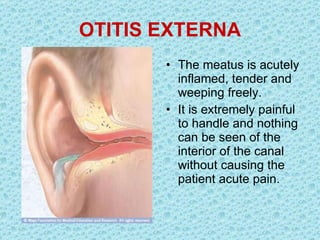
OTITIS EXTERNA The meatus is acutely inflamed, tender and weeping freely. It is extremely painful to handle and nothing can be seen of the interior of the canal without causing the patient acute pain.
OTITIS EXTERNA Pain, located in the ear itself ; Purulent discharges ; Slight hearing loss ; Usually temperature is normal.
OTITIS EXTERNA
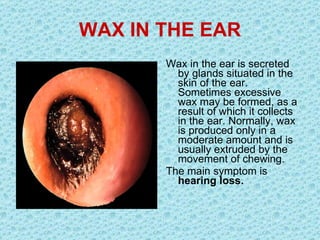
WAX IN THE EAR Wax in the ear is secreted by glands situated in the skin of the ear. Sometimes excessive wax may be formed, as a result of which it collects in the ear. Normally, wax is produced only in a moderate amount and is usually extruded by the movement of chewing.  The main symptom is  hearing loss.
WAX IN THE EAR Wax can be removed safely, by the careful use of a wax curette or by the more usual method of syringing.  Nota bene!   You mustn’t syringe the wax if patient has dry perforation of the eardrum
Acute otitis media The middle ear : The tympanum The Eustachian tube The mastoid cells
Pathways of infection Throw the Eustachian tube
Pathways of infection Infection may be diffuse   (influenza, measles, scarlett fever) From ear channel ( only in case of pre-existing eardrum perforation ) Measles
The great frequency of otitis in children   explained by: their  short and wide auditory tube . recumbent position  of the body in newborns (in this case infection from nasopharynx can easy enter to the tube and further to the tympanum) presence of a myxoid tissue  in the middle ear.
The 1-st step is the closing of the Eustachian tube The pressure inside is negative exudates The pressure inside is positive  Symptoms: Pain Rise in temperature The eardrum becomes red and bulge and finally - perforated
 
Three clinically distinguished periods Before perforation Purulent discharge   Period of restoration
The period before perforation Symptoms : Pain, located in the ear itself !!! Hearing loss Rise in temperature
The period before perforation
The period before perforation There is  no discharge  in the ear channel. The eardrum  has no perforation .  The eardrum becomes  hyperemic  with vessels injections in earlier stage.  The  light reflex disappears , the landmarks of eardrum become invisible. The eardrum begins  to bulge  and finally becomes perforated.
The period of purulent discharge
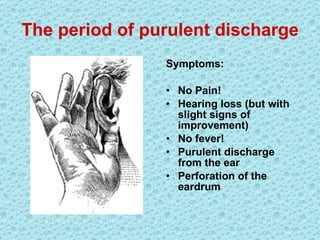
The period of purulent discharge Symptoms : No Pain ! Hearing loss (but with slight signs of improvement)  No fever! Purulent discharge from the ear Perforation of the eardrum
The purulent discharge period The meatus is full of discharge and if this is mopped away the discharge may be seen coming from the perforation. Pulsation of discharge is present and is synchronous with the pulse
TREATMENT Conservative Surgical
Conservative treatment Antibiotics  ( N.B.!  –  not use  antibiotics of the aminoglycoside group !) Nasal decongestants for the improving of the tube functions Antihistamines and  antiinflammatory  drugs Ear drops
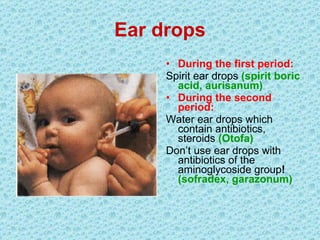
Ear drops During the first period : Spirit  ear drops   ( spirit  boric acid,  aurisanum ) During the second period : Water ear drops which contain antibiotics, steroids   (О t о f а) Don’t use ear drops with antibiotics of the aminoglycoside group !   ( sofradex ,  garazonum )
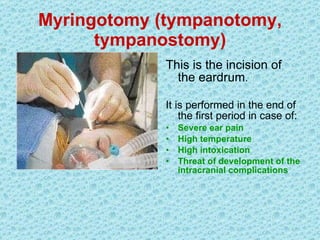
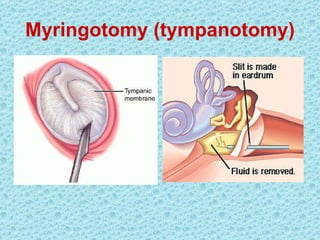
Myringotomy (tympanotomy, tympanostomy) This is the  incision  of the eardrum . It is performed in the end of the first period in case of : Severe ear pain High temperature High  intoxication Threat of development of the intracranial complications
Myringotomy (tympanotomy)
Tympanotomy
Tympanotomy
Tympanostomy
Surgical treatment The operation is called   antromastoidotomy . It is performed in case of complications
The characteristic properties of the acute otitis media in newborn The signs of meningism may be present.  The main symptoms of the disease may be fever and parenteral diarrhea
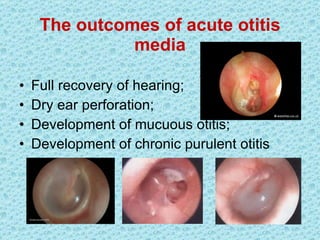
The outcomes of acute otitis media Full  recovery  of hearing; Dry ear perforation; Development of mucuous otitis; Development of chronic purulent otitis

Otitis externa and media

  • 1.
    DISEASES ofthe EAR - I
  • 2.
    FURUNCULOSIS This isan infection of the hair follicle and so can occur only in the skin of the outer part of the meatus Acute pain that may spread up the side of the head into the jaw, or down the neck as far as the shoulder. There is swelling of the parts around the ear . Tenderness on pressure is marked
  • 3.
    OTITIS EXTERNA Thisis a generalized infection involving as a rule the whole skin of the external canal Aetiology. hot, humid climate ('Singapore ear'); all irritants which induces scratching of the ears (dust); a tendency to eczema; sensitization to certain antibiotic drops.
  • 4.
    OTITIS EXTERNA Themeatus is acutely inflamed, tender and weeping freely. It is extremely painful to handle and nothing can be seen of the interior of the canal without causing the patient acute pain.
  • 5.
    OTITIS EXTERNA Pain,located in the ear itself ; Purulent discharges ; Slight hearing loss ; Usually temperature is normal.
  • 6.
  • 7.
    WAX IN THEEAR Wax in the ear is secreted by glands situated in the skin of the ear. Sometimes excessive wax may be formed, as a result of which it collects in the ear. Normally, wax is produced only in a moderate amount and is usually extruded by the movement of chewing. The main symptom is hearing loss.
  • 8.
    WAX IN THEEAR Wax can be removed safely, by the careful use of a wax curette or by the more usual method of syringing. Nota bene! You mustn’t syringe the wax if patient has dry perforation of the eardrum
  • 9.
    Acute otitis mediaThe middle ear : The tympanum The Eustachian tube The mastoid cells
  • 10.
    Pathways of infectionThrow the Eustachian tube
  • 11.
    Pathways of infectionInfection may be diffuse (influenza, measles, scarlett fever) From ear channel ( only in case of pre-existing eardrum perforation ) Measles
  • 12.
    The great frequencyof otitis in children explained by: their short and wide auditory tube . recumbent position of the body in newborns (in this case infection from nasopharynx can easy enter to the tube and further to the tympanum) presence of a myxoid tissue in the middle ear.
  • 13.
    The 1-st stepis the closing of the Eustachian tube The pressure inside is negative exudates The pressure inside is positive Symptoms: Pain Rise in temperature The eardrum becomes red and bulge and finally - perforated
  • 14.
  • 15.
    Three clinically distinguishedperiods Before perforation Purulent discharge Period of restoration
  • 16.
    The period beforeperforation Symptoms : Pain, located in the ear itself !!! Hearing loss Rise in temperature
  • 17.
    The period beforeperforation
  • 18.
    The period beforeperforation There is no discharge in the ear channel. The eardrum has no perforation . The eardrum becomes hyperemic with vessels injections in earlier stage. The light reflex disappears , the landmarks of eardrum become invisible. The eardrum begins to bulge and finally becomes perforated.
  • 19.
    The period ofpurulent discharge
  • 20.
    The period ofpurulent discharge Symptoms : No Pain ! Hearing loss (but with slight signs of improvement) No fever! Purulent discharge from the ear Perforation of the eardrum
  • 21.
    The purulent dischargeperiod The meatus is full of discharge and if this is mopped away the discharge may be seen coming from the perforation. Pulsation of discharge is present and is synchronous with the pulse
  • 22.
  • 23.
    Conservative treatment Antibiotics ( N.B.! – not use antibiotics of the aminoglycoside group !) Nasal decongestants for the improving of the tube functions Antihistamines and antiinflammatory drugs Ear drops
  • 24.
    Ear drops Duringthe first period : Spirit ear drops ( spirit boric acid, aurisanum ) During the second period : Water ear drops which contain antibiotics, steroids (О t о f а) Don’t use ear drops with antibiotics of the aminoglycoside group ! ( sofradex , garazonum )
  • 25.
    Myringotomy (tympanotomy, tympanostomy)This is the incision of the eardrum . It is performed in the end of the first period in case of : Severe ear pain High temperature High intoxication Threat of development of the intracranial complications
  • 26.
  • 27.
  • 28.
  • 29.
  • 30.
    Surgical treatment Theoperation is called antromastoidotomy . It is performed in case of complications
  • 31.
    The characteristic propertiesof the acute otitis media in newborn The signs of meningism may be present. The main symptoms of the disease may be fever and parenteral diarrhea
  • 32.
    The outcomes ofacute otitis media Full recovery of hearing; Dry ear perforation; Development of mucuous otitis; Development of chronic purulent otitis