بسم الله الرحمن الرحيم NASAL INFLAMMATIONS Presented by :-   Ass.professor  Mohammad shaddad     ENT consultant
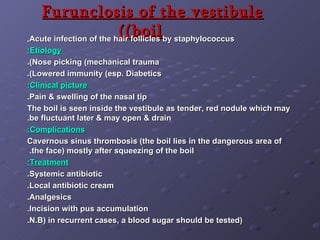
Furunclosis of the vestibule (boil) Acute infection of the hair follicles by staphylococcus, Etiology: Nose picking (mechanical trauma). Lowered immunity (esp. Diabetics). Clinical picture: Pain & swelling of the nasal tip. The boil is seen inside the vestibule as tender, red nodule which may be fluctuant later & may open & drain. Complications: Cavernous sinus thrombosis (the boil lies in the dangerous area of the face) mostly after squeezing of the boil.  Treatment: Systemic antibiotic. Local antibiotic cream. Analgesics. Incision with pus accumulation. (N.B) in recurrent cases, a blood sugar should be tested.
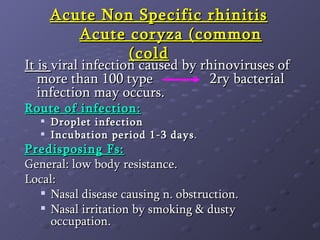
Acute Non Specific rhinitis   Acute coryza (common cold)   It is  viral infection caused by rhinoviruses of more than 100 type    2ry bacterial infection may occurs. Route of infection: Droplet infection  Incubation period 1-3 days . Predisposing Fs: General: low body resistance. Local: Nasal disease causing n. obstruction. Nasal irritation by smoking & dusty occupation.
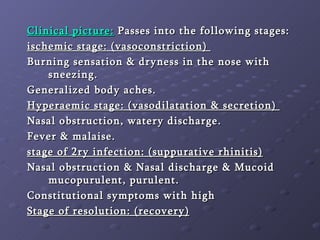
Clinical picture:  Passes into the following stages: ischemic stage: (vasoconstriction)  Burning sensation & dryness in the nose with sneezing. Generalized body aches. Hyperaemic stage: (vasodilatation & secretion)  Nasal obstruction, watery discharge.  Fever & malaise. stage of 2ry infection: (suppurative rhinitis) Nasal obstruction & Nasal discharge & Mucoid mucopurulent, purulent.  Constitutional symptoms with high  Stage of resolution: (recovery)
Complications: Sinusitis. Otitis media. Descending infection: laryngitis, bronchitis pneumonia. Permanent anosmia. Treatment: Rest, plenty of warm fluids. Analgesics, antipyretics & Vit.C.  Antibiotics to avoid 2ry bacterial. Infection. Oral decongestants, antihistaminic. Local nasal drops. Steam inhalation. Prophylaxis - Avoid predisposing factors. - Avoid exposure to persons with common old.
Influenzal rhinitis Similar to common cold, but more sever. Caused by influenza viruses, types A,B,&C. Clinical picture:   Similar to common cold with the following differences: - Sever   headach, fever & malaise. - Mild  rhinorrhoea & sneezing. - 2ry bacterial infection more common. - Complication may occur & more sever. Treatment: :  - As common cold. -  Vaccination of high risk groups.
CHRONIC INFLAMMATION  A. Chronic non-specific rhinitis   1.Chronic hypertrophic rhinitis Hypertrophy of the mucous membrane of the nose especially the turbinates.
Etiology:   - Repeated acute rhinitis  irreversible changes.   - Allergic rhinitis.   - Vasomotor rhinitis. Symptoms:   nasal obstruction & nasal & postnasal discharge. Signs :  enlarged inferior turbinate which dose not Shrink with the application of vasoconstrictor (irreversible changes).
Treatment: Control of predisposing. Reduction of size of inferior turbinate: *   Sub mucous diathermy (Electro  coagulation )  *   Partial inferior turbinectomy. *   Laser turbinectomy
Atrophic rhinitis Definition: Chronic nonspecific rhinitis with progressive atrophy of the nasal mucosa(with its vessels & glands) & bony turbinates.
Etiology: Primary   (idiopathic or ozaena): unknown cause, Endocrinal imbalance, as it more common in females (estrogen lack). Infection, purulent sinusitis  and rhinitisin young age . Organism may be klebsilla ozaenae. Deficiency of iron & vit A. Autoimmune disease. Autonomic imbalance  sympathetic over activity.
B)Secondary:  Distraction of nasal mucosa with subsequent atrophic changes:  Chronic specific rhinitis (granulomas). Postoperative: excessive removal of nasal mucosa as after turbinectomy.  Poste irraditon.
Symptoms:  bilateral & female at age of puberty. Nasal discharge: greenish crusty with foetor (2ry anaerobic infection & putrefaction under crusts). The patient can not smell his bad odour. Nasal obstruction : (although the nose is roomy) caused by crusts & dullness of sensation of air over the atrophic mucous membrane. Anosmia, due to atrophy of never endings. Epistaxis with separation of crusts.
Signs: Roomy nose with pale atrophic mucosa & turbinates. Greenish or black crusts with marked foetor.
Treatment: 1.ttt of the cause in 2ry rhinitis 2.  Medical :   Alkaline nasal wash to dissolves & helps their separation. 2.5% glucose in glycerin nasal drops  potassium iodide to stimulate secretion by glands. Iron & Vit. A supplementation. 3.  Surgical :  TO narrow the wide cavity  sub mucosal implantation of grafts e.g. fat or bone. Temporary occlusion of one nostril, 6months-2years (young’s operation).
B. Chronic specific rhinitis 1-Rhinoscleroma Definition Chronic specific granuloma of the upper respiratory  tract ,affect nose ,larynx &pharynx.
Organism: -Klebsiella rhinoscleromatis (gram-ve Frish bacillus) -Infection requires long &intiamate contact. Pathology: 1. Atrophic stage : as atrophic rhinitis. 2. Nodular active  stage: sub mucosa show rich vascularity &cellular infiltration . (Mickulicz cells, Russel  bodies .lymphocyte & plasma cell). 3. Fibrotic stage : there are increase in fibroblasts& collagen fibers  with decrease in  cellularity & vascularity.
Clinical picture : Middle ages (15 -35years) females. Passes in to stages may be more  than  one  stage at a time: 1 . Atrophic stage  similar to atrophic rhinitis  2 . nodular stage  a.  Bilateral sub mucosal hard nodules starting at the mucocutaneous junction. b.  they coalesce to form a large mass filing the nasal & cavity & expanding the nose. c.  May extend to :  -Tip of nose & upper lip -Lacrimal passages(dacryoscleroma) 3- Fibrotic stage  stenosis of nasal cavity & deformity.
Investigation: Biopsy  :Characteristic histopathological picture A) Mikulicz cells :  -Macrophages undergo hydropic degeneration. -Large vacuolated foam cells containing  the bacilli within in the vaccules B)  Russel bodies ::bright red degenerated plasma  cells  C) In fibrotic (in active )stage , these cell s are replaced by fibroblasts& dense fibrous tissues  The vascularity  decrease  11) Electron  microscopy  : positive in some case –ve with light microscopy 111)Culture  :short capsulated gram  -ve diplo-bacilli.
TREATMENT: Medial: 1.Rifampicin (rimactan):600mq/dialy before  meals oraly for 8-10 weeks for 3 month  Side effects :Hepatotoxic & Reddish coloration of urine . 2.Striptomycin :1gm/dialyIM for 40 days.  Side effects: Ototoxic, vestibulotoxic & nephrotoxic. 3.Others: ampicilin ,cephalosporin. 4.Local :as atrophic  rhinitis
SURGICA L  1 Removal of localized  masses. 2.Fibrotic narrowing can be removed by Co2 laser. Plastic reconstruction e limited success.
Syphilis of the nose Organism  :Treponema palladum  (spirochatetes). Pathology :   Either  a - Acquired :1ry,2ry or 3ry b- Congenital :early &late      (Transplacental infection)
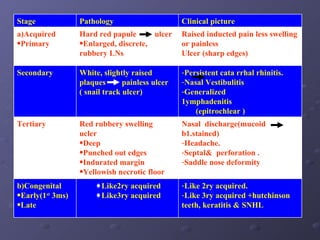
Like 2ry acquired. Like 3ry acquired +hutchinson teeth, keratitis & SNHL Like2ry acquired Like3ry acquired b)Congenital Early(1 st  3ms)  Late Nasal  discharge(mucoid  b1.stained) Headache. Septal&  perforation . Saddle nose deformity Red rubbery swelling  ucler Deep Punched out edges  Indurated margin Yellowish necrotic floor Tertiary Persistent cata rrhal rhinitis.  Nasal Vestibulitis Generalized  1ymphadenitis (epitrochlear )  White, slightly raised plaques  painless ulcer ( snail track ulcer)  Secondary Raised inducted pain less swelling or painless  Ulcer (sharp edges) Hard red papule  ulcer  Enlarged, discrete, rubbery LNs a)Acquired Primary Clinical picture Pathology Stage
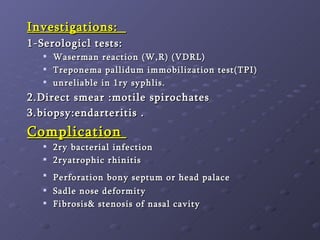
Investigations:  1-Serologicl tests: Waserman reaction (W,R) (VDRL) Treponema pallidum immobilization test(TPI) unreliable in 1ry syphlis. 2.Direct smear :motile spirochates 3.biopsy:endarteritis . Complication  2ry bacterial infection 2ryatrophic rhinitis Perforation bony septum or head palace   Sadle nose deformity Fibrosis& stenosis of nasal cavity
Treatment  :  Penicillin. Alkaline nasal wash Plastic sugary for septal perforation.
Lupus of the nose(lupus vulgaris)  Definition :  Chronic form of  TB . infection that affects skin & mucous membrane .   Organism:  Attenuated TB bacilli Clinical picture :  More common in female  1. Nasal obstruction, discharge,& epistaxis 2.Apple jelly nodules, buffer fly area of the face, ulcer undermined edges  perforation of canfilginous septum.
Investigations;   1. BIOPSY 2. Bacteriological ex  T.B BACILI. Treatment: 1.ant.TB treatment. 2.Alkaline nasal wash 3.Surgical repair of nasal deformity
Leprosy Caused  by mycobacterium  leprae it has three types: Tuberculoid  leprosy:  solitory lesions cause anasthetic cutaneous patches  with  involvement of one or more related sensory or motor nerves. Lepromatous leprosy :  diffuse infiltration of the skin , nerves and mucosal surfaces , nasal discharge in these pts contains infectious bacilli  root of spread  of infection . Border line leprosy:  skin  lesion more numerous. conversion to the above tow types may occur .
Clinical picture ; With lepromatous leprosy ; nodular thickening of the nasal mucosa. Perforation of the cartilaginous portion  of nasal septum  perichondritis and  periositis which lead to typical nasal deformity
Diagnosis ; Of early and intermediate change in the nose , pathognomion of lepromatous leprosy . Microscopy of nasal  discharge  for acid fast bacilli  Microscopy of scraping of nasal mucosa  (anterior end of inferior turbinate)for acid fast bacilli  Radiology of anterior nasal  spine erosion.
Treatment ; Dapson Rifampicin Clofazimine (lamprene) local treatment of the nose ; Betnovate in unguentum .  For years or for life.
Wagener's  granulomatosis May affect the upper air way ,  lung and  kidney with systemic vasculitis  Diagnosis ; ESR & C- reactive protein  Anti neutrophil cytoplasmic anti  Body (ANCA )  Histological ; shows vasculitis necrosis  and granulomatous  inflammation Treatment Steroids Cyclophosphomide
Sarcoidosis Chronic systemic disease of un known cause  Hypothese advanced . Clinical picture ; Nasal discharge , nasal obstruction ,epistaxis ,facial  pain
Sarcoidosis Diagnosis  : Biopsy  Kveim skin test Radiology of the nasal bone ,chest ,  hand  & feet. Serum &  urinary calcium  hypercalcemia . Serum level of angiotensin converting  enzyme
Sarcoidosis Treatment : Steroids  local or systemic Chlorqine  Retenal damage . Methotrexate. Heerfordt,s  syndrome  transient bilateral  facial palsy ,fever ,parotid enlargement and uveal tract disease
Thanks 4 U...

Ent

  • 1.
    بسم الله الرحمنالرحيم NASAL INFLAMMATIONS Presented by :- Ass.professor Mohammad shaddad ENT consultant
  • 2.
    Furunclosis of thevestibule (boil) Acute infection of the hair follicles by staphylococcus, Etiology: Nose picking (mechanical trauma). Lowered immunity (esp. Diabetics). Clinical picture: Pain & swelling of the nasal tip. The boil is seen inside the vestibule as tender, red nodule which may be fluctuant later & may open & drain. Complications: Cavernous sinus thrombosis (the boil lies in the dangerous area of the face) mostly after squeezing of the boil. Treatment: Systemic antibiotic. Local antibiotic cream. Analgesics. Incision with pus accumulation. (N.B) in recurrent cases, a blood sugar should be tested.
  • 3.
    Acute Non Specificrhinitis Acute coryza (common cold) It is viral infection caused by rhinoviruses of more than 100 type 2ry bacterial infection may occurs. Route of infection: Droplet infection Incubation period 1-3 days . Predisposing Fs: General: low body resistance. Local: Nasal disease causing n. obstruction. Nasal irritation by smoking & dusty occupation.
  • 4.
    Clinical picture: Passes into the following stages: ischemic stage: (vasoconstriction) Burning sensation & dryness in the nose with sneezing. Generalized body aches. Hyperaemic stage: (vasodilatation & secretion) Nasal obstruction, watery discharge. Fever & malaise. stage of 2ry infection: (suppurative rhinitis) Nasal obstruction & Nasal discharge & Mucoid mucopurulent, purulent. Constitutional symptoms with high Stage of resolution: (recovery)
  • 5.
    Complications: Sinusitis. Otitismedia. Descending infection: laryngitis, bronchitis pneumonia. Permanent anosmia. Treatment: Rest, plenty of warm fluids. Analgesics, antipyretics & Vit.C. Antibiotics to avoid 2ry bacterial. Infection. Oral decongestants, antihistaminic. Local nasal drops. Steam inhalation. Prophylaxis - Avoid predisposing factors. - Avoid exposure to persons with common old.
  • 6.
    Influenzal rhinitis Similarto common cold, but more sever. Caused by influenza viruses, types A,B,&C. Clinical picture: Similar to common cold with the following differences: - Sever headach, fever & malaise. - Mild rhinorrhoea & sneezing. - 2ry bacterial infection more common. - Complication may occur & more sever. Treatment: : - As common cold. - Vaccination of high risk groups.
  • 7.
    CHRONIC INFLAMMATION A. Chronic non-specific rhinitis 1.Chronic hypertrophic rhinitis Hypertrophy of the mucous membrane of the nose especially the turbinates.
  • 8.
    Etiology: - Repeated acute rhinitis irreversible changes. - Allergic rhinitis. - Vasomotor rhinitis. Symptoms: nasal obstruction & nasal & postnasal discharge. Signs : enlarged inferior turbinate which dose not Shrink with the application of vasoconstrictor (irreversible changes).
  • 9.
    Treatment: Control ofpredisposing. Reduction of size of inferior turbinate: * Sub mucous diathermy (Electro coagulation ) * Partial inferior turbinectomy. * Laser turbinectomy
  • 10.
    Atrophic rhinitis Definition:Chronic nonspecific rhinitis with progressive atrophy of the nasal mucosa(with its vessels & glands) & bony turbinates.
  • 11.
    Etiology: Primary (idiopathic or ozaena): unknown cause, Endocrinal imbalance, as it more common in females (estrogen lack). Infection, purulent sinusitis and rhinitisin young age . Organism may be klebsilla ozaenae. Deficiency of iron & vit A. Autoimmune disease. Autonomic imbalance sympathetic over activity.
  • 12.
    B)Secondary: Distractionof nasal mucosa with subsequent atrophic changes: Chronic specific rhinitis (granulomas). Postoperative: excessive removal of nasal mucosa as after turbinectomy. Poste irraditon.
  • 13.
    Symptoms: bilateral& female at age of puberty. Nasal discharge: greenish crusty with foetor (2ry anaerobic infection & putrefaction under crusts). The patient can not smell his bad odour. Nasal obstruction : (although the nose is roomy) caused by crusts & dullness of sensation of air over the atrophic mucous membrane. Anosmia, due to atrophy of never endings. Epistaxis with separation of crusts.
  • 14.
    Signs: Roomy nosewith pale atrophic mucosa & turbinates. Greenish or black crusts with marked foetor.
  • 15.
    Treatment: 1.ttt ofthe cause in 2ry rhinitis 2. Medical : Alkaline nasal wash to dissolves & helps their separation. 2.5% glucose in glycerin nasal drops potassium iodide to stimulate secretion by glands. Iron & Vit. A supplementation. 3. Surgical : TO narrow the wide cavity sub mucosal implantation of grafts e.g. fat or bone. Temporary occlusion of one nostril, 6months-2years (young’s operation).
  • 16.
    B. Chronic specificrhinitis 1-Rhinoscleroma Definition Chronic specific granuloma of the upper respiratory tract ,affect nose ,larynx &pharynx.
  • 17.
    Organism: -Klebsiella rhinoscleromatis(gram-ve Frish bacillus) -Infection requires long &intiamate contact. Pathology: 1. Atrophic stage : as atrophic rhinitis. 2. Nodular active stage: sub mucosa show rich vascularity &cellular infiltration . (Mickulicz cells, Russel bodies .lymphocyte & plasma cell). 3. Fibrotic stage : there are increase in fibroblasts& collagen fibers with decrease in cellularity & vascularity.
  • 18.
    Clinical picture :Middle ages (15 -35years) females. Passes in to stages may be more than one stage at a time: 1 . Atrophic stage similar to atrophic rhinitis 2 . nodular stage a. Bilateral sub mucosal hard nodules starting at the mucocutaneous junction. b. they coalesce to form a large mass filing the nasal & cavity & expanding the nose. c. May extend to : -Tip of nose & upper lip -Lacrimal passages(dacryoscleroma) 3- Fibrotic stage stenosis of nasal cavity & deformity.
  • 19.
    Investigation: Biopsy :Characteristic histopathological picture A) Mikulicz cells : -Macrophages undergo hydropic degeneration. -Large vacuolated foam cells containing the bacilli within in the vaccules B) Russel bodies ::bright red degenerated plasma cells C) In fibrotic (in active )stage , these cell s are replaced by fibroblasts& dense fibrous tissues The vascularity decrease 11) Electron microscopy : positive in some case –ve with light microscopy 111)Culture :short capsulated gram -ve diplo-bacilli.
  • 20.
    TREATMENT: Medial: 1.Rifampicin(rimactan):600mq/dialy before meals oraly for 8-10 weeks for 3 month Side effects :Hepatotoxic & Reddish coloration of urine . 2.Striptomycin :1gm/dialyIM for 40 days. Side effects: Ototoxic, vestibulotoxic & nephrotoxic. 3.Others: ampicilin ,cephalosporin. 4.Local :as atrophic rhinitis
  • 21.
    SURGICA L 1 Removal of localized masses. 2.Fibrotic narrowing can be removed by Co2 laser. Plastic reconstruction e limited success.
  • 22.
    Syphilis of thenose Organism :Treponema palladum (spirochatetes). Pathology : Either a - Acquired :1ry,2ry or 3ry b- Congenital :early &late (Transplacental infection)
  • 23.
    Like 2ry acquired.Like 3ry acquired +hutchinson teeth, keratitis & SNHL Like2ry acquired Like3ry acquired b)Congenital Early(1 st 3ms) Late Nasal discharge(mucoid b1.stained) Headache. Septal& perforation . Saddle nose deformity Red rubbery swelling ucler Deep Punched out edges Indurated margin Yellowish necrotic floor Tertiary Persistent cata rrhal rhinitis. Nasal Vestibulitis Generalized 1ymphadenitis (epitrochlear ) White, slightly raised plaques painless ulcer ( snail track ulcer) Secondary Raised inducted pain less swelling or painless Ulcer (sharp edges) Hard red papule ulcer Enlarged, discrete, rubbery LNs a)Acquired Primary Clinical picture Pathology Stage
  • 24.
    Investigations: 1-Serologicltests: Waserman reaction (W,R) (VDRL) Treponema pallidum immobilization test(TPI) unreliable in 1ry syphlis. 2.Direct smear :motile spirochates 3.biopsy:endarteritis . Complication 2ry bacterial infection 2ryatrophic rhinitis Perforation bony septum or head palace Sadle nose deformity Fibrosis& stenosis of nasal cavity
  • 25.
    Treatment : Penicillin. Alkaline nasal wash Plastic sugary for septal perforation.
  • 26.
    Lupus of thenose(lupus vulgaris) Definition : Chronic form of TB . infection that affects skin & mucous membrane . Organism: Attenuated TB bacilli Clinical picture : More common in female 1. Nasal obstruction, discharge,& epistaxis 2.Apple jelly nodules, buffer fly area of the face, ulcer undermined edges perforation of canfilginous septum.
  • 27.
    Investigations; 1. BIOPSY 2. Bacteriological ex T.B BACILI. Treatment: 1.ant.TB treatment. 2.Alkaline nasal wash 3.Surgical repair of nasal deformity
  • 28.
    Leprosy Caused by mycobacterium leprae it has three types: Tuberculoid leprosy: solitory lesions cause anasthetic cutaneous patches with involvement of one or more related sensory or motor nerves. Lepromatous leprosy : diffuse infiltration of the skin , nerves and mucosal surfaces , nasal discharge in these pts contains infectious bacilli root of spread of infection . Border line leprosy: skin lesion more numerous. conversion to the above tow types may occur .
  • 29.
    Clinical picture ;With lepromatous leprosy ; nodular thickening of the nasal mucosa. Perforation of the cartilaginous portion of nasal septum perichondritis and periositis which lead to typical nasal deformity
  • 30.
    Diagnosis ; Ofearly and intermediate change in the nose , pathognomion of lepromatous leprosy . Microscopy of nasal discharge for acid fast bacilli Microscopy of scraping of nasal mucosa (anterior end of inferior turbinate)for acid fast bacilli Radiology of anterior nasal spine erosion.
  • 31.
    Treatment ; DapsonRifampicin Clofazimine (lamprene) local treatment of the nose ; Betnovate in unguentum . For years or for life.
  • 32.
    Wagener's granulomatosisMay affect the upper air way , lung and kidney with systemic vasculitis Diagnosis ; ESR & C- reactive protein Anti neutrophil cytoplasmic anti Body (ANCA ) Histological ; shows vasculitis necrosis and granulomatous inflammation Treatment Steroids Cyclophosphomide
  • 33.
    Sarcoidosis Chronic systemicdisease of un known cause Hypothese advanced . Clinical picture ; Nasal discharge , nasal obstruction ,epistaxis ,facial pain
  • 34.
    Sarcoidosis Diagnosis : Biopsy Kveim skin test Radiology of the nasal bone ,chest , hand & feet. Serum & urinary calcium hypercalcemia . Serum level of angiotensin converting enzyme
  • 35.
    Sarcoidosis Treatment :Steroids local or systemic Chlorqine Retenal damage . Methotrexate. Heerfordt,s syndrome transient bilateral facial palsy ,fever ,parotid enlargement and uveal tract disease
  • 36.