ACUTE &CHRONIC RHINITIS
DR. K.RAVI KUMAR
ASSISTANT PROFESSOR
DEPT OF ENT
GREAT EASTERN MEDICAL SCHOOL,SRIKAKULAM
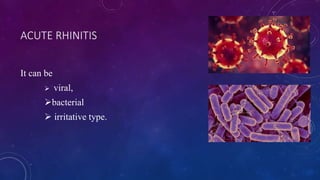
ACUTE RHINITIS
It can be
 viral,
bacterial
 irritative type.
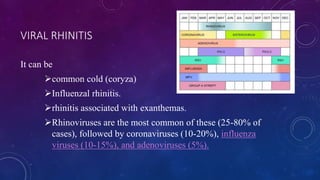
VIRAL RHINITIS
It can be
common cold (coryza)
Influenzal rhinitis.
rhinitis associated with exanthemas.
Rhinoviruses are the most common of these (25-80% of
cases), followed by coronaviruses (10-20%), influenza
viruses (10-15%), and adenoviruses (5%).
COMMON COLD (CORYZA)
Several viruses (adenovirus, picornavirus and its subgroups such as
rhinovirus, coxsackie virus
The infection is usually contracted through airborne droplets.
Incubation period is 1–4 days
 illness lasts for 2–3 weeks.
Clinical features.
Burning sensation at the back of nose
nasal stuffiness,
rhinorrhoea
sneezing.
low-grade fever.
Initially, nasal discharge is watery and profuse but may become
mucopurulent due to secondary bacterial invasion.
 Secondary invaders include Streptococcus haemolyticus, pneumo-
coccus, Staphylococcus, Haemophilus influenzae, Klebsiella
pneumoniae and Moraxella catarrhalis.
TREATMENT
Bed rest
Plenty of fluids
antihistaminics
nasal decongestants.
Analgesics(NSAIDs)
Antibiotics
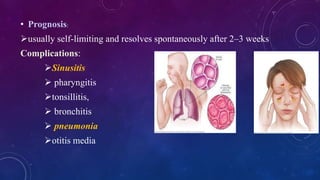
• Prognosis:
usually self-limiting and resolves spontaneously after 2–3 weeks
Complications:
Sinusitis
 pharyngitis
tonsillitis,
 bronchitis
 pneumonia
otitis media
INFLUENZAL RHINITIS
Causative: Influenza viruses A, B or C
Symptoms and signs are similar to those of common cold.
Complications due to bacterial invasion are common.
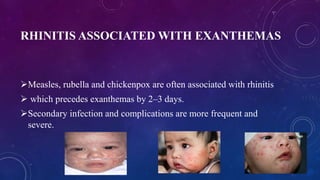
RHINITIS ASSOCIATED WITH EXANTHEMAS
Measles, rubella and chickenpox are often associated with rhinitis
 which precedes exanthemas by 2–3 days.
Secondary infection and complications are more frequent and
severe.
BACTERIAL RHINITIS
Non specific infections:
• It may be primary or secondary.
Primary bacterial rhinitis
seen in children
pneumococcus, streptococcus or staphylococcus.
 A greyish white tenacious membrane may form in the nose, which
with attempted removal causes bleeding.
Secondary bacterial rhinitis is the result of bacterial infection supervening
acute viral rhinitis.
DIPHTHERITIC RHINITIS
Diphtheria of nose is rare
It may be primary or secondary to faucial diphtheria
may occur in acute or chronic form.
A greyish membrane is seen covering the inferior
turbinate and the floor of nose
 membrane is tenacious and its removal causes bleeding.
Excoriation of anterior nares and upper lip may be seen.
 Treatment is isolation of the patient, systemic penicillin and
diphtheria antitoxin.
IRRITATIVE RHINITIS
• caused by exposure to dust, smoke or irritating gases
such as ammonia, formaline, acid fumes,
• trauma inflicted on the nasal mucosa during intranasal manipulation,
e.g. removal of a foreign body.
• immediate catarrhal reaction with sneezing, rhinorrhoea and nasal
congestion.
• The symptoms may pass off rapidly with removal of the offending agent
or may persist for some days if nasal epithelium has been damaged.
• Recovery will depend on the amount of epithelial damage and the
infection that supervenes.
CHRONIC RHINITIS
• Chronic nonspecific inflammations of nose include
1. Chronic simple rhinitis.
2. Hypertrophic rhinitis.
3. Atrophic rhinitis
4. Rhinitis sicca.
5. Rhinitis caseosa.
CHRONIC SIMPLE RHINITIS
• Recurrent attacks of acute rhinitis in the presence of pre- disposing factors
leads to chronicity.
• The predisposing factors are:
1. Persistence of nasal infection due to sinusitis, tonsillitis and adenoids.
2. Chronic irritation from dust, smoke, cigarette smoking, snuff, etc.
3. Nasal obstruction due to deviated nasal septum, synechia leading to persistence
of discharge in the nose.
4. Vasomotor rhinitis.
5. Endocrinal or metabolic factors, e.g. hypothyroidism..
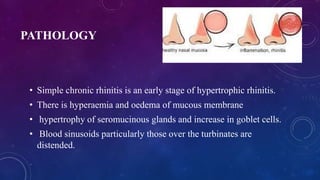
PATHOLOGY
• Simple chronic rhinitis is an early stage of hypertrophic rhinitis.
• There is hyperaemia and oedema of mucous membrane
• hypertrophy of seromucinous glands and increase in goblet cells.
• Blood sinusoids particularly those over the turbinates are
distended.
CLINICAL FEATURES
Nasal obstruction.
Nasal discharge.
Headache
Swollen turbinates
Postnasal discharge
TREATMENT
1. Treat the cause.
2. Nasal irrigations with alkaline solution
3. Nasal decongestants
4. Antibiotics help to clear nasal infection and concomitant sinusitis.
HYPERTROPHIC RHINITIS
Aetiology:
recurrent nasal infections
chronic sinusitis,
chronic irritation of nasal mucosa due to smoking, industrial irritants,
prolonged use of nasal drops
vasomotor and allergic rhinitis.
PATHOLOGY
Thickening of mucosa, submucosa, seromucinous glands,
periosteum and bone.
Changes are more marked on the turbinates.
CLINICAL FEATURES
Nasal obstruction (predominantly)
Nasal discharge
Head ache
On examination :
Turbinate hypertrophy (inferior)
Mucosa thick do not pit on pressure ,
 no changes with decongestant drops
TREATMENT
Remove the cause
 Turbinate reduction procedures:
1.Linear cauterization.
2. Submucosal diathermy.
3. Cryosurgery of turbinates.
4. Partial or total turbinectomy.
5. Submucous resection of turbinate bone.
6. Lasers
COMPENSATORY HYPERTROPHIC
RHINITIS
• This is seen in cases of marked deviation of septum to one side.
• The roomier side of the nose shows hypertrophy of inferior and middle
turbinates.
• This is an attempt on the part of nature to reduce the wide space to
overcome the ill effects of drying and crusting that always attend wider
nasal space.
• Hypertrophic changes in these cases are not reversible with the
correction of nasal septum and often require reduction of turbinates at
the time of septal surgery
ATROPHIC RHINITIS (OZAENA)
TWO TYPES: PRIMARY AND SECONDARY.
Primary Atrophic Rhinitis:
The exact cause is not known.
(HERNIA)
1. Hereditary factors
2. Endocrinal disturbance
3. Racial factors
4. Nutritional deficiency.
5. Infective
6. Autoimmune process.
Secondary Atrophic Rhinitis:
Specific infections like syphilis,
lupus, leprosy and rhino scleroma
radiotherapy
excessive surgical removal of
turbinates.
PATHOLOGY
• Ciliated columnar epithelium is lost and is replaced by stratified
squamous type.
• There is atrophy of seromucinous glands, venous blood sinusoids
and nerve elements.
• Arteries in the mucosa, periosteum and bone show obliterative
endarteritis.
• The bone of turbinates undergoes resorption causing widening of
nasal chambers.
CLINICAL FEATURES:
• Patient may complain of nasal obstruction in
spite of unduly wide nasal chambers.
• merciful anosmia:There is foul smell from
the nose making the patient a social outcast
though patient himself is unaware of the
smell due to marked anosmia
• Epistaxis
Examination:
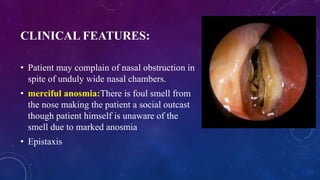
nasal cavity : full of greenish or greyish black dry crusts covering the
turbinates and septum.
Attempts to remove them may cause bleeding.
When the crusts have been removed, nasal cavities appear roomy with
atrophy of turbinates so much so that the posterior wall of nasopharynx
can be easily seen.
Nasal turbinates may be reduced to mere ridges.
Nasal mucosa appears pale.
• Septal perforation and dermatitis of nasal vestibule may be present.
• Nose may show a saddle deformity.
• pharyngeal mucosa which may appear dry and glazed with crusts
• Similar changes may occur in the larynx with cough and hoarseness
of voice (atrophic laryngitis).
• Hearing impairment may be noticed because of obstruction to
eustachian tube and middle ear effusion.
• Prognosis:
• The disease persists for years but there is a tendency to recover
spontaneously in middle age.
• Treatment:
• It may be medical or surgical.
MEDICAL TREATMENT
Aim:
• maintaining nasal hygiene by removal of crusts and the putrefying
smell to further check crust formation.
(a) Nasal irrigation and removal of crusts
(b) 25% glucose in glycerine.
(c) Local antibiotics.
(d) Oestradiol spray.
(e) Placental extract
(f) Systemic use of streptomycin
(g) Potassium iodide
NASAL IRRIGATION
Composition: by dissolving a teaspoonful of powder containing
o sodium bicarbonate 1 part, (28.4 gm)
o sodium biborate 1 part, (28.4 gm)
o sodium chloride 2 parts (56.7 gm)
o In 280 mL of water
Initially, irrigations are done two or three times a day
later once in every 2 or 3 days is sufficient.
25% GLUCOSE IN GLYCERINE.
• After crusts are removed, nose is painted
with 25% glucose in glycerine.
• This inhibits the growth of proteolytic
organisms which are responsible for foul
smell.
LOCAL ANTIBIOTICS
• Spraying or painting the nose with appropriate antibiotics help to
eliminate secondary infection.
• KemicetineTM antiozaena solution contains
 chloromycetin,
oestradiol
vitamin D2
• (d) Oestradiol spray:
• Helps to increase vascularity of nasal
mucosa and regeneration of seromucinous
glands.
• (e) Placental extract injected
submucosally in the nosemay provide some
relief.
(f) Systemic use of streptomycin.
1 g/day for 10 days has given good results in reducing crusting and
odour.
 It is effective against Klebsiella organisms.
(g) Potassium iodide
given by the mouth promotes and liquefies nasal secretion.
SURGICAL TREATMENT
Includes
1. Young’s operation.
2. Modified Young’s operation.
3. Narrowing the nasal cavities.
• Young’s operation.
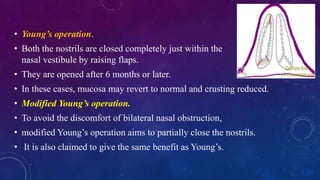
• Both the nostrils are closed completely just within the
nasal vestibule by raising flaps.
• They are opened after 6 months or later.
• In these cases, mucosa may revert to normal and crusting reduced.
• Modified Young’s operation.
• To avoid the discomfort of bilateral nasal obstruction,
• modified Young’s operation aims to partially close the nostrils.
• It is also claimed to give the same benefit as Young’s.
(B) NARROWING THE NASAL CAVITIES.
• Nasal chambers are very wide in atrophic rhinitis and air currents dry up
secretions leading to crusting.
• Narrowing the size of the nasal airway helps to relieve the symptoms.
(i) Submucosal injection of teflon paste.
(ii) Insertion of fat, cartilage, bone or teflon strips under the
mucoperiosteum of the floor and lateral wall of nose and the
mucoperichondriumof the septum.
(iii) Section and medial displacement of lateral wall of nose.
RHINITIS SICCA
• It is also a crust-forming disease seen in patients who work in hot,
dry and dusty surroundings, e.g. bakers, iron- and goldsmiths.
• the ciliated columnar epithelium undergoes squamous metaplasia
with atrophy of seromucinous glands.
• Condition is confined to the anterior third of nose particularly of
the nasal septum.
• Crusts form on the anterior part of septum and their removal causes
ulceration and epistaxis, and may lead to septal perforation.
• Treatment consists of correction of the occupational surroundings
• application of bland ointment or one with an antibiotic and steroid
to the affected part.
• Nose pricking and forcible removal of crusts should be avoided.
• Nasal douche, like the one used in cases of atrophic rhi- nitis, is
useful.
RHINITIS CASEOSA OR
CHOLESTEATOMA OF NOSE
• uncommon condition
• usually unilateral
• mostly affecting males.
• Nose is filled with offensive purulent discharge and cheesy material.
• Sinus mucosa becomes granulomatous. Bony walls of sinus may be destroyed
• requiring differentiation from malignancy.
• Treatment is removal of debris and granulation tissue and free drainage of the
affected sinus.
• Prognosis is good.
THANK YOU

Rhinitis

  • 1.
    ACUTE &CHRONIC RHINITIS DR.K.RAVI KUMAR ASSISTANT PROFESSOR DEPT OF ENT GREAT EASTERN MEDICAL SCHOOL,SRIKAKULAM
  • 2.
    ACUTE RHINITIS It canbe  viral, bacterial  irritative type.
  • 3.
    VIRAL RHINITIS It canbe common cold (coryza) Influenzal rhinitis. rhinitis associated with exanthemas. Rhinoviruses are the most common of these (25-80% of cases), followed by coronaviruses (10-20%), influenza viruses (10-15%), and adenoviruses (5%).
  • 4.
    COMMON COLD (CORYZA) Severalviruses (adenovirus, picornavirus and its subgroups such as rhinovirus, coxsackie virus The infection is usually contracted through airborne droplets. Incubation period is 1–4 days  illness lasts for 2–3 weeks.
  • 5.
    Clinical features. Burning sensationat the back of nose nasal stuffiness, rhinorrhoea sneezing. low-grade fever. Initially, nasal discharge is watery and profuse but may become mucopurulent due to secondary bacterial invasion.  Secondary invaders include Streptococcus haemolyticus, pneumo- coccus, Staphylococcus, Haemophilus influenzae, Klebsiella pneumoniae and Moraxella catarrhalis.
  • 6.
    TREATMENT Bed rest Plenty offluids antihistaminics nasal decongestants. Analgesics(NSAIDs) Antibiotics
  • 7.
    • Prognosis: usually self-limitingand resolves spontaneously after 2–3 weeks Complications: Sinusitis  pharyngitis tonsillitis,  bronchitis  pneumonia otitis media
  • 8.
    INFLUENZAL RHINITIS Causative: Influenzaviruses A, B or C Symptoms and signs are similar to those of common cold. Complications due to bacterial invasion are common.
  • 9.
    RHINITIS ASSOCIATED WITHEXANTHEMAS Measles, rubella and chickenpox are often associated with rhinitis  which precedes exanthemas by 2–3 days. Secondary infection and complications are more frequent and severe.
  • 10.
    BACTERIAL RHINITIS Non specificinfections: • It may be primary or secondary. Primary bacterial rhinitis seen in children pneumococcus, streptococcus or staphylococcus.  A greyish white tenacious membrane may form in the nose, which with attempted removal causes bleeding. Secondary bacterial rhinitis is the result of bacterial infection supervening acute viral rhinitis.
  • 11.
    DIPHTHERITIC RHINITIS Diphtheria ofnose is rare It may be primary or secondary to faucial diphtheria may occur in acute or chronic form. A greyish membrane is seen covering the inferior turbinate and the floor of nose  membrane is tenacious and its removal causes bleeding. Excoriation of anterior nares and upper lip may be seen.  Treatment is isolation of the patient, systemic penicillin and diphtheria antitoxin.
  • 12.
    IRRITATIVE RHINITIS • causedby exposure to dust, smoke or irritating gases such as ammonia, formaline, acid fumes, • trauma inflicted on the nasal mucosa during intranasal manipulation, e.g. removal of a foreign body. • immediate catarrhal reaction with sneezing, rhinorrhoea and nasal congestion. • The symptoms may pass off rapidly with removal of the offending agent or may persist for some days if nasal epithelium has been damaged. • Recovery will depend on the amount of epithelial damage and the infection that supervenes.
  • 13.
    CHRONIC RHINITIS • Chronicnonspecific inflammations of nose include 1. Chronic simple rhinitis. 2. Hypertrophic rhinitis. 3. Atrophic rhinitis 4. Rhinitis sicca. 5. Rhinitis caseosa.
  • 14.
    CHRONIC SIMPLE RHINITIS •Recurrent attacks of acute rhinitis in the presence of pre- disposing factors leads to chronicity. • The predisposing factors are: 1. Persistence of nasal infection due to sinusitis, tonsillitis and adenoids. 2. Chronic irritation from dust, smoke, cigarette smoking, snuff, etc. 3. Nasal obstruction due to deviated nasal septum, synechia leading to persistence of discharge in the nose. 4. Vasomotor rhinitis. 5. Endocrinal or metabolic factors, e.g. hypothyroidism..
  • 15.
    PATHOLOGY • Simple chronicrhinitis is an early stage of hypertrophic rhinitis. • There is hyperaemia and oedema of mucous membrane • hypertrophy of seromucinous glands and increase in goblet cells. • Blood sinusoids particularly those over the turbinates are distended.
  • 16.
    CLINICAL FEATURES Nasal obstruction. Nasaldischarge. Headache Swollen turbinates Postnasal discharge
  • 17.
    TREATMENT 1. Treat thecause. 2. Nasal irrigations with alkaline solution 3. Nasal decongestants 4. Antibiotics help to clear nasal infection and concomitant sinusitis.
  • 18.
    HYPERTROPHIC RHINITIS Aetiology: recurrent nasalinfections chronic sinusitis, chronic irritation of nasal mucosa due to smoking, industrial irritants, prolonged use of nasal drops vasomotor and allergic rhinitis.
  • 19.
    PATHOLOGY Thickening of mucosa,submucosa, seromucinous glands, periosteum and bone. Changes are more marked on the turbinates.
  • 20.
    CLINICAL FEATURES Nasal obstruction(predominantly) Nasal discharge Head ache On examination : Turbinate hypertrophy (inferior) Mucosa thick do not pit on pressure ,  no changes with decongestant drops
  • 21.
    TREATMENT Remove the cause Turbinate reduction procedures: 1.Linear cauterization. 2. Submucosal diathermy. 3. Cryosurgery of turbinates. 4. Partial or total turbinectomy. 5. Submucous resection of turbinate bone. 6. Lasers
  • 22.
    COMPENSATORY HYPERTROPHIC RHINITIS • Thisis seen in cases of marked deviation of septum to one side. • The roomier side of the nose shows hypertrophy of inferior and middle turbinates. • This is an attempt on the part of nature to reduce the wide space to overcome the ill effects of drying and crusting that always attend wider nasal space. • Hypertrophic changes in these cases are not reversible with the correction of nasal septum and often require reduction of turbinates at the time of septal surgery
  • 23.
    ATROPHIC RHINITIS (OZAENA) TWOTYPES: PRIMARY AND SECONDARY. Primary Atrophic Rhinitis: The exact cause is not known. (HERNIA) 1. Hereditary factors 2. Endocrinal disturbance 3. Racial factors 4. Nutritional deficiency. 5. Infective 6. Autoimmune process. Secondary Atrophic Rhinitis: Specific infections like syphilis, lupus, leprosy and rhino scleroma radiotherapy excessive surgical removal of turbinates.
  • 24.
    PATHOLOGY • Ciliated columnarepithelium is lost and is replaced by stratified squamous type. • There is atrophy of seromucinous glands, venous blood sinusoids and nerve elements. • Arteries in the mucosa, periosteum and bone show obliterative endarteritis. • The bone of turbinates undergoes resorption causing widening of nasal chambers.
  • 25.
    CLINICAL FEATURES: • Patientmay complain of nasal obstruction in spite of unduly wide nasal chambers. • merciful anosmia:There is foul smell from the nose making the patient a social outcast though patient himself is unaware of the smell due to marked anosmia • Epistaxis
  • 26.
    Examination: nasal cavity :full of greenish or greyish black dry crusts covering the turbinates and septum. Attempts to remove them may cause bleeding. When the crusts have been removed, nasal cavities appear roomy with atrophy of turbinates so much so that the posterior wall of nasopharynx can be easily seen. Nasal turbinates may be reduced to mere ridges. Nasal mucosa appears pale.
  • 27.
    • Septal perforationand dermatitis of nasal vestibule may be present. • Nose may show a saddle deformity. • pharyngeal mucosa which may appear dry and glazed with crusts • Similar changes may occur in the larynx with cough and hoarseness of voice (atrophic laryngitis). • Hearing impairment may be noticed because of obstruction to eustachian tube and middle ear effusion.
  • 28.
    • Prognosis: • Thedisease persists for years but there is a tendency to recover spontaneously in middle age. • Treatment: • It may be medical or surgical.
  • 29.
    MEDICAL TREATMENT Aim: • maintainingnasal hygiene by removal of crusts and the putrefying smell to further check crust formation. (a) Nasal irrigation and removal of crusts (b) 25% glucose in glycerine. (c) Local antibiotics. (d) Oestradiol spray. (e) Placental extract (f) Systemic use of streptomycin (g) Potassium iodide
  • 30.
    NASAL IRRIGATION Composition: bydissolving a teaspoonful of powder containing o sodium bicarbonate 1 part, (28.4 gm) o sodium biborate 1 part, (28.4 gm) o sodium chloride 2 parts (56.7 gm) o In 280 mL of water Initially, irrigations are done two or three times a day later once in every 2 or 3 days is sufficient.
  • 31.
    25% GLUCOSE INGLYCERINE. • After crusts are removed, nose is painted with 25% glucose in glycerine. • This inhibits the growth of proteolytic organisms which are responsible for foul smell.
  • 32.
    LOCAL ANTIBIOTICS • Sprayingor painting the nose with appropriate antibiotics help to eliminate secondary infection. • KemicetineTM antiozaena solution contains  chloromycetin, oestradiol vitamin D2
  • 33.
    • (d) Oestradiolspray: • Helps to increase vascularity of nasal mucosa and regeneration of seromucinous glands. • (e) Placental extract injected submucosally in the nosemay provide some relief.
  • 34.
    (f) Systemic useof streptomycin. 1 g/day for 10 days has given good results in reducing crusting and odour.  It is effective against Klebsiella organisms. (g) Potassium iodide given by the mouth promotes and liquefies nasal secretion.
  • 35.
    SURGICAL TREATMENT Includes 1. Young’soperation. 2. Modified Young’s operation. 3. Narrowing the nasal cavities.
  • 36.
    • Young’s operation. •Both the nostrils are closed completely just within the nasal vestibule by raising flaps. • They are opened after 6 months or later. • In these cases, mucosa may revert to normal and crusting reduced. • Modified Young’s operation. • To avoid the discomfort of bilateral nasal obstruction, • modified Young’s operation aims to partially close the nostrils. • It is also claimed to give the same benefit as Young’s.
  • 37.
    (B) NARROWING THENASAL CAVITIES. • Nasal chambers are very wide in atrophic rhinitis and air currents dry up secretions leading to crusting. • Narrowing the size of the nasal airway helps to relieve the symptoms. (i) Submucosal injection of teflon paste. (ii) Insertion of fat, cartilage, bone or teflon strips under the mucoperiosteum of the floor and lateral wall of nose and the mucoperichondriumof the septum. (iii) Section and medial displacement of lateral wall of nose.
  • 38.
    RHINITIS SICCA • Itis also a crust-forming disease seen in patients who work in hot, dry and dusty surroundings, e.g. bakers, iron- and goldsmiths. • the ciliated columnar epithelium undergoes squamous metaplasia with atrophy of seromucinous glands. • Condition is confined to the anterior third of nose particularly of the nasal septum. • Crusts form on the anterior part of septum and their removal causes ulceration and epistaxis, and may lead to septal perforation.
  • 39.
    • Treatment consistsof correction of the occupational surroundings • application of bland ointment or one with an antibiotic and steroid to the affected part. • Nose pricking and forcible removal of crusts should be avoided. • Nasal douche, like the one used in cases of atrophic rhi- nitis, is useful.
  • 40.
    RHINITIS CASEOSA OR CHOLESTEATOMAOF NOSE • uncommon condition • usually unilateral • mostly affecting males. • Nose is filled with offensive purulent discharge and cheesy material. • Sinus mucosa becomes granulomatous. Bony walls of sinus may be destroyed • requiring differentiation from malignancy. • Treatment is removal of debris and granulation tissue and free drainage of the affected sinus. • Prognosis is good.
  • 41.