Dr. Navin Kumaresan
Definition of Granuloma
Granuloma is a tumor like mass of nodular
granulation tissue with actively growing fibroblasts
and capillary buds due to chronic inflammation
with vasculitis.
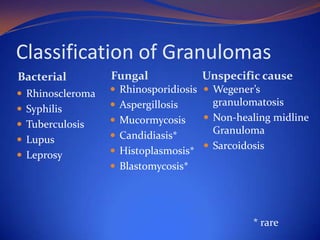
Classification of Granulomas
Bacterial

Fungal

 Rhinoscleroma

 Rhinosporidiosis  Wegener’s

 Syphilis
 Tuberculosis
 Lupus
 Leprosy

Unspecific cause

granulomatosis
 Non-healing midline
Mucormycosis
Granuloma
Candidiasis*
Histoplasmosis*  Sarcoidosis
Blastomycosis*

 Aspergillosis





* rare
Respiratory Scleroma or
Mikulicz disease
Definition
Rhinoscleroma or scleroma is a chronic granulomatous
disease caused by gram negative bacillus Klebsiella

rhinoscleromatis [von Frisch bacillus].
Nasal involvement staging
1.

Catarrhal Stage: foul smelling purulent nasal
discharge (carpenter’s glue), not responding to

conventional antibiotics
2. Atrophic stage: foul smelling, honey-comb colour

crusting in stenosed nasal cavity
Nasal involvement staging
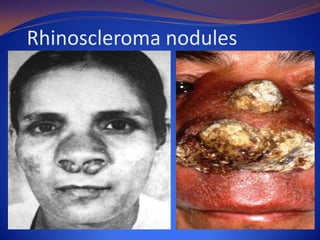
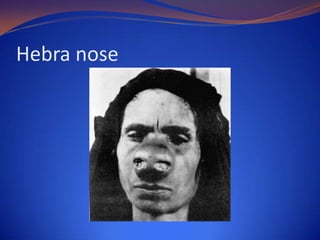
3. Nodular/granulation stage: Non-ulcerative, painless

nodules which widen lower nose (Hebra nose)
4. Cicatrizing stage: Adhesions & stenosis

coarse &

distorted external nose (Tapir nose). Lower external

nose & upper lip have woody feel.
Rhinoscleroma nodules
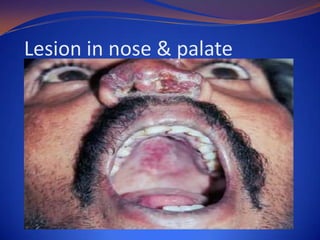
Lesion in nose & palate
Hebra nose
Investigations
 X-ray PNS: Sinusitis + bone destruction
 Nasopharyngoscopy: Obliteration of nasopharynx due to

adhesions between deformed V-shaped soft palate &

posterior pharyngeal wall (Gothic sign)
 Flexible laryngoscopy: Subglottic stenosis
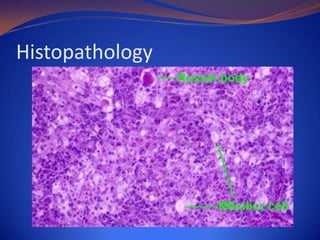
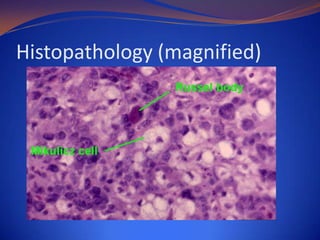
 Biopsy & HPE: Mikulicz cell & Russel body
 Complement fixation test: Between patient’s serum &

Frisch bacillus suspension.
Histopathology
Granulomatous tissue characterized by:
1.

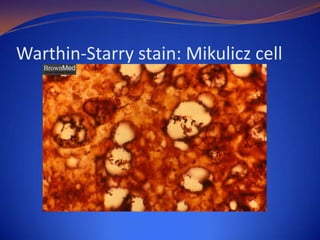
Mikulicz (foam) cells: histiocytes with foamy vacuolated

cytoplasm, central nucleus & containing Frisch bacilli
2.

Russel (Hyaline) body: degenerated plasma cells with

large round eosinophilic material
Histopathology
Histopathology (magnified)
Warthin-Starry stain: Mikulicz cell
Medical treatment
 Streptomycin 1 g OD im and Tetracycline 500 mg QID:

oral together for 4-6 weeks plus 1 month (till two

consecutive negatives from biopsy)
 Rifampicin: 650 mg OD orally
Radiotherapy & Surgery
 Radiotherapy: 3500 rad over 3 week
 Surgery: Removal of granulations & nodular lesions

with cautery or laser
 Plastic reconstructive surgery
Tuberculosis
 Nose:
 C/F:

 Diagnosis:

Nasal Septum and ant. inferior
turbinate
Ulceration & Perforation of Nasal
Septum cartilaginous part

 Treatment:

Biopsy & AFS
Anti-tubercular drugs

 Skin:

Lupus Vulgaris “apple-jelly”
Syphilis
Acquired or Congenital
 Acquired:
Chancre of the vestibule of nose
Saddle Nose
 Congenital:
Saddle nose, corneal opacities,
deafness and Hutchinson’s teeth
 Diagnosis:

 Treatment:

VDRL
Benzathine pencillin
Leprosy
 Nose:

Nasal septum and ant. inferior turbinate

 C/F:

Nodular lesion
Atrophic rhinitis, dep. of nose,

destruction of ant. nasal spine

 Diagnosis: Scraping & Biopsy
 Treatment: Dapsone, Rifampin and Isoniazid
Definition
 Chronic granulomatous infection of the mucous

membrane by Rhinosporidium seeberi, mainly
affecting nose & nasopharynx
 Characterized by formation of friable, bleeding and

polypoidal lesions
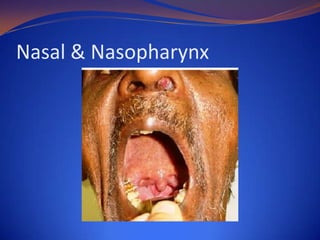
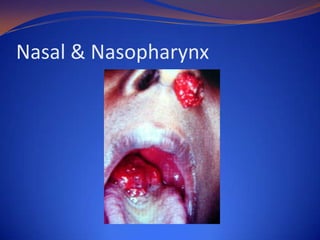
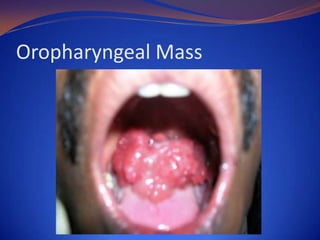
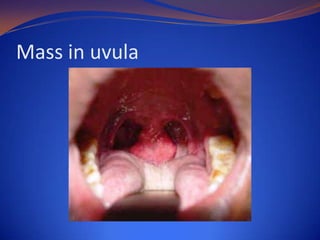
 Other sites: lips, palate, conjunctiva, epiglottis, larynx,

trachea, bronchi, skin, vulva, vagina, hand & feet.
Epidemiology
 88 – 95% cases in India, Pakistan & Sri Lanka
 Common in Kerala, Karnataka & Tamil Nadu

 Age:

20 – 40 yrs.

 Sex ratio: Male : Female

4:1
Incidence
 Nasal

78%

 Nasopharyngeal

16%

 Mixed (naso-nasopharyngeal, nasolacrimal)

05%

 Bizarre (Conjunctival / Tarsal / Cutaneous)

rare
Clinical Presentation
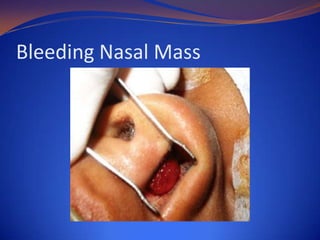
 Epistaxis + nasal discharge + nose block
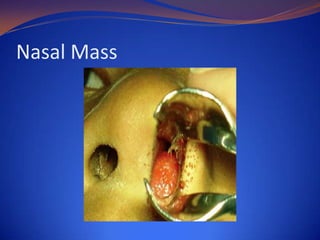
 Nasal mass: papillomatous or polypoid, granular,

friable, bleeds on touch, pedunculated or sessile, pink
surface studded with white dots [Strawberry

appearance], involves septum & turbinates
Nasal Mass
Bleeding Nasal Mass
Nasal & Nasopharynx
Nasal & Nasopharynx
Oropharyngeal Mass
Mass in uvula
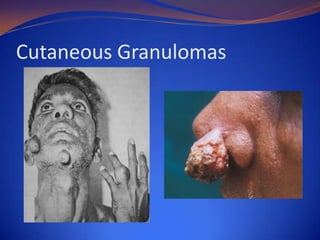
Cutaneous Granulomas
Mode of transmission
 Bathing in infected water; infective spores enter via

breached nasal mucosa
 Droplet infection by cattle dung dust
 Contact transmission: contaminated fingernails are

responsible for cutaneous lesions
 Haematogenous: to other sites in infected patient
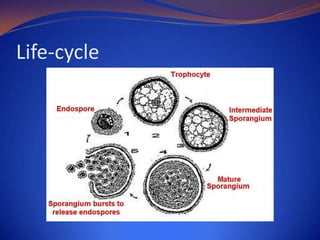
Life-cycle
Investigation
 Biopsy & Histopathological examination
 Microscopic examination of nasal discharge for spores

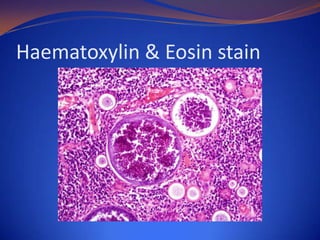
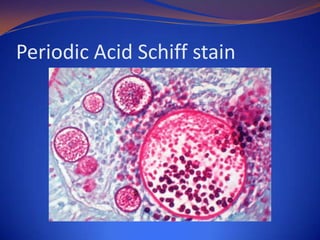
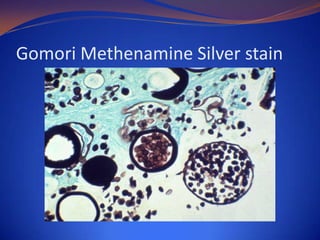
Sporangia of different shapes oval to round and
bursting spores are present.
Haematoxylin & Eosin stain
Periodic Acid Schiff stain
Gomori Methenamine Silver stain
Medical Treatment
 Dapsone: arrests maturation of spores
 Dose: 100 mg OD orally (with meals) for one year

 Iron & Vitamin supplements
Surgical management
 General anesthesia with Oro-tracheal intubation
 2% Xylocaine with adrenaline infiltrated till

surrounding mucosa appears blanched
 Mass avulsed using Luc’s forceps & suction
 After removal of mass, its base cauterized
 Laser excision: minimal bleeding
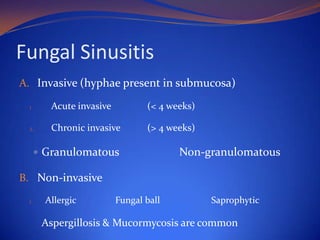
Fungal Sinusitis
A. Invasive (hyphae present in submucosa)
1.

Acute invasive

(< 4 weeks)

2.

Chronic invasive

(> 4 weeks)

 Granulomatous

Non-granulomatous

B. Non-invasive
1.

Allergic

Fungal ball

Saprophytic

Aspergillosis & Mucormycosis are common
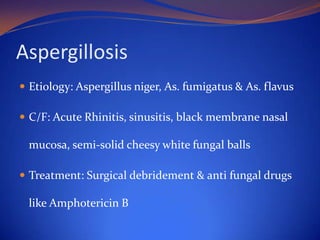
Aspergillosis
 Etiology: Aspergillus niger, As. fumigatus & As. flavus
 C/F: Acute Rhinitis, sinusitis, black membrane nasal

mucosa, semi-solid cheesy white fungal balls
 Treatment: Surgical debridement & anti fungal drugs

like Amphotericin B
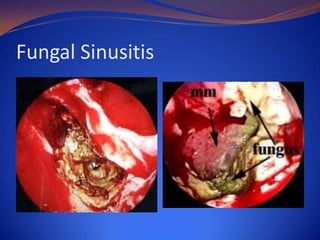
Fungal Sinusitis
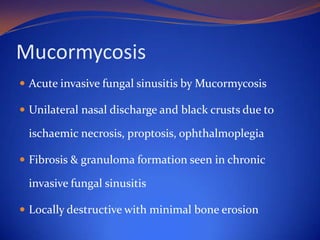
Mucormycosis
 Acute invasive fungal sinusitis by Mucormycosis
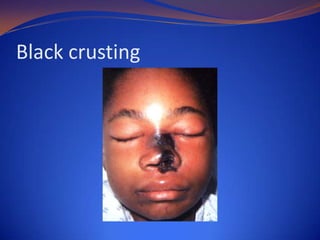
 Unilateral nasal discharge and black crusts due to

ischaemic necrosis, proptosis, ophthalmoplegia
 Fibrosis & granuloma formation seen in chronic

invasive fungal sinusitis
 Locally destructive with minimal bone erosion
Black crusting
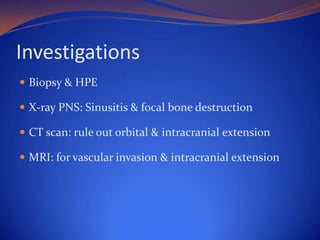
Investigations
 Biopsy & HPE
 X-ray PNS: Sinusitis & focal bone destruction
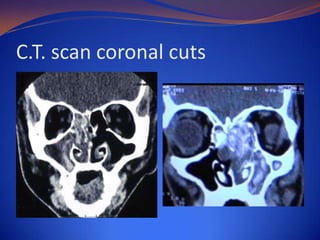
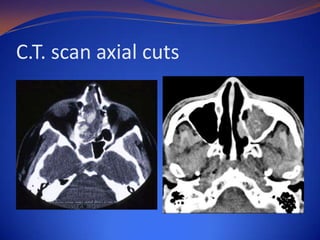
 CT scan: rule out orbital & intracranial extension
 MRI: for vascular invasion & intracranial extension
C.T. scan coronal cuts
C.T. scan axial cuts
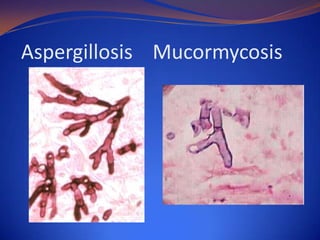
Aspergillosis Mucormycosis
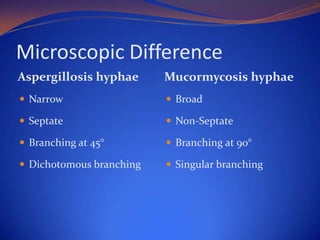
Microscopic Difference
Aspergillosis hyphae

Mucormycosis hyphae

 Narrow

 Broad

 Septate

 Non-Septate

 Branching at 45°

 Branching at 90°

 Dichotomous branching

 Singular branching
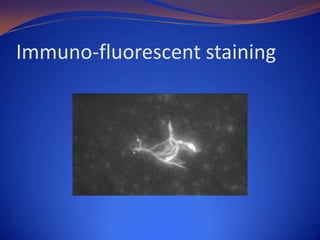
Immuno-fluorescent staining
Treatment
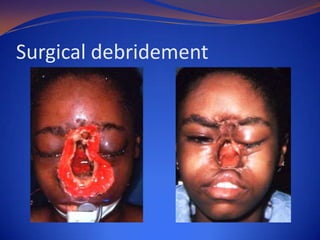
 Surgical debridement of necrotic debris
 Amphotericin B infusion: 1 mg / kg / day IV daily / on

alternate days
 Itraconazole: 100 mg BD for 6-12 months
Surgical debridement
Definition & Etiology
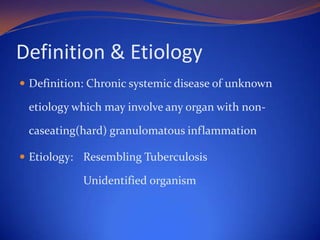
 Definition: Chronic systemic disease of unknown

etiology which may involve any organ with noncaseating(hard) granulomatous inflammation
 Etiology: Resembling Tuberculosis

Unidentified organism
Clinical Features
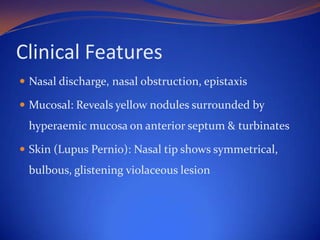
 Nasal discharge, nasal obstruction, epistaxis
 Mucosal: Reveals yellow nodules surrounded by

hyperaemic mucosa on anterior septum & turbinates
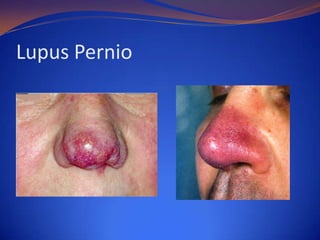
 Skin (Lupus Pernio): Nasal tip shows symmetrical,

bulbous, glistening violaceous lesion
Lupus Pernio
Investigations
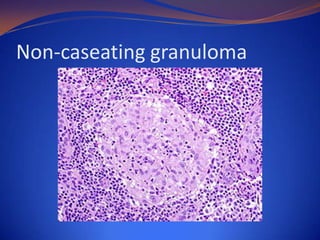
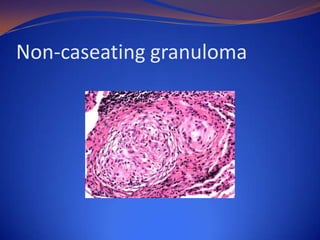
 Biopsy of nodule & HPE: Non-caseating hard

granuloma
 Kveim intradermal Test
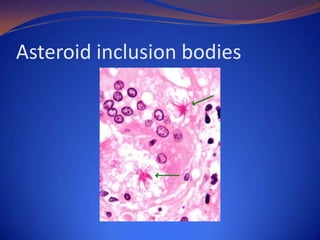
Non-caseating granuloma
Asteroid inclusion bodies
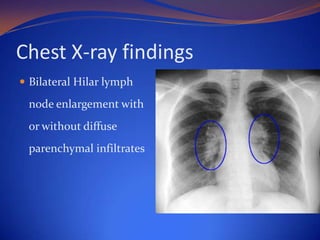
Chest X-ray findings
 Bilateral Hilar lymph

node enlargement with
or without diffuse
parenchymal infiltrates
Treatment
1.

Prednisolone

2. Chloroquine / Methotrexate + Prednisolone: In

patients not responding to steroids
3. Cutaneous lesions: Excised & skin grafted
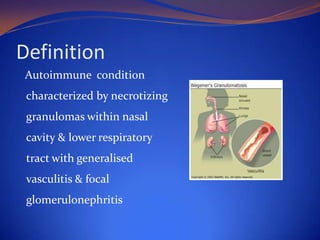
Definition
Autoimmune condition
characterized by necrotizing
granulomas within nasal

cavity & lower respiratory
tract with generalised
vasculitis & focal

glomerulonephritis
Clinical Features
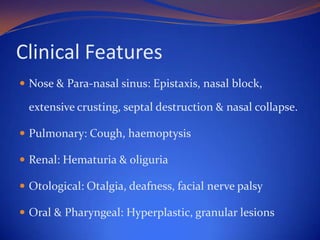
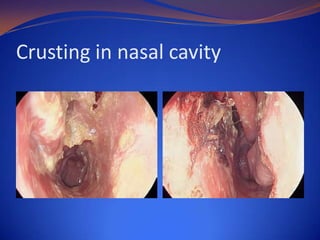
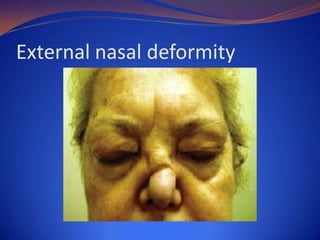
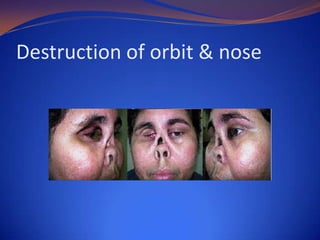
 Nose & Para-nasal sinus: Epistaxis, nasal block,

extensive crusting, septal destruction & nasal collapse.
 Pulmonary: Cough, haemoptysis
 Renal: Hematuria & oliguria
 Otological: Otalgia, deafness, facial nerve palsy
 Oral & Pharyngeal: Hyperplastic, granular lesions
Crusting in nasal cavity
External nasal deformity
Destruction of orbit & nose
Investigations
 E.S.R.
 Urine: microscopic examination
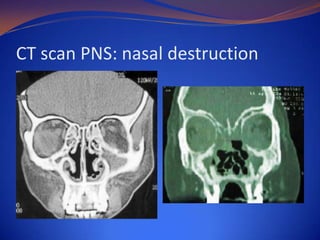
 CT scan: PNS
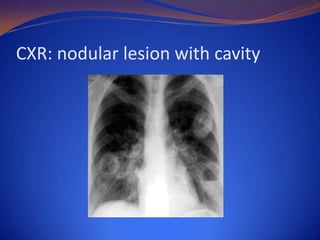
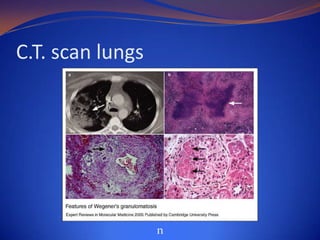
 Chest X-ray & CT scan
 Serum urea & creatinine
 Biopsy & HPE
CT scan PNS: nasal destruction
CXR: nodular lesion with cavity
C.T. scan lungs

n
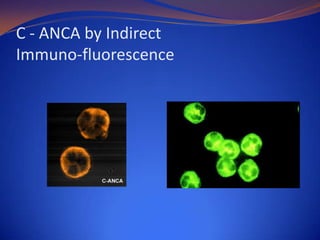
C - ANCA by Indirect
Immuno-fluorescence
Medical Treatment
1.

Triple therapy: Prednisolone + Cyclophosphamide
+ Cotrimoxazole

2. Plasma exchange & intravenous immunoglobulin
3. Alkaline nasal douche for crusts
Nasal Granuloma

Nasal Granuloma