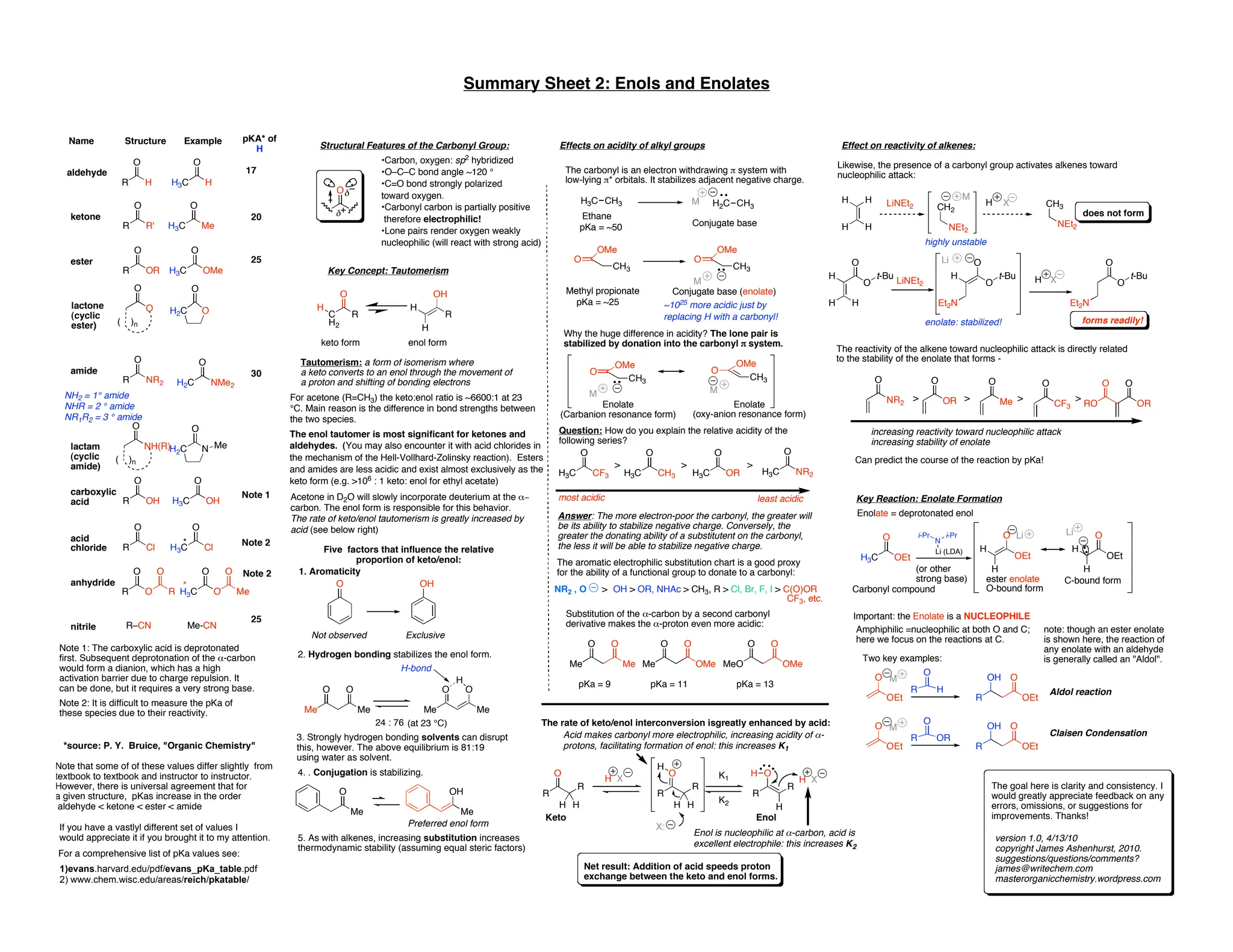
Summary Sheet 2: Enols and Enolates
version 1.0, 4/13/10
copyright James Ashenhurst, 2010.
suggestions/questions/comments?
james@writechem.com
masterorganicchemistry.wordpress.com
Oδ
δ+
–
Structural Features of the Carbonyl Group:
•Carbon, oxygen: sp2 hybridized
•O–C–C bond angle ~120 °
•C=O bond strongly polarized
toward oxygen.
•Carbonyl carbon is partially positive
therefore electrophilic!
•Lone pairs render oxygen weakly
nucleophilic (will react with strong acid)
The carbonyl is an electron withdrawing π system with
low-lying π* orbitals. It stabilizes adjacent negative charge.
H3C CH3
CH3
O
OMe
Ethane
pKa = ~50
Methyl propionate
pKa = ~25 ~1025 more acidic just by
replacing H with a carbonyl!
Why the huge difference in acidity? The lone pair is
stabilized by donation into the carbonyl π system.
H2C CH3
M
Conjugate base
CH3
O
OMe
M
Conjugate base (enolate)
CH3
O
OMe
M
CH3
O
OMe
M
Answer: The more electron-poor the carbonyl, the greater will
be its ability to stabilize negative charge. Conversely, the
greater the donating ability of a substitutent on the carbonyl,
the less it will be able to stabilize negative charge.
Enolate
(Carbanion resonance form)
Enolate
(oxy-anion resonance form)
Question: How do you explain the relative acidity of the
following series?
H3C
O
CF3 H3C
O
CH3 H3C
O
OR H3C
O
NR2
> > >
most acidic least acidic
The aromatic electrophilic substitution chart is a good proxy
for the ability of a functional group to donate to a carbonyl:
Substitution of the α-carbon by a second carbonyl
derivative makes the α-proton even more acidic:
O
Me
O
Me
O
OMe
O
Me
O
OMe
O
MeO
pKa = 9 pKa = 11 pKa = 13
NR2 , O > OH > OR, NHAc > CH3, R > Cl, Br, F, I > C(O)OR
CF3, etc.
CH2
H H
H H
LiNEt2
NEt2
M
highly unstable
CH3
NEt2
does not form
H
H H
LiNEt2
O
O
H
Et2N
O
O
t-Bu
Li
Et2N
O
O
t-Bu
H
H
X
X
forms readily!
t-Bu
Likewise, the presence of a carbonyl group activates alkenes toward
nucleophilic attack:
enolate: stabilized!
O
CF3
O
Me
O
OR
O
NR2
The reactivity of the alkene toward nucleophilic attack is directly related
to the stability of the enolate that forms -
> > >
increasing reactivity toward nucleophilic attack
increasing stability of enolate
Can predict the course of the reaction by pKa!
Enolate = deprotonated enol
Carbonyl compound
H3C
O
OEt
O
OEt
H
H
ester enolate
O-bound form
O
OEt
H
H
N
i-Pr
i-Pr
Li (LDA)
Li Li
C-bound form
(or other
strong base)
Important: the Enolate is a NUCLEOPHILE
Two key examples:
O
OEt
O
R H
M O
OEt
OH
R
O
OEt
O
R OR
M O
OEt
OH
R
note: though an ester enolate
is shown here, the reaction of
any enolate with an aldehyde
is generally called an "Aldol".
Aldol reaction
Claisen Condensation
Key Reaction: Enolate Formation
O
OR
O
RO
>
Amphiphilic =nucleophilic at both O and C;
here we focus on the reactions at C.
Name Structure
aldehyde
R
O
H
ketone
R
O
R'
ester
R
O
OR
amide
R
O
NR2
carboxylic
acid R
O
OH
acid
chloride R
O
Cl
anhydride
R
O
O
nitrile R–CN
lactone
(cyclic
ester)
O
O
( )n
lactam
(cyclic
amide)
O
NH(R)
( )n
*
*
NH2 = 1° amide
NHR = 2 ° amide
NR1R2 = 3 ° amide
O
R
1)evans.harvard.edu/pdf/evans_pKa_table.pdf
2) www.chem.wisc.edu/areas/reich/pkatable/
Key Concept: Tautomerism
O
C
H2
R
OH
R
H
H
keto form enol form
Tautomerism: a form of isomerism where
a keto converts to an enol through the movement of
a proton and shifting of bonding electrons
H
For acetone (R=CH3) the keto:enol ratio is ~6600:1 at 23
°C. Main reason is the difference in bond strengths between
the two species.
The enol tautomer is most significant for ketones and
aldehydes. (You may also encounter it with acid chlorides in
the mechanism of the Hell-Vollhard-Zolinsky reaction). Esters
and amides are less acidic and exist almost exclusively as the
keto form (e.g. >106 : 1 keto: enol for ethyl acetate)
Acetone in D2O will slowly incorporate deuterium at the α−
carbon. The enol form is responsible for this behavior.
The rate of keto/enol tautomerism is greatly increased by
acid (see below right)
Example pKA* of
H
H3C
O
H
17
H3C
O
Me
20
H3C
O
OMe
H2C O
O
H2C N
O
Me
O
NMe2
H2C
H3C
O
OH
H3C
O
Cl
H3C
O
O
O
Me
Me-CN
For a comprehensive list of pKa values see:
25
Note that some of of these values differ slightly from
textbook to textbook and instructor to instructor.
However, there is universal agreement that for
a given structure, pKas increase in the order
aldehyde < ketone < ester < amide
If you have a vastlyl different set of values I
would appreciate it if you brought it to my attention.
The goal here is clarity and consistency. I
would greatly appreciate feedback on any
errors, omissions, or suggestions for
improvements. Thanks!
30
Note 2
Note 2
Note 1
Note 1: The carboxylic acid is deprotonated
first. Subsequent deprotonation of the α-carbon
would form a dianion, which has a high
activation barrier due to charge repulsion. It
can be done, but it requires a very strong base.
Note 2: It is difficult to measure the pKa of
these species due to their reactivity.
Effects on acidity of alkyl groups Effect on reactivity of alkenes:
The rate of keto/enol interconversion isgreatly enhanced by acid:
Five factors that influence the relative
proportion of keto/enol:
O
R
R
H H
H X
O
R
R
H
H
X:
Acid makes carbonyl more electrophilic, increasing acidity of α-
protons, facilitating formation of enol: this increases K1
O
R
R
H
H
Keto Enol
Enol is nucleophilic at α-carbon, acid is
excellent electrophile: this increases K2
K1
K2
H
H X
Net result: Addition of acid speeds proton
exchange between the keto and enol forms.
*source: P. Y. Bruice, "Organic Chemistry"
25
1. Aromaticity
O OH
Exclusive
Not observed
2. Hydrogen bonding stabilizes the enol form.
O O
Me
Me
O O
Me
Me
H
H-bond
24 : 76 (at 23 °C)
3. Strongly hydrogen bonding solvents can disrupt
this, however. The above equilibrium is 81:19
using water as solvent.
O
Me
4. . Conjugation is stabilizing.
OH
Me
Preferred enol form
5. As with alkenes, increasing substitution increases
thermodynamic stability (assuming equal steric factors)

Enol and enolate ions. Organic chemistry

  • 1.
    Summary Sheet 2:Enols and Enolates version 1.0, 4/13/10 copyright James Ashenhurst, 2010. suggestions/questions/comments? james@writechem.com masterorganicchemistry.wordpress.com Oδ δ+ – Structural Features of the Carbonyl Group: •Carbon, oxygen: sp2 hybridized •O–C–C bond angle ~120 ° •C=O bond strongly polarized toward oxygen. •Carbonyl carbon is partially positive therefore electrophilic! •Lone pairs render oxygen weakly nucleophilic (will react with strong acid) The carbonyl is an electron withdrawing π system with low-lying π* orbitals. It stabilizes adjacent negative charge. H3C CH3 CH3 O OMe Ethane pKa = ~50 Methyl propionate pKa = ~25 ~1025 more acidic just by replacing H with a carbonyl! Why the huge difference in acidity? The lone pair is stabilized by donation into the carbonyl π system. H2C CH3 M Conjugate base CH3 O OMe M Conjugate base (enolate) CH3 O OMe M CH3 O OMe M Answer: The more electron-poor the carbonyl, the greater will be its ability to stabilize negative charge. Conversely, the greater the donating ability of a substitutent on the carbonyl, the less it will be able to stabilize negative charge. Enolate (Carbanion resonance form) Enolate (oxy-anion resonance form) Question: How do you explain the relative acidity of the following series? H3C O CF3 H3C O CH3 H3C O OR H3C O NR2 > > > most acidic least acidic The aromatic electrophilic substitution chart is a good proxy for the ability of a functional group to donate to a carbonyl: Substitution of the α-carbon by a second carbonyl derivative makes the α-proton even more acidic: O Me O Me O OMe O Me O OMe O MeO pKa = 9 pKa = 11 pKa = 13 NR2 , O > OH > OR, NHAc > CH3, R > Cl, Br, F, I > C(O)OR CF3, etc. CH2 H H H H LiNEt2 NEt2 M highly unstable CH3 NEt2 does not form H H H LiNEt2 O O H Et2N O O t-Bu Li Et2N O O t-Bu H H X X forms readily! t-Bu Likewise, the presence of a carbonyl group activates alkenes toward nucleophilic attack: enolate: stabilized! O CF3 O Me O OR O NR2 The reactivity of the alkene toward nucleophilic attack is directly related to the stability of the enolate that forms - > > > increasing reactivity toward nucleophilic attack increasing stability of enolate Can predict the course of the reaction by pKa! Enolate = deprotonated enol Carbonyl compound H3C O OEt O OEt H H ester enolate O-bound form O OEt H H N i-Pr i-Pr Li (LDA) Li Li C-bound form (or other strong base) Important: the Enolate is a NUCLEOPHILE Two key examples: O OEt O R H M O OEt OH R O OEt O R OR M O OEt OH R note: though an ester enolate is shown here, the reaction of any enolate with an aldehyde is generally called an "Aldol". Aldol reaction Claisen Condensation Key Reaction: Enolate Formation O OR O RO > Amphiphilic =nucleophilic at both O and C; here we focus on the reactions at C. Name Structure aldehyde R O H ketone R O R' ester R O OR amide R O NR2 carboxylic acid R O OH acid chloride R O Cl anhydride R O O nitrile R–CN lactone (cyclic ester) O O ( )n lactam (cyclic amide) O NH(R) ( )n * * NH2 = 1° amide NHR = 2 ° amide NR1R2 = 3 ° amide O R 1)evans.harvard.edu/pdf/evans_pKa_table.pdf 2) www.chem.wisc.edu/areas/reich/pkatable/ Key Concept: Tautomerism O C H2 R OH R H H keto form enol form Tautomerism: a form of isomerism where a keto converts to an enol through the movement of a proton and shifting of bonding electrons H For acetone (R=CH3) the keto:enol ratio is ~6600:1 at 23 °C. Main reason is the difference in bond strengths between the two species. The enol tautomer is most significant for ketones and aldehydes. (You may also encounter it with acid chlorides in the mechanism of the Hell-Vollhard-Zolinsky reaction). Esters and amides are less acidic and exist almost exclusively as the keto form (e.g. >106 : 1 keto: enol for ethyl acetate) Acetone in D2O will slowly incorporate deuterium at the α− carbon. The enol form is responsible for this behavior. The rate of keto/enol tautomerism is greatly increased by acid (see below right) Example pKA* of H H3C O H 17 H3C O Me 20 H3C O OMe H2C O O H2C N O Me O NMe2 H2C H3C O OH H3C O Cl H3C O O O Me Me-CN For a comprehensive list of pKa values see: 25 Note that some of of these values differ slightly from textbook to textbook and instructor to instructor. However, there is universal agreement that for a given structure, pKas increase in the order aldehyde < ketone < ester < amide If you have a vastlyl different set of values I would appreciate it if you brought it to my attention. The goal here is clarity and consistency. I would greatly appreciate feedback on any errors, omissions, or suggestions for improvements. Thanks! 30 Note 2 Note 2 Note 1 Note 1: The carboxylic acid is deprotonated first. Subsequent deprotonation of the α-carbon would form a dianion, which has a high activation barrier due to charge repulsion. It can be done, but it requires a very strong base. Note 2: It is difficult to measure the pKa of these species due to their reactivity. Effects on acidity of alkyl groups Effect on reactivity of alkenes: The rate of keto/enol interconversion isgreatly enhanced by acid: Five factors that influence the relative proportion of keto/enol: O R R H H H X O R R H H X: Acid makes carbonyl more electrophilic, increasing acidity of α- protons, facilitating formation of enol: this increases K1 O R R H H Keto Enol Enol is nucleophilic at α-carbon, acid is excellent electrophile: this increases K2 K1 K2 H H X Net result: Addition of acid speeds proton exchange between the keto and enol forms. *source: P. Y. Bruice, "Organic Chemistry" 25 1. Aromaticity O OH Exclusive Not observed 2. Hydrogen bonding stabilizes the enol form. O O Me Me O O Me Me H H-bond 24 : 76 (at 23 °C) 3. Strongly hydrogen bonding solvents can disrupt this, however. The above equilibrium is 81:19 using water as solvent. O Me 4. . Conjugation is stabilizing. OH Me Preferred enol form 5. As with alkenes, increasing substitution increases thermodynamic stability (assuming equal steric factors)