International Journal of Computer Applications Technology and Research
Volume 5–Issue 10, 678-682, 2016, ISSN:-2319–8656
www.ijcat.com 678
Enhancement of Payload Capacity for Image
Steganography based on LSB
Abstract: In this result paper we will show the implementation result of our proposed method. Steganography is an art and
science of Hide the data in a cover image using some techniques that it remains undetected by the unauthorized access. We hide
the data in a manner that the stego image looks like a single entry by any third person. No one has doubt that the image is the
stego image. We use some different methods that keep data to be secret. It is a powerful tool for security with which we can
keep the data secret behind an object. An object may be Text, Audio, Video, and Image. The factor that affects the steganography
methods are PSNR, MSE, Payload Capacity and BER. Security of data will be shown by the Histogram of picture.
Keywords: Steganography, PSNR, MSE, Stego-Image, Stego-Key, Data covering, Data Extraction.
1. INTRODUCTION TO
STEGANOGRAPHY
Exponentially increase in the use of internet it becomes important
to secure the confidential data and information on internet.
Therefore, to cover the defensive information on the internet
various. To avoid these problems many methods are used to hide
the data in digital media
One is Cryptography, it only keeps the contents of the message
secret i.e. No one can understands the secret message. But
sometimes it is necessary to keep the existence of the
message is secure that no one can think even a single secret bit is
existing. So, a technique which keeps the existence of a message
secret is known a steganography [1].
Steganography is a Greek origin word that means “HIDDEN
WRITING” Steganography is an art and science of hiding
information [2] in some cover media. It aims is to hide the
presence of the secret message behind any object (Text, Image,
Video, Audio) file By embedding one piece of data inside of
another, the two entity become a
new single entity, thus eliminating the need to keep a link
between the two
distinct pieces of data, or risk the chance of their separation.
After hide the message in any object file –called Stego Image. In
this technology we will use many type of techniques using
different type of the cover objects.
One application that demonstrate the
advantage of this regards of steganography is the
embedding of patient information within the medical imaging.
By doing so a persistent association between these two
information objects is generate [3]-[5].
“What You See Is What You Get” this concepts
which we encounter sometimes does not always hold true.
Images can be more than what we see with our Visual
System; hence they can convey more than merely 1000
words. Figure1.1 (Types of the Steganography cover objects)
shows how a Stenographic system works [6]-[7].
1.1 Motivation
Exponentially increase in the use of internet it becomes important
to secure the confidential data and information on internet. Hence,
there is need to cover the defensive information on the internet.
Those days are gone when we use the image for our memorable
part, Audio as our favourite songs, Video as our favourite movie
or song. In the digital world we use image, audio, video as our
containers. In earlier, the use of the internet is increasing
exponentially. So the unauthorized access of the data is also
increase day by day. So we need some secure method preventing
from this type of access. We can secure our data using
cryptography and steganography. Cryptography is a technique
which can encrypt the data in an another form called cipher text
using a key(Symmetric & Asymmetric key).If the third party
knows the key of the cipher text then he can access the data. But
if we hide the existence of the data. Then the third party don’t
know about the existence of the data. So data is secured from the
unauthorized access. This is called steganography. So it is a
motivational point that time we need it.
To hide the secret data we need some terminology:
 Secret data that must be hidden (M); it may be plain text or
may be Cipher text.
 Cover object (C) that works as a container in which we will
hide the data.
 Stego encoding (Se) and decoding(Se-1
)
 A stego key (K) which is used at the time of encoding and at
the time of decoding.
 A Payload capacity is a capacity that a Cover Object can
contains the secret bits.
The main terminology in the steganography is the objects that we
use to hide the data called cover objects. There are many types of
the cover objects we have. Cover object is the object which is used
to hide the secret bits in the bits of the cover objects bits. We have
to modify the bits to hide the data in the cover objects. We can use
the audio, video, image, text, any type of puzzles and network
protocol (PDU). Behind these objects we can hide the data which
we want to hide. Using the techniques of the data hiding we can
hide the data.
Vidya Verma
Guru Jambheshwar University of
Science and Technology,
Department of Computer Science
and Engineering, Hisar, Haryana,
India
Abhishek Kajal
Guru Jambheshwar University of
Science and Technology,
Department of Computer Science
and Engineering, Hisar, Haryana,
India
Isha Kajal
Indus institute of Engineering and
Technology,
Department of Computer Science
and Engineering, Rohtak Road,
Jind, Haryana, India
International Journal of Computer Applications Technology and Research
Volume 5–Issue 10, 678-682, 2016, ISSN:-2319–8656
www.ijcat.com 679
In the steganography process before hiding the data we must chose
the object that was used in the data hiding. It may be text Image
audio and video. Then enter the data that will be hidden and apply
some technique on the secret data to make it more secure. We can
encode it or also encoding with compressing the data. It will
provide more security than the normal data. After encoding the
data we will secure it by a security key that is known by only
receiver. And then apply the steganography technique on it. After
it sends to the receiver .Receiver performs the reverse process of
steganography with the help of the Security key and extract all the
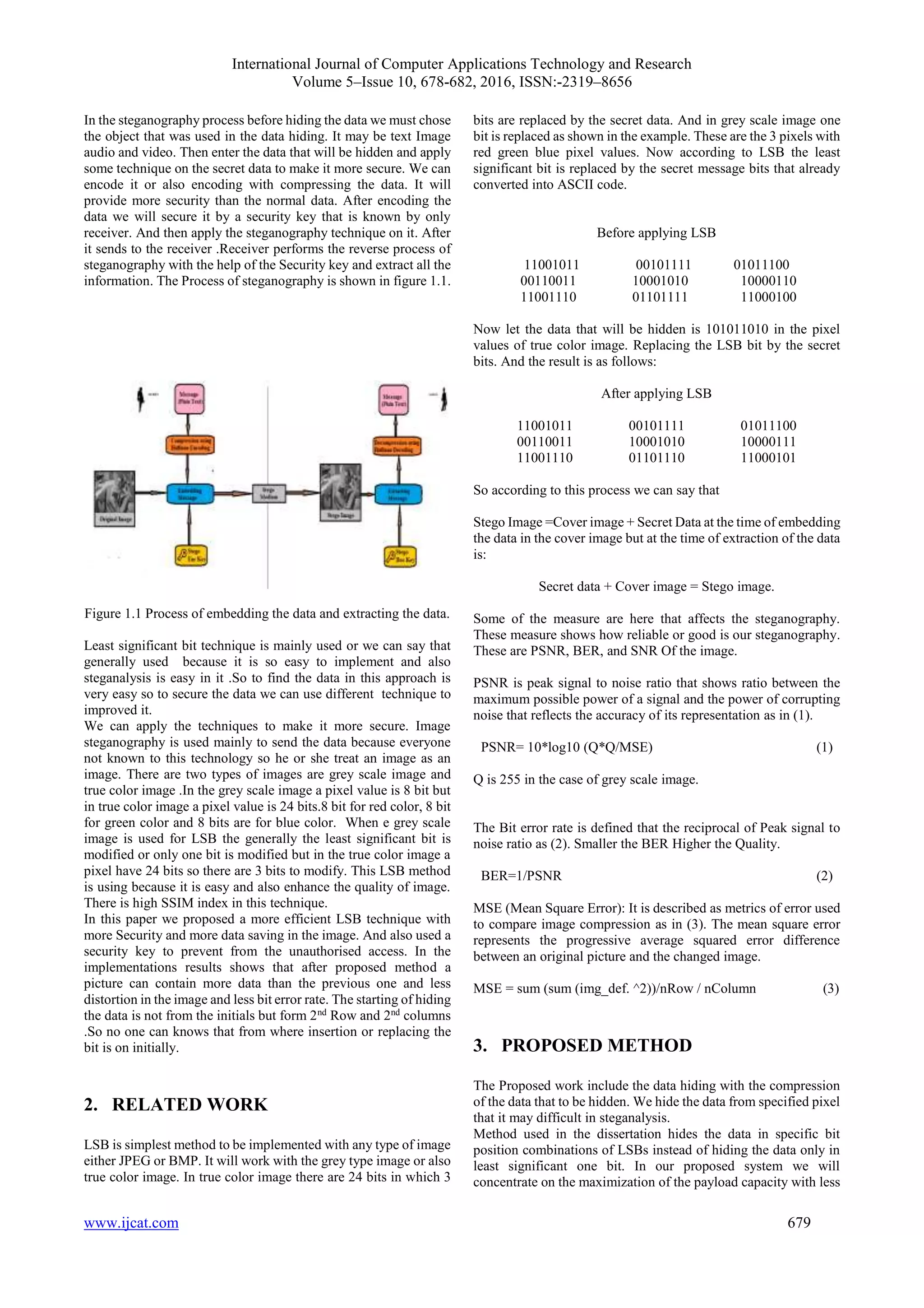
information. The Process of steganography is shown in figure 1.1.
Figure 1.1 Process of embedding the data and extracting the data.
Least significant bit technique is mainly used or we can say that
generally used because it is so easy to implement and also
steganalysis is easy in it .So to find the data in this approach is
very easy so to secure the data we can use different technique to
improved it.
We can apply the techniques to make it more secure. Image
steganography is used mainly to send the data because everyone
not known to this technology so he or she treat an image as an
image. There are two types of images are grey scale image and
true color image .In the grey scale image a pixel value is 8 bit but
in true color image a pixel value is 24 bits.8 bit for red color, 8 bit
for green color and 8 bits are for blue color. When e grey scale
image is used for LSB the generally the least significant bit is
modified or only one bit is modified but in the true color image a
pixel have 24 bits so there are 3 bits to modify. This LSB method
is using because it is easy and also enhance the quality of image.
There is high SSIM index in this technique.
In this paper we proposed a more efficient LSB technique with
more Security and more data saving in the image. And also used a
security key to prevent from the unauthorised access. In the
implementations results shows that after proposed method a
picture can contain more data than the previous one and less
distortion in the image and less bit error rate. The starting of hiding
the data is not from the initials but form 2nd
Row and 2nd
columns
.So no one can knows that from where insertion or replacing the
bit is on initially.
2. RELATED WORK
LSB is simplest method to be implemented with any type of image
either JPEG or BMP. It will work with the grey type image or also
true color image. In true color image there are 24 bits in which 3
bits are replaced by the secret data. And in grey scale image one
bit is replaced as shown in the example. These are the 3 pixels with
red green blue pixel values. Now according to LSB the least
significant bit is replaced by the secret message bits that already
converted into ASCII code.
Before applying LSB
11001011 00101111 01011100
00110011 10001010 10000110
11001110 01101111 11000100
Now let the data that will be hidden is 101011010 in the pixel
values of true color image. Replacing the LSB bit by the secret
bits. And the result is as follows:
After applying LSB
11001011 00101111 01011100
00110011 10001010 10000111
11001110 01101110 11000101
So according to this process we can say that
Stego Image =Cover image + Secret Data at the time of embedding
the data in the cover image but at the time of extraction of the data
is:
Secret data + Cover image = Stego image.
Some of the measure are here that affects the steganography.
These measure shows how reliable or good is our steganography.
These are PSNR, BER, and SNR Of the image.
PSNR is peak signal to noise ratio that shows ratio between the
maximum possible power of a signal and the power of corrupting
noise that reflects the accuracy of its representation as in (1).
PSNR= 10*log10 (Q*Q/MSE) (1)
Q is 255 in the case of grey scale image.
The Bit error rate is defined that the reciprocal of Peak signal to
noise ratio as (2). Smaller the BER Higher the Quality.
BER=1/PSNR (2)
MSE (Mean Square Error): It is described as metrics of error used
to compare image compression as in (3). The mean square error
represents the progressive average squared error difference
between an original picture and the changed image.
MSE = sum (sum (img_def. ^2))/nRow / nColumn (3)
3. PROPOSED METHOD
The Proposed work include the data hiding with the compression
of the data that to be hidden. We hide the data from specified pixel
that it may difficult in steganalysis.
Method used in the dissertation hides the data in specific bit
position combinations of LSBs instead of hiding the data only in
least significant one bit. In our proposed system we will
concentrate on the maximization of the payload capacity with less
International Journal of Computer Applications Technology and Research
Volume 5–Issue 10, 678-682, 2016, ISSN:-2319–8656
www.ijcat.com 680
degradation in the image. We also used the reduction (Huffman
coding) on the secret bits so we can more data hide in the cover
object. It not just provide data reduction also provide encryption
or data encoding because after implementing of Huffman coding
it gives output in reduction and in encoded form. So it is an
advantageous for us that data is also encoding so the time factor is
also less in it for data extraction. It also provide security in manner
that how it will encode (Huffman code) the confidential data. It
provides two level of security.
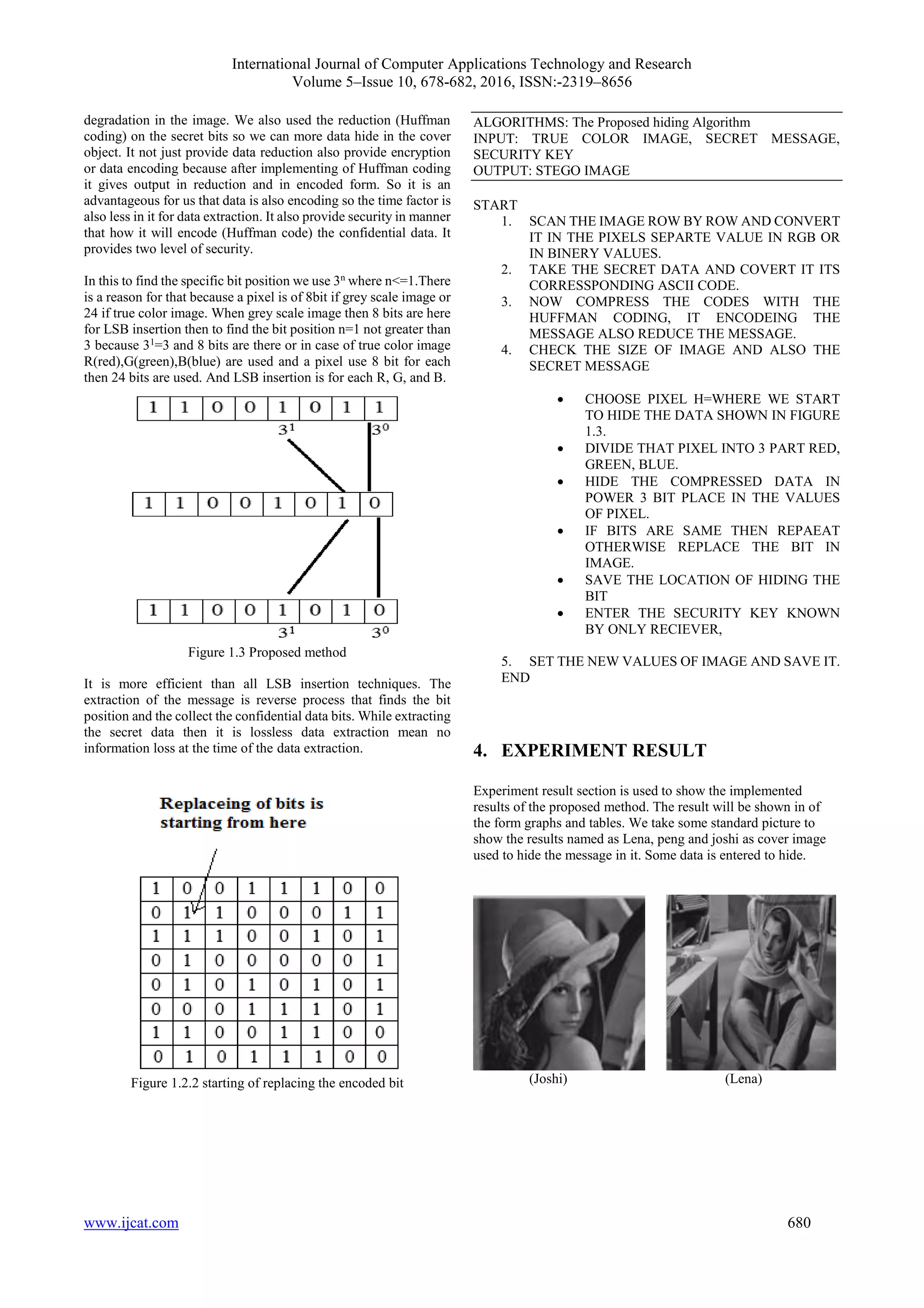
In this to find the specific bit position we use 3n
where n<=1.There
is a reason for that because a pixel is of 8bit if grey scale image or
24 if true color image. When grey scale image then 8 bits are here
for LSB insertion then to find the bit position n=1 not greater than
3 because 31
=3 and 8 bits are there or in case of true color image
R(red),G(green),B(blue) are used and a pixel use 8 bit for each
then 24 bits are used. And LSB insertion is for each R, G, and B.
Figure 1.3 Proposed method
It is more efficient than all LSB insertion techniques. The
extraction of the message is reverse process that finds the bit
position and the collect the confidential data bits. While extracting
the secret data then it is lossless data extraction mean no
information loss at the time of the data extraction.
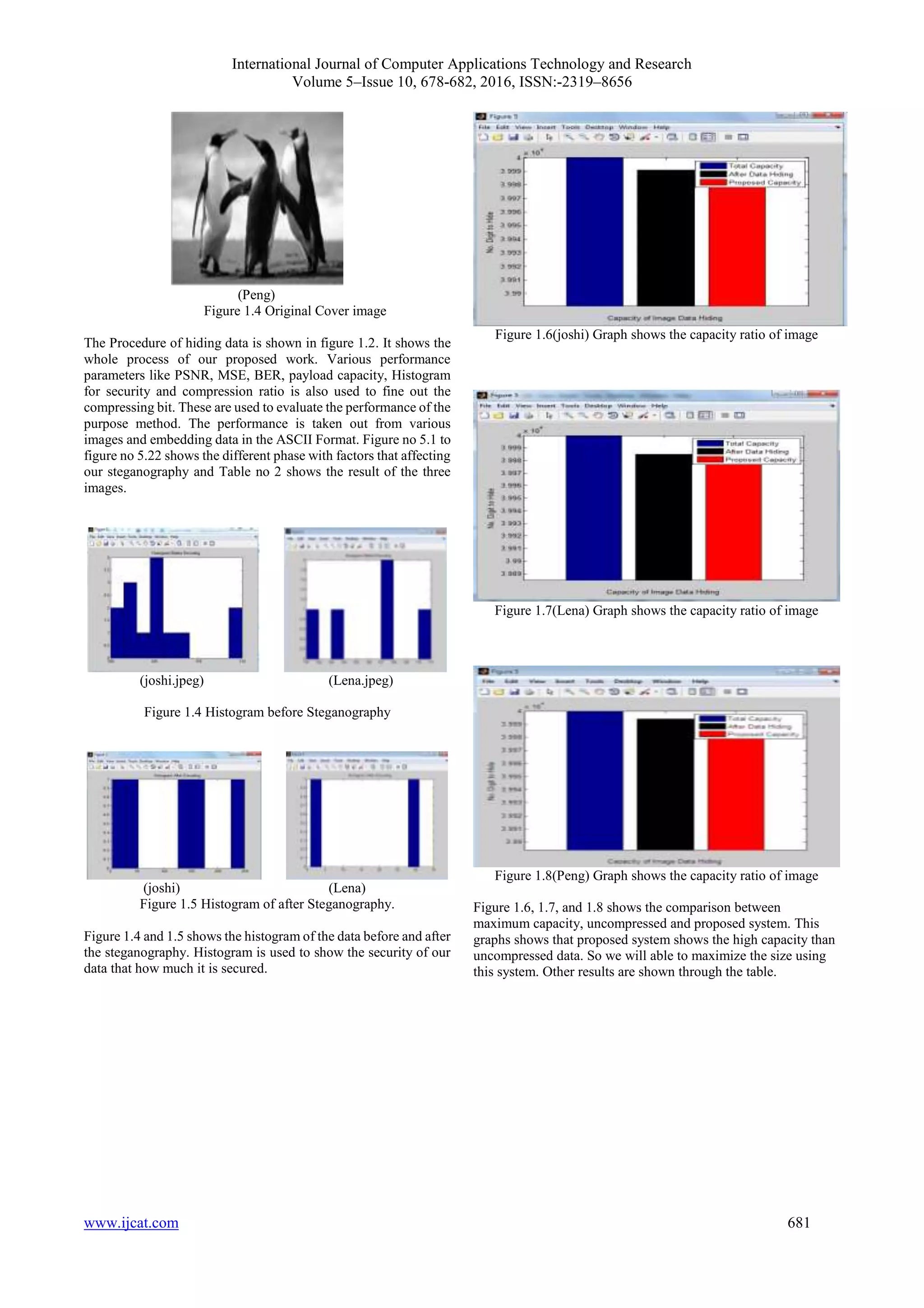
Figure 1.2.2 starting of replacing the encoded bit
ALGORITHMS: The Proposed hiding Algorithm
INPUT: TRUE COLOR IMAGE, SECRET MESSAGE,
SECURITY KEY
OUTPUT: STEGO IMAGE
START
1. SCAN THE IMAGE ROW BY ROW AND CONVERT
IT IN THE PIXELS SEPARTE VALUE IN RGB OR
IN BINERY VALUES.
2. TAKE THE SECRET DATA AND COVERT IT ITS
CORRESSPONDING ASCII CODE.
3. NOW COMPRESS THE CODES WITH THE
HUFFMAN CODING, IT ENCODEING THE
MESSAGE ALSO REDUCE THE MESSAGE.
4. CHECK THE SIZE OF IMAGE AND ALSO THE
SECRET MESSAGE
 CHOOSE PIXEL H=WHERE WE START
TO HIDE THE DATA SHOWN IN FIGURE
1.3.
 DIVIDE THAT PIXEL INTO 3 PART RED,
GREEN, BLUE.
 HIDE THE COMPRESSED DATA IN
POWER 3 BIT PLACE IN THE VALUES
OF PIXEL.
 IF BITS ARE SAME THEN REPAEAT
OTHERWISE REPLACE THE BIT IN
IMAGE.
 SAVE THE LOCATION OF HIDING THE
BIT
 ENTER THE SECURITY KEY KNOWN
BY ONLY RECIEVER,
5. SET THE NEW VALUES OF IMAGE AND SAVE IT.
END
4. EXPERIMENT RESULT
Experiment result section is used to show the implemented
results of the proposed method. The result will be shown in of
the form graphs and tables. We take some standard picture to
show the results named as Lena, peng and joshi as cover image
used to hide the message in it. Some data is entered to hide.
(Joshi) (Lena)
International Journal of Computer Applications Technology and Research
Volume 5–Issue 10, 678-682, 2016, ISSN:-2319–8656
www.ijcat.com 681
(Peng)
Figure 1.4 Original Cover image
The Procedure of hiding data is shown in figure 1.2. It shows the
whole process of our proposed work. Various performance
parameters like PSNR, MSE, BER, payload capacity, Histogram
for security and compression ratio is also used to fine out the
compressing bit. These are used to evaluate the performance of the
purpose method. The performance is taken out from various
images and embedding data in the ASCII Format. Figure no 5.1 to
figure no 5.22 shows the different phase with factors that affecting
our steganography and Table no 2 shows the result of the three
images.
(joshi.jpeg) (Lena.jpeg)
Figure 1.4 Histogram before Steganography
(joshi) (Lena)
Figure 1.5 Histogram of after Steganography.
Figure 1.4 and 1.5 shows the histogram of the data before and after
the steganography. Histogram is used to show the security of our
data that how much it is secured.
Figure 1.6(joshi) Graph shows the capacity ratio of image
Figure 1.7(Lena) Graph shows the capacity ratio of image
Figure 1.8(Peng) Graph shows the capacity ratio of image
Figure 1.6, 1.7, and 1.8 shows the comparison between
maximum capacity, uncompressed and proposed system. This
graphs shows that proposed system shows the high capacity than
uncompressed data. So we will able to maximize the size using
this system. Other results are shown through the table.
International Journal of Computer Applications Technology and Research
Volume 5–Issue 10, 678-682, 2016, ISSN:-2319–8656
www.ijcat.com 682
Table 1 Results and Observation
Cover
Image
Before
Compress
ion
After
Compress
ion
PSNR BER MSE
39985 39995 88.892
0
0.012
43
0.525
0
39983 39993 91.405
4
0.021
23
0.306
2
39988 39995 87.642
6
0.019
89
0.212
50
5. CONCLUSION
Table 1 shows the results and observations of the proposed system.
Here are the results of the system in the tabular form. This
observation shows that the proposed system is better from the
previous technique. The Parameters used to define the proposed
system is better than the previous one technique are Payload
capacity, PSNR, BER, MSE. The parameter are used to compare
the results define less error rate and noise ratio. And less
degradation in the image quality after the proposed system. The
main aim of my dissertation is to enhance the payload capacity and
we meet our aim in the dissertation. Less visible to human eyes
and results are meets to our objectives of our dissertation.
6. REFERENCES
[1] Morkel, Tayana, Jan HP Eloff, and Martin S. Olivier.
“An overview of image steganography." In ISSA, pp. 1-11.
2005.
[2] Petitcolas, Fabien AP, Ross J. Anderson, and Markus G.
Kuhn. "Information hiding-a survey." Proceedings of the
IEEE 87, no. 7, 1062-1078, 1999.
[3] Marvel, Lisa M. "Image steganography for hidden
communication." PhD diss., University of Delaware, 1999.
[4] Chandramouli, Rajarathnam, Mehdi Kharrazi, and Nasir
Memon. "Image steganography and steganalysis: Concepts
and practice." In International Workshop on Digital
Watermarking, pp. 35-49. Springer Berlin Heidelberg, 2003.
[5] Al-Mohammad, Adel. "Steganography-based secret and
reliable communications: Improving steganographic
capacity and imperceptibility." PhD diss., Brunel
University, School of Information Systems, Computing and
Mathematics Theses, 2010.
[6] Morkel, Tayana, Jan HP Eloff, and Martin S. Olivier. "An
overview of image steganography." In ISSA, pp. 1-11. 2005.
[7] Cheddad, Abbas, Joan Condell, Kevin Curran, and Paul Mc
Kevitt. "Digital image steganography: Survey and analysis
of current methods." Signal processing 90, no. 3 727-752,
2010.
[8] Vaishali and Abhishek Kajal, “Increasing Data Hiding
Capacity of Carrier Image Using BPCS Steganography”,
International Journal of Science and Research (IJSR), ISSN
(Online): 2319-7064, Volume 4, Issue 5, May 2015, PP 434-
437.
[9] Vidya , Abhishek Kajal, “A Short Survey on Cover Objects for
Hidden Communications”, International Journal of
Advanced Research in Computer and Communication
Engineering Vol. 5, Issue 5, May 2016.

Enhancement of Payload Capacity for Image Steganography based on LSB

  • 1.
    International Journal ofComputer Applications Technology and Research Volume 5–Issue 10, 678-682, 2016, ISSN:-2319–8656 www.ijcat.com 678 Enhancement of Payload Capacity for Image Steganography based on LSB Abstract: In this result paper we will show the implementation result of our proposed method. Steganography is an art and science of Hide the data in a cover image using some techniques that it remains undetected by the unauthorized access. We hide the data in a manner that the stego image looks like a single entry by any third person. No one has doubt that the image is the stego image. We use some different methods that keep data to be secret. It is a powerful tool for security with which we can keep the data secret behind an object. An object may be Text, Audio, Video, and Image. The factor that affects the steganography methods are PSNR, MSE, Payload Capacity and BER. Security of data will be shown by the Histogram of picture. Keywords: Steganography, PSNR, MSE, Stego-Image, Stego-Key, Data covering, Data Extraction. 1. INTRODUCTION TO STEGANOGRAPHY Exponentially increase in the use of internet it becomes important to secure the confidential data and information on internet. Therefore, to cover the defensive information on the internet various. To avoid these problems many methods are used to hide the data in digital media One is Cryptography, it only keeps the contents of the message secret i.e. No one can understands the secret message. But sometimes it is necessary to keep the existence of the message is secure that no one can think even a single secret bit is existing. So, a technique which keeps the existence of a message secret is known a steganography [1]. Steganography is a Greek origin word that means “HIDDEN WRITING” Steganography is an art and science of hiding information [2] in some cover media. It aims is to hide the presence of the secret message behind any object (Text, Image, Video, Audio) file By embedding one piece of data inside of another, the two entity become a new single entity, thus eliminating the need to keep a link between the two distinct pieces of data, or risk the chance of their separation. After hide the message in any object file –called Stego Image. In this technology we will use many type of techniques using different type of the cover objects. One application that demonstrate the advantage of this regards of steganography is the embedding of patient information within the medical imaging. By doing so a persistent association between these two information objects is generate [3]-[5]. “What You See Is What You Get” this concepts which we encounter sometimes does not always hold true. Images can be more than what we see with our Visual System; hence they can convey more than merely 1000 words. Figure1.1 (Types of the Steganography cover objects) shows how a Stenographic system works [6]-[7]. 1.1 Motivation Exponentially increase in the use of internet it becomes important to secure the confidential data and information on internet. Hence, there is need to cover the defensive information on the internet. Those days are gone when we use the image for our memorable part, Audio as our favourite songs, Video as our favourite movie or song. In the digital world we use image, audio, video as our containers. In earlier, the use of the internet is increasing exponentially. So the unauthorized access of the data is also increase day by day. So we need some secure method preventing from this type of access. We can secure our data using cryptography and steganography. Cryptography is a technique which can encrypt the data in an another form called cipher text using a key(Symmetric & Asymmetric key).If the third party knows the key of the cipher text then he can access the data. But if we hide the existence of the data. Then the third party don’t know about the existence of the data. So data is secured from the unauthorized access. This is called steganography. So it is a motivational point that time we need it. To hide the secret data we need some terminology:  Secret data that must be hidden (M); it may be plain text or may be Cipher text.  Cover object (C) that works as a container in which we will hide the data.  Stego encoding (Se) and decoding(Se-1 )  A stego key (K) which is used at the time of encoding and at the time of decoding.  A Payload capacity is a capacity that a Cover Object can contains the secret bits. The main terminology in the steganography is the objects that we use to hide the data called cover objects. There are many types of the cover objects we have. Cover object is the object which is used to hide the secret bits in the bits of the cover objects bits. We have to modify the bits to hide the data in the cover objects. We can use the audio, video, image, text, any type of puzzles and network protocol (PDU). Behind these objects we can hide the data which we want to hide. Using the techniques of the data hiding we can hide the data. Vidya Verma Guru Jambheshwar University of Science and Technology, Department of Computer Science and Engineering, Hisar, Haryana, India Abhishek Kajal Guru Jambheshwar University of Science and Technology, Department of Computer Science and Engineering, Hisar, Haryana, India Isha Kajal Indus institute of Engineering and Technology, Department of Computer Science and Engineering, Rohtak Road, Jind, Haryana, India
  • 2.
    International Journal ofComputer Applications Technology and Research Volume 5–Issue 10, 678-682, 2016, ISSN:-2319–8656 www.ijcat.com 679 In the steganography process before hiding the data we must chose the object that was used in the data hiding. It may be text Image audio and video. Then enter the data that will be hidden and apply some technique on the secret data to make it more secure. We can encode it or also encoding with compressing the data. It will provide more security than the normal data. After encoding the data we will secure it by a security key that is known by only receiver. And then apply the steganography technique on it. After it sends to the receiver .Receiver performs the reverse process of steganography with the help of the Security key and extract all the information. The Process of steganography is shown in figure 1.1. Figure 1.1 Process of embedding the data and extracting the data. Least significant bit technique is mainly used or we can say that generally used because it is so easy to implement and also steganalysis is easy in it .So to find the data in this approach is very easy so to secure the data we can use different technique to improved it. We can apply the techniques to make it more secure. Image steganography is used mainly to send the data because everyone not known to this technology so he or she treat an image as an image. There are two types of images are grey scale image and true color image .In the grey scale image a pixel value is 8 bit but in true color image a pixel value is 24 bits.8 bit for red color, 8 bit for green color and 8 bits are for blue color. When e grey scale image is used for LSB the generally the least significant bit is modified or only one bit is modified but in the true color image a pixel have 24 bits so there are 3 bits to modify. This LSB method is using because it is easy and also enhance the quality of image. There is high SSIM index in this technique. In this paper we proposed a more efficient LSB technique with more Security and more data saving in the image. And also used a security key to prevent from the unauthorised access. In the implementations results shows that after proposed method a picture can contain more data than the previous one and less distortion in the image and less bit error rate. The starting of hiding the data is not from the initials but form 2nd Row and 2nd columns .So no one can knows that from where insertion or replacing the bit is on initially. 2. RELATED WORK LSB is simplest method to be implemented with any type of image either JPEG or BMP. It will work with the grey type image or also true color image. In true color image there are 24 bits in which 3 bits are replaced by the secret data. And in grey scale image one bit is replaced as shown in the example. These are the 3 pixels with red green blue pixel values. Now according to LSB the least significant bit is replaced by the secret message bits that already converted into ASCII code. Before applying LSB 11001011 00101111 01011100 00110011 10001010 10000110 11001110 01101111 11000100 Now let the data that will be hidden is 101011010 in the pixel values of true color image. Replacing the LSB bit by the secret bits. And the result is as follows: After applying LSB 11001011 00101111 01011100 00110011 10001010 10000111 11001110 01101110 11000101 So according to this process we can say that Stego Image =Cover image + Secret Data at the time of embedding the data in the cover image but at the time of extraction of the data is: Secret data + Cover image = Stego image. Some of the measure are here that affects the steganography. These measure shows how reliable or good is our steganography. These are PSNR, BER, and SNR Of the image. PSNR is peak signal to noise ratio that shows ratio between the maximum possible power of a signal and the power of corrupting noise that reflects the accuracy of its representation as in (1). PSNR= 10*log10 (Q*Q/MSE) (1) Q is 255 in the case of grey scale image. The Bit error rate is defined that the reciprocal of Peak signal to noise ratio as (2). Smaller the BER Higher the Quality. BER=1/PSNR (2) MSE (Mean Square Error): It is described as metrics of error used to compare image compression as in (3). The mean square error represents the progressive average squared error difference between an original picture and the changed image. MSE = sum (sum (img_def. ^2))/nRow / nColumn (3) 3. PROPOSED METHOD The Proposed work include the data hiding with the compression of the data that to be hidden. We hide the data from specified pixel that it may difficult in steganalysis. Method used in the dissertation hides the data in specific bit position combinations of LSBs instead of hiding the data only in least significant one bit. In our proposed system we will concentrate on the maximization of the payload capacity with less
  • 3.
    International Journal ofComputer Applications Technology and Research Volume 5–Issue 10, 678-682, 2016, ISSN:-2319–8656 www.ijcat.com 680 degradation in the image. We also used the reduction (Huffman coding) on the secret bits so we can more data hide in the cover object. It not just provide data reduction also provide encryption or data encoding because after implementing of Huffman coding it gives output in reduction and in encoded form. So it is an advantageous for us that data is also encoding so the time factor is also less in it for data extraction. It also provide security in manner that how it will encode (Huffman code) the confidential data. It provides two level of security. In this to find the specific bit position we use 3n where n<=1.There is a reason for that because a pixel is of 8bit if grey scale image or 24 if true color image. When grey scale image then 8 bits are here for LSB insertion then to find the bit position n=1 not greater than 3 because 31 =3 and 8 bits are there or in case of true color image R(red),G(green),B(blue) are used and a pixel use 8 bit for each then 24 bits are used. And LSB insertion is for each R, G, and B. Figure 1.3 Proposed method It is more efficient than all LSB insertion techniques. The extraction of the message is reverse process that finds the bit position and the collect the confidential data bits. While extracting the secret data then it is lossless data extraction mean no information loss at the time of the data extraction. Figure 1.2.2 starting of replacing the encoded bit ALGORITHMS: The Proposed hiding Algorithm INPUT: TRUE COLOR IMAGE, SECRET MESSAGE, SECURITY KEY OUTPUT: STEGO IMAGE START 1. SCAN THE IMAGE ROW BY ROW AND CONVERT IT IN THE PIXELS SEPARTE VALUE IN RGB OR IN BINERY VALUES. 2. TAKE THE SECRET DATA AND COVERT IT ITS CORRESSPONDING ASCII CODE. 3. NOW COMPRESS THE CODES WITH THE HUFFMAN CODING, IT ENCODEING THE MESSAGE ALSO REDUCE THE MESSAGE. 4. CHECK THE SIZE OF IMAGE AND ALSO THE SECRET MESSAGE  CHOOSE PIXEL H=WHERE WE START TO HIDE THE DATA SHOWN IN FIGURE 1.3.  DIVIDE THAT PIXEL INTO 3 PART RED, GREEN, BLUE.  HIDE THE COMPRESSED DATA IN POWER 3 BIT PLACE IN THE VALUES OF PIXEL.  IF BITS ARE SAME THEN REPAEAT OTHERWISE REPLACE THE BIT IN IMAGE.  SAVE THE LOCATION OF HIDING THE BIT  ENTER THE SECURITY KEY KNOWN BY ONLY RECIEVER, 5. SET THE NEW VALUES OF IMAGE AND SAVE IT. END 4. EXPERIMENT RESULT Experiment result section is used to show the implemented results of the proposed method. The result will be shown in of the form graphs and tables. We take some standard picture to show the results named as Lena, peng and joshi as cover image used to hide the message in it. Some data is entered to hide. (Joshi) (Lena)
  • 4.
    International Journal ofComputer Applications Technology and Research Volume 5–Issue 10, 678-682, 2016, ISSN:-2319–8656 www.ijcat.com 681 (Peng) Figure 1.4 Original Cover image The Procedure of hiding data is shown in figure 1.2. It shows the whole process of our proposed work. Various performance parameters like PSNR, MSE, BER, payload capacity, Histogram for security and compression ratio is also used to fine out the compressing bit. These are used to evaluate the performance of the purpose method. The performance is taken out from various images and embedding data in the ASCII Format. Figure no 5.1 to figure no 5.22 shows the different phase with factors that affecting our steganography and Table no 2 shows the result of the three images. (joshi.jpeg) (Lena.jpeg) Figure 1.4 Histogram before Steganography (joshi) (Lena) Figure 1.5 Histogram of after Steganography. Figure 1.4 and 1.5 shows the histogram of the data before and after the steganography. Histogram is used to show the security of our data that how much it is secured. Figure 1.6(joshi) Graph shows the capacity ratio of image Figure 1.7(Lena) Graph shows the capacity ratio of image Figure 1.8(Peng) Graph shows the capacity ratio of image Figure 1.6, 1.7, and 1.8 shows the comparison between maximum capacity, uncompressed and proposed system. This graphs shows that proposed system shows the high capacity than uncompressed data. So we will able to maximize the size using this system. Other results are shown through the table.
  • 5.
    International Journal ofComputer Applications Technology and Research Volume 5–Issue 10, 678-682, 2016, ISSN:-2319–8656 www.ijcat.com 682 Table 1 Results and Observation Cover Image Before Compress ion After Compress ion PSNR BER MSE 39985 39995 88.892 0 0.012 43 0.525 0 39983 39993 91.405 4 0.021 23 0.306 2 39988 39995 87.642 6 0.019 89 0.212 50 5. CONCLUSION Table 1 shows the results and observations of the proposed system. Here are the results of the system in the tabular form. This observation shows that the proposed system is better from the previous technique. The Parameters used to define the proposed system is better than the previous one technique are Payload capacity, PSNR, BER, MSE. The parameter are used to compare the results define less error rate and noise ratio. And less degradation in the image quality after the proposed system. The main aim of my dissertation is to enhance the payload capacity and we meet our aim in the dissertation. Less visible to human eyes and results are meets to our objectives of our dissertation. 6. REFERENCES [1] Morkel, Tayana, Jan HP Eloff, and Martin S. Olivier. “An overview of image steganography." In ISSA, pp. 1-11. 2005. [2] Petitcolas, Fabien AP, Ross J. Anderson, and Markus G. Kuhn. "Information hiding-a survey." Proceedings of the IEEE 87, no. 7, 1062-1078, 1999. [3] Marvel, Lisa M. "Image steganography for hidden communication." PhD diss., University of Delaware, 1999. [4] Chandramouli, Rajarathnam, Mehdi Kharrazi, and Nasir Memon. "Image steganography and steganalysis: Concepts and practice." In International Workshop on Digital Watermarking, pp. 35-49. Springer Berlin Heidelberg, 2003. [5] Al-Mohammad, Adel. "Steganography-based secret and reliable communications: Improving steganographic capacity and imperceptibility." PhD diss., Brunel University, School of Information Systems, Computing and Mathematics Theses, 2010. [6] Morkel, Tayana, Jan HP Eloff, and Martin S. Olivier. "An overview of image steganography." In ISSA, pp. 1-11. 2005. [7] Cheddad, Abbas, Joan Condell, Kevin Curran, and Paul Mc Kevitt. "Digital image steganography: Survey and analysis of current methods." Signal processing 90, no. 3 727-752, 2010. [8] Vaishali and Abhishek Kajal, “Increasing Data Hiding Capacity of Carrier Image Using BPCS Steganography”, International Journal of Science and Research (IJSR), ISSN (Online): 2319-7064, Volume 4, Issue 5, May 2015, PP 434- 437. [9] Vidya , Abhishek Kajal, “A Short Survey on Cover Objects for Hidden Communications”, International Journal of Advanced Research in Computer and Communication Engineering Vol. 5, Issue 5, May 2016.