IOSR Journal of Electronics and Communication Engineering (IOSR-JECE)
e-ISSN: 2278-2834,p- ISSN: 2278-8735.Volume 10, Issue 5, Ver. I (Sep - Oct .2015), PP 14-20
www.iosrjournals.org
DOI: 10.9790/2834-10511420 www.iosrjournals.org 14 | Page
Design of Random Scan Algorithm in Video Steganography for
Security Purposes
Sahil Gupta1
, Jyoti Saxena2
and Sukhjinder Singh3
1, 2, 3
Department of ECE, GianiZail SinghPTU campus, Bathinda-151001, Punjab (India)
Abstract: Steganography is defined as the process of hiding information in a multimedia carrier. In this paper,
video is taken as a carrier to hide information. To achieve Undetectability and robustness of the hidden data,
Random Scan approach is used. To make the data more secure encryption is done on the data before hiding.
Experimental results show that MSE, PSNR are better forMLSB technique whereas Correlation factor is better
for Random scan technique.
Keywords: Modified Least Significant bit (MLSB), Mean Square Error (MSE), Peak Signal to Noise Ratio
(PSNR), Correlation.
I. Introduction
Internet is the fastest medium for communication but it faces many security related problems like
hacking, copyright, eavesdropping etc.There are various techniques for security of data likecryptography and
steganography. Cryptography is a technique which is used to secure the secrecy of communication. There are
many different methods to encrypt and decrypt the data in order to keep the message secret. Unfortunately, it is
not enough to keep the content of a message secret, at the same time it is also important to keep the existence of
message secret. The technique in which the existence of hidden message is kept secret is called as steganography
[1].
Steganography (literally meaning coveredwriting) dates back to ancient Greece, where common
practices consisted of etching messages in wooden tablets and covering them with wax, and tattooing a shared
messenger’s head, letting his hair grow back , then sharing it again when he arrived at his contact point [2].
Steganography is the art of hiding message into cover objects such as images, text, videos [3].Images
had been mostly used media for data hiding. But now a day, video steganography is used for hiding data in a
more secure hiding way than in images as data capacity of video is more than images. A Steganography system
consists of three elements: cover object (which hides the secret message), the secret message and the stego object
(which is the cover object with message embedded inside it) [4].
The paper is organized as follows; section II starts with literature Survey, section III gives the
Experimental setup in which block diagram and algorithm with examples is explained. Section IV illustrates the
results in which MSE, PSNR and Correlation factor ofRandom scan technique is compared with Modified LSB
technique. The conclusion and scope of future work is discussed in section V.
Fig. 1 Block Diagram of Steganography
Figure 1 shows the fundamental block diagram of Steganography. In Steganography cover file and
secret data is read. Then encryption algorithm is applied on secret data followed byhiding algorithm applied
onencrypted data to hide in cover object. After thatstego object is transmitted.At receiver side recovery algorithm
is applied on stego object for extracting secret data.
Design of Random Scan Algorithm in Video Steganography for Security Purposes
DOI: 10.9790/2834-10511420 www.iosrjournals.org 15 | Page
II. Literature Survey
In the literature, various steganography techniques for digital images have been proposed. However, the
digital videos, one of the most suitable cover for data hiding was less considered.
SamidhaSet.al [5], discussed various image steganography techniques based on spatial domain. Spatial
domaintechniques are based on physical location of pixels in an image. Generally 8 bit gray level or color images
can be used as a cover to hide data. Random bits from these bytes are used to replace the secret data bits.
Bhautmageet.al[6], presented new technique for data embedding and extraction for AVI (audio video
interleave) videos in which instead of changing the LSB of the cover file, the LSB and LSB+3 bits are changed
in alternate bytes of the cover file. The secret message is encrypted by using a simple bit exchange method
before the actual embedding process starts. An index is created for the secret information and the index is placed
in a frame of the video itself. With the help of this index, the secret message can be extracted easily, which also
reduce the extraction time.
Dasguptaet.al [7],proposed hash based technique for video steganography. Eight bits of the secret
information is divided into 3, 3, and 2 bits, and thenembedded into the RGB pixel values of the cover frames
respectively. A hash function is used to select the position of insertion in LSB bits.
Kelashet al. [8], proposed algorithm to hide message within part of frame or in whole frame based on
HCV (histogram constant value). The random selection of frame increases security level and to increase
embedding capacity, faded pixel were reduced in each frame.
In this paper motivation is taken from [5, 6, 7 and 8] and proposed a technique for data hiding. In this
technique before hiding, the encryption of data is done in which the negative of data is generated by doing
complement. After that data is made to hide using Random Scan and MLSB Techniques.
III. Experimental Setup
In this work, Random Scan and MLSB techniques are implemented usingMatlab platform.Figure 2
shows the experimental set up of this process in which the secret message is hidden in anyvideo frame as cover.
Cover Video: Video consists of images as well as audio. Hence both images and audio are considered for
steganography.
Frame Extraction: Frame extraction is the process of extracting frames from the video. Video is converted
into frames. From the frames one frame is selected for embedding.
Fig. 2 Experimental setup of Video Steganography
Secret Message: The secret data is in any form like text, audio, image. In the proposed algorithm the
encryption of data is done. For encryption the negative of data is generated.
Embedding Algorithm: For embedding the encrypted data, Random Scan and MLSB technique is applied. In
Random scan technique for hiding bits, 1 to 4 bits are taken from LSB side randomly because as the bit goes
from 4th
to 5th
bit there is large variation in pixels whereas in MLSB technique, data is hidden at 2 LSB
positions only.
Stego Video: After embedding the encrypted data in frame, the reconstruction of video is done and stego
video is generated.
3.1 Algorithm
The step by step algorithm for video steganography is explained below:
Step 1: Read the video file.
Step 2: Extract the frame from video file.
Step 3: Read the secret data
Design of Random Scan Algorithm in Video Steganography for Security Purposes
DOI: 10.9790/2834-10511420 www.iosrjournals.org 16 | Page
Step 4: Encryption Algorithm is applied on secret data.
Step 5: Split the data into 2-2 bits for hiding.
Step 6: The encrypted data is hidden in cover frame using Random Scan and Modified LSB Technique.
Step 7:Compare MSE and PSNR of random scan technique with MLSB technique.
Example
1. Cover Frame Pixels
Table 1 Cover Frame Pixel
Cover data of Ist Row 01011010 01010101 11001100 10111011
Cover data of Second Row 00011100 00111100 11100001 10001000
2. Data value: 10110111
3. After Encryption Data Value: 01001000
4. Stego Frame Pixel values after Modified LSB Technique
Table 2 Stego pixel after MLSB Technique
Cover data of Ist Row 01011010 01010101 11001100 10111011
Encrypted data shifted to 2 LSB 00000000 00000010 00000000 00000001
Data Embedding using replacement 01011000 01010110 11001100 10111001
Bit Variation 2 bit 1 bit No 2 bit
Cover data of 2nd
Row 00011100 00111100 11100001 10001000
5. Stego Frame Pixel Values after apply Random Scan Technique
Table 3Stego pixel after Random Scan Technique
Cover data of ist Row 01011010 01010101 11001100 10111011
Encrypted data shifted to 2 LSB 00000000 00000010 00000000 00000001
Data Embedding using EXOR 01011010 01010111 11001100 10111010
Bit Variation No 2 bit No 1 bit
Cover data of 2nd
Row 00011100 00111100 11100001 10001000
3.2 Performance Metrics
To measure the imperceptibility of steganography several metrics are used.The metrics indicate how
similar or different the stego image is from cover image.The following metrics are used:
1. Mean Square Error (MSE) is computed by performing byte by byte comparison of the cover image and
stego image. The Computation formula is expressed as[4]
MSE =
1
M∗N
Fij − Gij 2N
1
M
1 (1)
M: numbers of rows of cover image
N: number of column of Cover Image
Fij: Pixel value from cover image
Gij: Pixel value from Stego Image
Higher value of MSE indicates dissimilarity between Cover image and Stego image.
2. Peak signal to noise ratio (PSNR) measures in decibels the quality of the stego image compared with the
cover image. The higher the PSNR better the quality. PSNR is computedusing the following equation.
PSNR = 20 log10 255 − 10 log10 MSE (2)
3. Correlation Factor: Correlation factor is one of the performance parameters. Correlation factor ‘r’ is the
measure of extent and direction of linear combination of two random variables. If two variables are closely
related, the correlation factor is close to the value 1. On the other hand, if the factor is close to 0, two variables
are not related.
Design of Random Scan Algorithm in Video Steganography for Security Purposes
DOI: 10.9790/2834-10511420 www.iosrjournals.org 17 | Page
r =
Xi−Xm (Yi−Ym )i
(Xi−Xmi )2 (Yi−Ym )2
i
(3)
Where
Xi - Pixel intensity of original image
Xm- Mean value of original image intensity
Yi- Pixel intensity of encrypted image
Ym - Mean value of encrypted image intensity
IV. Results and Discussion
In this paper, Random Scan and MLSB Techniquesare implemented in MATLAB 2013. The
experiment is carried out on two different video files namely (visiontraffic.avi) and (atrium.avi) which is used as
a cover file and six images are used as secret data.
Cover media file
In this process visiontraffic.avi and atrium.avi video having resolution of 360*640 has been used as a cover
media. Figure 3 shows the frame extraction from visiontraffic.avi and atrium.avi video.
Fig. 3 Frame Extraction from visiontraffic.avi and atrium.avi
The features of these cover file have been shown in table 4.
Table 4 Cover video
S. No Cover video file information
Name of
video file
Resolution
(W*H)
Frames/sec Total
frames
1. Visiontraffi
c.avi
360*640 29 531
2. atrium.avi 360*640 30 431
4.1 Secret data
In this process image taken from MATLAB data base has been used as secret data which is to be
hidden in cover media.
Scene_right Parkinglot_right Vision team1
Vipstereo_halwayLeft Stopsigntest Yellowstone_right
Fig.4 Secret data images
Design of Random Scan Algorithm in Video Steganography for Security Purposes
DOI: 10.9790/2834-10511420 www.iosrjournals.org 18 | Page
The features of these secret images have been shown in table 5
Table 5 Secret Data
S.No Secret data image information
Name of image Size Format
1. Scene_right 284*512 Png
2. Vipstereo_halwayLeft 300*400 Png
3. Parkinglot_right 480*640 Png
4. Yellowstone_right 480*640 Png
5. Stopsigntest 368*653 Jpg
6. Vision team1 582*800 Jpg
Stego Video
The secret imageis embedded in cover video with the help of two techniques namely:
 Random Scan method
 Modified LSB method
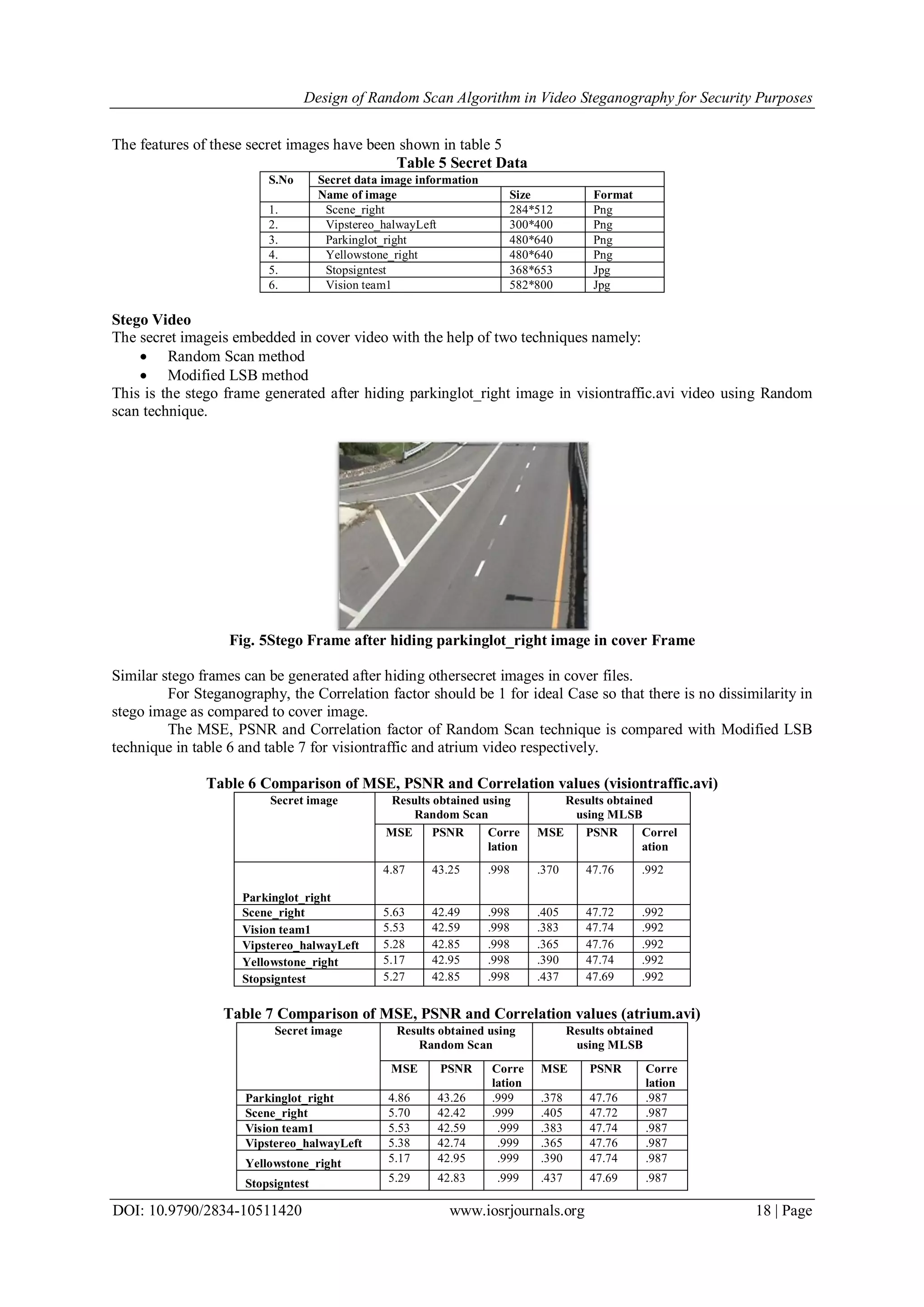
This is the stego frame generated after hiding parkinglot_right image in visiontraffic.avi video using Random
scan technique.
Fig. 5Stego Frame after hiding parkinglot_right image in cover Frame
Similar stego frames can be generated after hiding othersecret images in cover files.
For Steganography, the Correlation factor should be 1 for ideal Case so that there is no dissimilarity in
stego image as compared to cover image.
The MSE, PSNR and Correlation factor of Random Scan technique is compared with Modified LSB
technique in table 6 and table 7 for visiontraffic and atrium video respectively.
Table 6 Comparison of MSE, PSNR and Correlation values (visiontraffic.avi)
Secret image Results obtained using
Random Scan
Results obtained
using MLSB
MSE PSNR Corre
lation
MSE PSNR Correl
ation
Parkinglot_right
4.87 43.25 .998 .370 47.76 .992
Scene_right 5.63 42.49 .998 .405 47.72 .992
Vision team1 5.53 42.59 .998 .383 47.74 .992
Vipstereo_halwayLeft 5.28 42.85 .998 .365 47.76 .992
Yellowstone_right 5.17 42.95 .998 .390 47.74 .992
Stopsigntest 5.27 42.85 .998 .437 47.69 .992
Table 7 Comparison of MSE, PSNR and Correlation values (atrium.avi)
Secret image Results obtained using
Random Scan
Results obtained
using MLSB
MSE PSNR Corre
lation
MSE PSNR Corre
lation
Parkinglot_right 4.86 43.26 .999 .378 47.76 .987
Scene_right 5.70 42.42 .999 .405 47.72 .987
Vision team1 5.53 42.59 .999 .383 47.74 .987
Vipstereo_halwayLeft 5.38 42.74 .999 .365 47.76 .987
Yellowstone_right 5.17 42.95 .999 .390 47.74 .987
Stopsigntest 5.29 42.83 .999 .437 47.69 .987
Design of Random Scan Algorithm in Video Steganography for Security Purposes
DOI: 10.9790/2834-10511420 www.iosrjournals.org 19 | Page
Fig.6Comparison of MSE, PSNR and Correlation factor using Random Scan and MLSB technique for
Visiontraffic video
Fig. 7Comparison of MSE, PSNR and Correlation factor using Random Scan and MLSB technique for
atrium video
Figure 6 and 7shows thatMSE using MLSB technique has less value as comparison to Random Scan
technique. Becausethere is very small change in pixel value using MLSB technique, whereas PSNR using MLSB
technique is more than Random scan technique. But Correlation factor using Random Scan Technique is better
than MLSB Technique. Therefore Random scan technique is preferable over MLSB technique as per security
concern.
V. Conclusion
In this work video is used as a carrier to embed secret message. In this technique the negative of secret
image is made to hide in cover frame. So it is difficult to extract the original image from cover frame
becausePixels are hidden at Random locations in cover frame pixels.Also even if an unknown person extracts
the image from cover frame they get the negative of secret image.The figure 6 and 7 shows that the MLSB
technique has better MSE and PSNR as compared to Random scan technique, but Correlation factor is better for
Random scan technique. In Futuremore emphasis will be given on frequency domain due to better PSNR and
MSE value as compared to spatial domain.
Design of Random Scan Algorithm in Video Steganography for Security Purposes
DOI: 10.9790/2834-10511420 www.iosrjournals.org 20 | Page
References
[1] S.D. Thepade and S.S. Chavan, Cosine, Walsh and Slant Wavelet Transforms for Robust Image Steganography, Tenth International
Conference on Wireless and Optical Communications Networks (WOCN), 2013, 1-5.
[2] K.S.Jenifer, G. Yogaraj and K. Rajalakshmi, 2014, approach for Video Steganography to embed Images, International Journal of
Computer Science and Information Technologies, 5(1), 2014, 319-322.
[3] R.G Bal, P.Ezhilarasu,An Efficient Safe and Secured Video Steganography Using Shadow Derivation, International Journal of
Innovative Research in Computer and Communication Engineering, 2, 2014, 3251-3258.
[4] I. Premi and S. Kaur,Random Scan Algorithm for image steganography inScilab for security purposes, International Journal of
Advanced Research in Computer and Communication Engineering, 3(12), 2014, 8876-8879.
[5] D. Samidha and D. Agrawal, Random Image Steganography in Spatial Domain, International Conference on Emerging Trends in
VLSI, Embedded System, Nano Electronics and Telecommunication System, 2013, 1-3.
[6] P. Bhautmage, A.J kumar and A. Dahatonde, Advanced Video Steganography Algorithm, International Journal of Engineering
Research, 3(1) 2013, 1641-1644.
[7] K. Dasgupta, J.K Mandal and P. Dutta,Hash Based Least Significant Bit Technique for Video Steganography, International Journal
of Security, Privacy and Trust Management, 1(2), 2012, 1-11.
[8] H.M. Kelash, O.F.A Wahab, O.A. Elshakankiry and H. S. El-sayed,Utilization of SteganographicTechniques in Video Sequences,
International Journal of Computing and Network Technology, 2(1), 2014,17-24.

C010511420

  • 1.
    IOSR Journal ofElectronics and Communication Engineering (IOSR-JECE) e-ISSN: 2278-2834,p- ISSN: 2278-8735.Volume 10, Issue 5, Ver. I (Sep - Oct .2015), PP 14-20 www.iosrjournals.org DOI: 10.9790/2834-10511420 www.iosrjournals.org 14 | Page Design of Random Scan Algorithm in Video Steganography for Security Purposes Sahil Gupta1 , Jyoti Saxena2 and Sukhjinder Singh3 1, 2, 3 Department of ECE, GianiZail SinghPTU campus, Bathinda-151001, Punjab (India) Abstract: Steganography is defined as the process of hiding information in a multimedia carrier. In this paper, video is taken as a carrier to hide information. To achieve Undetectability and robustness of the hidden data, Random Scan approach is used. To make the data more secure encryption is done on the data before hiding. Experimental results show that MSE, PSNR are better forMLSB technique whereas Correlation factor is better for Random scan technique. Keywords: Modified Least Significant bit (MLSB), Mean Square Error (MSE), Peak Signal to Noise Ratio (PSNR), Correlation. I. Introduction Internet is the fastest medium for communication but it faces many security related problems like hacking, copyright, eavesdropping etc.There are various techniques for security of data likecryptography and steganography. Cryptography is a technique which is used to secure the secrecy of communication. There are many different methods to encrypt and decrypt the data in order to keep the message secret. Unfortunately, it is not enough to keep the content of a message secret, at the same time it is also important to keep the existence of message secret. The technique in which the existence of hidden message is kept secret is called as steganography [1]. Steganography (literally meaning coveredwriting) dates back to ancient Greece, where common practices consisted of etching messages in wooden tablets and covering them with wax, and tattooing a shared messenger’s head, letting his hair grow back , then sharing it again when he arrived at his contact point [2]. Steganography is the art of hiding message into cover objects such as images, text, videos [3].Images had been mostly used media for data hiding. But now a day, video steganography is used for hiding data in a more secure hiding way than in images as data capacity of video is more than images. A Steganography system consists of three elements: cover object (which hides the secret message), the secret message and the stego object (which is the cover object with message embedded inside it) [4]. The paper is organized as follows; section II starts with literature Survey, section III gives the Experimental setup in which block diagram and algorithm with examples is explained. Section IV illustrates the results in which MSE, PSNR and Correlation factor ofRandom scan technique is compared with Modified LSB technique. The conclusion and scope of future work is discussed in section V. Fig. 1 Block Diagram of Steganography Figure 1 shows the fundamental block diagram of Steganography. In Steganography cover file and secret data is read. Then encryption algorithm is applied on secret data followed byhiding algorithm applied onencrypted data to hide in cover object. After thatstego object is transmitted.At receiver side recovery algorithm is applied on stego object for extracting secret data.
  • 2.
    Design of RandomScan Algorithm in Video Steganography for Security Purposes DOI: 10.9790/2834-10511420 www.iosrjournals.org 15 | Page II. Literature Survey In the literature, various steganography techniques for digital images have been proposed. However, the digital videos, one of the most suitable cover for data hiding was less considered. SamidhaSet.al [5], discussed various image steganography techniques based on spatial domain. Spatial domaintechniques are based on physical location of pixels in an image. Generally 8 bit gray level or color images can be used as a cover to hide data. Random bits from these bytes are used to replace the secret data bits. Bhautmageet.al[6], presented new technique for data embedding and extraction for AVI (audio video interleave) videos in which instead of changing the LSB of the cover file, the LSB and LSB+3 bits are changed in alternate bytes of the cover file. The secret message is encrypted by using a simple bit exchange method before the actual embedding process starts. An index is created for the secret information and the index is placed in a frame of the video itself. With the help of this index, the secret message can be extracted easily, which also reduce the extraction time. Dasguptaet.al [7],proposed hash based technique for video steganography. Eight bits of the secret information is divided into 3, 3, and 2 bits, and thenembedded into the RGB pixel values of the cover frames respectively. A hash function is used to select the position of insertion in LSB bits. Kelashet al. [8], proposed algorithm to hide message within part of frame or in whole frame based on HCV (histogram constant value). The random selection of frame increases security level and to increase embedding capacity, faded pixel were reduced in each frame. In this paper motivation is taken from [5, 6, 7 and 8] and proposed a technique for data hiding. In this technique before hiding, the encryption of data is done in which the negative of data is generated by doing complement. After that data is made to hide using Random Scan and MLSB Techniques. III. Experimental Setup In this work, Random Scan and MLSB techniques are implemented usingMatlab platform.Figure 2 shows the experimental set up of this process in which the secret message is hidden in anyvideo frame as cover. Cover Video: Video consists of images as well as audio. Hence both images and audio are considered for steganography. Frame Extraction: Frame extraction is the process of extracting frames from the video. Video is converted into frames. From the frames one frame is selected for embedding. Fig. 2 Experimental setup of Video Steganography Secret Message: The secret data is in any form like text, audio, image. In the proposed algorithm the encryption of data is done. For encryption the negative of data is generated. Embedding Algorithm: For embedding the encrypted data, Random Scan and MLSB technique is applied. In Random scan technique for hiding bits, 1 to 4 bits are taken from LSB side randomly because as the bit goes from 4th to 5th bit there is large variation in pixels whereas in MLSB technique, data is hidden at 2 LSB positions only. Stego Video: After embedding the encrypted data in frame, the reconstruction of video is done and stego video is generated. 3.1 Algorithm The step by step algorithm for video steganography is explained below: Step 1: Read the video file. Step 2: Extract the frame from video file. Step 3: Read the secret data
  • 3.
    Design of RandomScan Algorithm in Video Steganography for Security Purposes DOI: 10.9790/2834-10511420 www.iosrjournals.org 16 | Page Step 4: Encryption Algorithm is applied on secret data. Step 5: Split the data into 2-2 bits for hiding. Step 6: The encrypted data is hidden in cover frame using Random Scan and Modified LSB Technique. Step 7:Compare MSE and PSNR of random scan technique with MLSB technique. Example 1. Cover Frame Pixels Table 1 Cover Frame Pixel Cover data of Ist Row 01011010 01010101 11001100 10111011 Cover data of Second Row 00011100 00111100 11100001 10001000 2. Data value: 10110111 3. After Encryption Data Value: 01001000 4. Stego Frame Pixel values after Modified LSB Technique Table 2 Stego pixel after MLSB Technique Cover data of Ist Row 01011010 01010101 11001100 10111011 Encrypted data shifted to 2 LSB 00000000 00000010 00000000 00000001 Data Embedding using replacement 01011000 01010110 11001100 10111001 Bit Variation 2 bit 1 bit No 2 bit Cover data of 2nd Row 00011100 00111100 11100001 10001000 5. Stego Frame Pixel Values after apply Random Scan Technique Table 3Stego pixel after Random Scan Technique Cover data of ist Row 01011010 01010101 11001100 10111011 Encrypted data shifted to 2 LSB 00000000 00000010 00000000 00000001 Data Embedding using EXOR 01011010 01010111 11001100 10111010 Bit Variation No 2 bit No 1 bit Cover data of 2nd Row 00011100 00111100 11100001 10001000 3.2 Performance Metrics To measure the imperceptibility of steganography several metrics are used.The metrics indicate how similar or different the stego image is from cover image.The following metrics are used: 1. Mean Square Error (MSE) is computed by performing byte by byte comparison of the cover image and stego image. The Computation formula is expressed as[4] MSE = 1 M∗N Fij − Gij 2N 1 M 1 (1) M: numbers of rows of cover image N: number of column of Cover Image Fij: Pixel value from cover image Gij: Pixel value from Stego Image Higher value of MSE indicates dissimilarity between Cover image and Stego image. 2. Peak signal to noise ratio (PSNR) measures in decibels the quality of the stego image compared with the cover image. The higher the PSNR better the quality. PSNR is computedusing the following equation. PSNR = 20 log10 255 − 10 log10 MSE (2) 3. Correlation Factor: Correlation factor is one of the performance parameters. Correlation factor ‘r’ is the measure of extent and direction of linear combination of two random variables. If two variables are closely related, the correlation factor is close to the value 1. On the other hand, if the factor is close to 0, two variables are not related.
  • 4.
    Design of RandomScan Algorithm in Video Steganography for Security Purposes DOI: 10.9790/2834-10511420 www.iosrjournals.org 17 | Page r = Xi−Xm (Yi−Ym )i (Xi−Xmi )2 (Yi−Ym )2 i (3) Where Xi - Pixel intensity of original image Xm- Mean value of original image intensity Yi- Pixel intensity of encrypted image Ym - Mean value of encrypted image intensity IV. Results and Discussion In this paper, Random Scan and MLSB Techniquesare implemented in MATLAB 2013. The experiment is carried out on two different video files namely (visiontraffic.avi) and (atrium.avi) which is used as a cover file and six images are used as secret data. Cover media file In this process visiontraffic.avi and atrium.avi video having resolution of 360*640 has been used as a cover media. Figure 3 shows the frame extraction from visiontraffic.avi and atrium.avi video. Fig. 3 Frame Extraction from visiontraffic.avi and atrium.avi The features of these cover file have been shown in table 4. Table 4 Cover video S. No Cover video file information Name of video file Resolution (W*H) Frames/sec Total frames 1. Visiontraffi c.avi 360*640 29 531 2. atrium.avi 360*640 30 431 4.1 Secret data In this process image taken from MATLAB data base has been used as secret data which is to be hidden in cover media. Scene_right Parkinglot_right Vision team1 Vipstereo_halwayLeft Stopsigntest Yellowstone_right Fig.4 Secret data images
  • 5.
    Design of RandomScan Algorithm in Video Steganography for Security Purposes DOI: 10.9790/2834-10511420 www.iosrjournals.org 18 | Page The features of these secret images have been shown in table 5 Table 5 Secret Data S.No Secret data image information Name of image Size Format 1. Scene_right 284*512 Png 2. Vipstereo_halwayLeft 300*400 Png 3. Parkinglot_right 480*640 Png 4. Yellowstone_right 480*640 Png 5. Stopsigntest 368*653 Jpg 6. Vision team1 582*800 Jpg Stego Video The secret imageis embedded in cover video with the help of two techniques namely:  Random Scan method  Modified LSB method This is the stego frame generated after hiding parkinglot_right image in visiontraffic.avi video using Random scan technique. Fig. 5Stego Frame after hiding parkinglot_right image in cover Frame Similar stego frames can be generated after hiding othersecret images in cover files. For Steganography, the Correlation factor should be 1 for ideal Case so that there is no dissimilarity in stego image as compared to cover image. The MSE, PSNR and Correlation factor of Random Scan technique is compared with Modified LSB technique in table 6 and table 7 for visiontraffic and atrium video respectively. Table 6 Comparison of MSE, PSNR and Correlation values (visiontraffic.avi) Secret image Results obtained using Random Scan Results obtained using MLSB MSE PSNR Corre lation MSE PSNR Correl ation Parkinglot_right 4.87 43.25 .998 .370 47.76 .992 Scene_right 5.63 42.49 .998 .405 47.72 .992 Vision team1 5.53 42.59 .998 .383 47.74 .992 Vipstereo_halwayLeft 5.28 42.85 .998 .365 47.76 .992 Yellowstone_right 5.17 42.95 .998 .390 47.74 .992 Stopsigntest 5.27 42.85 .998 .437 47.69 .992 Table 7 Comparison of MSE, PSNR and Correlation values (atrium.avi) Secret image Results obtained using Random Scan Results obtained using MLSB MSE PSNR Corre lation MSE PSNR Corre lation Parkinglot_right 4.86 43.26 .999 .378 47.76 .987 Scene_right 5.70 42.42 .999 .405 47.72 .987 Vision team1 5.53 42.59 .999 .383 47.74 .987 Vipstereo_halwayLeft 5.38 42.74 .999 .365 47.76 .987 Yellowstone_right 5.17 42.95 .999 .390 47.74 .987 Stopsigntest 5.29 42.83 .999 .437 47.69 .987
  • 6.
    Design of RandomScan Algorithm in Video Steganography for Security Purposes DOI: 10.9790/2834-10511420 www.iosrjournals.org 19 | Page Fig.6Comparison of MSE, PSNR and Correlation factor using Random Scan and MLSB technique for Visiontraffic video Fig. 7Comparison of MSE, PSNR and Correlation factor using Random Scan and MLSB technique for atrium video Figure 6 and 7shows thatMSE using MLSB technique has less value as comparison to Random Scan technique. Becausethere is very small change in pixel value using MLSB technique, whereas PSNR using MLSB technique is more than Random scan technique. But Correlation factor using Random Scan Technique is better than MLSB Technique. Therefore Random scan technique is preferable over MLSB technique as per security concern. V. Conclusion In this work video is used as a carrier to embed secret message. In this technique the negative of secret image is made to hide in cover frame. So it is difficult to extract the original image from cover frame becausePixels are hidden at Random locations in cover frame pixels.Also even if an unknown person extracts the image from cover frame they get the negative of secret image.The figure 6 and 7 shows that the MLSB technique has better MSE and PSNR as compared to Random scan technique, but Correlation factor is better for Random scan technique. In Futuremore emphasis will be given on frequency domain due to better PSNR and MSE value as compared to spatial domain.
  • 7.
    Design of RandomScan Algorithm in Video Steganography for Security Purposes DOI: 10.9790/2834-10511420 www.iosrjournals.org 20 | Page References [1] S.D. Thepade and S.S. Chavan, Cosine, Walsh and Slant Wavelet Transforms for Robust Image Steganography, Tenth International Conference on Wireless and Optical Communications Networks (WOCN), 2013, 1-5. [2] K.S.Jenifer, G. Yogaraj and K. Rajalakshmi, 2014, approach for Video Steganography to embed Images, International Journal of Computer Science and Information Technologies, 5(1), 2014, 319-322. [3] R.G Bal, P.Ezhilarasu,An Efficient Safe and Secured Video Steganography Using Shadow Derivation, International Journal of Innovative Research in Computer and Communication Engineering, 2, 2014, 3251-3258. [4] I. Premi and S. Kaur,Random Scan Algorithm for image steganography inScilab for security purposes, International Journal of Advanced Research in Computer and Communication Engineering, 3(12), 2014, 8876-8879. [5] D. Samidha and D. Agrawal, Random Image Steganography in Spatial Domain, International Conference on Emerging Trends in VLSI, Embedded System, Nano Electronics and Telecommunication System, 2013, 1-3. [6] P. Bhautmage, A.J kumar and A. Dahatonde, Advanced Video Steganography Algorithm, International Journal of Engineering Research, 3(1) 2013, 1641-1644. [7] K. Dasgupta, J.K Mandal and P. Dutta,Hash Based Least Significant Bit Technique for Video Steganography, International Journal of Security, Privacy and Trust Management, 1(2), 2012, 1-11. [8] H.M. Kelash, O.F.A Wahab, O.A. Elshakankiry and H. S. El-sayed,Utilization of SteganographicTechniques in Video Sequences, International Journal of Computing and Network Technology, 2(1), 2014,17-24.