International Journal of Computer Science, Engineering and Applications (IJCSEA) Vol.1, No.1, February 2011
1
A NOVEL APPROACH FOR CONCEALED DATA
SHARING AND DATA EMBEDDING FOR SECURED
COMMUNICATION
Gaurav Prasad1
and Sujay Narayana2
1
Department of Information Technology, NITK, Surathkal, INDIA
chgauravprasad@gmail.com
2
Department ofElectronics and Communication, NITK, Surathkal, INDIA
sujaynarayana@gmail.com
ABSTRACT
This paper introduces a new method of securing image using cryptographic and steganographic
techniques. The science of securing a data by encryption is Cryptography whereas the method of hiding
secret messages in other messages is Steganography, so that the secret’s very existence is concealed. The
term ‘Steganography’ describes the method of hiding cognitive content in another medium to avoid
detection by the intruders. The proposed method uses cryptographic and steganographic techniques to
encrypt the data as well as hide the encrypted data in another medium so the fact, that a message being
sent is concealed. The image is concealed by converting it into a ciphertext using SDES algorithm with a
secret key,which is also an image, and sent to the receiving end securely.
KEYWORDS
Steganography, Cryptography, image hiding, least-significant bit (LSB) method
1. INTRODUCTION
In the present world of communication, one of the necessary requirements to prevent data theft
is securing the information. Security has become a critical feature for thriving networks and in
military alike. Cryptography and Steganography are well known and widely used techniques
that manipulate information (messages) in order to cipher or hide their existence. These
techniques have many applications in computer science and other related fields: they are used to
protect military messages, E-mails, credit card information, corporate data, personal files, etc.
Cryptography (from Greek kryptós, "hidden", and gráphein, "to write") is, traditionally, the
study of means of converting information from its normal, comprehensible form into an
incomprehensible format, rendering it unreadable without secret knowledge, the art of
encryption. The art of protecting information (plain text) by transforming it (encrypting it) into
an unreadable format is called cipher text. Only those who possess a secret key can decipher (or
decrypt) the message into plain text. Encrypted messages can sometimes be broken by
cryptanalysis, also called code breaking, although modern cryptography techniques are virtually
unbreakable. Cryptography encrypts the actual message that is being sent. This security
mechanism uses mathematical schemes and algorithms to scramble data into unreadable text. It
can only be decoded or decrypted by the party that possesses the associated key [20]. The
general form of cryptographic technique is shown in figure 1.1.
International Journal of Computer Science, Engineering and Applications (IJCSEA) Vol.1, No.1, February 2011
2
Figure 1.1Cryptographic flow
Steganography(from Greek Stegános, "Covered/hidden", and gráphein, "to write") is the art and
science of communicating in a way which hides the existence of the
communication[1].Steganography hides the very existence of the message by embedding it
inside a carrier file of some type. An eavesdropper can intercept a cryptographic message, but
he may not even know that a steganographic message exists. Cryptography and Steganography
achieve the same goal via different means. Encryption encodes the data so that an unintended
recipient cannot determine its intended meaning. Steganography, in contrast attempts to prevent
an unintended recipient from suspecting that the data is there. [4].Combining encryption with
steganography allows for a better private communication. The goal of steganography is to avoid
drawing suspicion to the transmission of the secret message. On other hand, steganalysis is a
way of detecting possible secret communication using against steganography. That is,
steganalysis attempts to defeat steganography techniques. It relies on the fact that hiding
information in digital media alters the carriers and introduces unusual signatures or some form
of degradation that could be exploited. Thus, it is crucial that a steganography system to
ascertain that the hidden messages are not detectable [1013 23].
Steganography includes the hiding of media like text, image, audio, video files, etc in another
media of same type or of different type. Later, the message hidden in the selected media is
transmitted to recipient. At receiver end, reverse process is implemented to recover the original
message [5].
Some terminologies in Steganography [7]:
Payload: The information which is to be concealed.
Carrier File: The media where payload has to be hidden.
Stego-Medium: The medium in which the information is hidden.
Redundant Bits: Pieces of information inside a file which can be overwritten or altered without
damaging the file.
Steganalysis: The process of detecting hidden information inside of a file.
Stego medium = Payload file + Carrier file.
International Journal of Computer Science, Engineering and Applicat
The four basic techniques used for Steganography are:
LSB method: The LSB of carrier medium is directly inserted with the message bit.
the carrier medium contains the payload.
Injection: Hiding data in sections of a file that are ignored by the processing application.
Therefore avoid modifying those file bits that are relevant to an end
perfectly usable.
Substitution: Replacement of the least significant bits of information that determine the
meaningful content of the original file with new data in a way that causes the
distortion.
Generation: Unlike injection and substitution, this does not require an existing cover file but
generates a cover file for the sole purpose of hiding the message.
The general form of Steganographic technique is shown in figure
Many ideas and techniques have been proposed to secure data i.e., mainly concealing of text in
images. The simple method to do the same is Least Significant Bit replacement method in
steganography. But it has its own
replacement technique [19]. The new proposed method overcomes this drawback
International Journal of Computer Science, Engineering and Applications (IJCSEA) Vol.1, No.1, Febr
techniques used for Steganography are:
LSB method: The LSB of carrier medium is directly inserted with the message bit.
the carrier medium contains the payload.
Injection: Hiding data in sections of a file that are ignored by the processing application.
e file bits that are relevant to an end-user leaving the cover file
Substitution: Replacement of the least significant bits of information that determine the
meaningful content of the original file with new data in a way that causes the least amount of
Generation: Unlike injection and substitution, this does not require an existing cover file but
generates a cover file for the sole purpose of hiding the message.
The general form of Steganographic technique is shown in figure 1.2
Figure 1.2Steganographic flow
Many ideas and techniques have been proposed to secure data i.e., mainly concealing of text in
images. The simple method to do the same is Least Significant Bit replacement method in
steganography. But it has its own limitations [2].Steganalysis can be easily done on LSB
. The new proposed method overcomes this drawback [12
ions (IJCSEA) Vol.1, No.1, February 2011
3
LSB method: The LSB of carrier medium is directly inserted with the message bit. So LSB of
Injection: Hiding data in sections of a file that are ignored by the processing application.
user leaving the cover file
Substitution: Replacement of the least significant bits of information that determine the
least amount of
Generation: Unlike injection and substitution, this does not require an existing cover file but
Many ideas and techniques have been proposed to secure data i.e., mainly concealing of text in
images. The simple method to do the same is Least Significant Bit replacement method in
limitations [2].Steganalysis can be easily done on LSB
12 17 21 22].
International Journal of Computer Science, Engineering and Applications (IJCSEA) Vol.1, No.1, February 2011
4
2. PROPOSED IDEA
To a computer, an image file is simply a file that shows different colors and intensities of light
on different areas of an image. We can represent an image in the form of matrix of pixels which
helps in image processing. The size of an image is mxn if it is composed of m pixels in the
horizontal direction and n pixels in the vertical direction. The total no of pixels in the image will
be mxn. Each pixel is indicated by bits. In uint8 class, a gray scale image can be represented in
matrix having integers between 0 and 255 to represent the brightness of a pixel. The value 0
corresponds to black and 255 to white.So the total no of bits required to represent a pixel is 8
bits. A RGB color image has three frames of images. These frames altogether represent an
image with three matrices of sizes matching the main image format. Each matrix corresponds to
one of the colors red, green and blue and gives an instruction of how much of each of these
colors a certain pixel should be. So the total number of bits required to represent a pixel of this
color image is 24 bits. Hence sending the image is nothing but sending the pixel values of the
image. If these pixel values are encrypted, then the whole image will be encrypted. Such an
encrypted message can be sent directly which is visible as encrypted data in the channel where it
can be known that the data is being sent, or it can be hidden in some other medium where the
intruder will fail to find the actual data that is being sent. In this paper, we have proposed two
techniques to secure the image that is being transferred.
S-DES encryption (decryption) algorithm takes 8-bit block of plaintext and a 10-bit key to
produce an 8-bit ciphertext. The encryption algorithm involves 5 functions: an initial
permutation (IP); a complex function fK, which involves both permutation and substitution that
depends on a key input; a simple permutation function that switches (SW) the two halves of the
data; the function fK again and finally, the inverse permutation of IP (IP-1). The function fK
takes two 8-bit keys which are obtained from the original 10-bit key [6]. The S-DES algorithm
flow is shown in figure 2.1 and figure 2.2.
Figure 2.1S-DES algorithmflow
International Journal of Computer Science, Engineering and Applications (IJCSEA) Vol.1, No.1, February 2011
5
Figure 2.2S-DES Algorithm in detail
The 10-bit key is first subjected to a permutation (P10) and then a shift operation is performed.
The output of the shift operation then passes through a permutation function that produces a 8-
bit output (P8) for the first sub key (K1). The output of the shift operation again feeds into
another shift and (P8) to produce the 2nd sub key (K2) [18].We can express encryption
algorithm as superposition:
International Journal of Computer Science, Engineering and Applications (IJCSEA) Vol.1, No.1, February 2011
6
2.1 Encryption of image using S-DES algorithm.
Considering a 24-bpp color image, the image is split into three matrices (frames) each matrix
containing pixels indicating the intensities of Red, Green and Blue. If m by n is the dimension
of that image, then there will be mxn number of pixels in that image. Hence, the matrices
corresponding to Red, Green and Blue intensities will also have mxn number of pixels. Every
byte (pixel) of all these three matrices are encrypted using S-DES algorithm and an image
comprised of encrypted pixels is formed. The key used to encrypt each pixel is of 10-bit length
and is obtained from the pixels of key image.
The pixel values of red, green and blue intensities of each pixel of the key image is combined to
get a 24-bit value. The first ten bits are selected as the key to encrypt the red intensity pixel of
payload image. The middle ten bits will be the key to encrypt the green intensity pixel of
payload and finally the last ten bits is the key to encrypt blue intensity pixel of payload image.
So the size of key image must be same as that of payload. If not, then the key image will get
resized. Each pixel (24-bit) of the key image is split into three keys(10-bit each).This encrypted
data is represented as a image which is hidden in another image called carrier image using
steganography.
2.2 Image Stegoanography: Embedding the encrypted image in carrier image.
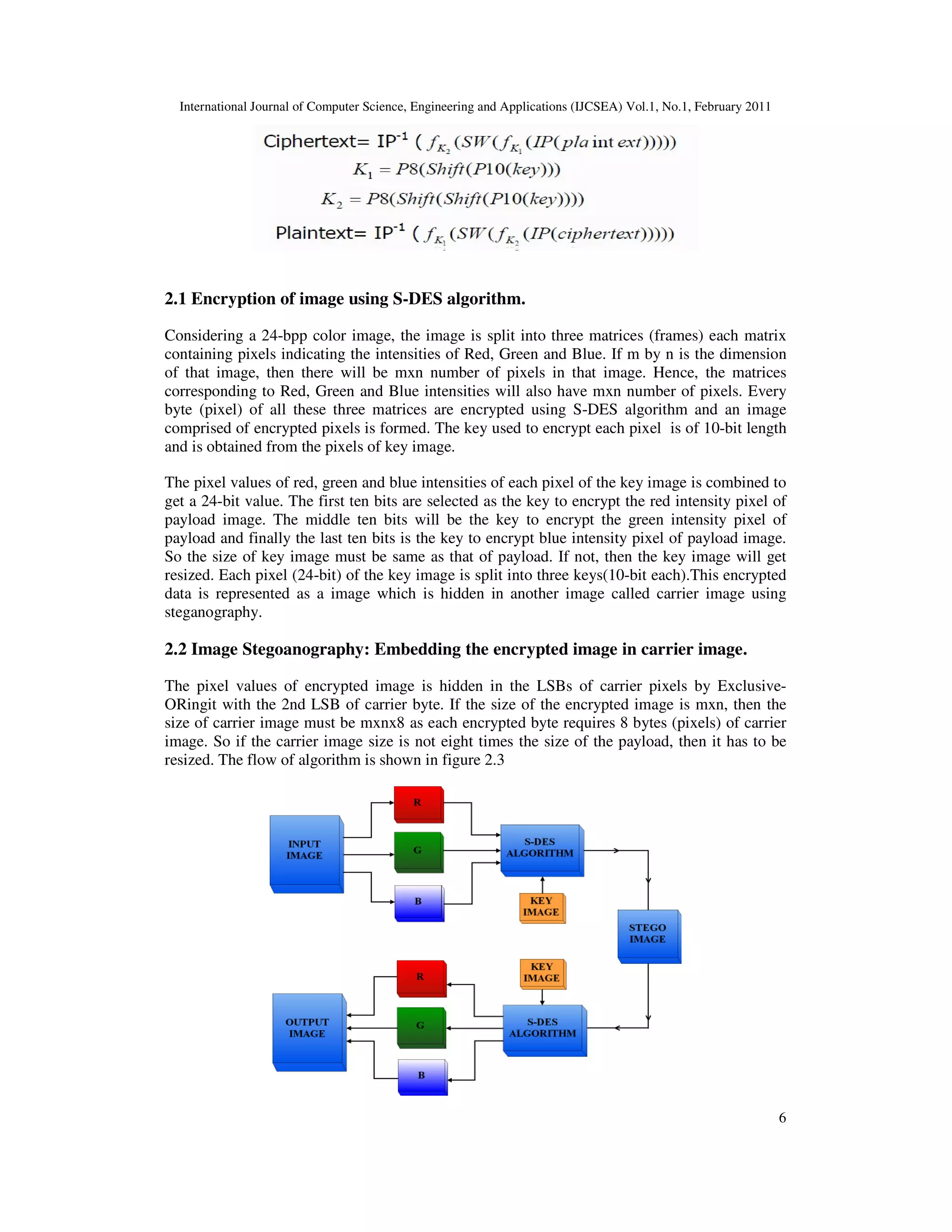
The pixel values of encrypted image is hidden in the LSBs of carrier pixels by Exclusive-
ORingit with the 2nd LSB of carrier byte. If the size of the encrypted image is mxn, then the
size of carrier image must be mxnx8 as each encrypted byte requires 8 bytes (pixels) of carrier
image. So if the carrier image size is not eight times the size of the payload, then it has to be
resized. The flow of algorithm is shown in figure 2.3
International Journal of Computer Science, Engineering and Applications (IJCSEA) Vol.1, No.1, February 2011
7
Figure 2.3.Flow of proposed idea
As we know, the least significant bit insertion method is probably the most well known image
steganography technique. It is a common, simple approach to embed information in a graphical
image file. Two basic types of LSB modifications that can be used for the embedding schemes
are LSB replacement and LSB matching. In LSB replacement, the LSB of the carrier is replaced
by the message bit directly. On the other hand, in LSB matching if the LSB of the cover pixel is
same as the message bit, then it remains unchanged; otherwise, it is randomly incremented or
decremented by one. This technique, however, requires both the sender and the receiver to have
the same original image, which makes LSB matching very inconvenient. LSB replacement
method is vulnerable to Steganalysis [3 8]. To overcome this, in the proposed algorithm, the
LSB of carrier medium is not changed directly, but the message bit is Exclusive-ORed with the
2nd least significant bit of the carrier byte and the LSB of carrier medium is replace by the
result bit. The Exclusive-OR operation of the encrypted bit with the second LSB bit makes the
stego image more secured [11].
3. IMPLEMETATION RESULTS
The above method has been successfully implemented using MATLAB.We have
considered'fingerprint.jpg' as the payload image that has to be concealed. The image pixels were
encrypted using S-DES with the key image ‘key.jpg’. Each pixel of payload is encrypted by
using the respective pixel of key image as key for S-DES algorithm. So in case if the key image
size is not as same as the payload, then it has to be resized to the size of payload. The payload,
key image and the S-DES encrypted images are shown in figure 3.1.
Figure 3.1Payload, Key image and S-DES encrypted image
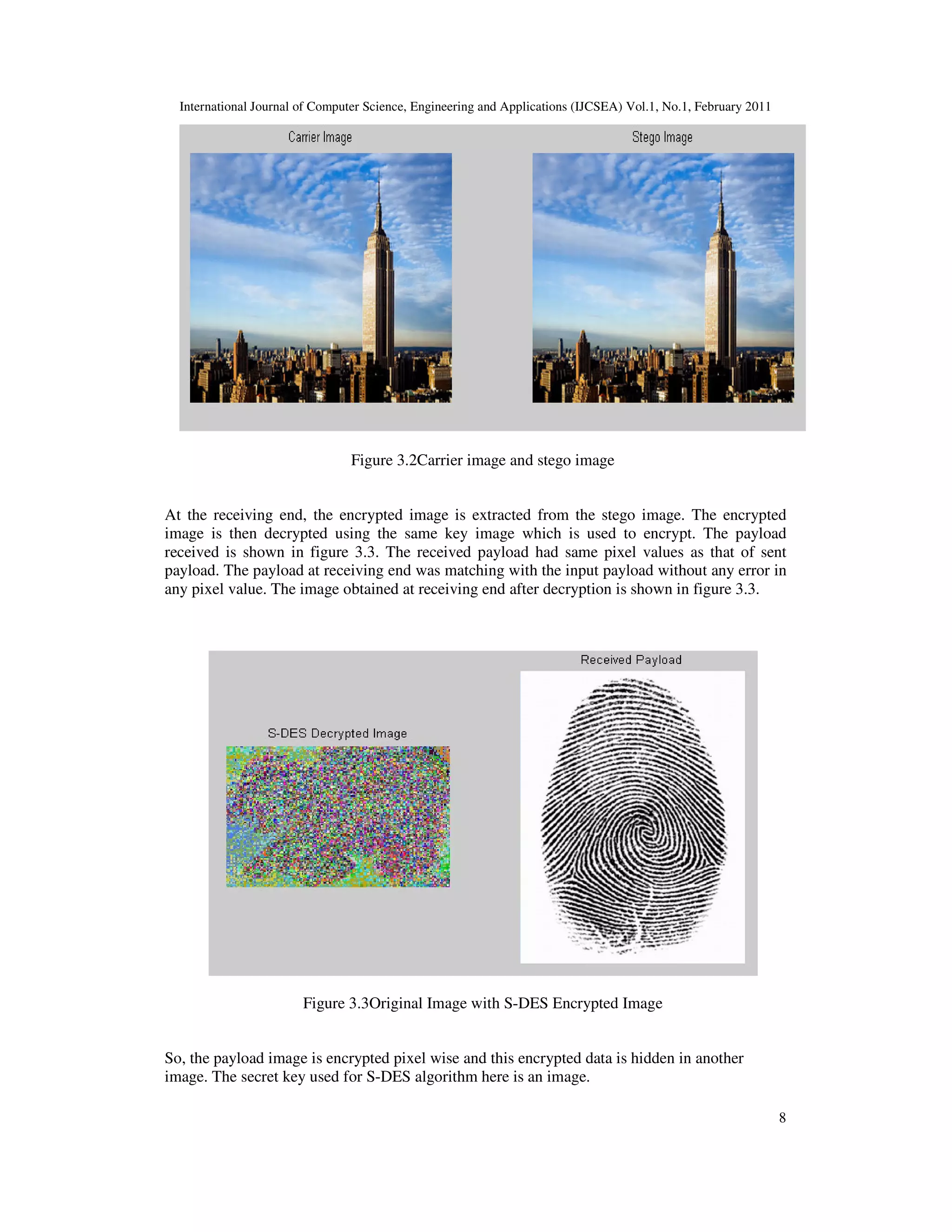
We have taken ‘tower.jpg’ as the carrier image where the encrypted payload has to be hidden.
The S-DES Encrypted image is embedded in this carrier image as described in the said method
to obtain the Stego image as shown in figure 3.2.
International Journal of Computer Science, Engineering and Applications (IJCSEA) Vol.1, No.1, February 2011
8
Figure 3.2Carrier image and stego image
At the receiving end, the encrypted image is extracted from the stego image. The encrypted
image is then decrypted using the same key image which is used to encrypt. The payload
received is shown in figure 3.3. The received payload had same pixel values as that of sent
payload. The payload at receiving end was matching with the input payload without any error in
any pixel value. The image obtained at receiving end after decryption is shown in figure 3.3.
Figure 3.3Original Image with S-DES Encrypted Image
So, the payload image is encrypted pixel wise and this encrypted data is hidden in another
image. The secret key used for S-DES algorithm here is an image.
International Journal of Computer Science, Engineering and Applications (IJCSEA) Vol.1, No.1, February 2011
9
4. ACKNOWLEDGEMENT
It is our privilege to express our sincere gratitude to Dr MuralidharKulkarni, Professor,
Department of Electronics and Communication, National Institute of Technology
Karnataka, Surathkal for his constant support, encouragement and valuable suggestions
throughout the work. We would also like to thank staff of Department of Electronics
and Communication and Department of Information technology, NITK, Surathkal for
all their help during this work. We are thankful to our parents to whom we are greatly
indebted for their support and encouragement.
5.CONCLUSION
This paper introduced the concept of combination of cryptography and steganography. It also
proposed a new algorithm to overcome steganalysis. The proposed method provided a higher
similaritybetween the cover and stego pictures is achieved that alsoyields a better
imperceptibility.As per the results obtained, steganography when combined with encryption
provides a secured means of secret communication between two parties.The future work could
be to extend this methodto arrange the text that is obtained by the encryption of image, to form a
word or meaningful sentence and new methods to prevent steganalysis, done by other than LSB
method.
REFERENCES
[1] Clair, Bryan. “Steganography: How to Send a Secret Message.” 8 Nov. 2001
www.strangehorizons.com/2001/20011008/steganography.shtml
[2] R.J. Anderson and F. A. P. Petitcolas (2001) On the limits of the Stegnography, IEEE Journal
Selected Areas in Communications, 16(4), pp. 474-481.
[3] Johnson, Neil F., and SushilJajodia. “Exploring Steganography: Seeing the Unseen.” IEEE Computer
Feb. 1998: 26-34
[4] Westfeld, A., and G. Wolf, Steganography in a Video conferencing system, in proceedings of the
second international workshop on information hiding, vol. 1525 of lecture notes in computer
science,Springer, 1998. pp. 32-47.
[5] Krenn, R., “Steganography and Steganalysis”, http://www.Krenn.nl/univ/cry/steg/article.pdf
[6] E. Biham, A. Shamir. “Differential cryptanalysis of DES-like cryptosystems,” Journal of Cryptology,
vol. 4, pp. 3-72, January 1991.
[7] T. Moerland, “Steganography and Steganalysis”, Leiden Institute of Advanced Computing Science,
www.Liacs.nl/home/tmoerl/priytech.pdf
[8] A. Ker, “Improved detection of LSB steganography in grayscale images,” in Proc. Information
Hiding Workshop, vol. 3200, Springer LNCS, pp. 97–115, 2004.
[9] A. Ker, “Steganalysis of LSB matching in greyscale images,” IEEE Signal Process. Lett., Vol. 12,
No. 6, pp. 441–444, June 2005
[10]C. C. Lin, and W. H. Tsai, "Secret Image Sharing with Steganography and Authentication," Journal
of Systems and Software, 73(3):405-414, December 2004.
[11]N. F. Johnson and S. Jajodia, “Steganalysis of Images Created using Current Steganography
Software,” Lecture Notes in Computer Science, vol. 1525, pp. 32 – 47, Springer Verlag, 1998.
[12]J. Fridrich, M. Long, “Steganalysis of LSB encoding in colorimages,”Multimedia and Expo, vol. 3,
pp. 1279-1282, July 2000.
International Journal of Computer Science, Engineering and Applications (IJCSEA) Vol.1, No.1, February 2011
10
[13]KafaRabah. Steganography - The Art of Hiding Data. Information technology Journal 3 (3) - 2004.
[14]A. Westfeld, "F5-A Steganographic Algorithm: High Capacity Despite Better Steganalysis," LNCS,
Vol. 2137, pp. 289-302,April 2001.
[15] C.-C. Chang, T. D. Kieu, and Y.-C. Chou, "A High Payload Steganographic Scheme Based on (7, 4)
Hamming Code for Digital Images," Proc. of the 2008 International Symposium onElectronic
Commerce and Security, pp.16-21, August 2008.
[16] Jiri Fridrich ,Du Dui, “Secure Steganographic Method for Palette Images,” 3rd Int. Workshop on
InformationHiding, pp.47-66, 1999.
[17] R. Chandramouli, M. Kharrazi, N. Memon, “Image Steganography and Steganalysis: Concepts and
Practice “ , International Workshop on DigitalWatermarking, Seoul, October 2004.
[18] K. Kim, S. Park, and S. Lee, “Reconstruction of s2DES S–Boxes and their Immunity to
DifferentialCryptanalysis,” Proceedings of the 1993 Korea–Japan Workshop on Information Security
and Cryptography, Seoul, Korea, 24–26 Oct 1993, pp. 282–291.
[19] S. Dumitrescu, W.X.Wu and N. Memon (2002) On steganalysis of random LSB embedding in
continuous-tone images, Proc. International Conference on Image Processing, Rochester, NY, pp.
641-644.
[20] William Stallings, Cryptography and Network Security, Principles and Practice, Third edition,
PearsonEducation, Singapore, 2003.
[21]Hide & Seek: An Introduction to Stegnography: http:niels.xtdnet.nl/papers/practical.pdf.
[22] Y. Lee and L. Chen (2000) High capacity image steganographic model, IEE Proceedings on
Vision,Image and Signal Processing, 147(3), pp. 288-294.
[23]T. Morkel, J. H. P. Eloff, M. S. Olivier, ”An Overview of Image Steganography”, Information and
Computer Security Architecture (ICSA) Research Group, Department of Computer Science,
University of Pretoria, SA.
Authors
Gaurav Prasad received the BE degree in
Information Science from P.A College of Engineering,
Nadupadavu, Mangalore in 2006 and MTech degree
in Information Security from NITK, Surathkal . He is
currently with the Department of Information
Technology, National Institute of Technology Karnataka,
Surathkal.
SujayNarayana received the BE degree in
Electronics and Communication from
KVG College of Engineering, Sullia, in
2009. He is currently with the Department of
Electronics and Communication,
National Institute of Technology Karnataka,
Surathkal.

A NOVEL APPROACH FOR CONCEALED DATA SHARING AND DATA EMBEDDING FOR SECURED COMMUNICATION

  • 1.
    International Journal ofComputer Science, Engineering and Applications (IJCSEA) Vol.1, No.1, February 2011 1 A NOVEL APPROACH FOR CONCEALED DATA SHARING AND DATA EMBEDDING FOR SECURED COMMUNICATION Gaurav Prasad1 and Sujay Narayana2 1 Department of Information Technology, NITK, Surathkal, INDIA chgauravprasad@gmail.com 2 Department ofElectronics and Communication, NITK, Surathkal, INDIA sujaynarayana@gmail.com ABSTRACT This paper introduces a new method of securing image using cryptographic and steganographic techniques. The science of securing a data by encryption is Cryptography whereas the method of hiding secret messages in other messages is Steganography, so that the secret’s very existence is concealed. The term ‘Steganography’ describes the method of hiding cognitive content in another medium to avoid detection by the intruders. The proposed method uses cryptographic and steganographic techniques to encrypt the data as well as hide the encrypted data in another medium so the fact, that a message being sent is concealed. The image is concealed by converting it into a ciphertext using SDES algorithm with a secret key,which is also an image, and sent to the receiving end securely. KEYWORDS Steganography, Cryptography, image hiding, least-significant bit (LSB) method 1. INTRODUCTION In the present world of communication, one of the necessary requirements to prevent data theft is securing the information. Security has become a critical feature for thriving networks and in military alike. Cryptography and Steganography are well known and widely used techniques that manipulate information (messages) in order to cipher or hide their existence. These techniques have many applications in computer science and other related fields: they are used to protect military messages, E-mails, credit card information, corporate data, personal files, etc. Cryptography (from Greek kryptós, "hidden", and gráphein, "to write") is, traditionally, the study of means of converting information from its normal, comprehensible form into an incomprehensible format, rendering it unreadable without secret knowledge, the art of encryption. The art of protecting information (plain text) by transforming it (encrypting it) into an unreadable format is called cipher text. Only those who possess a secret key can decipher (or decrypt) the message into plain text. Encrypted messages can sometimes be broken by cryptanalysis, also called code breaking, although modern cryptography techniques are virtually unbreakable. Cryptography encrypts the actual message that is being sent. This security mechanism uses mathematical schemes and algorithms to scramble data into unreadable text. It can only be decoded or decrypted by the party that possesses the associated key [20]. The general form of cryptographic technique is shown in figure 1.1.
  • 2.
    International Journal ofComputer Science, Engineering and Applications (IJCSEA) Vol.1, No.1, February 2011 2 Figure 1.1Cryptographic flow Steganography(from Greek Stegános, "Covered/hidden", and gráphein, "to write") is the art and science of communicating in a way which hides the existence of the communication[1].Steganography hides the very existence of the message by embedding it inside a carrier file of some type. An eavesdropper can intercept a cryptographic message, but he may not even know that a steganographic message exists. Cryptography and Steganography achieve the same goal via different means. Encryption encodes the data so that an unintended recipient cannot determine its intended meaning. Steganography, in contrast attempts to prevent an unintended recipient from suspecting that the data is there. [4].Combining encryption with steganography allows for a better private communication. The goal of steganography is to avoid drawing suspicion to the transmission of the secret message. On other hand, steganalysis is a way of detecting possible secret communication using against steganography. That is, steganalysis attempts to defeat steganography techniques. It relies on the fact that hiding information in digital media alters the carriers and introduces unusual signatures or some form of degradation that could be exploited. Thus, it is crucial that a steganography system to ascertain that the hidden messages are not detectable [1013 23]. Steganography includes the hiding of media like text, image, audio, video files, etc in another media of same type or of different type. Later, the message hidden in the selected media is transmitted to recipient. At receiver end, reverse process is implemented to recover the original message [5]. Some terminologies in Steganography [7]: Payload: The information which is to be concealed. Carrier File: The media where payload has to be hidden. Stego-Medium: The medium in which the information is hidden. Redundant Bits: Pieces of information inside a file which can be overwritten or altered without damaging the file. Steganalysis: The process of detecting hidden information inside of a file. Stego medium = Payload file + Carrier file.
  • 3.
    International Journal ofComputer Science, Engineering and Applicat The four basic techniques used for Steganography are: LSB method: The LSB of carrier medium is directly inserted with the message bit. the carrier medium contains the payload. Injection: Hiding data in sections of a file that are ignored by the processing application. Therefore avoid modifying those file bits that are relevant to an end perfectly usable. Substitution: Replacement of the least significant bits of information that determine the meaningful content of the original file with new data in a way that causes the distortion. Generation: Unlike injection and substitution, this does not require an existing cover file but generates a cover file for the sole purpose of hiding the message. The general form of Steganographic technique is shown in figure Many ideas and techniques have been proposed to secure data i.e., mainly concealing of text in images. The simple method to do the same is Least Significant Bit replacement method in steganography. But it has its own replacement technique [19]. The new proposed method overcomes this drawback International Journal of Computer Science, Engineering and Applications (IJCSEA) Vol.1, No.1, Febr techniques used for Steganography are: LSB method: The LSB of carrier medium is directly inserted with the message bit. the carrier medium contains the payload. Injection: Hiding data in sections of a file that are ignored by the processing application. e file bits that are relevant to an end-user leaving the cover file Substitution: Replacement of the least significant bits of information that determine the meaningful content of the original file with new data in a way that causes the least amount of Generation: Unlike injection and substitution, this does not require an existing cover file but generates a cover file for the sole purpose of hiding the message. The general form of Steganographic technique is shown in figure 1.2 Figure 1.2Steganographic flow Many ideas and techniques have been proposed to secure data i.e., mainly concealing of text in images. The simple method to do the same is Least Significant Bit replacement method in steganography. But it has its own limitations [2].Steganalysis can be easily done on LSB . The new proposed method overcomes this drawback [12 ions (IJCSEA) Vol.1, No.1, February 2011 3 LSB method: The LSB of carrier medium is directly inserted with the message bit. So LSB of Injection: Hiding data in sections of a file that are ignored by the processing application. user leaving the cover file Substitution: Replacement of the least significant bits of information that determine the least amount of Generation: Unlike injection and substitution, this does not require an existing cover file but Many ideas and techniques have been proposed to secure data i.e., mainly concealing of text in images. The simple method to do the same is Least Significant Bit replacement method in limitations [2].Steganalysis can be easily done on LSB 12 17 21 22].
  • 4.
    International Journal ofComputer Science, Engineering and Applications (IJCSEA) Vol.1, No.1, February 2011 4 2. PROPOSED IDEA To a computer, an image file is simply a file that shows different colors and intensities of light on different areas of an image. We can represent an image in the form of matrix of pixels which helps in image processing. The size of an image is mxn if it is composed of m pixels in the horizontal direction and n pixels in the vertical direction. The total no of pixels in the image will be mxn. Each pixel is indicated by bits. In uint8 class, a gray scale image can be represented in matrix having integers between 0 and 255 to represent the brightness of a pixel. The value 0 corresponds to black and 255 to white.So the total no of bits required to represent a pixel is 8 bits. A RGB color image has three frames of images. These frames altogether represent an image with three matrices of sizes matching the main image format. Each matrix corresponds to one of the colors red, green and blue and gives an instruction of how much of each of these colors a certain pixel should be. So the total number of bits required to represent a pixel of this color image is 24 bits. Hence sending the image is nothing but sending the pixel values of the image. If these pixel values are encrypted, then the whole image will be encrypted. Such an encrypted message can be sent directly which is visible as encrypted data in the channel where it can be known that the data is being sent, or it can be hidden in some other medium where the intruder will fail to find the actual data that is being sent. In this paper, we have proposed two techniques to secure the image that is being transferred. S-DES encryption (decryption) algorithm takes 8-bit block of plaintext and a 10-bit key to produce an 8-bit ciphertext. The encryption algorithm involves 5 functions: an initial permutation (IP); a complex function fK, which involves both permutation and substitution that depends on a key input; a simple permutation function that switches (SW) the two halves of the data; the function fK again and finally, the inverse permutation of IP (IP-1). The function fK takes two 8-bit keys which are obtained from the original 10-bit key [6]. The S-DES algorithm flow is shown in figure 2.1 and figure 2.2. Figure 2.1S-DES algorithmflow
  • 5.
    International Journal ofComputer Science, Engineering and Applications (IJCSEA) Vol.1, No.1, February 2011 5 Figure 2.2S-DES Algorithm in detail The 10-bit key is first subjected to a permutation (P10) and then a shift operation is performed. The output of the shift operation then passes through a permutation function that produces a 8- bit output (P8) for the first sub key (K1). The output of the shift operation again feeds into another shift and (P8) to produce the 2nd sub key (K2) [18].We can express encryption algorithm as superposition:
  • 6.
    International Journal ofComputer Science, Engineering and Applications (IJCSEA) Vol.1, No.1, February 2011 6 2.1 Encryption of image using S-DES algorithm. Considering a 24-bpp color image, the image is split into three matrices (frames) each matrix containing pixels indicating the intensities of Red, Green and Blue. If m by n is the dimension of that image, then there will be mxn number of pixels in that image. Hence, the matrices corresponding to Red, Green and Blue intensities will also have mxn number of pixels. Every byte (pixel) of all these three matrices are encrypted using S-DES algorithm and an image comprised of encrypted pixels is formed. The key used to encrypt each pixel is of 10-bit length and is obtained from the pixels of key image. The pixel values of red, green and blue intensities of each pixel of the key image is combined to get a 24-bit value. The first ten bits are selected as the key to encrypt the red intensity pixel of payload image. The middle ten bits will be the key to encrypt the green intensity pixel of payload and finally the last ten bits is the key to encrypt blue intensity pixel of payload image. So the size of key image must be same as that of payload. If not, then the key image will get resized. Each pixel (24-bit) of the key image is split into three keys(10-bit each).This encrypted data is represented as a image which is hidden in another image called carrier image using steganography. 2.2 Image Stegoanography: Embedding the encrypted image in carrier image. The pixel values of encrypted image is hidden in the LSBs of carrier pixels by Exclusive- ORingit with the 2nd LSB of carrier byte. If the size of the encrypted image is mxn, then the size of carrier image must be mxnx8 as each encrypted byte requires 8 bytes (pixels) of carrier image. So if the carrier image size is not eight times the size of the payload, then it has to be resized. The flow of algorithm is shown in figure 2.3
  • 7.
    International Journal ofComputer Science, Engineering and Applications (IJCSEA) Vol.1, No.1, February 2011 7 Figure 2.3.Flow of proposed idea As we know, the least significant bit insertion method is probably the most well known image steganography technique. It is a common, simple approach to embed information in a graphical image file. Two basic types of LSB modifications that can be used for the embedding schemes are LSB replacement and LSB matching. In LSB replacement, the LSB of the carrier is replaced by the message bit directly. On the other hand, in LSB matching if the LSB of the cover pixel is same as the message bit, then it remains unchanged; otherwise, it is randomly incremented or decremented by one. This technique, however, requires both the sender and the receiver to have the same original image, which makes LSB matching very inconvenient. LSB replacement method is vulnerable to Steganalysis [3 8]. To overcome this, in the proposed algorithm, the LSB of carrier medium is not changed directly, but the message bit is Exclusive-ORed with the 2nd least significant bit of the carrier byte and the LSB of carrier medium is replace by the result bit. The Exclusive-OR operation of the encrypted bit with the second LSB bit makes the stego image more secured [11]. 3. IMPLEMETATION RESULTS The above method has been successfully implemented using MATLAB.We have considered'fingerprint.jpg' as the payload image that has to be concealed. The image pixels were encrypted using S-DES with the key image ‘key.jpg’. Each pixel of payload is encrypted by using the respective pixel of key image as key for S-DES algorithm. So in case if the key image size is not as same as the payload, then it has to be resized to the size of payload. The payload, key image and the S-DES encrypted images are shown in figure 3.1. Figure 3.1Payload, Key image and S-DES encrypted image We have taken ‘tower.jpg’ as the carrier image where the encrypted payload has to be hidden. The S-DES Encrypted image is embedded in this carrier image as described in the said method to obtain the Stego image as shown in figure 3.2.
  • 8.
    International Journal ofComputer Science, Engineering and Applications (IJCSEA) Vol.1, No.1, February 2011 8 Figure 3.2Carrier image and stego image At the receiving end, the encrypted image is extracted from the stego image. The encrypted image is then decrypted using the same key image which is used to encrypt. The payload received is shown in figure 3.3. The received payload had same pixel values as that of sent payload. The payload at receiving end was matching with the input payload without any error in any pixel value. The image obtained at receiving end after decryption is shown in figure 3.3. Figure 3.3Original Image with S-DES Encrypted Image So, the payload image is encrypted pixel wise and this encrypted data is hidden in another image. The secret key used for S-DES algorithm here is an image.
  • 9.
    International Journal ofComputer Science, Engineering and Applications (IJCSEA) Vol.1, No.1, February 2011 9 4. ACKNOWLEDGEMENT It is our privilege to express our sincere gratitude to Dr MuralidharKulkarni, Professor, Department of Electronics and Communication, National Institute of Technology Karnataka, Surathkal for his constant support, encouragement and valuable suggestions throughout the work. We would also like to thank staff of Department of Electronics and Communication and Department of Information technology, NITK, Surathkal for all their help during this work. We are thankful to our parents to whom we are greatly indebted for their support and encouragement. 5.CONCLUSION This paper introduced the concept of combination of cryptography and steganography. It also proposed a new algorithm to overcome steganalysis. The proposed method provided a higher similaritybetween the cover and stego pictures is achieved that alsoyields a better imperceptibility.As per the results obtained, steganography when combined with encryption provides a secured means of secret communication between two parties.The future work could be to extend this methodto arrange the text that is obtained by the encryption of image, to form a word or meaningful sentence and new methods to prevent steganalysis, done by other than LSB method. REFERENCES [1] Clair, Bryan. “Steganography: How to Send a Secret Message.” 8 Nov. 2001 www.strangehorizons.com/2001/20011008/steganography.shtml [2] R.J. Anderson and F. A. P. Petitcolas (2001) On the limits of the Stegnography, IEEE Journal Selected Areas in Communications, 16(4), pp. 474-481. [3] Johnson, Neil F., and SushilJajodia. “Exploring Steganography: Seeing the Unseen.” IEEE Computer Feb. 1998: 26-34 [4] Westfeld, A., and G. Wolf, Steganography in a Video conferencing system, in proceedings of the second international workshop on information hiding, vol. 1525 of lecture notes in computer science,Springer, 1998. pp. 32-47. [5] Krenn, R., “Steganography and Steganalysis”, http://www.Krenn.nl/univ/cry/steg/article.pdf [6] E. Biham, A. Shamir. “Differential cryptanalysis of DES-like cryptosystems,” Journal of Cryptology, vol. 4, pp. 3-72, January 1991. [7] T. Moerland, “Steganography and Steganalysis”, Leiden Institute of Advanced Computing Science, www.Liacs.nl/home/tmoerl/priytech.pdf [8] A. Ker, “Improved detection of LSB steganography in grayscale images,” in Proc. Information Hiding Workshop, vol. 3200, Springer LNCS, pp. 97–115, 2004. [9] A. Ker, “Steganalysis of LSB matching in greyscale images,” IEEE Signal Process. Lett., Vol. 12, No. 6, pp. 441–444, June 2005 [10]C. C. Lin, and W. H. Tsai, "Secret Image Sharing with Steganography and Authentication," Journal of Systems and Software, 73(3):405-414, December 2004. [11]N. F. Johnson and S. Jajodia, “Steganalysis of Images Created using Current Steganography Software,” Lecture Notes in Computer Science, vol. 1525, pp. 32 – 47, Springer Verlag, 1998. [12]J. Fridrich, M. Long, “Steganalysis of LSB encoding in colorimages,”Multimedia and Expo, vol. 3, pp. 1279-1282, July 2000.
  • 10.
    International Journal ofComputer Science, Engineering and Applications (IJCSEA) Vol.1, No.1, February 2011 10 [13]KafaRabah. Steganography - The Art of Hiding Data. Information technology Journal 3 (3) - 2004. [14]A. Westfeld, "F5-A Steganographic Algorithm: High Capacity Despite Better Steganalysis," LNCS, Vol. 2137, pp. 289-302,April 2001. [15] C.-C. Chang, T. D. Kieu, and Y.-C. Chou, "A High Payload Steganographic Scheme Based on (7, 4) Hamming Code for Digital Images," Proc. of the 2008 International Symposium onElectronic Commerce and Security, pp.16-21, August 2008. [16] Jiri Fridrich ,Du Dui, “Secure Steganographic Method for Palette Images,” 3rd Int. Workshop on InformationHiding, pp.47-66, 1999. [17] R. Chandramouli, M. Kharrazi, N. Memon, “Image Steganography and Steganalysis: Concepts and Practice “ , International Workshop on DigitalWatermarking, Seoul, October 2004. [18] K. Kim, S. Park, and S. Lee, “Reconstruction of s2DES S–Boxes and their Immunity to DifferentialCryptanalysis,” Proceedings of the 1993 Korea–Japan Workshop on Information Security and Cryptography, Seoul, Korea, 24–26 Oct 1993, pp. 282–291. [19] S. Dumitrescu, W.X.Wu and N. Memon (2002) On steganalysis of random LSB embedding in continuous-tone images, Proc. International Conference on Image Processing, Rochester, NY, pp. 641-644. [20] William Stallings, Cryptography and Network Security, Principles and Practice, Third edition, PearsonEducation, Singapore, 2003. [21]Hide & Seek: An Introduction to Stegnography: http:niels.xtdnet.nl/papers/practical.pdf. [22] Y. Lee and L. Chen (2000) High capacity image steganographic model, IEE Proceedings on Vision,Image and Signal Processing, 147(3), pp. 288-294. [23]T. Morkel, J. H. P. Eloff, M. S. Olivier, ”An Overview of Image Steganography”, Information and Computer Security Architecture (ICSA) Research Group, Department of Computer Science, University of Pretoria, SA. Authors Gaurav Prasad received the BE degree in Information Science from P.A College of Engineering, Nadupadavu, Mangalore in 2006 and MTech degree in Information Security from NITK, Surathkal . He is currently with the Department of Information Technology, National Institute of Technology Karnataka, Surathkal. SujayNarayana received the BE degree in Electronics and Communication from KVG College of Engineering, Sullia, in 2009. He is currently with the Department of Electronics and Communication, National Institute of Technology Karnataka, Surathkal.