Seminar
On
Dual Layer Security Of Data Using LSB Image
Steganography Method And AES Encryption Algorithm
Presented By:
Bikash Chandra Prusty
Reg. No. : 1301227584
Department of Electronics and Telecommunication Engineering
C. V. Raman College Of Engineering, Bhubaneswar
Outline
1. Problem Statement
2. Motivation
3. Introduction
4. Steganography Layer
5. Encryption/Decryption Layer
6. LSB Image Steganography Algorithm
7. Implementation
8. Comparison Between Cover Image, Stego And Encrypted Stego Image
9. Advantages
10. Applications
11. Conclusion
12. Future Prospects
13. References
2Department of Electronics and Telecommunication Engineering, CVRCE
Problem Statement
In today’s scenario security of data is a very big challenge in any communication. The Digital
Image Steganography is the science of hiding sensitive information in another transmission
medium to achieve secure and secret communication.
3Department of Electronics and Telecommunication Engineering, CVRCE
Motivation
 To limit unauthorized access and provide better security during message transmission
 To embed data or secret message in a digital image by the application of a suitable encryption and
decryption algorithm
 To hide the existence of communication
4Department of Electronics and Telecommunication Engineering, CVRCE
Introduction
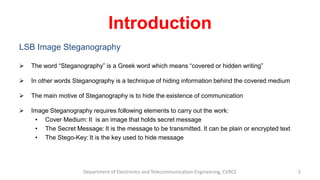
LSB Image Steganography
 The word “Steganography” is a Greek word which means “covered or hidden writing”
 In other words Steganography is a technique of hiding information behind the covered medium
 The main motive of Steganography is to hide the existence of communication
 Image Steganography requires following elements to carry out the work:
• Cover Medium: It is an image that holds secret message
• The Secret Message: It is the message to be transmitted. It can be plain or encrypted text
• The Stego-Key: It is the key used to hide message
5Department of Electronics and Telecommunication Engineering, CVRCE
Introduction (contd.)
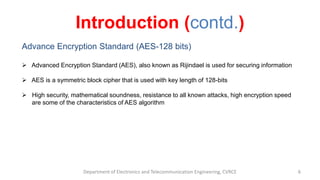
Advance Encryption Standard (AES-128 bits)
 Advanced Encryption Standard (AES), also known as Rijindael is used for securing information
 AES is a symmetric block cipher that is used with key length of 128-bits
 High security, mathematical soundness, resistance to all known attacks, high encryption speed
are some of the characteristics of AES algorithm
6Department of Electronics and Telecommunication Engineering, CVRCE
Introduction (contd.)
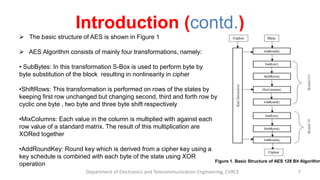
Figure 1. Basic Structure of AES 128 Bit Algorithm
 The basic structure of AES is shown in Figure 1
 AES Algorithm consists of mainly four transformations, namely:
• SubBytes: In this transformation S-Box is used to perform byte by
byte substitution of the block resulting in nonlinearity in cipher
•ShiftRows: This transformation is performed on rows of the states by
keeping first row unchanged but changing second, third and forth row by
cyclic one byte , two byte and three byte shift respectively
•MixColumns: Each value in the column is multiplied with against each
row value of a standard matrix. The result of this multiplication are
XORed together
•AddRoundKey: Round key which is derived from a cipher key using a
key schedule is combined with each byte of the state using XOR
operation
7Department of Electronics and Telecommunication Engineering, CVRCE
Steganography Layer
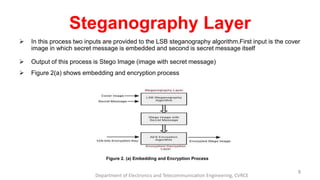
 In this process two inputs are provided to the LSB steganography algorithm.First input is the cover
image in which secret message is embedded and second is secret message itself
 Output of this process is Stego Image (image with secret message)
 Figure 2(a) shows embedding and encryption process
Figure 2. (a) Embedding and Encryption Process
8
Department of Electronics and Telecommunication Engineering, CVRCE
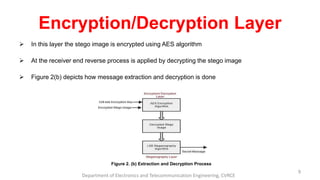
Encryption/Decryption Layer
 In this layer the stego image is encrypted using AES algorithm
 At the receiver end reverse process is applied by decrypting the stego image
 Figure 2(b) depicts how message extraction and decryption is done
Figure 2. (b) Extraction and Decryption Process
9
Department of Electronics and Telecommunication Engineering, CVRCE
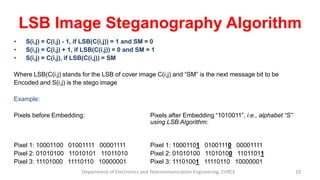
LSB Image Steganography Algorithm
• S(i,j) = C(i,j) - 1, if LSB(C(i,j)) = 1 and SM = 0
• S(i,j) = C(i,j) + 1, if LSB(C(i,j)) = 0 and SM = 1
• S(i,j) = C(i,j), if LSB(C(i,j)) = SM
Where LSB(C(i,j) stands for the LSB of cover image C(i,j) and “SM” is the next message bit to be
Encoded and S(i,j) is the stego image
Example:
Pixels before Embedding: Pixels after Embedding “1010011”, i.e., alphabet “S”
using LSB Algorithm:
Pixel 1: 10001100 01001111 00001111 Pixel 1: 10001101 01001110 00001111
Pixel 2: 01010100 11010101 11011010 Pixel 2: 01010100 11010100 11011011
Pixel 3: 11101000 11110110 10000001 Pixel 3: 11101001 11110110 10000001
10Department of Electronics and Telecommunication Engineering, CVRCE
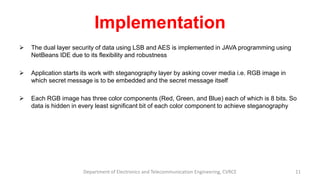
Implementation
 The dual layer security of data using LSB and AES is implemented in JAVA programming using
NetBeans IDE due to its flexibility and robustness
 Application starts its work with steganography layer by asking cover media i.e. RGB image in
which secret message is to be embedded and the secret message itself
 Each RGB image has three color components (Red, Green, and Blue) each of which is 8 bits. So
data is hidden in every least significant bit of each color component to achieve steganography
11Department of Electronics and Telecommunication Engineering, CVRCE
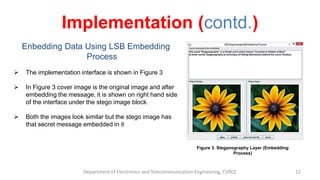
Implementation (contd.)
Enbedding Data Using LSB Embedding
Process
 The implementation interface is shown in Figure 3
 In Figure 3 cover image is the original image and after
embedding the message, it is shown on right hand side
of the interface under the stego image block
 Both the images look similar but the stego image has
that secret message embedded in it
Figure 3. Steganography Layer (Embedding
Process)
12Department of Electronics and Telecommunication Engineering, CVRCE
Implementation (contd.)
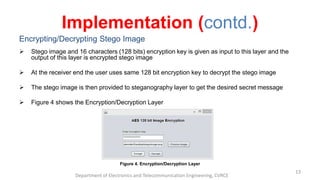
Encrypting/Decrypting Stego Image
 Stego image and 16 characters (128 bits) encryption key is given as input to this layer and the
output of this layer is encrypted stego image
 At the receiver end the user uses same 128 bit encryption key to decrypt the stego image
 The stego image is then provided to steganography layer to get the desired secret message
 Figure 4 shows the Encryption/Decryption Layer
Figure 4. Encryption/Decryption Layer
13
Department of Electronics and Telecommunication Engineering, CVRCE
Implementation (contd.)
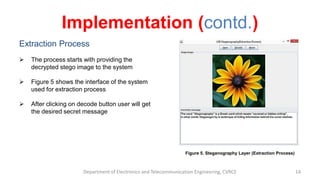
Extraction Process
 The process starts with providing the
decrypted stego image to the system
 Figure 5 shows the interface of the system
used for extraction process
 After clicking on decode button user will get
the desired secret message
Figure 5. Steganography Layer (Extraction Process)
14Department of Electronics and Telecommunication Engineering, CVRCE
Comparison Between Cover Image,
Stego And Encrypted Stego Image
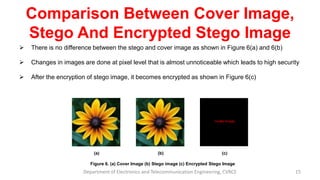
 There is no difference between the stego and cover image as shown in Figure 6(a) and 6(b)
 Changes in images are done at pixel level that is almost unnoticeable which leads to high security
 After the encryption of stego image, it becomes encrypted as shown in Figure 6(c)
(a) (b) (c)
Figure 6. (a) Cover Image (b) Stego image (c) Encrypted Stego Image
15Department of Electronics and Telecommunication Engineering, CVRCE
Advantages
 Intruder cannot detect a message
 Simple to implement
 Existence of communication is hidden
16Department of Electronics and Telecommunication Engineering, CVRCE
Applications
 Smart IDs (identity cards) where individuals’ details are embedded in their photographs
 Media database systems
 Confidential communication and secret data storing
 In modern printers
17Department of Electronics and Telecommunication Engineering, CVRCE
Conclusion
 Both steganography and cryptography are combined together to achieve desired results
 For image steganography, simplest yet effective method called LSB image steganography
algorithm is used
 For encryption/decryption layer AES encryption algorithm is used
18Department of Electronics and Telecommunication Engineering, CVRCE
Future Prospects
 Enhancing the current LSB algorithm for modifying the steganography layer
 Applying other steganography techniques to improve upon the results
 Test with other symmetric and asymmetric key encryption algorithm
19Department of Electronics and Telecommunication Engineering, CVRCE
References
[1] Satwinder Singh and Varinder Kaur Attri, ” Dual Layer Security of data using LSB Image Steganography
Method and AES Encryption Algorithm”, International Journal of Signal Processing, Image Processing
and Pattern Recognition, vol. 8, no. 5, (2015).
[2] N. A. Al-Otaibi and A. A. Gutub, “2-Leyer Security System for Hiding Sensitive Text Data on
Personal Computers”, Lecture Notes on Information Theory, vol. 2, no. 2, (2014).
[3] S. Gupta, G. Gujral and N. Aggarwal, “Enhanced Least Significant Bit Algorithm for Image
Steganography”, International Journal of Computational Engineering & Management, vol. 15 no. 4,
(2012).
20Department of Electronics and Telecommunication Engineering, CVRCE
21Department of Electronics and Telecommunication Engineering, CVRCE
22Department of Electronics and Telecommunication Engineering, CVRCE

Dual Layer Security Of Data Using LSB Image Steganography And AES Encryption Algorithm

  • 1.
    Seminar On Dual Layer SecurityOf Data Using LSB Image Steganography Method And AES Encryption Algorithm Presented By: Bikash Chandra Prusty Reg. No. : 1301227584 Department of Electronics and Telecommunication Engineering C. V. Raman College Of Engineering, Bhubaneswar
  • 2.
    Outline 1. Problem Statement 2.Motivation 3. Introduction 4. Steganography Layer 5. Encryption/Decryption Layer 6. LSB Image Steganography Algorithm 7. Implementation 8. Comparison Between Cover Image, Stego And Encrypted Stego Image 9. Advantages 10. Applications 11. Conclusion 12. Future Prospects 13. References 2Department of Electronics and Telecommunication Engineering, CVRCE
  • 3.
    Problem Statement In today’sscenario security of data is a very big challenge in any communication. The Digital Image Steganography is the science of hiding sensitive information in another transmission medium to achieve secure and secret communication. 3Department of Electronics and Telecommunication Engineering, CVRCE
  • 4.
    Motivation  To limitunauthorized access and provide better security during message transmission  To embed data or secret message in a digital image by the application of a suitable encryption and decryption algorithm  To hide the existence of communication 4Department of Electronics and Telecommunication Engineering, CVRCE
  • 5.
    Introduction LSB Image Steganography The word “Steganography” is a Greek word which means “covered or hidden writing”  In other words Steganography is a technique of hiding information behind the covered medium  The main motive of Steganography is to hide the existence of communication  Image Steganography requires following elements to carry out the work: • Cover Medium: It is an image that holds secret message • The Secret Message: It is the message to be transmitted. It can be plain or encrypted text • The Stego-Key: It is the key used to hide message 5Department of Electronics and Telecommunication Engineering, CVRCE
  • 6.
    Introduction (contd.) Advance EncryptionStandard (AES-128 bits)  Advanced Encryption Standard (AES), also known as Rijindael is used for securing information  AES is a symmetric block cipher that is used with key length of 128-bits  High security, mathematical soundness, resistance to all known attacks, high encryption speed are some of the characteristics of AES algorithm 6Department of Electronics and Telecommunication Engineering, CVRCE
  • 7.
    Introduction (contd.) Figure 1.Basic Structure of AES 128 Bit Algorithm  The basic structure of AES is shown in Figure 1  AES Algorithm consists of mainly four transformations, namely: • SubBytes: In this transformation S-Box is used to perform byte by byte substitution of the block resulting in nonlinearity in cipher •ShiftRows: This transformation is performed on rows of the states by keeping first row unchanged but changing second, third and forth row by cyclic one byte , two byte and three byte shift respectively •MixColumns: Each value in the column is multiplied with against each row value of a standard matrix. The result of this multiplication are XORed together •AddRoundKey: Round key which is derived from a cipher key using a key schedule is combined with each byte of the state using XOR operation 7Department of Electronics and Telecommunication Engineering, CVRCE
  • 8.
    Steganography Layer  Inthis process two inputs are provided to the LSB steganography algorithm.First input is the cover image in which secret message is embedded and second is secret message itself  Output of this process is Stego Image (image with secret message)  Figure 2(a) shows embedding and encryption process Figure 2. (a) Embedding and Encryption Process 8 Department of Electronics and Telecommunication Engineering, CVRCE
  • 9.
    Encryption/Decryption Layer  Inthis layer the stego image is encrypted using AES algorithm  At the receiver end reverse process is applied by decrypting the stego image  Figure 2(b) depicts how message extraction and decryption is done Figure 2. (b) Extraction and Decryption Process 9 Department of Electronics and Telecommunication Engineering, CVRCE
  • 10.
    LSB Image SteganographyAlgorithm • S(i,j) = C(i,j) - 1, if LSB(C(i,j)) = 1 and SM = 0 • S(i,j) = C(i,j) + 1, if LSB(C(i,j)) = 0 and SM = 1 • S(i,j) = C(i,j), if LSB(C(i,j)) = SM Where LSB(C(i,j) stands for the LSB of cover image C(i,j) and “SM” is the next message bit to be Encoded and S(i,j) is the stego image Example: Pixels before Embedding: Pixels after Embedding “1010011”, i.e., alphabet “S” using LSB Algorithm: Pixel 1: 10001100 01001111 00001111 Pixel 1: 10001101 01001110 00001111 Pixel 2: 01010100 11010101 11011010 Pixel 2: 01010100 11010100 11011011 Pixel 3: 11101000 11110110 10000001 Pixel 3: 11101001 11110110 10000001 10Department of Electronics and Telecommunication Engineering, CVRCE
  • 11.
    Implementation  The duallayer security of data using LSB and AES is implemented in JAVA programming using NetBeans IDE due to its flexibility and robustness  Application starts its work with steganography layer by asking cover media i.e. RGB image in which secret message is to be embedded and the secret message itself  Each RGB image has three color components (Red, Green, and Blue) each of which is 8 bits. So data is hidden in every least significant bit of each color component to achieve steganography 11Department of Electronics and Telecommunication Engineering, CVRCE
  • 12.
    Implementation (contd.) Enbedding DataUsing LSB Embedding Process  The implementation interface is shown in Figure 3  In Figure 3 cover image is the original image and after embedding the message, it is shown on right hand side of the interface under the stego image block  Both the images look similar but the stego image has that secret message embedded in it Figure 3. Steganography Layer (Embedding Process) 12Department of Electronics and Telecommunication Engineering, CVRCE
  • 13.
    Implementation (contd.) Encrypting/Decrypting StegoImage  Stego image and 16 characters (128 bits) encryption key is given as input to this layer and the output of this layer is encrypted stego image  At the receiver end the user uses same 128 bit encryption key to decrypt the stego image  The stego image is then provided to steganography layer to get the desired secret message  Figure 4 shows the Encryption/Decryption Layer Figure 4. Encryption/Decryption Layer 13 Department of Electronics and Telecommunication Engineering, CVRCE
  • 14.
    Implementation (contd.) Extraction Process The process starts with providing the decrypted stego image to the system  Figure 5 shows the interface of the system used for extraction process  After clicking on decode button user will get the desired secret message Figure 5. Steganography Layer (Extraction Process) 14Department of Electronics and Telecommunication Engineering, CVRCE
  • 15.
    Comparison Between CoverImage, Stego And Encrypted Stego Image  There is no difference between the stego and cover image as shown in Figure 6(a) and 6(b)  Changes in images are done at pixel level that is almost unnoticeable which leads to high security  After the encryption of stego image, it becomes encrypted as shown in Figure 6(c) (a) (b) (c) Figure 6. (a) Cover Image (b) Stego image (c) Encrypted Stego Image 15Department of Electronics and Telecommunication Engineering, CVRCE
  • 16.
    Advantages  Intruder cannotdetect a message  Simple to implement  Existence of communication is hidden 16Department of Electronics and Telecommunication Engineering, CVRCE
  • 17.
    Applications  Smart IDs(identity cards) where individuals’ details are embedded in their photographs  Media database systems  Confidential communication and secret data storing  In modern printers 17Department of Electronics and Telecommunication Engineering, CVRCE
  • 18.
    Conclusion  Both steganographyand cryptography are combined together to achieve desired results  For image steganography, simplest yet effective method called LSB image steganography algorithm is used  For encryption/decryption layer AES encryption algorithm is used 18Department of Electronics and Telecommunication Engineering, CVRCE
  • 19.
    Future Prospects  Enhancingthe current LSB algorithm for modifying the steganography layer  Applying other steganography techniques to improve upon the results  Test with other symmetric and asymmetric key encryption algorithm 19Department of Electronics and Telecommunication Engineering, CVRCE
  • 20.
    References [1] Satwinder Singhand Varinder Kaur Attri, ” Dual Layer Security of data using LSB Image Steganography Method and AES Encryption Algorithm”, International Journal of Signal Processing, Image Processing and Pattern Recognition, vol. 8, no. 5, (2015). [2] N. A. Al-Otaibi and A. A. Gutub, “2-Leyer Security System for Hiding Sensitive Text Data on Personal Computers”, Lecture Notes on Information Theory, vol. 2, no. 2, (2014). [3] S. Gupta, G. Gujral and N. Aggarwal, “Enhanced Least Significant Bit Algorithm for Image Steganography”, International Journal of Computational Engineering & Management, vol. 15 no. 4, (2012). 20Department of Electronics and Telecommunication Engineering, CVRCE
  • 21.
    21Department of Electronicsand Telecommunication Engineering, CVRCE
  • 22.
    22Department of Electronicsand Telecommunication Engineering, CVRCE