Ms. Azza Arafa
English grammar
Word classes
Verb Nouns
Adjectiveslinking words
pronounprepositions
Determiner adverb
Sentences structure
Subject Verb
Subject verb object
Subject verb complement
Subject verb adverbial
Subject verb object object
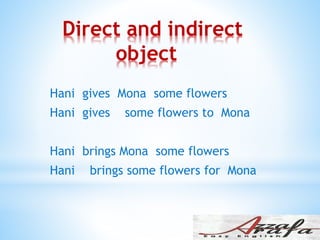
Direct and indirect
object
Hani gives Mona some flowers
Hani gives some flowers to Mona
Hani brings Mona some flowers
Hani brings some flowers for Mona
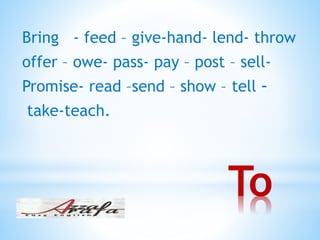
To
Bring - feed – give-hand- lend- throw
offer – owe- pass- pay – post – sell-
-tellPromise- read –send – show –
take-teach.
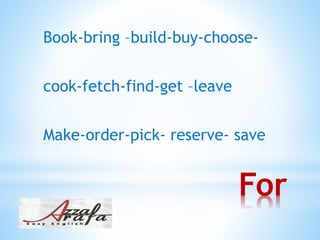
For
Book-bring –build-buy-choose-
cook-fetch-find-get –leave
Make-order-pick- reserve- save
The
present
continuous
The present continuous
Form :
v.to Be + v+ ing
he is playing football
negative :
he isn't playing football
interrogative:
ls he playing football
The present continuous
time expressions:
now - at the moment – these days-
nowadaysat present – still –
smell ! - look !- listen!-
The present continuous
:usage
-when we are in the middle of the action
-when an action is going on around now but
not
at the actual moment of speaking
Use
We use the present simple to:
Express thoughts and feelings: I think so, like it*
States, things staying the same, facts, and things that are
true for a long time: we live quite near
*repeated actions :we come here every week
* in phrases like I promise ,I agree ,…
I promise ,I'll pay you back
*In negative questions with why to make a suggestion :
Why don't we go out ?
*for the future meaning of the present simple
The new term starts next week.
Time expressions:
Usually, often , always , sometimes,
never , seldom ,ever, rarely ,frequently,
generally every day /week/month,
in the morning/afternoon/evening, at
night , at the weekend , on Fridays ,…
I/we/they/you go
He /she/it goes
Positive forms:
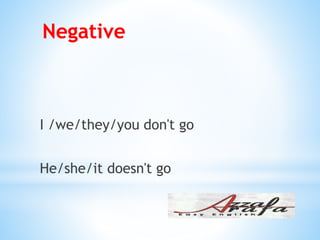
Negative
I /we/they/you don't go
He/she/it doesn't go
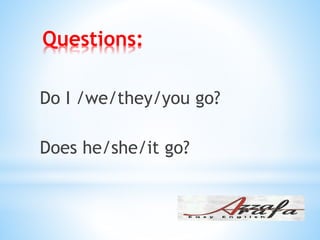
Questions:
Do I /we/they/you go?
Does he/she/it go?
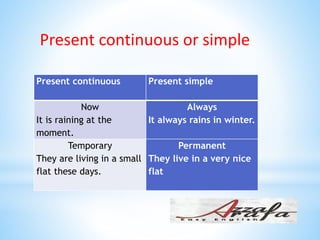
Present continuous or simple
Present simplePresent continuous
Always
It always rains in winter.
Now
It is raining at the
moment.
Permanent
They live in a very nice
flat
Temporary
They are living in a small
flat these days.
The Past simple
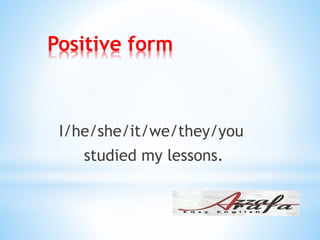
Positive form
I/he/she/it/we/they/you
studied my lessons.
Negative
I/he/she/it/we/they/you
didn't study my lessons.
Interrogative
Did you/he/they
study the lesson ?
Usage
*for an action which began and finished in the
past
*for an actions which happened immediately one
after the other in the past
*for the past habits which are now finished
*for telling stories
The time expressions
Yesterday – last/ night/ week-two days ago –
How long ago …?- in 1900 – the other day –for
Always-never-often-to express habits in the past
then –when
Past continuous
Form
Was /were +v + ing
I was studying English all
night yesterday
Negative
Wasn’t /weren’t +v + ing
usage
For an action which began and finished in the
past
For an action which was in progress when
another action interrupted
For two actions that were happening at the
same time
Time expressions
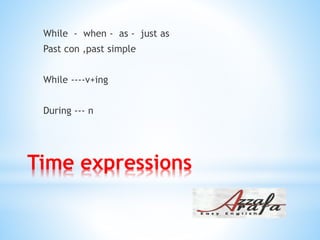
While - when - as - just as
Past con ,past simple
While ----v+ing
During --- n
Present
perfect
Form
Has / have +pp
They have played football
Negative
Have not / has not + pp
I haven’t played tennis
Interrogative
Have /has +sub + pp
Wh-word +have/has +sub + pp ?
Usage
For the actions which begin in the past and
continues for the present
For an action which has recently finished and
whose result is visible in the present
For an action which happened at an unknown
time in the past
Time expressions
Already – just – ever – never –yet – so far -
up till now – lately – recently - over – how
long …?
-This is the first time –it ‘s the second time
– it’s ages /4 years since – today -
This morning /month-For (duration) – since
for
Weeks – 2hours –ages
a long time –the last year-A
day –a month
since
Friday – last April - 2000 –
2 o’clock – his childhood –
last week – then since
The present perfect
continuous
Introduction
It’s used for an action that
happens over a period of
time . It may last to the
present
Form
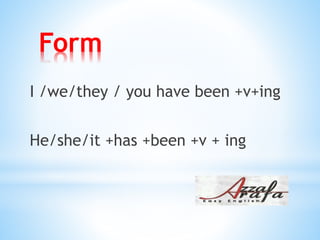
I /we/they / you have been +v+ing
He/she/it +has +been +v + ing
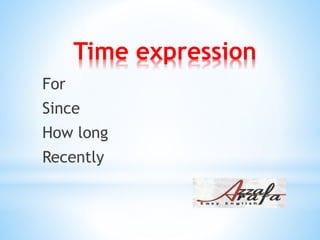
Time expression
For
Since
How long
Recently
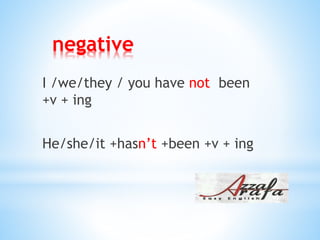
negative
I /we/they / you have not been
+v + ing
He/she/it +hasn’t +been +v + ing
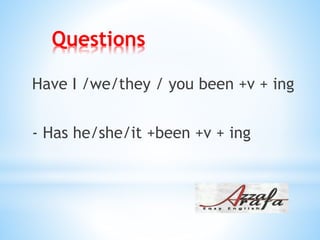
Questions
Have I /we/they / you been +v + ing
- Has he/she/it +been +v + ing
The past
perfect
usage
form
Had + pp
They hadn’t gone to bed
until late
Negative
Hadn’t +pp
They hadn’t gone to bed
until late
questions
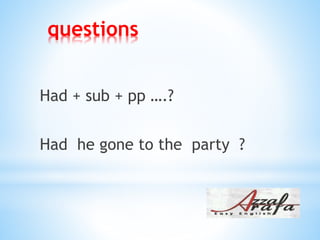
Had + sub + pp ….?
Had he gone to the party ?
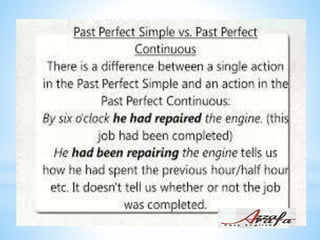
The past perfect
continuous
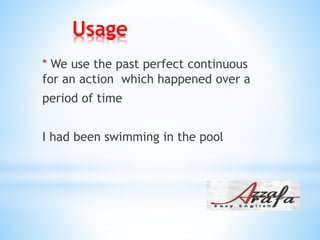
Usage
* We use the past perfect continuous
for an action which happened over a
period of time
I had been swimming in the pool
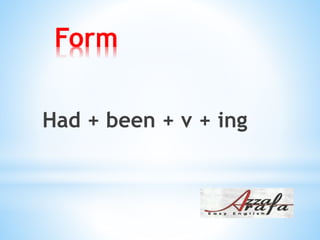
Form
Had + been + v + ing
The future
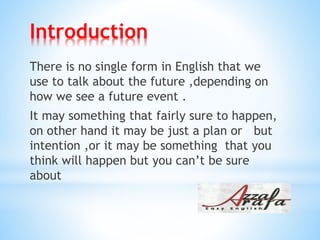
Introduction
There is no single form in English that we
use to talk about the future ,depending on
how we see a future event .
It may something that fairly sure to happen,
buton other hand it may be just a plan or
intention ,or it may be something that you
think will happen but you can’t be sure
about
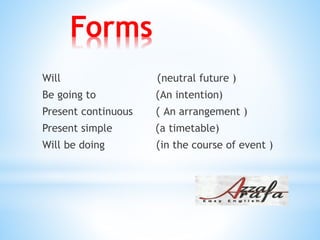
Forms
neutral future ))Will
An intention))Be going to
An arrangement ))Present continuous
a timetable))Present simple
in the course of event ))Will be doing
:Predictions/statements of fact
The auxiliary verb will is used in making predictions or simple
statements of fact about the future.
The sun will rise at 6.30 tomorrow.
Lunch break today will be 10 minutes longer than usual.
In the year 2050 all students will have their own computers in
school.
If you help me, I will help you.
Will it snow for Christmas?
I know she's sick, but will she be back in school tomorrow?
will
Be going to
Intentions
The auxiliary verb going to is used in talking about intentions.
(An intention is a plan for the future that you have already thought about.)
We're going to buy a new car next month.
I'm going to work in a bank when I leave school.
I'm not going to watch TV until my science project is finished.
Are you going to play basketball after school?
Note:
going to is often used in the past tense to talk about an unfulfilled
intention. Examples: I was going to study for my grammar test, but I had
no time.
Be +v +
ing
Arrangements
The present continuous tense is used in talking about
arrangements.
(An arrangement is is a plan for the future that you have
already thought about and discussed with someone else.)
I'm meeting my mother at the airport tomorrow.
I'm not returning home for the holidays, so I can come to
your party after all!
Are you doing anything on Sunday morning?
Present simple
Scheduled events
The present simple tense is usually used to refer to future events
that are scheduled (and outside of our control).
* Hurry up! The train departs in 10 minutes.
I leave Frankfurt at 5 o'clock in the morning and arrive in*
New York at midnight the next day.
* She has an appointment with the headmaster after school today.
* When does the meeting begin?
Be to - Be about to
We use be to for the events which officially
arranged
It is often used in news reports
*The queen is to visit Egypt next Monday
We use be about to for the near future
*do you want to say good bye for our
visitors ?they are about to leave
Future continuous
Continuous actions
*At this time next week I will be sitting in the
plane on the way to New York.
* Don't call me after 10 o'clock. I'll be
sleeping
Future perfect
Usage
We use future perfect for something will be
over in the future
There's no point calling her at home. She will
have left for work already.
On June 25 2020 they will have been married
for 60 years
Was/ were going to
* We use be going to in the past to
express an intention in the past. Often
the intended action didn’t happen
* we can also use it for prediction in the
past
have got
*They mean the same thing
Have got is more formal
*We don’t use have got in short answers
We don’t often use had got in past
tenses
have
With action verb have we can’t use got
He is having lunch
It can be continuous
We can say :
We have a talk instead of “ talk “
Yes/no questions
use
- A yes /no questions is one that we can
answer
with yes or no
--These questions are asking for information
- These questions are asking for making
suggestions
form
Is it raining ?
Has Sam got a car ?
Can Mona drive ?
Do you finish your H.W?
Does Amr play football?
Did you meet Ahmed ?

English grammar

  • 1.
  • 2.
    Word classes Verb Nouns Adjectiveslinkingwords pronounprepositions Determiner adverb
  • 3.
    Sentences structure Subject Verb Subjectverb object Subject verb complement Subject verb adverbial Subject verb object object
  • 4.
    Direct and indirect object Hanigives Mona some flowers Hani gives some flowers to Mona Hani brings Mona some flowers Hani brings some flowers for Mona
  • 5.
    To Bring - feed– give-hand- lend- throw offer – owe- pass- pay – post – sell- -tellPromise- read –send – show – take-teach.
  • 6.
  • 8.
  • 9.
    The present continuous Form: v.to Be + v+ ing he is playing football negative : he isn't playing football interrogative: ls he playing football
  • 10.
    The present continuous timeexpressions: now - at the moment – these days- nowadaysat present – still – smell ! - look !- listen!-
  • 11.
    The present continuous :usage -whenwe are in the middle of the action -when an action is going on around now but not at the actual moment of speaking
  • 13.
    Use We use thepresent simple to: Express thoughts and feelings: I think so, like it* States, things staying the same, facts, and things that are true for a long time: we live quite near *repeated actions :we come here every week * in phrases like I promise ,I agree ,… I promise ,I'll pay you back *In negative questions with why to make a suggestion : Why don't we go out ? *for the future meaning of the present simple The new term starts next week.
  • 14.
    Time expressions: Usually, often, always , sometimes, never , seldom ,ever, rarely ,frequently, generally every day /week/month, in the morning/afternoon/evening, at night , at the weekend , on Fridays ,…
  • 15.
    I/we/they/you go He /she/itgoes Positive forms:
  • 16.
    Negative I /we/they/you don'tgo He/she/it doesn't go
  • 17.
    Questions: Do I /we/they/yougo? Does he/she/it go?
  • 18.
    Present continuous orsimple Present simplePresent continuous Always It always rains in winter. Now It is raining at the moment. Permanent They live in a very nice flat Temporary They are living in a small flat these days.
  • 19.
  • 20.
  • 21.
  • 22.
  • 23.
    Usage *for an actionwhich began and finished in the past *for an actions which happened immediately one after the other in the past *for the past habits which are now finished *for telling stories
  • 24.
    The time expressions Yesterday– last/ night/ week-two days ago – How long ago …?- in 1900 – the other day –for Always-never-often-to express habits in the past then –when
  • 25.
  • 26.
    Form Was /were +v+ ing I was studying English all night yesterday
  • 27.
  • 28.
    usage For an actionwhich began and finished in the past For an action which was in progress when another action interrupted For two actions that were happening at the same time
  • 29.
    Time expressions While -when - as - just as Past con ,past simple While ----v+ing During --- n
  • 30.
  • 31.
    Form Has / have+pp They have played football
  • 32.
    Negative Have not /has not + pp I haven’t played tennis
  • 33.
    Interrogative Have /has +sub+ pp Wh-word +have/has +sub + pp ?
  • 34.
    Usage For the actionswhich begin in the past and continues for the present For an action which has recently finished and whose result is visible in the present For an action which happened at an unknown time in the past
  • 35.
    Time expressions Already –just – ever – never –yet – so far - up till now – lately – recently - over – how long …? -This is the first time –it ‘s the second time – it’s ages /4 years since – today - This morning /month-For (duration) – since
  • 36.
    for Weeks – 2hours–ages a long time –the last year-A day –a month
  • 37.
    since Friday – lastApril - 2000 – 2 o’clock – his childhood – last week – then since
  • 38.
  • 39.
    Introduction It’s used foran action that happens over a period of time . It may last to the present
  • 40.
    Form I /we/they /you have been +v+ing He/she/it +has +been +v + ing
  • 41.
  • 42.
    negative I /we/they /you have not been +v + ing He/she/it +hasn’t +been +v + ing
  • 43.
    Questions Have I /we/they/ you been +v + ing - Has he/she/it +been +v + ing
  • 44.
  • 45.
  • 46.
    form Had + pp Theyhadn’t gone to bed until late
  • 47.
  • 48.
    questions Had + sub+ pp ….? Had he gone to the party ?
  • 50.
  • 51.
    Usage * We usethe past perfect continuous for an action which happened over a period of time I had been swimming in the pool
  • 52.
    Form Had + been+ v + ing
  • 54.
  • 55.
    Introduction There is nosingle form in English that we use to talk about the future ,depending on how we see a future event . It may something that fairly sure to happen, buton other hand it may be just a plan or intention ,or it may be something that you think will happen but you can’t be sure about
  • 56.
    Forms neutral future ))Will Anintention))Be going to An arrangement ))Present continuous a timetable))Present simple in the course of event ))Will be doing
  • 57.
    :Predictions/statements of fact Theauxiliary verb will is used in making predictions or simple statements of fact about the future. The sun will rise at 6.30 tomorrow. Lunch break today will be 10 minutes longer than usual. In the year 2050 all students will have their own computers in school. If you help me, I will help you. Will it snow for Christmas? I know she's sick, but will she be back in school tomorrow? will
  • 58.
    Be going to Intentions Theauxiliary verb going to is used in talking about intentions. (An intention is a plan for the future that you have already thought about.) We're going to buy a new car next month. I'm going to work in a bank when I leave school. I'm not going to watch TV until my science project is finished. Are you going to play basketball after school? Note: going to is often used in the past tense to talk about an unfulfilled intention. Examples: I was going to study for my grammar test, but I had no time.
  • 59.
    Be +v + ing Arrangements Thepresent continuous tense is used in talking about arrangements. (An arrangement is is a plan for the future that you have already thought about and discussed with someone else.) I'm meeting my mother at the airport tomorrow. I'm not returning home for the holidays, so I can come to your party after all! Are you doing anything on Sunday morning?
  • 60.
    Present simple Scheduled events Thepresent simple tense is usually used to refer to future events that are scheduled (and outside of our control). * Hurry up! The train departs in 10 minutes. I leave Frankfurt at 5 o'clock in the morning and arrive in* New York at midnight the next day. * She has an appointment with the headmaster after school today. * When does the meeting begin?
  • 61.
    Be to -Be about to We use be to for the events which officially arranged It is often used in news reports *The queen is to visit Egypt next Monday We use be about to for the near future *do you want to say good bye for our visitors ?they are about to leave
  • 62.
  • 63.
    Continuous actions *At thistime next week I will be sitting in the plane on the way to New York. * Don't call me after 10 o'clock. I'll be sleeping
  • 64.
  • 65.
    Usage We use futureperfect for something will be over in the future There's no point calling her at home. She will have left for work already. On June 25 2020 they will have been married for 60 years
  • 66.
    Was/ were goingto * We use be going to in the past to express an intention in the past. Often the intended action didn’t happen * we can also use it for prediction in the past
  • 67.
    have got *They meanthe same thing Have got is more formal *We don’t use have got in short answers We don’t often use had got in past tenses
  • 68.
    have With action verbhave we can’t use got He is having lunch It can be continuous We can say : We have a talk instead of “ talk “
  • 69.
  • 70.
    use - A yes/no questions is one that we can answer with yes or no --These questions are asking for information - These questions are asking for making suggestions
  • 71.
    form Is it raining? Has Sam got a car ? Can Mona drive ? Do you finish your H.W? Does Amr play football? Did you meet Ahmed ?