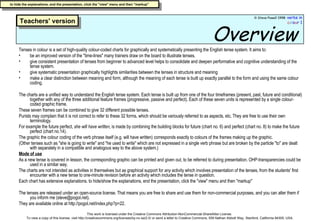
Overview Tenses in colour is a set of high-quality colour-coded charts for graphically and systematically presenting the English tense system. It aims to:  be an improved version of the "time-lines" many trainers draw on the board to illustrate tenses.  give consistent presentation of tenses from beginner to advanced level helps to consolidate and deepen performative and cognitive understanding of the tense system. give systematic presentation graphically highlights similarities between the tenses in structure and meaning  make a clear distinction between meaning and form, although the meaning of each tense is built up exactly parallel to the form and using the same colour coding. The charts are a unified way to understand the English tense system. Each tense is built up from one of the four timeframes (present, past, future and conditional) together with any of the three additional feature frames (progressive, passive and perfect). Each of these seven units is represented by a single colour-coded graphic frame.  These seven frames can be combined to give 32 different possible tenses.  Purists may complain that it is not correct to refer to these 32 forms, which should be variously referred to as aspects, etc. They are free to use their own terminology. For example the future perfect,  she will have written,  is made by combining the building blocks for future (chart no. 6) and perfect (chart no. 8) to make the future perfect (chart no.14). The graphic the colour coding of the verb phrase itself (e.g. will have written) corresponds exactly to colours of the frames making up the graphic. (Other tenses such as "she is going to write" and "he used to write" which are not expressed in a single verb phrase but are broken by the particle "to" are dealt with separately in a compatible and analogous way to the above system.)  Mode of use As a new tense is covered in lesson, the corresponding graphic can be printed and given out, to be referred to during presentation. OHP-transparencies could be used in a similar way. The charts are not intended as activities in themselves but as graphical support for  any  activity which involves presentation of the tenses, from the students' first encounter with a new tense to one-minute revision before an activity which includes the tense in question.  Each chart has extensive explanations.  to hide/show the explanations, end the presentation, click the "view" menu and then "markup" The tenses are released under an open-source license. That means you are free to share and use them for non-commercial purposes, and you can alter them if you inform me (steve@pogol.net). They are available online at http://pogol.net/index.php?p=22.
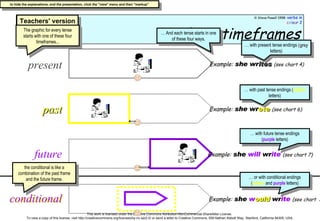
the 4 timeframes conditional present past conditional future Example:  she wr ote   (see chart 6) Example:  she  w ould  wr ite   (see chart  xx) Example:  she wr ites   (see chart 4) Example:  she  will  wr ite   (see chart 7) the conditional is like a combination of the past frame and the future frame. …  with present tense endings ( grey  letters) …  with past tense endings ( yellow  letters) …  with future tense endings ( purple  letters) The graphic for every tense starts with one of these four timeframes... …  And each tense starts in one of these four ways. …  or with conditional endings ( yellow  and  purple  letters)
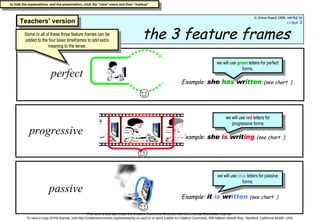
the 3 feature frames Example:  she  is  writ ing   (see chart  ) Example:  she  has  wr itten   (see chart  ) Example:  it  is  wr itten   (see chart  ) Some or all of these three feature frames can be added to the four basic timeframes to add extra meaning to the tense. we will use  green  letters for perfect forms. we will use  red  letters for progressive forms we will use  blue  letters for passive forms. perfect progressive passive
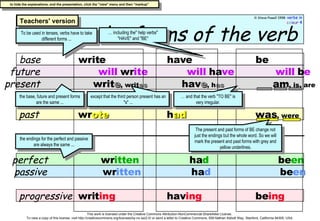
the forms of the verb perfect wr itten  ha d  be en  progressive writ ing hav ing be ing future  will  wr ite   will  ha v e will   b e present writ e , writ es   hav e , h as   am , is, are passive wr itten ha d be en base  write   hav e be To be used in tenses, verbs have to take different forms ... …  including the" help verbs" "HAVE" and "BE" the base, future and present forms are the same ... except that the third person present has an "s" ... …  and that the verb "TO BE" is very irregular. The present and past forms of BE change not just the endings but the whole word. So we will mark the present and past forms with grey and yellow underlines. the endings for the perfect and passive are always the same ... past wr ote   h ad   was , were
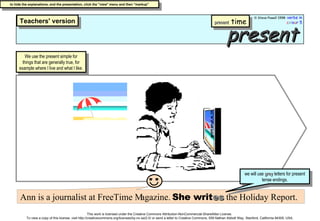
present Ann is a journalist at FreeTime Magazine.  She writ es   the Holiday Report. we will use  grey  letters for present tense endings. We use the present simple for things that are generally true, for example where I live and what I like. present  time
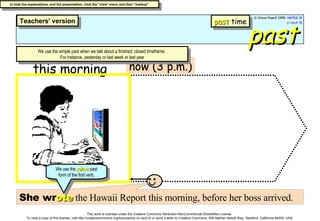
past now (3 p.m.) this morning She wr ote  the Hawaii Report this morning, before her boss arrived. We use the simple past when we talk about a finished, closed timeframe.  For instance, yesterday or last week or last year We use the  yellow  past form of the first verb. past  time
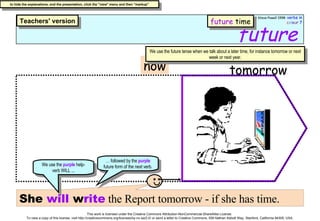
future now tomorrow She  will  w rite  the Report tomorrow - if she has time. We use the future tense when we talk about a later time, for instance tomorrow or next week or next year. We use the  purple  help-verb WILL ... …  followed by the  purple  future form of the next verb. future  time
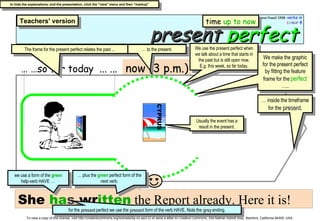
present   perfect She  ha s  wr itten  the Report already. Here it is! now (3 p.m.) … … so far today  ... ... The frame for the present perfect relates the past ... we use a form of the  green  help-verb HAVE …  …  to the present. We use the present perfect when we talk about a time that starts in the past but is still open now. E.g. this week, so far today. Usually the event has a result in the present. …  plus the  green  perfect form of the next verb. for the  present  perfect we use the  present  form of the verb HAVE. Note the  grey  ending. We make the graphic for the present perfect by fitting the feature frame for the  perfect  ….. time  up to now …  inside the timeframe for the  present . CYPRUS
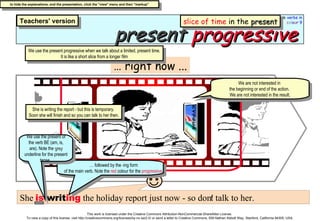
present   progressive …  right now ... She  is  writ ing  the holiday report just now - so don't talk to her. We use the present progressive when we talk about a limited, present time. It is like a short slice from a longer film …  followed by the -ing form  of the main verb. Note the  red  colour for the  progressive .. We are not interested in  the beginning or end of the action.  We are not interested in the result. She is writing the report - but this is temporary.  Soon she will finish and so you can talk to her then. We use the present of the verb BE (am, is, are). Note the  grey  underline for the present tense.. slice of time  in the  present
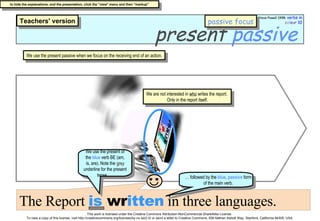
present   passive The Report  is  wr itten  in three languages. We use the present passive when we focus on the receiving end of an action. …  followed by the  blue ,  passive  form  of the main verb.  We are not interested in  who  writes the report.  Only in the report itself. We use the present of the  blue  verb BE (am, is, are). Note the  grey  underline for the present tense….. passive focus
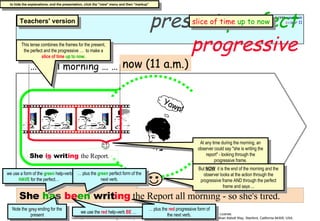
present   perfect   progressive now (11 a.m.) … …  all morning … … Yawn! She  is  writ ing  the Report . She  ha s   be en  writ ing  the Report all morning - so she's tired. At any time during the morning, an observer could say "she is writing the report" - looking through the progressive frame. This tense combines the frames for the present, the perfect and the progressive …  to make a  slice of time   up to now . But  NOW   it is the end of the morning and   the observer looks at the action through the progressive frame AND through the perfect frame and says ... Note the  grey  ending for the present we use a form of the  green  help-verb  HAVE  for the perfect…  …  plus the  green  perfect form of the next verb. we use the  red  help-verb  BE  …  …  plus the  red  progressive form of the next verb. slice of time   up to now CYPRUS
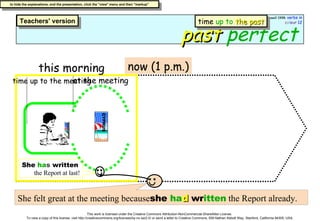
past   perfect now (1 p.m.) at the meeting She felt great at the meeting because  she  ha d  wr itten  the Report already. time up to the meeting this morning She  ha s  written   the Report at last! time  up to   the past CYPRUS
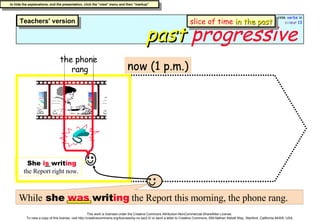
past   progressive now (1 p.m.) the phone  rang While  she  was  writ ing  the Report this morning, the phone rang. She  is  writ ing  the Report right now. slice of time   in the past
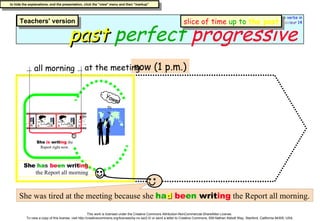
past   perfect   progressive now (1 p.m.) at the meeting …  all morning … Yawn! She was tired at the meeting because she  ha d   be en  writ ing  the Report all morning. She  ha s   be en  writ ing  the Report all morning slice of time   up to   the past She  is  writ ing  the Report right now .
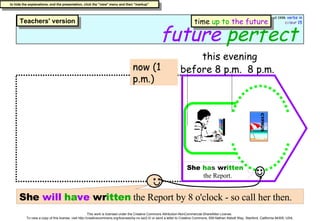
future   perfect 8 p.m. now  (1 p.m.) She  ha s  wr itten   the Report.  before 8 p.m. this evening She  will   ha ve  wr itten  the Report by 8 o'clock - so call her then. time  up to   the future CYPRUS
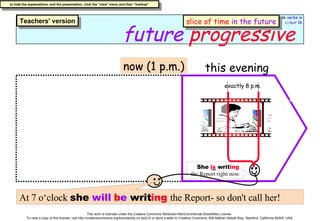
future  progressive now  (1 p.m.) exactly 8 p.m. She  is  writ ing   the Report right now. this evening At 7 o‘clock  she  will   b e  writ ing   the Report- so don't call her! slice of time   in the future
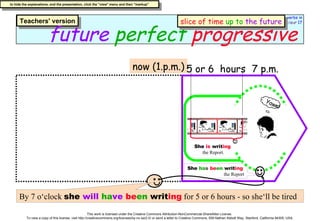
future   perfect   progressive now (1.p.m.) 7 p.m. 5 or 6  hours Yawn! She  ha s   be en  writ ing   the Report By 7 o‘clock  she  will   ha ve   be en  writ ing   for 5 or 6 hours - so she‘ll be tired She  is  writ ing  the Report. slice of time   up to   the future
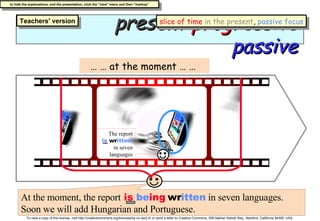
present   progressive  passive … …  at the moment … …  At the moment, the report   is  be ing   wr itten  in seven languages. Soon we will add Hungarian and Portuguese. The report   is   wr itten   in seven languages slice of time   in the present ,  passive focus
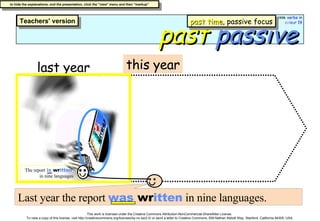
past  passive this year last year Last year the report  was  wr itten  in nine languages. The report   is   wr itten   in nine languages past time , passive focus

Tenses Charts

  • 1.
    Overview Tenses incolour is a set of high-quality colour-coded charts for graphically and systematically presenting the English tense system. It aims to: be an improved version of the "time-lines" many trainers draw on the board to illustrate tenses. give consistent presentation of tenses from beginner to advanced level helps to consolidate and deepen performative and cognitive understanding of the tense system. give systematic presentation graphically highlights similarities between the tenses in structure and meaning make a clear distinction between meaning and form, although the meaning of each tense is built up exactly parallel to the form and using the same colour coding. The charts are a unified way to understand the English tense system. Each tense is built up from one of the four timeframes (present, past, future and conditional) together with any of the three additional feature frames (progressive, passive and perfect). Each of these seven units is represented by a single colour-coded graphic frame. These seven frames can be combined to give 32 different possible tenses. Purists may complain that it is not correct to refer to these 32 forms, which should be variously referred to as aspects, etc. They are free to use their own terminology. For example the future perfect, she will have written, is made by combining the building blocks for future (chart no. 6) and perfect (chart no. 8) to make the future perfect (chart no.14). The graphic the colour coding of the verb phrase itself (e.g. will have written) corresponds exactly to colours of the frames making up the graphic. (Other tenses such as "she is going to write" and "he used to write" which are not expressed in a single verb phrase but are broken by the particle "to" are dealt with separately in a compatible and analogous way to the above system.) Mode of use As a new tense is covered in lesson, the corresponding graphic can be printed and given out, to be referred to during presentation. OHP-transparencies could be used in a similar way. The charts are not intended as activities in themselves but as graphical support for any activity which involves presentation of the tenses, from the students' first encounter with a new tense to one-minute revision before an activity which includes the tense in question. Each chart has extensive explanations. to hide/show the explanations, end the presentation, click the "view" menu and then "markup" The tenses are released under an open-source license. That means you are free to share and use them for non-commercial purposes, and you can alter them if you inform me (steve@pogol.net). They are available online at http://pogol.net/index.php?p=22.
  • 2.
    the 4 timeframesconditional present past conditional future Example: she wr ote (see chart 6) Example: she w ould wr ite (see chart xx) Example: she wr ites (see chart 4) Example: she will wr ite (see chart 7) the conditional is like a combination of the past frame and the future frame. … with present tense endings ( grey letters) … with past tense endings ( yellow letters) … with future tense endings ( purple letters) The graphic for every tense starts with one of these four timeframes... … And each tense starts in one of these four ways. … or with conditional endings ( yellow and purple letters)
  • 3.
    the 3 featureframes Example: she is writ ing (see chart ) Example: she has wr itten (see chart ) Example: it is wr itten (see chart ) Some or all of these three feature frames can be added to the four basic timeframes to add extra meaning to the tense. we will use green letters for perfect forms. we will use red letters for progressive forms we will use blue letters for passive forms. perfect progressive passive
  • 4.
    the forms ofthe verb perfect wr itten ha d be en progressive writ ing hav ing be ing future will wr ite will ha v e will b e present writ e , writ es hav e , h as am , is, are passive wr itten ha d be en base write hav e be To be used in tenses, verbs have to take different forms ... … including the" help verbs" "HAVE" and "BE" the base, future and present forms are the same ... except that the third person present has an "s" ... … and that the verb "TO BE" is very irregular. The present and past forms of BE change not just the endings but the whole word. So we will mark the present and past forms with grey and yellow underlines. the endings for the perfect and passive are always the same ... past wr ote h ad was , were
  • 5.
    present Ann isa journalist at FreeTime Magazine. She writ es the Holiday Report. we will use grey letters for present tense endings. We use the present simple for things that are generally true, for example where I live and what I like. present time
  • 6.
    past now (3p.m.) this morning She wr ote the Hawaii Report this morning, before her boss arrived. We use the simple past when we talk about a finished, closed timeframe. For instance, yesterday or last week or last year We use the yellow past form of the first verb. past time
  • 7.
    future now tomorrowShe will w rite the Report tomorrow - if she has time. We use the future tense when we talk about a later time, for instance tomorrow or next week or next year. We use the purple help-verb WILL ... … followed by the purple future form of the next verb. future time
  • 8.
    present perfect She ha s wr itten the Report already. Here it is! now (3 p.m.) … … so far today ... ... The frame for the present perfect relates the past ... we use a form of the green help-verb HAVE … … to the present. We use the present perfect when we talk about a time that starts in the past but is still open now. E.g. this week, so far today. Usually the event has a result in the present. … plus the green perfect form of the next verb. for the present perfect we use the present form of the verb HAVE. Note the grey ending. We make the graphic for the present perfect by fitting the feature frame for the perfect ….. time up to now … inside the timeframe for the present . CYPRUS
  • 9.
    present progressive … right now ... She is writ ing the holiday report just now - so don't talk to her. We use the present progressive when we talk about a limited, present time. It is like a short slice from a longer film … followed by the -ing form of the main verb. Note the red colour for the progressive .. We are not interested in the beginning or end of the action. We are not interested in the result. She is writing the report - but this is temporary. Soon she will finish and so you can talk to her then. We use the present of the verb BE (am, is, are). Note the grey underline for the present tense.. slice of time in the present
  • 10.
    present passive The Report is wr itten in three languages. We use the present passive when we focus on the receiving end of an action. … followed by the blue , passive form of the main verb. We are not interested in who writes the report. Only in the report itself. We use the present of the blue verb BE (am, is, are). Note the grey underline for the present tense….. passive focus
  • 11.
    present perfect progressive now (11 a.m.) … … all morning … … Yawn! She is writ ing the Report . She ha s be en writ ing the Report all morning - so she's tired. At any time during the morning, an observer could say "she is writing the report" - looking through the progressive frame. This tense combines the frames for the present, the perfect and the progressive … to make a slice of time up to now . But NOW it is the end of the morning and the observer looks at the action through the progressive frame AND through the perfect frame and says ... Note the grey ending for the present we use a form of the green help-verb HAVE for the perfect… … plus the green perfect form of the next verb. we use the red help-verb BE … … plus the red progressive form of the next verb. slice of time up to now CYPRUS
  • 12.
    past perfect now (1 p.m.) at the meeting She felt great at the meeting because she ha d wr itten the Report already. time up to the meeting this morning She ha s written the Report at last! time up to the past CYPRUS
  • 13.
    past progressive now (1 p.m.) the phone rang While she was writ ing the Report this morning, the phone rang. She is writ ing the Report right now. slice of time in the past
  • 14.
    past perfect progressive now (1 p.m.) at the meeting … all morning … Yawn! She was tired at the meeting because she ha d be en writ ing the Report all morning. She ha s be en writ ing the Report all morning slice of time up to the past She is writ ing the Report right now .
  • 15.
    future perfect 8 p.m. now (1 p.m.) She ha s wr itten the Report. before 8 p.m. this evening She will ha ve wr itten the Report by 8 o'clock - so call her then. time up to the future CYPRUS
  • 16.
    future progressivenow (1 p.m.) exactly 8 p.m. She is writ ing the Report right now. this evening At 7 o‘clock she will b e writ ing the Report- so don't call her! slice of time in the future
  • 17.
    future perfect progressive now (1.p.m.) 7 p.m. 5 or 6 hours Yawn! She ha s be en writ ing the Report By 7 o‘clock she will ha ve be en writ ing for 5 or 6 hours - so she‘ll be tired She is writ ing the Report. slice of time up to the future
  • 18.
    present progressive passive … … at the moment … … At the moment, the report is be ing wr itten in seven languages. Soon we will add Hungarian and Portuguese. The report is wr itten in seven languages slice of time in the present , passive focus
  • 19.
    past passivethis year last year Last year the report was wr itten in nine languages. The report is wr itten in nine languages past time , passive focus