
PAST PERFECT TENSE
Had + Past Participle verbs
HOW DO WE USE IT?
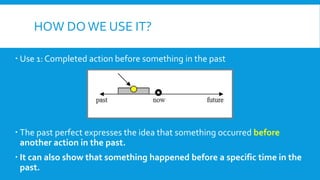
 Use 1: Completed action before something in the past
 The past perfect expresses the idea that something occurred before
another action in the past.
 It can also show that something happened before a specific time in the
past.
EXAMPLES:
She only understood
the movie because she
had read the book.
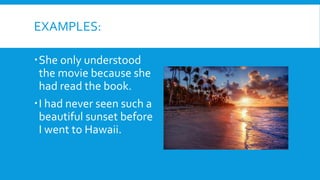
I had never seen such a
beautiful sunset before
I went to Hawaii.
USE 2: DURATION BEFORE SOMETHING IN
THE PAST
We can also use the past perfect to show hat something
started in the past and continued up until another action
in the past.
EXAMPLES:
We had owned this car for 10
years before it finally died.
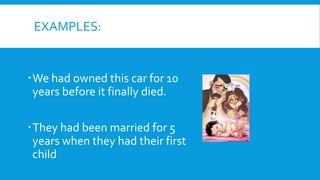
They had been married for 5
years when they had their first
child
STRUCTURE OFTHE PAST PERFECT
He had already left when she called
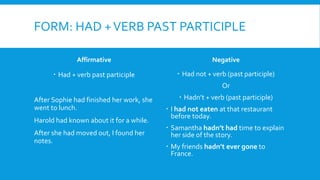
FORM: HAD +VERB PAST PARTICIPLE
Affirmative
 Had + verb past participle
After Sophie had finished her work, she
went to lunch.
Harold had known about it for a while.
After she had moved out, I found her
notes.
Negative
 Had not + verb (past participle)
Or
 Hadn’t + verb (past participle)
 I had not eaten at that restaurant
before today.
 Samantha hadn’t had time to explain
her side of the story.
 My friends hadn’t ever gone to
France.
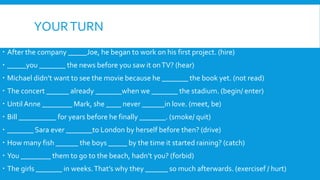
YOURTURN
 After the company _____Joe, he began to work on his first project. (hire)
 _____you _______ the news before you saw it onTV? (hear)
 Michael didn’t want to see the movie because he _______ the book yet. (not read)
 The concert ______ already _______when we _______ the stadium. (begin/ enter)
 Until Anne ________ Mark, she ____ never ______in love. (meet, be)
 Bill __________ for years before he finally _______. (smoke/ quit)
 _______ Sara ever _______to London by herself before then? (drive)
 How many fish ______ the boys _____ by the time it started raining? (catch)
 You ________ them to go to the beach, hadn’t you? (forbid)
 The girls _______ in weeks.That’s why they ______ so much afterwards. (exercisef / hurt)

Past perfect tense

  • 1.
    PAST PERFECT TENSE Had+ Past Participle verbs
  • 2.
    HOW DO WEUSE IT?  Use 1: Completed action before something in the past  The past perfect expresses the idea that something occurred before another action in the past.  It can also show that something happened before a specific time in the past.
  • 3.
    EXAMPLES: She only understood themovie because she had read the book. I had never seen such a beautiful sunset before I went to Hawaii.
  • 4.
    USE 2: DURATIONBEFORE SOMETHING IN THE PAST We can also use the past perfect to show hat something started in the past and continued up until another action in the past.
  • 5.
    EXAMPLES: We had ownedthis car for 10 years before it finally died. They had been married for 5 years when they had their first child
  • 6.
    STRUCTURE OFTHE PASTPERFECT He had already left when she called
  • 7.
    FORM: HAD +VERBPAST PARTICIPLE Affirmative  Had + verb past participle After Sophie had finished her work, she went to lunch. Harold had known about it for a while. After she had moved out, I found her notes. Negative  Had not + verb (past participle) Or  Hadn’t + verb (past participle)  I had not eaten at that restaurant before today.  Samantha hadn’t had time to explain her side of the story.  My friends hadn’t ever gone to France.
  • 8.
    YOURTURN  After thecompany _____Joe, he began to work on his first project. (hire)  _____you _______ the news before you saw it onTV? (hear)  Michael didn’t want to see the movie because he _______ the book yet. (not read)  The concert ______ already _______when we _______ the stadium. (begin/ enter)  Until Anne ________ Mark, she ____ never ______in love. (meet, be)  Bill __________ for years before he finally _______. (smoke/ quit)  _______ Sara ever _______to London by herself before then? (drive)  How many fish ______ the boys _____ by the time it started raining? (catch)  You ________ them to go to the beach, hadn’t you? (forbid)  The girls _______ in weeks.That’s why they ______ so much afterwards. (exercisef / hurt)