PRESENTATION OF ENGLISH
Punctuation 
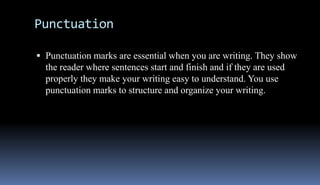
 Punctuation marks are essential when you are writing. They show 
the reader where sentences start and finish and if they are used 
properly they make your writing easy to understand. You use 
punctuation marks to structure and organize your writing.
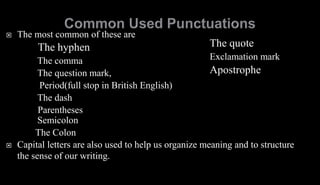
 The most common of these are 
The hyphen The quote 
The comma 
The question mark, 
The dash 
Parentheses 
 Capital letters are also used to help us organize meaning and to structure 
the sense of our writing. 
Apostrophe 
Semicolon 
The Colon 
Exclamation mark 
Period(full stop in British English)
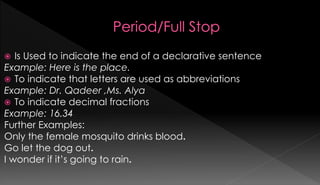
 Is Used to indicate the end of a declarative sentence 
Example: Here is the place. 
 To indicate that letters are used as abbreviations 
Example: Dr. Qadeer ,Ms. Alya 
 To indicate decimal fractions 
Example: 16.34 
Further Examples: 
Only the female mosquito drinks blood. 
Go let the dog out. 
I wonder if it’s going to rain.
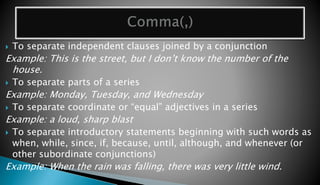
 To separate independent clauses joined by a conjunction 
Example: This is the street, but I don’t know the number of the 
house. 
 To separate parts of a series 
Example: Monday, Tuesday, and Wednesday 
 To separate coordinate or “equal” adjectives in a series 
Example: a loud, sharp blast 
 To separate introductory statements beginning with such words as 
when, while, since, if, because, until, although, and whenever (or 
other subordinate conjunctions) 
Example: When the rain was falling, there was very little wind.
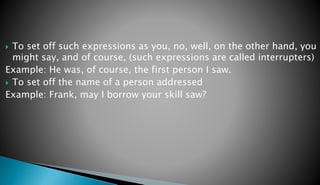
 To set off such expressions as you, no, well, on the other hand, you 
might say, and of course, (such expressions are called interrupters) 
Example: He was, of course, the first person I saw. 
 To set off the name of a person addressed 
Example: Frank, may I borrow your skill saw?
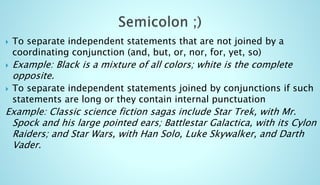
 To separate independent statements that are not joined by a 
coordinating conjunction (and, but, or, nor, for, yet, so) 
 Example: Black is a mixture of all colors; white is the complete 
opposite. 
 To separate independent statements joined by conjunctions if such 
statements are long or they contain internal punctuation 
Example: Classic science fiction sagas include Star Trek, with Mr. 
Spock and his large pointed ears; Battlestar Galactica, with its Cylon 
Raiders; and Star Wars, with Han Solo, Luke Skywalker, and Darth 
Vader.
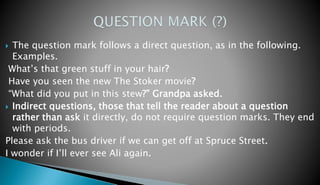
 The question mark follows a direct question, as in the following. 
Examples. 
What’s that green stuff in your hair? 
Have you seen the new The Stoker movie? 
“What did you put in this stew?” Grandpa asked. 
 Indirect questions, those that tell the reader about a question 
rather than ask it directly, do not require question marks. They end 
with periods. 
Please ask the bus driver if we can get off at Spruce Street. 
I wonder if I’ll ever see Ali again.
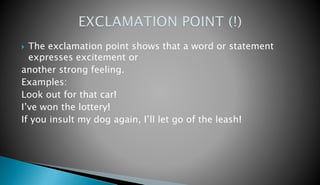
 The exclamation point shows that a word or statement 
expresses excitement or 
another strong feeling. 
Examples: 
Look out for that car! 
I’ve won the lottery! 
If you insult my dog again, I’ll let go of the leash!
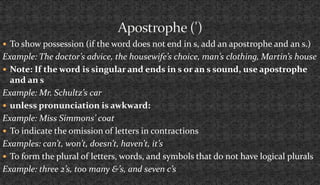
 To show possession (if the word does not end in s, add an apostrophe and an s.) 
Example: The doctor’s advice, the housewife’s choice, man’s clothing, Martin’s house 
 Note: If the word is singular and ends in s or an s sound, use apostrophe 
and an s 
Example: Mr. Schultz’s car 
 unless pronunciation is awkward: 
Example: Miss Simmons’ coat 
 To indicate the omission of letters in contractions 
Examples: can’t, won’t, doesn’t, haven’t, it’s 
 To form the plural of letters, words, and symbols that do not have logical plurals 
Example: three 2’s, too many &’s, and seven c’s
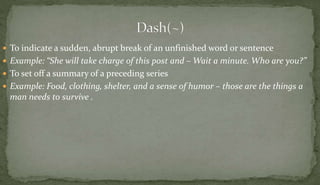
 To indicate a sudden, abrupt break of an unfinished word or sentence 
 Example: “She will take charge of this post and – Wait a minute. Who are you?” 
 To set off a summary of a preceding series 
 Example: Food, clothing, shelter, and a sense of humor – those are the things a 
man needs to survive .
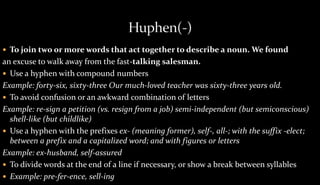
 To join two or more words that act together to describe a noun. We found 
an excuse to walk away from the fast-talking salesman. 
 Use a hyphen with compound numbers 
Example: forty-six, sixty-three Our much-loved teacher was sixty-three years old. 
 To avoid confusion or an awkward combination of letters 
Example: re-sign a petition (vs. resign from a job) semi-independent (but semiconscious) 
shell-like (but childlike) 
 Use a hyphen with the prefixes ex- (meaning former), self-, all-; with the suffix -elect; 
between a prefix and a capitalized word; and with figures or letters 
Example: ex-husband, self-assured 
 To divide words at the end of a line if necessary, or show a break between syllables 
 Example: pre-fer-ence, sell-ing
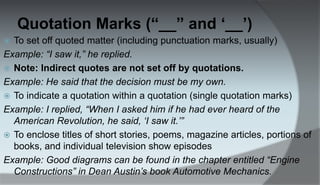
Quotation Marks (“__” and ‘__’) 
 To set off quoted matter (including punctuation marks, usually) 
Example: “I saw it,” he replied. 
 Note: Indirect quotes are not set off by quotations. 
Example: He said that the decision must be my own. 
 To indicate a quotation within a quotation (single quotation marks) 
Example: I replied, “When I asked him if he had ever heard of the 
American Revolution, he said, ‘I saw it.’” 
 To enclose titles of short stories, poems, magazine articles, portions of 
books, and individual television show episodes 
Example: Good diagrams can be found in the chapter entitled “Engine 
Constructions” in Dean Austin’s book Automotive Mechanics.
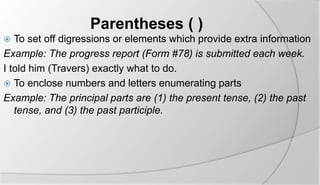
Parentheses ( ) 
 To set off digressions or elements which provide extra information 
Example: The progress report (Form #78) is submitted each week. 
I told him (Travers) exactly what to do. 
 To enclose numbers and letters enumerating parts 
Example: The principal parts are (1) the present tense, (2) the past 
tense, and (3) the past participle.
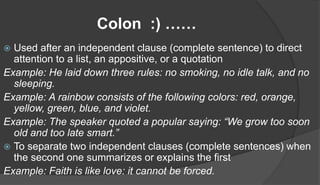
Colon :) …… 
 Used after an independent clause (complete sentence) to direct 
attention to a list, an appositive, or a quotation 
Example: He laid down three rules: no smoking, no idle talk, and no 
sleeping. 
Example: A rainbow consists of the following colors: red, orange, 
yellow, green, blue, and violet. 
Example: The speaker quoted a popular saying: “We grow too soon 
old and too late smart.” 
 To separate two independent clauses (complete sentences) when 
the second one summarizes or explains the first 
Example: Faith is like love: it cannot be forced.
Thanks

English Punctuation

  • 1.
  • 2.
    Punctuation  Punctuationmarks are essential when you are writing. They show the reader where sentences start and finish and if they are used properly they make your writing easy to understand. You use punctuation marks to structure and organize your writing.
  • 3.
     The mostcommon of these are The hyphen The quote The comma The question mark, The dash Parentheses  Capital letters are also used to help us organize meaning and to structure the sense of our writing. Apostrophe Semicolon The Colon Exclamation mark Period(full stop in British English)
  • 4.
     Is Usedto indicate the end of a declarative sentence Example: Here is the place.  To indicate that letters are used as abbreviations Example: Dr. Qadeer ,Ms. Alya  To indicate decimal fractions Example: 16.34 Further Examples: Only the female mosquito drinks blood. Go let the dog out. I wonder if it’s going to rain.
  • 5.
     To separateindependent clauses joined by a conjunction Example: This is the street, but I don’t know the number of the house.  To separate parts of a series Example: Monday, Tuesday, and Wednesday  To separate coordinate or “equal” adjectives in a series Example: a loud, sharp blast  To separate introductory statements beginning with such words as when, while, since, if, because, until, although, and whenever (or other subordinate conjunctions) Example: When the rain was falling, there was very little wind.
  • 6.
     To setoff such expressions as you, no, well, on the other hand, you might say, and of course, (such expressions are called interrupters) Example: He was, of course, the first person I saw.  To set off the name of a person addressed Example: Frank, may I borrow your skill saw?
  • 7.
     To separateindependent statements that are not joined by a coordinating conjunction (and, but, or, nor, for, yet, so)  Example: Black is a mixture of all colors; white is the complete opposite.  To separate independent statements joined by conjunctions if such statements are long or they contain internal punctuation Example: Classic science fiction sagas include Star Trek, with Mr. Spock and his large pointed ears; Battlestar Galactica, with its Cylon Raiders; and Star Wars, with Han Solo, Luke Skywalker, and Darth Vader.
  • 8.
     The questionmark follows a direct question, as in the following. Examples. What’s that green stuff in your hair? Have you seen the new The Stoker movie? “What did you put in this stew?” Grandpa asked.  Indirect questions, those that tell the reader about a question rather than ask it directly, do not require question marks. They end with periods. Please ask the bus driver if we can get off at Spruce Street. I wonder if I’ll ever see Ali again.
  • 9.
     The exclamationpoint shows that a word or statement expresses excitement or another strong feeling. Examples: Look out for that car! I’ve won the lottery! If you insult my dog again, I’ll let go of the leash!
  • 10.
     To showpossession (if the word does not end in s, add an apostrophe and an s.) Example: The doctor’s advice, the housewife’s choice, man’s clothing, Martin’s house  Note: If the word is singular and ends in s or an s sound, use apostrophe and an s Example: Mr. Schultz’s car  unless pronunciation is awkward: Example: Miss Simmons’ coat  To indicate the omission of letters in contractions Examples: can’t, won’t, doesn’t, haven’t, it’s  To form the plural of letters, words, and symbols that do not have logical plurals Example: three 2’s, too many &’s, and seven c’s
  • 11.
     To indicatea sudden, abrupt break of an unfinished word or sentence  Example: “She will take charge of this post and – Wait a minute. Who are you?”  To set off a summary of a preceding series  Example: Food, clothing, shelter, and a sense of humor – those are the things a man needs to survive .
  • 12.
     To jointwo or more words that act together to describe a noun. We found an excuse to walk away from the fast-talking salesman.  Use a hyphen with compound numbers Example: forty-six, sixty-three Our much-loved teacher was sixty-three years old.  To avoid confusion or an awkward combination of letters Example: re-sign a petition (vs. resign from a job) semi-independent (but semiconscious) shell-like (but childlike)  Use a hyphen with the prefixes ex- (meaning former), self-, all-; with the suffix -elect; between a prefix and a capitalized word; and with figures or letters Example: ex-husband, self-assured  To divide words at the end of a line if necessary, or show a break between syllables  Example: pre-fer-ence, sell-ing
  • 13.
    Quotation Marks (“__”and ‘__’)  To set off quoted matter (including punctuation marks, usually) Example: “I saw it,” he replied.  Note: Indirect quotes are not set off by quotations. Example: He said that the decision must be my own.  To indicate a quotation within a quotation (single quotation marks) Example: I replied, “When I asked him if he had ever heard of the American Revolution, he said, ‘I saw it.’”  To enclose titles of short stories, poems, magazine articles, portions of books, and individual television show episodes Example: Good diagrams can be found in the chapter entitled “Engine Constructions” in Dean Austin’s book Automotive Mechanics.
  • 14.
    Parentheses ( )  To set off digressions or elements which provide extra information Example: The progress report (Form #78) is submitted each week. I told him (Travers) exactly what to do.  To enclose numbers and letters enumerating parts Example: The principal parts are (1) the present tense, (2) the past tense, and (3) the past participle.
  • 15.
    Colon :) ……  Used after an independent clause (complete sentence) to direct attention to a list, an appositive, or a quotation Example: He laid down three rules: no smoking, no idle talk, and no sleeping. Example: A rainbow consists of the following colors: red, orange, yellow, green, blue, and violet. Example: The speaker quoted a popular saying: “We grow too soon old and too late smart.”  To separate two independent clauses (complete sentences) when the second one summarizes or explains the first Example: Faith is like love: it cannot be forced.
  • 16.