Punctuation Marks
By: Anza Afzal Dar
Punctuation is the system of signs or symbols given to a reader to show how a
sentence is constructed and how it should be read.
• Sentences are the building blocks used to construct written accounts. They are
complete statements.
• Punctuation shows how the sentence should be read and makes the meaning
clear.
• Every sentence should include at least a capital letter at the start, and a full stop,
exclamation mark or question mark at the end.
• This basic system indicates that the sentence is complete.
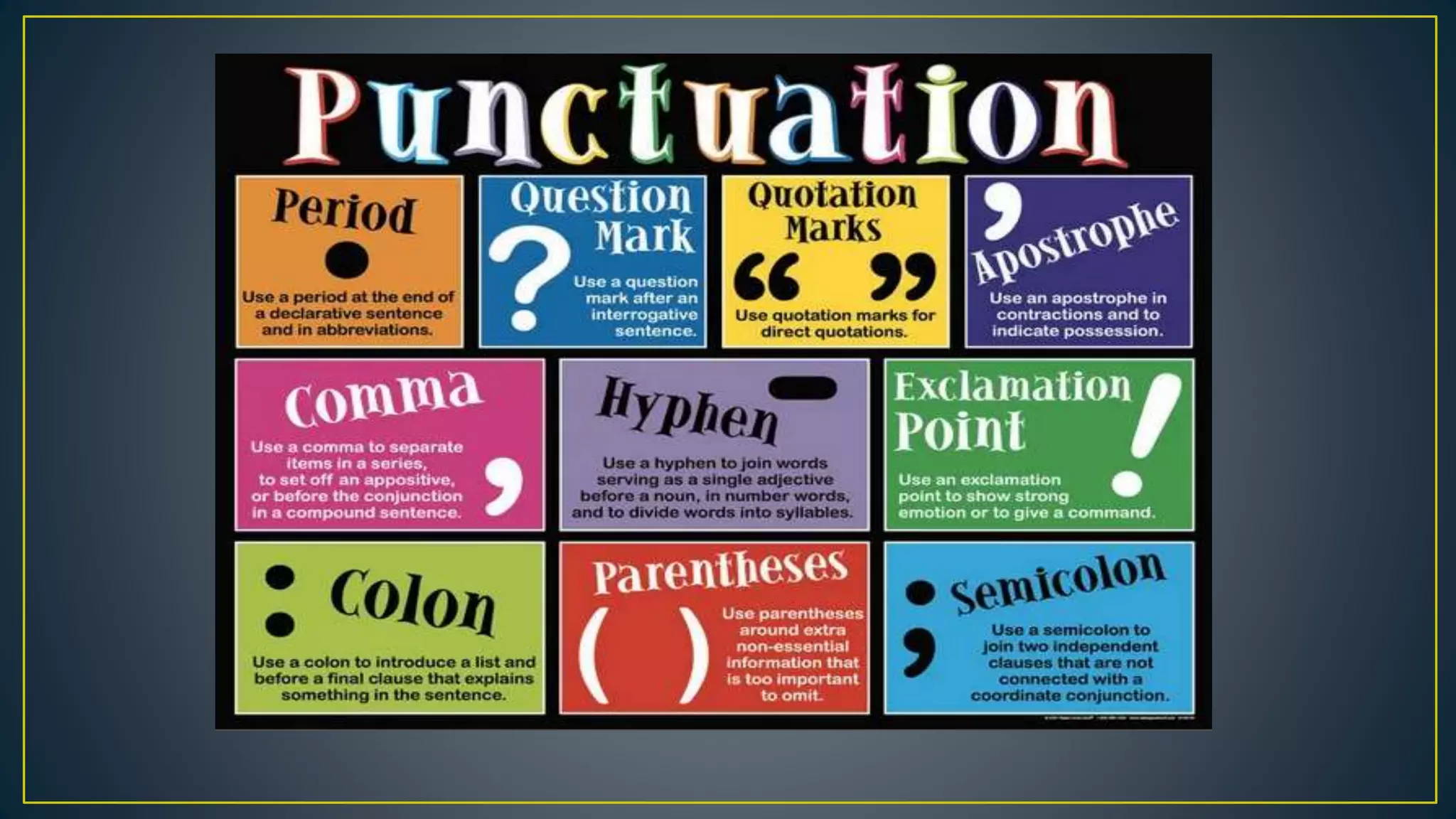
• The English language has many punctuation marks,
• Here are 14 common punctuation marks in English.
• The Full Stop (.)
• The Question Mark (?)
• Quotation Marks/Speech Marks (“ ”)
• The Apostrophe (‘)
• The Comma (,)
• The Hyphen (-)
• The dash (en dash (–) em
dash (—))
• The Exclamation Mark (!)
• The Colon (:)
• The Semicolon (;)
• Parentheses ()
• Brackets []
• Ellipsis (…)
• The Slash (/)
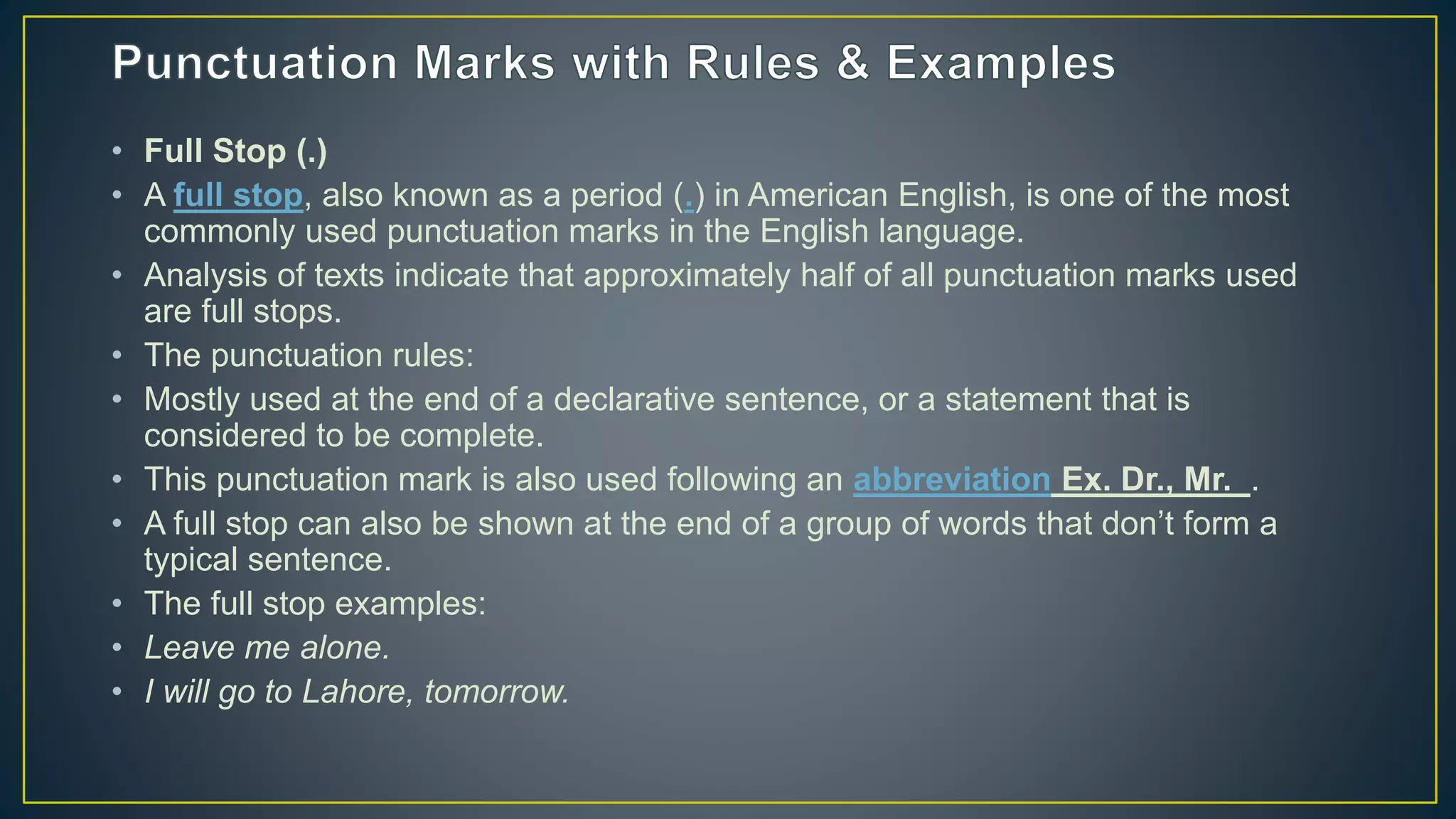
• Full Stop (.)
• A full stop, also known as a period (.) in American English, is one of the most
commonly used punctuation marks in the English language.
• Analysis of texts indicate that approximately half of all punctuation marks used
are full stops.
• The punctuation rules:
• Mostly used at the end of a declarative sentence, or a statement that is
considered to be complete.
• This punctuation mark is also used following an abbreviation Ex. Dr., Mr. .
• A full stop can also be shown at the end of a group of words that don’t form a
typical sentence.
• The full stop examples:
• Leave me alone.
• I will go to Lahore, tomorrow.
• We use a question mark (?) after an interrogative sentence in English.
• Examples:
• What is your name?
• Where are you from?
• Quotation Marks/Speech Marks (“ ”)
• We use quotation marks (“ ”) for direct quotations in English.
• Examples:
• She asked me, ‘’ what are you doing” ?
• An apostrophe (‘) is used to show that certain letters have been omitted from a
word.
• The punctuation symbol can also be used to show the possessive form of a
noun, in addition to indicating the plural form of lowercase letters.
• The punctuation rules:
• Use an apostrophe in contractions
• He is = He’s
• I am = I’m
• Do not = Don’t
• They have = They’ve
• It is = It’s
• I would = I’d
• Let us = Let’s
• The apostrophe examples:
• He joined Players’ club in 2016.
• Hina’s hair was curly.
• We have put together an anthology of children’s poetry.
• A comma (,) is used to show the difference between two separate ideas
or elements within a sentence. Commas have other uses as well, as they
can be used to separate numbers, and write dates.
• The comma rules and examples:
• Add a comma when two separate sentences are combined
• Example:
• We purchased some cheese, and we purchased some fruit.
• Use commas between words in a series. Notice that a comma does not
follow the last word in the series
• Example:
• He was tall, dark, and handsome.
• Use a comma to separate an introductory element from the rest of the
sentence
• Example:
• As the day came to an end, the fire fighters put out the last spark.
• Use the comma to set off the words “yes” and “no”.
• Example:
• No, thank you.
• Use a comma to set off a tag question from the rest of the sentence.
• Example:
• She is your sister, isn’t she?
• Use a comma to indicate direct address.
• Example:
• Is that you, Mary?
• Add a comma when a participle phrase clause is used.
• Example:
• Walking slowly, I could see the beautiful flowers.
• Use a comma to separate parts of the date.
• Example:
• Tuesday, May 2, 2016, was when I graduated.
• A hyphen (–) is a punctuation mark with three main uses.
• Many people confuse this punctuation mark with the dash, but the two are
quite different.
• The hyphen can be used in compound words, to link words to prefixes,
and also as a way to show word breaks.
• The hyphen punctuation rules and examples:
• Use a hyphen to join two or more words together into a compound term.
• Do not separate the words with spaces.
• Examples:
• My eight-year-old boy loves reading.
• I work part-time.
• Self-expression
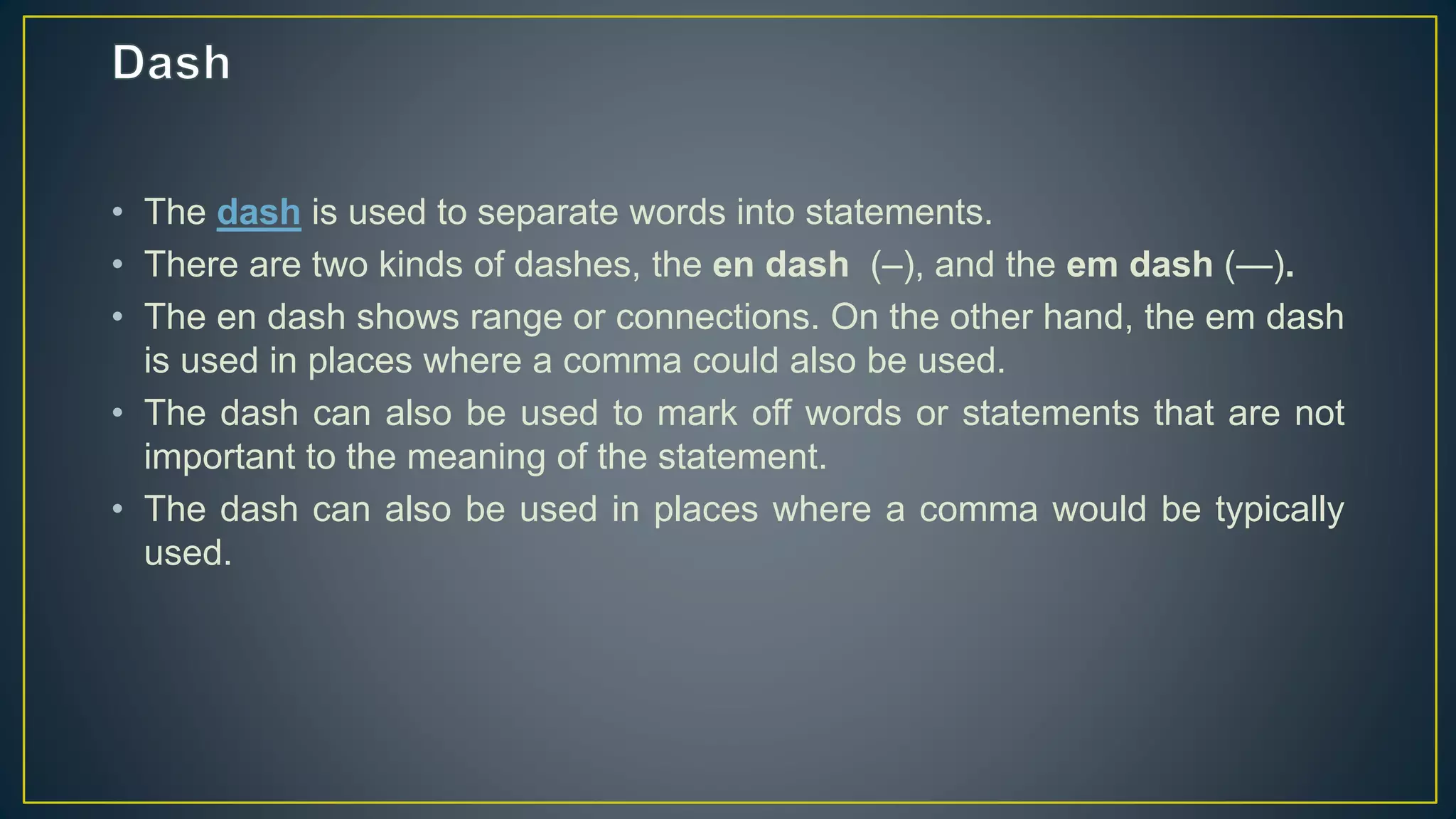
• The dash is used to separate words into statements.
• There are two kinds of dashes, the en dash (–), and the em dash (—).
• The en dash shows range or connections. On the other hand, the em dash
is used in places where a comma could also be used.
• The dash can also be used to mark off words or statements that are not
important to the meaning of the statement.
• The dash can also be used in places where a comma would be typically
used.
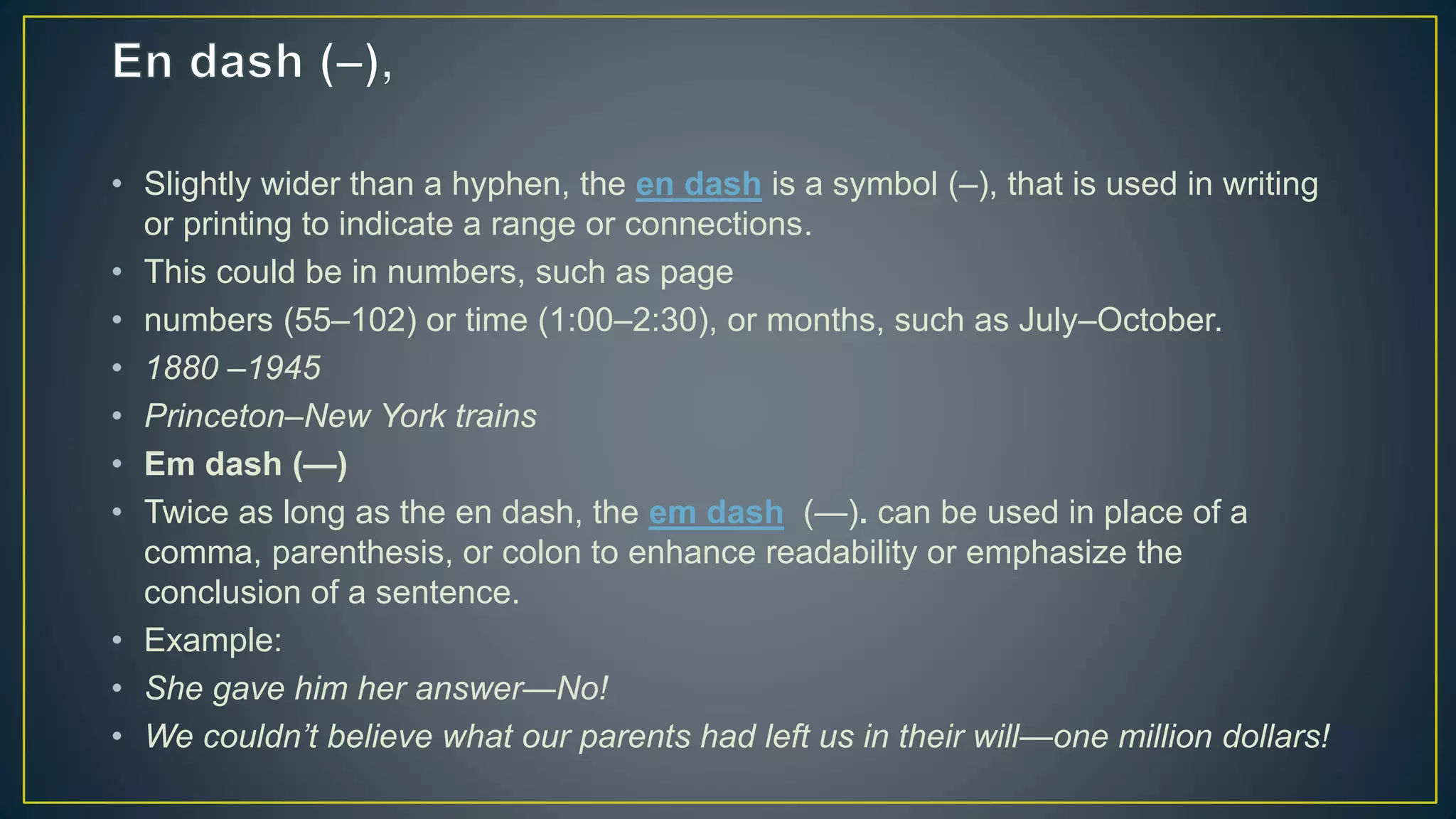
• Slightly wider than a hyphen, the en dash is a symbol (–), that is used in writing
or printing to indicate a range or connections.
• This could be in numbers, such as page
• numbers (55–102) or time (1:00–2:30), or months, such as July–October.
• 1880 –1945
• Princeton–New York trains
• Em dash (—)
• Twice as long as the en dash, the em dash (—). can be used in place of a
comma, parenthesis, or colon to enhance readability or emphasize the
conclusion of a sentence.
• Example:
• She gave him her answer—No!
• We couldn’t believe what our parents had left us in their will—one million dollars!
• An exclamation mark is used to show emphasis.
• It can be used in the middle of a sentence or at the end of a sentence.
• When used at the end of a sentence, it also takes on the role of a full stop
or a period.
• We often use an exclamation mark (!) to show strong emotion or give a
command.
• Examples:
• Stop!
• Yeah!
• Sit down!
• What a lovely view you have here!
• Used for interjection words:
• Alas!, Hurrah!
• A colon (:) is a fairly common punctuation mark with a varied number of
uses.
• It can be used to introduce a quotation, an example, a series, or even an
explanation.
• Secondly, it can be used to separate two independent clauses.
• Finally, a colon can be used to show emphasis.
• Examples:
• You have two choices: finish the work today or lose the contract.
• That’s because we have one goal: for you to consider your website a
success.
• The diet includes four main types of food: cereals, leafy vegetables, fruits,
and fish.
• A semicolon (;) is used to separate two independent clauses while still
demonstrating that a close relationship exists between them.
• The semicolon does a better job of showing the connection between two
statements than a full stop would.
• Examples:
• My daughter is a teacher; my son is a doctor.
• There are eight members in the team: two from China, Japan; three from
France, Spain; two from Brazil; and one from India.
• My sister always slept with the light on; she was afraid of the dark.
• Parenthesis, ( () ) are quotation marks that show additional thoughts
about a statement.
• In many scenarios, they can be replaced by commas without any changes
to the meaning of the sentence.
• We also often use parentheses to set off less important details.
• Example:
• The two brothers (Ali and Sleem) were learning how to play guitar.
• Katrina (a hurricane) had a devastating effect on thousands of people.
• We typically use square brackets when we want to modify another
person's words.
• Here, we want to make it clear that the modification has been made by
us, not by the original writer. For example:
• to add clarification:
• The witness said: "He [the policeman] hit me."
• to add information:
• The two teams in the finals of the first FIFA Football World Cup were both from South
America [Uruguay and Argentina].
• to add missing words:
• It is [a] good question.
• An ellipsis is usually represented by three dots (…), although it can also
be represented by three asterisks (***).
• This punctuation symbol is used to show that there has been an omission
of some letters or words.
• In many cases, ellipses are used to cut statement short to avoid
unnecessary or irrelevant words that have no impact on the meaning of
the statement being made.
• We often use ellipsis to show that parts of sentences are left out.
• Examples:
• To be continued…
• You’ll never believe what I saw…
• A slash, which is also known as a forward slash, a
virgule, or even an oblique dash, has a number of uses.
• The slash can be used to separate lines in a song or
poem when they are written in a continuous line.
• The slash (/) is also used in place of the word or the
slash can also be used to show two contradictory
notions.
• The slash punctuation rules and examples:
• Use slashes to separate parts of internet (web)
addresses and file names for some computer programs.
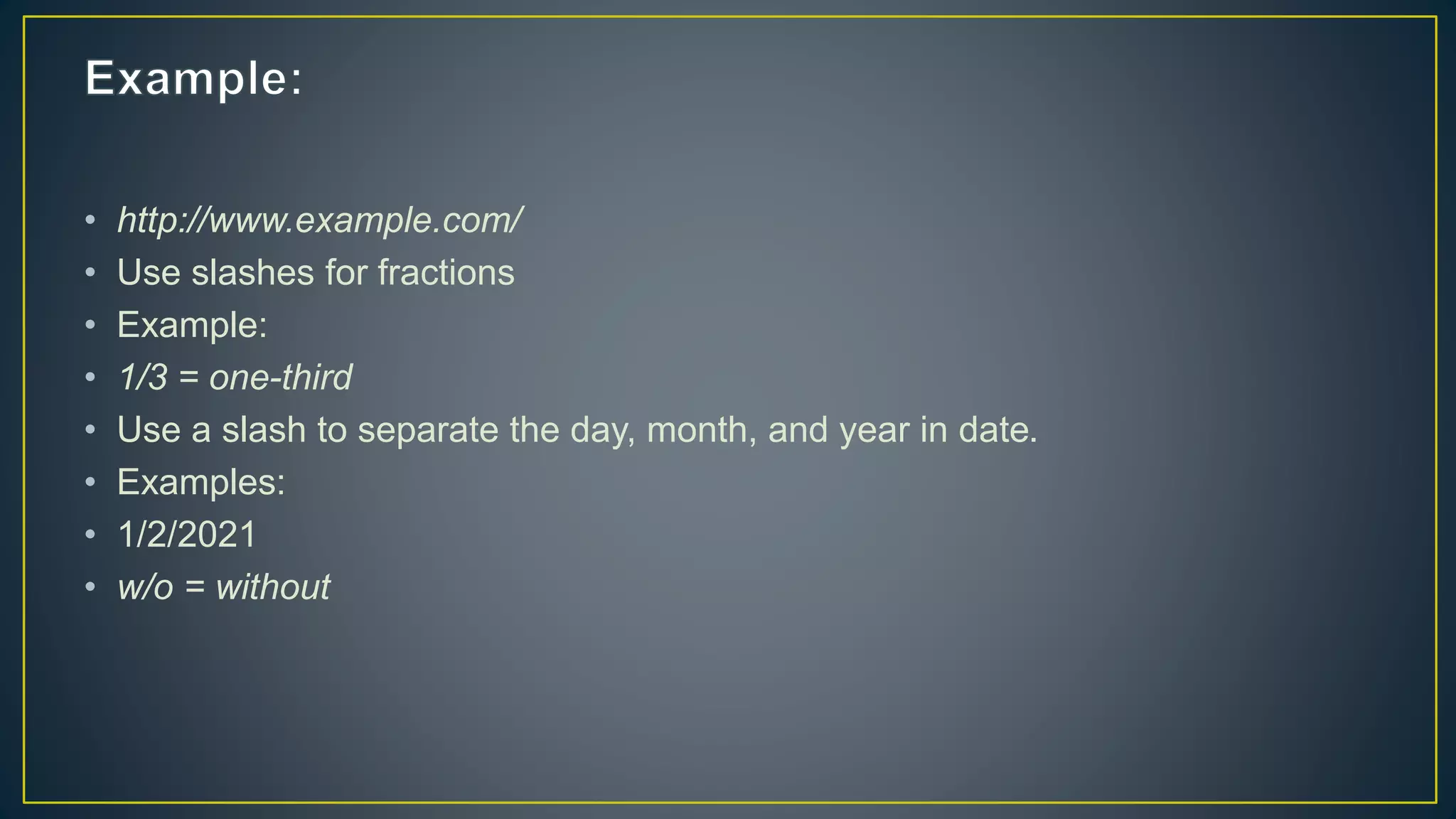
• http://www.example.com/
• Use slashes for fractions
• Example:
• 1/3 = one-third
• Use a slash to separate the day, month, and year in date.
• Examples:
• 1/2/2021
• w/o = without
• Example:
• 80 miles/hour = 80 miles per hour
• Use a slash to separate lines of poetry or rhymes in regular text.
• Example:
• Twinkle, twinkle, little star, / How I wonder what you are. / Up above the world
so high, / Like a diamond in the sky.
• Use a slash to show alternatives in a sentence.
• Example:
• Please press your browser’s Refresh/Reload button.
• 1. Use a capital letter for the personal pronoun 'I':
• What can I say?
• 2. Use a capital letter to begin a sentence or to begin speech:
• The man arrived. He sat down.
• Suddenly Mary asked, "Do you love me?"
• 3. Use capital letters for many abbreviations and acronyms:
• PST(Pakistan Standard Time)
• N.A.T.O. or NATO or Nato (North Atlantic Treaty Organization)
• 4. Use a capital letter for days of the week, months of the year, holidays:
• Monday, Tuesday
• January, February
• Christmas
• Quid -e- Azam Day
• 5. Use a capital letter for countries, languages & nationalities, religions (all proper
nouns):
• China, France
• Japanese, English
• Christianity, Buddhism, Islam
• 6. Use a capital letter for people's names and titles:
• Anthony, Ram, William Shakespeare
• Professor Jones, Dr. Smith
• King Henry VIII
• 7. Use a capital letter for trade-marks and names of companies and other
organizations:
• Pepsi Cola, Walkman
• Microsoft Corporation, Toyota
• the United Nations, the Red Cross
• 8. Use a capital letter for places and monuments:
• London, Paris, the Latin Quarter
• the Eiffel Tower, St Paul's Cathedral
• Buckingham Palace, the White House
• Oxford Street, Fifth Avenue
• Jupiter, Mars, Sirius
• Asia, the Middle East, the North Pole
• 9. Use a capital letter for names of vehicles like ships, trains and
spacecraft:
• the Titanic
• the Orient Express, the Flying Scotsman
• Challenger 2, the Enterprise
• 10. Use a capital letter for titles of books, poems, songs, plays, films etc:
• War And Peace
• Like a Virgin
• In The Line Of Fire
• 11. Use capital letters (sometimes!) for headings, titles of articles, books
etc, and newspaper headlines:
• HOW TO WIN AT POKER
• Chapter 2: CLINTON'S EARLY LIFE
• LIFE FOUND ON MARS!
• MAN BITES DOG
• Correct the paragraph by adding appropriate punctuation and capitalization.
• winston is one of the most laid-back people i know he is tall and slim with
black hair and he always wears a t-shirt and black jeans his jeans have holes
in them and his baseball boots are scruffy too he usually sits at the back of
the class and he often seems to be asleep however when the exam results
are given out he always gets an "A" i don't think hes as lazy as he appears to
be
• Winston is one of the most laid-back people I know. He is tall and slim with
black hair, and he always wears a t-shirt and black jeans. His jeans have
holes in them, and his baseball boots are scruffy, too. He usually sits at the
back of the class, and he often seems to be asleep. However, when the exam
results are given out he always gets an "A". I don't think he's as lazy as he
appears to be.

Punctuation Marks

  • 1.
  • 3.
    Punctuation is thesystem of signs or symbols given to a reader to show how a sentence is constructed and how it should be read. • Sentences are the building blocks used to construct written accounts. They are complete statements. • Punctuation shows how the sentence should be read and makes the meaning clear. • Every sentence should include at least a capital letter at the start, and a full stop, exclamation mark or question mark at the end. • This basic system indicates that the sentence is complete. • The English language has many punctuation marks, • Here are 14 common punctuation marks in English. • The Full Stop (.) • The Question Mark (?) • Quotation Marks/Speech Marks (“ ”) • The Apostrophe (‘)
  • 4.
    • The Comma(,) • The Hyphen (-) • The dash (en dash (–) em dash (—)) • The Exclamation Mark (!) • The Colon (:) • The Semicolon (;) • Parentheses () • Brackets [] • Ellipsis (…) • The Slash (/)
  • 5.
    • Full Stop(.) • A full stop, also known as a period (.) in American English, is one of the most commonly used punctuation marks in the English language. • Analysis of texts indicate that approximately half of all punctuation marks used are full stops. • The punctuation rules: • Mostly used at the end of a declarative sentence, or a statement that is considered to be complete. • This punctuation mark is also used following an abbreviation Ex. Dr., Mr. . • A full stop can also be shown at the end of a group of words that don’t form a typical sentence. • The full stop examples: • Leave me alone. • I will go to Lahore, tomorrow.
  • 6.
    • We usea question mark (?) after an interrogative sentence in English. • Examples: • What is your name? • Where are you from? • Quotation Marks/Speech Marks (“ ”) • We use quotation marks (“ ”) for direct quotations in English. • Examples: • She asked me, ‘’ what are you doing” ?
  • 7.
    • An apostrophe(‘) is used to show that certain letters have been omitted from a word. • The punctuation symbol can also be used to show the possessive form of a noun, in addition to indicating the plural form of lowercase letters. • The punctuation rules: • Use an apostrophe in contractions • He is = He’s • I am = I’m • Do not = Don’t • They have = They’ve • It is = It’s • I would = I’d • Let us = Let’s
  • 8.
    • The apostropheexamples: • He joined Players’ club in 2016. • Hina’s hair was curly. • We have put together an anthology of children’s poetry.
  • 9.
    • A comma(,) is used to show the difference between two separate ideas or elements within a sentence. Commas have other uses as well, as they can be used to separate numbers, and write dates. • The comma rules and examples: • Add a comma when two separate sentences are combined • Example: • We purchased some cheese, and we purchased some fruit. • Use commas between words in a series. Notice that a comma does not follow the last word in the series
  • 10.
    • Example: • Hewas tall, dark, and handsome. • Use a comma to separate an introductory element from the rest of the sentence • Example: • As the day came to an end, the fire fighters put out the last spark. • Use the comma to set off the words “yes” and “no”. • Example: • No, thank you. • Use a comma to set off a tag question from the rest of the sentence. • Example: • She is your sister, isn’t she?
  • 11.
    • Use acomma to indicate direct address. • Example: • Is that you, Mary? • Add a comma when a participle phrase clause is used. • Example: • Walking slowly, I could see the beautiful flowers. • Use a comma to separate parts of the date. • Example: • Tuesday, May 2, 2016, was when I graduated.
  • 12.
    • A hyphen(–) is a punctuation mark with three main uses. • Many people confuse this punctuation mark with the dash, but the two are quite different. • The hyphen can be used in compound words, to link words to prefixes, and also as a way to show word breaks. • The hyphen punctuation rules and examples: • Use a hyphen to join two or more words together into a compound term. • Do not separate the words with spaces. • Examples: • My eight-year-old boy loves reading. • I work part-time. • Self-expression
  • 13.
    • The dashis used to separate words into statements. • There are two kinds of dashes, the en dash (–), and the em dash (—). • The en dash shows range or connections. On the other hand, the em dash is used in places where a comma could also be used. • The dash can also be used to mark off words or statements that are not important to the meaning of the statement. • The dash can also be used in places where a comma would be typically used.
  • 14.
    • Slightly widerthan a hyphen, the en dash is a symbol (–), that is used in writing or printing to indicate a range or connections. • This could be in numbers, such as page • numbers (55–102) or time (1:00–2:30), or months, such as July–October. • 1880 –1945 • Princeton–New York trains • Em dash (—) • Twice as long as the en dash, the em dash (—). can be used in place of a comma, parenthesis, or colon to enhance readability or emphasize the conclusion of a sentence. • Example: • She gave him her answer—No! • We couldn’t believe what our parents had left us in their will—one million dollars!
  • 15.
    • An exclamationmark is used to show emphasis. • It can be used in the middle of a sentence or at the end of a sentence. • When used at the end of a sentence, it also takes on the role of a full stop or a period. • We often use an exclamation mark (!) to show strong emotion or give a command. • Examples: • Stop! • Yeah! • Sit down! • What a lovely view you have here! • Used for interjection words: • Alas!, Hurrah!
  • 16.
    • A colon(:) is a fairly common punctuation mark with a varied number of uses. • It can be used to introduce a quotation, an example, a series, or even an explanation. • Secondly, it can be used to separate two independent clauses. • Finally, a colon can be used to show emphasis. • Examples: • You have two choices: finish the work today or lose the contract. • That’s because we have one goal: for you to consider your website a success. • The diet includes four main types of food: cereals, leafy vegetables, fruits, and fish.
  • 17.
    • A semicolon(;) is used to separate two independent clauses while still demonstrating that a close relationship exists between them. • The semicolon does a better job of showing the connection between two statements than a full stop would. • Examples: • My daughter is a teacher; my son is a doctor. • There are eight members in the team: two from China, Japan; three from France, Spain; two from Brazil; and one from India. • My sister always slept with the light on; she was afraid of the dark.
  • 18.
    • Parenthesis, (() ) are quotation marks that show additional thoughts about a statement. • In many scenarios, they can be replaced by commas without any changes to the meaning of the sentence. • We also often use parentheses to set off less important details. • Example: • The two brothers (Ali and Sleem) were learning how to play guitar. • Katrina (a hurricane) had a devastating effect on thousands of people.
  • 19.
    • We typicallyuse square brackets when we want to modify another person's words. • Here, we want to make it clear that the modification has been made by us, not by the original writer. For example: • to add clarification: • The witness said: "He [the policeman] hit me." • to add information: • The two teams in the finals of the first FIFA Football World Cup were both from South America [Uruguay and Argentina]. • to add missing words: • It is [a] good question.
  • 20.
    • An ellipsisis usually represented by three dots (…), although it can also be represented by three asterisks (***). • This punctuation symbol is used to show that there has been an omission of some letters or words. • In many cases, ellipses are used to cut statement short to avoid unnecessary or irrelevant words that have no impact on the meaning of the statement being made. • We often use ellipsis to show that parts of sentences are left out. • Examples: • To be continued… • You’ll never believe what I saw…
  • 21.
    • A slash,which is also known as a forward slash, a virgule, or even an oblique dash, has a number of uses. • The slash can be used to separate lines in a song or poem when they are written in a continuous line. • The slash (/) is also used in place of the word or the slash can also be used to show two contradictory notions. • The slash punctuation rules and examples: • Use slashes to separate parts of internet (web) addresses and file names for some computer programs.
  • 22.
    • http://www.example.com/ • Useslashes for fractions • Example: • 1/3 = one-third • Use a slash to separate the day, month, and year in date. • Examples: • 1/2/2021 • w/o = without
  • 23.
    • Example: • 80miles/hour = 80 miles per hour • Use a slash to separate lines of poetry or rhymes in regular text. • Example: • Twinkle, twinkle, little star, / How I wonder what you are. / Up above the world so high, / Like a diamond in the sky. • Use a slash to show alternatives in a sentence. • Example: • Please press your browser’s Refresh/Reload button.
  • 24.
    • 1. Usea capital letter for the personal pronoun 'I': • What can I say? • 2. Use a capital letter to begin a sentence or to begin speech: • The man arrived. He sat down. • Suddenly Mary asked, "Do you love me?" • 3. Use capital letters for many abbreviations and acronyms: • PST(Pakistan Standard Time) • N.A.T.O. or NATO or Nato (North Atlantic Treaty Organization) • 4. Use a capital letter for days of the week, months of the year, holidays: • Monday, Tuesday • January, February • Christmas • Quid -e- Azam Day
  • 25.
    • 5. Usea capital letter for countries, languages & nationalities, religions (all proper nouns): • China, France • Japanese, English • Christianity, Buddhism, Islam • 6. Use a capital letter for people's names and titles: • Anthony, Ram, William Shakespeare • Professor Jones, Dr. Smith • King Henry VIII • 7. Use a capital letter for trade-marks and names of companies and other organizations: • Pepsi Cola, Walkman • Microsoft Corporation, Toyota • the United Nations, the Red Cross
  • 26.
    • 8. Usea capital letter for places and monuments: • London, Paris, the Latin Quarter • the Eiffel Tower, St Paul's Cathedral • Buckingham Palace, the White House • Oxford Street, Fifth Avenue • Jupiter, Mars, Sirius • Asia, the Middle East, the North Pole • 9. Use a capital letter for names of vehicles like ships, trains and spacecraft: • the Titanic • the Orient Express, the Flying Scotsman • Challenger 2, the Enterprise
  • 27.
    • 10. Usea capital letter for titles of books, poems, songs, plays, films etc: • War And Peace • Like a Virgin • In The Line Of Fire • 11. Use capital letters (sometimes!) for headings, titles of articles, books etc, and newspaper headlines: • HOW TO WIN AT POKER • Chapter 2: CLINTON'S EARLY LIFE • LIFE FOUND ON MARS! • MAN BITES DOG
  • 28.
    • Correct theparagraph by adding appropriate punctuation and capitalization. • winston is one of the most laid-back people i know he is tall and slim with black hair and he always wears a t-shirt and black jeans his jeans have holes in them and his baseball boots are scruffy too he usually sits at the back of the class and he often seems to be asleep however when the exam results are given out he always gets an "A" i don't think hes as lazy as he appears to be
  • 29.
    • Winston isone of the most laid-back people I know. He is tall and slim with black hair, and he always wears a t-shirt and black jeans. His jeans have holes in them, and his baseball boots are scruffy, too. He usually sits at the back of the class, and he often seems to be asleep. However, when the exam results are given out he always gets an "A". I don't think he's as lazy as he appears to be.