PUNCTUATION
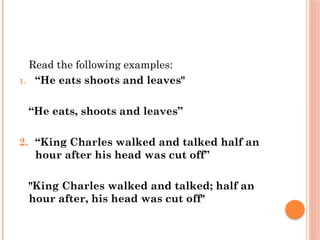
Read the following examples:
1. “He eats shoots and leaves"
“He eats, shoots and leaves”
2. “King Charles walked and talked half an
hour after his head was cut off”
"King Charles walked and talked; half an
hour after, his head was cut off"
WHY PUNCTUATION MARKS?
 Writers use punctuation marks to help the
reader better understand what is written.
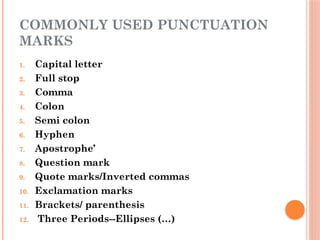
COMMONLY USED PUNCTUATION
MARKS
1. Capital letter
2. Full stop
3. Comma
4. Colon
5. Semi colon
6. Hyphen
7. Apostrophe’
8. Question mark
9. Quote marks/Inverted commas
10. Exclamation marks
11. Brackets/ parenthesis
12. Three Periods--Ellipses (…)
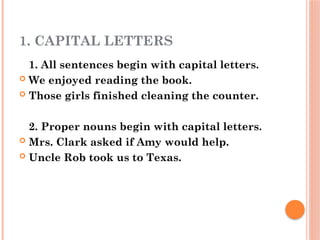
1. CAPITAL LETTERS
1. All sentences begin with capital letters.
 We enjoyed reading the book.
 Those girls finished cleaning the counter.
2. Proper nouns begin with capital letters.
 Mrs. Clark asked if Amy would help.
 Uncle Rob took us to Texas.
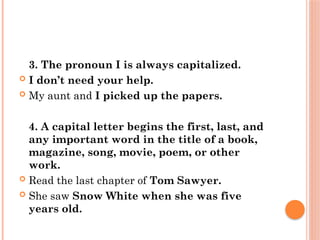
3. The pronoun I is always capitalized.
 I don’t need your help.
 My aunt and I picked up the papers.
4. A capital letter begins the first, last, and
any important word in the title of a book,
magazine, song, movie, poem, or other
work.
 Read the last chapter of Tom Sawyer.
 She saw Snow White when she was five
years old.
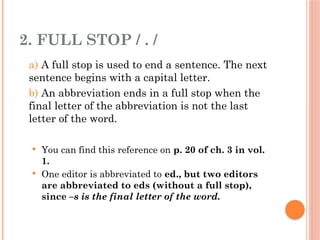
2. FULL STOP / . /
a) A full stop is used to end a sentence. The next
sentence begins with a capital letter.
b) An abbreviation ends in a full stop when the
final letter of the abbreviation is not the last
letter of the word.
 You can find this reference on p. 20 of ch. 3 in vol.
1.
 One editor is abbreviated to ed., but two editors
are abbreviated to eds (without a full stop),
since –s is the final letter of the word.
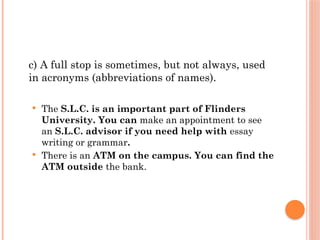
c) A full stop is sometimes, but not always, used
in acronyms (abbreviations of names).
 The S.L.C. is an important part of Flinders
University. You can make an appointment to see
an S.L.C. advisor if you need help with essay
writing or grammar.
 There is an ATM on the campus. You can find the
ATM outside the bank.
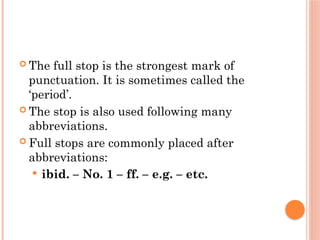
 The full stop is the strongest mark of
punctuation. It is sometimes called the
‘period’.
 The stop is also used following many
abbreviations.
 Full stops are commonly placed after
abbreviations:
 ibid. – No. 1 – ff. – e.g. – etc.
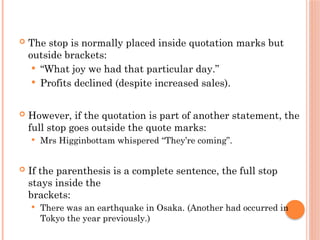
 The stop is normally placed inside quotation marks but
outside brackets:
 “What joy we had that particular day.”
 Profits declined (despite increased sales).
 However, if the quotation is part of another statement, the
full stop goes outside the quote marks:
 Mrs Higginbottam whispered “They’re coming”.
 If the parenthesis is a complete sentence, the full stop
stays inside the
brackets:
 There was an earthquake in Osaka. (Another had occurred in
Tokyo the year previously.)
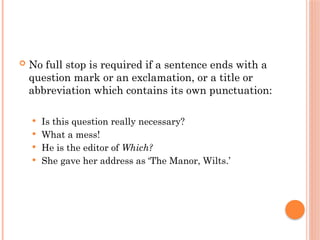
 No full stop is required if a sentence ends with a
question mark or an exclamation, or a title or
abbreviation which contains its own punctuation:
 Is this question really necessary?
 What a mess!
 He is the editor of Which?
 She gave her address as ‘The Manor, Wilts.’
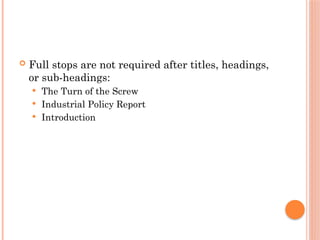
 Full stops are not required after titles, headings,
or sub-headings:
 The Turn of the Screw
 Industrial Policy Report
 Introduction
 In British English, the stop is not necessary
following common titles which are shortened
forms of a word (technically, ‘contractions’):
 Dr – [Doctor]
 Mr – [Mister]
 St – [Street]
 Mme – [Madame]
 Full stops are not necessary after the capital letters
used as abbreviations for titles of organisations and
countries:
 NATO – North Atlantic Treaty Organisation
BBC – British Broadcasting Corporation
UNO – United Nations Organisation
USA – United States of America
 They are not used where the initials of a standard
work of reference are used as an abbreviated title:
 OED – Oxford English Dictionary
DNB – Dictionary of National Biography
PMLA – Papers of the Modern Languages Association
3. COMMA / , /
Basically it separates parts of the sentence. It is
used:
 I ate pizza, a burger and ice cream.
a) to separate a non-defining relative clause (a
clause which adds extra information, introduced
by a word such as that, which or who) from the
rest of the sentence.
 It is years since I read Anna Karenina,
which is my favourite novel. Anna
Karenina, which is my favourite novel,
was written by Tolstoy.
b) when a subordinate clause comes before
the principal clause.
 If you do not understand, please tell me.
c) A comma separates an interruption from the
rest of the sentence.
 Mr Gorbachev, the President, said that he approved
of the policy.
 Mr. Walker, our teacher, was happy.
d) to separate items in lists.
 I shall need a book, some paper, a pencil and a
ruler
e) to separate a number of connectives from the
rest of the sentence: too, however, nevertheless,
though, of course, then, etc.
 You can, however, do it if you wish.
 Nevertheless, these results must be interpreted
within their context.
 This is, of course, the best action to take.
f) before a coordinating conjunction (and, but,
or, nor, for, so, yet) linking two main clauses,
when this clarifies the meaning.
 The first vendor was selling ice cream with
chocolate chips, and worms were available
from the second vendor.
g) between coordinate adjectives not joined by
and.
 Informative, imaginative, appealing
writing can sell your ideas.
4. COLON / : /
A colon is not often used. The sentence before the colon should
be complete in itself, not a sentence fragment.
a) It indicates that what follows it is an explanation of what
precedes it.
 I have some news for you: John’s father has arrived.
b) It shows the reader that a list or explanation follows.
 Please send him the following items: a passport, a visa application
and the correct fee.
 I will need the following items: scissors, paper, glue, and
paint.
 You have two choices: finish the work today or lose the
contract.
c) A colon is used to separate hours and minutes.
 The time is 2:15.
5. SEMI-COLON / ; /
a). A semi-colon joins two independent sentences
that are not joined by a coordinating conjunction.
 The lecture was badly delivered; it went on far
too long.
 Black is a mixture of all colors; white is the
complete opposite.
 I don't often go swimming; I prefer to play
tennis.
It is possible to avoid using the semi-colon here,
by replacing it with a word such as and or
because, or by creating two separate sentences.
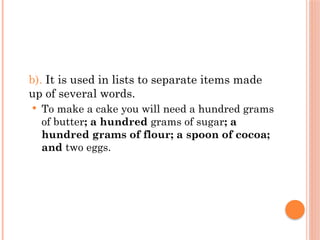
b). It is used in lists to separate items made
up of several words.
 To make a cake you will need a hundred grams
of butter; a hundred grams of sugar; a
hundred grams of flour; a spoon of cocoa;
and two eggs.
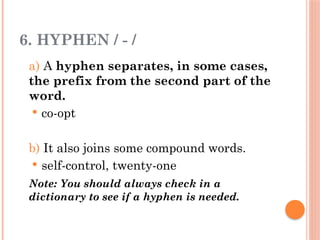
6. HYPHEN / - /
a) A hyphen separates, in some cases,
the prefix from the second part of the
word.
 co-opt
b) It also joins some compound words.
 self-control, twenty-one
Note: You should always check in a
dictionary to see if a hyphen is needed.
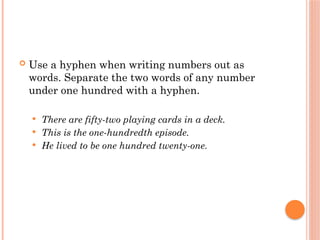
 Use a hyphen when writing numbers out as
words. Separate the two words of any number
under one hundred with a hyphen.
 There are fifty-two playing cards in a deck.
 This is the one-hundredth episode.
 He lived to be one hundred twenty-one.
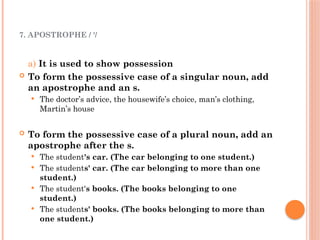
7. APOSTROPHE / '/
a) It is used to show possession
 To form the possessive case of a singular noun, add
an apostrophe and an s.
 The doctor’s advice, the housewife’s choice, man’s clothing,
Martin’s house
 To form the possessive case of a plural noun, add an
apostrophe after the s.
 The student's car. (The car belonging to one student.)
 The students' car. (The car belonging to more than one
student.)
 The student's books. (The books belonging to one
student.)
 The students' books. (The books belonging to more than
one student.)
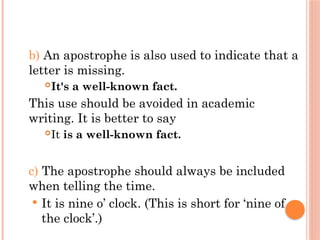
b) An apostrophe is also used to indicate that a
letter is missing.
It's a well-known fact.
This use should be avoided in academic
writing. It is better to say
It is a well-known fact.
c) The apostrophe should always be included
when telling the time.
 It is nine o’ clock. (This is short for ‘nine of
the clock’.)
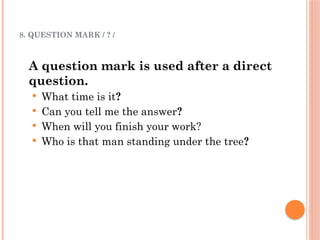
8. QUESTION MARK / ? /
A question mark is used after a direct
question.
 What time is it?
 Can you tell me the answer?
 When will you finish your work?
 Who is that man standing under the tree?
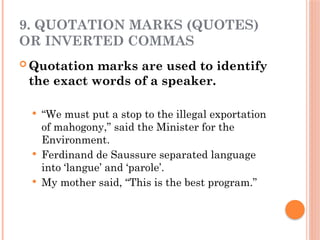
9. QUOTATION MARKS (QUOTES)
OR INVERTED COMMAS
 Quotation marks are used to identify
the exact words of a speaker.
 “We must put a stop to the illegal exportation
of mahogony,” said the Minister for the
Environment.
 Ferdinand de Saussure separated language
into ‘langue’ and ‘parole’.
 My mother said, “This is the best program.”
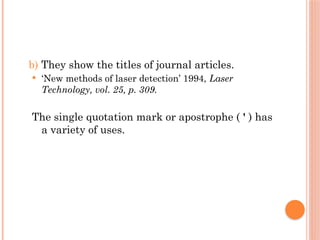
b) They show the titles of journal articles.
 ‘New methods of laser detection’ 1994, Laser
Technology, vol. 25, p. 309.
The single quotation mark or apostrophe ( ' ) has
a variety of uses.
10. EXCLAMATION MARK / ! /
The exclamation mark is not often used in
academic writing. It is usually appropriate
after real exclamations or short
commands.
 Oh dear!
 Get out!
 A statement expression strong feeling or
excitement ends with an exclamation mark.
 What a beautiful day it is!
 "Help!" he cried. "I'm drowning!"
11. BRACKETS(PARENTHESES)
/ ( ) /
a) Brackets are used to clarify, or to avoid
confusion. In your academic writing such
confusion should not arise, and so this use
of brackets will not be necessary.
 He (Mr Brown) told him (Mr Jones) that he
(Mr Green) had been accepted for the job.
b) They provide additional, non-essential
information in a sentence.
 French, Italian and Spanish (but not Portuguese)
may be studied at this university.
c) They enclose author-date references in the
text.
 A number of experiments (Smith1987; Tan 1990;
Wong 1991) indicate that this is correct.
d) They enclose the number for an equation, and
bracket parts of an equation together.
 x = 2(a+b)
12. THREE PERIODS--ELLIPSES
(…)
 To indicate that a portion of quoted matter
is omitted or a part of the text has been
intentionally been left out.
 “To receive, obey, and pass on…”
 0, 2, 4, ... , 100
KNOW HOW TO USE THE SLASH ( / )
 Use the slash to separate and and or, when
appropriate. The phrase and/or suggests that a
series of options are not mutually exclusive.
 To register, you will need your driver's license and/or
your birth certificate.
 The slash is used when quoting lyrics and poetry
to denote a line break. Be sure to add spaces
between your slashes here.
 Row, row, row your boat / Gently down the stream. /
Merrily, merrily, merrily, merrily, / Life is but a
dream.

6 Punctuation comprehensive explanation.pptx

  • 1.
  • 2.
    Read the followingexamples: 1. “He eats shoots and leaves" “He eats, shoots and leaves” 2. “King Charles walked and talked half an hour after his head was cut off” "King Charles walked and talked; half an hour after, his head was cut off"
  • 3.
    WHY PUNCTUATION MARKS? Writers use punctuation marks to help the reader better understand what is written.
  • 4.
    COMMONLY USED PUNCTUATION MARKS 1.Capital letter 2. Full stop 3. Comma 4. Colon 5. Semi colon 6. Hyphen 7. Apostrophe’ 8. Question mark 9. Quote marks/Inverted commas 10. Exclamation marks 11. Brackets/ parenthesis 12. Three Periods--Ellipses (…)
  • 5.
    1. CAPITAL LETTERS 1.All sentences begin with capital letters.  We enjoyed reading the book.  Those girls finished cleaning the counter. 2. Proper nouns begin with capital letters.  Mrs. Clark asked if Amy would help.  Uncle Rob took us to Texas.
  • 6.
    3. The pronounI is always capitalized.  I don’t need your help.  My aunt and I picked up the papers. 4. A capital letter begins the first, last, and any important word in the title of a book, magazine, song, movie, poem, or other work.  Read the last chapter of Tom Sawyer.  She saw Snow White when she was five years old.
  • 7.
    2. FULL STOP/ . / a) A full stop is used to end a sentence. The next sentence begins with a capital letter. b) An abbreviation ends in a full stop when the final letter of the abbreviation is not the last letter of the word.  You can find this reference on p. 20 of ch. 3 in vol. 1.  One editor is abbreviated to ed., but two editors are abbreviated to eds (without a full stop), since –s is the final letter of the word.
  • 8.
    c) A fullstop is sometimes, but not always, used in acronyms (abbreviations of names).  The S.L.C. is an important part of Flinders University. You can make an appointment to see an S.L.C. advisor if you need help with essay writing or grammar.  There is an ATM on the campus. You can find the ATM outside the bank.
  • 9.
     The fullstop is the strongest mark of punctuation. It is sometimes called the ‘period’.  The stop is also used following many abbreviations.  Full stops are commonly placed after abbreviations:  ibid. – No. 1 – ff. – e.g. – etc.
  • 10.
     The stopis normally placed inside quotation marks but outside brackets:  “What joy we had that particular day.”  Profits declined (despite increased sales).  However, if the quotation is part of another statement, the full stop goes outside the quote marks:  Mrs Higginbottam whispered “They’re coming”.  If the parenthesis is a complete sentence, the full stop stays inside the brackets:  There was an earthquake in Osaka. (Another had occurred in Tokyo the year previously.)
  • 11.
     No fullstop is required if a sentence ends with a question mark or an exclamation, or a title or abbreviation which contains its own punctuation:  Is this question really necessary?  What a mess!  He is the editor of Which?  She gave her address as ‘The Manor, Wilts.’
  • 12.
     Full stopsare not required after titles, headings, or sub-headings:  The Turn of the Screw  Industrial Policy Report  Introduction
  • 13.
     In BritishEnglish, the stop is not necessary following common titles which are shortened forms of a word (technically, ‘contractions’):  Dr – [Doctor]  Mr – [Mister]  St – [Street]  Mme – [Madame]
  • 14.
     Full stopsare not necessary after the capital letters used as abbreviations for titles of organisations and countries:  NATO – North Atlantic Treaty Organisation BBC – British Broadcasting Corporation UNO – United Nations Organisation USA – United States of America  They are not used where the initials of a standard work of reference are used as an abbreviated title:  OED – Oxford English Dictionary DNB – Dictionary of National Biography PMLA – Papers of the Modern Languages Association
  • 15.
    3. COMMA /, / Basically it separates parts of the sentence. It is used:  I ate pizza, a burger and ice cream. a) to separate a non-defining relative clause (a clause which adds extra information, introduced by a word such as that, which or who) from the rest of the sentence.
  • 16.
     It isyears since I read Anna Karenina, which is my favourite novel. Anna Karenina, which is my favourite novel, was written by Tolstoy. b) when a subordinate clause comes before the principal clause.  If you do not understand, please tell me.
  • 17.
    c) A commaseparates an interruption from the rest of the sentence.  Mr Gorbachev, the President, said that he approved of the policy.  Mr. Walker, our teacher, was happy. d) to separate items in lists.  I shall need a book, some paper, a pencil and a ruler
  • 18.
    e) to separatea number of connectives from the rest of the sentence: too, however, nevertheless, though, of course, then, etc.  You can, however, do it if you wish.  Nevertheless, these results must be interpreted within their context.  This is, of course, the best action to take.
  • 19.
    f) before acoordinating conjunction (and, but, or, nor, for, so, yet) linking two main clauses, when this clarifies the meaning.  The first vendor was selling ice cream with chocolate chips, and worms were available from the second vendor. g) between coordinate adjectives not joined by and.  Informative, imaginative, appealing writing can sell your ideas.
  • 20.
    4. COLON /: / A colon is not often used. The sentence before the colon should be complete in itself, not a sentence fragment. a) It indicates that what follows it is an explanation of what precedes it.  I have some news for you: John’s father has arrived. b) It shows the reader that a list or explanation follows.  Please send him the following items: a passport, a visa application and the correct fee.  I will need the following items: scissors, paper, glue, and paint.  You have two choices: finish the work today or lose the contract. c) A colon is used to separate hours and minutes.  The time is 2:15.
  • 21.
    5. SEMI-COLON /; / a). A semi-colon joins two independent sentences that are not joined by a coordinating conjunction.  The lecture was badly delivered; it went on far too long.  Black is a mixture of all colors; white is the complete opposite.  I don't often go swimming; I prefer to play tennis. It is possible to avoid using the semi-colon here, by replacing it with a word such as and or because, or by creating two separate sentences.
  • 22.
    b). It isused in lists to separate items made up of several words.  To make a cake you will need a hundred grams of butter; a hundred grams of sugar; a hundred grams of flour; a spoon of cocoa; and two eggs.
  • 23.
    6. HYPHEN /- / a) A hyphen separates, in some cases, the prefix from the second part of the word.  co-opt b) It also joins some compound words.  self-control, twenty-one Note: You should always check in a dictionary to see if a hyphen is needed.
  • 24.
     Use ahyphen when writing numbers out as words. Separate the two words of any number under one hundred with a hyphen.  There are fifty-two playing cards in a deck.  This is the one-hundredth episode.  He lived to be one hundred twenty-one.
  • 25.
    7. APOSTROPHE /'/ a) It is used to show possession  To form the possessive case of a singular noun, add an apostrophe and an s.  The doctor’s advice, the housewife’s choice, man’s clothing, Martin’s house  To form the possessive case of a plural noun, add an apostrophe after the s.  The student's car. (The car belonging to one student.)  The students' car. (The car belonging to more than one student.)  The student's books. (The books belonging to one student.)  The students' books. (The books belonging to more than one student.)
  • 26.
    b) An apostropheis also used to indicate that a letter is missing. It's a well-known fact. This use should be avoided in academic writing. It is better to say It is a well-known fact. c) The apostrophe should always be included when telling the time.  It is nine o’ clock. (This is short for ‘nine of the clock’.)
  • 27.
    8. QUESTION MARK/ ? / A question mark is used after a direct question.  What time is it?  Can you tell me the answer?  When will you finish your work?  Who is that man standing under the tree?
  • 28.
    9. QUOTATION MARKS(QUOTES) OR INVERTED COMMAS  Quotation marks are used to identify the exact words of a speaker.  “We must put a stop to the illegal exportation of mahogony,” said the Minister for the Environment.  Ferdinand de Saussure separated language into ‘langue’ and ‘parole’.  My mother said, “This is the best program.”
  • 29.
    b) They showthe titles of journal articles.  ‘New methods of laser detection’ 1994, Laser Technology, vol. 25, p. 309. The single quotation mark or apostrophe ( ' ) has a variety of uses.
  • 30.
    10. EXCLAMATION MARK/ ! / The exclamation mark is not often used in academic writing. It is usually appropriate after real exclamations or short commands.  Oh dear!  Get out!  A statement expression strong feeling or excitement ends with an exclamation mark.  What a beautiful day it is!  "Help!" he cried. "I'm drowning!"
  • 31.
    11. BRACKETS(PARENTHESES) / () / a) Brackets are used to clarify, or to avoid confusion. In your academic writing such confusion should not arise, and so this use of brackets will not be necessary.  He (Mr Brown) told him (Mr Jones) that he (Mr Green) had been accepted for the job.
  • 32.
    b) They provideadditional, non-essential information in a sentence.  French, Italian and Spanish (but not Portuguese) may be studied at this university. c) They enclose author-date references in the text.  A number of experiments (Smith1987; Tan 1990; Wong 1991) indicate that this is correct. d) They enclose the number for an equation, and bracket parts of an equation together.  x = 2(a+b)
  • 33.
    12. THREE PERIODS--ELLIPSES (…) To indicate that a portion of quoted matter is omitted or a part of the text has been intentionally been left out.  “To receive, obey, and pass on…”  0, 2, 4, ... , 100
  • 34.
    KNOW HOW TOUSE THE SLASH ( / )  Use the slash to separate and and or, when appropriate. The phrase and/or suggests that a series of options are not mutually exclusive.  To register, you will need your driver's license and/or your birth certificate.  The slash is used when quoting lyrics and poetry to denote a line break. Be sure to add spaces between your slashes here.  Row, row, row your boat / Gently down the stream. / Merrily, merrily, merrily, merrily, / Life is but a dream.